





Introduction
With the exceptions of Simone Weil (Reference Weil and Miles1986) and Iris Murdoch (Reference Murdoch1970), Western philosophy has, until very recently, had comparatively little to say about the normative significance of attention. By contrast, Buddhist moral psychology has always centered this question. Buddhist accounts of attention are very much in line with Murdoch’s claim that “the word ‘attention’…express[es] the idea of a just and loving gaze directed upon an individual reality.” And, that cultivating one’s capacities for attention is, “…the characteristic and proper mark of the active moral agent” (1970: 33). The idea that one needs to infuse one’s attention with appropriate forms of affect (for Murdoch, love) is central to the Buddhist view I will reconstruct and argue for.
Buddhist norms of attention are significant because they advocate for what I call ‘transformative’ and ‘existential’ norms for shaping attention. That is, they do not simply add attention into the domain of things that can be normatively evaluated. Rather, they think of our capacity for attention as the core psychological means by which we can change ourselves. I will read Buddhist philosophers like Buddhaghosa as asking the following question: how should we use the contemplative cultivation of attention to transform the cognitive-emotional economy of the mind? Most of the excellent recent work that is starting to probe this domain of inquiry (Bommarito Reference Bommarito2018, Davis Reference Davis and Repetti2022, Gardiner Reference Gardiner, Alfano, Klein and de Ridder2022, Irving Reference Irving2019, Mole Reference Mole and Archer2022, Watzl Reference Watzl and Archer2022, Whiteley Reference Whiteley2023) has yet to articulate the centrality of this kind of attention norm (though, see Carpenter Reference Carpenter2018). Rather, contemporary discussions hold that our cognitive architecture is relatively fixed and then make prescriptive claims about how and to what attention should be applied.
This article goes further by highlighting a connection between affective bias and attention’s normative significance. That is, our attention is pervasively affectively biased because, I claim, affective states are a core psychological mechanism for furnishing attention with salience (de Sousa Reference De Sousa1987). We are normatively assessable in various ways because of this pervasiveness. Further, I explain how we should deal with our failures to live up to these norms from a Buddhist philosophical perspective; namely, we are exhorted to establish a rational-agential connection between the parts of our psychology over which we exert some degree of control already and those that might otherwise, without adequate intervention, remain outside of our control. By engaging in this form of attentional training, we aim to acquire capacities of self-regulation we would otherwise lack, ones that allow us to intervene in the micro-causal dynamics of our mental lives. Through a gradual process of self-influence, we are said to undergo a profound transformation in our cognitive-emotional constitution. This transformation, according to Buddhist orthodoxy, is liberatory; it puts one in a state that is beyond suffering (dukkha) by eradicating all reactive attitudes that cause it. Thus, for Buddhist philosophers, attentional normativity is not just about accuracy or reliability of representation of self and world. Rather, the normatively constrained training of attention is the engine of a transformational process which fundamentally reconfigures one’s constitution.
In §1, I explain my understanding of the nature of attention and give my account of the sorts of norms that I think can apply to it. I focus on what I call an ‘existential’ norm on attention that exhorts us to transform our cognitive-emotional constitution. §2 argues that we are pervasively affectively perturbed and that our attentional habits are shaped in profound ways for which we are normatively evaluable. In §3, I offer my reconstruction of Buddhaghosa’s moral psychology of attention focusing on the brahmavihārā, modes of empathetic attention that are constitutively affective. Finally, in §4, I look at how my view squares with another approach to this question before offering some brief conclusions.
1. The Nature of Attention and its Normative Significance
Attention is a personal level or subjective phenomenon (Mole Reference Mole2010, Watzl Reference Watzl2017) that involves the selection of some information for further processing at the expense of disattended information. When something is attentionally selected it gets prioritized as phenomenologically salient; attention creates a gestalt structure in consciousness. Selection here does not necessarily imply agency and control. Paradigm cases of attention involve these things, but we are also often attending to the world in a stimulus driven way in which our capacities for agency barely figure. My view of attention is true to James’s famous quip that we all know what attention is (James 1890/Reference James1950 Vol. I: 403).
1.1 Fixed vs. Transformational Attention Norms
Let’s begin with the paradigmatic cases in which attention does involve agency and control. It’s important to note that our ordinary evaluative attitudes track the philosophical claim that our attention is normatively evaluable; we are in the widespread habit of evaluating our attentional acts in a number of ways. Sebastian Watzl helpfully points out that, “As a matter of fact, the public seems to care a lot more about normative questions regarding attention than normative philosophy does…In our contemporary context - dominated as it is by mass information and social media - many in the public are faced with pressing challenges about how to organize information, how to individually distinguish what is relevant from what isn’t, and how to together agree on what is currently most deserving of collective attention” (2022: 93). This kind of normative injunction represents an approach that sees the attentional system as fixed and then, under the auspices of the ought implies can principle, asks how and to what one ought to pay attention. Some philosophers focus on the value of certain kinds of salience that attention delivers (Archer Reference Archer and Archer2022, Whiteley Reference Whiteley2023), others on how attention should modulate rational inquiry (Siegel Reference Siegel2017), or how attention is reflective of our moral lives (Murdoch Reference Murdoch1970, Bommarito Reference Bommarito2018, Gardiner Reference Gardiner, Alfano, Klein and de Ridder2022).
However, the Buddhist project as I understand it, goes considerably further. Specifically, Buddhist philosophers like Buddhaghosa claim that the cultivation of attention is a means by which the cognitive-emotional architecture of the sentient being is radically transfigured away from habitual forms of salience construction that lead to suffering (dukkha) and towards a more salutary and liberated constitution. Contemporary philosophers are concerned with how and to what we should attend, given the kind of creatures we are. Buddhaghosa is concerned with the kind of attentional creature we should be and claims that the plasticity of our cognitive-emotional constitution opens us up to a much more provocative and profound transformational project through the cultivation of attention.
1.2. Components of Attention and How They are Normatively Evaluable
There are at least three dimensions of an attentional act that are susceptible to normative evaluation. The first and most obvious component of an attentional act is its intentionality. When we attend, the act of attention is normally about something. Attention is selective in that when we attend to one thing we must dis-attend to other things. Context can demand of us that we ought to attend to one thing over another and we can fail to meet that demand; in so doing, we can be normatively evaluated because of what we are or are not attending to. For example, if Zac is really enjoying the weather, his attention might be on the natural beauty of the city instead of on the route he has previously selected as a lunch destination for himself and his colleagues. We might imagine Seamus, in a ruminative mood, focusing too intently on some vague area of space over their colleague’s shoulder instead of on their face and words over lunch. In both cases, Seamus and Zac have done something wrong in virtue of attending to the wrong thing.Footnote 1
Attention is also the kind of mental activity that can undergo adverbial modification. We can attend in an agitated or stable way, our attention can be preoccupied, obsessive, or ruminative; attention can be calm and detached. Certain situations might require us to attend with some adverbial profile or another. The possibility of failure and success along this axis of attention leaves us open to normative assessment. For example, Seamus might often be too focused on some task at hand and miss out on the enjoyable details of the side show; colloquially, Seamus is quite bad at stopping to smell the roses. By contrast, Zac might often be so engrossed in the profligate beauty of his surroundings that the object of his activity can get lost. Both scenarios are failures to attend in the right way. What makes Seamus and Zac normatively assessable is that their manner of attending was not properly suited to the demands of the situation; Seamus tends to be too ruminative and focused, Zac’s attention wanders too much and isn’t focused enough. These failures reflect the fact that, “Proper attunement is paying attention to the right things in the right way, at the right time; being sensitive to significant features and ignoring what should be ignored” (Gardiner Reference Gardiner, Alfano, Klein and de Ridder2022: 49). What makes a case of attention proper in any given moment will involve advertence to a highly complex web of contextual factors.
This scenario is closely related to a third component of attention that can come in for normative evaluation. In cognitive science, attention is often grouped into two kinds: spontaneous, exogenous, ‘bottom-up’ attention and directed, endogenous, or ‘top-down’ attention (Wu Reference Wu2014: 29-38). When is it appropriate to attend in one way as opposed to the other? Irving (Reference Irving2019) argues that there is a kind of exploratory attention that is important for good epistemic practice. There are times when letting our attention be guided by our open curiosity in a spontaneous way is important for intellectual growth. Being too focused and task oriented can miss the epistemic forest for the trees. This lack of balance makes one normatively evaluable because of the kind of attention they’re deploying.
1.3. Four Norms for Evaluating Attention
Here I enumerate four types of norms that human beings use to assess each other, and their attentional interaction with the world. The first relevant form of normativity is prudential: one can be more or less prudent depending on how and to what they attend. If one is not careful in paying attention to where one is walking or driving, they run the risk of getting lost or being harmed. As an observer, we might even grab their arm and shout to them: ‘Hey! Pay attention or you’re going to get killed!’ This kind of attention norm isn’t necessarily about the kind of inferences one is performing (which would make them rationally assessable), but about psychological facts of fatigue and distraction. Another closely related attention norm is rational: one can also be more or less rational depending on how and to what they attend. As Susanna Siegel points out: “Which evidence one ends up with is a function of what one pays attention to” (Siegel Reference Siegel2017: 159). It is irrational to only attend to pieces of evidence that support your beliefs but not to those that fail to support them. What makes us rational or irrational in these scenarios is what we’re attending to.
One can also be more or less moral depending on how and to what they attend. If someone attends to one part of your body rather than another in the context of a conversation, this can be morally wrong (looking at someone’s chest rather than their face when speaking, for example). I can also attend in an overt rather than covert way to a person and be morally accountable for that (like leering). The kind of moral agent we are is consistently reflected in, expressed and embodied by, our patterns of attention. The conduct one exhibits exercises a powerful influence over the kind of person one is. Thus, how one attends to the world shapes who we are as a person, holistically.
I thus submit that there is an existential norm on attention. By this I mean that one’s life, as a whole, can be said to go better or worse depending on how and to what one attends to and that the kind of person one ends up being, i.e. their constitution, is shaped by such attentional habits. The optimist (Zac) and the pessimist (Seamus) might live very different lives even though the contents of their experiences are very similar. What we think about the nature of life itself, its possibilities and inevitabilities, exercises a pervasive influence over how we attend. If Zac is excited about what the future holds, this will condition how their attention parses available information; if Seamus is downtrodden about the inevitability of death, how and to what they attend will also be affected. How, and to what, we attend shapes what shows up for us in experience and what we expect and don’t expect. Such conditioning-influences shape the course of our lives holistically in a way that expresses our character, and which is self-reinforcing. On character, Archer explains that “…the extent of your responsibility for what is or is not salient to you in a particular situation depends on the extent to which this is representative of your character. Your evaluative control that grounds this responsibility is exercised via your standing evaluations that partially constitute your character, not by mere one-off occurrent evaluations, that may be out of character for you" (Archer Reference Archer and Archer2022: 120). The evaluative control at work here is about our agency in ordering priorities as we see fit. This capacity for ordering is psychologically manifest in how your occurrent choices of what to attend to express wider habits of attention and how wider habits of attention constrain occurrent choices.
Our attentional habits shape the way we take up with local situations by providing a background of dispositions which motivate and constrain how we interpret the specifics of a given experience. Such attentional habits are self-reinforcing (Gardiner Reference Gardiner, Alfano, Klein and de Ridder2022: 53):
Attention is potent. Clothing choice does not merely seem more evidentially and socially important if people attend to it. Mere attention can render something important, which fuels further attention. Attentional feedback loops can be seen, for example, in attention to celebrities’ political opinions. Those opinions matter when, and because, people attend to them. This illustrates how attentional patterns shape what people should pay attention to. Attention snowballs.
Holistic and existential patterns of attention and their attendant norms exercise a pervasive influence over more local and punctate patterns of attention and their attendant (prudential, rational, and moral) norms. Consider again the attentional habits of Zac: we would not be remiss to consider him something of an optimist for he is often in the habit of remarking off-hand ‘Wow, isn’t life amazing?’. Seamus’s reply to these remarks is usually something to the effect of, “No Zac, your life is amazing. Life itself is a miasma of struggle and strain followed inevitably by the surcease of death. I’m glad you enjoy your experience so much, but the amount of suffering in this world cannot be squared with your appraisal.” Seamus’s and Zac’s existential outlooks – what I very loosely call their respective pessimism and optimism – exercises a conditioning-influence on how they take up with their world attentionally. We might rightly characterize each of their attitudes as extreme along some axes of evaluation. How they attend to their world can be normatively evaluated along the several metrics I outlined above, but especially in accordance with the existential attention norm.
2. The Pervasiveness of Affective Bias
The world that we attend to is populated by entities and persons that are affectively salient to us. This is the tendency of an object to stand out relative to its surroundings due to an association in the subject between the object’s significance and affective/emotional arousal (Todd et al. 2012: 365). Attention is affectively biased when preferential perception of a stimulus is instantiated based on the stimuli’s affective salience. I claim that all attention is affectively biased to some degree or another and this pervasive influence of the affects on our attention is the main reason that our attentional habits are apt for various forms of normative assessment. I use the term bias in a neutral sense to describe the ways in which affects of various sorts influence our attention. When biases lead to pernicious behaviors or beliefs, then they rightfully come to have a pejorative connotation. However, as I will note below, in certain Buddhist contexts, biases can be morally salutary by influencing our attention in a preferential way towards properties in the world, in particular traits of persons.
Pāli Buddhist philosophy is a well-spring of philosophical insight on the nature of embodiment and affective bias (Smith Reference Smith2019). Understanding these phenomena is very much at the heart of the Buddhist soteriological project and informs their approach to the normative assessment and cultivation of attention. The term ‘soteriology’ refers to any system of concepts and practices aimed at delivering the human being from the existential predicaments of suffering and death. Consider the following passages: “Yet it is just within this fathom-long body, with its recognition and intelligence, that I declare that there is the world, the origination of the world, the cessation of the world, and the path of practice leading to the cessation of the world" (AN II: 47).Footnote 2 Here we see a close connection between our capacity to understand the world (loke) and the cognitive-affective structures of human embodiment. This connection is amplified in an explicitly soteriological register in the following: “It is just within this fathom-long carcass, with its recognition and intelligence, that I make known the world, the cause of the world, the cessation of the world, and the path leading to the cessation of the world” (Reference BodhiSN I: 144).Footnote 3 What is known through the body in these passages is the soteriological norms of cultivation and emancipation associated with the four noble truths as applied to the world (loke). These initial forays into Pāli Buddhist thought illustrate a deep concern with the sentient being’s embodiment and how that embodiment gives the sentient being an epistemic perspective on its world and a soteriological lever through which to cultivate a path of practice that leads to a state of transcending the world’s misery (dukkha).
2.1. Affectively Biased Attention
According to Buddhist philosophers, the misery of human life (dukkha) is caused by craving or thirst (taṇhā), a pervasive pre-reflective attitude of appropriation. This attitude is caused by habitual reactions towards our feelings (vedanā). It is this constant bombardment of the embodied mind by sensory perturbation (phassa) – and feelings arising in dependence on that bombardment (phassa-paccaya vedanā) – that I seek to analyze by examining four paradigm scenarios of affective perturbation (De Sousa Reference De Sousa1987). These analyses show that our everyday pre-reflective conscious lives are permeated by embodied affects that condition our habits of attention in myriad ways (Smith Reference Smith2024).
Consider the first time you ever experienced severe pain due to heat exposure; perhaps you touched a stove or your finger was licked by a campfire. Your aversive reaction to that pain was probably quite fast and your memory of that event was – pardon the pun – burned quite deep. In that moment, and in all moments thereafter, you did not feel the need to be a good scientist about your experience. If it was your right hand that was exposed to the campfire, you did not feel the need to expose your left hand to replicate your experience and provide further evidence in favor of your conclusion that you should never do that again. So pronounced was the conditioning-influence of that experience that from that moment onwards your entire cognitive apparatus, including your pre-reflective perceptual attention to your environment, has at least tacitly, been on the lookout for stimuli that might hurt you in such a way. Here we have an example of a punctate moment of negative bodily affect conditioning the sum total of your subsequent experience. Thankfully, these sorts of extreme cases are quite rare. But it is their very sparseness that demonstrates the point here. Even though such affective experiences are only occasional, they exercise a pervasive conditioning-influence over our attention.
Another important example is more commonplace: the case of slight discomforts. We experience these en masse on a daily basis. Consider sitting in a classroom listening to a philosophy lecture. Perhaps your right leg is crossed over your left. After a while, the distribution of your body’s weight onto only one half of your posterior will probably cause you some slight discomfort by way of muscular tension in your glute muscles and legs. Neither of these sensations are painful, but they are slightly uncomfortable. What do we do in such a situation? We shift our position, of course! Human beings are notoriously bad at living with slight discomforts. Do you have a mild itch? Scratch it. Is the room a little bit too hot? Turn on the air conditioning. Are you feeling ever so slightly uncomfortable in your body in any way? Take any and all steps to remedy that discomfort immediately. Much of the micro-contours of our daily lives are structured by our near-constant reactions to perturbations within the body. Whenever the body calls, we give our attention to the place it calls from and we do what it tells us in an asymptotic search for comfort. Bodily affects exercise a pervasive and near constant influence over our attention, cognition, and behavior.
Let’s shift to the other side of the spectrum of valence and consider cases of pleasant bodily affects. I begin with cases of what I will call ordinary comforts. Examples of these kinds of affects are legion; consider cases of eating one’s fill, or getting ‘likes’ on Facebook, or taking a shower. None of these cases constitute mind-bending, life-altering pleasure (we’ll get to that in a moment). But these are pleasures that occupy us for a few moments and help us through our day. Eating a meal to the point of satiation or drinking a glass of water to the point of extinguishing one’s thirst are cases where there is a pleasant sensation in the body; the pleasure in these cases is normally minor, but they nevertheless condition our attention, focusing our awareness on what we’re doing and re-orienting us when we are done. The ever so slight kick of pleasure one receives when a social media post receives a threshold of ‘likes’ is another case where there is pleasure – in the social media case, perhaps a very addictive pleasure – that disappears not long after it arises, but nevertheless generates a reaction that conditions subsequent behavior, one that impacts your sense of priority and shapes what shows up for you in your attention as relevant. These ordinary comforts are pervasive, near-constant, and powerful in their conditioning-influence over our lives.
The final example is intense pleasure, a paradigm scenario of which is sex. For a good number of people, though certainly not for everyone, the intensity of sexual climax can be transformative, especially during the transition from pre-sexual life. Who could deny the pervasive influence that sex has on our behavior, the way we comport ourselves, our sense of value and meaning? It’s not a universal truth, of course, but it’s pretty close. My purpose here is not to make universal pronouncements about the nature and meaning of sexual pleasure. Rather, it is to point out that sexual pleasure is one sort of intense pleasure whose conditioning-influence over our habits of attention has the potential to be quite profound. Our sense of beauty and value in interpersonal relationships, even those that aren’t potentially romantic, is powerfully conditioned by our desire for sexual pleasure.
It should be noted here that subtler affects and the more intense ones bias attention in different ways. The subtler affects can motivate attention towards the stimulus source without becoming objects of attention themselves. It is precisely by being in the background of our experience that our attention is shaped tacitly by such affects. By contrast, more explicit affects solicit our attention and those very feelings become the object of our attention. So, in these latter cases, the biasing is much more explicit. But in both cases, attention is shaped by our capacity to feel in different ways. In conclusion, these four paradigm scenarios demonstrate that bodily affects exercise a pervasive influence over our attention. How we attend to the world is structured by deep habits of reaction and response to the affective imperatives that the body gives us. We are conditioned into myriad habits of attention through our habitual reactions to these affects, which in turn shape our behavior and cognition.
One objection that arises here is that there are some states with a neutral valence. If so, then the problem of affective bias is not as pervasive as I claim. It is true that Buddhist philosophers acknowledge a neutral valence that is neither pleasant nor painful (adukkham-asukhā). These philosophers also acknowledge states of contemplative cessation that are absent any categorizing or affect (nirodha samāpatti). However, even if there are cases where affects are neutral, such cases are few and far between. It remains true that our attentional architecture is still massively biased by pervasive affective perturbations and that this constitutes a problem for our attentional habits and reactive attitudes. In such cases, where the cultivation of attention is not undertaken, the biasing influence of affect on attention is a negative that needs to be addressed. But as I show below, the solution is not to eliminate biases but to develop counteracting biases whose conditioning influences on attention are salutary rather than problematic.
2.2. The Dependent Origination of the Affectively Biased Perspective
It is this pervasive conditioning-influence of affect on behavior and cognition that Buddhist philosophers want to problematize. In this sub-section I explain how Buddhist philosophers understood this problem. My approach to their diagnosis is to analyze three relevant pieces of the Buddhist metaphysics of dependent origination (paṭicca-samuppāda). These links show how Buddhist philosophers think about the role of affect as a factor of experience that both arises from antecedent conditions and which in turn gives rise to subsequent conditions. It is the patterns of reaction that arise in this conditioning process that lead Buddhist philosophers to become such robust normative theorists about attention.
We begin with the Buddhist contention that consciousness is at least partially constituted by the embodiment of the organism (Varela et al. Reference Varela, Thompson and Rosch2001). In the Mahānidāna Sutta (Reference BodhiDN II: 55), this point is expressed by two important claims: the first is that consciousness is the condition for psycho-physicality (viññāṇa-paccayā nāma-rūpaṃ); the second is that in turn, psycho-physicality is the condition for consciousness (nāma-rūpa-paccayā viññāṇaṃ) (Reference Nikāya and WalsheDN II: 63). Consciousness (viññāṇa) is that discernment through a perceptual or cognitive modality that enables a subject to come to know things about that which they are aware. By contrast, the definition of psycho-physicality (nāma-rūpa) is a bit more nuanced. The term ‘rūpa’ is the physical form and bodily sensitivity that makes our body not just a physical object but also a living sensitive being that is differentially in touch with its world. Buddhaghosa glosses this term in terms of the verb ruppana which means to be assaulted or resisted by things like adverse weather (Reference BuddhaghosaVis 443 XIV: 34). As such, we must understand the physicality of rūpa not as the raw matter of the body considered as a physical object but as the living embodiment that provides boundary conditions that are perturbed by an environment (Ganeri Reference Ganeri2017: 77). Thus, our very capacity for embodied perception is tied to a susceptibility to perturbation.
The Pāli word ‘nāma’ means ‘name’ which is analyzed in the sutta literature compositionally in terms of five psychological constituents: feeling (vedanā), recognition (saññā), intention (cetanā), contact (phassa), and attention or orientation (mansikara). In the context of its conjunction with rūpa, we should understand nāma as the intentional directedness which along with an organism’s embodiment (rūpa) puts consciousness (viññāṇa) into a relationship with an object that is causally stimulating the system. Thus, we can understand the claim that consciousness is the condition for psycho-physicality as saying that without consciousness as a principle of sentient awareness, there is no development of the psycho-physical organism into a living being with a poised intentional relationship with its world. By contrast, the inverse conditioning relationship claims that there is no awareness of the world without the embodied intentionality of an organism being poised and responsive to its environment.
The most important of nāma’s constituents for my present purposes are vedanā and phassa because they are the main relata in the second relevant link in the schema of dependent origination (paṭicca-samuppāda). According to this part of the schema, contact (phassa) is the condition (paccaya) for feelings (vedanā). Contact is the embodied mind’s (nāma-rūpa) sensitivity to environmental perturbations, which are bombarding the organism. The embodied mind is both sensitive and undergoing constant bombardment. Accompanying this bombardment are feelings of various sorts. We are constantly, if tacitly, experiencing many different feelings according to the kind of stimulus afforded us by contact with our environment.
The incessant arising of feeling exerts a profound conditioning-influence over our evaluative attitudes and pre-reflective orientation towards the world. This is expressed by the third relevant link in the dependent origination schema: feelings are the condition for the arising of craving or thirst (vedanā-paccayā taṇhā). Craving or thirst (taṇhā) is the cause of all suffering (dukkha) in Buddhist soteriology; it is the second of the four noble truths (ariya sacca). The arising of feelings in response to contact is the main condition that brings about the underlying cause of the Buddhist soteriological predicament. Feelings are constantly arising in dependence on our embodied sensitivity to our world and thereby thoroughly conditioning our attitudes. Buddhists schematize this conditioning influence in terms of a deeply entrenched habitual enjoyment of pleasant feelings, aversion to unpleasant feelings, and indifference to neutral feelings (Reference Nikāya and BodhiMN I: 299).
To take up with one’s world requires us to pay attention. Without attention, it would be impossible for us to be differentially engaged with some parts of our experience at the expense of others. Buddhist philosophers have shown that affects exercise a pervasive influence over our attention. Therefore, to actively engage the world is to be affectively stimulated by and thereby differentially responsive to the world (Ganeri Reference Ganeri2017: 53). What affects us conditions how we attend to the world. The world is constantly soliciting our attention through the way in which it perturbs us.
3. Buddhaghosa’s Normative Schemes of Attention and their Biases
I maintain that attention is evaluable along an existential norm because of the role it plays in constituting our perspective, our sense of value, and our overall outlook on life while we endure the pervasive affective perturbations analyzed in the last section. Consider the following passage from the Dhammapada (Reference NormanDhp II: 21) on heedfulness:
Heedfulness is the way of the deathless, heedlessness is the way of death.
The heedful do not die, the heedless are as though dead already.
For these philosophers, attending well is literally a matter of life and death. The notion of ‘heedfulness’ emphasizes the close relationship between what we care about and what we attend to. It also seeks to point out that the world places a mortal constraint on our attending. We are constantly being solicited by the world and our possibilities for response to these solicitations are finite. Thus, our attentional and behavioral responses to worldly solicitation come with a timeline that places a strong demand on us to exercise care in our commerce with the world.
I take the Buddhist point about existential attentional normativity to pertain to a cycle that exists between our overall outlook on the world and those individual experiences which we interpret through that outlook. This cycle is often referred to as saṃsāra and explained as a cosmological transmigration, a cyclical form of existence leading from birth to death to rebirth and so on. This narrative of cyclical existence can be understood at a psychological level; the course of a lifetime is shaped by heedless reactive attitudes of thirst or craving (taṇhā) for feelings (vedanā). Such attitudes, whether implicit or explicit, shape our cognitive-emotional economy by driving our attention towards saliences that reinforce those very reactive habits (saṇkhārā). Mental reactivity of these sorts is the karmically active part of the mind that drives the stream of consciousness in this life, and for most committed Buddhists, all subsequent lives. Agency (cetanā) is one such saṇkhārā, the one that expresses conscious volition. But for the most part, at the time a subject generates a volition to act in a certain way, they have already been massively conditioned – from below, as it were – by craving (taṇhā) for feelings (vedanā). However, since we do have some capacity to direct and control our attention, we are capable of exercising a gradual and increasing degree of self-influence to change the course of our lives.
Holistic patterns of attending and disattending fundamentally structure one’s salience map of the world and the attention sets used to navigate it. Attention is the psychological glue that makes our outlook coherent and gives us the dispositional poise we need to interpret our experiences according to that outlook. It is therefore no wonder that Buddhist philosophers like Buddhaghosa want us to reflect in more psychologically precise terms about how we might intervene on this self-reinforcing process of affectively biased attention and its construction of salience. It is to a careful unpacking of Buddhaghosa’s proposals along these lines that I now turn.
3.1. Buddhaghosa’s Fourfold Analysis of Psychological Kinds
In Ch. IX of his magum opus the Visuddhimagga, Buddhaghosa provides us with a nuanced model of existential attention norms. In this chapter he is examining the four brahmavihārā-s (literally translated as ‘divine abodes’); these are prosocial attitudes that are specified psychologically as empathetic modes of attention to others (Ganeri Reference Ganeri2017: Ch. 13). Interestingly, for Buddhaghosa, even when one is in the right kind of attentional mode, it is possible for such empathic modes of attention to go wrong in interesting ways. Buddhaghosa here explains how and why attention – even spontaneous bottom-up attention, which might otherwise escape ordinary forms of intervention – is trainable, and therefore evaluable, according to the kinds of norms I looked at earlier.
The four brahmavihārā-s are: loving kindness (mettā), a kind of universal friendly attitude towards others, compassion (karunā) which signifies a sensitivity to, and empathic consideration for, the suffering (dukkha) of others, sympathetic joy (muditā), the capacity to feel sincere joy at the successes of others, and equanimity (upekkhā), a non-reactive and impartial balance of mind (Heim Reference Heim and Ganeri2017: 175, Reference Heim2020: 27).Footnote 4 Buddhaghosa explains that each of these modes of attending is an antidote for problematic and morally compromised modes of relating to others (Reference Atthasālinī and PeFount 195, Ganeri Reference Ganeri2017: 269):
Indeed, amongst these [brahmavihārā-s] because mettā is for one of abundant malevolence, karuṇā is for one of abundant cruelty, muditā for one of abundant aversion, upekkhā is for one of abundant lust, this is the path to purification; and because benefit gathers, non-benefits are taken away, attainments are enjoyed, and [there is] an absence of disinclination, one’s fourfold attention (manasikāro) to others (sattesu) is on account [of these benefits].
The four brahmavihārā-s are here understood as particular and highly normatively constrained ways of relating to other sentient beings, they are varied forms of an empathic second-personal mode of attending.
Buddhaghosa’s analysis of these and other psychological concepts is compellingly sophisticated. Ganeri (Reference Ganeri2017: 50) summarizes nicely:
In addition to providing us with [1] a distinctive characteristic (lakkhaṇa), the analysis should tell us [2] the function (rasa) performed by the item, that is, its task (kicca) within the mind; the analysis should specify [3] the item’s typical proximate cause or ‘immediate occasion’ (padatṭḥāna); and finally, the analysis should describe [4] the item’s way of showing itself (paccupatṭḥāna).
In his analysis of the four brahmanvihārā-s, Buddhaghosa will also add success and failure conditions for the cultivation and application of these attentional attitudes to one’s life. What is important to keep in mind at this point is the way in which the various forms of analysis reinforce each other to embed the relevant attentional mode into the subject’s pre-reflective outlook. Bear in mind also the ways in which this training necessarily involves a partiality in the subject’s engagement with others; only certain features of the other agent are relevant, others are ignored (cf. Garfield Reference Garfield2022: 141). I have summarized his analysis in the table above (Vis 317 ff, IX: 93-96):
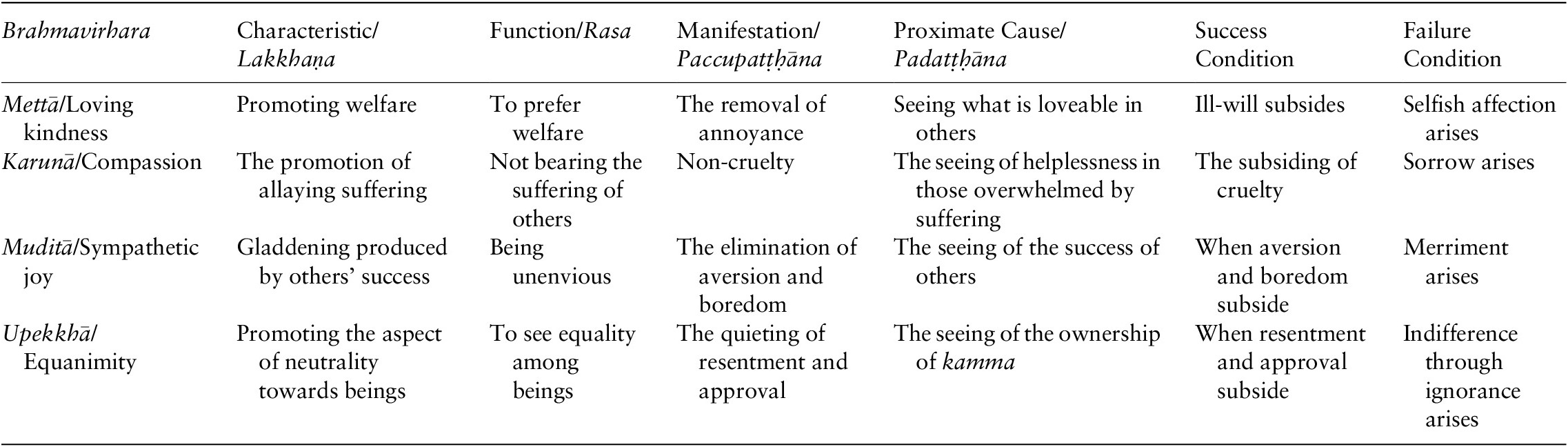
Consider metta: it has a characteristic (lakkhaṇa) of habituating one to promoting welfare. This characteristic is manifest in one’s life in virtue of its function (rasa), which is an attentional bias to prefer welfare. The cause of this preferential partiality is the ability to see what is lovable in others. By seeing what is loveable in others, one’s mettā is manifest in their life as a removal of annoyance, a lack of aversion towards others. This motivates us to promote the welfare of those around us.
There are three philosophically important points here. First, this system is self-reinforcing and biased. In this case, the biasing process has a salutary influence on the agent’s perspective. The more we remove our aversive attitudes, the more we come to see what is lovable in others, which in turn conditions our preferential attention. What shows up for us is a function of our biased attention, which in turn affects what we see. Second, we have agency over this process; we have some control over how we attend to others and therefore over how our attentional system discloses a normatively alive world of value and meaning (Ganeri Reference Ganeri2017: 76-81, Smith Reference Smith2020). This includes the gradual process of self-influence that re-shapes what shows up for us passively as salient. Finally, Buddhaghosa thinks we have an obligation to engage in this process (hence his inclusion of success and failure conditions). How we attend has an impact on what shows up for us in experience and therefore on how we comport ourselves in response to what the world affords us (Garfield Reference Garfield2022: 43). If we have control, even indirect control, over how the world is manifest to us in experience, then we are obligated to cultivate a mode of attentional engagement that, as far as is possible, improves our own lives and those of others. We accomplish this by setting up attentional habits in ourselves that selectively alight upon those properties we deem relevant and normatively significant.
3.2. The Near and Far Enemies of Empathic Attention
The success and failure conditions I highlighted above are schematized further into two ways in which the attention set can fail to live up to a norm it is designed to meet. Buddhaghosa distinguishes between remote and near enemies to our empathetic attention (Heim Reference Heim and Ganeri2017, Garfield Reference Garfield2022: Ch. 9). The remote enemy is a kind of psychological opposite. For example, the remote enemy of compassion is cruelty. By contrast, the near enemy is a bias on attention that corrupts from within. For example, the near enemy of compassion is a kind of aggrieved attachment. In the far enemy case, not only is the adverbial aspect of attention wrong because of its affective valence and lack of moral virtue, one is also getting the wrong property in view. In the case of the near enemy, the right property is in view, but the adverbial profile is off, but in a much subtler way than in the far enemy case.
Returning to the compassion case: that having a compassionate regard for others would function as a psychological antidote for cruelty is clear. But even in avoiding the moral and emotional pitfalls of cruelty, our compassion can still lead us astray. Compassion has the proximate cause (padatṭḥāna) of seeing the helplessness of those who are overwhelmed by suffering. It’s function (rasa) is to see their plight without bearing that suffering oneself. And yet, in becoming sensitive to the plight of others, we can become grief stricken and weighed down by how awful things can be, especially for those we care about. According to Buddhaghosa, this is a trap that will distort our attention to others by gripping the mind with attachment that will prevent us from executing the function (rasa) of compassion. This in turn makes it harder for compassion to manifest its defining characteristic (lakkhaṇa), allaying the suffering of others. If we are burdened by others suffering, then we will not be able to help them. Note again here, the self-reinforcing nature of the predicament.
Consider the following chart (Vis 318, IX: 98-101):
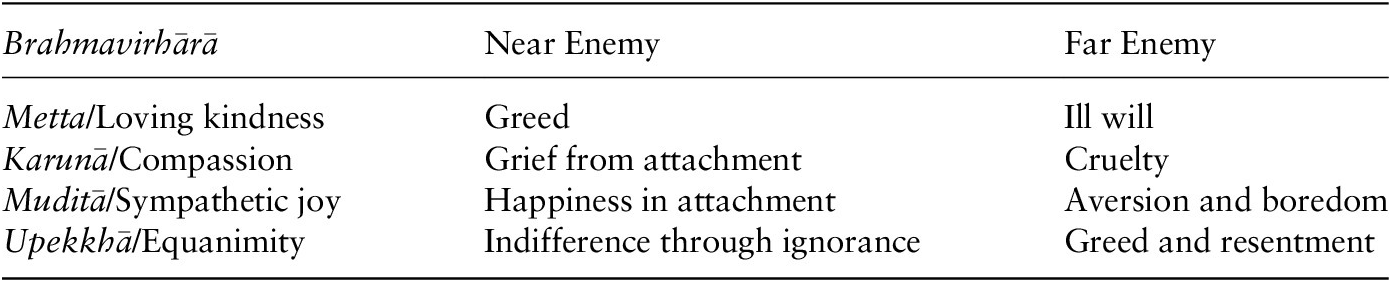
The risk embedded in each near enemy is that even in the context of hitting upon the correct form of attention and the correct object, there is still a risk of adverbial corruption. The very prosocial qualities that structure the mind can become distorted and problematic because of subtle affective biases that shape our attitude towards that which we are empathizing with. This is how prone we are to the distorting influence of affective bias.
In sum, according to Buddhaghosa, our attention is subject to several biasing influences. This should come as no surprise given that we are finite beings for whom the selectivity of our attention provides us with the ability to intelligently ignore huge swaths of information that might otherwise overwhelm us. Consider how easily equanimity (upekkhā) can slip into a subtle indifference rather than remaining a fully present-centered non-reactive attitude. With this selectivity comes the burden of pervasive biases. According to Buddhaghosa, even when our orientation is wholesome, we can still fall into subtle distortions that have a pernicious influence over our conduct with others. Where and how we attend is a primary mode of agency that has an immediate and long-term conditioning-influence over what shows up for us as salient.
Archer seems to object to this view when she claims that “[t]he indirect voluntary control you exercise over what is salient to you does not involve a rational connection between the voluntary actions you perform in ‘training’ yourself and what is salient to you” (2022: 122). I disagree. What Buddhaghosa is exhorting us to do is to establish a rational connection by the cultivation of our attentional habits. He is encouraging us to exercise our agency in the cultivation of attention so as to construct normatively wholesome patterns of salience in our pre-reflective experience of the world. This kind of intervention – on levels of mental processing that might otherwise escape our efforts to improve – is what makes Buddhaghosa’s evaluative scheme for attention so important.
4. Skillfully Cultivating Biases that Work
Here I address an important question: what should we do about attention given that it is pervasively affectively biased? Buddhist philosophers thought that we should engage in a rigorous course of attentional cultivation or training. But even so, we must then ask, precisely how should we train our attention? What goals should we have in mind? What kind of habits of attention should we cultivate? One potential answer to these questions is that we should try to eliminate biases so as to achieve a kind of objective understanding of things as they are in themselves (yathābhūtaṃ). Davis and Thompson (Reference Davis, Thompson, Brown, Creswell and Ryan2015) and McRae (Reference McRae2013, Reference McRae and Davis2017) suggest that eliminating affective biases is a viable solution to the problem of pervasive bias. I will argue against this proposed solution and instead claim that we should aim to cultivate attentional biases that harmonize with our antecedently endorsed normative principles.
The analysis of affective bias provided by Davis and Thompson (Reference Davis, Thompson, Brown, Creswell and Ryan2015) proceeds by analyzing an important Pāli concept in the nomenclature of cognitive science. The Pāli concept is satipaṭṭhāna which translates as ‘the foundation for’ or ‘establishing of’, mindfulness. The term ‘mindfulness’ is a near-universal English translation for the Pāli word sati. Footnote 5 Davis and Thompson develop their cognitive scientific analysis of mindfulness along two dimensions: the first is that it involves developing subtler levels of phenomenal awareness beyond what our ordinary pre-reflective experience of the world delivers. Second, with this increased awareness, one becomes aware of factors that were up until that point influencing one’s behavior outside the purview of the subject’s control (Davis Reference Davis and Repetti2022: 285). Thus, the second goal of mindfulness practice is decreasing (with an eye to eliminating) affective biases of attention. According to Davis and Thompson, “…to the degree that attention and memory are affectively biased, one is less likely to consciously experience subtle emotional stimuli that do not fit one’s biases. Thus, by decreasing affective biases and increasing alertness, cognitive understanding is enhanced” (2015: 55).Footnote 6 This cognitive scientific reconstruction of the function of Buddhist mindfulness practices also accords well with a certain image of the Buddha as one who sees things as they are free from the distorting influence of any biases. Thus, in rejecting this picture I am also rejecting a certain image of the Buddha common to narratives about the meaning of his enlightenment.
It is true that affective biases decrease the likeliness of one becoming viscerally aware of subtle stimuli that do not fit with one’s biases. However, it does not follow that we should strive towards some objective awareness of stimuli where the problematic influences of affect are replaced by a cognitive awareness devoid of affective bias. Definitionally, attending is a matter of selecting and ignoring. Our capacity to attend (actively and passively) is pervasively influenced by affective bias. In particular, we are primally motivated by our need to avoid pain and acquire pleasure. So, the very selection process that is at the heart of attention is shaped by our affects. Elsewhere, Davis seems to agree with me on this: “if it is affective valence that serves as the basic currency of human and animal motivation, then we can only override the motivational pull of the affective valence of a particular emotional state, for instance, by employing an opposing affective force, of a certain thought, for example. The ascetic who plans to deny himself every sensual pleasure must use a thought of some end to do so, a thought that must itself have enough affective force to beat out the opposing affective pulls on his motivational system” (Davis Reference Davis and Davis2017: 229-30). But if all attention is so biased, we can now steer the argument against the view that the solution to the problem of bias influence is to eliminate those biases. Why? Because if all attention is affectively biased in some way, then eliminating affective biases is not a viable strategy for training attention in light of our normative assessment of it. What it means to attend to something is to be guided by affective biases of various sorts. What it means to get a world in view attentionally is to be solicited by the world affectively.
Even if we could eliminate all affective biases, this would be psychologically demanding in the extreme. This would be some version of Stoic sagehood, perhaps. But wanting this kind of constitution is almost certainly not what’s best for us. We can use our affective minds in ways that harness our biased perspective in salutary ways. That is, we can exercise agency over the constitution of our affective-attentional architecture to make our biases virtuous. This seems like a better road forward as it takes seriously the core role that affects play in our lives rather than seeing them as something to do away with. This is the role that the brahmavihārā play for Buddhist philosophers like Buddhaghosa.
We should not try to eliminate affective biases, because we need them in order to navigate our world, we would live massively impoverished lives without them. They can no doubt create problems for us, but they can also be helpful too. Either way, they are an irreducible part of what it means to be a finite psychological agent. Affective biases are how salience maps of one’s environment remain manageable considering one’s limited attentional capacities. Yet, we remain relentlessly perturbed and biased by our affective relation to our world and this can lead to problems. To deal with these various biases on attention and the normative demands they engender we must exercise agency on our own cognitive system and the way it constructs salience for us; we must pick biases that maximize the kinds of salience we choose and attenuate whatever sorts of states that we reject. In sum, we must cultivate attentional biases that work for us. By ‘work’, I mean that the kinds of salience we condition ourselves to be sensitive to need to harmonize with antecedently endorsed normative principles. Thus, on my view, the role of reflection as a constraint on affectively biased salience construction is vital, just as much as salience constrains what shows up for us as relevant for reflection. The attentional mind is a self-reinforcing mind; as Gardiner (Reference Gardiner, Alfano, Klein and de Ridder2022) mentions, ‘attention snowballs’. Taking account of this fact is how we begin a process of gradual self-influencing that can lead us to develop systems of affectively biased attentional salience that are worth having.
Conclusions
My Buddhist-inspired approach to re-shaping the constitution of the cognitive-emotional system through attentional training goes well-beyond what Western philosophers in the Aristotelian tradition are used to in discussions of character formation.Footnote 7 In the Aristotilean tradition, the learning mechanisms that facilitate skill acquisition are relatively fixed by ordinary development – hence the emphasis on the importance of childhood – and are governed by the self-consciousness of practical reason. To change a bias, one must have repeated exposure to the relevant stimuli. Buddhaghosa would not disagree with this – hence, the need for sustained contemplation on a single object to reorient attention – but would add that once an agent reaches a certain level of self-awareness and proficiency, one gains highly amplified agential capacities to intervene on the micro-causal flow of the cognitive-emotional life, thus granting us a level of self-control over salience map construction that we would otherwise lack. This highlights the radical nature of the Buddhist project and the kind of responsibility they envision for human life. Buddhist philosophers like Buddhaghosa want us to take responsibility for not just the shape of our lives as we live them but also for the very constitution of our organism as an affective-attentional being.
One final question: how should this picture shape my understanding of the Buddha’s enlightenment? In short, since I understand the Brahmaviharas as affectively biased modes of empathetic attention, I understand an enlightened person to be one who has fully developed the skill of attending to the world in a biased way that is conducive to freeing themselves from the bondages of craving (taṇhā) and ignorance (avijja). Thus, on my view, the right kinds of affective biases are partially constitutive of what it means to be liberated. How does this reconstruction sit in relation to near-universal claims of Buddha’s omniscience (however variously conceived)? Can an enlightened person be affectively biased and ‘see things as they are’ (yathābhūtaṃ)? I see no reason why not. The world is not a neutral place and so to get things properly before the mind involves having a properly cultivated affective response system poised with respect to the available saliences. Indeed, one way of understanding the Buddha’s intervention in Classical India is to understand him as claiming that only by having a properly attuned cognitive-affective mental economy can one gain the proper level of fine-grained self-awareness and cultivate appropriate attitudes of detachment. This transformation of awareness and attitude allows us to intervene in the micro-causal level flow of mental life and engage in a gradual process of self-influence to transform the sentient being’s constitution from one of suffering to that of freedom. On this score, being biased by appropriate forms of love, compassion, and friendliness, is perhaps the only way to see things as they are.

 Open access

