

Introduction
The COVID-19 pandemic caused extreme personal protective equipment (PPE) shortages. A survey of over 20,000 health care workers (HCWs) in March through May of 2020 showed 22% of HCWs reported “sometimes” or “always” lacking appropriate PPE. Reference Rich-Edwards, Ding, Rocheleau, Boiano, Kang and Becene1 Due to these shortages, hospitals sought methods to safely conserve PPE.
The Healthcare Infection Control Practices Advisory Committee (HICPAC) has traditionally recommended contact precautions (CP) with gowns and gloves in acute care settings for patients colonized or infected with multidrug-resistant organisms (MDROs). Reference Siegel, Rhinehart, Jackson and Chiarello2 However, a 2018 meta-analysis found that discontinuation of CP for methicillin-resistant Staphylococcus aureus (MRSA) and vancomycin-resistant enterococci (VRE) was not associated with increased infection rates. Counterintuitively, removal of CP resulted in MRSA infections trending downward, and VRE infections were significantly reduced. Reference Marra, Edmond, Schweizer, Ryan and Diekema3 Therefore, modifying CP for MDRO colonized patients came to be considered a viable option for PPE conservation during the COVID-19 pandemic.
This study aimed to evaluate a PPE conservation strategy that modified CP for patients asymptomatically colonized with MRSA and VRE and determine its impact on healthcare-associated MRSA (HA-MRSA) bacteremia, healthcare-associated Clostridioides difficile infections (HA-CDI), and healthcare-associated VRE (HA-VRE) infections.
Methods
This study was performed at BJC HealthCare, a 14-site hospital group with more than 3,000 acute care beds located in Missouri and Illinois. Colonized patients were identified by prior positive MRSA or VRE cultures without current infections at that site. Some BJC hospitals also identified colonized patients via admission surveillance cultures (MRSA nasal swabs and VRE stool or rectal swabs) for high-risk populations. Surveillance cultures were paused during modified CP. Patients with active MRSA, Clostridioides difficile, or VRE infections were excluded from modified CP.
Prior to 2020 at BJC HealthCare, baseline CP for MRSA or VRE colonization involved single-use gowns and gloves, consistent with HICPAC guidelines. Reference Siegel, Rhinehart, Jackson and Chiarello2 We defined “modified CP” as HCWs donning gloves upon entry into rooms of patients colonized with MRSA or VRE, but foregoing gowns unless needed for standard precautions.
Cases of HA-MRSA bacteremia and HA-CDI were based on National Healthcare Safety Network (NHSN) laboratory identification (LabID) criteria, defined as a positive laboratory result more than three days after admission. Cases of HA-VRE bacteremia and bacteriuria were defined as a positive culture more than two days after admission. Rates were retrospectively identified using available Electronic Health Record data across acute care beds in the BJC HealthCare system.
BJC HealthCare initiated modified CP in April 2020 and announced the return to baseline CP in July 2021. Therefore, the study was divided into three periods: prepandemic baseline CP in 2019, pandemic modified CP in 2021, and postpandemic baseline CP in 2023. To minimize temporal bias, January through August was analyzed in all three periods. Rates of infection per 1,000 patient-days were compared using MedCalc two-way χ 2 analyses. 4
Results
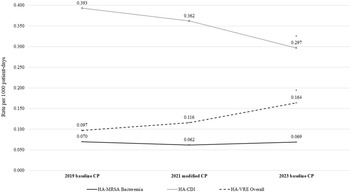
HA-MRSA bacteremia rates were not significantly different across all periods. The HA-MRSA bacteremia rate with baseline CP in 2019 was 0.070 (36 cases/516,390 patient-days), compared to a rate of 0.062 (34/545,086) with modified CP in 2021 and a rate of 0.069 (40/577,095) with baseline CP in 2023 (P = .87).
The rate of HA-CDI with modified CP in 2021 was 0.362 (182 cases/503,327 patient-days), which was not significantly different from the rate with baseline CP in 2019, 0.393 (186/473,884) (P = .43), or from the rate with baseline CP in 2023, 0.297(159/535,901) (P = .07). However, the rate of HA-CDI with baseline CP in 2023 was significantly lower than the rate with baseline CP in 2019 (P = .009).
HA-VRE bacteremia rates were not significantly different across all periods. The rate of HA-VRE bacteremia was 0.038 (19 cases/493,794 patient-days) with baseline CP in 2019 compared to a rate of 0.047 (24/510,814) with modified CP in 2021 and a rate of 0.057 (31/547,614) with baseline CP in 2023 (P = .41).
The rate of HA-VRE bacteriuria with baseline CP in 2019 was 0.059 (29 cases/493,794 patient-days), which was not significantly different from the rate with modified CP in 2021, 0.069 (35/510,814) (P = .54). However, the rate of HA-VRE bacteriuria with baseline CP in 2023 was 0.108 (59/547,614), which was significantly higher than the rate with modified CP in 2021 (P = .03) and significantly higher than the rate with baseline CP in 2019 (P = .007).
The overall rate of HA-VRE infections was 0.097 (48 cases/493,794 patient-days) with baseline CP in 2019, which was not significantly different from the rate with modified CP in 2021, 0.116 (59/510,814) (P = .37). However, the rate of HA-VRE infections with baseline CP in 2023 was 0.164 (90/547,614), which was significantly higher than the rate with modified CP in 2021 (P = .03) and significantly higher than the rate with baseline CP in 2019 (P = .003) (Table 1, Figure 1).
National Healthcare Safety Network (NHSN) laboratory identification (LabID) healthcare-associated methicillin-resistant Staphylococcus aureus (HA-MRSA) bacteremia, LabID healthcare-associated Clostridioides difficile infection (HA-CDI), and healthcare-associated vancomycin-resistant enterococci (HA-VRE) infection rates per 1,000 patient-days with baseline contact precautions (CP) in 2019, modified CP in 2021, and baseline CP in 2023.

Rates of National Healthcare Safety Network (NHSN) laboratory identification (LabID) healthcare-associated methicillin-resistant Staphylococcus aureus (HA-MRSA) bacteremia, LabID healthcare-associated Clostridioides difficile (HA-CDI), and healthcare-associated vancomycin-resistant enterococci (HA-VRE) infections during baseline contact precautions (CP) in 2019, modified CP in 2021, and baseline CP in 2023, per 1,000 patient-days with 95% Confidence Intervals (CI) and χ2 P values

Statistically significant with P < .05.
†Overall χ 2 P values did not show significant difference between any year.
Discussion
During the COVID-19 pandemic, our hospital group modified CP for patients colonized with MRSA or VRE as a gown conservation effort. Modified CP were not associated with increased rates of HA-MRSA bacteremia, HA-CDI, or HA-VRE infections compared to prepandemic rates with baseline CP.
Our results support existing literature that baseline CP for some MDRO colonized patients may be a low-value intervention. A 2019 literature review concluded that CP have not been shown to effectively reduce transmission of MRSA and VRE. Reference Young, Doernberg, Snedecor and Mallin5 Additionally, isolation may affect patient safety and experience. A 2010 systematic review showed isolated patients had higher scores for depression and anxiety, higher anger-hostility scores, and reports of fear and loneliness. Isolated patients also experienced more medical errors, more adverse events, and less frequent care documentation, however, these outcomes were not adjusted for severity of illness. Reference Abad, Fearday and Safdar6
Furthermore, PPE may have a significant global cost and environmental impact. The National Health System (NHS) in the United Kingdom reported that PPE was the third largest health expense during the COVID-19 pandemic, costing £15 billion between 2020 and 2022. Reference Stiebahl7 PPE use by the NHS in the first 6 months of the pandemic also resulted in over 100,000 tons of CO2 emissions according to one life-cycle analysis, with gowns having the highest carbon footprint per item. Reference Rizan, Reed and Bhutta8 Thus, discontinuation of CP for MDRO colonization could reduce PPE costs and emissions. Supplies and labor costs for active surveillance could also be eliminated.
This study showed significant reduction in HA-CDI in the postpandemic baseline CP period, however this mirrors national rates. The CDC reported a 13% decrease in HA-CDI in acute care hospitals between 2022 and 2023. 9 Additionally, in 2022 BJC implemented measures to reduce repeat CDI testing. The BJC laboratory also stopped reflexing specimens with negative Clostridioides difficile toxin EIA and positive glutamate dehydrogenase test results to PCR. These efforts likely reduced HA-CDI rates at BJC in 2023. This study also showed a significant increase in HA-VRE bacteriuria and overall HA-VRE infection rates in the postpandemic period. This reflects national trends, too, as CDC data showed increased HA-VRE from 2019 to 2022, which could be related to changing antibiotic prescribing practices. 10
Limitations of this study are that PPE compliance audits were not performed, and enhanced cleaning during the COVID-19 pandemic may have affected results. The three short study periods may have also been insufficient to detect infection rate differences.
This study is significant because it highlights how a PPE conservation strategy was employed successfully during the COVID-19 pandemic without increasing HA-MRSA bacteremia, HA-CDI, or HA-VRE infections. Due to this analysis, our hospital system is modifying MDRO isolation practices permanently to improve patient experience and reduce PPE cost and environmental impact.
Acknowledgments
D.K.W.’s current affiliation is the University of Nebraska Medical Center. He has received institutional financial support from the Centers for Disease Control and Prevention as well as the National Institutes of Health. He owns shares of Pfizer, Inc.
Competing interests
J.M received financial support from the Centers for Disease Control and Prevention and grant support from the Agency for Healthcare Research and Quality. He has received consulting fees from the National Center for Infection Control, Switzerland. He received financial support as an invited speaker to The Congress of the European Society of Clinical Microbiology and Infectious Diseases (ESGMID Global), Barcelona 2024. He received travel compensation by the International Consortium for Prevention and Infection Control Conference, Geneva in 2023.
Other authors have no relevant conflicts of interest or financial support.


 Open access

