





Impact statement
This review establishes biological carbon capture, leveraging plants, algae and microorganisms, as an indispensable nature-based solution critical to achieving the urgent global target of mid-century carbon neutrality. Through rigorous assessment of current progress and potential, the study demonstrates that optimizing photosynthetic efficiency and harnessing microbial metabolism provide scalable pathways for removing CO₂ from the atmosphere and flue gas. This approach transcends passive carbon storage by emphasizing biological utilization, converting captured carbon into valuable bioproducts. Critically, advancing these biotechnologies promises to diversify and strengthen our climate mitigation arsenal substantially, complementing engineered approaches such as geological carbon storage. Success hinges on enhancing efficiency through a deeper understanding of environmental modulators and deploying integrated symbiotic systems. Ultimately, accelerating innovation in the biological carbon capture field is not merely scientifically significant but an urgent necessity. Establishing effective strategies to redress the anthropogenic imbalance in the global carbon cycle through practical, sustainable and universally applicable solutions is a critical strategic priority. This endeavor is paramount for mitigating the most severe and potentially irreversible consequences of anthropogenic climate change for ecosystems and human societies worldwide.
Introduction
The acceleration of anthropogenic activities globally promotes greenhouse gas emissions, leading to a significant rise in atmospheric CO2 levels. The Intergovernmental Panel on Climate Change (IPCC) released “Climate Change 2023” in March 2023, which established that the global surface temperature from 2011–2020 increased by 1.1 °C compared to 1850–1900 and is projected to rise by an additional 1.5 °C between 2021 and 2040 (Gayathri et al., Reference Gayathri, Mahboob, Govindarajan, Al-Ghanim, Ahmed, Al-Mulhm, Vodovnik and Vijayalakshmi2021; Shu et al., Reference Shu, Chen, Huang and Fu2022). Reports indicate that CO2 constitutes 76% of total greenhouse gas emissions, with current atmospheric CO2 levels at approximately 420 ppm (Saravanan et al., Reference Saravanan, Senthil kumar, Vo, Jeevanantham, Bhuvaneswari, Anantha Narayanan, Yaashikaa, Swetha and Reshma2021). Consequently, achieving global carbon neutrality through urgent CO₂ emission reduction is imperative. This necessitates a dual strategy: curtailing fossil fuel consumption to mitigate emissions and deploying carbon capture, utilization and storage (CCUS) technologies to reduce atmospheric CO₂ (Kim et al., Reference Kim, Ahn, Lee, Jeong, Park, Shin and Jung2021; Khan et al., Reference Khan, Liaquat, Zeshan, A and Bano2022).
According to the latest literature, by the end of 2024, atmospheric CO₂ concentrations had reached levels approximately 52% higher than preindustrial values (around 278 ppm circa 1750). Concurrently, anthropogenic CO₂ emissions for 2024 are projected to reach 41.6 GtCO₂·y⁻1 (Friedlingstein et al., Reference Friedlingstein, O’Sullivan, Jones, Andrew, Hauck, Landschutzer, Le Quere, Li, Luijkx, Olsen, Peters, Peters, Pongratz, Schwingshackl, Sitch, Canadell, Ciais, Jackson, Alin, Arneth, Arora, Bates, Becker, Bellouin, Berghoff, Bittig, Bopp, Cadule, Campbell, Chamberlain, Chandra, Chevallier, Chini, Colligan, Decayeux, Djeutchouang, Dou, Rojas, Enyo, Evans, Fay, Feely, Ford, Foster, Gasser, Gehlen, Gkritzalis, Grassi, Gregor, Gruber, Gurses, Harris, Hefner, Heinke, Hurtt, Iida, Ilyina, Jacobson, Jain, Jarnikova, Jersild, Jiang, Jin, Kato, Keeling, Goldewijk, Knauer, Korsbakken, Lan, Lauvset, Lefevre, Liu, Liu, Ma, Maksyutov, Marland, Mayot, PC, Metzl, Monacci, Morgan, Nakaoka, Neill, Niwa, Nuetzel, Olivier, Ono, Palmer, Pierrot, Qin, Resplandy, Roobaert, Rosan, Roedenbeck, Schwinger, Smallman, Smith, Sospedra-Alfonso, Steinhoff, Sun, Sutton, Seferian, Takao, Tatebe, Tian, Tilbrook, Torres, Tourigny, Tsujino, Tubiello, van der Werf, Wanninkhof, Wang, Yang, Yang, Yu, Yuan, Yue, Zaehle, Zeng and Zeng2025). Given this trajectory of persistently rising emissions, the imperative to enhance carbon capture capacity has become paramount. As of the first quarter of 2025, the global operational capacity of CCUS – a critical suite of technologies for decarbonizing fossil-based industries and achieving net-zero goals – exceeds 50 million metric tons of CO₂ annually across operational facilities. Projections indicate this capacity will scale significantly to approximately 430 million tons per year by 2030, driven by ongoing large-scale demonstrations in sectors like power generation, cement production and hydrogen manufacturing (REF) (Tyagi et al., Reference Tyagi, Bhardwaj, Sinha and Dhiman2025). The main emerging carbon capture technologies can be classified into direct carbon capture, point source carbon capture, precombustion capture, biological carbon capture and ocean capture. Although microbial carbon sink currently represents a small fraction of global carbon fluxes (~70–100 Gt annually), its scalability offers transformative potential for enhanced carbon sequestration (Aguiló-Nicolau et al., Reference Aguiló-Nicolau, Iñiguez, Capó-Bauçà and Galmés2025). Furthermore, atmospheric CO₂ concentrations reached a record 420 ± 2 ppm in 2024 marking a 52% increase above preindustrial levels (278 ppm) (Friedlingstein et al., Reference Friedlingstein, O’Sullivan, Jones, Andrew, Hauck, Landschutzer, Le Quere, Li, Luijkx, Olsen, Peters, Peters, Pongratz, Schwingshackl, Sitch, Canadell, Ciais, Jackson, Alin, Arneth, Arora, Bates, Becker, Bellouin, Berghoff, Bittig, Bopp, Cadule, Campbell, Chamberlain, Chandra, Chevallier, Chini, Colligan, Decayeux, Djeutchouang, Dou, Rojas, Enyo, Evans, Fay, Feely, Ford, Foster, Gasser, Gehlen, Gkritzalis, Grassi, Gregor, Gruber, Gurses, Harris, Hefner, Heinke, Hurtt, Iida, Ilyina, Jacobson, Jain, Jarnikova, Jersild, Jiang, Jin, Kato, Keeling, Goldewijk, Knauer, Korsbakken, Lan, Lauvset, Lefevre, Liu, Liu, Ma, Maksyutov, Marland, Mayot, PC, Metzl, Monacci, Morgan, Nakaoka, Neill, Niwa, Nuetzel, Olivier, Ono, Palmer, Pierrot, Qin, Resplandy, Roobaert, Rosan, Roedenbeck, Schwinger, Smallman, Smith, Sospedra-Alfonso, Steinhoff, Sun, Sutton, Seferian, Takao, Tatebe, Tian, Tilbrook, Torres, Tourigny, Tsujino, Tubiello, van der Werf, Wanninkhof, Wang, Yang, Yang, Yu, Yuan, Yue, Zaehle, Zeng and Zeng2025). Biological carbon capture is primarily divided into ecosystem-based and industrial biological carbon sequestration (Cowie et al., Reference Cowie, Berndes, Bentsen, Brandão, Cherubini, Egnell, George, Gustavsson, Hanewinkel, Harris, Johnsson, Junginger, Kline, Koponen, Koppejan, Kraxner, Lamers, Majer, Marland, Nabuurs, Pelkmans, Sathre, Schaub, Smith, Soimakallio, Van Der Hilst, Woods and Ximenes2021; Gayathri et al., Reference Gayathri, Mahboob, Govindarajan, Al-Ghanim, Ahmed, Al-Mulhm, Vodovnik and Vijayalakshmi2021; Fu et al., Reference Fu, Li, Lin, Du, Liu, Zhu and Ren2022). Ecosystem-based carbon encompasses terrestrial systems including forests and soil alongside marine environments, specifically blue carbon ecosystems and algal-mediated sequestration pathways (Macreadie et al., Reference Macreadie, Costa, Atwood, Friess, Kelleway, Kennedy, Lovelock, Serrano and Duarte2021; Nunes, Reference Nunes2023). In soil ecosystems, synergistic interactions between microorganisms and plants augment plant-mediated carbon sequestration and liberate bioavailable nutrients through the mineralization of organic matter, thereby elevating soil fertility (Gayathri et al., Reference Gayathri, Mahboob, Govindarajan, Al-Ghanim, Ahmed, Al-Mulhm, Vodovnik and Vijayalakshmi2021). This synergistic effect establishes a self-sustaining ecosystem, promoting plant growth rates and carbon fixation. The efficiency of these processes is contingent upon environmental factors, including temperature, pH and nutrient availability (Panchal et al., Reference Panchal, Preece, Penuelas and Giri2022). The ocean carbon sink absorbed 2.9 ± 0.4 GtC yr⁻1 during 2023 and is projected to increase to ∼3.0 GtC yr⁻1 in 2024 (Friedlingstein et al., Reference Friedlingstein, O’Sullivan, Jones, Andrew, Hauck, Landschutzer, Le Quere, Li, Luijkx, Olsen, Peters, Peters, Pongratz, Schwingshackl, Sitch, Canadell, Ciais, Jackson, Alin, Arneth, Arora, Bates, Becker, Bellouin, Berghoff, Bittig, Bopp, Cadule, Campbell, Chamberlain, Chandra, Chevallier, Chini, Colligan, Decayeux, Djeutchouang, Dou, Rojas, Enyo, Evans, Fay, Feely, Ford, Foster, Gasser, Gehlen, Gkritzalis, Grassi, Gregor, Gruber, Gurses, Harris, Hefner, Heinke, Hurtt, Iida, Ilyina, Jacobson, Jain, Jarnikova, Jersild, Jiang, Jin, Kato, Keeling, Goldewijk, Knauer, Korsbakken, Lan, Lauvset, Lefevre, Liu, Liu, Ma, Maksyutov, Marland, Mayot, PC, Metzl, Monacci, Morgan, Nakaoka, Neill, Niwa, Nuetzel, Olivier, Ono, Palmer, Pierrot, Qin, Resplandy, Roobaert, Rosan, Roedenbeck, Schwinger, Smallman, Smith, Sospedra-Alfonso, Steinhoff, Sun, Sutton, Seferian, Takao, Tatebe, Tian, Tilbrook, Torres, Tourigny, Tsujino, Tubiello, van der Werf, Wanninkhof, Wang, Yang, Yang, Yu, Yuan, Yue, Zaehle, Zeng and Zeng2025). In addition, the ocean, the largest active carbon reservoir on Earth, stores approximately 40 trillion tons of dissolved inorganic carbon dioxide (CO2) and organic carbon (Friedlingstein et al., Reference Friedlingstein, O’Sullivan, Jones, Andrew, Bakker, Hauck, Landschützer, Le Quéré, Luijkx, Peters, Peters, Pongratz, Schwingshackl, Sitch, Canadell, Ciais, Jackson, Alin, Anthoni, Barbero, Bates, Becker, Bellouin, Decharme, Bopp, Brasika, Cadule, Chamberlain, Chandra, Chau, Chevallier, Chini, Cronin, Dou, Enyo, Evans, Falk, Feely, Feng, Ford, Gasser, Ghattas, Gkritzalis, Grassi, Gregor, Gruber, Gürses, Harris, Hefner, Heinke, Houghton, Hurtt, Iida, Ilyina, Jacobson, Jain, Jarníková, Jersild, Jiang, Jin, Joos, Kato, Keeling, Kennedy, Klein Goldewijk, Knauer, Korsbakken, Körtzinger, Lan, Lefèvre, Li, Liu, Liu, Ma, Marland, Mayot, McGuire, McKinley, Meyer, Morgan, Munro, Nakaoka, Niwa, O’Brien, Olsen, Omar, Ono, Paulsen, Pierrot, Pocock, Poulter, Powis, Rehder, Resplandy, Robertson, Rödenbeck, Rosan, Schwinger, Séférian, Smallman, Smith, Sospedra-Alfonso, Sun, Sutton, Sweeney, Takao, Tans, Tian, Tilbrook, Tsujino, Tubiello, van der Werf, van Ooijen, Wanninkhof, Watanabe, Wimart-Rousseau, Yang, Yang, Yuan, Yue, Zaehle, Zeng and Zheng2023).
Industrial biological carbon capture primarily utilizes bacteria, fungi, microalgae and other microorganisms. The biological process does not necessitate a high-purity CO2 environment, as microorganisms can effectively capture and utilize CO2 even in the presence of SO2 and NOx (Su et al., Reference Su, Xu, Brynjólfsson and Fu2023). Studies have shown that microorganisms possess the capability to metabolize CO₂ derived from anthropogenic flue gases at concentrations as low as 4.0% (v/v) (Oliveira et al., Reference Oliveira, Caetano, Mata and Martins2020). Notably, extremophilic taxa (e.g., halophiles, thermophiles) demonstrate conserved carbon sequestration functionality. The cyanobacterium Chroococcidiopsis thermalis achieves intracellular CO₂ concentrations 140× atmospheric levels during desert photosynthesis. Parallel capabilities occur in Chroococcidiopsis cubana PCC 7433, where this xerotolerant strain maintains carbon fixation within hypolithic crusts at oxygen production rates of 0.4 g O₂ g⁻1 biomass d⁻1 (Krings et al., Reference Krings, Chen, Keddie and Hingley-Wilson2023; Aguiló-Nicolau et al., Reference Aguiló-Nicolau, Iñiguez, Capó-Bauçà and Galmés2025). The potential of microbial carbon capture lies in its capacity to fix CO2 directly while concurrently generating valuable bioproducts (Duarte et al., Reference Duarte, Losada, Hendriks, Mazarrasa and Marbà2013). This technology offers new opportunities for achieving sustainable development goals. By integrating genetic engineering technologies, microorganisms can be customized for specific environmental conditions, significantly enhancing their carbon capture and conversion capacities (Onyeaka and Ekwebelem, Reference Onyeaka and Ekwebelem2023). For phytoplankton (microalgae), the carbon sequestration efficiency is predominantly governed by photosynthesis and further modulated by environmental factors including temperature, light intensity and nutrient concentrations (Yahya et al., Reference Yahya, Harun and Abdullah2020; Salehi-Ashtiani et al., Reference Salehi-Ashtiani, Mystikou, Nelson, Fu, Chaiboonchoe, Dohai, El Assal, Daakour and Alzahmi2021; Saravanan et al., Reference Saravanan, Senthil kumar, Vo, Jeevanantham, Bhuvaneswari, Anantha Narayanan, Yaashikaa, Swetha and Reshma2021; Hasnain et al., Reference Hasnain, Zainab, Ali, Abideen, Yong, El-Keblawy, Hashmi and Radicetti2023; Onyeaka and Ekwebelem, Reference Onyeaka and Ekwebelem2023). Optimizing these environmental conditions can significantly improve microalgae’s biomass production and CO2 absorption capabilities. Furthermore, microalgae are used to develop photosynthetic cell factories for synthesizing valuable bioactive compounds, such as lipids and carotenoids (Kusmayadi et al., Reference Kusmayadi, Leong, Yen, Huang and Chang2021).
In this review, we examine the recent advances in biological carbon capture methodologies. Specifically, we analyze advances in the processes and underlying mechanisms of biological carbon sequestration, with particular emphasis on photosynthetic pathways. Furthermore, we synthesize key biological carbon sequestration pathways operating within both natural ecosystems and in industry, critically evaluating the benefits and limitations inherent in these approaches. Finally, we propose strategic research directions to enhance carbon fixation efficiency and optimize resource utilization, thereby offering more effective solutions for mitigating global climate change.
The processes and mechanisms of biological carbon capture
Plants and algae mainly capture and fix carbon through photosynthesis. Photosynthesis is the process of synthesizing organic matter from CO2 and releasing O2, which provides the energy and material basis for the vast majority of life on Earth (Prajapati et al., Reference Prajapati, Kumar, Dayal, Gairola, Borate and Srivastava2023).
In terrestrial plants, the primary site of photosynthesis is the leaf, which contains specialized pores called stomata. These stomata serve to regulate gas exchange; under conditions of sufficient water availability, they open to allow the uptake of atmospheric CO₂ (Melo et al., Reference Melo, Yule, Barros, Rivas and Santos2021). Photosynthesis takes place within the chloroplasts, organelles in leaf cells. Chloroplasts have a double-layered membrane that encloses an internal matrix, consisting of small flat sacs surrounded by multiple single-layer membranes, known as thylakoids (Perez-Boerema et al., Reference Perez-Boerema, Engel and Wietrzynski2024).
Photosynthesis is divided into two parts: the light reaction and the dark reaction. The reaction mechanism of photosynthesis is shown in Figure 1. The light reaction occurs in the thylakoids, where the pigments in Photosystem II (PSII) transfer the energy in the light to the reaction center (RC), which excites a special chlorophyll a P680 into a strong reducing agent P680*. P680* transfers electrons to the phytin molecule (Phe) to generate P680+, which then transfers electrons in the plastoquinone (PQ) to ultimately generate plastoquinol (PQH2) (Barber, Reference Barber2003). Meanwhile, P680+ captures electrons in the (Mn)4 cluster, and this reaction is repeated four times to catalyze the conversion of two molecules of water into oxygen, protons and electrons (Shevela et al., Reference Shevela, Kern, Govindjee, Whitmarsh and Messinger2021). PQH2 is oxidized by the cytochrome b6f (cytb6f) complex, releasing electrons that are transferred to plastocyanin (PC) in the thylakoid lumen. Photosystem I (PSI) then oxidizes reduced plastocyanin and transfers electrons via ferredoxin to reduce NADP+ to NADPH. Subsequently, ATP synthase transfers H+ from the thylakoid lumen to the chloroplast stroma, while converting adenosine diphosphate (ADP) to adenosine triphosphate (ATP) (Liu et al., Reference Liu, Schubert, Könneke and Berg2021; Prasad et al., Reference Prasad, Gupta, Shabnam, Oliveira, Nema, Ansari and Bux2021; Zeng et al. Reference Zeng, Wang and Chen2021). The dark reaction, also known as the Calvin-Benson cycle, occurs in the chloroplast stroma and consists of three main steps: (1) Conversion of CO2, H2O and ribulose-1,5-bisphosphate (RuBP) in the stroma into 3-phosphoglycerate (3-PGA) under the catalysis of ribulose-1,5-bisphosphate carboxylase (Rubisco); (2) Phosphorylation of 3-PGA by ATP to intermediate 1,3-bisphosphoglycerate under the action of 3-phosphoglycerate kinase, followed by reduction of 1,3-bisphosphoglycerate to glyceraldehyde-3-phosphate (GAP) by glyceraldehyde-3-phosphate dehydrogenase using NADPH; (3) Conversion of a small portion of GAP to carbohydrates such as glucose, while the remaining GAP is used to regenerate RuBP (which requires ATP consumption) (Alami et al., Reference Alami, Alasad, Ali and Alshamsi2021; Li et al., Reference Li, Li and Ho2022; Hu et al., Reference Hu, Meng, Su, Qian and Fu2023).
Photosynthesis in land plants and microalgae. Abbreviations: PSII, Photosystem II; cytb6f, Cytochrome b6f; PSI, Photosystem I; PC, Plastocyanin; ATP, Adenosine triphosphate; ADP, Adenosine diphosphate; NADP+, Nicotinamide adenine dinucleotide phosphate; NADPH, Nicotinamide adenine dinucleotide phosphate hydrogen; RuBP, ribulose-1,5-bisphosphate; Rubisco, ribulose-1,5-bisphosphate carboxylase; 3-PGA, 3-phosphoglycerate;GAP, glyceraldehyde-3-phosphate.

To combat photorespiration and maintain high levels of biomass productivity, plants and algae have evolved CO2 concentrating mechanisms (CCMs). Some plants, such as corn and sugarcane, fix and store CO2 in the form of malate through the C4 mechanism. They then release CO2 from bundle sheath cells to participate in the Calvin-Benson cycle while generating pyruvate (Ludwig, Reference Ludwig2012). In other higher plants such as Crassulaceae plants, there is another CCM strategy called CAM (Crassulacean acid metabolism) mechanism, which fixes CO2 into malate through phosphoenolpyruvate (PEP), stores it in vacuoles of plant cells at night and releases it into tissues during the day to participate in photosynthesis (Nobel, Reference Nobel1991). In microalgae, CO2 and HCO3− are transported into the cell from the environment through active transport and diffusion. Due to the alkaline environment in the cytoplasm, carbonic anhydrases (CAs) convert CO2 into HCO3−, forming a high-concentration HCO3− pool. Then, HCO3− diffuses into the chloroplast stroma, where it is converted into CO2 by CAs under appropriate conditions and utilized by dark reactions (Kupriyanova et al., Reference Kupriyanova, Pronina and Los2023).
In addition, some microorganisms can oxidize inorganic molecules and use the generated chemical energy to fix CO2 into organic matter. Compared to the Calvin-Benson cycle, the carbon sequestration mechanisms of these microorganisms are different, mainly including the reductive TCA cycle, reductive acetyl-CoA pathway, 3-hydroxypropionate pathway, 3-hydroxypropionate/4-hydroxybutyrate cycle, dicarboxylate/4-hydroxybutyrate cycle and other pathways (Berg, Reference Berg2011; Saini et al., Reference Saini, Kapoor, Kumar, Siddiqi and Kumar2011). For the reductive TCA cycle (tricarboxylic acid cycle), citrate is cleaved to oxaloacetate and acetyl-CoA by ATP citrate lyase. Oxaloacetate undergoes a series of reduction reactions to decarboxylate into citrate, while acetyl-CoA is converted to pyruvate through pyruvate: ferredoxin oxidoreductase (POR) and then converted back to oxaloacetate via pyruvate carboxylase to participate in subsequent biochemical reactions (Zhang et al. Reference Zhang, Jensen, Gray, El, Wang, Lu, Becker, Campbell and Newgard2021). The reductive acetyl-CoA pathway is linear rather than cyclic and is divided into Western and Eastern branches. In the Western branch, CO2 is reduced to CO under the action of carbon monoxide dehydrogenase (CODH), and in the Eastern (methyl) branch, CO2 is reduced to methyl-CFeSP through a series of reduction reactions. Then, acetyl-CoA is synthesized by reacting with CO from the Western branch using acetyl-CoA synthase (ACS) (Ragsdale, Reference Ragsdale1991). For the 3-hydroxypropionate pathway, acetyl-CoA is converted into succinyl-CoA through a series of reactions and then regenerated into acetyl-CoA under the action of enzymes such as succinic dehydrogenase and malyl-CoA lyase (Zhao and Tian Reference Zhao and Tian2021). For the 3-hydroxypropionate/4-hydroxybutyrate cycle: this cycle can be divided into two parts, the first part transforms acetyl-CoA and two molecules of bicarbonate into succinyl-CoA and the other forms two molecules of acetyl-CoA from succinyl-CoA (Liu et al., Reference Liu, Schubert, Könneke and Berg2021); For dicarboxylate/4-hydroxybutyrate cycle: This mechanism is also divided into two parts, the first part involves the transformation of acetyl-CoA and two inorganic carbon to succinyl-CoA using pyruvate synthase and pyruvate carboxylase, as carboxylation enzyme and the second part involves the regeneration of acetyl-CoA from succinyl-CoA via a route similar to 4-hydroxybutyrate pathway (Garritano et al., Reference Garritano, Song and Thomas2022).
Biological carbon sequestration pathways based on natural ecosystems
Biogeochemical cycle of carbon
The biogeochemical cycle of carbon is shown in Figure 2. CO2 is a critical greenhouse gas in the atmosphere that affects the Earth’s climate. Plants and algae fix the absorbed solar energy in carbohydrates through photosynthesis and transfer it to various levels of organisms (Nunes, Reference Nunes2023). The carbon storage in the ocean is approximately 3.77 × 10¹³ tC, including dissolved inorganic carbon (DIC) 3.70 × 10¹³ tC, dissolved organic carbon (DOC) 6.85 × 10¹¹ tC and particulate organic carbon (POC) 1.3–2.3 × 10¹⁰ tC (Hansell and Carlson, Reference Hansell and Carlson1998; Falkowski et al., Reference Falkowski, Scholes, Boyle, Canadell, Canfield, Elser, Gruber, Hibbard, Högberg and Linder2000; Sarmiento, Reference Sarmiento2013). The carbon storage in soil is 2.50 × 10¹² tC, including 1.55 × 10¹² tC of soil organic carbon (SOC) and 9.50 × 10¹¹ tC of soil inorganic carbon (SIC) (Lal, Reference Lal2004). The circulation and exchange of carbon between these major carbon reservoirs constitute the biogeochemical cycle of carbon on Earth (Li et al., Reference Li, Wang, Yi, Wang, Santos and Liu2024).
Schematic process of biogeochemical cycling of carbon. Abbreviations: BCP, biological carbon pump; SCP, solubility carbon pump; CP, carbonate pump; DOC, dissolved organic carbon; POC, particulate organic carbon; RDOC, recalcitrant dissolved organic carbon; MCP, microbial carbon pump.

Land plants, microalgae and seaweed use photosynthesis to fix atmospheric CO2 in their bodies, which is an important pathway for carbon sequestration. These fixed carbons are transmitted along the food chain and oxidized, releasing energy to organisms at various levels, thereby driving the overall life activities of the community. Plant litter and animal residues are humified by soil microorganisms to form stable soil organic matter such as humus (Hedges and Oades, Reference Hedges and Oades1997). In addition, microbial residues combine with minerals through ligand exchange, hydrogen bonding and intermolecular forces, becoming part of mineral-bound organic matter (Wu et al. Reference Wu, Cui, Fu, Li, Qi, Liu, Yang, Xiao and Qiao2023). Microbial secretions can also chemically bond with mineral surfaces or be embedded in soil micropores, ultimately forming stable mineral-bound organic matter (Lavallee et al., Reference Lavallee, Soong and Cotrufo2020). Carbon from the atmosphere and soil flows into the ocean through CO2 diffusion, microbial decomposition, weathering, respiration and other processes and is then utilized by seaweed, microalgae and other organisms. Marine organisms bury carbon in seabed sediments for a long time through digestion, excretion and corpse decomposition (DeVries, Reference DeVries2022). Before the Industrial Revolution, the atmospheric CO2 concentration was relatively stable at around 280 ppm (Beck, Reference Beck2007). After the Industrial Revolution, with the combustion of fossil fuels, the concentration of CO2 in the atmosphere has been steadily increasing and has exceeded 400 ppm (Major et al., Reference Major, Haszpra, Rinyu, Futó, Bihari, Hammer, Jull and Molnár2018). Human industrial and agricultural activities have become an important factor affecting the atmospheric CO2 level (Salam and Noguchi, Reference Salam and Noguchi2005; Wilberforce et al., Reference Wilberforce, Olabi, Sayed, Elsaid and Abdelkareem2021). At present, the global CO2 emissions are about 3.68 × 10¹⁰ tCO2, of which China accounts for 31.2% (Hu et al., Reference Hu, Zhang, Wu and Meng2023).
Carbon capture by microalgae and plants
The global forest area accounts for over 30% of the total land area, reaching 4 × 10³ Mha. The balance of CO2 captured by photosynthesis in forests is 5.17 × 10¹⁰ tCO2·y−1, and the balance of CO2 released through respiration and forest fires is 4.25 × 10¹⁰ tCO2·y−1, with net capture of 9.17 × 10⁹ tCO2·y−1, accounting for 24.92% of global CO2 emissions (Nunes et al., Reference Nunes, Meireles, Pinto Gomes and Almeida Ribeiro2020). The direct way to enhance forest carbon capture capacity is afforestation, which involves planting trees in areas without forests. China has the highest afforestation rate in the world. In the past decade, the forest area in southwestern China has increased by approximately 4 to 4.4 Mha (Wang et al. Reference Wang, Feng, Palmer, Liu, Fang, Bösch, O’Dell, Tang, Yang and Liu2020). There is still 67.2 Mha of land in China suitable for afforestation, with a maximum storage capacity of 3.99 × 10⁹ tC (Jiang et al., Reference Jiang, Ziegler, Liang, Wang and Zeng2022).
Currently, blue carbon ecosystems (BCEs) only include mangroves, salt marsh wetlands and seagrass beds. The dynamic changes in their carbon storage can affect the blue carbon balance. BCEs have stored over 3 × 10¹⁰ tC on approximately 185 Mha of land and can still capture 2.98 × 10⁸ tCO2·y−1 (Bertram et al., Reference Bertram, Quaas, Reusch, Vafeidis, Wolff and Rickels2021). Due to human activities and environmental pollution, BCE is suffering from large-scale losses: the annual loss rates are 1%–2% for salt marsh wetlands, 1.5% for seagrass beds and 0.4% for mangrove forests, respectively (Macreadie et al., Reference Macreadie, Costa, Atwood, Friess, Kelleway, Kennedy, Lovelock, Serrano and Duarte2021). Therefore, it is necessary to carry out BCE restoration. It is estimated that the recoverable areas are 0.2 to 3.2 Mha for salt marsh wetlands, 8.3–25.4 Mha for seagrass beds and 9–13 Mha for mangroves (Worthington and Spalding Reference Worthington and Spalding2018). If these BCEs can be successfully restored, an additional 8.41 × 10⁸ tCO2(equivalent to 2.21% of the current global CO2 emissions) can be reduced annually by 2030 (Macreadie et al., Reference Macreadie, Costa, Atwood, Friess, Kelleway, Kennedy, Lovelock, Serrano and Duarte2021). However, currently, BCEs do not calculate the carbon capture and storage by mudflats (Tidal flats), coastal algae ecosystems, etc., due to accountability issues; therefore, blue carbon may be largely underestimated and needs to be expanded with an updated definition.
The ocean stores more CO2 than all forests, with excellent carbon capture capacity. Algae, including macroalgae (seaweed) and microalgae, are widely distributed with diverse species and large amounts (Mann and Vanormelingen, Reference Mann and Vanormelingen2013). Seaweed are one of the main primary photosynthetic organisms and are considered to have the highest productivity among plants in coastal areas, with an average of carbon capture at 5.58 × 10⁹ tCO2 y−1 over a total area of 3.5 Mkm2, equivalent to 15.16% of global CO2 emissions (Zahed et al. Reference Zahed, Movahed, Khodayari, Zanganeh and Badamaki2021). Microalgae are a group of photosynthetic microorganisms that can grow in both marine and freshwater environments. They can rapidly capture CO2 and form biomass, making them one of the best candidates for biological carbon capture to achieve carbon neutrality (Onyeaka et al., Reference Onyeaka, Miri, Obileke, Hart, Anumudu and Al-Sharify2021; Su et al., Reference Su, Hu, Xia, Chen, Meng, Qian, Shu, Wang, Wang, Salehi-Ashtiani, Brynjólfsson, Lin, Li, Zhang, Wang, Fu and Xu2024). Photosynthesis by microalgae accounts for about 50% of O2 evolution and atmospheric CO2 capture (Mao et al., Reference Mao, Vadiveloo, Qiu and Gao2024). Future marine fertilization strategies could deploy two primary methodologies: (i) Terrestrial-sourced nutrient supplementation, involving land-based production of tailored fertilizer composites transported via subsea infrastructure beyond the continental shelf break; and (ii) Deep ocean macronutrient upwelling, utilizing wave-driven pumping systems to elevate nutrient-rich waters (400–1000 m depth) to the photic zone. Both approaches enhance micro- and macroalgal cultivation to stimulate photosynthetic carbon sequestration and macronutrient supply from the deep ocean, which involves the use of local wave power to pump deep nutrient-rich water from depths of several hundred meters to the surface, to cultivate microalgae and macroalgae, promoting their growth and helping to fix more CO2 (Rees et al., Reference Rees, Law and Woodward2006; Lovelock and Rapley, Reference Lovelock and Rapley2007; Lampitt et al., Reference Lampitt, Achterberg, Anderson, Hughes, Iglesias-Rodriguez, Kelly-Gerreyn, Lucas, Popova, Sanders and Shepherd2008; Sethi et al., Reference Sethi, Butler, Shuhaili and Vaidyanathan2020). The common microalgae species involved in carbon capture are shown in Table 1. In recent years, microalgae have been commonly used to fix CO2 from human activities in urban ecosystems. For urban ecosystems, open or closed photoreactors can be installed near major carbon emission sources such as steel plants, utilizing microalgae to reduce CO2 content in flue gas (Branco-Vieira et al., Reference Branco-Vieira, Lopes and Caetano2022). In addition, introducing microalgae into industrial wastewater, aquaculture wastewater or aquaculture can significantly reduce carbon emissions through water bodies (Ji and Liu, Reference Ji and Liu2022; Liang et al., Reference Liang, Li, Liang, Liu, Wang, Chen, Gao, Qi and Guo2024). A central research priority involves developing genetically engineered microorganisms for enhanced carbon sequestration. Proof-of-concept studies confirm that engineered microalgae strains improve CO₂ assimilation and storage kinetics. Notably, chloroplast-targeted expression of cyanobacterial fructose-1,6-bisphosphate aldolase (FBA) in Chlorella vulgaris elevated photosynthetic quantum yield and carbon fixation rates by 1.2-fold (Yang et al. Reference Yang, Liu, Ma, Guo, Liu, Wu, Jiang and Chen2017).
Types of microorganisms for carbon capture

Note:1–7 are microalgae and 8–15 are other microorganisms. *This refers to biomass production, while the rest refers to CO2 capture.
Carbon capture by other microorganisms
In addition to microalgae, many other microorganisms (including bacteria, fungi, etc) are involved in carbon capture and are widely distributed in environments such as oceans and soils. Table 1 shows some carbon capture microorganisms. Among them, bacteria that can survive in a chemosynthetic autotrophic mode account for a large proportion, such as nitrifying bacteria, which can obtain energy by oxidizing inorganic nitrogen compounds and reducing CO2 to organic carbon, including ammonia-oxidizing microorganisms (AOMs) and nitrate-oxidizing bacteria (NOB). AOMs oxidize ammonia nitrogen to nitrite, and NOB oxidizes nitrite to nitrate. NOB, such as Nitrobacter vulgaris and Nitrococcus mobilis, use the Calvin-Benson cycle to fix CO2, while Nitrospira uses the reductive TCA cycle to fix CO2 (Elling et al., Reference Elling, Evans, Nathan, Hemingway, Kharbush, Bayer, Spieck, Husain, Summons and Pearson2022). Fe (II)-oxidizing bacteria (FeOB) synthesize organic matter by oxidizing Fe (II) to Fe (III) to obtain energy. Among FeOB, the acidophilic iron-oxidizing bacteria Leptospirillum ferriphilum can fix carbon through a reductive TCA cycle under aerobic conditions (Emerson et al., Reference Emerson, Fleming and McBeth2010; Mi et al., Reference Mi, Song, Lin, Che, Zheng and Lin2011). In addition, some bacteria fix carbon through mineralization, such as Bacillus pasteurei, which can induce CO2 or DIC to form carbonate crystals, such as calcite, and also increase soil pH through metabolic processes, thereby increasing DIC concentration and promoting the formation of carbonate crystals (Warren et al. Reference Warren, Maurice, Parmar and Ferris2001; Li et al., Reference Li, Yu, Wu, L-P and Yuan2007). Apart from bacteria, fungi such as the arbuscular mycorrhizal fungi (AMF) also indirectly participate in carbon fixation by affecting carbon turnover between plants and soils. AMF can fix carbon in the soil by transferring photosynthetic products from the host plant to the root hyphae of AMF, then to the outer hyphae and finally releasing them into the soil (He et al., Reference He, Wang, Wang, Zhang, Shi, Kurakov and Song2023). The presence of AMF can cause host plants to release 4%–20% of their carbon into their hyphae, which can then be buried in the soil.
Biological carbon capture in industry
Potential of microalgae for carbon capture and producing zero-carbon-emission fine chemicals
Microalgae play a crucial role in carbon capture through photosynthesis, fixing CO₂ from diverse sources, including the atmosphere, industrial waste gases and soluble carbonates. On a dry weight basis, microalgae biomass comprises approximately 50% carbon, meaning 100 tons of algal biomass can sequester roughly 183 tons of CO₂ (Zhang et al. Reference Zhang, Jensen, Gray, El, Wang, Lu, Becker, Campbell and Newgard2021). Due to their rapid growth and efficient nutrient absorption, microalgae effectively treat wastewater while doubling their biomass in short periods. The production of high-value coproducts further offsets carbon capture costs, enhancing economic feasibility.
In industrial applications, microalgae like Chlorella demonstrate significant environmental benefits. For instance, when cultivated in pretreated landfill leachate, Chlorella removes 91% of dissolved organic carbon (DOC), 86% of total nitrogen (TN), 90% of ammoniacal nitrogen (NH₄-N) and 96% of phosphate via photosynthesis – simultaneously treating wastewater and generating biomass (Singh and Ahluwalia, Reference Singh and Ahluwalia2012). Colocating Chlorella cultivation facilities near power plants could mitigate up to 9.8 × 10⁸ kg of CO₂ emissions annually (Oliveira et al., Reference Oliveira, Caetano, Mata and Martins2020). Microalgae also utilize CO₂ from cement production flue gas, despite trace heavy metal contaminants (Olofsson et al., Reference Olofsson, Lindehoff, Frick, Svensson and Legrand2015; Lara-Gil et al., Reference Lara-Gil, Senés-Guerrero and Pacheco2016).
Beyond environmental applications, microalgae are rich sources of bioactive compounds (Figure 3), such as polyunsaturated fatty acids, carotenoids, peptides, vitamins and polysaccharides; these compounds possess substantial market size and generate significant economic contributions. For instance, the global carotenoids market reached approximately1.84 billion in 2024, with projections indicating growth to 2.842 billion by 2031. This represents a compound annual growth rate (CAGR) of 6.8% from 2025 to 2031. Separately, the DHA (docosahexaenoic acid) market was valued at around 14.4 billion in 2024 (Zhang et al. Reference Zhang, Yang, Sun, Yan, Chen and Fan2024). Cultivation and extraction methods influence compound yields, enabling the development of pharmaceuticals and functional foods. Research highlights microalgae extracts’ anti-inflammatory, anticancer and therapeutic potential (Chen et al., Reference Chen, Liou, Chen and Shih2011; Besednova et al., Reference Besednova, Zaporozhets, Kuznetsova, Makarenkova, Kryzhanovsky, Fedyanina and Ermakova2020; Wu et al. Reference Wu, Gu, Yang, Xu, Wang, Chen and Wang2021; Sasaki et al., Reference Sasaki, Linh, Hirano, Tominaga, Nukaga, Nozaki, Arimura and Isoda2022; Moradi et al., Reference Moradi, Aghamaali and Hadavi2023), underscoring their value in nutrition and medicine.
Applications of microalgae in carbon capture and production of high-value products. Abbreviations: ALE: Adaptive Laboratory Evolution; FAME: Fatty acid methyl ester.

Microalgae further benefit agriculture and animal husbandry. Microalgae-based fertilizers enhance seed germination, increase sugar and carotenoid content in tomatoes (Ferrazzano et al., Reference Ferrazzano, Papa, Pollio, Ingenito, Sangianantoni and Cantile2020) and boost rice yields (Dineshkumar et al., Reference Dineshkumar, Kumaravel, Gopalsamy, Sikder and Sampathkumar2017). As feed additives, they improve daily weight gain in livestock and poultry while optimizing fatty acid profiles via n-3 LCPUFAs (Hopkins et al., Reference Hopkins, Clayton, Lamb, van de Ven, Refshauge, Kerr, Bailes, Lewandowski and Ponnampalam2014; Madeira et al., Reference Madeira, Cardoso, Lopes, Coelho, Afonso, Bandarra and Prates2017). They also support pet gastrointestinal health by promoting beneficial microbiota (Delsante et al., Reference Delsante, Pinna, Sportelli, Dalmonte, Stefanelli, Vecchiato and Biagi2022; Cabrita et al., Reference Cabrita, Guilherme-Fernandes, Spínola, Maia, Yergaliyev, Camarinha-Silva and Fonseca2023). These dual agricultural and environmental advantages position microalgae as sustainable tools for resource recycling (Shah et al., Reference Shah, Lutzu, Alam, Sarker, Kabir Chowdhury, Parsaeimehr, Liang and Daroch2017; Saadaoui et al., Reference Saadaoui, Rasheed, Aguilar, Cherif, Al Jabri, Sayadi and Manning2021).
Finally, microalgae serve as a versatile feedstock for producing diverse biofuels – including biodiesel, methane, ethanol and butanol – through biochemical or thermochemical conversion. This capability not only offers renewable alternatives to fossil fuels but also embodies a closed-loop resource model: utilizing waste CO₂ and nutrients for cultivation, converting biomass into energy and recycling byproducts. Consequently, microalgae systems significantly advance circular economies by valorizing waste streams, reducing net emissions and sustaining resource cycles without competing with arable land.
Other biological carbon capture technologies
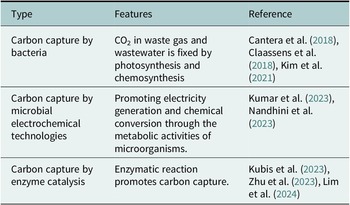
Beyond microalgae-based carbon capture, several alternative biological systems demonstrate significant potential for carbon sequestration, as shown in Table 2. Bacteria, in particular, are capable of biological carbon fixation and the production of high-value products. Chemoautotrophic bacteria, for instance, utilize atmospheric CO₂ as a carbon source to synthesize various organic compounds (Cantera et al., Reference Cantera, Munoz, Lebrero, Lopez, Rodriguez and Garcia-Encina2018). Specific strains, such as Halomonas stevensii, have been shown to convert CO₂ into valuable fatty alcohols like lauryl alcohol and pentanol (Claassens et al., Reference Claassens, Sanchez-Andrea, Sousa and Bar-Even2018). Furthermore, specific bacterial consortia, including methane-oxidizing bacteria (e.g., Methylophilus) and ammonia-oxidizing bacteria, offer dual benefits: they effectively treat wastewater by removing ammonia while concurrently performing biological carbon fixation (Kim et al., Reference Kim, Ahn, Lee, Jeong, Park, Shin and Jung2021).
Other biological carbon capture systems

Microbial electrosynthesis systems (MES), microbial electrolysis carbon capture (MECC), photosynthetic microbial fuel cells (pMFCs) and microbial fuel cells (MFCs) are technologies that facilitate wastewater treatment while simultaneously generating energy (Zhu et al., Reference Zhu, Lei, Qi, Zhen, Lu, Xu, Zhang, Liu, Zhang and Wu2022). MES can convert CO2 into biofuels, organic acids and other high-value chemicals (Chen et al., Reference Chen, Wang, Sun, Chen, Iyobosa and Zhao2023). MECC primarily utilizes microorganisms to convert organic carbon in wastewater into electricity while capturing carbon (Kumar et al., Reference Kumar, Tripathi, Chakraborty and Ghangrekar2023). Additionally, enzymes play an important role in the carbon capture process. Supplementing fungal-derived cellulase during the conversion of corn stover to ethanol can reduce production costs and improve carbon capture efficiency, achieving negative carbon emissions (Krings et al., Reference Krings, Chen, Keddie and Hingley-Wilson2023). Similarly, immobilized carbonic anhydrase effectively captures CO2 in an aqueous solution, by catalyzing its hydration reaction, thereby enhancing carbon capture efficiency (Zhu et al., Reference Zhu, Du, Gao and He2023; Lim and Jo, Reference Lim and Jo2024).
Conclusions and future perspectives
Biological carbon sequestration is mainly a process in which plants, bacteria, microalgae and other microorganisms directly fix CO2 through photosynthesis, or microorganisms fix CO2 from industrial waste gases, soluble carbonate and other sources. If all land were covered with plants, terrestrial and marine ecosystems could sequester a significant amount of CO2 each year. Although biological carbon sequestration in natural ecosystems has environmental significance, it also faces many difficulties in practical applications, mainly including: (1) Biological carbon sequestration requires a large amount of land for vegetation cultivation, which may compete with agriculture, urban development and natural ecosystems, leading to land resource conflicts; (2) Climate adaptability: the climate varies greatly in different regions, and some plants may perform well under certain climatic conditions, but may not grow well or survive in other regions; (3) Long-term ecological impacts and assessment, for example, the effects of artificial plantation and ocean fertilization on ecosystems need to be monitored and evaluated over time to ensure that these technologies have minimized adverse impacts.
Compared to biological carbon sequestration in natural ecosystems, industrial biological carbon sequestration has the advantages of efficient carbon capture, process-controlled diversification of products, efficient use of resources and capital utilization, reduced dependence on natural ecology and flexibility to cope with climate change. Microalgae are an important candidate for industrial biological carbon sequestration because of their high photosynthetic efficiency, capability to produce various valuable products, strong adaptability and wide applications. Despite substantial research on microalgae-based carbon fixation technology in recent years, several challenges remain. The isolation and purification of microalgae typically require lengthy cycles, and the carbon fixation performance of isolated strains demands further investigation, resulting in low efficiency. While genetic editing offers high transformation efficiency, the vastly different genetic backgrounds and high specificity among microalgal species limit its broad application. Continuous CO₂ influx during carbon fixation acidifies the algal culture medium, adversely impacting fixation efficiency. Sustaining elevated carbon fixation rates under high-CO₂ conditions, therefore, necessitates optimization of carbon-tolerant strain selection methods and enhanced research into genetic and metabolic engineering approaches. In addition, further optimization of bioreactor parameters is essential to improve the carbon fixation efficiency of microalgae within these systems.
At the same time, there are still challenges hindering the successful development and commercialization of microalgae-based carbon capture technologies. Specifically, economic constraints and feasibility assessments necessitate consideration of microalgal bioreactor costs, footprints and spatial requirements. At the same time, further research is needed to obtain better light conditions and higher photosynthetic efficiency at a low cost on a commercial scale. In addition, when using microalgae to treat industrial wastewater or flue gas, some toxic biomass may be generated and accumulated due to different sources. Appropriate utilization of such biomass should be developed. The development of genetic engineering technology has enabled the creation of transgenic microalgae with enhanced carbon sequestration capabilities. However, policy and regulations are important to support transgenic technologies, which remain to be addressed concerning algal technology. Through technological innovation, economic model exploration and policy support, carbon capture by biological methods will demonstrate great potential, paving the way to achieve carbon neutrality and sustainability shortly.
Open peer review
To view the open peer review materials for this article, please visit https://doi.org/10.1017/cat.2025.10005.
Data availability statement
All data used in this study were cited from the literature with appropriate citations, and no data were generated in the preparation of this manuscript.
Acknowledgments
Any use of trade, firm or product names is for descriptive purposes only and does not imply endorsement by the Chinese government. We thank the editor and anonymous reviewers for their comments that improved the manuscript.
Author contribution
Weiqi Fu led the conceptualization of the manuscript with inputs from co-authors. Xiaomin Liang and Yitao Duan led the writing of the original drafts with contributions from co-authors. All authors contributed to the revision and review of this manuscript.
Financial support
This work was supported by the Zhejiang Province Leading Geese Plan (Grant No. 2024C03110) and the National Natural Science Foundation of China Joint Fund Project (Grant No. U23A2034).
Competing interests
The authors declare none.



 Open access


Comments
Dear Editors,
We are enthusiastically submitting our manuscript, “Carbon Capture by Biological Methods” to Cambridge Prisms: Carbon Technologies for publication as a review article. Our manuscript describes original, unpublished work and is not under consideration elsewhere.
To tackle the global climate crisis, there is an urgent need to achieve carbon neutrality by the middle of the 21st century, balancing carbon emissions and carbon uptake in the atmosphere. Our manuscript explores recent advances in biological approaches to carbon dioxide (CO2) management in response to global climate change and reviews recent advances in biological carbon capture approaches. We discuss advances in the processes and mechanisms of biological carbon capture, with a focus on photosynthesis. In addition, we summarize biological carbon sequestration pathways based on natural ecosystems and industry and discuss the advantages and disadvantages of these approaches. Finally, the development direction of biological carbon capture is proposed further to improve carbon fixation capacity and resource utilization efficiency, to provide a more effective solution to global climate change.
We believe that this review provides comprehensive information and valuable insights into carbon capture by biological methods in response to global climate change. We thank you in advance for considering our manuscript for publication in Cambridge Prisms: Carbon Technologies.
Sincerely,
Weiqi Fu, Ph.D.
Professor
Department of Marine Science, Ocean College, Zhejiang University, Zhejiang, China;
Adjunct Professor
Center for Systems Biology &
Faculty of Industrial Engineering, Mechanical Engineering, and Computer Science, School of Engineering and Natural Sciences, University of Iceland
Emails: weiqifu@zju.edu.cn; weiqi@hi.is