


The majority of UK military personnel do not develop combat-related psychiatric injuries, despite enduring arduous operational duties, including deployments to Iraq (Reference Hotopf, Hull and FearHotopf et al, 2006). Previous work has focused on military experiences (Reference Yager, Laufer and GallopsYager et al, 1984; Reference Elder and ClippElder & Clipp, 1988), but there is renewed interest in individual factors which may predispose a minority of individuals to becoming unwell (Reference Brewin, Andrews and ValentineBrewin et al, 2000; Reference Ozer, Best and LipseyOzer et al, 2003). Childhood vulnerability is understood to be an important modulator of an individual's risk of later psychological problems, including post-traumatic stress disorder (PTSD; Reference Engel, Engel and CampbellEngel et al, 1993; Reference Zaidi and FoyZaidi & Foy, 1994). The aim of the current study is to examine the association of such self-reported vulnerabilities with later health outcomes in a large randomly selected male military cohort.
METHOD
Sample
Full details of the study have been described previously (Reference Hotopf, Hull and FearHotopf et al, 2006). In brief, the study was the first phase of a cohort study of UK military personnel in service at the time of the Iraq war in March 2003. In total, 4722 personnel who were deployed on the initial 2003 invasion, code named TELIC 1, and 5550 personnel who were not deployed on TELIC 1 (the ‘Era’ cohort) completed a questionnaire on their childhood experiences, deployment experiences and health outcomes (n=10 272). TELIC 1 was defined, for the purposes of this study, as 18 January to 28 April 2003.
The 10 272 participants represented a response rate after three mailings and active follow-up of 61%. The main reason for non-response was inability to contact personnel. There was no evidence of any response bias by health outcomes, and no difference in the prevalence of medical downgrading (being unfit for duty) in non-responders (Reference Tate, Jones and HullTate et al, 2007).
As we have previously reported that there are important gender differences in the UK military (Reference Rona, Fear and HullRona et al, 2007) and the proportion of women in the military and in our sample is small, we have limited this analysis to men. In addition, because we have previously shown an interaction between reservist status and deployment (Reference Hotopf, Hull and FearHotopf et al, 2006), which has been explored in greater depth in another paper (Reference Browne, Hull and HornBrowne et al, 2007), we limit the present analyses to regular personnel. After exclusion, the sample size available for these analyses was 7937.
Questionnaire
Participants were sent a detailed 28-page questionnaire booklet. This included information that participation in the survey was voluntary and that the research was being conducted independently of the UK Ministry of Defence. The questionnaire consisted of seven sections: (1) demographics; (2) service information; (3) experiences prior to deployment; (4) experiences on deployment; (5) experiences following deployment; (6) information on current health; and (7) background information, including past medical history and adversity in childhood. The Era cohort were asked to complete sections 3–5 for their most recent deployment; thus it was possible to gain information on deployment experiences for individuals who had served on later Iraq deployments. Full details of the questionnaire and measures have been described previously (Reference Hotopf, Hull and FearHotopf et al, 2006) and are available in the online data supplement to the current paper.
As part of section 7, participants were asked to give a true or false response to a series of 16 questions (some adverse and some protective) which followed the stem statement ‘When I was growing up…’. Three categories were chosen: family relationships, parenting and adolescent behaviour. Three items were adapted from the Adverse Childhood Exposure study scale (ACE; Reference Felitti, Anda and NordenbergFelitti et al, 1998), and the remaining items were single items based on the existing evidence from the general population on childhood exposures for later adverse health outcomes for adolescents and young people (see online data supplement for further details).
Statistical analyses
From the 16 questions on childhood adversity, a four-point vulnerability count was created by scoring individuals reporting none or one adverse factor as 1, two or three factors as 2, four or five factors as 3 and six or more factors as 4.
To measure exposure to trauma, a composite measure was derived from the sum of a list of possible ‘trauma’ exposures experienced during deployment. Participants' scores ranged from 0 to 16 and were divided into three categories for the purposes of analysis (0–1, 2–3 and 4+).
All analyses were performed using STATA version 9.0 and statistical significance was defined as P<0.05. Associations between demographic and vulnerability factors were examined using chi-squared tests and logistic regression analyses were performed to examine the relationship between vulnerability factors and health outcomes (Reference Clayton and HillsClayton & Hills, 1993). Odds ratios, 95% confidence intervals and two-sided P values are presented. All analyses were adjusted for age, service, rank, educational status and marital status.
To identify the factor structure of the vulnerability variables a tetrachoric principal-component factor analysis was undertaken. The Kaiser–Meyer–Olkin measure of sampling adequacy was 0.87 and therefore principal-component factor analysis was deemed appropriate. The loading matrix was rotated to maximise the correlations between each factor. Two factors were identified based on the eigenvalues (>2.0).
RESULTS
Frequency of pre-enlistment vulnerability
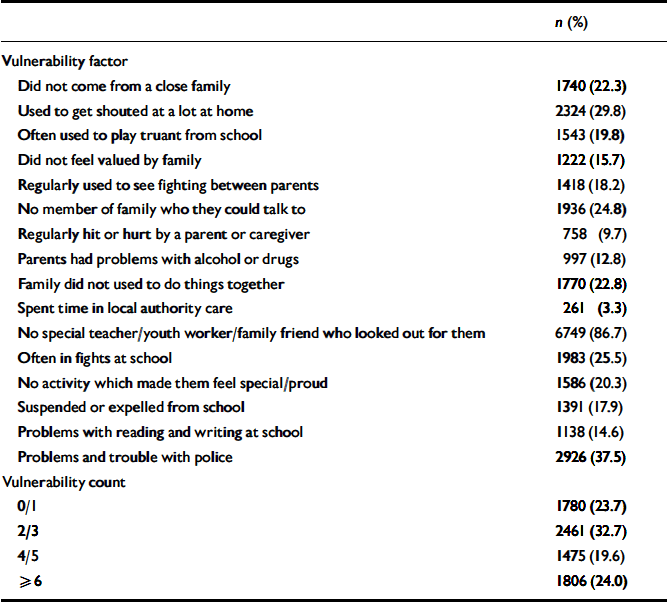
Pre-enlistment vulnerability was relatively common in this military population; 76% of those sampled reported at least two or more vulnerability markers while growing up: 37.5% had been in trouble with the police; 29.8% got shouted at a lot at home; 25.5% had been in fights at school; and 3.3% had spent time in local authority care (Table 1).
Frequency of each vulnerability factor and vulnerability count
| n (%) | |
|---|---|
| Vulnerability factor | |
| Did not come from a close family | 1740 (22.3) |
| Used to get shouted at a lot at home | 2324 (29.8) |
| Often used to play truant from school | 1543 (19.8) |
| Did not feel valued by family | 1222 (15.7) |
| Regularly used to see fighting between parents | 1418 (18.2) |
| No member of family who they could talk to | 1936 (24.8) |
| Regularly hit or hurt by a parent or caregiver | 758 (9.7) |
| Parents had problems with alcohol or drugs | 997 (12.8) |
| Family did not used to do things together | 1770 (22.8) |
| Spent time in local authority care | 261 (3.3) |
| No special teacher/youth worker/family friend who looked out for them | 6749 (86.7) |
| Often in fights at school | 1983 (25.5) |
| No activity which made them feel special/proud | 1586 (20.3) |
| Suspended or expelled from school | 1391 (17.9) |
| Problems with reading and writing at school | 1138 (14.6) |
| Problems and trouble with police | 2926 (37.5) |
| Vulnerability count | |
| 0/1 | 1780 (23.7) |
| 2/3 | 2461 (32.7) |
| 4/5 | 1475 (19.6) |
| ⩾6 | 1806 (24.0) |
Demographic and service factors associated with high vulnerability
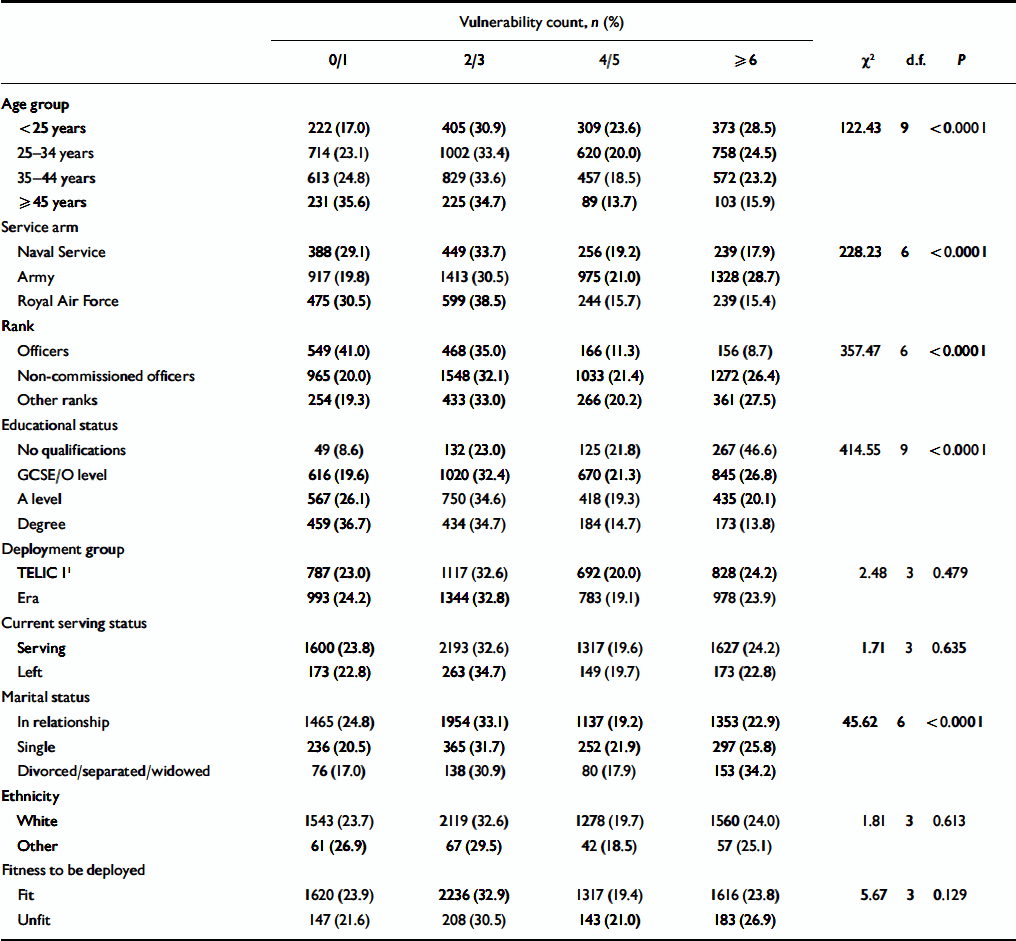
Higher vulnerability counts were associated with younger age, being in the Army, being a non-commissioned officer or other rank, having low educational attainment and being divorced, separated or widowed (Table 2).
Vulnerability count according to demographic and service characteristics
| Vulnerability count, n (%) | ||||||||||
|---|---|---|---|---|---|---|---|---|---|---|
| 0/1 | 2/3 | 4/5 | ⩾6 | χ2 | d.f. | P | ||||
| Age group | ||||||||||
| <25 years | 222 (17.0) | 405 (30.9) | 309 (23.6) | 373 (28.5) | 122.43 | 9 | <0.0001 | |||
| 25–34 years | 714 (23.1) | 1002 (33.4) | 620 (20.0) | 758 (24.5) | ||||||
| 35–44 years | 613 (24.8) | 829 (33.6) | 457 (18.5) | 572 (23.2) | ||||||
| ⩾45 years | 231 (35.6) | 225 (34.7) | 89 (13.7) | 103 (15.9) | ||||||
| Service arm | ||||||||||
| Naval Service | 388 (29.1) | 449 (33.7) | 256 (19.2) | 239 (17.9) | 228.23 | 6 | <0.0001 | |||
| Army | 917 (19.8) | 1413 (30.5) | 975 (21.0) | 1328 (28.7) | ||||||
| Royal Air Force | 475 (30.5) | 599 (38.5) | 244 (15.7) | 239 (15.4) | ||||||
| Rank | ||||||||||
| Officers | 549 (41.0) | 468 (35.0) | 166 (11.3) | 156 (8.7) | 357.47 | 6 | <0.0001 | |||
| Non-commissioned officers | 965 (20.0) | 1548 (32.1) | 1033 (21.4) | 1272 (26.4) | ||||||
| Other ranks | 254 (19.3) | 433 (33.0) | 266 (20.2) | 361 (27.5) | ||||||
| Educational status | ||||||||||
| No qualifications | 49 (8.6) | 132 (23.0) | 125 (21.8) | 267 (46.6) | 414.55 | 9 | <0.0001 | |||
| GCSE/O level | 616 (19.6) | 1020 (32.4) | 670 (21.3) | 845 (26.8) | ||||||
| A level | 567 (26.1) | 750 (34.6) | 418 (19.3) | 435 (20.1) | ||||||
| Degree | 459 (36.7) | 434 (34.7) | 184 (14.7) | 173 (13.8) | ||||||
| Deployment group | ||||||||||
| TELIC I 1 | 787 (23.0) | 1117 (32.6) | 692 (20.0) | 828 (24.2) | 2.48 | 3 | 0.479 | |||
| Era | 993 (24.2) | 1344 (32.8) | 783 (19.1) | 978 (23.9) | ||||||
| Current serving status | ||||||||||
| Serving | 1600 (23.8) | 2193 (32.6) | 1317 (19.6) | 1627 (24.2) | 1.71 | 3 | 0.635 | |||
| Left | 173 (22.8) | 263 (34.7) | 149 (19.7) | 173 (22.8) | ||||||
| Marital status | ||||||||||
| In relationship | 1465 (24.8) | 1954 (33.1) | 1137 (19.2) | 1353 (22.9) | 45.62 | 6 | <0.0001 | |||
| Single | 236 (20.5) | 365 (31.7) | 252 (21.9) | 297 (25.8) | ||||||
| Divorced/separated/widowed | 76 (17.0) | 138 (30.9) | 80 (17.9) | 153 (34.2) | ||||||
| Ethnicity | ||||||||||
| White | 1543 (23.7) | 2119 (32.6) | 1278 (19.7) | 1560 (24.0) | 1.81 | 3 | 0.613 | |||
| Other | 61 (26.9) | 67 (29.5) | 42 (18.5) | 57 (25.1) | ||||||
| Fitness to be deployed | ||||||||||
| Fit | 1620 (23.9) | 2236 (32.9) | 1317 (19.4) | 1616 (23.8) | 5.67 | 3 | 0.129 | |||
| Unfit | 147 (21.6) | 208 (30.5) | 143 (21.0) | 183 (26.9) | ||||||
1. Deployed in Iraq between 18 January and 28 April 2003
Vulnerability count and associated health outcomes
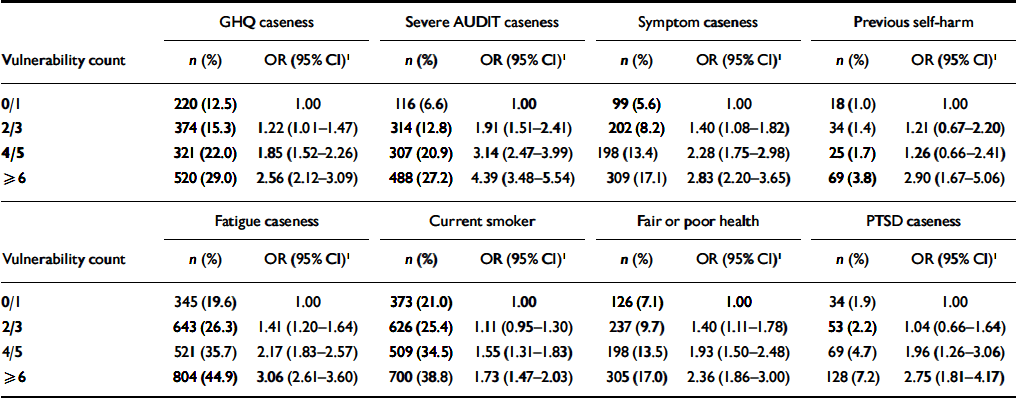
Higher vulnerability counts were significantly associated with all health outcomes examined (Table 3), all of which showed evidence of a highly statistically significant trend (i.e. the more vulnerabilities that an individual has, the more likely it is that they will meet ‘easeness’ on these various measures of ill health; P<0.0001 for each health outcome).
Vulnerability count according to health outcomes *
| GHQ caseness | Severe AUDIT caseness | Symptom caseness | Previous self-harm | |||||||||
|---|---|---|---|---|---|---|---|---|---|---|---|---|
| Vulnerability count | n (%) | OR (95% CI) 1 | n (%) | OR (95% CI) 1 | n (%) | OR (95% CI) 1 | n (%) | OR (95% CI) 1 | ||||
| 0/1 | 220 (12.5) | 1.00 | 116 (6.6) | 1.00 | 99 (5.6) | 1.00 | 18 (1.0) | 1.00 | ||||
| 2/3 | 374 (15.3) | 1.22 (1.01–1.47) | 314 (12.8) | 1.91 (1.51–2.41) | 202 (8.2) | 1.40 (1.08–1.82) | 34 (1.4) | 1.21 (0.67–2.20) | ||||
| 4/5 | 321 (22.0) | 1.85 (1.52–2.26) | 307 (20.9) | 3.14 (2.47–3.99) | 198 (13.4) | 2.28 (1.75–2.98) | 25 (1.7) | 1.26 (0.66–2.41) | ||||
| ⩾6 | 520 (29.0) | 2.56 (2.12–3.09) | 488 (27.2) | 4.39 (3.48–5.54) | 309 (17.1) | 2.83 (2.20–3.65) | 69 (3.8) | 2.90 (1.67–5.06) | ||||
| Fatigue caseness | Current smoker | Fair or poor health | PTSD caseness | |||||||||
| Vulnerability count | n (%) | OR (95% CI) 1 | n (%) | OR (95% CI) 1 | n (%) | OR (95% CI) 1 | n (%) | OR (95% CI) 1 | ||||
| 0/1 | 345 (19.6) | 1.00 | 373 (21.0) | 1.00 | 126 (7.1) | 1.00 | 34 (1.9) | 1.00 | ||||
| 2/3 | 643 (26.3) | 1.41 (1.20–1.64) | 626 (25.4) | 1.11 (0.95–1.30) | 237 (9.7) | 1.40 (1.11–1.78) | 53 (2.2) | 1.04 (0.66–1.64) | ||||
| 4/5 | 521 (35.7) | 2.17 (1.83–2.57) | 509 (34.5) | 1.55 (1.31–1.83) | 198 (13.5) | 1.93 (1.50–2.48) | 69 (4.7) | 1.96 (1.26–3.06) | ||||
| ⩾6 | 804 (44.9) | 3.06 (2.61–3.60) | 700 (38.8) | 1.73 (1.47–2.03) | 305 (17.0) | 2.36 (1.86–3.00) | 128 (7.2) | 2.75 (1.81–4.17) | ||||
GHQ, General Health Questionnaire; PTSD, post-traumatic stress disorder; AUDIT, Alcohol Use Disorders Identification Test
* P < 0.0001 for all health outcomes
1. Adjusted for age, service, rank, educational status and marital status
Factor analysis
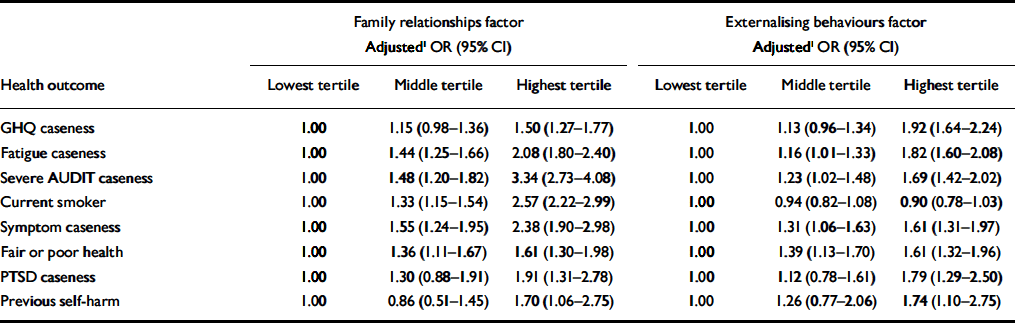
To aid data interpretation, two factors were generated using a tetrachoric principal-component factor analysis: factor 1 (family relationships) is comprised of not coming from a close family, family not doing things together, no family member to talk to, not feeling valued by family, being hit by parent or caregiver, seeing/hearing parents fight, parents with drug or alcohol problem and being shouted at when young. Factor 2 (externalising behaviours) is comprised of being expelled or suspended from school, being involved in fights at school, being in trouble with the police and playing truant. Factors were then divided into tertiles, with the highest tertile representing those with the highest factor scores. Associations between each factor and the various health outcomes were examined in the same model since the correlation between the two factors was relatively low (r=0.3252), despite being highly statistically significant (P<0.0001). Furthermore, there was no evidence of interaction between the two factors on the outcomes examined.
Factors 1 and 2 were, in general, positively associated with all negative health outcomes (Table 4). The ‘family relationships’ factor was highly associated with having chronic fatigue, multiple physical symptoms, being a current smoker and heavy drinking. The ‘externalising behaviours’ factor was particularly associated with high levels of alcohol consumption and with having chronic fatigue or meeting caseness on the General Health Questionnaire (GHQ; Reference Goldberg and WilliamsGoldberg & Williams, 1988).
Vulnerability factors according to health outcomes
| Family relationships factor Adjusted 1 OR (95% CI) | Externalising behaviours factor Adjusted 1 OR (95% CI) | |||||||||
|---|---|---|---|---|---|---|---|---|---|---|
| Health outcome | Lowest tertile | Middle tertile | Highest tertile | Lowest tertile | Middle tertile | Highest tertile | ||||
| GHQ caseness | 1.00 | 1.15 (0.98–1.36) | 1.50 (1.27–1.77) | 1.00 | 1.13 (0.96–1.34) | 1.92 (1.64–2.24) | ||||
| Fatigue caseness | 1.00 | 1.44 (1.25–1.66) | 2.08 (1.80–2.40) | 1.00 | 1.16 (1.01–1.33) | 1.82 (1.60–2.08) | ||||
| Severe AUDIT caseness | 1.00 | 1.48 (1.20–1.82) | 3.34 (2.73–4.08) | 1.00 | 1.23 (1.02–1.48) | 1.69 (1.42–2.02) | ||||
| Current smoker | 1.00 | 1.33 (1.15–1.54) | 2.57 (2.22–2.99) | 1.00 | 0.94 (0.82–1.08) | 0.90 (0.78–1.03) | ||||
| Symptom caseness | 1.00 | 1.55 (1.24–1.95) | 2.38 (1.90–2.98) | 1.00 | 1.31 (1.06–1.63) | 1.61 (1.31–1.97) | ||||
| Fair or poor health | 1.00 | 1.36 (1.11–1.67) | 1.61 (1.30–1.98) | 1.00 | 1.39 (1.13–1.70) | 1.61 (1.32–1.96) | ||||
| PTSD caseness | 1.00 | 1.30 (0.88–1.91) | 1.91 (1.31–2.78) | 1.00 | 1.12 (0.78–1.61) | 1.79 (1.29–2.50) | ||||
| Previous self-harm | 1.00 | 0.86 (0.51–1.45) | 1.70 (1.06–2.75) | 1.00 | 1.26 (0.77–2.06) | 1.74 (1.10–2.75) | ||||
GHQ, General Health Questionnaire; AUDIT, Alcohol Use Disorders Identification Test; PTSD, post-traumatic stress disorder
1. Adjusted for age, service, rank, educational status, marital status and the other vulnerability factor
Vulnerability factors and exposure to trauma
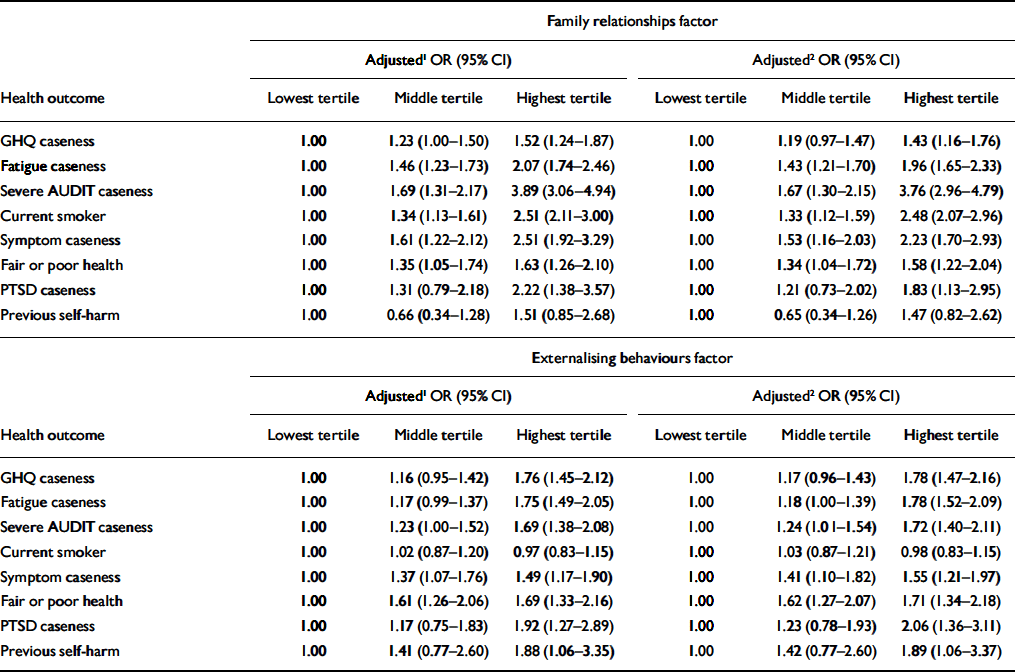
To examine the possibility that those with pre-enlistment vulnerability were at greater risk of adverse health outcomes because of confounding (i.e. the possibility that more pre-enlistment vulnerability meant more exposure to trauma), we examined the association of each of the vulnerability factors with exposure to trauma. The ‘family relationships’ factor is highly correlated with trauma (P<0.0001), and there is a clear pattern between increasing exposure to trauma and being in the highest tertile for this factor. The association with the ‘externalising behaviours’ factor is less clear, although there is still a correlation (P=0.001). In view of this association, we repeated the analyses with only those with previous deployments (n=5185) with and without adjustment for exposure to trauma (Table 5). Adjusting for exposure to trauma reduced the effect of the ‘family relationships’ factor but had a marginal effect on the associations with the ‘externalising behaviours’ factor.
Vulnerability factors according to health outcomes, restricted to those who have been deployed since 2000 (n=5185)
| Family relationships factor | |||||||||||
|---|---|---|---|---|---|---|---|---|---|---|---|
| Adjusted 1 OR (95% CI) | Adjusted 2 OR (95% CI) | ||||||||||
| Health outcome | Lowest tertile | Middle tertile | Highest tertile | Lowest tertile | Middle tertile | Highest tertile | |||||
| GHQ caseness | 1.00 | 1.23 (1.00–1.50) | 1.52 (1.24–1.87) | 1.00 | 1.19 (0.97–1.47) | 1.43 (1.16–1.76) | |||||
| Fatigue caseness | 1.00 | 1.46 (1.23–1.73) | 2.07 (1.74–2.46) | 1.00 | 1.43 (1.21–1.70) | 1.96 (1.65–2.33) | |||||
| Severe AUDIT caseness | 1.00 | 1.69 (1.31–2.17) | 3.89 (3.06–4.94) | 1.00 | 1.67 (1.30–2.15) | 3.76 (2.96–4.79) | |||||
| Current smoker | 1.00 | 1.34 (1.13–1.61) | 2.51 (2.11–3.00) | 1.00 | 1.33 (1.12–1.59) | 2.48 (2.07–2.96) | |||||
| Symptom caseness | 1.00 | 1.61 (1.22–2.12) | 2.51 (1.92–3.29) | 1.00 | 1.53 (1.16–2.03) | 2.23 (1.70–2.93) | |||||
| Fair or poor health | 1.00 | 1.35 (1.05–1.74) | 1.63 (1.26–2.10) | 1.00 | 1.34 (1.04–1.72) | 1.58 (1.22–2.04) | |||||
| PTSD caseness | 1.00 | 1.31 (0.79–2.18) | 2.22 (1.38–3.57) | 1.00 | 1.21 (0.73–2.02) | 1.83 (1.13–2.95) | |||||
| Previous self-harm | 1.00 | 0.66 (0.34–1.28) | 1.51 (0.85–2.68) | 1.00 | 0.65 (0.34–1.26) | 1.47 (0.82–2.62) | |||||
| Externalising behaviours factor | |||||||||||
| Adjusted 1 OR (95% CI) | Adjusted 2 OR (95% CI) | ||||||||||
| Health outcome | Lowest tertile | Middle tertile | Highest tertile | Lowest tertile | Middle tertile | Highest tertile | |||||
| GHQ caseness | 1.00 | 1.16 (0.95–1.42) | 1.76 (1.45–2.12) | 1.00 | 1.17 (0.96–1.43) | 1.78 (1.47–2.16) | |||||
| Fatigue caseness | 1.00 | 1.17 (0.99–1.37) | 1.75 (1.49–2.05) | 1.00 | 1.18 (1.00–1.39) | 1.78 (1.52–2.09) | |||||
| Severe AUDIT caseness | 1.00 | 1.23 (1.00–1.52) | 1.69 (1.38–2.08) | 1.00 | 1.24 (1.01–1.54) | 1.72 (1.40–2.11) | |||||
| Current smoker | 1.00 | 1.02 (0.87–1.20) | 0.97 (0.83–1.15) | 1.00 | 1.03 (0.87–1.21) | 0.98 (0.83–1.15) | |||||
| Symptom caseness | 1.00 | 1.37 (1.07–1.76) | 1.49 (1.17–1.90) | 1.00 | 1.41 (1.10–1.82) | 1.55 (1.21–1.97) | |||||
| Fair or poor health | 1.00 | 1.61 (1.26–2.06) | 1.69 (1.33–2.16) | 1.00 | 1.62 (1.27–2.07) | 1.71 (1.34–2.18) | |||||
| PTSD caseness | 1.00 | 1.17 (0.75–1.83) | 1.92 (1.27–2.89) | 1.00 | 1.23 (0.78–1.93) | 2.06 (1.36–3.11) | |||||
| Previous self-harm | 1.00 | 1.41 (0.77–2.60) | 1.88 (1.06–3.35) | 1.00 | 1.42 (0.77–2.60) | 1.89 (1.06–3.37) | |||||
GHQ, General Health Questionnaire; AUDIT, Alcohol Use, Disorder Identification Test; PTSD, post-traumatic stress disorder
1. Adjusted for age, service, rank, educational status, marital status and the other vulnerability factor
2. Adjusted for all the factors listed in 1 above, plus exposure to trauma
DISCUSSION
Key findings
Pre-enlistment vulnerability is common in the UK armed forces. Two main factors emerge as important predictors of ill health: a ‘family relationships’ factor, which reflects the home environment during childhood, and an ‘externalising behaviours’ factor, which reflects a variety of markers of behavioural disturbance during childhood and adolescence. Pre-enlistment vulnerability is more common in young single men from lower ranks in the Army with low educational attainment. Pre-enlistment vulnerability is associated with a variety of negative health outcomes, including general psychological ill health, PTSD and self-harming behaviour, heavy drinking and smoking. There was a trend between all health outcomes and increasing vulnerability. The ‘family relationships’ factor is associated with increased exposure to trauma, and this may contribute to the association of this factor with increased risk of PTSD.
Childhood adversity and health
The association of childhood vulnerability and poor adult mental health outcomes reported here has been reported previously in the general population (Reference Brown and HarrisBrown & Harris, 1993; Reference Kessler, Davis and KendlerKessler et al, 1997; Reference Molnar, Buka and KesslerMolnar et al, 2001). A series of studies using a similar range of measures of childhood adversity has shown a clear and graded association between these measures and other negative health outcomes, such as heavy alcohol use, smoking, illicit drug use, poor physical health, increased mortality and attempted suicide (Anda et al, Reference Anda, Croft and Felitti1999, Reference Anda, Whitfield and Felitti2002; Dube et al, Reference Dube, Anda and Felitti2001, Reference Dube, Felitti and Dong2003a ,Reference Dube, Felitti and Dong b ).
Vulnerability and the UK military
Historically, the UK armed forces have recruited from inner-city areas with high levels of socio-economic deprivation and social problems (Reference JohnstoneJohnstone, 1978). Individuals growing up in such areas have often been exposed to many of the vulnerability factors known to contribute to a variety of poor outcomes in adult life (Reference Stewart-Brown, Fletcher and WadsworthStewart-Brown et al, 2002).
The finding that such vulnerabilities are common and more prevalent among those who are young, from the Army and from lower ranks confirms anecdote, although we believe that this is the first time that it has been documented by an epidemiological study. It has been suggested that such individuals often join up to ‘escape’ from adversity at home such as physical abuse or marital discord between parents. The decision to make a career in the armed forces may also select for individuals with personality traits, such as sensation-seeking and impulsivity, and these traits are also likely to be associated with pre-enlistment vulnerability (Reference Brodsky, Oquendo and EllisBrodsky et al, 2001).
Childhood adversity and PTSD
The association of early adversity with PTSD is of particular interest. A previous meta-analysis has revealed that adversity in childhood, including experience of prior trauma and psychopathology in a parent (including alcohol dependence), is associated with an increased risk of PTSD after exposure to subsequent trauma (Reference Ozer, Best and LipseyOzer et al, 2003).
Previous work suggests that early adversity may predispose an individual to PTSD by a ‘double hit’: not only are they are more likely to develop PTSD with any given traumatic exposure but they are also more likely to be exposed to trauma in a combat situation (Reference Helzer, Robins and McEvoyHelzer et al, 1987; Reference King, King and FoyKing et al, 1996). This finding is replicated here. This may be explained by the fact that adversity in childhood and adolescence is associated with risk-taking/impulsivity, poor self-regulation and sensation-seeking in adult life, and such personality traits predispose an individual to be exposed to combat (Reference King, King and FoyKing et al, 1996).
The relationship between these risk factors, risk of exposure to traumatic events during combat, other more proximal factors (for example social support, morale within the unit and current psychopathology such as anxiety or depression), and subsequent PTSD will be explored in a subsequent publication.
Limitations
Response bias can be a special problem for sensitive questions within a larger questionnaire, although there was no differential response bias for these questions (data available from authors). Retrospective recall of childhood experiences, particularly adverse ones, is vulnerable to recall bias (Reference Maughan and RutterMaughan & Rutter, 1997). Robins et al (Reference Robins, Schoenberg and Holmes1985) tested recall of family environments in adults by comparing their responses with siblings of a similar age. He found that recall was reliable and valid, and was not influenced by whether the person had a psychiatric disorder or not. Furthermore, questionnaire ratings of early parenting experiences show good stability over a 20-year period (Reference Wilhelm, Niven and ParkerWilhelm et al, 2005). If there is a systematic bias, most studies suggest that people tend to underreport such experiences as adults (Reference Lewis, Lovely and YeagerLewis et al, 1989; Reference Della Femina, Yeager and LewisDella Femina et al, 1990).
A limitation of our study is that we do not have comparative data from the general population. We are therefore unable to comment on the prevalence of these factors in the military in comparison to a similar age-matched general population, or to compare their contributions to ill health in the two groups. It may be possible to address such questions by linking our cohort with a contemporaneous general population cohort which has been questioned about similar vulnerability and health outcomes.
Implications
How could this information be used in a meaningful way? Our group have argued that there is no benefit in the routine screening of either new recruits or prospective combatants, as our ability to predict who develops PTSD is poor (Reference Rona, Hooper and JonesRona et al, 2006). Aside from the practical considerations of the stigma of raising these questions within the setting of military culture, none of these factors have sufficient precision to be used to prospectively identify individual personnel likely to develop PTSD. Also, what this analysis does not tell us is the reverse side of the coin – the numbers of equally ‘vulnerable’ personnel whose social and psychological trajectories have been improved by the strong sense of identity, career structure and social support that the military provides.
We therefore categorically do not suggest that these results should lead to a principle of excluding recruits from vulnerable backgrounds. Instead we argue that it is important to recognise that some individuals have pre-enlistment histories which make them more vulnerable to psychological problems. Therefore it should remain a priority for the military as an employer to continue to develop appropriate support systems for all personnel during their service.




eLetters
No eLetters have been published for this article.