

Introduction
After the December 2020 elections, the National Liberal Party (PNL) unsuccessfully tried to forge an alliance with the Save Romania Union (USR), eventually entering a partnership with the Social Democratic Party (PSD) based on the understanding that, mid-way through the mandate, a PSD prime minister would replace the PNL prime minister. On 15 June 2023, the Cabinet of Prime Minister Nicolae-Ionel Ciucă (PNL) was replaced by the Cabinet of Ion-Marcel Ciolacu (PSD). The Democratic Union of Magyars in Romania (UDMR), representing the Hungarian minority in Transylvania, withdrew from the government and won no ministerial position in the new Cabinet. The Ciolacu I Cabinet hopes to govern Romania until the 2024 elections.
Election report
No national elections or referendums were held in 2023.
Cabinet report
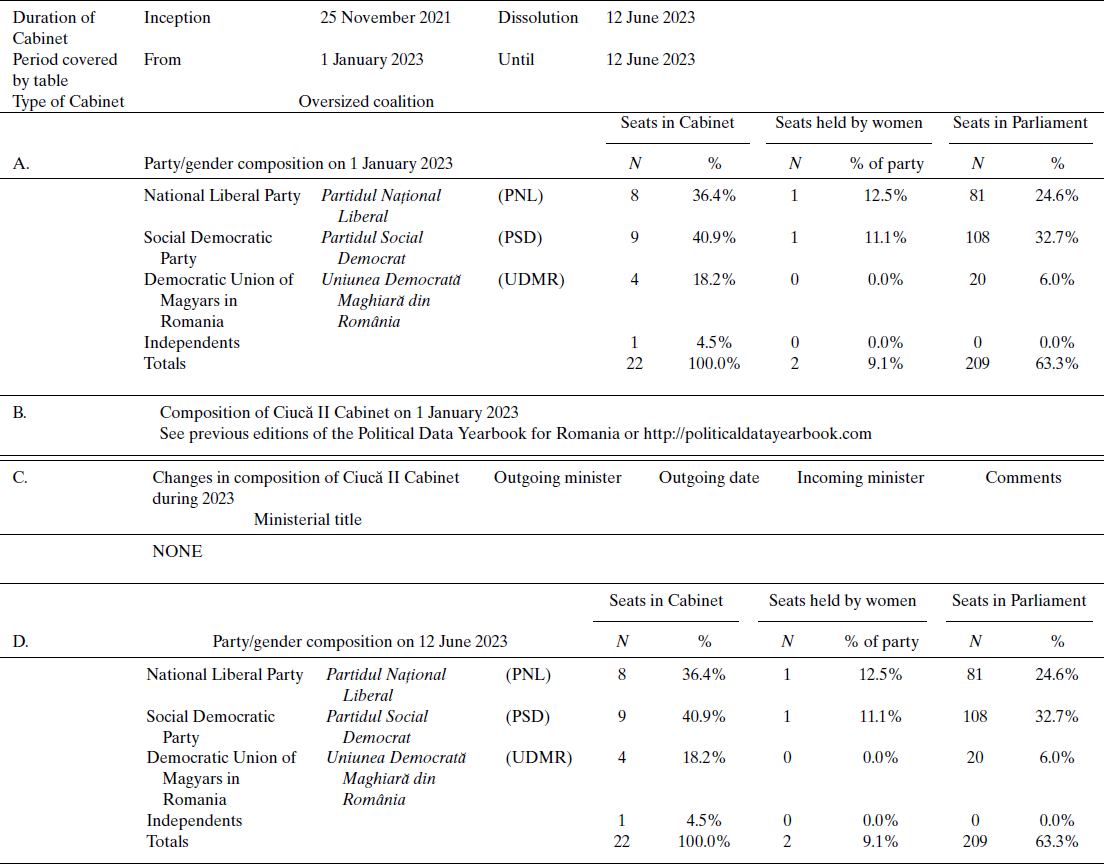
The composition of the Ciucă II Cabinet can be found in Table 1. A Cabinet reshuffle, which was initially agreed by the government parties and scheduled for 25 May, was delayed by a teachers’ strike, which started on 22 May and ended on 12 June. The strike ended after the government promised a 25 per cent salary increase starting in 2024.
Cabinet composition of Ciucă II in Romania in 2023

Sources: Camera Deputatilor website (2023) (www.cdep.ro/); Guvernul Romaniei website (2023) (https://gov.ro/ro/guvernul/cabinetul-de-ministri).
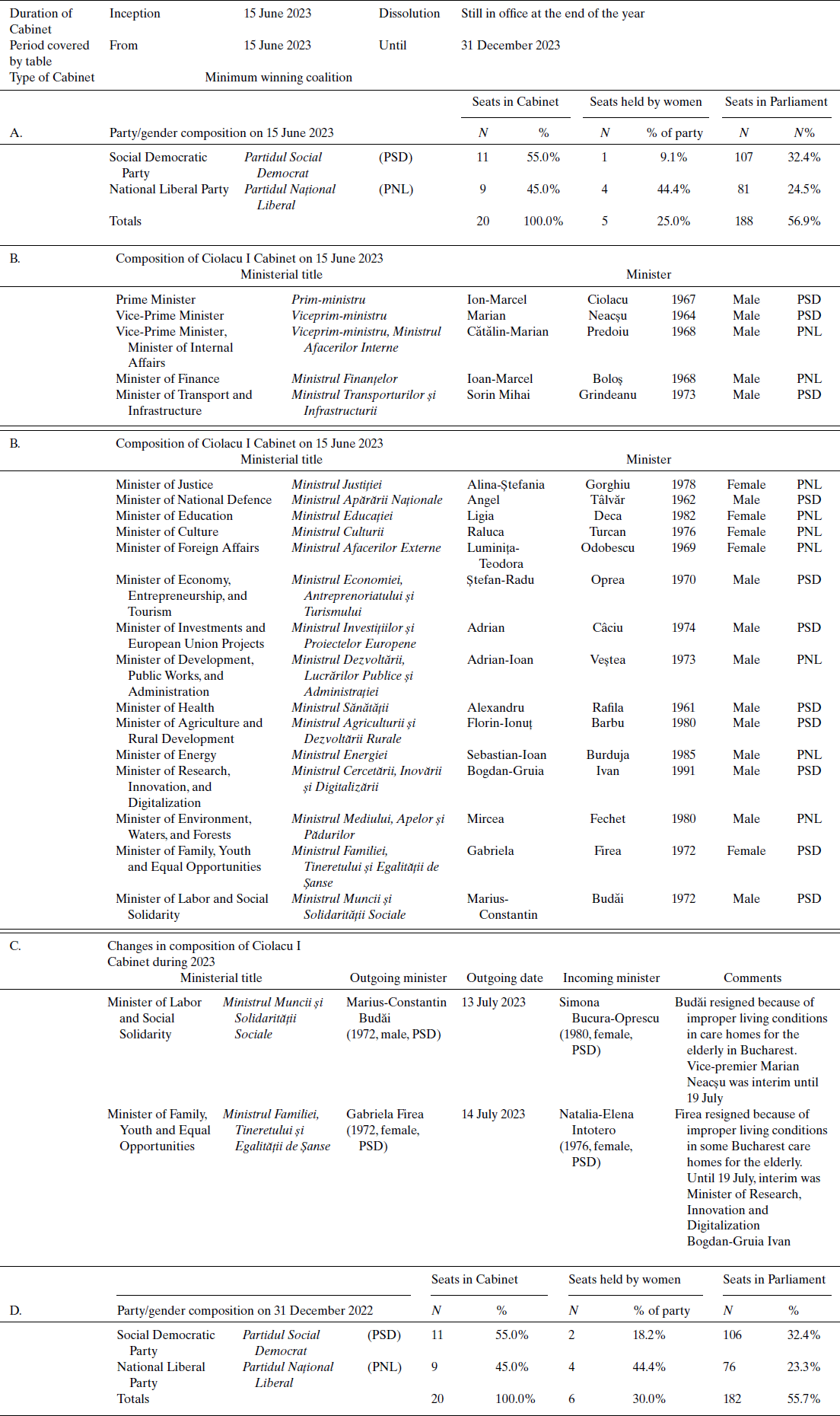
Days after the Ciolacu I Cabinet (Table 2) was sworn in, the press reported on the improper life conditions in some of the care homes for the old and disabled located in Voluntari, a town near Bucharest. As a result, two of the new ministers resigned: Minister of Labor and Social Solidarity Marius-Constantin Budăi (PSD), because his ministry failed to monitor the care homes, and Minister of Family, Youth and Equal Opportunities Gabriela Firea (PSD), because two of her friends managed a care home and her husband, the Voluntary mayor, had failed to monitor the state of care homes.
Cabinet composition of Ciolacu I in Romania in 2023

Note: Cabinet Ciucă II resigned on 12 June. Negotiations to reduce the number of Cabinet ministers from 22 to 20 and divide UDMR ministerial portfolios took three days. This is why Cabinet Ciolacu I was installed on 15 June.
Sources: Camera Deputatilor website (2023) (www.cdep.ro/); Guvernul Romaniei website (2023) (https://gov.ro/ro/guvernul/cabinetul-de-ministri).
Parliament report
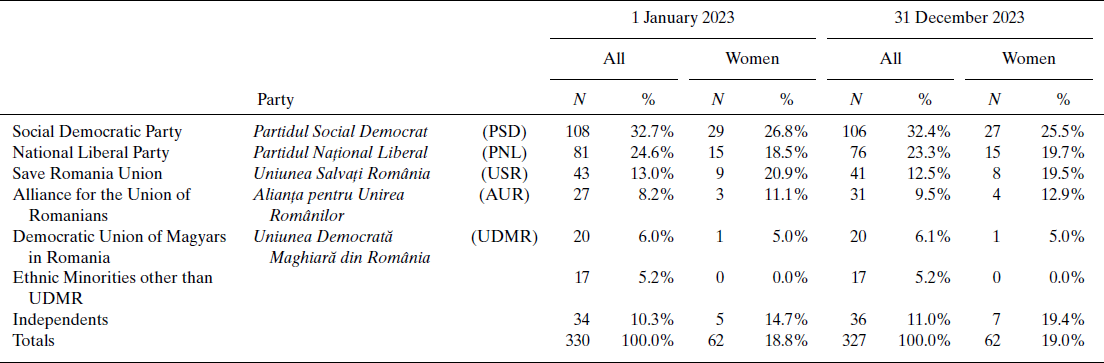
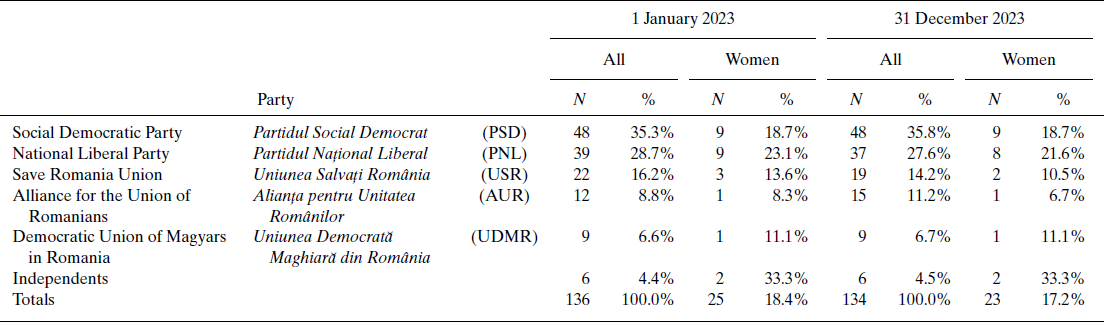
Tables 3 and 4 show information about the composition of both houses of Parliament. No significant changes took place in 2023.
Party and gender composition of the lower house of the Parliament (Camera Deputaților) in Romania in 2023

Note: On 22 December, two PNL deputies were appointed to the Board of the Financial Supervisory Authority, a position incompatible with the legislator position, and a PSD deputy was appointed general counsel in Thessaloniki (Greece). Seats unoccupied on 31 December 2023 will be allocated in 2024.
Source: Camera Deputatilor website (2023) (www.cdep.ro/).
Party and gender composition of the upper house of the Parliament (Senat) in Romania in 2023

Note: A PSD senator became vice-president of the Romanian Court of Accounts, a PNL senator became member of the Regulatory Committee of the National Authority for Monitoring the Energy Sector (ANRE, Autoritatea Națională de Reglementare în domeniul Energiei).
Source: Senatul României website (2023) (www.senat.ro/).
Political party report
On 18 December, the leaders of the USR, the Popular Movement Party, and the Force of the Right (Forţa Dreptei) formed the United Right Alliance (Alianţa Dreapta Unită) ahead of the 2024 elections, when the alliance expected to gain a significant percentage of the vote. This is not a new political party but an electoral alliance of three political parties which retain their leadership and autonomy in all other respects. At the same time, in 2023 the Alliance for the Union of Romanians (AUR) attracted legislators from other parties, and as a result, by the end of the year, it accounted for 9.5 per cent of seats in the Chamber of Deputies and 11.2 per cent of seats in the Senate, compared to 8.2 per cent and 8.8 per cent, respectively, at the beginning of the year. Note that in 2021, Senator Diana Iovanovici-Şoşoacă quit the AUR to form S.O.S. Romania, which polls suggested might pass the 5 per cent national threshold for parliamentary representation in 2024. Iovanovici-Şoşoacă is known for her pro-Russian stance and aggressive behavior.
According to a poll conducted in January 2024, one in four Romanians would support an extremist formation; AUR could garner 18.4 per cent of votes in the European Parliament Elections in 2024 and S.O.S. Romania 6.5 per cent (digi24.ro 2024a). AUR won only 9 per cent of the vote in the 2020 general elections. For presidential elections, also scheduled for 2024, the same poll ranked Iovanovici-Şoşoacă third, with 14.8 per cent of votes, and George Simion (the controversial AUR leader) sixth, with 10.4 per cent (digi24.ro 2024b).
Institutional change report
No significant changes occurred in 2023.
Issues in national politics
In 2023, important PSD leaders were accused of corruption. Dumitru Buzatu, the Vaslui County Council president, was caught accepting 1.25 million lei (250,000 euros) from a businessman seeking a public tender. After the businessman denounced him, the PSD excluded Buzatu, whereas his son, Tudor Buzatu, renounced his position as Deputy Minister in the General Secretariat of the Government. The Mioveni mayor, Ion Georgescu, was arrested for traffic of influence. He was denounced by an old friend, the head of the local police station. Georgescu requested 30,000 euros to hire the policeman's daughter at the Mioveni hospital. But he was unable to mediate that hire, and the National Anticorruption Directorate (NAD) caught him trying to return 10,000 euros. Mioveni is a wealthy town where Romania's main car manufacturing plant is located. The Baia Mare mayor, Cătălin Cherecheş, received five years in prison for taking a bribe. He fled to Hungary and then Germany but was arrested in Munich, where he still fights extradition. Politicians from other parties also got in trouble. The NAD indicted former Prime Minister Florin-Vasile Cîţu (PNL, 2020–2021), and Ministers of Health Vlad Vasile Voiculescu (PLUS) and Ioana Mihăilă (PLUS), for purchasing vaccine doses in excess of the number of people needing vaccination. The government bought 90 million doses but used only 17 million, overspending 1 billion euros (digi24.ro 2023).
Some key laws were adopted in 2023. The new education laws provided for student-focused programs to raise literacy, decrease school abandonment, and reach equality. But university presidents may complete as many as four mandates, and there are some situations of incompatibility and conflicts of interest that are left unpunished, and PhD supervisors have reduced responsibilities for detecting plagiarism in doctoral theses. The new pension law provided for a 40 per cent rise in the average pension starting in 2024 and banned early retirement before 60 years of age but continued to allow enormous “special pensions” for state dignitaries, magistrates, and army officers, among others.
Romania faced high inflation in 2023, the second highest in the European Union (at 7 per cent as compared to 3.4 per cent, respectively) (Eurostat 2024). National debt and deficit also rose, with governments being unable to remedy the economy.
Romania continued to support Ukraine. Farmers protested about the sale of Ukrainian wheat at lower prices, and as a result, the government banned its sale in Romania. At the same time, the Romanian government continued to allow Ukrainian cereals to transit to reach other markets. In 2023, President Klaus Iohannis visited 34 countries. Total expenses for these trips reached 8.2 million euros, 2.5 times the 2022 level due to the use of private planes for trips to tourist destinations.

 Open access

