


The eleventh-century Aquitanian troper-proser Pa 887 and the question of its provenance
A rich collection of tenth- and eleventh-century Aquitanian tropers was brought to the French royal library on 5 September 1730.Footnote 1 Among them was the manuscript now catalogued at the Bibliothèque nationale de France as fonds latin 887 (hereafter Pa 887).Footnote 2 Like many of those that had arrived that day from the Abbey of St Martial, Limoges, its original provenance was initially identified as the abbey itself.Footnote 3 It is true that Pa 887 has tropes and proses for two saints closely associated with the monastery: Martial and Valeria. The evidence of the extant sources seems to indicate that Valeria was honoured almost exclusively at St Martial.
Besides Pa 887, the large number of sources testifying to Valeria’s cult at the monastery of St Martial, Limoges from the tenth century onwards, are the following:
-
1. Pa 1240 (dated 923–36), Valeria’s feast is listed in the calendar (fol. 15v), in the rogation litany (fol. 32v) she appears as the first of the list of virgin martyrs, and provision is made in its abbreviated antiphoner (fol. 70r–v).Footnote 4
-
2. The early eleventh-century office antiphoner Pa 1085 provides for Valeria’s feast (fol. 7v).Footnote 5
-
3. There are calendar entries for her in two eleventh-century sacramentaries, Pa 822 (fol. 7v) and Pa 821 (fol. 5v).
-
4. There are also calendar entries for Valeria in an eleventh-century breviary fragment bound into Wo 79 (fols. 96r–97r, on which see section ‘Material from the Abbey of St Marital, Limoges’).
-
5. There is an eleventh-century Office for Valeria composed by Adémar de Chabannes, included by him in Pa 909 (fols. 79r–81v).Footnote 6
-
6. The provision of tropes to the introit in Pa 1120 (fol. 64r–64v); Pa 1084a (fol. 50r–v); Pa 909 (fols. 57v–58); and Pa 1119 (fols. 80v–81r), discussed later in section ‘Material from the Abbey of St Marital, Limoges’.
However, it is important to caution against over-reliance on extant sources. Pa 903, prepared for Saint Yrieix, includes commemoration of Valeria’s Natale in the gradual (fol. 116v), and her name appears in an introit trope for the Common of Virgins (fol. 162r). It is therefore possible that she was honoured at other centres whose witnesses are now lost to us.
Martial, by contrast, was venerated at almost all Aquitanian centres. Many liturgical manuscripts destined for use at the Abbey of St Martial in the first third of the eleventh century, a period that may have seen the production of Pa 887, were ‘corrected’ to reflect the promulgation of Martial’s apostolic status, of which Pa 887 bears no trace.Footnote 7 These two saints apart, the manuscript appears to transmit little that gives an identification of provenance. Indeed, it includes features that set it apart from all other contemporary Aquitanian sources. There are ‘northern French’ traits, some of which, but not all, are shared with Pa 1240, a manuscript prepared a full century earlier, many of whose textual and melodic readings are absent from the eleventh-century sources. At the same time, points of unique textual and melodic variance can be identified in the tropes, sequences and proses of Pa 887, and it is a repository for compositions not found elsewhere.
The manuscript is well ordered, with little correction or addition, presented in legible scribal hands, with notation that is carefully heightened and, though without staff or clef, systematically supplied with an end-of-line custos and appropriate re-heightening cues. It has been a useful source for students of the trope and prose repertories. If its provenance could be established, it would not only provide a better understanding of the interrelationship of Aquitanian tropers and prosers, but might also improve our knowledge of how these repertoires developed after their initial acquisition from northern France.
Pa 887: contents
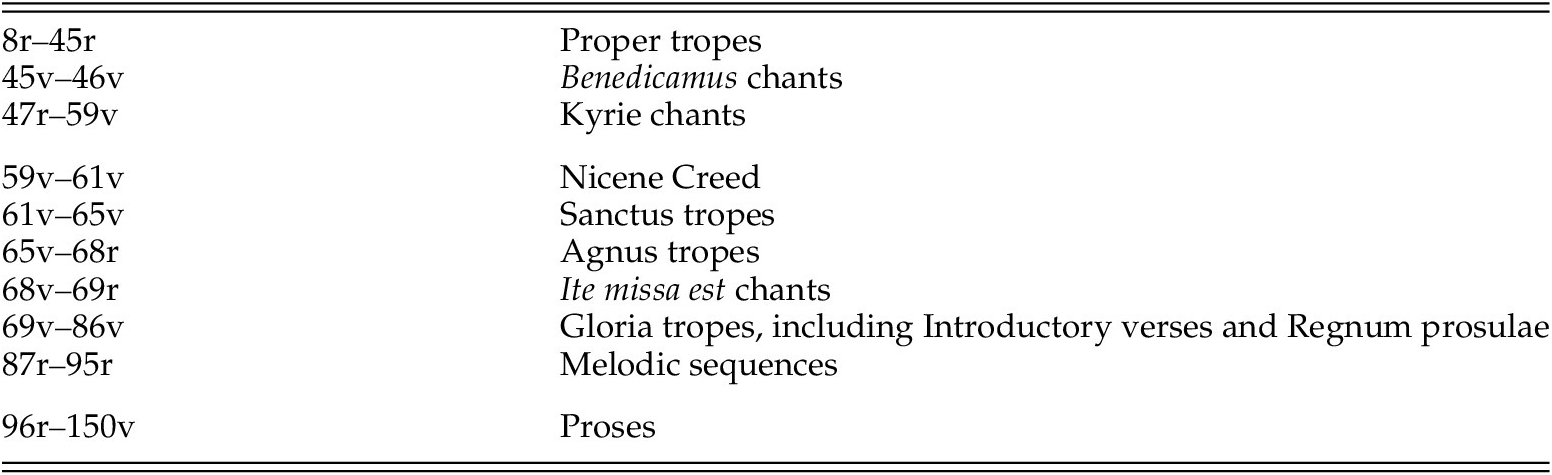
The making of Pa 887 was carried out in two stages. First came the compilation of a troper-proser, beginning on what is now fol. 8 and continuing through to fol. 150 (Table 1). In the main this comprised a series of quaternios, with new gatherings only coordinating with changes of genre twice: before the ordinary tropes (fol. 47); and before the proses (fol. 96), where a ternio (gathering 13: fols. 91–93, 93bis–95) was introduced to facilitate this. Other than these two locations, the content runs continuously across changes of gathering.
The contents of the main section of Pa 887

The presence of a collection of Benedicamus domino tropes and songs is notable: Pa 887 seems to be the earliest known source to preserve such a collection.Footnote 8 Its primary section (fols. 8–150) consists of material supporting the celebration of the Mass: ordinary chants, proper and ordinary tropes, sequences and proses. As Anne Walters Robertson has commented, the versicle Benedicamus domino was usually associated with the conclusion of the Daily Office hours, only used in the context of the Mass during penitential seasons when the Gloria was not sung, replacing the versicle Ite missa est. Footnote 9 Arlt observed that nine of the fifteen texted Benedicamus chants on fols. 45v–46v were destined for Christmas, Holy Innocents, Easter, Martial and Mary; he also remarked that the collection might be a later insertion, although script and notation were not significantly different from the surrounding material.Footnote 10 This lack of association of the texted Benedicamus chants with penitential feasts suggests that the greater part, if not all, items in the collection were destined for use at the end of the Office hours, and that – given their lack of relation to the surrounding material – they were indeed a later insertion, taking advantage of unused space at the end of gathering 6, before the ordinary tropes at the start of gathering 7. Given the similarity of script and neume hand, this addition may have been made close to the time of the main redaction.
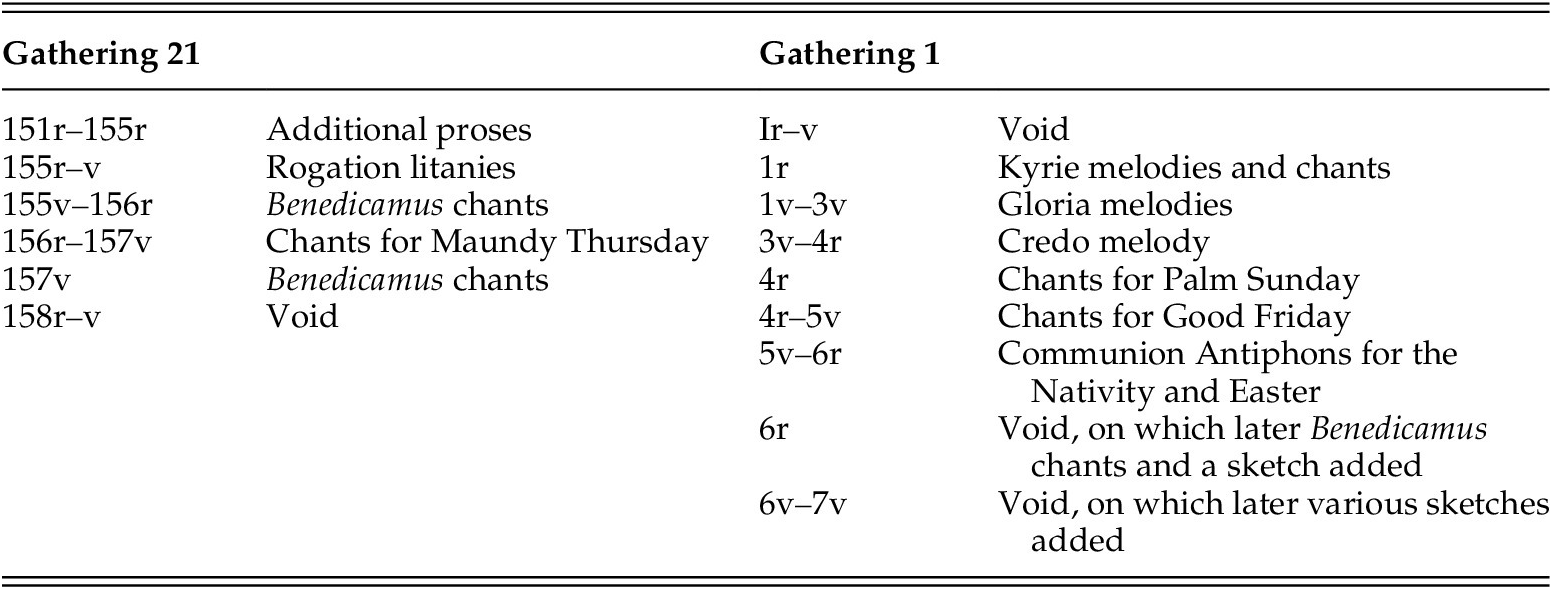
After the completion of the last prose (fols. 149v–150v), a decision was taken to expand the collection. For this second stage, two additional quires were prepared with discarded sheets from the beginning of an aborted gradual. A new scribe erased the prose on fols. 149v–150v, now no longer identifiable. Extending into one of the two new quires (gathering 21), ten additional proses were entered, followed by miscellaneous material, including the Rogation litanies and the chants for Maundy Thursday. The second quire (gathering 1) similarly had a range of appropriate chants, including the melodies that underpin the troped Glorias (Table 2).
The contents of the quires added to Pa 887

It is likely that gathering 1, when added to Pa 887, always introduced the whole manuscript rather than following on from gathering 21, despite the two quires having been prepared at the same time, from the same source material, with similar liturgical items and at least one shared scribal hand.
In its original state, the sequences finished near the bottom of fol. 94v, and the whole of fol. 95 (recto and verso) was left void. At a later date in the manuscript’s active history, the melody of Notker’s prose Sancti spiritus was entered as a sequence (on fols. 94v and 95r). Sancti spiritus had been adopted by Cluny during the abbacy of Odilo (994–1049).Footnote 11 Only after the Burgundian abbey took control of various Aquitanian monasteries, including the Abbey of St Martial in 1063,Footnote 12 did Sancti spiritus appear in the region’s surviving manuscripts. It seems probable that at the same time as the sequence melody was added to Pa 887 Notker’s prose was entered on fols. 118v–119r. To make room for it, a previous prose together with a rubric introducing Da camoena, a prose for John the Baptist, were completely erased. Sancti spiritus was entered in a hand similar to that of the sequence melody on fol. 95r–v and the rubric for Da camoena in the margin of fol. 119v, the sole occasion on which a rubric was entered in a margin, a hand that also employed a distinctive contraction for ‘Sancti’. Entered in this position, Notker’s Pentecost prose Sancti spiritus is slightly out of its correct liturgical position, following after Benedicta sit for the Trinity; suggesting that the erased text was redundant material; presumably all the other Pentecost proses were still in use.
The introduction of Sancti spiritus in Aquitaine appears to be linked to Cluny’s assuming control of several monasteries, perhaps the most significant being St Martial in Limoges. Given this, the addition in Pa 887 can probably be dated to after 1063. This may have been some time after the completion of the manuscript as a whole, since the extended prosarium in gathering 21 (fols. 151r–155r) included two texts for Pentecost, but not Sancti spiritus, which suggests that it was not available when the new gathering was prepared.
After the addition of the sequence Sancti spiritus on fol. 94v and 95r, another hand, possibly of the eleventh century, entered the Marian prose Imperatrix gloriosa (fol. 95r).Footnote 13 Elsewhere in Pa 887, various other small additions were also made at various times. During the manuscript’s subsequent history, a folio was lost (after fol. 22, the beginning of the Ascension trope series); probably four folios – the central two folds – were lost from between folios 80 and 81 (among the series of Gloria tropes); the greater part of fol. 115bis was removed (apparently a prose for Valeria); and the gathering of which it formed a part (gathering 16) became muddled (the correct order is: fols. 112–13, 115bis, 114, 115, 116–118). A section of fol. 1 and almost all of fol. 158 were also torn away. In sum, the manuscript sustained few losses and survives largely in the form originally conceived.
Relationships between the Aquitanian troper-prosers
Jacques Chailley, in his examination of the music of the Abbey of St Martial of Limoges during the ninth to the twelfth centuries and the relationships between the Aquitanian sources,Footnote 14 allocated sixteen of them to one of three groups based on the relative prominence of Saints Martial, Martin or Saturnin and the presence of other localised cults within individual sources (Table 3).Footnote 15 Another approach in establishing relationships was undertaken by Günther Weiß, through a consideration of the melodies of the Aquitanian introit tropes.Footnote 16 He also assigned the sources to one of three groups (Table 4).Footnote 17
Chailley’s grouping of the Aquitanian tropers and prosers

Weiß’s grouping of the Aquitanian tropers

Pa 887 and Apt 17 were placed in group 3, in part due the number of tropes with unique melodic readings, that is, versions that do not appear in any other southern French source: nine in Pa 887,Footnote 18 twenty-three in the case of Apt 17. Weiß noted that Pa 887 followed the melodic readings of the second group on seven occasions. However, reviewing the examples he listed, six of the seven are tropes that do not appear in any of the manuscripts in the first group (of these, three of the tropes may be linked to Pa 903, four to Pa 1118). The only authentic example where the melody of Pa 887 agrees with group 2 rather than group 1 is Cum patris dextram for the Ascension.Footnote 19
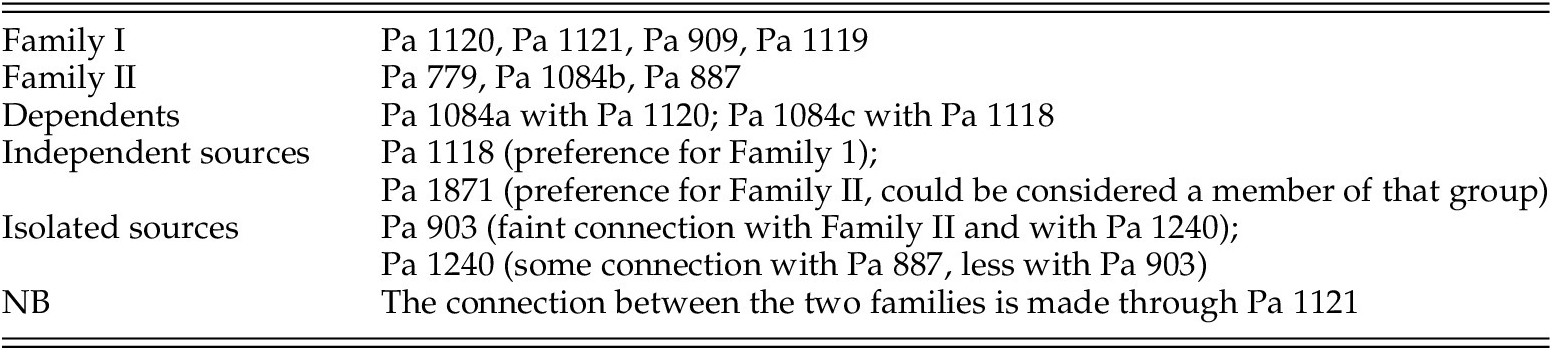
Hughes noted that Weiß’s approach was reliant on situations where two or more melodies to the same text were being transmitted.Footnote 20 He observed that there were relatively few such cases, that some manuscripts did not transmit any of them and, among those that did, a manuscript did not always fall into the same group in each case. Hughes reconsidered the interrelationships with a statistical analysis based on the content and order of the introit trope sets. As a consequence, he arrived at a somewhat different arrangement (Table 5).Footnote 21 He noted that:
A point in favour of the 887–1240 connection is provided by evidence of another type. As has been said, 1240 generally contains only fairly common tropes. It uses peripheral tropes (pieces contained in four manuscripts or fewer) only ten times in the feasts considered in this paper (unica not included). In four out of these ten cases, the trope is shared with 887 (twice these are the only two Aquitanian sources for the piece). No other source shares more than one with 1240.Footnote 22
Planchart revisited the relationship between the sources based on their trope repertoires.Footnote 23 He identified three groups, as follows:
-
1. Those clearly related to St Martial: Pa 1240, Pa 1120, Pa 1121, Pa 909, Pa 1119, Pa 1084a and the fragment Pa 1834. Footnote 24
-
2. A group he assigned to Aurillac: Pa 1084b, Pa 1084c, Pa 1871 and the fragment Pa 2826.Footnote 25
-
3. And others, also placed outside Limoges: Pa 1118, Pa 779, Pa 903 and Pa 887.
Hughes’s grouping of the Aquitanian tropers

Specifically considering Pa 887, Planchart identified similarities with Pa 903.Footnote 26 He noted that it incorporated traits that related to a northern French tradition;Footnote 27 he was highly critical of an assignment of the manuscript’s provenance to Aurillac;Footnote 28 and he was somewhat critical of the way the material of manuscript itself had been assembled.Footnote 29
Marie-Noël Colette has drawn attention to a fragment from an Aquitanian troper, brought together with other, unrelated material, in Pa 2444, fols. 5r–6v.Footnote 30 In her description and inventory of the contents, Colette dates the fragment to the end of the tenth or early eleventh century. While the provenance of the fragment is unknown, she draws parallels in the notation (evolving Aquitanian neumes) to aspects of Pa 1240 and as additions to Pa 1120. Colette also notes concordances in the chants included – texted Kyries and Sanctus tropes – with Pa 887, including a textual variant. These concordances are possibly symptoms of sources accessing an Aquitanian repertoire related to practice at St Martial.
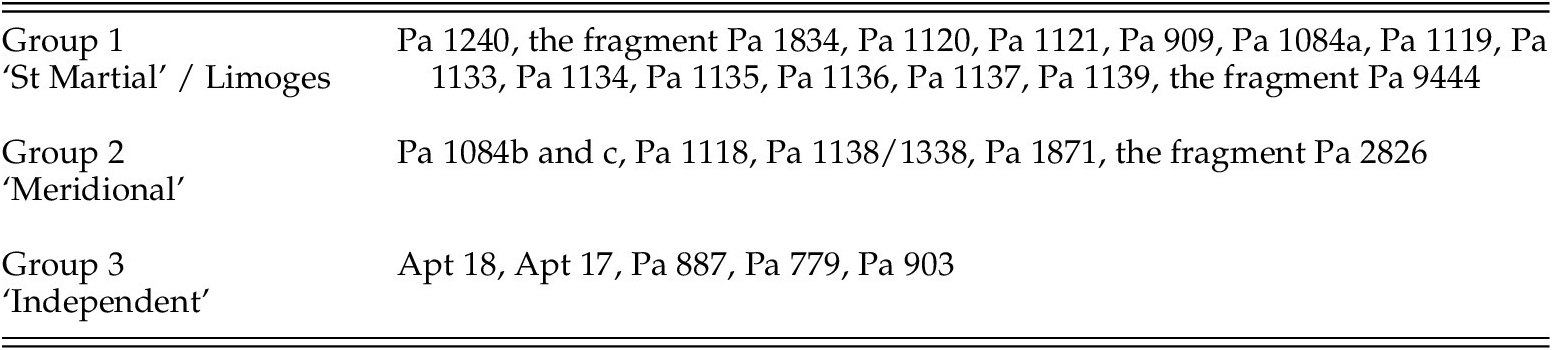
Taking into account the various ways in which Chailley, Weiß, Hughes and Planchart have related the Aquitanian tropers to one another, for the purposes of this study the manuscripts are grouped as in Table 6. The sources in the ‘Meridional’ group show similarities in their repertoire and textual and melodic readings. Each of the sources in the ‘Independent’ group is inconsistent in its association with the manuscripts in either of the other two groups.
New grouping of the Aquitanian tropers and prosers

The distinctive characteristics of Pa 887
As the contents of the individual tropers and prosers have become better understood, the placement of Pa 887 within those of tenth- and eleventh-century Aquitaine has seemed increasingly problematic. Its distinctive repertory can be characterised by at least five features: (1) a unique relationship with Pa 1240; (2) the inclusion of elements that have links with northern France, not all of which can be accounted for through shared material with Pa 1240;Footnote 31 (3) material that has clearly been derived from the repertory at the Abbey of St Martial, Limoges; (4) at the same time, concordances within Aquitaine with sources from the meridional group of manuscripts; and (5) material unique to Pa 887.
Material that is uniquely common to Pa 887 and Pa 1240
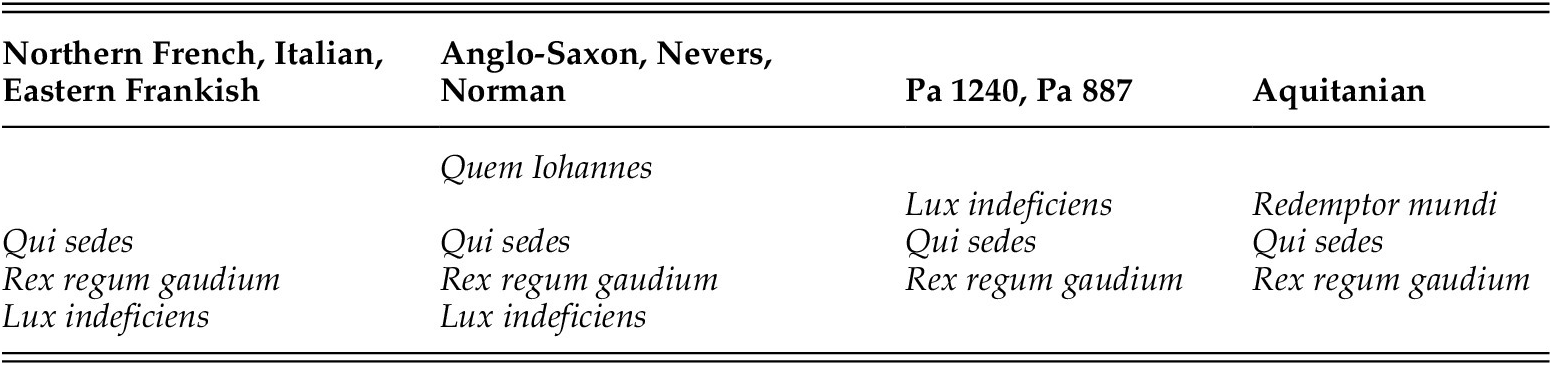
Among the examples compiled by Hughes, he pinpointed two found only in Pa 1240 and Pa 887. (Several more have been identified and considered elsewhere in some detail.Footnote 32) One example is the Agnus trope for the Third Mass of the Nativity, Qui sedes ad dexteram. Footnote 33 The extant sources from northern France, northern Italy and eastern Francia point to a three-element structure: Qui sedes / Rex regum / Lux indeficiens (Table 7).
The structural arrangement of the Agnus trope Qui sedes ad dexteram

This arrangement appears to have been altered after the chant’s arrival in southern France: when recorded in Pa 1240 (fol. 19v), Lux indeficiens was repositioned so as to open the trope set, an arrangement found elsewhere only in Pa 887 (fol. 67r). For the copyist of Pa 1240, Lux indeficiens was something novel, since he wrote it out in full, while the other two elements were given as incipits. Its opening position may have been occasioned by its Nativity placement: a desire to contextualise the Agnus trope through its reference to the ‘unfailing light of peace’. In later Aquitanian practice, Redemptor mundi replaced Lux indeficiens, and this change was indicated by a marginal addition in Pa 1240. Pa 887 transmits the trope in the arrangement as it was first copied into Pa 1240.
Another example of the interrelationship between Pa 887 and Pa 1240 can be seen in the Dedication introit trope Hic pia / trina sonat. Footnote 34 Its distribution is restricted to Aquitanian sources. In Pa 1240 (fol. 37r), it is given without notation as a single element prefacing the introit Terribilis in Pa 1240 (fol. 37r) with the reading
Hic pia sonat deitas una que potestas: TERRIBILIS
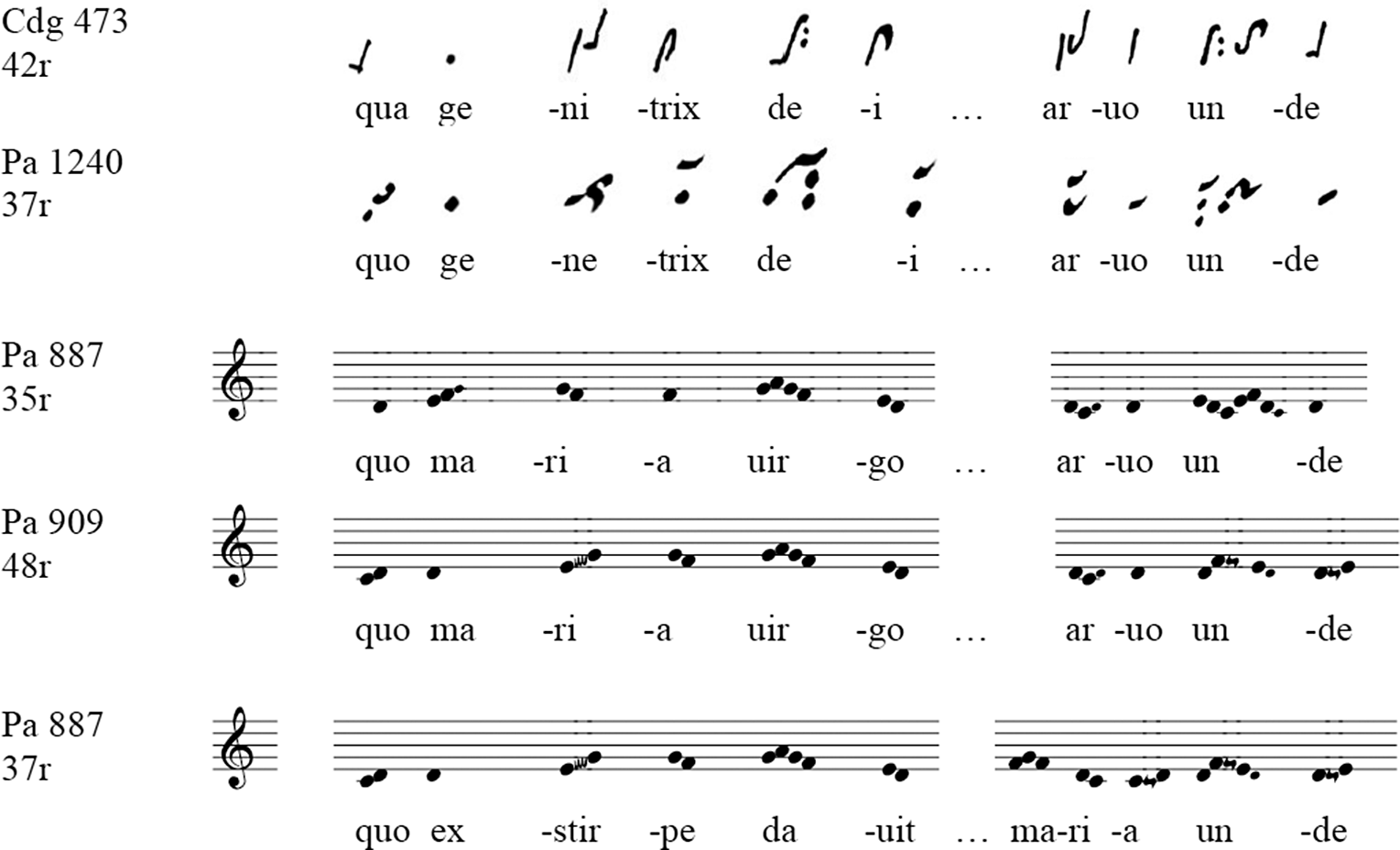
The text is written out with a significant gap after the first syllable of deitas. In Pa 887 (fols. 24r–v), the element is followed by the three standard Aquitanian internal elements (Nectare dulcedinis / Lumine lustrate piorum / Per quam Christicolae). However, it reproduces the same textual reading as Pa 1240, including an extended melisma on de(itas) not found in the other manuscripts. The text scribe of Pa 887, though conscious of the reading pia sonat, appeared unaware of the melisma on de(itas), leaving no space for its entry. The neume scribe, on entering the melody, was forced to reposition the final two syllables; he also misjudged the intervals between the pes stratus and the first climacus (Example 1).
The element Hic pia / trina sonat (images from https://gallica.bnf.fr).

Northern French aspects
As discussed in the previous section, the manner of presenting the Agnus trope Lux indeficiens in both Pa 1240 and Pa 887 reflects a northern French influence. This influence can also be seen in a Marian introit trope set, introduced with the element Fulget nempe dies and employed for both the Assumption and the Nativity of the Virgin.Footnote 35
Fulget nempe dies is found in variant textual readings. The older and more widely dispersed version is:
Fulget nempe dies cunctis veneranda per orbem,
qua genitrix dei caelos penetravit ab arvo. (CT IX, 49a)
For the Nativity of the Virgin, and almost certainly – given its distribution – of Aquitanian origin, it reads:
Fulget nempe dies cunctis veneranda per orbem,
qua ex stirpe David virgo processit Maria unde. (CT IX, 49b)
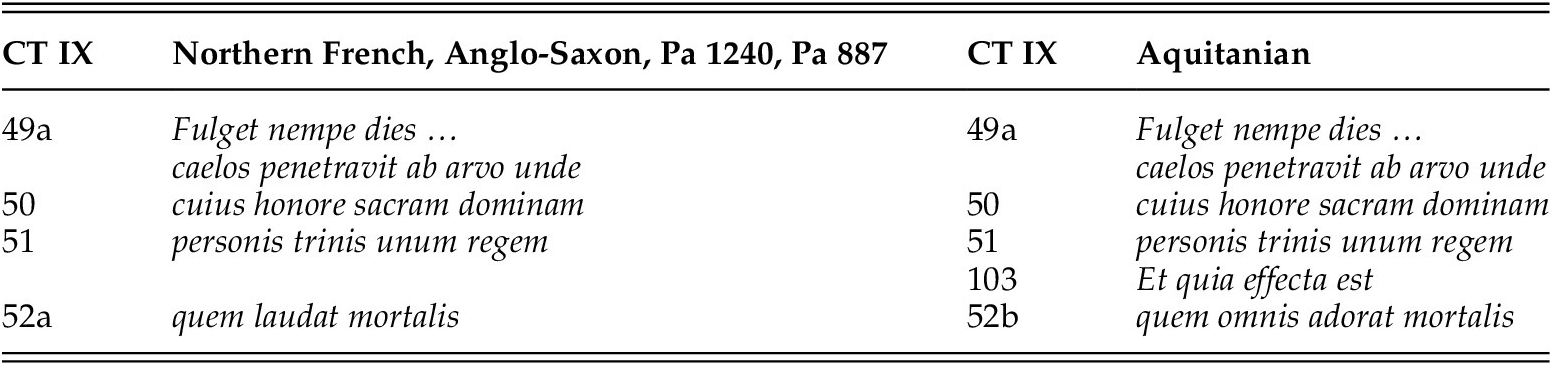
In the transmission of the introit trope set, several northern French aspects can be identified.Footnote 36 As a trope for the Assumption, in Pa 1240 (fol. 37r), Pa 887 (fol. 35r) and a group of French and Anglo-Saxon sources – Vat 222 (fol. 95v), Pa 13252 (fol. 13v), Apt 18 (fol. 69r),Footnote 37 Cdg 473 (fol. 42r) and Ox 775 (fol. 49v) – this takes the form of a four-element set. It is later expanded in Aquitaine by the addition of the verse Et quia effecta est to form a five-element set (Table 8). Both Pa 1240 and Pa 887 retain the older northern French four-element structure, including the textual reading for the last element (quem laudat mortalis et omnia numina sursum, CT XI, 52a) rather than a revised text found in the Aquitanian sources (quem omnis adorat mortalis et omnia numina sursum, CT IX, 52b).
The structural arrangement of the Assumption introit trope Fulget nempe dies

In the text of the first element, Fulget nempe dies (CT IX, 59a) Cdg 473 has qua genetrix dei, the northern French reading. However, Pa 887 follows an Aquitanian revision at this point, replacing genetrix dei with Maria virgo. Footnote 38 Possibly this use of the Aquitanian wording in Pa 887 was unexpected, causing the neume scribe of Pa 887 to falter, omitting the pes on quo and consequently forced to realign the melody over Maria: an error that was not made when entering the Aquitanian adaptation for the Nativity of the Virgin (fol. 37r; Example 2).Footnote 39 On the last word of the element (unde, CT IX, 59a), both Pa 1240 and Pa 887 transmit the northern French melodic configuration.
Textual and melodic variants in Fulget nempe dies.

Further evidence for the reception of the revised southern French trope repertory at the Pa 887 centre, while at the same time a desire to retain aspects of the older northern French repertoire, can be seen in the introit trope for St Stephen, Clamat hians (Table 9).Footnote 40 The three-element set beginning Miles ovans (first column) was received from the north.Footnote 41 In the south (second and third columns) the first element was revised:

The structural arrangements of the introit trope Miles ovans / Clamat hians

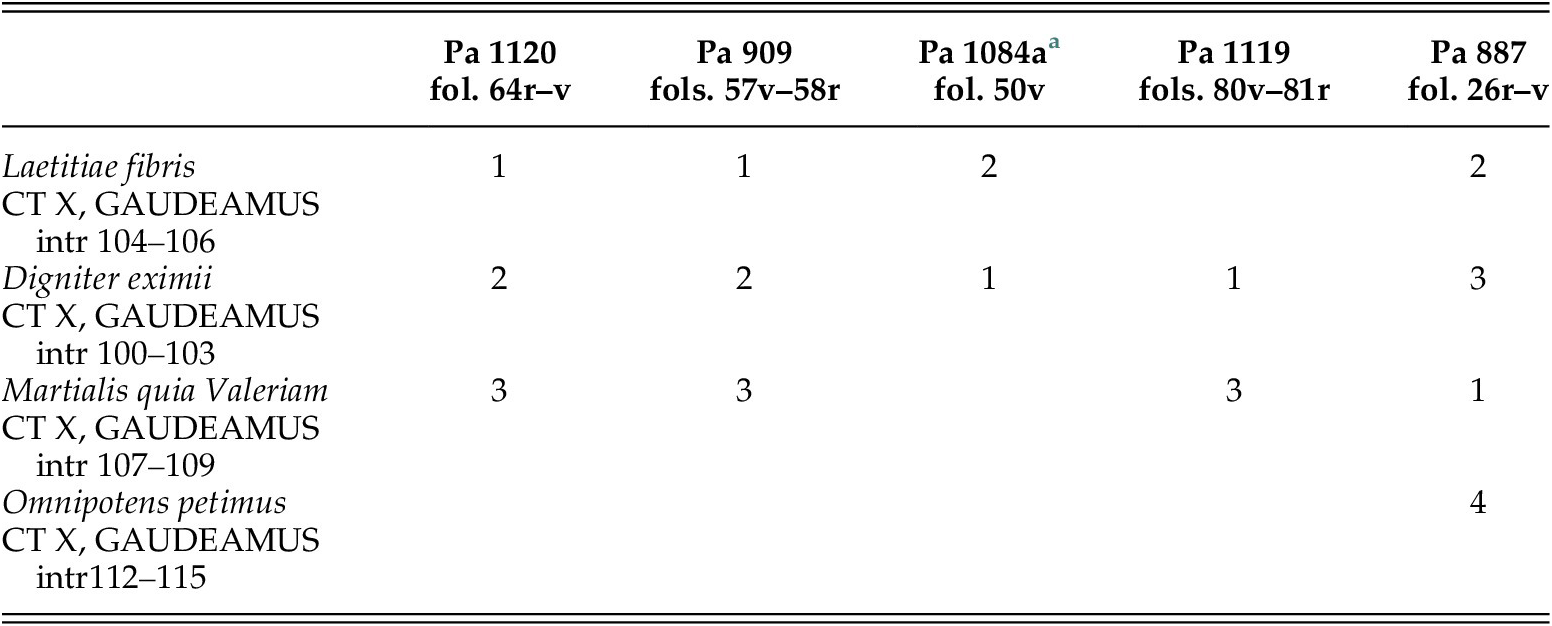
The ordering of the introit tropes for Saint Valeria

a In Pa 1084a, the St Martial supplement to the manuscript, the scribe first entered the element Laetitiae fibris at the bottom of fol. 50r. He abandoned this without providing the initial letter. The trope sets Digniter eximii and Laetitiae fibris were then supplied complete on fol. 50v. As with the majority of tropes in this supplement, these lack notation.
The second and third elements were left unaltered.
The revision had already been carried out by the time Pa 1240 (fol. 20r) was prepared. During the tenth century, the set was expanded in southern France with the addition of Dum tuus in tanto. This expanded version appeared in Pa 887 (fol. 13r). Possibly prior to the manuscript’s production, Miles ovans with its two northern French internal verses had been sung. There followed the reception of the revised Clamat hians at the Pa 887 centre. However, there was a desire to retain the older Miles ovans, or at least as much of it that fitted the revised melody. This too was therefore copied into Pa 887 (fol. 13v), but with a group of three unique elements newly composed for the internal troping.Footnote 42 The original internal elements had already been included with the revised Clamat hians.
Material from the Abbey of St Martial, Limoges
It has been ascertained that Pa 887 retained material that can be traced back at least a century, and subsequently almost completely edited out of the Aquitanian trope and prose repertory of the late tenth and the eleventh centuries. Nevertheless, as in the case of Clamat hians, the centre for which Pa 887 was produced obtained much new material from the Abbey of St Martial. This can be observed in the prose Exsultet nunc omnes, and also in a cycle of introit tropes for Valeria.
The melody for the prose Exsultet nunc omnes (fol. 139r) can be dated back to at least the ninth century. This is evidenced by its use with the text Gaude Maria virgo, included by Notker in his Liber Ymnorum for the Octave of the Nativity.Footnote 43 And in Beata tu virgo, present c.900 in Mü 14843 (fol. 101r) from Toul.Footnote 44 Gaude Maria virgo never found its way to Aquitaine, but Beata tu virgo had been collected by the omnivorous scribe of Pa 1118 before the end of the tenth century and was later to reappear in Pa 1871. The melody was best known in Aquitaine associated with two proses: Haec est vera Footnote 45 and Exsultet nunc omnes. Footnote 46 A feature in the transmission of these two proses – the composition of which can probably be dated to the middle years of the tenth century – was the manner of their distribution within the southern French sources. Haec est vera only circulated among the meridional manuscripts: Pa 1118, Pa 1084, Pa 1138/1338 (old series),Footnote 47 Pa 1871, Pa 778 (later erased) and Apt 18. By contrast, Exsultet nunc omnes was almost exclusively centred on St Martial: Pa 1120, Pa 1119, Pa 1136, Pa 1137, Pa 1132 and Pa 1139. Probably from there it was transmitted to Nevers (Pa 9449, Pa 1235 and Pa 3126). Given the clear divide in the circulation of these two proses, the Pa 887 centre must have obtained Exsultet nunc omnes from St Martial, Limoges.
A similar reliance on the Abbey of St Martial for material – and a significant one in relation to the provenance of Pa 887 – is found in the proper tropes for Valeria. Section 1 demonstrated that, in respect to saints Martial and Valeria, closely associated with the Abbey of St Martial, Limoges, the cult of Valeria was largely restricted to that abbey, visible in calendars and liturgical books (breviaries, tropers, sequenciaries and prosers). This notwithstanding the commemoration of Valeria’s Natale in the Gradual from Saint Yrieix (Pa 903, fol. 116v), and her name in a trope for the Common of Virgin Martyrs (Pa 903, fol. 162r). The review in section 1 deliberately excluded Pa 887. Among the contents of Pa 887, Valeria is provided with proper tropes, sequences and proses. The proper tropes are all for the introit. The lack of proper tropes to the offertory or communion possibly reflects Valeria’s lower status compared with Martial’s, for whose feast days these Mass antiphons were also troped.Footnote 48
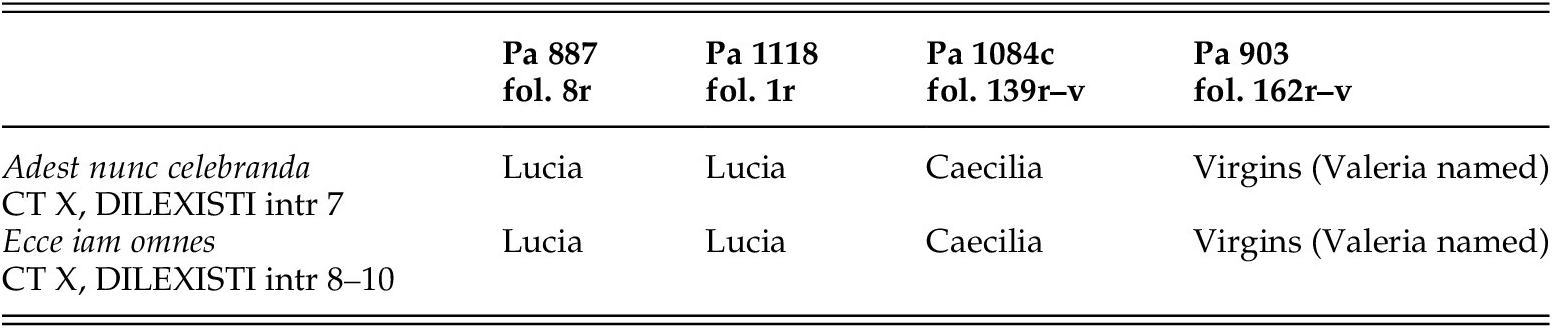
The order of Valeria’s introit tropes in the St Martial manuscripts, including those acquired by the abbey and subsequently altered to bring them in line with St Martial practice, together with those in Pa 887, are identified in Table 10.Footnote 49 Apart from Pa 887, with the single exception in Pa 903 previously identified, tropes for Valeria are only found in a small group of four manuscripts all directly attributed to St Martial. Valeria’s Natale (on 10 December)Footnote 50 was provided with three sets in the earliest source, Pa 1120, and all of these were included in Pa 909.Footnote 51 However, only two were added to Pa 1084 when it entered the Abbey; the scribe of Pa 1119 likewise reduced the number, though omitting Laetitiae fibris rather than Martialis quia Valeriam. While Pa 887 utilised the series found in the St Martial books, the order was rearranged, placing Martialis qui Valeriam first. In Martial’s Vita, he is responsible for Valeria’s conversion to Christianity.Footnote 52 It may have been felt that citing Martial at the beginning of the whole introit complex – before the enumeration of the martyr Valeria’s virtues – established a historical narrative. Uniquely, Pa 887 also extended the length of the introit chant by incorporating the trope element Omnipotens petimus, found in a number of different contexts, as a fourth troping.Footnote 53
Material from meridional sources
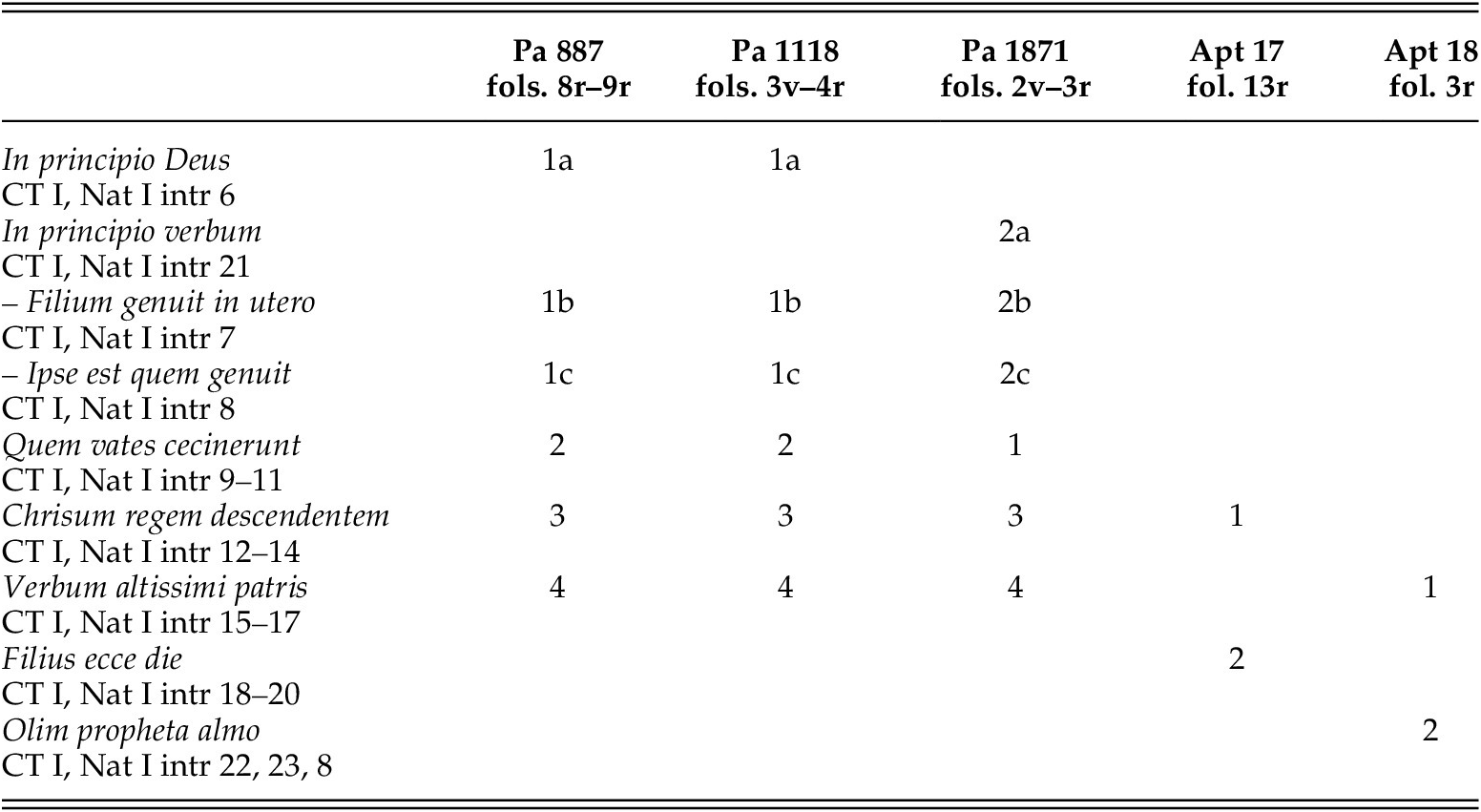
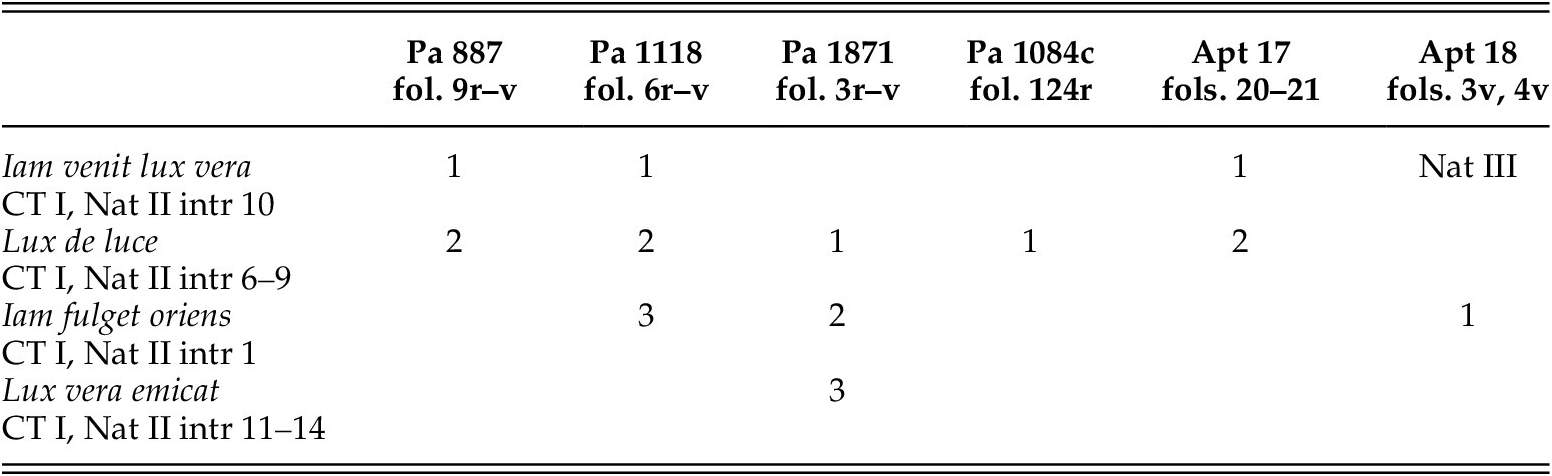
The cycle of proper tropes in Pa 887 opens with proper tropes for Saint Lucia, and the First and the Second Mass of the Nativity. There are no extant Mass antiphoners from St Martial prior to Pa 1132 of the late eleventh century, produced some time after Cluny took control of the abbey, and in which all three Mass propers are included.Footnote 54 However, we can be confident that Masses on all three occasions were observed with the appropriate proper chants at St Martial prior to that time: they were embedded in all Hesbert’s Mass antiphoners, and in the early Aquitanian source from Albi (Albi 44) and the gradual from Saint Yrieix (Pa 903).Footnote 55 None of the abbey’s tropers included any proper tropes for use on these three occasions. When Pa 1084b entered St Martial, early in the eleventh century,Footnote 56 it contained in its first supplement (Pa 1084c) introit tropes for the Second Mass of the Nativity. No attempt was made to add introit tropes for either Lucia or for the First Mass of the Nativity in the St Martial supplement (Pa 1084a); these tropes for the Second Mass of the Nativity almost certainly became redundant on entry to the abbey. To explore the possible source of the introit tropes for Lucia and the First and the Second Mass of the Nativity in Pa 887, Tables 11, 12 and 13 present all Aquitanian concordances for these proper tropes.Footnote 57
Aquitanian introit tropes for Saint Lucia

Aquitanian introit tropes for the First Mass of the Nativity

Aquitanian introit tropes for the Second Mass of the Nativity

Pa 887 concludes the series of tropes for Lucia with a melisma on the Amen of the doxology.Footnote 58 At St Martial, melismas on the Amen were confined to the introit Suscepimus for the Purification, and as part of the melodically elaborated introit Nunc scio for Peter. Also at St Martial, a melisma was supplied on the concluding meum of the introit verse Domine probasti me when used with Nunc scio; and the melismas associated with the Easter introit Resurrexi were added to Pa 1240. The specific melisma found with the introit Dilexisti for Lucia in Pa 887 can be found associated with introits or included in tonaries in Pa 780, Pa 1118, Pa 776, Pa 903 and Pa 780: it was therefore well represented in the meridional sources but absent from St Martial.
A feature of both Tables 11 and 12 is that Pa 887 and Pa 1118 match each other in content and ordering. This close relationship is sustained in the introit tropes for the Second Mass of the Nativity (Table 13). For Nativity II, there appears to have been a core troping (Lux de luce), preceded in Pa 887, Pa 1118 and Apt 17 with an extended versus ante officium, namely Iam venit lux vera (assigned to Nativity III in the earlier Apt 18).Footnote 59 Iam fulget oriens was included in Pa 1118, Pa 1871 and Apt 18, while Pa 1871 added a further complete troping of the introit.Footnote 60
The close relationship between Pa 887 and Pa 1118 becomes even more evident when the texts of Iam venit lux from the different manuscripts are compared (Table 14). Its presence in the extant sources reflects limited transmission within Aquitaine and northern Italy. The closest parallels to Pa 887 are in Pa 1118, Apt 18 and Pst 121; however, Apt 18 has undergone adaptation for use at the Third Mass of the Nativity and Pst 121 is from Pistoia in northern Italy. Only Pa 1118 and Pa 887 include the phrase ‘lux fulgebit et filius dei eia’.
The versus ante officium Iam venit lux vera

a lux fulgebit– eia: omitted Pst 121; s.n. Pa 887.
It would appear, therefore, that the trope series of all three feasts at the start of Pa 887 were acquired from a source external to St Martial, either Pa 1118 itself or one very similar. There is evidence that, despite having been prepared during the last two decades of the tenth century, Pa 1118 had already been acquired by the Abbey of St Martial by the second decade of the eleventh.Footnote 61 In all likelihood, the compiler of Pa 887 – in preparing the manuscript – drew directly on Pa 1118 for the modest series of tropes for Lucia, Nativity I and Nativity II before turning to an existing repertoire predicated on that of St Martial for Nativity III. Thus, for these feasts at least, there was no direct link with a meridional centre.
As stated earlier, when Weiß considered those introit tropes texts with more than one melody, he isolated seven examples in Pa 887 where the melody it transmitted was congruent with the meridional group of manuscripts. When these cases were considered in more detail, it was found that in all but one case, the tropes concerned did not feature in any St Martial source. Only Cum patris dextram for the Ascension had two melodies, one used at St Martial, the other in the meridional sources, with Pa 887 employing the melody associated with the meridional group.
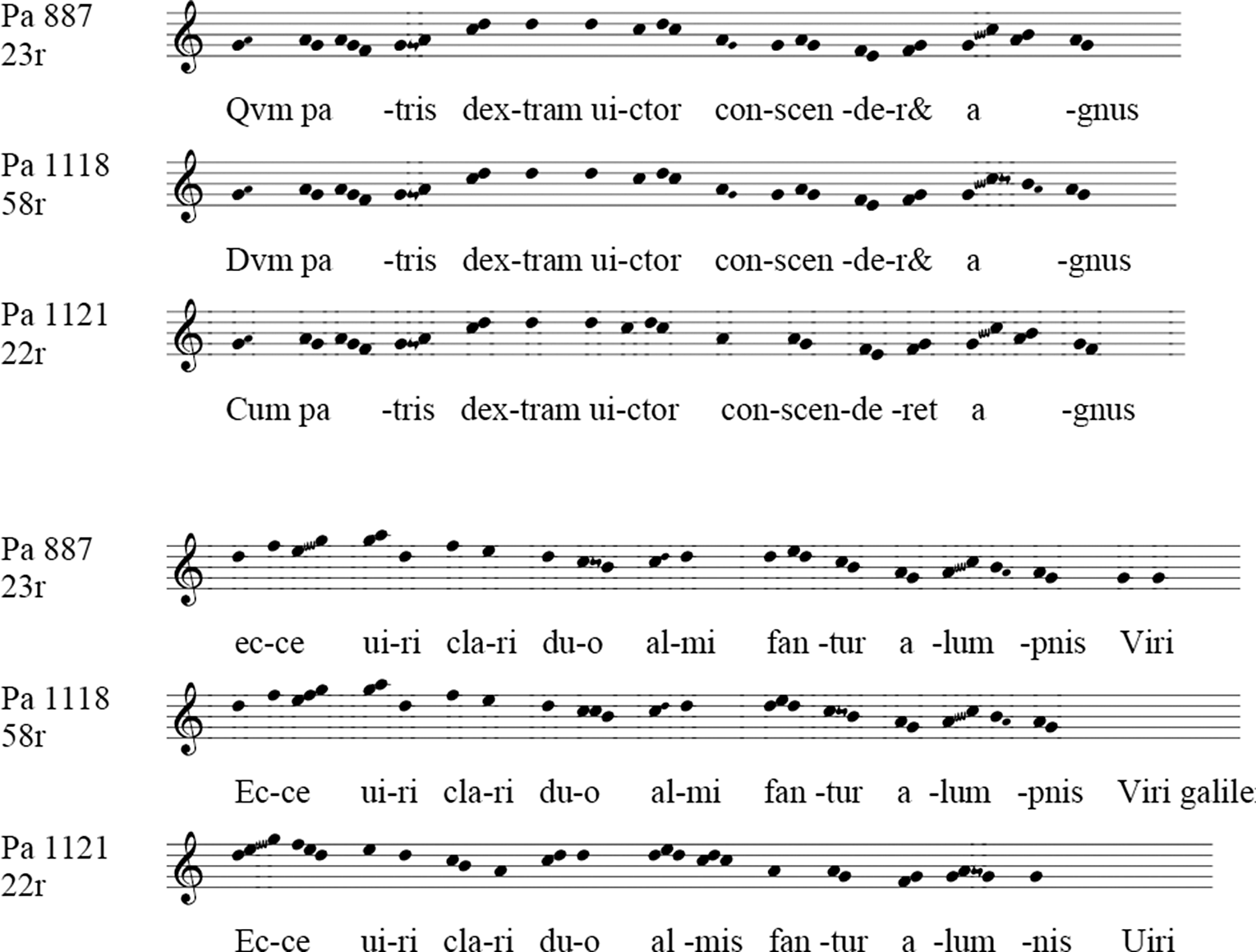
When the two melodies of Cum patris dextram are compared, it is evident that they are effectively the same; one is a variant of the other (Example 3).Footnote 62 In the first half, the melodies are almost identical; in the second, the melody over ‘Ecce’ differs, the correspondence between text and melody diverges, and a simpler final cadence is provided in the St Martial sources. A similar process of variant versions of a common melody is also found in the two internal trope elements. All sources employing the melody given earlier from Pa 1121 are from a single centre, St Martial, whereas those following Pa 1118 come from a number of different locations. This suggests that the original form of the melody may have been that given in Pa 1118 – subsequently revised at St Martial – prior to be being copied into the early fragment Pa 1834, a source which pre-dates Pa 1120.Footnote 63
Melodies for Cum patris dextram.

As shown in Example 3, Pa 887 follows the melody in the meridional source Pa 1118. This could imply that the Pa 887 compiler was drawing on a meridional recension. However, that seems unlikely. Evident in both the text and the melody of Pa 887 are traits that can be traced to St Martial: the reading Cum is found in all the St Martial manuscripts, but none of the meridional; the St Martial variant in the cadence on ag(nus) (G~cabaG) with the upward moving ab is present in all the St Martial sources; and there is disagreement between the meridional sources at this point, the most convincing being the downward moving ba in Pa 1118, Apt 17 and Pa 1084 (G~c~ba aG). A likely scenario is that Cum patris dextram was acquired early at the Pa 887 centre, along with other material from St Martial. This version was retained when Cum patris dextram was revised at St Martial, sometime towards the end of the tenth century. Such an interpretation would agree with the tendency for the Pa 887 centre to retain older, established textual and melodic readings. Overall, it may be stated that the meridional influence in Pa 887 can be explained by direct copying from sources in the library at St Martial, Limoges, or by transmission from St Martial prior to subsequent revision at the abbey.
Content unique to Pa 887
There are a number of unique texts and melodies in Pa 887. In the preceding review, the composition of three new internal elements to accompany the northern French Miles ovans was noted (see Table 9); and two proses to be considered later (see section ‘Saint Valeria, Chambon, and the Provenance of Pa 887’), Laude digna and a second beginning ‘P’, are unique contrafacta.
Reflecting on the preceding material, it seems clear that the centre for which Pa 887 was produced retained elements in both its tropes and its proses that dated back to an early stage in the reception of material from northern France. It also benefitted from the injection from the Abbey of St Martial of newer Aquitanian compositions as they were being produced. The Pa 887 centre itself retained capable musicians who, either when the manuscript was produced or earlier in the community’s history, were also able to contribute to the expansion of the repertoire. In this, and in the adoption of feasts that were not furnished with tropes at St Martial, a significant degree of independence is evident. All this contributed to a manuscript whose contents do not correspond to the liturgical practice of any other known Aquitanian source.
Theories of provenance for Pa 887
The early modern references to Pa 887 referred to it as originating at the Abbey of St Martial, Limoges.Footnote 64 By volume 46 of Analecta Hynmica, the editors tentatively assigned it to the nearby monastery of St Martin, Limoges, though their reasoning was not made clear; it may have related to an insufficient prominence of Martial over Martin. Chailley, after discussing the provision in the manuscript for both Martial and Martin, and the various indications of a Limoges origin – with special honour to Lucia, Valeria and Vincent and to Stephen, the dedicatee of the cathedral – endorsed the St Martin provenance.Footnote 65
The Abbey of St Martin, Limoges, was founded in the seventh century by Alicius, brother of Saint Eloi, and dedicated in 647.Footnote 66 Much of its early history is unknown, but what can be determined is that by the end of the tenth century it had ceased to be an active monastic community. The situation was remedied in 1012 when it was re-founded by Hilduin, bishop of Limoges and brother of the abbot of St Martial, Godefroy.Footnote 67 It may well be that this revival would have required the provision of new service books, including a troper-proser, from the scriptorium of St Martial, just a short distance away. But these books would necessarily have reflected current practice at St Martial in the eleventh century. To produce a manuscript such as Pa 887, with its highly idiosyncratic content, would have necessitated drawing on the practices and collective memory of a community that had remained active during the course of the tenth century. Such a resource was available neither at St Martial, which – on the evidence of Pa 1120 and later sources – had by the start of the new millennium adopted a revised Aquitanian recension, nor at St Martin, where continuity of practice had broken down. Indeed, with an active scriptorium and strong musical tradition, the Abbey of St Martial would have had a pervasive influence on liturgical chant on all the religious communities in Limoges.
Heinrich Husmann noted in both the troper and the proser of Pa 887 the presence of Martial and Valeria, saints especially honoured at the Abbey of St Martial.Footnote 68 However, he argued that the presence of neither saint precluded use elsewhere. He then commented that ‘closer examination of the repertoire’ showed a relationship with Pa 1084 and Pa 1871 ‘often down to the smallest details’, and that, as these two manuscripts also honoured Gerald of Aurillac, they were therefore written for Aurillac. Husmann went on to reason that, as Pa 887 included tropes for Peter and Clement – the two patrons of the monastery at Aurillac, later to be joined by Gerald as a third – it was prepared for Aurillac, based on material inherited from St Martial prior to the emergence of the more developed repertoire exhibited by Pa 1084 and Pa 1871.
This assignment of Pa 887 to Aurillac has proved a difficult one to reject, coming as it did from a distinguished scholar, despite being roundly criticised by Planchart.Footnote 69 Dufour demonstrated that Pa 1871 emerged from the scriptorium at Moissac, and the material in the manuscript marks out special commemoration of Peter as that Abbey’s patron.Footnote 70 The primary layer of Pa 1084 has no indication of provenance; it is only in the first addition (Pa 1084c, fol. 138v–139) that there is specific commemoration of Gerald.Footnote 71 The most secure identification of an Aurillac manuscript would appear to be the fragment Pa 2826. Planchart, in his study of that source, sought to show how Pa 887 was unrelated to practice at Aurillac.Footnote 72 What Husmann was possibly observing in the ‘smallest details’ was the close relationship between the meridional sources: Pa 1118, Pa 1084, Pa 1871 and also, for the proser, Pa 1138/1338.
In conclusion, neither St Martin, Limoges nor the monastery at Aurillac provide a suitable place of origin for Pa 887. As shown earlier, it is a manuscript that in many respects corresponds to practice at St Martial. Yet Pa 887 maintains a trope and prose tradition that, in part, reflects obsolete practice current more than a century prior to its production, and which exhibits a degree of independence incompatible with practice at the Abbey of St Martial.
Saint Valeria and Chambon
Sometime after 985, and before the mid-1030s, a sermon was preached at the priory at Chambon (now Chambon-sur-Voueize). This priory, a hundred or so kilometres northeast of Limoges, had been founded by the second abbot of St Martial, Abbo, around 857, and remained one of its possessions.Footnote 73 The sermon was later recorded in a book containing, among other writings, a small collection of saints’ lives.Footnote 74 The preacher relates how, sometime before 985, the body of Valeria was moved to Chambon from the crypt in Limoges in which Martial was also buried:
The grace of Almighty God wrought many and innumerable miracles in the church in which the most sacred body of the most blessed virgin Valeria had been buried; but since the most blessed Apostle Martial had commanded himself to be buried in the same place, through his merits, quite rightly, these were attributed to him…
But after the body of the most holy virgin had been brought here, certain things happened which seem worthy of report.Footnote 75
The one fixed date for a translation given in the sermon, 985, was related to the ‘certain things’ that occurred ‘after the body had been brought here’. Through his systematic use of ‘we’, the preacher places himself as witness to the moving of Valeria’s body within the priory that year. From what the preacher says, it seems Valeria’s body had been transferred to Chambon because miracles that may have been achieved through her intervention at Limoges were being attributed to Martial. At Chambon, they would be credited directly to her.
As the preacher relates, in the year 985 the decision was taken by the monks at the priory to relocate Valeria’s body after she had brought winter floods under control, the first of a number of miracles recorded the first of the ‘certain things’:
Nor should we suppress with silence the miracle which was wrought here, when it became our duty to remove her sacred body, and take more care to preserve it.
Indeed, in the nine hundred and eighty fifth year from the incarnation of our Lord Jesus Christ, the summer season – due to our exigent sins – turned into winter rains; and the inundation of the waters was so great that no one could go over the fields, far removed from the channels of the rivers, except by boat or by swimming.Footnote 76
In this sermon:Footnote 77
-
I Valeria is a child of rich parents, in a time that was still pagan.
-
II Her many positive attributes are described, she is betrothed to a young noble called Stephen.
-
III Peter sends Martial, who like himself is a converted Jew, to evangelise Gaul.
Martial makes Limoges his centre.
-
IV The doctrinal teaching of Martial and of the life of Christ.
-
V The moral teaching of Martial.
-
VI Conversion of Valeria.
Stephen, having been away, returns to find Valeria converted and having taken a vow of chastity.
-
VII Valeria shares her new beliefs with Stephen and attempts to convert him.
Stephen, angered by this, decapitates Valeria, upon which she picks up her head and, carrying it, takes herself to Martial.
-
VIII Stephen repents and is converted to Christianity.
Martial buries Valeria in the tomb that had been set aside for himself.
Stephen dedicates all Valeria’s and his wealth to the Abbey.
This Vita section is preceded by an introductory prologue and followed by accounts of a number of miracles associated with the tomb of Valeria at Chambon, beginning with that of the summer floods at the time of her 985 translation recounted earlier.
Both Louis DuchesneFootnote 78 and Charles de LasteyrieFootnote 79 rejected the existence of a ‘saint’ Valeria. The sixth-century bishop of Tours, Gregory, was not aware of her existence, her first appearance being in the early life of Martial, the Vita Antiquior,Footnote 80 possibly written around the time of the Carolingian renaissance. Duchesne and Lasteyrie each found ways of explaining how she became caught up in the story of Martial: possibly a woman had already been buried in the crypt chapel of St Peter when the third-century bishop Martial died; perhaps at some much later date a wealthy patroness was granted the privilege of burial alongside the saintly bishop. In either case, memory would fade with time. To explain her tomb’s proximity to that of Martial, ‘Saint’ Valeria’s story was woven into Martial’s Vita.
When he left for Angouleme in 1029, Adémar de Chabannes appears to have taken with him Pa 2768A, the manuscript containing the sermon, along with others.Footnote 81 He subsequently had sections of it altered by a scribe at the Abbey of St CybardFootnote 82 to conform to the revised story of Martial as portrayed in the Vita Prolixior.Footnote 83 Adémar took advantage of the cephalophore episode, missing from the Prolixior, weaving it into the Valeria sermons that form part of his cycle of forty-six extolling the ‘Apostle’ Martial,Footnote 84 to be returned, ‘corrected’, to the Abbey of St Martial in 1034 before his departure for the Holy Land.Footnote 85
Saint Valeria, Chambon and the Provenance of Pa 887
An important contribution to the discussion about the origins of Pa 887 was made in 1957 by Richard Crocker.Footnote 86 He noticed the number of proses for Valeria and their location in the summer period, rather than a position corresponding to her Natale on 10 December. Crocker commented that if there were anywhere with a significant interest in the saint, this might be the original home of the manuscript. He made reference to Chambon, and the sermon identifying the summer translation of Valeria in 985. His conclusion was that ‘the manuscript may have been written at the priory or at the abbey for the priory, around the year 1000 A.D.’.Footnote 87 All that has been reviewed earlier is compatible with Crocker’s suggestion that Chambon was indeed the location for which Pa 887 was prepared, though the quality of the diastematic notation would suggest a date later than the year 1000 he proposed.
The priory of Chambon was an early foundation of St Martial, under Abbo, the second abbot, in 857, and long remained closely associated with the mother house. The monks originally sent there from Limoges would have carried with them an early Aquitanian chant repertoire. By the second quarter of the tenth century, tropes and proses had not only arrived in the Southwest but also undergone a degree of revision, as we saw with the trope Miles ovans / Clamat hians. It is therefore quite credible that the chant repertoire transmitted to Chambon in the second half of the ninth century would have included tropes and proses, and that at that date these would show few traces of local adaption. From what has been seen, Pa 887 displays features of an early repertoire of tropes and proses that were to disappear from the mother house during the course of the tenth century.
The music of the repertoire established at the priory would have been committed to memory; notation, if available, would have been in its infancy.Footnote 88 Certainly small alterations would creep in, localised inflections in the melody, but later revisions would not be present.Footnote 89 As seen in the Ascension trope Cum patris dextram, the difference between two states of the same melody could be quite subtle. Ensuring that a community made that melodic change and sustained it without the two versions of the melody coming into conflict during performance would be difficult to achieve. It could be argued that a community such as Chambon, somewhat isolated from its founding abbey, might have been unaware of the changes that led to a distinct Aquitanian recension. But this is unlikely. Most probably, Cum patris dextram was an Aquitanian composition, produced during the course of the tenth century, and accepted into the repertoire of Pa 887 from St Martial, before being revised later at St Martial itself.
Chambon was surely a strong, flourishing community through the ninth and into the tenth century. Given the veneration in which she was held, the abbot and monks of St Martial would not have decided to send Valeria’s body to the priory unless they saw it as a fitting place for such an important figure in the hagiography of their patron. Why they did so is not entirely clear. As expressed in the sermon, the monks of Chambon believed it was to ensure that miracles effected through the intervention of Valeria could be properly attributed to her. From the Abbey’s perspective, it may have been linked to one of the Norman invasions or to the fire at St Martial in 952, perhaps to create more space around the tomb of their patron for pilgrims or for ceremonial occasions. Alternatively, there may have been a desire to allow a more impressive cult of Saint Valeria to develop, and a belief that this might be better achieved away from the abbey, out from under the shadow of Saint Martial.
As mentioned earlier, there is remarkably little in Pa 887 to indicate provenance. The strongest feature, and the one that caught Crocker’s eye, was the provision for Valeria. Pa 887 contains a cycle of tropes for Valeria that must have come from St Martial. However, not only has the order of the cycle been revised but it has also been extended from three sets to four by borrowing the introit trope Omnipotens petimus. Unfortunately, what is lacking is an elaborate initial at the start of the cycle, such as marks out the Third Mass of the Nativity (fol. 9v) or Easter (fol. 19r), or an appropriate rubric to identify the feast’s importance to the community.
There is likewise a significant provision of proses for Valeria. The first, Laude digna (fol. 112r),Footnote 90 is a contrafactum of the Saint Martial prose Valde lumen. Footnote 91 Its text is unique, probably written for the Pa 887 community. The next, Alle boans luia (fol. 113r),Footnote 92 is also found in St Martial sources, and was added at the end of Pa 1084 (fol. 334v), presumably some time after the manuscript’s acquisition by the abbey. It cannot be ruled out that this too was first written for the Pa 887 centre, since Pa 887 is possibly the earliest source for the prose. The third, concluding prose was also unique. All that remains of it is the initial ‘P’ (fol. 115bisr) at the beginning, and towards the end enough to show that it uses the partially texted sequence melody Via lux veritas. Footnote 93 Like the tropes, these three proses are all located between Ascension and Pentecost.
However, a fourth prose is present that makes significant reference to Valeria: Adest nempe (fol. 142r).Footnote 94 This prose, an Aquitanian composition, allows for the honouring of a specific saint at verses 13b and 14a. The earliest sources, Pa 1118 (fol. 239v) and Pa 1084 (fol. 276r), along with Pa 1138/1338 (fols. 134v and 80r, respectively) invoke Radegund:
Virginum chorus immarcessibilis liliis stematis vernant premia
Non amittibus reginam suo que hanc urbem dotavit corpore sancta
O Radegundis piae ablutos a noxia Dominum implora ut ad sedem deducat
(A chorus of virgins springing forth as unwithering lilies from the stem
They will not lose their queen who endowed this city with her holy body
Oh, the pious Radegund, washed from harm, beg the Lord to lead us to the throne)
When the prose arrived at St Martial in time for inclusion in Pa 1120 (fol. 129r), Radegund gave way to Martial.
Non amittimus presulem suo que hanc urbem ditavit corpore sanctam
O Martialis piae ablutos a noxa
(Let us not forget his presbyter, who enriched this city with his holy body
O pious Martial washed from harm)
The compiler of Pa 887 obtained the prose from St Martial, put ‘Valeria’ in front of Martial (without actually deleting Martial’s name, though leaving it without notation) and changed the location from ‘city’ to ‘hall’:
Non omittimus virginem, suo quae hanc aulam ditavit corpore sanctam.
O Valeria (o martialis) pia, ablutos a noxa Dominum implora ut ad sedem devehat
(We do not leave out the virgin, who has enriched this hall with her holy body.
O dear Valeria, washed from harm Beg the Lord to bring us to his seat)
While the Abbey of St Martial cannot be ruled out, the expression ‘hanc aulam’ surely refers to the priory at Chambon.Footnote 95
Despite the prominence of Valeria, Martial is still the most strongly represented saint in Pa 887. He has nine sets of tropes, to the introit, tropes ad sequentiam,Footnote 96 to the offertory and to the communion; also four proses, all derived from St Martial practice. However, among these there are no indications of the apostolic status promulgated by Adémar de Chabannes.
Finally, there is the placement of Valeria’s commemoration in Pa 887. The feast of Valeria’s Natale was 10 December and the St Martial books reflect this in their placing of both her tropes and proses. In Pa 887, these have been moved to a position between Ascension and Pentecost. This coincides with the sermon’s reference to the translation at Chambon in 985 as having taken place in the summer. It seems logical that the community at Chambon would wish to mark that day with especial honour. It is also possible that if the priory were seeking to promote pilgrimage, the summer would be a much better season for the commemoration than the depths of winter.
Though Ascension and Pentecost are moveable feasts, they frequently had fixed dates in the medieval calendars: 5 and 15 May.Footnote 97 If we accept that the position of the tropes commemorates the 985 translation, it would have fallen between those two days. Over two hundred years after the 985 translation, a new church was built at Chambon, specifically to honour Valeria. Its dedication was 14 May 1212.Footnote 98 Like the 985 translation, this date falls between Ascension and Pentecost. It seems possible that in setting the date for the dedication in 1212, the decision was taken to hold it on the anniversary of the earlier translation, which could thus be identified as 14 May 985.
There is one further observation to make: not only does Pa 887 make provision for Valeria during that ten-day period between the Ascension and Pentecost, but the tropes for the feast of the Dedication are also placed between the Ascension and Valeria. It seems likely that the traditional Dedication date of 13 May, based on that of the Basilica of Maria ad Martyres in Rome, was being observed.
As discussed earlier, transmission patterns suggest that the tropes in Pa 887 were acquired from St Martial and, as in the example Hic pia / trina sonat, at least in part included in the earliest repertoire established at Chambon. Unlike the tropes, the Dedication proses were gathered near the end of the prosarium. They too were acquired from St Martial: the prose Ad te sancta, otherwise only found in Pa 1120, invokes both Martial and Stephen, the patron of the Cathedral at Limoges.Footnote 99 Another of the proses supports Planchart’s comment on the somewhat haphazard assembling of material in Pa 887. Observanda was written specifically for the Abbey of St Martial.Footnote 100 It refers to Martial dedicating the church of St Peter where he was later to be buried (verse 2b: Qua pontifex maximus hanc Marcialis dicauit basilicam) and to his relics being present there (verses 3b–4a: Quanto fuit sanctior qui ipsam sacrauit ecclesiam / In qua iacent tumulata membrorum huius climata). Although these references do not apply to the priory church at Chambon, the prose was copied into Pa 887 without change. Subsequently, another scribe sought to ameliorate the situation, replacing the reference to Martial’s relics in verse 4a, with In qua sunt festa celebrata sanctorum.
At some point the decision was taken to prepare a new book of chants for the community, which we now know as Pa 887. Its compiler evidently had access to Pa 1118 at a time when Pa 1118 was at St Martial, which argues for the production of Pa 887 during the first third of the eleventh century. That it carries no hint of Adémar’s apostolic efforts would suggest earlier in that period, rather than later. It seems possible that the original, core manuscript (fols. 8 to 150) was the work of the priory’s cantor rather than a professional scribe, certainly he would have been responsible for its organisation and entering much of the notation.Footnote 101 It is less certain where it was made. This was possibly in the scriptorium of St Martial, where all the relevant sources would be to hand. Alternatively, Pa 1118 and other appropriate material may have been temporarily made available to Chambon. Feasts such as Lucia, the First and Second Masses of the Nativity were probably the result of the encounter with Pa 1118 during the production of Pa 887; it is uncertain the extent to which various locally composed items were already in the performed repertoire or whether the production of the book was the catalyst to their creation. The two additional quires were produced after the reception of ten new proses. However, these did not use all the space available, allowing further material useful to the priory to be included. How soon this took place after the original troper-proser was complete is as yet uncertain. Likewise, it is difficult to say whether these sections of the manuscript (gathering 1: fols. 1–7; gathering 21: fols. 151–158) were produced in the scriptorium of St Martial or in the cloisters of the priory at Chambon, under the protection of Saint Valeria.
Pa 887 comes to the library of the Abbey of St Martial
Pa 887 may well have been transferred from Chambon to the library of St Martial in the early years of the thirteenth century. There is no discernible reason for the loss of the manuscript to St Martial: perhaps the number of monks in Chambon had declined and it no longer served the liturgical needs of the community, or possibly it simply succumbed to the acquisitive nature of St Martial and its librarians. One such librarian was Bernard Itier, the abbey’s subarmarius from 1195 and armarius from 1204 to his death in 1225.
It is possible that Itier was personally responsible for the acquisition of Pa 887. He certainly knew the manuscript and made use of it. On fol. 95v, he entered a selective list of prose incipits in liturgical order drawn from those available in Pa 887.Footnote 102 This list included the prose Sancti spiritus, which, as shown earlier, was probably entered in Pa 887 after the extension of the prosarium and the addition of gathering 21. Sometime after Itier made his list, the incipit of Imperatrix gloriosa was added in another hand at the top of the list, possibly identifying the point at which the prose was copied into Pa 887 (fols. 85v–118v) at St Martial.
Prepared early in the eleventh century, Pa 887 displays many idiosyncratic characteristics. It transmits traits of the repertory received when the priory of Chambon was founded, features that reflect the earliest state of the Aquitanian trope repertory, but also the subsequent development of that repertory at St Martial, together with the work of an independent cantor who shaped and added his own creations. A final question to consider is to what extent Pa 887 proved of service after its transfer to St Martial. The answer is that it may possibly have been of greater use than the foregoing evidence might suggest. The abbey’s acquisition by Cluny in 1063 resulted in the discouragement of the singing of tropes and the subsequent almost complete absence of proper tropes in late St Martial sources. Pa 887 came to St Martial after this change of liturgical practice. Its collection of proper tropes, with their archaic structures and old melodies, was not needed. Melodic sequences, however, continued to be sung as did proses.Footnote 103 The extent to which the sequence and prose melodies recorded in Pa 887 would be congruent with later St Martial practice is open to question. It may at least be said that the proses would have been a useful resource for the chant repertoire of the abbey. As has often been remarked, such collections were not necessarily prescriptive, but more in the nature of anthologies upon which the cantor could draw for the actual practice of the liturgy. With Pa 887, elements of St Martial’s own earlier practice returned to their original home.