





Introduction
Developing the next generation of physicians in congenital cardiology is critical to advancing the field and supporting innovation in clinical care, education, and research. It has become increasingly recognised across various disciplines that early-career faculty may benefit from opportunities to establish professional collaborations, expand their research networks, learn about unique clinical programmes, and gain experience in dissemination of scholarly work. 1–3 High-quality mentorship is a key driver of these outcomes, with strong evidence demonstrating its positive effects on academic progress and job satisfaction. Reference Walensky, Kim and Chang4
While many institutions sponsor visiting professorships and faculty visits, these opportunities are typically reserved for established senior faculty. To date, the potential benefits of such initiatives related to early-career faculty development and mentorship have not been evaluated. Although cross-institutional collaboration is well established in areas such as quality improvement with many initiatives supporting sharing of knowledge and best practices across congenital heart centres, Reference Gaies, Anderson and Kipps5–Reference Hill, Bingler and McCoy7 similar collaboration to support mentorship and career development has not been widely studied or adopted.
To address these gaps, the Congenital Heart Early-Career Exchange Programme was launched in 2022 as a collaborative effort between several major congenital heart centres across the United States (US). This manuscript outlines the development of the programme and presents initial results from the first two cohorts of participants.
Methods
Programme goals
The programme was developed with the overarching goal of promoting the advancement of early-career faculty through providing career development and networking opportunities, including:
-
1. Increasing national visibility and reputation
-
2. Supporting research collaborations
-
3. Accelerating dissemination of academic work
-
4. Developing new clinical skills and/or learning about unique clinical programmes
-
5. Fostering further collaboration and a supportive environment across partner institutions
Collaborating sites
Current sites participating in the programme include several large US academic congenital heart centres noted below:
-
1. Congenital Heart Center, University of Michigan C.S. Mott Children’s Hospital
-
2. The Cardiac Center, Children’s Hospital of Philadelphia
-
3. Heart Center, Texas Children’s Hospital
-
4. Benderson Family Heart Center, Boston Children’s Hospital
-
5. Betty Irene Moore Children’s Heart Center, Stanford Children’s Health
An additional site participated in the first year but opted out in subsequent years during a leadership transition.
Programme processes and structure
Early-career faculty at participating sites are invited annually to submit a proposal to visit a collaborating institution. Faculty members within 10 years of completing their training are eligible to apply by submitting a brief electronic application form available on the programme’s website. Reference Pasquali8 The application includes a summary of the applicant’s clinical and research interests, their work to date in those areas, the preferred site for the exchange visit, experiences they hope to gain, and key faculty members they would like to meet with during their visit. Currently, any faculty member in congenital cardiology is eligible to apply including adult congenital cardiologists, as well as cardiac intensivists. A programme lead at each site is available to provide information about the programme, address inquiries, and offer guidance on areas of interest as well as recommend the most suitable site for their exchange.
Sites are provided access to all applications, which are independently reviewed by programme leadership. Programme leadership and designated site leads then convene to best match participants with a host site. As the number of applicants and site preferences vary from year to year, the assignment process was intentionally flexible with the overall goal of maximising the number of faculty exchanges made each year. In many cases, only a single applicant selected a given site, resulting in a straightforward assignment. While each site agrees to host at least one applicant, many elected to host multiple faculty exchanges based on participant interest and available resources at the host site. Occasionally, if a participant’s goals align closely with a site different from the one they applied to, the leadership team may reassign them to ensure the best educational fit. Applicants with greater seniority or who had applied previously were given priority to ensure completion of the visit prior to exceeding the 10-year post-training eligibility threshold. Applicants not selected for the current cycle are encouraged to reapply in future cycles as the goal is for all early-career faculty to participate in this faculty development activity.
Visits are coordinated by a designated lead at each host site and are tailored to align with both the visiting faculty member’s career interests as well as the host institution’s area of expertise. Typically lasting for three or more days, these visits are arranged to foster meaningful engagement between the early-career faculty and host institutions through discussions about research interests, ongoing projects, and potential collaborations. Additionally, the visit provides opportunities to learn about and observe unique clinical programmes, participate in other skill development or relevant activities of interest, and to deliver an invited lecture within the congenital heart centre to promote an exchange of ideas across institutions.
Currently, the programme is funded internally by individual participating sites. The home site supports the majority of costs including funds for travel and lodging, while the host site typically provides meals and often hosts a group dinner during the visit. The programme’s lead institution (University of Michigan) provides key administrative support including managing the programme website, processing the electronic application, assistance with coordinating meetings between the institutions, and facilitating the match process.
Programme evaluation
Programme leadership and site leads meet two to three times a year to review progress, address challenges, and to share their perspectives. Informal feedback provided during these meetings is used to make necessary modifications for future programme cycles.
For faculty participant feedback, an anonymous, voluntary electronic survey using a common link was emailed to each cohort at the end of each exchange cycle. All surveys were distributed simultaneously to participants, and respondents could not be identified. A second survey reminder was sent a few weeks after the initial survey email. The survey includes both structured questions with responses using a 5-point Likert scale (strongly agree, agree, neutral, disagree, and strongly disagree) and open-ended response options. The survey administered to participants is included as a supplemental appendix. Descriptive data from the survey results are presented. The University of Michigan institutional review board designated this programme evaluation as a not regulated quality improvement activity.
Results
Participant demographics
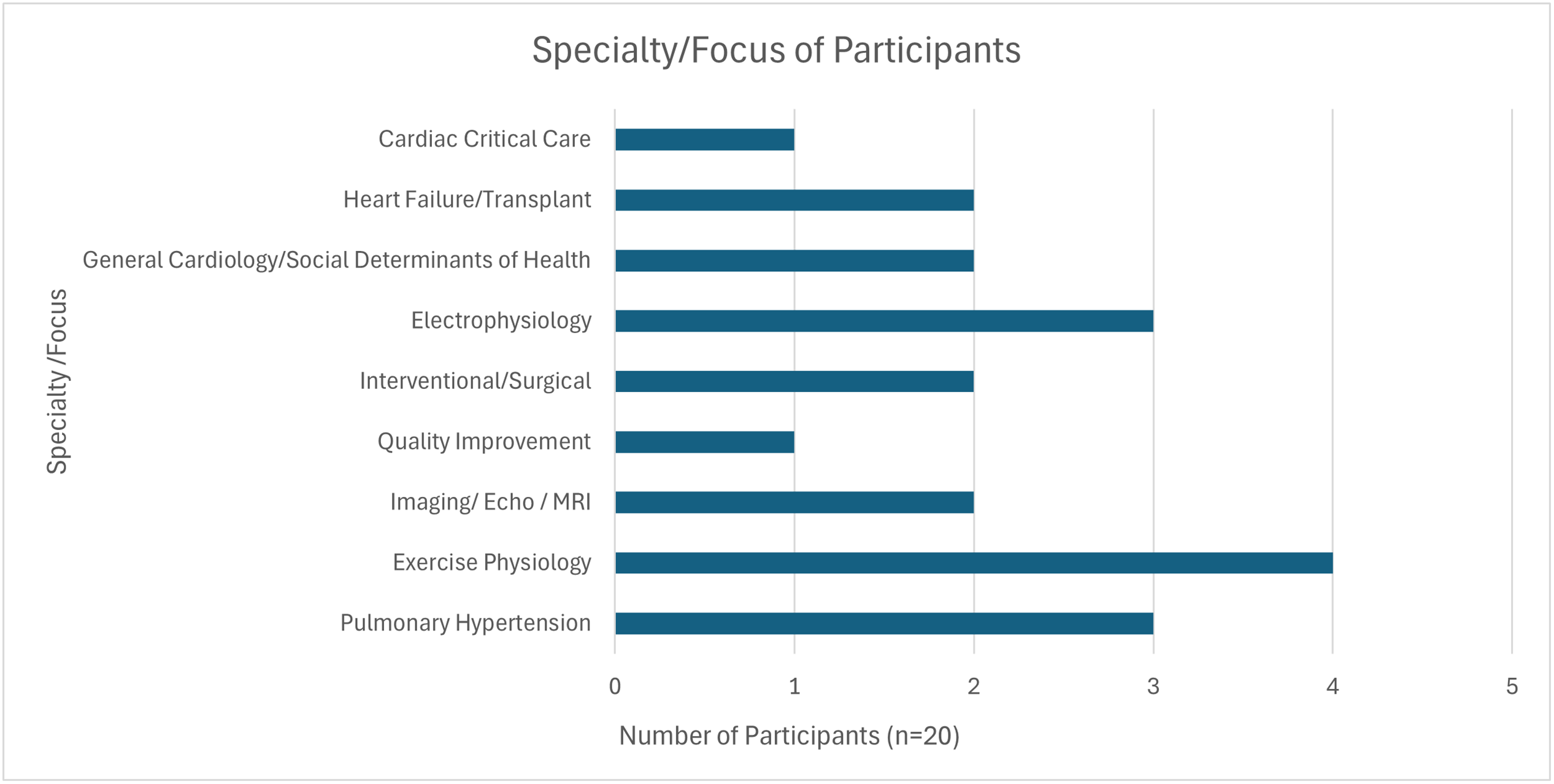
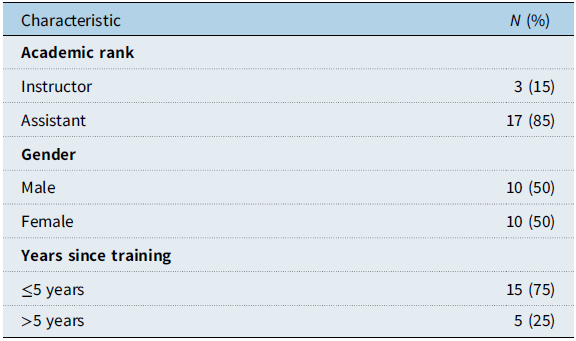
In total, the programme received 28 applications including 15 in its inaugural year and 13 in the second year. In total, 20 (71%) of applicants were selected for participation. Among the participants, the majority (85%) held the rank of assistant professor and 75% were within 5 years of completing fellowship training (Table 1). There was an equal distribution of male and female participants (Table 1), and a diverse range of clinical specialties and areas of interest within the field were represented (Figure 1). The median number of faculty selected to participate in the exchange from each site was 3.5 (interquartile range 3–4), and the median number of faculty hosted by each site was 3.5 (interquartile range 2–4).
Distribution of specialty/area of focus of participants.

Participant demographics (Total N = 20)

Programme evaluation by host sites
Informal qualitative feedback from site leads during regular programme leadership meetings has been uniformly positive, highlighting overall ease of programme implementation, and value in fostering professional growth of early-career faculty.
Programme evaluation by faculty participants
Overall, 15 of 20 (75%) participants completed a post-visit survey, with results displayed in Figure 2. Responses across survey questions were uniformly positive with an average of 92% responding “strongly agree” as to the value of the programme across domains (Figure 2) and no participant indicating disagreement.
Participant responses to program evaluation.

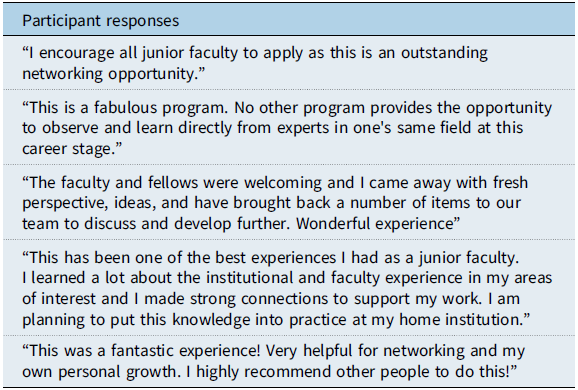
Excerpts of participants’ open-ended response are displayed in Table 2. Common themes included appreciation for valuable networking opportunities, mentorship, and exposure to diverse clinical and research environments, particularly in areas that are not well represented at their home institution. Participants noted that the programme significantly enhanced their professional development by providing new insights with the potential to positively influence their career trajectories.
Excerpts from participant free-text responses

Discussion
These results suggest that the development and implementation of an early-career exchange programme to support career development in congenital cardiology is both feasible and promising. Preliminary data indicate a consistently positive experience among participating faculty and site leadership.
Our programme was designed based on established models from similar efforts across other fields. One notable example is the Early-Career Faculty Exchange Programme supported by the University of Michigan’s Department of Surgery. This initiative has led to a collaboration of 10+ surgical programmes nationwide, aimed at providing early-career faculty members with opportunities to connect with, learn from, and establish collaborations with others around the country. 1 Similarly, Nationwide Children’s Hospital leads the Neonatal Early-Career Exchange with numerous participating centres where early-career faculty are paired with experts who align with their career interests. 2 Finally, the Association of Academic Radiology and Association of Program Directors in Radiology collaborate to lead the Early-Career Lecture Exchange Program, which is designed to provide participants with the opportunity to deliver invited lectures at participating centres across the US and receive feedback on their teaching, facilitating over 20 such exchanges annually. 3 A virtual exchange programme has also been successfully implemented in radiology and breast imaging. Reference Dodelzon, Patel and Smetherman9 Most recently, the Society for Cardiovascular Magnetic Resonance has announced a funded exchange programme for early-career and mid-career faculty to promote international visiting professorships and research collaborations, 10 underscoring the value of such inter-institutional exchanges early in an academic career.
Taken together, these prior initiatives along with the successful implementation of the exchange programme within congenital cardiology suggest that this model of collaboration can effectively support faculty development in a way that is adaptable across a range of disciplines. Given the rarity and heterogeneity of CHD, multi-centre efforts are often required to advance new research, quality improvement programmes, and other initiatives. Thus, programmes such as the exchange which foster broader engagement and networking may be particularly impactful in our field, serving as a powerful catalyst for professional growth and advancement. This is especially true for early-career faculty at smaller congenital heart centres for whom the opportunity to visit and connect with senior colleagues at larger centres offers unique access to mentorship, collaboration, and academic opportunities that may otherwise be difficult to obtain locally.
Building on the early success of the programme’s first two cohorts, there is growing interest in potential expansion. This may include incorporating additional specialties that are involved in the care of patients with CHD, such as paediatric cardiac anaesthesia and congenital cardiac surgery. Supporting these efforts will require developing additional collaboration across departments at participating sites to accommodate visits from faculty in these disciplines. Expansion to include additional institutions, nationwide and internationally, deserves further logistical and financial consideration. A potential challenge with expansion is ensuring a balanced distribution of faculty exchanges across all participating sites. The current model relies on reciprocity, with each institution both sending and hosting visiting faculty. As the number of participating sites increases, there is a risk that applicants may preferentially select certain centres, resulting in imbalances that could challenge the reciprocal structure of the programme. To support programme expansion, alternative financial models or additional sources of funding may need to be explored beyond the current reciprocal structure.
There are also several limitations to consider. This is an early report from the initial cohort of participants at a few large congenital heart centres, preventing us from drawing generalisable conclusions regarding its long-term effectiveness or applicability across sites. Although participant satisfaction was high, longer follow-up will be necessary to evaluate additional outcomes such as the programme’s influence on academic promotion of participants and other markers of academic achievement. Our current follow-up period was insufficient to assess these longer-term career impacts. While criteria for promotions may vary across institutions, all typically require some combination of clinical and scholarly achievements, along with increasing regional and national recognition, and it is anticipated that the exchange programme may support participants in meeting these criteria. We plan to assess the programme’s longer-term effects, including any academic collaborations that emerge as a result, in future evaluations. Additionally, further understanding and feedback from host sites would be valuable, as well as a mechanism to provide structured feedback to participants regarding the lecture they deliver during the visit.
Finally, strategies to offset the administrative burden, faculty effort, and costs involved in supporting an expanded programme will require further evaluation. To support meaningful growth of the programme, additional funding sources and administrative efforts would be needed, whether through increased institutional investment in faculty development, which could be challenging given current budget constraints at many academic centres, or through external sources such as philanthropy and grants.
In summary, early outcomes from this career exchange programme highlight the positive impact of a multi-centre collaborative faculty development initiative in congenital cardiology. The current model has proven to be sustainable at small scale, supported by participating centres. Future expansion will require thoughtful planning, sustained collaboration, and dedicated funding and resources to ensure long-term success.
Supplementary material
The supplementary material for this article can be found at https://doi.org/10.1017/S1047951126113298
Acknowledgements
The authors would like to acknowledge the faculty and staff across participating sites for their mentorship and efforts devoted to supporting the faculty visits.
Financial support
Financial support for the exchange visits was provided by the respective cardiology programmes sponsoring their early-career faculty.
Competing interests
The authors of this paper participated in the design and implementation of the reported programme across sites.



 Open access

