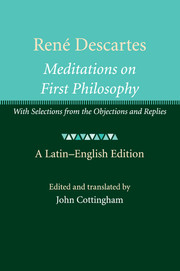
Book contents
- Frontmatter
- Contents
- Philosophical introduction
- Editorial introduction
- Meditationes de prima philosophia
- Meditatio Prima: De iis quae in dubium revocari possunt
- Meditatio Secunda: De natura mentis humanae: quod ipsa sit notior quam corpus
- Meditatio Tertia: De Deo, quod existat
- Meditatio Quarta: De vero et falso
- Meditatio Quinta: De essentia rerum materialium; et iterum de Deo, quod existat
- Meditatio Sexta: De rerum materialium existentia, et reali mentis a corpore distinctione
- OBJECTIONES CUM RESPONSIONIBUS
- Index
- References
Philosophical introduction
The Meditations and Cartesian philosophy
Published online by Cambridge University Press: 05 May 2013
Edited by

Book contents
- Frontmatter
- Contents
- Philosophical introduction
- Editorial introduction
- Meditationes de prima philosophia
- Meditatio Prima: De iis quae in dubium revocari possunt
- Meditatio Secunda: De natura mentis humanae: quod ipsa sit notior quam corpus
- Meditatio Tertia: De Deo, quod existat
- Meditatio Quarta: De vero et falso
- Meditatio Quinta: De essentia rerum materialium; et iterum de Deo, quod existat
- Meditatio Sexta: De rerum materialium existentia, et reali mentis a corpore distinctione
- OBJECTIONES CUM RESPONSIONIBUS
- Index
- References
Summary
Descartes’s Meditations on First Philosophy is, indisputably, one of the greatest philosophical classics of all time. The challenge it offers is in many ways definitive of the philosophical enterprise: to leave behind the comfortable world of inherited prejudice and preconceived opinion; to take nothing for granted in the determination to achieve secure and reliable knowledge. Descartes talks of ‘demolish[ing] everything completely and start[ing] again right from the foundations’, and for this purpose he famously uses doubt, stretched to its limits, as an instrument which self-destructs, impelling him forwards on the journey towards certainty and truth. These central themes are today part of every introductory course in the philosophy of knowledge: Descartes’s masterpiece has achieved canonical status in that part of the philosophy syllabus we now call ‘epistemology’. Yet for Descartes himself these epistemic concerns were but one part of a much wider project: the construction of a grand, all-embracing system of philosophy which would encompass metaphysics, natural science, psychology and morals, connecting all the objects within the scope of human understanding. In the words of the famous metaphor which he deployed some six years after the publication of the Meditations, ‘the whole of philosophy is like a tree. The roots are metaphysics, the trunk is physics, and the branches … all the other sciences.’
Information
- Type
- Chapter
- Information
- René Descartes: Meditations on First PhilosophyWith Selections from the Objections and Replies, pp. vii - xxxPublisher: Cambridge University PressPrint publication year: 2013
References
Meditations on First Philosophy with Selections from the Objections and Replies, trans. and ed. (Cambridge: Cambridge University Press, rev. edn, 1996Google Scholar
, and , The Philosophical Writings of Descartes, vols. I and II (Cambridge: Cambridge University Press, 1985Google Scholar
The Correspondence, by the same translators and (Cambridge: Cambridge University Press, 1991Google Scholar
, ‘Descartes’ Life and the Development of his Philosophy’, in J. Cottingham (ed.), The Cambridge Companion to Descartes (Cambridge: Cambridge University Press, 1992Google Scholar
Accessibility standard: Unknown
Why this information is here
This section outlines the accessibility features of this content - including support for screen readers, full keyboard navigation and high-contrast display options. This may not be relevant for you.Accessibility Information
Accessibility compliance for the PDF of this chapter is currently unknown
and may be updated in the future.