




Introduction
Research conducted in Oceania encompasses aspects of developmental origins of health and disease (DOHaD) awareness in Pacific Peoples from both a global and an Aotearoa New Zealand (NZ)-centric perspective, with Pacific adolescents living in NZ a recent focus. Reference Tohi, Tu’akoi and Vickers1 Improving health literacy in adolescents has been highlighted as a key intervention strategy to break the cycle of non-communicable diseases (NCDs) Reference Hoelscher, Evans, Parcel and Kelder2,Reference Baird, Cooper, Margetts, Barker and Inskip3 through empowerment of adolescents to engage in evidence-based decision making and informed actions related to the prevention and control of NCDs worldwide. 4 DOHaD awareness in adolescents is key to enabling knowledge uptake and behavioural change, particularly in Pacific adolescents who have a higher NCDs burden. Reference Tohi, Tu’akoi and Vickers5 Previous work by our group found that the awareness of DOHaD-related concepts among adolescents in NZ was low, including some adolescents showing disagreement with key DOHaD concepts. Reference Tohi, Tu’akoi and Vickers5 Semi-structured interviews were then conducted by our group to explore DOHaD perspective and understanding among a group of adolescents who responded to the survey. Reference Tohi, Tu’akoi and Vickers1 Core themes from this work emphasised the need for culturally and contextually relevant approaches to be undertaken in this area. As such, Pacific research approaches need to be incorporated to facilitate and validate the research process. This paper presents a methodological approach that was designed using the traditional Tongan Taumafa Kava to illustrate the steps required to plan, undertake and produce DOHaD research with Pacific Peoples. Moreover, the Taumafa Kava conceptual framework was successfully applied in a PhD project. Reference Tohi6 This manuscript details the application of the Taumafa Kava framework as a case example of how this framework directed the PhD research project. The Talanoa research methodology was incorporated to aid with the qualitative components of the PhD research project. Reference Vaioleti7 As the perspectives of Pacific Peoples are a key focus, it is appropriate to adopt a Pacific framework to ensure DOHaD projects among Pacific Peoples in Oceania are carried out in line with Pacific ways of knowing. Reference Thaman8
The preparation of the methysticum plant root (kava) as a drink has been used in a variety of Pacific contexts as a means of asserting cultural identity. Reference Aporosa9 This includes Papua New Guinea, Fiji, Samoa, Hawaii, Federal States of Micronesia, Vanuatu and Tonga. Reference Aporosa and Ratuva10 The origin of the kava story is an integral and complex aspect of Tongan culture that we cannot cover exhaustively in this article. The origin of the kava in Tonga dates back to the era of the tenth Tu‘i Tonga (500–800 BP). Reference Tecun, Reeves and Wolfgramm11 The origin story of kava is about a young woman named Kava‘onau who was leprous and was offered up as a sacrifice to the Tu‘i Tonga by her parents Fefafa and Fevanga. Reference Leach and La Fontaine12 Kava was named after Kava‘onau as it grew out of the ‘umu (earth oven) that became her tomb after the chiefly refusal of this initial offerings. Reference Potauaine, Fetokai, Moa, Vaka and Māhina13 Since then, kava has been used as offering in Kava ceremonies in Tonga. Reference Newell14 The ritualised use of kava carries gendered symbolism in which feminine qualities express chiefliness. It embodies key moral principles such as sacrifice, truth, justice, beauty and love in Kava‘onau. Reference Tecun, Reeves and Wolfgramm11
Although the traditions and uses associated with kava vary across different Pacific Island nations, Tongan Kava ceremonies can be performed in Tongan society to celebrate different important occasions. Reference Nosa and Ofanoa15 Tongan Kava ceremonies range in formality from informal faikava Reference Fehoko16 and formal ma‘u kava Reference Fotu and Tafa17 to the highly stratified, ancient and ritualised Taumafa Kava or Royal Kava Ceremony. Reference Smith, Shumway and Wineera18 For the methodology underpinning this framework, we focused on Tongan Taumafa Kava, the Royal Kava Ceremony at which the King presides over the investiture of the noble title. Reference Smith, Shumway and Wineera18 After discussion with key Tongan advisors, the Taumafa Kava was selected due to the profound cultural value it holds. The use of the Taumafa Kava emphasises the importance of DOHaD research in Oceania to focus on adolescence as a key lifecourse window stage where lifestyle behaviours become entrained and typically track into adulthood. Thus, ensuring the widespread recognition of adolescence as a critical window of opportunity for health interventions holds potential to break the transgenerational cycle of NCDs in the Pacific. It also echoes calls for global multisectoral partnerships to achieve better health outcomes. The presiding of the King in the Taumafa Kava not only emphasises the authenticity of DOHaD research but also serves as a challenge for researchers to ensure that cultural integrity is prioritised in research, particularly when it involves Pacific Peoples.
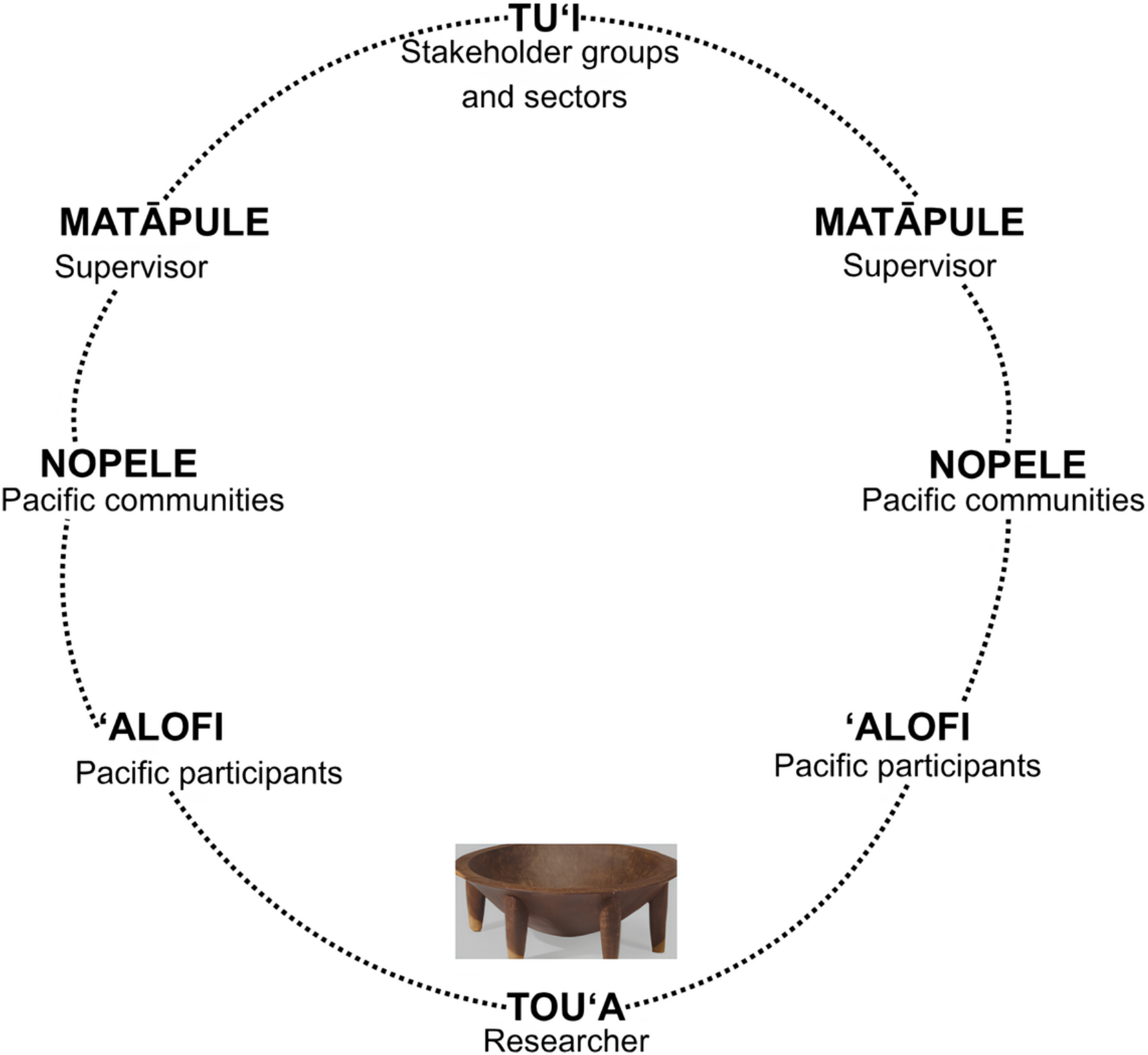
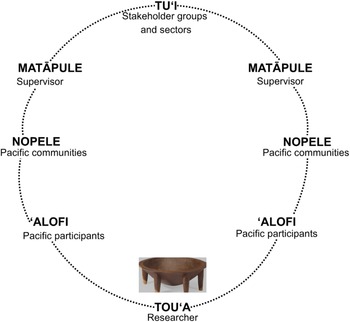
The arrangement of the Taumafa Kava circle is very important as it is the physical manifestation of the fonua, the land and people, in communion with their King, where all members of society are represented. Reference Smith, Shumway and Wineera19 At the head of the Kava ring (seated circle of people partaking in the Taumafa Kava) is the King who is the highest rank. Beside the King is the matāpule (the talking chiefs). Following the chiefs seated in the circle are the ‘alofi (warriors or participants), including the nobles, on whom chiefly titles have been invested. Reference Smith, Shumway and Wineera18 At the other end of the circle is the tou’a (the person preparing the kava). Reference Smith, Shumway and Wineera18 Applied to DOHaD research among Pacific peoples, the ‘Taumafa Kava’ takes place with the King (represented by the stakeholder groups and sectors), the nobles (Pacific communities), the tou‘a (researcher), the matāpule (supervisor) and the ‘alofi (the Pacific participants) (see Figure 1).
Taumafa Kava circle arrangement. Note: the representatives of the Taumafa Kava circle are subject to change depending on the nature of the research project and who is involved.
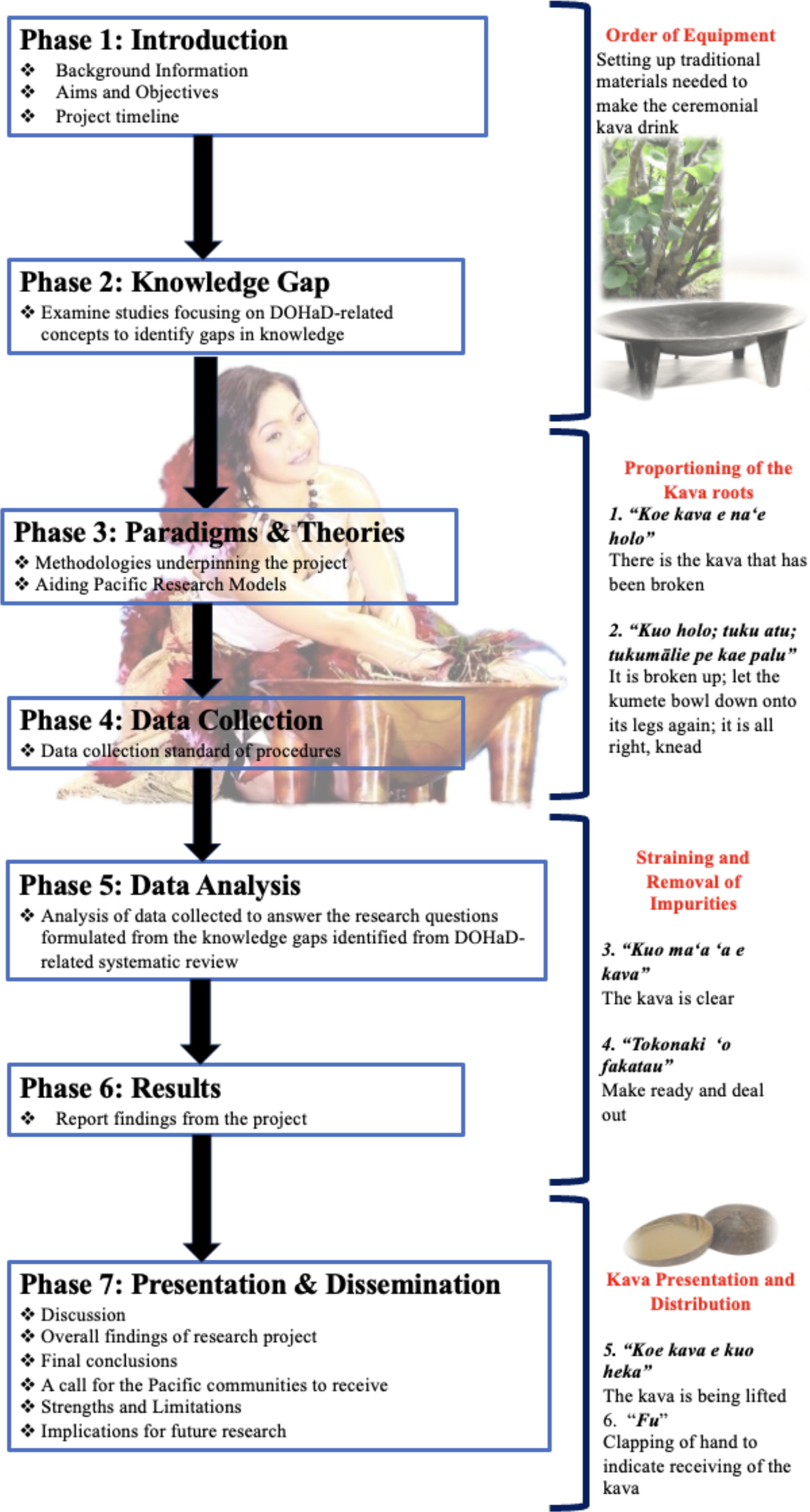
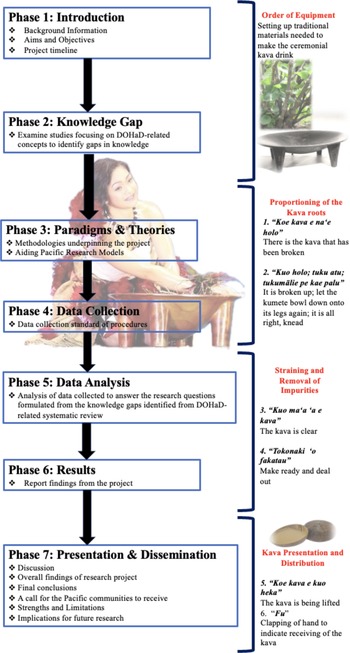
The Kava that is prepared through this process is represented by the findings of the particular DOHaD project of choice. There are set protocols for a Taumafa Kava ceremony. Reference Smith, Shumway and Wineera18 However, only four protocols for the preparation of Taumafa Kava were utilised in this framework. These included; (i) order of equipment, (ii) proportioning of the kava root, (iii) brewed Kava (drink) and (iv) Kava presentation and distribution. These protocols are accompanied by five calls that are part of the Taumafa Kava ritual; (1) ‘Taumafa e na’e holo’ (There is the regal kava root that has been broken), (2) ‘Kuo holo; tuku atu; tukumālie pe kae palu’ (The kava root is broken up; let the traditional wooden kava bowl down onto its legs again; it is alright, knead), (3) ‘Kuo ma’a ‘a e taumafa ni’ (This regal brewed Kava is clear), (4) ‘Tokonaki ‘o fakatau’ (Make ready and deal out) and (5) ‘Kava kuo heka’ (The Kava is being lifted). The callings during the Taumafa Kava act as metaphors for the conversations between the student researcher, supervisors and Pacific participants to ensure the prosperity of the research project (see Figure 2).
DOHaD research structure presented according to the Taumafa Kava Process.
Methods
Order of equipment
Equipment is required for the processing and brewing of the kava for the Taumafa Kava. The necessary equipment includes a kumete (traditional wooden kava bowl in which the kava roots will be prepared in), water, fau (a strainer made from hibiscus fibre) and ipu kava (half coconut shell cups for the brewed Kava to be served in). Reference Aporosa, Atkins and Leov20 In this article, there is a distinction between the usage of ‘kava’, denoting the methysticum plant root, and ‘Kava’ referring to the traditional ceremony and the brewed drink. This order of equipment equates to the foundations of the chosen DOHaD research project. Phase 1 and 2 thus represent the ‘equipment’, beginning with a wide lens on DOHaD as a mechanism for curbing NCD risk and narrowing down the rationale to focus on Pacific in Oceania. A systematic review of the current literature serves to highlight the gap in knowledge within the DOHaD space. Both Phase 1 and 2 act as the foundation on which a research project is built.
Proportioning of the Kava roots
The next protocol following the gathering of equipment is the proportioning of the kava. The kava plant (of ceremonial quality) is dug up from its roots as a whole and brought to the ceremony to be portioned. Reference Smith, Shumway and Wineera19 The central part of the kava root (the royal part of the plant) is to be pounded for the kava drink, and the amount is dependent on the size of the assembly. Reference Smith, Shumway and Wineera18 In the Taumafa Kava, the tou‘a calls out to the matāpule that the kava roots have been portioned. ‘Taumafa e na’e holo’ translates to ‘There is the regal kava root that has been broken’. Reference Smith, Shumway and Wineera19 Similarly, after the background information is collated for the research, the researcher then calls out to their supervisors, ‘There is the information gathered’ while presenting the literature reviews for feedback. In the circle of the Taumafa Kava ceremony, the matāpule will then reply to the call: ‘Kuo holo; tuku atu; tukumālie pe kae palu’. This call is a set of instructions to follow, and it translates to ‘It (the kava root) is broken up; let the kumete bowl down onto its legs again; it is all right, knead’. Reference Smith, Shumway and Wineera19 Applying this process to the research project, the supervisory team reviews the background information and ensures the paradigms and methodologies frame the project appropriately. Similar to the set of instructions in the Kava ceremony, the supervisory discussions could then be represented by metaphorically calling out, ‘The information suffices, and paradigms are suitable’, thus instructing the researcher to proceed with data collection and analysis. Any software and programs used to collect and analyse the data for the project will be incorporated into this protocol.
Straining and removal of impurities
Once the straining process is completed, the resulting brewed Kava is then ready for the ceremony. Applying this to research, once the data analysis is completed, the tou‘a is then ready to present the results to its target audience. Before the straining ceases, the tou‘a must indicate to the matāpule that the straining process is accomplished. The tou‘a would call out to the matāpule, ‘Kuo ma‘a ‘a e taumafa ni’, meaning that the regal brewed Kava is clear of impurities. The matāpule will then respond, ‘Tokonaki ‘o fakatau’, which translates to ‘Make ready and deal out’. Reference Smith, Shumway and Wineera19 Applied to a DOHaD research project, once the data analysis is completed, the researcher calls out to the supervisors ‘The data analysis is complete’ by presenting the data in tables and graphs. The supervisors then assesses the quality of the analysis and provide feedback on improvements needed. The assistance of a statistician could also be sought to check the overall data analysis and the presentation of data for peer-reviewed publications.
Kava presentation and distribution
The Kava presentation and distribution comprise the final protocol once the Kava is ready to be served in the ceremony. ‘Kava kuo heka’ is the elaborated call that is heard amid the Kava ceremony. It translates to ‘the Kava is being lifted as the server is ready to serve the Kava drink’. The receiver must clap once with cupped hands to let the server know who to serve the Kava to. This deep-pitched clap is called a Fu. Reference Smith, Shumway and Wineera19 The Fu is important in the Kava ceremony as it serves as an act of acceptance by the receiver. Reference Smith, Shumway and Wineera19 The first serving of the Kava is for the stakeholder groups and sectors (in place of the King), then it proceeds to Pacific communities represented by community leaders (nobles). Serving the Kava to the representatives of the Pacific communities (nobles) signifies that they are socially valuable in this Kava circle. Reference Smith, Shumway and Wineera18 In relation to research, the final phase of research represents the presentation and distribution protocol of the Taumafa Kava ceremony.
Application of framework
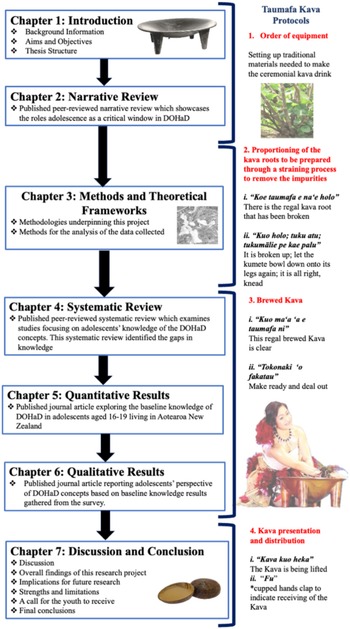
A research project that provided the basis for a PhD thesis entitled ‘Adolescents as catalysts of change for a better future’ looked at adolescents’ awareness and understanding of concepts related to DOHaD. Reference Tohi6 Due to the specific focus of this project on Pacific adolescents, a Pacific framework was designed and incorporated to aid with the process of conducting research and the preparation and offering of the thesis as a foundation for future DOHaD-related work to be undertaken with and for our Pacific Peoples in Oceania (see Figure 3).
Example of thesis structure presented according to the Taumafa Kava process.
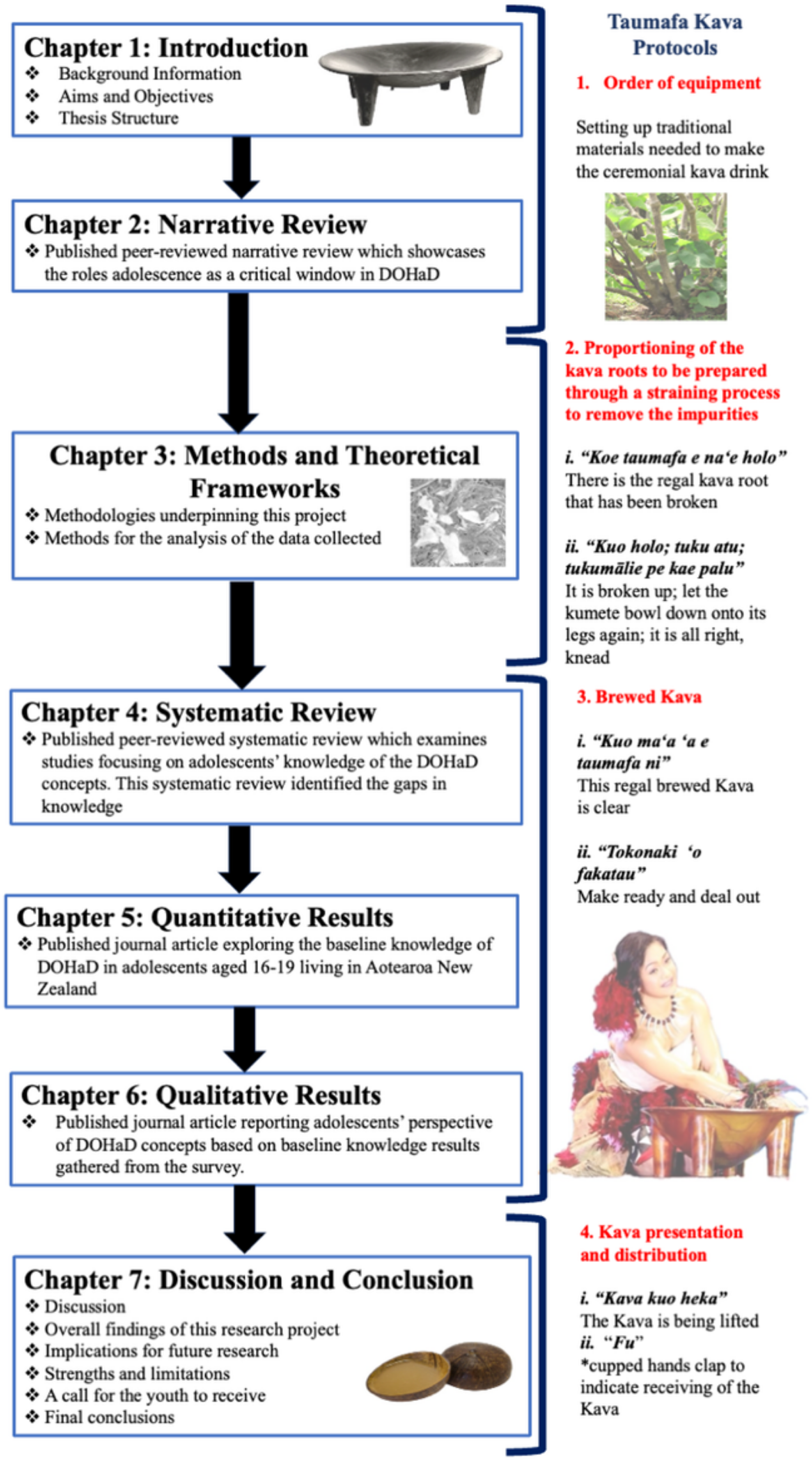
Chapter 1 of the thesis was the introduction. This provided background information on the PhD research project, including the aims, objectives and thesis structure. Aligned with the introduction to the Taumafa Kava ceremony, this chapter presented the important context of DOHaD and NCDs for framing the research on NZ adolescents.
Chapter 2 was the narrative review which presented a review of the current DOHaD field and how it has expanded over the years. Reference Tohi, Bay, Tu’akoi and Vickers21 The first protocol from the Taumafa Kava ceremony, ‘order of equipment’, was woven into the presentation of this chapter.
Chapter 3 was the methods and theoretical frameworks. This chapter introduced the methodologies and Pacific research models underpinning the PhD research project. The second protocol from the Taumafa Kava, ‘proportioning of the kava roots’, corresponded to this chapter. Tongan dialect calls within the Taumafa Kava was used as a metaphor for the conversations between the researcher (myself) and supervisors of this project as we navigated through the project.
Chapter 4 was the systematic review (first results chapter). It showcased a review of research that recognised adolescence as a critical window of opportunity for NCD risk prevention. Reference Tohi, Tu’akoi and Vickers22 The third protocol from the Taumafa Kava, ‘brewed Kava’, was used as an analogy to describe the results presented in Chapters 4–6.
Chapter 5 included the quantitative results. This chapter presented data from investigating baseline knowledge of DOHaD concepts and lifelong health among Pacific adolescents aged 16–19 years old living in NZ. Reference Tohi, Tu’akoi and Vickers5
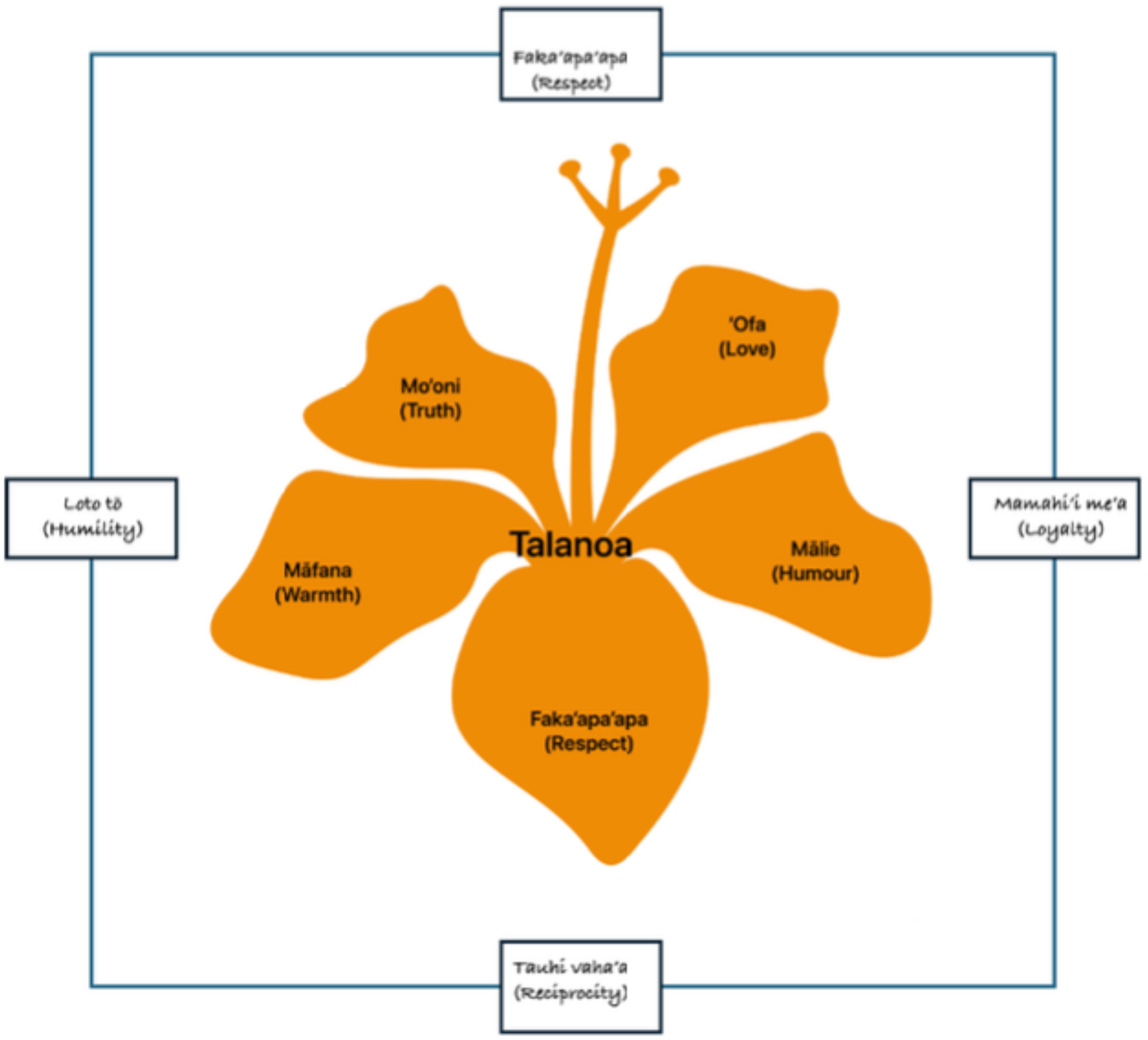
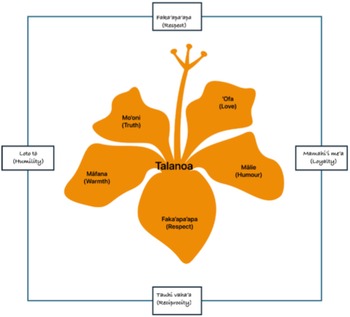
Chapter 6 included the qualitative data. This chapter reported on adolescent perspectives of DOHaD concepts based on baseline knowledge results gathered from the survey. The qualitative interviews and focus groups with the adolescents were guided by Talanoa. Reference Vaioleti7 The five aspects of Talanoa (‘ofa – love, māfana – warmth, mālie – humour, mo‘oni – truth and faka‘apa‘apa – respect) were embedded in the four pillars of Tongan culture; faka‘apa‘apa (respect), loto tō (humility), tauhi vā (reciprocity) and mamahi‘i me‘a (loyalty) Reference Kalavite23 as illustrated in Figure 4. This chapter outlined suggestions from the adolescents for future interventions. Reference Tohi, Tu’akoi and Vickers1
Aspects of Talanoa embedded in the four pillars of Tongan culture.
Chapter 7 was the final discussion. This tied all the components of the doctoral research together and considered the overall findings, final conclusions, strengths and limitations, as well as implications for future research. The fourth Taumafa Kava protocol, ‘Kava presentation and distribution’, was utilised as a metaphor for dissemination of the research project results. It served as a call for recommendations and research directions that can enable healthy adolescents in the future.
Discussion
There has been an increasing shift away from the Western ways of conducting Pacific research with more Pacific-centred research methodology. Reference Naepi24 Several strategies have been designed and implemented in Pacific-centred research. Some of the commonly used Pacific models/frameworks includes Talanoa, Reference Vaioleti7 Ula, Reference Sauni25 Fa‘afaletui, Reference Goodyear-Smith and Ofanoa26 Kakala, Reference Johansson-Fua, Okoko, Tunison and Walker27 Tivaevae, Reference Futter-Puati and Maua-Hodges28 Manulua, Reference Fonua29 Fonofale Reference Young, Bird, Hohmann-Marriott, Girling and Taumoepeau30 and Vanua framework Reference Nabobo-Baba31 with some providing ethnic-specific approaches and others being more pan-Pacific. Similar to these existing Pacific model/frameworks, the Taumafa Kava conceptual framework can be applied to research conducted with and for Pacific Peoples. The social values embedded in the kava story include sacrifice and duty Reference Tecun, Reeves and Wolfgramm11 and align strongly with Pacific People’s identity of loyalty and dedication to society. The Taumafa Kava may be specific to Tonga, but the general consensus in the use and preparation of kava amongst different Pacific countries in Oceania symbolises our collective sense of obligation and duty towards healthier lifestyles for all Pacific Peoples. The Taumafa Kava conceptual framework is new knowledge that can be added to the existing Pacific models and frameworks known in this space. The contribution of this methodology is in the calls that accompany the protocols. This is used in the analogy of the conversations that take place in research as explained in the methods section above.
The use of Taumafa Kava highlights the collaboration of the supervision and advisory team, which included experts from a number of different departments in this project. Expertise included early-life origins and DOHaD research, community-based participatory research and Pacific adolescent health and health promotion. This collaborative partnership ensured that the student researcher was given appropriate guidance about methodologies and ways of carrying out respectful and relevant research that could yield meaningful results with adolescents. Partnerships were also fostered with the adolescents throughout the studies discussed in this paper. The adolescents who initially took part in the quantitative survey were invited to share their views through focus groups and interviews. This provided an opportunity to update the participants on the main findings of the survey and it prioritised their views on the potential reasons and explanations for the results. This process ensured trusted and reciprocal relationships.
The concept of Talanoa is common among many Pacific cultures, Reference Naepi and Hytten32 and highlights the importance of balancing the inclusivity of the participants with developing consensus about a topic in order to achieve depth in the discussion. Reference Vaka, Brannelly and Huntington33 Balance was maintained within group discussions in the research described through the linking of the aspects of Talanoa to the four golden pillars of Tongan culture. Reference Manuatu34 Barriers including, but not limited to language, communication, access to translation services and health literacy Reference Tukuitonga, Campbell and Connell35 impact Pacific People’s access to key public health messages (and their understanding of these messages), thereby compromising their engagement with healthy lifestyle activities earlier in life that could lower the risk of developing NCDs later in life. A systems-based approach in DOHaD that is contextually specific to Oceania can strengthen communication and increase health literacy. This can empower adolescents living in Oceania to be the agents of change for better health through the improvement of their knowledge of DOHaD.
Applying the processes of the Taumafa Kava ceremony to DOHaD-related research in the Pacific, and the traditional Tongan ideology of social structure represented by the arrangement of the Taumafa Kava circle, underscores the idea of all members of society working together as good stewards to improve health. Reference Tohi, Tu’akoi and Vickers1 The presence of the adolescents in the Taumafa Kava circle represents the importance of DOHaD research to increase awareness of the essence of adolescence as a critical window of opportunity to break the transgenerational cycle of NCDs in Oceania. A holistic approach requires a physical manifestation of the fonua (both land and people) in communion with their king. Reference Tohi6 Thus, within the Pacific, being in communion means that different organisations, divisions and communities should avoid working in silos and come together to co-design health promotion approaches that empower adolescent-led action. When groups in society are given such opportunity to learn about evidence and examine its relevance to their health, community-led actions can be facilitated. Reference Bay and Vickers36 The collaboration model utilised in this research project provides a key system of sharing knowledge, empowering adolescents to be experts in co-designing future resources and ensuring that reciprocity is replicated throughout research with communities. While researchers strive to effect change, true empowerment of change lies in the hands of those communities who are affected by the research of interest.
As a research project wraps up, there is an expectation that the results are taken back and presented to the communities where the research was undertaken. The researcher calls out ‘Kava kuo heka!’ The final call echoes hope as the research project outputs are gifted back to the Pacific communities. The call also serves as a challenge for adolescents (the next generation of parents) to be catalysts of change for better health.
Conclusion
As explained by the Taumafa Kava methodology, breaking the transgenerational cycle of NCDs requires collaboration between stakeholders, government agencies, researchers, health promoters to acknowledge Pacific communities in Oceania as equal members and to stress that their perspective is valuable in the effort to increase awareness of DOHaD in Oceania and promote the importance of adolescence as a window of opportunity for better lifelong health, both in the present and future generations. The contribution of this framework to DOHaD research represents a steppingstone for future DOHaD research that continues to empower adolescents as agents of change to break the cycle of NCDs. The Tongan proverb koe hakau ‘o e ‘aho ni, koe fonua ia he kaha’u which translates to the reef of today will be the land tomorrow . It emphasises why we must prioritise DOHaD research in Oceania. Better health for adolescents means a stronger land and a healthier nation tomorrow.
Funding statement
MT was supported by a Pacific PhD scholarship from the Health Research Council of New Zealand (22/121).
Competing interests
None.

 Open access

