


A total of 16.7% of people with administratively defined learning disability in the UK have challenging behaviour (e.g. aggression or self-injury) (Reference Qureshi and AlborzQureshi & Alborz, 1992). This behaviour is costly to manage and frequently leads to significant burden of care, high health care and social costs and social exclusion (Reference Felce, Lowe and PerryFelce et al, 2000). Recently, it has been suggested that some challenging behaviour may be caused or exacerbated by a coexisting psychiatric disorder (Reference Emerson, Moss, Kiernan and BourasEmerson et al, 1999). Prompt identification and treatment of these psychiatric disorders could thus have a positive impact on the challenging behaviour, and hence on the burden of care, the quality of life of the individual and carers and the cost-effectiveness of service provision. At the present time, however, the mental health needs of this group of individuals are poorly understood. This paper presents the results of a study investigating the prevalence of psychiatric symptoms in people with learning disability and challenging behaviour in the North West of England.
METHOD
Design considerations
Age, IQ and gender are factors known to be associated with the presence of challenging behaviour (e.g. Reference Borthwick-Duffy, Thompson and GrayBorthwick-Duffy, 1994):
-
(a) the overall prevalence of challenging behaviour increases with age during childhood, reaches a peak during the age range 15-34 years and then declines;
-
(b) the prevalence of aggression, property destruction, self-injurious behaviour and other forms of challenging behaviour is positively correlated with degree of intellectual impairment;
-
(c) males are more likely to be identified as showing challenging behaviour than females.
Because the incidence of challenging behaviour decreases markedly in later life, the confounding effect of age was minimised by restricting the investigation to people under 60 years and matching by age bands. Because IQ is also a powerful confounder, the samples were stratified by their level of speech, as an approximate measure of intellectual level. There was no significant difference between the proportion of males in the sample groups.
Derivation of the samples
In 1988, seven district health authorities in the area then covered by the North West Regional Health Authority participated in a total population survey of the extent and nature of challenging behaviour among people with learning disability (Reference Qureshi and AlborzQureshi & Alborz, 1992; Reference Kiernan, Qureshi and KiernanKiernan & Qureshi, 1993). The study included individuals with challenging behaviour from age 3 to 87 years. A further study was undertaken in 1995 (Reference Emerson, Kiernan and AlborzEmerson et al, 1997). This involved: the attempted follow-up of all people identified in 1988 as showing more severe challenging behaviour; a repeat of the total population screening in two of the seven districts; and the attempted follow-up of all people identified in 1988 as showing less severe challenging behaviour. The current investigation uses the 1995 data on those individuals who were between 18 and 60 years of age at the time of follow-up (n=234).
A control group (n=86) was drawn from a study of the health needs of 200 people with learning disability, commissioned by Tameside Learning Disability Services. The control sample was drawn from those individuals living in staffed accommodation, because there were few missing cases (in comparison with those living alone or with family members). Those individuals identified on the Wessex Scale (Reference Kushlick, Blunden and CoxKushlick et al, 1973) as having no challenging behaviour were randomly selected and age-matched to produce the same age banding as in the challenging behaviour study. Those in the latter study tended to be younger than the Tameside population, so the selection was achieved by randomly removing Tameside cases from the upper age bands to achieve the same proportions.
Information collected
Challenging behaviour
A full account of the extensive information collected in this sample can be found in the report by Emerson et al (Reference Emerson, Kiernan and Alborz1997). Sample members in the challenging behaviour studies were rated on four basic types of challenging behaviour: aggression; destruction of property; self-injury; and other unacceptable behaviour. Each of these types was rated on a four-point scale (serious, controlled, lesser, no problem). Overall severity of challenging behaviour was estimated using a compound dichotomous variable (less demanding/more demanding) derived from other information collected on the sample members. A client was coded as ‘more demanding’ if any of the following applied:
-
(a) the person showed any challenging behaviour at least once a day;
-
(b) the challenging behaviour usually prevented the person from taking part in programmes or activities that would otherwise be appropriate to his or her level of skills and competence;
-
(c) physical intervention by more than one member of staff was the usual level needed to control any of the person's challenging behaviour;
-
(d) the usual consequence of challenging behaviour was major injury to the self, to another person with learning disability or to staff; ‘major injury’ was defined as that requiring hospital treatment (e.g. broken bones, cuts or stab wounds).
Level of learning disability
There were no formal measures of intellectual ability collected on the sample members. However, a strong indication could be inferred from sample members' level of speech. In both the challenging behaviour study and the control group this was measured on a three-point scale (no language, words and phrases, full sentences).
Psychiatric symptoms
The Psychiatric Assessment Schedule for Adults with a Developmental Disability (PAS-ADD) Checklist (Reference Moss, Prosser and CostelloMoss et al, 1998) is a screening instrument designed to identify mental health problems in people with learning disability. In both the challenging behaviour and the Tameside study, a PAS-ADD Checklist was completed for each sample member by an individual (staff member or family member) judged to be in the best position to rate the symptoms. The PAS-ADD Checklist has a four-point rating scale, designed to be the best compromise between the loss of information resulting from a binary scale and the unreliability resulting from too many points. However, because the psychometric properties of the four-point scale were not known, a conservative analysis was performed, items being dichotomised into symptom present/absent.
RESULTS
Sample details
Age banding of the total sample of 320 people with administratively defined learning disability was as follows: 18-30 years, n=129 (40%); 31-45 years, n=125 (39%); 46+ years, n=66 (21%). Numbers in each level of challenging behaviour were: no problem, n=86 (26.9%); less demanding, n=148 (46.2%); more demanding, n=86 (26.9%). There were 64% males (n=205) and 36% females (n=115). There was no significant difference in the proportion of males to females in the Tameside and challenging behaviour studies.
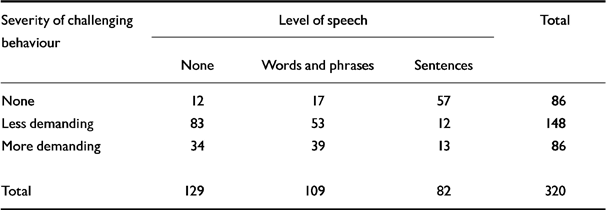
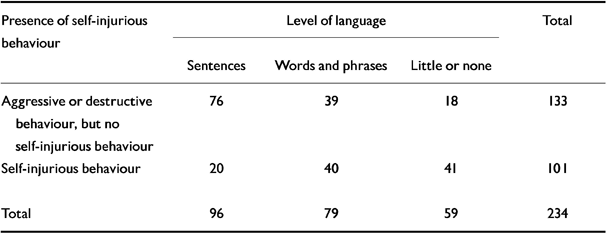
Speech results indicated that there was an expected strong association between level of challenging behaviour and level of learning disability (see Table 1). Most of the 234 individuals in the two challenging behaviour groups showed aggressive behaviour of various kinds, including self-injurious behaviour. However, 57% of the people in the study (n=133) did not manifest any self-injurious behaviour at all. As expected, those who did manifest self-injury (n=101) included a significantly larger proportion of individuals with no speech (see Table 2).
Relation between level of speech and severity of challenging behaviour
| Severity of challenging behaviour | Level of speech | Total | ||
|---|---|---|---|---|
| None | Words and phrases | Sentences | ||
| None | 12 | 17 | 57 | 86 |
| Less demanding | 83 | 53 | 12 | 148 |
| More demanding | 34 | 39 | 13 | 86 |
| Total | 129 | 109 | 82 | 320 |
Distribution of individuals in the two challenging behaviour groups by level of language and presence/absence of self-injurious behaviour
| Presence of self-injurious behaviour | Level of language | Total | ||
|---|---|---|---|---|
| Sentences | Words and phrases | Little or none | ||
| Aggressive or destructive behaviour, but no self-injurious behaviour | 76 | 39 | 18 | 133 |
| Self-injurious behaviour | 20 | 40 | 41 | 101 |
| Total | 96 | 79 | 59 | 234 |
Group comparisons of psychiatric symptomatology
Increasing severity of challenging behaviour was strongly associated with the mean number of psychiatric symptoms (range 0-16) scored on the PAS-ADD Checklist: no problem, n=1.4; less demanding, n=2.0; more demanding, n=4.3; p < 0.0001 (Kruskal-Wallis test). Post hoc comparisons using the Mann-Whitney test indicated that the difference between the group without challenging behaviour and the group with less demanding challenging behaviour was not significant. The difference between the groups with less and more demanding challenging behaviour was highly significant (P < 0.0001).
Table 3 gives details of the individual symptoms in relation to each level of severity of challenging behaviour. It can be seen that for 23 of the 26 items the prevalence was highest in the group whose challenging behaviour was more demanding.
Prevalence of Psychiatric Assessment Schedule for Adults with a Developmental Disability (PAS-ADD) symptoms in the three samples

| Symptom | Severity of challenging behaviour | Total sample | ||
|---|---|---|---|---|
| None | Less demanding | More demanding | ||
| Irritability/bad temper*** | 15.3 | 23.6 | 50.6 | 28.8 |
| Odd gestures or mannerisms*** | 7.2 | 18.2 | 34.5 | 19.8 |
| Elevated mood** | 9.4 | 19.6 | 28.7 | 19.4 |
| Odd or repetitive use of language | 14.5 | 18.9 | 24.1 | 19.2 |
| Pacing*** | 3.5 | 10.8 | 34.5 | 15.3 |
| Loss of self-care skills** | 9.5 | 10.8 | 24.1 | 14.1 |
| Depressed mood*** | 4.7 | 10.8 | 27.6 | 13.8 |
| Confusion | 10.8 | 9.6 | 13.8 | 11.0 |
| Broken sleep*** | 7.1 | 5.4 | 21.8 | 10.3 |
| Loss of concentration*** | 0.0 | 8.8 | 21.8 | 10.0 |
| Delay in falling asleep | 9.4 | 6.1 | 14.9 | 9.4 |
| Hallucinations | 7.4 | 6.1 | 12.6 | 8.2 |
| Phobic anxiety | 6.0 | 6.9 | 11.5 | 7.8 |
| Repeated actions | 6.0 | 6.8 | 10.3 | 7.5 |
| Loss of interest** | 3.5 | 4.7 | 14.9 | 7.2 |
| Loss of energy | 4.7 | 5.4 | 11.6 | 6.9 |
| Suspicious, untrusting | 3.5 | 6.1 | 10.3 | 6.6 |
| Waking too early* | 3.6 | 4.7 | 12.6 | 6.6 |
| Loss of appetite* | 5.9 | 3.4 | 11.5 | 6.3 |
| Non-situational anxiety | 3.5 | 4.7 | 6.9 | 5.0 |
| Jumpy | 4.7 | 2.9 | 8.0 | 4.4 |
| Increased appetite | 2.4 | 3.4 | 8.0 | 4.4 |
| Delusional beliefs | 3.8 | 2.0 | 6.9 | 3.8 |
| Suicidal thoughts or actions | 6.0 | 2.0 | 2.3 | 3.1 |
| Avoidance/withdrawal* | 2.4 | 0.7 | 6.9 | 2.8 |
| Loss of self-esteem | 2.4 | 2.0 | 0.0 | 1.8 |
| Loss of weight | 0.0 | 0.0 | 0.0 | 0.0 |
Four diagnostic categories were then derived from the PAS-ADD scores: anxiety, depression, hypomania and psychosis. In relation to anxiety, depression and psychosis it was possible to identify items on the schedule whose diagnostic significance was very clear-cut. With regard to hypomania, the core symptom in the PAS-ADD Checklist is elevated mood. However, the diagnostic significance of this symptom was not considered to be sufficiently clearcut, so for the present purpose individuals with probable hypomania were defined as those with elevated mood in conjunction with reduced need for sleep (either broken sleep or early waking). Core symptoms were thus as follows: anxiety — phobic anxiety, non-situational anxiety; depression — depressed mood, suicidal intent/actions; hypomania — elevated mood plus early waking or broken sleep; psychosis — hallucinations, delusions.
Table 4 shows the prevalence of individuals who either had at least one core symptom in the anxiety, depression or psychosis symptom groups or met the criteria for hypomania. These results show the prevalence of psychiatric disorders to be high in the whole sample and very high in the group with more demanding challenging behaviour. All four categories showed an increasing prevalence with severity of challenging behaviour, although this did not reach significance in the case of anxiety and psychosis. Depression showed a very marked prevalence that was differential across the three groups. For the whole study, the overall prevalence of psychiatric disorders is in accord with other published studies (Reference Cambell and MaloneCampbell & Malone, 1991).
Percentages of individuals meeting defined diagnostic criteria, in relation to severity of challenging behaviour

| Disorder category | Severity of challenging behaviour | Total population | ||
|---|---|---|---|---|
| None (n=86) | Less demanding (n=148) | More demanding (n=86) | ||
| Anxiety | 7.1 | 8.1 | 12.6 | 9.1 |
| Depression*** | 8.3 | 11.5 | 28.7 | 15.4 |
| Hypomania* | 2.4 | 3.4 | 10.3 | 5.0 |
| Psychosis | 7.5 | 7.4 | 13.8 | 9.2 |
| At least one of the three categories*** | 16.3 | 22.3 | 43.7 | 26.7 |
Self-injurious behaviour
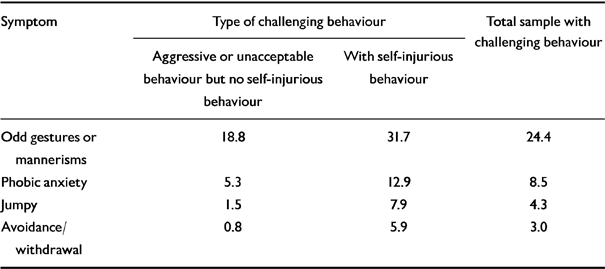
Within the 234 people in the challenging behaviour groups, the prevalence of PAS-ADD symptoms in people with and without self-injurious behaviour was investigated. In terms of the mean total number of psychiatric symptoms identified by the PAS-ADD Checklist, there was no significant difference. However, four individual symptoms showed significant differences in prevalence (Table 5).
The Psychiatric Assessment Schedule for Adults with a Developmental Disability (PAS—ADD) symptoms showing significantly different prevalence in people with self-injurious behaviour (n=101) compared with those who have challenging behaviour but no self-injurious behaviour (n=133)
| Symptom | Type of challenging behaviour | Total sample with challenging behaviour | |
|---|---|---|---|
| Aggressive or unacceptable behaviour but no self-injurious behaviour | With self-injurious behaviour | ||
| Odd gestures or mannerisms | 18.8 | 31.7 | 24.4 |
| Phobic anxiety | 5.3 | 12.9 | 8.5 |
| Jumpy | 1.5 | 7.9 | 4.3 |
| Avoidance/withdrawal | 0.8 | 5.9 | 3.0 |
The sympton ‘odd gestures and mannerisms’ probably features because people with self-injurious behaviour include a higher proportion of individuals with profound learning disability, many of whom demonstrate stereotyped behaviour. However, two of the symptoms are indicative of the fact that anxiety disorders are a possible factor in self-injurious behaviour (‘jumpy’ and ‘phobic anxiety’).
DISCUSSION
Significance of the association
The results provide some evidence for a statistical association between challenging behaviour and psychiatric disorders. The overall prevalence of psychiatric disorders, as measured by the four diagnostic categories, showed people with more demanding challenging behaviour to have over twice the prevalence compared with those who had no challenging behaviour. Depression was four times as prevalent in those whose challenging behaviour was more demanding than in people showing no challenging behaviour; hypomania was three times as prevalent. The strong association with depression is particularly important because this condition often remains undetected, both in the general population (Reference Goldberg and HuxleyGoldberg & Huxley, 1980) and in people with learning disability (Reference Patel, Goldberg and MossPatel et al, 1993). It is thus probable that there are many individuals with learning disability and challenging behaviour who also have unrecognised psychiatric problems. This highlights the importance of introducing improved methods for identification of psychiatric problems in people with learning disability — methods such as the PAS-ADD Checklist (Reference Moss, Prosser and CostelloMoss et al, 1998) and the Mini PAS-ADD (Reference Prosser, Moss and CostelloProsser et al, 1998).
Challenging behaviour as a possible diagnostic criterion for depression
Some authors (e.g. Reference MeinsMeins, 1995) have suggested that challenging behaviour can sometimes be an atypical expression of depression and should be incorporated into diagnostic criteria modified specifically for this population. Although the results from the current study suggest that this assertion merits attention, it may be difficult to implement in practice. The determinants of challenging behaviour are likely to be highly complex — a combination of factors relating to history of learned behaviour and biological, environmental, social and psychological factors. Challenging behaviour may exacerbate a coexisting psychiatric disorder, whereas psychiatric disorders may express themselves partly in terms of a challenging behaviour. Given this complexity, the use of data on challenging behaviour to make psychiatric diagnoses would pose major questions of validity.
Self-injurious behaviour
Among people with self-injurious behaviour, anxiety disorders were identified as being more prevalent than among people without such behaviour. It is not clear whether this finding relates specifically to the presence of self-injurious behaviour or whether it is because this group contains more individuals with profound learning disability. It has been noted elsewhere (Reference King, De Antonio and McCrackenKing et al, 1994) that anxiety disorder is one of the most frequent diagnoses made in people with this level of disability.
Reliance on untrained raters
A potential limitation of the current study was that the information on psychiatric disorders was provided exclusively by non-psychiatrists. Although the PAS-ADD Checklist has been validated for use by unqualified observers (Reference Moss, Prosser and CostelloMoss et al, 1998), accurate quantification of the statistical associations between challenging behaviour and psychiatric disorders would need a further study using comprehensive multidisciplinary assessment, including expert psychiatric opinion.
Clinical Implications and Limitations
CLINICAL IMPLICATIONS
-
▪ Psychiatric disorders, particularly depression and hypomania, are significantly related to the presence of challenging behaviour.
-
▪ There is a clear potential for reducing challenging behaviour through the identification and treatment of unrecognised psychiatric problems.
-
▪ Improved methods for identifying psychiatric disorders in the community should be adopted as a routine part of service provision to people with learning disabilities.
LIMITATIONS
-
▪ Data on psychiatric symptoms were collected by support staff, rather than psychiatrists with expertise in learning disability.
-
▪ Learning disability was administratively defined, rather than from an epidemiological perspective.
-
▪ The intellectual level of the subjects could be inferred only approximately from their level of speech.




eLetters
No eLetters have been published for this article.