


Corruption, typically defined as ‘misuse of public office for private gain’ (Treisman Reference Treisman2000, 399), is blamed for numerous dysfunctions in social, political and economic life. Institutional corruption, based on favouritism and particularism, leads to suboptimal outcomes, such as reduced capacity of public institutions, and lowers popular evaluations of their performance (Moldogaziev and Liu Reference Moldogaziev and Liu2021; Pellegata and Memoli Reference Pellegata and Memoli2016). This, in turn, creates strong incentives among the general public to condemn corruption and support anti-corruption measures. Yet, anti-corruption interventions rarely get traction where they are most needed, that is, in contexts ridden with corruption.
This puzzle is the starting point on our way to re-examine the relationship between corruption and institutional evaluations. Literature on the determinants of corruption either frames it as a collective action problem, as in high-corruption environments, it is oftentimes neither rational nor beneficial for individuals to resist petty corruption (Karklins Reference Karklins2005; Mungiu-Pippidi Reference Mungiu-Pippidi2015b; Persson, Rothstein and Teorell Reference Persson, Rothstein and Teorell2013), or studies its individual (incentives/pay-offs) and institutional/contextual (punishment/deterrence) correlates (Corbacho et al. Reference Corbacho2016; Zaloznaya, Claypool and Reisinger Reference Zaloznaya, Claypool and Reisinger2018). However, all of these streams apply the same normative framework to both grand and petty corruption, assuming corruption to be universally perceived as an immoral, condemnable act, regardless of the perpetrator's status. By contrast, our argument is an extension of yet another stream of research, arguing that in settings permeated by corruption, it will be perceived as functional and effective, and thus largely acceptable. This, in turn, will attenuate its negative effect on institutional evaluations (Gouvêa Maciel Reference Gouvêa2021; Pavão Reference Pavão2018). We test our hypothesis using survey data on over 8,000 inhabitants of 389 municipalities located in eleven countries of Central and Eastern Europe. We rely on a recently developed objective indicator of corruption, namely, single bidding in the domain of public procurement (Fazekas and Kocsis Reference Fazekas and Kocsis2020; Mungiu-Pippidi Reference Mungiu-Pippidi2015a), measured at the municipality level. We merge this contextual indicator with survey data on respondents' encounters with street-level bureaucracy, including their factual answers about petty corruption. We subsequently estimate conditional effects of street-level corruption on institutional evaluations. Our empirical test supports the hypothesis that we put forward.
The letter proceeds as follows. The next section explicates our hypothesis and situates our contribution within the literature on corruption effects. The third section touches upon methodological aspects of our empirical test. The fourth section presents and discusses the results. The last section concludes the letter.
Concepts
The contribution of this letter to the scholarly study of corruption lies in simultaneously addressing two aspects relatively rarely explored by the extant literature. First, unlike the bulk of this research, we focus on what is termed ‘petty’, rather than ‘grand’, corruption. For the vast majority of people, grand corruption – bribery, favouritism and nepotism of senior public officials and political leaders – is an important, yet rather distant, issue that they experience only in a mediated form, mostly through journalistic accounts (Dávid-Barrett and Fazekas Reference Dávid-Barrett and Fazekas2019). By contrast, petty corruption, occasionally labelled ‘service corruption’ (Bussell Reference Bussell, Rose-Ackerman and Lagunes2015) or ‘market corruption’ (Jancsics Reference Jancsics2019), is what ordinary citizens can potentially encounter at first hand through day-to-day interactions with street-level institutions, such as schools, public hospitals or police (Jancsics Reference Jancsics2013; Mungiu-Pippidi Reference Mungiu-Pippidi2015b). This type of corruption involves citizens' participation and yields direct returns, such as access to goods and services or the avoidance of a penalty. The pervasiveness of corruption among street-level bureaucracy increases its ‘functionality’ and, in turn, boosts its acceptability. Thus, unlike the majority of existing studies, we explicitly refrain from making the assumption that corruption is universally perceived as a harm or misdeed.
In this letter, we explore the context dependency of petty corruption effects. The relatively sparse literature that emphasizes such heterogeneity argues that the normalization and the resulting social acceptability of informal micro-level exchanges emerges in settings marked by resource shortages, excessive bureaucratization, over-regulation and the rigidity of the public sector (Bohn Reference Bohn, Debiel and Gawrich2014; see also Mauro Reference Mauro1998; Rose-Ackerman Reference Rose-Ackerman1999). Accordingly, experimental research demonstrates a moderating effect of perceptions of corruption: people are more prone to engage in illicit acts if they believe the setting to be a high-corruption one (Corbacho et al. Reference Corbacho2016). Here, we go a step further and argue that as everyday corruption becomes prevalent, its negative effect on citizens' evaluations of public institutions diminishes. Our reasoning is based on the fundamental premise of Bayesian updating processes (see, for example, Hill Reference Hill2022): updating of beliefs and attitudes occurs once an individual encounters novel, surprising information, not in the face of facts viewed as quotidian. Hence, we argue that in high-corruption environments, individual experiences of petty corruption will not be seen as extraordinary, thus being less likely to lower institutional evaluations than they would be in a low-corruption setting. Therefore, we put forward the following hypothesis:
Hypothesis: As levels of corruption in public institutions increase, the negative effect of corruption experiences on citizens’ evaluations of public institutions diminishes in strength.
We believe that it is in at least three ways that our reasoning about the effects of petty corruption fits into the picture sketched by the existing literature. First, it resonates with studies of the effects of grand corruption, showing that in high-corruption settings, voters become insensitive to revelations about corruption scandals and thus tend not to punish corrupt politicians at the polls (Agerberg Reference Agerberg2020b; Pavão Reference Pavão2018; but for contrasting findings, see Vera Reference Vera2020). Secondly, despite the popular view of corruption as extortionist and imposed on citizens by public officials (Karklins Reference Karklins2005), qualitative studies show that in the bulk of the interactions, citizens respond to the ‘window of opportunity’ offered by officials (Jancsics Reference Jancsics2013). Such an offer is communicated through implicit cues and shared understandings, emerging through participation in a broader sociocultural setting (Miller Reference Miller2006). Gifts and bribes become socially functional institutions, operating as rule systems (Mungiu-Pippidi Reference Mungiu-Pippidi2015b). In such settings, citizens may tend to view themselves as actively initiating the interaction and shaping it as if it were a regular market exchange. As a result, they might even derive feelings of efficacy from the act of giving a bribe; thus, no negative evaluations would follow.
Finally, the micro-level perceptual side of the normalization of corruption appears to have its macro-level counterpart: there exists evidence for corruption playing the role of ‘grease in the wheels’ of inefficient institutions and low-quality governance, despite its simultaneously having a more intuitive ‘sand in the wheels’ effect under high-quality governance regimes (Aidt Reference Aidt2003; Méon and Weill Reference Méon and Weill2010; Mironov and Zhuravskaya Reference Mironov and Zhuravskaya2016). This is reinforced by findings from studies on the processes of the normalization of corruption within organizations, where corrupt exchanges are institutionalized through routine, rationalized through justifying discourses and instilled in newcomers to the system through socialization (Ashforth and Anand Reference Ashforth and Anand2003, 26–7). In this way, the normalization of corruption facilitates individuals' comfortable functioning in high-corruption local contexts.
Data and Variables
In what follows, we put the concepts explicated earlier to a quantitative test, based on a large-scale dataset collected in the course of the Public Goods through Private Eyes project (Letki Reference Letki2015). The project's main output has been a face-to-face survey, administered in 2014 to nationally representative samples (around 1,500 in each country) in fourteen countries of Central-Eastern Europe: Bulgaria, Croatia, Czech Republic, Estonia, Hungary, Latvia, Lithuania, Moldova, Poland, Romania, Serbia, Slovakia, Slovenia and Ukraine. The critical characteristic of the survey is sample clustering at a low (municipality) level, which facilitates merging individual responses with contextual data. Unfortunately, the unavailability of fine-grained contextual figures on corruption forced us to exclude from the analysis the non-members of the EU: Moldova, Serbia and Ukraine (for sampling details, see the Online Supplementary Material).
Central-Eastern Europe is a highly suitable context for testing our hypothesis. In addition to the availability of high-quality contextual data (see later), it offers a high degree of variation in terms of the presence of informality and corruption. In our sample of countries, levels of corruption vary from the lowest in Estonia (Transparency International 2013 CPI score of 68/100, comparable to that of France), to the highest in Bulgaria (Transparency International 2013 CPI score of 41/100, comparable to that of Brazil) (Transparency International 2021a). At the same time, there are no reasons to expect that the mechanisms we test are specific to this particular context, as normalization of corruption has also been studied beyond Central-Eastern Europe, for example, in Africa, East Asia and Latin America (Baez-Camargo et al. Reference Baez-Camargo2020; Chang and Huang Reference Chang and Huang2016; Corbacho et al. Reference Corbacho2016).
The dependent variable in our study is respondents' evaluation of street-level institutions they had dealt with over the twelve-month period directly preceding the interview. The set of institutions respondents were asked about comprises local authorities, tax offices, social security agencies, police, courts, public healthcare establishments and public schools of all types. Those that had indicated contact with at least one institution on the list (72.1 per cent) were then asked to evaluate up to three randomly drawn institutions on a 1–5 scale on a number of dimensions, including, but not limited to, public officials' efficiency, politeness, competence and fairness (for the exact question wording, see the Online Supplementary Material). The resulting outcome variable is an arithmetic average computed over all the evaluated institutions and taking values from 1 to 5 (mean = 4.038; SD = 0.811) (see the Online Supplementary Material).
The core individual-level explanatory variable is respondents' experience of petty corruption. It is a binary variable taking the value of 1 if a respondent (or any of their family members and relatives) had to give a bribe to a public official over the period of ‘the last couple of years’ prior to the interview and the value of 0 otherwise. Nearly 20 per cent of our respondents reported having experienced a corrupt exchange, but this varies from as little as 4.5 per cent in Slovenia to as much as 38.9 per cent in Lithuania (see Tables A1 and A2 in the Online Supplementary Material). While a respondent's self-reported experience of corruption has occasionally been criticized for its alleged sensitivity and resultant limited reliability (see, for example, Agerberg Reference Agerberg2020a), this measure nonetheless tends to be considered as ‘the most promising development in the past decade’ (Heath et al. Reference Heath, Richards and De Graaf2016, 58) and one thoroughly validated at the country level (Charron Reference Charron2016). Moreover, under-reporting of corruption experiences does not necessarily pose a serious threat to the validity of our empirical findings. Such intentional misreporting should be more pronounced in low-corruption municipalities, that is, those whose inhabitants should be more likely to perceive a corrupt exchange as unethical and would thus be less prone to speak about it. Thus, it would suppress, rather than magnify, the observed context-driven divergence that we theorize. Finally, the question's wording, targeting precisely factual information about the potential event, rather than general attitudes or perceptions of it, allows us to safely rule out reverse causation concerns.
Another key variable is a contextual indicator of corruption. Following Fazekas and Kocsis (Reference Fazekas and Kocsis2020), we argue that the prevalence of single bidding in the domain of public procurement constitutes an optimal option here. This is mainly because the tenders whose competitiveness it measures are held by essentially the same institutions that are evaluated by our respondents. While these two indicators are capturing the quality of public institutions' interactions with two different sets of actors (citizens/customers versus firms/service providers), they both refer to the prevalence of particularism and favouritism in public institutions, reflecting the rent-seeking behaviour of their representatives (Mungiu-Pippidi Reference Mungiu-Pippidi2015b). The cross-municipality distribution of the prevalence of single bidding is demonstrated graphically in the Online Supplementary Material (Figure A1). The municipality-level proportion of public tenders contested by a single bidder has been calculated for the five years preceding the interview (two years for Croatia) on a scale from 0 to 1, where 1 would mean that all tenders in a municipality had only one bidder. Countries in our sample vary significantly in this respect, with Estonia having the lowest municipality-level prevalence of single bidding (mean = 0.164; SD = 0.080) and Poland the highest (mean = 0.446; SD = 0.120); for comparison, the maximum proportion of single bidding in Sweden, Denmark and the Netherlands equals 0.06 (Mungiu-Pippidi Reference Mungiu-Pippidi2015a). Overall, proportions of tenders contested by a single bidder are high; 87.15 per cent of municipalities score over 0.1, while relatively few municipalities with extremely high levels of single bidding tend to cluster in some countries. Due to that, we refrain from analysing our data country by country and estimating country-specific effects; such analyses would be extremely sensitive to atypical municipality-level dynamics, coupled with errors resulting from the average number of survey respondents per municipality being equal to just about twenty-one.
In order to examine the context-dependent effects of corruption experience, we include an interaction of a corrupt encounter and municipality-level measure of corruption (prevalence of single bidding). Furthermore, we control for the following characteristics of respondents: gender, age, education, religiosity, minority ethnic status, whether they are a business owner, sector of employment and the length of residence in a locality. Our model also contains the following municipality-level covariates: number of tenders held over the analysed period, type of locality (urban versus rural), unemployment rate and natural logarithm of population size. Basic descriptive statistics for all the variables are provided in the Online Supplementary Material (Table A1).
Results
In Table 1, we present estimates for the model described in the previous section (Model 2), preceded by a simple additive model without an interaction between corruption experience and municipal context (Model 1). In order to mitigate the impact of idiosyncrasies resulting from a small number of tenders being held in certain municipalities, we exclude those with fewer than ten tenders. We estimate an ordinary least squares (OLS) regression model, with dummy variables for countries and cluster-robust standard errors at the municipality level. In the Online Supplementary Material, we present estimates for two alternative model specifications: a three-level, random-effects linear regression and a Heckman selection model (Heckman Reference Heckman1979). The latter model accounts for the potential selection problem resulting from the fact that some respondents had no contact with public institutions. Both the alternative specifications yield results remarkably similar to those discussed here.
Predictors of respondents' evaluations of public institutions
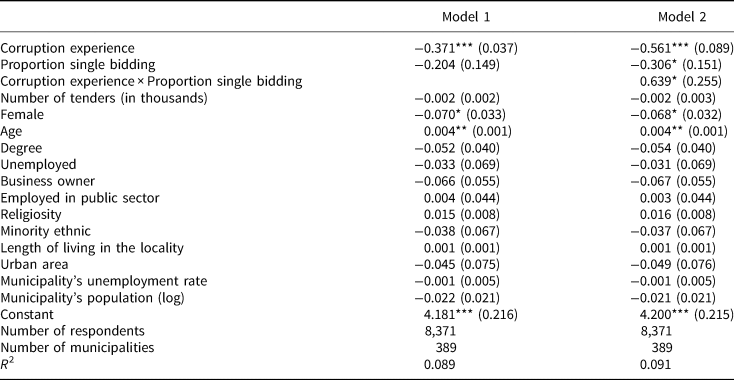
Notes: OLS, country dummies are included (coefficients not reported). Main entries are unstandardized regression coefficients, and numbers in parentheses are robust standard errors. Errors are clustered at the municipality level. *** p < 0.001; ** p < 0.01; * p < 0.05.
As estimates for Model 1 show, the effect of corruption experience on a respondent's evaluation of public institutions is unsurprisingly negative and highly statistically significant (p < 0.01). However, as we add the interaction effect between experience of corruption and the municipality-level prevalence of single bidding (Model 2), we notice that the average effect of the former variable tells us only part of the story. The interaction effect in Model 2 is strong and statistically significant (p < 0.05), suggesting that the effect is moderated by local context (see Figure 1). When the prevalence of single bidding in the municipality is held at its first percentile (no single bidding), an experience of a corrupt exchange, other things held constant, lowers a respondent's evaluation of public institutions by about 0.56 (on a 1 to 5 scale).
Context-dependent effects of corrupt encounter on evaluations of public institutions. Note: The points with 95 per cent confidence intervals represent estimated effects for localities with different levels of corruption (single-bidding proportion is given in brackets). Grey bars at the bottom represent the distribution of the moderating variable, that is, single-bidding proportion, across municipalities.
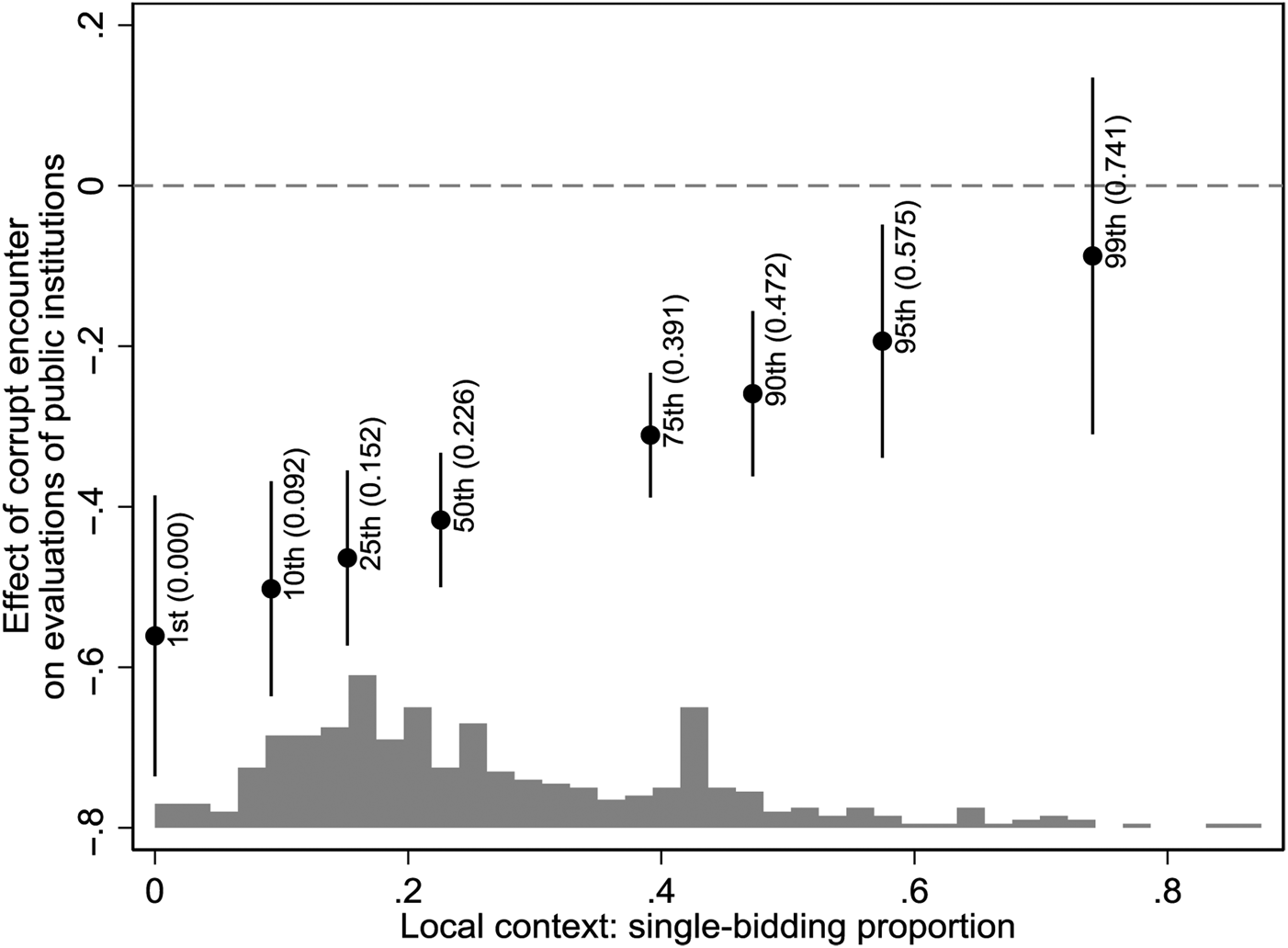
As we move to the municipalities with a large proportion of single bidding, the magnitude of the negative effect of corruption experience shrinks. For the majority of local contexts, the effects are similar, but at the seventy-fifth percentile (proportion of single bidding equal to 39.1 per cent), the negative effect of a corruption encounter is about 45 per cent smaller and statistically distinguishable from the tenth percentile estimate (p < 0.05). In other words, for the 10 per cent least corrupt settings, the effect of corruption experience is significantly lower than that for the 25 per cent most corrupt ones – an arguably suggestive result. For the municipalities with the highest prevalence of single bidding (above 70 per cent of bids), the effect of corruption experience becomes extremely weak and statistically indistinguishable from 0 (p > 0.05).
While it may seem that there are relatively few areas with levels of corruption so high as to render individual corrupt encounters inconsequential for institutional evaluations, it needs to be remembered that in terms of the prevalence of bribe giving to public officials, the countries in our sample score only moderately high: about 20 per cent of countries in the world are classified as more corrupt than the most corrupt country in our dataset (based on the 2013–17 Transparency International Global Corruption Barometer). Our study can thus serve as a useful benchmark for creating hypotheses about the most corrupt settings.
Overall, the results we obtain constitute fairly strong, and certainly very suggestive, evidence in support of the hypothesis we put forward. We recognize the fact that, in the first place, the negative effect of a person's experience of a corrupt exchange on their evaluation of public institutions is rather moderate, even in municipalities with no single bidding. The causes of this may be diverse, including such factors as the varying susceptibility of different institutions to corrupt practices and freedom from corruption not being the chief factor influencing popular perceptions. Nonetheless, the conditional effect of a corrupt encounter that we observe, with the core effect substantially shrinking for the municipalities with the highest prevalence of single bidding, seems non-trivial.
Conclusion
In this letter, we demonstrate a conditional effect of petty corruption, emphasizing the micro-level perspective rather than that of a firm or a country. We do not question the dominant view of corruption as highly detrimental to a political system's quality and legitimacy. We nonetheless argue that corruption effects may be nuanced and dependent on the local context, as citizens' experience of petty corruption tends to be strongly localized, especially in comparison to that of grand corruption. At the same time, our findings may have distant implications for the scholarly debate on grand corruption. In particular, our results tend to echo findings that in high-corruption settings, voters tend not to punish corrupt politicians at the polls and are more likely to engage in corruption themselves (Corbacho et al. Reference Corbacho2016; Pavão Reference Pavão2018).
Last but not least, we believe our findings also have important policy implications. Contexts permeated by corruption may be susceptible to the processes of its normalization. In such settings, a personal experience of a petty corrupt exchange may not have a noticeable impact on citizens' evaluation of public institutions, as the functionality of corruption leads to its increased acceptability. In other words, a corruption encounter no longer serves as a cue that local institutions function poorly. Moreover, anti-corruption efforts are unlikely to get traction because bribery and private connections are seen as an accessible method of increasing institutional efficiency, with favouritism and particularism becoming dominant logics (Persson, Rothstein and Teorell Reference Persson, Rothstein and Teorell2013). It thus seems that in order to be effective, future policies should refrain from assuming a universal unacceptability of corruption, openly and convincingly emphasizing its negative consequences for individuals and societies.
Supplementary Material
Online appendices are available at: https://doi.org/10.1017/S0007123422000047
Data Availability Statement
Replication data for this article can be found at: https://doi.org/10.7910/DVN/SYGABT
Acknowledgements
We would like to thank Katarzyna Zagórska for research assistance.
Financial Support
This work was supported by the European Research Council (Natalia Letki, grant number StG240830) and the Department of Political Science and International Studies, University of Warsaw (Natalia Letki).
Competing interests
None.
Ethical Standards
The research was conducted in accordance with the legal standards for personal data protection in each country surveyed. The approval for data collection was obtained in each country by the surveying company prior to fieldwork commencement. Data collection and handling complied with the International Chamber of Commerce/European Association for Social, Opinion and Market Research (ISS/ESOMAR) International Code on Market and Social Research, and the surveying companies were ESOMAR members. All participants provided informed consent and were compensated for their participation. Research ethical standards were approved by the ERC.


 Open access

