





First-episode psychosis (FEP) is characterised by heterogeneous clinical presentations, Reference Voineskos, Jacobs and Ameis1 temporal progression Reference Prakash, Chatterjee, Srivastava and Chauhan2 and responses to medication. Reference Leucht, Crippa, Siafis, Patel, Orsini and Davis3 Cross-sectional magnetic resonance imaging (MRI) studies consistently report alterations in frontal and temporal cortices, Reference Oertel-Knöchel, Knöchel, Rotarska-Jagiela, Reinke, Prvulovic and Haenschel4 with some identifying changes in insular, Reference Crespo-Facorro5 parietal Reference Yildiz, Borgwardt and Berger6 and occipital regions. Reference Tordesillas-Gutierrez, Ayesa-Arriola, Delgado-Alvarado, Robinson, Lopez-Morinigo and Pujol7 Longitudinal studies have additionally revealed progressive cortical deterioration in FEP, especially in frontal and temporal regions, over 1, Reference Del Re, Stone, Bouix, Seitz, Zeng and Guliano8 2–3, Reference Cobia, Smith, Wang and Csernansky9 5 Reference van Haren, Hulshoff Pol, Schnack, Cahn, Mandl and Collins10 and 10 years. Reference Rodriguez-Perez, Ayesa-Arriola, Ortiz-García de la Foz, Setien-Suero, Tordesillas-Gutierrez and Crespo-Facorro11 Despite these findings, the complex interplay between brain development, gender and neurodevelopmental pathophysiology complicates the disentanglement of their individual contributions to brain structure and function. Normative modelling addresses this by creating ‘growth charts of brain development, Reference Bethlehem, Seidlitz, White, Vogel, Anderson and Adamson12 allowing individuals to be ranked and assigned centile scores based on deviations from expected neurotypical trajectories. This approach has been used to identify abnormal structural subtypes in autism Reference Shan, Uddin, Xiao, He, Ling and Li13 and deviations in attention-deficit hyperactivity disorder symptoms. Reference Marquand, Rezek, Buitelaar and Beckmann14 In psychosis, normative modelling reveals deviations in cortical thickness in temporal areas during high-risk states 15 and across the cortex in FEP, Reference Worker, Berthert, Lawrence, Kia, Arango and Dinga16 with these deviations diminishing during treatment. Reference Berthet, Haatveit, Kjelkenes, Worker, Kia and Wolfers17
Brain structure and clinical outcomes
MRI studies have also extensively explored the clinical presentation of FEP, linking positive symptoms, such as hallucinations and delusions, to thinning in frontal Reference Padmanabhan, Tandon, Haller, Mathew, Eack and Clementz18 and temporal Reference Walton, Hibar, van Erp, Potkin, Roiz‐Santiañez and Crespo‐Facorro19 cortices. Conversely, negative symptoms, including anhedonia and social withdrawal, are associated with reduced orbitofrontal thickness. Reference Walton, Hibar, van Erp, Potkin, Roiz-Santiañez and Crespo-Facorro20 The effects of antipsychotics on brain structure remain debated, with studies reporting both grey matter reductions Reference Vita, De Peri, Deste, Barlati and Sacchetti21 and increased regional thickness. Reference Goghari, Smith, Honer, Kopala, Thornton and Su22 Cognitive decline in FEP has been observed prior to the onset of psychosis Reference Bora and Murray23 while post-onset trajectories vary, with reports of stabilisation, Reference McCleery and Nuechterlein24 decline Reference Fett, Velthorst, Reichenberg, Ruggero, Callahan and Fochtmann25 and improvement. Reference Burgher, Scott, Cocchi and Breakspear26 Normative modelling has shown neurocognitive delays in youth reporting psychotic symptoms, Reference Gur, Calkins, Satterthwaite, Ruparel, Bilker and Moore27 but the long-term impact of antipsychotics on cognition remains uncertain. Reference Husa, Moilanen, Murray, Marttila, Haapea and Rannikko28
Regional vulnerability to atypical development
The spatial patterns of cortical deterioration shared across psychiatric and neurological conditions have been interpreted as a reflection of differential regional vulnerability to pathology. Reference Hettwer, Larivière, Park, van den Heuvel, Schmaal and Andreassen29 Under this hypothesis, cortical vulnerability to psychosis-related deterioration may reflect regional differences in cellular composition, neurotransmitter receptors and metabolism, Reference Hettwer, Larivière, Park, van den Heuvel, Schmaal and Andreassen29 with regions of high serotonin and acetylcholine receptor density showing greater atypical deviations. Reference García-San-Martín, Bethlehem, Mihalik, Seidlitz, Sebenius and Alemán-Morrillo30 In this study, we hypothesise that FEP patients exhibit atypical brain development influenced by treatment and medication, which impacts cognitive and symptom progression. We analysed baseline and 10-year follow-up longitudinal data to explore associations among brain deviations, clinical diagnosis, medication, cognition and symptoms. Using cytoarchitectonic and neurobiological atlases, we additionally characterised psychosis-related brain deviations based on neurotransmitters, cell types, microstructure and metabolism.
Method
Subjects
MRI and phenotypic data were collected from healthy controls (n = 195; 120 males, mean age 29.1 ± 7.63 years) and individuals with FEP (n = 357; 213 males, mean age 29.8 ± 8.76 years), who were followed longitudinally. Follow-up assessments were conducted at baseline (193 controls, 333 FEP) and at 1 (62 controls, 96 FEP), 3 (51 controls, 136 FEP), 5 (76 controls, 70 FEP) and 10 (91 controls, 101 FEP) years (see Supplementary Figs 1 and 2 available at https://doi.org/10.1192/bjp.2025.10482 for flow diagram for study participants and alluvial diagram of attrition).
Recruitment was conducted through the Program for Attention to the Initial Phases of Psychoses (PAFIP) at Marqués de Valdecilla University Hospital and Valdecilla Health Research Institute (IDIVAL) in Spain. The authors assert that all procedures contributing to this work comply with the ethical standards of the relevant national and institutional committees on human experimentation, and with the Helsinki Declaration of 1975 as revised in 2013. All procedures involving human subjects were approved by CEIC-Cantabria (clinical trial nos NCT0235832 and NCT02534363) and the Ethics Committee of the University of Seville (no. 2024-2534). Following a comprehensive explanation of the study, each participant provided written informed consent prior to enrolment. Participants in the clinical group met DSM-IV criteria for schizophrenia spectrum disorders, including schizophrenia (n = 156), schizophreniform disorder (n = 99), schizoaffective disorder (n = 6), brief psychotic disorder (n = 48) and psychosis not otherwise specified (n = 24). The full list of inclusion and exclusion criteria is provided in Supplementary Methods. Detailed demographic and clinical information, stratified by gender and diagnosis, are provided in Supplementary Figs 3 and 4 and Supplementary Tables 1–4).
Cognitive and symptom assessment
Cognition was assessed for the following domains: (a) verbal memory: Rey Auditory Verbal Learning Test long-term recall score; (b) visual memory: Rey Complex Figure test long-term recall score; (c) motor dexterity: grooved pegboard, time to complete with dominant hand; (d) executive functions: Trail Making Test part B; (e) working memory: WAIS III-Backward Digits total score; (f) speed of processing: WAIS III-Digit Symbol standard total score; and (g) attention: Continuous Performance Test Degraded-Stimulus, the total number of correct responses. Reference Rodríguez-Sánchez, Setién-Suero, Suárez-Pinilla, Van Son, Vázquez-Bourgon and López31 For each cognitive test, z-scores were computed by subtracting the mean and dividing by the standard deviation of the control group’s scores. Overall cognitive functioning was calculated as the mean z-score across the seven cognitive tests for each individual. FEP participants were also assessed using the Scale for the Assessment of Negative Symptoms (SANS, 21 items), Scale for the Assessment of Positive Symptoms (SAPS, 30 items) and Brief Psychiatric Rating Scale (BPRS, 24 items).
Principal component analysis (PCA) was conducted on cognition and symptom items for comparison with average scores used in the calculations. Sensitivity analyses examined the impact of cannabis use and study dropout on cognitive and symptom measures. Psychological evaluations were performed by experienced psychiatrists using the structured clinical interview for DSM-IV, with diagnoses confirmed at 6 months. All statistical analyses were performed using RStudio version 2023.9.1.494 for Windows (RStudio, Boston, Massachusetts, USA; https://www.rstudio.com/products/rstudio/download/).
MRI acquisition and volume extraction
Structural MRI scans were acquired using a 1.5T General Electric SIGMA System (GE, Milwaukee, USA) and a 3T Philips Medical Systems MRI scanner (Achieva, Best, The Netherlands) equipped with an 8-channel head coil. Baseline and follow-up scans for each individual were consistently conducted using the same machine. The imaging protocol included a T1-weighted image that underwent visual inspection for quality control. The parameters for the 1.5T system were: echo time 5 ms, repetition time 24 ms, NEX 2, rotation angle 45°, FOV 26 × 19.5 cm2, slice thickness 1.5 mm, voxel size 1.02 × 1.02 × 1.5 mm3 and matrix 256 × 192; and for 3T: echo time 3.7 ms, repetition time 8.2 ms, flip angle 8°, acquisition matrix 256 × 256, voxel size 0.94 × 0.94 × 1 mm3 and 160 contiguous slices. The longitudinal pipeline of FreeSurfer 7.0.0 (recon-all) was used to estimate the global cortical volume and regional volume of each region defined in the Desikan–Killiany atlas (34 regions per hemisphere). One regional outlier (>5 s.d. from the mean) was excluded. Raw regional volumetric data from both scanners were harmonised using ComBatLS, preserving age, gender and diagnosis variance. Reference Gardner, Shinohara, Bethlehem, Romero-Garcia, Warrier and Dorfschmidt32
Regional volumetric centile estimation
We leveraged the cross-sectional normative trajectories established by the BrainChart study, which benchmarked cortical volumes from the Desikan–Killiany atlas against data from over 100 000 neurotypical individuals. Reference Bethlehem, Seidlitz, White, Vogel, Anderson and Adamson12 Based on these trajectories, we computed out-of-sample centile estimates for our longitudinal sample, using the control cohort to account for scanner-related offsets (https://github.com/brainchart/Lifespan). Following the pipeline of Bethlehem et al, Reference Bethlehem, Seidlitz, White, Vogel, Anderson and Adamson12 the volumetric values of left and right homologous regions were averaged to obtain a single measure per region, and centiles were subsequently computed from these averaged values. Age-normed, gender-stratified and site-corrected deviations were derived and expressed as centile scores; centile scores represent the relative position of an individual’s grey matter volume with respect to normative lifespan trajectories. Scores below 0.5 indicate volumes lower than the median for age- and gender-matched individuals, whereas scores above 0.5 indicate volumes higher than the median. Residual effects of site or motion (Euler index) on centile scores were assessed using analysis of variance (ANOVA).
Baseline analyses using multiple regression
To evaluate the impact of FEP diagnosis on baseline centiles, a multiple regression was performed for each cortical region using the following model:
 $$\small{\rm{regional\ centile\sim 1 + diagnosis + gender+ age\ of\ inclusion + etiv}}$$
where diagnosis is a binary variable (control versus FEP), age of inclusion refers to participants’ age at the first scan and etiv (estimated total intracranial volume) represents cranial volume residuals following age and gender correction (which allowed us to account for anthropometric factors using a single variable). Age of inclusion and etiv were z-scored prior to regression. All P-values were corrected for multiple comparisons across regions using false discovery rate (FDR).
Longitudinal analyses using mixed modelling
The longitudinal effects of disease and medication on centiles and clinical outcomes were analysed using mixed modelling over 1209 assessments (195 controls, 357 FEP). Antipsychotic medication exposure was assessed at each visit (Supplementary Fig. 5) and converted to chlorpromazine equivalents (CPZ-equivalents). Reference Danivas and Venkatasubramanian33
LMM for prediction of regional centiles as a function of disease progression and treatment
Linear mixed modelling (LMM) was used to assess the impact of time from the first scan (for controls) and time from treatment initiation (for FEP), collectively referred to as time, in regional centiles. The contribution of age was separated between age of inclusion and time to ability, to capture specific interaction effects among treatment time, medication and centiles trajectory in patients:
 $$\small{\eqalign{\rm{regional\ centile} & \sim 1+ {\rm diagnosis+ gender + age\ of\ inclusion} \cr& \hskip 11pt + \, {\rm etiv} + {\rm medication+time+ time \times diagnosis} \cr & \,\,\,\,\,\,\,{\rm +\ medication \times time+(1\vert subject)}}}$$
where, in addition to the aforementioned variables, we also considered the following: medication at the time of MRI acquisition (antipsychotic dose in CPZ-equivalents), time × diagnosis (interaction between time and diagnosis) and medication × time (interaction indicating whether medication alters the effect of treatment time on centiles); and ‘1|subject as a random intercept to account for random subject-specific offsets overall. Age of inclusion, etiv, medication and time were z-scored prior to regression.
Sensitivity analyses repeated these models, using raw regional volumes rather than centiles as the dependent variable.
LMM for prediction of cognitive functioning as a function of treatment and regional centiles
After exploring the effects of disease and treatment on centiles, we evaluated how these factors relate to overall cognitive functioning:
 $$\small{\eqalign{\rm cognition & \sim 1+ \rm diagnosis+ \rm gender+ \rm age\ \rm of\ \rm inclusion + \rm etiv\cr & \hskip 11pt + \rm medication+\rm time+\rm centile+\rm time \times \rm diagnosis \cr & \hskip 11pt + \rm medication \times \rm time+centile \times diagnosis \cr & \hskip 11pt +\rm centile \times \rm time+(1\vert \rm subject)}}$$
Models were fitted independently for each region, resulting in one parameter estimate per region and covariate. For visualisation, a cortical map was generated for each covariate to summarise the regional patterns of association. All P-values were corrected for multiple comparisons across regions using FDR.
Generalised mixed modelling for prediction of clinical symptomatology as a function of treatment and regional centiles
Symptomatology (BPRS, SAPS and SANS scores) was modelled as:
 $$\small{\eqalign{& \rm symptoms \sim 1+ gender+age\ of\ inclusion + etiv+centile\cr& \hskip 52.51pt +\rm time + \rm medication+medication \times time \cr& \hskip 52.5pt +\rm centile\times medication +centile \times time+ (1\vert subject)}} $$
Generalised mixed models with a Poisson distribution were used, due to the count-like nature of symptom scores and their alignment with exponential decay patterns. Separate analyses were conducted for each region and psychometric scale.
Furthermore, for each scale, we conducted a mediation analysis to determine whether the association between medication and symptoms was mediated by the regional centile most strongly associated with symptoms. A bootstrap with 10 000 resamples was used to test for the presence of average direct effect (ADE), average causal mediation effect (ACME) and total effect (ADE + ACME).
Cytoarchitectural characterisation of centile associations
Cortical centiles associated with phenotypic variables (diagnosis, medication, BPRS, SAPS, SANS) were mapped onto the cortical hierarchies defined by the Mesulam atlas (unimodal, paralimbic, idiotypic, heteromodal; https://github.com/ucam-department-of-psychiatry/maps_and_parcs; Supplementary Table 5. Reference Mesulam34 ANOVA tests and Tukey post hoc analyses were used to identify differential distributions of centile associations across Mesulam areas.
Neurobiological mapping of centile associations
Centile–phenotypic associations were also profiled using 46 molecular and microarchitectural maps derived from MRI/positron emission tomography studies, expanding on the methodology presented in ref. Reference Hansen, Shafiei, Markello, Smart, Cox and Nørgaard35 and implemented at https://github.com/netneurolab/neuromaps and https://github.com/RafaelRomeroGarcia/NeurobiologyCentilesPsychosis. These maps included neurotransmitter receptors (5-HT1A, 5-HT1B, 5-HT2A, 5-HT4, 5-HTT, H3, D1, D2, DAT, NET, α4β2, VAChT, CB1, M1, MOR, mGluR5, NMDA, GABA); cell types (astrocytes, endothelial cells, microglia, oligodendrocytes, oligodendrocyte precursors, excitatory neurons, inhibitory neurons); cortical layers (I–VI); microstructural properties (synapse density, neurotransmitter PC1, gene expression PC1 (which is highly driven by cell types Reference Dear, Wagstyl, Seidlitz, Markello, Arnatkevičiūtė and Anderson36 ); cortical thickness, myelin); metabolism (glycolytic index, cerebral blood flow, cerebral blood volume, oxygen metabolism, glucose metabolism); cortical expansion (evolutionary expansion, developmental expansion, allometric scaling from the Philadelphia Neurodevelopmental Cohort; and allometric scaling from the National Institutes of Health). See Supplementary Table 6 for the full list of neurobiological features included in the analysis.
Principal component–canonical correlation analysis (PC-CCA; https://github.com/RafaelRomeroGarcia/cca_pls_toolkit) was used to identify combinations of neurobiological features that best explained centile–phenotypic associations. Reference Mihalik, Chapman, Adams, Winter, Ferreira and Shawe-Taylor37 PC-CCA reduces data dimensionality using PCA to minimise overfitting and then identifies the linear combination (weighted sum of loadings) of the neurobiological maps that best predicts the inter-regional variance of each centile–phenotypic association map. Statistical significance was evaluated using spatial autocorrelation-preserving permutation tests (spin tests; https://github.com/frantisekvasa/rotate_parcellation), with 10 000 parcellation-specific rotations. To validate the multiple regression patterns identified with PC-CCA, we conducted a sensitivity analysis with partial least squares (PLS). PLS maximises the covariance between the two variable sets, providing a robust alternative when collinearity might affect the canonical solution. Reference Mihalik, Chapman, Adams, Winter, Ferreira and Shawe-Taylor37
Results
Impact of diagnosis and treatment on centiles
Using multiple regression on baseline data, FEP patients demonstrated significantly lower total grey matter volume centiles compared with controls (t = −6.20, P < 10−8), but no reductions in total white matter centiles (t = 1.67, P = 0.095; see Supplementary Tables 7 and 8 for model fit estimates). Consistently, regional analyses showed widespread cortical reductions in centiles associated with diagnosis (Fig. 1, baseline). Covariates including age of inclusion and etiv correlated positively with centiles, while females exhibited lower centiles (Fig. 1, baseline). All effect sizes and FDR-corrected significance levels are provided in the supplementary data. Centiles were not significantly associated with motion artefacts quantified using the Euler index (Spearman’s rho −0.016, P = 0.587; Supplementary Fig. 6). As a sensitivity analysis, we recalculated the model including an age of inclusion × diagnosis interaction term, which revealed that the positive effect of age of inclusion on centiles was significantly attenuated in patients (t = −2.73, P = 0.006).
Associations between phenotypic data and covariates with regional centiles. Top: contribution of each variable to the multiple regression of baseline data; bottom: contribution of each variable to the linear mixed modelling of longitudinal changes in centiles (up to 10 years of follow-up). Scale represents t-values associated with each regression parameter. Non-significant contributions (P fdr ≥ 0.05) are depicted with desaturated colours. Etiv, estimated total intracranial volume; fdr, false discovery rate.

Longitudinal analyses using LMM over 10 years revealed that longer treatment duration in FEP patients was associated with increased global centile scores, progressively approaching normative values (t = 4.02, P < 10−4; Supplementary Table 9). Regionally, significant diagnosis–centile associations were observed across the whole cortex (Fig. 1, longitudinal). The main effect of time showed both positive and negative correlations with centiles; however, the time × FEP interaction revealed a generalised positive association (see Supplementary Fig. 7a for an illustration of this interaction). Medication (CPZ-equivalent) was negatively associated with centiles, showing also a negative interaction with time. Despite the robust effect of medication, substantial inter-subject variability in centiles persisted between individuals with low versus high medication doses (Supplementary Fig. 8).
The LMM analyses above were repeated using raw volumes rather than centiles. As illustrated in Supplementary Fig. 9, the principal age- and time-related negative association captured the expected decline in regional volume with ageing. Consistent with the centile results, this model also indicated a positive time × FEP interaction, which was attenuated by medication.
Regional centiles associated with cognitive impairment
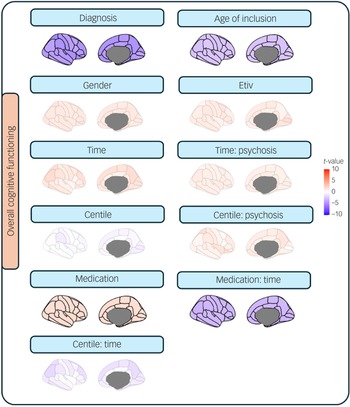
Because PCA of cognitive subscales revealed a first principal component explaining 45.3% of the variance, with similar weights across the 7 subscales (Supplementary Table 10), for simplicity, the mean score was used in subsequent analyses. Cognitive function was negatively associated with FEP diagnosis (Fig. 2, diagnosis) but did not correlate with regional centiles (Fig. 2, centile–psychosis interaction). Accordingly, the high individual variability limits reliable subgrouping based on centile trajectories (Supplementary Fig. 10). The observed positive effect of medication, together with the negative medication × time interaction, indicate that the initial therapeutic benefits are attenuated with prolonged treatment (illustrated in Supplementary Fig. 7b). As a sensitivity analysis, models were repeated by categorisation of individuals as either low-medicated (CPZ ≤ 300) or highly medicated (CPZ > 300). Interestingly, the global grey matter volume centile showed a weak but significant association with cognitive performance in patients (P = 0.04; Supplementary Table 11). Time had a negative impact on cognition among highly medicated individuals (β time – β time × high-medication = 0.13–0.21 = −0.08; Supplementary Table 11).
Associations between cognitive performance and phenotypic data, covariates and centiles. Contribution of each variable to the linear mixed modelling of longitudinal changes in cognition (up to 10 years of follow-up). Scale represents t-values associated with each regression parameter. Non-significant contributions (P fdr ≥ 0.05) are depicted with desaturated colours. Etiv, estimated total intracranial volume; fdr, false discovery rate.

Regional centiles associated with symptomatology
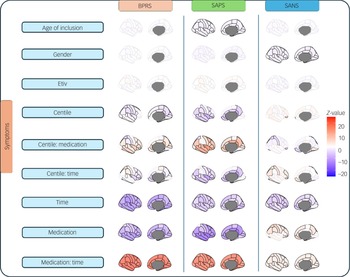
Treatment time correlated negatively with BPRS, SAPS and SANS scores, indicating symptom reduction over time (Fig. 3; see Supplementary Table 8 for model fit estimates). Medication was associated with reductions in BPRS and SAPS scores but increased SANS scores, probably due to pharmacological specificity for positive symptoms. A positive medication × time interaction indicates that symptom improvement with time was less pronounced in highly medicated patients. Positive symptoms (SAPS) were negatively associated with centiles, particularly overlapping with BPRS, whereas SANS showed a weak correlation with centiles. Younger age at onset was linked to more severe positive symptoms (SAPS). The sensitivity analysis comparing low- versus highly medicated patients revealed that, although attenuated, the effect of time on symptoms remained positive in the latter group (Supplementary Table 11). No significant differences were observed in cognitive or symptom scores between cannabis users and non-users (Supplementary Table 12), or between participants who completed the study and those who dropped out (Supplementary Table 13).
Associations between symptomatolgy and phenotypic data, covariates and centiles. Contribution of each variable to the generalised mixed modelling of longitudinal changes in BPRS, SAPS and SANS (each column represents different models). Scale represents the Wald z-statistic associated with each regression parameter. Non-significant contributions (P fdr ≥ 0.05) are depicted with desaturated colours. BPRS, Brief Psychiatric Rating Scale; SAPS, Scale for the Assessment of Positive Symptoms; SANS, Scale for the Assessment of Negative Symptoms; etiv, estimated total intracranial volume; fdr, false discovery rate.

Additionally, mediation analyses were performed to examine the potential mediating effects of centiles and time on the association between medication and symptom severity. Although no evidence of centile mediation was observed at treatment initiation, significant long-term mediation effects were identified. Specifically, the association between medication and symptoms was fully mediated by the insula for SAPS (β = 0.15, CI: [0.04, 0.27]), and partially mediated by the pars orbitalis cortex for SANS (β = –0.05, CI: [–0.11, –0.01]; Supplementary Fig. 11).
Cytoarchitectural and neurobiological characterisation of FEP-related regional centiles
Using the Mesulam cytoarchitectonic atlas, Reference Mesulam34 we characterised regional associations among centiles, cognition and symptoms. Centiles linked to BPRS or SANS did not show a preferential topographic Mesulam distribution. However, SAPS displayed significantly stronger negative associations in paralimbic regions compared with idiotypic areas (ANOVA, post hoc Tukey, P fdr< 0.05; Fig. 4(a)). PCA-CCA was used to capture associations between neurobiological data from normative individuals Reference Hansen, Shafiei, Markello, Smart, Cox and Nørgaard35 and centiles related to clinical outcomes. Neurobiological mapping revealed that regions associated with FEP diagnosis (Fig. 1) co-located with areas rich in neurotransmitters such as 5-HT1B, 5-HT2A and 5-HT6, as well as with neurons and metabolic features (P = 0.004; Fig. 4(b), negative loadings). Conversely, FEP diagnosis-related regions were associated with lower glial cell densities and 5-HT1A neurotransmitter levels (positive loadings). Neurobiological mapping for regions negatively impacted by medication was not significant.
Cytoarchitectural and neurobiological characterisation of first-episode psychosis-related centiles. (a) Distribution of t-values shown in Fig. 3 across the four cortices delineated in the atlas of Mesulam. Each dot represents a brain region in the Desikan–Killiany atlas. (b) Neurobiological maps co-located with the diagnosis–centile and medication–centile associations. Positive loadings indicate neurobiological features that are co-located with regions where centiles were positively associated with the variables of interest (in this case, diagnosis and medication). Conversely, negative loadings indicate co-location with regions negatively associated with the variable of interest. (c) Neurobiological maps co-located with the association between centiles and clinical outcomes (BPRS, SAPS and SANS). NS denotes non-significant models (P fdr ≥ 0.05); for significant models, only significant (P fdr < 0.05) loadings are displayed; BPRS, Brief Psychiatric Rating Scale; SAPS, Scale for the Assessment of Positive Symptoms; SANS, Scale for the Assessment of Negative Symptoms; fdr, false discovery rate.

Neurobiological features were significantly co-located with the centile–symptoms associations (Fig. 4(c)). Specifically, centiles associated with BPRS co-located with serotonin 5-HT1A, D2 and norepinephrine transporters, as well as with glial cells (P = 0.009). Regions showing negative correlations between centiles and BPRS (i.e. associated with symptom improvement) were co-located with 5-HT1B, GABA, NMDA receptors, inhibitory neurons, myelin, developmental expansion and allometric scaling. Centiles associated with SAPS recovery were co-located with 5-HT1A, 5-HT4, cannabinoid receptors, D2, norepinephrine transporters, glia and cortical thickness (P = 0.012). Centiles correlated with SANS were co-located with 5-HT4, cortical thickness and metabolism (P = 0.01).
Collectively, these results reveal a significant co-location of atypical brain maturation in FEP with specific neurobiological factors, suggesting that they may play an important role in shaping the structural vulnerability to FEP symptomatology. Consistency analyses using PLS rather than PCA-CCA yielded highly similar neurobiological loading estimates (all r > 0.78; Supplementary Fig. 12).
Discussion
In this study, we examined cortical volume deviations using normative centiles models in both neurotypical and FEP participants scanned over the course of 10 years. Our findings indicated that FEP participants had lower regional centiles than controls in multiple cortical areas, a difference that decreased in intensity over the treatment period. However, this convergence between patients and controls was less pronounced in those who were highly medicated. Psychotic symptomatology was negatively correlated with centiles co-located with regions of high serotonin receptor density. These results highlight the value of normative approaches for better understanding of the long-term relationship between cortical maturation and clinical profiles in psychosis.
Our normative analysis revealed atypical developmental values in FEP patients who exhibited a generalised reduction in regional centile scores. Reference Worker, Berthert, Lawrence, Kia, Arango and Dinga16 Previous studies have extensively reported reductions in cortical volume and thickness at different stages of psychosis-related conditions. Reference Crespo-Facorro5,Reference Tordesillas-Gutierrez, Ayesa-Arriola, Delgado-Alvarado, Robinson, Lopez-Morinigo and Pujol7,Reference Worker, Berthert, Lawrence, Kia, Arango and Dinga16 As shown by the ENIGMA consortium, although frontal and temporal cortices are the regions showing the strongest effect size when compared with normative controls, schizophrenia is also characterised by a generalised reduction over the whole cortex. Reference Thompson, Jahanshad, Ching, Salminen, Thomopoulos and Bright38 Nevertheless, a major challenge in traditional case–control studies is the lack of personalised metrics capable of detecting individuals with atypical neurodevelopment. Conversely, normative modelling leverages data from thousands of individuals for identification of participants with abnormal trajectories. Using this approach, Worker et al Reference Worker, Berthert, Lawrence, Kia, Arango and Dinga16 demonstrated the existence of a large and widespread number of extreme negative deviations in cortical thickness centiles among FEP, revealing that this condition is characterised not only by a diminished group-average cortical thickness but also by specific individuals that exhibit severe thickness reductions.
The combination of normative modelling and long-term longitudinal MRI revealed that centiles increased during the treatment period of FEP participants. These findings indicate that grey matter reductions are more pronounced during the early stages of psychosis, Reference Pantelis, Yücel, Wood, Velakoulis, Sun and Berger39 whereas the age-related volume decreases observed in controls are less pronounced in late psychosis. Reference Goghari, Smith, Honer, Kopala, Thornton and Su22 Berthet et al Reference Berthet, Haatveit, Kjelkenes, Worker, Kia and Wolfers17 also reported this trend towards a reduced difference over time between controls and FEP patients when investigating cortical thickness using normative modelling. Because that study did not include untreated patients, we cannot disentangle the specific effects of treatment from the natural course of the disease and potential late effects of neurodegenerative pathogenesis. Reference Woods40 Medication has previously been associated with grey matter loss, Reference Haijma, Van Haren, Cahn, Koolschijn, Hulshoff Pol and Kahn41 specifically attributed to caspase-3-mediated neurotoxicity. Reference Gassó, Mas, Molina, Bernardo, Lafuente and Parellada42 In this line, we also found that high medication doses were associated with generalised cortical reduction. As suggested by a meta-analysis conducted by Fusar-Poli et al, Reference Fusar-Poli, Smieskova, Kempton, Ho, Andreasen and Borgwardt43 long-term grooved pegboard reductions may be the consequence of cumulative exposure to antipsychotics, a finding also supported by other studies. Reference Vita, De Peri, Deste, Barlati and Sacchetti21
While describing the anatomical alterations related to the progression and treatment of psychosis is of great interest, understanding how these changes impact patients’ cognitive functionality is of crucial clinical importance. We reported reduced cognitive abilities in drug-naïve and minimally medicated FEP participants immediately after onset, suggesting that impairment occurs even before the first episode. Reference Bora and Murray23 Cognitive functionality also improved throughout the treatment, indicating that, while medication targets positive symptoms, it may also lead to cognitive improvement, albeit as an indirect effect. Reference Bora and Murray23 Previous studies have also demonstrated cognitive improvement in patients after 1 Reference Zipparo, Whitford, Redoblado Hodge, Lucas, Farrow and Brennan44 or 3 Reference Zabala, Eguiluz, Segarra, Enjuto, Ezcurra and Elizagarate45 years of antipsychotic treatment. Nevertheless, our LMM additionally found that medication influenced the association between treatment duration and cognitive function, leading to attenuation of cognitive recovery over time for patients with higher medication doses. In line with this observation, Kawai et al Reference Kawai, Yamakawa, Baba, Nemoto, Tachikawa and Hori46 demonstrated that dose reductions led to improvements in cognitive performance in a limited sample of individuals treated with multiple conventional antipsychotics.
Unsurprisingly, treatment yielded a positive effect on FEP-related symptomatology. As expected, both time and medication primarily had an impact on positive symptoms. Conversely, time had a positive but weaker effect on the reduction of negative symptoms. Despite the fact that medication, especially first-generation antipsychotics, does not alleviate negative symptoms, meta-analyses of placebo-control trials have indeed revealed that most treatments can help reduce negative symptomatology. Reference Fusar-Poli, Papanastasiou, Stahl, Rocchetti, Carpenter and Shergill47 Nevertheless, here we observed opposite trends in the model slopes of time (negative) and medication (positive) with SANS, indicating that heavily medicated individuals do not experience negative symptom improvements over time. This may reflect the diverse and distinct recovery trajectories of illness, with a significant proportion of patients experiencing relapse and showing no improvement in negative symptoms. Reference Austin, Mors, Budtz-Jørgensen, Secher, Hjorthøj and Bertelsen48 FEP symptomatology was also associated with regional volumes, with higher centile values being associated with lower positive symptoms. Similarly, previous studies have associated positive symptoms with cortical alterations in prefrontal, temporal and parietal areas. Reference Walton, Hibar, van Erp, Potkin, Roiz‐Santiañez and Crespo‐Facorro19 Conversely, negative symptoms exhibited a weak correlation with centiles, suggesting that while treatment and medication may provide moderate improvement in this domain, these symptoms remain relatively stable and do not significantly influence cortical plasticity. However, further placebo-controlled trials will be necessary to elucidate this. Reference Austin, Mors, Budtz-Jørgensen, Secher, Hjorthøj and Bertelsen48
Neurobiologically, serotonin neurotransmitters were predominantly present in regions associated with psychosis diagnosis. This may be related to the role of this neurotransmitter in mediating the effect of antipsychotic medication, which affects mood and cognitive function. Reference Grinchii and Dremencov49 We also reported differences in centile associations across receptor subtypes including 5HT1A and 5HT2A, which could be a reflection of their complex role in psychosis. Reference Celada, Puig, Amargós-Bosch, Adell and Artigas50 Additionally, the co-location of dopamine receptors in regions associated with symptoms suggests a potential pathway whereby elevated levels of antipsychotic medications disproportionately affect dopaminergic regions. Moreover, diagnosis- and symptom-related centiles were associated not only with neuronal density maps but also with glial cells, indicating a potential involvement of immunological and inflammatory risk factors. Reference Bernstein, Steiner, Guest, Dobrowolny and Bogerts51
Limitations
Several limitations must be acknowledged. First, the primary inclusion criterion was the diagnosis of FEP at baseline, regardless of subsequent follow-up diagnoses, which predominantly included schizophrenia but also other psychotic disorders. Second, the use of CPZ-equivalents provides a simplified representation of the heterogeneous antipsychotic treatments across the sample, allowing us to capture the overall medication effect with a single parameter. However, different classes of antipsychotics may have differential effects on centiles and clinical outcomes. Inclusion of all drug-specific doses was not feasible, because this would have substantially increased the number of variables and the risk of overfitting. Finally, higher medication doses were generally prescribed to individuals with more resistant positive symptoms. However, these prescriptions were influenced by factors such as age of onset and treatment duration, complicating the disentanglement of individual contributions in the models.
This Brain-Wide Association Study (BWAS) demonstrates that centiles are associated with clinical outcomes in FEP. Nevertheless, growing evidence highlights important concerns: BWAS findings are susceptible to inflated effect sizes and low replication rates unless samples include thousands of individuals. Reference Marek, Tervo-Clemmens, Calabro, Montez, Kay and Hatoum52 Recent findings by Kang et al have shown, however, that longitudinal designs can substantially improve replicability. Reference Kang, Seidlitz, Bethlehem, Xiong, Jones and Mehta53 In that study, participants were comprehensively assessed over a 10-year period. While replication gains plateau after the first follow-up, particularly for structural markers, which exhibit limited within-subject variability, longitudinal assessments remain valuable for capturing the pronounced phenotypic decline in cognition and symptoms over time in FEP. Importantly, this high within-subject phenotypic variability is critical for enhancement of replicability, especially when modelled separately from between-subject variability, Reference Kang, Seidlitz, Bethlehem, Xiong, Jones and Mehta53 as implemented here.
We aimed to maintain the models as parsimonious as possible. With 552 participants, up to 11 fixed variables and at least 449 degrees of freedom, the resulting balance was appropriate for robust and replicable estimation of model parameters. Reference Maas and Hox54 Nevertheless, aspects such as the inclusion of moderate covariates, potential underlying collinearity or missing data further contribute to the complexity of assessing the actual statistical power and the potential risk of overfitting of the models.
Centiles derived from cross-sectional brain charts have demonstrated underestimation of longitudinal brain changes, resulting in inaccurate predictors of longitudinal individual changes. Reference Di Biase, Tian, Bethlehem, Seidlitz, Alexander-Bloch and Yeo55 In the present study, which includes extensive follow-up data, our objective was not to perform individualised age-related prediction but to identify volumetric deviations associated with long-term cognitive and symptomatic outcomes in FEP. To account for residual age effects retained by the centiles, both age of inclusion and time were included as main effects in the models. However, longitudinal normative modelling was not performed due to the limited sample size. Future work will benefit from calibrating brain reference charts with longitudinal data-sets. Reference Di Biase, Tian, Bethlehem, Seidlitz, Alexander-Bloch and Yeo55 This will be crucial for characterisation of individual-level trajectories, and for identification of subgroups that may account for clinical heterogeneity and differences in treatment response.
This study applied a normative modelling approach to demonstrate that FEP is characterised by regional decreases in cortical centiles. Centiles recovered to normative values during treatment, but were negatively affected by high doses of long-term medication. Similarly, improvements in cognitive abilities and symptomatology were positively associated with time but negatively influenced by prolonged medication use. Regions sensitive to symptomatology co-located with higher serotonin receptor densities and other neurobiological features. Collectively, these findings provide critical insights into the long-term interactions among cortical structure, treatment, medication, cognitive function and symptom profiles.
Supplementary material
The supplementary material is available online at https://doi.org/10.1192/bjp.2025.10482
Data availability
All code and non-clinical data used to perform the analyses can be found at https://github.com/RafaelRomeroGarcia/LongitudinalCentilesFEP/. Data on patients are available upon request, in accordance with ethical regulations. All statistical results are provided in a supplementary Excel file.
Acknowledgements
We thank Agoston Mihalik, Golia Shafiei, Bratislav Misic, Victor Ortiz and Lifespan Brain Chart Consortium for their contributions.
Author contributions
C.A.-M. performed data curation, methodological design, data analysis and drafted the manuscript; N.G.-S.-M., R.A.I.B., L.D., M.A.-N., P.S., A.P., M.M.-C., M.C.-R., J. Seidlitz, R.A.-A., J.V.-B., J. Suckling, M.R.-V., B.C.-F. and R.R.-G. contributed to data acquisition, provided advice on data analysis and participated in writing and editing the manuscript. R.R.-G. also contributed to conceptualisation, the first manuscript draft and supervision of the work. All authors approved the submitted version of the manuscript.
Funding
R.R.-G. is funded by the EMERGIA Junta de Andalucía programme (no. EMERGIA20_00139), ERANET Neuron JTC 2023 (no. ERP-2023-23684211) and Plan de Consolidación (no. CNS2023-143647). Both R.R.-G. and C.A.-M. are funded by Plan de Generación de Conocimiento from Agencia Estatal de Investigación (no. PID2021-122853OA-I00). J. Suckling is funded by the Psychosis Immune Mechanism Stratified Medicine Study, UK Medical Research Council (no. MR/S037675/1). All research at the Department of Psychiatry in the University of Cambridge is supported by the National Institute for Health and Care Research (NIHR) Cambridge Biomedical Research Centre (no. NIHR203312) and NIHR Applied Research Collaboration East of England. The views expressed are those of the author(s) and are not necessarily those of the NIHR or the Department of Health and Social Care.
Declaration of interest
R.A.I.B. and J. Seidlitz hold equity in, and are directors of, Centile Bioscience. All other authors declare that they have no known competing interests.



 Open access


eLetters
No eLetters have been published for this article.