





The intersection of emotion and language has been a central focus in psycholinguistics, spanning around two decades of research (Alonso-Arbiol et al., Reference Alonso-Arbiol, Shaver, Fraley, Oronoz, Unzurrunzaga and Urizar2006; Altarriba, Reference Altarriba, Heredia and Altarriba2014; Altarriba et al., Reference Altarriba, Bauer and Benvenuto1999; Wu & Zhang, Reference Wu and Zhang2022). Recognizing emotion as a pivotal element in personal and social life amplifies the significance of understanding how it influences language processing (Imbir et al., Reference Imbir, Pastwa, Jankowska, Kosman, Modzelewska and Wielgopolan2020; Speed & Brysbaert, Reference Speed and Brysbaert2023; Warriner et al., Reference Warriner, Kuperman and Brysbaert2013). The interplay between emotion and language has prompted investigations into key variables, notably valence (El-Dakhs & Altarriba, Reference El-Dakhs and Altarriba2019; Imbir et al., Reference Imbir, Pastwa, Wielgopolan, Modzelewska and Sobieszek2023) and arousal (Altarriba & Canary, Reference Altarriba and Canary2004; Yao et al., Reference Yao, Zhu and Luo2019). Here, valence pertains to the differentiation between negative and positive words, while arousal refers to the variation of a word from being calm to being arousing. The combination of valence and arousal constitutes the fundamental theoretical framework for delineating emotion words (Russell, Reference Russell1980).
Established findings indicated negative words are processed more slowly than positive words (Bromberek-Dyzman et al., Reference Bromberek-Dyzman, Jonczyk, Vasileanu, Niculescu-Gorpin and Bak2021; Estes & Adelman, Reference Estes and Adelman2008). However, some studies showed that negative and positive words were processed equally faster than neutral words, indicating a general facilitation effect of emotionality (e.g., Citron et al., Reference Citron, Weekes and Ferstl2014; Kousta et al., Reference Kousta, Vinson and Vigliocco2009; Vinson et al., Reference Vinson, Ponari and Vigliocco2014). Some evidence even revealed that negative words were processed faster than positive words (Larsen et al., Reference Larsen, Mercer, Balota and Strube2008). In addition to valence, concurrently, high-arousing words are processed more rapidly than their low-arousing counterparts (Wu et al., Reference Wu, Shi and Zhang2023). Notably, an intriguing interaction between valence and arousal emerged for abstract words—high-arousing positive words exhibited longer reaction times than low-arousing positive words, while the reverse pattern was observed for negative words (Yao et al., Reference Yao, Yu, Wang, Zhu, Guo and Wang2016), affirming the nuanced role of valence and arousal in defining emotion words. The interaction between valence and arousal was also observed for concrete words (Hoffman et al., Reference Hofmann, Kuchinke, Tamm, Võ and Jacobs2009; Larsen et al., Reference Larsen, Mercer, Balota and Strube2008; Vieitez et al., Reference Vieitez, Haro, Ferré, Padrón and Fraga2021).
Beyond valence and arousal, additional factors like concreteness (Wang & Yao, Reference Wang and Yao2012), age of acquisition (Wu et al., Reference Wu, Shi and Zhang2023), word frequency (Kahan & Hely, Reference Kahan and Hely2008; Kuperman et al., Reference Kuperman, Estes, Brysbaert and Warriner2014; Méndez-Bértolo et al., Reference Méndez-Bértolo, Pozo and Hinojosa2011; Palazova et al., Reference Palazova, Mantwill, Sommer and Schacht2011; Sheikh & Titone, Reference Sheikh and Titone2013), and the emotion word type (Liu et al., Reference Liu, Fan, Tian, Li and Feng2023; Zhang, Teo, et al., Reference Zhang, Teo and Wu2019; Zhang et al., Reference Zhang, Wu, Yuan and Meng2018) are gaining prominence in influencing emotion word processing. For instance, Méndez-Bértolo et al. (Reference Méndez-Bértolo, Pozo and Hinojosa2011) demonstrated that negative words were recognized more rapidly than neutral words; however, this processing advantage was solely detected for words of low frequency. Additionally, Kousta et al. (Reference Kousta, Vigliocco, Vinson, Andrews and Del Campo2011) further linked concreteness and emotionality by revealing that abstract words were more emotional than concrete words, suggesting a crucial role of emotionality in abstract concepts. For the complex relationship between concreteness, valence, and arousal, Yao et al. (Reference Yao, Yu, Wang, Zhu, Guo and Wang2016) found the absence of a valence–arousal interaction for concrete words, distinguishing them from abstract words. Recently, Wu et al. (Reference Wu, Shi and Zhang2023) highlighted the independent impacts of valence and age of acquisition on emotion word recognition. Negative words, in particular, exhibited longer reaction times than positive words, with an additional facilitation effect of age of acquisition on recognition. Notably, an interaction between arousal and age of acquisition was identified, revealing that the effect of age of acquisition was observed only for low-arousing words. These nuanced findings underscore the importance of considering the age of acquisition in the broader landscape of emotion word processing. Recently, Sabater et al. (Reference Sabater, Ponari, Haro, Fernández-Folgueiras, Moreno, Pozo and Hinojosa2023) observed that positive emotion-laden words were acquired at an earlier stage than negative ones, thereby indicating a connection between the age of acquisition and the valence for emotion-laden words. This particular study expanded upon previous investigations which had demonstrated a comparable outcome that positive emotion-label words were obtained earlier than negative emotion-label words (e.g., Li & Yu, Reference Li and Yu2015). This line of research also suggested an emotion word type perspective that has garnered increased attention recently (Jia et al., Reference Jia, Zhang, Wang and Zhou2022; Li et al., Reference Li, Xu, Liu, Yang, Zhang and He2022; Wu & Zhang, Reference Wu and Zhang2020; Zhang et al., Reference Zhang, Wu, Meng and Yuan2024). This perspective not only introduces another influential factor but also provides valuable insights into conceptualizing what constitutes an emotion word.
Emotion word type and emotional prototypicality
The emotion word type perspective posits that emotion words fall into two categories: emotion-label words, directly referencing specific emotions like anger or delight, and emotion-laden words, containing emotional content without explicitly identifying affective states (Wu et al., Reference Wu, Zhang and Yuan2020; Wu et al., Reference Wu, Zhang and Yuan2022; Zhang et al., Reference Zhang, Wu, Meng and Yuan2017). At the outset, Pavlenko (Reference Pavlenko2008) and Altarriba (Reference Altarriba2006) contended for a division between “emotion words” and emotion-laden words. But recently, terminological attention has been given to naming “emotion words” as emotion-label words and combining emotion-label words and emotion-laden words together to form a class of emotion words (Wang et al., Reference Wang, Shangguan and Lu2019; Wu & Zhang, Reference Wu and Zhang2020; Zhang et al., Reference Zhang, Wu, Meng and Yuan2017). This distinction between emotion-label words and emotion-laden words holds across various languages, including English (Knickerbocker & Altarriba, Reference Knickerbocker and Altarriba2013), Chinese (Wang et al., Reference Wang, Shangguan and Lu2019; Zhang, Wu, et al., Reference Zhang, Wu, Yuan and Meng2019), Korean (Kwon et al., Reference Kwon, Yun and Lee2022), Spanish (Betancourt et al., Reference Betancourt, Guasch and Ferré2023, Reference Betancourt, Guasch and Ferré2024), and Polish (Bromberek-Dyzman et al., Reference Bromberek-Dyzman, Jonczyk, Vasileanu, Niculescu-Gorpin and Bak2021). For example, a recent study using a masked affective priming paradigm (Wu et al., Reference Wu, Zhang and Yuan2021a) underscores that emotion-laden words elicit affective priming effects on similar words rather than on emotion-label words. Complementing this, previous research has demonstrated a more significant priming effect for emotion-label words than emotion-laden words (Kazanas & Altarriba, Reference Kazanas and Altarriba2016a, Reference Kazanas and Altarriba2016b), consolidating the distinction between the two categories. Besides the studies using priming paradigm, other behavioral investigations using affective Simon task (Altarriba & Basnight-Brown, Reference Altarriba and Basnight-Brown2011), flanker task (Zhang et al., Reference Zhang, Teo and Wu2019), and emotion categorization task (Gu & Chen, Reference Gu and Chen2024) also provided converging results.
In addition to behavioral studies showing differences between the two types of words, an increasing number of electrophysiological studies also provided converging evidence (Jia et al., Reference Jia, Zhang, Wang and Zhou2022; Li et al., Reference Li, Xu, Liu, Yang, Zhang and He2022). Event-related potential (ERP), being a scalp-electricity recording technique that gauges the averaged brain activation of a large number of cortical pyramidal cells, has been prevalently employed in emotion word recognition (Kissler et al., Reference Kissler, Assadollahi and Herbert2006), as it holds an advantage in uncovering the temporal sequences of word processing (Zhang et al., Reference Zhang, He, Wang, Luo, Zhu, Gu and Luo2014). For example, Wu and Zhang (Reference Wu and Zhang2019) observed more enhanced brain activation for second language (L2) positive emotion-laden words compared to L2 positive emotion-label words, especially in N100, an early ERP component related to early attention activation, indicating early neurophysiological differences between L2 positive emotion-label words and emotion-laden words (Wu & Zhang, Reference Wu and Zhang2019). Similarly, Liu et al. (Reference Liu, Fan, Tian, Li and Feng2023) reported enhanced early posterior negativity (EPN, an ERP component related to emotion activation) for emotion-laden words compared to emotion-label words, further supporting the distinct neural correlates. Despite these findings, a clear consensus on how emotion-label and emotion-laden words differ remains elusive. Some evidence suggests higher emotion activation for reading emotion-label words (Kazanas & Altarriba, Reference Kazanas and Altarriba2015; Zhang et al., Reference Zhang, Wu, Meng and Yuan2017), while other studies propose the opposite (Liu et al., Reference Liu, Fan, Tian, Li and Feng2023; Wu & Zhang, Reference Wu and Zhang2019).
An underlying factor contributing to the inconsistency in results may be researchers’ subjective determination of emotion word types (Hinojosa et al., Reference Hinojosa, Moreno and Ferré2020). Recognizing this, researchers propose employing emotional prototypicality (EmoPro) to objectively measure the extent to which an emotion-label word refers to an emotion (Pérez-Sánchez et al., Reference Pérez-Sánchez, Stadthagen-Gonzalez, Guasch, Hinojosa, Fraga, Marín and Ferré2021; Wu, Reference Wu2023; Zheng et al., Reference Zheng, Zhang, Guo, Guasch and Ferré2023). The EmoPro approach is not a novel one and has been in existence for several decades (Niedenthal et al., Reference Niedenthal, Auxiette, Nugier, Dalle, Bonin and Fayol2004, Russell, Reference Russell1991; Shaver et al., Reference Shaver, Schwartz, Kirson and O’Connor1987). It is derived from the prototype theory, which posits that emotion concepts, like other “fuzzy” concepts such as furniture, are organized in a prototypical structure (Russell, Reference Russell1991; Shaver et al., Reference Shaver, Murdaya and Fraley2001). For example, “happy” is a more prototypical emotion word than “awe”. Based on this proposition, EmoPro ratings have been collected for different languages, including French (Niedenthal et al., Reference Niedenthal, Auxiette, Nugier, Dalle, Bonin and Fayol2004), Indonesian (Shaver et al., Reference Shaver, Murdaya and Fraley2001), and more recently, Spanish (Pérez-Sánchez et al., Reference Pérez-Sánchez, Stadthagen-Gonzalez, Guasch, Hinojosa, Fraga, Marín and Ferré2021). Specially, Pérez-Sánchez et al. (Reference Pérez-Sánchez, Stadthagen-Gonzalez, Guasch, Hinojosa, Fraga, Marín and Ferré2021) established an EmoPro normative database in Spanish, revealing that EmoPro was negatively correlated with valence and age of acquisition. Meanwhile, Wu (Reference Wu2023) extended this exploration to Chinese, finding a negative correlation between EmoPro and age of acquisition, though no significant relationship with valence. Importantly, Wu (Reference Wu2023) investigated the predictive power of EmoPro in Chinese word recognition using a lexical decision task, concluding that EmoPro did not significantly predict performance.
However, Wu (Reference Wu2023) only used correlation analysis to explore how EmoPro influences Chinese emotion word recognition. Recognizing the need for experimental evidence, Haro et al. (Reference Haro, Calvillo, Poch, Hinojosa and Ferré2023) conducted a lexical decision task in Spanish, demonstrating that high EmoPro words facilitated word recognition. The facilitation effect of EmoPro was identified even when emotion-laden words were used as fillers (Haro et al., Reference Haro, Calvillo, Poch, Hinojosa and Ferré2023). However, whether this EmoPro effect extends to Chinese remains uncertain, as Wu (Reference Wu2023) found no predictive power in a Chinese lexical decision task. As argued before, Wu (Reference Wu2023) only used a correlation approach to investigate the relationship between EmoPro and linguistic decision performance, so it was unclear whether EmoPro effect could be observed in an experiment of the lexical decision task and whether EmoPro could facilitate word recognition in another experiment using an explicit emotion task, such as a valence judgment task. By using experimental approach and controlling relevant factors, a straight influence of EmoPro on Chinese emotion word recognition should be examined. Furthermore, the facilitation effect of EmoPro has, up to this point, been discovered in Spanish. Consequently, it is also necessary to investigate whether this effect can be observed in other languages through the use of an experimental approach.
Another unresolved matter pertains to whether the effect of EmoPro in emotion word recognition is contingent upon task requirements. Mounting evidence has affirmed that the processing of emotion stimuli is reliant on task demands (Flaisch et al., Reference Flaisch, Imhof, Schmälzle, Wentz, Ibach and Schupp2015; Frühholz et al., Reference Frühholz, Jellinghaus and Herrmann2011; Hinojosa et al., Reference Hinojosa, Albert, López-Martín and Carretié2014). For instance, Frühholz et al. (Reference Frühholz, Jellinghaus and Herrmann2011) contrasted the processing of emotion words in color naming (an implicit emotion task) and emotion judgment (an explicit emotion task) tasks and discovered that emotion words elicited a greater early posterior negativity (EPN), an early negative ERP component associated with emotion activation, than neutral words solely in the emotion judgment task. These findings suggested that the processing of emotion words could be modulated by task demands, an aspect that has not been probed in the study of Haro et al. (Reference Haro, Calvillo, Poch, Hinojosa and Ferré2023). The current study thus aimed to further explore the EmoPro effect in two tasks, one being related to implicit emotion processing (lexical decision task) and the other associated with explicit emotion processing (valence judgment task).
Experiment 1
The current experiment aimed to examine the role of EmoPro in the lexical decision task by following the study of Haro et al. (Reference Haro, Calvillo, Poch, Hinojosa and Ferré2023). Since an increased EmoPro indicated enhanced access to emotion concepts (Haro et al., Reference Haro, Calvillo, Poch, Hinojosa and Ferré2023), it is predicted that high EmoPro words would be recognized faster than low EmoPro words. Specifically, the access to semantic-affective information would be more facile for high EmoPro words as compared to low EmoPro words. The enhanced access to the related semantic-affective information provides an increased room for permitting feedback from semantics to the lexical representation and facilitating lexical processing (Haro et al., Reference Haro, Calvillo, Poch, Hinojosa and Ferré2023). On the contrary, if the facilitation effect of EmoPro was solely restricted to Spanish, it would be prognosticated that EmoPro would not have an impact on the recognition of Chinese emotion words.
Method
Participants
Thirty-one Chinese speakers (4 males, mean age: 22.19 ± 0.70 years) were recruited for Experiment 1. One female participant reported that she was left-handed, whereas the rest of the participants said that they were right-handed. None of the participants suffered from psychiatric or mental disorders. All of the participants completed the consent forms before the experiment.
Stimuli
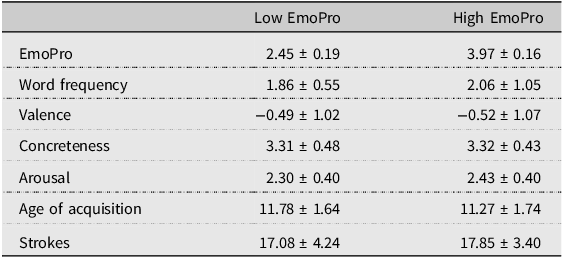
The Chinese words were obtained from a recent normative database on EmoPro (Wu, Reference Wu2023). There were 80 real Chinese words and 80 non-words that were constructed by randomly combining two Chinese characters. The 80 Chinese real words contained 40 high EmoPro words (> 3.0) and 40 low EmoPro words (< 3.0) (characteristics are shown in Table 1). The high and low EmoPro words were matched on word frequency (Cai & Brysbaert, Reference Cai and Brysbaert2010), F (1, 78)=1.126, p > 0.1, valence (Xu et al., Reference Xu, Li and Chen2022), F (1, 78)=0.01, p > 0.1, concreteness (Xu & Li, Reference Xu and Li2020), F (1, 78)=0.2, p > 0.1, arousal (Xu et al., Reference Xu, Li and Chen2022), F (1, 78)=2.268, p > 0.1, age of acquisition (Xu, Li, & Guo, Reference Xu, Li and Guo2021), F (1, 78)=1.779, p > 0.1, and strokes, F (1, 78)=0.813, p > 0.1. The real words (17.46 ± 3.84 strokes) and non-words (17.25 ± 4.79 strokes) were also matched on strokes, F (1, 158)=0.096, p > 0.1. The discrepancy in EmoPro of the two groups of Chinese was confirmed, F (1, 78)=1467.224, p < 0.001.
Word characteristics of two groups of Chinese emotion words in Experiment 1 (M ± SD)
Procedure
Before commencing the experiment, participants were required to complete a consent form. The experiment comprised five blocks, including one practice and four formal blocks. The practice block involved 12 trials, encompassing six real words and six non-words distinct from the 160 critical words featured in the formal blocks.
The 80 real and 80 non-words were randomly and evenly distributed across the four blocks. Each block consisted of 20 real words (ten high EmoPro words and ten low EmoPro words) and 20 non-words. In each trial, a fixation point appeared for 1000 ms, followed by the presentation of a target word, prompting participants to determine its authenticity as a real word. The words were displayed in white, Song font, and 48-point size against a black background. Participants were directed to make a response by utilizing two keys on the keyboard within 2000 ms, after which the target words vanished. The corresponding keys for the words and pseudowords were counterbalanced among the participants. The order of word presentation within a block and the block sequence were randomized. Short rest intervals were allowed between blocks to minimize fatigue.
Results
Trials that exceeded the M ± 2.5 SD were trimmed for further analysis. Thus, 3.25% of trials were discarded. The reaction time analysis was conducted with a linear mixed effect model that was fitted using maximum likelihood by including the fixed effect of EmoPro and random effects of trials and subjects. The fixed effect of EmoPro was marginally significant, Estimate=13.295, SE=6.704, t=1.983, p=0.051, such that high EmoPro words (684 ms) were recognized faster than low EmoPro words (710 ms). The accuracy rate analysis was conducted with a generalized linear mixed effect model that was also fitted using maximum likelihood by incorporating the fixed effect of EmoPro and random effects of trials and subjects. The high (0.978) and low (0.981) EmoPro words had very similar accuracy rates, Estimate=0.077, SE=0.178, t=0.432, p=0.666.
Discussion
Experiment 1 aimed to replicate the findings of Haro et al. (Reference Haro, Calvillo, Poch, Hinojosa and Ferré2023) and investigate the impact of EmoPro on Chinese emotion word recognition. Despite the marginal significance, the results confirmed the overall facilitation effect of EmoPro on lexical processing. The underlying assumption was that emotion words with higher EmoPro would exhibit easier access to affective-semantic information (Haro et al., Reference Haro, Calvillo, Poch, Hinojosa and Ferré2023), a hypothesis supported by the outcomes of Experiment 1.
However, crucial to recognize that this assumption could not be thoroughly examined in the lexical decision task employed by both Experiment 1 and Haro et al. (Reference Haro, Calvillo, Poch, Hinojosa and Ferré2023). In a lexical task, such as a lexical decision task, affective-semantic information is not as strongly activated. Participants explicitly retrieve semantic information in tasks requiring participants to categorize words, like determining whether a word belongs to the animacy category. Therefore, to explore whether EmoPro enhances emotion word recognition by facilitating the ease of accessing affective-semantic information, Experiment 2 employed an explicit emotion task (i.e., valence judgment task), anticipating a more pronounced effect of EmoPro on emotion word recognition compared to the lexical decision task. This expectation will be tested and validated in Experiment 2.
Experiment 2
Experiment 2 aimed to explore the role of EmoPro in an explicit emotion task that required participants to access affective-semantic details of the words. In this task, participants were asked to judge the valence of the target words. It is hypothesized that high EmoPro words would be processed faster than low EmoPro words.
Method
Participants
Thirty-six Chinese native speakers (3 males, mean age: 20.97 ±1.48 years) finished Experiment 2, and none of them participated in Experiment 1. Only one female speaker reported that she was left-handed, and the rest of the participants were right-handed. None of the participant reported any neurological or psychiatric disorders. All of the participants completed the consent forms before the experiment.
Stimuli
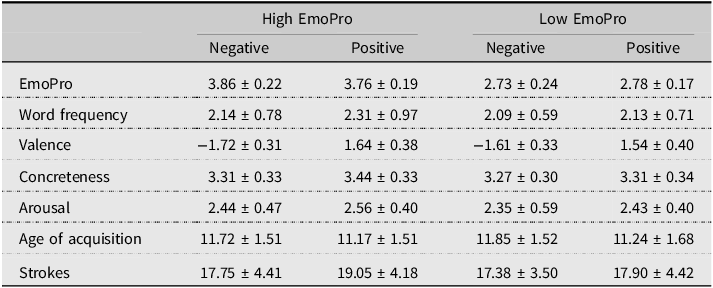
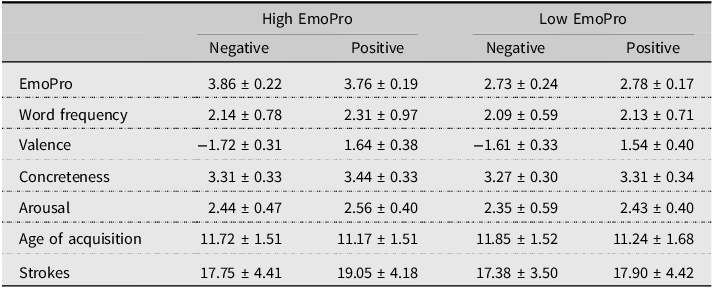
For critical Chinese emotion words in Experiment 2, 160 emotion words were retrieved from Wu’s database (Reference Wu2023). Among the 160 words, four types of emotion words (negative high EmoPro, negative low EmoPro, positive high EmoPro, and positive low EmoPro) were equally distributed. The negative and positive words were determined by the valence, where being greater than 0 is considered a positive bias and being less than 0 is regarded as a negative bias (Xu et al., Reference Xu, Li and Chen2022). The four types of words were statistically comparable on word frequency, F (3, 156)=0.661, p > 0.1, concreteness, F (3, 156)=1.881, p > 0.1, arousal, F (3, 156)=1.35, p > 0.1, age of acquisition, F (3, 156) =1.925, p > 0.1, and strokes, F (3, 156)=1.203, p > 0.1. The positive words were more positive than negative words, F (3, 156)=344.964, p < 0.001, and high EmoPro were also higher than low EmoPro on EmoPro, F (3, 156)=1111.246, p < 0.001. However, negative and positive words were matched on valence for high EmoPro and low EmoPro words, ps > 0.1. High EmoPro words and low EmoPro words were also matched for negative words and positive words on valence, respectively, ps > 0.1 (see Table 2 for details).
Word characteristics of four groups of Chinese emotion words in Experiment 2 (M ± SD)
Procedure
The procedure was identical to Experiment 1, except that the task requirement was to ask participants to judge the target words’ valence.
Results
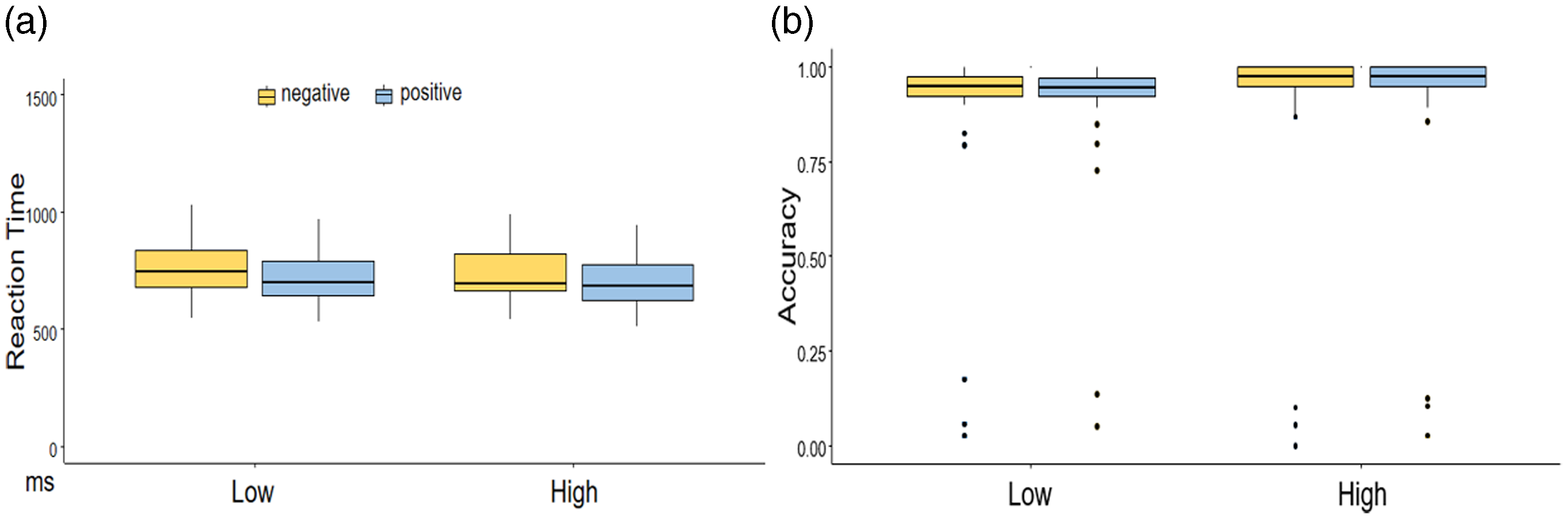
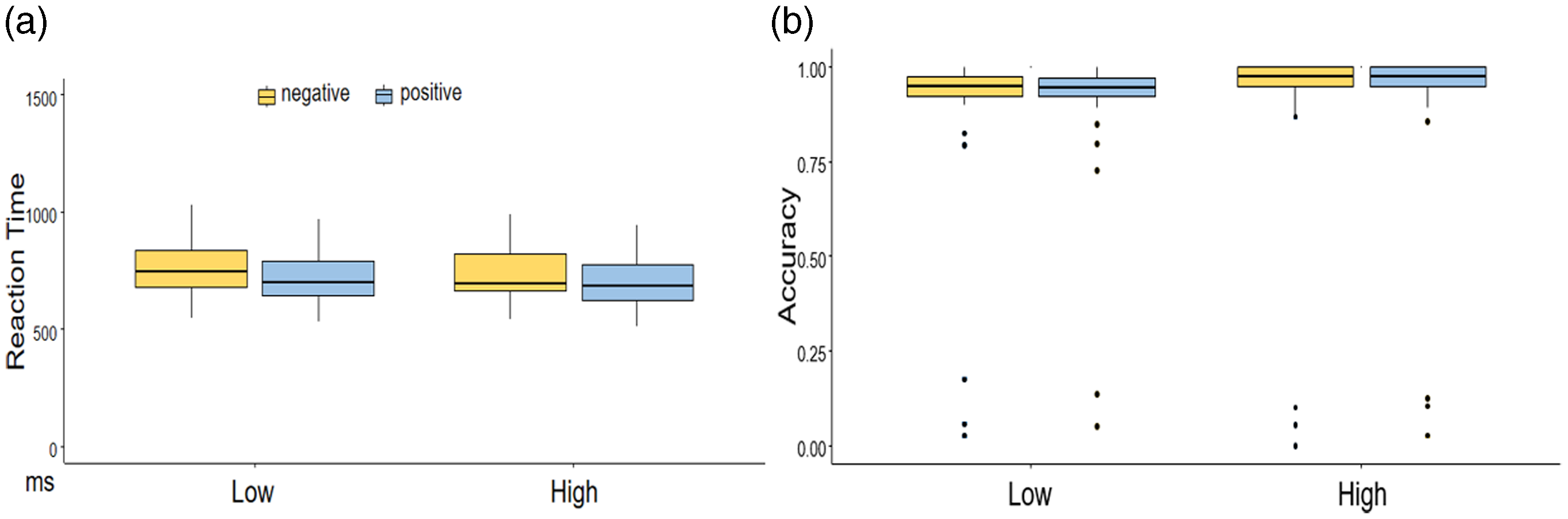
Trials out of the M ± 2.5 SD were discarded for further analysis. Thereby, 3.5% trials were trimmed. The analysis method was identical with the Experiment 1, except that valence was added as an additional fixed factor. The reaction time results showed that both effects of valence and EmoPro were confirmed, such that positive words (719 ms) were recognized faster than negative words (749 ms), Estimate=14.892, SE=3.842, t=3.877, p < 0.001. High EmoPro words (721 ms) were also evaluated faster than low EmoPro words (747 ms), Estimate=14.892, SE=3.842, t=3.877, p < 0.001. However, no interaction between the two factors was observed, Estimate=2.511, SE=3.841, t=0.654, p > 0.1. As for accuracy rate, only the fixed effect of EmoPro was identified, such that high EmoPro words (0.973) had a higher accuracy rate than low EmoPro words (0.959), Estimate=−2.229, SE=0.106, t=−2.156, p < 0.05, while the fixed effect of valence (negative: 0.966, positive: 0.968) and the interaction between the two factors were not significant, Estimate=−0.026, SE=0.106, t=−0.242, p > 0.1 for valence, Estimate=0.112, SE=0.106, t=1.054, p > 0.1, for the interaction (see Figure 1 for details).
Behavioral performance in Experiment 2, (a): reaction time for high and low EmoPro words; (b): accuracy rate for high and low EmoPro words.
Discussion
Experiment 2 demonstrated that EmoPro effectively facilitates Chinese emotion word recognition in an explicit emotion task. Participants, tasked with judging the valence of target words, explicitly accessed affective-semantic information. Both reaction time and accuracy rate results consistently affirmed the facilitative role of EmoPro for emotion words in the valence judgment task. Notably, this facilitation effect was more pronounced in the explicit emotion task than the implicit emotion task in Experiment 1, although the magnitude was comparable (both are 26 ms), suggesting that the influence of EmoPro is inherently affective-semantic.
Furthermore, Experiment 2 revealed a processing advantage for positive words over negative words, aligning with the consistent findings of prior studies (Bromberek-Dyzman et al., Reference Bromberek-Dyzman, Jonczyk, Vasileanu, Niculescu-Gorpin and Bak2021; Kazanas & Altarriba, Reference Kazanas and Altarriba2015; Kazanas & Altarriba, Reference Kazanas and Altarriba2016b; Wu et al., Reference Wu, Zhang and Yuan2021a, Reference Wu, Zhang and Yuan2021b; Zhang, Wu, et al., Reference Zhang, Wu, Yuan and Meng2019). This robust replication emphasizes the enduring nature of the processing advantage associated with positive valence in emotion word recognition tasks.
General Discussion
The main objective of this study was to examine the impact of EmoPro on Chinese word recognition in both a lexical decision task (implicit emotion task) and a valence judgment task (explicit emotion task). While considering factors such as word frequency, valence, arousal, age of acquisition, and concreteness, the findings indicated that high EmoPro words exhibited faster recognition than low EmoPro words in the lexical decision task, albeit marginally significant. Notably, in the valence judgment task, high EmoPro words were processed more rapidly and accurately compared to low EmoPro words. These results underscore the pivotal role of EmoPro in the processing of emotion words.
Decades ago, the Emotion Prototype concept emerged, rooted in the prototype perspective that posits category membership is determined by resemblance to other objects or events (Russell, Reference Russell1991). In this framework, a prototype represents the typical event or object within a specific category (Rosch, Reference Rosch1973). For instance, a sparrow is a prototype of a bird, while a penguin is not considered a prototypical bird. This notion extends to emotions, where anger and fear are deemed more prototypical than emotions like boredom and nostalgia (Shaver et al., Reference Shaver, Schwartz, Kirson and O’Connor1987). Recent normative studies provided EmoPro ratings for Spanish (Pérez-Sánchez et al., Reference Pérez-Sánchez, Stadthagen-Gonzalez, Guasch, Hinojosa, Fraga, Marín and Ferré2021) and Chinese (Zheng et al., Reference Zheng, Zhang, Guo, Guasch and Ferré2023), revealing positive associations between EmoPro and arousal, as well as a negative correlation with valence (Zheng et al., Reference Zheng, Zhang, Guo, Guasch and Ferré2023). Additionally, Wu (Reference Wu2023) found EmoPro to be negatively correlated with age of acquisition (AoA) and positively correlated with sensory experience and semantic transparency. However, Wu (Reference Wu2023) did not observe EmoPro’s predictive ability in a Chinese lexical decision task. In contrast, Haro et al. (Reference Haro, Calvillo, Poch, Hinojosa and Ferré2023) presented contradictory evidence, suggesting that EmoPro facilitated Spanish emotion word recognition in a lexical decision task. Given these inconsistent findings, further verification is necessary, and the impact of EmoPro on emotion word processing across different tasks remains unclear. Since previous studies with emotion-label words and emotion-laden words have utilized various tasks, including implicit emotion task (e.g., lexical decision task and color flanker task) and explicit emotion task (e.g., valence judgment task and emotion categorization task), it was unclear whether EmoPro effect could survive the change of task demands. Therefore, this study employs both lexical decision task and valence judgment task to elucidate the influence of EmoPro on Chinese word recognition under varied task demands.
In Experiment 1, the results indicated a tendency for high EmoPro words to be recognized faster than low EmoPro words, aligning with the typicality effect observed in the literature where typical exemplars exhibit better retrieval and recognition compared to atypical exemplars (Folstein & Dieciuc, Reference Folstein and Dieciuc2019). This facilitation effect, although marginally significant, was consistent with findings by Haro et al. (Reference Haro, Calvillo, Poch, Hinojosa and Ferré2023) in a lexical decision task among Spanish speakers, where high EmoPro words were recognized more rapidly. The marginally significant finding of Experiment 1 was likely due to the fact that the variance between high EmoPro and low EmoPro in the current study was smaller than that in the study by Haro et al. (Reference Haro, Calvillo, Poch, Hinojosa and Ferré2023). This is because the minimum EmoPro in the present study was 1.89, whereas the minimum EmoPro in the study by Haro et al. (Reference Haro, Calvillo, Poch, Hinojosa and Ferré2023) was 1.27. Since our aim was to match the high and low EmoPro in various aspects, this restricted our variance of EmoPro and thereby resulted in a marginally significant outcome. Moreover, the magnitude of the facilitation effect was relatively modest (26 ms), suggesting that in the lexical decision task, EmoPro activation might not be as robust. Haro et al. (Reference Haro, Calvillo, Poch, Hinojosa and Ferré2023) proposed that the facilitation stemmed from the ease of emotionally conceptual retrieval of high EmoPro words, with semantic modulation playing a role, as confirmed in lexical decision tasks (Pexman, Reference Pexman2020). Nevertheless, in the lexical decision task, the processing of semantics is somewhat implicit, while more explicit semantic and conceptual retrieval is necessitated in tasks with a semantic focus, such as the valence judgment task. This explicit retrieval is vital for task completion. For instance, in a valence judgment task, participants must actively retrieve the semantics of words to determine whether a word is negative or not (Wu et al., Reference Wu, Zhang and Yuan2021b; Zhang, Wu, et al., Reference Zhang, Wu, Yuan and Meng2019). Consequently, a stronger EmoPro effect is anticipated in explicit emotion tasks, like valence judgment, as would be validated by the results obtained in Experiment 2.
The outcomes of Experiment 2 aligned with expectations, revealing, for the first time, a significant facilitation effect of high EmoPro words with faster processing speed and higher accuracy rates compared to low EmoPro words in the valence judgment task. This substantial EmoPro effect in an explicit emotion task, such as valence judgment, contrasted with its less pronounced impact in linguistic tasks like the lexical decision task, supporting the notion that the EmoPro effect in emotion word recognition is closely tied to semantics. The findings suggested that the ease of accessing emotional concepts associated with high EmoPro words contributed to their swifter and more accurate recognition (Haro et al., Reference Haro, Calvillo, Poch, Hinojosa and Ferré2023). Furthermore, the independent influences of EmoPro and valence on emotion word recognition were affirmed in Experiment 2. This corroborated the results from Haro et al. (Reference Haro, Calvillo, Poch, Hinojosa and Ferré2023), indicating no interaction between valence and EmoPro in the lexical decision task. This lack of interaction implied that positive and negative words exhibited distinct processing characteristics regardless of EmoPro levels. Recent normative studies (Wu, Reference Wu2023; Zheng et al., Reference Zheng, Zhang, Guo, Guasch and Ferré2023) revealing a negative correlation between EmoPro and valence suggested that high EmoPro words were more likely to be negative. Unlike correlational studies, our experimental design controlled for valence between high and low EmoPro words, allowing us to explore how these two factors jointly modulate emotion word recognition. This approach extended the understanding of the independent roles of EmoPro and valence from the lexical decision task to the valence judgment task in the present study.
Regarding the main effect of valence, a consistent pattern emerged with positive words being recognized faster than negative words across various tasks, such as lexical decision task (Kazanas & Altarriba, Reference Kazanas and Altarriba2015), valence judgment task (Zhang, Wu, et al., Reference Zhang, Wu, Yuan and Meng2019), and emotion Stroop task (Liu et al., Reference Liu, Fan, Tian, Li and Feng2023). The distinction between positive and negative words was influenced by task demands, revealing a more pronounced difference in explicit emotion tasks like the valence judgment task compared to implicit emotion tasks such as the lexical decision task. This observation suggested that positive concepts exhibit a more integrated representation than negative concepts, aligning with the density hypothesis (Unkelbach et al., Reference Unkelbach, Fiedler, Bayer, Stegmüller and Danner2008).
The present study has certain limitations and suggests potential avenues for future research. First, the focus was primarily on task demands and the interaction between valence and EmoPro in word recognition. However, correlational studies have highlighted the relationship between EmoPro and various affective and semantic variables, including arousal, age of acquisition, sensory experience, and semantic transparency (Wu, Reference Wu2023). Specifically, the Experiment 1 only included EmoPro as a fixed factor and did not consider the possible influence of valence and other factors. Therefore, future research could explore how EmoPro, along with these factors, collectively influences word recognition. Second, the study did not explore the neural correlates of the EmoPro effect. Incorporating brain activation recording methods such as ERPs in future studies could provide insights into the temporal processing of EmoPro’s impact on the human brain. Investigating the association between EmoPro and early or late ERP components could be particularly enlightening. For instance, preliminary results from the current study suggest a potential correlation between the EmoPro effect and semantic ERP components like N400. It is hypothesized that high EmoPro words, owing to their ease of emotion concept access, might elicit smaller N400 amplitudes compared to low EmoPro words. This hypothesis could be empirically tested in ERP studies. Furthermore, the words were dissimilar in the two experiments within the present study, which makes it difficult to directly compare the discoveries of the two experiments. Moreover, Haro et al. (Reference Haro, Calvillo, Poch, Hinojosa and Ferré2023) also included some neutral words and emotion-laden words as fillers to make the task natural. Future investigations might contemplate utilizing the same words across the two tasks and add some neutral words and emotion-laden words to further consolidate the findings.
The current study holds certain applications for emotion language learning and the role of language in emotion perception. Emotion-label words vary in EmoPro, and it would be simpler for children to acquire the most prototypical emotion-label words first rather than mingling emotion-label words with different levels of EmoPro. In alignment with the concept that affective information has a role in the development of abstract concepts (Kousta et al., Reference Kousta, Vigliocco, Vinson, Andrews and Del Campo2011), EmoPro establishes an interface between the development of abstract emotion concepts and language development and opens a new avenue to decipher how language constructs emotions. Specifically, emotion-label words build a well-structured emotion conceptual system based on the EmoPro, and sequentially, other non-affective abstract concepts are consolidated. In this sense, the processing advantage of high EmoPro words suggests the necessity to initially learn and acquire typical emotion-label words, thereby enhancing subsequent language and emotion development in general.
Conclusion
The current investigation employed both the lexical decision task and the valence judgment task to explore the influence of EmoPro on emotion word recognition. Notably, a marginally significant effect of EmoPro emerged in the lexical decision task. Moreover, the valence judgment task revealed that high EmoPro words were recognized more swiftly and with heightened accuracy compared to their low EmoPro counterparts. These findings affirm the established role of EmoPro in word recognition, as demonstrated in the lexical decision task (Haro et al., Reference Haro, Calvillo, Poch, Hinojosa and Ferré2023), and extend its impact to the more complex valence judgment task. Significantly, the observed EmoPro effect in the valence judgment task was attributed to the enhanced ease of accessing emotion concepts associated with high EmoPro words. This facilitation proved particularly beneficial in valence judgment, an explicit emotion task demanding nuanced affective-semantic processing.
Acknowledgements
The authors would like to appreciate the participants for their participation. The author are also grateful for the comments from the reviewers and editors.
Competing interests
The authors have no competing interests to disclose.

 Open access

