

a) Sri Lanka in the late Pleistocene tropics; b) the two rockshelters. Shaded: annual rainfall >2500mm (satellite image: ).

Introduction
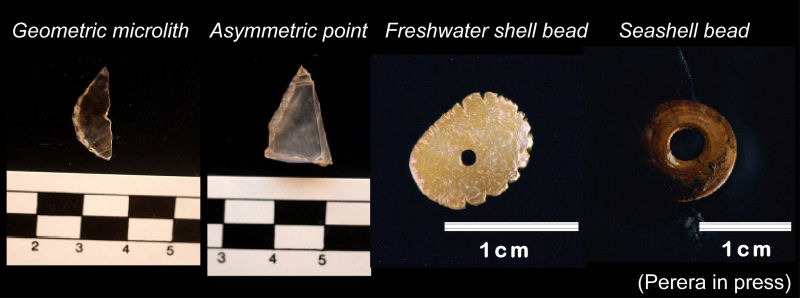
Sri Lanka’s rainforests and grasslands, fashioned by the interaction of mountainous relief and Late Quaternary fluctuations of the Asian Monsoon, were inhabited by anatomically modern hunter-gatherers as early as at least c. 40 000 BP (Perera, in press). Rockshelters in the south-western, humid-tropical part of the island (Figure 1) have yielded some of the earliest manifestations of ‘behavioural modernity’ in South Asia, including geometric microliths, articles of personal ornamentation (Figure 2), evidence for long networks of exchange, differentiated use of space, burial and widespread use of ochre (Reference DeraniyagalaDeraniyagala 1992; Reference WijeyapalaWijeyapala 1997; James 2007; Perera, in press). This archaeological record, together with Sri Lanka’s location halfway on the inferred route of anatomically modern human dispersal to Australasia (Figure 1a), locate the island’s prehistory at the centre of current debates on late Pleistocene human evolution, ecology, dispersal and cultural change.
Stone tools and shell beads, Batadomba-lena (Perera, in press).

Our ongoing project concentrates on two key rockshelter sites, Kitulgala Beli-lena and Batadomba-lena (Figure 1b), spanning the critical period c. 36 000–7880 BP. We combine micromorphology (microscopic analysis of resin-impregnated sediment samples) with an array of environmental (sediment facies, faunal and botanical macroremains) and stone tool typology analyses (Perera, in press) in order to:
-
• establish high-resolution microstratigraphies of these key sites
-
• interpret site formation processes (sediment deposition, human input, postdepositional change)
-
• identify sedimentary proxies of millennial- to submillenial-scale change in the surrounding landscape, triggered by fluctuations in intensity of the prime climatic driver in the region, the Asian Monsoon
-
• document subtle aspects of on-site activities of the late Pleistocene rockshelter occupants
-
• investigate interactions between shifting environments and cultural, including technological, change in Pleistocene hunter-gatherer societies.
Summary chronostratigraphy of the two rockshelters.

Late Quaternary rockshelter stratigraphies
Kitulgala Beli-lena contains c. 3m of excavated sediment with a tripartite stratigraphy, reflecting Late Quaternary environmental change in the environs of the site (Figure 3). Diamictic loams deposited by colluvial and roof fall processes between c. 30 000–20 000 BP register the effects of seasonal rainfall and vegetation reorganisation as the drier and colder conditions of the LGM were beginning to unfold. Slowly infiltrated clays c. 20 000–16 000 BP reflect severe weakening of monsoonal activity during peak LGM conditions. These and underlying sediments contain only sporadic human input. Breccia and loams with high charcoal content that follow were deposited c. 15 700–11 000 BP by roof fall, colluviation and human activity on-site, including tool-making and processing of plant and animal foods. These facies probably reflect the combined effect of monsoon intensification, ecosystem reorganisation and intensified human use of the rockshelter on the wane of the LGM (Kourampas et al. 2008).
In Batadomba-lena, c. 4.5m of excavated sediment record human presence from c. 38 000 BP to terminal Pleistocene. Colluvia and roof fall debris with sporadic human input were succeeded by anthropogenic facies from c. 19 000 BP onwards. Micromorphological results from juxtaposed hearths, earth ovens and diverse habitation debris show abundant charred and raw vegetable remains (wood charcoal, seeds, tissue of fruit, leaves, phytoliths), arboreal snails and diminutive fragments of bone (Figure 4). Palaeofloor facies suggest that, as in Beli-lena, rockshelter use probably intensified from c. 16 000 BP to the end of the Pleistocene.
Anthropogenic facies in 17 000–11 000 BP strata, Batadomba-lena.

Late Pleistocene hunter-gatherers in the rainforest
These sediments afford insights on the ecology and behaviour of inland Sri Lanka’s late Pleistocene inhabitants in times of pronounced environmental change. Preliminary identifications of thin section content include abundant charred seeds of wild banana (Musa spp.), breadfruit (Artocarpus sp.), Canarium nuts and arboreal, Acavus snails (Kourampas et al. 2008), which tally with the marked rainforest character of plant macroremains (Reference KajaleKajale 1989) and vertebrate fauna (Reference WijeyapalaWijeyapala 1997; Perera, in press). Evidently, late Pleistocene hunter-gatherers in inland Sri Lanka relied on resources of a rainforest biome, which may have persisted even through the driest period of the LGM. Our working hypothesis is that intensified rockshelter use during monsoon recovery—and postulated rainforest expansion—c. 16 000 BP was effected by societies culturally equipped for life in the rainforest after a long legacy of inhabiting forested refugia. Micromorphological manifestations of human behaviour also include allusions of spatial patterning of activity on-site, while possible long-term structures, evidenced by postholes and palaeofloors draped with leaf ash, invite comparisons with the ethnographic record. These sites are, thus, emerging as highly significant ‘windows’ to a late Pleistocene rainforest landscape acculturated by its human inhabitants.
Acknowledgements
The authors wish to thank the Sri Lankan Department of Archaeology for outstanding field support, Ana Polo-Diaz (Vitoria) for insights shared, George MacLeod (Stirling) for thin section manufacturing and the British Academy for funding part of this project.