



INTRODUCTION
Shiga toxin-producing Escherichia coli (STEC) have emerged as an important public health concern globally. They have been associated with outbreaks and sporadic cases of diarrhoea, HC (haemorrhagic colitis) and haemolytic uraemic syndrome (HUS) in humans [Reference Bettelheim1, Reference Karmali, Gannon and Sargeant2].
More than 100 serotypes of STEC have been reported to be associated with disease in humans [3]. STEC O157:H7 is considered the most important serotype due to its association with large outbreaks of disease [Reference Mainil and Daube4]. However, non-O157 STEC, such as STEC O26, O45, O103, O111, O121 and O145 (‘Super Six’) have emerged as important pathogens in some parts of the world [5, Reference Conrad6]. The number of STEC cases in New Zealand has increased from 4·1 per 100 000 in 2014 to 7·2 per 100 000 population in 2015 [7]. The change to non-culture-based methods for screening may be responsible for an increase in STEC cases in New Zealand [8].
Ruminants, especially cattle are considered an important reservoir of STEC [Reference Bettelheim1, Reference Hancock9]. Humans may acquire STEC infection by direct contact with animals, animal faeces or contact with faecally contaminated food or water [Reference Bettelheim1, Reference Luna-Gierke10]. Therefore, cattle play an important role in the epidemiology of STEC.
In New Zealand both cattle and sheep are considered to be important reservoirs of STEC [Reference Buncic and Avery11–Reference Cookson13]. A recent prospective case control study indicated environmental exposure and direct contact with animals as important risk factors for transmission of STEC to humans in New Zealand [Reference Jaros14]. However, limited information is available about the epidemiology of STEC in cattle especially ‘bobby’ calves which are defined as dairy calves culled from herds at an age of <1 week. A recent study of young calves slaughtered at four New Zealand abattoirs (two in the North Island and two in the South Island) indicated a prevalence by culture of 3·9% and 2·3% for STEC O26 and STEC O157, respectively [Reference Jaros15]. In New Zealand 2·1 million calves are slaughtered annually with meat being exported overseas especially to North America [16]. The USA has a zero tolerance policy for STEC O157 in the ground beef and the ‘Super Six’ non-O157 STEC (O26, O45, O103, O111, O121 and O145) have more recently been added to the list of meat adulterants [17]. This study was therefore conducted to enhance our understanding of the molecular epidemiology of non-O157 STEC (O26, O103, O111 and O145) associated with bobby calves originating from farms in the North Island of New Zealand and to examine the hypothesis that the carriage of non-O157 STEC is associated with the concentration of maternally derived immunity. It is likely that this study would provide important data for the New Zealand meat industry and public health sector. These data would contribute to the development of STEC risk management strategy to maintain overseas markets for the red meat and dairy export industries which are economically important to New Zealand (exports equivalent to NZ$20.3 billion) [18].
METHODS
Recto-anal mucosal swab (RAMS) and blood samples were collected from bobby calves from two different slaughter plants (A and B) in the North Island of New Zealand [Reference Irshad19]. Each slaughter plant was visited six times during July and October 2008 and every 10th calf on the chain was sampled with a total of 25 calves sampled on each visit. Immediately after the slaughter of each animal, free draining blood samples were collected in vacutainers (Becton Dickinson, Auckland, New Zealand) and RAMS were collected using sterile swabs (Copan, Brescia, Italy). RAMS were then placed in the transport media provided by the manufacturer and transported to the laboratory on ice with blood samples. The details of the sampled animals, address of the farm, tag number, weight, sex and breed of the animal were recorded as described in Irshad et al. [Reference Irshad19].
Isolates from this study were obtained from RAMS re-enrichments (buffered peptone water, 37°C, 24 h) whereafter thawing at room temperature for 5 min, 100 µl of each sample was re-enriched in 10 ml of buffered peptone water at 37°C for 6 h. Template DNA for PCR was prepared from a 1 ml aliquot of re-enriched broth using 2% Chelex (Bio-Rad, Auckland, New Zealand) solution as described previously [Reference Irshad19]. Real-time PCR (RT–PCR) was performed to detect the presence of serogroup-specific loci wzx (O26) [Reference Perelle20], wzx (O103) [Reference Fratamico21], wbdI (O111) [Reference Perelle20] and wzx1 (O145) genes [Reference Fratamico22] using previously described methods [Reference Irshad23].
Enrichments that provided O26, O103, O111 or O145 RT–PCR-positive samples were subjected to immuno-magnetic separation (IMS) using serotype-specific beads in an attempt to isolate each respective serogroup [Reference Irshad23]. The IMS bead suspension (100 µl) was inoculated onto rhamnose MacConkey agar supplemented with cefixime (50 µg/ml) and potassium tellurite (2·5 mg/ml) (CT-RMAC) (Fort Richard, Auckland, New Zealand) for isolation of O26 and sorbitol MacConkey agar (SMAC) (Fort Richard, Auckland, New Zealand) for isolation of O103, O111 and O145. Agar media was incubated at 37°C for 24 h and observed for the presence of serogroup O26 colonies (grey colour/colourless colonies on CT-RMAC) and O103, O111 and O145 colonies (pink/purple colonies on SMAC). Suspect colonies were sub-cultured on MacConkey agar (Fort Richard, Auckland, New Zealand). Potentially positive O26, O103, O111 and O145 colonies were identified using RT–PCR. Multiplex PCR was performed to detect the presence of Shiga toxin 1 (stx1), Shiga toxin 2 (stx2), E. coli attaching and effacing (eae) and enterohaemolysin (ehxA) genes on DNA extracted from colonies positive for non-O157 (O26, O103, O111 and O145) as described previously [Reference Paton and Paton24, Reference Sharma and Dean-Nystrom25]. PCR products were electrophoresed through an agarose (2% w/v) gel (Invitrogen, Auckland, New Zealand) and visualised using ethidium bromide under ultraviolet illumination.
E. coli O26 isolates (49) were genotyped using pulsed field gel electrophoresis (PFGE). PFGE was performed according to the protocol described previously [26]. The Unweighted Pair Group Method with Arithmetic Mean (UPGMA), Dice coefficient with >70% similarity cut off, 0·5% optimisation and band matching tolerance were used to construct the clusters of E. coli O26 isolates.
Calf serum samples were sent to New Zealand Veterinary Pathology Laboratory, Palmerston North, New Zealand for quantification of IgG. IgG was measured using a commercially available TIA (turbidimetric immunoassay) kit (Midland Products Corporation, Mt. Maunganui, New Zealand) and Hitachi P800 analyser (Diamond Diagnostics, Holliston, USA).
Statistical analysis
Farms that were both RT–PCR positive and negative for O26, O103 and O145 were mapped using R package maptools (R Development Core Team, R Foundation for Statistical Computing, Vienna, Austria). The addresses of these farms (193) were recorded from the slaughter plant records and coordinates (Latitude and Longitude) of 180 farms were obtained using Agribase data [Reference Sanson and Pearson27] and Google earth (www.google.com/earth). The latitude and longitude of each farm was then converted to XY coordinates and farms were then assigned to 5 × 5 km grid cells for mapping and to maintain anonymity. The coordinates of 13 farms were missing.
The K function analysis was used to determine the localised, also known as second-order, spatial clustering of positive (case) and negative (control) farms [Reference Ripley28]. The K function analysis is a method of comparing the spatial properties of different spatial point patterns that does not require the underlying process to be ‘stationary’, i.e. the method does not require the intensity of the spatial process to be the same (homogeneous) in all geographical locations. In this study, the location of each farm is considered as a spatial point pattern. The distributions of positive and negative farms for each serogroup were compared at a range of 1–10 km distance by calculating the difference between two K functions [Reference Bailey and Gatrell29]. The difference between two K functions was plotted against distance with 95% upper and lower simulation envelopes. Any difference between the two K functions falling above the upper envelope is suggestive that farms positive for a specific serogroup are significantly more clustered than negative farms. Clustering of positive farms may be indicative of localised transmission.
The prevalence of serogroups O26, O103 and O145 in calves was estimated and adjusted for clustering of calves within farms using R package ‘survey’.
A logistic regression model, including farm as a random effect, was used to examine the association between three outcome variables and potential risk factors. The outcome variables were the serogroup O26, O103 and O145 RT–PCR status of the calves and risk factors considered were the concentration of IgG, weight, sex, breed and reciprocal detection of other serogroups by RT–PCR (i.e. the detection of serogroups other than the outcome variable). The statistical analysis was conducted using software R 2.8.1 (The R Foundation for Statistical Computing). Seven generalised linear mixed-effects models were fitted for each variable (concentration of IgG, weight, sex, breed, RT–PCR status of the calves for serogroup O26, O103 and O145), P ij being the j-th PCR result from farm i, and IgG ij being the j-th IgG result from farm i. The following logistic regression model was fitted with a random effect at the farm level:
 $${\rm logit}(P_{ij} ) = \beta _0 + \beta _1 IgG_{ij} + \mu _i + \varepsilon _{ij}, $$
where μ i ~N(0, v 2); ε ij ~N(0, σ 2); μ, the farm random effect; N, the normal distribution; β, the regression coefficient; σ 2, the variance of residuals; v 2, the variance for random effect for farm.
The model shown in equation (1) was fitted again by replacing variable IgG with weight, sex and breed, respectively.
The generalised mixed-effects model was also fitted with all the variables (concentration of IgG, weight, sex, breed and RT–PCR status of the calves for serogroup O26, O103 and O145) to observe their combined relationship with each RT–PCR outcome adjusted for confounding, where:
 $$\eqalign{{\rm logit}(P_{ij} ) & = \beta _0 + \beta _1 IgG + \beta _2 {\rm Weight}_{ij} + \beta _3 {\rm Sex}_{ij} \cr & \quad + \beta _4 {\rm Breed}_{ij} + \mu _i + \varepsilon _{ij}.}$$
RESULTS
In total 299 RAMS and serum samples were collected from bobby calves originating from two abattoirs in the North Island of New Zealand. RT–PCR indicated that 134, 68 and 47 RAMS samples were positive for serogroups O26, O103 and O145, respectively. None of the RAMS samples were RT–PCR positive for serogroup O111. There was no significant difference in prevalence of serogroup O26, O103 or O145 in male and female calves (Table 1).
Recto-anal mucosal swab (RAMS) samples (n = 299) obtained from bobby calves originating from two abattoirs in the North Island of New Zealand were analysed for E. coli serogroups O26, O103, O111 and O145 using real-time PCR (RT–PCR)

No samples were positive for E. coli O111 by RT–PCR.
Results of linear mixed-effects models fitted consecutively for each variable (IgG, weight, sex, breed and RT–PCR results for serogroup O26, O103 and O145) and models in which all the variables were fitted together for O26, O103 and O145 are shown in Table 2. There was no significant relationship between any of the serogroups and the variables: concentration of IgG, sex and breed of the calves. However, log odds of being positive for O26 by RT–PCR were likely to decrease by 0·05 with every 1 kg of increase in weight of calves (P = 0·05) (Table 2). There was also a relationship between PCR prevalence of serogroup O26 and O103 and between serogroup O103 and O145; log odds of being positive for serogroup O26 by RT–PCR were likely to increase by 0·57 with each sample positive for serogroup O103 and vice versa (P = 0·04) (Table 2). Similarly, the log odds of being positive for serogroup O145 by RT–PCR were likely to increase by 0·80 (P = 0·01) and 0·73 (P = 0·03) with each sample positive for serogroup O103 and vice versa with univariable and multivariable models respectively (Table 2).
The univariable and multivariable relationships between the likelihood a calf is positive by RT–PCR for E. coli serogroups O26, O103 or O145, and five explanatory variables
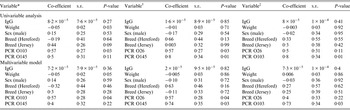
The reference category for breed was Friesian.
* O26.
† O103.
‡ O145.
The spatial distribution of the farms positive or negative for serogroup O26, O103 and O145 is shown in the Figure 1. The farms positive for serogroups O26, O103 and O145 are present in Taranaki, Waikato and Manawatu, three important dairy-producing areas of the North Island that supplied the abattoirs sampled in this study. The K function analysis was used to test for the presence of spatial clustering of farms positive for serogroups O26, O103 and O145. There was no evidence of localised clustering (second order upto 10 km apart) in farms positive for serogroup O26, O103 and O145 as the difference between two K functions did not cross the upper 95% CI envelope (Fig. 2).
Map showing the distribution of the farm of origin of E. coli O26, O103 and O145-positive calves in North Island, New Zealand. The data are aggregated to 5 × 5 km grid cells. Only cells containing farms that submitted calves to the abattoir that were subsequently sampled are displayed. If a single animal was positive the grid cell was coloured grey. If no animals sampled were positive the cell was coloured black.

The K function analysis of (a) E. coli O26-positive (cases) and E. coli O26-negative (control) farms (b) O103, and (c) O145. The black line represents the difference between the two K functions and dashed lines represent the upper and lower simulation envelopes.

RT–PCR positive enrichment samples for serogroups O26 (134), O103 (68) and O145 (47) were subjected to IMS. Specific use of CT-RMAC and sub-culture of rhamnose non-fermenting colonies allowed the identification of 49 E. coli O26 isolates. These 49 E. coli O26 isolates were recovered from 134 RT–PCR positive samples. IMS and subsequent plating of beads on SMAC plates allowed the identification of four O103 and five O145 isolates but none were STEC. The O26 isolates were able to be separated into three groups based on contrasting allelic profiles; 25 isolates were stx1+, eae +, ehxA+; 17 were eae +, ehxA+ and seven were eae +only. However, all serogroup O103 and O145 isolates were eae + and ehxA+ only. PFGE subtyping separated the 49 O26 isolates into four clusters (A, B, C and D). For cluster A, 25 of 26 isolates were stx1+, eae +, ehxA+; the remaining isolate was eae +, ehxA+. Sixteen further eae +, ehxA+ isolates were present in cluster B. The eae + only isolates were present in cluster B (one isolate), C (two isolates) and D (one isolate) (Fig. 3). PFGE profiles could not be generated from the remaining three O26 isolates. Two isolates (EcCa82a and b) with contrasting PFGE and allelic profiles were isolated from the same animal, and two isolates were obtained from separate animals sourced from the same farm on four occasions (farms 582, 638 and 678 and 739). Similarly, the two isolates from separate animals on farm 638 had contrasting allelic profiles and clustered separately. The other three pairs of isolates obtained from the same farm, clustered together in the same group (isolates from farm 739 in cluster A, and isolates from farms 582 and 678 in cluster B).
Clustering (UPGMA dendrogram) of the PFGE profiles of E. coli O26 isolates recovered from bobby calves from the North Island of New Zealand with >70% similarity cut off using XbaI. The last lane is the Salmonella serotype Braenderup reference standard (H9812).

DISCUSSION
The beef and dairy industries are key contributors to New Zealand economy [18] however; limited information is available regarding the prevalence of non-O157 STEC in cattle. Although non-O157 STEC serogroups including O5, O26, O84 and O128 were isolated from New Zealand cattle (n = 187) and sheep (n = 132) in a previous study [Reference Cookson13], no specific methods such as RT–PCR or IMS were included for selection of serogroups O26, O103, O111 and O145. However, a recent nationwide survey of cattle in New Zealand indicated a higher prevalence of STEC O157 and O26 in calves compared with adult cattle [Reference Jaros15].
RT–PCR has been used successfully for detection of non-O157 serogroups in food and faecal samples [Reference Perelle20, Reference Sharma30]. In this study using RT–PCR to detect serogroup-specific amplicons, the prevalence of E. coli (STEC and non-STEC) O26 (44·8%) was higher compared with O103 (22·7%) and O145 (15·7%). In contrast, a Scottish study using only IMS reported a much lower faecal pat-level prevalence of E. coli (STEC and non-STEC) O26 (4·6%), O103 (2·7%) and O145 (0·7%) [Reference Pearce31]. The failure to isolate STEC O103 and O145 in this study, compared with STEC O26 may also be due to contrasting transmission dynamics of O26, O103 and O145. O'Reilly et al. [Reference O'Reilly32] reported that O26 appeared to be well adapted to the cattle host compared with other serotypes, such as O103, where routes of transmission other than cattle to cattle may be more important for persistence. The absence of STEC O103 and O145 isolates from this study may reflect their scarcity in young calves in comparison to STEC O26, coupled with the availability of specific media (CT-RMAC) for the differentiation of O26. Furthermore, the presence of genetic material associated with lysed cells may contribute to increased number of positive samples using an amplification-based DNA detection method.
The most common virulence profile of the serogroup O26 isolates was stx1+, eae +, ehxA+. Other studies have also noted that the stx1+, eae +, ehxA+ allelic profile is most frequently associated with O26 isolates [Reference Jaros15, Reference Pearce33]. This allelic profile is of significant public health concern as it is most frequently associated with O26 isolates obtained from human diarrhoeal cases [Reference Schmidt34, Reference Zhang35]. To date, stx2 has not been detected in STEC O26 isolated from cattle or human clinical cases of disease in New Zealand.
Using PFGE, the O26 isolates were able to be grouped on the basis of specific allelic profiles suggesting that the STEC and stx-negative variants represent lineages with contrasting clinical outcomes. The presence of a single eae +, ehxA+ positive isolate in cluster A that included 25 stx1+, eae +, ehxA+ isolates, may indicate that the EcCa110a isolate may have lost the stx1-encoding bacteriophage. The loss of, and transduction with stx-encoding bacteriophage indicates that some aEPEC (atypical enteropathogenic E. coli) and STEC may be genetically related with reversion between the two pathotypes occurring during prolonged culture or during clinical infections [Reference Bielaszewska36, Reference Hernandes37]. In contrast, detailed sequence analysis of the O-antigen biosynthesis loci has provided evidence of divergent STEC and stx-variants lineages within the same serogroup that are readily detected using single nucleotide polymorphism analysis [Reference Norman38].
The univariable and multivariable relationship determined in this study using RT–PCR data suggest a correlation between samples positive for O103 and O26 and between samples positive for O103 and O145. The data were also analysed including the E. coli O157 data from our previous study [Reference Irshad19]. Upon adding ‘O157 RT–PCR positive’ as a further variable these new data indicated no significant relationship between whether animals were both O26 and O157 RT–PCR positive, O103 and O157, or O145 and O157. The occurrence of multiple E. coli serogroups in a single faecal sample has been reported on a number of occasions [Reference Pearce33, Reference Cookson39, Reference Hofer40]. Pearce et al. [Reference Pearce33] analysed 750 faecal samples from calves and adult cattle using IMS and PCR; serogroup O145 and O26 were detected simultaneously from three faecal samples and serogroup O26, O103 and O145 from another faecal sample.
Serogroup O111 is the second most common cause of STEC infection and HUS in Australia and the USA, respectively [Reference Hofer40–Reference Vally42], however, no RAMS samples were RT–PCR positive for O111 in this study and to our knowledge, STEC O111 has rarely been isolated from New Zealand cattle. The reason for the very low prevalence of STEC O111 in New Zealand cattle is not known, however it can be speculated that the diversity of microbial pathogens in New Zealand is generally lower than that observed elsewhere due to its unique geographic location and relatively recent contact to exotic animals and humans [Reference Crump, Murdoch and Baker43].
The K function analysis has been used to determine the second order clustering of cases for various diseases and can be helpful in understanding the process of transmission of disease [Reference Benschop44, Reference Fenton45]. Although our previous work reported the second order clustering of O157 positive farms between 3 and 4 km in the North Island of New Zealand [Reference Irshad19], no spatial clustering of farms positive for O26, O103 and O145 was observed in this study (Fig. 2).
Calf serum samples were processed to quantify IgG to determine whether animals RT–PCR positive for serogroups O26, O103 or O145 had increased IgG levels compared with RT–PCR-negative animals. A higher concentration of serum IgG against STEC has previously been reported from the calves that were fed colostrum or vaccinated against STEC [Reference Bretschneider, Berberov and Moxley46–Reference van Diemen48]. Indeed the presence of serum IgG against STEC O157 was associated with a reported reduction in the faecal shedding of O157 after vaccination [Reference Potter49]. Similarly, Rugbjerg et al. [Reference Rugbjerg, Nielsen and Andersen50] reported that calves that were fed colostrum were less likely to shed STEC O157 than the calves that did not have access to colostrum.
Whilst faecal samples from Hereford, Jersey and Friesian calves were equally likely to be positive for O26, O103 and O145 in this study, other studies have indicated that certain E. coli serogroups may be isolated from certain calf breeds more frequently. For example, Widiasih et al. [Reference Widiasih51] reported that the shedding of serogroup O157 (10·7%) was higher in Japanese Black calves whereas the shedding of serogroup O26 (8·9%) was higher in Holstein calves. Similarly, the likelihood of shedding of serogroup O157 from Romosinuano cattle was less than (P < 0·01) Angus or Brahmas cows [Reference Riley52]. In contrast there was no difference in shedding of STEC in Holstein, Japanese Black and cross of Holstein and Japanese Black calves of age 0–8 months [Reference Shinagawa53].
In summary this study has used a combination of DNA and culture-based methods to determine the prevalence of clinically important STEC serogroups. O26 was the most prevalent serogroup detected from calf RAMS using both RT–PCR and IMS/culture in contrast to O103 and O145, and serogroup O111, which was not detected. In very young calves there was no association of maternally derived immunity as measured through serum IgG concentration and O26, O103 and O145 RT–PCR positive data. Although early feeding with colostrum high in IgG is an important factor associated with reduced calf diarrhoea, it may not be effective in reducing colonisation and shedding of serogroup O26, O103 and O145 strains, or alternatively, the industry recommendation that bobby calves have access to colostrum for at least 48 h before separation from the dam, may not be universally adhered to. This study has provided useful information regarding the molecular epidemiology of several non-O157 STEC of economic and public health significance. However, further investigations are required to assess the risk factors associated with other clinically important STEC adulterants such as serogroups O45 and O121 and to devise appropriate on-farm and pre-slaughter control strategies to reduce environmental and food-associated levels of STEC adulterants in bobby calves.
ACKNOWLEDGEMENTS
The authors thank the New Zealand Foundation for Research, Science and Technology for financially supporting this work which contributes to the IMPACT project (contract no. C03X0701). They thank Sara Moore (mEpiLab, Massey University) for providing assistance in collection of samples. They are also thankful to Higher Education Commission of Pakistan for providing funds for this study.
DECLARATION OF INTEREST
None.



