

‘Why is that? Because it's still far too complicated and takes too long. Change that, Madam Minister!’, said Götz Frömming, MP for the Alternative for Germany (AfD) in the Bundestag, on 5 July 2018. In a speech on education funding in Germany, he claimed that the system is not doing well enough and is still too complex to make Germany competitive on an international standard. This speech hints at the oversimplification of political problems and the suggestion of easy solutions that is frequently assigned to populist actors.
Populist politicians often claim mainstream politics is too complex and removed from ‘ordinary’ citizens. Therefore, populist actors aim to be closer to ‘ordinary’ citizens and act in their interest (Mudde Reference Mudde2004). One strategy populist actors use is to simplify political problems. This can be achieved through the oversimplification of complex issues and arguably through simpler language.
Indeed, populism is often associated with a certain language style. Previous studies, however, reach contradictory conclusions on whether populist actors actually employ simpler language. On the one hand, Daniel Bischof and Roman Senninger (Reference Bischof and Senninger2018) show that right-wing populist party manifestos employ simpler language than their non-populist counterparts. Sylvia Decadri and Constantine Boussalis (Reference Decadri and Boussalis2020) find similar results. In contrast, Duncan McDonnell and Stefano Ondelli (Reference McDonnell and Ondelli2020) find that right-wing populist leaders do not use significantly simpler language in their public speeches.Footnote 1 What is more, as populism is often seen as an exclusively right-wing phenomenon in Western Europe, research has hitherto only analysed right-wing populism, thereby ignoring whether left-wing populists simplify their language too. Resolving whether populism in general, or its ideological roots, drives language simplicity is important to better understand the appeal of populist politicians. Resolving whether simplicity is part of this language style can help us determine why populist actors are becoming more convincing across the globe. Likewise, answering this helps us to evaluate whether populist actors have an impact on parliamentary debates and simplify the overall debating style in parliament. Thus, this article poses the question: do populist actors indeed use simpler language than other political actors in parliamentary debates?
I study this question in the context of Germany, which serves as a relevant case as there is a right-wing (AfD)Footnote 2 as well as a left-wing (The Left – Linke) populist party represented in the national parliament (Bundestag), allowing me to explore whether populist rhetoric differs depending on ideology. For the analysis, I will focus on parliamentary speech data and use the available data from the Open Discourse Dataset (Richter et al. Reference Richter2020) between 1991 and 2021, covering seven legislative periods after the reunification of Germany. The benefit of parliamentary speech data is that it allows one to estimate language complexity on the speech level, the speaker level, as well as on the party level. Thus, the data allow me both to be more comprehensive and to delve deeper than has been possible in previous studies.
First, I will explore whether populist actors indeed do use simpler language than other politicians in parliamentary debates. By applying a commonly used readability score for German texts, the so-called Läsbarhetsindex (LIXFootnote 3 score) developed by Carl-Hugo Björnsson (Reference Björnsson1968), I show that there is no clear relationship between populism and language complexity. Rather, it is individual factors and ideology, as well as debate topics, that determine language complexity. I also show that parliamentary speeches became, on average, simpler over the last 30 years.
In a broader scope, the use of simple language can also provide new insights into how populist and non-populist actors permute concepts of representation. In general, as agents to their principals (voters), MPs should feel incentivized to explain complex problems in terms voters can understand as MPs aim to be accountable and relatable to their voters. This would underline a substantive (acting and communicating in the interest of their voters) or even surrogate (acting or communicating in the interest of their voters and also the general public) understanding of representation. However, populists are known to rely heavily on symbolic representation to signal their understanding of the unity of the ‘populist’ in-group which does not allow for any ideological or class divergence or permit social or political pluralism (Caramani Reference Caramani2017: 62). As such, populists may opt to use only language that is understood by their in-group or voter group. They do not have any incentives to use a more inclusive language to include people outside their in-group. Therefore, populist actors may not opt for simpler language as they strategically want to exclude people.
This could be one explanation why populists may choose not to use simple language in their parliamentary discourse as this contradicts their idea of symbolic representation, which is presented as one way of representing a specific social or voter group (Stokke and Selboe Reference Stokke, Selboe, Törnquist, Webster and Stokke2009). Within the form of symbolic representation, political actors want to include only voters of their own group and may, therefore, adopt a specific language style. This can work in the opposite way to simple language, which can opt to include voters from various groups and social backgrounds.
This study makes three empirical contributions. First, it shows that populist actors do not employ simpler language in the parliamentary arena than their non-populist counterparts. Populism rather correlates with more complex language. Second, it analyses language complexity in a highly comparative manner and sheds light on when political actors employ simple language. As such, the study examines how individual- and party-level characteristics correlate with language complexity. The analysis also reveals that the debate level has become more simplistic since the 1990s. Thirdly, the article shows that language complexity varies across topics. However, it does not provide an answer to why certain topics are discussed by using simpler language than others.
Additionally, this article opens the theoretical discussion on what makes populists appear so simplistic. It shows that simplicity is identified not only in linguistic or language simplicity but also in conceptual simplicity. This analysis contributes to the broader concept of political communication and what effect the use of simple language has in the political arena. Accordingly, it also adds to our understanding of the functioning of representative democracy and how simple language corresponds to different concepts of representation.
Language complexity in political discourse
Communication links parties with their electorate. It allows MPs to express their positions and views on various issues but also ensures that MPs can be held accountable for what they promise their voters. If MPs are able to communicate in a clear way, voters will find it easier to understand what they stand for and for whom they are voting. Simple language can help frame a political message straightforwardly and helps voters understand often complex issues. On the other hand, MPs might use complex language strategically to blur a message or to be more ambiguous. Thus, language complexity constitutes an essential aspect that should be considered when assessing the quality and impact of political discourse. As language complexity determines who can understand a text, it ultimately also defines who can participate in a political debate and form an opinion on a given issue. As such, language complexity also matters in the broader sense for political participation and representation. Representation literature shows that MPs aim to use effective communication with their constituents to strengthen their relationship (Page Reference Page1976). It is also considered a core belief of representative democracy (Powell Reference Powell2000).
These ideas connect strongly with the party model of representative government. In this model, parties face the challenge between demands for responsiveness and demands for responsibility (Dahl Reference Dahl1956); that is, being responsive to their voters, acting in their best possible interests and being efficient in achieving the best possible policy outcome. These two opposing ideals of representative governments are heavily linked to populism and technocracy as two opposing extremes challenging parliamentary democracy and liberalism. Populism is considered illiberal as its vision of democracy ‘is inimical to liberty as it equates the will of the majority with the comprehensive totality of the people’ (Caramani Reference Caramani2017: 64). Technocracy, on the other hand, in its extreme form, ‘is authoritarian as it does not involve the support of the majority of the population’ (Caramani Reference Caramani2017: 64). Parties are faced with these two extremes and have to balance both demands in order to operate successfully in a representative system.
Parliaments are considered an important platform for parties as they can show their voters how they represent them (Proksch and Slapin Reference Proksch and Slapin2015). Additionally, parliaments provide a stage for parties to interact strategically with their electorate and other parties. As such, parliaments play an essential role in representative democracies and political life. To understand representation and the debating culture in parliaments and, more importantly, the role populists and other political actors have in it, it is important to understand communication strategies.
A growing body of literature in political science focuses on language complexity as one communication element strategically employed by political actors. As such, studies discuss that conservatives seem to use simpler language than liberals (Schoonvelde et al. Reference Schoonvelde, Brosius, Schumacher and Bakker2019) or that elites adopt simpler language in parliament to address constituents with lower education levels or less language proficiency (Lin and Osnabrügge Reference Lin and Osnabrügge2018; Spirling Reference Spirling2015). Likewise, Ryan Owens and Justin Wedeking (Reference Owens and Wedeking2011) discusses language complexity among US Supreme Court decisions and show that it is not related to ideological positions, even though some justices produce simpler and clearer messages than others. Jonathan Slapin and Justin Kirkland (Reference Slapin and Kirkland2020) show that more rebellious MPs use simpler language in parliaments even though they usually talk for longer. Christian Rauh (Reference Rauh2022), on the other hand, offers evidence that the complexity of language used at the European Commission has not reduced over the past 35 years.
When defining political complexity, it is important to consider conceptual complexity in addition to linguistic complexity. I define conceptual complexity as the substantive complexity of a given concept or issue. For example, understanding how nuclear energy works as a power source is a highly complex issue in itself, which I refer to as concept or issue complexity. MPs can decide for themselves how they talk about nuclear energy: they can try to explain nuclear energy in easy terms, or they can present it in a more complex way. Thus, it is important to distinguish between concept complexity and linguistic complexity, as the latter does not account for how difficult a given topic or issue is. In line with this understanding, Steffen Hurka et al. (Reference Hurka, Haag and Kaplaner2021) focus on different complexity measures (conceptual and linguistic) and show that EU policy proposals have become more readable over time, even though policy complexity displays an upward trend. Eric Hansen and Joshua Jansa (Reference Hansen and Jansa2021) employ an event-history analysis of policy diffusion in the United States. They show that states that adopt a given policy from another state make fewer changes for less complex policy proposals – whether conceptual or linguistic – and more changes for complex proposals.
Overall, language complexity is an essential tool in political communication strategies.Footnote 4 It defines how easy or difficult it is to understand a political text, speech or newspaper article. Political actors always have to find a balance between presenting topics simply enough so that the broader public can understand them and not sounding so simple as to be seen as incompetent or unreliable. This analysis, however, only focuses on the linguistic part of political complexity, as this can be measured by applying quantitative means of the text structure. Thus, I only focus on how difficult a text is based on its semantic structure. I abstain from defining political complexity in relation to its concepts, as concept complexity is hard to measure through quantitative means.
Simple language in populist communication
Populism as a concept has been hotly debated not only among scholars but also more broadly among the public. One of the most used and widely accepted definitions of populism has been proposed by Cas Mudde (Reference Mudde2004). He states that populism ‘is an ideology that considers society to be ultimately separated into two homogeneous and antagonistic groups, “the pure people” versus “the corrupt elite”, and which argues that politics should be an expression of the volonté générale (general will) of the people’ (Mudde Reference Mudde2004: 543). Mainstream politicians are viewed as evil elites who only act in their own interests but who have no concern for the general public good. Accordingly, populism is not attached to one specific ideology but can range from left-wing to right-wing populism (Rooduijn Reference Rooduijn2019).
This view often manifests itself via language and discourse (Hawkins Reference Hawkins2009, Reference Hawkins2010). Paris Aslanidis (Reference Aslanidis2018) points out that ‘even if rhetoric is perhaps not the sole defining element of populism, it is impossible to grasp populist mobilization without some exhibition of anti-elite discourse in the name of the sovereign people’ (Aslanidis Reference Aslanidis2018: 1242). Populist actors are known for using specific words and phrases that reflect their worldview (Rooduijn and Pauwels Reference Rooduijn and Pauwels2011), such as opposing globalization, immigration or capitalism, but also fighting for the ‘ordinary’ people and being against the establishment.
But it is not simply that populists use different language; they often use a particular communication style (Kazin Reference Kazin1998). More precisely, people-centric and anti-elite, as well as emotional language, mark populist speech. The first and perhaps most important component is the use of simple language. There are numerous anecdotal and theoretical explanations of why populist actors use simpler language than non-populist actors. The theoretical roots of simplicity in populist language lie in the idea that ‘complexity is a self-serving racket perpetuated by professional politicians, and that the solution to the problems ordinary people care about are essentially simple’ (Canovan Reference Canovan1999: 6). Populists not only present simple solutions to complex problems, but they arguably do so in simpler terms. Michael Hameleers et al. (Reference Hameleers, Bos, de Vreese, Aalberg, Esser, Reinemann, Stromback and de Vreese2016: 143) point out that ‘the populist style of language is characterized by short sentences, one-liners, common sense, and direct speech to the people’.
As populism is diverse and not attached to one specific ideology, it is important to also consider changes in language complexity among populist actors with different ideological backgrounds. Scholars analysing populist discourse mainly focus on right-wing populist discourse. They find evidence that populist actors from the ideological right use simpler language than other political actors (Bischof and Senninger Reference Bischof and Senninger2018). However, actors from the ideological left are said to use more complex language. Bischof and Senninger (Reference Bischof and Senninger2018: 484) point out that ‘the more right a party is placed on the left–right-scale, the less complex its manifesto will be’. They show that right-wing parties use, on average, simpler language. Martijn Schoonvelde et al. (Reference Schoonvelde, Brosius, Schumacher and Bakker2019) find that conservative politicians are more likely to use simpler language than liberal politicians. They argue that ‘divergence in linguistic complexity is argued to be rooted in personality differences among conservative and liberal politicians’ (Schoonvelde et al. Reference Schoonvelde, Brosius, Schumacher and Bakker2019: 1).
These results show not only that the traditional left–right axis influences language complexity but also that the newer division ‘GAL–TAN’ (green/alternative/libertarian–traditional/authoritarian/nationalist) dimensions (Hooghe et al. Reference Hooghe, Marks and Wilson2002) affects party stances. As such, it seems that parties leaning towards supporting traditional, authoritarian or nationalistic views are more prone to apply simpler language. With a focus on left-wing and right-wing populist actors, we can assume that right-wing populist actors use simpler language than left-wing populist actors. These studies underline that simple language should not be analysed irrespective of a populist actor's main ideological background. Their results emphasize that ideology plays a crucial role when it comes to the language complexity of political actors. Also, emerging experimental studies show that exclusively using too simple language often turns people away from voting for a candidate. However, if simple language is applied with people-centric rhetoric and blame attribution towards refugees, people with underlying right-wing populist attitudes respond to it (Kittel Reference Kittel2024).
Therefore, I draw a distinction between right-wing and left-wing populist rhetorical strategies, which is important for understanding language complexity and its interconnection to populism more accurately. Considering simple language as a more important tool of the right-wing populist rhetorical toolbox, the following hypotheses can be stated:
Hypothesis 1a (H1a): Populist actors use on average simpler language than non-populist political actors.
Hypothesis 1b (H1b): Right-wing populist actors use, on average, simpler language than left-wing populist actors.
Topics can also affect language complexity as parties have different incentives to emphasize certain topics during electoral campaigns and during debates (Budge Reference Budge2015). Research has shown that parties can ‘own’ certain issues if they are evaluated by the public as being especially competent or known for these issues. This is known as issue-ownership theory (Petrocik Reference Petrocik1996). One main argument of issue ownership builds on the assumption that parties emphasize issues where they can promote their strength and avoid issues that benefit the opposition (Green and Hobolt Reference Green and Hobolt2008).
Following these ideas, one way of emphasizing issues is through simpler and more clarified language, as this makes it easier for voters to follow parties’ key messages (Bischof and Senninger Reference Bischof and Senninger2018). The political rhetoric of a party is, therefore, understood as a structuring feature to emphasize its important or owned issues. Populist messages especially have a positive effect on issue emphasis because they can be ‘highly persuasive as they respond to the ordinary people's hopes and fears while formulating easy solutions to important societal problems’ (Hameleers et al. Reference Hameleers, Bos and de Vreese2017: 871). Accordingly, I assume that populist parties speak more simply on topics that they own. As such, right-wing populists are expected to rely on simpler language in debates on immigration, whereas left-wing populists are expected to simplify their language when speaking on issues about labour and welfare. This leads to the second hypothesis:
Hypothesis 2 (H2): In general, parties talk more simply on issues that they own. Accordingly, left-wing populist parties speak more simply on labour and welfare issues; right-wing populists speak more simply on immigration issues.
Even though these theoretical assumptions are based on the supply side of populism, it is important to highlight that they also interact with the demand side of populism. As such, the demand for populism can change over time and across political systems. As Luigi Guiso et al. (Reference Guiso, Herrera, Morelli and Sonno2017: 4) show, ‘lower income, financial distress and higher economic insecurity from exposure to globalisation competition of immigrants drive the populist vote’. Also, several experimental studies demonstrate that the populist vote can be driven by various rhetorical strategies as well as the ideological approach of populist actors (Castanho Silva and Wratil Reference Castanho Silva and Wratil2023; Dai and Kustov Reference Dai and Kustov2024). Emerging studies even show that language complexity can drive the populist vote choice (Bischof and Senninger Reference Bischof and Senninger2021; Kittel Reference Kittel2024), although results do show that too simple language in most instances leads to a negative effect on vote choice.
Therefore, I believe that parties are aware of these dynamics and adopt their rhetorical strategies accordingly. As Dirk Hovy and Diyi Yang (Reference Hovy and Yang2021: 591) point out, ‘when it comes to broadcasting or highly public spaces, receivers are often “imagined” by the speaker’. Therefore, this article focuses exclusively on the demand side of populism, but taking into account that populist actors do consider the supply side of populism when drafting their speeches.
Research design
Measurements of language complexity
Political science research often draws upon readability scores when evaluating language complexity in political texts. Readability scores were originally developed in education research to assess the educational level an individual would need to read a text. Readability scores are usually calculated based on the number of words, sentences and syllables, as well as fixed parameters.Footnote 5 Thus, they exclusively focus on the semantic structure of a text. Many readability scores are included in the quanteda package in R (Benoit et al. Reference Benoit, Watanabe, Wang, Nulty, Obeng, Müller and Matsuo2018) and are, therefore, easy to use on huge text corpora. Researchers have also aimed to incorporate machine-learning models to assess language complexity (Benoit et al. Reference Benoit, Munger and Spirling2019).
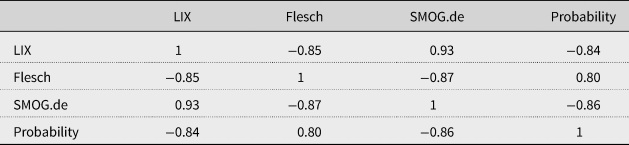
In this article, I will use the Läsbarhetsindex (LIX score) developed by Björnsson (Reference Björnsson1968). This score is often applied to German texts even though it was originally developed for Swedish. The LIX score, however, provides an accurate measure of language complexity in the German context and has been used on other occasions too (Bischof and Senninger Reference Bischof and Senninger2018). Nevertheless, I also consider three other measures of language complexity. I compare the so-called Flesch Reading Ease (FRE or Flesch) score (Flesch Reference Flesch1948), which is developed for English texts but also applied to various other languages (Lin and Osnabrügge Reference Lin and Osnabrügge2018; Schoonvelde et al. Reference Schoonvelde, Brosius, Schumacher and Bakker2019). The SMOG.de grading score is based on the SMOG score developed by G. Harry McLaughlin (Reference McLaughlin1969). The final measure is a machine-learning measure developed by Kenneth Benoit et al. (Reference Benoit, Munger and Spirling2019) to measure political sophistication in texts, which I label as Sophistication Probability. All measures are described in more detail in Appendix A in the Supplementary Material. Table 1 presents the correlation matrix of the four readability scores; Appendix A describes the scores in more detail. The table shows that all scores correlate highly with each other; the LIX and SMOG.de scores correlate especially highly with each other and are arguably most suited for the German language. This is in line with earlier research, which shows too that readability scores provide a reasonable approximation of language complexity (Bizzoni et al. Reference Bizzoni2023; Contreras et al. Reference Contreras, Garcia-Alonso, Echenique and Daye-Contreras1999) and correlate closely with more modern machine-learning models which aim to detect language complexity (Benoit et al. Reference Benoit, Munger and Spirling2019; Bischof and Senninger Reference Bischof and Senninger2021; Slapin and Kirkland Reference Slapin and Kirkland2020).
Correlation Matrix of Language Complexity Measures

Therefore, the LIX score seems to be an appropriate measure to detect language complexity in German texts. However, we should keep in mind that readability formulas ‘were never proposed to be used as the sole medium to assess reading difficulty’ (Contreras et al. Reference Contreras, Garcia-Alonso, Echenique and Daye-Contreras1999: 26). The precise formula for the LIX score is:

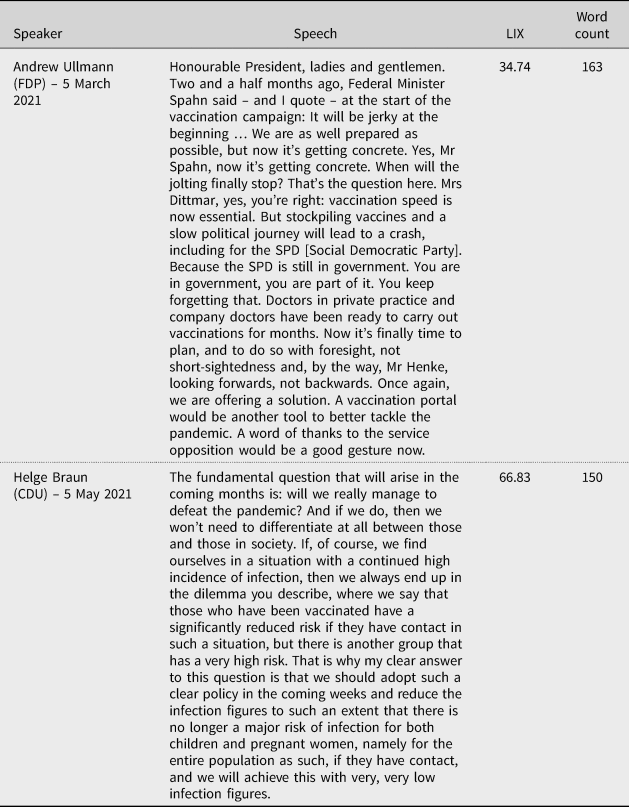
To illustrate what is captured as low and high language complexity following the LIX score, two examples are presented in Table 2. In general, high values of the LIX score display more complex language and low values of the LIX score display easier language. The first example displays a LIX score of 34.7 and reports an example of easier language. The second example displays a LIX score of 66.8 and displays, therefore, rather complex language. To put these in context, the average language complexity for all debates between 1991 and 2021 is 48.5; for the 19th legislative period (2017–2021), it is 46.5, including only debates with more than 150 words. Table 2 presents a snippet of two speeches, translated into English. This is intended to serve as an illustration of the LIX score. The originals of the two speeches are presented in Appendix A, Table A1, in the Supplementary Material.
Example of Easy and Difficult Language in Parliamentary Statements on Vaccination Strategies during the COVID-19 Pandemic in Germany*

* Based on LIX readability score – English version (translation by the author)
Both examples display a parliamentary speech given by an MP on vaccination strategies during the COVID-19 pandemic. We can see that the two speeches vary observably in their length of words and sentences, even though they are nearly the same length overall. Andrew Ullmann of the liberal Free Democratic Party (FDP) gave a simpler speech. In the speech, he is directly addressing his audience and emphasizing a rather short and to-the-point style of speaking. The example of a more complex speech is from Helge Braun of the centre-right Christian Democratic Union (CDU). He speaks with a lot of subordinate clauses and sub-sentences, incorporating many thoughts into one sentence. The examples show what the LIX score or, in general, readability scores are able to detect, which is the structure of a sentence and the length/complexity of words. Especially in German, the length of words correlates highly with language complexity, as many technical words consist of individual nouns that are compounded together. These compound nouns are very common in the German language and can make words quite long. However, the examples also show the limitations of the LIX score as it can only capture linguistic and quantitatively observable elements of a sentence or speech. It cannot account for rare words or the complexity of concepts or policies that are presented in speeches. This is important to keep in mind when discussing the results. It also highlights that perspective studies are necessary and account for these concerns. I provide a comparison of the four measures of complexity and discuss them in Appendix A. Even though these measures are either readability scores or based on them, they provide highly correlating results.
Parliamentary speech data
I use parliamentary speech data from Germany to test the hypothesis. The data are retrieved from the Open Discourse Dataset (Richter et al. Reference Richter2020), which provides parliamentary speeches for Germany from 1949 up to 2021 in a machine-readable format. I use a subset of the whole dataset, looking at parliamentary speech data from 1991 up to 2021 (12th to 19th legislative periods of the German Bundestag). This covers seven full legislative periods since the reunification of Germany. Particular focus is placed on the last legislative period – the 19th German Bundestag – as this was the first time when a right-wing populist party, the AfD, entered the German parliament since World War II.
The parliamentary speech data are pre-processed. Only speeches with 150 or more words are included in the main analysis.Footnote 6 This is because shorter speeches are not considered as full speeches but rather as interruptions, comments or questions. Thus, they may not display a speaker's correct language complexity as, in these cases, speakers more often use half-sentences or short comments. The average word count before trimming the dataset was 400 words per speech. I have also removed speeches by chairpersons (presidents or vice-presidents of the Bundestag) as the role of these figures is to facilitate the debates but not take part in them. The final corpus consists of 132,778 speeches between September 1991 and May 2021.Footnote 7
In addition, I added metadata about the MPs to the parliamentary speeches. The data are drawn from the Open Data of the Bundestag (Bundestag 2022). Parts of the data have been pre-processed through the Open Discourse Database. Any missing information has been collected and added manually. As such, the following individual-level characteristics for each MP are added: gender, age, party membership (original dataset only considers factions), education proxy (controlling for a doctor title) and mandate type (list or direct mandate).
To detect the topics of the debates in parliamentary speeches, I apply a seeded Latent Dirichlet Allocation (LDA) topic model on the speech data using the seeded LDA package in R (see Lu et al. Reference Lu, Ott, Cardie and Tsou2011 and Watanabe and Zhou Reference Watanabe and Zhou2022). Seeded LDA topic models are a semi-supervised adaption from unsupervised topic models. They come with the benefit that researchers can predefine topics and main (seeded) words that relate to this topic. Thus, as a first step, I created a dictionary covering 13 policy areas. The policy areas are defined based on Heike Klüver and Radoslaw Zubek's (Reference Klüver and Zubek2018) coding scheme. They developed a coding scheme based on Manifesto Project data (Volkens et al. Reference Volkens2019) and parliamentary bill data. Thus, their division of policy topics corresponds neatly with the German parliamentary speech data. Furthermore, it offers us the possibility to create a dictionary based on their pre-defined coding scheme. The dictionary was derived through a hand coding of bills mentioned in the parliamentary speech data. The dictionary as well as the top 20 words of each category derived through the seeded LDA are presented in the Supplementary Material, Appendix B, Table 3 for the dictionary and Tables 4–7 for the top 20 words. Also, a distribution of topics over time is presented in Appendix B, Figure 7. This provides another validity check of the topic model. For example, decentralization is assigned to many debates in the 12th and 13th legislative periods, hinting at many discussions about the unification of Germany. On the other hand, immigration topics became more prevalent in the 18th legislative period, showing evidence of the refugee crisis in Germany. Similar patterns are observable for the financial crisis in 2008 and an increase in economic topics also for the COVID-19 pandemic, which led to more discussions on health issues in the 19th legislative period. Finally, I hand-coded 100 debates and compared them to the topic model. The Krippendorff's Alpha is 0.67.
Method
To test H1, language complexity is calculated for each individual speech and later aggregated to the speaker and party levels. First, I calculate different descriptive statistics based on different t-tests and evaluate language complexity among MPs and parties. To test H1, I focus on the 19th legislative period and compare the results, as well as setting them in relation to the different measurement techniques.
Additionally, I run different specifications of multilevel regression models to control for MPs' individual and political characteristics to determine whether these influence language complexity. I run a multilevel model that sets individual speeches at the lowest observation unit. As speeches are nested within MPs, who are nested within parties, I employ random intercepts that vary at the MP and party level. Further, I add a random slope for time, controlling for legislative periods to model the time differences in my data. The dependent variable is, accordingly, language complexity measured through the LIX score. I standardize the LIX score for the regression analysis. More precisely, I run the following baseline model of a multilevel regression model:

where β 0 is the fixed intercept, representing the average language complexity across all groups; β 1 is the fixed effect of the legislative period on language complexity; u 0j is the random intercept for each party j, capturing variation in baseline language complexity between parties; u 1j is the random slope for the legislative period within each party j, allowing the effect of the legislative period to vary by party; and v ij is the random effect for each speaker i within party j, accounting for speaker-specific deviations.
The baseline model is then extended through various independent variables. First, I test for the main independent variable Populists, controlling if MPs belong a populist party or not and then controlling if MPs belong to a left-wing populist party (LINKE), a right-wing populist party (AfD)Footnote 8 or a non-populist party. I further add gender, age and education proxy, as well as being a cabinet member or having a direct mandate to the model. First, I run the multilevel model, including all legislative periods as specified above. As the AfD only entered parliament in 2017, I also ran a model specification where I only look at the 19th legislative period (2017–2021) and control for time at the weekly level.
To test H2, I use the classified debate topics from the seeded topic model and compare party complexity for each topic. I apply a t-test to compare party language complexity across the different debate topics. Finally, I present general trends in debate topics, showing that certain topics use simpler language than others. Further, I also run multilevel models controlling for the debate topic and distribution of each topic. As such, I extend the baseline model described above and add topic and topic proportions to each model.
Results
Language complexity across time
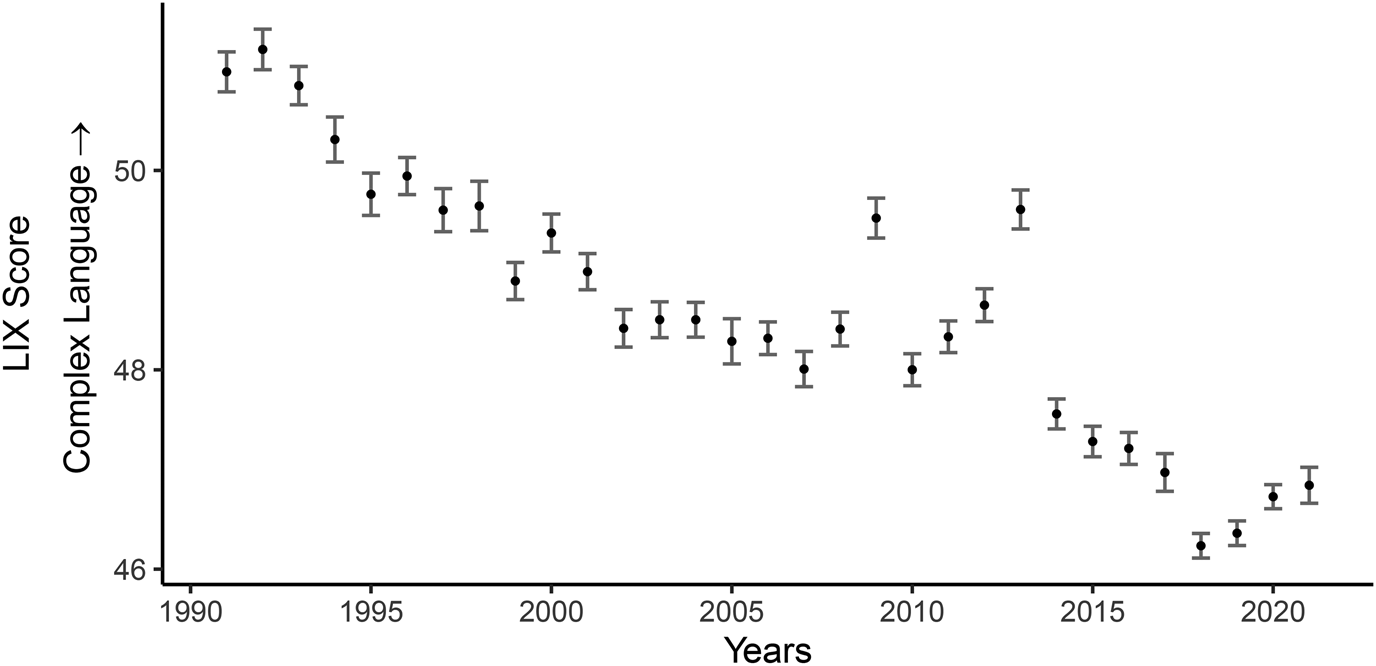
To further inspect language complexity and what affects it, I will now draw on time variances in language complexity. Figure 1 shows language complexity aggregated for each year between 1991 and 2021. It shows that language became simpler over time, from an average of 50 on the LIX scale in the 12th legislative period to an average of 46 on the LIX scale in the 19th legislative period. Thus, we can observe a clear simplification of language across the last 30 years, as lower values in the LIX score mean simpler language. Usually, LIX scores range from 20 (very easy) to 60 (very complicated) (Björnsson Reference Björnsson1968), with regard to the parliamentary speech data. The lowest values of speech complexity display a score of around 25. However, the highest scores of language complexity go even above 60.
Language Complexity across Time in the German Bundestag with 95% Confidence Intervals.
Note: Average language complexity per year of all members of parliament represented in the German Bundestag.

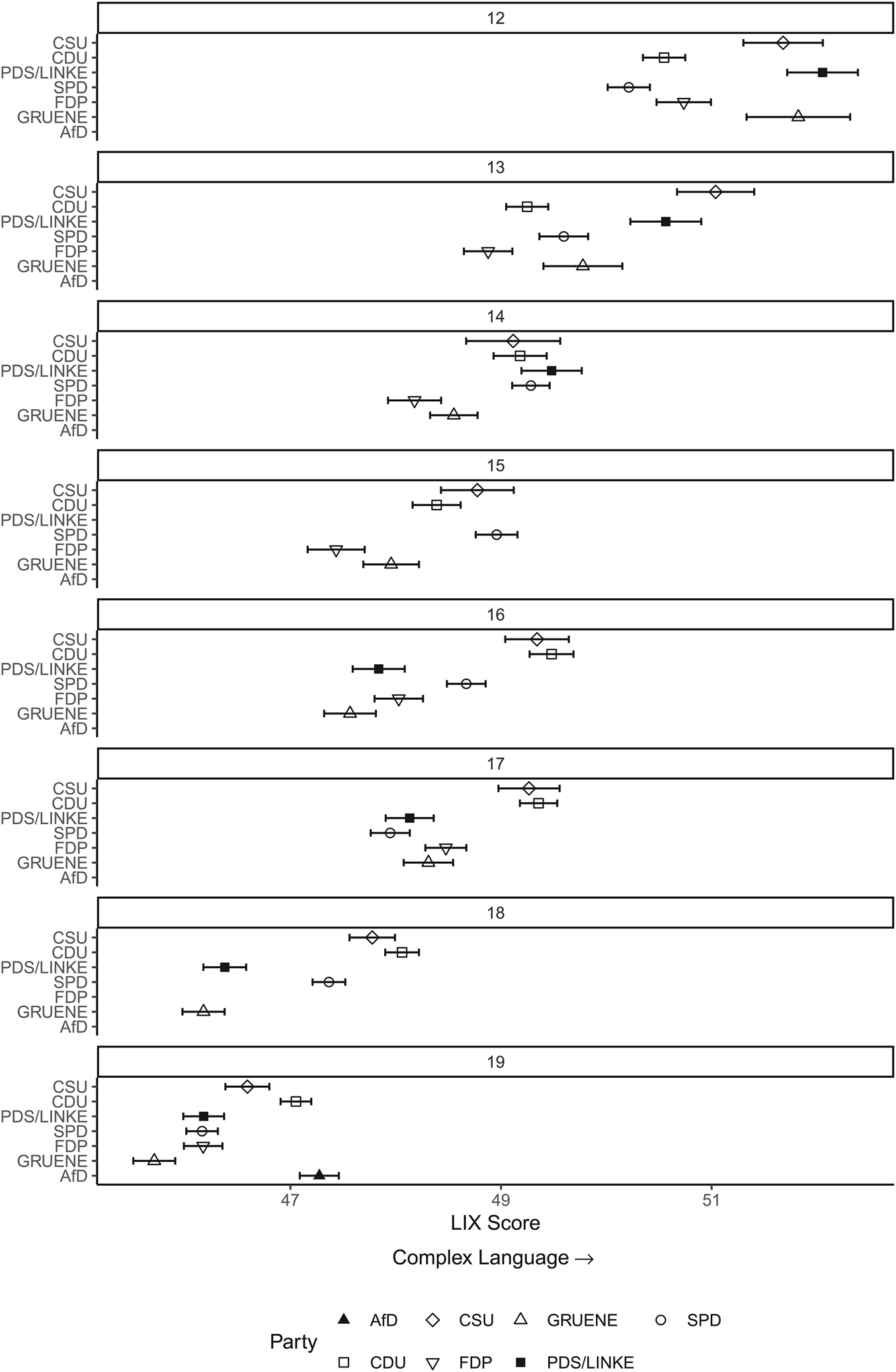
In Figure 2, I provide a more detailed description of the timely influence on party complexity. Thus, the table displays aggregated LIX scores for parties represented in the German Bundestag between the 12th and the 19th legislative periods with 95% confidence intervals. It shows that the language of all parties got simpler over the period of 30 years. However, it also shows how parties changed their use of language. The Greens (GRUENE) had been one of the more complex parties between 1991Footnote 9 and November 1994 (12th legislative period). In the 19th legislative period, however, the Greens were among the most simple speakers in the German Bundestag. Nevertheless, the figure displays quite wide confidence intervals, which again illustrates that there seems to be a lot of variance in language complexity among MPs from the same party.
Language Complexity among Parties for 12th to 19th Legislative Period with 95% Confidence Intervals.
Note: AfD: Alternative for Germany; CSU: Christian Social Union; CDU: Christian Democratic Union; PDS/LINKE: PDS/The Left; SPD: Social Democratic Party of German; FDP: Free Democratic Party; GRUENE: Alliance 90/Greens.

If we compare the AfD (right-wing populist party) with the other parties, it becomes obvious that it is the most complex party in the 19th legislative period. However, if we do an overall comparison across time, these results change (compare Figure 2).Footnote 10 As language complexity decreases over time, this comparison has to be treated carefully. Furthermore, the results change if we consider language complexity with or without word restrictions. As discussed earlier, I chose to deploy a word restriction of a minimum of 150 words to the speech data to filter for interruptions, comments or questions. As the AfD rate of interruption is 10% higher than that of other parties, this control measure has a huge effect on the results. If I keep all speeches in the data the AfD switches with the FDP (liberals) (see Appendix A, Figure A1 and Figure A3). It also shows that removing word restrictions makes all parties simpler. Therefore, keeping a word limit is justified as it leads to more accurate results. Not doing so, on the other hand, would lead to skewed results.
Individual characteristics and language complexity
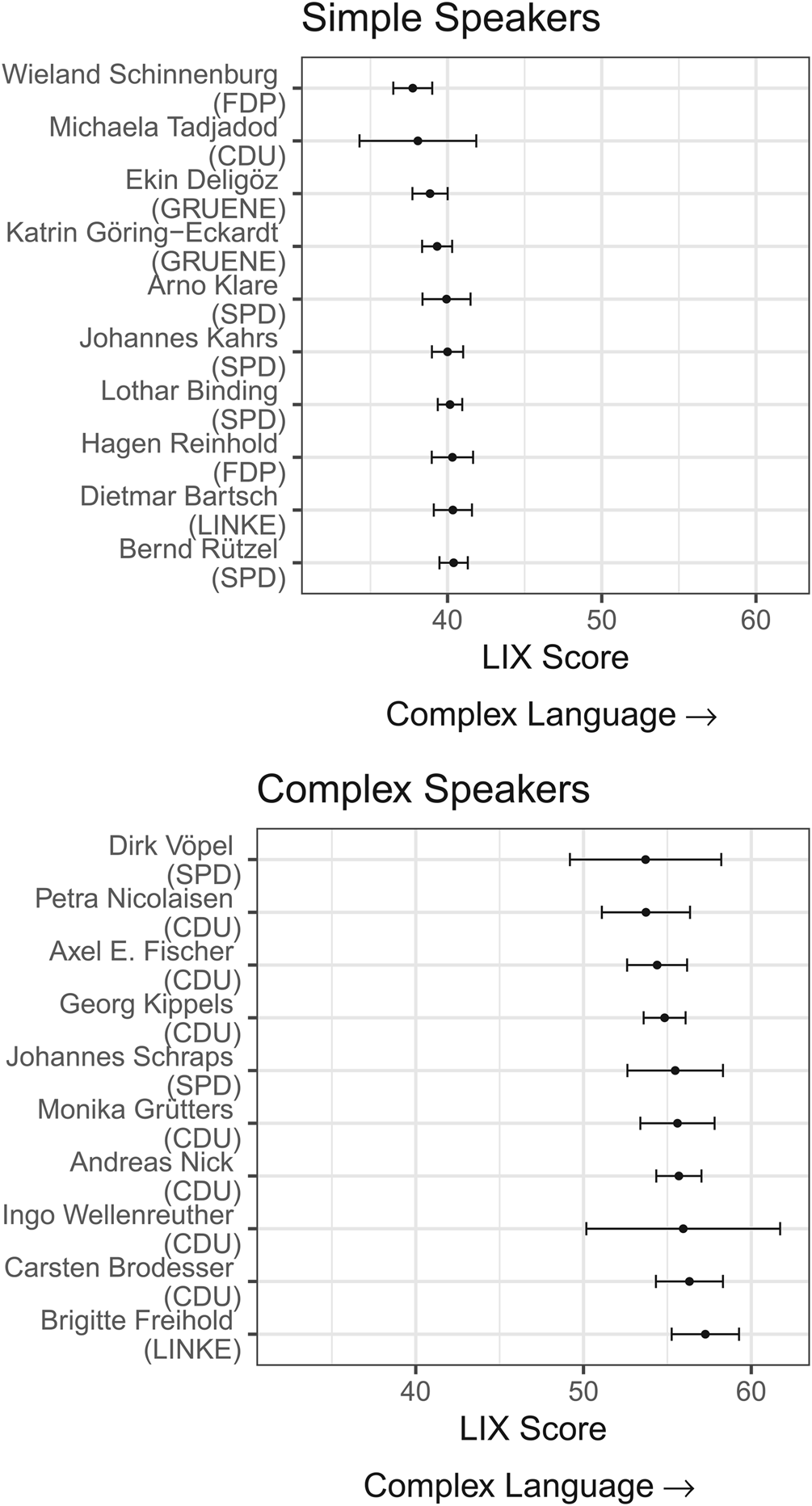
To further inspect how language complexity varies among political actors, I look at individual speakers and their language complexity during the 19th legislative period. Figure 3 displays the ten simplest and the ten most complex speakers according to the LIX score. The speaker who uses the simplest language is Wieland Schinnenburg from the liberal party (FDP), with a mean LIX score of about 38. The most complex speaker is Brigitte Freihold from the left-populist party LINKE, with a mean LIX score of 57. The difference is nearly 20 points in the LIX score. In the analysis, only speakers from the 19th Bundestag are included to make it comparable to the other results. Speakers must have spoken at least three times to be considered for the analysis.
Ten most Simple (top) Speakers and Ten most Complex (bottom) Speakers in the 19th Legislative Period.

Figure 3 also gives substantive insights into language complexity in parliament. It shows that neither the simplest nor the most complex speakers exclusively belong to one party. It shows that speakers from the CDU, FDP, GRUENE and SPD are among the most simple speakers. This gives a first hint that language complexity seems not to depend exclusively on party affiliation but much more on MPs' individual characteristics and speech practices.
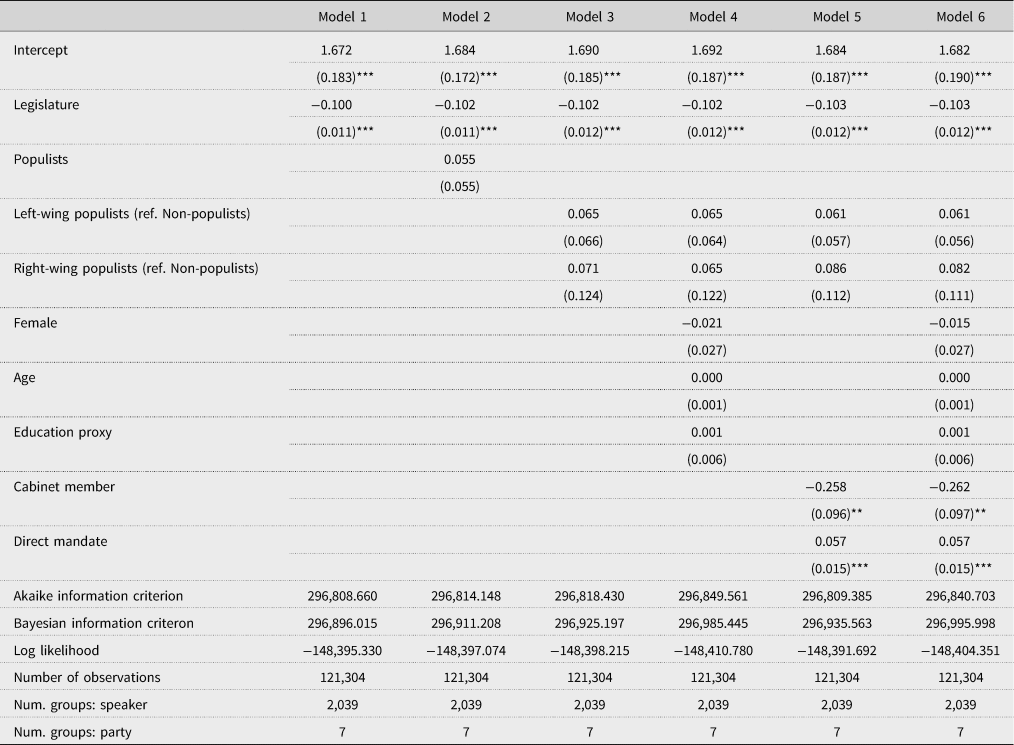
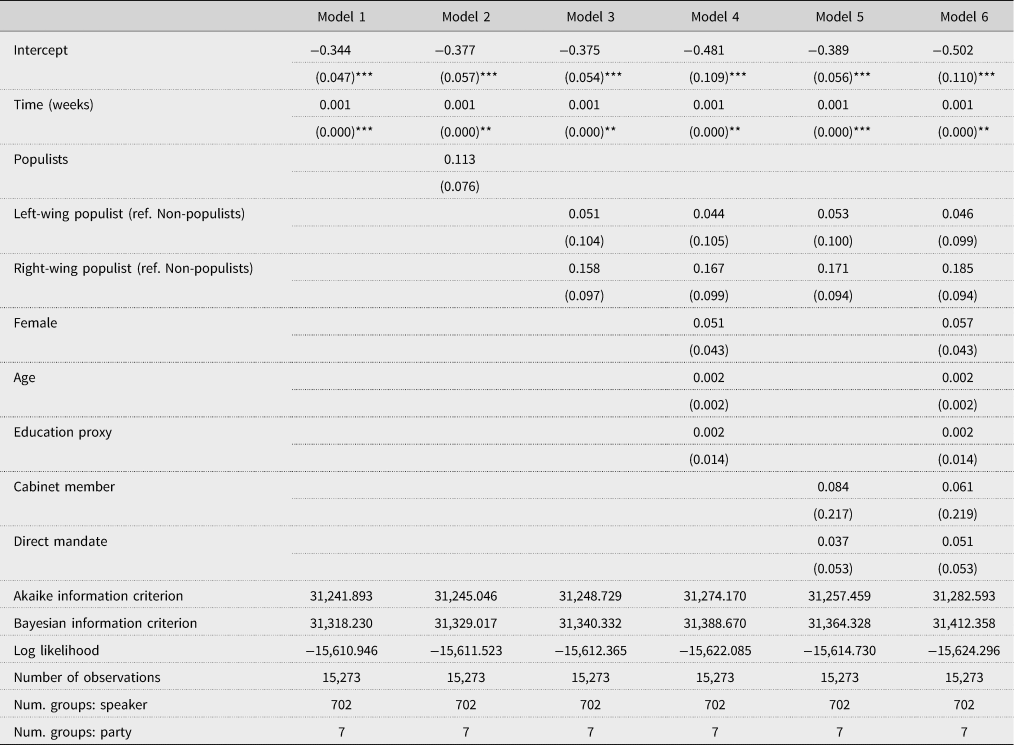
To dive further into what predicts the use of simpler language, I conduct a multilevel regression analysis on MPs' individual and political characteristics on their LIX scores at individual speeches. Table 3 presents the results for the full dataset (12th to 19th legislative period) with random intercepts for MP and party level and a random slope for legislative periods. Table 4, on the other hand, only focuses on the 19th legislative period with a random slope that varies at a weekly level. When looking at all legislative periods, having a direct mandate instead of a list mandate seems to increase language complexity. However, when we look only at the 19th legislative period, these results hold but are not statistically significant any more. Being a member of cabinet seems to decrease language complexity when looking at all legislative periods. This effect, however, turns around when we only look at the 19th legislative period and is not statistically significant. These mixed results display once again that language complexity seems to be highly influenced by various contexts. Looking at the personal characteristics, the results show that age has a slightly positive effect on language complexity, being female increases language complexity as well as holding a doctorate. However, all the results are not statistically significant.
Language Complexity in Parliament between 1991 and 2021

Note: *** p < 0.001; ** p < 0.01; * p < 0.05.
Language Complexity in Parliament, 19th Legislative Period Only – Weekly Intervals

Note: *** p < 0.001; ** p < 0.01; * p < 0.05.
Language complexity across topic
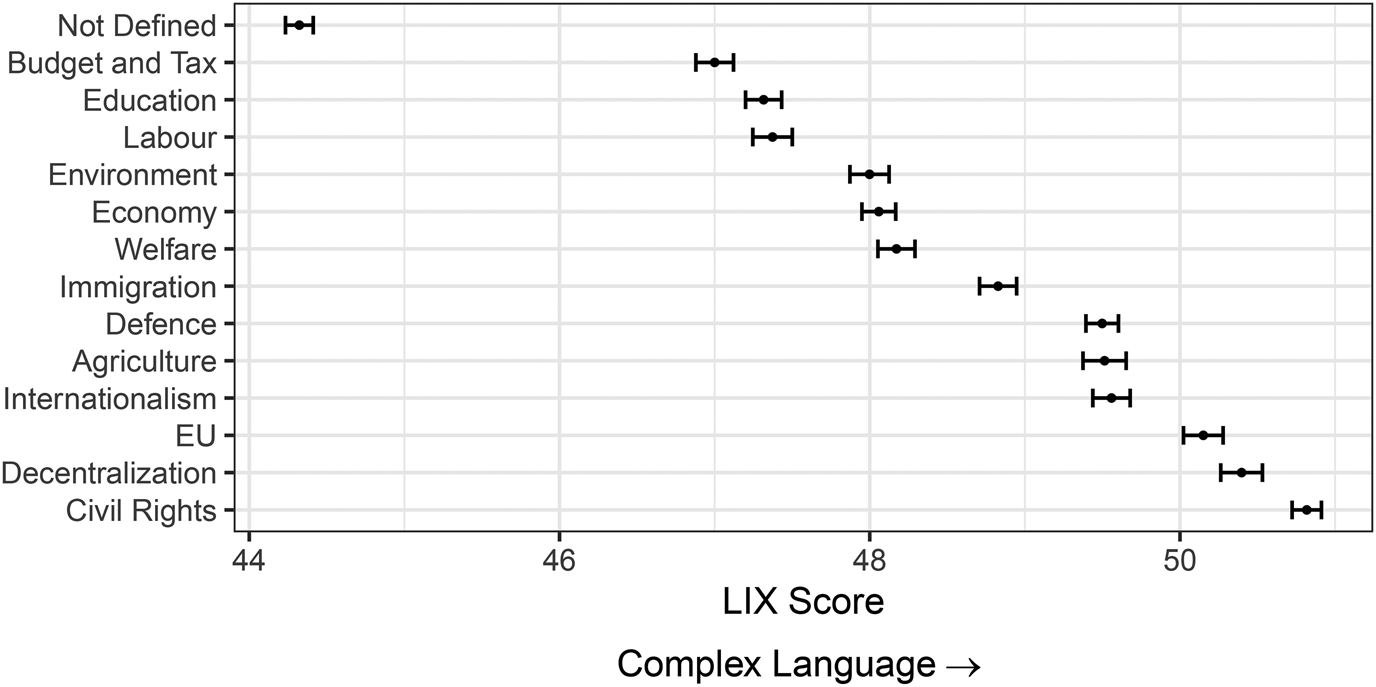
Having discussed individual as well as political determinants of language complexity, I will now turn to debate topics. As H2 assumes that certain topics require less or more complex language, Figure 4 displays language complexity across all topics. It shows that, on average, debates on budget and tax policies display the simplest language (LIX score: 47), whereas debates on civil rights seem to require the most difficult language (LIX score: 51). The simplest language is used for topics that are not defined. Often, these include rather shorter statements, such as comments, interruptions or questions. These are harder to define through the seeded LDA topic model algorithm. Also, EU topics score highly on the language complexity measure. This may be explained by the fact that these topics are, in general, more complex and, therefore, require more complex and/or technical language.
Language Complexity across Debate Topics.

As H2 is concerned with how issue ownership has an effect on language complexity, Figure 5 shows parties' language complexity for policy areas in parliamentary debates. It shows that the AfD scores the highest on language complexity in policy areas of agriculture, budget and tax, civil rights, economy, education, internationalism and labour. On debates on the policy areas of decentralization, defence, the EU and immigration, it displays scores of medium language complexity. As such, there is a trend that the AfD speaks more simply on issues it ‘owns’. However, we cannot observe a statistically significant effect in comparison to other parties.
Language Complexity per Party across Policy Areas, 19th Legislative Period.

The Left (LINKE), on the other hand, displays the lowest score of language complexity on labour issues. It also displays rather low scores in the policy areas of budget and tax, the EU, immigration, defence, decentralization and welfare. This points towards the concept that the Left (LINKE) does speak simply on issues it ‘owns’ or at least that are important for its portfolio and electorate. However, again we cannot observe the statistical significance of the results.
Further, it is interesting to observe that the Greens (GRUENE) do not speak the simplest about environmental issues. They display a medium score of language complexity in environmental parliamentary debates. The Socialist Party (SPD) scores the second lowest score on language complexity on labour issues. Also, on welfare issues, the SPD scores a rather medium value compared to other parties. As these results are only limited to the 19th legislative period, a full overview of policy areas between the 12th and 19th legislative periods is displayed in the Supplementary Material, Appendix D, Figure A6.
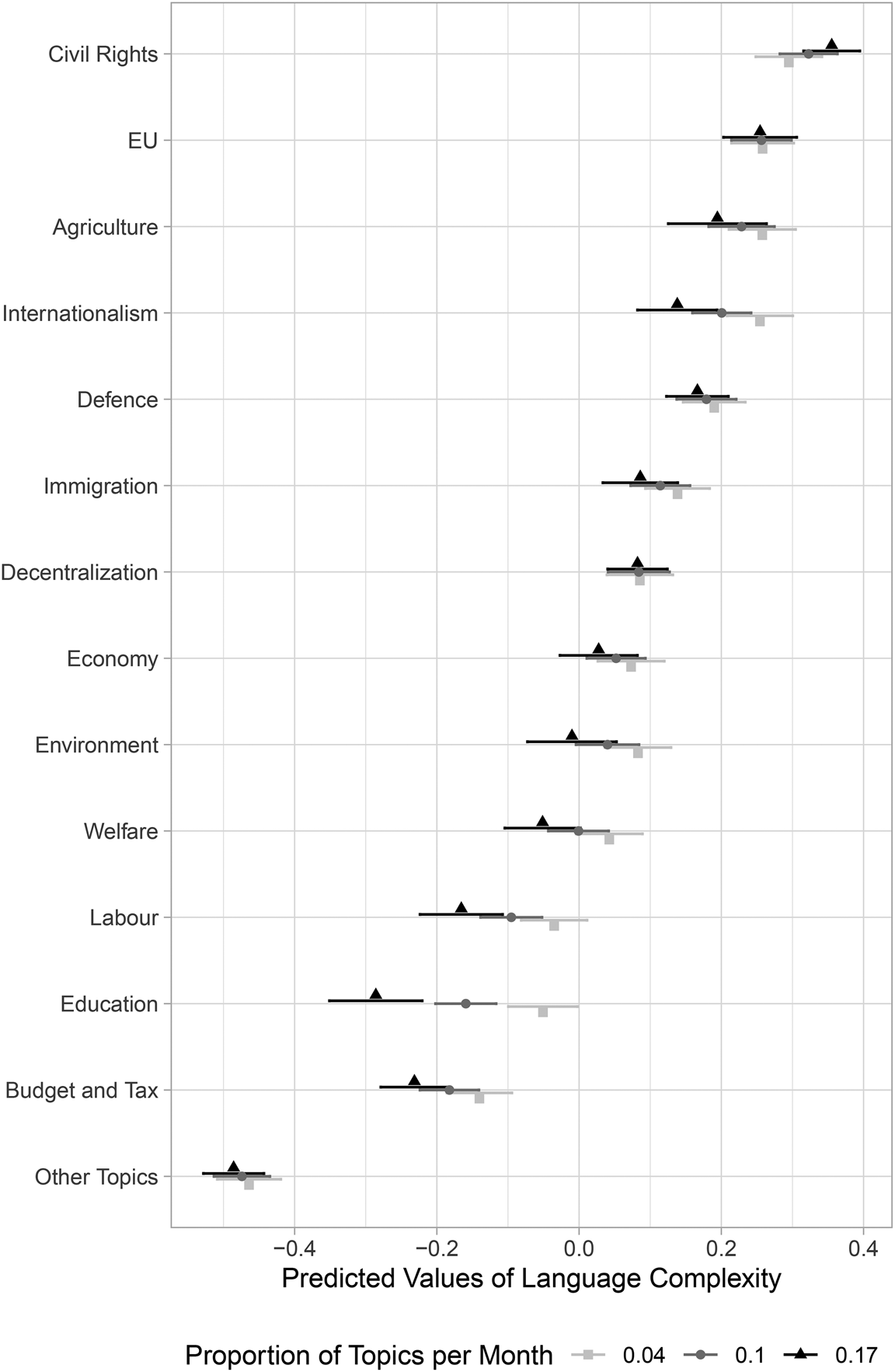
To inspect further how topics affect language complexity, I run multilevel models and add topic as well as the corresponding topic proportion per month, which is the number of speeches per topic divided by the overall number of speeches in that month. Figure 6 shows interaction terms of the topic and its proportion per month. It displays the predicted values for the scaled LIX score if the topic is discussed in 4%, 10% or 17% of all speeches in a given month. It shows that speaking more about a topic decreases language complexity for all topics except civil rights (black triangle). If the topic is not addressed much in parliamentary debates, language complexity seems to increase for most topics (light grey square). The results look similar when we look only at the interaction terms that are calculated on the 19th legislative period with random slopes on a weekly level (see Appendix D, Figure A8, and Table A13). This hints that the salience of a topic may affect the language complexity of that topic. More salient topics may be discussed in simpler language as they are picked up more by the media, and MPs try to address a broader audience when debating them in parliament.
Interaction of Topic and Topic Distribution in Parliamentary Speeches between 1991 and 2021.

Robustness checks
As populism is not a dichotomous measure but can appear in various degrees, I also add a measure to define the degree of populism in each speech. There have been various dictionaries developed and applied over the years (Bonikowski and Gidron Reference Bonikowski and Gidron2016; Pauwels Reference Pauwels, Heinisch, Holtz-Bacha and Mazzoleni2017; Rooduijn and Pauwels Reference Rooduijn and Pauwels2011). Johann Gründl (Reference Gründl2022) developed a dictionary explicitly for the German language. His dictionary is based on the above-mentioned dictionaries and has already been successfully applied to German parliamentary speech data (Breyer Reference Breyer2023).
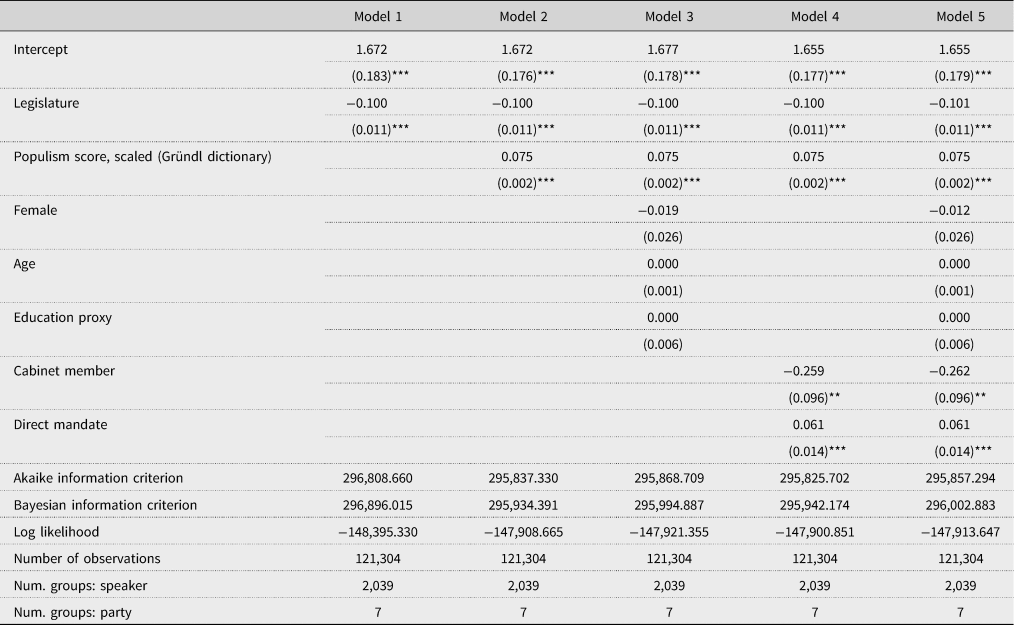
Thus, the dictionary by Gründl (Reference Gründl2022) seems well suited for measuring a degree of populism in German parliamentary speech data. Table 5 displays the same multilevel regression as displayed in Table 3, with a new main independent variable. The only difference is that I control for Degree of Populism in each speech, calculated by the proportion of populist sentences divided by the number of overall sentences, as suggested by Gründl (Reference Gründl2022). Afterwards, I also standardize the Degree of Populism to receive a better measurement. It is still important to note that the dictionary terms themselves cannot always be equated with populism. It is rather the case that the terms ‘indicate a high probability of populist argumentation in the direct surroundings of the term’ (Breyer Reference Breyer2023: 677). The distribution of the variable across time and per party type is presented in Appendix D, Figure A9. We can see that especially the AfD, as a right-wing populist party, uses comparatively more populist words in its speeches than any other German party. Non-populist actors, on the other hand, use rather a low percentage of populist vocabulary in their speeches.
Language Complexity in Parliament between 1991 and 2021, Degree of Populism

Notes: *** p < 0.001; ** p < 0.01; * p < 0.05.
Table 5 presents the results of the robustness test with Degree of Populism as the main independent variable instead of the party type. The results provide similar results to the main multilevel regression analysis in Table 3. It is shown that a higher Degree of Populism is associated with a higher LIX score and, accordingly, higher language complexity. As such, populism and language complexity do not seem to correlate – at least not in the German Bundestag. The results also confirm that MPs with direct mandates seem to increase language complexity, whereas cabinet members seem to have a lower level of language complexity. Not all predictors display statistically significant results.
Discussion and conclusion
The results presented in this analysis provide mixed evidence for the hypotheses. Thus, the research question can be answered in the following way: (1) there is no evidence that MPs from populist parties use, on average, simpler language than MPs from other parties; rather, it is individual, ideological and political circumstances that seem to determine the language complexity of an MP; (2) right-wing populist party members do not use more simplistic language than left-wing populist party members, rather it seems to be the opposite; and (3) debate topics seem to affect language complexity, showing slight evidence that topic salience decreases language complexity but issue ownership does not seem to affect language complexity.
Further to this, the results show that language complexity is only weakly predicted by populism. It is rather time and individual characteristics as well as political circumstances that predict language complexity. This may also be caused by populists' understanding of representation. Populism often relies on symbolic representation (Caramani Reference Caramani2017). Populists focus on creating their in-group through symbolic representation instead of emphasizing how their policy interests can align with a broader audience. As such, they may want to address only voters of their in-group and exclude all other voters. Simple language can help to include a broader audience as complex policy issues get explained simply. This may explain why populists avoid using simple language in their parliamentary discourse, as simple language instead contributes to substantive or even surrogate representation. In these types of representation, MPs want to represent the interests of their voter group and sometimes even people beyond that. As such, simple language helps MPs address the public and explain policies to all.
Again, in comparison to Schoonvelde et al. (Reference Schoonvelde, Brosius, Schumacher and Bakker2019), it is left-leaning parties that tend to employ simpler language than their right-leaning counterparts. One explanation for these results is that left-leaning parties have started as parties representing the working class. As such, MPs of left-leaning parties may have always adopted a more straightforward and simple way of talking. Other explanations could be that these results are driven by looking at Germany and the German language as a case. First, the German language is complicated and multifaceted. Second, German MPs are known for being highly educated and are often more educated than the country average. This is also displayed by the above-average number of academic titles per individual among MPs. More in-depth and cross-country comparisons would be necessary to detect with more certainty what impact ideology has on language complexity, as time also played a crucial role on average language complexity in parliament. Lastly, the texts analysed – in this case, parliamentary speeches – can also affect language complexity. Analysing manifestos or social media communication could reveal different results (see Bischof and Senninger (Reference Bischof and Senninger2018)). As this article focused exclusively on parliamentary debates, further analysis would be necessary to determine whether other channels of communication lead to different results.
Next to an in-depth analysis of who and when MPs use simple language, this article also showed that parliamentary speeches have become simpler over the last 30 years. This adds to earlier research on US presidential speeches. Research has also shown that speeches have become simpler over time (Lim Reference Lim2012; Sigelman Reference Sigelman1996; Teten Reference Teten2003) as a response to a shift from an elite discourse to more publicly directed discourse. Even though populist party affiliation does not seem to impact language complexity after all, it is striking that the 19th legislative period is by far the most simplistic period in terms of language use. Thus, it remains to be seen if the AfD's entry into parliament led to an overall more simplified discourse or if the general trend led to the most linguistically simple period of parliament. In addition, the analysis has evidenced that debate topics influence language complexity. The article shows that topics that are discussed more in parliament lead to simpler language. The reason for this may be that salient topics are picked up more by the media, and MPs may want to include a broader audience in these speeches. However, further research would be necessary to disentangle these effects in more detail.
This analysis also refrains from making a normative evaluation of simple language as a negative phenomenon; having the ability to describe a complex phenomenon in simple and understandable terms can be considered as positive, just as downplaying complex issues through simple rhetoric can be considered negative. This emphasizes that more research is necessary to disentangle the effect of simplicity in political discourse from a linguistic and conceptual perspective.
Overall, this analysis has presented new insights into individual speech patterns in parliamentary debates and has shown that populism does not serve as a determinant for simple language. Populists may present simple ideas. However, the language they use is similar to the language of their non-populist counterparts. Right-wing populists seem to use even more complex language in comparison to other political actors.
Supplementary material
The supplementary material for this article can be found at https://doi.org/10.1017/gov.2025.4.
Data availability
The replication files for the analysis are available on OSF Registries at https://doi.org/10.17605/OSF.IO/93DQY.
Acknowledgements
I would like to thank Amy Catalinac, Ellen Immergut, Fabian Habersack, Simon Hix, Sophia Hunger, Jasper Praet, Sven-Oliver Proksch, Massimo Pulejo and Mariken van der Velden for reading and commenting on earlier versions of the manuscript as well as participants of the NYU Comparative Politics Colloquium, EPSA 2022 conference, the ECPR General Conference 2022 and the ECPR Joint Sessions 2023 for their fruitful discussions. I also thank Marcus Immonen Hagley, Anica Waldendorf and Mirko Wegemann for support on data preparation. Finally, I thank the three anonymous reviewers for their constructive feedback. All errors remain my own.



 Open access

