




Introduction
Cancer is a life-threatening disease. According to the latest estimated global cancer burden, the incidence and mortality rate in China account for 23.7% and 30.2% of cancer worldwide, respectively (Sung et al. Reference Sung, Ferlay and Siegel2021). Two-thirds of cancer patients are diagnosed at advanced stages. Cancer-related fatigue (CRF) and sleep disturbance are the 2 most common and painful symptoms and are long-lasting in advanced cancer patients (Charalambous et al. Reference Charalambous, Berger and Matthews2019; Wu et al. Reference Wu, Balachandran and Faiz2022). Furthermore, these symptoms interact with each other and form a fatigue–sleep disturbance symptom cluster (Wu et al. Reference Wu, Balachandran and Faiz2022). Biologically, both are related to cytokine imbalance, hypothalamic–pituitary–adrenal axis dysfunction, and central nervous system inflammatory response (Dun et al. Reference Dun, Xian-Yi and Si-Ting2022; Liu et al. Reference Liu, Mills and Rissling2012; Miller et al. Reference Miller, Ancoli-Israel and Bower2008). Behaviorally, patients with higher levels of fatigue are more likely to nap during the day, and daytime sleepiness and nighttime sleep disturbance can exacerbate fatigue (Liu et al. Reference Liu, Mills and Rissling2012; Wu et al. Reference Wu, Balachandran and Faiz2022). The cumulative effect of the fatigue–sleep disturbance symptom cluster is often more serious than a single symptom, which has negative psychological, physical, and social impacts on patients, and thus seriously affects their QOL (Tolotti et al. Reference Tolotti, Bonetti and Pedrazzani2021). While existing treatment protocols focus on individual symptoms, strategies simultaneously managing the 2 symptoms are warranted given the high prevalence and significant impact of the fatiguesleep disturbance symptom cluster.
Exercise therapy aimed at alleviating cancer-related symptoms is energy-saving, cost-effective, and easy to implement. There is considerable evidence of the benefits of exercise in advanced cancer patients, with reductions in CRF and improvements in sleep quality and QOL (American College of Sports Medicine 2022; Network Reference Network2022). However, most patients cannot tolerate universal exercise prescriptions due to treatment-related side effects, compromised mobility, and debility (Heywood et al. Reference Heywood, McCarthy and Skinner2017). It is therefore important to select appropriate exercise modalities and tailor exercise prescriptions based on a patient’s needs. Baduanjin (BDJ) Qigong is a mind–body exercise modality characterized by slow and fluid movements, mental focus, and controlled breathing (Kuo et al. Reference Kuo, Wang and Chang2021; Yuen et al. Reference Yuen, Ouyang and Miller2021). It is especially suitable for those who are frail or not inclined toward endurance or vigorous activity. Meta-analyses have shown that in cancer patients, BDJ can have beneficial effects on cancer-specific QOL, the amount of fatigue experienced, sleep quality, and immune function (Kuo et al. Reference Kuo, Wang and Chang2021). However, for individuals practicing standing BDJ, a decline in motor control and uncoordinated movement could increase the risk of falling (Heywood et al. Reference Heywood, McCarthy and Skinner2017; Zhao et al. Reference Zhao, Chau and Lo2021). Compared to the standing position, for those with impaired physical mobility, sitting could be a safer option and achieve similar benefits (Bao et al. Reference Bao, Qiu and Shao2020). Sitting Baduanjin (SBDJ) has been used in frail people, including patients with disability, patients receiving mechanical ventilation, and postoperative patients with myocardial infarction (Chen Reference Chen2019; Chen et al. Reference Chen, Hong and Lin2021; Zhang et al. Reference Zhang, Chen and Kong2019). Previous studies indicate that SBDJ is effective and free of adverse effects, but its application in cancer patients has not yet been investigated. Given the similar physical capabilities of patients with advanced cancer and the frail population, (Network Reference Network2022; American College of Sports Medicine 2022), it is worth developing a tailored SBDJ to address fatigue–sleep disturbance symptom cluster in advanced cancer patients (Zhou et al. Reference Zhou, Kou and Zhou2022). Therefore, based on the traditional Chinese medicine pathogenesis of the fatigue–sleep disturbance symptom cluster and the principle of Chinese medicinal Qigong theory, our research team developed a 4-movement Sitting Simple Baduanjin (SSBDJ) program for advanced cancer patients. To inform the design features of a more definitive future study, the present work evaluated the feasibility and safety of such a program, as well as the potential effects on advanced cancer patients. Qualitative interviews were also conducted to explore participants’ perspectives on SSBDJ.
Methods
Study design
This was a 12-week single-arm mixed-methods feasibility study, which was conducted as a preliminary project to assist in the design of a larger-scale randomized clinical trial (ChiCTR-2300072331). The research team strictly abided by the bioethics principles proposed by Beauchamp and Childress (Beauchamp 2013).
Participants and setting
The sample size for an intervention feasibility study is recommended to be at least 30 cases (Hertzog Reference Hertzog2008). In the present work, 30 advanced cancer patients were recruited from the medical oncology department of a university-affiliated general hospital in Fujian Province, southeast China, from December 2022 to April 2023. Adult patients (aged ≥18 years) were recruited if they were: (1) aware of their diagnosis, prognosis, and therapy; (2) diagnosed with advanced cancer (UICC Stages III and IV); (3) able to communicate in Mandarin Chinese; and (4) had Karnofsky Performance Scale (KPS) scores ≥60; (5) presented with a mild to moderate level of fatigue and sleep disturbance as indicated by 0–10 numerical rating scales (NRS), with NRS score was greater than 1 for each symptom during the previous one month. Patients were excluded if they: (1) were prescribed psychostimulants, antidepressant medications, or hypnotics for treatment of fatigue or sleep disturbance symptoms or had; (2) medical contraindications for exercise; (3) previous mental illness; or (4) regular exercise habits. All patients signed informed consent forms before participating in this study.
Intervention
SSBDJ development
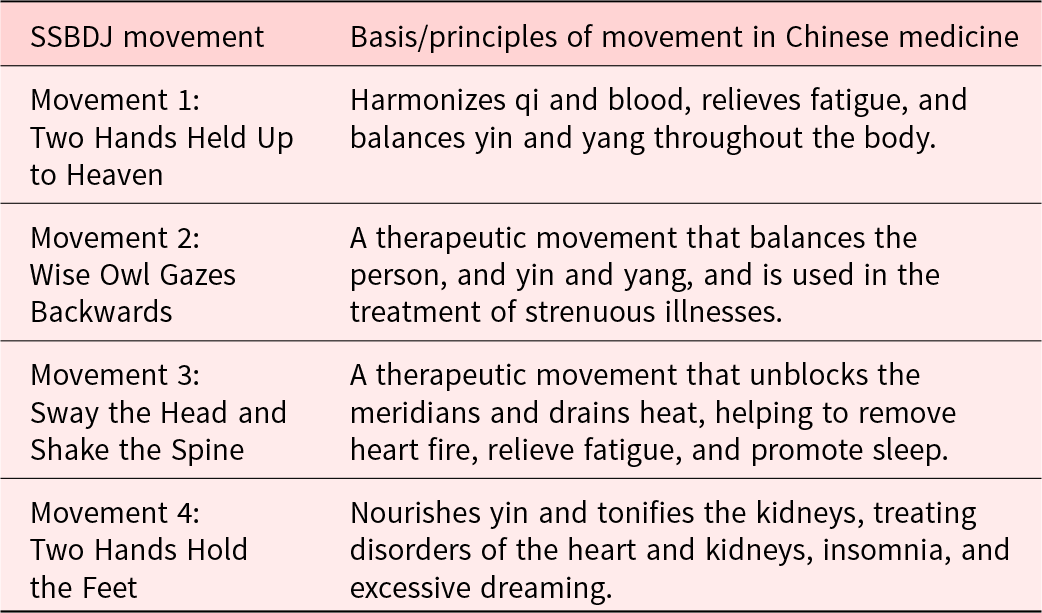
SSBDJ was developed based on the principles of discriminative gongfu in Chinese medicinal Qigong theory (Table 1). First, according to the physical characteristics of advanced cancer patients, the researcher selected 4 BDJ movements targeting the reduction of the fatigue–sleep disturbance symptom cluster; these served as the practice content. Second, under the guidance of BDJ professionals and after a literature review, the selected movements were modified in terms of exercise intensity, safety, and form. Finally, the draft SSBDJ was formulated for advanced cancer patients through group brainstorming.
Principles on which the various SSBDJ movements are based

Validation of SSBDJ
The draft SSBDJ was validated by 20 experts through a two-round Delphi survey. The research areas of the panelists were Chinese traditional exercise, rehabilitation, and traditional Chinese medicine. All held a bachelor’s degree or above and had at least 5 years of work experience in their respective fields. The panelists evaluated the appropriateness of the program, including the program’s content, format, frequency, and duration. The program was refined according to the experts’ comments.
Intervention procedure and monitoring
In this study, the first author acted as the SSBDJ facilitator. She was a registered nurse and postgraduate in the oncology sports research area. First, a patient’s exercise risk was assessed using the “Medical Assessment Form before Exercise for Patients with Malignant Tumors” and “Physical Activity Assessment Form,” as recommended by the American College of Sports Medicine (American College of Sports Medicine 2019). Then, the facilitator trained the eligible patients on SSBDJ through a PPT presentation and on-site demonstration. This occurred during their stay in the hospital. After discharge, the facilitator contacted the patient every week via WeChat or telephone to ensure they were engaging in home-based SSBDJ practices. The participants were asked to practice SSBDJ under the guidance of the SSBDJ video and booklet formulated by our research group. Participants performed 15 to 20 minutes of SSBDJ 5 times a week for 12 weeks and filled in the exercise log sheet after each practice. It was suggested that SSBDJ be performed 1 hour before or after meals to avoid impacting appetite and digestion. It could be practiced in any indoor or outdoor environment with fresh air. During the intervention, real-time medical supervision was provided to ensure sports safety. The SSBDJ practice was to be stopped if participants felt any discomfort and such cessation was recorded in the self-reported adverse event (AE) checklist.
Outcome measurements
Demographic and clinical characteristics of the participants
A self-designed demographic and clinical data form was employed to collect the participants’ sociodemographic data (i.e., age, educational background, employment status, marital status, and household income) and medical history (i.e., date of diagnosis, disease diagnosis, metastasis, and treatment.) at baseline.
Feasibility and safety outcomes
Feasibility outcomes
To evaluate the feasibility of SSBDJ for patients with advanced cancer, we collected data on retention rates, home practice adherence, and satisfaction with the intervention. Exercise compliance information was obtained through an exercise log sheet and weekly WeChat/phone follow-ups. The exercise log sheet contained the practice date, practice duration, and self-perceptions of the practice. As per Bowen’s Feasibility Framework, the success of the intervention’s execution was defined as a completion rate of ≥70% of participants attending at least 75% of the exercise sessions (Bowen et al. Reference Bowen, Kreuter and Spring2009). Participants’ satisfaction with the program was rated on a 5-point scale ranging from 1 (strongly dissatisfied) to 5 (strongly satisfied), with higher scores indicating greater satisfaction.
Safety outcomes
Safety was evaluated by AEs related to SSBDJ practice that occurred during the exercise session (Vicent et al. Reference Vicent, Ariza-Sole and Gonzalez-Juanatey2018). The severity was rated Grade 1 (asymptomatic or mild symptoms) to Grade 5 (death related to AE), based on the National Cancer Institute Common Terminology Criteria for Adverse Events, Version 5.0.
The safety of SSBDJ was defined as the absence of exercise-related AE classified as Grade 3 (i.e., significant symptoms requiring hospitalization and/or limitations in self-care activities related to daily living) or above (Reljic et al. Reference Reljic, Herrmann and Jakobs2022).
Effect-related outcomes
Fatigue
CRF was measured using the Brief Fatigue Inventory (BFI). The BFI has 9 items, with higher scores corresponding to more severe fatigue (Mendoza et al. Reference Mendoza, Wang and Cleeland1999). The Cronbach’s alpha of the Chinese version ranged from 0.90 to 0.92 (Wang et al. Reference Wang, Hao and Wang2004).
Sleep disturbance
Sleep disturbance was assessed using the Pittsburgh Sleep Quality Index (PSQI). The questionnaire has 7 domains: sleep latency, habitual sleep efficiency, subjective sleep quality, sleep duration, use of sleeping medication, sleep disturbance, and daytime dysfunction (Buysse et al. Reference Buysse, Reynolds and Monk1989). Higher total scores indicate poorer sleep quality. The Chinese version of the PSQI has been demonstrated to be a reliable and valid scale and is widely used among patients with cancer (Liu et al. Reference Liu, Tang and Hu1996).
Quality of life
The QOL items represented in the end-of-life questionnaire (QOLC-E) (Pang et al. Reference Pang, Chan and Chung2005) were used to evaluate the advanced cancer patients’ QOL. This measure consists of 29 items with 8 subscales. It is rated on an 11-point scale ranging from 0 (least desirable) to 10 (most desirable), with higher scores indicating greater satisfaction. Its Cronbach’s α coefficient for the present study was 0.87.
Qualitative interviews
Our research team developed a semi-structured interview outline to guide interviews. Participants also responded to the following open-ended questions to provide feedback on their experience: (1) What are your perceptions of SSBDJ? (2) What impacts did SSBDJ have on you? (3) What facilitators or barriers were there that affected your participation in the program? Probing questions were also used to facilitate in-depth interviews.
Data collection
Quantitative data
A trained research assistant who will be blinded to group assignments will conduct all data collection. The feasibility of recruitment, follow-up process outcomes, and acceptability of SSBDJ were collected from the baseline (T0) to completion of the program (T3). The principle of diminishing returns of exercise training was applied, which states that an assessment period during the intervention will assist in determining the expected time course for improvement of outcomes. Therefore, the participants’ CRF, sleep disturbance, and QOL were measured at pre-intervention (T0), 4 weeks (T1), 8 weeks (T2), and 12 weeks (T3) via the BFI, PSQI, and QOLC-E administered by a research assistant.
Qualitative data
Patients were invited to participate in semi-structured interviews. The interviews were conducted by the first author immediately after the 12-week SSBDJ. Each interview lasted 20 to 30 mins. All interviews were recorded with the participants’ written informed consent. The interviews were transcribed verbatim by the first author within 24 hours.
Statistical analyses
Quantitative data
Quantitative data were analyzed using an intention-to-treat approach via SPSS (version 26.0, IBM, Armonk, NY, USA). Feasibility-related outcomes (i.e., retention, compliance, and satisfaction) were analyzed using descriptive statistics. For effect-related outcomes (i.e., CRF, sleep quality, and QOL), a repeated measures ANOVA was used to compare the differences before and after the intervention.
Qualitative data
Qualitative content analysis was employed to analyze the qualitative data (Graneheim and Lundman) (Graneheim and Lundman Reference Graneheim and Lundman2004). The first author and another research team member independently carried out the analysis. Inconsistent opinions were resolved by team discussion.
Results
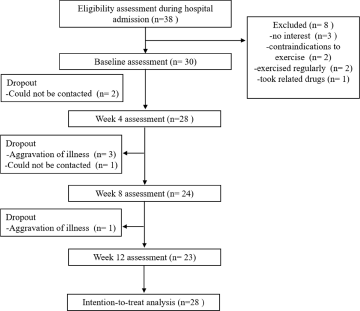
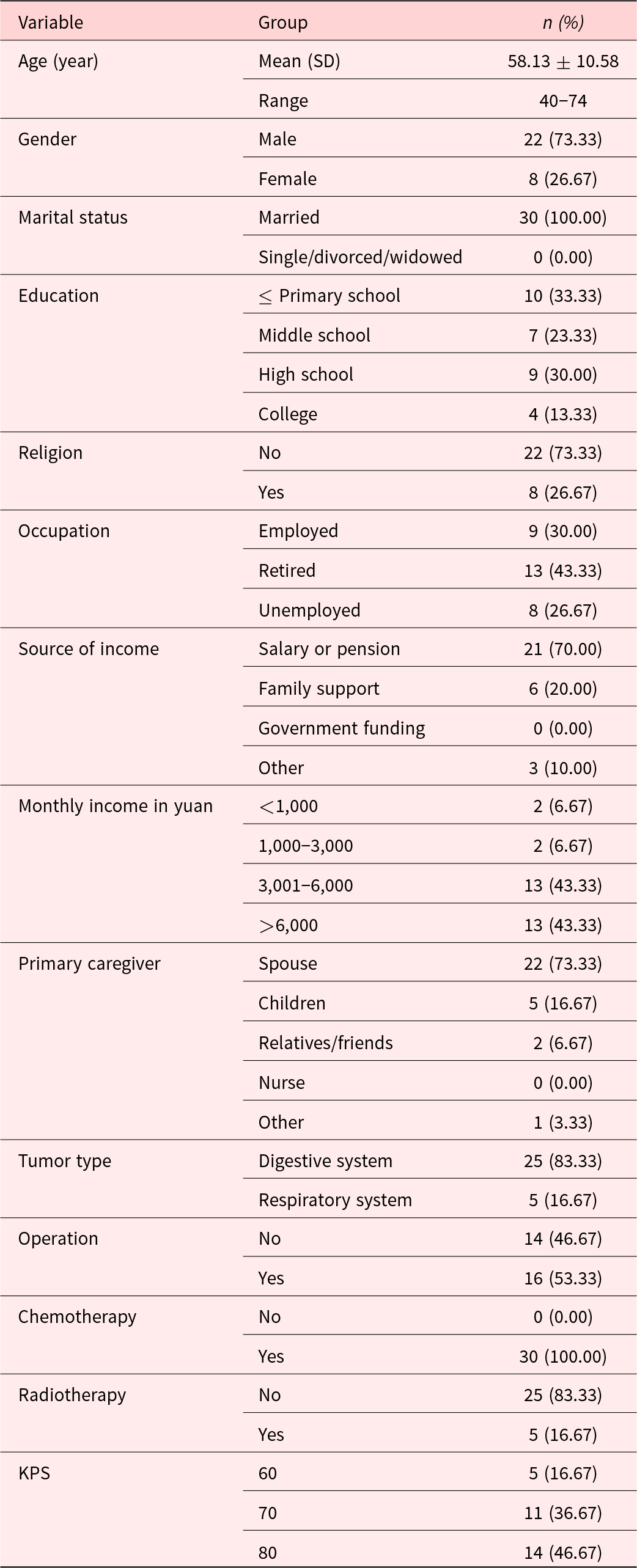
A total of 38 patients were screened for eligibility. Of those, 8 were ineligible. 3 had no interest in our study, 2 had contraindications to exercise, 2 exercised regularly, and 1 took related drugs. Finally, 30 participants were enrolled in the study. The flow of participants through the SSBDJ trial is presented in Fig. 1. Participants’ characteristics are reported in Table 2.
CONSORT flow diagram.

Baseline demographic characteristics of study participants

Feasibility and safety outcomes
Retention rate. All of the 30 enrolled participants completed the baseline assessments, 28 (93.3%) completed the 4-week assessment, 24 (80.0%) the 8-week assessment, and 23 (76.7%) the 12-week assessment. Seven participants withdrew from the study because of disease progression (n = 4) or failure to contact (n = 3).
Compliance rate
The compliance rate was calculated as a percentage of the scheduled exercises completed. There were 60 exercises scheduled. Of the total, 23 participants completed the 12-week intervention. The mean adherence rate was 88%, ranging from 71% to 98%. The reasons for noncompletion were physical limits and lack of time.
Satisfaction with the program
A total of 23 patients who completed all SSBDJ sessions rated the program using the satisfaction questionnaire. All were satisfied or very satisfied.
Adverse events
No AEs were reported. The only AE mentioned by one participant was mild and transient, a musculoskeletal discomfort due to overstretching.
Effect-related outcomes
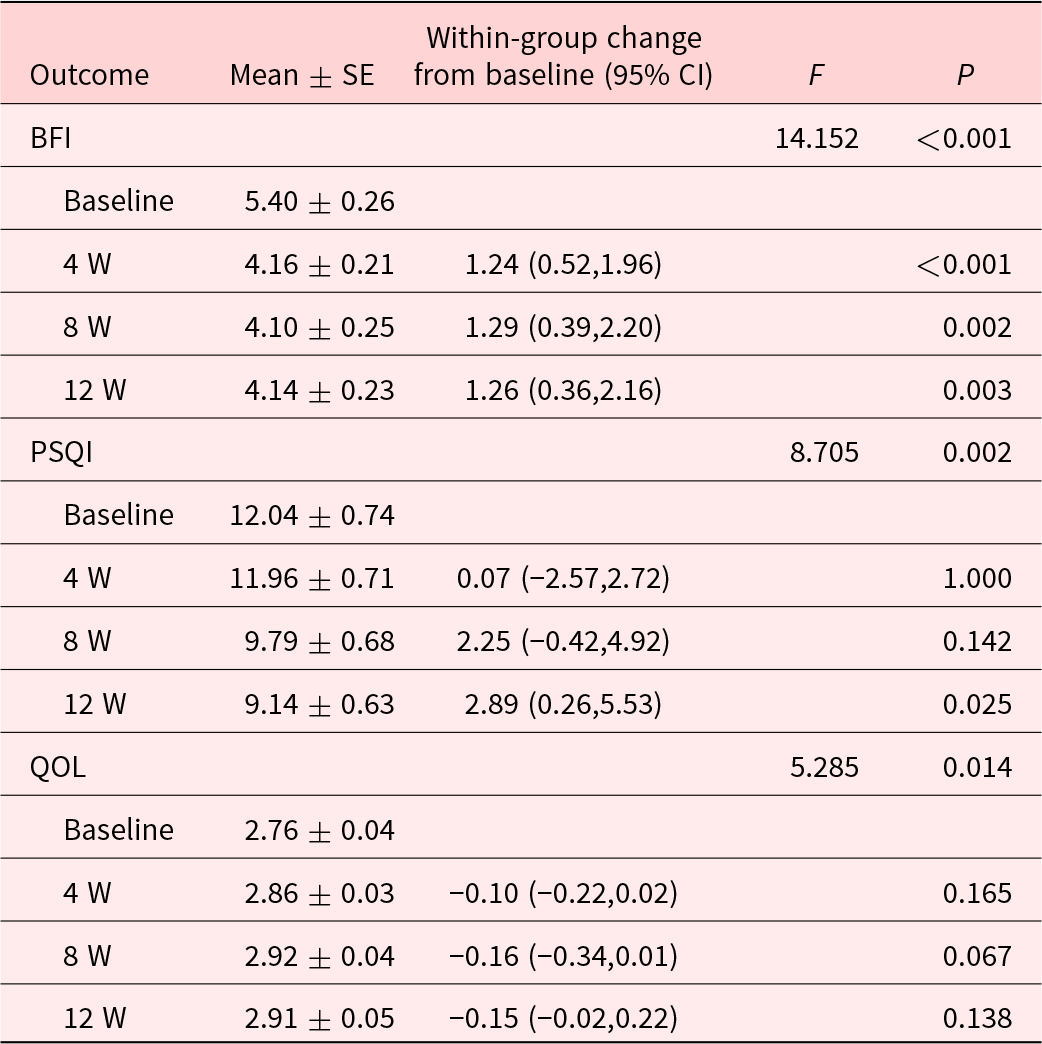
Effect-related outcomes are reported in Table 3.
Effect-related outcomes

Perceptions of participants involved in the program
To understand the patients’ feelings and feedback about participating in SSBDJ, 15 participants were invited for semi-structured interviews. At that point, the data reached significance saturation. Four themes emerged from the qualitative data: (a) acceptability of SSBDJ, (b) perceived benefits of exercise, (c) barriers, and (d) facilitators of the SSBD intervention program.
Acceptability
Patients expressed that the program was simple to learn and practice. They would recommend it to others.
“The movement is quite easy to learn. You can do it by watching the video and following the movement. It is not difficult.” (Participant 6)
“I also sent this video (SSBDJ) to my son. I suggested he do the SSBDJ too because it is helpful for staying healthy.” (Participant 1)
Perceived benefits of exercise
Relaxation of mind and body. Patients described that they felt relaxed in either their minds or bodies after SSBDJ.
“I feel more relaxed physically and mentally. I feel more comfortable when I stretch my body with those breathing methods.” (Participant 8).
Sleep promotion. Patients also noted that SSBDJ was helpful for good sleep.
“Sleep is good after doing SSBDJ. It has become easier for me to fall asleep now since I do SSBDJ.” (Participant 7)
“After the exercise, I am less likely to wake at midnight. I can sleep the whole night, so I feel energy in the morning.” (Participant 11)
Meeting exercise needs. Patients stated that SBDJ matched their exercise needs.
“We patients have to lie in bed. I do not know how to do exercise. The exercise you introduced is suitable for me. I take time to exercise every day.” (Participant 3)
Barriers and facilitators
Physical limitations. Patients complained that physical symptoms and treatment affected their participation in the exercise program.
“The obstacle is a physical reason. It is inconvenient to do the exercises due to this PICC. And after chemotherapy, I often feel discomfort, such as diarrhea, and nausea. This often interferes with the exercise.” (Participant 1)
Family tasks. Some participants mentioned that they had to deal with family tasks or work, which may have conflicted with the exercises due to a lack of energy.
“My wife is suffering from uremia and receiving hemodialysis. I have to take care of her. Sometimes I don’t even have enough time and energy to do exercise.” (Participant 2)
Discussion
To the best of our best knowledge, this is the first study to evaluate SSBDJ for use with advanced cancer patients. The findings indicate that SSBDJ is acceptable, feasible, and safe. Preliminary data also suggest a clinically meaningful reduction in the fatigue–sleep disturbance symptom cluster in this population, supporting the value of a more definitive future study.
SSBDJ was deemed safe, with no adverse reactions reported in the present study. Although 1 participant experienced mild and temporary muscle bloating from stretching, this is a natural reaction to a physical exercise program. Our findings demonstrate that 76.6% of participants completed the 12-week intervention with an 88% satisfactory adherence rate. The major cause of withdrawal or missing parts of the exercise program was progression of the illness. A systematic review revealed that the completion rates of exercise interventions in advanced cancer patients ranged from 58% to 90%, with adherence levels ranging between 44% and 95% (Sheill et al. Reference Sheill, Guinan and Brady2019). This shows that SSBDJ is feasible. The satisfaction survey indicated that all participants were either very satisfied or satisfied with the program. The qualitative interviews supported the notion that patients with advanced cancer would have a positive attitude toward SSBDJ. This can be explained as follows. First, SSBDJ is a simple 4-movement Qigong exercise. For the patients, the practice was easy to learn and engage in on their own, after receiving training. It can also be practiced in a sitting position, which matches their physical performance abilities and meets their exercise needs. Second, the SSBDJ video and manual developed for this study could guide any patients engaging in home practice. Third, SSBDJ allows patients to choose convenient times and places for exercise. Weekly follow-ups were conducted in the present study to supervise and encourage patients to continue the program. It is worth noting that a facilitator should consider disease progression, physical performance, and family tasks, all of which may affect a patient’s ability to exercise.
Although effect estimates are not the focus of the present feasibility study, the relatively remarkable improvements observed in the SSBDJ groups are worth noting. Quantitative measures showed that Qigong exercises can improve sleep and QOL and reduce CRF in advanced cancer patients; these conclusions are supported by previous studies (Cheung et al. Reference Cheung, Takemura and Lam2021a; Vanderbyl et al. Reference Vanderbyl, Mayer and Nash2017). Our qualitative data also support the quantitative results, indicating that SBDJ relaxed patients’ bodies and minds and improved their quality of sleep. Each movement of SSBDJ enhances inner energy blood flow by dredging the meridian and modulating the viscera and somatic system, thus achieving calming and relaxing effects and promoting sleep (Liu and Zhang Reference Liu and Zhang2016). As a mind–body exercise focusing on meditation and deep breathing, BDJ may also reduce inflammation, increase melatonin, and affect stress response pathways, thereby reducing the fatigue–sleep disturbance symptom cluster (Cheung et al. Reference Cheung, Takemura and Smith2021b).
Limitations
The study has several limitations. First, the present investigation was an initial feasibility study with a relatively small sample size. Thus, the effects of SSBDJ on CRF, sleep disturbance, and QOL outcomes in advanced cancer patients need to be confirmed in further research. A second limitation is the absence of a control group; however, given the focus on the feasibility of implementation, a control group was not appropriate (Bowen et al. Reference Bowen, Kreuter and Spring2009). Third, participants were recruited from a single clinical site, limiting the generalizability of the findings. In future research, recruitment conducted from multiple sites would reduce the risk of selection bias.
Conclusion
The 12-week SSBDJ is a feasible and safe exercise program for advanced cancer patients. It also shows promise in reducing the fatigue–sleep disturbance symptom cluster and improving QOL in advanced cancer patients. Given the biopsychosocial complexity of CRF and sleep disturbance, SSBDJ may be particularly useful for advanced cancer patients facing this syndrome who need to improve their QOL.
Supplementary material
The supplementary material for this article can be found at https://doi.org/10.1017/S1478951524001482.
Data availability statement
The datasets generated during and/or analyzed during the current study are available from the corresponding author on reasonable request.
Acknowledgments
The authors would like to thank all the participants from this study, without which this work would not have been possible.
Author contributions
ZHN: Conceptualization, Investigation, Methodology, Data curation, Writing-Original draft preparation.
CLY: Conceptualization, Writing–Reviewing, Editing the Manuscript Critically for Important Intellectual Content, Supervision.
DTJ: Conceptualization, Editing the Manuscript Critically for Important Intellectual Content and Supervision.
LXY: Conceptualization, Writing–Reviewing, Editing the Manuscript Critically for Important Intellectual Content, Supervision.
ZJW: Conceptualization, Writing–Reviewing, Editing the Manuscript Critically for Important Intellectual Content, Supervision.
XHM: Conceptualization, Writing–Reviewing, Editing the Manuscript Critically for Important Intellectual Content, Supervision.
Huina Zou and Liangying Chen contributed equally as a first author of this study.
Funding
This study was funded by the Fujian Science and Technology Innovation Joint Fund Project (Grant no. 2021Y9025). The funding sources played no role in the design of the study.
Competing interest
No competing interests.
Ethical approval
The study adhered to ethical standards throughout, and all procedures were conducted in accordance with relevant guidelines and regulations. Ethical approval has been obtained from the Biological and Medical Research Ethics Committee of Fujian University (IRB Ref No. 2023/97). Written informed consent was obtained from all participants.


 Open access

