


1 Introduction
1.1. Let $\mathbf{G}$
be a connected reductive algebraic group defined over an algebraic closure
$\mathbf{G}$
be a connected reductive algebraic group defined over an algebraic closure $\mathbb{K}=\overline{\mathbb{F}_{p}}$
of the finite field of prime order
$\mathbb{K}=\overline{\mathbb{F}_{p}}$
of the finite field of prime order $p$
and let
$p$
and let $F:\mathbf{G}\rightarrow \mathbf{G}$
be a Frobenius endomorphism defining an
$F:\mathbf{G}\rightarrow \mathbf{G}$
be a Frobenius endomorphism defining an $\mathbb{F}_{q}$
-rational structure
$\mathbb{F}_{q}$
-rational structure $G=\mathbf{G}^{F}$
on
$G=\mathbf{G}^{F}$
on $\mathbf{G}$
. Assuming
$\mathbf{G}$
. Assuming $p$
is a good prime for
$p$
is a good prime for $\mathbf{G}$
a theory of generalized Gelfand–Graev representations (GGGRs) was developed by Kawanaka in [Reference KawanakaKaw3] building on his investigations in [Reference KawanakaKaw2]. These are certain unipotently supported representations
$\mathbf{G}$
a theory of generalized Gelfand–Graev representations (GGGRs) was developed by Kawanaka in [Reference KawanakaKaw3] building on his investigations in [Reference KawanakaKaw2]. These are certain unipotently supported representations $\unicode[STIX]{x1D6E4}_{u}$
of
$\unicode[STIX]{x1D6E4}_{u}$
of $G$
which are defined for any unipotent element
$G$
which are defined for any unipotent element $u\in G$
. Note that, identifying
$u\in G$
. Note that, identifying $\unicode[STIX]{x1D6E4}_{u}$
with its character, we have
$\unicode[STIX]{x1D6E4}_{u}$
with its character, we have $\unicode[STIX]{x1D6E4}_{u}=\unicode[STIX]{x1D6E4}_{v}$
whenever
$\unicode[STIX]{x1D6E4}_{u}=\unicode[STIX]{x1D6E4}_{v}$
whenever $u,v\in G$
are
$u,v\in G$
are $G$
-conjugate so the GGGRs are naturally indexed by the unipotent conjugacy classes of
$G$
-conjugate so the GGGRs are naturally indexed by the unipotent conjugacy classes of $G$
.
$G$
.
1.2. Let $\unicode[STIX]{x1D70C}\in \text{Irr}(G)$
be an irreducible character and
$\unicode[STIX]{x1D70C}\in \text{Irr}(G)$
be an irreducible character and ${\mathcal{O}}$
an
${\mathcal{O}}$
an $F$
-stable unipotent conjugacy class of
$F$
-stable unipotent conjugacy class of $\mathbf{G}$
. We will denote by
$\mathbf{G}$
. We will denote by $\text{AV}(\unicode[STIX]{x1D70C},{\mathcal{O}})$
the average value
$\text{AV}(\unicode[STIX]{x1D70C},{\mathcal{O}})$
the average value $\sum _{g\in {\mathcal{O}}^{F}}\unicode[STIX]{x1D70C}(g)$
of
$\sum _{g\in {\mathcal{O}}^{F}}\unicode[STIX]{x1D70C}(g)$
of $\unicode[STIX]{x1D70C}$
on the rational points
$\unicode[STIX]{x1D70C}$
on the rational points ${\mathcal{O}}^{F}$
. We say
${\mathcal{O}}^{F}$
. We say ${\mathcal{O}}$
is a unipotent support of
${\mathcal{O}}$
is a unipotent support of $\unicode[STIX]{x1D70C}$
if:
$\unicode[STIX]{x1D70C}$
if:
-
(US1) $\text{AV}(\unicode[STIX]{x1D70C},{\mathcal{O}})\neq 0$
and
$\text{AV}(\unicode[STIX]{x1D70C},{\mathcal{O}})\neq 0$
and -
(US2)
$\text{AV}(\unicode[STIX]{x1D70C},\widetilde{{\mathcal{O}}})\neq 0$
implies
$\dim \widetilde{{\mathcal{O}}}\leqslant \dim {\mathcal{O}}$
with
$\widetilde{{\mathcal{O}}}$
any
$F$
-stable unipotent class.





For any unipotent element $v\in \mathbf{G}$
we denote by
$v\in \mathbf{G}$
we denote by ${\mathcal{O}}_{v}$
the
${\mathcal{O}}_{v}$
the $\mathbf{G}$
-conjugacy class containing
$\mathbf{G}$
-conjugacy class containing $v$
. With this we say that
$v$
. With this we say that ${\mathcal{O}}$
is a wave front set of
${\mathcal{O}}$
is a wave front set of $\unicode[STIX]{x1D70C}$
if:
$\unicode[STIX]{x1D70C}$
if:
-
(WF1)
$\langle \unicode[STIX]{x1D6E4}_{u},\unicode[STIX]{x1D70C}\rangle \neq 0$
for some
$u\in {\mathcal{O}}$
and -
(WF2)
$\langle \unicode[STIX]{x1D6E4}_{v},\unicode[STIX]{x1D70C}\rangle \neq 0$
implies
$\dim {\mathcal{O}}_{v}\leqslant \dim {\mathcal{O}}$
with
$v\in G$
any unipotent element.




When $u$
is the identity element we have
$u$
is the identity element we have $\unicode[STIX]{x1D6E4}_{u}$
is the regular representation of
$\unicode[STIX]{x1D6E4}_{u}$
is the regular representation of $G$
so
$G$
so $\langle \unicode[STIX]{x1D6E4}_{1},\unicode[STIX]{x1D70C}\rangle =\unicode[STIX]{x1D70C}(1)=\text{AV}(\unicode[STIX]{x1D70C},\{1\})$
; hence every irreducible character of
$\langle \unicode[STIX]{x1D6E4}_{1},\unicode[STIX]{x1D70C}\rangle =\unicode[STIX]{x1D70C}(1)=\text{AV}(\unicode[STIX]{x1D70C},\{1\})$
; hence every irreducible character of $G$
admits a unipotent support and a wave front set. However, it was conjectured by Lusztig [Reference LusztigLus1], respectively, Kawanaka [Reference KawanakaKaw2], that each irreducible character
$G$
admits a unipotent support and a wave front set. However, it was conjectured by Lusztig [Reference LusztigLus1], respectively, Kawanaka [Reference KawanakaKaw2], that each irreducible character $\unicode[STIX]{x1D70C}\in \text{Irr}(G)$
admits a unique unipotent support
$\unicode[STIX]{x1D70C}\in \text{Irr}(G)$
admits a unique unipotent support ${\mathcal{O}}_{\unicode[STIX]{x1D70C}}$
, respectively, wave front set
${\mathcal{O}}_{\unicode[STIX]{x1D70C}}$
, respectively, wave front set ${\mathcal{O}}_{\unicode[STIX]{x1D70C}}^{\ast }$
. If this conjecture is satisfied then we say the unipotent support/wave front set of
${\mathcal{O}}_{\unicode[STIX]{x1D70C}}^{\ast }$
. If this conjecture is satisfied then we say the unipotent support/wave front set of $\unicode[STIX]{x1D70C}$
is well defined.
$\unicode[STIX]{x1D70C}$
is well defined.
1.3. Assuming $p$
and
$p$
and $q$
are sufficiently large then Lusztig has shown in [Reference LusztigLus9] that the unipotent support and wave front set of an irreducible character are well defined. He also gave a definition for the unipotent support of a character sheaf and similarly showed that each character sheaf has a well-defined unipotent support, see Definition 13.2 for the definition. These results provide one of the most profound relationships between irreducible characters of
$q$
are sufficiently large then Lusztig has shown in [Reference LusztigLus9] that the unipotent support and wave front set of an irreducible character are well defined. He also gave a definition for the unipotent support of a character sheaf and similarly showed that each character sheaf has a well-defined unipotent support, see Definition 13.2 for the definition. These results provide one of the most profound relationships between irreducible characters of $G$
and the geometry of the algebraic group
$G$
and the geometry of the algebraic group $\mathbf{G}$
. They also highlight the central role that character sheaves play in the representation theory of finite reductive groups.
$\mathbf{G}$
. They also highlight the central role that character sheaves play in the representation theory of finite reductive groups.
1.4. Using Lusztig’s results Geck was able to show that each irreducible character has a unique unipotent support whenever $p$
is a good prime for
$p$
is a good prime for $\mathbf{G}$
, see [Reference GeckGec1]. In turn, using Geck’s result together with ideas developed in [Reference LusztigLus5] Aubert was able to prove, in certain special cases, that character sheaves admit a unique unipotent support whenever
$\mathbf{G}$
, see [Reference GeckGec1]. In turn, using Geck’s result together with ideas developed in [Reference LusztigLus5] Aubert was able to prove, in certain special cases, that character sheaves admit a unique unipotent support whenever $p$
is good, see [Reference AubertAub]. The following completes this picture in good characteristic, see Theorems 13.8 and 14.10, thus proving Kawanaka’s conjecture in general.
$p$
is good, see [Reference AubertAub]. The following completes this picture in good characteristic, see Theorems 13.8 and 14.10, thus proving Kawanaka’s conjecture in general.
Theorem.
Assume $p$
is a good prime for
$p$
is a good prime for $\mathbf{G}$
then any irreducible character of
$\mathbf{G}$
then any irreducible character of $G$
has a unique wave front set and any character sheaf of
$G$
has a unique wave front set and any character sheaf of $\mathbf{G}$
has a unique unipotent support.
$\mathbf{G}$
has a unique unipotent support.
1.5. Thanks to results of Achar and Aubert [Reference Achar and AubertAA] we may even give a geometric refinement of the conditions (US2) and (WF2). Namely, for any $F$
-stable unipotent class
$F$
-stable unipotent class $\widetilde{{\mathcal{O}}}$
of
$\widetilde{{\mathcal{O}}}$
of $\mathbf{G}$
or unipotent element
$\mathbf{G}$
or unipotent element $v\in G$
we have
$v\in G$
we have
-
(US2′)
$\text{AV}(\unicode[STIX]{x1D70C},\widetilde{{\mathcal{O}}})\neq 0$
implies
$\widetilde{{\mathcal{O}}}\subseteq \overline{{\mathcal{O}}_{\unicode[STIX]{x1D70C}}}$
;


-
(WF2′)
$\langle \unicode[STIX]{x1D6E4}_{v},\unicode[STIX]{x1D70C}\rangle \neq 0$
implies
${\mathcal{O}}_{v}\subseteq \overline{{\mathcal{O}}_{\unicode[STIX]{x1D70C}}^{\ast }}$
;


see [Reference Achar and AubertAA, Théorèmes 6.3 and 9.1] and Proposition 15.2. Here $\overline{{\mathcal{O}}_{\unicode[STIX]{x1D70C}}}$
denotes the Zariski closure of
$\overline{{\mathcal{O}}_{\unicode[STIX]{x1D70C}}}$
denotes the Zariski closure of ${\mathcal{O}}_{\unicode[STIX]{x1D70C}}$
and similarly for
${\mathcal{O}}_{\unicode[STIX]{x1D70C}}$
and similarly for ${\mathcal{O}}_{\unicode[STIX]{x1D70C}}^{\ast }$
. Now, if
${\mathcal{O}}_{\unicode[STIX]{x1D70C}}^{\ast }$
. Now, if $p$
is a good prime for
$p$
is a good prime for $\mathbf{G}$
then we have two well-defined maps
$\mathbf{G}$
then we have two well-defined maps
 $$\begin{eqnarray}\text{Irr}(G)\rightarrow \{F\text{-}\text{stable unipotent conjugacy classes of}~\mathbf{G}\}\end{eqnarray}$$
given by $\unicode[STIX]{x1D70C}\mapsto {\mathcal{O}}_{\unicode[STIX]{x1D70C}}$
and
$\unicode[STIX]{x1D70C}\mapsto {\mathcal{O}}_{\unicode[STIX]{x1D70C}}$
and $\unicode[STIX]{x1D70C}\mapsto {\mathcal{O}}_{\unicode[STIX]{x1D70C}}^{\ast }$
. These turn out to be dual in the following sense. Let
$\unicode[STIX]{x1D70C}\mapsto {\mathcal{O}}_{\unicode[STIX]{x1D70C}}^{\ast }$
. These turn out to be dual in the following sense. Let $\unicode[STIX]{x1D70C}^{\ast }\in \text{Irr}(G)$
be the unique irreducible character such that
$\unicode[STIX]{x1D70C}^{\ast }\in \text{Irr}(G)$
be the unique irreducible character such that $\unicode[STIX]{x1D70C}^{\ast }=\pm D_{G}(\unicode[STIX]{x1D70C})$
where
$\unicode[STIX]{x1D70C}^{\ast }=\pm D_{G}(\unicode[STIX]{x1D70C})$
where $D_{G}(\unicode[STIX]{x1D70C})$
is the Alvis–Curtis dual of
$D_{G}(\unicode[STIX]{x1D70C})$
is the Alvis–Curtis dual of $\unicode[STIX]{x1D70C}$
then
$\unicode[STIX]{x1D70C}$
then ${\mathcal{O}}_{\unicode[STIX]{x1D70C}^{\ast }}={\mathcal{O}}_{\unicode[STIX]{x1D70C}}^{\ast }$
, see Lemma 14.15. In other words, the unipotent support of the Alvis–Curtis dual of
${\mathcal{O}}_{\unicode[STIX]{x1D70C}^{\ast }}={\mathcal{O}}_{\unicode[STIX]{x1D70C}}^{\ast }$
, see Lemma 14.15. In other words, the unipotent support of the Alvis–Curtis dual of $\unicode[STIX]{x1D70C}$
is the wave front set of
$\unicode[STIX]{x1D70C}$
is the wave front set of $\unicode[STIX]{x1D70C}$
.
$\unicode[STIX]{x1D70C}$
.
1.6. We note here that in [Reference LusztigLus11] Lusztig has obtained a refinement of the notion of unipotent support for a character sheaf in good characteristic. There it is stated that the uniqueness of unipotent supports in good characteristic may be deduced from the case of large characteristic by standard methods. In Proposition 13.10 we give an example of such methods in the special case where $\mathbf{G}$
is
$\mathbf{G}$
is $\text{SL}_{n}(\mathbb{K})$
.
$\text{SL}_{n}(\mathbb{K})$
.
1.7. We now give an overview of the arguments used in this paper. In [Reference LusztigLus9] Lusztig gave a formula relating GGGRs and IC complexes on unipotent classes, which we will refer to as Lusztig’s formula. Reading carefully [Reference LusztigLus9] one sees that Lusztig’s proof that the wave front set of an irreducible character is well defined ultimately relies on the validity of Lusztig’s formula and the validity of the results in [Reference LusztigLus8]. If $p$
is good for
$p$
is good for $\mathbf{G}$
then the results of [Reference LusztigLus8] are true if
$\mathbf{G}$
then the results of [Reference LusztigLus8] are true if $q$
is sufficiently large. However, if
$q$
is sufficiently large. However, if $\mathbf{G}$
has a connected center then Shoji has shown that this restriction on
$\mathbf{G}$
has a connected center then Shoji has shown that this restriction on $q$
may be dropped, see [Reference ShojiSho2]. In other words, if
$q$
may be dropped, see [Reference ShojiSho2]. In other words, if $p$
is a good prime for
$p$
is a good prime for $\mathbf{G}$
and
$\mathbf{G}$
and $Z(\mathbf{G})$
is connected then the results of [Reference LusztigLus8] are true.
$Z(\mathbf{G})$
is connected then the results of [Reference LusztigLus8] are true.
1.8. One of the main results in this paper shows that Lusztig’s formula remains valid whenever $p$
is an acceptable prime for
$p$
is an acceptable prime for $\mathbf{G}$
, see Definition 6.1 and Theorem 11.13. Combining this with Shoji’s result from [Reference ShojiSho2] one sees that Lusztig’s proof in [Reference LusztigLus9] showing that the wave front set is well defined remains valid if
$\mathbf{G}$
, see Definition 6.1 and Theorem 11.13. Combining this with Shoji’s result from [Reference ShojiSho2] one sees that Lusztig’s proof in [Reference LusztigLus9] showing that the wave front set is well defined remains valid if $p$
is an acceptable prime for
$p$
is an acceptable prime for $\mathbf{G}$
and
$\mathbf{G}$
and $Z(\mathbf{G})$
is connected. Now, the notion of acceptable prime lies in between the notions of very good prime and good prime. More precisely, we have a series of implications
$Z(\mathbf{G})$
is connected. Now, the notion of acceptable prime lies in between the notions of very good prime and good prime. More precisely, we have a series of implications
 $$\begin{eqnarray}p\text{ is very good for }\mathbf{G}\Rightarrow p~\text{is acceptable for}~\mathbf{G}\Rightarrow p~\text{is good for}~\mathbf{G}.\end{eqnarray}$$
If $\mathbf{G}$
is
$\mathbf{G}$
is $\text{GL}_{n}(\mathbb{K})$
or
$\text{GL}_{n}(\mathbb{K})$
or $Z(\mathbf{G})$
is connected and
$Z(\mathbf{G})$
is connected and $\mathbf{G}/Z(\mathbf{G})$
is simple not of type
$\mathbf{G}/Z(\mathbf{G})$
is simple not of type $\mathsf{A}$
then a prime
$\mathsf{A}$
then a prime $p$
is acceptable for
$p$
is acceptable for $\mathbf{G}$
if and only if it is good for
$\mathbf{G}$
if and only if it is good for $\mathbf{G}$
. Thus, for these groups we have the wave front set is well defined if
$\mathbf{G}$
. Thus, for these groups we have the wave front set is well defined if $p$
is good for
$p$
is good for $\mathbf{G}$
by Theorem 11.13, [Reference ShojiSho2] and [Reference LusztigLus9]. Using a series of standard reduction arguments we may then deduce that the wave front set is well defined for any connected reductive algebraic group
$\mathbf{G}$
by Theorem 11.13, [Reference ShojiSho2] and [Reference LusztigLus9]. Using a series of standard reduction arguments we may then deduce that the wave front set is well defined for any connected reductive algebraic group $\mathbf{G}$
assuming only that
$\mathbf{G}$
assuming only that $p$
is good for
$p$
is good for $\mathbf{G}$
. Similar reduction arguments were also used by Geck in [Reference GeckGec1] to show that the unipotent support is well defined. Our approach for dealing with unipotent supports of character sheaves is entirely similar, however in this case things are somewhat simpler as one may ignore the
$\mathbf{G}$
. Similar reduction arguments were also used by Geck in [Reference GeckGec1] to show that the unipotent support is well defined. Our approach for dealing with unipotent supports of character sheaves is entirely similar, however in this case things are somewhat simpler as one may ignore the $\mathbb{F}_{q}$
-structure. These reduction arguments are carried out in Sections 12–15.
$\mathbb{F}_{q}$
-structure. These reduction arguments are carried out in Sections 12–15.
1.9. Recall that if $p$
is sufficiently large then one may define inverse isomorphisms
$p$
is sufficiently large then one may define inverse isomorphisms $\exp :{\mathcal{N}}\rightarrow {\mathcal{U}}$
and
$\exp :{\mathcal{N}}\rightarrow {\mathcal{U}}$
and $\log :{\mathcal{U}}\rightarrow {\mathcal{N}}$
between the unipotent variety of
$\log :{\mathcal{U}}\rightarrow {\mathcal{N}}$
between the unipotent variety of $\mathbf{G}$
and the nilpotent cone of its Lie algebra
$\mathbf{G}$
and the nilpotent cone of its Lie algebra $\mathfrak{g}$
. In [Reference LusztigLus9] Lusztig uses the
$\mathfrak{g}$
. In [Reference LusztigLus9] Lusztig uses the $\exp$
and
$\exp$
and $\log$
maps to define the GGGRs and to transfer their study to that of
$\log$
maps to define the GGGRs and to transfer their study to that of $\mathbf{G}$
-invariant functions supported on
$\mathbf{G}$
-invariant functions supported on ${\mathcal{N}}$
. The upshot of this is that one acquires a powerful new tool, namely the Fourier transform. Lusztig then uses results from [Reference LusztigLus6] on the Fourier transform to deduce the formula.
${\mathcal{N}}$
. The upshot of this is that one acquires a powerful new tool, namely the Fourier transform. Lusztig then uses results from [Reference LusztigLus6] on the Fourier transform to deduce the formula.
1.10. The results in [Reference LusztigLus6] are proved under the assumption that $p$
is sufficiently large. However, in [Reference LetellierLet], Letellier has shown that the main results of [Reference LusztigLus6] still hold if
$p$
is sufficiently large. However, in [Reference LetellierLet], Letellier has shown that the main results of [Reference LusztigLus6] still hold if $p$
is an acceptable prime for
$p$
is an acceptable prime for $\mathbf{G}$
. This is where our assumption on the characteristic comes from as we prolifically use the results of Letellier throughout this article. With this in hand, our strategy for proving Lusztig’s formula is to show that Lusztig’s argument still applies if one replaces the
$\mathbf{G}$
. This is where our assumption on the characteristic comes from as we prolifically use the results of Letellier throughout this article. With this in hand, our strategy for proving Lusztig’s formula is to show that Lusztig’s argument still applies if one replaces the $\exp$
and
$\exp$
and $\log$
maps with
$\log$
maps with $\unicode[STIX]{x1D719}_{\text{spr}}^{-1}$
and
$\unicode[STIX]{x1D719}_{\text{spr}}^{-1}$
and $\unicode[STIX]{x1D719}_{\text{spr}}$
, where
$\unicode[STIX]{x1D719}_{\text{spr}}$
, where $\unicode[STIX]{x1D719}_{\text{spr}}:{\mathcal{U}}\rightarrow {\mathcal{N}}$
is a suitably chosen Springer isomorphism.
$\unicode[STIX]{x1D719}_{\text{spr}}:{\mathcal{U}}\rightarrow {\mathcal{N}}$
is a suitably chosen Springer isomorphism.
1.11. For this strategy to work we must address several technical details, which are dealt with in Sections 2–5. For instance, to ensure that a Springer isomorphism exists one needs to make some assumption on the group $\mathbf{G}$
. In particular, if we assume that a simply connected covering of the derived subgroup of
$\mathbf{G}$
. In particular, if we assume that a simply connected covering of the derived subgroup of $\mathbf{G}$
is a separable morphism then a Springer isomorphism will exist. We call a group satisfying this condition proximate. In Section 4 we show that if
$\mathbf{G}$
is a separable morphism then a Springer isomorphism will exist. We call a group satisfying this condition proximate. In Section 4 we show that if $\mathbf{G}$
is proximate then one can find a special type of Springer isomorphism
$\mathbf{G}$
is proximate then one can find a special type of Springer isomorphism $\unicode[STIX]{x1D719}_{\text{spr}}$
satisfying properties which mean that
$\unicode[STIX]{x1D719}_{\text{spr}}$
satisfying properties which mean that $\unicode[STIX]{x1D719}_{\text{spr}}$
can be used in the definition of the GGGRs of
$\unicode[STIX]{x1D719}_{\text{spr}}$
can be used in the definition of the GGGRs of $G$
. This construction is then given in Section 5 following the work of Kawanaka. Note this is very important to our cause. If one constructs the GGGRs as in [Reference KawanakaKaw3] without using a Springer isomorphism then one runs into serious problems when trying to compute the Fourier transform of the corresponding GGGR on the Lie algebra.
$G$
. This construction is then given in Section 5 following the work of Kawanaka. Note this is very important to our cause. If one constructs the GGGRs as in [Reference KawanakaKaw3] without using a Springer isomorphism then one runs into serious problems when trying to compute the Fourier transform of the corresponding GGGR on the Lie algebra.
1.12. As well as finding a good Springer isomorphism we will also need to know various facts concerning centralizers of nilpotent elements. These are used in proving statements that are needed for the definition of GGGRs. Under the assumption that $\mathbf{G}$
is proximate we derive these results in Section 3 from the work of Premet [Reference PremetPre2]. Note that these results can fail if
$\mathbf{G}$
is proximate we derive these results in Section 3 from the work of Premet [Reference PremetPre2]. Note that these results can fail if $\mathbf{G}$
is not proximate. In light of this, we show in Section 2 that for any connected reductive algebraic group
$\mathbf{G}$
is not proximate. In light of this, we show in Section 2 that for any connected reductive algebraic group $\mathbf{G}$
and Frobenius endomorphism
$\mathbf{G}$
and Frobenius endomorphism $F:\mathbf{G}\rightarrow \mathbf{G}$
there exist a proximate algebraic group
$F:\mathbf{G}\rightarrow \mathbf{G}$
there exist a proximate algebraic group $\overline{\mathbf{G}}$
, a bijective morphism of algebraic groups
$\overline{\mathbf{G}}$
, a bijective morphism of algebraic groups $\unicode[STIX]{x1D719}:\overline{\mathbf{G}}\rightarrow \mathbf{G}$
and a Frobenius endomorphism
$\unicode[STIX]{x1D719}:\overline{\mathbf{G}}\rightarrow \mathbf{G}$
and a Frobenius endomorphism $\overline{F}:\overline{\mathbf{G}}\rightarrow \overline{\mathbf{G}}$
such that
$\overline{F}:\overline{\mathbf{G}}\rightarrow \overline{\mathbf{G}}$
such that $\unicode[STIX]{x1D719}\circ \overline{F}=F\circ \unicode[STIX]{x1D719}$
. In particular, we have
$\unicode[STIX]{x1D719}\circ \overline{F}=F\circ \unicode[STIX]{x1D719}$
. In particular, we have $\unicode[STIX]{x1D719}$
restricts to an isomorphism
$\unicode[STIX]{x1D719}$
restricts to an isomorphism $\overline{\mathbf{G}}^{\overline{F}}\rightarrow \mathbf{G}^{F}$
. This shows that, for the purposes of defining the GGGRs of
$\overline{\mathbf{G}}^{\overline{F}}\rightarrow \mathbf{G}^{F}$
. This shows that, for the purposes of defining the GGGRs of $\mathbf{G}^{F}$
, we can assume that
$\mathbf{G}^{F}$
, we can assume that $\mathbf{G}$
is proximate so that the desired results are available to us.
$\mathbf{G}$
is proximate so that the desired results are available to us.
1.13. With the groundwork on GGGRs in place we then proceed to prove Lusztig’s formula in Sections 6–11. Here we follow [Reference LusztigLus9] to the letter, simply finding alternative arguments when either the $\exp$
or
$\exp$
or $\log$
maps were used or when the theory of
$\log$
maps were used or when the theory of $\mathfrak{s}\mathfrak{l}_{2}$
-triples was used. We have tried not to unnecessarily repeat arguments from [Reference LusztigLus9] but some things are repeated to improve the quality of the exposition. Having said this, we have chosen to give most of the arguments from [Reference LusztigLus9, Section 6] as this was originally proved under the assumption that
$\mathfrak{s}\mathfrak{l}_{2}$
-triples was used. We have tried not to unnecessarily repeat arguments from [Reference LusztigLus9] but some things are repeated to improve the quality of the exposition. Having said this, we have chosen to give most of the arguments from [Reference LusztigLus9, Section 6] as this was originally proved under the assumption that $F$
is split but later remarked that this assumption is unnecessary [Reference LusztigLus9, 8.7].
$F$
is split but later remarked that this assumption is unnecessary [Reference LusztigLus9, 8.7].
2 Proximate algebraic groups

2.1. Recall that a root datum ${\mathcal{R}}=(X,\unicode[STIX]{x1D6F7},Y,\check{\unicode[STIX]{x1D6F7}})$
is a quadruple such that
${\mathcal{R}}=(X,\unicode[STIX]{x1D6F7},Y,\check{\unicode[STIX]{x1D6F7}})$
is a quadruple such that $X$
and
$X$
and $Y$
are free
$Y$
are free $\mathbb{Z}$
-modules of finite rank equipped with a perfect pairing
$\mathbb{Z}$
-modules of finite rank equipped with a perfect pairing $\langle -,-\rangle _{{\mathcal{R}}}:X\times Y\rightarrow \mathbb{Z}$
and
$\langle -,-\rangle _{{\mathcal{R}}}:X\times Y\rightarrow \mathbb{Z}$
and $\unicode[STIX]{x1D6F7}\subseteq X$
and
$\unicode[STIX]{x1D6F7}\subseteq X$
and $\check{\unicode[STIX]{x1D6F7}}\subseteq Y$
are finite subsets equipped with a bijection
$\check{\unicode[STIX]{x1D6F7}}\subseteq Y$
are finite subsets equipped with a bijection $\unicode[STIX]{x1D6FC}\mapsto \check{\unicode[STIX]{x1D6FC}}$
satisfying the conditions in [Reference SpringerSpr2, 7.4.1, 7.4.4]. In particular, all our root data are assumed to be reduced. Now assume
$\unicode[STIX]{x1D6FC}\mapsto \check{\unicode[STIX]{x1D6FC}}$
satisfying the conditions in [Reference SpringerSpr2, 7.4.1, 7.4.4]. In particular, all our root data are assumed to be reduced. Now assume ${\mathcal{R}}^{\prime }=(X^{\prime },\unicode[STIX]{x1D6F7}^{\prime },Y^{\prime },\check{\unicode[STIX]{x1D6F7}}^{\prime })$
is another root datum and
${\mathcal{R}}^{\prime }=(X^{\prime },\unicode[STIX]{x1D6F7}^{\prime },Y^{\prime },\check{\unicode[STIX]{x1D6F7}}^{\prime })$
is another root datum and $\unicode[STIX]{x1D711}:X^{\prime }\rightarrow X$
is a
$\unicode[STIX]{x1D711}:X^{\prime }\rightarrow X$
is a $\mathbb{Z}$
-module homomorphism. We will denote by
$\mathbb{Z}$
-module homomorphism. We will denote by $\check{\unicode[STIX]{x1D711}}:Y\rightarrow Y^{\prime }$
the transpose of
$\check{\unicode[STIX]{x1D711}}:Y\rightarrow Y^{\prime }$
the transpose of $\unicode[STIX]{x1D711}$
which is the unique
$\unicode[STIX]{x1D711}$
which is the unique $\mathbb{Z}$
-module homomorphism satisfying
$\mathbb{Z}$
-module homomorphism satisfying
 $$\begin{eqnarray}\langle \unicode[STIX]{x1D711}(x),y\rangle _{{\mathcal{R}}}=\langle x,\check{\unicode[STIX]{x1D711}}(y)\rangle _{{\mathcal{R}}^{\prime }}\end{eqnarray}$$
for all $x\in X^{\prime }$
and
$x\in X^{\prime }$
and $y\in Y$
. We say
$y\in Y$
. We say $\unicode[STIX]{x1D711}$
is a homomorphism of root data if
$\unicode[STIX]{x1D711}$
is a homomorphism of root data if $\unicode[STIX]{x1D711}$
restricts to a bijection
$\unicode[STIX]{x1D711}$
restricts to a bijection $\unicode[STIX]{x1D6F7}^{\prime }\rightarrow \unicode[STIX]{x1D6F7}$
and
$\unicode[STIX]{x1D6F7}^{\prime }\rightarrow \unicode[STIX]{x1D6F7}$
and $\check{\unicode[STIX]{x1D711}}(\check{\unicode[STIX]{x1D6FC}})=\check{\unicode[STIX]{x1D6FD}}$
whenever
$\check{\unicode[STIX]{x1D711}}(\check{\unicode[STIX]{x1D6FC}})=\check{\unicode[STIX]{x1D6FD}}$
whenever $\unicode[STIX]{x1D711}(\unicode[STIX]{x1D6FD})=\unicode[STIX]{x1D6FC}$
. A homomorphism of root data is an isomorphism if
$\unicode[STIX]{x1D711}(\unicode[STIX]{x1D6FD})=\unicode[STIX]{x1D6FC}$
. A homomorphism of root data is an isomorphism if $\unicode[STIX]{x1D711}$
is a
$\unicode[STIX]{x1D711}$
is a $\mathbb{Z}$
-module isomorphism. Following [Reference SteinbergSte2] we say that
$\mathbb{Z}$
-module isomorphism. Following [Reference SteinbergSte2] we say that $\unicode[STIX]{x1D711}$
is an isogeny of root data if the following hold:
$\unicode[STIX]{x1D711}$
is an isogeny of root data if the following hold:
-
(i)
$\unicode[STIX]{x1D711}:X^{\prime }\rightarrow X$
and
$\check{\unicode[STIX]{x1D711}}:Y\rightarrow Y^{\prime }$
are injective; -
(ii) there exist a bijection
$b:\unicode[STIX]{x1D6F7}\rightarrow \unicode[STIX]{x1D6F7}^{\prime }$
and a map
$q:\unicode[STIX]{x1D6F7}\rightarrow \{p^{a}\mid a\in \mathbb{Z}_{{\geqslant}0}\}$
such that for any
$\unicode[STIX]{x1D6FC}\in \unicode[STIX]{x1D6F7}$
we have
$\unicode[STIX]{x1D711}(\unicode[STIX]{x1D6FD})=q(\unicode[STIX]{x1D6FC})\unicode[STIX]{x1D6FC}$
and
$\check{\unicode[STIX]{x1D711}}(\check{\unicode[STIX]{x1D6FC}})=q(\unicode[STIX]{x1D6FC})\check{\unicode[STIX]{x1D6FD}}$
where
$\unicode[STIX]{x1D6FD}=b(\unicode[STIX]{x1D6FC})$
.





2.2. If $\mathbf{T}\leqslant \mathbf{G}$
is a maximal torus then one may construct a root datum
$\mathbf{T}\leqslant \mathbf{G}$
is a maximal torus then one may construct a root datum ${\mathcal{R}}(\mathbf{G},\mathbf{T})=(X(\mathbf{T}),\unicode[STIX]{x1D6F7},Y(\mathbf{T}),\check{\unicode[STIX]{x1D6F7}})$
as in [Reference SpringerSpr2, 7.4.3], where
${\mathcal{R}}(\mathbf{G},\mathbf{T})=(X(\mathbf{T}),\unicode[STIX]{x1D6F7},Y(\mathbf{T}),\check{\unicode[STIX]{x1D6F7}})$
as in [Reference SpringerSpr2, 7.4.3], where $X(\mathbf{T})$
, respectively,
$X(\mathbf{T})$
, respectively, $Y(\mathbf{T})$
, is the character, respectively, cocharacter, group of
$Y(\mathbf{T})$
, is the character, respectively, cocharacter, group of $\mathbf{T}$
. Recall that an isogeny of algebraic groups is defined to be a surjective homomorphism of algebraic groups whose kernel is finite. If
$\mathbf{T}$
. Recall that an isogeny of algebraic groups is defined to be a surjective homomorphism of algebraic groups whose kernel is finite. If $(\mathbf{H},\mathbf{S})$
is another pair consisting of a connected reductive algebraic group
$(\mathbf{H},\mathbf{S})$
is another pair consisting of a connected reductive algebraic group $\mathbf{H}$
over
$\mathbf{H}$
over $\mathbb{K}$
and a maximal torus
$\mathbb{K}$
and a maximal torus $\mathbf{S}$
then we say
$\mathbf{S}$
then we say $\unicode[STIX]{x1D711}:(\mathbf{G},\mathbf{T})\rightarrow (\mathbf{H},\mathbf{S})$
is an isogeny, respectively, isomorphism, if
$\unicode[STIX]{x1D711}:(\mathbf{G},\mathbf{T})\rightarrow (\mathbf{H},\mathbf{S})$
is an isogeny, respectively, isomorphism, if $\unicode[STIX]{x1D711}:\mathbf{G}\rightarrow \mathbf{H}$
is an isogeny, respectively, isomorphism, of algebraic groups and
$\unicode[STIX]{x1D711}:\mathbf{G}\rightarrow \mathbf{H}$
is an isogeny, respectively, isomorphism, of algebraic groups and $\unicode[STIX]{x1D711}(\mathbf{T})=\mathbf{S}$
. If
$\unicode[STIX]{x1D711}(\mathbf{T})=\mathbf{S}$
. If $\unicode[STIX]{x1D711}$
is such an isogeny, respectively, isomorphism, then the map
$\unicode[STIX]{x1D711}$
is such an isogeny, respectively, isomorphism, then the map $\unicode[STIX]{x1D711}^{\ast }:X(\mathbf{S})\rightarrow X(\mathbf{T})$
given by
$\unicode[STIX]{x1D711}^{\ast }:X(\mathbf{S})\rightarrow X(\mathbf{T})$
given by $\unicode[STIX]{x1D711}^{\ast }(\unicode[STIX]{x1D712})=\unicode[STIX]{x1D712}\circ \unicode[STIX]{x1D711}$
is an isogeny, respectively, isomorphism, of root data. Now, for any
$\unicode[STIX]{x1D711}^{\ast }(\unicode[STIX]{x1D712})=\unicode[STIX]{x1D712}\circ \unicode[STIX]{x1D711}$
is an isogeny, respectively, isomorphism, of root data. Now, for any $g\in \mathbf{G}$
we denote by
$g\in \mathbf{G}$
we denote by $\text{Inn}\,g:\mathbf{G}\rightarrow \mathbf{G}$
the inner automorphism defined by
$\text{Inn}\,g:\mathbf{G}\rightarrow \mathbf{G}$
the inner automorphism defined by $\text{Inn}\,g(x)=gxg^{-1}$
for all
$\text{Inn}\,g(x)=gxg^{-1}$
for all $x\in \mathbf{G}$
. With this we have the following classical result, see [Reference SteinbergSte2, 1.5] and [Reference Digne and MichelDM3, 3.17].
$x\in \mathbf{G}$
. With this we have the following classical result, see [Reference SteinbergSte2, 1.5] and [Reference Digne and MichelDM3, 3.17].
Theorem 2.3. (Isogeny Theorem)
Let $(\mathbf{G},\mathbf{T})$
and
$(\mathbf{G},\mathbf{T})$
and $(\mathbf{H},\mathbf{S})$
be two pairs as in 2.2 then every isogeny, respectively, isomorphism, of root data
$(\mathbf{H},\mathbf{S})$
be two pairs as in 2.2 then every isogeny, respectively, isomorphism, of root data ${\mathcal{R}}(\mathbf{H},\mathbf{S})\rightarrow {\mathcal{R}}(\mathbf{G},\mathbf{T})$
is of the form
${\mathcal{R}}(\mathbf{H},\mathbf{S})\rightarrow {\mathcal{R}}(\mathbf{G},\mathbf{T})$
is of the form $\unicode[STIX]{x1D711}^{\ast }$
for some isogeny, respectively, isomorphism,
$\unicode[STIX]{x1D711}^{\ast }$
for some isogeny, respectively, isomorphism, $\unicode[STIX]{x1D711}:(\mathbf{G},\mathbf{T})\rightarrow (\mathbf{H},\mathbf{S})$
. Moreover, if
$\unicode[STIX]{x1D711}:(\mathbf{G},\mathbf{T})\rightarrow (\mathbf{H},\mathbf{S})$
. Moreover, if $\unicode[STIX]{x1D711},\unicode[STIX]{x1D713}:(\mathbf{G},\mathbf{T})\rightarrow (\mathbf{H},\mathbf{S})$
are two isogenies such that
$\unicode[STIX]{x1D711},\unicode[STIX]{x1D713}:(\mathbf{G},\mathbf{T})\rightarrow (\mathbf{H},\mathbf{S})$
are two isogenies such that $\unicode[STIX]{x1D711}^{\ast }=\unicode[STIX]{x1D713}^{\ast }$
then
$\unicode[STIX]{x1D711}^{\ast }=\unicode[STIX]{x1D713}^{\ast }$
then $\unicode[STIX]{x1D713}=\unicode[STIX]{x1D711}\circ \text{Inn}\,t$
for some
$\unicode[STIX]{x1D713}=\unicode[STIX]{x1D711}\circ \text{Inn}\,t$
for some $t\in \mathbf{T}$
. Furthermore an isogeny
$t\in \mathbf{T}$
. Furthermore an isogeny $\unicode[STIX]{x1D711}:(\mathbf{G},\mathbf{T})\rightarrow (\mathbf{G},\mathbf{T})$
is a Frobenius endomorphism defining an
$\unicode[STIX]{x1D711}:(\mathbf{G},\mathbf{T})\rightarrow (\mathbf{G},\mathbf{T})$
is a Frobenius endomorphism defining an $\mathbb{F}_{q}$
-rational structure on
$\mathbb{F}_{q}$
-rational structure on $\mathbf{G}$
if and only if
$\mathbf{G}$
if and only if $\unicode[STIX]{x1D711}^{\ast }=q\unicode[STIX]{x1D70F}$
with
$\unicode[STIX]{x1D711}^{\ast }=q\unicode[STIX]{x1D70F}$
with $\unicode[STIX]{x1D70F}:X(\mathbf{T})\rightarrow X(\mathbf{T})$
a finite order automorphism.
$\unicode[STIX]{x1D70F}:X(\mathbf{T})\rightarrow X(\mathbf{T})$
a finite order automorphism.
Remark 2.4. Note that $\unicode[STIX]{x1D711}^{\ast }$
is of the form
$\unicode[STIX]{x1D711}^{\ast }$
is of the form $q\unicode[STIX]{x1D70F}$
with
$q\unicode[STIX]{x1D70F}$
with $\unicode[STIX]{x1D70F}:X(\mathbf{T})\rightarrow X(\mathbf{T})$
a finite order automorphism if and only if its transpose is of the form
$\unicode[STIX]{x1D70F}:X(\mathbf{T})\rightarrow X(\mathbf{T})$
a finite order automorphism if and only if its transpose is of the form $q\check{\unicode[STIX]{x1D70F}}$
with
$q\check{\unicode[STIX]{x1D70F}}$
with $\check{\unicode[STIX]{x1D70F}}:Y(\mathbf{T})\rightarrow Y(\mathbf{T})$
a finite order automorphism.
$\check{\unicode[STIX]{x1D70F}}:Y(\mathbf{T})\rightarrow Y(\mathbf{T})$
a finite order automorphism.
2.5. For any $\mathbb{Z}$
-module
$\mathbb{Z}$
-module $W$
we will denote by
$W$
we will denote by $W^{\ast }=\text{Hom}(W,\mathbb{Z})$
the dual module. Now assume
$W^{\ast }=\text{Hom}(W,\mathbb{Z})$
the dual module. Now assume ${\mathcal{R}}=(X,\unicode[STIX]{x1D6F7},Y,\check{\unicode[STIX]{x1D6F7}})$
is a root datum and
${\mathcal{R}}=(X,\unicode[STIX]{x1D6F7},Y,\check{\unicode[STIX]{x1D6F7}})$
is a root datum and $B\subseteq Y$
is a submodule such that
$B\subseteq Y$
is a submodule such that $\check{\unicode[STIX]{x1D6F7}}\subseteq B$
. We denote by
$\check{\unicode[STIX]{x1D6F7}}\subseteq B$
. We denote by $\langle -,-\rangle _{{\mathcal{R}}^{B}}:B\times B^{\ast }\rightarrow \mathbb{Z}$
the natural perfect pairing given by
$\langle -,-\rangle _{{\mathcal{R}}^{B}}:B\times B^{\ast }\rightarrow \mathbb{Z}$
the natural perfect pairing given by $\langle x,y\rangle _{{\mathcal{R}}^{B}}=y(x)$
. By the definition of a perfect pairing the homomorphisms
$\langle x,y\rangle _{{\mathcal{R}}^{B}}=y(x)$
. By the definition of a perfect pairing the homomorphisms
 $$\begin{eqnarray}\begin{array}{@{}rclcrcl@{}}\unicode[STIX]{x1D6E9}_{X}:X\ & \rightarrow \ & Y^{\ast } & & \unicode[STIX]{x1D6E9}_{Y}:Y\ & \rightarrow \ & X^{\ast }\\ x\ & \mapsto \ & \langle x,-\rangle _{{\mathcal{R}}} & & y\ & \mapsto \ & \langle -,y\rangle _{{\mathcal{R}}}\end{array}\end{eqnarray}$$
are isomorphisms. Now if $\unicode[STIX]{x1D704}:B\rightarrow Y$
is the natural inclusion then it is easily checked that
$\unicode[STIX]{x1D704}:B\rightarrow Y$
is the natural inclusion then it is easily checked that $\check{\unicode[STIX]{x1D704}}=\unicode[STIX]{x1D704}^{\ast }\circ \unicode[STIX]{x1D6E9}_{X}:X\rightarrow B^{\ast }$
is the transpose of
$\check{\unicode[STIX]{x1D704}}=\unicode[STIX]{x1D704}^{\ast }\circ \unicode[STIX]{x1D6E9}_{X}:X\rightarrow B^{\ast }$
is the transpose of $\unicode[STIX]{x1D704}$
, where
$\unicode[STIX]{x1D704}$
, where $\unicode[STIX]{x1D704}^{\ast }:X^{\ast }\rightarrow B^{\ast }$
is the map defined by
$\unicode[STIX]{x1D704}^{\ast }:X^{\ast }\rightarrow B^{\ast }$
is the map defined by $\unicode[STIX]{x1D704}^{\ast }(f)=f\circ \unicode[STIX]{x1D704}$
. By [Reference Gille and PoloGP, XXI, 1.1.4] we have
$\unicode[STIX]{x1D704}^{\ast }(f)=f\circ \unicode[STIX]{x1D704}$
. By [Reference Gille and PoloGP, XXI, 1.1.4] we have $\check{\unicode[STIX]{x1D704}}:X\rightarrow B^{\ast }$
restricts to a bijection
$\check{\unicode[STIX]{x1D704}}:X\rightarrow B^{\ast }$
restricts to a bijection $\unicode[STIX]{x1D6F7}\rightarrow \check{\unicode[STIX]{x1D704}}(\unicode[STIX]{x1D6F7})$
and by definition
$\unicode[STIX]{x1D6F7}\rightarrow \check{\unicode[STIX]{x1D704}}(\unicode[STIX]{x1D6F7})$
and by definition
 $$\begin{eqnarray}\langle \check{\unicode[STIX]{x1D704}}(\unicode[STIX]{x1D6FC}),\check{\unicode[STIX]{x1D6FC}}\rangle _{{\mathcal{R}}_{A}}=\langle \unicode[STIX]{x1D6FC},\unicode[STIX]{x1D704}(\check{\unicode[STIX]{x1D6FC}})\rangle _{{\mathcal{R}}}=2\end{eqnarray}$$
for any $\unicode[STIX]{x1D6FC}\in \unicode[STIX]{x1D6F7}$
. From this it is easy to see that
$\unicode[STIX]{x1D6FC}\in \unicode[STIX]{x1D6F7}$
. From this it is easy to see that ${\mathcal{R}}^{B}=(B^{\ast },\check{\unicode[STIX]{x1D704}}(\unicode[STIX]{x1D6F7}),B,\check{\unicode[STIX]{x1D6F7}})$
is a root datum such that
${\mathcal{R}}^{B}=(B^{\ast },\check{\unicode[STIX]{x1D704}}(\unicode[STIX]{x1D6F7}),B,\check{\unicode[STIX]{x1D6F7}})$
is a root datum such that $\unicode[STIX]{x1D704}(\check{\unicode[STIX]{x1D6FC}})=\check{\unicode[STIX]{x1D6FD}}$
if
$\unicode[STIX]{x1D704}(\check{\unicode[STIX]{x1D6FC}})=\check{\unicode[STIX]{x1D6FD}}$
if $\unicode[STIX]{x1D6FD}=\check{\unicode[STIX]{x1D704}}(\unicode[STIX]{x1D6FC})$
for any
$\unicode[STIX]{x1D6FD}=\check{\unicode[STIX]{x1D704}}(\unicode[STIX]{x1D6FC})$
for any $\unicode[STIX]{x1D6FC}\in \unicode[STIX]{x1D6F7}$
hence
$\unicode[STIX]{x1D6FC}\in \unicode[STIX]{x1D6F7}$
hence $\check{\unicode[STIX]{x1D704}}:A\rightarrow X$
is a homomorphism of root data. Following [Reference Gille and PoloGP, XXI, 6.5] we call
$\check{\unicode[STIX]{x1D704}}:A\rightarrow X$
is a homomorphism of root data. Following [Reference Gille and PoloGP, XXI, 6.5] we call ${\mathcal{R}}^{B}$
the root datum coinduced by
${\mathcal{R}}^{B}$
the root datum coinduced by $B$
.
$B$
.
2.6. Now for any subset $B\subseteq Y$
we define submodules
$B\subseteq Y$
we define submodules
 $$\begin{eqnarray}\displaystyle B^{\bot } & = & \displaystyle \{x\in X\mid \langle x,y\rangle _{{\mathcal{R}}}=0\text{ for all }y\in B\}\subseteq Y,\nonumber\\ \displaystyle B^{\top } & = & \displaystyle \{y\in Y\mid ny\in \mathbb{Z}B\text{ for some nonzero }n\in \mathbb{Z}\}\subseteq Y,\nonumber\end{eqnarray}$$
where $\mathbb{Z}B$
is the submodule generated by
$\mathbb{Z}B$
is the submodule generated by $B$
. For any subset
$B$
. For any subset $A\subseteq X$
we have the submodules
$A\subseteq X$
we have the submodules $A^{\bot }\subseteq Y$
and
$A^{\bot }\subseteq Y$
and $A^{\top }\subseteq X$
are defined analogously. Note that
$A^{\top }\subseteq X$
are defined analogously. Note that $B^{\top }/\mathbb{Z}B$
is nothing other than the torsion submodule of
$B^{\top }/\mathbb{Z}B$
is nothing other than the torsion submodule of $Y/\mathbb{Z}B$
and so the module
$Y/\mathbb{Z}B$
and so the module $Y/B^{\top }$
is a free module.
$Y/B^{\top }$
is a free module.
2.7. By 2.6 we have the quotient $Y/\check{\unicode[STIX]{x1D6F7}}^{\top }$
is a free module so the natural short exact sequence
$Y/\check{\unicode[STIX]{x1D6F7}}^{\top }$
is a free module so the natural short exact sequence

splits. In particular, there exists a submodule $N\subseteq Y$
such that
$N\subseteq Y$
such that $Y=\check{\unicode[STIX]{x1D6F7}}^{\top }\oplus N$
which implies that
$Y=\check{\unicode[STIX]{x1D6F7}}^{\top }\oplus N$
which implies that $Y^{\ast }=(\check{\unicode[STIX]{x1D6F7}}^{\top })^{\ast }\oplus N^{\ast }$
. Now
$Y^{\ast }=(\check{\unicode[STIX]{x1D6F7}}^{\top })^{\ast }\oplus N^{\ast }$
. Now $\unicode[STIX]{x1D704}^{\ast }:Y^{\ast }\rightarrow (\check{\unicode[STIX]{x1D6F7}}^{\top })^{\ast }$
is the natural projection homomorphism so the transpose
$\unicode[STIX]{x1D704}^{\ast }:Y^{\ast }\rightarrow (\check{\unicode[STIX]{x1D6F7}}^{\top })^{\ast }$
is the natural projection homomorphism so the transpose $\check{\unicode[STIX]{x1D704}}:X\rightarrow (\check{\unicode[STIX]{x1D6F7}}^{\top })^{\ast }$
is surjective with kernel
$\check{\unicode[STIX]{x1D704}}:X\rightarrow (\check{\unicode[STIX]{x1D6F7}}^{\top })^{\ast }$
is surjective with kernel $\check{\unicode[STIX]{x1D6F7}}^{\bot }$
, see, 2.5. Let
$\check{\unicode[STIX]{x1D6F7}}^{\bot }$
, see, 2.5. Let ${\mathcal{R}}_{\text{der}}=(X_{\text{der}},\unicode[STIX]{x1D6F7},Y_{\text{der}},\check{\unicode[STIX]{x1D6F7}})$
be the root datum with
${\mathcal{R}}_{\text{der}}=(X_{\text{der}},\unicode[STIX]{x1D6F7},Y_{\text{der}},\check{\unicode[STIX]{x1D6F7}})$
be the root datum with $X_{\text{der}}=X/\check{\unicode[STIX]{x1D6F7}}^{\bot }$
,
$X_{\text{der}}=X/\check{\unicode[STIX]{x1D6F7}}^{\bot }$
, $Y_{\text{der}}=\check{\unicode[STIX]{x1D6F7}}^{\top }$
and the perfect pairing
$Y_{\text{der}}=\check{\unicode[STIX]{x1D6F7}}^{\top }$
and the perfect pairing $\langle -,-\rangle _{{\mathcal{R}}_{\text{der}}}:X_{\text{der}}\times Y_{\text{der}}\rightarrow \mathbb{Z}$
given by
$\langle -,-\rangle _{{\mathcal{R}}_{\text{der}}}:X_{\text{der}}\times Y_{\text{der}}\rightarrow \mathbb{Z}$
given by
 $$\begin{eqnarray}\langle x+\check{\unicode[STIX]{x1D6F7}}^{\bot },y\rangle _{{\mathcal{R}}_{\text{der}}}:=\langle x,y\rangle _{{\mathcal{R}}}\end{eqnarray}$$
for all $x+\check{\unicode[STIX]{x1D6F7}}^{\top }\in X_{\text{der}}$
and
$x+\check{\unicode[STIX]{x1D6F7}}^{\top }\in X_{\text{der}}$
and $y\in Y_{\text{der}}$
. The map
$y\in Y_{\text{der}}$
. The map $X/\check{\unicode[STIX]{x1D6F7}}^{\bot }\rightarrow B^{\ast }$
given by
$X/\check{\unicode[STIX]{x1D6F7}}^{\bot }\rightarrow B^{\ast }$
given by $x+\check{\unicode[STIX]{x1D6F7}}^{\bot }\mapsto \check{\unicode[STIX]{x1D704}}(x)$
is then an isomorphism of root data
$x+\check{\unicode[STIX]{x1D6F7}}^{\bot }\mapsto \check{\unicode[STIX]{x1D704}}(x)$
is then an isomorphism of root data ${\mathcal{R}}_{\text{der}}\rightarrow {\mathcal{R}}^{\check{\unicode[STIX]{x1D6F7}}^{\top }}$
.
${\mathcal{R}}_{\text{der}}\rightarrow {\mathcal{R}}^{\check{\unicode[STIX]{x1D6F7}}^{\top }}$
.
Lemma 2.8. [Reference SpringerSpr2, 8.1.9]
If $\mathbf{G}$
is a connected reductive algebraic group with root datum
$\mathbf{G}$
is a connected reductive algebraic group with root datum ${\mathcal{R}}(\mathbf{G},\mathbf{T})$
then the root datum
${\mathcal{R}}(\mathbf{G},\mathbf{T})$
then the root datum ${\mathcal{R}}(\mathbf{G}_{\text{der}},\mathbf{T}\cap \mathbf{G}_{\text{der}})$
of the derived subgroup
${\mathcal{R}}(\mathbf{G}_{\text{der}},\mathbf{T}\cap \mathbf{G}_{\text{der}})$
of the derived subgroup $\mathbf{G}_{\text{der}}$
of
$\mathbf{G}_{\text{der}}$
of $\mathbf{G}$
is isomorphic to
$\mathbf{G}$
is isomorphic to ${\mathcal{R}}(\mathbf{G},\mathbf{T})_{\text{der}}\cong {\mathcal{R}}(\mathbf{G},\mathbf{T})^{\check{\unicode[STIX]{x1D6F7}}^{\top }}$
.
${\mathcal{R}}(\mathbf{G},\mathbf{T})_{\text{der}}\cong {\mathcal{R}}(\mathbf{G},\mathbf{T})^{\check{\unicode[STIX]{x1D6F7}}^{\top }}$
.
2.9. Let $\mathbb{Q}X_{\text{der}}$
, respectively,
$\mathbb{Q}X_{\text{der}}$
, respectively, $\mathbb{Q}Y_{\text{der}}$
, be the
$\mathbb{Q}Y_{\text{der}}$
, be the $\mathbb{Q}$
-vector space
$\mathbb{Q}$
-vector space $\mathbb{Q}\otimes _{\mathbb{Z}}X_{\text{der}}$
, respectively,
$\mathbb{Q}\otimes _{\mathbb{Z}}X_{\text{der}}$
, respectively, $\mathbb{Q}\otimes _{\mathbb{Z}}Y_{\text{der}}$
. The
$\mathbb{Q}\otimes _{\mathbb{Z}}Y_{\text{der}}$
. The $\mathbb{Z}$
-submodules
$\mathbb{Z}$
-submodules $\mathbb{Z}\unicode[STIX]{x1D6F7}\subseteq X_{\text{der}}$
may naturally be considered as submodules of the weight lattice
$\mathbb{Z}\unicode[STIX]{x1D6F7}\subseteq X_{\text{der}}$
may naturally be considered as submodules of the weight lattice
 $$\begin{eqnarray}\unicode[STIX]{x1D6EC}=\{\unicode[STIX]{x1D714}\in \mathbb{Q}\unicode[STIX]{x1D6F7}\mid \langle \unicode[STIX]{x1D714},\check{\unicode[STIX]{x1D6FC}}\rangle _{{\mathcal{R}}}\in \mathbb{Z}\text{ for all }\check{\unicode[STIX]{x1D6FC}}\in \check{\unicode[STIX]{x1D6F7}}\}\subseteq \mathbb{Q}X_{\text{der}},\end{eqnarray}$$
where the form $\langle -,-\rangle _{{\mathcal{R}}}$
is extended naturally to the
$\langle -,-\rangle _{{\mathcal{R}}}$
is extended naturally to the $\mathbb{Q}$
-vector spaces. We may then form the root datum
$\mathbb{Q}$
-vector spaces. We may then form the root datum ${\mathcal{R}}_{\text{sc}}=(\unicode[STIX]{x1D6EC},\unicode[STIX]{x1D6F7},\mathbb{Z}\check{\unicode[STIX]{x1D6F7}},\check{\unicode[STIX]{x1D6F7}})$
with the perfect pairing
${\mathcal{R}}_{\text{sc}}=(\unicode[STIX]{x1D6EC},\unicode[STIX]{x1D6F7},\mathbb{Z}\check{\unicode[STIX]{x1D6F7}},\check{\unicode[STIX]{x1D6F7}})$
with the perfect pairing $\langle -,-\rangle _{{\mathcal{R}}_{\text{sc}}}$
being the natural one inherited from the extension of
$\langle -,-\rangle _{{\mathcal{R}}_{\text{sc}}}$
being the natural one inherited from the extension of $\langle -,-\rangle _{{\mathcal{R}}}$
to coefficients over
$\langle -,-\rangle _{{\mathcal{R}}}$
to coefficients over $\mathbb{Q}$
. The root datum
$\mathbb{Q}$
. The root datum ${\mathcal{R}}_{\text{sc}}$
is the root datum of a connected reductive algebraic group
${\mathcal{R}}_{\text{sc}}$
is the root datum of a connected reductive algebraic group $\mathbf{G}_{\text{sc}}$
, which is the simply connected group of the same type as
$\mathbf{G}_{\text{sc}}$
, which is the simply connected group of the same type as $\mathbf{G}_{\text{der}}$
. Now we have a natural injective homomorphism
$\mathbf{G}_{\text{der}}$
. Now we have a natural injective homomorphism $f_{\text{sc}}:X_{\text{der}}\rightarrow \unicode[STIX]{x1D6EC}$
given by inclusion whose dual is simply the natural inclusion
$f_{\text{sc}}:X_{\text{der}}\rightarrow \unicode[STIX]{x1D6EC}$
given by inclusion whose dual is simply the natural inclusion $\check{f}_{\text{sc}}:\mathbb{Z}\check{\unicode[STIX]{x1D6F7}}\rightarrow Y_{\text{der}}$
. In particular, one easily checks that
$\check{f}_{\text{sc}}:\mathbb{Z}\check{\unicode[STIX]{x1D6F7}}\rightarrow Y_{\text{der}}$
. In particular, one easily checks that $f_{\text{sc}}$
is an isogeny of root data which lifts to an isogeny
$f_{\text{sc}}$
is an isogeny of root data which lifts to an isogeny $\unicode[STIX]{x1D719}_{\text{sc}}:\mathbf{G}_{\text{sc}}\rightarrow \mathbf{G}_{\text{der}}$
. We call
$\unicode[STIX]{x1D719}_{\text{sc}}:\mathbf{G}_{\text{sc}}\rightarrow \mathbf{G}_{\text{der}}$
. We call $\unicode[STIX]{x1D719}_{\text{sc}}$
a simply connected covering of
$\unicode[STIX]{x1D719}_{\text{sc}}$
a simply connected covering of $\mathbf{G}_{\text{der}}$
.
$\mathbf{G}_{\text{der}}$
.

Definition 2.10. We say an algebraic group $\mathbf{G}$
is proximate if
$\mathbf{G}$
is proximate if $\mathbf{G}$
is connected, reductive and the isogeny
$\mathbf{G}$
is connected, reductive and the isogeny $\unicode[STIX]{x1D719}_{\text{sc}}$
is separable.
$\unicode[STIX]{x1D719}_{\text{sc}}$
is separable.
Remark 2.11. The isogeny $\unicode[STIX]{x1D719}_{\text{sc}}$
is not uniquely defined but as any two simply connected coverings differ by an inner automorphism of
$\unicode[STIX]{x1D719}_{\text{sc}}$
is not uniquely defined but as any two simply connected coverings differ by an inner automorphism of $\mathbf{G}$
we see that
$\mathbf{G}$
we see that $\unicode[STIX]{x1D719}_{\text{sc}}$
is separable if and only if every simply connected covering is separable.
$\unicode[STIX]{x1D719}_{\text{sc}}$
is separable if and only if every simply connected covering is separable.
2.12. For any algebraic group $\mathbf{H}$
we will denote by
$\mathbf{H}$
we will denote by $\text{Lie}(\mathbf{H})$
the corresponding Lie algebra, that is, the tangent space
$\text{Lie}(\mathbf{H})$
the corresponding Lie algebra, that is, the tangent space $T_{1}(\mathbf{H})$
at the identity. Moreover, for notational convenience, we define
$T_{1}(\mathbf{H})$
at the identity. Moreover, for notational convenience, we define $\mathfrak{g}=\text{Lie}(\mathbf{G})$
,
$\mathfrak{g}=\text{Lie}(\mathbf{G})$
, $\mathfrak{g}_{\text{der}}=\text{Lie}(\mathbf{G}_{\text{der}})$
and
$\mathfrak{g}_{\text{der}}=\text{Lie}(\mathbf{G}_{\text{der}})$
and $\mathfrak{g}_{\text{sc}}=\text{Lie}(\mathbf{G}_{\text{sc}})$
. The following easy result shows the utility of a proximate algebraic group, see, [Reference SpringerSpr2, 4.3.7(iii)].
$\mathfrak{g}_{\text{sc}}=\text{Lie}(\mathbf{G}_{\text{sc}})$
. The following easy result shows the utility of a proximate algebraic group, see, [Reference SpringerSpr2, 4.3.7(iii)].
Proposition 2.13. If $\unicode[STIX]{x1D719}:\mathbf{H}\rightarrow \mathbf{H}^{\prime }$
is an isogeny between two affine algebraic groups then
$\unicode[STIX]{x1D719}:\mathbf{H}\rightarrow \mathbf{H}^{\prime }$
is an isogeny between two affine algebraic groups then $\unicode[STIX]{x1D719}$
is separable if and only if the differential
$\unicode[STIX]{x1D719}$
is separable if and only if the differential $\text{d}\unicode[STIX]{x1D719}:\text{Lie}(\mathbf{H})\rightarrow \text{Lie}(\mathbf{H}^{\prime })$
is an isomorphism.
$\text{d}\unicode[STIX]{x1D719}:\text{Lie}(\mathbf{H})\rightarrow \text{Lie}(\mathbf{H}^{\prime })$
is an isomorphism.
2.14. We now wish to show that we can replace our algebraic group $\mathbf{G}$
by a proximate algebraic group without affecting the finite reductive group
$\mathbf{G}$
by a proximate algebraic group without affecting the finite reductive group $\mathbf{G}^{F}$
(up to isomorphism). This will be important later as we will need to assume that
$\mathbf{G}^{F}$
(up to isomorphism). This will be important later as we will need to assume that $\mathbf{G}$
is proximate to define Kawanaka’s GGGRs. Before doing this we will need the following characterization of proximate algebraic groups.
$\mathbf{G}$
is proximate to define Kawanaka’s GGGRs. Before doing this we will need the following characterization of proximate algebraic groups.
Lemma 2.15. If $\mathbf{G}$
has root datum
$\mathbf{G}$
has root datum ${\mathcal{R}}(\mathbf{G},\mathbf{T})=(X,\unicode[STIX]{x1D6F7},Y,\check{\unicode[STIX]{x1D6F7}})$
with respect to some maximal torus
${\mathcal{R}}(\mathbf{G},\mathbf{T})=(X,\unicode[STIX]{x1D6F7},Y,\check{\unicode[STIX]{x1D6F7}})$
with respect to some maximal torus $\mathbf{T}\leqslant \mathbf{G}$
then
$\mathbf{T}\leqslant \mathbf{G}$
then $\mathbf{G}$
is proximate if and only if
$\mathbf{G}$
is proximate if and only if $Y/\mathbb{Z}\check{\unicode[STIX]{x1D6F7}}$
has no
$Y/\mathbb{Z}\check{\unicode[STIX]{x1D6F7}}$
has no $p$
-torsion.
$p$
-torsion.
Proof. Let the notation be as in 2.9. The groups $\unicode[STIX]{x1D6EC}/X_{\text{der}}$
and
$\unicode[STIX]{x1D6EC}/X_{\text{der}}$
and $Y_{\text{der}}/\mathbb{Z}\check{\unicode[STIX]{x1D6F7}}$
are finite groups in duality, see, [Reference Gille and PoloGP, XXI, 6.2.3], so
$Y_{\text{der}}/\mathbb{Z}\check{\unicode[STIX]{x1D6F7}}$
are finite groups in duality, see, [Reference Gille and PoloGP, XXI, 6.2.3], so $Y_{\text{der}}/\mathbb{Z}\check{\unicode[STIX]{x1D6F7}}$
has no
$Y_{\text{der}}/\mathbb{Z}\check{\unicode[STIX]{x1D6F7}}$
has no $p$
-torsion if and only if
$p$
-torsion if and only if $\unicode[STIX]{x1D6EC}/X_{\text{der}}$
has no
$\unicode[STIX]{x1D6EC}/X_{\text{der}}$
has no $p$
-torsion. However, this latter condition is precisely equivalent to
$p$
-torsion. However, this latter condition is precisely equivalent to $\unicode[STIX]{x1D719}_{\text{sc}}$
being separable, see [Reference LetellierLet, Proposition 2.4.4]. It now suffices to observe that the torsion submodule of
$\unicode[STIX]{x1D719}_{\text{sc}}$
being separable, see [Reference LetellierLet, Proposition 2.4.4]. It now suffices to observe that the torsion submodule of $Y/\mathbb{Z}\check{\unicode[STIX]{x1D6F7}}$
is naturally isomorphic to the quotient
$Y/\mathbb{Z}\check{\unicode[STIX]{x1D6F7}}$
is naturally isomorphic to the quotient $Y_{\text{der}}/\mathbb{Z}\check{\unicode[STIX]{x1D6F7}}$
because
$Y_{\text{der}}/\mathbb{Z}\check{\unicode[STIX]{x1D6F7}}$
because $Y_{\text{der}}$
has a complement, see, 2.7.◻
$Y_{\text{der}}$
has a complement, see, 2.7.◻
Proposition 2.16. There exists a proximate algebraic group $\overline{\mathbf{G}}$
, defined over
$\overline{\mathbf{G}}$
, defined over $\mathbb{K}$
, and a bijective morphism of algebraic groups
$\mathbb{K}$
, and a bijective morphism of algebraic groups $\unicode[STIX]{x1D719}:\overline{\mathbf{G}}\rightarrow \mathbf{G}$
. Furthermore, there exists a Frobenius endomorphism
$\unicode[STIX]{x1D719}:\overline{\mathbf{G}}\rightarrow \mathbf{G}$
. Furthermore, there exists a Frobenius endomorphism $\overline{F}:\overline{\mathbf{G}}\rightarrow \overline{\mathbf{G}}$
such that
$\overline{F}:\overline{\mathbf{G}}\rightarrow \overline{\mathbf{G}}$
such that $\unicode[STIX]{x1D719}\circ \overline{F}=F\circ \unicode[STIX]{x1D719}$
so that
$\unicode[STIX]{x1D719}\circ \overline{F}=F\circ \unicode[STIX]{x1D719}$
so that $\unicode[STIX]{x1D719}$
restricts to an isomorphism
$\unicode[STIX]{x1D719}$
restricts to an isomorphism $\overline{\mathbf{G}}^{\overline{F}}\rightarrow G$
.
$\overline{\mathbf{G}}^{\overline{F}}\rightarrow G$
.
Proof. Let ${\mathcal{R}}(\mathbf{G},\mathbf{T})=(X,\unicode[STIX]{x1D6F7},Y,\check{\unicode[STIX]{x1D6F7}})$
be the root datum of
${\mathcal{R}}(\mathbf{G},\mathbf{T})=(X,\unicode[STIX]{x1D6F7},Y,\check{\unicode[STIX]{x1D6F7}})$
be the root datum of $\mathbf{G}$
with respect to a maximal torus
$\mathbf{G}$
with respect to a maximal torus $\mathbf{T}\leqslant \mathbf{G}$
. A submodule
$\mathbf{T}\leqslant \mathbf{G}$
. A submodule $V\subseteq Y$
is said to have property (
$V\subseteq Y$
is said to have property ( $\star$
) if the following holds:
$\star$
) if the following holds:
- (⋆)
-
$\check{\unicode[STIX]{x1D6F7}}\subseteq V$
and
$Y/V$
is a
$p$
-group.


Note, in particular, that $Y/V$
is necessarily finite. Now assume
$Y/V$
is necessarily finite. Now assume $W\subseteq Y$
also has property (
$W\subseteq Y$
also has property ( $\star$
) then we claim that
$\star$
) then we claim that $V\cap W$
has property (
$V\cap W$
has property ( $\star$
) as well. Clearly we need only show that
$\star$
) as well. Clearly we need only show that $Y/V\cap W$
is a
$Y/V\cap W$
is a $p$
-group. By the second isomorphism theorem we have
$p$
-group. By the second isomorphism theorem we have $V/V\cap W\cong V+W/V$
which is a
$V/V\cap W\cong V+W/V$
which is a $p$
-group because
$p$
-group because $V+W/V\leqslant Y/V$
. Moreover by the first isomorphism theorem we have
$V+W/V\leqslant Y/V$
. Moreover by the first isomorphism theorem we have $|Y/V\cap W|=|Y/V|\cdot |V/V\cap W|$
which shows that
$|Y/V\cap W|=|Y/V|\cdot |V/V\cap W|$
which shows that $Y/V\cap W$
is a
$Y/V\cap W$
is a $p$
-group, as desired.
$p$
-group, as desired.
With this we see that there is a unique minimal submodule $\overline{Y}\subseteq Y$
having property (
$\overline{Y}\subseteq Y$
having property ( $\star$
), which is simply the intersection of all the submodules having property (
$\star$
), which is simply the intersection of all the submodules having property ( $\star$
). If
$\star$
). If $\unicode[STIX]{x1D704}:\overline{Y}\rightarrow Y$
is the natural inclusion then we may construct the root datum
$\unicode[STIX]{x1D704}:\overline{Y}\rightarrow Y$
is the natural inclusion then we may construct the root datum ${\mathcal{R}}^{\overline{Y}}=(\overline{Y}^{\ast },\check{\unicode[STIX]{x1D704}}(\unicode[STIX]{x1D6F7}),\overline{Y},\check{\unicode[STIX]{x1D6F7}})$
coinduced by
${\mathcal{R}}^{\overline{Y}}=(\overline{Y}^{\ast },\check{\unicode[STIX]{x1D704}}(\unicode[STIX]{x1D6F7}),\overline{Y},\check{\unicode[STIX]{x1D6F7}})$
coinduced by $\overline{Y}$
, see, 2.5. Now consider the natural short exact sequence
$\overline{Y}$
, see, 2.5. Now consider the natural short exact sequence

By assumption $Y/\overline{Y}$
is finite so applying
$Y/\overline{Y}$
is finite so applying $\text{Hom}(-,\mathbb{Z})$
to this sequence we obtain an exact sequence
$\text{Hom}(-,\mathbb{Z})$
to this sequence we obtain an exact sequence

In particular, we have $\unicode[STIX]{x1D704}^{\ast }:Y^{\ast }\rightarrow \overline{Y}^{\ast }$
is injective hence so is the dual
$\unicode[STIX]{x1D704}^{\ast }:Y^{\ast }\rightarrow \overline{Y}^{\ast }$
is injective hence so is the dual $\check{\unicode[STIX]{x1D704}}:X\rightarrow \overline{Y}^{\ast }$
. It is then easily checked that
$\check{\unicode[STIX]{x1D704}}:X\rightarrow \overline{Y}^{\ast }$
. It is then easily checked that $\check{\unicode[STIX]{x1D704}}:X\rightarrow \overline{Y}^{\ast }$
is an isogeny of root data.
$\check{\unicode[STIX]{x1D704}}:X\rightarrow \overline{Y}^{\ast }$
is an isogeny of root data.
We will denote by $(\overline{\mathbf{G}},\overline{\mathbf{T}})$
a connected reductive algebraic group
$(\overline{\mathbf{G}},\overline{\mathbf{T}})$
a connected reductive algebraic group $\overline{\mathbf{G}}$
and maximal torus
$\overline{\mathbf{G}}$
and maximal torus $\overline{\mathbf{T}}\leqslant \overline{\mathbf{G}}$
such that
$\overline{\mathbf{T}}\leqslant \overline{\mathbf{G}}$
such that ${\mathcal{R}}(\overline{\mathbf{G}},\overline{\mathbf{T}})={\mathcal{R}}^{\overline{Y}}$
. By Theorem 2.3 there exists an isogeny
${\mathcal{R}}(\overline{\mathbf{G}},\overline{\mathbf{T}})={\mathcal{R}}^{\overline{Y}}$
. By Theorem 2.3 there exists an isogeny $\unicode[STIX]{x1D719}:\overline{\mathbf{G}}\rightarrow \mathbf{G}$
of algebraic groups such that
$\unicode[STIX]{x1D719}:\overline{\mathbf{G}}\rightarrow \mathbf{G}$
of algebraic groups such that $\check{\unicode[STIX]{x1D704}}=\unicode[STIX]{x1D719}^{\ast }$
. In particular,
$\check{\unicode[STIX]{x1D704}}=\unicode[STIX]{x1D719}^{\ast }$
. In particular, $\unicode[STIX]{x1D719}$
is surjective and has finite kernel. By design the quotient
$\unicode[STIX]{x1D719}$
is surjective and has finite kernel. By design the quotient $Y/\overline{Y}$
is a
$Y/\overline{Y}$
is a $p$
-group so according to [Reference BonnaféBon2, 1.11] we have
$p$
-group so according to [Reference BonnaféBon2, 1.11] we have $\text{Ker}(\unicode[STIX]{x1D719})=\{1\}$
, which shows that
$\text{Ker}(\unicode[STIX]{x1D719})=\{1\}$
, which shows that $\unicode[STIX]{x1D719}$
is a bijective morphism of algebraic groups. Clearly
$\unicode[STIX]{x1D719}$
is a bijective morphism of algebraic groups. Clearly $\overline{Y}/\mathbb{Z}\check{\unicode[STIX]{x1D6F7}}$
has no
$\overline{Y}/\mathbb{Z}\check{\unicode[STIX]{x1D6F7}}$
has no $p$
-torsion because
$p$
-torsion because $\overline{Y}$
is the unique minimal submodule having property (
$\overline{Y}$
is the unique minimal submodule having property ( $\star$
). Hence
$\star$
). Hence $\overline{\mathbf{G}}$
is proximate by Lemma 2.15.
$\overline{\mathbf{G}}$
is proximate by Lemma 2.15.
Let us now consider the statement concerning the Frobenius endomorphism. We may assume that our chosen maximal torus $\mathbf{T}$
is
$\mathbf{T}$
is $F$
-stable so that
$F$
-stable so that $F$
induces an isogeny of root data
$F$
induces an isogeny of root data $F^{\ast }:X\rightarrow X$
. By Theorem 2.3
$F^{\ast }:X\rightarrow X$
. By Theorem 2.3 $F^{\ast }$
is necessarily of the form
$F^{\ast }$
is necessarily of the form $q\unicode[STIX]{x1D70F}$
with
$q\unicode[STIX]{x1D70F}$
with $\unicode[STIX]{x1D70F}:X\rightarrow X$
a finite order automorphism. As the dual
$\unicode[STIX]{x1D70F}:X\rightarrow X$
a finite order automorphism. As the dual $\check{\unicode[STIX]{x1D70F}}:Y\rightarrow Y$
is an automorphism stabilizing
$\check{\unicode[STIX]{x1D70F}}:Y\rightarrow Y$
is an automorphism stabilizing $\check{\unicode[STIX]{x1D6F7}}$
we see that
$\check{\unicode[STIX]{x1D6F7}}$
we see that $\check{\unicode[STIX]{x1D70F}}(\overline{Y})=\overline{Y}$
from the definition of
$\check{\unicode[STIX]{x1D70F}}(\overline{Y})=\overline{Y}$
from the definition of $\overline{Y}$
. In particular,
$\overline{Y}$
. In particular, $\check{F}^{\ast }$
restricts to an injective homomorphism
$\check{F}^{\ast }$
restricts to an injective homomorphism $\check{\unicode[STIX]{x1D70E}}:\overline{Y}\rightarrow \overline{Y}$
which satisfies
$\check{\unicode[STIX]{x1D70E}}:\overline{Y}\rightarrow \overline{Y}$
which satisfies $\unicode[STIX]{x1D704}\circ \check{\unicode[STIX]{x1D70E}}=\check{F}^{\ast }\circ \unicode[STIX]{x1D704}$
by definition. Consequently we have
$\unicode[STIX]{x1D704}\circ \check{\unicode[STIX]{x1D70E}}=\check{F}^{\ast }\circ \unicode[STIX]{x1D704}$
by definition. Consequently we have $\unicode[STIX]{x1D70E}\circ \check{\unicode[STIX]{x1D704}}=\check{\unicode[STIX]{x1D704}}\circ F^{\ast }$
where
$\unicode[STIX]{x1D70E}\circ \check{\unicode[STIX]{x1D704}}=\check{\unicode[STIX]{x1D704}}\circ F^{\ast }$
where $\unicode[STIX]{x1D70E}:\overline{Y}^{\ast }\rightarrow \overline{Y}^{\ast }$
is the dual of
$\unicode[STIX]{x1D70E}:\overline{Y}^{\ast }\rightarrow \overline{Y}^{\ast }$
is the dual of $\check{\unicode[STIX]{x1D70E}}$
. From this it follows easily that
$\check{\unicode[STIX]{x1D70E}}$
. From this it follows easily that $\unicode[STIX]{x1D70E}$
is an isogeny of root data because
$\unicode[STIX]{x1D70E}$
is an isogeny of root data because $F^{\ast }$
is.
$F^{\ast }$
is.
As $\check{\unicode[STIX]{x1D70E}}=q\check{\unicode[STIX]{x1D70F}}|_{\overline{Y}}$
we have by Theorem 2.3 and Remark 2.4 that there exists a Frobenius endomorphism
$\check{\unicode[STIX]{x1D70E}}=q\check{\unicode[STIX]{x1D70F}}|_{\overline{Y}}$
we have by Theorem 2.3 and Remark 2.4 that there exists a Frobenius endomorphism $\overline{F}^{\prime }:\overline{\mathbf{G}}\rightarrow \overline{\mathbf{G}}$
stabilizing
$\overline{F}^{\prime }:\overline{\mathbf{G}}\rightarrow \overline{\mathbf{G}}$
stabilizing $\overline{\mathbf{T}}$
such that
$\overline{\mathbf{T}}$
such that ${\overline{F}^{\prime }}^{\ast }=\unicode[STIX]{x1D70E}$
. Now, as
${\overline{F}^{\prime }}^{\ast }=\unicode[STIX]{x1D70E}$
. Now, as $\unicode[STIX]{x1D70E}\circ \check{\unicode[STIX]{x1D704}}=\check{\unicode[STIX]{x1D704}}\circ F^{\ast }$
we have
$\unicode[STIX]{x1D70E}\circ \check{\unicode[STIX]{x1D704}}=\check{\unicode[STIX]{x1D704}}\circ F^{\ast }$
we have $(\unicode[STIX]{x1D719}\circ \overline{F}^{\prime })^{\ast }=(F\circ \unicode[STIX]{x1D719})^{\ast }$
so there exists an element
$(\unicode[STIX]{x1D719}\circ \overline{F}^{\prime })^{\ast }=(F\circ \unicode[STIX]{x1D719})^{\ast }$
so there exists an element $t\in \overline{\mathbf{T}}$
such that
$t\in \overline{\mathbf{T}}$
such that $\unicode[STIX]{x1D719}\circ \overline{F}^{\prime }\circ \text{Inn}\,t=F\circ \unicode[STIX]{x1D719}$
by Theorem 2.3. Setting
$\unicode[STIX]{x1D719}\circ \overline{F}^{\prime }\circ \text{Inn}\,t=F\circ \unicode[STIX]{x1D719}$
by Theorem 2.3. Setting $\overline{F}=\overline{F}^{\prime }\circ \text{Inn}\,t$
we thus have
$\overline{F}=\overline{F}^{\prime }\circ \text{Inn}\,t$
we thus have $\unicode[STIX]{x1D719}\circ \overline{F}=F\circ \unicode[STIX]{x1D719}$
as desired. We now need only show that
$\unicode[STIX]{x1D719}\circ \overline{F}=F\circ \unicode[STIX]{x1D719}$
as desired. We now need only show that $\overline{F}$
is a Frobenius endomorphism. By [Reference Digne and MichelDM3, 3.6(i)] it suffices to show that
$\overline{F}$
is a Frobenius endomorphism. By [Reference Digne and MichelDM3, 3.6(i)] it suffices to show that $\overline{F}^{n}=\overline{F}^{\prime n}$
for some integer
$\overline{F}^{n}=\overline{F}^{\prime n}$
for some integer $n>0$
. However, for any
$n>0$
. However, for any $n>0$
we have
$n>0$
we have
 $$\begin{eqnarray}\overline{F}^{n}=\text{Inn}\,\overline{F}^{\prime }(t)\overline{F}^{\prime 2}(t)\cdots \overline{F}^{\prime n}(t)\circ \overline{F}^{\prime n}.\end{eqnarray}$$
The statement now follows because every element of $\mathbf{G}$
is fixed by some power of
$\mathbf{G}$
is fixed by some power of $\overline{F}^{\prime }$
and has finite order.◻
$\overline{F}^{\prime }$
and has finite order.◻
3 Unipotent and nilpotent elements

Springer isomorphisms
3.1. As $\mathbf{G}$
is equipped with a Frobenius endomorphism so is
$\mathbf{G}$
is equipped with a Frobenius endomorphism so is $\mathfrak{g}$
and we will denote this again by
$\mathfrak{g}$
and we will denote this again by $F:\mathfrak{g}\rightarrow \mathfrak{g}$
. Our main interest of study will be the variety of unipotent elements
$F:\mathfrak{g}\rightarrow \mathfrak{g}$
. Our main interest of study will be the variety of unipotent elements ${\mathcal{U}}(\mathbf{G})\subset \mathbf{G}$
and the nilpotent cone
${\mathcal{U}}(\mathbf{G})\subset \mathbf{G}$
and the nilpotent cone ${\mathcal{N}}(\mathfrak{g})\subset \mathfrak{g}$
. If there is no ambiguity over the ambient group, respectively, Lie algebra, then we will simply write
${\mathcal{N}}(\mathfrak{g})\subset \mathfrak{g}$
. If there is no ambiguity over the ambient group, respectively, Lie algebra, then we will simply write ${\mathcal{U}}$
, respectively,
${\mathcal{U}}$
, respectively, ${\mathcal{N}}$
, for
${\mathcal{N}}$
, for ${\mathcal{U}}(\mathbf{G})$
, respectively,
${\mathcal{U}}(\mathbf{G})$
, respectively, ${\mathcal{N}}(\mathfrak{g})$
. To relate these two objects we will need the existence of a Springer isomorphism, which is a
${\mathcal{N}}(\mathfrak{g})$
. To relate these two objects we will need the existence of a Springer isomorphism, which is a $\mathbf{G}$
-equivariant isomorphism of varieties
$\mathbf{G}$
-equivariant isomorphism of varieties $\unicode[STIX]{x1D719}_{\text{spr}}:{\mathcal{U}}\rightarrow {\mathcal{N}}$
compatible with the Frobenius endomorphisms on
$\unicode[STIX]{x1D719}_{\text{spr}}:{\mathcal{U}}\rightarrow {\mathcal{N}}$
compatible with the Frobenius endomorphisms on $\mathbf{G}$
and
$\mathbf{G}$
and $\mathfrak{g}$
. Note that this is
$\mathfrak{g}$
. Note that this is $\mathbf{G}$
-equivariant in the sense that
$\mathbf{G}$
-equivariant in the sense that
 $$\begin{eqnarray}\unicode[STIX]{x1D719}_{\text{spr}}\circ \text{Inn}\,g=\text{Ad}\,g\circ \unicode[STIX]{x1D719}_{\text{spr}}\end{eqnarray}$$
for all $g\in \mathbf{G}$
where
$g\in \mathbf{G}$
where $\text{Ad}\,g=d(\text{Inn}\,g):\mathfrak{g}\rightarrow \mathfrak{g}$
is the differential of
$\text{Ad}\,g=d(\text{Inn}\,g):\mathfrak{g}\rightarrow \mathfrak{g}$
is the differential of $\text{Inn}\,g:\mathbf{G}\,\rightarrow \,\mathbf{G}$
, see, 2.2.
$\text{Inn}\,g:\mathbf{G}\,\rightarrow \,\mathbf{G}$
, see, 2.2.
3.2. We will need the following well known result which states that a separable isogeny between connected algebraic groups restricts to an isomorphism between unipotent varieties. This result was stated by Springer in [Reference SpringerSpr1] but he omits the proof. An argument is given in [Reference HumphreysHum, Section 6.2] for this statement but this seems only to show that the restriction is a birational morphism. If one knew the target unipotent variety was normal then one could conclude that this was indeed an isomorphism but usually one uses such an isomorphism to deduce the unipotent variety is normal so this is circular. The following argument was communicated to us by George McNinch; we thank him for kindly allowing us to include it here.
Lemma 3.3. Assume $\mathbf{H}$
and
$\mathbf{H}$
and $\mathbf{H}^{\prime }$
are connected affine algebraic groups defined over
$\mathbf{H}^{\prime }$
are connected affine algebraic groups defined over $\mathbb{K}$
. If
$\mathbb{K}$
. If $\unicode[STIX]{x1D719}:\mathbf{H}\rightarrow \mathbf{H}^{\prime }$
is a separable isogeny then
$\unicode[STIX]{x1D719}:\mathbf{H}\rightarrow \mathbf{H}^{\prime }$
is a separable isogeny then $\unicode[STIX]{x1D719}$
restricts to an isomorphism
$\unicode[STIX]{x1D719}$
restricts to an isomorphism ${\mathcal{U}}(\mathbf{H})\rightarrow {\mathcal{U}}(\mathbf{H}^{\prime })$
which is equivariant with respect to the natural conjugation action.
${\mathcal{U}}(\mathbf{H})\rightarrow {\mathcal{U}}(\mathbf{H}^{\prime })$
which is equivariant with respect to the natural conjugation action.
Proof. Let us denote by $Z$
the kernel of
$Z$
the kernel of $\unicode[STIX]{x1D719}$
, which is by assumption a finite subgroup of the center
$\unicode[STIX]{x1D719}$
, which is by assumption a finite subgroup of the center $Z(\mathbf{H})$
. We start by noting that
$Z(\mathbf{H})$
. We start by noting that $(\mathbf{H}^{\prime },\unicode[STIX]{x1D719})$
is the affine quotient of
$(\mathbf{H}^{\prime },\unicode[STIX]{x1D719})$
is the affine quotient of $\mathbf{H}$
by
$\mathbf{H}$
by $Z$
in the sense of [Reference GeckGec2, 2.5.8]. Indeed, if
$Z$
in the sense of [Reference GeckGec2, 2.5.8]. Indeed, if $\unicode[STIX]{x1D70B}:\mathbf{H}\rightarrow \mathbf{H}/Z$
is the natural projection map then there exists a unique morphism
$\unicode[STIX]{x1D70B}:\mathbf{H}\rightarrow \mathbf{H}/Z$
is the natural projection map then there exists a unique morphism $\unicode[STIX]{x1D6FD}:\mathbf{H}/Z\rightarrow \mathbf{H}^{\prime }$
such that
$\unicode[STIX]{x1D6FD}:\mathbf{H}/Z\rightarrow \mathbf{H}^{\prime }$
such that $\unicode[STIX]{x1D719}=\unicode[STIX]{x1D70B}\circ \unicode[STIX]{x1D6FD}$
by the universal property of the quotient. Clearly
$\unicode[STIX]{x1D719}=\unicode[STIX]{x1D70B}\circ \unicode[STIX]{x1D6FD}$
by the universal property of the quotient. Clearly $\unicode[STIX]{x1D6FD}$
is bijective. Moreover, by assumption, the field extension
$\unicode[STIX]{x1D6FD}$
is bijective. Moreover, by assumption, the field extension $\mathbb{K}(\mathbf{H})/\unicode[STIX]{x1D719}^{\ast }(\mathbb{K}(\mathbf{H}^{\prime }))$
is separable hence so is
$\mathbb{K}(\mathbf{H})/\unicode[STIX]{x1D719}^{\ast }(\mathbb{K}(\mathbf{H}^{\prime }))$
is separable hence so is $\unicode[STIX]{x1D70B}^{\ast }(\mathbb{K}(\mathbf{H}/Z))/\unicode[STIX]{x1D719}^{\ast }(\mathbb{K}(\mathbf{H}^{\prime }))$
but as
$\unicode[STIX]{x1D70B}^{\ast }(\mathbb{K}(\mathbf{H}/Z))/\unicode[STIX]{x1D719}^{\ast }(\mathbb{K}(\mathbf{H}^{\prime }))$
but as $\unicode[STIX]{x1D70B}^{\ast }$
is injective this implies
$\unicode[STIX]{x1D70B}^{\ast }$
is injective this implies $\mathbb{K}(\mathbf{H}/Z)/\unicode[STIX]{x1D6FD}^{\ast }(\mathbb{K}(\mathbf{H}^{\prime }))$
is separable. Hence
$\mathbb{K}(\mathbf{H}/Z)/\unicode[STIX]{x1D6FD}^{\ast }(\mathbb{K}(\mathbf{H}^{\prime }))$
is separable. Hence $\unicode[STIX]{x1D6FD}$
is bijective and separable and so is an isomorphism, see, [Reference SpringerSpr2, 4.3.7(iii), 5.3.3(ii)].
$\unicode[STIX]{x1D6FD}$
is bijective and separable and so is an isomorphism, see, [Reference SpringerSpr2, 4.3.7(iii), 5.3.3(ii)].
Now let us denote by $\mathbf{V}$
the preimage
$\mathbf{V}$
the preimage $\unicode[STIX]{x1D719}^{-1}({\mathcal{U}}(\mathbf{H}^{\prime }))$
of the unipotent variety under
$\unicode[STIX]{x1D719}^{-1}({\mathcal{U}}(\mathbf{H}^{\prime }))$
of the unipotent variety under $\unicode[STIX]{x1D719}$
. The Jordan decomposition shows that
$\unicode[STIX]{x1D719}$
. The Jordan decomposition shows that $\mathbf{V}$
is the disjoint union
$\mathbf{V}$
is the disjoint union $\bigsqcup _{z\in Z}z{\mathcal{U}}(\mathbf{H})$
and clearly each
$\bigsqcup _{z\in Z}z{\mathcal{U}}(\mathbf{H})$
and clearly each $z{\mathcal{U}}(\mathbf{H})$
is a closed subvariety isomorphic to
$z{\mathcal{U}}(\mathbf{H})$
is a closed subvariety isomorphic to ${\mathcal{U}}(\mathbf{H})$
. The kernel
${\mathcal{U}}(\mathbf{H})$
. The kernel $Z$
acts simply transitively on
$Z$
acts simply transitively on $\mathbf{V}$
by left multiplication and we claim that
$\mathbf{V}$
by left multiplication and we claim that $({\mathcal{U}}(\mathbf{H}^{\prime }),\unicode[STIX]{x1D719})$
is the affine quotient of
$({\mathcal{U}}(\mathbf{H}^{\prime }),\unicode[STIX]{x1D719})$
is the affine quotient of $\mathbf{V}$
by
$\mathbf{V}$
by $Z$
. Certainly the fibers of
$Z$
. Certainly the fibers of $\unicode[STIX]{x1D719}$
are
$\unicode[STIX]{x1D719}$
are $Z$
-orbits and
$Z$
-orbits and $\unicode[STIX]{x1D719}$
is an open map by [Reference GeckGec2, 2.5.6(b)]. We just need to show that the map
$\unicode[STIX]{x1D719}$
is an open map by [Reference GeckGec2, 2.5.6(b)]. We just need to show that the map $\unicode[STIX]{x1D719}^{\ast }:\mathbb{K}[{\mathcal{U}}(\mathbf{H}^{\prime })]\rightarrow \mathbb{K}[\mathbf{V}]^{Z}$
is surjective. If
$\unicode[STIX]{x1D719}^{\ast }:\mathbb{K}[{\mathcal{U}}(\mathbf{H}^{\prime })]\rightarrow \mathbb{K}[\mathbf{V}]^{Z}$
is surjective. If $\unicode[STIX]{x1D704}_{\mathbf{V}}:\mathbf{V}\rightarrow \mathbf{H}$
and
$\unicode[STIX]{x1D704}_{\mathbf{V}}:\mathbf{V}\rightarrow \mathbf{H}$
and $\unicode[STIX]{x1D704}_{{\mathcal{U}}(\mathbf{H}^{\prime })}:{\mathcal{U}}(\mathbf{H}^{\prime })\rightarrow \mathbf{H}^{\prime }$
are the natural closed embeddings then we have a commutative square
$\unicode[STIX]{x1D704}_{{\mathcal{U}}(\mathbf{H}^{\prime })}:{\mathcal{U}}(\mathbf{H}^{\prime })\rightarrow \mathbf{H}^{\prime }$
are the natural closed embeddings then we have a commutative square

where the vertical arrows are surjective. By the first part the top arrow is surjective, which proves the claim.
Now let $\unicode[STIX]{x1D6FC}:{\mathcal{U}}(\mathbf{H})\rightarrow \mathbf{V}/Z$
be the morphism obtained as the composition of the natural closed embedding
$\unicode[STIX]{x1D6FC}:{\mathcal{U}}(\mathbf{H})\rightarrow \mathbf{V}/Z$
be the morphism obtained as the composition of the natural closed embedding ${\mathcal{U}}(\mathbf{H})\rightarrow \mathbf{V}$
and the natural projection
${\mathcal{U}}(\mathbf{H})\rightarrow \mathbf{V}$
and the natural projection $\mathbf{V}\rightarrow \mathbf{V}/Z$
. As
$\mathbf{V}\rightarrow \mathbf{V}/Z$
. As $\unicode[STIX]{x1D719}:{\mathcal{U}}(\mathbf{H})\rightarrow {\mathcal{U}}(\mathbf{H}^{\prime })$
factors as a composition of
$\unicode[STIX]{x1D719}:{\mathcal{U}}(\mathbf{H})\rightarrow {\mathcal{U}}(\mathbf{H}^{\prime })$
factors as a composition of $\unicode[STIX]{x1D6FC}$
and an isomorphism
$\unicode[STIX]{x1D6FC}$
and an isomorphism $\mathbf{V}/Z\rightarrow {\mathcal{U}}(\mathbf{H}^{\prime })$
it suffices to show that
$\mathbf{V}/Z\rightarrow {\mathcal{U}}(\mathbf{H}^{\prime })$
it suffices to show that $\unicode[STIX]{x1D6FC}$
is an isomorphism. As
$\unicode[STIX]{x1D6FC}$
is an isomorphism. As $\mathbf{V}=\bigsqcup _{z\in Z}z{\mathcal{U}}(\mathbf{H})$
we have a
$\mathbf{V}=\bigsqcup _{z\in Z}z{\mathcal{U}}(\mathbf{H})$
we have a $\mathbb{K}$
-algebra isomorphism
$\mathbb{K}$
-algebra isomorphism $\mathbb{K}[\mathbf{V}]\rightarrow \prod _{z\in Z}\mathbb{K}[z{\mathcal{U}}(\mathbf{H})]$
defined by
$\mathbb{K}[\mathbf{V}]\rightarrow \prod _{z\in Z}\mathbb{K}[z{\mathcal{U}}(\mathbf{H})]$
defined by $f\mapsto (f|_{z{\mathcal{U}}(\mathbf{H})})_{z\in Z}$
. This clearly maps
$f\mapsto (f|_{z{\mathcal{U}}(\mathbf{H})})_{z\in Z}$
. This clearly maps $\mathbb{K}[\mathbf{V}]^{Z}$
onto the subalgebra
$\mathbb{K}[\mathbf{V}]^{Z}$
onto the subalgebra $\{(f_{z})\in \prod _{z\in Z}\mathbb{K}[z{\mathcal{U}}(\mathbf{H})]\mid f_{z}(zu)=f_{z}(u)\text{ for all }z\in Z$
and
$\{(f_{z})\in \prod _{z\in Z}\mathbb{K}[z{\mathcal{U}}(\mathbf{H})]\mid f_{z}(zu)=f_{z}(u)\text{ for all }z\in Z$
and $u\in {\mathcal{U}}(\mathbf{H})\!\}$
. Moreover, under this identification the comorphism of the closed embedding
$u\in {\mathcal{U}}(\mathbf{H})\!\}$
. Moreover, under this identification the comorphism of the closed embedding ${\mathcal{U}}(\mathbf{H})\rightarrow \mathbf{V}$
is simply the projection onto
${\mathcal{U}}(\mathbf{H})\rightarrow \mathbf{V}$
is simply the projection onto $\mathbb{K}[{\mathcal{U}}(\mathbf{H})]$
, that is, the factor indexed by the identity. With this it is clear that the comorphism
$\mathbb{K}[{\mathcal{U}}(\mathbf{H})]$
, that is, the factor indexed by the identity. With this it is clear that the comorphism $\unicode[STIX]{x1D6FC}^{\ast }:\mathbb{K}[\mathbf{V}/Z]\rightarrow \mathbb{K}[{\mathcal{U}}(\mathbf{H})]$
is an isomorphism, hence
$\unicode[STIX]{x1D6FC}^{\ast }:\mathbb{K}[\mathbf{V}/Z]\rightarrow \mathbb{K}[{\mathcal{U}}(\mathbf{H})]$
is an isomorphism, hence $\unicode[STIX]{x1D6FC}$
is an isomorphism as desired.◻
$\unicode[STIX]{x1D6FC}$
is an isomorphism as desired.◻
Lemma 3.4. If $\mathbf{G}$
is proximate then there exists a Springer isomorphism
$\mathbf{G}$
is proximate then there exists a Springer isomorphism $\unicode[STIX]{x1D719}_{\text{spr}}:{\mathcal{U}}(\mathbf{G})\rightarrow {\mathcal{N}}(\mathfrak{g})$
.
$\unicode[STIX]{x1D719}_{\text{spr}}:{\mathcal{U}}(\mathbf{G})\rightarrow {\mathcal{N}}(\mathfrak{g})$
.
Proof. First let us note that ${\mathcal{U}}(\mathbf{G})={\mathcal{U}}(\mathbf{G}_{\text{der}})$
and
${\mathcal{U}}(\mathbf{G})={\mathcal{U}}(\mathbf{G}_{\text{der}})$
and ${\mathcal{N}}(\mathfrak{g})={\mathcal{N}}(\mathfrak{g}_{\text{der}})$
, for example, see [Reference PremetPre1, p. 2966]. As
${\mathcal{N}}(\mathfrak{g})={\mathcal{N}}(\mathfrak{g}_{\text{der}})$
, for example, see [Reference PremetPre1, p. 2966]. As $\unicode[STIX]{x1D719}_{\text{sc}}:\mathbf{G}_{\text{sc}}\rightarrow \mathbf{G}_{\text{der}}$
is assumed to be a separable isogeny we have by Lemma 3.3 that it restricts to an equivariant isomorphism
$\unicode[STIX]{x1D719}_{\text{sc}}:\mathbf{G}_{\text{sc}}\rightarrow \mathbf{G}_{\text{der}}$
is assumed to be a separable isogeny we have by Lemma 3.3 that it restricts to an equivariant isomorphism $\unicode[STIX]{x1D6FC}:{\mathcal{U}}(\mathbf{G}_{\text{sc}})\rightarrow {\mathcal{U}}(\mathbf{G}_{\text{der}})$
. Now we may view the vector spaces
$\unicode[STIX]{x1D6FC}:{\mathcal{U}}(\mathbf{G}_{\text{sc}})\rightarrow {\mathcal{U}}(\mathbf{G}_{\text{der}})$
. Now we may view the vector spaces $\mathfrak{g}_{\text{sc}}$
and
$\mathfrak{g}_{\text{sc}}$
and $\mathfrak{g}_{\text{der}}$
as affine varieties, in which case the nilpotent cones are closed subvarieties. By Proposition 2.13 the differential
$\mathfrak{g}_{\text{der}}$
as affine varieties, in which case the nilpotent cones are closed subvarieties. By Proposition 2.13 the differential $d\unicode[STIX]{x1D719}_{\text{sc}}$
is an isomorphism of vector spaces which must therefore also be an isomorphism of varieties. This is because the inverse of
$d\unicode[STIX]{x1D719}_{\text{sc}}$
is an isomorphism of vector spaces which must therefore also be an isomorphism of varieties. This is because the inverse of $d\unicode[STIX]{x1D719}_{\text{sc}}$
is a linear map and any linear map between vector spaces is clearly a morphism of varieties. In particular, we have
$d\unicode[STIX]{x1D719}_{\text{sc}}$
is a linear map and any linear map between vector spaces is clearly a morphism of varieties. In particular, we have $d\unicode[STIX]{x1D719}_{\text{sc}}$
restricts to an equivariant isomorphism
$d\unicode[STIX]{x1D719}_{\text{sc}}$
restricts to an equivariant isomorphism $\unicode[STIX]{x1D6FD}:{\mathcal{N}}(\mathfrak{g}_{\text{sc}})\rightarrow {\mathcal{N}}(\mathfrak{g}_{\text{der}})$
.
$\unicode[STIX]{x1D6FD}:{\mathcal{N}}(\mathfrak{g}_{\text{sc}})\rightarrow {\mathcal{N}}(\mathfrak{g}_{\text{der}})$
.
Let us denote by $F_{\text{sc}}:\mathbf{G}_{\text{sc}}\rightarrow \mathbf{G}_{\text{sc}}$
a Frobenius endomorphism such that
$F_{\text{sc}}:\mathbf{G}_{\text{sc}}\rightarrow \mathbf{G}_{\text{sc}}$
a Frobenius endomorphism such that $F\circ \unicode[STIX]{x1D719}_{\text{sc}}=\unicode[STIX]{x1D719}_{\text{sc}}\circ F_{\text{sc}}$
, which exists by [Reference SteinbergSte1, 9.16]. By [Reference JantzenJan, Corollary 8.5] we know that the nilpotent cone
$F\circ \unicode[STIX]{x1D719}_{\text{sc}}=\unicode[STIX]{x1D719}_{\text{sc}}\circ F_{\text{sc}}$
, which exists by [Reference SteinbergSte1, 9.16]. By [Reference JantzenJan, Corollary 8.5] we know that the nilpotent cone ${\mathcal{N}}(\mathfrak{g}_{\text{sc}})$
is a normal variety. Hence, by [Reference Springer and SteinbergSS, III, 3.12] and the remark following the statement of the theorem there exists a Springer isomorphism
${\mathcal{N}}(\mathfrak{g}_{\text{sc}})$
is a normal variety. Hence, by [Reference Springer and SteinbergSS, III, 3.12] and the remark following the statement of the theorem there exists a Springer isomorphism $\tilde{\unicode[STIX]{x1D719}}_{\text{spr}}:{\mathcal{U}}(\mathbf{G}_{\text{sc}})\rightarrow {\mathcal{N}}(\mathfrak{g}_{\text{sc}})$
with respect to
$\tilde{\unicode[STIX]{x1D719}}_{\text{spr}}:{\mathcal{U}}(\mathbf{G}_{\text{sc}})\rightarrow {\mathcal{N}}(\mathfrak{g}_{\text{sc}})$
with respect to $F_{\text{sc}}$
, see also [Reference HumphreysHum, Section 6.20]. Clearly one then also has that
$F_{\text{sc}}$
, see also [Reference HumphreysHum, Section 6.20]. Clearly one then also has that $\unicode[STIX]{x1D719}_{\text{spr}}=\unicode[STIX]{x1D6FD}\circ \tilde{\unicode[STIX]{x1D719}}_{\text{spr}}\circ \unicode[STIX]{x1D6FC}^{-1}:{\mathcal{U}}(\mathbf{G}_{\text{der}})\rightarrow {\mathcal{N}}(\mathfrak{g}_{\text{der}})$
is an equivariant isomorphism as it is a composition of equivariant isomorphisms. Finally, as
$\unicode[STIX]{x1D719}_{\text{spr}}=\unicode[STIX]{x1D6FD}\circ \tilde{\unicode[STIX]{x1D719}}_{\text{spr}}\circ \unicode[STIX]{x1D6FC}^{-1}:{\mathcal{U}}(\mathbf{G}_{\text{der}})\rightarrow {\mathcal{N}}(\mathfrak{g}_{\text{der}})$
is an equivariant isomorphism as it is a composition of equivariant isomorphisms. Finally, as $\mathbf{G}=\mathbf{G}_{\text{der}}Z(\mathbf{G})$
and
$\mathbf{G}=\mathbf{G}_{\text{der}}Z(\mathbf{G})$
and $Z(\mathbf{G})$
acts trivially on both
$Z(\mathbf{G})$
acts trivially on both ${\mathcal{U}}$
and
${\mathcal{U}}$
and ${\mathcal{N}}$
we may consider
${\mathcal{N}}$
we may consider $\unicode[STIX]{x1D719}_{\text{spr}}$
to be
$\unicode[STIX]{x1D719}_{\text{spr}}$
to be $\mathbf{G}$
-equivariant. Hence, we have
$\mathbf{G}$
-equivariant. Hence, we have $\unicode[STIX]{x1D719}_{\text{spr}}$
is a Springer isomorphism.◻
$\unicode[STIX]{x1D719}_{\text{spr}}$
is a Springer isomorphism.◻
Remark 3.5. It seems reasonable to suspect that the converse to Lemma 3.4 is also true. In other words, we have a Springer isomorphism if and only if $\mathbf{G}$
is proximate. Note also that the Springer isomorphism
$\mathbf{G}$
is proximate. Note also that the Springer isomorphism $\unicode[STIX]{x1D719}_{\text{spr}}$
is by no means unique. In fact, in the appendix to [Reference McNinchMcN] Serre has shown that the Springer isomorphisms form a variety whose dimension is given by the rank of
$\unicode[STIX]{x1D719}_{\text{spr}}$
is by no means unique. In fact, in the appendix to [Reference McNinchMcN] Serre has shown that the Springer isomorphisms form a variety whose dimension is given by the rank of $\mathbf{G}$
.
$\mathbf{G}$
.
Separability of centralizers
3.6. An issue for us in this article will also be the so-called separability of centralizers. For any subset $\mathfrak{h}\subseteq \mathfrak{g}$
we define
$\mathfrak{h}\subseteq \mathfrak{g}$
we define
 $$\begin{eqnarray}\displaystyle C_{\mathbf{G}}(\mathfrak{h}) & = & \displaystyle \{g\in \mathbf{G}\mid \text{Ad}\,g(x)=x\text{ for all }x\in \mathfrak{h}\},\nonumber\\ \displaystyle \mathfrak{c}_{\mathfrak{g}}(\mathfrak{h}) & = & \displaystyle \{y\in \mathfrak{g}\mid [y,x]=0\text{ for all }x\in \mathfrak{h}\}.\nonumber\end{eqnarray}$$
If $\mathfrak{h}=\{x\}$
then we simply write
$\mathfrak{h}=\{x\}$
then we simply write $C_{\mathbf{G}}(x)$
, respectively,
$C_{\mathbf{G}}(x)$
, respectively, $\mathfrak{c}_{\mathfrak{g}}(x)$
, for
$\mathfrak{c}_{\mathfrak{g}}(x)$
, for $C_{\mathbf{G}}(\mathfrak{h})$
, respectively,
$C_{\mathbf{G}}(\mathfrak{h})$
, respectively, $\mathfrak{c}_{\mathfrak{g}}(\mathfrak{h})$
. Furthermore we will denote by
$\mathfrak{c}_{\mathfrak{g}}(\mathfrak{h})$
. Furthermore we will denote by $\mathfrak{z}(\mathfrak{g})=\bigcap _{x\in \mathfrak{g}}\mathfrak{c}_{\mathfrak{g}}(x)$
the center of the Lie algebra. Note that, in general, we do not have
$\mathfrak{z}(\mathfrak{g})=\bigcap _{x\in \mathfrak{g}}\mathfrak{c}_{\mathfrak{g}}(x)$
the center of the Lie algebra. Note that, in general, we do not have $\mathfrak{z}(\mathfrak{g})=\text{Lie}(Z(\mathbf{G}))$
. We will be interested in knowing when
$\mathfrak{z}(\mathfrak{g})=\text{Lie}(Z(\mathbf{G}))$
. We will be interested in knowing when $C_{\mathbf{G}}(x)$
is separable in the sense that
$C_{\mathbf{G}}(x)$
is separable in the sense that $\text{Lie}(C_{\mathbf{G}}(x))=\mathfrak{c}_{\mathfrak{g}}(x)$
. The following gives some equivalent characterizations of separability.
$\text{Lie}(C_{\mathbf{G}}(x))=\mathfrak{c}_{\mathfrak{g}}(x)$
. The following gives some equivalent characterizations of separability.
Lemma 3.7. [Reference BorelBor, II, 6.7]
For any element $x\in \mathfrak{g}$
the following are equivalent:
$x\in \mathfrak{g}$
the following are equivalent:
-
(i)
$C_{\mathbf{G}}(x)$
is separable; -
(ii) the orbit map
$\unicode[STIX]{x1D70B}_{x}:\mathbf{G}\rightarrow (\text{Ad}\,\mathbf{G})x$
defined by
$\unicode[STIX]{x1D70B}_{x}(g)=(\text{Ad}\,g)x$
is separable; -
(iii)
$\unicode[STIX]{x1D70B}_{x}$
factors as
$\unicode[STIX]{x1D70E}\circ \overline{\unicode[STIX]{x1D70B}}_{x}$
where
$\unicode[STIX]{x1D70E}:\mathbf{G}\rightarrow \mathbf{G}/C_{\mathbf{G}}(x)$
is the natural projection morphism and
$\overline{\unicode[STIX]{x1D70B}}_{x}:\mathbf{G}/C_{\mathbf{G}}(x)\rightarrow (\text{Ad}\,\mathbf{G})x$
is an isomorphism of varieties; -
(iv)
$T_{x}((\text{Ad}\,\mathbf{G})x)=[\mathfrak{g},x]$
.








3.8. In [Reference HerpelHer] Herpel has considered when the scheme-theoretic centralizer of a closed subgroup scheme of $\mathbf{G}$
is smooth and shown that this is related to the notion of separability. To apply his results to centralizers we will need to recall his elegant notion of a pretty good prime.
$\mathbf{G}$
is smooth and shown that this is related to the notion of separability. To apply his results to centralizers we will need to recall his elegant notion of a pretty good prime.
Definition 3.9. (Herpel, [Reference HerpelHer, Definition 2.11])
Assume ${\mathcal{R}}(\mathbf{G},\mathbf{T})=(X,\unicode[STIX]{x1D6F7},Y,\check{\unicode[STIX]{x1D6F7}})$
is the root datum of
${\mathcal{R}}(\mathbf{G},\mathbf{T})=(X,\unicode[STIX]{x1D6F7},Y,\check{\unicode[STIX]{x1D6F7}})$
is the root datum of $\mathbf{G}$
with respect to some maximal torus
$\mathbf{G}$
with respect to some maximal torus $\mathbf{T}\leqslant \mathbf{G}$
then we say
$\mathbf{T}\leqslant \mathbf{G}$
then we say $p$
is a pretty good prime for
$p$
is a pretty good prime for $\mathbf{G}$
if
$\mathbf{G}$
if $X/\mathbb{Z}\unicode[STIX]{x1D6F9}$
and
$X/\mathbb{Z}\unicode[STIX]{x1D6F9}$
and $Y/\mathbb{Z}\check{\unicode[STIX]{x1D6F9}}$
have no
$Y/\mathbb{Z}\check{\unicode[STIX]{x1D6F9}}$
have no $p$
-torsion for any subsets
$p$
-torsion for any subsets $\unicode[STIX]{x1D6F9}\subseteq \unicode[STIX]{x1D6F7}$
and
$\unicode[STIX]{x1D6F9}\subseteq \unicode[STIX]{x1D6F7}$
and $\check{\unicode[STIX]{x1D6F9}}\subseteq \check{\unicode[STIX]{x1D6F7}}$
.
$\check{\unicode[STIX]{x1D6F9}}\subseteq \check{\unicode[STIX]{x1D6F7}}$
.
Proposition 3.10. (Herpel)
Assume $p$
is a pretty good prime for
$p$
is a pretty good prime for $\mathbf{G}$
then
$\mathbf{G}$
then $C_{\mathbf{G}}(x)$
is separable for all
$C_{\mathbf{G}}(x)$
is separable for all $x\in \mathfrak{g}$
.
$x\in \mathfrak{g}$
.
Proof. Let $\mathfrak{h}\subseteq \mathfrak{g}$
be the 1-dimensional subalgebra generated by
$\mathfrak{h}\subseteq \mathfrak{g}$
be the 1-dimensional subalgebra generated by $x$
then it is clear that we have
$x$
then it is clear that we have $C_{\mathbf{G}}(x)=C_{\mathbf{G}}(\mathfrak{h})$
and
$C_{\mathbf{G}}(x)=C_{\mathbf{G}}(\mathfrak{h})$
and $\mathfrak{c}_{\mathfrak{g}}(x)=\mathfrak{c}_{\mathfrak{g}}(\mathfrak{h})$
. In particular, to show that
$\mathfrak{c}_{\mathfrak{g}}(x)=\mathfrak{c}_{\mathfrak{g}}(\mathfrak{h})$
. In particular, to show that $C_{\mathbf{G}}(x)$
is separable it suffices to show that
$C_{\mathbf{G}}(x)$
is separable it suffices to show that $C_{\mathbf{G}}(\mathfrak{h})$
is separable. In [Reference HerpelHer, Lemma 3.1(ii)] Herpel constructs a closed subgroup scheme
$C_{\mathbf{G}}(\mathfrak{h})$
is separable. In [Reference HerpelHer, Lemma 3.1(ii)] Herpel constructs a closed subgroup scheme $\mathbf{H}^{\prime }\leqslant \mathbf{G}$
and shows that
$\mathbf{H}^{\prime }\leqslant \mathbf{G}$
and shows that $C_{\mathbf{G}}(\mathfrak{h})$
is separable if and only if the scheme-theoretic centralizer of
$C_{\mathbf{G}}(\mathfrak{h})$
is separable if and only if the scheme-theoretic centralizer of $\mathbf{H}^{\prime }$
in
$\mathbf{H}^{\prime }$
in $\mathbf{G}$
is smooth. By [Reference HerpelHer, Theorem 1.1] the scheme-theoretic centralizer of any closed subgroup scheme of
$\mathbf{G}$
is smooth. By [Reference HerpelHer, Theorem 1.1] the scheme-theoretic centralizer of any closed subgroup scheme of $\mathbf{G}$
is smooth if
$\mathbf{G}$
is smooth if $p$
is a pretty good prime. Hence we can conclude that
$p$
is a pretty good prime. Hence we can conclude that $C_{\mathbf{G}}(x)$
is smooth.◻
$C_{\mathbf{G}}(x)$
is smooth.◻
Remark 3.11. If $\mathbf{G}$
is simple or
$\mathbf{G}$
is simple or $\text{GL}_{n}(\mathbb{K})$
then this result is classical and contained in [Reference Springer and SteinbergSS, I, 5.6], see also [Reference SlodowySlo, 3.13, Theorem].
$\text{GL}_{n}(\mathbb{K})$
then this result is classical and contained in [Reference Springer and SteinbergSS, I, 5.6], see also [Reference SlodowySlo, 3.13, Theorem].
$\mathbb{G}_{m}$
-varieties

3.12. We will denote by $\mathbb{G}_{m}$
the set
$\mathbb{G}_{m}$
the set $\mathbb{K}\smallsetminus \{0\}$
viewed as an algebraic group under multiplication. It will be useful to recall here some properties of
$\mathbb{K}\smallsetminus \{0\}$
viewed as an algebraic group under multiplication. It will be useful to recall here some properties of $\mathbb{G}_{m}$
-actions that we will use several times. Assume
$\mathbb{G}_{m}$
-actions that we will use several times. Assume $\mathbf{X}$
is an affine
$\mathbf{X}$
is an affine $\mathbb{G}_{m}$
-variety, in the sense of [Reference SpringerSpr2, Section 2.3.1], with action map
$\mathbb{G}_{m}$
-variety, in the sense of [Reference SpringerSpr2, Section 2.3.1], with action map $\unicode[STIX]{x1D6FC}:\mathbb{G}_{m}\times \mathbf{X}\rightarrow \mathbf{X}$
. The affine algebra
$\unicode[STIX]{x1D6FC}:\mathbb{G}_{m}\times \mathbf{X}\rightarrow \mathbf{X}$
. The affine algebra $\mathbb{K}[\mathbf{X}]$
of
$\mathbb{K}[\mathbf{X}]$
of $\mathbf{X}$
then becomes an abstract
$\mathbf{X}$
then becomes an abstract $\mathbb{G}_{m}$
-module by setting
$\mathbb{G}_{m}$
-module by setting
 $$\begin{eqnarray}(k\cdot f)(x)=f(\unicode[STIX]{x1D6FC}(k^{-1},x))\end{eqnarray}$$
for all $k\in \mathbb{G}_{m}$
,
$k\in \mathbb{G}_{m}$
, $f\in \mathbb{K}[\mathbf{X}]$
and
$f\in \mathbb{K}[\mathbf{X}]$
and $x\in \mathbf{X}$
. By [Reference SpringerSpr2, 2.3.9(i), 3.2.3(c)] we have
$x\in \mathbf{X}$
. By [Reference SpringerSpr2, 2.3.9(i), 3.2.3(c)] we have $\mathbb{K}[\mathbf{X}]=\bigoplus _{n\in \mathbb{Z}}\mathbb{K}[\mathbf{X}]_{n}$
where we have
$\mathbb{K}[\mathbf{X}]=\bigoplus _{n\in \mathbb{Z}}\mathbb{K}[\mathbf{X}]_{n}$
where we have
 $$\begin{eqnarray}\mathbb{K}[\mathbf{X}]_{n}=\{f\in \mathbb{K}[\mathbf{X}]\mid k\cdot f=k^{n}f\text{ for all }k\in \mathbb{G}_{m}\}\end{eqnarray}$$
is the corresponding weight space. For any $x\in \mathbf{X}$
we have a morphism
$x\in \mathbf{X}$
we have a morphism $\unicode[STIX]{x1D6FC}_{x}:\mathbb{G}_{m}\rightarrow \mathbf{X}$
defined by setting
$\unicode[STIX]{x1D6FC}_{x}:\mathbb{G}_{m}\rightarrow \mathbf{X}$
defined by setting $\unicode[STIX]{x1D6FC}_{x}(k)=\unicode[STIX]{x1D6FC}(k,x)$
for all
$\unicode[STIX]{x1D6FC}_{x}(k)=\unicode[STIX]{x1D6FC}(k,x)$
for all $k\in \mathbb{G}_{m}$
. We say the limit
$k\in \mathbb{G}_{m}$
. We say the limit $\lim _{k\rightarrow 0}\unicode[STIX]{x1D6FC}_{x}(k)$
exists if the morphism
$\lim _{k\rightarrow 0}\unicode[STIX]{x1D6FC}_{x}(k)$
exists if the morphism $\unicode[STIX]{x1D6FC}_{x}:\mathbb{G}_{m}\rightarrow \mathbf{X}$
extends to a morphism
$\unicode[STIX]{x1D6FC}_{x}:\mathbb{G}_{m}\rightarrow \mathbf{X}$
extends to a morphism $\tilde{\unicode[STIX]{x1D6FC}}_{x}:\mathbb{A}^{1}\rightarrow \mathbf{X}$
; note such an extension is unique by [Reference SpringerSpr2, 1.6.11(ii)]. Moreover we write
$\tilde{\unicode[STIX]{x1D6FC}}_{x}:\mathbb{A}^{1}\rightarrow \mathbf{X}$
; note such an extension is unique by [Reference SpringerSpr2, 1.6.11(ii)]. Moreover we write $\lim _{k\rightarrow 0}\unicode[STIX]{x1D6FC}_{x}(k)=z$
if
$\lim _{k\rightarrow 0}\unicode[STIX]{x1D6FC}_{x}(k)=z$
if $\tilde{\unicode[STIX]{x1D6FC}}_{x}(0)=z$
. Now we say the
$\tilde{\unicode[STIX]{x1D6FC}}_{x}(0)=z$
. Now we say the $\mathbb{G}_{m}$
-action is contracting if there exists a fixed point
$\mathbb{G}_{m}$
-action is contracting if there exists a fixed point $x_{0}\in \mathbf{X}^{\mathbb{G}_{m}}$
such that
$x_{0}\in \mathbf{X}^{\mathbb{G}_{m}}$
such that $\lim _{k\rightarrow 0}\unicode[STIX]{x1D6FC}_{x}(k)=x_{0}$
for all
$\lim _{k\rightarrow 0}\unicode[STIX]{x1D6FC}_{x}(k)=x_{0}$
for all $x\in \mathbf{X}$
. We will also say that the action is a contraction to
$x\in \mathbf{X}$
. We will also say that the action is a contraction to $x_{0}$
. With this we have the following.
$x_{0}$
. With this we have the following.
Lemma 3.13. If $\unicode[STIX]{x1D6FC}:\mathbb{G}_{m}\times \mathbf{X}\rightarrow \mathbf{X}$
is a contracting
$\unicode[STIX]{x1D6FC}:\mathbb{G}_{m}\times \mathbf{X}\rightarrow \mathbf{X}$
is a contracting $\mathbb{G}_{m}$
-action then the following hold:
$\mathbb{G}_{m}$
-action then the following hold:
-
(i) the fixed point
$x_{0}\in \mathbf{X}^{\mathbb{G}_{m}}$
is unique; -
(ii)
$\mathbb{K}[\mathbf{X}]_{n}=\{0\}$
for all
$n<0$
; -
(iii)
$\mathbb{K}[\mathbf{X}]_{n}$
is finite dimensional as a
$\mathbb{K}$
-vector space for all
$n\in \mathbb{Z}$
.


Proof. (i) Assume $x_{0}^{\prime }\in X^{\mathbb{G}_{m}}$
was another fixed point and let
$x_{0}^{\prime }\in X^{\mathbb{G}_{m}}$
was another fixed point and let $\tilde{\unicode[STIX]{x1D6FC}}_{x_{0}^{\prime }}:\mathbb{A}^{1}\rightarrow \mathbf{X}$
be the morphism extending
$\tilde{\unicode[STIX]{x1D6FC}}_{x_{0}^{\prime }}:\mathbb{A}^{1}\rightarrow \mathbf{X}$
be the morphism extending $\unicode[STIX]{x1D6FC}_{x_{0}^{\prime }}:\mathbb{G}_{m}\rightarrow \mathbf{X}$
. Let
$\unicode[STIX]{x1D6FC}_{x_{0}^{\prime }}:\mathbb{G}_{m}\rightarrow \mathbf{X}$
. Let $f_{x_{0}^{\prime }}:\mathbb{A}^{1}\rightarrow \mathbf{X}$
be the morphism defined by
$f_{x_{0}^{\prime }}:\mathbb{A}^{1}\rightarrow \mathbf{X}$
be the morphism defined by $f_{x_{0}^{\prime }}(k)=x_{0}^{\prime }$
then as
$f_{x_{0}^{\prime }}(k)=x_{0}^{\prime }$
then as $x_{0}^{\prime }$
is fixed by the
$x_{0}^{\prime }$
is fixed by the $\mathbb{G}_{m}$
action we have
$\mathbb{G}_{m}$
action we have $\tilde{\unicode[STIX]{x1D6FC}}_{x_{0}^{\prime }}(k)=f_{x_{0}^{\prime }}(k)$
for all
$\tilde{\unicode[STIX]{x1D6FC}}_{x_{0}^{\prime }}(k)=f_{x_{0}^{\prime }}(k)$
for all $k\in \mathbb{G}_{m}$
. As noted above, the extending morphism is unique so we must have
$k\in \mathbb{G}_{m}$
. As noted above, the extending morphism is unique so we must have $\tilde{\unicode[STIX]{x1D6FC}}_{x_{0}^{\prime }}=f_{x_{0}^{\prime }}$
. However, by assumption
$\tilde{\unicode[STIX]{x1D6FC}}_{x_{0}^{\prime }}=f_{x_{0}^{\prime }}$
. However, by assumption $\tilde{\unicode[STIX]{x1D6FC}}_{x_{0}^{\prime }}(0)=x_{0}$
which implies
$\tilde{\unicode[STIX]{x1D6FC}}_{x_{0}^{\prime }}(0)=x_{0}$
which implies $x_{0}^{\prime }=x_{0}$
.
$x_{0}^{\prime }=x_{0}$
.
(ii) For any $x\in \mathbf{X}$
we have the morphism
$x\in \mathbf{X}$
we have the morphism $\unicode[STIX]{x1D6FC}_{x}:\mathbb{G}_{m}\rightarrow \mathbf{X}$
extends to
$\unicode[STIX]{x1D6FC}_{x}:\mathbb{G}_{m}\rightarrow \mathbf{X}$
extends to $\mathbb{A}^{1}$
if and only if the image of the comorphism
$\mathbb{A}^{1}$
if and only if the image of the comorphism $\unicode[STIX]{x1D6FC}_{x}^{\ast }:\mathbb{K}[\mathbf{X}]\rightarrow \mathbb{K}[\mathbb{G}_{m}]=\mathbb{K}[T,T^{-1}]$
is contained in
$\unicode[STIX]{x1D6FC}_{x}^{\ast }:\mathbb{K}[\mathbf{X}]\rightarrow \mathbb{K}[\mathbb{G}_{m}]=\mathbb{K}[T,T^{-1}]$
is contained in $\mathbb{K}[T]$
. For any
$\mathbb{K}[T]$
. For any $f\in \mathbb{K}[\mathbf{X}]$
we may write
$f\in \mathbb{K}[\mathbf{X}]$
we may write $f=\sum _{n\in \mathbb{Z}}f_{n}$
with
$f=\sum _{n\in \mathbb{Z}}f_{n}$
with $f_{n}\in \mathbb{K}[\mathbf{X}]_{n}$
. It is easy to see that we have
$f_{n}\in \mathbb{K}[\mathbf{X}]_{n}$
. It is easy to see that we have
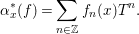 $$\begin{eqnarray}\unicode[STIX]{x1D6FC}_{x}^{\ast }(f)=\mathop{\sum }_{n\in \mathbb{Z}}f_{n}(x)T^{n}.\end{eqnarray}$$
Hence for any $n<0$
we must have
$n<0$
we must have $f_{n}(x)=0$
for all
$f_{n}(x)=0$
for all $x\in \mathbf{X}$
and so
$x\in \mathbf{X}$
and so $\mathbb{K}[\mathbf{X}]_{n}=\{0\}$
for any
$\mathbb{K}[\mathbf{X}]_{n}=\{0\}$
for any $n<0$
.
$n<0$
.
(iii) By part (ii) we need only show that $\dim _{\mathbb{K}}\mathbb{K}[\mathbf{X}]_{n}<\infty$
when
$\dim _{\mathbb{K}}\mathbb{K}[\mathbf{X}]_{n}<\infty$
when $n\geqslant 0$
. Moreover, as
$n\geqslant 0$
. Moreover, as $\mathbb{K}[\mathbf{X}]_{0}$
is nothing other than the affine algebra
$\mathbb{K}[\mathbf{X}]_{0}$
is nothing other than the affine algebra $\mathbb{K}[\mathbf{X}^{\mathbb{G}_{m}}]$
of the fixed points we have
$\mathbb{K}[\mathbf{X}^{\mathbb{G}_{m}}]$
of the fixed points we have $\mathbb{K}[\mathbf{X}]_{0}=\mathbb{K}$
by (i) so we may assume
$\mathbb{K}[\mathbf{X}]_{0}=\mathbb{K}$
by (i) so we may assume $n>0$
. Let
$n>0$
. Let $\{g_{1},\ldots ,g_{k}\}\subseteq \mathbb{K}[\mathbf{X}]$
be a generating set for the algebra then the set
$\{g_{1},\ldots ,g_{k}\}\subseteq \mathbb{K}[\mathbf{X}]$
be a generating set for the algebra then the set ${\mathcal{B}}=\{g_{1}^{i_{1}}\cdots g_{k}^{i_{k}}\mid i_{1},\ldots ,i_{k}\geqslant 0\}$
is a
${\mathcal{B}}=\{g_{1}^{i_{1}}\cdots g_{k}^{i_{k}}\mid i_{1},\ldots ,i_{k}\geqslant 0\}$
is a $\mathbb{K}$
-basis of the algebra, where we assume that not all powers are 0. Let us assume that
$\mathbb{K}$
-basis of the algebra, where we assume that not all powers are 0. Let us assume that $g_{j}$
is contained in the weight space
$g_{j}$
is contained in the weight space $\mathbb{K}[\mathbf{X}]_{n_{j}}$
then by (i) and (ii) we have
$\mathbb{K}[\mathbf{X}]_{n_{j}}$
then by (i) and (ii) we have $n_{j}>0$
. The subset
$n_{j}>0$
. The subset ${\mathcal{B}}_{n}=\{g_{1}^{i_{1}}\cdots g_{k}^{i_{k}}\mid n=n_{1}i_{1}+\cdots +n_{k}i_{k}\}\subseteq {\mathcal{B}}$
is obviously a basis for the weight space
${\mathcal{B}}_{n}=\{g_{1}^{i_{1}}\cdots g_{k}^{i_{k}}\mid n=n_{1}i_{1}+\cdots +n_{k}i_{k}\}\subseteq {\mathcal{B}}$
is obviously a basis for the weight space $\mathbb{K}[\mathbf{X}]_{n}$
. However as
$\mathbb{K}[\mathbf{X}]_{n}$
. However as $n,n_{1},\ldots ,n_{k}>0$
are all strictly positive we see that the set
$n,n_{1},\ldots ,n_{k}>0$
are all strictly positive we see that the set ${\mathcal{B}}_{n}$
must be finite.◻
${\mathcal{B}}_{n}$
must be finite.◻
Remark 3.14. Assume that $\mathbf{X}$
is a
$\mathbf{X}$
is a $\mathbb{K}$
-vector space and the
$\mathbb{K}$
-vector space and the $\mathbb{G}_{m}$
-action
$\mathbb{G}_{m}$
-action $\unicode[STIX]{x1D6FC}:\mathbb{G}_{m}\times \mathbf{X}\rightarrow \mathbf{X}$
is linear in the sense that
$\unicode[STIX]{x1D6FC}:\mathbb{G}_{m}\times \mathbf{X}\rightarrow \mathbf{X}$
is linear in the sense that $\unicode[STIX]{x1D6FC}(k,x)=\unicode[STIX]{x1D70C}(k)x$
for some rational representation
$\unicode[STIX]{x1D6FC}(k,x)=\unicode[STIX]{x1D70C}(k)x$
for some rational representation $\unicode[STIX]{x1D70C}:\mathbb{G}_{m}\rightarrow \text{GL}(\mathbf{X})$
. In this situation we can directly break up
$\unicode[STIX]{x1D70C}:\mathbb{G}_{m}\rightarrow \text{GL}(\mathbf{X})$
. In this situation we can directly break up $\mathbf{X}$
as a direct sum
$\mathbf{X}$
as a direct sum $\bigoplus _{n\in \mathbb{Z}}\mathbf{X}_{n}$
of its weight spaces, see, [Reference SpringerSpr2, 3.2.3(c)]. Using the above arguments one easily sees that the action is contracting if and only if
$\bigoplus _{n\in \mathbb{Z}}\mathbf{X}_{n}$
of its weight spaces, see, [Reference SpringerSpr2, 3.2.3(c)]. Using the above arguments one easily sees that the action is contracting if and only if $\mathbf{X}_{n}=\{0\}$
for all
$\mathbf{X}_{n}=\{0\}$
for all $n\leqslant 0$
; then 0 is the unique fixed point of the action.
$n\leqslant 0$
; then 0 is the unique fixed point of the action.
Cocharacters
3.15. We now recall some results from [Reference PremetPre2]. Assume $\unicode[STIX]{x1D706}\in Y(\mathbf{G})=\text{Hom}(\mathbb{G}_{m},\mathbf{G})$
is a cocharacter of
$\unicode[STIX]{x1D706}\in Y(\mathbf{G})=\text{Hom}(\mathbb{G}_{m},\mathbf{G})$
is a cocharacter of $\mathbf{G}$
then
$\mathbf{G}$
then $\unicode[STIX]{x1D706}$
defines a
$\unicode[STIX]{x1D706}$
defines a $\mathbb{Z}$
-grading
$\mathbb{Z}$
-grading $\mathfrak{g}=\bigoplus _{i\in \mathbb{Z}}\mathfrak{g}(\unicode[STIX]{x1D706},i)$
on the Lie algebra by setting
$\mathfrak{g}=\bigoplus _{i\in \mathbb{Z}}\mathfrak{g}(\unicode[STIX]{x1D706},i)$
on the Lie algebra by setting
 $$\begin{eqnarray}\mathfrak{g}(\unicode[STIX]{x1D706},i)=\{x\in \mathfrak{g}\mid (\text{Ad}\unicode[STIX]{x1D706}(k))(x)=k^{i}x\text{ for all }k\in \mathbb{G}_{m}\}.\end{eqnarray}$$
From the definition we see immediately that
 $$\begin{eqnarray}[\mathfrak{g}(\unicode[STIX]{x1D706},i),\mathfrak{g}(\unicode[STIX]{x1D706},j)]\subseteq \mathfrak{g}(\unicode[STIX]{x1D706},i+j)\end{eqnarray}$$
for all $i,j\in \mathbb{Z}$
. We note the following useful observation concerning the weight spaces. It is clear that we have
$i,j\in \mathbb{Z}$
. We note the following useful observation concerning the weight spaces. It is clear that we have $\mathfrak{g}=\mathfrak{g}_{\text{der}}+\text{Lie}(Z(\mathbf{G}))$
but this sum need not be direct. Furthermore, it is also obvious that
$\mathfrak{g}=\mathfrak{g}_{\text{der}}+\text{Lie}(Z(\mathbf{G}))$
but this sum need not be direct. Furthermore, it is also obvious that $\text{Lie}(Z(\mathbf{G}))\subseteq \mathfrak{g}(\unicode[STIX]{x1D706},0)$
so we must have
$\text{Lie}(Z(\mathbf{G}))\subseteq \mathfrak{g}(\unicode[STIX]{x1D706},0)$
so we must have $\mathfrak{g}(\unicode[STIX]{x1D706},i)\subseteq \mathfrak{g}_{\text{der}}$
for any
$\mathfrak{g}(\unicode[STIX]{x1D706},i)\subseteq \mathfrak{g}_{\text{der}}$
for any $i\neq 0$
. In particular, if
$i\neq 0$
. In particular, if $\unicode[STIX]{x1D706}\in Y(\mathbf{G}_{\text{der}})\subseteq Y(\mathbf{G})$
then we have
$\unicode[STIX]{x1D706}\in Y(\mathbf{G}_{\text{der}})\subseteq Y(\mathbf{G})$
then we have $\mathfrak{g}(\unicode[STIX]{x1D706},i)=\mathfrak{g}_{\text{der}}(\unicode[STIX]{x1D706},i)$
for all
$\mathfrak{g}(\unicode[STIX]{x1D706},i)=\mathfrak{g}_{\text{der}}(\unicode[STIX]{x1D706},i)$
for all $i\neq 0$
.
$i\neq 0$
.
3.17. To any cocharacter $\unicode[STIX]{x1D706}\in Y(\mathbf{G})$
we assign a parabolic subgroup
$\unicode[STIX]{x1D706}\in Y(\mathbf{G})$
we assign a parabolic subgroup $\mathbf{P}(\unicode[STIX]{x1D706})\leqslant \mathbf{G}$
with unipotent radical
$\mathbf{P}(\unicode[STIX]{x1D706})\leqslant \mathbf{G}$
with unipotent radical $\mathbf{U}(\unicode[STIX]{x1D706})$
given by
$\mathbf{U}(\unicode[STIX]{x1D706})$
given by
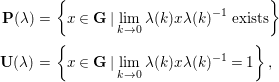 $$\begin{eqnarray}\displaystyle \mathbf{P}(\unicode[STIX]{x1D706}) & = & \displaystyle \left\{x\in \mathbf{G}\mid \lim _{k\rightarrow 0}\unicode[STIX]{x1D706}(k)x\unicode[STIX]{x1D706}(k)^{-1}\text{ exists}\right\}\nonumber\\ \displaystyle \mathbf{U}(\unicode[STIX]{x1D706}) & = & \displaystyle \left\{x\in \mathbf{G}\mid \lim _{k\rightarrow 0}\unicode[STIX]{x1D706}(k)x\unicode[STIX]{x1D706}(k)^{-1}=1\right\},\nonumber\end{eqnarray}$$
see [Reference SpringerSpr2, 3.2.15, 8.4.5]. We then have a Levi decomposition $\mathbf{P}(\unicode[STIX]{x1D706})=\mathbf{L}(\unicode[STIX]{x1D706})\mathbf{U}(\unicode[STIX]{x1D706})$
by setting
$\mathbf{P}(\unicode[STIX]{x1D706})=\mathbf{L}(\unicode[STIX]{x1D706})\mathbf{U}(\unicode[STIX]{x1D706})$
by setting $\mathbf{L}(\unicode[STIX]{x1D706})=C_{\mathbf{G}}(\unicode[STIX]{x1D706}(\mathbb{G}_{m}))$
. The Lie algebras of these subgroups are given by
$\mathbf{L}(\unicode[STIX]{x1D706})=C_{\mathbf{G}}(\unicode[STIX]{x1D706}(\mathbb{G}_{m}))$
. The Lie algebras of these subgroups are given by
 $$\begin{eqnarray}\mathfrak{p}(\unicode[STIX]{x1D706})=\mathop{\bigoplus }_{i\geqslant 0}\mathfrak{g}(\unicode[STIX]{x1D706},i)\quad \mathfrak{l}(\unicode[STIX]{x1D706})=\mathop{\bigoplus }_{i=0}\mathfrak{g}(\unicode[STIX]{x1D706},i)\quad \mathfrak{u}(\unicode[STIX]{x1D706})=\mathop{\bigoplus }_{i>0}\mathfrak{g}(\unicode[STIX]{x1D706},i).\end{eqnarray}$$
For any $i\in \mathbb{Z}_{{>}0}$
we will also need the Lie subalgebra
$i\in \mathbb{Z}_{{>}0}$
we will also need the Lie subalgebra $\mathfrak{u}(\unicode[STIX]{x1D706},i)=\bigoplus _{j\geqslant i}\mathfrak{g}(\unicode[STIX]{x1D706},j)$
and its corresponding closed connected unipotent subgroup
$\mathfrak{u}(\unicode[STIX]{x1D706},i)=\bigoplus _{j\geqslant i}\mathfrak{g}(\unicode[STIX]{x1D706},j)$
and its corresponding closed connected unipotent subgroup $\mathbf{U}(\unicode[STIX]{x1D706},i)\leqslant \mathbf{U}(\unicode[STIX]{x1D706})$
.
$\mathbf{U}(\unicode[STIX]{x1D706},i)\leqslant \mathbf{U}(\unicode[STIX]{x1D706})$
.
Assume now that $\unicode[STIX]{x1D706}\in Y(\mathbf{T}_{0})$
and let
$\unicode[STIX]{x1D706}\in Y(\mathbf{T}_{0})$
and let $\mathbf{X}_{\unicode[STIX]{x1D6FC}}\leqslant \mathbf{G}$
be the 1-dimensional unipotent root subgroup whose Lie algebra is the root space
$\mathbf{X}_{\unicode[STIX]{x1D6FC}}\leqslant \mathbf{G}$
be the 1-dimensional unipotent root subgroup whose Lie algebra is the root space $\mathfrak{g}_{\unicode[STIX]{x1D6FC}}$
for any
$\mathfrak{g}_{\unicode[STIX]{x1D6FC}}$
for any $\unicode[STIX]{x1D6FC}\in \unicode[STIX]{x1D6F7}$
. If
$\unicode[STIX]{x1D6FC}\in \unicode[STIX]{x1D6F7}$
. If $\mathbf{P}(\unicode[STIX]{x1D706})$
is standard, that is, it contains
$\mathbf{P}(\unicode[STIX]{x1D706})$
is standard, that is, it contains $\mathbf{T}_{0}\leqslant \mathbf{B}_{0}$
, then we may also write the above as
$\mathbf{T}_{0}\leqslant \mathbf{B}_{0}$
, then we may also write the above as
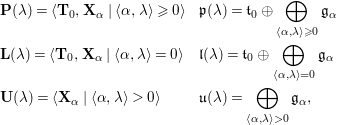 $$\begin{eqnarray}\begin{array}{@{}ll@{}}\displaystyle \mathbf{P}(\unicode[STIX]{x1D706})=\langle \mathbf{T}_{0},\mathbf{X}_{\unicode[STIX]{x1D6FC}}\mid \langle \unicode[STIX]{x1D6FC},\unicode[STIX]{x1D706}\rangle \geqslant 0\rangle & \displaystyle \mathfrak{p}(\unicode[STIX]{x1D706})=\mathfrak{t}_{0}\oplus \mathop{\bigoplus }_{\langle \unicode[STIX]{x1D6FC},\unicode[STIX]{x1D706}\rangle \geqslant 0}\mathfrak{g}_{\unicode[STIX]{x1D6FC}}\\ \displaystyle \mathbf{L}(\unicode[STIX]{x1D706})=\langle \mathbf{T}_{0},\mathbf{X}_{\unicode[STIX]{x1D6FC}}\mid \langle \unicode[STIX]{x1D6FC},\unicode[STIX]{x1D706}\rangle =0\rangle & \displaystyle \mathfrak{l}(\unicode[STIX]{x1D706})=\mathfrak{t}_{0}\oplus \mathop{\bigoplus }_{\langle \unicode[STIX]{x1D6FC},\unicode[STIX]{x1D706}\rangle =0}\mathfrak{g}_{\unicode[STIX]{x1D6FC}}\\ \displaystyle \mathbf{U}(\unicode[STIX]{x1D706})=\langle \mathbf{X}_{\unicode[STIX]{x1D6FC}}\mid \langle \unicode[STIX]{x1D6FC},\unicode[STIX]{x1D706}\rangle >0\rangle & \displaystyle \mathfrak{u}(\unicode[STIX]{x1D706})=\mathop{\bigoplus }_{\langle \unicode[STIX]{x1D6FC},\unicode[STIX]{x1D706}\rangle >0}\mathfrak{g}_{\unicode[STIX]{x1D6FC}},\end{array}\end{eqnarray}$$
as $\mathfrak{t}_{0}\subseteq \mathfrak{g}(\unicode[STIX]{x1D706},0)$
. With this we see that we have an analogue of (3.16) which follows immediately from Chevalley’s commutator relation [Reference SpringerSpr2, 8.2.3]. Namely,
$\mathfrak{t}_{0}\subseteq \mathfrak{g}(\unicode[STIX]{x1D706},0)$
. With this we see that we have an analogue of (3.16) which follows immediately from Chevalley’s commutator relation [Reference SpringerSpr2, 8.2.3]. Namely,
 $$\begin{eqnarray}[\mathbf{U}(\unicode[STIX]{x1D706},i),\mathbf{U}(\unicode[STIX]{x1D706},j)]\subseteq \mathbf{U}(\unicode[STIX]{x1D706},i+j)\end{eqnarray}$$
for any $i,j\geqslant 1$
. Note this clearly holds for all cocharacters.
$i,j\geqslant 1$
. Note this clearly holds for all cocharacters.
Weighted Dynkin diagrams
3.19. Let us assume temporarily that $\mathbf{G}$
is semisimple and simply connected. We will denote by
$\mathbf{G}$
is semisimple and simply connected. We will denote by $\mathbf{G}_{\mathbb{C}}$
an algebraic group over
$\mathbf{G}_{\mathbb{C}}$
an algebraic group over $\mathbb{C}$
and by
$\mathbb{C}$
and by $\mathbf{T}_{\mathbb{C}}\leqslant \mathbf{B}_{\mathbb{C}}\leqslant \mathbf{G}_{\mathbb{C}}$
a maximal torus and Borel subgroup of
$\mathbf{T}_{\mathbb{C}}\leqslant \mathbf{B}_{\mathbb{C}}\leqslant \mathbf{G}_{\mathbb{C}}$
a maximal torus and Borel subgroup of $\mathbf{G}_{\mathbb{C}}$
such that the root datum, and simple roots, of
$\mathbf{G}_{\mathbb{C}}$
such that the root datum, and simple roots, of $\mathbf{G}_{\mathbb{C}}$
with respect to
$\mathbf{G}_{\mathbb{C}}$
with respect to $\mathbf{T}_{\mathbb{C}}\leqslant \mathbf{B}_{\mathbb{C}}$
is the same as that of
$\mathbf{T}_{\mathbb{C}}\leqslant \mathbf{B}_{\mathbb{C}}$
is the same as that of $\mathbf{G}$
. Fix a Chevalley basis
$\mathbf{G}$
. Fix a Chevalley basis ${\mathcal{B}}_{\mathbb{C}}=\{X_{\unicode[STIX]{x1D6FC}}\mid \unicode[STIX]{x1D6FC}\in \unicode[STIX]{x1D6F7}\}\cup \{H_{\unicode[STIX]{x1D6FC}}\mid \unicode[STIX]{x1D6FC}\in \unicode[STIX]{x1D6E5}\}$
of
${\mathcal{B}}_{\mathbb{C}}=\{X_{\unicode[STIX]{x1D6FC}}\mid \unicode[STIX]{x1D6FC}\in \unicode[STIX]{x1D6F7}\}\cup \{H_{\unicode[STIX]{x1D6FC}}\mid \unicode[STIX]{x1D6FC}\in \unicode[STIX]{x1D6E5}\}$
of $\mathfrak{g}_{\mathbb{C}}$
and denote by
$\mathfrak{g}_{\mathbb{C}}$
and denote by $\mathfrak{g}_{\mathbb{Z}}\subset \mathfrak{g}_{\mathbb{C}}$
the
$\mathfrak{g}_{\mathbb{Z}}\subset \mathfrak{g}_{\mathbb{C}}$
the $\mathbb{Z}$
-span of
$\mathbb{Z}$
-span of ${\mathcal{B}}_{\mathbb{C}}$
. As
${\mathcal{B}}_{\mathbb{C}}$
. As $\mathbf{G}$
is simply connected we may identify
$\mathbf{G}$
is simply connected we may identify $\mathfrak{g}$
with
$\mathfrak{g}$
with $\mathfrak{g}_{\mathbb{Z}}\otimes _{\mathbb{Z}}\mathbb{K}$
as Lie algebras. Setting
$\mathfrak{g}_{\mathbb{Z}}\otimes _{\mathbb{Z}}\mathbb{K}$
as Lie algebras. Setting $e_{\unicode[STIX]{x1D6FC}}=X_{\unicode[STIX]{x1D6FC}}\otimes 1$
and
$e_{\unicode[STIX]{x1D6FC}}=X_{\unicode[STIX]{x1D6FC}}\otimes 1$
and $h_{\unicode[STIX]{x1D6FC}}=H_{\unicode[STIX]{x1D6FC}}\otimes 1$
for each
$h_{\unicode[STIX]{x1D6FC}}=H_{\unicode[STIX]{x1D6FC}}\otimes 1$
for each $\unicode[STIX]{x1D6FC}\in \unicode[STIX]{x1D6F7}$
we have
$\unicode[STIX]{x1D6FC}\in \unicode[STIX]{x1D6F7}$
we have ${\mathcal{B}}=\{e_{\unicode[STIX]{x1D6FC}}\mid \unicode[STIX]{x1D6FC}\in \unicode[STIX]{x1D6F7}\}\cup \{h_{\unicode[STIX]{x1D6FC}}\mid \unicode[STIX]{x1D6FC}\in \unicode[STIX]{x1D6E5}\}$
is a basis for
${\mathcal{B}}=\{e_{\unicode[STIX]{x1D6FC}}\mid \unicode[STIX]{x1D6FC}\in \unicode[STIX]{x1D6F7}\}\cup \{h_{\unicode[STIX]{x1D6FC}}\mid \unicode[STIX]{x1D6FC}\in \unicode[STIX]{x1D6E5}\}$
is a basis for $\mathfrak{g}$
and the corresponding root space
$\mathfrak{g}$
and the corresponding root space $\mathfrak{g}_{\unicode[STIX]{x1D6FC}}$
of
$\mathfrak{g}_{\unicode[STIX]{x1D6FC}}$
of $\mathfrak{g}$
is simply
$\mathfrak{g}$
is simply $\mathbb{K}e_{\unicode[STIX]{x1D6FC}}$
.
$\mathbb{K}e_{\unicode[STIX]{x1D6FC}}$
.
By the Jacobson–Morozov theorem, see [Reference CarterCar2, 5.3.2], any nilpotent element $e\in \mathfrak{g}_{\mathbb{C}}=\text{Lie}(\mathbf{G}_{\mathbb{C}})$
is contained in an
$e\in \mathfrak{g}_{\mathbb{C}}=\text{Lie}(\mathbf{G}_{\mathbb{C}})$
is contained in an $\mathfrak{s}\mathfrak{l}_{2}$
-triple
$\mathfrak{s}\mathfrak{l}_{2}$
-triple $\{e,h,f\}\subset \mathfrak{g}_{\mathbb{C}}$
. Arguing as in [Reference PremetPre2, p. 344] we may assume, after possibly replacing
$\{e,h,f\}\subset \mathfrak{g}_{\mathbb{C}}$
. Arguing as in [Reference PremetPre2, p. 344] we may assume, after possibly replacing $\{e,h,f\}$
by
$\{e,h,f\}$
by $\{\text{Ad}\,g(e),\text{Ad}\,g(h),\text{Ad}\,g(f)\}$
for some
$\{\text{Ad}\,g(e),\text{Ad}\,g(h),\text{Ad}\,g(f)\}$
for some $g\in \mathbf{G}$
, that
$g\in \mathbf{G}$
, that $h=\sum _{\unicode[STIX]{x1D6FC}\in \unicode[STIX]{x1D6E5}}q_{\unicode[STIX]{x1D6FC}}H_{\unicode[STIX]{x1D6FC}}$
with
$h=\sum _{\unicode[STIX]{x1D6FC}\in \unicode[STIX]{x1D6E5}}q_{\unicode[STIX]{x1D6FC}}H_{\unicode[STIX]{x1D6FC}}$
with $q_{\unicode[STIX]{x1D6FC}}\in \mathbb{Z}$
and
$q_{\unicode[STIX]{x1D6FC}}\in \mathbb{Z}$
and $\unicode[STIX]{x1D6FC}(h)\geqslant 0$
for all
$\unicode[STIX]{x1D6FC}(h)\geqslant 0$
for all $\unicode[STIX]{x1D6FC}\in \unicode[STIX]{x1D6E5}$
. The function
$\unicode[STIX]{x1D6FC}\in \unicode[STIX]{x1D6E5}$
. The function $d:\unicode[STIX]{x1D6F7}\rightarrow \mathbb{Z}$
given by
$d:\unicode[STIX]{x1D6F7}\rightarrow \mathbb{Z}$
given by $\unicode[STIX]{x1D6FC}\mapsto \unicode[STIX]{x1D6FC}(h)$
is called the weighted Dynkin diagram of the nilpotent orbit
$\unicode[STIX]{x1D6FC}\mapsto \unicode[STIX]{x1D6FC}(h)$
is called the weighted Dynkin diagram of the nilpotent orbit ${\mathcal{O}}\subset \mathfrak{g}_{\mathbb{C}}$
containing
${\mathcal{O}}\subset \mathfrak{g}_{\mathbb{C}}$
containing $e$
. We denote by
$e$
. We denote by ${\mathcal{D}}_{\unicode[STIX]{x1D6F7}}$
the set of weighted Dynkin diagrams.
${\mathcal{D}}_{\unicode[STIX]{x1D6F7}}$
the set of weighted Dynkin diagrams.
Note that, for each weighted Dynkin diagram $d\in {\mathcal{D}}_{\unicode[STIX]{x1D6F7}}$
, there exists a cocharacter
$d\in {\mathcal{D}}_{\unicode[STIX]{x1D6F7}}$
, there exists a cocharacter $\unicode[STIX]{x1D706}_{d}^{\mathbf{G}}\in Y(\mathbf{T}_{0})\subseteq Y(\mathbf{G})$
such that
$\unicode[STIX]{x1D706}_{d}^{\mathbf{G}}\in Y(\mathbf{T}_{0})\subseteq Y(\mathbf{G})$
such that $\text{Ad}\,\unicode[STIX]{x1D706}_{d}^{\mathbf{G}}(k)(e_{\unicode[STIX]{x1D6FC}})=k^{d(\unicode[STIX]{x1D6FC})}e_{\unicode[STIX]{x1D6FC}}$
and
$\text{Ad}\,\unicode[STIX]{x1D706}_{d}^{\mathbf{G}}(k)(e_{\unicode[STIX]{x1D6FC}})=k^{d(\unicode[STIX]{x1D6FC})}e_{\unicode[STIX]{x1D6FC}}$
and $\text{Ad}\,\unicode[STIX]{x1D706}_{d}^{\mathbf{G}}(k)(x)=x$
for all
$\text{Ad}\,\unicode[STIX]{x1D706}_{d}^{\mathbf{G}}(k)(x)=x$
for all $\unicode[STIX]{x1D6FC}\in \pm \unicode[STIX]{x1D6E5}$
,
$\unicode[STIX]{x1D6FC}\in \pm \unicode[STIX]{x1D6E5}$
, $x\in \mathfrak{t}_{0}$
and
$x\in \mathfrak{t}_{0}$
and $k\in \mathbb{G}_{m}$
. In fact this can be constructed by setting
$k\in \mathbb{G}_{m}$
. In fact this can be constructed by setting $\unicode[STIX]{x1D706}_{d}^{\mathbf{G}}=\sum _{\unicode[STIX]{x1D6FC}\in \unicode[STIX]{x1D6E5}}q_{\unicode[STIX]{x1D6FC}}\check{\unicode[STIX]{x1D6FC}}\in \mathbb{Z}\check{\unicode[STIX]{x1D6F7}}$
where
$\unicode[STIX]{x1D706}_{d}^{\mathbf{G}}=\sum _{\unicode[STIX]{x1D6FC}\in \unicode[STIX]{x1D6E5}}q_{\unicode[STIX]{x1D6FC}}\check{\unicode[STIX]{x1D6FC}}\in \mathbb{Z}\check{\unicode[STIX]{x1D6F7}}$
where $q_{\unicode[STIX]{x1D6FC}}\in \mathbb{Z}$
is as above and
$q_{\unicode[STIX]{x1D6FC}}\in \mathbb{Z}$
is as above and $\check{\unicode[STIX]{x1D6FC}}\in \check{\unicode[STIX]{x1D6F7}}$
is the coroot corresponding to
$\check{\unicode[STIX]{x1D6FC}}\in \check{\unicode[STIX]{x1D6F7}}$
is the coroot corresponding to $\unicode[STIX]{x1D6FC}\in \unicode[STIX]{x1D6E5}$
.
$\unicode[STIX]{x1D6FC}\in \unicode[STIX]{x1D6E5}$
.
3.20. We now drop our assumption that $\mathbf{G}$
is semisimple and simply connected. Let us denote by
$\mathbf{G}$
is semisimple and simply connected. Let us denote by $\mathbf{T}_{\text{sc}}\leqslant \mathbf{G}_{\text{sc}}$
the maximal torus such that
$\mathbf{T}_{\text{sc}}\leqslant \mathbf{G}_{\text{sc}}$
the maximal torus such that $\unicode[STIX]{x1D719}_{\text{sc}}(\mathbf{T}_{\text{sc}})\leqslant \mathbf{T}_{0}$
. The isogeny
$\unicode[STIX]{x1D719}_{\text{sc}}(\mathbf{T}_{\text{sc}})\leqslant \mathbf{T}_{0}$
. The isogeny $\unicode[STIX]{x1D719}_{\text{sc}}$
then induces a natural injection
$\unicode[STIX]{x1D719}_{\text{sc}}$
then induces a natural injection $Y(\mathbf{G}_{\text{sc}})\rightarrow Y(\mathbf{G})$
which maps
$Y(\mathbf{G}_{\text{sc}})\rightarrow Y(\mathbf{G})$
which maps $Y(\mathbf{T}_{\text{sc}})$
into
$Y(\mathbf{T}_{\text{sc}})$
into $Y(\mathbf{T}_{0})$
. In 3.19 we have defined a cocharacter
$Y(\mathbf{T}_{0})$
. In 3.19 we have defined a cocharacter $\unicode[STIX]{x1D706}_{d}^{\mathbf{G}_{\text{sc}}}\in Y(\mathbf{T}_{\text{sc}})$
for each weighted Dynkin diagram
$\unicode[STIX]{x1D706}_{d}^{\mathbf{G}_{\text{sc}}}\in Y(\mathbf{T}_{\text{sc}})$
for each weighted Dynkin diagram $d\in {\mathcal{D}}_{\unicode[STIX]{x1D6F7}}$
. We now set
$d\in {\mathcal{D}}_{\unicode[STIX]{x1D6F7}}$
. We now set $\unicode[STIX]{x1D706}_{d}^{\mathbf{G}}:=\unicode[STIX]{x1D719}_{\text{sc}}\circ \unicode[STIX]{x1D706}_{d}^{\mathbf{G}_{\text{sc}}}$
and denote by
$\unicode[STIX]{x1D706}_{d}^{\mathbf{G}}:=\unicode[STIX]{x1D719}_{\text{sc}}\circ \unicode[STIX]{x1D706}_{d}^{\mathbf{G}_{\text{sc}}}$
and denote by ${\mathcal{D}}_{\unicode[STIX]{x1D6F7}}(\mathbf{G})$
the set
${\mathcal{D}}_{\unicode[STIX]{x1D6F7}}(\mathbf{G})$
the set $\{\unicode[STIX]{x1D706}_{d}^{\mathbf{G}}\mid d\in {\mathcal{D}}_{\unicode[STIX]{x1D6F7}}\}$
of resulting cocharacters. Note that the definition of
$\{\unicode[STIX]{x1D706}_{d}^{\mathbf{G}}\mid d\in {\mathcal{D}}_{\unicode[STIX]{x1D6F7}}\}$
of resulting cocharacters. Note that the definition of $\unicode[STIX]{x1D706}_{d}^{\mathbf{G}}$
does not depend upon the choice of simply connected cover
$\unicode[STIX]{x1D706}_{d}^{\mathbf{G}}$
does not depend upon the choice of simply connected cover $\unicode[STIX]{x1D719}_{\text{sc}}$
. Indeed, if
$\unicode[STIX]{x1D719}_{\text{sc}}$
. Indeed, if $\unicode[STIX]{x1D719}_{\text{sc}}^{\prime }$
is another simply connected cover then
$\unicode[STIX]{x1D719}_{\text{sc}}^{\prime }$
is another simply connected cover then $\unicode[STIX]{x1D719}_{\text{sc}}^{\prime }=\unicode[STIX]{x1D719}_{\text{sc}}\circ \text{Inn}\,t$
for some element
$\unicode[STIX]{x1D719}_{\text{sc}}^{\prime }=\unicode[STIX]{x1D719}_{\text{sc}}\circ \text{Inn}\,t$
for some element $t\in \mathbf{T}_{\text{sc}}$
by Theorem 2.3. However, clearly
$t\in \mathbf{T}_{\text{sc}}$
by Theorem 2.3. However, clearly $\text{Inn}\,t\circ \unicode[STIX]{x1D706}_{d}^{\mathbf{G}_{\text{sc}}}=\unicode[STIX]{x1D706}_{d}^{\mathbf{G}_{\text{sc}}}$
because the image is contained in
$\text{Inn}\,t\circ \unicode[STIX]{x1D706}_{d}^{\mathbf{G}_{\text{sc}}}=\unicode[STIX]{x1D706}_{d}^{\mathbf{G}_{\text{sc}}}$
because the image is contained in $\mathbf{T}_{\text{sc}}$
, which is abelian. Moreover we will denote by
$\mathbf{T}_{\text{sc}}$
, which is abelian. Moreover we will denote by ${\mathcal{D}}(\mathbf{G})$
the set
${\mathcal{D}}(\mathbf{G})$
the set
 $$\begin{eqnarray}\{\text{Inn}\,g\circ \unicode[STIX]{x1D706}_{d}^{\mathbf{G}}\mid d\in {\mathcal{D}}_{\unicode[STIX]{x1D6F7}}~\text{and}~g\in \mathbf{G}\}.\end{eqnarray}$$
Finally we remark that if $\mathbf{G}$
is a proximate algebraic group then
$\mathbf{G}$
is a proximate algebraic group then $\text{d}\unicode[STIX]{x1D719}_{\text{sc}}$
is an isomorphism so we may, and will, identify the Chevalley basis considered in 3.19 with a basis of
$\text{d}\unicode[STIX]{x1D719}_{\text{sc}}$
is an isomorphism so we may, and will, identify the Chevalley basis considered in 3.19 with a basis of $\mathfrak{g}_{\text{der}}$
.
$\mathfrak{g}_{\text{der}}$
.
Classification of nilpotent orbits
3.21. We now have the following cheap generalization of [Reference PremetPre2], which gives a case-free proof of the classification of nilpotent orbits in good characteristic by weighted Dynkin diagrams. For historical remarks concerning this theorem see [Reference PremetPre2, Remark 2]. In fact, we will also give certain statements concerning centralizers of nilpotent elements but for this we will need to assume that $\mathbf{G}$
is proximate. This assumption cannot be dropped, in general, as is evident by the example given at the end of [Reference PremetPre1, Introduction].
$\mathbf{G}$
is proximate. This assumption cannot be dropped, in general, as is evident by the example given at the end of [Reference PremetPre1, Introduction].
Theorem 3.22. (Kawanaka, Premet)
For any cocharacter $\unicode[STIX]{x1D706}\in {\mathcal{D}}(\mathbf{G})\subseteq Y(\mathbf{G})$
let
$\unicode[STIX]{x1D706}\in {\mathcal{D}}(\mathbf{G})\subseteq Y(\mathbf{G})$
let $\mathfrak{g}(\unicode[STIX]{x1D706},2)_{\text{reg}}$
be the unique open dense orbit of
$\mathfrak{g}(\unicode[STIX]{x1D706},2)_{\text{reg}}$
be the unique open dense orbit of $\mathbf{L}(\unicode[STIX]{x1D706})$
acting on
$\mathbf{L}(\unicode[STIX]{x1D706})$
acting on $\mathfrak{g}(\unicode[STIX]{x1D706},2)$
, see, [Reference CarterCar2, p. 132].
$\mathfrak{g}(\unicode[STIX]{x1D706},2)$
, see, [Reference CarterCar2, p. 132].
-
(i) The map
${\mathcal{D}}_{\unicode[STIX]{x1D6F7}}(\mathbf{G})\rightarrow {\mathcal{N}}(\mathfrak{g})/\mathbf{G}$
given by is a bijection.
$$\begin{eqnarray}\unicode[STIX]{x1D706}_{d}^{\mathbf{G}}\mapsto {\mathcal{O}}_{\mathbf{G}}(d):=(\text{Ad}\,\mathbf{G})\mathfrak{g}(\unicode[STIX]{x1D706}_{d}^{\mathbf{G}},2)_{\text{reg}}\end{eqnarray}$$
-
(ii) Assume
$\mathbf{G}$
is proximate then for any
$\unicode[STIX]{x1D706}\in {\mathcal{D}}(\mathbf{G})$
and
$e\in \mathfrak{g}(\unicode[STIX]{x1D706},2)_{\text{reg}}\subseteq {\mathcal{N}}(\mathfrak{g})$
the following hold:-
(a)
$\mathfrak{c}_{\mathfrak{g}}(e)\subseteq \mathfrak{p}(\unicode[STIX]{x1D706})$
and
$C_{\mathbf{G}}(e)\subseteq \mathbf{P}(\unicode[STIX]{x1D706})$
; -
(b)
$[e,\mathfrak{p}(\unicode[STIX]{x1D706})]=\mathfrak{u}(\unicode[STIX]{x1D706},2)$
; -
(c)
$(\text{Ad}\,\mathbf{P}(\unicode[STIX]{x1D706}))e$
is dense in
$\mathfrak{u}(\unicode[STIX]{x1D706},2)$
.
-










Proof. (i) Assume $\unicode[STIX]{x1D711}:\mathbf{G}\rightarrow \mathbf{H}$
is a surjective homomorphism of algebraic groups such that
$\unicode[STIX]{x1D711}:\mathbf{G}\rightarrow \mathbf{H}$
is a surjective homomorphism of algebraic groups such that $\text{Ker}(\unicode[STIX]{x1D711})\subseteq Z(\mathbf{G})$
and
$\text{Ker}(\unicode[STIX]{x1D711})\subseteq Z(\mathbf{G})$
and $\text{Ker}(\text{d}\unicode[STIX]{x1D711})\subseteq \mathfrak{z}(\mathfrak{g})$
. Let
$\text{Ker}(\text{d}\unicode[STIX]{x1D711})\subseteq \mathfrak{z}(\mathfrak{g})$
. Let $\mathfrak{h}=\text{Lie}(\mathbf{H})$
then according to [Reference JantzenJan, 2.7, Proposition] the differential
$\mathfrak{h}=\text{Lie}(\mathbf{H})$
then according to [Reference JantzenJan, 2.7, Proposition] the differential $\text{d}\unicode[STIX]{x1D711}:\mathfrak{g}\rightarrow \mathfrak{h}$
induces a bijection
$\text{d}\unicode[STIX]{x1D711}:\mathfrak{g}\rightarrow \mathfrak{h}$
induces a bijection ${\mathcal{N}}(\mathfrak{g})/\mathbf{G}\rightarrow {\mathcal{N}}(\mathfrak{h})/\mathbf{H}$
. Now the restriction of
${\mathcal{N}}(\mathfrak{g})/\mathbf{G}\rightarrow {\mathcal{N}}(\mathfrak{h})/\mathbf{H}$
. Now the restriction of $\unicode[STIX]{x1D711}$
to the derived subgroup
$\unicode[STIX]{x1D711}$
to the derived subgroup $\mathbf{G}_{\text{der}}$
defines an isogeny between the derived subgroups
$\mathbf{G}_{\text{der}}$
defines an isogeny between the derived subgroups $\mathbf{G}_{\text{der}}\rightarrow \mathbf{H}_{\text{der}}$
. Moreover
$\mathbf{G}_{\text{der}}\rightarrow \mathbf{H}_{\text{der}}$
. Moreover $\unicode[STIX]{x1D711}\circ \unicode[STIX]{x1D719}_{\text{sc}}:\mathbf{G}_{\text{sc}}\rightarrow \mathbf{H}_{\text{der}}$
is a simply connected covering. As remarked in 3.20 the cocharacter
$\unicode[STIX]{x1D711}\circ \unicode[STIX]{x1D719}_{\text{sc}}:\mathbf{G}_{\text{sc}}\rightarrow \mathbf{H}_{\text{der}}$
is a simply connected covering. As remarked in 3.20 the cocharacter $\unicode[STIX]{x1D706}_{d}^{\mathbf{H}}$
does not depend upon the choice of simply connected cover used to define it. Hence, we must have
$\unicode[STIX]{x1D706}_{d}^{\mathbf{H}}$
does not depend upon the choice of simply connected cover used to define it. Hence, we must have $\unicode[STIX]{x1D706}_{d}^{\mathbf{H}}=\unicode[STIX]{x1D711}\circ \unicode[STIX]{x1D706}_{d}^{\mathbf{G}}$
for any weighted Dynkin diagram
$\unicode[STIX]{x1D706}_{d}^{\mathbf{H}}=\unicode[STIX]{x1D711}\circ \unicode[STIX]{x1D706}_{d}^{\mathbf{G}}$
for any weighted Dynkin diagram $d\in {\mathcal{D}}_{\unicode[STIX]{x1D6F7}}$
. In particular, this shows that
$d\in {\mathcal{D}}_{\unicode[STIX]{x1D6F7}}$
. In particular, this shows that $\unicode[STIX]{x1D711}$
induces a bijection
$\unicode[STIX]{x1D711}$
induces a bijection ${\mathcal{D}}_{\unicode[STIX]{x1D6F7}}(\mathbf{G})\rightarrow {\mathcal{D}}_{\unicode[STIX]{x1D6F7}}(\mathbf{H})$
. It is easily checked that
${\mathcal{D}}_{\unicode[STIX]{x1D6F7}}(\mathbf{G})\rightarrow {\mathcal{D}}_{\unicode[STIX]{x1D6F7}}(\mathbf{H})$
. It is easily checked that $\unicode[STIX]{x1D711}(\mathbf{L}(\unicode[STIX]{x1D706}_{d}^{\mathbf{G}}))=\mathbf{L}(\unicode[STIX]{x1D706}_{d}^{\mathbf{H}})$
and
$\unicode[STIX]{x1D711}(\mathbf{L}(\unicode[STIX]{x1D706}_{d}^{\mathbf{G}}))=\mathbf{L}(\unicode[STIX]{x1D706}_{d}^{\mathbf{H}})$
and $\text{d}\unicode[STIX]{x1D711}(\mathfrak{g}(\unicode[STIX]{x1D706}_{d}^{\mathbf{G}},2))=\mathfrak{h}(\unicode[STIX]{x1D706}_{d}^{\mathbf{H}},2)$
, see, 3.17 and [Reference SpringerSpr2, 4.4.11(7)]. Moreover
$\text{d}\unicode[STIX]{x1D711}(\mathfrak{g}(\unicode[STIX]{x1D706}_{d}^{\mathbf{G}},2))=\mathfrak{h}(\unicode[STIX]{x1D706}_{d}^{\mathbf{H}},2)$
, see, 3.17 and [Reference SpringerSpr2, 4.4.11(7)]. Moreover $\text{d}\unicode[STIX]{x1D711}$
induces a bijection between the
$\text{d}\unicode[STIX]{x1D711}$
induces a bijection between the $\mathbf{L}(\unicode[STIX]{x1D706}_{d}^{\mathbf{G}})$
-orbits on
$\mathbf{L}(\unicode[STIX]{x1D706}_{d}^{\mathbf{G}})$
-orbits on $\mathfrak{g}(\unicode[STIX]{x1D706}_{d}^{\mathbf{G}},2)$
and the
$\mathfrak{g}(\unicode[STIX]{x1D706}_{d}^{\mathbf{G}},2)$
and the $\mathbf{L}(\unicode[STIX]{x1D706}_{d}^{\mathbf{H}})$
-orbits on
$\mathbf{L}(\unicode[STIX]{x1D706}_{d}^{\mathbf{H}})$
-orbits on $\mathfrak{h}(\unicode[STIX]{x1D706}_{d}^{\mathbf{H}},2)$
. Now
$\mathfrak{h}(\unicode[STIX]{x1D706}_{d}^{\mathbf{H}},2)$
. Now $\text{d}\unicode[STIX]{x1D711}:{\mathcal{N}}(\mathfrak{g})\rightarrow {\mathcal{N}}(\mathfrak{h})$
is a homeomorphism as it is a bijective morphism between irreducible varieties, see, [Reference SpringerSpr2, 5.2.3, 5.2.6, 5.2.9(4)]. In particular, the restriction
$\text{d}\unicode[STIX]{x1D711}:{\mathcal{N}}(\mathfrak{g})\rightarrow {\mathcal{N}}(\mathfrak{h})$
is a homeomorphism as it is a bijective morphism between irreducible varieties, see, [Reference SpringerSpr2, 5.2.3, 5.2.6, 5.2.9(4)]. In particular, the restriction $\text{d}\unicode[STIX]{x1D711}:\mathfrak{g}(\unicode[STIX]{x1D706}_{d}^{\mathbf{G}},2)\rightarrow \mathfrak{h}(\unicode[STIX]{x1D706}_{d}^{\mathbf{H}},2)$
is also a homeomorphism so clearly
$\text{d}\unicode[STIX]{x1D711}:\mathfrak{g}(\unicode[STIX]{x1D706}_{d}^{\mathbf{G}},2)\rightarrow \mathfrak{h}(\unicode[STIX]{x1D706}_{d}^{\mathbf{H}},2)$
is also a homeomorphism so clearly $\text{d}\unicode[STIX]{x1D711}({\mathcal{O}}_{\mathbf{G}}(d))={\mathcal{O}}_{\mathbf{H}}(d)$
. With this we see that (i) holds in
$\text{d}\unicode[STIX]{x1D711}({\mathcal{O}}_{\mathbf{G}}(d))={\mathcal{O}}_{\mathbf{H}}(d)$
. With this we see that (i) holds in $\mathbf{G}$
if and only if (i) holds in
$\mathbf{G}$
if and only if (i) holds in $\mathbf{H}$
.
$\mathbf{H}$
.
Now let $\mathbf{G}_{\text{ad}}=\text{Ad}(\mathbf{G})$
be the image of the adjoint representation
$\mathbf{G}_{\text{ad}}=\text{Ad}(\mathbf{G})$
be the image of the adjoint representation $\text{Ad}:\mathbf{G}\rightarrow \text{GL}(V)$
, where
$\text{Ad}:\mathbf{G}\rightarrow \text{GL}(V)$
, where $V=\mathfrak{g}$
. Certainly
$V=\mathfrak{g}$
. Certainly $\text{Ad}$
satisfies the above hypotheses, see, [Reference JantzenJan, 2.7], so applying the above argument we see that we need only prove (i) for
$\text{Ad}$
satisfies the above hypotheses, see, [Reference JantzenJan, 2.7], so applying the above argument we see that we need only prove (i) for $\mathbf{G}_{\text{ad}}$
. As
$\mathbf{G}_{\text{ad}}$
. As $\mathbf{G}_{\text{ad}}$
is an adjoint semisimple group it is a direct product of simple algebraic groups. Hence, we clearly need only prove (i) in the case where
$\mathbf{G}_{\text{ad}}$
is an adjoint semisimple group it is a direct product of simple algebraic groups. Hence, we clearly need only prove (i) in the case where $\mathbf{G}_{\text{ad}}$
is simple. Let us now assume this to be the case. If
$\mathbf{G}_{\text{ad}}$
is simple. Let us now assume this to be the case. If $\mathbf{G}_{\text{ad}}$
is of type
$\mathbf{G}_{\text{ad}}$
is of type $\mathsf{A}_{n}$
then we assume
$\mathsf{A}_{n}$
then we assume $\mathbf{G}=\text{GL}_{n+1}(\mathbb{K})$
and
$\mathbf{G}=\text{GL}_{n+1}(\mathbb{K})$
and $\unicode[STIX]{x1D711}:\mathbf{G}\rightarrow \mathbf{G}_{\text{ad}}$
is the adjoint representation. Otherwise we assume that
$\unicode[STIX]{x1D711}:\mathbf{G}\rightarrow \mathbf{G}_{\text{ad}}$
is the adjoint representation. Otherwise we assume that $\unicode[STIX]{x1D711}:\mathbf{G}\rightarrow \mathbf{G}_{\text{ad}}$
is a simply connected covering of
$\unicode[STIX]{x1D711}:\mathbf{G}\rightarrow \mathbf{G}_{\text{ad}}$
is a simply connected covering of $\mathbf{G}_{\text{ad}}$
. By [Reference PremetPre2, 2.6, 2.7] we then have (i) holds for
$\mathbf{G}_{\text{ad}}$
. By [Reference PremetPre2, 2.6, 2.7] we then have (i) holds for $\mathbf{G}$
so by the above argument we have (i) holds for
$\mathbf{G}$
so by the above argument we have (i) holds for $\mathbf{G}_{\text{ad}}$
.
$\mathbf{G}_{\text{ad}}$
.
(ii) We assume $\unicode[STIX]{x1D706}^{\mathbf{G}}\in {\mathcal{D}}(\mathbf{G})$
is a cocharacter. Now, assume
$\unicode[STIX]{x1D706}^{\mathbf{G}}\in {\mathcal{D}}(\mathbf{G})$
is a cocharacter. Now, assume $\unicode[STIX]{x1D70B}:\mathbf{G}\rightarrow \widetilde{\mathbf{G}}$
is a closed embedding of algebraic groups such that
$\unicode[STIX]{x1D70B}:\mathbf{G}\rightarrow \widetilde{\mathbf{G}}$
is a closed embedding of algebraic groups such that $\widetilde{\mathbf{G}}$
is a connected reductive algebraic group and
$\widetilde{\mathbf{G}}$
is a connected reductive algebraic group and $\unicode[STIX]{x1D70B}$
restricts to an isomorphism between the derived subgroup of
$\unicode[STIX]{x1D70B}$
restricts to an isomorphism between the derived subgroup of $\mathbf{G}$
and the derived subgroup of
$\mathbf{G}$
and the derived subgroup of $\widetilde{\mathbf{G}}$
. In particular,
$\widetilde{\mathbf{G}}$
. In particular, $\widetilde{\mathbf{G}}=\unicode[STIX]{x1D70B}(\mathbf{G})Z(\widetilde{\mathbf{G}})$
and
$\widetilde{\mathbf{G}}=\unicode[STIX]{x1D70B}(\mathbf{G})Z(\widetilde{\mathbf{G}})$
and $\widetilde{\mathbf{G}}$
is proximate because we assume
$\widetilde{\mathbf{G}}$
is proximate because we assume $\mathbf{G}$
is proximate. For convenience we will consider
$\mathbf{G}$
is proximate. For convenience we will consider $\mathbf{G}$
as a subgroup of
$\mathbf{G}$
as a subgroup of $\widetilde{\mathbf{G}}$
by identifying it with
$\widetilde{\mathbf{G}}$
by identifying it with $\unicode[STIX]{x1D70B}(\mathbf{G})$
. Moreover we will identify
$\unicode[STIX]{x1D70B}(\mathbf{G})$
. Moreover we will identify $\mathfrak{g}$
with a subalgebra of
$\mathfrak{g}$
with a subalgebra of $\widetilde{\mathfrak{g}}=\text{Lie}(\widetilde{\mathbf{G}})$
. By the remarks in 3.15 we see that
$\widetilde{\mathfrak{g}}=\text{Lie}(\widetilde{\mathbf{G}})$
. By the remarks in 3.15 we see that ${\mathcal{N}}(\mathfrak{g})={\mathcal{N}}(\widetilde{\mathfrak{g}})$
and
${\mathcal{N}}(\mathfrak{g})={\mathcal{N}}(\widetilde{\mathfrak{g}})$
and $\mathfrak{g}(\unicode[STIX]{x1D706}^{\mathbf{G}},2)=\widetilde{\mathfrak{g}}(\unicode[STIX]{x1D706}^{\widetilde{\mathbf{G}}},2)$
where
$\mathfrak{g}(\unicode[STIX]{x1D706}^{\mathbf{G}},2)=\widetilde{\mathfrak{g}}(\unicode[STIX]{x1D706}^{\widetilde{\mathbf{G}}},2)$
where $\unicode[STIX]{x1D706}^{\widetilde{\mathbf{G}}}:=\unicode[STIX]{x1D70B}\circ \unicode[STIX]{x1D706}^{\mathbf{G}}$
.
$\unicode[STIX]{x1D706}^{\widetilde{\mathbf{G}}}:=\unicode[STIX]{x1D70B}\circ \unicode[STIX]{x1D706}^{\mathbf{G}}$
.
From the definition one can easily check that $\mathbf{P}(\unicode[STIX]{x1D706}^{\widetilde{\mathbf{G}}})=\mathbf{P}(\unicode[STIX]{x1D706}^{\mathbf{G}})Z(\widetilde{\mathbf{G}})$
and
$\mathbf{P}(\unicode[STIX]{x1D706}^{\widetilde{\mathbf{G}}})=\mathbf{P}(\unicode[STIX]{x1D706}^{\mathbf{G}})Z(\widetilde{\mathbf{G}})$
and $\mathfrak{p}(\unicode[STIX]{x1D706}^{\widetilde{\mathbf{G}}})=\mathfrak{p}(\unicode[STIX]{x1D706}^{\mathbf{G}})+\text{Lie}(Z(\widetilde{\mathbf{G}}))$
. In particular, for any
$\mathfrak{p}(\unicode[STIX]{x1D706}^{\widetilde{\mathbf{G}}})=\mathfrak{p}(\unicode[STIX]{x1D706}^{\mathbf{G}})+\text{Lie}(Z(\widetilde{\mathbf{G}}))$
. In particular, for any $e\in \mathfrak{g}(\unicode[STIX]{x1D706}^{\mathbf{G}},2)_{\text{reg}}=\widetilde{\mathfrak{g}}(\unicode[STIX]{x1D706}^{\widetilde{\mathbf{G}}},2)_{\text{reg}}$
we see that
$e\in \mathfrak{g}(\unicode[STIX]{x1D706}^{\mathbf{G}},2)_{\text{reg}}=\widetilde{\mathfrak{g}}(\unicode[STIX]{x1D706}^{\widetilde{\mathbf{G}}},2)_{\text{reg}}$
we see that
 $$\begin{eqnarray}\mathfrak{c}_{\mathfrak{g}}(e)\subseteq \mathfrak{p}(\unicode[STIX]{x1D706}^{\mathbf{G}})\Leftrightarrow \mathfrak{c}_{\mathfrak{ g}}(e)+\text{Lie}(Z(\widetilde{\mathbf{G}}))\subseteq \mathfrak{p}(\unicode[STIX]{x1D706}^{\mathbf{G}})+\text{Lie}(Z(\widetilde{\mathbf{G}}))\Leftrightarrow \mathfrak{c}_{\widetilde{\mathfrak{ g}}}(e)\subseteq \mathfrak{p}(\unicode[STIX]{x1D706}^{\widetilde{\mathbf{G}}}),\end{eqnarray}$$
which shows that (a) holds in $\mathbf{G}$
if and only if (a) holds in
$\mathbf{G}$
if and only if (a) holds in $\widetilde{\mathbf{G}}$
. As
$\widetilde{\mathbf{G}}$
. As $\text{Lie}(Z(\widetilde{\mathbf{G}}))\subseteq \mathfrak{z}(\widetilde{\mathfrak{g}})$
we have
$\text{Lie}(Z(\widetilde{\mathbf{G}}))\subseteq \mathfrak{z}(\widetilde{\mathfrak{g}})$
we have $[e,\mathfrak{p}(\unicode[STIX]{x1D706}^{\widetilde{\mathbf{G}}})]=[e,\mathfrak{p}(\unicode[STIX]{x1D706}^{\mathbf{G}})]$
so the observations in 3.15 show that (b) holds in
$[e,\mathfrak{p}(\unicode[STIX]{x1D706}^{\widetilde{\mathbf{G}}})]=[e,\mathfrak{p}(\unicode[STIX]{x1D706}^{\mathbf{G}})]$
so the observations in 3.15 show that (b) holds in $\mathbf{G}$
if and only if (b) holds in
$\mathbf{G}$
if and only if (b) holds in $\widetilde{\mathbf{G}}$
. Finally we clearly have
$\widetilde{\mathbf{G}}$
. Finally we clearly have $(\text{Ad}\,\mathbf{P}(\unicode[STIX]{x1D706}^{\widetilde{\mathbf{G}}}))e=(\text{Ad}\,\mathbf{P}(\unicode[STIX]{x1D706}^{\mathbf{G}}))e$
hence (c) holds in
$(\text{Ad}\,\mathbf{P}(\unicode[STIX]{x1D706}^{\widetilde{\mathbf{G}}}))e=(\text{Ad}\,\mathbf{P}(\unicode[STIX]{x1D706}^{\mathbf{G}}))e$
hence (c) holds in $\mathbf{G}$
if and only if (c) holds in
$\mathbf{G}$
if and only if (c) holds in $\widetilde{\mathbf{G}}$
. Hence we have shown that (ii) holds in
$\widetilde{\mathbf{G}}$
. Hence we have shown that (ii) holds in $\mathbf{G}$
if and only if (ii) holds in
$\mathbf{G}$
if and only if (ii) holds in $\widetilde{\mathbf{G}}$
.
$\widetilde{\mathbf{G}}$
.
Applying this argument to the natural closed embedding $\mathbf{G}_{\text{der}}{\hookrightarrow}\mathbf{G}$
we see that we need only prove (ii) for
$\mathbf{G}_{\text{der}}{\hookrightarrow}\mathbf{G}$
we see that we need only prove (ii) for $\mathbf{G}_{\text{der}}$
. Now assume (ii) holds for
$\mathbf{G}_{\text{der}}$
. Now assume (ii) holds for $\mathbf{G}_{\text{sc}}$
then we claim (ii) holds for
$\mathbf{G}_{\text{sc}}$
then we claim (ii) holds for $\mathbf{G}_{\text{der}}$
. Let
$\mathbf{G}_{\text{der}}$
. Let $\unicode[STIX]{x1D706}^{\mathbf{G}_{\text{der}}}\in {\mathcal{D}}(\mathbf{G}_{\text{der}})$
be a cocharacter then by the definition of the set
$\unicode[STIX]{x1D706}^{\mathbf{G}_{\text{der}}}\in {\mathcal{D}}(\mathbf{G}_{\text{der}})$
be a cocharacter then by the definition of the set ${\mathcal{D}}(\mathbf{G}_{\text{der}})$
there exists a cocharacter
${\mathcal{D}}(\mathbf{G}_{\text{der}})$
there exists a cocharacter $\unicode[STIX]{x1D706}^{\mathbf{G}_{\text{sc}}}\in {\mathcal{D}}(\mathbf{G}_{\text{sc}})$
such that
$\unicode[STIX]{x1D706}^{\mathbf{G}_{\text{sc}}}\in {\mathcal{D}}(\mathbf{G}_{\text{sc}})$
such that $\unicode[STIX]{x1D706}^{\mathbf{G}}=\unicode[STIX]{x1D719}_{\text{sc}}\circ \unicode[STIX]{x1D706}^{\mathbf{G}_{\text{sc}}}$
. From the definition we see that
$\unicode[STIX]{x1D706}^{\mathbf{G}}=\unicode[STIX]{x1D719}_{\text{sc}}\circ \unicode[STIX]{x1D706}^{\mathbf{G}_{\text{sc}}}$
. From the definition we see that $\unicode[STIX]{x1D719}_{\text{sc}}(\mathbf{P}(\unicode[STIX]{x1D706}^{\mathbf{G}_{\text{sc}}}))=\mathbf{P}(\unicode[STIX]{x1D706}^{\mathbf{G}_{\text{der}}})$
and as
$\unicode[STIX]{x1D719}_{\text{sc}}(\mathbf{P}(\unicode[STIX]{x1D706}^{\mathbf{G}_{\text{sc}}}))=\mathbf{P}(\unicode[STIX]{x1D706}^{\mathbf{G}_{\text{der}}})$
and as $\text{d}\unicode[STIX]{x1D719}_{\text{sc}}:\mathfrak{g}_{\text{sc}}\rightarrow \mathfrak{g}_{\text{der}}$
is an isomorphism it is clear that (c), (b) and the first part of (a) hold in
$\text{d}\unicode[STIX]{x1D719}_{\text{sc}}:\mathfrak{g}_{\text{sc}}\rightarrow \mathfrak{g}_{\text{der}}$
is an isomorphism it is clear that (c), (b) and the first part of (a) hold in $\mathbf{G}_{\text{der}}$
if they hold in
$\mathbf{G}_{\text{der}}$
if they hold in $\mathbf{G}_{\text{sc}}$
. To see that the second part of (a) holds in
$\mathbf{G}_{\text{sc}}$
. To see that the second part of (a) holds in $\mathbf{G}_{\text{der}}$
if it holds in
$\mathbf{G}_{\text{der}}$
if it holds in $\mathbf{G}_{\text{sc}}$
one only needs to note that
$\mathbf{G}_{\text{sc}}$
one only needs to note that $\unicode[STIX]{x1D719}_{\text{sc}}(C_{\mathbf{G}_{\text{sc}}}(e))=C_{\mathbf{G}_{\text{der}}}(e)$
, where we identify
$\unicode[STIX]{x1D719}_{\text{sc}}(C_{\mathbf{G}_{\text{sc}}}(e))=C_{\mathbf{G}_{\text{der}}}(e)$
, where we identify $e$
with an element of
$e$
with an element of $\mathfrak{g}_{\text{sc}}$
. This is because the kernel of
$\mathfrak{g}_{\text{sc}}$
. This is because the kernel of $\unicode[STIX]{x1D719}_{\text{sc}}$
is contained in the center
$\unicode[STIX]{x1D719}_{\text{sc}}$
is contained in the center $Z(\mathbf{G}_{\text{sc}})$
which is the kernel of
$Z(\mathbf{G}_{\text{sc}})$
which is the kernel of $\text{Ad}$
.
$\text{Ad}$
.
We now need only prove (ii) for $\mathbf{G}_{\text{sc}}$
. As
$\mathbf{G}_{\text{sc}}$
. As $\mathbf{G}_{\text{sc}}$
is simply connected it is a direct product of simple groups, hence we may clearly assume that
$\mathbf{G}_{\text{sc}}$
is simply connected it is a direct product of simple groups, hence we may clearly assume that $\mathbf{G}_{\text{sc}}$
is simple. If
$\mathbf{G}_{\text{sc}}$
is simple. If $\mathbf{G}_{\text{sc}}$
is of type
$\mathbf{G}_{\text{sc}}$
is of type $\mathsf{A}_{n}$
then we choose a closed embedding
$\mathsf{A}_{n}$
then we choose a closed embedding $\unicode[STIX]{x1D70B}:\mathbf{G}_{\text{sc}}\rightarrow \widetilde{\mathbf{G}}$
such that
$\unicode[STIX]{x1D70B}:\mathbf{G}_{\text{sc}}\rightarrow \widetilde{\mathbf{G}}$
such that $\widetilde{\mathbf{G}}=\text{GL}_{n+1}(\mathbb{K})$
and
$\widetilde{\mathbf{G}}=\text{GL}_{n+1}(\mathbb{K})$
and $\unicode[STIX]{x1D70B}(\mathbf{G}_{\text{sc}})$
is the derived subgroup, which clearly exists as we have an isomorphism
$\unicode[STIX]{x1D70B}(\mathbf{G}_{\text{sc}})$
is the derived subgroup, which clearly exists as we have an isomorphism $\mathbf{G}_{\text{sc}}\cong \text{SL}_{n+1}(\mathbb{K})$
. If
$\mathbf{G}_{\text{sc}}\cong \text{SL}_{n+1}(\mathbb{K})$
. If $\mathbf{G}_{\text{sc}}$
is not of type
$\mathbf{G}_{\text{sc}}$
is not of type $\mathsf{A}_{n}$
then we assume
$\mathsf{A}_{n}$
then we assume $\widetilde{\mathbf{G}}=\mathbf{G}_{\text{sc}}$
and
$\widetilde{\mathbf{G}}=\mathbf{G}_{\text{sc}}$
and $\unicode[STIX]{x1D70B}$
is the identity. By the previous argument we need only prove (ii) for
$\unicode[STIX]{x1D70B}$
is the identity. By the previous argument we need only prove (ii) for $\widetilde{\mathbf{G}}$
. Let
$\widetilde{\mathbf{G}}$
. Let $\unicode[STIX]{x1D706}^{\widetilde{\mathbf{G}}}\in {\mathcal{D}}(\widetilde{\mathbf{G}})$
be a cocharacter. The first two parts (a) and (b) are given by [Reference PremetPre2, Theorem 2.3]. For part (c) we will use the fact that
$\unicode[STIX]{x1D706}^{\widetilde{\mathbf{G}}}\in {\mathcal{D}}(\widetilde{\mathbf{G}})$
be a cocharacter. The first two parts (a) and (b) are given by [Reference PremetPre2, Theorem 2.3]. For part (c) we will use the fact that $C_{\mathbf{G}}(e)$
is separable because
$C_{\mathbf{G}}(e)$
is separable because $p$
is a pretty good prime for
$p$
is a pretty good prime for $\widetilde{\mathbf{G}}$
, see Proposition 3.10. In particular, by (a) we have
$\widetilde{\mathbf{G}}$
, see Proposition 3.10. In particular, by (a) we have $C_{\widetilde{\mathbf{G}}}(e)=C_{\mathbf{P}(\unicode[STIX]{x1D706}^{\widetilde{\mathbf{G}}})}(e)$
so
$C_{\widetilde{\mathbf{G}}}(e)=C_{\mathbf{P}(\unicode[STIX]{x1D706}^{\widetilde{\mathbf{G}}})}(e)$
so
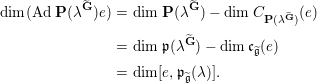 $$\begin{eqnarray}\displaystyle \dim (\text{Ad}\,\mathbf{P}(\unicode[STIX]{x1D706}^{\widetilde{\mathbf{G}}})e) & = & \displaystyle \dim \mathbf{P}(\unicode[STIX]{x1D706}^{\widetilde{\mathbf{G}}})-\dim C_{\mathbf{P}(\unicode[STIX]{x1D706}^{\widetilde{\mathbf{G}}})}(e)\nonumber\\ \displaystyle & = & \displaystyle \dim \mathfrak{p}(\unicode[STIX]{x1D706}^{\widetilde{\mathbf{G}}})-\dim \mathfrak{c}_{\widetilde{\mathfrak{g}}}(e)\nonumber\\ \displaystyle & = & \displaystyle \dim [e,\mathfrak{p}_{\widetilde{\mathfrak{g}}}(\unicode[STIX]{x1D706})].\nonumber\end{eqnarray}$$
Combining this with (b) gives (c). ◻
3.23. To complete this picture we show that rational nilpotent elements are determined by rational cocharacters. Specifically let $F^{\ast }=q\unicode[STIX]{x1D70F}:X(\mathbf{T}_{0})\rightarrow X(\mathbf{T}_{0})$
with
$F^{\ast }=q\unicode[STIX]{x1D70F}:X(\mathbf{T}_{0})\rightarrow X(\mathbf{T}_{0})$
with $\unicode[STIX]{x1D70F}$
a finite order automorphism, see, Theorem 2.3. If
$\unicode[STIX]{x1D70F}$
a finite order automorphism, see, Theorem 2.3. If $F_{q}:\mathbb{G}_{m}\rightarrow \mathbb{G}_{m}$
denotes the Frobenius endomorphism defined by
$F_{q}:\mathbb{G}_{m}\rightarrow \mathbb{G}_{m}$
denotes the Frobenius endomorphism defined by $F_{q}(k)=k^{q}$
then we define an action of
$F_{q}(k)=k^{q}$
then we define an action of $F$
on the set of cocharacters
$F$
on the set of cocharacters $Y(\mathbf{G})$
by setting
$Y(\mathbf{G})$
by setting
 $$\begin{eqnarray}(F\cdot \unicode[STIX]{x1D706})(k)=F(\unicode[STIX]{x1D706}(F_{q}^{-1}(k)))\end{eqnarray}$$
for all $k\in \mathbb{G}_{m}$
and
$k\in \mathbb{G}_{m}$
and $\unicode[STIX]{x1D706}\in Y(\mathbf{G})$
. An easy calculation shows that for any integer
$\unicode[STIX]{x1D706}\in Y(\mathbf{G})$
. An easy calculation shows that for any integer $i\in \mathbb{Z}$
we have
$i\in \mathbb{Z}$
we have
 $$\begin{eqnarray}F(\mathfrak{g}(\unicode[STIX]{x1D706},i))=\mathfrak{g}(F\circ \unicode[STIX]{x1D706},qi)=\mathfrak{g}(F\cdot \unicode[STIX]{x1D706},i).\end{eqnarray}$$
In particular, if $F\cdot \unicode[STIX]{x1D706}=\unicode[STIX]{x1D706}$
then we have
$F\cdot \unicode[STIX]{x1D706}=\unicode[STIX]{x1D706}$
then we have $F(\mathfrak{u}(\unicode[STIX]{x1D706},i))=\mathfrak{u}(\unicode[STIX]{x1D706},i)$
and
$F(\mathfrak{u}(\unicode[STIX]{x1D706},i))=\mathfrak{u}(\unicode[STIX]{x1D706},i)$
and $F(\mathbf{U}(\unicode[STIX]{x1D706},i))=\mathbf{U}(\unicode[STIX]{x1D706},i)$
for any
$F(\mathbf{U}(\unicode[STIX]{x1D706},i))=\mathbf{U}(\unicode[STIX]{x1D706},i)$
for any $i\in \mathbb{Z}_{{>}0}$
.
$i\in \mathbb{Z}_{{>}0}$
.
3.24. It is clear from the definition of the characters $\unicode[STIX]{x1D706}_{d}^{\mathbf{G}}\in {\mathcal{D}}_{\unicode[STIX]{x1D6F7}}(\mathbf{G})$
that we have
$\unicode[STIX]{x1D706}_{d}^{\mathbf{G}}\in {\mathcal{D}}_{\unicode[STIX]{x1D6F7}}(\mathbf{G})$
that we have $F\cdot \unicode[STIX]{x1D706}_{d}^{\mathbf{G}}=\unicode[STIX]{x1D706}_{d\circ \unicode[STIX]{x1D70F}}^{\mathbf{G}}$
. Moreover, the composition
$F\cdot \unicode[STIX]{x1D706}_{d}^{\mathbf{G}}=\unicode[STIX]{x1D706}_{d\circ \unicode[STIX]{x1D70F}}^{\mathbf{G}}$
. Moreover, the composition $d\circ \unicode[STIX]{x1D70F}$
is a weighted Dynkin diagram and so
$d\circ \unicode[STIX]{x1D70F}$
is a weighted Dynkin diagram and so $F\cdot \unicode[STIX]{x1D706}_{d}^{\mathbf{G}}\in {\mathcal{D}}_{\unicode[STIX]{x1D6F7}}(\mathbf{G})$
. This implies that
$F\cdot \unicode[STIX]{x1D706}_{d}^{\mathbf{G}}\in {\mathcal{D}}_{\unicode[STIX]{x1D6F7}}(\mathbf{G})$
. This implies that $F$
stabilizes the sets
$F$
stabilizes the sets ${\mathcal{D}}_{\unicode[STIX]{x1D6F7}}(\mathbf{G})\subseteq {\mathcal{D}}(\mathbf{G})$
. It is in fact known that the bijection
${\mathcal{D}}_{\unicode[STIX]{x1D6F7}}(\mathbf{G})\subseteq {\mathcal{D}}(\mathbf{G})$
. It is in fact known that the bijection ${\mathcal{D}}_{\unicode[STIX]{x1D6F7}}(\mathbf{G})\rightarrow {\mathcal{N}}(\mathfrak{g})/\mathbf{G}$
restricts to a bijection
${\mathcal{D}}_{\unicode[STIX]{x1D6F7}}(\mathbf{G})\rightarrow {\mathcal{N}}(\mathfrak{g})/\mathbf{G}$
restricts to a bijection ${\mathcal{D}}_{\unicode[STIX]{x1D6F7}}(\mathbf{G})^{F}\rightarrow ({\mathcal{N}}(\mathfrak{g})/\mathbf{G})^{F}$
between the
${\mathcal{D}}_{\unicode[STIX]{x1D6F7}}(\mathbf{G})^{F}\rightarrow ({\mathcal{N}}(\mathfrak{g})/\mathbf{G})^{F}$
between the $F$
-fixed cocharacters and the
$F$
-fixed cocharacters and the $F$
-stable nilpotent orbits, although we will not need this here. We will, however, need the following concerning rational cocharacters and rational nilpotent elements.
$F$
-stable nilpotent orbits, although we will not need this here. We will, however, need the following concerning rational cocharacters and rational nilpotent elements.
Lemma 3.25. Assume $e\in {\mathcal{N}}(\mathfrak{g})^{F}$
is an
$e\in {\mathcal{N}}(\mathfrak{g})^{F}$
is an $F$
-fixed nilpotent element then there exists an
$F$
-fixed nilpotent element then there exists an $F$
-fixed cocharacter
$F$
-fixed cocharacter $\unicode[STIX]{x1D706}\in {\mathcal{D}}(\mathbf{G})^{F}$
, unique up to
$\unicode[STIX]{x1D706}\in {\mathcal{D}}(\mathbf{G})^{F}$
, unique up to $G$
-conjugacy, such that
$G$
-conjugacy, such that $e\in \mathfrak{g}(\unicode[STIX]{x1D706},2)_{\text{reg}}$
.
$e\in \mathfrak{g}(\unicode[STIX]{x1D706},2)_{\text{reg}}$
.
Proof. Let ${\mathcal{X}}_{e}$
denote the set of all cocharacters
${\mathcal{X}}_{e}$
denote the set of all cocharacters $\unicode[STIX]{x1D706}\in {\mathcal{D}}(\mathbf{G})$
such that
$\unicode[STIX]{x1D706}\in {\mathcal{D}}(\mathbf{G})$
such that $e\in \mathfrak{g}(\unicode[STIX]{x1D706},2)_{\text{reg}}$
. As any
$e\in \mathfrak{g}(\unicode[STIX]{x1D706},2)_{\text{reg}}$
. As any $\unicode[STIX]{x1D706}\in {\mathcal{X}}_{e}$
is conjugate to a cocharacter of the form
$\unicode[STIX]{x1D706}\in {\mathcal{X}}_{e}$
is conjugate to a cocharacter of the form $\unicode[STIX]{x1D706}_{d}^{\mathbf{G}}$
it follows from [Reference PremetPre2, 2.5] that
$\unicode[STIX]{x1D706}_{d}^{\mathbf{G}}$
it follows from [Reference PremetPre2, 2.5] that $\unicode[STIX]{x1D706}$
is associated to
$\unicode[STIX]{x1D706}$
is associated to $e$
in the sense of [Reference JantzenJan, 5.3, Definition]. We thus have by [Reference JantzenJan, 5.3, Lemma] that the connected centralizer
$e$
in the sense of [Reference JantzenJan, 5.3, Definition]. We thus have by [Reference JantzenJan, 5.3, Lemma] that the connected centralizer $C_{\mathbf{G}}^{\circ }(e)$
of
$C_{\mathbf{G}}^{\circ }(e)$
of $e$
acts transitively on
$e$
acts transitively on ${\mathcal{X}}_{e}$
via
${\mathcal{X}}_{e}$
via $(g,\unicode[STIX]{x1D706})\mapsto \text{Inn}\,g\circ \unicode[STIX]{x1D706}$
. As
$(g,\unicode[STIX]{x1D706})\mapsto \text{Inn}\,g\circ \unicode[STIX]{x1D706}$
. As $F(e)=e$
we have
$F(e)=e$
we have $F$
restricts to a Frobenius endomorphism on
$F$
restricts to a Frobenius endomorphism on $C_{\mathbf{G}}^{\circ }(e)$
. The existence of a fixed point
$C_{\mathbf{G}}^{\circ }(e)$
. The existence of a fixed point $\unicode[STIX]{x1D706}\in {\mathcal{X}}_{e}^{F}$
is a standard application of the Lang–Steinberg theorem, see [Reference GeckGec2, 4.3.2(a)]. The stabilizer of
$\unicode[STIX]{x1D706}\in {\mathcal{X}}_{e}^{F}$
is a standard application of the Lang–Steinberg theorem, see [Reference GeckGec2, 4.3.2(a)]. The stabilizer of $\unicode[STIX]{x1D706}$
is the closed subgroup
$\unicode[STIX]{x1D706}$
is the closed subgroup $C_{\mathbf{G}}^{\circ }(e)\cap \mathbf{L}(\unicode[STIX]{x1D706})$
. One easily concludes from [Reference PremetPre2, 2.3], using similar arguments to those used in the proof of Theorem 3.22, that
$C_{\mathbf{G}}^{\circ }(e)\cap \mathbf{L}(\unicode[STIX]{x1D706})$
. One easily concludes from [Reference PremetPre2, 2.3], using similar arguments to those used in the proof of Theorem 3.22, that $C_{\mathbf{G}}^{\circ }(e)\cap \mathbf{L}(\unicode[STIX]{x1D706})=C_{\mathbf{L}(\unicode[STIX]{x1D706})}^{\circ }(e)$
is connected. Again applying [Reference GeckGec2, 4.3.2(a)] we see that
$C_{\mathbf{G}}^{\circ }(e)\cap \mathbf{L}(\unicode[STIX]{x1D706})=C_{\mathbf{L}(\unicode[STIX]{x1D706})}^{\circ }(e)$
is connected. Again applying [Reference GeckGec2, 4.3.2(a)] we see that $\unicode[STIX]{x1D706}$
is unique up to
$\unicode[STIX]{x1D706}$
is unique up to $G$
-conjugacy.◻
$G$
-conjugacy.◻
3.26. Assume now that $x\in \mathfrak{g}$
is any element of the Lie algebra. Following [Reference SlodowySlo, Section 5.1, p. 60] we say a locally closed subvariety
$x\in \mathfrak{g}$
is any element of the Lie algebra. Following [Reference SlodowySlo, Section 5.1, p. 60] we say a locally closed subvariety $\unicode[STIX]{x1D6F4}\subseteq \mathfrak{g}$
is a transverse slice to
$\unicode[STIX]{x1D6F4}\subseteq \mathfrak{g}$
is a transverse slice to $(\text{Ad}\,\mathbf{G})x$
at
$(\text{Ad}\,\mathbf{G})x$
at $x$
if the following hold:
$x$
if the following hold:
-
(i)
$x\in \unicode[STIX]{x1D6F4}$
; -
(ii) the action map
$\mathbf{G}\times \unicode[STIX]{x1D6F4}\rightarrow \mathfrak{g}$
, defined by
$(g,s)\mapsto \text{Ad}\,g(s)$
, is a smooth morphism; -
(iii)
$\dim \unicode[STIX]{x1D6F4}$
is minimal with respect to (i) and (ii).




Note that we have $\dim \unicode[STIX]{x1D6F4}\geqslant \dim C_{\mathbf{G}}(x)$
with equality if and only if
$\dim \unicode[STIX]{x1D6F4}\geqslant \dim C_{\mathbf{G}}(x)$
with equality if and only if $C_{\mathbf{G}}(x)$
is separable, see, [Reference SlodowySlo, Section 5.1, p. 61]. The following corollary of Theorem 3.22 shows that under some mild restrictions we can always find a transverse slice to a nilpotent orbit. This fact will be used later.
$C_{\mathbf{G}}(x)$
is separable, see, [Reference SlodowySlo, Section 5.1, p. 61]. The following corollary of Theorem 3.22 shows that under some mild restrictions we can always find a transverse slice to a nilpotent orbit. This fact will be used later.
Corollary 3.27. Assume $\mathbf{G}$
is proximate and
$\mathbf{G}$
is proximate and $e\in {\mathcal{N}}(\mathfrak{g})$
is a nilpotent element such that
$e\in {\mathcal{N}}(\mathfrak{g})$
is a nilpotent element such that $C_{\mathbf{G}}(e)$
is separable. For any cocharacter
$C_{\mathbf{G}}(e)$
is separable. For any cocharacter $\unicode[STIX]{x1D706}\in {\mathcal{D}}(\mathbf{G})$
satisfying
$\unicode[STIX]{x1D706}\in {\mathcal{D}}(\mathbf{G})$
satisfying $e\in \mathfrak{g}(\unicode[STIX]{x1D706},2)_{\text{reg}}$
there exists a subspace
$e\in \mathfrak{g}(\unicode[STIX]{x1D706},2)_{\text{reg}}$
there exists a subspace $\mathfrak{s}\subset \mathfrak{g}$
such that the following hold:
$\mathfrak{s}\subset \mathfrak{g}$
such that the following hold:
-
∙
$\mathfrak{g}=\mathfrak{s}\oplus T_{e}(\text{Ad}\,\mathbf{G}(e))$
; -
∙
$\mathfrak{s}$
is stable under the
$\mathbb{G}_{m}$
-action
$(k,x)\mapsto (\text{Ad}\,\unicode[STIX]{x1D706}(k))(x)$
; -
∙
$\mathfrak{s}\subseteq \bigoplus _{i\leqslant 0}\mathfrak{g}(\unicode[STIX]{x1D706},i)$
.




For any such subspace we have $\unicode[STIX]{x1D6F4}=e+\mathfrak{s}$
is a transverse slice to
$\unicode[STIX]{x1D6F4}=e+\mathfrak{s}$
is a transverse slice to $\text{Ad}\,\mathbf{G}(e)$
at
$\text{Ad}\,\mathbf{G}(e)$
at $e$
. Moreover let
$e$
. Moreover let $x\in \unicode[STIX]{x1D6F4}$
be an element whose centralizer
$x\in \unicode[STIX]{x1D6F4}$
be an element whose centralizer $C_{\mathbf{G}}(x)$
is separable then we have
$C_{\mathbf{G}}(x)$
is separable then we have
 $$\begin{eqnarray}T_{x}(\mathfrak{g})=T_{x}(\unicode[STIX]{x1D6F4})+T_{x}(\text{Ad}\,\mathbf{G}(x)).\end{eqnarray}$$
In other words, $\unicode[STIX]{x1D6F4}$
intersects any such
$\unicode[STIX]{x1D6F4}$
intersects any such $\text{Ad}\,\mathbf{G}$
-orbit transversally.
$\text{Ad}\,\mathbf{G}$
-orbit transversally.
Proof. First, as $C_{\mathbf{G}}(e)$
is separable we have
$C_{\mathbf{G}}(e)$
is separable we have $T_{e}(\text{Ad}\,\mathbf{G}(e))=[\mathfrak{g},e]$
by Lemma 3.7 so
$T_{e}(\text{Ad}\,\mathbf{G}(e))=[\mathfrak{g},e]$
by Lemma 3.7 so $T_{e}(\text{Ad}\,\mathbf{G}(e))$
is stable under the
$T_{e}(\text{Ad}\,\mathbf{G}(e))$
is stable under the $\mathbb{G}_{m}$
-action. Hence, one can find a graded, that is,
$\mathbb{G}_{m}$
-action. Hence, one can find a graded, that is, $\mathbb{G}_{m}$
-invariant, complement
$\mathbb{G}_{m}$
-invariant, complement $\mathfrak{s}$
of
$\mathfrak{s}$
of $T_{e}(\text{Ad}\,\mathbf{G}(e))$
in
$T_{e}(\text{Ad}\,\mathbf{G}(e))$
in $\mathfrak{g}$
by simply picking a complement in each graded piece. By Theorem 3.22 we certainly have
$\mathfrak{g}$
by simply picking a complement in each graded piece. By Theorem 3.22 we certainly have $\mathfrak{u}(\unicode[STIX]{x1D706},2)\subseteq [\mathfrak{g},e]$
. Now the map
$\mathfrak{u}(\unicode[STIX]{x1D706},2)\subseteq [\mathfrak{g},e]$
. Now the map $\mathfrak{g}(\unicode[STIX]{x1D706},-1)\rightarrow \mathfrak{g}(\unicode[STIX]{x1D706},1)$
defined by
$\mathfrak{g}(\unicode[STIX]{x1D706},-1)\rightarrow \mathfrak{g}(\unicode[STIX]{x1D706},1)$
defined by $x\mapsto [x,e]$
is injective because
$x\mapsto [x,e]$
is injective because $\mathfrak{g}(\unicode[STIX]{x1D706},-1)\cap \mathfrak{c}_{\mathfrak{g}}(e)=\{0\}$
by Theorem 3.22. However it must also be surjective because
$\mathfrak{g}(\unicode[STIX]{x1D706},-1)\cap \mathfrak{c}_{\mathfrak{g}}(e)=\{0\}$
by Theorem 3.22. However it must also be surjective because $\dim \mathfrak{g}(\unicode[STIX]{x1D706},-1)=\dim \mathfrak{g}(\unicode[STIX]{x1D706},1)$
, see, 5.8. This shows that
$\dim \mathfrak{g}(\unicode[STIX]{x1D706},-1)=\dim \mathfrak{g}(\unicode[STIX]{x1D706},1)$
, see, 5.8. This shows that $\mathfrak{u}(\unicode[STIX]{x1D706},1)\subseteq T_{e}(\text{Ad}\,\mathbf{G}(e))$
and so
$\mathfrak{u}(\unicode[STIX]{x1D706},1)\subseteq T_{e}(\text{Ad}\,\mathbf{G}(e))$
and so $\mathfrak{s}\subseteq \bigoplus _{i\leqslant 0}\mathfrak{g}(\unicode[STIX]{x1D706},i)$
.
$\mathfrak{s}\subseteq \bigoplus _{i\leqslant 0}\mathfrak{g}(\unicode[STIX]{x1D706},i)$
.
Now the set $\unicode[STIX]{x1D6F4}$
is certainly locally closed and has dimension
$\unicode[STIX]{x1D6F4}$
is certainly locally closed and has dimension $\dim C_{\mathbf{G}}(e)$
, so we need only show that the action map
$\dim C_{\mathbf{G}}(e)$
, so we need only show that the action map $\unicode[STIX]{x1D70B}:\mathbf{G}\times \unicode[STIX]{x1D6F4}\rightarrow \mathfrak{g}$
is a smooth morphism. Recall that for a morphism of varieties
$\unicode[STIX]{x1D70B}:\mathbf{G}\times \unicode[STIX]{x1D6F4}\rightarrow \mathfrak{g}$
is a smooth morphism. Recall that for a morphism of varieties $f:\mathbf{X}\rightarrow \mathbf{Y}$
we say
$f:\mathbf{X}\rightarrow \mathbf{Y}$
we say $x\in \mathbf{X}$
is a smooth point of
$x\in \mathbf{X}$
is a smooth point of $f$
if
$f$
if $x$
and
$x$
and $f(x)$
are nonsingular and the differential
$f(x)$
are nonsingular and the differential $d_{x}f:T_{x}\mathbf{X}\rightarrow T_{f(x)}\mathbf{Y}$
is surjective. Now clearly
$d_{x}f:T_{x}\mathbf{X}\rightarrow T_{f(x)}\mathbf{Y}$
is surjective. Now clearly $(1,e)$
is a smooth point of
$(1,e)$
is a smooth point of $\unicode[STIX]{x1D70B}$
because
$\unicode[STIX]{x1D70B}$
because $\mathfrak{g}=\mathfrak{s}\oplus [\mathfrak{g},e]$
. In particular, by [Reference SpringerSpr2, Theorem 4.3.6], we have
$\mathfrak{g}=\mathfrak{s}\oplus [\mathfrak{g},e]$
. In particular, by [Reference SpringerSpr2, Theorem 4.3.6], we have $\unicode[STIX]{x1D70B}$
is dominant and separable and the set
$\unicode[STIX]{x1D70B}$
is dominant and separable and the set $O$
of smooth points of
$O$
of smooth points of $\unicode[STIX]{x1D70B}$
is nonempty and open because
$\unicode[STIX]{x1D70B}$
is nonempty and open because $\mathbf{G}\times \unicode[STIX]{x1D6F4}$
and
$\mathbf{G}\times \unicode[STIX]{x1D6F4}$
and $\mathfrak{g}$
are irreducible. By [Reference HartshorneHar, III, Section 10, 10.4] we then have
$\mathfrak{g}$
are irreducible. By [Reference HartshorneHar, III, Section 10, 10.4] we then have $\unicode[STIX]{x1D70B}$
is a smooth morphism if and only if
$\unicode[STIX]{x1D70B}$
is a smooth morphism if and only if $O=\mathbf{G}\times \unicode[STIX]{x1D6F4}$
because
$O=\mathbf{G}\times \unicode[STIX]{x1D6F4}$
because $\mathbf{G}\times \unicode[STIX]{x1D6F4}$
and
$\mathbf{G}\times \unicode[STIX]{x1D6F4}$
and $\mathfrak{g}$
are nonsingular. To show this we argue as in [Reference SlodowySlo, p. 111].
$\mathfrak{g}$
are nonsingular. To show this we argue as in [Reference SlodowySlo, p. 111].
We define a linear action $\unicode[STIX]{x1D6FC}:\mathbb{G}_{m}\times \mathfrak{g}\rightarrow \mathfrak{g}$
by setting
$\unicode[STIX]{x1D6FC}:\mathbb{G}_{m}\times \mathfrak{g}\rightarrow \mathfrak{g}$
by setting $\unicode[STIX]{x1D6FC}(k,x)=\unicode[STIX]{x1D70C}(k)x$
, where
$\unicode[STIX]{x1D6FC}(k,x)=\unicode[STIX]{x1D70C}(k)x$
, where $\unicode[STIX]{x1D70C}:\mathbb{G}_{m}\rightarrow \text{GL}(\mathfrak{g})$
is defined by
$\unicode[STIX]{x1D70C}:\mathbb{G}_{m}\rightarrow \text{GL}(\mathfrak{g})$
is defined by $\unicode[STIX]{x1D70C}(k)(x)=k^{2}(\text{Ad}\,\unicode[STIX]{x1D706}(k^{-1}))(x)$
for all
$\unicode[STIX]{x1D70C}(k)(x)=k^{2}(\text{Ad}\,\unicode[STIX]{x1D706}(k^{-1}))(x)$
for all $x\in \mathfrak{g}$
and
$x\in \mathfrak{g}$
and $k\in \mathbb{G}_{m}$
. Note that the
$k\in \mathbb{G}_{m}$
. Note that the $\mathbb{G}_{m}$
-action
$\mathbb{G}_{m}$
-action $\unicode[STIX]{x1D70C}$
preserves
$\unicode[STIX]{x1D70C}$
preserves $\mathfrak{s}$
and as
$\mathfrak{s}$
and as $e\in \mathfrak{g}(\unicode[STIX]{x1D706},2)$
we have
$e\in \mathfrak{g}(\unicode[STIX]{x1D706},2)$
we have $\unicode[STIX]{x1D70C}(k)(e+y)=e+\unicode[STIX]{x1D70C}(k)(y)$
for all
$\unicode[STIX]{x1D70C}(k)(e+y)=e+\unicode[STIX]{x1D70C}(k)(y)$
for all $y\in \mathfrak{s}$
. In particular, the restriction of
$y\in \mathfrak{s}$
. In particular, the restriction of $\unicode[STIX]{x1D6FC}$
to
$\unicode[STIX]{x1D6FC}$
to $\mathbb{G}_{m}\times \unicode[STIX]{x1D6F4}$
is a contraction to
$\mathbb{G}_{m}\times \unicode[STIX]{x1D6F4}$
is a contraction to $e$
, see, Remark 3.14. Now we can define an action of the direct product
$e$
, see, Remark 3.14. Now we can define an action of the direct product $\mathbf{G}\times \mathbb{G}_{m}$
on
$\mathbf{G}\times \mathbb{G}_{m}$
on $\mathbf{G}\times \unicode[STIX]{x1D6F4}$
defined by
$\mathbf{G}\times \unicode[STIX]{x1D6F4}$
defined by $(h,k)\cdot (g,x)=(hg\unicode[STIX]{x1D706}(k),\unicode[STIX]{x1D70C}(k)(x))$
and on
$(h,k)\cdot (g,x)=(hg\unicode[STIX]{x1D706}(k),\unicode[STIX]{x1D70C}(k)(x))$
and on $\mathfrak{g}$
defined by
$\mathfrak{g}$
defined by $(h,k)\cdot y=k^{2}\text{Ad}\,h(y)$
. An easy calculation shows that
$(h,k)\cdot y=k^{2}\text{Ad}\,h(y)$
. An easy calculation shows that $\unicode[STIX]{x1D70B}$
is equivariant with respect to these actions. Hence we need only show that
$\unicode[STIX]{x1D70B}$
is equivariant with respect to these actions. Hence we need only show that $O$
meets every
$O$
meets every $\mathbf{G}\times \mathbb{G}_{m}$
-orbit of
$\mathbf{G}\times \mathbb{G}_{m}$
-orbit of $\mathbf{G}\times \unicode[STIX]{x1D6F4}$
. Assume
$\mathbf{G}\times \unicode[STIX]{x1D6F4}$
. Assume $n$
is the minimal integer such that
$n$
is the minimal integer such that $\mathfrak{g}(\unicode[STIX]{x1D706},n)\neq \{0\}$
then it is easy to see that every
$\mathfrak{g}(\unicode[STIX]{x1D706},n)\neq \{0\}$
then it is easy to see that every $\mathbf{G}\times \mathbb{G}_{m}$
-orbit of
$\mathbf{G}\times \mathbb{G}_{m}$
-orbit of $\mathbf{G}\times \unicode[STIX]{x1D6F4}$
contains a set of the form
$\mathbf{G}\times \unicode[STIX]{x1D6F4}$
contains a set of the form
 $$\begin{eqnarray}X_{y}=\left\{\left.\left(1,e+\mathop{\sum }_{i=n}^{0}a_{i}y_{i}\right)\right|a_{i}\in \mathbb{G}_{m}\right\}\end{eqnarray}$$
for some $y_{i}\in \mathfrak{g}(\unicode[STIX]{x1D706},i)$
because
$y_{i}\in \mathfrak{g}(\unicode[STIX]{x1D706},i)$
because $\mathbb{K}$
is algebraically closed and
$\mathbb{K}$
is algebraically closed and $\mathfrak{s}\subseteq \bigoplus _{i\leqslant 0}\mathfrak{g}(\unicode[STIX]{x1D706},i)$
. Now
$\mathfrak{s}\subseteq \bigoplus _{i\leqslant 0}\mathfrak{g}(\unicode[STIX]{x1D706},i)$
. Now $O\cap \overline{X_{y}}$
is a nonempty open set of the closure
$O\cap \overline{X_{y}}$
is a nonempty open set of the closure $\overline{X_{y}}$
because it contains
$\overline{X_{y}}$
because it contains $(1,e)$
, see, Remark 3.14. However as
$(1,e)$
, see, Remark 3.14. However as $\overline{X_{y}}$
is clearly irreducible, as
$\overline{X_{y}}$
is clearly irreducible, as $X_{y}$
is, we must have
$X_{y}$
is, we must have $O\cap X_{y}\neq \emptyset$
because
$O\cap X_{y}\neq \emptyset$
because $X_{y}$
is open in its closure. Thus we have shown that
$X_{y}$
is open in its closure. Thus we have shown that $\unicode[STIX]{x1D70B}$
is smooth.
$\unicode[STIX]{x1D70B}$
is smooth.
We now consider the final point. Embedding $\mathbf{G}$
as a closed subgroup of some
$\mathbf{G}$
as a closed subgroup of some $\text{GL}_{n}(\mathbb{K})$
we may easily compute the differential
$\text{GL}_{n}(\mathbb{K})$
we may easily compute the differential $\text{d}_{(1,x)}\unicode[STIX]{x1D70B}:\mathfrak{g}\oplus T_{x}(\unicode[STIX]{x1D6F4})\rightarrow T_{x}(\mathfrak{g})$
using the framework of dual numbers, see, [Reference BorelBor, AG, 16.2]. Indeed, one readily checks that we have
$\text{d}_{(1,x)}\unicode[STIX]{x1D70B}:\mathfrak{g}\oplus T_{x}(\unicode[STIX]{x1D6F4})\rightarrow T_{x}(\mathfrak{g})$
using the framework of dual numbers, see, [Reference BorelBor, AG, 16.2]. Indeed, one readily checks that we have $\text{d}_{(1,x)}\unicode[STIX]{x1D70B}(g,y)=y+[g,x]$
. Now, by the above we know the differential is surjective so we must have
$\text{d}_{(1,x)}\unicode[STIX]{x1D70B}(g,y)=y+[g,x]$
. Now, by the above we know the differential is surjective so we must have $T_{x}(\mathfrak{g})=T_{x}(\unicode[STIX]{x1D6F4})+[\mathfrak{g},x]$
; so the statement follows from Lemma 3.7.◻
$T_{x}(\mathfrak{g})=T_{x}(\unicode[STIX]{x1D6F4})+[\mathfrak{g},x]$
; so the statement follows from Lemma 3.7.◻
4 Springer isomorphisms and Kawanaka isomorphisms
Definition 4.1. Given any cocharacter $\unicode[STIX]{x1D706}\in Y(\mathbf{G})$
we say an isomorphism
$\unicode[STIX]{x1D706}\in Y(\mathbf{G})$
we say an isomorphism $\unicode[STIX]{x1D713}:\mathbf{U}(\unicode[STIX]{x1D706})\rightarrow \mathfrak{u}(\unicode[STIX]{x1D706})$
is a Kawanaka isomorphism if it commutes with the action of the Frobenius endomorphism and furthermore the following hold:
$\unicode[STIX]{x1D713}:\mathbf{U}(\unicode[STIX]{x1D706})\rightarrow \mathfrak{u}(\unicode[STIX]{x1D706})$
is a Kawanaka isomorphism if it commutes with the action of the Frobenius endomorphism and furthermore the following hold:
-
(K1)
$\unicode[STIX]{x1D713}(\mathbf{U}(\unicode[STIX]{x1D706},2))\subseteq \mathfrak{u}(\unicode[STIX]{x1D706},2)$
; -
(K2)
$\unicode[STIX]{x1D713}(uv)-\unicode[STIX]{x1D713}(u)-\unicode[STIX]{x1D713}(v)\in \mathfrak{u}(\unicode[STIX]{x1D706},i+1)$
for any
$u,v\in \mathbf{U}(\unicode[STIX]{x1D706},i)$
and
$i\in \{1,2\}$
; -
(K3)
$\unicode[STIX]{x1D713}([u,v])-c_{i}[\unicode[STIX]{x1D713}(u),\unicode[STIX]{x1D713}(v)]\in \mathfrak{u}(\unicode[STIX]{x1D706},2i+1)$
for any
$u,v\in \mathbf{U}(\unicode[STIX]{x1D706},i)$
and
$i\in \{1,2\}$
where
$c_{i}\in \mathbb{G}_{m}$
is a constant not depending on
$u$
or
$v$
.







Note that $[u,v]$
denotes the commutator
$[u,v]$
denotes the commutator $uvu^{-1}v^{-1}$
of
$uvu^{-1}v^{-1}$
of $u$
and
$u$
and $v$
.
$v$
.
4.2. Kawanaka isomorphisms will be the crucial ingredient for the definition of generalized Gelfand–Graev representations. In [Reference KawanakaKaw3, Section 3] Kawanaka gave a general construction for a Kawanaka isomorphism. However, the construction he gives is not in general $\mathbf{G}$
-equivariant so cannot be obtained as the restriction of a Springer isomorphism by [Reference McNinchMcN, Remark 10]. In this section we wish to show that there always exists a Springer isomorphism whose restriction to
$\mathbf{G}$
-equivariant so cannot be obtained as the restriction of a Springer isomorphism by [Reference McNinchMcN, Remark 10]. In this section we wish to show that there always exists a Springer isomorphism whose restriction to $\mathbf{U}(\unicode[STIX]{x1D706})$
is a Kawanaka isomorphism for all cocharacters
$\mathbf{U}(\unicode[STIX]{x1D706})$
is a Kawanaka isomorphism for all cocharacters $\unicode[STIX]{x1D706}\in Y(\mathbf{G})$
.
$\unicode[STIX]{x1D706}\in Y(\mathbf{G})$
.
Lemma 4.3. Assume $\mathbf{G}$
is an adjoint simple group of exceptional type then there exists a Springer isomorphism
$\mathbf{G}$
is an adjoint simple group of exceptional type then there exists a Springer isomorphism $\unicode[STIX]{x1D719}_{\text{spr}}:{\mathcal{U}}\rightarrow {\mathcal{N}}$
whose restriction to
$\unicode[STIX]{x1D719}_{\text{spr}}:{\mathcal{U}}\rightarrow {\mathcal{N}}$
whose restriction to $\mathbf{U}(\unicode[STIX]{x1D706})$
is a Kawanaka isomorphism for every cocharacter
$\mathbf{U}(\unicode[STIX]{x1D706})$
is a Kawanaka isomorphism for every cocharacter $\unicode[STIX]{x1D706}\in Y(\mathbf{G})$
.
$\unicode[STIX]{x1D706}\in Y(\mathbf{G})$
.
Proof. As $\mathbf{G}$
is adjoint we have the adjoint representation
$\mathbf{G}$
is adjoint we have the adjoint representation $\text{Ad}:\mathbf{G}\rightarrow \text{GL}(V)$
, with
$\text{Ad}:\mathbf{G}\rightarrow \text{GL}(V)$
, with $V=\mathfrak{g}$
, is faithful and according to [Reference Springer and SteinbergSS, I, Section 5, 5.3] we have
$V=\mathfrak{g}$
, is faithful and according to [Reference Springer and SteinbergSS, I, Section 5, 5.3] we have
 $$\begin{eqnarray}\mathfrak{g}\mathfrak{l}(V)=\text{ad}(\mathfrak{g})\oplus \mathfrak{m},\end{eqnarray}$$
where $\mathfrak{m}$
is an
$\mathfrak{m}$
is an $\text{Ad}\,\mathbf{G}$
-invariant subspace of
$\text{Ad}\,\mathbf{G}$
-invariant subspace of $\mathfrak{g}\mathfrak{l}(V)$
containing
$\mathfrak{g}\mathfrak{l}(V)$
containing $\text{id}_{V}$
. Let
$\text{id}_{V}$
. Let $\unicode[STIX]{x1D70B}:\mathfrak{g}\mathfrak{l}(V)\rightarrow \text{ad}(\mathfrak{g})$
be the natural projection map then according to Bardsley and Richardson the composition
$\unicode[STIX]{x1D70B}:\mathfrak{g}\mathfrak{l}(V)\rightarrow \text{ad}(\mathfrak{g})$
be the natural projection map then according to Bardsley and Richardson the composition $\unicode[STIX]{x1D719}_{\text{spr}}=\text{ad}^{-1}\circ \unicode[STIX]{x1D70B}\circ \text{Ad}$
is a Springer isomorphism whose differential is the identity, see [Reference Bardsley and RichardsonBR, 9.3.4]. Note that this makes sense because we have
$\unicode[STIX]{x1D719}_{\text{spr}}=\text{ad}^{-1}\circ \unicode[STIX]{x1D70B}\circ \text{Ad}$
is a Springer isomorphism whose differential is the identity, see [Reference Bardsley and RichardsonBR, 9.3.4]. Note that this makes sense because we have $\text{GL}(V)\subseteq \mathfrak{g}\mathfrak{l}(V)$
.
$\text{GL}(V)\subseteq \mathfrak{g}\mathfrak{l}(V)$
.
By conjugating we may and will assume that $\mathbf{T}_{0}\leqslant \mathbf{B}_{0}$
are contained in
$\mathbf{T}_{0}\leqslant \mathbf{B}_{0}$
are contained in $\mathbf{P}(\unicode[STIX]{x1D706})$
. For each root
$\mathbf{P}(\unicode[STIX]{x1D706})$
. For each root $\unicode[STIX]{x1D6FC}\in \unicode[STIX]{x1D6F7}$
we choose an isomorphism
$\unicode[STIX]{x1D6FC}\in \unicode[STIX]{x1D6F7}$
we choose an isomorphism $x_{\unicode[STIX]{x1D6FC}}:\mathbb{G}_{a}\rightarrow \mathbf{X}_{\unicode[STIX]{x1D6FC}}$
, where
$x_{\unicode[STIX]{x1D6FC}}:\mathbb{G}_{a}\rightarrow \mathbf{X}_{\unicode[STIX]{x1D6FC}}$
, where $\mathbf{X}_{\unicode[STIX]{x1D6FC}}\leqslant \mathbf{G}$
is the root subgroup corresponding to
$\mathbf{X}_{\unicode[STIX]{x1D6FC}}\leqslant \mathbf{G}$
is the root subgroup corresponding to $\unicode[STIX]{x1D6FC}$
, normalized such that
$\unicode[STIX]{x1D6FC}$
, normalized such that $\text{d}x_{\unicode[STIX]{x1D6FC}}(t)=te_{\unicode[STIX]{x1D6FC}}\in \mathfrak{g}_{\unicode[STIX]{x1D6FC}}$
for all
$\text{d}x_{\unicode[STIX]{x1D6FC}}(t)=te_{\unicode[STIX]{x1D6FC}}\in \mathfrak{g}_{\unicode[STIX]{x1D6FC}}$
for all $t\in \mathbb{G}_{a}$
, see, 3.20. We claim that for any
$t\in \mathbb{G}_{a}$
, see, 3.20. We claim that for any $\unicode[STIX]{x1D6FC}\in \unicode[STIX]{x1D6F7}^{+}$
and
$\unicode[STIX]{x1D6FC}\in \unicode[STIX]{x1D6F7}^{+}$
and $t\in \mathbb{G}_{a}$
we have
$t\in \mathbb{G}_{a}$
we have
 $$\begin{eqnarray}\text{Ad}\,x_{\unicode[STIX]{x1D6FC}}(t)=\text{id}_{V}+t\,\text{ad}\,e_{\unicode[STIX]{x1D6FC}}+t^{2}\frac{(\text{ad}\,e_{\unicode[STIX]{x1D6FC}})^{2}}{2}+t^{3}\frac{(\text{ad}\,e_{\unicode[STIX]{x1D6FC}})^{3}}{6},\end{eqnarray}$$
in fact $(\text{ad}\,e_{\unicode[STIX]{x1D6FC}})^{3}=0$
unless
$(\text{ad}\,e_{\unicode[STIX]{x1D6FC}})^{3}=0$
unless $\mathbf{G}$
is of type
$\mathbf{G}$
is of type $\mathsf{G}_{2}$
. If
$\mathsf{G}_{2}$
. If $\mathbf{G}$
is of type
$\mathbf{G}$
is of type $\mathsf{E}_{n}$
then this follows from the general argument given in [Reference SpringerSpr2, 10.2.7]. If
$\mathsf{E}_{n}$
then this follows from the general argument given in [Reference SpringerSpr2, 10.2.7]. If $\mathbf{G}$
is of type
$\mathbf{G}$
is of type $\mathsf{G}_{2}$
or
$\mathsf{G}_{2}$
or $\mathsf{F}_{4}$
then one can use the implementation of the adjoint representation in [GAP] to check that this holds. Indeed, one can check the order of
$\mathsf{F}_{4}$
then one can use the implementation of the adjoint representation in [GAP] to check that this holds. Indeed, one can check the order of $\text{ad}\,e_{\unicode[STIX]{x1D6FC}}$
and can check that for
$\text{ad}\,e_{\unicode[STIX]{x1D6FC}}$
and can check that for $j\in \{2,3\}$
the matrix
$j\in \{2,3\}$
the matrix $(\text{ad}\,e_{\unicode[STIX]{x1D6FC}})^{j}/j!$
is integer valued, the result then follows as in [Reference CarterCar1, Section 11.3].
$(\text{ad}\,e_{\unicode[STIX]{x1D6FC}})^{j}/j!$
is integer valued, the result then follows as in [Reference CarterCar1, Section 11.3].
Now $\text{Ad}\,g(\text{ad}\,x)=\text{ad}(\text{Ad}\,g(x))$
for all
$\text{Ad}\,g(\text{ad}\,x)=\text{ad}(\text{Ad}\,g(x))$
for all $g\in \mathbf{G}$
and
$g\in \mathbf{G}$
and $x\in \mathfrak{g}$
so we have
$x\in \mathfrak{g}$
so we have $x\in \mathfrak{g}(\unicode[STIX]{x1D706},i)$
if and only if
$x\in \mathfrak{g}(\unicode[STIX]{x1D706},i)$
if and only if $\text{Ad}\,\unicode[STIX]{x1D706}(k)(\text{ad}\,x)=k^{i}\,\text{ad}\,x$
for all
$\text{Ad}\,\unicode[STIX]{x1D706}(k)(\text{ad}\,x)=k^{i}\,\text{ad}\,x$
for all $k\in \mathbb{G}_{m}$
. Let us assume now that
$k\in \mathbb{G}_{m}$
. Let us assume now that $x\in \mathfrak{g}(\unicode[STIX]{x1D706},i)$
and
$x\in \mathfrak{g}(\unicode[STIX]{x1D706},i)$
and $y\in \mathfrak{g}(\unicode[STIX]{x1D706},j)$
. As the action of
$y\in \mathfrak{g}(\unicode[STIX]{x1D706},j)$
. As the action of $\text{Ad}\,\unicode[STIX]{x1D706}(k)$
on
$\text{Ad}\,\unicode[STIX]{x1D706}(k)$
on $\text{ad}\,x$
is given simply by conjugation we have
$\text{ad}\,x$
is given simply by conjugation we have
 $$\begin{eqnarray}\text{Ad}\,\unicode[STIX]{x1D706}(k)(\text{ad}\,x\,\text{ad}\,y)=\text{Ad}\,\unicode[STIX]{x1D706}(k)(\text{ad}\,x)\text{Ad}\,\unicode[STIX]{x1D706}(k)(\text{ad}\,y)=k^{i+j}\,\text{ad}\,x\,\text{ad}\,y.\end{eqnarray}$$
In particular, this implies that
 $$\begin{eqnarray}(\text{ad}^{-1}\circ \unicode[STIX]{x1D70B})(\text{ad}\,x\,\text{ad}\,y)\in \mathfrak{g}(\unicode[STIX]{x1D706},i+j).\end{eqnarray}$$
This could of course simply be 0.
We now wish to show that the restriction of $\unicode[STIX]{x1D719}_{\text{spr}}$
to
$\unicode[STIX]{x1D719}_{\text{spr}}$
to $\mathbf{U}(\unicode[STIX]{x1D706})$
satisfies the properties (K1) to (K3). For this we fix a total ordering
$\mathbf{U}(\unicode[STIX]{x1D706})$
satisfies the properties (K1) to (K3). For this we fix a total ordering $\unicode[STIX]{x1D6FC}_{1},\ldots ,\unicode[STIX]{x1D6FC}_{m}$
on the set of positive roots
$\unicode[STIX]{x1D6FC}_{1},\ldots ,\unicode[STIX]{x1D6FC}_{m}$
on the set of positive roots $\unicode[STIX]{x1D6F7}^{+}$
then, as a variety, we may identify
$\unicode[STIX]{x1D6F7}^{+}$
then, as a variety, we may identify $\mathbf{U}(\unicode[STIX]{x1D706})$
with the product
$\mathbf{U}(\unicode[STIX]{x1D706})$
with the product $\prod _{i=1}^{m}\mathbf{X}_{\unicode[STIX]{x1D6FC}_{i}}$
. In particular, any element
$\prod _{i=1}^{m}\mathbf{X}_{\unicode[STIX]{x1D6FC}_{i}}$
. In particular, any element $u\in \mathbf{U}(\unicode[STIX]{x1D706})$
may be written uniquely as
$u\in \mathbf{U}(\unicode[STIX]{x1D706})$
may be written uniquely as
 $$\begin{eqnarray}u=x_{\unicode[STIX]{x1D6FC}_{1}}(t_{1})\cdots x_{\unicode[STIX]{x1D6FC}_{m}}(t_{m})\end{eqnarray}$$
for some $t_{i}\in \mathbb{G}_{a}$
. By (4.4) we can write
$t_{i}\in \mathbb{G}_{a}$
. By (4.4) we can write $\text{Ad}\,u=\text{Ad}(x_{\unicode[STIX]{x1D6FC}_{1}}(t_{1})\cdots x_{\unicode[STIX]{x1D6FC}_{m}}(t_{m}))=\text{Ad}\,x_{\unicode[STIX]{x1D6FC}_{1}}(t_{1})\cdots \text{Ad}\,x_{\unicode[STIX]{x1D6FC}_{m}}(t_{m})$
as
$\text{Ad}\,u=\text{Ad}(x_{\unicode[STIX]{x1D6FC}_{1}}(t_{1})\cdots x_{\unicode[STIX]{x1D6FC}_{m}}(t_{m}))=\text{Ad}\,x_{\unicode[STIX]{x1D6FC}_{1}}(t_{1})\cdots \text{Ad}\,x_{\unicode[STIX]{x1D6FC}_{m}}(t_{m})$
as
 $$\begin{eqnarray}\text{Ad}\,u=\mathop{\prod }_{i=1}^{m}\left(\text{id}_{V}+t_{i}\,\text{ad}\,e_{\unicode[STIX]{x1D6FC}_{i}}+t_{i}^{2}\frac{(\text{ad}\,e_{\unicode[STIX]{x1D6FC}_{i}})^{2}}{2}+t^{3}\frac{(\text{ad}\,e_{\unicode[STIX]{x1D6FC}_{i}})^{3}}{6}\right).\end{eqnarray}$$
Now assume $u\in \mathbf{U}(\unicode[STIX]{x1D706},2)$
then by definition we must have for each
$u\in \mathbf{U}(\unicode[STIX]{x1D706},2)$
then by definition we must have for each $1\leqslant i\leqslant m$
with
$1\leqslant i\leqslant m$
with $t_{i}\neq 0$
that
$t_{i}\neq 0$
that $e_{\unicode[STIX]{x1D6FC}_{i}}\in \mathfrak{u}(\unicode[STIX]{x1D706},2)$
. Hence, expanding the brackets and applying (4.5) we see that (K1) holds. As
$e_{\unicode[STIX]{x1D6FC}_{i}}\in \mathfrak{u}(\unicode[STIX]{x1D706},2)$
. Hence, expanding the brackets and applying (4.5) we see that (K1) holds. As $u^{-1}=x_{\unicode[STIX]{x1D6FC}_{m}}(-t_{m})\cdots x_{\unicode[STIX]{x1D6FC}_{1}}(-t_{1})$
we see that an entirely similar argument shows that (K2) and (K3) hold. We leave it to the reader to fill in the details.◻
$u^{-1}=x_{\unicode[STIX]{x1D6FC}_{m}}(-t_{m})\cdots x_{\unicode[STIX]{x1D6FC}_{1}}(-t_{1})$
we see that an entirely similar argument shows that (K2) and (K3) hold. We leave it to the reader to fill in the details.◻
Proposition 4.6. Assume $\mathbf{G}$
is a proximate algebraic group then there exists a Springer isomorphism
$\mathbf{G}$
is a proximate algebraic group then there exists a Springer isomorphism $\unicode[STIX]{x1D719}_{\text{spr}}:{\mathcal{U}}\rightarrow {\mathcal{N}}$
whose restriction to
$\unicode[STIX]{x1D719}_{\text{spr}}:{\mathcal{U}}\rightarrow {\mathcal{N}}$
whose restriction to $\mathbf{U}(\unicode[STIX]{x1D706})$
is a Kawanaka isomorphism for every cocharacter
$\mathbf{U}(\unicode[STIX]{x1D706})$
is a Kawanaka isomorphism for every cocharacter $\unicode[STIX]{x1D706}\in Y(\mathbf{G})$
.
$\unicode[STIX]{x1D706}\in Y(\mathbf{G})$
.
Proof. Assume $\mathbf{G}$
is
$\mathbf{G}$
is $\text{SL}(V)$
,
$\text{SL}(V)$
, $\text{Sp}(V)$
or
$\text{Sp}(V)$
or $\text{SO}(V)$
then Kawanaka already observed in [Reference KawanakaKaw2, 1.2] that such a Springer isomorphism exists. If
$\text{SO}(V)$
then Kawanaka already observed in [Reference KawanakaKaw2, 1.2] that such a Springer isomorphism exists. If $\mathbf{G}$
is
$\mathbf{G}$
is $\text{SL}(V)$
then one simply takes the map
$\text{SL}(V)$
then one simply takes the map $f\mapsto f-\text{id}_{V}$
, for which the statement is easy to deduce. If
$f\mapsto f-\text{id}_{V}$
, for which the statement is easy to deduce. If $\mathbf{G}$
is
$\mathbf{G}$
is $\text{Sp}(V)$
or
$\text{Sp}(V)$
or $\text{SO}(V)$
then one can use the Cayley map
$\text{SO}(V)$
then one can use the Cayley map $x\mapsto (f-\text{id}_{V})(f+\text{id}_{V})^{-1}$
. In fact, if
$x\mapsto (f-\text{id}_{V})(f+\text{id}_{V})^{-1}$
. In fact, if $\mathbf{G}$
is
$\mathbf{G}$
is $\text{Sp}(V)$
or
$\text{Sp}(V)$
or $\text{SO}(V)$
then one could argue as in the proof of Lemma 4.3 to deduce the existence of
$\text{SO}(V)$
then one could argue as in the proof of Lemma 4.3 to deduce the existence of $\unicode[STIX]{x1D719}_{\text{spr}}$
but instead replacing the adjoint representation with the natural representation.
$\unicode[STIX]{x1D719}_{\text{spr}}$
but instead replacing the adjoint representation with the natural representation.
Let $\mathbf{G}_{\text{sc}}$
be a simple simply connected algebraic group defined over a field of good characteristic. Then there is a natural surjective separable morphism
$\mathbf{G}_{\text{sc}}$
be a simple simply connected algebraic group defined over a field of good characteristic. Then there is a natural surjective separable morphism $\unicode[STIX]{x1D70B}:\mathbf{G}_{\text{sc}}\rightarrow \mathbf{G}$
of algebraic groups where
$\unicode[STIX]{x1D70B}:\mathbf{G}_{\text{sc}}\rightarrow \mathbf{G}$
of algebraic groups where $\mathbf{G}$
is either
$\mathbf{G}$
is either $\text{SL}(V)$
,
$\text{SL}(V)$
, $\text{Sp}(V)$
,
$\text{Sp}(V)$
, $\text{SO}(V)$
or an adjoint exceptional group. According to Lemma 4.3 and the above remarks there exists a Springer isomorphism
$\text{SO}(V)$
or an adjoint exceptional group. According to Lemma 4.3 and the above remarks there exists a Springer isomorphism $\unicode[STIX]{x1D719}_{\text{spr}}$
of
$\unicode[STIX]{x1D719}_{\text{spr}}$
of $\mathbf{G}$
whose restriction to each
$\mathbf{G}$
whose restriction to each $\mathbf{U}(\unicode[STIX]{x1D706})\leqslant \mathbf{G}$
is a Kawanaka isomorphism. Arguing as in Lemma 3.4 we see that this lifts to a Springer isomorphism on
$\mathbf{U}(\unicode[STIX]{x1D706})\leqslant \mathbf{G}$
is a Kawanaka isomorphism. Arguing as in Lemma 3.4 we see that this lifts to a Springer isomorphism on $\mathbf{G}_{\text{sc}}$
which also has this property. One may now argue as in Lemma 3.4 to show that such a Springer isomorphism exists for all proximate algebraic groups. We leave the details to the reader.◻
$\mathbf{G}_{\text{sc}}$
which also has this property. One may now argue as in Lemma 3.4 to show that such a Springer isomorphism exists for all proximate algebraic groups. We leave the details to the reader.◻
5 Generalized Gelfand–Graev representations
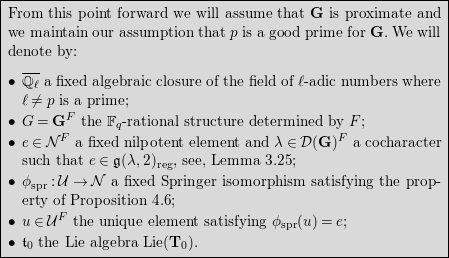
Definition 5.1. (Kawanaka, [Reference KawanakaKaw1, 3.1.4])
An involutive homomorphism $^{\dagger }:\mathfrak{g}\rightarrow \mathfrak{g}$
is called an
$^{\dagger }:\mathfrak{g}\rightarrow \mathfrak{g}$
is called an $\mathbb{F}_{q}$
-opposition automorphism if the following holds:
$\mathbb{F}_{q}$
-opposition automorphism if the following holds:
-
(i)
$\mathfrak{t}_{0}^{\dagger }=\mathfrak{t}_{0}$
; -
(ii)
$e_{\unicode[STIX]{x1D6FC}}^{\dagger }\in \mathbb{F}_{q}e_{-\unicode[STIX]{x1D6FC}}$
for all
$\unicode[STIX]{x1D6FC}\in \unicode[STIX]{x1D6F7}$
where
$e_{\unicode[STIX]{x1D6FC}}\in \mathfrak{g}_{\unicode[STIX]{x1D6FC}}$
is as in 3.19.


Lemma 5.2. The map defined by $t^{\dagger }=-t$
if
$t^{\dagger }=-t$
if $t\in \mathfrak{t}_{0}$
and
$t\in \mathfrak{t}_{0}$
and $e_{\unicode[STIX]{x1D6FC}}^{\dagger }=-e_{-\unicode[STIX]{x1D6FC}}$
for all
$e_{\unicode[STIX]{x1D6FC}}^{\dagger }=-e_{-\unicode[STIX]{x1D6FC}}$
for all $\unicode[STIX]{x1D6FC}\in \unicode[STIX]{x1D6F7}$
is an
$\unicode[STIX]{x1D6FC}\in \unicode[STIX]{x1D6F7}$
is an $\mathbb{F}_{q}$
-opposition automorphism of
$\mathbb{F}_{q}$
-opposition automorphism of $\mathfrak{g}$
.
$\mathfrak{g}$
.
Proof. We only have to show that $^{\dagger }$
is a Lie algebra homomorphism. Recall from 3.20 that
$^{\dagger }$
is a Lie algebra homomorphism. Recall from 3.20 that $\mathfrak{g}_{\text{der}}$
has a Chevalley basis then by [Reference CarterCar1, p. 56] we see that the restriction of
$\mathfrak{g}_{\text{der}}$
has a Chevalley basis then by [Reference CarterCar1, p. 56] we see that the restriction of $^{\dagger }$
to
$^{\dagger }$
to $\mathfrak{g}_{\text{der}}$
is a homomorphism. However this easily implies that
$\mathfrak{g}_{\text{der}}$
is a homomorphism. However this easily implies that $^{\dagger }$
is a homomorphism as
$^{\dagger }$
is a homomorphism as $\mathfrak{g}=\mathfrak{g}_{\text{der}}+\mathfrak{z}(\mathfrak{g})$
and
$\mathfrak{g}=\mathfrak{g}_{\text{der}}+\mathfrak{z}(\mathfrak{g})$
and $\mathfrak{z}(\mathfrak{g})^{\dagger }=\mathfrak{z}(\mathfrak{g})$
, see, 3.6.◻
$\mathfrak{z}(\mathfrak{g})^{\dagger }=\mathfrak{z}(\mathfrak{g})$
, see, 3.6.◻

The following will not be needed until the proof of Lemma 11.16 but it will be convenient to prove this here.
Proposition 5.3. The elements $e$
and
$e$
and $-e^{\dagger }$
are contained in the same
$-e^{\dagger }$
are contained in the same $\mathbf{G}$
-orbit.
$\mathbf{G}$
-orbit.
Proof. For any $\unicode[STIX]{x1D6FC}\in \unicode[STIX]{x1D6F7}$
and
$\unicode[STIX]{x1D6FC}\in \unicode[STIX]{x1D6F7}$
and $t\in \mathbb{G}_{a}$
let us denote by
$t\in \mathbb{G}_{a}$
let us denote by $\overline{x}_{\unicode[STIX]{x1D6FC}}(t)$
the element
$\overline{x}_{\unicode[STIX]{x1D6FC}}(t)$
the element $\text{Ad}\,x_{\unicode[STIX]{x1D6FC}}(t)$
then
$\text{Ad}\,x_{\unicode[STIX]{x1D6FC}}(t)$
then $\{\overline{x}_{\unicode[STIX]{x1D6FC}}(t)\mid \unicode[STIX]{x1D6FC}\in \unicode[STIX]{x1D6F7},t\in \mathbb{G}_{a}\}$
is a generating set for
$\{\overline{x}_{\unicode[STIX]{x1D6FC}}(t)\mid \unicode[STIX]{x1D6FC}\in \unicode[STIX]{x1D6F7},t\in \mathbb{G}_{a}\}$
is a generating set for $\text{Ad}\,\mathbf{G}$
; here
$\text{Ad}\,\mathbf{G}$
; here $x_{\unicode[STIX]{x1D6FC}}(t)$
is defined as in the proof of Lemma 4.3. Furthermore, for each
$x_{\unicode[STIX]{x1D6FC}}(t)$
is defined as in the proof of Lemma 4.3. Furthermore, for each $\unicode[STIX]{x1D6FC}\in \unicode[STIX]{x1D6F7}$
we denote by
$\unicode[STIX]{x1D6FC}\in \unicode[STIX]{x1D6F7}$
we denote by $\unicode[STIX]{x1D6FE}_{\unicode[STIX]{x1D6FC}}\in \mathbb{F}_{q}^{\times }$
the scalar such that
$\unicode[STIX]{x1D6FE}_{\unicode[STIX]{x1D6FC}}\in \mathbb{F}_{q}^{\times }$
the scalar such that $e_{\unicode[STIX]{x1D6FC}}^{\dagger }=\unicode[STIX]{x1D6FE}_{\unicode[STIX]{x1D6FC}}e_{-\unicode[STIX]{x1D6FC}}$
. As in the proof of [Reference CarterCar1, Proposition 12.2.3] let
$e_{\unicode[STIX]{x1D6FC}}^{\dagger }=\unicode[STIX]{x1D6FE}_{\unicode[STIX]{x1D6FC}}e_{-\unicode[STIX]{x1D6FC}}$
. As in the proof of [Reference CarterCar1, Proposition 12.2.3] let $\unicode[STIX]{x1D703}:\text{Ad}\,\mathbf{G}\rightarrow \text{Ad}\,\mathbf{G}$
be the automorphism defined by
$\unicode[STIX]{x1D703}:\text{Ad}\,\mathbf{G}\rightarrow \text{Ad}\,\mathbf{G}$
be the automorphism defined by $\unicode[STIX]{x1D703}(\overline{x}_{\unicode[STIX]{x1D6FC}}(t))=\overline{x}_{-\unicode[STIX]{x1D6FC}}(\unicode[STIX]{x1D6FE}_{\unicode[STIX]{x1D6FC}}t)$
for all
$\unicode[STIX]{x1D703}(\overline{x}_{\unicode[STIX]{x1D6FC}}(t))=\overline{x}_{-\unicode[STIX]{x1D6FC}}(\unicode[STIX]{x1D6FE}_{\unicode[STIX]{x1D6FC}}t)$
for all $\unicode[STIX]{x1D6FC}\in \unicode[STIX]{x1D6F7}$
and
$\unicode[STIX]{x1D6FC}\in \unicode[STIX]{x1D6F7}$
and $t\in \mathbb{G}_{a}$
then we have
$t\in \mathbb{G}_{a}$
then we have
 $$\begin{eqnarray}\text{Ad}\,g(x^{\dagger })=\unicode[STIX]{x1D703}(\text{Ad}\,g)(x)^{\dagger }\end{eqnarray}$$
for all $g\in \mathbf{G}$
and
$g\in \mathbf{G}$
and $x\in \mathfrak{g}$
.
$x\in \mathfrak{g}$
.
By [Reference JantzenJan, 2.10, Lemma] we see that it is sufficient to show that $e$
and
$e$
and $e^{\dagger }$
are in the same
$e^{\dagger }$
are in the same $\mathbf{G}$
-orbit. Let us denote by
$\mathbf{G}$
-orbit. Let us denote by ${\dot{w}}_{0}\in N_{\mathbf{G}}(\mathbf{T}_{0})$
a representative for the longest element
${\dot{w}}_{0}\in N_{\mathbf{G}}(\mathbf{T}_{0})$
a representative for the longest element $w_{0}\in W_{\mathbf{G}}(\mathbf{T}_{0})$
. The action of
$w_{0}\in W_{\mathbf{G}}(\mathbf{T}_{0})$
. The action of $-w_{0}$
on
$-w_{0}$
on $\unicode[STIX]{x1D6F7}$
induces a permutation
$\unicode[STIX]{x1D6F7}$
induces a permutation $\unicode[STIX]{x1D70C}:\unicode[STIX]{x1D6F7}\rightarrow \unicode[STIX]{x1D6F7}$
on the roots which is known to satisfy
$\unicode[STIX]{x1D70C}:\unicode[STIX]{x1D6F7}\rightarrow \unicode[STIX]{x1D6F7}$
on the roots which is known to satisfy $\langle \unicode[STIX]{x1D6FC},\unicode[STIX]{x1D706}\rangle =\langle \unicode[STIX]{x1D70C}(\unicode[STIX]{x1D6FC}),\unicode[STIX]{x1D706}\rangle$
for all
$\langle \unicode[STIX]{x1D6FC},\unicode[STIX]{x1D706}\rangle =\langle \unicode[STIX]{x1D70C}(\unicode[STIX]{x1D6FC}),\unicode[STIX]{x1D706}\rangle$
for all $\unicode[STIX]{x1D6FC}\in \unicode[STIX]{x1D6F7}$
. To see this it suffices to observe that the weighted Dynkin diagrams of
$\unicode[STIX]{x1D6FC}\in \unicode[STIX]{x1D6F7}$
. To see this it suffices to observe that the weighted Dynkin diagrams of $\mathsf{A}_{n}$
,
$\mathsf{A}_{n}$
, $\mathsf{D}_{2n+1}$
and
$\mathsf{D}_{2n+1}$
and $\mathsf{E}_{6}$
are invariant under the graph automorphism induced by
$\mathsf{E}_{6}$
are invariant under the graph automorphism induced by $w_{0}$
, which is easily checked by inspecting [Reference CarterCar2, Section 13.1]. In particular, it follows that
$w_{0}$
, which is easily checked by inspecting [Reference CarterCar2, Section 13.1]. In particular, it follows that $\text{Ad}\,{\dot{w}}_{0}(e^{\dagger })\in \mathfrak{g}(\unicode[STIX]{x1D706},2)$
,
$\text{Ad}\,{\dot{w}}_{0}(e^{\dagger })\in \mathfrak{g}(\unicode[STIX]{x1D706},2)$
, $\unicode[STIX]{x1D703}(\text{Ad}\,\mathbf{L}(\unicode[STIX]{x1D706}))=\text{Ad}\,\mathbf{L}(\unicode[STIX]{x1D706})$
and
$\unicode[STIX]{x1D703}(\text{Ad}\,\mathbf{L}(\unicode[STIX]{x1D706}))=\text{Ad}\,\mathbf{L}(\unicode[STIX]{x1D706})$
and $\text{Ad}\,{\dot{w}}_{0}$
normalizes
$\text{Ad}\,{\dot{w}}_{0}$
normalizes $\text{Ad}\,\mathbf{L}(\unicode[STIX]{x1D706})$
. Combining this with (5.4) we see that
$\text{Ad}\,\mathbf{L}(\unicode[STIX]{x1D706})$
. Combining this with (5.4) we see that
 $$\begin{eqnarray}\text{Ad}\,\mathbf{L}(\unicode[STIX]{x1D706})(\text{Ad}\,{\dot{w}}_{0}(e^{\dagger }))=\text{Ad}\,{\dot{w}}_{0}(\text{Ad}\,\mathbf{L}(\unicode[STIX]{x1D706})(e)^{\dagger }).\end{eqnarray}$$
As the orbit $\text{Ad}\,\mathbf{L}(\unicode[STIX]{x1D706})(e)$
is dense in
$\text{Ad}\,\mathbf{L}(\unicode[STIX]{x1D706})(e)$
is dense in $\mathfrak{g}(\unicode[STIX]{x1D706},2)$
we must have
$\mathfrak{g}(\unicode[STIX]{x1D706},2)$
we must have $\text{Ad}\,\mathbf{L}(\unicode[STIX]{x1D706})(\text{Ad}\,{\dot{w}}_{0}(e^{\dagger }))$
is dense in
$\text{Ad}\,\mathbf{L}(\unicode[STIX]{x1D706})(\text{Ad}\,{\dot{w}}_{0}(e^{\dagger }))$
is dense in $\mathfrak{g}(\unicode[STIX]{x1D706},2)$
so
$\mathfrak{g}(\unicode[STIX]{x1D706},2)$
so $\text{Ad}\,{\dot{w}}_{0}(e^{\dagger })\in \mathfrak{g}(\unicode[STIX]{x1D706},2)_{\text{reg}}$
. The statement now follows from Theorem 3.22.◻
$\text{Ad}\,{\dot{w}}_{0}(e^{\dagger })\in \mathfrak{g}(\unicode[STIX]{x1D706},2)_{\text{reg}}$
. The statement now follows from Theorem 3.22.◻
5.5. We now proceed to define GGGRs following [Reference KawanakaKaw3, Section 3]. Note that all results in this section are due to Kawanaka. Recall that the definition of GGGRs requires the choice of a $\mathbf{G}$
-invariant symmetric bilinear form
$\mathbf{G}$
-invariant symmetric bilinear form $\unicode[STIX]{x1D705}:\mathfrak{g}\times \mathfrak{g}\rightarrow \mathbb{K}$
. Here, the
$\unicode[STIX]{x1D705}:\mathfrak{g}\times \mathfrak{g}\rightarrow \mathbb{K}$
. Here, the $\mathbf{G}$
-invariance means
$\mathbf{G}$
-invariance means $\unicode[STIX]{x1D705}(\text{Ad}\,g(x),\text{Ad}\,g(y))=\unicode[STIX]{x1D705}(x,y)$
for all
$\unicode[STIX]{x1D705}(\text{Ad}\,g(x),\text{Ad}\,g(y))=\unicode[STIX]{x1D705}(x,y)$
for all $x,y\in \mathfrak{g}$
and
$x,y\in \mathfrak{g}$
and $g\in \mathbf{G}$
. Such a form can be obtained as a trace form
$g\in \mathbf{G}$
. Such a form can be obtained as a trace form
 $$\begin{eqnarray}(x,y)\mapsto \text{Tr}(\text{d}\unicode[STIX]{x1D70F}(x)\circ \text{d}\unicode[STIX]{x1D70F}(y))\end{eqnarray}$$
where $\unicode[STIX]{x1D70F}:\mathbf{G}\rightarrow \text{GL}(V)$
is a finite dimensional rational representation. For convenience we recall that such a form satisfies the property
$\unicode[STIX]{x1D70F}:\mathbf{G}\rightarrow \text{GL}(V)$
is a finite dimensional rational representation. For convenience we recall that such a form satisfies the property
 $$\begin{eqnarray}\unicode[STIX]{x1D705}(x,[y,z])=\unicode[STIX]{x1D705}([x,y],z)\end{eqnarray}$$
for all $x,y,z\in \mathfrak{g}$
, which we will use without explicit mention. It is important to note that, even with the assumption that
$x,y,z\in \mathfrak{g}$
, which we will use without explicit mention. It is important to note that, even with the assumption that $\mathbf{G}$
is proximate, we cannot always choose
$\mathbf{G}$
is proximate, we cannot always choose $\unicode[STIX]{x1D705}$
to be nondegenerate, see [Reference LetellierLet, Proposition 2.5.10]. However, we can choose it so that it is not too degenerate.
$\unicode[STIX]{x1D705}$
to be nondegenerate, see [Reference LetellierLet, Proposition 2.5.10]. However, we can choose it so that it is not too degenerate.
Lemma 5.6. There exists a form $\unicode[STIX]{x1D705}$
on
$\unicode[STIX]{x1D705}$
on $\mathfrak{g}$
defined over
$\mathfrak{g}$
defined over $\mathbb{F}_{q}$
such that, for all
$\mathbb{F}_{q}$
such that, for all $\unicode[STIX]{x1D6FC}\in \unicode[STIX]{x1D6F7}$
, we have
$\unicode[STIX]{x1D6FC}\in \unicode[STIX]{x1D6F7}$
, we have
 $$\begin{eqnarray}\mathfrak{g}_{\unicode[STIX]{x1D6FC}}^{\bot }=\mathfrak{t}_{0}\oplus \mathop{\bigoplus }_{\unicode[STIX]{x1D6FD}\in \unicode[STIX]{x1D6F7}\smallsetminus \{-\unicode[STIX]{x1D6FC}\}}\mathfrak{g}_{\unicode[STIX]{x1D6FD}}\end{eqnarray}$$
where $\mathfrak{g}_{\unicode[STIX]{x1D6FC}}^{\bot }=\{x\in \mathfrak{g}\mid \unicode[STIX]{x1D705}(x,y)=0~\text{for all}~y\in \mathfrak{g}_{\unicode[STIX]{x1D6FC}}\}$
.
$\mathfrak{g}_{\unicode[STIX]{x1D6FC}}^{\bot }=\{x\in \mathfrak{g}\mid \unicode[STIX]{x1D705}(x,y)=0~\text{for all}~y\in \mathfrak{g}_{\unicode[STIX]{x1D6FC}}\}$
.
Proof. Let $\unicode[STIX]{x1D719}:\mathbf{G}\rightarrow \mathbf{G}_{\text{ad}}$
be an adjoint quotient of
$\unicode[STIX]{x1D719}:\mathbf{G}\rightarrow \mathbf{G}_{\text{ad}}$
be an adjoint quotient of $\mathbf{G}$
. As
$\mathbf{G}$
. As $\mathbf{G}_{\text{ad}}$
is an adjoint group it is a direct product of simple adjoint groups
$\mathbf{G}_{\text{ad}}$
is an adjoint group it is a direct product of simple adjoint groups $\mathbf{G}_{1}\times \cdots \times \mathbf{G}_{r}$
so
$\mathbf{G}_{1}\times \cdots \times \mathbf{G}_{r}$
so $\mathfrak{g}_{\text{ad}}=\mathfrak{g}_{1}\oplus \cdots \oplus \mathfrak{g}_{r}$
where
$\mathfrak{g}_{\text{ad}}=\mathfrak{g}_{1}\oplus \cdots \oplus \mathfrak{g}_{r}$
where $\mathfrak{g}_{i}=\text{Lie}(\mathbf{G}_{i})$
. If
$\mathfrak{g}_{i}=\text{Lie}(\mathbf{G}_{i})$
. If $\mathbf{G}_{i}$
is not of type
$\mathbf{G}_{i}$
is not of type $\mathsf{A}_{n}$
then there exists a nondegenerate
$\mathsf{A}_{n}$
then there exists a nondegenerate $\mathbf{G}_{i}$
-invariant symmetric bilinear form
$\mathbf{G}_{i}$
-invariant symmetric bilinear form $\unicode[STIX]{x1D705}_{i}$
on
$\unicode[STIX]{x1D705}_{i}$
on $\mathfrak{g}_{i}$
defined over
$\mathfrak{g}_{i}$
defined over $\mathbb{F}_{q}$
, see [Reference Springer and SteinbergSS, I, 5.3]. Using [Reference LetellierLet, 2.5.1(2)] we can deduce that the appropriate version of (5.7) holds for
$\mathbb{F}_{q}$
, see [Reference Springer and SteinbergSS, I, 5.3]. Using [Reference LetellierLet, 2.5.1(2)] we can deduce that the appropriate version of (5.7) holds for $\unicode[STIX]{x1D705}_{i}$
by dimension counting.
$\unicode[STIX]{x1D705}_{i}$
by dimension counting.
Now assume $\mathbf{G}_{i}$
is of type
$\mathbf{G}_{i}$
is of type $\mathsf{A}_{n}$
then
$\mathsf{A}_{n}$
then $\mathbf{G}_{i}\cong \text{PGL}_{n+1}(\mathbb{K})$
for some
$\mathbf{G}_{i}\cong \text{PGL}_{n+1}(\mathbb{K})$
for some $n$
and we set
$n$
and we set $\widetilde{\mathbf{G}}_{i}=\text{GL}_{n+1}(\mathbb{K})$
and
$\widetilde{\mathbf{G}}_{i}=\text{GL}_{n+1}(\mathbb{K})$
and $\widetilde{\mathfrak{g}}_{i}=\mathfrak{g}\mathfrak{l}_{n+1}(\mathbb{K})=\text{Lie}(\widetilde{\mathbf{G}}_{i})$
. As the natural trace form
$\widetilde{\mathfrak{g}}_{i}=\mathfrak{g}\mathfrak{l}_{n+1}(\mathbb{K})=\text{Lie}(\widetilde{\mathbf{G}}_{i})$
. As the natural trace form $\widetilde{\unicode[STIX]{x1D705}}_{i}(x,y)=\text{Tr}(xy)$
is nondegenerate on
$\widetilde{\unicode[STIX]{x1D705}}_{i}(x,y)=\text{Tr}(xy)$
is nondegenerate on $\widetilde{\mathfrak{g}}_{i}$
and defined over
$\widetilde{\mathfrak{g}}_{i}$
and defined over $\mathbb{F}_{q}$
we have (5.7) holds in
$\mathbb{F}_{q}$
we have (5.7) holds in $\widetilde{\mathfrak{g}}_{i}$
. According to [Reference LetellierLet, 2.3.1] we have an isomorphism of Lie algebras
$\widetilde{\mathfrak{g}}_{i}$
. According to [Reference LetellierLet, 2.3.1] we have an isomorphism of Lie algebras $\widetilde{\mathfrak{g}}_{i}\cong \text{Lie}(Z^{\circ }(\widetilde{\mathbf{G}}_{i}))\oplus \mathfrak{g}_{i}$
. Through this isomorphism we may define a
$\widetilde{\mathfrak{g}}_{i}\cong \text{Lie}(Z^{\circ }(\widetilde{\mathbf{G}}_{i}))\oplus \mathfrak{g}_{i}$
. Through this isomorphism we may define a $\mathbf{G}_{i}$
-invariant symmetric bilinear form
$\mathbf{G}_{i}$
-invariant symmetric bilinear form $\unicode[STIX]{x1D705}_{i}$
on
$\unicode[STIX]{x1D705}_{i}$
on $\mathfrak{g}_{i}$
by restricting
$\mathfrak{g}_{i}$
by restricting $\widetilde{\unicode[STIX]{x1D705}}_{i}$
but this is not necessarily nondegenerate. As the image of each root space under this isomorphism must be contained in
$\widetilde{\unicode[STIX]{x1D705}}_{i}$
but this is not necessarily nondegenerate. As the image of each root space under this isomorphism must be contained in $\mathfrak{g}_{i}$
we see that (5.7) holds for
$\mathfrak{g}_{i}$
we see that (5.7) holds for $\unicode[STIX]{x1D705}_{i}$
.
$\unicode[STIX]{x1D705}_{i}$
.
We now set $\unicode[STIX]{x1D705}_{\text{ad}}=\unicode[STIX]{x1D705}_{1}+\cdots +\unicode[STIX]{x1D705}_{r}$
and define
$\unicode[STIX]{x1D705}_{\text{ad}}=\unicode[STIX]{x1D705}_{1}+\cdots +\unicode[STIX]{x1D705}_{r}$
and define $\unicode[STIX]{x1D705}$
by setting
$\unicode[STIX]{x1D705}$
by setting $\unicode[STIX]{x1D705}(x,y)=\unicode[STIX]{x1D705}_{\text{ad}}(\text{d}\unicode[STIX]{x1D719}(x),\text{d}\unicode[STIX]{x1D719}(y))$
. Clearly this is
$\unicode[STIX]{x1D705}(x,y)=\unicode[STIX]{x1D705}_{\text{ad}}(\text{d}\unicode[STIX]{x1D719}(x),\text{d}\unicode[STIX]{x1D719}(y))$
. Clearly this is $\mathbf{G}$
-invariant and we see that (5.7) holds by noticing that
$\mathbf{G}$
-invariant and we see that (5.7) holds by noticing that $\text{Ker}(\text{d}\unicode[STIX]{x1D719})$
is contained in
$\text{Ker}(\text{d}\unicode[STIX]{x1D719})$
is contained in $\mathfrak{t}_{0}$
.◻
$\mathfrak{t}_{0}$
.◻

5.8. If $\mathfrak{h}$
is a Lie algebra over
$\mathfrak{h}$
is a Lie algebra over $\mathbb{K}$
then we will denote by
$\mathbb{K}$
then we will denote by $\mathfrak{h}^{\ast }=\text{Hom}(\mathfrak{h},\mathbb{K})$
the dual space. Assume now that
$\mathfrak{h}^{\ast }=\text{Hom}(\mathfrak{h},\mathbb{K})$
the dual space. Assume now that $i\neq 0$
and
$i\neq 0$
and $\mathfrak{g}_{\unicode[STIX]{x1D6FC}}\subseteq \mathfrak{g}(\unicode[STIX]{x1D706},i)$
then clearly we have
$\mathfrak{g}_{\unicode[STIX]{x1D6FC}}\subseteq \mathfrak{g}(\unicode[STIX]{x1D706},i)$
then clearly we have $\mathfrak{g}(\unicode[STIX]{x1D706},i)^{\bot }\subseteq \mathfrak{g}_{\unicode[STIX]{x1D6FC}}^{\bot }$
. In particular, applying (5.7) we see that
$\mathfrak{g}(\unicode[STIX]{x1D706},i)^{\bot }\subseteq \mathfrak{g}_{\unicode[STIX]{x1D6FC}}^{\bot }$
. In particular, applying (5.7) we see that $\mathfrak{g}(\unicode[STIX]{x1D706},i)^{\bot }\cap \mathfrak{g}(\unicode[STIX]{x1D706},-i)=\{0\}$
because
$\mathfrak{g}(\unicode[STIX]{x1D706},i)^{\bot }\cap \mathfrak{g}(\unicode[STIX]{x1D706},-i)=\{0\}$
because $\mathfrak{g}_{\unicode[STIX]{x1D6FC}}\subseteq \mathfrak{g}(\unicode[STIX]{x1D706},i)$
if and only if
$\mathfrak{g}_{\unicode[STIX]{x1D6FC}}\subseteq \mathfrak{g}(\unicode[STIX]{x1D706},i)$
if and only if $\mathfrak{g}_{-\unicode[STIX]{x1D6FC}}\subseteq \mathfrak{g}(\unicode[STIX]{x1D706},-i)$
. With this we see that the map
$\mathfrak{g}_{-\unicode[STIX]{x1D6FC}}\subseteq \mathfrak{g}(\unicode[STIX]{x1D706},-i)$
. With this we see that the map $x\mapsto \unicode[STIX]{x1D705}(x,-)$
gives an identification of
$x\mapsto \unicode[STIX]{x1D705}(x,-)$
gives an identification of $\mathfrak{g}(\unicode[STIX]{x1D706},-i)=\mathfrak{g}(\unicode[STIX]{x1D706},i)^{\dagger }$
with the dual space
$\mathfrak{g}(\unicode[STIX]{x1D706},-i)=\mathfrak{g}(\unicode[STIX]{x1D706},i)^{\dagger }$
with the dual space $\mathfrak{g}(\unicode[STIX]{x1D706},i)^{\ast }$
.
$\mathfrak{g}(\unicode[STIX]{x1D706},i)^{\ast }$
.
Lemma 5.9. (Kawanaka)
The skew-symmetric bilinear form $\mathfrak{g}(\unicode[STIX]{x1D706},1)\times \mathfrak{g}(\unicode[STIX]{x1D706},1)\rightarrow \mathbb{K}$
given by
$\mathfrak{g}(\unicode[STIX]{x1D706},1)\times \mathfrak{g}(\unicode[STIX]{x1D706},1)\rightarrow \mathbb{K}$
given by $(x,y)\mapsto \unicode[STIX]{x1D705}(e^{\dagger },[x,y])$
is nondegenerate.
$(x,y)\mapsto \unicode[STIX]{x1D705}(e^{\dagger },[x,y])$
is nondegenerate.
Proof. Assume $x\in \mathfrak{g}(\unicode[STIX]{x1D706},1)$
and
$x\in \mathfrak{g}(\unicode[STIX]{x1D706},1)$
and $\unicode[STIX]{x1D705}(e^{\dagger },[x,y])=\unicode[STIX]{x1D705}([e^{\dagger },x],y)=0$
for all
$\unicode[STIX]{x1D705}(e^{\dagger },[x,y])=\unicode[STIX]{x1D705}([e^{\dagger },x],y)=0$
for all $y\in \mathfrak{g}(\unicode[STIX]{x1D706},1)$
. As
$y\in \mathfrak{g}(\unicode[STIX]{x1D706},1)$
. As $[e^{\dagger },x]\in \mathfrak{g}(\unicode[STIX]{x1D706},-1)$
we must have
$[e^{\dagger },x]\in \mathfrak{g}(\unicode[STIX]{x1D706},-1)$
we must have $[e^{\dagger },x]=0$
by 5.8 but this implies
$[e^{\dagger },x]=0$
by 5.8 but this implies $x=0$
because
$x=0$
because $x\in \mathfrak{c}_{\mathfrak{u}(\unicode[STIX]{x1D706})}(e^{\dagger })=\mathfrak{c}_{\mathfrak{g}}(e)^{\dagger }\cap \mathfrak{u}(\unicode[STIX]{x1D706})=\{0\}$
, see Theorem 3.22.◻
$x\in \mathfrak{c}_{\mathfrak{u}(\unicode[STIX]{x1D706})}(e^{\dagger })=\mathfrak{c}_{\mathfrak{g}}(e)^{\dagger }\cap \mathfrak{u}(\unicode[STIX]{x1D706})=\{0\}$
, see Theorem 3.22.◻
5.10. We now choose once and for all a nontrivial additive character $\unicode[STIX]{x1D712}_{p}:\mathbb{F}_{p}^{+}\rightarrow \overline{\mathbb{Q}_{\ell }}^{\times }$
of the finite field
$\unicode[STIX]{x1D712}_{p}:\mathbb{F}_{p}^{+}\rightarrow \overline{\mathbb{Q}_{\ell }}^{\times }$
of the finite field $\mathbb{F}_{p}$
viewed as an additive group. If
$\mathbb{F}_{p}$
viewed as an additive group. If $r\in \mathbb{Z}_{{>}1}$
is an integral power of
$r\in \mathbb{Z}_{{>}1}$
is an integral power of $p$
then we denote by
$p$
then we denote by $\mathbb{F}_{r}\subseteq \mathbb{K}$
the subfield fixed by
$\mathbb{F}_{r}\subseteq \mathbb{K}$
the subfield fixed by $x\mapsto x^{r}$
. The choice of
$x\mapsto x^{r}$
. The choice of $\unicode[STIX]{x1D712}_{p}$
gives rise to a character
$\unicode[STIX]{x1D712}_{p}$
gives rise to a character $\unicode[STIX]{x1D712}_{r}:\mathbb{F}_{r}^{+}\rightarrow \overline{\mathbb{Q}_{\ell }}^{\times }$
by setting
$\unicode[STIX]{x1D712}_{r}:\mathbb{F}_{r}^{+}\rightarrow \overline{\mathbb{Q}_{\ell }}^{\times }$
by setting $\unicode[STIX]{x1D712}_{r}=\unicode[STIX]{x1D712}_{p}\circ \text{Tr}_{\mathbb{F}_{r}/\mathbb{F}_{p}}$
where
$\unicode[STIX]{x1D712}_{r}=\unicode[STIX]{x1D712}_{p}\circ \text{Tr}_{\mathbb{F}_{r}/\mathbb{F}_{p}}$
where $\text{Tr}_{\mathbb{F}_{r}/\mathbb{F}_{p}}$
is the field trace. As
$\text{Tr}_{\mathbb{F}_{r}/\mathbb{F}_{p}}$
is the field trace. As $\unicode[STIX]{x1D706}\in {\mathcal{D}}(\mathbf{G})^{F}$
is
$\unicode[STIX]{x1D706}\in {\mathcal{D}}(\mathbf{G})^{F}$
is $F$
-fixed we have
$F$
-fixed we have $F(\mathbf{U}(\unicode[STIX]{x1D706},2))=\mathbf{U}(\unicode[STIX]{x1D706},2)$
, see, 3.23. Moreover, as
$F(\mathbf{U}(\unicode[STIX]{x1D706},2))=\mathbf{U}(\unicode[STIX]{x1D706},2)$
, see, 3.23. Moreover, as $\unicode[STIX]{x1D719}_{\text{spr}}$
satisfies (K2) we obtain a linear character
$\unicode[STIX]{x1D719}_{\text{spr}}$
satisfies (K2) we obtain a linear character $\unicode[STIX]{x1D711}_{u}:U(\unicode[STIX]{x1D706},2)\rightarrow \overline{\mathbb{Q}_{\ell }}^{\times }$
by setting
$\unicode[STIX]{x1D711}_{u}:U(\unicode[STIX]{x1D706},2)\rightarrow \overline{\mathbb{Q}_{\ell }}^{\times }$
by setting
 $$\begin{eqnarray}\unicode[STIX]{x1D711}_{u}(x)=\unicode[STIX]{x1D712}_{q}(\unicode[STIX]{x1D705}(e^{\dagger },\unicode[STIX]{x1D719}_{\text{spr}}(x))).\end{eqnarray}$$
5.11. We could now induce the character $\unicode[STIX]{x1D711}_{u}$
to
$\unicode[STIX]{x1D711}_{u}$
to $G$
to obtain a character of
$G$
to obtain a character of $G$
but this turns out not to be the right idea. Instead we construct an intermediary subgroup as follows. The nondegeneracy of the form, see, Lemma 5.9, implies that there exists a Lagrangian subspace
$G$
but this turns out not to be the right idea. Instead we construct an intermediary subgroup as follows. The nondegeneracy of the form, see, Lemma 5.9, implies that there exists a Lagrangian subspace $\mathfrak{m}=\mathfrak{m}^{\bot }\subseteq \mathfrak{g}(\unicode[STIX]{x1D706},1)$
by which we mean that
$\mathfrak{m}=\mathfrak{m}^{\bot }\subseteq \mathfrak{g}(\unicode[STIX]{x1D706},1)$
by which we mean that
 $$\begin{eqnarray}\unicode[STIX]{x1D705}(e^{\dagger },[x,y])=0\end{eqnarray}$$
for all $x,y\in \mathfrak{m}$
. This subspace necessarily has dimension
$x,y\in \mathfrak{m}$
. This subspace necessarily has dimension $\dim \mathfrak{g}(\unicode[STIX]{x1D706},1)/2$
. Note that
$\dim \mathfrak{g}(\unicode[STIX]{x1D706},1)/2$
. Note that $\mathfrak{m}$
is not necessarily unique so we must choose some such subspace. We then define
$\mathfrak{m}$
is not necessarily unique so we must choose some such subspace. We then define $\mathbf{U}(\unicode[STIX]{x1D706},1.5)$
to be the variety
$\mathbf{U}(\unicode[STIX]{x1D706},1.5)$
to be the variety
 $$\begin{eqnarray}\mathbf{U}(\unicode[STIX]{x1D706},1.5)=\{x\in \mathbf{U}(\unicode[STIX]{x1D706})\mid \unicode[STIX]{x1D719}_{\text{spr}}(x)\in \mathfrak{m}+\mathfrak{u}(\unicode[STIX]{x1D706},2)\},\end{eqnarray}$$
which is a closed connected $F$
-stable subgroup of
$F$
-stable subgroup of $\mathbf{U}(\unicode[STIX]{x1D706})$
containing
$\mathbf{U}(\unicode[STIX]{x1D706})$
containing $\mathbf{U}(\unicode[STIX]{x1D706},2)$
. This follows from the properties of a Kawanaka isomorphism and the fact that
$\mathbf{U}(\unicode[STIX]{x1D706},2)$
. This follows from the properties of a Kawanaka isomorphism and the fact that $\unicode[STIX]{x1D705}$
is defined over
$\unicode[STIX]{x1D705}$
is defined over $\mathbb{F}_{q}$
.
$\mathbb{F}_{q}$
.
Lemma 5.13. (Kawanaka, [Reference KawanakaKaw3, 3.1.9])
-
(i)
$U(\unicode[STIX]{x1D706},1.5)$
is a subgroup of
$G$
containing
$U(\unicode[STIX]{x1D706},2)$
such that
$[U(\unicode[STIX]{x1D706}):U(\unicode[STIX]{x1D706},1.5)]=[U(\unicode[STIX]{x1D706},1.5):U(\unicode[STIX]{x1D706},2)]$
. -
(ii)
$\unicode[STIX]{x1D711}_{u}$
extends to a linear character
$\widetilde{\unicode[STIX]{x1D711}}_{u}$
of
$U(\unicode[STIX]{x1D706},1.5)$
.





Proof. (i) The first statement is obvious and the second follows from a theorem of Rosenlicht, see [Reference GeckGec2, 4.2.4].
(ii) We first observe that $U(\unicode[STIX]{x1D706})/\text{Ker}(\unicode[STIX]{x1D711}_{u})$
is abelian which follows from 5.8, (K3), (5.12) and the definition of
$U(\unicode[STIX]{x1D706})/\text{Ker}(\unicode[STIX]{x1D711}_{u})$
is abelian which follows from 5.8, (K3), (5.12) and the definition of $U(\unicode[STIX]{x1D706},1.5)$
. The result now follows from the following general fact: if
$U(\unicode[STIX]{x1D706},1.5)$
. The result now follows from the following general fact: if $H$
is a finite group and
$H$
is a finite group and $X\leqslant H$
is a subgroup with linear character
$X\leqslant H$
is a subgroup with linear character $\unicode[STIX]{x1D712}\in \text{Irr}(X)$
such that
$\unicode[STIX]{x1D712}\in \text{Irr}(X)$
such that $H/\text{Ker}(\unicode[STIX]{x1D712})$
is abelian then
$H/\text{Ker}(\unicode[STIX]{x1D712})$
is abelian then $\unicode[STIX]{x1D712}$
extends to
$\unicode[STIX]{x1D712}$
extends to $H$
. Indeed, passing to the quotient we may assume that
$H$
. Indeed, passing to the quotient we may assume that $H$
is abelian and
$H$
is abelian and $\unicode[STIX]{x1D712}$
is a faithful linear character of
$\unicode[STIX]{x1D712}$
is a faithful linear character of $X$
, in particular
$X$
, in particular $X$
must be cyclic. We can then write
$X$
must be cyclic. We can then write $H$
as a direct product
$H$
as a direct product $\widetilde{X}\times Y$
such that
$\widetilde{X}\times Y$
such that $X\leqslant \widetilde{X}$
and
$X\leqslant \widetilde{X}$
and $\widetilde{X}$
is cyclic. The result then follows from [Reference IsaacsIsa, Corollary 11.22].◻
$\widetilde{X}$
is cyclic. The result then follows from [Reference IsaacsIsa, Corollary 11.22].◻
Definition 5.14. We call the induced representation $\unicode[STIX]{x1D6E4}_{u}=\text{Ind}_{U(\unicode[STIX]{x1D706},1.5)}^{G}(\widetilde{\unicode[STIX]{x1D711}}_{u})$
the Generalized Gelfand–Graev Representation (GGGR) associated with
$\unicode[STIX]{x1D6E4}_{u}=\text{Ind}_{U(\unicode[STIX]{x1D706},1.5)}^{G}(\widetilde{\unicode[STIX]{x1D711}}_{u})$
the Generalized Gelfand–Graev Representation (GGGR) associated with $u$
. We identify
$u$
. We identify $\unicode[STIX]{x1D6E4}_{u}$
with its character.
$\unicode[STIX]{x1D6E4}_{u}$
with its character.
Lemma 5.15. (Kawanaka, [Reference KawanakaKaw3, 3.1.12])
We have
 $$\begin{eqnarray}\unicode[STIX]{x1D6E4}_{u}=q^{-\dim \mathfrak{g}(\unicode[STIX]{x1D706},1)/2}\,\text{Ind}_{U(\unicode[STIX]{x1D706},2)}^{G}(\unicode[STIX]{x1D711}_{u}).\end{eqnarray}$$
In particular, the construction of $\unicode[STIX]{x1D6E4}_{u}$
does not depend upon the choice of Lagrangian
$\unicode[STIX]{x1D6E4}_{u}$
does not depend upon the choice of Lagrangian $\mathfrak{m}$
or extension
$\mathfrak{m}$
or extension $\widetilde{\unicode[STIX]{x1D711}}_{u}$
.
$\widetilde{\unicode[STIX]{x1D711}}_{u}$
.
Proof. First of all let us note that by (3.18) we have $U(\unicode[STIX]{x1D706},2)$
contains the derived subgroup of
$U(\unicode[STIX]{x1D706},2)$
contains the derived subgroup of $U(\unicode[STIX]{x1D706})$
so both
$U(\unicode[STIX]{x1D706})$
so both $U(\unicode[STIX]{x1D706},2)$
and
$U(\unicode[STIX]{x1D706},2)$
and $U(\unicode[STIX]{x1D706},1.5)$
are normal subgroups of
$U(\unicode[STIX]{x1D706},1.5)$
are normal subgroups of $U(\unicode[STIX]{x1D706})$
. Assume
$U(\unicode[STIX]{x1D706})$
. Assume $v\in U(\unicode[STIX]{x1D706},1.5)$
then by definition we have
$v\in U(\unicode[STIX]{x1D706},1.5)$
then by definition we have
 $$\begin{eqnarray}\text{Ind}_{U(\unicode[STIX]{x1D706},1.5)}^{U(\unicode[STIX]{x1D706})}(\widetilde{\unicode[STIX]{x1D711}}_{u})(v)=q^{-\text{dim}\,\mathfrak{g}(\unicode[STIX]{x1D706},1)/2-\dim \mathfrak{u}(\unicode[STIX]{x1D706},2)}\mathop{\sum }_{g\in U(\unicode[STIX]{x1D706})}\widetilde{\unicode[STIX]{x1D711}}_{u}(gvg^{-1}).\end{eqnarray}$$
Again by (3.18) we have $[g,v]\in \mathbf{U}(\unicode[STIX]{x1D706},2)$
so we may rewrite the sum on the right as
$[g,v]\in \mathbf{U}(\unicode[STIX]{x1D706},2)$
so we may rewrite the sum on the right as
 $$\begin{eqnarray}\mathop{\sum }_{g\in U(\unicode[STIX]{x1D706})}\widetilde{\unicode[STIX]{x1D711}}_{u}(gvg^{-1})=\mathop{\sum }_{g\in U(\unicode[STIX]{x1D706})}\widetilde{\unicode[STIX]{x1D711}}_{u}(v)\unicode[STIX]{x1D711}_{u}([g,v])=\widetilde{\unicode[STIX]{x1D711}}_{u}(v)\mathop{\sum }_{x\in \mathfrak{u}(\unicode[STIX]{x1D706})^{F}}\unicode[STIX]{x1D701}_{v}(x),\end{eqnarray}$$
where $\unicode[STIX]{x1D701}_{v}$
is the linear character
$\unicode[STIX]{x1D701}_{v}$
is the linear character $x\mapsto \unicode[STIX]{x1D712}_{q}(\unicode[STIX]{x1D705}(e^{\dagger },c[x,\unicode[STIX]{x1D719}_{\text{spr}}(v)]))$
of the abelian group
$x\mapsto \unicode[STIX]{x1D712}_{q}(\unicode[STIX]{x1D705}(e^{\dagger },c[x,\unicode[STIX]{x1D719}_{\text{spr}}(v)]))$
of the abelian group $\mathfrak{u}(\unicode[STIX]{x1D706})^{F}$
; here
$\mathfrak{u}(\unicode[STIX]{x1D706})^{F}$
; here $c$
is a constant as in (K3). Now the character sum is 0 unless
$c$
is a constant as in (K3). Now the character sum is 0 unless $\unicode[STIX]{x1D701}_{v}$
is identically 1, in which case it is simply
$\unicode[STIX]{x1D701}_{v}$
is identically 1, in which case it is simply $q^{\dim \mathfrak{u}(\unicode[STIX]{x1D706})}$
. However, we have
$q^{\dim \mathfrak{u}(\unicode[STIX]{x1D706})}$
. However, we have $\unicode[STIX]{x1D701}_{v}=1$
if and only if
$\unicode[STIX]{x1D701}_{v}=1$
if and only if $v\in U(\unicode[STIX]{x1D706},2)$
which shows that
$v\in U(\unicode[STIX]{x1D706},2)$
which shows that
 $$\begin{eqnarray}\text{Ind}_{U(\unicode[STIX]{x1D706},1.5)}^{U(\unicode[STIX]{x1D706})}(\widetilde{\unicode[STIX]{x1D711}}_{u})(v)=\left\{\begin{array}{@{}ll@{}}q^{\dim \mathfrak{g}(\unicode[STIX]{x1D706},1)/2}\unicode[STIX]{x1D711}_{u}(v)\quad & \text{if}~v\in U(\unicode[STIX]{x1D706},2),\\ 0\quad & \text{if}~v\not \in U(\unicode[STIX]{x1D706},2).\end{array}\right.\end{eqnarray}$$
Applying the exact same argument as above to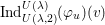 $\text{Ind}_{U(\unicode[STIX]{x1D706},2)}^{U(\unicode[STIX]{x1D706})}(\unicode[STIX]{x1D711}_{u})(v)$
we see that
$\text{Ind}_{U(\unicode[STIX]{x1D706},2)}^{U(\unicode[STIX]{x1D706})}(\unicode[STIX]{x1D711}_{u})(v)$
we see that
 $$\begin{eqnarray}\text{Ind}_{U(\unicode[STIX]{x1D706},1.5)}^{U(\unicode[STIX]{x1D706})}(\widetilde{\unicode[STIX]{x1D711}}_{u})=q^{-\text{dim}\,\mathfrak{g}(\unicode[STIX]{x1D706},1)/2}\,\text{Ind}_{U(\unicode[STIX]{x1D706},2)}^{U(\unicode[STIX]{x1D706})}(\unicode[STIX]{x1D711}_{u}),\end{eqnarray}$$
from which the result follows immediately. ◻
Remark 5.17. In [Reference KawanakaKaw3] GGGRs are defined with no assumption on the algebraic group $\mathbf{G}$
. However, it seems to be necessary to have some assumption on
$\mathbf{G}$
. However, it seems to be necessary to have some assumption on $\mathbf{G}$
to define GGGRs, see for instance the proof of Lemma 5.9. Note that assumptions similar to
$\mathbf{G}$
to define GGGRs, see for instance the proof of Lemma 5.9. Note that assumptions similar to $\mathbf{G}$
being proximate were made in [Reference KawanakaKaw2, 1.1.1] but not in [Reference KawanakaKaw3]. In any case, we have by Proposition 2.16 that our assumption on
$\mathbf{G}$
being proximate were made in [Reference KawanakaKaw2, 1.1.1] but not in [Reference KawanakaKaw3]. In any case, we have by Proposition 2.16 that our assumption on $\mathbf{G}$
is not restrictive when defining GGGRs.
$\mathbf{G}$
is not restrictive when defining GGGRs.
6 Fourier transforms on the Lie algebra
Definition 6.1. (Letellier, [Reference LetellierLet, 5.0.14])
We say the prime $p$
is acceptable for
$p$
is acceptable for $\mathbf{G}$
if:
$\mathbf{G}$
if:
-
(i)
$p$
is a pretty good prime for
$\mathbf{G}$
, see Definition 3.9; -
(ii)
$p$
is a very good prime for any Levi subgroup
$\mathbf{L}$
of
$\mathbf{G}$
supporting a cuspidal pair
$(S,\mathscr{E})$
, in the sense of [Reference LusztigLus3, 2.4], such that
$S$
contains a unipotent conjugacy class of
$\mathbf{L}$
; -
(iii) there exists a nondegenerate
$\mathbf{G}$
-invariant bilinear form on
$\mathfrak{g}$
.


6.2. This definition of an acceptable prime is slightly different than that given in [Reference LetellierLet, 5.0.14]. However we note that if $p$
is acceptable in the sense of Definition 6.1 then it is acceptable in the sense of [Reference LetellierLet, 5.0.14]. Indeed, we need only observe that if
$p$
is acceptable in the sense of Definition 6.1 then it is acceptable in the sense of [Reference LetellierLet, 5.0.14]. Indeed, we need only observe that if $p$
is an acceptable prime in the sense of Definition 6.1 then:
$p$
is an acceptable prime in the sense of Definition 6.1 then: $p$
is a good prime for
$p$
is a good prime for $\mathbf{G}$
, see [Reference HerpelHer, Lemma 2.12(b)], the quotient
$\mathbf{G}$
, see [Reference HerpelHer, Lemma 2.12(b)], the quotient $X(\mathbf{T}_{0})/\mathbb{Z}\unicode[STIX]{x1D6F7}$
has no
$X(\mathbf{T}_{0})/\mathbb{Z}\unicode[STIX]{x1D6F7}$
has no $p$
-torsion and there exists a Springer isomorphism, see Lemma 3.4. To show that these definitions are actually equivalent it would be sufficient to prove the converse to Lemma 3.4, see, Remark 3.5. The following observation concerning acceptable primes will also be needed, see [Reference LetellierLet, 5.0.16].
$p$
-torsion and there exists a Springer isomorphism, see Lemma 3.4. To show that these definitions are actually equivalent it would be sufficient to prove the converse to Lemma 3.4, see, Remark 3.5. The following observation concerning acceptable primes will also be needed, see [Reference LetellierLet, 5.0.16].
Lemma 6.3. The following hold:
-
(i)
$p$
is very good for
$\mathbf{G}$
$\Rightarrow$
$p$
is acceptable for
$\mathbf{G}$
; -
(ii) if
$\mathbf{G}=\text{GL}_{n}(\mathbb{K})$
then all primes are acceptable for
$\mathbf{G}$
.



6.4. Let us denote by $\unicode[STIX]{x1D71E}_{u}:\mathfrak{g}^{F}\rightarrow \overline{\mathbb{Q}_{\ell }}$
the
$\unicode[STIX]{x1D71E}_{u}:\mathfrak{g}^{F}\rightarrow \overline{\mathbb{Q}_{\ell }}$
the $\text{Ad}\,G$
-invariant function obtained as the extension of
$\text{Ad}\,G$
-invariant function obtained as the extension of $\unicode[STIX]{x1D6E4}_{u}|_{{\mathcal{U}}^{F}}\circ \unicode[STIX]{x1D719}_{\text{spr}}^{-1}$
by 0 on
$\unicode[STIX]{x1D6E4}_{u}|_{{\mathcal{U}}^{F}}\circ \unicode[STIX]{x1D719}_{\text{spr}}^{-1}$
by 0 on $\mathfrak{g}^{F}\smallsetminus {\mathcal{N}}^{F}$
. As
$\mathfrak{g}^{F}\smallsetminus {\mathcal{N}}^{F}$
. As $\unicode[STIX]{x1D6E4}_{u}$
is zero outside
$\unicode[STIX]{x1D6E4}_{u}$
is zero outside ${\mathcal{U}}^{F}$
we see that
${\mathcal{U}}^{F}$
we see that $\unicode[STIX]{x1D71E}_{u}$
contains the same information as that of
$\unicode[STIX]{x1D71E}_{u}$
contains the same information as that of $\unicode[STIX]{x1D6E4}_{u}$
. The upshot of working with
$\unicode[STIX]{x1D6E4}_{u}$
. The upshot of working with $\unicode[STIX]{x1D71E}_{u}$
is that we have the Fourier transform at our disposal, which is defined as follows. For any function
$\unicode[STIX]{x1D71E}_{u}$
is that we have the Fourier transform at our disposal, which is defined as follows. For any function $f:\mathfrak{g}^{F}\rightarrow \overline{\mathbb{Q}_{\ell }}$
we define the Fourier transform of
$f:\mathfrak{g}^{F}\rightarrow \overline{\mathbb{Q}_{\ell }}$
we define the Fourier transform of $f$
to be the function
$f$
to be the function ${\mathcal{F}}(f):\mathfrak{g}^{F}\rightarrow \overline{\mathbb{Q}_{\ell }}$
given by
${\mathcal{F}}(f):\mathfrak{g}^{F}\rightarrow \overline{\mathbb{Q}_{\ell }}$
given by
 $$\begin{eqnarray}{\mathcal{F}}(f)(y)=\mathop{\sum }_{x\in \mathfrak{g}^{F}}\unicode[STIX]{x1D712}_{q}(\unicode[STIX]{x1D705}(y,x))f(x),\end{eqnarray}$$
where $\unicode[STIX]{x1D712}_{q}:\mathbb{F}_{q}^{+}\rightarrow \overline{\mathbb{Q}_{\ell }}$
is as in 5.10. We recall the following property of the Fourier transform, see [Reference LetellierLet, 3.1.9, 3.1.10].
$\unicode[STIX]{x1D712}_{q}:\mathbb{F}_{q}^{+}\rightarrow \overline{\mathbb{Q}_{\ell }}$
is as in 5.10. We recall the following property of the Fourier transform, see [Reference LetellierLet, 3.1.9, 3.1.10].
Lemma 6.5. The Fourier transform admits an inverse ${\mathcal{F}}^{-}$
given by
${\mathcal{F}}^{-}$
given by $q^{-\dim \mathfrak{g}}({\mathcal{F}}\circ \unicode[STIX]{x1D6F9})$
where
$q^{-\dim \mathfrak{g}}({\mathcal{F}}\circ \unicode[STIX]{x1D6F9})$
where $\unicode[STIX]{x1D6F9}(f)(x)=\unicode[STIX]{x1D712}(-x)$
for all
$\unicode[STIX]{x1D6F9}(f)(x)=\unicode[STIX]{x1D712}(-x)$
for all $x\in \mathfrak{g}^{F}$
and
$x\in \mathfrak{g}^{F}$
and $f:\mathfrak{g}^{F}\rightarrow \overline{\mathbb{Q}_{\ell }}$
. In other words, we have
$f:\mathfrak{g}^{F}\rightarrow \overline{\mathbb{Q}_{\ell }}$
. In other words, we have $({\mathcal{F}}^{-}\circ {\mathcal{F}})(f)=({\mathcal{F}}\circ {\mathcal{F}}^{-})(f)=f$
for all functions
$({\mathcal{F}}^{-}\circ {\mathcal{F}})(f)=({\mathcal{F}}\circ {\mathcal{F}}^{-})(f)=f$
for all functions $f:\mathfrak{g}^{F}\rightarrow \overline{\mathbb{Q}_{\ell }}$
.
$f:\mathfrak{g}^{F}\rightarrow \overline{\mathbb{Q}_{\ell }}$
.
6.6. Following [Reference LusztigLus9, Proposition 2.5] we would like to obtain an expression for the value of the Fourier transform ${\mathcal{F}}(\unicode[STIX]{x1D71E}_{u})$
at an element of
${\mathcal{F}}(\unicode[STIX]{x1D71E}_{u})$
at an element of $\mathfrak{g}^{F}$
. The argument used in [Reference LusztigLus9] can be applied verbatim to our situation once we know that [Reference LusztigLus9, Lemma 2.2] holds. In fact we will prove a stronger statement than that of [Reference LusztigLus9, Lemma 2.2]. The proof of this stronger statement is due to Gan–Ginzburg who considered the corresponding statement over
$\mathfrak{g}^{F}$
. The argument used in [Reference LusztigLus9] can be applied verbatim to our situation once we know that [Reference LusztigLus9, Lemma 2.2] holds. In fact we will prove a stronger statement than that of [Reference LusztigLus9, Lemma 2.2]. The proof of this stronger statement is due to Gan–Ginzburg who considered the corresponding statement over $\mathbb{C}$
, see [Reference Gan and GinzburgGG, Lemma 2.1]. To obtain the desired result we will need the following (general) lemma.
$\mathbb{C}$
, see [Reference Gan and GinzburgGG, Lemma 2.1]. To obtain the desired result we will need the following (general) lemma.
Lemma 6.7. Assume, for $i\in \{1,2\}$
, that
$i\in \{1,2\}$
, that $\mathbf{X}_{i}$
is an irreducible affine variety with a contracting
$\mathbf{X}_{i}$
is an irreducible affine variety with a contracting $\mathbb{G}_{m}$
-action such that the fixed point
$\mathbb{G}_{m}$
-action such that the fixed point $x_{i}\in \mathbf{X}_{i}$
is nonsingular, see, Lemma 3.13. Let us denote by
$x_{i}\in \mathbf{X}_{i}$
is nonsingular, see, Lemma 3.13. Let us denote by $T_{i}$
the tangent space of
$T_{i}$
the tangent space of $\mathbf{X}_{i}$
at the point
$\mathbf{X}_{i}$
at the point $x_{i}$
. If
$x_{i}$
. If $\unicode[STIX]{x1D6FC}:\mathbf{X}_{1}\rightarrow \mathbf{X}_{2}$
is a
$\unicode[STIX]{x1D6FC}:\mathbf{X}_{1}\rightarrow \mathbf{X}_{2}$
is a $\mathbb{G}_{m}$
-equivariant morphism such that the differential
$\mathbb{G}_{m}$
-equivariant morphism such that the differential $\text{d}_{x_{1}}\unicode[STIX]{x1D6FC}:T_{1}\rightarrow T_{2}$
is an isomorphism then
$\text{d}_{x_{1}}\unicode[STIX]{x1D6FC}:T_{1}\rightarrow T_{2}$
is an isomorphism then $\unicode[STIX]{x1D6FC}$
is an isomorphism.
$\unicode[STIX]{x1D6FC}$
is an isomorphism.
Proof. As $\unicode[STIX]{x1D6FC}$
induces an isomorphism between the tangent spaces of nonsingular points we must have the comorphism
$\unicode[STIX]{x1D6FC}$
induces an isomorphism between the tangent spaces of nonsingular points we must have the comorphism $\unicode[STIX]{x1D6FC}^{\ast }:\mathbb{K}[\mathbf{X}_{2}]\rightarrow \mathbb{K}[\mathbf{X}_{1}]$
is injective, see, [Reference SpringerSpr2, 1.9.1(ii), 4.3.6(i)]. Hence, we are done if we can show that
$\unicode[STIX]{x1D6FC}^{\ast }:\mathbb{K}[\mathbf{X}_{2}]\rightarrow \mathbb{K}[\mathbf{X}_{1}]$
is injective, see, [Reference SpringerSpr2, 1.9.1(ii), 4.3.6(i)]. Hence, we are done if we can show that $\unicode[STIX]{x1D6FC}^{\ast }$
is surjective. Let
$\unicode[STIX]{x1D6FC}^{\ast }$
is surjective. Let $\mathfrak{m}_{x_{i}}\subset \mathbb{K}[\mathbf{X}_{i}]$
be the (maximal) vanishing ideal of
$\mathfrak{m}_{x_{i}}\subset \mathbb{K}[\mathbf{X}_{i}]$
be the (maximal) vanishing ideal of $x_{i}$
which is invariant under the induced action of
$x_{i}$
which is invariant under the induced action of $\mathbb{G}_{m}$
on
$\mathbb{G}_{m}$
on $\mathbb{K}[\mathbf{X}_{i}]$
defined in 3.12. We denote by
$\mathbb{K}[\mathbf{X}_{i}]$
defined in 3.12. We denote by $\text{gr}\,\mathbb{K}[\mathbf{X}_{i}]$
the associated graded ring with respect to
$\text{gr}\,\mathbb{K}[\mathbf{X}_{i}]$
the associated graded ring with respect to $\mathfrak{m}_{x_{i}}$
, that is,
$\mathfrak{m}_{x_{i}}$
, that is,
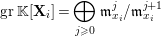 $$\begin{eqnarray}\text{gr}\,\mathbb{K}[\mathbf{X}_{i}]=\mathop{\bigoplus }_{j\geqslant 0}\mathfrak{m}_{x_{i}}^{j}/\mathfrak{m}_{x_{i}}^{j+1}\end{eqnarray}$$
where $\mathfrak{m}_{x_{i}}^{0}=\mathbb{K}[\mathbf{X}_{i}]$
. This clearly also inherits an action of
$\mathfrak{m}_{x_{i}}^{0}=\mathbb{K}[\mathbf{X}_{i}]$
. This clearly also inherits an action of $\mathbb{G}_{m}$
as does the tangent space
$\mathbb{G}_{m}$
as does the tangent space $T_{i}$
and its affine algebra. We thus obtain decompositions of these algebras into weight spaces
$T_{i}$
and its affine algebra. We thus obtain decompositions of these algebras into weight spaces
 $$\begin{eqnarray}\mathbb{K}[T_{i}]=\mathop{\bigoplus }_{n\geqslant 0}\mathbb{K}[T_{i}]_{n}\quad \mathbb{K}[\mathbf{X}_{i}]=\mathop{\bigoplus }_{n\geqslant 0}\mathbb{K}[\mathbf{X}_{i}]_{n}\quad \text{gr}\,\mathbb{K}[\mathbf{X}_{i}]=\mathop{\bigoplus }_{n\geqslant 0}(\text{gr}\,\mathbb{K}[\mathbf{X}_{i}])_{n}.\end{eqnarray}$$
Let us assume that the following equality holds
 $$\begin{eqnarray}\dim \mathbb{K}[\mathbf{X}_{1}]_{n}=\dim \mathbb{K}[T_{1}]_{n}=\dim \mathbb{K}[T_{2}]_{n}=\dim \mathbb{K}[\mathbf{X}_{2}]_{n}\end{eqnarray}$$
for all $n\in \mathbb{Z}$
; these are finite dimensional vector spaces by Lemma 3.13. Then, as
$n\in \mathbb{Z}$
; these are finite dimensional vector spaces by Lemma 3.13. Then, as $\unicode[STIX]{x1D6FC}^{\ast }$
is injective and
$\unicode[STIX]{x1D6FC}^{\ast }$
is injective and $\mathbb{G}_{m}$
-equivariant we must have
$\mathbb{G}_{m}$
-equivariant we must have $\unicode[STIX]{x1D6FC}^{\ast }$
is surjective. Thus we need only prove (6.8).
$\unicode[STIX]{x1D6FC}^{\ast }$
is surjective. Thus we need only prove (6.8).
By assumption, the point $x_{i}$
is nonsingular so the tangent space
$x_{i}$
is nonsingular so the tangent space $T_{i}$
coincides with the tangent cone of
$T_{i}$
coincides with the tangent cone of $\mathbf{X}_{i}$
at
$\mathbf{X}_{i}$
at $x_{i}$
. This implies that
$x_{i}$
. This implies that $\mathbb{K}[T_{i}]$
is isomorphic to the associated graded algebra
$\mathbb{K}[T_{i}]$
is isomorphic to the associated graded algebra $\text{gr}\,\mathbb{K}[\mathbf{X}_{i}]$
and this isomorphism is in fact
$\text{gr}\,\mathbb{K}[\mathbf{X}_{i}]$
and this isomorphism is in fact $\mathbb{G}_{m}$
-equivariant, see [Reference MumfordMum, III, Section 3, Section 4]. In particular, we have an equality
$\mathbb{G}_{m}$
-equivariant, see [Reference MumfordMum, III, Section 3, Section 4]. In particular, we have an equality $\dim \mathbb{K}[T_{i}]_{n}=\dim (\text{gr}\,\mathbb{K}[\mathbf{X}_{i}])_{n}$
for all
$\dim \mathbb{K}[T_{i}]_{n}=\dim (\text{gr}\,\mathbb{K}[\mathbf{X}_{i}])_{n}$
for all $n\in \mathbb{Z}$
. Now as the maximal ideal
$n\in \mathbb{Z}$
. Now as the maximal ideal $\mathfrak{m}_{x_{i}}$
is
$\mathfrak{m}_{x_{i}}$
is $\mathbb{G}_{m}$
-invariant we have
$\mathbb{G}_{m}$
-invariant we have $\mathfrak{m}_{x_{i}}=\bigoplus _{n\in \mathbb{Z}}\mathfrak{m}_{x_{i},n}$
with
$\mathfrak{m}_{x_{i}}=\bigoplus _{n\in \mathbb{Z}}\mathfrak{m}_{x_{i},n}$
with $\mathfrak{m}_{x_{i},n}\subseteq \mathbb{K}[\mathbf{X}_{i}]_{n}$
. Moreover we clearly have
$\mathfrak{m}_{x_{i},n}\subseteq \mathbb{K}[\mathbf{X}_{i}]_{n}$
. Moreover we clearly have
 $$\begin{eqnarray}(\text{gr}\,\mathbb{K}[\mathbf{X}_{i}])_{n}=\mathop{\bigoplus }_{j\geqslant 0}\mathfrak{m}_{x_{i},n}^{j}/\mathfrak{m}_{x_{i},n}^{j+1}=\text{gr}(\mathbb{K}[\mathbf{X}_{i}]_{n}).\end{eqnarray}$$
As $\mathbb{K}[\mathbf{X}_{i}]_{n}$
is a finite dimensional vector space we have
$\mathbb{K}[\mathbf{X}_{i}]_{n}$
is a finite dimensional vector space we have $\dim \text{gr}(\mathbb{K}[\mathbf{X}_{i}]_{n})=\dim \mathbb{K}[\mathbf{X}_{i}]_{n}$
. Putting things together we see that (6.8) holds because
$\dim \text{gr}(\mathbb{K}[\mathbf{X}_{i}]_{n})=\dim \mathbb{K}[\mathbf{X}_{i}]_{n}$
. Putting things together we see that (6.8) holds because $\dim \mathbb{K}[T_{1}]_{n}=\dim \mathbb{K}[T_{2}]_{n}$
for all
$\dim \mathbb{K}[T_{1}]_{n}=\dim \mathbb{K}[T_{2}]_{n}$
for all $n\in \mathbb{Z}$
by assumption.◻
$n\in \mathbb{Z}$
by assumption.◻
Proposition 6.9. Let $\unicode[STIX]{x1D6F4}=-e^{\dagger }+\mathfrak{s}$
where
$\unicode[STIX]{x1D6F4}=-e^{\dagger }+\mathfrak{s}$
where $\mathfrak{s}\subseteq \mathfrak{p}(\unicode[STIX]{x1D706})$
is as in Corollary 3.27 with respect to
$\mathfrak{s}\subseteq \mathfrak{p}(\unicode[STIX]{x1D706})$
is as in Corollary 3.27 with respect to $-e^{\dagger }$
. Then the action map
$-e^{\dagger }$
. Then the action map $\unicode[STIX]{x1D6FC}:\mathbf{U}(\unicode[STIX]{x1D706},2)\times \unicode[STIX]{x1D6F4}\rightarrow -e^{\dagger }+\mathfrak{p}(\unicode[STIX]{x1D706})$
given by
$\unicode[STIX]{x1D6FC}:\mathbf{U}(\unicode[STIX]{x1D706},2)\times \unicode[STIX]{x1D6F4}\rightarrow -e^{\dagger }+\mathfrak{p}(\unicode[STIX]{x1D706})$
given by $\unicode[STIX]{x1D6FC}(u,x)=\text{Ad}\,u(x)$
is an isomorphism.
$\unicode[STIX]{x1D6FC}(u,x)=\text{Ad}\,u(x)$
is an isomorphism.
Proof. We define a linear $\mathbb{G}_{m}$
-action
$\mathbb{G}_{m}$
-action $\unicode[STIX]{x1D6FD}:\mathbb{G}_{m}\times \mathfrak{g}\rightarrow \mathfrak{g}$
by setting
$\unicode[STIX]{x1D6FD}:\mathbb{G}_{m}\times \mathfrak{g}\rightarrow \mathfrak{g}$
by setting $\unicode[STIX]{x1D6FD}(k,x)=\unicode[STIX]{x1D70C}(k)x$
where
$\unicode[STIX]{x1D6FD}(k,x)=\unicode[STIX]{x1D70C}(k)x$
where $\unicode[STIX]{x1D70C}:\mathbb{G}_{m}\rightarrow \text{GL}(\mathfrak{g})$
is defined by
$\unicode[STIX]{x1D70C}:\mathbb{G}_{m}\rightarrow \text{GL}(\mathfrak{g})$
is defined by $\unicode[STIX]{x1D70C}(k)(x)=k^{2}(\text{Ad}\,\unicode[STIX]{x1D706}(k))(x)$
. Note that the
$\unicode[STIX]{x1D70C}(k)(x)=k^{2}(\text{Ad}\,\unicode[STIX]{x1D706}(k))(x)$
. Note that the $\mathbb{G}_{m}$
-action preserves both
$\mathbb{G}_{m}$
-action preserves both $\mathfrak{p}(\unicode[STIX]{x1D706})$
and
$\mathfrak{p}(\unicode[STIX]{x1D706})$
and $\mathfrak{s}$
, see, Corollary 3.27, and as
$\mathfrak{s}$
, see, Corollary 3.27, and as $-e^{\dagger }\in \mathfrak{g}(\unicode[STIX]{x1D706},-2)$
we have
$-e^{\dagger }\in \mathfrak{g}(\unicode[STIX]{x1D706},-2)$
we have $\unicode[STIX]{x1D70C}(k)(-e^{\dagger }+x)=-e^{\dagger }+\unicode[STIX]{x1D70C}(k)(x)$
for all
$\unicode[STIX]{x1D70C}(k)(-e^{\dagger }+x)=-e^{\dagger }+\unicode[STIX]{x1D70C}(k)(x)$
for all $x\in \mathfrak{p}(\unicode[STIX]{x1D706})$
. In particular, we have
$x\in \mathfrak{p}(\unicode[STIX]{x1D706})$
. In particular, we have $\unicode[STIX]{x1D6FD}$
restricts to a
$\unicode[STIX]{x1D6FD}$
restricts to a $\mathbb{G}_{m}$
-action on
$\mathbb{G}_{m}$
-action on $-e^{\dagger }+\mathfrak{p}(\unicode[STIX]{x1D706})$
and
$-e^{\dagger }+\mathfrak{p}(\unicode[STIX]{x1D706})$
and $\unicode[STIX]{x1D6F4}$
. By Remark 3.14 these actions are contractions to
$\unicode[STIX]{x1D6F4}$
. By Remark 3.14 these actions are contractions to $-e^{\dagger }$
. We also define a
$-e^{\dagger }$
. We also define a $\mathbb{G}_{m}$
-action on
$\mathbb{G}_{m}$
-action on $\mathbf{U}(\unicode[STIX]{x1D706},2)\times \unicode[STIX]{x1D6F4}$
by setting
$\mathbf{U}(\unicode[STIX]{x1D706},2)\times \unicode[STIX]{x1D6F4}$
by setting
 $$\begin{eqnarray}k\cdot (u,x)=(\unicode[STIX]{x1D706}(k)u\unicode[STIX]{x1D706}(k^{-1}),\unicode[STIX]{x1D70C}(k)(x))\end{eqnarray}$$
for all $k\in \mathbb{G}_{m}$
. It is clear that
$k\in \mathbb{G}_{m}$
. It is clear that $\lim _{k\rightarrow 0}k\cdot (u,x)=(1,-e^{\dagger })$
for all
$\lim _{k\rightarrow 0}k\cdot (u,x)=(1,-e^{\dagger })$
for all $(u,x)\in \mathbf{U}(\unicode[STIX]{x1D706},2)\times \unicode[STIX]{x1D6F4}$
, see, 3.17, so this is also a contraction to
$(u,x)\in \mathbf{U}(\unicode[STIX]{x1D706},2)\times \unicode[STIX]{x1D6F4}$
, see, 3.17, so this is also a contraction to $(1,-e^{\dagger })$
and the action map
$(1,-e^{\dagger })$
and the action map $\unicode[STIX]{x1D6FC}$
is
$\unicode[STIX]{x1D6FC}$
is $\mathbb{G}_{m}$
-equivariant with respect to these actions.
$\mathbb{G}_{m}$
-equivariant with respect to these actions.
Consider the tangent space $T\cong \mathfrak{u}(\unicode[STIX]{x1D706},2)\times \mathfrak{s}$
of
$T\cong \mathfrak{u}(\unicode[STIX]{x1D706},2)\times \mathfrak{s}$
of $\mathbf{U}(\unicode[STIX]{x1D706},2)\times \unicode[STIX]{x1D6F4}$
at the point
$\mathbf{U}(\unicode[STIX]{x1D706},2)\times \unicode[STIX]{x1D6F4}$
at the point $(1,-e^{\dagger })$
and the tangent space
$(1,-e^{\dagger })$
and the tangent space $S\cong \mathfrak{p}(\unicode[STIX]{x1D706})$
of
$S\cong \mathfrak{p}(\unicode[STIX]{x1D706})$
of $-e^{\dagger }+\mathfrak{p}(\unicode[STIX]{x1D706})$
at
$-e^{\dagger }+\mathfrak{p}(\unicode[STIX]{x1D706})$
at $-e^{\dagger }=\unicode[STIX]{x1D6FC}(1,-e^{\dagger })$
. We claim that the differential
$-e^{\dagger }=\unicode[STIX]{x1D6FC}(1,-e^{\dagger })$
. We claim that the differential $\text{d}_{(1,-e^{\dagger })}\unicode[STIX]{x1D6FC}:T\rightarrow S$
is an isomorphism. First, recall from the proof of Corollary 3.27 that the differential is given by
$\text{d}_{(1,-e^{\dagger })}\unicode[STIX]{x1D6FC}:T\rightarrow S$
is an isomorphism. First, recall from the proof of Corollary 3.27 that the differential is given by $\text{d}_{(1,-e^{\dagger })}\unicode[STIX]{x1D6FC}(u,x)=x+[u,-e^{\dagger }]$
for all
$\text{d}_{(1,-e^{\dagger })}\unicode[STIX]{x1D6FC}(u,x)=x+[u,-e^{\dagger }]$
for all $(u,x)\in T$
. Therefore to prove the map is surjective it suffices to show that
$(u,x)\in T$
. Therefore to prove the map is surjective it suffices to show that
 $$\begin{eqnarray}\mathfrak{p}(\unicode[STIX]{x1D706})=\mathfrak{s}\oplus [\mathfrak{u}(\unicode[STIX]{x1D706},2),-e^{\dagger }].\end{eqnarray}$$
Now the map $\text{ad}_{-e^{\dagger }}:\mathfrak{u}(\unicode[STIX]{x1D706},2)\rightarrow \mathfrak{p}(\unicode[STIX]{x1D706})$
is injective because
$\text{ad}_{-e^{\dagger }}:\mathfrak{u}(\unicode[STIX]{x1D706},2)\rightarrow \mathfrak{p}(\unicode[STIX]{x1D706})$
is injective because $\mathfrak{c}_{\mathfrak{u}(\unicode[STIX]{x1D706},2)}(-e^{\dagger })=\{0\}$
and
$\mathfrak{c}_{\mathfrak{u}(\unicode[STIX]{x1D706},2)}(-e^{\dagger })=\{0\}$
and $[\mathfrak{u}(\unicode[STIX]{x1D706},2),-e^{\dagger }]\cap \mathfrak{s}=\{0\}$
by Corollary 3.27 and Lemma 3.7. Hence we have
$[\mathfrak{u}(\unicode[STIX]{x1D706},2),-e^{\dagger }]\cap \mathfrak{s}=\{0\}$
by Corollary 3.27 and Lemma 3.7. Hence we have $\mathfrak{s}\oplus [\mathfrak{u}(\unicode[STIX]{x1D706},2),-e^{\dagger }]\subseteq \mathfrak{p}(\unicode[STIX]{x1D706})$
. However, as
$\mathfrak{s}\oplus [\mathfrak{u}(\unicode[STIX]{x1D706},2),-e^{\dagger }]\subseteq \mathfrak{p}(\unicode[STIX]{x1D706})$
. However, as $\dim \mathfrak{s}=\dim \mathfrak{c}_{\mathfrak{g}}(-e^{\dagger })=\dim \mathfrak{c}_{\mathfrak{g}}(e)$
we have
$\dim \mathfrak{s}=\dim \mathfrak{c}_{\mathfrak{g}}(-e^{\dagger })=\dim \mathfrak{c}_{\mathfrak{g}}(e)$
we have
 $$\begin{eqnarray}\dim (\mathfrak{s}\oplus [\mathfrak{u}(\unicode[STIX]{x1D706},2),-e^{\dagger }])=\dim \mathfrak{u}(\unicode[STIX]{x1D706},2)+\dim \mathfrak{c}_{\mathfrak{ g}}(e)=\dim \mathfrak{p}(\unicode[STIX]{x1D706})\end{eqnarray}$$
so we must have an equality. The same dimension counting argument also proves the map $\text{d}_{(1,-e^{\dagger })}\unicode[STIX]{x1D6FC}$
is injective. The result now follows from Lemma 6.7.◻
$\text{d}_{(1,-e^{\dagger })}\unicode[STIX]{x1D6FC}$
is injective. The result now follows from Lemma 6.7.◻

6.10. With this in hand we now obtain [Reference LusztigLus9, Proposition 2.5] in exactly the same way. We give the argument here for smoothness of the exposition. From the definitions and Lemma 5.15 we have for any $y\in \mathfrak{g}^{F}$
that
$y\in \mathfrak{g}^{F}$
that
 $$\begin{eqnarray}\displaystyle {\mathcal{F}}(\unicode[STIX]{x1D71E}_{u})(y) & = & \displaystyle q^{\dim \mathfrak{g}(\unicode[STIX]{x1D706},1)/2-\dim \mathfrak{u}(\unicode[STIX]{x1D706})}\mathop{\sum }_{\substack{ x\in \mathfrak{g}^{F},g\in G \\ \text{Ad}\,g(x)\in \mathfrak{u}(\unicode[STIX]{x1D706})^{F}}}\unicode[STIX]{x1D712}_{q}(\unicode[STIX]{x1D705}(y,x)+\unicode[STIX]{x1D705}(e^{\dagger },\text{Ad}\,g(x)))\nonumber\\ \displaystyle & = & \displaystyle q^{\dim \mathfrak{g}(\unicode[STIX]{x1D706},1)/2-\dim \mathfrak{u}(\unicode[STIX]{x1D706})}\mathop{\sum }_{\substack{ g\in G \\ x\in \mathfrak{u}(\unicode[STIX]{x1D706})^{F}}}\unicode[STIX]{x1D701}_{y,g}(x),\nonumber\end{eqnarray}$$
where $\unicode[STIX]{x1D701}_{y,g}$
is the linear character
$\unicode[STIX]{x1D701}_{y,g}$
is the linear character $x\mapsto \unicode[STIX]{x1D712}_{q}(\unicode[STIX]{x1D705}(e^{\dagger }+\text{Ad}\,g(y),x))$
of
$x\mapsto \unicode[STIX]{x1D712}_{q}(\unicode[STIX]{x1D705}(e^{\dagger }+\text{Ad}\,g(y),x))$
of $\mathfrak{u}(\unicode[STIX]{x1D706})^{F}$
as an abelian group. As
$\mathfrak{u}(\unicode[STIX]{x1D706})^{F}$
as an abelian group. As $\unicode[STIX]{x1D701}_{y,g}$
is an irreducible character of a finite abelian group we have the sum of its values is either 0 or
$\unicode[STIX]{x1D701}_{y,g}$
is an irreducible character of a finite abelian group we have the sum of its values is either 0 or $q^{\dim \mathfrak{u}(\unicode[STIX]{x1D706})}$
with the latter happening if and only if
$q^{\dim \mathfrak{u}(\unicode[STIX]{x1D706})}$
with the latter happening if and only if $\unicode[STIX]{x1D701}_{y,g}$
is the trivial character. By 5.8 and the nondegeneracy of
$\unicode[STIX]{x1D701}_{y,g}$
is the trivial character. By 5.8 and the nondegeneracy of $\unicode[STIX]{x1D705}$
we have the character
$\unicode[STIX]{x1D705}$
we have the character $\unicode[STIX]{x1D701}_{y,g}$
is trivial precisely when
$\unicode[STIX]{x1D701}_{y,g}$
is trivial precisely when $e^{\dagger }+\text{Ad}\,g(y)\in \mathfrak{p}(\unicode[STIX]{x1D706})^{F}$
, see, Lemma 5.6, so we have
$e^{\dagger }+\text{Ad}\,g(y)\in \mathfrak{p}(\unicode[STIX]{x1D706})^{F}$
, see, Lemma 5.6, so we have
 $$\begin{eqnarray}{\mathcal{F}}(\unicode[STIX]{x1D71E}_{u})(y)=q^{\dim \mathfrak{g}(\unicode[STIX]{x1D706},1)/2}|\{(g,x)\in G\times \mathfrak{p}(\unicode[STIX]{x1D706})^{F}\mid \text{Ad}\,g(y)=-e^{\dagger }+x\}|.\end{eqnarray}$$
Applying Proposition 6.9 we see that the element $-e^{\dagger }+x$
can be written uniquely as
$-e^{\dagger }+x$
can be written uniquely as $\text{Ad}\,h(-e^{\dagger }+z)$
for some
$\text{Ad}\,h(-e^{\dagger }+z)$
for some $h\in U(\unicode[STIX]{x1D706},2)$
and
$h\in U(\unicode[STIX]{x1D706},2)$
and $z\in \mathfrak{s}^{F}$
, which are necessarily fixed by
$z\in \mathfrak{s}^{F}$
, which are necessarily fixed by $F$
through the uniqueness. In particular, we may rewrite the above as
$F$
through the uniqueness. In particular, we may rewrite the above as
 $$\begin{eqnarray}\displaystyle {\mathcal{F}}(\unicode[STIX]{x1D71E}_{u})(y) & = & \displaystyle q^{\dim \mathfrak{g}(\unicode[STIX]{x1D706},1)/2}\nonumber\\ \displaystyle & & \displaystyle \times |\{(g,h,z)\in G\times U(\unicode[STIX]{x1D706},2)\times \mathfrak{s}^{F}\mid \text{Ad}\,h^{-1}g(y)=-e^{\dagger }+z\}|.\nonumber\end{eqnarray}$$
Thus, changing the variable $h^{-1}g\rightarrow g$
we obtain the following.
$h^{-1}g\rightarrow g$
we obtain the following.
Proposition 6.11. (Lusztig, [Reference LusztigLus9, Proposition 2.5])
For any $y\in \mathfrak{g}^{F}$
we have
$y\in \mathfrak{g}^{F}$
we have
 $$\begin{eqnarray}{\mathcal{F}}(\unicode[STIX]{x1D71E}_{u})(y)=q^{r_{u}}|\{g\in G\mid \text{Ad}\,g(y)\in \unicode[STIX]{x1D6F4}\}|\end{eqnarray}$$
where
 $$\begin{eqnarray}r_{u}=\dim \mathfrak{g}(\unicode[STIX]{x1D706},1)/2+\dim \mathfrak{u}(\unicode[STIX]{x1D706},2)=(\dim \mathbf{G}-\dim C_{\mathbf{G}}(u))/2.\end{eqnarray}$$
7 Poincaré duality
Notation
7.1. For any algebraic variety $\mathbf{X}$
over
$\mathbf{X}$
over $\mathbb{K}$
we will denote by
$\mathbb{K}$
we will denote by $\mathscr{D}\mathbf{X}:=\mathscr{D}_{c}^{b}\mathbf{X}$
the bounded derived category of
$\mathscr{D}\mathbf{X}:=\mathscr{D}_{c}^{b}\mathbf{X}$
the bounded derived category of $\overline{\mathbb{Q}_{\ell }}$
-constructible sheaves on
$\overline{\mathbb{Q}_{\ell }}$
-constructible sheaves on $\mathbf{X}$
defined as in [Reference Beĭlinson, Bernstein and DeligneBBD]. Assume now that the Frobenius endomorphism induces a morphism of varieties on
$\mathbf{X}$
defined as in [Reference Beĭlinson, Bernstein and DeligneBBD]. Assume now that the Frobenius endomorphism induces a morphism of varieties on $\mathbf{X}$
then we say
$\mathbf{X}$
then we say $A\in \mathscr{D}\mathbf{X}$
is
$A\in \mathscr{D}\mathbf{X}$
is $F$
-stable if there exists an isomorphism
$F$
-stable if there exists an isomorphism $\unicode[STIX]{x1D719}:F^{\ast }A\rightarrow A$
in
$\unicode[STIX]{x1D719}:F^{\ast }A\rightarrow A$
in $\mathscr{D}\mathbf{X}$
. With such a choice of isomorphism we will denote by
$\mathscr{D}\mathbf{X}$
. With such a choice of isomorphism we will denote by $\unicode[STIX]{x1D712}_{A,\unicode[STIX]{x1D719}}:\mathbf{X}^{F}\rightarrow \overline{\mathbb{Q}_{\ell }}$
the corresponding characteristic function defined by
$\unicode[STIX]{x1D712}_{A,\unicode[STIX]{x1D719}}:\mathbf{X}^{F}\rightarrow \overline{\mathbb{Q}_{\ell }}$
the corresponding characteristic function defined by
 $$\begin{eqnarray}\unicode[STIX]{x1D712}_{A,\unicode[STIX]{x1D719}}(x)=\mathop{\sum }_{i\in \mathbb{Z}}(-1)^{i}\,\text{Tr}(\unicode[STIX]{x1D719},\mathscr{H}_{x}^{i}(A))\end{eqnarray}$$
for any $x\in \mathbf{X}^{F}$
. We will denote by
$x\in \mathbf{X}^{F}$
. We will denote by $\text{supp}(A)$
the set
$\text{supp}(A)$
the set $\{\!x\in \mathbf{X}\mid \mathscr{H}_{x}^{i}(A)\neq 0$
for some
$\{\!x\in \mathbf{X}\mid \mathscr{H}_{x}^{i}(A)\neq 0$
for some $i\in \mathbb{Z}\!\}$
which we call the support of
$i\in \mathbb{Z}\!\}$
which we call the support of $A$
.
$A$
.
7.2. Assume now that $\mathbf{X}$
is equidimensional, that is, all the irreducible components of
$\mathbf{X}$
is equidimensional, that is, all the irreducible components of $\mathbf{X}$
have the same dimension, then the full subcategory of
$\mathbf{X}$
have the same dimension, then the full subcategory of $\mathscr{D}\mathbf{X}$
consisting of the perverse sheaves on
$\mathscr{D}\mathbf{X}$
consisting of the perverse sheaves on $\mathbf{X}$
will be denoted by
$\mathbf{X}$
will be denoted by $\mathscr{M}\mathbf{X}$
. Moreover, let us assume that
$\mathscr{M}\mathbf{X}$
. Moreover, let us assume that $\mathbf{X}\subseteq \mathbf{Y}$
is a subvariety of
$\mathbf{X}\subseteq \mathbf{Y}$
is a subvariety of $\mathbf{Y}$
. We will naturally consider any complex
$\mathbf{Y}$
. We will naturally consider any complex $A\in \mathscr{D}\mathbf{X}$
as a complex on
$A\in \mathscr{D}\mathbf{X}$
as a complex on $\mathbf{Y}$
through extension by 0 and we will sometimes do this without explicit mention. Finally assume
$\mathbf{Y}$
through extension by 0 and we will sometimes do this without explicit mention. Finally assume $\mathbf{X}$
is a smooth open dense subset of
$\mathbf{X}$
is a smooth open dense subset of $\overline{\mathbf{X}}$
and that
$\overline{\mathbf{X}}$
and that $\mathscr{L}$
is a local system on
$\mathscr{L}$
is a local system on $\mathbf{X}$
. We will denote by
$\mathbf{X}$
. We will denote by $\text{IC}(\overline{\mathbf{X}},\mathscr{L})[\dim \mathbf{X}]\in \mathscr{M}\overline{\mathbf{X}}$
the corresponding intersection cohomology complex determined by
$\text{IC}(\overline{\mathbf{X}},\mathscr{L})[\dim \mathbf{X}]\in \mathscr{M}\overline{\mathbf{X}}$
the corresponding intersection cohomology complex determined by $\mathscr{L}$
.
$\mathscr{L}$
.
7.3. For any connected reductive algebraic group $\mathbf{H}$
we denote by
$\mathbf{H}$
we denote by ${\mathcal{V}}_{\mathbf{H}}={\mathcal{V}}_{\mathbf{H}}^{\text{nil}}$
the set of all pairs
${\mathcal{V}}_{\mathbf{H}}={\mathcal{V}}_{\mathbf{H}}^{\text{nil}}$
the set of all pairs $\unicode[STIX]{x1D704}=({\mathcal{O}}_{\unicode[STIX]{x1D704}},\mathscr{E}_{\unicode[STIX]{x1D704}})$
consisting of a nilpotent
$\unicode[STIX]{x1D704}=({\mathcal{O}}_{\unicode[STIX]{x1D704}},\mathscr{E}_{\unicode[STIX]{x1D704}})$
consisting of a nilpotent $\mathbf{H}$
-orbit
$\mathbf{H}$
-orbit ${\mathcal{O}}_{\unicode[STIX]{x1D704}}\subseteq \text{Lie}(\mathbf{H})$
and an irreducible
${\mathcal{O}}_{\unicode[STIX]{x1D704}}\subseteq \text{Lie}(\mathbf{H})$
and an irreducible $\mathbf{L}$
-equivariant local system
$\mathbf{L}$
-equivariant local system $\mathscr{E}_{\unicode[STIX]{x1D704}}$
on
$\mathscr{E}_{\unicode[STIX]{x1D704}}$
on ${\mathcal{O}}_{\unicode[STIX]{x1D704}}$
taken up to isomorphism. We will write
${\mathcal{O}}_{\unicode[STIX]{x1D704}}$
taken up to isomorphism. We will write ${\mathcal{V}}_{\mathbf{H}}^{0}\subseteq {\mathcal{V}}_{\mathbf{H}}$
for the subset consisting of all pairs
${\mathcal{V}}_{\mathbf{H}}^{0}\subseteq {\mathcal{V}}_{\mathbf{H}}$
for the subset consisting of all pairs $\unicode[STIX]{x1D704}$
such that
$\unicode[STIX]{x1D704}$
such that $\mathscr{E}_{\unicode[STIX]{x1D704}}$
is a cuspidal local system in the sense of [Reference LusztigLus3, Definition 2.4], see also [Reference LetellierLet, 5.1.59]. We call the elements of
$\mathscr{E}_{\unicode[STIX]{x1D704}}$
is a cuspidal local system in the sense of [Reference LusztigLus3, Definition 2.4], see also [Reference LetellierLet, 5.1.59]. We call the elements of ${\mathcal{V}}_{\mathbf{H}}^{0}$
cuspidal pairs.
${\mathcal{V}}_{\mathbf{H}}^{0}$
cuspidal pairs.
Induction diagram
7.4. Let $\mathbf{L}\leqslant \mathbf{G}$
be the Levi complement of a parabolic subgroup
$\mathbf{L}\leqslant \mathbf{G}$
be the Levi complement of a parabolic subgroup $\mathbf{P}\leqslant \mathbf{G}$
and let
$\mathbf{P}\leqslant \mathbf{G}$
and let $\mathfrak{l}=\text{Lie}(\mathbf{L})\subseteq \mathfrak{p}=\text{Lie}(\mathbf{P})$
be the corresponding Lie algebras. If
$\mathfrak{l}=\text{Lie}(\mathbf{L})\subseteq \mathfrak{p}=\text{Lie}(\mathbf{P})$
be the corresponding Lie algebras. If $\mathfrak{z}(\mathfrak{l})$
is the center of the Lie algebra
$\mathfrak{z}(\mathfrak{l})$
is the center of the Lie algebra $\mathfrak{l}$
then we define
$\mathfrak{l}$
then we define
 $$\begin{eqnarray}\mathfrak{z}(\mathfrak{l})_{\text{reg}}=\{t\in \mathfrak{z}(\mathfrak{l})\mid \mathfrak{c}_{\mathfrak{g}}(t)=\mathfrak{l}\},\end{eqnarray}$$
which is an open subset of $\mathfrak{z}(\mathfrak{l})$
. Note that this is nonempty because of our standing assumption that
$\mathfrak{z}(\mathfrak{l})$
. Note that this is nonempty because of our standing assumption that $p$
is an acceptable prime, see, [Reference LetellierLet, 2.6.13(i)]. We will assume that
$p$
is an acceptable prime, see, [Reference LetellierLet, 2.6.13(i)]. We will assume that $\unicode[STIX]{x1D704}_{0}=({\mathcal{O}}_{0},\mathscr{E}_{0})\in {\mathcal{V}}_{\mathbf{L}}^{0}$
is a cuspidal pair. Setting
$\unicode[STIX]{x1D704}_{0}=({\mathcal{O}}_{0},\mathscr{E}_{0})\in {\mathcal{V}}_{\mathbf{L}}^{0}$
is a cuspidal pair. Setting $\unicode[STIX]{x1D6F1}={\mathcal{O}}_{0}+\mathfrak{z}(\mathfrak{l})$
and
$\unicode[STIX]{x1D6F1}={\mathcal{O}}_{0}+\mathfrak{z}(\mathfrak{l})$
and $\unicode[STIX]{x1D6F1}_{\text{reg}}={\mathcal{O}}_{0}+\mathfrak{z}(\mathfrak{l})_{\text{reg}}$
we have, as in [Reference LusztigLus9, 3.1], the following induction diagram
$\unicode[STIX]{x1D6F1}_{\text{reg}}={\mathcal{O}}_{0}+\mathfrak{z}(\mathfrak{l})_{\text{reg}}$
we have, as in [Reference LusztigLus9, 3.1], the following induction diagram

where
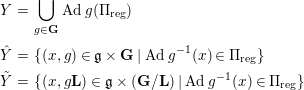 $$\begin{eqnarray}\displaystyle Y & = & \displaystyle \mathop{\bigcup }_{g\in \mathbf{G}}\text{Ad}\,g(\unicode[STIX]{x1D6F1}_{\text{reg}})\nonumber\\ \displaystyle {\hat{Y}} & = & \displaystyle \{(x,g)\in \mathfrak{g}\times \mathbf{G}\mid \text{Ad}\,g^{-1}(x)\in \unicode[STIX]{x1D6F1}_{\text{reg}}\}\nonumber\\ \displaystyle {\tilde{Y}} & = & \displaystyle \{(x,g\mathbf{L})\in \mathfrak{g}\times (\mathbf{G}/\mathbf{L})\mid \text{Ad}\,g^{-1}(x)\in \unicode[STIX]{x1D6F1}_{\text{reg}}\}\nonumber\end{eqnarray}$$
 $$\begin{eqnarray}\displaystyle & \displaystyle \unicode[STIX]{x1D6FC}(x,g)=\unicode[STIX]{x1D70B}_{0}(\text{Ad}\,g^{-1}(x))\quad \unicode[STIX]{x1D6FD}(x,g) & \displaystyle =(x,g\mathbf{L})\quad \unicode[STIX]{x1D6FE}(x,g\mathbf{L})=x\nonumber\end{eqnarray}$$
and $\unicode[STIX]{x1D70B}_{0}:\unicode[STIX]{x1D6F1}\rightarrow {\mathcal{O}}_{0}$
is the natural projection. As discussed in [Reference LusztigLus9, 3.1] and [Reference LetellierLet, p. 75] from this data one constructs a local system
$\unicode[STIX]{x1D70B}_{0}:\unicode[STIX]{x1D6F1}\rightarrow {\mathcal{O}}_{0}$
is the natural projection. As discussed in [Reference LusztigLus9, 3.1] and [Reference LetellierLet, p. 75] from this data one constructs a local system $\mathscr{L}$
on
$\mathscr{L}$
on $Y$
and a corresponding intersection cohomology complex
$Y$
and a corresponding intersection cohomology complex $K_{0}=\text{IC}(\overline{Y},\mathscr{L})[\dim Y]$
, which is denoted by
$K_{0}=\text{IC}(\overline{Y},\mathscr{L})[\dim Y]$
, which is denoted by $\text{ind}_{\unicode[STIX]{x1D6F4}}^{\mathbf{G}}(\mathscr{E}_{0})$
in [Reference LetellierLet]. Let us also note that we have
$\text{ind}_{\unicode[STIX]{x1D6F4}}^{\mathbf{G}}(\mathscr{E}_{0})$
in [Reference LetellierLet]. Let us also note that we have $\dim Y=\dim \mathbf{G}/\mathbf{L}+\dim \unicode[STIX]{x1D6F1}$
, see, [Reference LetellierLet, 5.1.28].
$\dim Y=\dim \mathbf{G}/\mathbf{L}+\dim \unicode[STIX]{x1D6F1}$
, see, [Reference LetellierLet, 5.1.28].

Lemma 7.5. The fibers of the smooth morphism $\unicode[STIX]{x1D70B}:\mathbf{G}\times \unicode[STIX]{x1D6F4}\rightarrow \mathfrak{g}$
given by
$\unicode[STIX]{x1D70B}:\mathbf{G}\times \unicode[STIX]{x1D6F4}\rightarrow \mathfrak{g}$
given by $\unicode[STIX]{x1D70B}(g,x)=\text{Ad}\,g(x)$
are of pure dimension equal to
$\unicode[STIX]{x1D70B}(g,x)=\text{Ad}\,g(x)$
are of pure dimension equal to $\dim \mathfrak{c}_{\mathfrak{g}}(e)$
.
$\dim \mathfrak{c}_{\mathfrak{g}}(e)$
.
Proof. First let us note that $\mathbf{G}$
,
$\mathbf{G}$
, $\mathfrak{g}$
and
$\mathfrak{g}$
and $\unicode[STIX]{x1D6F4}$
are irreducible varieties then applying [Reference HartshorneHar, III, Section 9, 9.6] we have, for any
$\unicode[STIX]{x1D6F4}$
are irreducible varieties then applying [Reference HartshorneHar, III, Section 9, 9.6] we have, for any $y\in \mathfrak{g}$
, that every irreducible component of the fiber
$y\in \mathfrak{g}$
, that every irreducible component of the fiber $\unicode[STIX]{x1D70B}^{-1}(y)$
has dimension
$\unicode[STIX]{x1D70B}^{-1}(y)$
has dimension $\dim \unicode[STIX]{x1D6F4}=\dim \mathfrak{c}_{\mathfrak{g}}(e)$
which gives us the first part.◻
$\dim \unicode[STIX]{x1D6F4}=\dim \mathfrak{c}_{\mathfrak{g}}(e)$
which gives us the first part.◻
7.6. Let $\mathfrak{u}_{\mathfrak{p}}$
be the Lie algebra of the unipotent radical of
$\mathfrak{u}_{\mathfrak{p}}$
be the Lie algebra of the unipotent radical of $\mathbf{P}$
. Recall from [Reference Lusztig and SpaltensteinLS1] that there exists a unique nilpotent orbit
$\mathbf{P}$
. Recall from [Reference Lusztig and SpaltensteinLS1] that there exists a unique nilpotent orbit ${\mathcal{O}}\in {\mathcal{N}}/\mathbf{G}$
such that the intersection
${\mathcal{O}}\in {\mathcal{N}}/\mathbf{G}$
such that the intersection ${\mathcal{O}}\cap ({\mathcal{O}}_{0}+\mathfrak{u}_{\mathfrak{p}})$
is open and dense in
${\mathcal{O}}\cap ({\mathcal{O}}_{0}+\mathfrak{u}_{\mathfrak{p}})$
is open and dense in ${\mathcal{O}}_{0}+\mathfrak{u}_{\mathfrak{p}}$
, see also [Reference Collingwood and McGovernCM, 7.1.1]. We denote the orbit
${\mathcal{O}}_{0}+\mathfrak{u}_{\mathfrak{p}}$
, see also [Reference Collingwood and McGovernCM, 7.1.1]. We denote the orbit ${\mathcal{O}}$
by
${\mathcal{O}}$
by $\text{Ind}_{\mathbf{L}\subseteq \mathbf{P}}^{\mathbf{G}}({\mathcal{O}}_{0})$
and call it the induced nilpotent orbit.
$\text{Ind}_{\mathbf{L}\subseteq \mathbf{P}}^{\mathbf{G}}({\mathcal{O}}_{0})$
and call it the induced nilpotent orbit.
Proposition 7.7. (Lusztig)
The intersection $\overline{Y}\cap {\mathcal{N}}$
is the closure of the induced orbit
$\overline{Y}\cap {\mathcal{N}}$
is the closure of the induced orbit $\text{Ind}_{\mathbf{L}\subseteq \mathbf{P}}^{\mathbf{G}}({\mathcal{O}}_{0})$
. In particular, it is irreducible of dimension
$\text{Ind}_{\mathbf{L}\subseteq \mathbf{P}}^{\mathbf{G}}({\mathcal{O}}_{0})$
. In particular, it is irreducible of dimension $\dim \mathbf{G}/\mathbf{L}+\dim {\mathcal{O}}_{0}$
.
$\dim \mathbf{G}/\mathbf{L}+\dim {\mathcal{O}}_{0}$
.
Proof. For this we argue as in the proof of [Reference LusztigLus3, Proposition 7.2] using the analogous statements for the Lie algebra proven in [Reference LetellierLet]. Consider the variety
 $$\begin{eqnarray}X=\{(x,g\mathbf{P})\in \mathfrak{g}\times (\mathbf{G}/\mathbf{P})\mid \text{Ad}\,g^{-1}(x)\in \overline{\unicode[STIX]{x1D6F1}}+\mathfrak{u}_{\mathfrak{ p}}\}.\end{eqnarray}$$
If $\unicode[STIX]{x1D719}:X\rightarrow \mathfrak{g}$
is the morphism defined by
$\unicode[STIX]{x1D719}:X\rightarrow \mathfrak{g}$
is the morphism defined by $\unicode[STIX]{x1D719}(x,g\mathbf{P})=x$
then we have
$\unicode[STIX]{x1D719}(x,g\mathbf{P})=x$
then we have $\unicode[STIX]{x1D719}(X)=\overline{Y}$
, see [Reference LetellierLet, 5.1.30(ii)]. Therefore we have
$\unicode[STIX]{x1D719}(X)=\overline{Y}$
, see [Reference LetellierLet, 5.1.30(ii)]. Therefore we have $\unicode[STIX]{x1D719}(X_{{\mathcal{N}}})=\overline{Y}\cap {\mathcal{N}}$
where
$\unicode[STIX]{x1D719}(X_{{\mathcal{N}}})=\overline{Y}\cap {\mathcal{N}}$
where
 $$\begin{eqnarray}X_{{\mathcal{N}}}=\{(x,g\mathbf{P})\in \mathfrak{g}\times (\mathbf{G}/\mathbf{P})\mid \text{Ad}\,g^{-1}(x)\in \overline{{\mathcal{O}}_{0}}+\mathfrak{u}_{\mathfrak{p}}\}\end{eqnarray}$$
because $\overline{\unicode[STIX]{x1D6F1}}\cap {\mathcal{N}}=\overline{{\mathcal{O}}_{0}}$
. The argument in [Reference LetellierLet, 5.1.10] shows that
$\overline{\unicode[STIX]{x1D6F1}}\cap {\mathcal{N}}=\overline{{\mathcal{O}}_{0}}$
. The argument in [Reference LetellierLet, 5.1.10] shows that $X_{{\mathcal{N}}}$
is irreducible, hence so is
$X_{{\mathcal{N}}}$
is irreducible, hence so is $\overline{Y}\cap {\mathcal{N}}$
. As
$\overline{Y}\cap {\mathcal{N}}$
. As $\overline{Y}\cap {\mathcal{N}}$
is invariant under the
$\overline{Y}\cap {\mathcal{N}}$
is invariant under the $\text{Ad}\,\mathbf{G}$
-action we see it is a union
$\text{Ad}\,\mathbf{G}$
-action we see it is a union ${\mathcal{O}}_{1}\sqcup \cdots \sqcup {\mathcal{O}}_{k}$
of distinct nilpotent orbits
${\mathcal{O}}_{1}\sqcup \cdots \sqcup {\mathcal{O}}_{k}$
of distinct nilpotent orbits ${\mathcal{O}}_{i}\in {\mathcal{N}}/\mathbf{G}$
. Moreover as
${\mathcal{O}}_{i}\in {\mathcal{N}}/\mathbf{G}$
. Moreover as $\overline{Y}\cap {\mathcal{N}}$
is closed we have
$\overline{Y}\cap {\mathcal{N}}$
is closed we have $\overline{Y}\cap {\mathcal{N}}=\overline{{\mathcal{O}}_{1}}\cup \cdots \cup \overline{{\mathcal{O}}_{k}}$
but as
$\overline{Y}\cap {\mathcal{N}}=\overline{{\mathcal{O}}_{1}}\cup \cdots \cup \overline{{\mathcal{O}}_{k}}$
but as $\overline{Y}\cap {\mathcal{N}}$
and each orbit closure is irreducible we must have
$\overline{Y}\cap {\mathcal{N}}$
and each orbit closure is irreducible we must have $\overline{Y}\cap {\mathcal{N}}=\overline{{\mathcal{O}}_{i}}$
for a unique
$\overline{Y}\cap {\mathcal{N}}=\overline{{\mathcal{O}}_{i}}$
for a unique $1\leqslant i\leqslant k$
. The exact same proof as [Reference LusztigLus3, 7.3(a)] shows that
$1\leqslant i\leqslant k$
. The exact same proof as [Reference LusztigLus3, 7.3(a)] shows that ${\mathcal{O}}_{i}$
is the induced orbit
${\mathcal{O}}_{i}$
is the induced orbit $\text{Ind}_{\mathbf{L}\subseteq \mathbf{P}}^{\mathbf{G}}({\mathcal{O}}_{0})$
. We thus have
$\text{Ind}_{\mathbf{L}\subseteq \mathbf{P}}^{\mathbf{G}}({\mathcal{O}}_{0})$
. We thus have $\dim \overline{Y}\cap {\mathcal{N}}=\dim \text{Ind}_{\mathbf{L}\subseteq \mathbf{P}}^{\mathbf{G}}({\mathcal{O}}_{0})$
and this latter dimension is easily seen to be
$\dim \overline{Y}\cap {\mathcal{N}}=\dim \text{Ind}_{\mathbf{L}\subseteq \mathbf{P}}^{\mathbf{G}}({\mathcal{O}}_{0})$
and this latter dimension is easily seen to be $\dim \mathbf{G}/\mathbf{L}+\dim {\mathcal{O}}_{0}$
, see, [Reference Collingwood and McGovernCM, 7.1.4(i)].◻
$\dim \mathbf{G}/\mathbf{L}+\dim {\mathcal{O}}_{0}$
, see, [Reference Collingwood and McGovernCM, 7.1.4(i)].◻
Lemma 7.8. Assume $-e^{\dagger }\in \overline{Y}$
then the following hold:
$-e^{\dagger }\in \overline{Y}$
then the following hold:
-
(i) The restriction
$\unicode[STIX]{x1D70E}:\mathbf{G}\times (\overline{Y}\cap {\mathcal{N}}\cap \unicode[STIX]{x1D6F4})\rightarrow \overline{Y}\cap {\mathcal{N}}$
of the action map
$\unicode[STIX]{x1D70B}:\mathbf{G}\times \unicode[STIX]{x1D6F4}\rightarrow \mathfrak{g}$
is a smooth morphism with all fibers of pure dimension equal to
$\dim \mathfrak{c}_{\mathfrak{g}}(e)$
. -
(ii)
$\dim (\overline{Y}\cap {\mathcal{N}}\cap \unicode[STIX]{x1D6F4})=-\dim \mathbf{L}+\dim {\mathcal{O}}_{0}+\dim \mathfrak{c}_{\mathfrak{g}}(e)$
.




Proof. (i) We have $\mathbf{G}\times (\overline{Y}\cap {\mathcal{N}}\cap \unicode[STIX]{x1D6F4})$
is the preimage of
$\mathbf{G}\times (\overline{Y}\cap {\mathcal{N}}\cap \unicode[STIX]{x1D6F4})$
is the preimage of $\overline{Y}\cap {\mathcal{N}}$
under
$\overline{Y}\cap {\mathcal{N}}$
under $\unicode[STIX]{x1D70B}$
. As
$\unicode[STIX]{x1D70B}$
. As $\unicode[STIX]{x1D70E}$
is thus obtained by base change with respect to the closed embedding
$\unicode[STIX]{x1D70E}$
is thus obtained by base change with respect to the closed embedding $\overline{Y}\cap {\mathcal{N}}\rightarrow \mathfrak{g}$
we have the result follows from [Reference HartshorneHar, III, 10.1(b)] and Lemma 7.5.
$\overline{Y}\cap {\mathcal{N}}\rightarrow \mathfrak{g}$
we have the result follows from [Reference HartshorneHar, III, 10.1(b)] and Lemma 7.5.
(ii) As $\unicode[STIX]{x1D70E}$
is smooth we may again apply [Reference HartshorneHar, III, Section 9, 9.6] to deduce that
$\unicode[STIX]{x1D70E}$
is smooth we may again apply [Reference HartshorneHar, III, Section 9, 9.6] to deduce that
 $$\begin{eqnarray}\dim (\overline{Y}\cap {\mathcal{N}}\cap \unicode[STIX]{x1D6F4})=\dim \overline{Y}\cap {\mathcal{N}}+\dim \mathfrak{c}_{\mathfrak{g}}(e)-\dim \mathbf{G}.\end{eqnarray}$$
The statement now follows from Proposition 7.7. ◻
7.9. According to [Reference LusztigLus3, 6.6.1] we have the restriction $K_{0}[-\text{dim}\,\mathfrak{z}(\mathfrak{l})]|_{\overline{Y}\cap {\mathcal{N}}}$
is a perverse sheaf; note that
$K_{0}[-\text{dim}\,\mathfrak{z}(\mathfrak{l})]|_{\overline{Y}\cap {\mathcal{N}}}$
is a perverse sheaf; note that $\dim \overline{Y}\cap {\mathcal{N}}=\dim Y-\dim \mathfrak{z}(\mathfrak{l})$
. Let us take on the assumption that
$\dim \overline{Y}\cap {\mathcal{N}}=\dim Y-\dim \mathfrak{z}(\mathfrak{l})$
. Let us take on the assumption that $-e^{\dagger }\in \overline{Y}$
and let
$-e^{\dagger }\in \overline{Y}$
and let $\unicode[STIX]{x1D70E}$
be as in Proposition 7.7 then according to [Reference Beĭlinson, Bernstein and DeligneBBD, 4.2.4] we have
$\unicode[STIX]{x1D70E}$
be as in Proposition 7.7 then according to [Reference Beĭlinson, Bernstein and DeligneBBD, 4.2.4] we have
 $$\begin{eqnarray}\unicode[STIX]{x1D70E}^{\ast }(K_{0}[d]|_{\overline{Y}\cap {\mathcal{N}}})\in \mathscr{D}(\overline{Y}\cap {\mathcal{N}}\cap \unicode[STIX]{x1D6F4})\end{eqnarray}$$
is also a perverse sheaf where $d=\dim \mathfrak{c}_{\mathfrak{g}}(e)-\dim \mathfrak{z}(\mathfrak{l})$
. Now
$d=\dim \mathfrak{c}_{\mathfrak{g}}(e)-\dim \mathfrak{z}(\mathfrak{l})$
. Now $\mathbf{G}$
acts on
$\mathbf{G}$
acts on $Y$
, via
$Y$
, via $\text{Ad}$
, on
$\text{Ad}$
, on ${\hat{Y}}$
and
${\hat{Y}}$
and $\widetilde{Y}$
, via
$\widetilde{Y}$
, via $\text{Ad}$
on the first coordinate and left translation on the second, and finally on
$\text{Ad}$
on the first coordinate and left translation on the second, and finally on $\unicode[STIX]{x1D6F4}$
trivially. As discussed in [Reference LetellierLet, p. 75] we see that, with respect to these actions,
$\unicode[STIX]{x1D6F4}$
trivially. As discussed in [Reference LetellierLet, p. 75] we see that, with respect to these actions, $\mathscr{L}$
is a
$\mathscr{L}$
is a $\mathbf{G}$
-equivariant local system and
$\mathbf{G}$
-equivariant local system and $K_{0}$
is a
$K_{0}$
is a $\mathbf{G}$
-equivariant perverse sheaf where
$\mathbf{G}$
-equivariant perverse sheaf where $\mathscr{L}$
and
$\mathscr{L}$
and $K_{0}$
are as in 7.4. According to [Reference LusztigLus9, 3.3] as the pullback in (7.10) is a perverse sheaf we have
$K_{0}$
are as in 7.4. According to [Reference LusztigLus9, 3.3] as the pullback in (7.10) is a perverse sheaf we have $\widetilde{K}_{0}[d_{0}]\in \mathscr{D}(\overline{Y}\cap {\mathcal{N}}\cap \unicode[STIX]{x1D6F4})$
is also a perverse sheaf where
$\widetilde{K}_{0}[d_{0}]\in \mathscr{D}(\overline{Y}\cap {\mathcal{N}}\cap \unicode[STIX]{x1D6F4})$
is also a perverse sheaf where $\widetilde{K}_{0}\in \mathscr{D}(\overline{Y}\cap {\mathcal{N}}\cap \unicode[STIX]{x1D6F4})$
is the restriction of
$\widetilde{K}_{0}\in \mathscr{D}(\overline{Y}\cap {\mathcal{N}}\cap \unicode[STIX]{x1D6F4})$
is the restriction of $K_{0}$
to
$K_{0}$
to $\{1\}\times (\overline{Y}\cap {\mathcal{N}}\cap \unicode[STIX]{x1D6F4})$
and
$\{1\}\times (\overline{Y}\cap {\mathcal{N}}\cap \unicode[STIX]{x1D6F4})$
and $d_{0}=\dim \mathfrak{c}_{\mathfrak{g}}(e)-\dim \mathfrak{z}(\mathfrak{l})-\dim \mathbf{G}$
. Furthermore, if
$d_{0}=\dim \mathfrak{c}_{\mathfrak{g}}(e)-\dim \mathfrak{z}(\mathfrak{l})-\dim \mathbf{G}$
. Furthermore, if $\widetilde{K}_{0}^{\vee }$
is the restriction of
$\widetilde{K}_{0}^{\vee }$
is the restriction of $K_{0}^{\vee }=\text{IC}(\overline{Y},\mathscr{L}^{\vee })[\dim Y]$
, where
$K_{0}^{\vee }=\text{IC}(\overline{Y},\mathscr{L}^{\vee })[\dim Y]$
, where $\mathscr{L}^{\vee }$
is the local system dual to
$\mathscr{L}^{\vee }$
is the local system dual to $\mathscr{L}$
, then we have
$\mathscr{L}$
, then we have $\widetilde{K}_{0}^{\vee }[d_{0}]$
is also a perverse sheaf which is naturally the Verdier dual of
$\widetilde{K}_{0}^{\vee }[d_{0}]$
is also a perverse sheaf which is naturally the Verdier dual of $\widetilde{K}_{0}[d_{0}]$
. We then have a canonical nonsingular pairing (Poincaré duality)
$\widetilde{K}_{0}[d_{0}]$
. We then have a canonical nonsingular pairing (Poincaré duality)
 $$\begin{eqnarray}\mathbf{H}^{j}(\overline{Y}\cap {\mathcal{N}}\cap \unicode[STIX]{x1D6F4},\widetilde{K}_{0})\otimes \mathbf{H}_{c}^{2d-j}(\overline{Y}\cap {\mathcal{N}}\cap \unicode[STIX]{x1D6F4},\widetilde{K}_{0}^{\vee })\rightarrow \overline{\mathbb{Q}_{\ell }}(-d_{0}).\end{eqnarray}$$
between the corresponding hypercohomology groups.
7.12. If $\unicode[STIX]{x1D70C}$
is the contracting
$\unicode[STIX]{x1D70C}$
is the contracting $\mathbb{G}_{m}$
-action on
$\mathbb{G}_{m}$
-action on $\mathfrak{g}$
defined in the proof of Proposition 6.9 then we let
$\mathfrak{g}$
defined in the proof of Proposition 6.9 then we let $\mathbb{G}_{m}$
act on
$\mathbb{G}_{m}$
act on $Y$
, via
$Y$
, via $\unicode[STIX]{x1D70C}(k)$
, on
$\unicode[STIX]{x1D70C}(k)$
, on ${\hat{Y}}$
and
${\hat{Y}}$
and $\widetilde{Y}$
, via
$\widetilde{Y}$
, via $\unicode[STIX]{x1D70C}(k)$
on the first coordinate and
$\unicode[STIX]{x1D70C}(k)$
on the first coordinate and $\text{Ad}\,\unicode[STIX]{x1D706}(k^{-1})$
on the second, and finally on
$\text{Ad}\,\unicode[STIX]{x1D706}(k^{-1})$
on the second, and finally on ${\mathcal{O}}_{0}$
via
${\mathcal{O}}_{0}$
via $k\cdot x=k^{-2}x$
. By [Reference JantzenJan, 2.10, Lemma] and Corollary 3.27 the action of
$k\cdot x=k^{-2}x$
. By [Reference JantzenJan, 2.10, Lemma] and Corollary 3.27 the action of $\mathbb{G}_{m}$
by
$\mathbb{G}_{m}$
by $\unicode[STIX]{x1D70C}$
leaves invariant the space
$\unicode[STIX]{x1D70C}$
leaves invariant the space $\overline{Y}\cap {\mathcal{N}}\cap \unicode[STIX]{x1D6F4}$
. As in [Reference LusztigLus9, 3.4] we may use this contracting action to deduce that the canonical homomorphism
$\overline{Y}\cap {\mathcal{N}}\cap \unicode[STIX]{x1D6F4}$
. As in [Reference LusztigLus9, 3.4] we may use this contracting action to deduce that the canonical homomorphism
 $$\begin{eqnarray}\mathbf{H}^{j}(\overline{Y}\cap {\mathcal{N}}\cap \unicode[STIX]{x1D6F4},\widetilde{K}_{0})\rightarrow \mathscr{H}_{-e^{\dagger }}^{j}(\widetilde{K}_{0})\end{eqnarray}$$
is an isomorphism. In particular, the pairing of (7.11) becomes a pairing
 $$\begin{eqnarray}\mathscr{H}_{-e^{\dagger }}^{j}(\widetilde{K}_{0})\otimes \mathbf{H}_{c}^{2d-j}(\overline{Y}\cap {\mathcal{N}}\cap \unicode[STIX]{x1D6F4},\widetilde{K}_{0}^{\vee })\rightarrow \overline{\mathbb{Q}_{\ell }}(-d_{0}).\end{eqnarray}$$
8 Blocks
8.1. Let us denote by ${\mathcal{A}}$
the endomorphism algebra
${\mathcal{A}}$
the endomorphism algebra $\text{End}_{\mathscr{D}\overline{Y}}(K_{0})$
of the complex
$\text{End}_{\mathscr{D}\overline{Y}}(K_{0})$
of the complex $K_{0}$
; note this is naturally isomorphic to the endomorphism algebra
$K_{0}$
; note this is naturally isomorphic to the endomorphism algebra $\text{End}_{\mathscr{D}{\mathcal{O}}_{0}}(\mathscr{E}_{0})$
. The following is a combination of [Reference LusztigLus3, Theorem 9.2(a)] and [Reference LusztigLus5, 2.4], see also [Reference LetellierLet, Proposition 5.3.6].
$\text{End}_{\mathscr{D}{\mathcal{O}}_{0}}(\mathscr{E}_{0})$
. The following is a combination of [Reference LusztigLus3, Theorem 9.2(a)] and [Reference LusztigLus5, 2.4], see also [Reference LetellierLet, Proposition 5.3.6].
Proposition 8.2. There exists a set of basis elements $\{\unicode[STIX]{x1D703}_{w}\mid w\in W_{\mathbf{G}}(\mathbf{L})\}$
for
$\{\unicode[STIX]{x1D703}_{w}\mid w\in W_{\mathbf{G}}(\mathbf{L})\}$
for ${\mathcal{A}}$
such that the
${\mathcal{A}}$
such that the $\overline{\mathbb{Q}_{\ell }}$
-linear extension of the map
$\overline{\mathbb{Q}_{\ell }}$
-linear extension of the map $w\mapsto \unicode[STIX]{x1D703}_{w}$
defines a
$w\mapsto \unicode[STIX]{x1D703}_{w}$
defines a $\overline{\mathbb{Q}_{\ell }}$
-algebra isomorphism
$\overline{\mathbb{Q}_{\ell }}$
-algebra isomorphism $\overline{\mathbb{Q}_{\ell }}W_{\mathbf{G}}(\mathbf{L})\cong {\mathcal{A}}$
.
$\overline{\mathbb{Q}_{\ell }}W_{\mathbf{G}}(\mathbf{L})\cong {\mathcal{A}}$
.
8.3. Combining Proposition 8.2 with [Reference LusztigLus9, 4.2(b)], see also [Reference TaylorTay2, 4.3], we have a canonical isomorphism
 $$\begin{eqnarray}K_{0}\cong \mathop{\bigoplus }_{E\in \text{Irr}(W_{\boldsymbol{ G}}(\mathbf{L}))}(E\otimes K_{E}),\end{eqnarray}$$
where $K_{E}=\text{Hom}_{{\mathcal{A}}}(E,K_{0})\in \mathscr{M}\overline{Y}$
and we identify
$K_{E}=\text{Hom}_{{\mathcal{A}}}(E,K_{0})\in \mathscr{M}\overline{Y}$
and we identify $\text{Irr}({\mathcal{A}})$
and
$\text{Irr}({\mathcal{A}})$
and $\text{Irr}(W_{\mathbf{G}}(\mathbf{L}))$
through the isomorphism in Proposition 8.2. Again from [Reference LusztigLus9, 4.2], see also [Reference LusztigLus3, Theorem 6.5], there exists a unique pair
$\text{Irr}(W_{\mathbf{G}}(\mathbf{L}))$
through the isomorphism in Proposition 8.2. Again from [Reference LusztigLus9, 4.2], see also [Reference LusztigLus3, Theorem 6.5], there exists a unique pair $\unicode[STIX]{x1D704}\in {\mathcal{V}}_{\mathbf{G}}$
such that
$\unicode[STIX]{x1D704}\in {\mathcal{V}}_{\mathbf{G}}$
such that
 $$\begin{eqnarray}K_{E}|_{\overline{Y}\cap {\mathcal{N}}}\cong \text{IC}(\overline{{\mathcal{O}}}_{\unicode[STIX]{x1D704}},\mathscr{E}_{\unicode[STIX]{x1D704}})[\dim {\mathcal{O}}_{\unicode[STIX]{x1D704}}+\dim \mathfrak{z}(\mathfrak{l})].\end{eqnarray}$$
The map $E\rightarrow K_{E}\rightarrow \unicode[STIX]{x1D704}$
then gives us an injective map
$E\rightarrow K_{E}\rightarrow \unicode[STIX]{x1D704}$
then gives us an injective map $\text{Irr}(W_{\mathbf{G}}(\mathbf{L}))\rightarrow {\mathcal{V}}_{\mathbf{G}}$
. We will denote the perverse sheaf
$\text{Irr}(W_{\mathbf{G}}(\mathbf{L}))\rightarrow {\mathcal{V}}_{\mathbf{G}}$
. We will denote the perverse sheaf $K_{E}$
by
$K_{E}$
by $K_{\unicode[STIX]{x1D704}}$
.
$K_{\unicode[STIX]{x1D704}}$
.
8.6. Let us denote by $\widetilde{{\mathcal{W}}}_{\mathbf{G}}$
the set of all pairs
$\widetilde{{\mathcal{W}}}_{\mathbf{G}}$
the set of all pairs $(\mathbf{M},\unicode[STIX]{x1D710})$
consisting of a Levi complement
$(\mathbf{M},\unicode[STIX]{x1D710})$
consisting of a Levi complement $\mathbf{M}\leqslant \mathbf{G}$
of a parabolic subgroup of
$\mathbf{M}\leqslant \mathbf{G}$
of a parabolic subgroup of $\mathbf{G}$
and a cuspidal pair
$\mathbf{G}$
and a cuspidal pair $\unicode[STIX]{x1D710}\in {\mathcal{V}}_{\mathbf{M}}^{0}$
. We have
$\unicode[STIX]{x1D710}\in {\mathcal{V}}_{\mathbf{M}}^{0}$
. We have $\mathbf{G}$
acts naturally on
$\mathbf{G}$
acts naturally on $\widetilde{{\mathcal{W}}}_{\mathbf{G}}$
by conjugation and we denote by
$\widetilde{{\mathcal{W}}}_{\mathbf{G}}$
by conjugation and we denote by $[\mathbf{M},\unicode[STIX]{x1D710}]$
the orbit containing
$[\mathbf{M},\unicode[STIX]{x1D710}]$
the orbit containing $(\mathbf{M},\unicode[STIX]{x1D710})$
. We also denote by
$(\mathbf{M},\unicode[STIX]{x1D710})$
. We also denote by ${\mathcal{W}}_{\mathbf{G}}$
the set of all such orbits. Using the map in 8.3 we can associate to every pair
${\mathcal{W}}_{\mathbf{G}}$
the set of all such orbits. Using the map in 8.3 we can associate to every pair $(\mathbf{M},\unicode[STIX]{x1D710})\in \widetilde{{\mathcal{W}}}_{\mathbf{G}}$
a subset
$(\mathbf{M},\unicode[STIX]{x1D710})\in \widetilde{{\mathcal{W}}}_{\mathbf{G}}$
a subset $\mathscr{I}[\mathbf{M},\unicode[STIX]{x1D710}]\subseteq {\mathcal{V}}_{\mathbf{G}}$
which depends only on the orbit
$\mathscr{I}[\mathbf{M},\unicode[STIX]{x1D710}]\subseteq {\mathcal{V}}_{\mathbf{G}}$
which depends only on the orbit $[\mathbf{M},\unicode[STIX]{x1D710}]$
. We then have a disjoint union
$[\mathbf{M},\unicode[STIX]{x1D710}]$
. We then have a disjoint union
 $$\begin{eqnarray}{\mathcal{V}}_{\mathbf{G}}=\bigsqcup _{[\mathbf{M},\unicode[STIX]{x1D710}]\in {\mathcal{M}}_{\mathbf{G}}}\mathscr{I}[\mathbf{M},\unicode[STIX]{x1D710}]\end{eqnarray}$$
and we call $\mathscr{I}[\mathbf{M},\unicode[STIX]{x1D710}]$
a block of
$\mathscr{I}[\mathbf{M},\unicode[STIX]{x1D710}]$
a block of ${\mathcal{V}}_{\mathbf{G}}$
. If
${\mathcal{V}}_{\mathbf{G}}$
. If $\unicode[STIX]{x1D710}\in {\mathcal{V}}_{\mathbf{M}}^{0}$
is cuspidal then the relative Weyl group
$\unicode[STIX]{x1D710}\in {\mathcal{V}}_{\mathbf{M}}^{0}$
is cuspidal then the relative Weyl group $W_{\mathbf{G}}(\mathbf{M})=N_{\mathbf{G}}(\mathbf{M})/\mathbf{M}$
is a Coxeter group and 8.3 yields a bijection
$W_{\mathbf{G}}(\mathbf{M})=N_{\mathbf{G}}(\mathbf{M})/\mathbf{M}$
is a Coxeter group and 8.3 yields a bijection
 $$\begin{eqnarray}\mathscr{I}[\mathbf{M},\unicode[STIX]{x1D710}]\longleftrightarrow \text{Irr}(W_{\mathbf{G}}(\mathbf{M}))\end{eqnarray}$$
for all $[\mathbf{M},\unicode[STIX]{x1D710}]\in {\mathcal{W}}_{\mathbf{G}}$
, which we denote by
$[\mathbf{M},\unicode[STIX]{x1D710}]\in {\mathcal{W}}_{\mathbf{G}}$
, which we denote by $\unicode[STIX]{x1D704}\mapsto E_{\unicode[STIX]{x1D704}}$
.
$\unicode[STIX]{x1D704}\mapsto E_{\unicode[STIX]{x1D704}}$
.
8.8. The Frobenius endomorphism $F$
acts naturally on the set of pairs
$F$
acts naturally on the set of pairs ${\mathcal{V}}_{\mathbf{G}}$
via
${\mathcal{V}}_{\mathbf{G}}$
via
 $$\begin{eqnarray}\unicode[STIX]{x1D704}\mapsto F^{-1}(\unicode[STIX]{x1D704})=(F^{-1}({\mathcal{O}}_{\unicode[STIX]{x1D704}}),F^{\ast }\mathscr{E}_{\unicode[STIX]{x1D704}}).\end{eqnarray}$$
We say $\unicode[STIX]{x1D704}$
is
$\unicode[STIX]{x1D704}$
is $F$
-stable if
$F$
-stable if $F({\mathcal{O}}_{\unicode[STIX]{x1D704}})={\mathcal{O}}_{\unicode[STIX]{x1D704}}$
and there exists an isomorphism
$F({\mathcal{O}}_{\unicode[STIX]{x1D704}})={\mathcal{O}}_{\unicode[STIX]{x1D704}}$
and there exists an isomorphism $F^{\ast }\mathscr{E}_{\unicode[STIX]{x1D704}}\rightarrow \mathscr{E}_{\unicode[STIX]{x1D704}}$
and we denote by
$F^{\ast }\mathscr{E}_{\unicode[STIX]{x1D704}}\rightarrow \mathscr{E}_{\unicode[STIX]{x1D704}}$
and we denote by ${\mathcal{V}}_{\mathbf{G}}^{F}\subseteq {\mathcal{V}}_{\mathbf{G}}$
the subset of all
${\mathcal{V}}_{\mathbf{G}}^{F}\subseteq {\mathcal{V}}_{\mathbf{G}}$
the subset of all $F$
-stable pairs. The Frobenius also acts on the set
$F$
-stable pairs. The Frobenius also acts on the set $\widetilde{{\mathcal{W}}}_{\mathbf{G}}$
, hence also on
$\widetilde{{\mathcal{W}}}_{\mathbf{G}}$
, hence also on ${\mathcal{W}}_{\mathbf{G}}$
, via
${\mathcal{W}}_{\mathbf{G}}$
, via $(\mathbf{M},\unicode[STIX]{x1D710})\mapsto (F^{-1}(\mathbf{M}),F^{-1}(\unicode[STIX]{x1D710}))$
. We say the pair
$(\mathbf{M},\unicode[STIX]{x1D710})\mapsto (F^{-1}(\mathbf{M}),F^{-1}(\unicode[STIX]{x1D710}))$
. We say the pair $(\mathbf{M},\unicode[STIX]{x1D710})$
, respectively, the orbit
$(\mathbf{M},\unicode[STIX]{x1D710})$
, respectively, the orbit $[\mathbf{M},\unicode[STIX]{x1D710}]$
, is
$[\mathbf{M},\unicode[STIX]{x1D710}]$
, is $F$
-stable if
$F$
-stable if $F^{-1}(\mathbf{M})=\mathbf{M}$
and
$F^{-1}(\mathbf{M})=\mathbf{M}$
and $F^{-1}(\unicode[STIX]{x1D710})=\unicode[STIX]{x1D710}$
, respectively,
$F^{-1}(\unicode[STIX]{x1D710})=\unicode[STIX]{x1D710}$
, respectively, $[\mathbf{M},\unicode[STIX]{x1D710}]=[F^{-1}(\mathbf{M}),F^{-1}(\unicode[STIX]{x1D710})]$
, and we denote by
$[\mathbf{M},\unicode[STIX]{x1D710}]=[F^{-1}(\mathbf{M}),F^{-1}(\unicode[STIX]{x1D710})]$
, and we denote by $\widetilde{{\mathcal{W}}}_{\mathbf{G}}^{F}$
, respectively,
$\widetilde{{\mathcal{W}}}_{\mathbf{G}}^{F}$
, respectively, ${\mathcal{W}}_{\mathbf{G}}^{F}$
, the subset of all
${\mathcal{W}}_{\mathbf{G}}^{F}$
, the subset of all $F$
-stable pairs, respectively, orbits. Note that for any orbit
$F$
-stable pairs, respectively, orbits. Note that for any orbit $[\mathbf{M},\unicode[STIX]{x1D710}]\in {\mathcal{W}}_{\mathbf{G}}^{F}$
we have
$[\mathbf{M},\unicode[STIX]{x1D710}]\in {\mathcal{W}}_{\mathbf{G}}^{F}$
we have $[\mathbf{M},\unicode[STIX]{x1D710}]\cap \widetilde{{\mathcal{W}}}_{\mathbf{G}}^{F}\neq \emptyset$
and the map
$[\mathbf{M},\unicode[STIX]{x1D710}]\cap \widetilde{{\mathcal{W}}}_{\mathbf{G}}^{F}\neq \emptyset$
and the map ${\mathcal{V}}_{\mathbf{G}}\rightarrow {\mathcal{W}}_{\mathbf{G}}$
is compatible with the corresponding actions of
${\mathcal{V}}_{\mathbf{G}}\rightarrow {\mathcal{W}}_{\mathbf{G}}$
is compatible with the corresponding actions of $F$
so that we have an induced map
$F$
so that we have an induced map ${\mathcal{V}}_{\mathbf{G}}^{F}\rightarrow {\mathcal{W}}_{\mathbf{G}}^{F}$
. Furthermore if
${\mathcal{V}}_{\mathbf{G}}^{F}\rightarrow {\mathcal{W}}_{\mathbf{G}}^{F}$
. Furthermore if $(\mathbf{M},\unicode[STIX]{x1D710})\in {\mathcal{W}}_{\mathbf{G}}^{F}$
then we have the bijection in (8.7) is also compatible with
$(\mathbf{M},\unicode[STIX]{x1D710})\in {\mathcal{W}}_{\mathbf{G}}^{F}$
then we have the bijection in (8.7) is also compatible with $F$
, namely it restricts to a bijection
$F$
, namely it restricts to a bijection
 $$\begin{eqnarray}\mathscr{I}[\mathbf{M},\unicode[STIX]{x1D710}]^{F}\longleftrightarrow \text{Irr}(W_{\boldsymbol{ G}}(\mathbf{M}))^{F}.\end{eqnarray}$$
9 Deligne–Fourier transform
9.1. We define the Deligne–Fourier transform of a perverse sheaf as follows, see [Reference LusztigLus9]. Let $\mathbb{G}_{a}$
act transitively on the affine line
$\mathbb{G}_{a}$
act transitively on the affine line $\mathbb{A}^{1}=\mathbb{K}$
via
$\mathbb{A}^{1}=\mathbb{K}$
via $a\cdot t=t+a-a^{p}$
. Now the character
$a\cdot t=t+a-a^{p}$
. Now the character $\unicode[STIX]{x1D712}_{p}:\mathbb{F}_{p}^{+}\rightarrow \overline{\mathbb{Q}_{\ell }}$
fixed in 5.10 gives rise to a
$\unicode[STIX]{x1D712}_{p}:\mathbb{F}_{p}^{+}\rightarrow \overline{\mathbb{Q}_{\ell }}$
fixed in 5.10 gives rise to a $\mathbb{G}_{a}$
-equivariant local system of rank 1 on
$\mathbb{G}_{a}$
-equivariant local system of rank 1 on $\mathbb{A}^{1}$
which we denote by
$\mathbb{A}^{1}$
which we denote by $\mathscr{L}_{\unicode[STIX]{x1D712}_{p}}$
. More precisely this is the Artin–Schreier sheaf associated to
$\mathscr{L}_{\unicode[STIX]{x1D712}_{p}}$
. More precisely this is the Artin–Schreier sheaf associated to $\unicode[STIX]{x1D712}_{p}$
, defined as in [Reference LaumonLau, 1.2.1] or [Reference LetellierLet, 5.1.57]. Its inverse image under the nondegenerate form
$\unicode[STIX]{x1D712}_{p}$
, defined as in [Reference LaumonLau, 1.2.1] or [Reference LetellierLet, 5.1.57]. Its inverse image under the nondegenerate form $\unicode[STIX]{x1D705}$
is then a local system of rank 1 on
$\unicode[STIX]{x1D705}$
is then a local system of rank 1 on $\mathfrak{g}\times \mathfrak{g}$
. With this we define the Fourier transform
$\mathfrak{g}\times \mathfrak{g}$
. With this we define the Fourier transform ${\mathcal{F}}(A)$
of any complex
${\mathcal{F}}(A)$
of any complex $A\in \mathscr{D}(\mathfrak{g})$
by setting
$A\in \mathscr{D}(\mathfrak{g})$
by setting
 $$\begin{eqnarray}{\mathcal{F}}(A)=(\text{pr}_{2})_{!}(\text{pr}_{1}^{\ast }(A)\otimes \unicode[STIX]{x1D705}^{\ast }\mathscr{L}_{\unicode[STIX]{x1D712}_{p}})\end{eqnarray}$$
where $\text{pr}_{i}:\mathfrak{g}\times \mathfrak{g}\rightarrow \mathfrak{g}$
is the projection onto the
$\text{pr}_{i}:\mathfrak{g}\times \mathfrak{g}\rightarrow \mathfrak{g}$
is the projection onto the $i$
th factor. Note that the Deligne–Fourier transform of complexes and the Fourier transform of functions are related in the following way, see [Reference LetellierLet, 5.2.3].
$i$
th factor. Note that the Deligne–Fourier transform of complexes and the Fourier transform of functions are related in the following way, see [Reference LetellierLet, 5.2.3].
Lemma 9.3. Assume $A\in \mathscr{D}(\mathfrak{g})$
is an
$A\in \mathscr{D}(\mathfrak{g})$
is an $F$
-stable complex and
$F$
-stable complex and $\unicode[STIX]{x1D719}:F^{\ast }A\rightarrow A$
is an isomorphism then we have
$\unicode[STIX]{x1D719}:F^{\ast }A\rightarrow A$
is an isomorphism then we have
 $$\begin{eqnarray}\unicode[STIX]{x1D712}_{{\mathcal{F}}(A),{\mathcal{F}}(\unicode[STIX]{x1D719})}={\mathcal{F}}(\unicode[STIX]{x1D712}_{A,\unicode[STIX]{x1D719}}),\end{eqnarray}$$
where ${\mathcal{F}}(\unicode[STIX]{x1D719}):{\mathcal{F}}(F^{\ast }A)\rightarrow {\mathcal{F}}(A)$
is the induced isomorphism.
${\mathcal{F}}(\unicode[STIX]{x1D719}):{\mathcal{F}}(F^{\ast }A)\rightarrow {\mathcal{F}}(A)$
is the induced isomorphism.
Remark 9.4. We will frequently cite results from the work of Letellier [Reference LetellierLet] throughout this article. We point out here that our definitions of the Deligne–Fourier transform and Fourier transform do not coincide with those of [Reference LetellierLet] but that they differ only up to shifts and a scalar. The correction is easily seen by comparing Lemma 9.3 and [Reference LetellierLet, 5.2.3].
9.5. Let $A_{0}\in \mathscr{D}(\mathfrak{g})$
be the complex obtained as the extension by 0 of the complex
$A_{0}\in \mathscr{D}(\mathfrak{g})$
be the complex obtained as the extension by 0 of the complex $K_{0}[-\dim \mathfrak{z}(\mathfrak{l})]|_{\overline{Y}\cap {\mathcal{N}}}$
. According to the proof of [Reference LetellierLet, Proposition 6.2.9], see also [Reference LusztigLus6, Section 8], we have an isomorphism
$K_{0}[-\dim \mathfrak{z}(\mathfrak{l})]|_{\overline{Y}\cap {\mathcal{N}}}$
. According to the proof of [Reference LetellierLet, Proposition 6.2.9], see also [Reference LusztigLus6, Section 8], we have an isomorphism
 $$\begin{eqnarray}{\mathcal{F}}(K_{0})\rightarrow A_{0}.\end{eqnarray}$$
Comparing (8.4) and (8.5) we see that for each $\unicode[STIX]{x1D704}\in \mathscr{I}[\mathbf{L},\unicode[STIX]{x1D704}_{0}]$
there exists a unique pair
$\unicode[STIX]{x1D704}\in \mathscr{I}[\mathbf{L},\unicode[STIX]{x1D704}_{0}]$
there exists a unique pair $\hat{\unicode[STIX]{x1D704}}\in \mathscr{I}[\mathbf{L},\unicode[STIX]{x1D704}_{0}]$
such that
$\hat{\unicode[STIX]{x1D704}}\in \mathscr{I}[\mathbf{L},\unicode[STIX]{x1D704}_{0}]$
such that ${\mathcal{F}}(K_{\unicode[STIX]{x1D704}})\cong \text{IC}(\overline{{\mathcal{O}}_{\hat{\unicode[STIX]{x1D704}}}},\mathscr{E}_{\hat{\unicode[STIX]{x1D704}}})$
up to some shift. In particular, the map
${\mathcal{F}}(K_{\unicode[STIX]{x1D704}})\cong \text{IC}(\overline{{\mathcal{O}}_{\hat{\unicode[STIX]{x1D704}}}},\mathscr{E}_{\hat{\unicode[STIX]{x1D704}}})$
up to some shift. In particular, the map $\hat{\phantom{x}}:\mathscr{I}[\mathbf{L},\unicode[STIX]{x1D704}_{0}]\rightarrow \mathscr{I}[\mathbf{L},\unicode[STIX]{x1D704}_{0}]$
given by
$\hat{\phantom{x}}:\mathscr{I}[\mathbf{L},\unicode[STIX]{x1D704}_{0}]\rightarrow \mathscr{I}[\mathbf{L},\unicode[STIX]{x1D704}_{0}]$
given by $\unicode[STIX]{x1D704}\mapsto \hat{\unicode[STIX]{x1D704}}$
is a bijection. We will need the following property of this bijection and its corollary.
$\unicode[STIX]{x1D704}\mapsto \hat{\unicode[STIX]{x1D704}}$
is a bijection. We will need the following property of this bijection and its corollary.
Lemma 9.6. Assume $\mathscr{I}[\mathbf{L},\unicode[STIX]{x1D704}_{0}]\subseteq {\mathcal{V}}_{\mathbf{G}}$
is a block containing precisely two elements, that is,
$\mathscr{I}[\mathbf{L},\unicode[STIX]{x1D704}_{0}]\subseteq {\mathcal{V}}_{\mathbf{G}}$
is a block containing precisely two elements, that is, $\mathbf{L}$
is the Levi complement of a maximal parabolic subgroup of
$\mathbf{L}$
is the Levi complement of a maximal parabolic subgroup of $\mathbf{G}$
, then the bijection
$\mathbf{G}$
, then the bijection $\hat{\phantom{x}}$
is not the identity.
$\hat{\phantom{x}}$
is not the identity.
Corollary 9.7. (Lusztig, [Reference LusztigLus9, 5.5])
Under the bijection in (8.7) we have the map $\unicode[STIX]{x1D704}\mapsto \hat{\unicode[STIX]{x1D704}}$
corresponds to the natural bijection
$\unicode[STIX]{x1D704}\mapsto \hat{\unicode[STIX]{x1D704}}$
corresponds to the natural bijection
 $$\begin{eqnarray}E\mapsto E\otimes \text{sgn}\end{eqnarray}$$
where $\text{sgn}\in \text{Irr}(W_{\mathbf{G}}(\mathbf{M}))$
is the sign representation.
$\text{sgn}\in \text{Irr}(W_{\mathbf{G}}(\mathbf{M}))$
is the sign representation.
9.8. Lemma 9.6 can be proved as a consequence of the validity of Theorem 11.10 for a split Frobenius endomorphism $F$
just as in [Reference LusztigLus9, 7.7]. Note that the statement of Lemma 9.6 does not depend upon the
$F$
just as in [Reference LusztigLus9, 7.7]. Note that the statement of Lemma 9.6 does not depend upon the $\mathbb{F}_{q}$
-structure, so we may use any Frobenius to prove it. We will not use Lemma 9.6 in any step toward the proof of Theorem 11.10 for split Frobenius endomorphisms. However, we will use the validity of Lemma 9.6, more specifically Corollary 9.7, to prove Theorem 11.10 for twisted Frobenius endomorphisms. This is a fine needle to thread but the reader is free to check that the logic is sound.
$\mathbb{F}_{q}$
-structure, so we may use any Frobenius to prove it. We will not use Lemma 9.6 in any step toward the proof of Theorem 11.10 for split Frobenius endomorphisms. However, we will use the validity of Lemma 9.6, more specifically Corollary 9.7, to prove Theorem 11.10 for twisted Frobenius endomorphisms. This is a fine needle to thread but the reader is free to check that the logic is sound.
9.9. Reading carefully the rest of [Reference LusztigLus9, Section 5] one sees that the entire discussion holds unchanged. One needs only note that the results cited in [Reference LusztigLus6] are proved in [Reference LetellierLet] under our weaker assumption that $p$
is an acceptable prime for
$p$
is an acceptable prime for $\mathbf{G}$
, see in particular [Reference LetellierLet, 5.2.9, 5.2.10].
$\mathbf{G}$
, see in particular [Reference LetellierLet, 5.2.9, 5.2.10].
10
$\mathbb{F}_{q}$
-structures


Isomorphisms
10.1. We will now follow the path of [Reference LusztigLus9, Section 6]. However, unlike [Reference LusztigLus9] we will not assume that $F$
is a split Frobenius endomorphism. We will denote by
$F$
is a split Frobenius endomorphism. We will denote by $\unicode[STIX]{x1D711}_{0}:F^{\ast }\mathscr{E}_{0}\rightarrow \mathscr{E}_{0}$
a fixed isomorphism chosen such that the induced isomorphism
$\unicode[STIX]{x1D711}_{0}:F^{\ast }\mathscr{E}_{0}\rightarrow \mathscr{E}_{0}$
a fixed isomorphism chosen such that the induced isomorphism $(\mathscr{E}_{0})_{x}\rightarrow (\mathscr{E}_{0})_{x}$
at the stalk of any element
$(\mathscr{E}_{0})_{x}\rightarrow (\mathscr{E}_{0})_{x}$
at the stalk of any element $x\in {\mathcal{O}}_{0}^{F}$
has finite order. Recalling the notation from 7.4 we have the choice of
$x\in {\mathcal{O}}_{0}^{F}$
has finite order. Recalling the notation from 7.4 we have the choice of $\unicode[STIX]{x1D711}_{0}$
naturally determines an isomorphism
$\unicode[STIX]{x1D711}_{0}$
naturally determines an isomorphism $\unicode[STIX]{x1D719}_{0}:F^{\ast }K_{0}\rightarrow K_{0}$
and hence a corresponding automorphism
$\unicode[STIX]{x1D719}_{0}:F^{\ast }K_{0}\rightarrow K_{0}$
and hence a corresponding automorphism $\unicode[STIX]{x1D719}_{0}:\mathscr{H}_{x}^{i}(K_{0})\rightarrow \mathscr{H}_{x}^{i}(K_{0})$
for any
$\unicode[STIX]{x1D719}_{0}:\mathscr{H}_{x}^{i}(K_{0})\rightarrow \mathscr{H}_{x}^{i}(K_{0})$
for any $x\in \overline{Y}^{F}$
and
$x\in \overline{Y}^{F}$
and $i\in \mathbb{Z}$
, see [Reference TaylorTay2, 6.12]. Taking the contragredient of
$i\in \mathbb{Z}$
, see [Reference TaylorTay2, 6.12]. Taking the contragredient of $\unicode[STIX]{x1D711}_{0}$
we obtain an isomorphism
$\unicode[STIX]{x1D711}_{0}$
we obtain an isomorphism $\unicode[STIX]{x1D711}_{0}^{\vee }:F^{\ast }\mathscr{E}_{0}^{\vee }\rightarrow \mathscr{E}_{0}^{\vee }$
which in turn induces isomorphisms
$\unicode[STIX]{x1D711}_{0}^{\vee }:F^{\ast }\mathscr{E}_{0}^{\vee }\rightarrow \mathscr{E}_{0}^{\vee }$
which in turn induces isomorphisms $\unicode[STIX]{x1D719}_{0}^{\vee }:F^{\ast }K_{0}^{\vee }\rightarrow K_{0}^{\vee }$
and
$\unicode[STIX]{x1D719}_{0}^{\vee }:F^{\ast }K_{0}^{\vee }\rightarrow K_{0}^{\vee }$
and $\widetilde{\unicode[STIX]{x1D719}}_{0}^{\vee }:F^{\ast }\widetilde{K}_{0}^{\vee }\rightarrow \widetilde{K}_{0}^{\vee }$
. These in turn induce automorphisms
$\widetilde{\unicode[STIX]{x1D719}}_{0}^{\vee }:F^{\ast }\widetilde{K}_{0}^{\vee }\rightarrow \widetilde{K}_{0}^{\vee }$
. These in turn induce automorphisms $\mathscr{H}_{x}^{i}(K_{0}^{\vee })$
and
$\mathscr{H}_{x}^{i}(K_{0}^{\vee })$
and $\mathbf{H}_{c}^{i}(\overline{Y}\cap {\mathcal{N}}\cap \unicode[STIX]{x1D6F4},\widetilde{K}_{0}^{\vee })$
for any
$\mathbf{H}_{c}^{i}(\overline{Y}\cap {\mathcal{N}}\cap \unicode[STIX]{x1D6F4},\widetilde{K}_{0}^{\vee })$
for any $x\in \overline{Y}^{F}$
and
$x\in \overline{Y}^{F}$
and $i\in \mathbb{Z}$
.
$i\in \mathbb{Z}$
.
10.2. The choice of parabolic subgroup $\mathbf{P}$
naturally determines a set of Coxeter generators
$\mathbf{P}$
naturally determines a set of Coxeter generators $\mathbb{S}$
of the relative Weyl group
$\mathbb{S}$
of the relative Weyl group $W_{\mathbf{G}}(\mathbf{L})$
, see [Reference BonnaféBon1, Proposition 1.12]. Furthermore, as both
$W_{\mathbf{G}}(\mathbf{L})$
, see [Reference BonnaféBon1, Proposition 1.12]. Furthermore, as both $\mathbf{L}$
and
$\mathbf{L}$
and $\mathbf{P}$
are chosen to be
$\mathbf{P}$
are chosen to be $F$
-stable we have
$F$
-stable we have $F$
induces an automorphism
$F$
induces an automorphism $W_{\mathbf{G}}(\mathbf{L})\rightarrow W_{\mathbf{G}}(\mathbf{L})$
which stabilizes
$W_{\mathbf{G}}(\mathbf{L})\rightarrow W_{\mathbf{G}}(\mathbf{L})$
which stabilizes $\mathbb{S}$
. For any irreducible
$\mathbb{S}$
. For any irreducible $W_{\mathbf{G}}(\mathbf{L})$
-module
$W_{\mathbf{G}}(\mathbf{L})$
-module $E$
we denote by
$E$
we denote by $E_{F}$
the
$E_{F}$
the $\overline{\mathbb{Q}_{\ell }}W_{\mathbf{G}}(\mathbf{L})$
-module obtained from
$\overline{\mathbb{Q}_{\ell }}W_{\mathbf{G}}(\mathbf{L})$
-module obtained from $E$
by twisting with
$E$
by twisting with $F^{-1}$
. Now the module
$F^{-1}$
. Now the module $E$
is
$E$
is $F$
-stable if and only if there exists an isomorphism
$F$
-stable if and only if there exists an isomorphism $E\rightarrow E_{F}$
of
$E\rightarrow E_{F}$
of $\overline{\mathbb{Q}_{\ell }}W_{\mathbf{G}}(\mathbf{L})$
-modules. Furthermore, any choice of such an isomorphism naturally determines a
$\overline{\mathbb{Q}_{\ell }}W_{\mathbf{G}}(\mathbf{L})$
-modules. Furthermore, any choice of such an isomorphism naturally determines a $\overline{\mathbb{Q}_{\ell }}\widetilde{W}_{\mathbf{G}}(\mathbf{L})$
-module structure on
$\overline{\mathbb{Q}_{\ell }}\widetilde{W}_{\mathbf{G}}(\mathbf{L})$
-module structure on $E$
where
$E$
where $\widetilde{W}_{\mathbf{G}}(\mathbf{L})=W_{\mathbf{G}}(\mathbf{L})\rtimes \langle F\rangle$
.
$\widetilde{W}_{\mathbf{G}}(\mathbf{L})=W_{\mathbf{G}}(\mathbf{L})\rtimes \langle F\rangle$
.
Let $\unicode[STIX]{x1D704}\in \mathscr{I}[\mathbf{L},\unicode[STIX]{x1D704}_{0}]^{F}$
be an
$\unicode[STIX]{x1D704}\in \mathscr{I}[\mathbf{L},\unicode[STIX]{x1D704}_{0}]^{F}$
be an $F$
-stable pair in the block then we wish to choose an isomorphism
$F$
-stable pair in the block then we wish to choose an isomorphism $\unicode[STIX]{x1D719}_{\unicode[STIX]{x1D704}}:F^{\ast }K_{\unicode[STIX]{x1D704}}\rightarrow K_{\unicode[STIX]{x1D704}}$
. Recall that
$\unicode[STIX]{x1D719}_{\unicode[STIX]{x1D704}}:F^{\ast }K_{\unicode[STIX]{x1D704}}\rightarrow K_{\unicode[STIX]{x1D704}}$
. Recall that $E_{\unicode[STIX]{x1D704}}\in \text{Irr}(W_{\mathbf{G}}(\mathbf{L}))^{F}$
denotes the corresponding simple module under (8.9). Following the construction in [Reference TaylorTay2, 6.13] we see that choosing an isomorphism
$E_{\unicode[STIX]{x1D704}}\in \text{Irr}(W_{\mathbf{G}}(\mathbf{L}))^{F}$
denotes the corresponding simple module under (8.9). Following the construction in [Reference TaylorTay2, 6.13] we see that choosing an isomorphism $\unicode[STIX]{x1D719}_{\unicode[STIX]{x1D704}}$
is equivalent to choosing an isomorphism
$\unicode[STIX]{x1D719}_{\unicode[STIX]{x1D704}}$
is equivalent to choosing an isomorphism $\unicode[STIX]{x1D713}_{\unicode[STIX]{x1D704}}:E\rightarrow E_{F}$
of
$\unicode[STIX]{x1D713}_{\unicode[STIX]{x1D704}}:E\rightarrow E_{F}$
of $\overline{\mathbb{Q}_{\ell }}W_{\mathbf{G}}(\mathbf{L})$
-modules. Thus we define
$\overline{\mathbb{Q}_{\ell }}W_{\mathbf{G}}(\mathbf{L})$
-modules. Thus we define $\unicode[STIX]{x1D719}_{\unicode[STIX]{x1D704}}$
by requiring that the action of
$\unicode[STIX]{x1D719}_{\unicode[STIX]{x1D704}}$
by requiring that the action of $F^{-1}$
, through
$F^{-1}$
, through $\unicode[STIX]{x1D713}_{\unicode[STIX]{x1D704}}$
, makes
$\unicode[STIX]{x1D713}_{\unicode[STIX]{x1D704}}$
, makes $E_{\unicode[STIX]{x1D704}}$
Lusztig’s preferred extension of
$E_{\unicode[STIX]{x1D704}}$
Lusztig’s preferred extension of $E_{\unicode[STIX]{x1D704}}$
as a
$E_{\unicode[STIX]{x1D704}}$
as a $\overline{\mathbb{Q}_{\ell }}\widetilde{W}_{\mathbf{G}}(\mathbf{L})$
-module, see, [Reference LusztigLus4, 17.2].
$\overline{\mathbb{Q}_{\ell }}\widetilde{W}_{\mathbf{G}}(\mathbf{L})$
-module, see, [Reference LusztigLus4, 17.2].
10.3. From the isomorphism (8.5) we recover the local system $\mathscr{E}_{\unicode[STIX]{x1D704}}$
via the isomorphism
$\mathscr{E}_{\unicode[STIX]{x1D704}}$
via the isomorphism
 $$\begin{eqnarray}\mathscr{H}^{-\dim {\mathcal{O}}_{\unicode[STIX]{x1D704}}-\dim \mathfrak{z}(\mathfrak{l})}(K_{\unicode[STIX]{x1D704}})|_{{\mathcal{O}}_{\unicode[STIX]{x1D704}}}\cong \mathscr{E}_{\unicode[STIX]{x1D704}}.\end{eqnarray}$$
Through this we see that $\unicode[STIX]{x1D719}_{\unicode[STIX]{x1D704}}$
determines an isomorphism
$\unicode[STIX]{x1D719}_{\unicode[STIX]{x1D704}}$
determines an isomorphism $F^{\ast }\mathscr{E}_{\unicode[STIX]{x1D704}}\rightarrow \mathscr{E}_{\unicode[STIX]{x1D704}}$
which is of the form
$F^{\ast }\mathscr{E}_{\unicode[STIX]{x1D704}}\rightarrow \mathscr{E}_{\unicode[STIX]{x1D704}}$
which is of the form $q^{b_{\unicode[STIX]{x1D704}}/2}\unicode[STIX]{x1D711}_{\unicode[STIX]{x1D704}}$
where
$q^{b_{\unicode[STIX]{x1D704}}/2}\unicode[STIX]{x1D711}_{\unicode[STIX]{x1D704}}$
where
 $$\begin{eqnarray}\displaystyle b_{\unicode[STIX]{x1D704}} & = & \displaystyle -\dim {\mathcal{O}}_{\unicode[STIX]{x1D704}}-\dim \mathfrak{z}(\mathfrak{l})+\dim Y\nonumber\\ \displaystyle & = & \displaystyle (\dim \mathbf{G}-\dim {\mathcal{O}}_{\unicode[STIX]{x1D704}})-(\dim \mathbf{L}-\dim {\mathcal{O}}_{0})\end{eqnarray}$$
and $\unicode[STIX]{x1D711}_{\unicode[STIX]{x1D704}}:F^{\ast }\mathscr{E}_{\unicode[STIX]{x1D704}}\rightarrow \mathscr{E}_{\unicode[STIX]{x1D704}}$
is an isomorphism which induces an automorphism
$\unicode[STIX]{x1D711}_{\unicode[STIX]{x1D704}}:F^{\ast }\mathscr{E}_{\unicode[STIX]{x1D704}}\rightarrow \mathscr{E}_{\unicode[STIX]{x1D704}}$
is an isomorphism which induces an automorphism $\unicode[STIX]{x1D711}_{\unicode[STIX]{x1D704}}:(\mathscr{E}_{\unicode[STIX]{x1D704}})_{x}\rightarrow (\mathscr{E}_{\unicode[STIX]{x1D704}})_{x}$
of finite order for any
$\unicode[STIX]{x1D711}_{\unicode[STIX]{x1D704}}:(\mathscr{E}_{\unicode[STIX]{x1D704}})_{x}\rightarrow (\mathscr{E}_{\unicode[STIX]{x1D704}})_{x}$
of finite order for any $x\in {\mathcal{O}}_{\unicode[STIX]{x1D704}}^{F}$
, see [Reference LusztigLus3, 24.2.4]. Note that
$x\in {\mathcal{O}}_{\unicode[STIX]{x1D704}}^{F}$
, see [Reference LusztigLus3, 24.2.4]. Note that $b_{\unicode[STIX]{x1D704}}$
is not necessarily even, hence our discussion depends upon a choice for the square root of
$b_{\unicode[STIX]{x1D704}}$
is not necessarily even, hence our discussion depends upon a choice for the square root of $q$
in
$q$
in $\overline{\mathbb{Q}_{\ell }}$
. For this we implicitly assume chosen a fixed square root
$\overline{\mathbb{Q}_{\ell }}$
. For this we implicitly assume chosen a fixed square root $p^{1/2}\in \overline{\mathbb{Q}_{\ell }}$
of
$p^{1/2}\in \overline{\mathbb{Q}_{\ell }}$
of $p$
and then set
$p$
and then set $p^{a/2}=(p^{1/2})^{a}$
for any integer
$p^{a/2}=(p^{1/2})^{a}$
for any integer $a\in \mathbb{Z}$
. For convenience we will also define the value
$a\in \mathbb{Z}$
. For convenience we will also define the value
 $$\begin{eqnarray}a_{\unicode[STIX]{x1D704}}=-\dim {\mathcal{O}}_{\unicode[STIX]{x1D704}}-\dim Z^{\circ }(\mathbf{L})\end{eqnarray}$$
for any $\unicode[STIX]{x1D704}\in \mathscr{I}[\mathbf{L},\unicode[STIX]{x1D704}_{0}]$
.
$\unicode[STIX]{x1D704}\in \mathscr{I}[\mathbf{L},\unicode[STIX]{x1D704}_{0}]$
.
10.6. For $w\in W_{\mathbf{G}}(\mathbf{L})$
we consider an
$w\in W_{\mathbf{G}}(\mathbf{L})$
we consider an $F$
-stable Levi subgroup
$F$
-stable Levi subgroup $\mathbf{L}_{w}=g\mathbf{L}g^{-1}$
, where
$\mathbf{L}_{w}=g\mathbf{L}g^{-1}$
, where $g\in \mathbf{G}$
is such that
$g\in \mathbf{G}$
is such that $g^{-1}F(g)={\dot{w}}^{-1}\in N_{\mathbf{G}}(\mathbf{L})$
is a representative of
$g^{-1}F(g)={\dot{w}}^{-1}\in N_{\mathbf{G}}(\mathbf{L})$
is a representative of $w^{-1}\in W_{\mathbf{G}}(\mathbf{L})$
. Conjugating the cuspidal pair
$w^{-1}\in W_{\mathbf{G}}(\mathbf{L})$
. Conjugating the cuspidal pair $\unicode[STIX]{x1D704}_{0}$
we also obtain a corresponding
$\unicode[STIX]{x1D704}_{0}$
we also obtain a corresponding $F$
-stable cuspidal pair
$F$
-stable cuspidal pair $({\mathcal{O}}_{w},\mathscr{E}_{w})\in {\mathcal{V}}_{\mathbf{L}_{w}}^{0}$
where
$({\mathcal{O}}_{w},\mathscr{E}_{w})\in {\mathcal{V}}_{\mathbf{L}_{w}}^{0}$
where
 $$\begin{eqnarray}{\mathcal{O}}_{w}=^{g}{\mathcal{O}}_{0}\quad \mathscr{E}_{w}=(\text{Ad}\,g^{-1})^{\ast }\mathscr{E}_{0}.\end{eqnarray}$$
We now obtain complexes $K_{w}$
,
$K_{w}$
, $\widetilde{K}_{w}$
and
$\widetilde{K}_{w}$
and $K_{w}^{\vee }$
from
$K_{w}^{\vee }$
from $(\mathbf{L}_{w},{\mathcal{O}}_{w},\mathscr{E}_{w})$
just as
$(\mathbf{L}_{w},{\mathcal{O}}_{w},\mathscr{E}_{w})$
just as $K_{0}$
,
$K_{0}$
, $\widetilde{K}_{0}$
and
$\widetilde{K}_{0}$
and $K_{0}^{\vee }$
were obtained from
$K_{0}^{\vee }$
were obtained from $(\mathbf{L},{\mathcal{O}}_{0},\mathscr{E}_{0})$
. As in [Reference TaylorTay2, 6.9] using Lusztig’s basis element
$(\mathbf{L},{\mathcal{O}}_{0},\mathscr{E}_{0})$
. As in [Reference TaylorTay2, 6.9] using Lusztig’s basis element $\unicode[STIX]{x1D703}_{w}$
of
$\unicode[STIX]{x1D703}_{w}$
of $\text{End}(\mathscr{E}_{0})$
, see, Proposition 8.2, we see that the fixed isomorphism
$\text{End}(\mathscr{E}_{0})$
, see, Proposition 8.2, we see that the fixed isomorphism $\unicode[STIX]{x1D711}_{0}:F^{\ast }\mathscr{E}_{0}\rightarrow \mathscr{E}_{0}$
determines an isomorphism
$\unicode[STIX]{x1D711}_{0}:F^{\ast }\mathscr{E}_{0}\rightarrow \mathscr{E}_{0}$
determines an isomorphism $\unicode[STIX]{x1D711}_{w}:F^{\ast }\mathscr{E}_{w}\rightarrow \mathscr{E}_{w}$
. In turn, this induces isomorphisms
$\unicode[STIX]{x1D711}_{w}:F^{\ast }\mathscr{E}_{w}\rightarrow \mathscr{E}_{w}$
. In turn, this induces isomorphisms
 $$\begin{eqnarray}\unicode[STIX]{x1D719}_{w}:F^{\ast }K_{w}\rightarrow K_{w}\quad \unicode[STIX]{x1D719}_{w}^{\vee }:F^{\ast }K_{w}^{\vee }\rightarrow K_{w}^{\vee }\quad \widetilde{\unicode[STIX]{x1D719}}_{w}:F^{\ast }\widetilde{K}_{w}\rightarrow \widetilde{K}_{w},\end{eqnarray}$$
where $\unicode[STIX]{x1D719}_{w}^{\vee }$
is the contragredient of
$\unicode[STIX]{x1D719}_{w}^{\vee }$
is the contragredient of $\unicode[STIX]{x1D719}_{w}$
, see [Reference TaylorTay2, 6.12].
$\unicode[STIX]{x1D719}_{w}$
, see [Reference TaylorTay2, 6.12].
Remark 10.7. In light of Corollary 9.7 and 10.2 we would like to recall the following property of Lusztig’s preferred extension as observed by Digne–Lehrer–Michel in [Reference Digne, Lehrer and MichelDLM, Remark 3.6]. For any pair $\unicode[STIX]{x1D704}\in \mathscr{I}[\mathbf{L},\unicode[STIX]{x1D704}_{0}]^{F}$
there exists a unique sign
$\unicode[STIX]{x1D704}\in \mathscr{I}[\mathbf{L},\unicode[STIX]{x1D704}_{0}]^{F}$
there exists a unique sign $\unicode[STIX]{x1D700}_{\unicode[STIX]{x1D704}}\in \{\pm 1\}$
such that
$\unicode[STIX]{x1D700}_{\unicode[STIX]{x1D704}}\in \{\pm 1\}$
such that
 $$\begin{eqnarray}\text{Tr}(wF,E_{\hat{\unicode[STIX]{x1D704}}})=\unicode[STIX]{x1D700}_{\unicode[STIX]{x1D704}}\,\text{sgn}(w)\text{Tr}(wF,E_{\unicode[STIX]{x1D704}})\end{eqnarray}$$
for all $w\in W_{\mathbf{G}}(\mathbf{L})$
. Note that here we are using the characterization of the map
$w\in W_{\mathbf{G}}(\mathbf{L})$
. Note that here we are using the characterization of the map $\unicode[STIX]{x1D704}\mapsto \hat{\unicode[STIX]{x1D704}}$
given in Corollary 9.7.
$\unicode[STIX]{x1D704}\mapsto \hat{\unicode[STIX]{x1D704}}$
given in Corollary 9.7.
Lusztig’s algorithm
10.8. We now define functions $Y_{\unicode[STIX]{x1D704}},X_{\unicode[STIX]{x1D704}},\widetilde{X}_{\unicode[STIX]{x1D704}}:\mathfrak{g}^{F}\rightarrow \overline{\mathbb{Q}_{\ell }}$
by setting
$Y_{\unicode[STIX]{x1D704}},X_{\unicode[STIX]{x1D704}},\widetilde{X}_{\unicode[STIX]{x1D704}}:\mathfrak{g}^{F}\rightarrow \overline{\mathbb{Q}_{\ell }}$
by setting
 $$\begin{eqnarray}\displaystyle Y_{\unicode[STIX]{x1D704}}(y) & = & \displaystyle \text{Tr}(\unicode[STIX]{x1D711}_{\unicode[STIX]{x1D704}},(\mathscr{E}_{\unicode[STIX]{x1D704}})_{y})\nonumber\\ \displaystyle X_{\unicode[STIX]{x1D704}}(x) & = & \displaystyle \mathop{\sum }_{i\in \mathbb{Z}}(-1)^{i}\,\text{Tr}(\unicode[STIX]{x1D719}_{\unicode[STIX]{x1D704}},\mathscr{H}_{x}^{i}(K_{\unicode[STIX]{x1D704}}))\nonumber\\ \displaystyle \widetilde{X}_{\unicode[STIX]{x1D704}}(x) & = & \displaystyle \mathop{\sum }_{i\in \mathbb{Z}}(-1)^{i}\,\text{Tr}(\unicode[STIX]{x1D719}_{\unicode[STIX]{x1D704}}^{-1},\mathscr{H}_{x}^{i}(K_{\unicode[STIX]{x1D704}}))\nonumber\end{eqnarray}$$
if $y\in {\mathcal{O}}_{\unicode[STIX]{x1D704}}^{F}$
,
$y\in {\mathcal{O}}_{\unicode[STIX]{x1D704}}^{F}$
, $x\in \overline{{\mathcal{O}}_{\unicode[STIX]{x1D704}}}^{F}$
and 0 otherwise. For any
$x\in \overline{{\mathcal{O}}_{\unicode[STIX]{x1D704}}}^{F}$
and 0 otherwise. For any $x\in \mathfrak{g}$
we denote by
$x\in \mathfrak{g}$
we denote by $A_{\mathbf{G}}(x)$
the component group
$A_{\mathbf{G}}(x)$
the component group $C_{\mathbf{G}}(x)/C_{\mathbf{G}}^{\circ }(x)$
of the centralizer. With this notation we have the following lemma.
$C_{\mathbf{G}}(x)/C_{\mathbf{G}}^{\circ }(x)$
of the centralizer. With this notation we have the following lemma.
Lemma 10.9. Let $y=y_{1},\ldots ,y_{m}$
be a set of representatives for the orbits of
$y=y_{1},\ldots ,y_{m}$
be a set of representatives for the orbits of $G$
acting on
$G$
acting on ${\mathcal{O}}_{\unicode[STIX]{x1D704}}^{F}$
then the following orthogonality relations hold:
${\mathcal{O}}_{\unicode[STIX]{x1D704}}^{F}$
then the following orthogonality relations hold:
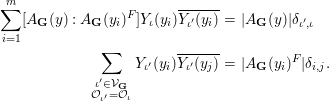 $$\begin{eqnarray}\displaystyle \mathop{\sum }_{i=1}^{m}[A_{\mathbf{G}}(y):A_{\mathbf{G}}(y_{i})^{F}]Y_{\unicode[STIX]{x1D704}}(y_{i})\overline{Y_{\unicode[STIX]{x1D704}^{\prime }}(y_{i})} & = & \displaystyle |A_{\mathbf{G}}(y)|\unicode[STIX]{x1D6FF}_{\unicode[STIX]{x1D704}^{\prime },\unicode[STIX]{x1D704}}\nonumber\\ \displaystyle \mathop{\sum }_{\substack{ \unicode[STIX]{x1D704}^{\prime }\in {\mathcal{V}}_{\boldsymbol{ G}} \\ {\mathcal{O}}_{\unicode[STIX]{x1D704}^{\prime }}={\mathcal{O}}_{\unicode[STIX]{x1D704}}}}Y_{\unicode[STIX]{x1D704}^{\prime }}(y_{i})\overline{Y_{\unicode[STIX]{x1D704}^{\prime }}(y_{j})} & = & \displaystyle |A_{\mathbf{G}}(y_{i})^{F}|\unicode[STIX]{x1D6FF}_{i,j}.\nonumber\end{eqnarray}$$
Here $\unicode[STIX]{x1D6FF}_{\unicode[STIX]{x1D704}^{\prime },\unicode[STIX]{x1D704}}$
and
$\unicode[STIX]{x1D6FF}_{\unicode[STIX]{x1D704}^{\prime },\unicode[STIX]{x1D704}}$
and $\unicode[STIX]{x1D6FF}_{i,j}$
denote the Kronecker delta.
$\unicode[STIX]{x1D6FF}_{i,j}$
denote the Kronecker delta.
Proof. Let $y\in {\mathcal{O}}_{\unicode[STIX]{x1D704}}^{F}$
be a fixed class representative and denote by
$y\in {\mathcal{O}}_{\unicode[STIX]{x1D704}}^{F}$
be a fixed class representative and denote by $H^{1}(F,A_{\mathbf{G}}(y))$
the
$H^{1}(F,A_{\mathbf{G}}(y))$
the $F$
-conjugacy classes of the component group. Then we may realize the set of representatives
$F$
-conjugacy classes of the component group. Then we may realize the set of representatives $\{y_{1},\ldots ,y_{m}\}$
as the set of
$\{y_{1},\ldots ,y_{m}\}$
as the set of $y_{a}=gyg^{-1}$
for every
$y_{a}=gyg^{-1}$
for every $a\in H^{1}(F,A_{\mathbf{G}}(y))$
, where
$a\in H^{1}(F,A_{\mathbf{G}}(y))$
, where $g^{-1}F(g)\in C_{\mathbf{G}}(y)$
is a representative of
$g^{-1}F(g)\in C_{\mathbf{G}}(y)$
is a representative of $a\in A_{\mathbf{G}}(y)$
. From the definition we see that
$a\in A_{\mathbf{G}}(y)$
. From the definition we see that $A_{\mathbf{G}}(y_{a})^{F}$
is naturally isomorphic to the
$A_{\mathbf{G}}(y_{a})^{F}$
is naturally isomorphic to the $F$
-centralizer
$F$
-centralizer $C_{A_{\mathbf{G}}(y),F}(a)=\{b\in A_{\mathbf{G}}(y)\mid b^{-1}aF(b)=a\}$
. Let us denote by
$C_{A_{\mathbf{G}}(y),F}(a)=\{b\in A_{\mathbf{G}}(y)\mid b^{-1}aF(b)=a\}$
. Let us denote by $\unicode[STIX]{x1D712}_{\unicode[STIX]{x1D704}}\in \text{Irr}(A_{\mathbf{G}}(u))$
the irreducible character corresponding to the local system
$\unicode[STIX]{x1D712}_{\unicode[STIX]{x1D704}}\in \text{Irr}(A_{\mathbf{G}}(u))$
the irreducible character corresponding to the local system $\mathscr{E}_{\unicode[STIX]{x1D704}}$
. Then
$\mathscr{E}_{\unicode[STIX]{x1D704}}$
. Then $\unicode[STIX]{x1D712}_{\unicode[STIX]{x1D704}}$
is
$\unicode[STIX]{x1D712}_{\unicode[STIX]{x1D704}}$
is $F$
-stable, as
$F$
-stable, as $\mathscr{E}_{\unicode[STIX]{x1D704}}$
is
$\mathscr{E}_{\unicode[STIX]{x1D704}}$
is $F$
-stable, and we can choose an extension
$F$
-stable, and we can choose an extension $\widetilde{\unicode[STIX]{x1D712}}_{\unicode[STIX]{x1D704}}$
to the semidirect product
$\widetilde{\unicode[STIX]{x1D712}}_{\unicode[STIX]{x1D704}}$
to the semidirect product $A_{\mathbf{G}}(y)\rtimes \langle F\rangle$
. According to [Reference ShojiSho3, 1.3] there exist an isomorphism
$A_{\mathbf{G}}(y)\rtimes \langle F\rangle$
. According to [Reference ShojiSho3, 1.3] there exist an isomorphism $\unicode[STIX]{x1D713}_{\unicode[STIX]{x1D704}}:F^{\ast }\mathscr{E}_{\unicode[STIX]{x1D704}}\rightarrow \mathscr{E}_{\unicode[STIX]{x1D704}}$
and a scalar
$\unicode[STIX]{x1D713}_{\unicode[STIX]{x1D704}}:F^{\ast }\mathscr{E}_{\unicode[STIX]{x1D704}}\rightarrow \mathscr{E}_{\unicode[STIX]{x1D704}}$
and a scalar $\unicode[STIX]{x1D709}_{\unicode[STIX]{x1D704}}\in \overline{\mathbb{Q}_{\ell }}^{\times }$
such that
$\unicode[STIX]{x1D709}_{\unicode[STIX]{x1D704}}\in \overline{\mathbb{Q}_{\ell }}^{\times }$
such that $\unicode[STIX]{x1D711}_{\unicode[STIX]{x1D704}}=\unicode[STIX]{x1D709}_{\unicode[STIX]{x1D704}}\unicode[STIX]{x1D713}_{\unicode[STIX]{x1D704}}$
and
$\unicode[STIX]{x1D711}_{\unicode[STIX]{x1D704}}=\unicode[STIX]{x1D709}_{\unicode[STIX]{x1D704}}\unicode[STIX]{x1D713}_{\unicode[STIX]{x1D704}}$
and
 $$\begin{eqnarray}\widetilde{\unicode[STIX]{x1D712}}_{\unicode[STIX]{x1D704}}(aF)=\text{Tr}(\unicode[STIX]{x1D713}_{\unicode[STIX]{x1D704}},(\mathscr{E}_{\unicode[STIX]{x1D704}})_{y_{a}})\end{eqnarray}$$
for all $a\in A_{\mathbf{G}}(y)$
. In fact, the isomorphism
$a\in A_{\mathbf{G}}(y)$
. In fact, the isomorphism $\unicode[STIX]{x1D713}_{\unicode[STIX]{x1D704}}$
induces a finite order automorphism on the stalk
$\unicode[STIX]{x1D713}_{\unicode[STIX]{x1D704}}$
induces a finite order automorphism on the stalk $(\mathscr{E}_{\unicode[STIX]{x1D704}})_{y}$
. As
$(\mathscr{E}_{\unicode[STIX]{x1D704}})_{y}$
. As $\unicode[STIX]{x1D711}_{\unicode[STIX]{x1D704}}$
also has this property we must have
$\unicode[STIX]{x1D711}_{\unicode[STIX]{x1D704}}$
also has this property we must have $\unicode[STIX]{x1D709}_{\unicode[STIX]{x1D704}}^{m}=1$
for some
$\unicode[STIX]{x1D709}_{\unicode[STIX]{x1D704}}^{m}=1$
for some $m\geqslant 1$
, hence
$m\geqslant 1$
, hence $\unicode[STIX]{x1D709}_{\unicode[STIX]{x1D704}}$
is a root of unity. In particular, we have
$\unicode[STIX]{x1D709}_{\unicode[STIX]{x1D704}}$
is a root of unity. In particular, we have
 $$\begin{eqnarray}Y_{\unicode[STIX]{x1D704}}(y_{a})\overline{Y_{\unicode[STIX]{x1D704}^{\prime }}(y_{a})}=\unicode[STIX]{x1D709}_{\unicode[STIX]{x1D704}}\unicode[STIX]{x1D709}_{\unicode[STIX]{x1D704}^{\prime }}^{-1}\widetilde{\unicode[STIX]{x1D712}}_{\unicode[STIX]{x1D704}}(aF)\overline{\widetilde{\unicode[STIX]{x1D712}}_{\unicode[STIX]{x1D704}^{\prime }}(aF)}\end{eqnarray}$$
for all $a\in A_{\mathbf{G}}(y)$
and so the result follows from the orthogonality relations of cosets, see [Reference Digne and MichelDM1, II, Corollaire 2.10] and [Reference IsaacsIsa, 8.14].◻
$a\in A_{\mathbf{G}}(y)$
and so the result follows from the orthogonality relations of cosets, see [Reference Digne and MichelDM1, II, Corollaire 2.10] and [Reference IsaacsIsa, 8.14].◻
10.10. The set of functions $\{Y_{\unicode[STIX]{x1D704}}\mid \unicode[STIX]{x1D704}\in {\mathcal{V}}_{\mathbf{G}}^{F}\}$
forms a basis for the space
$\{Y_{\unicode[STIX]{x1D704}}\mid \unicode[STIX]{x1D704}\in {\mathcal{V}}_{\mathbf{G}}^{F}\}$
forms a basis for the space $\text{Cent}_{\text{nil}}(\mathfrak{g}^{F})$
of
$\text{Cent}_{\text{nil}}(\mathfrak{g}^{F})$
of $\text{Ad}\,G$
-invariant functions
$\text{Ad}\,G$
-invariant functions $\mathfrak{g}^{F}\rightarrow \overline{\mathbb{Q}_{\ell }}$
which are supported on
$\mathfrak{g}^{F}\rightarrow \overline{\mathbb{Q}_{\ell }}$
which are supported on ${\mathcal{N}}^{F}$
, see [Reference LusztigLus4, 24.2.7]. In particular, for any two pairs
${\mathcal{N}}^{F}$
, see [Reference LusztigLus4, 24.2.7]. In particular, for any two pairs $\unicode[STIX]{x1D704},\unicode[STIX]{x1D704}^{\prime }\in {\mathcal{V}}_{\mathbf{G}}^{F}$
there exists a scalar
$\unicode[STIX]{x1D704},\unicode[STIX]{x1D704}^{\prime }\in {\mathcal{V}}_{\mathbf{G}}^{F}$
there exists a scalar $P_{\unicode[STIX]{x1D704}^{\prime },\unicode[STIX]{x1D704}}\in \overline{\mathbb{Q}_{\ell }}$
such that
$P_{\unicode[STIX]{x1D704}^{\prime },\unicode[STIX]{x1D704}}\in \overline{\mathbb{Q}_{\ell }}$
such that
 $$\begin{eqnarray}X_{\unicode[STIX]{x1D704}}=\mathop{\sum }_{\unicode[STIX]{x1D704}^{\prime }\in {\mathcal{V}}_{\mathbf{G}}^{F}}P_{\unicode[STIX]{x1D704}^{\prime },\unicode[STIX]{x1D704}}Y_{\unicode[STIX]{x1D704}^{\prime }}.\end{eqnarray}$$
By the definition of the functions $X_{\unicode[STIX]{x1D704}}$
and
$X_{\unicode[STIX]{x1D704}}$
and $Y_{\unicode[STIX]{x1D704}^{\prime }}$
we see that
$Y_{\unicode[STIX]{x1D704}^{\prime }}$
we see that
 $$\begin{eqnarray}P_{\unicode[STIX]{x1D704}^{\prime },\unicode[STIX]{x1D704}}=\left\{\begin{array}{@{}ll@{}}1\quad & \text{if}~\unicode[STIX]{x1D704}^{\prime }=\unicode[STIX]{x1D704},\\ 0\quad & \text{if}~{\mathcal{O}}_{\unicode[STIX]{x1D704}^{\prime }}\not \subseteq \overline{{\mathcal{O}}_{\unicode[STIX]{x1D704}}}~\text{or if}~{\mathcal{O}}_{\unicode[STIX]{x1D704}^{\prime }}={\mathcal{O}}_{\unicode[STIX]{x1D704}}~\text{and}~\unicode[STIX]{x1D704}\neq \unicode[STIX]{x1D704}^{\prime }\end{array}\right.\end{eqnarray}$$
for any $\unicode[STIX]{x1D704}^{\prime },\unicode[STIX]{x1D704}\in {\mathcal{V}}_{\mathbf{G}}^{F}$
, see also [Reference LusztigLus3, 24.2.10, 24.2.11]. We now also define scalars
$\unicode[STIX]{x1D704}^{\prime },\unicode[STIX]{x1D704}\in {\mathcal{V}}_{\mathbf{G}}^{F}$
, see also [Reference LusztigLus3, 24.2.10, 24.2.11]. We now also define scalars $\unicode[STIX]{x1D706}_{\unicode[STIX]{x1D704}^{\prime },\unicode[STIX]{x1D704}}\in \overline{\mathbb{Q}_{\ell }}$
by setting
$\unicode[STIX]{x1D706}_{\unicode[STIX]{x1D704}^{\prime },\unicode[STIX]{x1D704}}\in \overline{\mathbb{Q}_{\ell }}$
by setting
 $$\begin{eqnarray}\unicode[STIX]{x1D706}_{\unicode[STIX]{x1D704},\unicode[STIX]{x1D704}^{\prime }}=\unicode[STIX]{x1D706}_{\unicode[STIX]{x1D704}^{\prime },\unicode[STIX]{x1D704}}=\mathop{\sum }_{y\in {\mathcal{N}}^{F}}Y_{\unicode[STIX]{x1D704}}(y)\overline{Y_{\unicode[STIX]{x1D704}^{\prime }}(y)},\end{eqnarray}$$
which are integers by Lemma 10.9. Moreover, from the definition of the functions $Y_{\unicode[STIX]{x1D704}}$
it is clear that we have
$Y_{\unicode[STIX]{x1D704}}$
it is clear that we have
 $$\begin{eqnarray}\unicode[STIX]{x1D706}_{\unicode[STIX]{x1D704}^{\prime },\unicode[STIX]{x1D704}}=0\quad \text{if}~{\mathcal{O}}_{\unicode[STIX]{x1D704}^{\prime }}\neq {\mathcal{O}}_{\unicode[STIX]{x1D704}}.\end{eqnarray}$$
10.13. For any $w\in W_{\mathbf{G}}(\mathbf{L})$
let
$w\in W_{\mathbf{G}}(\mathbf{L})$
let $\mathbf{L}_{w}$
be as in 10.6 then for any
$\mathbf{L}_{w}$
be as in 10.6 then for any $\unicode[STIX]{x1D704}^{\prime },\unicode[STIX]{x1D704}\in \mathscr{I}[\mathbf{L},\unicode[STIX]{x1D704}_{0}]^{F}$
we set
$\unicode[STIX]{x1D704}^{\prime },\unicode[STIX]{x1D704}\in \mathscr{I}[\mathbf{L},\unicode[STIX]{x1D704}_{0}]^{F}$
we set $\unicode[STIX]{x1D714}_{\unicode[STIX]{x1D704},\unicode[STIX]{x1D704}^{\prime }}=\unicode[STIX]{x1D714}_{\unicode[STIX]{x1D704}^{\prime },\unicode[STIX]{x1D704}}$
to be the term
$\unicode[STIX]{x1D714}_{\unicode[STIX]{x1D704},\unicode[STIX]{x1D704}^{\prime }}=\unicode[STIX]{x1D714}_{\unicode[STIX]{x1D704}^{\prime },\unicode[STIX]{x1D704}}$
to be the term
 $$\begin{eqnarray}q^{-\dim \mathbf{G}-(a_{\unicode[STIX]{x1D704}}+a_{\unicode[STIX]{x1D704}^{\prime }})/2}\frac{1}{|W_{\mathbf{G}}(\mathbf{L})|}\mathop{\sum }_{w\in W_{\mathbf{G}}(\mathbf{L})}\,\text{Tr}(wF,E_{\unicode[STIX]{x1D704}})\text{Tr}(wF,E_{\unicode[STIX]{x1D704}^{\prime }})\frac{|\mathbf{G}^{F}|}{|Z^{\circ }(\mathbf{L}_{w})^{F}|}.\end{eqnarray}$$
Here $Z^{\circ }(\mathbf{L}_{w})$
denotes the connected center of
$Z^{\circ }(\mathbf{L}_{w})$
denotes the connected center of $\mathbf{L}_{w}$
and
$\mathbf{L}_{w}$
and $F$
is acting on
$F$
is acting on $E_{\unicode[STIX]{x1D704}}$
via the isomorphism
$E_{\unicode[STIX]{x1D704}}$
via the isomorphism $\unicode[STIX]{x1D713}_{\unicode[STIX]{x1D704}}^{-1}$
, similarly for
$\unicode[STIX]{x1D713}_{\unicode[STIX]{x1D704}}^{-1}$
, similarly for $E_{\unicode[STIX]{x1D704}^{\prime }}$
, see, 10.2. If either
$E_{\unicode[STIX]{x1D704}^{\prime }}$
, see, 10.2. If either $\unicode[STIX]{x1D704}$
or
$\unicode[STIX]{x1D704}$
or $\unicode[STIX]{x1D704}^{\prime }$
are not contained in the block
$\unicode[STIX]{x1D704}^{\prime }$
are not contained in the block $\mathscr{I}[\mathbf{L},\unicode[STIX]{x1D704}_{0}]$
then we set
$\mathscr{I}[\mathbf{L},\unicode[STIX]{x1D704}_{0}]$
then we set $\unicode[STIX]{x1D714}_{\unicode[STIX]{x1D704},\unicode[STIX]{x1D704}^{\prime }}=0$
. Our definition of the term
$\unicode[STIX]{x1D714}_{\unicode[STIX]{x1D704},\unicode[STIX]{x1D704}^{\prime }}=0$
. Our definition of the term $\unicode[STIX]{x1D714}_{\unicode[STIX]{x1D704},\unicode[STIX]{x1D704}^{\prime }}$
is slightly different to that given in [Reference LusztigLus4, 24.3.4]. However, one sees that these definitions are equivalent by [Reference LusztigLus4, 24.2.1]. With this we have the following theorem of Lusztig.
$\unicode[STIX]{x1D714}_{\unicode[STIX]{x1D704},\unicode[STIX]{x1D704}^{\prime }}$
is slightly different to that given in [Reference LusztigLus4, 24.3.4]. However, one sees that these definitions are equivalent by [Reference LusztigLus4, 24.2.1]. With this we have the following theorem of Lusztig.
Theorem 10.14. (Lusztig, [Reference LusztigLus4, Theorem 24.4])
Let us denote by $P$
,
$P$
, $\unicode[STIX]{x1D6EC}$
and
$\unicode[STIX]{x1D6EC}$
and $\unicode[STIX]{x1D6FA}$
the matrixes
$\unicode[STIX]{x1D6FA}$
the matrixes $(P_{\unicode[STIX]{x1D704}^{\prime },\unicode[STIX]{x1D704}})$
,
$(P_{\unicode[STIX]{x1D704}^{\prime },\unicode[STIX]{x1D704}})$
, $(\unicode[STIX]{x1D706}_{\unicode[STIX]{x1D704}^{\prime },\unicode[STIX]{x1D704}})$
and
$(\unicode[STIX]{x1D706}_{\unicode[STIX]{x1D704}^{\prime },\unicode[STIX]{x1D704}})$
and $(\unicode[STIX]{x1D714}_{\unicode[STIX]{x1D704}^{\prime },\unicode[STIX]{x1D704}})$
respectively. Then the entries of the matrixes
$(\unicode[STIX]{x1D714}_{\unicode[STIX]{x1D704}^{\prime },\unicode[STIX]{x1D704}})$
respectively. Then the entries of the matrixes $P$
and
$P$
and $\unicode[STIX]{x1D6EC}$
are the unique solution to the system of equations given by
$\unicode[STIX]{x1D6EC}$
are the unique solution to the system of equations given by $P\unicode[STIX]{x1D6EC}P^{T}=\unicode[STIX]{x1D6FA}$
, (10.11) and (10.12). Furthermore, we have:
$P\unicode[STIX]{x1D6EC}P^{T}=\unicode[STIX]{x1D6FA}$
, (10.11) and (10.12). Furthermore, we have:
-
(i)
$P$
,
$\unicode[STIX]{x1D6EC}$
and
$\unicode[STIX]{x1D6FA}$
are nonsingular integer valued matrices; -
(ii)
$P_{\unicode[STIX]{x1D704}^{\prime },\unicode[STIX]{x1D704}}=\unicode[STIX]{x1D706}_{\unicode[STIX]{x1D704}^{\prime },\unicode[STIX]{x1D704}}=0$
if
$\unicode[STIX]{x1D704}^{\prime },\unicode[STIX]{x1D704}\in {\mathcal{V}}_{\mathbf{G}}^{F}$
lie in different blocks.


10.15. Recall that on the character group $X(\mathbf{T}_{0})$
of our chosen maximal torus the Frobenius endomorphism factors as
$X(\mathbf{T}_{0})$
of our chosen maximal torus the Frobenius endomorphism factors as $q\unicode[STIX]{x1D70F}$
where
$q\unicode[STIX]{x1D70F}$
where $\unicode[STIX]{x1D70F}$
is a finite order automorphism, see, Theorem 2.3. For any
$\unicode[STIX]{x1D70F}$
is a finite order automorphism, see, Theorem 2.3. For any $n\geqslant 1$
the endomorphism
$n\geqslant 1$
the endomorphism $q^{n}\unicode[STIX]{x1D70F}$
of
$q^{n}\unicode[STIX]{x1D70F}$
of $X(\mathbf{T}_{0})$
lifts to a Frobenius endomorphism
$X(\mathbf{T}_{0})$
lifts to a Frobenius endomorphism $F^{\prime }:\mathbf{G}\rightarrow \mathbf{G}$
which determines an
$F^{\prime }:\mathbf{G}\rightarrow \mathbf{G}$
which determines an $\mathbb{F}_{q^{n}}$
-rational structure of
$\mathbb{F}_{q^{n}}$
-rational structure of $\mathbf{G}$
, see, Theorem 2.3. Replacing
$\mathbf{G}$
, see, Theorem 2.3. Replacing $q$
by
$q$
by $q^{n}$
in the entries for
$q^{n}$
in the entries for $P$
we see that we obtain the corresponding matrix for
$P$
we see that we obtain the corresponding matrix for $\mathbf{G}^{F^{\prime }}$
. In this way we may view the entries of
$\mathbf{G}^{F^{\prime }}$
. In this way we may view the entries of $P$
as polynomials in a single variable, say
$P$
as polynomials in a single variable, say $\mathbf{q}$
. We now denote by
$\mathbf{q}$
. We now denote by $P^{\star }=(P_{\unicode[STIX]{x1D704}^{\prime },\unicode[STIX]{x1D704}}^{\star })$
the rational valued matrix obtained from
$P^{\star }=(P_{\unicode[STIX]{x1D704}^{\prime },\unicode[STIX]{x1D704}}^{\star })$
the rational valued matrix obtained from $P$
by evaluating
$P$
by evaluating $\mathbf{q}$
at
$\mathbf{q}$
at $q^{-1}$
. This matrix is such that
$q^{-1}$
. This matrix is such that
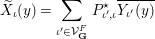 $$\begin{eqnarray}\widetilde{X}_{\unicode[STIX]{x1D704}}(y)=\mathop{\sum }_{\unicode[STIX]{x1D704}^{\prime }\in {\mathcal{V}}_{\mathbf{G}}^{F}}P_{\unicode[STIX]{x1D704}^{\prime },\unicode[STIX]{x1D704}}^{\star }\overline{Y_{\unicode[STIX]{x1D704}^{\prime }}(y)}\end{eqnarray}$$
for all $\unicode[STIX]{x1D704}\in {\mathcal{V}}_{\mathbf{G}}^{F}$
and
$\unicode[STIX]{x1D704}\in {\mathcal{V}}_{\mathbf{G}}^{F}$
and $y\in {\mathcal{N}}^{F}$
.
$y\in {\mathcal{N}}^{F}$
.
10.17. Let us denote by $Q=(Q_{\unicode[STIX]{x1D704}^{\prime },\unicode[STIX]{x1D704}})$
,
$Q=(Q_{\unicode[STIX]{x1D704}^{\prime },\unicode[STIX]{x1D704}})$
, $\widetilde{\unicode[STIX]{x1D6EC}}=(\widetilde{\unicode[STIX]{x1D706}}_{\unicode[STIX]{x1D704}^{\prime },\unicode[STIX]{x1D704}})$
and
$\widetilde{\unicode[STIX]{x1D6EC}}=(\widetilde{\unicode[STIX]{x1D706}}_{\unicode[STIX]{x1D704}^{\prime },\unicode[STIX]{x1D704}})$
and $\widetilde{\unicode[STIX]{x1D6FA}}=(\widetilde{\unicode[STIX]{x1D714}}_{\unicode[STIX]{x1D704}^{\prime },\unicode[STIX]{x1D704}})$
the inverse matrices to
$\widetilde{\unicode[STIX]{x1D6FA}}=(\widetilde{\unicode[STIX]{x1D714}}_{\unicode[STIX]{x1D704}^{\prime },\unicode[STIX]{x1D704}})$
the inverse matrices to $P$
,
$P$
, $\unicode[STIX]{x1D6EC}$
and
$\unicode[STIX]{x1D6EC}$
and $\unicode[STIX]{x1D6FA}$
respectively, see, Theorem 10.14. It is clear that we have
$\unicode[STIX]{x1D6FA}$
respectively, see, Theorem 10.14. It is clear that we have
 $$\begin{eqnarray}\displaystyle & \displaystyle Q\widetilde{\unicode[STIX]{x1D6EC}}Q^{T}=\widetilde{\unicode[STIX]{x1D6FA}} & \displaystyle\end{eqnarray}$$
 $$\begin{eqnarray}\displaystyle & \displaystyle Y_{\unicode[STIX]{x1D704}}=\mathop{\sum }_{\unicode[STIX]{x1D704}^{\prime }\in {\mathcal{V}}_{\mathbf{G}}^{F}}Q_{\unicode[STIX]{x1D704}^{\prime },\unicode[STIX]{x1D704}}X_{\unicode[STIX]{x1D704}^{\prime }} & \displaystyle\end{eqnarray}$$
for all $\unicode[STIX]{x1D704}\in {\mathcal{V}}_{\mathbf{G}}^{F}$
. Using the coset orthogonality relations for finite groups we deduce that
$\unicode[STIX]{x1D704}\in {\mathcal{V}}_{\mathbf{G}}^{F}$
. Using the coset orthogonality relations for finite groups we deduce that
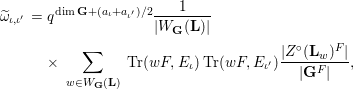 $$\begin{eqnarray}\displaystyle \widetilde{\unicode[STIX]{x1D714}}_{\unicode[STIX]{x1D704},\unicode[STIX]{x1D704}^{\prime }} & = & \displaystyle q^{\dim \mathbf{G}+(a_{\unicode[STIX]{x1D704}}+a_{\unicode[STIX]{x1D704}^{\prime }})/2}\frac{1}{|W_{\mathbf{G}}(\mathbf{L})|}\nonumber\\ \displaystyle & & \displaystyle \times \,\mathop{\sum }_{w\in W_{\mathbf{G}}(\mathbf{L})}\,\text{Tr}(wF,E_{\unicode[STIX]{x1D704}})\,\text{Tr}(wF,E_{\unicode[STIX]{x1D704}^{\prime }})\frac{|Z^{\circ }(\mathbf{L}_{w})^{F}|}{|\mathbf{G}^{F}|},\end{eqnarray}$$
if $\unicode[STIX]{x1D704}$
,
$\unicode[STIX]{x1D704}$
, $\unicode[STIX]{x1D704}^{\prime }\in \mathscr{I}[\mathbf{L},\unicode[STIX]{x1D704}_{0}]^{F}$
, see also [Reference Digne, Lehrer and MichelDLM, Lemma 5.1]. Clearly
$\unicode[STIX]{x1D704}^{\prime }\in \mathscr{I}[\mathbf{L},\unicode[STIX]{x1D704}_{0}]^{F}$
, see also [Reference Digne, Lehrer and MichelDLM, Lemma 5.1]. Clearly $\widetilde{\unicode[STIX]{x1D714}}_{\unicode[STIX]{x1D704},\unicode[STIX]{x1D704}^{\prime }}=0$
if
$\widetilde{\unicode[STIX]{x1D714}}_{\unicode[STIX]{x1D704},\unicode[STIX]{x1D704}^{\prime }}=0$
if $\unicode[STIX]{x1D704},\unicode[STIX]{x1D704}^{\prime }\in {\mathcal{V}}_{\mathbf{G}}^{F}$
are not contained in the same block.
$\unicode[STIX]{x1D704},\unicode[STIX]{x1D704}^{\prime }\in {\mathcal{V}}_{\mathbf{G}}^{F}$
are not contained in the same block.

Formula for the Fourier transform of the GGGR
10.21. Let $\mathbf{L}_{w}$
for some
$\mathbf{L}_{w}$
for some $w\in W_{\mathbf{G}}(\mathbf{L})$
be as in 10.6 then by the argument in [Reference LusztigLus4, 10.6, 25.6.3], see also [Reference TaylorTay2, 6.15] and [Reference LusztigLus9, 6.9], we have the following equalities
$w\in W_{\mathbf{G}}(\mathbf{L})$
be as in 10.6 then by the argument in [Reference LusztigLus4, 10.6, 25.6.3], see also [Reference TaylorTay2, 6.15] and [Reference LusztigLus9, 6.9], we have the following equalities
 $$\begin{eqnarray}\displaystyle \qquad \unicode[STIX]{x1D712}_{K_{w},\unicode[STIX]{x1D719}_{w}}(y)=\unicode[STIX]{x1D712}_{K_{0},\unicode[STIX]{x1D703}_{w}\circ \unicode[STIX]{x1D719}_{0}}(y) & = & \displaystyle \mathop{\sum }_{\unicode[STIX]{x1D704}\in \mathscr{I}[\mathbf{L},\unicode[STIX]{x1D704}_{0}]^{F}}q^{b_{\unicode[STIX]{x1D704}}}\,\text{Tr}(wF,E_{\unicode[STIX]{x1D704}})X_{\unicode[STIX]{x1D704}}(y),\end{eqnarray}$$
 $$\begin{eqnarray}\displaystyle \qquad \unicode[STIX]{x1D712}_{K_{w},\unicode[STIX]{x1D719}_{w}^{-1}}(y)=\unicode[STIX]{x1D712}_{K_{0},\unicode[STIX]{x1D703}_{w}\circ \unicode[STIX]{x1D719}_{0}^{-1}}(y) & = & \displaystyle \mathop{\sum }_{\unicode[STIX]{x1D704}\in \mathscr{I}[\mathbf{L},\unicode[STIX]{x1D704}_{0}]^{F}}q^{-b_{\unicode[STIX]{x1D704}}}\,\text{Tr}(wF,E_{\unicode[STIX]{x1D704}})\widetilde{X}_{\unicode[STIX]{x1D704}}(y),\end{eqnarray}$$
 $$\begin{eqnarray}\displaystyle \qquad \unicode[STIX]{x1D712}_{K_{w},\unicode[STIX]{x1D719}_{w}^{\vee }}(y)=\unicode[STIX]{x1D712}_{K_{0},\unicode[STIX]{x1D703}_{w}\circ \unicode[STIX]{x1D719}_{0}^{\vee }}(y) & = & \displaystyle \mathop{\sum }_{\unicode[STIX]{x1D704}\in \mathscr{I}[\mathbf{L},\unicode[STIX]{x1D704}_{0}]^{F}}q^{b_{\unicode[STIX]{x1D704}}}\,\text{Tr}(wF,E_{\unicode[STIX]{x1D704}})\overline{X_{\unicode[STIX]{x1D704}}(y)},\end{eqnarray}$$
for any $y\in (\overline{Y}\cap {\mathcal{N}})^{F}$
.
$y\in (\overline{Y}\cap {\mathcal{N}})^{F}$
.
10.25. According to [Reference LusztigLus9, 6.10(a)] we have, by Grothendieck’s trace formula, that
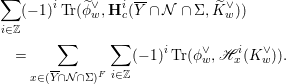 $$\begin{eqnarray}\displaystyle & & \displaystyle \mathop{\sum }_{i\in \mathbb{Z}}(-1)^{i}\,\text{Tr}(\widetilde{\unicode[STIX]{x1D719}}_{w}^{\vee },\mathbf{H}_{c}^{i}(\overline{Y}\cap {\mathcal{N}}\cap \unicode[STIX]{x1D6F4},\widetilde{K}_{w}^{\vee }))\nonumber\\ \displaystyle & & \displaystyle \quad =\mathop{\sum }_{x\in (\overline{Y}\cap {\mathcal{N}}\cap \unicode[STIX]{x1D6F4})^{F}}\mathop{\sum }_{i\in \mathbb{Z}}(-1)^{i}\,\text{Tr}(\unicode[STIX]{x1D719}_{w}^{\vee },\mathscr{H}_{x}^{i}(K_{w}^{\vee })).\end{eqnarray}$$
Using (7.14) we get
 $$\begin{eqnarray}\text{Tr}(\widetilde{\unicode[STIX]{x1D719}}_{w}^{\vee },\mathbf{H}_{c}^{2d_{\unicode[STIX]{x1D704}_{0}}-i}(\overline{Y}\cap {\mathcal{N}}\cap \unicode[STIX]{x1D6F4},\widetilde{K}_{w}^{\vee }))=q^{d_{\unicode[STIX]{x1D704}_{0}}}\,\text{Tr}(\unicode[STIX]{x1D719}_{w}^{-1},\mathscr{H}_{-e^{\dagger }}^{i}(K_{w}))\end{eqnarray}$$
where $d_{\unicode[STIX]{x1D704}_{0}}$
is the integer in (iii) of Proposition 7.7. Now, combining (10.26) and (10.27) we obtain
$d_{\unicode[STIX]{x1D704}_{0}}$
is the integer in (iii) of Proposition 7.7. Now, combining (10.26) and (10.27) we obtain
 $$\begin{eqnarray}q^{d_{\unicode[STIX]{x1D704}_{0}}}\mathop{\sum }_{i\in \mathbb{Z}}(-1)^{i}\,\text{Tr}(\unicode[STIX]{x1D719}_{w}^{-1},\mathscr{H}_{-e^{\dagger }}^{i}(K_{w}))=\mathop{\sum }_{x\in (\overline{Y}\cap {\mathcal{N}}\cap \unicode[STIX]{x1D6F4})^{F}}\mathop{\sum }_{i\in \mathbb{Z}}(-1)^{i}\,\text{Tr}(\unicode[STIX]{x1D719}_{w}^{\vee },\mathscr{H}_{x}^{i}(K_{w}^{\vee }))\end{eqnarray}$$
and applying (10.23) and (10.24) to this equality we obtain
 $$\begin{eqnarray}\mathop{\sum }_{\unicode[STIX]{x1D704}\in \mathscr{I}[\mathbf{L},\unicode[STIX]{x1D704}_{0}]^{F}}q^{d_{\unicode[STIX]{x1D704}_{0}}-b_{\unicode[STIX]{x1D704}}/2}\widetilde{X}_{\unicode[STIX]{x1D704}}(-e^{\dagger })f_{\unicode[STIX]{x1D704}}=\mathop{\sum }_{x\in (\overline{Y}\cap {\mathcal{N}}\cap \unicode[STIX]{x1D6F4})^{F}}\mathop{\sum }_{\unicode[STIX]{x1D704}\in \mathscr{I}[\mathbf{L},\unicode[STIX]{x1D704}_{0}]^{F}}q^{b_{\unicode[STIX]{x1D704}}/2}\overline{X_{\unicode[STIX]{x1D704}}(x)}f_{\unicode[STIX]{x1D704}},\end{eqnarray}$$
where $f_{\unicode[STIX]{x1D704}}:W_{\mathbf{G}}(\mathbf{L})\rightarrow \overline{\mathbb{Q}_{\ell }}$
is defined by
$f_{\unicode[STIX]{x1D704}}:W_{\mathbf{G}}(\mathbf{L})\rightarrow \overline{\mathbb{Q}_{\ell }}$
is defined by $f_{\unicode[STIX]{x1D704}}(w)=\text{Tr}(wF,E_{\unicode[STIX]{x1D704}})$
for all
$f_{\unicode[STIX]{x1D704}}(w)=\text{Tr}(wF,E_{\unicode[STIX]{x1D704}})$
for all $w\in W_{\mathbf{G}}(\mathbf{L})$
. Note that the set of functions
$w\in W_{\mathbf{G}}(\mathbf{L})$
. Note that the set of functions $\{f_{\unicode[STIX]{x1D704}}\mid \unicode[STIX]{x1D704}\in \mathscr{I}[\mathbf{L},\unicode[STIX]{x1D704}_{0}]^{F}\}$
is linearly independent hence we get
$\{f_{\unicode[STIX]{x1D704}}\mid \unicode[STIX]{x1D704}\in \mathscr{I}[\mathbf{L},\unicode[STIX]{x1D704}_{0}]^{F}\}$
is linearly independent hence we get
 $$\begin{eqnarray}q^{d_{\unicode[STIX]{x1D704}_{0}}-b_{\unicode[STIX]{x1D704}}/2}\widetilde{X}_{\unicode[STIX]{x1D704}}(-e^{\dagger })=\mathop{\sum }_{x\in (\overline{Y}\cap {\mathcal{N}}\cap \unicode[STIX]{x1D6F4})^{F}}q^{b_{\unicode[STIX]{x1D704}}/2}\overline{X_{\unicode[STIX]{x1D704}}(x)}.\end{eqnarray}$$
Rewriting the $X_{\unicode[STIX]{x1D704}}$
’s in terms of the
$X_{\unicode[STIX]{x1D704}}$
’s in terms of the $Y_{\unicode[STIX]{x1D704}}$
’s and conjugating by
$Y_{\unicode[STIX]{x1D704}}$
’s and conjugating by $\overline{\phantom{x}}$
we have
$\overline{\phantom{x}}$
we have
 $$\begin{eqnarray}q^{d_{\unicode[STIX]{x1D704}_{0}}-b_{\unicode[STIX]{x1D704}}}\mathop{\sum }_{\unicode[STIX]{x1D704}^{\prime }\in {\mathcal{V}}_{\mathbf{G}}^{F}}P_{\unicode[STIX]{x1D704}^{\prime },\unicode[STIX]{x1D704}}^{\star }Y_{\unicode[STIX]{x1D704}^{\prime }}(-e^{\dagger })=\mathop{\sum }_{x\in (\overline{Y}\cap {\mathcal{N}}\cap \unicode[STIX]{x1D6F4})^{F}}\mathop{\sum }_{\unicode[STIX]{x1D704}^{\prime }\in {\mathcal{V}}_{\mathbf{G}}^{F}}P_{\unicode[STIX]{x1D704}^{\prime },\unicode[STIX]{x1D704}}Y_{\unicode[STIX]{x1D704}^{\prime }}(x).\end{eqnarray}$$
Note that $P_{\unicode[STIX]{x1D704}^{\prime },\unicode[STIX]{x1D704}}^{\star }$
and
$P_{\unicode[STIX]{x1D704}^{\prime },\unicode[STIX]{x1D704}}^{\star }$
and $P_{\unicode[STIX]{x1D704}^{\prime },\unicode[STIX]{x1D704}}$
are both rational and neither sum on the right hand side depends on
$P_{\unicode[STIX]{x1D704}^{\prime },\unicode[STIX]{x1D704}}$
are both rational and neither sum on the right hand side depends on $\unicode[STIX]{x1D704}$
.
$\unicode[STIX]{x1D704}$
.
Finally, as $Q$
is the inverse to
$Q$
is the inverse to $P$
we have
$P$
we have $\sum _{\unicode[STIX]{x1D704}\in \mathscr{I}[\mathbf{L},\unicode[STIX]{x1D704}_{0}]^{F}}P_{\unicode[STIX]{x1D704}^{\prime },\unicode[STIX]{x1D704}}Q_{\unicode[STIX]{x1D704},\unicode[STIX]{x1D704}^{\prime \prime }}=\unicode[STIX]{x1D6FF}_{\unicode[STIX]{x1D704}^{\prime },\unicode[STIX]{x1D704}^{\prime \prime }}$
(the Kronecker delta) by (10.11) for any
$\sum _{\unicode[STIX]{x1D704}\in \mathscr{I}[\mathbf{L},\unicode[STIX]{x1D704}_{0}]^{F}}P_{\unicode[STIX]{x1D704}^{\prime },\unicode[STIX]{x1D704}}Q_{\unicode[STIX]{x1D704},\unicode[STIX]{x1D704}^{\prime \prime }}=\unicode[STIX]{x1D6FF}_{\unicode[STIX]{x1D704}^{\prime },\unicode[STIX]{x1D704}^{\prime \prime }}$
(the Kronecker delta) by (10.11) for any $\unicode[STIX]{x1D704}^{\prime }\in {\mathcal{V}}_{\mathbf{G}}^{F}$
and
$\unicode[STIX]{x1D704}^{\prime }\in {\mathcal{V}}_{\mathbf{G}}^{F}$
and $\unicode[STIX]{x1D704}^{\prime \prime }\in \mathscr{I}[\mathbf{L},\unicode[STIX]{x1D704}_{0}]^{F}$
. Thus, multiplying both sides of (10.28) by
$\unicode[STIX]{x1D704}^{\prime \prime }\in \mathscr{I}[\mathbf{L},\unicode[STIX]{x1D704}_{0}]^{F}$
. Thus, multiplying both sides of (10.28) by $\sum _{\unicode[STIX]{x1D704}\in \mathscr{I}[\mathbf{L},\unicode[STIX]{x1D704}_{0}]^{F}}Q_{\unicode[STIX]{x1D704},\unicode[STIX]{x1D704}^{\prime \prime }}$
we obtain
$\sum _{\unicode[STIX]{x1D704}\in \mathscr{I}[\mathbf{L},\unicode[STIX]{x1D704}_{0}]^{F}}Q_{\unicode[STIX]{x1D704},\unicode[STIX]{x1D704}^{\prime \prime }}$
we obtain
 $$\begin{eqnarray}\mathop{\sum }_{x\in (\overline{Y}\cap {\mathcal{N}}\cap \unicode[STIX]{x1D6F4})^{F}}Y_{\unicode[STIX]{x1D704}^{\prime \prime }}(x)=\mathop{\sum }_{\unicode[STIX]{x1D704},\unicode[STIX]{x1D704}^{\prime }\in \mathscr{I}[\mathbf{L},\unicode[STIX]{x1D704}_{0}]^{F}}q^{d_{\unicode[STIX]{x1D704}_{0}}-b_{\unicode[STIX]{x1D704}}}P_{\unicode[STIX]{x1D704}^{\prime },\unicode[STIX]{x1D704}}^{\star }Q_{\unicode[STIX]{x1D704},\unicode[STIX]{x1D704}^{\prime \prime }}Y_{\unicode[STIX]{x1D704}^{\prime }}(-e^{\dagger }),\end{eqnarray}$$
which holds for any $\unicode[STIX]{x1D704}^{\prime \prime }\in \mathscr{I}[\mathbf{L},\unicode[STIX]{x1D704}_{0}]^{F}$
. As is pointed out in [Reference LusztigLus9, 6.9] we have used here the assumption that
$\unicode[STIX]{x1D704}^{\prime \prime }\in \mathscr{I}[\mathbf{L},\unicode[STIX]{x1D704}_{0}]^{F}$
. As is pointed out in [Reference LusztigLus9, 6.9] we have used here the assumption that $-e^{\dagger }\in \overline{Y}$
but in fact this equality holds regardless as both sides are zero when
$-e^{\dagger }\in \overline{Y}$
but in fact this equality holds regardless as both sides are zero when $-e^{\dagger }\not \in \overline{Y}$
.
$-e^{\dagger }\not \in \overline{Y}$
.
10.30. By 10.10 we see there exist unique scalars $\unicode[STIX]{x1D6FC}_{\unicode[STIX]{x1D704}_{1}},\unicode[STIX]{x1D6FD}_{\unicode[STIX]{x1D704}_{1}}\in \overline{\mathbb{Q}_{\ell }}$
, for
$\unicode[STIX]{x1D6FC}_{\unicode[STIX]{x1D704}_{1}},\unicode[STIX]{x1D6FD}_{\unicode[STIX]{x1D704}_{1}}\in \overline{\mathbb{Q}_{\ell }}$
, for $\unicode[STIX]{x1D704}_{1}\in {\mathcal{V}}_{\mathbf{G}}^{F}$
, such that
$\unicode[STIX]{x1D704}_{1}\in {\mathcal{V}}_{\mathbf{G}}^{F}$
, such that
 $$\begin{eqnarray}{\mathcal{F}}(\unicode[STIX]{x1D71E}_{u})|_{{\mathcal{N}}^{F}}=\mathop{\sum }_{\unicode[STIX]{x1D704}_{1}\in {\mathcal{V}}_{\mathbf{G}}^{F}}\unicode[STIX]{x1D6FC}_{\unicode[STIX]{x1D704}_{1}}Y_{\unicode[STIX]{x1D704}_{1}}=\mathop{\sum }_{\unicode[STIX]{x1D704}_{1}\in {\mathcal{V}}_{\mathbf{G}}^{F}}\unicode[STIX]{x1D6FD}_{\unicode[STIX]{x1D704}_{1}}X_{\unicode[STIX]{x1D704}_{1}}.\end{eqnarray}$$
Our goal is to now try and determine these scalars. Multiplying ${\mathcal{F}}(\unicode[STIX]{x1D71E}_{u})|_{{\mathcal{N}}^{F}}$
by the complex conjugate of
${\mathcal{F}}(\unicode[STIX]{x1D71E}_{u})|_{{\mathcal{N}}^{F}}$
by the complex conjugate of $Y_{\unicode[STIX]{x1D704}_{2}}$
and summing over
$Y_{\unicode[STIX]{x1D704}_{2}}$
and summing over ${\mathcal{N}}^{F}$
, then inverting the matrix
${\mathcal{N}}^{F}$
, then inverting the matrix $\unicode[STIX]{x1D6EC}$
, we get
$\unicode[STIX]{x1D6EC}$
, we get
 $$\begin{eqnarray}\unicode[STIX]{x1D6FC}_{\unicode[STIX]{x1D704}_{1}}=\mathop{\sum }_{\unicode[STIX]{x1D704}_{2}\in \mathscr{I}[\mathbf{L},\unicode[STIX]{x1D704}_{0}]^{F}}\widetilde{\unicode[STIX]{x1D706}}_{\unicode[STIX]{x1D704}_{2},\unicode[STIX]{x1D704}_{1}}\mathop{\sum }_{x\in {\mathcal{N}}^{F}}\widehat{\unicode[STIX]{x1D71E}}_{u}(x)\overline{Y_{\unicode[STIX]{x1D704}_{2}}(x)}\end{eqnarray}$$
for any $\unicode[STIX]{x1D704}_{1}\in {\mathcal{V}}_{\mathbf{G}}^{F}$
, see, 10.10. Applying Proposition 6.11 we may rewrite this as
$\unicode[STIX]{x1D704}_{1}\in {\mathcal{V}}_{\mathbf{G}}^{F}$
, see, 10.10. Applying Proposition 6.11 we may rewrite this as
 $$\begin{eqnarray}\displaystyle \unicode[STIX]{x1D6FC}_{\unicode[STIX]{x1D704}_{1}} & = & \displaystyle \mathop{\sum }_{\unicode[STIX]{x1D704}_{2}\in \mathscr{I}[\mathbf{L},\unicode[STIX]{x1D704}_{0}]^{F}}\widetilde{\unicode[STIX]{x1D706}}_{\unicode[STIX]{x1D704}_{2},\unicode[STIX]{x1D704}_{1}}\mathop{\sum }_{x\in {\mathcal{N}}^{F}}q^{r_{u}}|\{g\in G\mid \text{Ad}\,g(x)\in \unicode[STIX]{x1D6F4}\}|\overline{Y_{\unicode[STIX]{x1D704}_{2}}(x)}\nonumber\\ \displaystyle & = & \displaystyle q^{r_{u}}|G|\mathop{\sum }_{\unicode[STIX]{x1D704}_{2}\in \mathscr{I}[\mathbf{L},\unicode[STIX]{x1D704}_{0}]^{F}}\widetilde{\unicode[STIX]{x1D706}}_{\unicode[STIX]{x1D704}_{2},\unicode[STIX]{x1D704}_{1}}\mathop{\sum }_{x\in {\mathcal{N}}^{F}\cap \unicode[STIX]{x1D6F4}}\overline{Y_{\unicode[STIX]{x1D704}_{2}}(x)}\nonumber\end{eqnarray}$$
where $r_{u}$
is as in Proposition 6.11. Now if
$r_{u}$
is as in Proposition 6.11. Now if $\widetilde{\unicode[STIX]{x1D706}}_{\unicode[STIX]{x1D704}_{2},\unicode[STIX]{x1D704}_{1}}\neq 0$
then we must have
$\widetilde{\unicode[STIX]{x1D706}}_{\unicode[STIX]{x1D704}_{2},\unicode[STIX]{x1D704}_{1}}\neq 0$
then we must have $\unicode[STIX]{x1D704}_{1}$
and
$\unicode[STIX]{x1D704}_{1}$
and $\unicode[STIX]{x1D704}_{2}$
are in the same block but if this is the case then
$\unicode[STIX]{x1D704}_{2}$
are in the same block but if this is the case then $Y_{\unicode[STIX]{x1D704}_{2}}(x)\neq 0$
implies
$Y_{\unicode[STIX]{x1D704}_{2}}(x)\neq 0$
implies $x\in \overline{Y}$
. So the right most sum can be taken over
$x\in \overline{Y}$
. So the right most sum can be taken over $(\overline{Y}\cap {\mathcal{N}}\cap \unicode[STIX]{x1D6F4})^{F}$
. Thus, using (10.29) we get
$(\overline{Y}\cap {\mathcal{N}}\cap \unicode[STIX]{x1D6F4})^{F}$
. Thus, using (10.29) we get
 $$\begin{eqnarray}\displaystyle \unicode[STIX]{x1D6FC}_{\unicode[STIX]{x1D704}_{1}} & = & \displaystyle |G|\mathop{\sum }_{\unicode[STIX]{x1D704}_{2},\unicode[STIX]{x1D704},\unicode[STIX]{x1D704}^{\prime }\in \mathscr{I}[\mathbf{L},\unicode[STIX]{x1D704}_{0}]^{F}}q^{d_{\unicode[STIX]{x1D704}_{0}}-b_{\unicode[STIX]{x1D704}}+r_{u}}\widetilde{\unicode[STIX]{x1D706}}_{\unicode[STIX]{x1D704}_{2},\unicode[STIX]{x1D704}_{1}}P_{\unicode[STIX]{x1D704}^{\prime },\unicode[STIX]{x1D704}}^{\star }Q_{\unicode[STIX]{x1D704},\unicode[STIX]{x1D704}_{2}}\overline{Y_{\unicode[STIX]{x1D704}^{\prime }}(-e^{\dagger })}.\nonumber\end{eqnarray}$$
Note that the scalars $\unicode[STIX]{x1D6FC}_{\ast }$
and
$\unicode[STIX]{x1D6FC}_{\ast }$
and $\unicode[STIX]{x1D6FD}_{\ast }$
are related via the equation
$\unicode[STIX]{x1D6FD}_{\ast }$
are related via the equation $\unicode[STIX]{x1D6FD}_{\unicode[STIX]{x1D704}_{1}}=\sum _{\unicode[STIX]{x1D704}_{1}^{\prime }\in \mathscr{I}[\mathbf{L},\unicode[STIX]{x1D704}_{0}]^{F}}Q_{\unicode[STIX]{x1D704}_{1},\unicode[STIX]{x1D704}_{1}^{\prime }}\unicode[STIX]{x1D6FC}_{\unicode[STIX]{x1D704}_{1}^{\prime }}$
so applying this to the above expression for
$\unicode[STIX]{x1D6FD}_{\unicode[STIX]{x1D704}_{1}}=\sum _{\unicode[STIX]{x1D704}_{1}^{\prime }\in \mathscr{I}[\mathbf{L},\unicode[STIX]{x1D704}_{0}]^{F}}Q_{\unicode[STIX]{x1D704}_{1},\unicode[STIX]{x1D704}_{1}^{\prime }}\unicode[STIX]{x1D6FC}_{\unicode[STIX]{x1D704}_{1}^{\prime }}$
so applying this to the above expression for $\unicode[STIX]{x1D6FC}_{\unicode[STIX]{x1D704}_{1}^{\prime }}$
we obtain
$\unicode[STIX]{x1D6FC}_{\unicode[STIX]{x1D704}_{1}^{\prime }}$
we obtain
 $$\begin{eqnarray}\displaystyle \unicode[STIX]{x1D6FD}_{\unicode[STIX]{x1D704}_{1}} & = & \displaystyle |G|\mathop{\sum }_{\unicode[STIX]{x1D704},\unicode[STIX]{x1D704}^{\prime }\in \mathscr{I}[\mathbf{L},\unicode[STIX]{x1D704}_{0}]^{F}}q^{d_{\unicode[STIX]{x1D704}_{0}}-b_{\unicode[STIX]{x1D704}}+r_{u}}P_{\unicode[STIX]{x1D704}^{\prime },\unicode[STIX]{x1D704}}^{\star }\overline{Y_{\unicode[STIX]{x1D704}^{\prime }}(-e^{\dagger })}\mathop{\sum }_{\unicode[STIX]{x1D704}_{1}^{\prime },\unicode[STIX]{x1D704}_{2}\in \mathscr{I}[\mathbf{L},\unicode[STIX]{x1D704}_{0}]^{F}}Q_{\unicode[STIX]{x1D704},\unicode[STIX]{x1D704}_{2}}\widetilde{\unicode[STIX]{x1D706}}_{\unicode[STIX]{x1D704}_{2},\unicode[STIX]{x1D704}_{1}^{\prime }}Q_{\unicode[STIX]{x1D704}_{1},\unicode[STIX]{x1D704}_{1}^{\prime }}\nonumber\\ \displaystyle & = & \displaystyle |G|\mathop{\sum }_{\unicode[STIX]{x1D704},\unicode[STIX]{x1D704}^{\prime }\in \mathscr{I}[\mathbf{L},\unicode[STIX]{x1D704}_{0}]^{F}}q^{d_{\unicode[STIX]{x1D704}_{0}}-b_{\unicode[STIX]{x1D704}}+r_{u}}P_{\unicode[STIX]{x1D704}^{\prime },\unicode[STIX]{x1D704}}^{\star }\widetilde{\unicode[STIX]{x1D714}}_{\unicode[STIX]{x1D704},\unicode[STIX]{x1D704}_{1}}\overline{Y_{\unicode[STIX]{x1D704}^{\prime }}(-e^{\dagger })}\nonumber\end{eqnarray}$$
where in the second equality we have used (10.18). Finally, using (10.20) we have the following.
Proposition 10.31. We define $\widehat{\unicode[STIX]{x1D71E}}_{u,\mathscr{I}[\mathbf{L},\unicode[STIX]{x1D704}_{0}]}:{\mathcal{N}}^{F}\rightarrow \overline{\mathbb{Q}_{\ell }}$
to be the function
$\widehat{\unicode[STIX]{x1D71E}}_{u,\mathscr{I}[\mathbf{L},\unicode[STIX]{x1D704}_{0}]}:{\mathcal{N}}^{F}\rightarrow \overline{\mathbb{Q}_{\ell }}$
to be the function
 $$\begin{eqnarray}\displaystyle & & \displaystyle \mathop{\sum }_{\unicode[STIX]{x1D704},\unicode[STIX]{x1D704}^{\prime },\unicode[STIX]{x1D704}_{1}\in \mathscr{I}[\mathbf{L},\unicode[STIX]{x1D704}_{0}]^{F}}q^{f(\unicode[STIX]{x1D704},\unicode[STIX]{x1D704}_{1})}\frac{1}{|W_{\mathbf{G}}(\mathbf{L})|}\nonumber\\ \displaystyle & & \displaystyle \quad \times \,\mathop{\sum }_{w\in W_{\mathbf{G}}(\mathbf{L})}\,\text{Tr}(wF,E_{\unicode[STIX]{x1D704}})\text{Tr}(wF,E_{\unicode[STIX]{x1D704}_{1}})|Z^{\circ }(\mathbf{L}_{w})^{F}|P_{\unicode[STIX]{x1D704}^{\prime },\unicode[STIX]{x1D704}}^{\star }\overline{Y_{\unicode[STIX]{x1D704}^{\prime }}(-e^{\dagger })}X_{\unicode[STIX]{x1D704}_{1}}\nonumber\end{eqnarray}$$
where
 $$\begin{eqnarray}\displaystyle f(\unicode[STIX]{x1D704},\unicode[STIX]{x1D704}_{1}) & = & \displaystyle d_{\unicode[STIX]{x1D704}_{0}}-b_{\unicode[STIX]{x1D704}}+r_{u}+\dim \mathbf{G}+(a_{\unicode[STIX]{x1D704}}+a_{\unicode[STIX]{x1D704}_{1}})/2\nonumber\\ \displaystyle & = & \displaystyle \dim \mathbf{G}-\dim Z^{\circ }(\mathbf{L})+(\dim {\mathcal{O}}_{\unicode[STIX]{x1D704}}-\dim {\mathcal{O}}_{\unicode[STIX]{x1D704}_{1}}-\dim {\mathcal{O}}_{u})/2.\nonumber\end{eqnarray}$$
Then we have
 $$\begin{eqnarray}{\mathcal{F}}(\unicode[STIX]{x1D71E}_{u})|_{{\mathcal{N}}^{F}}=\mathop{\sum }_{[\mathbf{L},\unicode[STIX]{x1D704}_{0}]\in {\mathcal{W}}_{\mathbf{G}}^{F}}\widehat{\unicode[STIX]{x1D71E}}_{u,\mathscr{I}[\mathbf{L},\unicode[STIX]{x1D704}_{0}]},\end{eqnarray}$$
where the sum is taken over all $F$
-stable blocks.
$F$
-stable blocks.
11 A decomposition of
$\unicode[STIX]{x1D6E4}_{u}$

11.1. By the definition of the bijection $\hat{\phantom{x}}:\mathscr{I}[\mathbf{L},\unicode[STIX]{x1D704}_{0}]\rightarrow \mathscr{I}[\mathbf{L},\unicode[STIX]{x1D704}_{0}]$
and [Reference LetellierLet, 5.2.3] we see that for any
$\hat{\phantom{x}}:\mathscr{I}[\mathbf{L},\unicode[STIX]{x1D704}_{0}]\rightarrow \mathscr{I}[\mathbf{L},\unicode[STIX]{x1D704}_{0}]$
and [Reference LetellierLet, 5.2.3] we see that for any $\unicode[STIX]{x1D704}\in \mathscr{I}[\mathbf{L},\unicode[STIX]{x1D704}_{0}]$
there exists a scalar
$\unicode[STIX]{x1D704}\in \mathscr{I}[\mathbf{L},\unicode[STIX]{x1D704}_{0}]$
there exists a scalar $c_{\unicode[STIX]{x1D704}}\in \overline{\mathbb{Q}_{\ell }}^{\times }$
such that
$c_{\unicode[STIX]{x1D704}}\in \overline{\mathbb{Q}_{\ell }}^{\times }$
such that
 $$\begin{eqnarray}{\mathcal{F}}(X_{\unicode[STIX]{x1D704}})|_{{\mathcal{N}}^{F}}=c_{\unicode[STIX]{x1D704}}X_{\hat{\unicode[STIX]{x1D704}}}|_{{\mathcal{N}}^{F}}.\end{eqnarray}$$
For any function $f:\mathfrak{g}^{F}\rightarrow \overline{\mathbb{Q}_{\ell }}$
we will denote by
$f:\mathfrak{g}^{F}\rightarrow \overline{\mathbb{Q}_{\ell }}$
we will denote by $f^{\ast }:\mathfrak{g}^{F}\rightarrow \overline{\mathbb{Q}_{\ell }}$
the function obtained as the extension by 0 of
$f^{\ast }:\mathfrak{g}^{F}\rightarrow \overline{\mathbb{Q}_{\ell }}$
the function obtained as the extension by 0 of $f|_{{\mathcal{N}}^{F}}$
. With this in hand we have the following lemma.
$f|_{{\mathcal{N}}^{F}}$
. With this in hand we have the following lemma.
Lemma 11.3. There exists a sign $\unicode[STIX]{x1D708}\in \{\pm 1\}$
such that
$\unicode[STIX]{x1D708}\in \{\pm 1\}$
such that $\unicode[STIX]{x1D6F9}(\unicode[STIX]{x1D712}_{K_{0},\unicode[STIX]{x1D719}_{0}})=\unicode[STIX]{x1D708}\unicode[STIX]{x1D712}_{K_{0},\unicode[STIX]{x1D719}_{0}}$
, where
$\unicode[STIX]{x1D6F9}(\unicode[STIX]{x1D712}_{K_{0},\unicode[STIX]{x1D719}_{0}})=\unicode[STIX]{x1D708}\unicode[STIX]{x1D712}_{K_{0},\unicode[STIX]{x1D719}_{0}}$
, where $\unicode[STIX]{x1D6F9}$
is as in Lemma 6.5 and
$\unicode[STIX]{x1D6F9}$
is as in Lemma 6.5 and
 $$\begin{eqnarray}{\mathcal{F}}(\unicode[STIX]{x1D712}_{K_{0},\unicode[STIX]{x1D719}_{0}})=\unicode[STIX]{x1D6FE}q^{(\dim \mathbf{G}+\dim Z^{\circ }(\mathbf{L}))/2}\unicode[STIX]{x1D712}_{K_{0},\unicode[STIX]{x1D719}_{0}}^{\ast }\end{eqnarray}$$
where $\unicode[STIX]{x1D6FE}\in \overline{\mathbb{Q}_{\ell }}^{\times }$
is such that
$\unicode[STIX]{x1D6FE}\in \overline{\mathbb{Q}_{\ell }}^{\times }$
is such that $\unicode[STIX]{x1D6FE}^{2}=\unicode[STIX]{x1D708}$
, hence
$\unicode[STIX]{x1D6FE}^{2}=\unicode[STIX]{x1D708}$
, hence $\unicode[STIX]{x1D6FE}^{4}=1$
. The constant
$\unicode[STIX]{x1D6FE}^{4}=1$
. The constant $\unicode[STIX]{x1D6FE}$
does not depend upon the choice of isomorphism
$\unicode[STIX]{x1D6FE}$
does not depend upon the choice of isomorphism $\unicode[STIX]{x1D719}_{0}$
and we have
$\unicode[STIX]{x1D719}_{0}$
and we have $\unicode[STIX]{x1D6FE}=\unicode[STIX]{x1D708}=1$
if
$\unicode[STIX]{x1D6FE}=\unicode[STIX]{x1D708}=1$
if $\mathbf{L}$
is a torus. Furthermore, assuming the conclusion of Lemma 9.6 holds then we have
$\mathbf{L}$
is a torus. Furthermore, assuming the conclusion of Lemma 9.6 holds then we have
 $$\begin{eqnarray}{\mathcal{F}}(\unicode[STIX]{x1D712}_{K_{0},\unicode[STIX]{x1D703}_{w}\circ \unicode[STIX]{x1D719}_{0}})=\unicode[STIX]{x1D6FE}\,\text{sgn}(w)q^{(\dim \mathbf{G}+\dim Z^{\circ }(\mathbf{L}))/2}\unicode[STIX]{x1D712}_{K_{0},\unicode[STIX]{x1D703}_{w}\circ \unicode[STIX]{x1D719}_{0}}^{\ast }\end{eqnarray}$$
for any $w\in W_{\mathbf{G}}(\mathbf{L})$
.
$w\in W_{\mathbf{G}}(\mathbf{L})$
.
Proof. All parts follow from the proof of [Reference LetellierLet, 6.2.9] together with [Reference LetellierLet, 4.4.6, 5.2.3, 5.2.8] and [Reference LetellierLet, 6.2.8, 6.2.12, 6.2.15]. One only has to take into consideration that our definitions of the Fourier and Deligne–Fourier transforms are slightly different to those used in [Reference LetellierLet], see, Remark 9.4. ◻
Proposition 11.5. Assume either that $F$
is split or that the conclusion of Lemma 9.6 holds then there exists a fourth root of unity
$F$
is split or that the conclusion of Lemma 9.6 holds then there exists a fourth root of unity $\unicode[STIX]{x1D701}\in \overline{\mathbb{Q}_{\ell }}^{\times }$
such that
$\unicode[STIX]{x1D701}\in \overline{\mathbb{Q}_{\ell }}^{\times }$
such that
 $$\begin{eqnarray}c_{\unicode[STIX]{x1D704}}=\unicode[STIX]{x1D700}_{\unicode[STIX]{x1D704}}\unicode[STIX]{x1D701}q^{(\dim \mathbf{G}-\dim Z^{\circ }(\mathbf{L})-\dim {\mathcal{O}}_{\hat{\unicode[STIX]{x1D704}}}+\dim {\mathcal{O}}_{\unicode[STIX]{x1D704}})/2},\end{eqnarray}$$
where $\unicode[STIX]{x1D700}_{\unicode[STIX]{x1D704}}$
is as in Remark 10.7. In particular, we have
$\unicode[STIX]{x1D700}_{\unicode[STIX]{x1D704}}$
is as in Remark 10.7. In particular, we have $\unicode[STIX]{x1D701}_{\mathscr{I}}=\unicode[STIX]{x1D701}$
depends only on the block
$\unicode[STIX]{x1D701}_{\mathscr{I}}=\unicode[STIX]{x1D701}$
depends only on the block $\mathscr{I}=\mathscr{I}[\mathbf{L},\unicode[STIX]{x1D704}_{0}]$
and not on
$\mathscr{I}=\mathscr{I}[\mathbf{L},\unicode[STIX]{x1D704}_{0}]$
and not on $\unicode[STIX]{x1D704}$
itself. Furthermore, if
$\unicode[STIX]{x1D704}$
itself. Furthermore, if $\mathbf{L}$
is a torus then
$\mathbf{L}$
is a torus then $\unicode[STIX]{x1D701}_{\mathscr{I}}=1$
.
$\unicode[STIX]{x1D701}_{\mathscr{I}}=1$
.
Proof. We are going to use Lemma 11.3 to determine the scalar $c_{\unicode[STIX]{x1D704}}$
. Applying
$c_{\unicode[STIX]{x1D704}}$
. Applying ${\mathcal{F}}^{-1}\circ \unicode[STIX]{x1D6F9}$
, see, Lemma 6.5, to the equality (11.4) we have
${\mathcal{F}}^{-1}\circ \unicode[STIX]{x1D6F9}$
, see, Lemma 6.5, to the equality (11.4) we have
 $$\begin{eqnarray}{\mathcal{F}}(\unicode[STIX]{x1D712}_{K_{0},\unicode[STIX]{x1D703}_{w}\circ \unicode[STIX]{x1D719}_{0}}^{\ast })=\unicode[STIX]{x1D708}\unicode[STIX]{x1D6FE}^{-1}\,\text{sgn}(w)q^{(\dim \mathbf{G}-\dim Z^{\circ }(\mathbf{L}))/2}\unicode[STIX]{x1D712}_{K_{0},\unicode[STIX]{x1D703}_{w}\circ \unicode[STIX]{x1D719}_{0}}.\end{eqnarray}$$
Now let us consider the restriction of the equality (11.6) to $(\overline{Y}\cap {\mathcal{N}})^{F}$
then applying (10.22) we obtain
$(\overline{Y}\cap {\mathcal{N}})^{F}$
then applying (10.22) we obtain
 $$\begin{eqnarray}\displaystyle & & \displaystyle \mathop{\sum }_{\unicode[STIX]{x1D704}\in \mathscr{I}[\mathbf{L},\unicode[STIX]{x1D704}_{0}]^{F}}q^{b_{\unicode[STIX]{x1D704}}/2}\,\text{Tr}(wF,E_{\unicode[STIX]{x1D704}}){\mathcal{F}}(X_{\unicode[STIX]{x1D704}})(y)\nonumber\\ \displaystyle & & \displaystyle \qquad =\unicode[STIX]{x1D708}\unicode[STIX]{x1D6FE}^{-1}q^{(\dim \mathbf{G}-\dim Z^{\circ }(\mathbf{L}))/2}\mathop{\sum }_{\unicode[STIX]{x1D704}\in \mathscr{I}[\mathbf{L},\unicode[STIX]{x1D704}_{0}]^{F}}q^{b_{\unicode[STIX]{x1D704}}/2}\,\text{sgn}(w)\text{Tr}(wF,E_{\unicode[STIX]{x1D704}})X_{\unicode[STIX]{x1D704}}(y),\end{eqnarray}$$
for all $w\in W_{\mathbf{G}}(\mathbf{L})$
and
$w\in W_{\mathbf{G}}(\mathbf{L})$
and $y\in (\overline{Y}\cap {\mathcal{N}})^{F}$
. Using (11.2) and the change of variable
$y\in (\overline{Y}\cap {\mathcal{N}})^{F}$
. Using (11.2) and the change of variable $\unicode[STIX]{x1D704}\mapsto \hat{\unicode[STIX]{x1D704}}$
this becomes
$\unicode[STIX]{x1D704}\mapsto \hat{\unicode[STIX]{x1D704}}$
this becomes
 $$\begin{eqnarray}\displaystyle & & \displaystyle \mathop{\sum }_{\unicode[STIX]{x1D704}\in \mathscr{I}[\mathbf{L},\unicode[STIX]{x1D704}_{0}]^{F}}q^{b_{\unicode[STIX]{x1D704}}/2}\,\text{Tr}(wF,E_{\unicode[STIX]{x1D704}})c_{\unicode[STIX]{x1D704}}X_{\hat{\unicode[STIX]{x1D704}}}(y)\nonumber\\ \displaystyle & & \displaystyle \qquad =\unicode[STIX]{x1D708}\unicode[STIX]{x1D6FE}^{-1}q^{(\dim \mathbf{G}-\dim Z^{\circ }(\mathbf{L}))/2}\mathop{\sum }_{\unicode[STIX]{x1D704}\in \mathscr{I}[\mathbf{L},\unicode[STIX]{x1D704}_{0}]^{F}}q^{b_{\hat{\unicode[STIX]{x1D704}}}/2}\,\text{sgn}(w)\text{Tr}(wF,E_{\hat{\unicode[STIX]{x1D704}}})X_{\hat{\unicode[STIX]{x1D704}}}(y).\end{eqnarray}$$
The set of functions $\{X_{\hat{\unicode[STIX]{x1D704}}}|_{(\overline{Y}\cap {\mathcal{N}})^{F}}\mid \unicode[STIX]{x1D704}\in \mathscr{I}[\mathbf{L},\unicode[STIX]{x1D704}_{0}]^{F}\}$
is linearly independent. Thus, using Remark 10.7 we get that
$\{X_{\hat{\unicode[STIX]{x1D704}}}|_{(\overline{Y}\cap {\mathcal{N}})^{F}}\mid \unicode[STIX]{x1D704}\in \mathscr{I}[\mathbf{L},\unicode[STIX]{x1D704}_{0}]^{F}\}$
is linearly independent. Thus, using Remark 10.7 we get that
 $$\begin{eqnarray}q^{b_{\unicode[STIX]{x1D704}}/2}\,\text{Tr}(wF,E_{\unicode[STIX]{x1D704}})c_{\unicode[STIX]{x1D704}}=\unicode[STIX]{x1D700}_{\unicode[STIX]{x1D704}}\unicode[STIX]{x1D708}\unicode[STIX]{x1D6FE}^{-1}q^{(b_{\hat{\unicode[STIX]{x1D704}}}+\dim \mathbf{G}-\dim Z^{\circ }(\mathbf{L}))/2}\,\text{Tr}(wF,E_{\unicode[STIX]{x1D704}}).\end{eqnarray}$$
Both sides of this equation may be 0 as $\text{Tr}(wF,E_{\unicode[STIX]{x1D704}})$
could be 0. However, choosing a
$\text{Tr}(wF,E_{\unicode[STIX]{x1D704}})$
could be 0. However, choosing a $w\in W_{\mathbf{G}}(\mathbf{L})$
such that
$w\in W_{\mathbf{G}}(\mathbf{L})$
such that $\text{Tr}(wF,E_{\unicode[STIX]{x1D704}})\neq 0$
we deduce the result with
$\text{Tr}(wF,E_{\unicode[STIX]{x1D704}})\neq 0$
we deduce the result with $\unicode[STIX]{x1D701}=\unicode[STIX]{x1D708}\unicode[STIX]{x1D6FE}^{-1}$
. Note that it is immediately clear from Lemma 11.3 that
$\unicode[STIX]{x1D701}=\unicode[STIX]{x1D708}\unicode[STIX]{x1D6FE}^{-1}$
. Note that it is immediately clear from Lemma 11.3 that $\unicode[STIX]{x1D6FE}=1$
if
$\unicode[STIX]{x1D6FE}=1$
if $\mathbf{L}$
is a torus.
$\mathbf{L}$
is a torus.
Now assume $F$
is split then
$F$
is split then $F$
acts trivially on
$F$
acts trivially on $W_{\mathbf{G}}(\mathbf{L})$
and so it acts as the identity on the representation
$W_{\mathbf{G}}(\mathbf{L})$
and so it acts as the identity on the representation $E_{\unicode[STIX]{x1D704}}$
. In this case we may take
$E_{\unicode[STIX]{x1D704}}$
. In this case we may take $w=1$
in the above argument as we will have
$w=1$
in the above argument as we will have $\text{Tr}(wF,E_{\unicode[STIX]{x1D704}})=\dim (E_{\unicode[STIX]{x1D704}})\neq 0$
. When
$\text{Tr}(wF,E_{\unicode[STIX]{x1D704}})=\dim (E_{\unicode[STIX]{x1D704}})\neq 0$
. When $w=1$
we have the results of Lemma 11.3 hold without assuming Lemma 9.6 holds, so the statement follows.◻
$w=1$
we have the results of Lemma 11.3 hold without assuming Lemma 9.6 holds, so the statement follows.◻
11.9. We point out that Digne–Lehrer–Michel both stated and indicated how to prove Proposition 11.5 in the proof of [Reference Digne, Lehrer and MichelDLM, Proposition 6.1]. We now come to the following main result of this article, which is due to Lusztig when $p$
is large enough so that
$p$
is large enough so that $\exp$
and
$\exp$
and $\log$
define inverse bijections between
$\log$
define inverse bijections between ${\mathcal{N}}$
and
${\mathcal{N}}$
and ${\mathcal{U}}$
.
${\mathcal{U}}$
.
Theorem 11.10. Let $\unicode[STIX]{x1D71E}_{u,\mathscr{I}[\mathbf{L},\unicode[STIX]{x1D704}_{0}]}:\mathfrak{g}^{F}\rightarrow \overline{\mathbb{Q}_{\ell }}$
denote the function
$\unicode[STIX]{x1D71E}_{u,\mathscr{I}[\mathbf{L},\unicode[STIX]{x1D704}_{0}]}:\mathfrak{g}^{F}\rightarrow \overline{\mathbb{Q}_{\ell }}$
denote the function
 $$\begin{eqnarray}\displaystyle & & \displaystyle \unicode[STIX]{x1D701}_{\mathscr{I}[\mathbf{L},\unicode[STIX]{x1D704}_{0}]}^{-1}\mathop{\sum }_{\unicode[STIX]{x1D704},\unicode[STIX]{x1D704}^{\prime },\unicode[STIX]{x1D704}_{1}\in \mathscr{I}[\mathbf{L},\unicode[STIX]{x1D704}_{0}]^{F}}q^{f^{\prime }(\unicode[STIX]{x1D704},\unicode[STIX]{x1D704}_{1})}\frac{1}{|W_{\mathbf{G}}(\mathbf{L})|}\nonumber\\ \displaystyle & & \displaystyle \quad \times \,\mathop{\sum }_{w\in W_{\mathbf{G}}(\mathbf{L})}\,\text{Tr}(wF,E_{\unicode[STIX]{x1D704}})\text{Tr}(wF,E_{\hat{\unicode[STIX]{x1D704}}_{1}})|Z^{\circ }(\mathbf{L}_{w})^{F}|P_{\unicode[STIX]{x1D704}^{\prime },\unicode[STIX]{x1D704}}^{\star }\overline{Y_{\unicode[STIX]{x1D704}^{\prime }}(-e^{\dagger })}\unicode[STIX]{x1D700}_{\unicode[STIX]{x1D704}_{1}}X_{\unicode[STIX]{x1D704}_{1}}\nonumber\end{eqnarray}$$
where
 $$\begin{eqnarray}\displaystyle f^{\prime }(\unicode[STIX]{x1D704},\unicode[STIX]{x1D704}_{1}) & = & \displaystyle f(\unicode[STIX]{x1D704},\unicode[STIX]{x1D704}_{1})-(\dim \mathbf{G}-\dim Z^{\circ }(\mathbf{L})-\dim {\mathcal{O}}_{\unicode[STIX]{x1D704}_{1}}+\dim {\mathcal{O}}_{\unicode[STIX]{x1D704}_{1}})/2\nonumber\\ \displaystyle & = & \displaystyle (\dim \mathbf{G}-\dim Z^{\circ }(\mathbf{L})+\dim {\mathcal{O}}_{\unicode[STIX]{x1D704}}-\dim {\mathcal{O}}_{\unicode[STIX]{x1D704}_{1}}-\dim {\mathcal{O}}_{u})/2.\nonumber\end{eqnarray}$$
Then we have
 $$\begin{eqnarray}\unicode[STIX]{x1D71E}_{u}=\mathop{\sum }_{[\mathbf{L},\unicode[STIX]{x1D704}_{0}]\in {\mathcal{W}}_{\mathbf{G}}^{F}}\unicode[STIX]{x1D71E}_{u,\mathscr{I}[\mathbf{L},\unicode[STIX]{x1D704}_{0}]},\end{eqnarray}$$
where the sum is taken over all $F$
-stable blocks.
$F$
-stable blocks.
Proof. If $F$
is split then this is proved in exactly the same way as [Reference LusztigLus9, Theorem 7.3]. Once the theorem is deduced when
$F$
is split then this is proved in exactly the same way as [Reference LusztigLus9, Theorem 7.3]. Once the theorem is deduced when $F$
is split we may prove Lemma 9.6 as in [Reference LusztigLus9, Theorem 7.7]. Finally, now that Lemma 9.6 is proved we have Proposition 11.5 holds so we may again apply the proof in [Reference LusztigLus9, Theorem 7.3] to deduce the theorem when
$F$
is split we may prove Lemma 9.6 as in [Reference LusztigLus9, Theorem 7.7]. Finally, now that Lemma 9.6 is proved we have Proposition 11.5 holds so we may again apply the proof in [Reference LusztigLus9, Theorem 7.3] to deduce the theorem when $F$
is twisted.◻
$F$
is twisted.◻
11.12. We now wish to transfer Theorem 11.10 to a statement about the GGGR $\unicode[STIX]{x1D6E4}_{u}$
. Let
$\unicode[STIX]{x1D6E4}_{u}$
. Let ${\mathcal{V}}_{\mathbf{G}}^{\text{uni}}$
denote the set of pairs
${\mathcal{V}}_{\mathbf{G}}^{\text{uni}}$
denote the set of pairs $({\mathcal{O}},\mathscr{E})$
consisting of a unipotent conjugacy class of
$({\mathcal{O}},\mathscr{E})$
consisting of a unipotent conjugacy class of $\mathbf{G}$
and an irreducible local system on
$\mathbf{G}$
and an irreducible local system on ${\mathcal{O}}$
. It is easy to see that the Springer isomorphism induces a bijection
${\mathcal{O}}$
. It is easy to see that the Springer isomorphism induces a bijection ${\mathcal{V}}_{\mathbf{G}}^{\text{nil}}\rightarrow {\mathcal{V}}_{\mathbf{G}}^{\text{uni}}$
given by
${\mathcal{V}}_{\mathbf{G}}^{\text{nil}}\rightarrow {\mathcal{V}}_{\mathbf{G}}^{\text{uni}}$
given by $({\mathcal{O}},\mathscr{E})\mapsto (\unicode[STIX]{x1D719}_{\text{spr}}^{-1}({\mathcal{O}}),\unicode[STIX]{x1D719}_{\text{spr}}^{\ast }\mathscr{E})$
. Assume now that
$({\mathcal{O}},\mathscr{E})\mapsto (\unicode[STIX]{x1D719}_{\text{spr}}^{-1}({\mathcal{O}}),\unicode[STIX]{x1D719}_{\text{spr}}^{\ast }\mathscr{E})$
. Assume now that $A\in \mathscr{D}{\mathcal{N}}$
is an
$A\in \mathscr{D}{\mathcal{N}}$
is an $F$
-stable complex and let
$F$
-stable complex and let $\unicode[STIX]{x1D6FE}:F^{\ast }A\rightarrow A$
be an isomorphism. We then have
$\unicode[STIX]{x1D6FE}:F^{\ast }A\rightarrow A$
be an isomorphism. We then have $\unicode[STIX]{x1D719}_{\text{spr}}^{\ast }A\in \mathscr{D}{\mathcal{U}}$
is a complex and
$\unicode[STIX]{x1D719}_{\text{spr}}^{\ast }A\in \mathscr{D}{\mathcal{U}}$
is a complex and $\unicode[STIX]{x1D719}_{\text{spr}}^{\ast }\unicode[STIX]{x1D6FE}$
defines an isomorphism
$\unicode[STIX]{x1D719}_{\text{spr}}^{\ast }\unicode[STIX]{x1D6FE}$
defines an isomorphism
 $$\begin{eqnarray}F^{\ast }\unicode[STIX]{x1D719}_{\text{spr}}^{\ast }A=\unicode[STIX]{x1D719}_{\text{spr}}^{\ast }F^{\ast }A\rightarrow \unicode[STIX]{x1D719}_{\text{spr}}^{\ast }A\end{eqnarray}$$
because $F$
and
$F$
and $\unicode[STIX]{x1D719}_{\text{spr}}$
commute. This has the following effect at the level of characteristic functions
$\unicode[STIX]{x1D719}_{\text{spr}}$
commute. This has the following effect at the level of characteristic functions
 $$\begin{eqnarray}\unicode[STIX]{x1D712}_{\unicode[STIX]{x1D719}_{\text{spr}}^{\ast }A,\unicode[STIX]{x1D719}_{\text{spr}}^{\ast }\unicode[STIX]{x1D6FE}}=\unicode[STIX]{x1D712}_{A,\unicode[STIX]{x1D6FE}}\circ \unicode[STIX]{x1D719}_{\text{spr}}.\end{eqnarray}$$
Applying this to the functions $X_{\unicode[STIX]{x1D704}}$
and
$X_{\unicode[STIX]{x1D704}}$
and $Y_{\unicode[STIX]{x1D704}}$
we may easily translate the statement in Theorem 11.10 to the following statement about
$Y_{\unicode[STIX]{x1D704}}$
we may easily translate the statement in Theorem 11.10 to the following statement about $\unicode[STIX]{x1D6E4}_{u}$
. For ease, we simply write
$\unicode[STIX]{x1D6E4}_{u}$
. For ease, we simply write $X_{\unicode[STIX]{x1D704}}$
for the unipotently supported class function corresponding to the nilpotently supported function.
$X_{\unicode[STIX]{x1D704}}$
for the unipotently supported class function corresponding to the nilpotently supported function.
Theorem 11.13. Recall that $\mathbf{G}$
is any connected reductive algebraic group with Frobenius endomorphism
$\mathbf{G}$
is any connected reductive algebraic group with Frobenius endomorphism $F:\mathbf{G}\rightarrow \mathbf{G}$
and
$F:\mathbf{G}\rightarrow \mathbf{G}$
and $p$
is an acceptable prime for
$p$
is an acceptable prime for $\mathbf{G}$
. Let
$\mathbf{G}$
. Let $\unicode[STIX]{x1D6E4}_{u,\mathscr{I}}:G\rightarrow \overline{\mathbb{Q}_{\ell }}$
denote the function
$\unicode[STIX]{x1D6E4}_{u,\mathscr{I}}:G\rightarrow \overline{\mathbb{Q}_{\ell }}$
denote the function
 $$\begin{eqnarray}\displaystyle & & \displaystyle \unicode[STIX]{x1D701}_{\mathscr{I}}^{-1}\mathop{\sum }_{\unicode[STIX]{x1D704},\unicode[STIX]{x1D704}^{\prime },\unicode[STIX]{x1D704}_{1}\in \mathscr{I}[\mathbf{L},\unicode[STIX]{x1D704}_{0}]^{F}}q^{f^{\prime }(\unicode[STIX]{x1D704},\unicode[STIX]{x1D704}_{1})}\frac{1}{|W_{\mathbf{G}}(\mathbf{L})|}\nonumber\\ \displaystyle & & \displaystyle \quad \times \,\mathop{\sum }_{w\in W_{\mathbf{G}}(\mathbf{L})}\,\text{Tr}(wF,E_{\unicode[STIX]{x1D704}})\text{Tr}(wF,E_{\hat{\unicode[STIX]{x1D704}}_{1}})|Z^{\circ }(\mathbf{L}_{w})^{F}|P_{\unicode[STIX]{x1D704}^{\prime },\unicode[STIX]{x1D704}}^{\star }\overline{Y_{\unicode[STIX]{x1D704}^{\prime }}(u^{\ast })}\unicode[STIX]{x1D700}_{\unicode[STIX]{x1D704}_{1}}X_{\unicode[STIX]{x1D704}_{1}}\nonumber\end{eqnarray}$$
where $f^{\prime }(\unicode[STIX]{x1D704},\unicode[STIX]{x1D704}_{1})$
is as in Theorem 11.10 and
$f^{\prime }(\unicode[STIX]{x1D704},\unicode[STIX]{x1D704}_{1})$
is as in Theorem 11.10 and $u^{\ast }=\unicode[STIX]{x1D719}_{\text{spr}}(-e^{\dagger })$
. Then
$u^{\ast }=\unicode[STIX]{x1D719}_{\text{spr}}(-e^{\dagger })$
. Then
 $$\begin{eqnarray}\unicode[STIX]{x1D6E4}_{u}=\mathop{\sum }_{\mathscr{I}}\unicode[STIX]{x1D6E4}_{u,\mathscr{I}},\end{eqnarray}$$
where the sum is taken over all $F$
-stable blocks.
$F$
-stable blocks.
11.14. In [Reference LusztigLus9] Lusztig slightly modified the GGGRs to obtain a new basis for the space $\text{Cent}_{\text{uni}}(\mathbf{G}^{F})$
of unipotently supported class functions, which tends to be more convenient than the GGGRs themselves. This is done as follows. Let
$\text{Cent}_{\text{uni}}(\mathbf{G}^{F})$
of unipotently supported class functions, which tends to be more convenient than the GGGRs themselves. This is done as follows. Let ${\mathcal{O}}\subseteq {\mathcal{U}}$
be an
${\mathcal{O}}\subseteq {\mathcal{U}}$
be an $F$
-stable unipotent conjugacy class of
$F$
-stable unipotent conjugacy class of $\mathbf{G}$
then we denote by
$\mathbf{G}$
then we denote by $\{u_{1},\ldots ,u_{r}\}\subseteq {\mathcal{O}}^{F}$
a set of representatives for the
$\{u_{1},\ldots ,u_{r}\}\subseteq {\mathcal{O}}^{F}$
a set of representatives for the $\mathbf{G}^{F}$
-classes contained in
$\mathbf{G}^{F}$
-classes contained in ${\mathcal{O}}^{F}$
. We then define
${\mathcal{O}}^{F}$
. We then define
 $$\begin{eqnarray}\unicode[STIX]{x1D6E4}_{\unicode[STIX]{x1D704}^{\ast }}=\mathop{\sum }_{i=1}^{r}[A_{\boldsymbol{ G}}(u_{i}):A_{\mathbf{G}}(u_{i})^{F}]Y_{\unicode[STIX]{x1D704}^{\star }}(u_{i})\unicode[STIX]{x1D6E4}_{u_{i}},\end{eqnarray}$$
for any $\unicode[STIX]{x1D704}^{\ast }\in {\mathcal{V}}_{\mathbf{G}}^{\text{uni}}$
with
$\unicode[STIX]{x1D704}^{\ast }\in {\mathcal{V}}_{\mathbf{G}}^{\text{uni}}$
with ${\mathcal{O}}_{\unicode[STIX]{x1D704}^{\ast }}={\mathcal{O}}$
. We now get the following expression for
${\mathcal{O}}_{\unicode[STIX]{x1D704}^{\ast }}={\mathcal{O}}$
. We now get the following expression for $\unicode[STIX]{x1D6E4}_{\unicode[STIX]{x1D704}^{\ast }}$
.
$\unicode[STIX]{x1D6E4}_{\unicode[STIX]{x1D704}^{\ast }}$
.
Lemma 11.16. Recall the assumptions of Theorem 11.13. Let $\mathscr{I}\subseteq {\mathcal{V}}_{\mathbf{G}}^{\text{uni}}$
be the block containing
$\mathscr{I}\subseteq {\mathcal{V}}_{\mathbf{G}}^{\text{uni}}$
be the block containing $\unicode[STIX]{x1D704}^{\ast }$
then we have
$\unicode[STIX]{x1D704}^{\ast }$
then we have
 $$\begin{eqnarray}\displaystyle \unicode[STIX]{x1D6E4}_{\unicode[STIX]{x1D704}^{\ast }} & = & \displaystyle \unicode[STIX]{x1D701}_{\mathscr{I}}^{-1}\mathop{\sum }_{\unicode[STIX]{x1D704},\unicode[STIX]{x1D704}_{1}\in \mathscr{I}^{F}}q^{f^{\prime }(\unicode[STIX]{x1D704},\unicode[STIX]{x1D704}_{1})}\frac{|A_{\mathbf{G}}(u)|}{|W_{\mathbf{G}}(\mathbf{L})|}\nonumber\\ \displaystyle & & \displaystyle \times \,\mathop{\sum }_{w\in W_{\mathbf{G}}(\mathbf{L})}\,\text{Tr}(wF,E_{\unicode[STIX]{x1D704}})\,\text{Tr}(wF,E_{\hat{\unicode[STIX]{x1D704}}_{1}})|Z^{\circ }(\mathbf{L}_{w})^{F}|P_{\unicode[STIX]{x1D704}^{\ast },\unicode[STIX]{x1D704}}^{\star }\unicode[STIX]{x1D700}_{\unicode[STIX]{x1D704}_{1}}X_{\unicode[STIX]{x1D704}_{1}}\nonumber\end{eqnarray}$$
where $f^{\prime }(\unicode[STIX]{x1D704},\unicode[STIX]{x1D704}_{1})$
is as in Theorem 11.10 and
$f^{\prime }(\unicode[STIX]{x1D704},\unicode[STIX]{x1D704}_{1})$
is as in Theorem 11.10 and $u\in {\mathcal{O}}_{\unicode[STIX]{x1D704}^{\ast }}$
.
$u\in {\mathcal{O}}_{\unicode[STIX]{x1D704}^{\ast }}$
.


12 Weyl groups and unipotent classes

12.1. We will denote by ${\mathcal{S}}(\mathbf{T}_{0})$
the set of (isomorphism classes of) tame local systems on
${\mathcal{S}}(\mathbf{T}_{0})$
the set of (isomorphism classes of) tame local systems on $\mathbf{T}_{0}$
. Assume that
$\mathbf{T}_{0}$
. Assume that $\mathscr{L}\in {\mathcal{S}}(\mathbf{T}_{0})$
is such a local system then we denote by
$\mathscr{L}\in {\mathcal{S}}(\mathbf{T}_{0})$
is such a local system then we denote by $W_{\mathbf{G}}(\mathscr{L})$
the quotient group
$W_{\mathbf{G}}(\mathscr{L})$
the quotient group $N_{\mathbf{G}}(\mathbf{T}_{0},\mathscr{L})/\mathbf{T}_{0}$
where
$N_{\mathbf{G}}(\mathbf{T}_{0},\mathscr{L})/\mathbf{T}_{0}$
where
 $$\begin{eqnarray}N_{\mathbf{G}}(\mathbf{T}_{0},\mathscr{L})=\{x\in N_{\mathbf{G}}(\mathbf{T}_{0})\mid (\text{Inn}\,x)^{\ast }(\mathscr{L})\cong \mathscr{L}\}.\end{eqnarray}$$
For any root $\unicode[STIX]{x1D6FC}\in \unicode[STIX]{x1D6F7}$
we denote by
$\unicode[STIX]{x1D6FC}\in \unicode[STIX]{x1D6F7}$
we denote by $s_{\unicode[STIX]{x1D6FC}}\in W_{\mathbf{G}}(\mathbf{T}_{0})$
the reflection of
$s_{\unicode[STIX]{x1D6FC}}\in W_{\mathbf{G}}(\mathbf{T}_{0})$
the reflection of $\unicode[STIX]{x1D6FC}$
in the natural action of
$\unicode[STIX]{x1D6FC}$
in the natural action of $W_{\mathbf{G}}(\mathbf{T}_{0})$
on
$W_{\mathbf{G}}(\mathbf{T}_{0})$
on $X(\mathbf{T}_{0})\otimes _{\mathbb{Z}}\mathbb{R}$
. Following [Reference LusztigLus4, 2.3] we set
$X(\mathbf{T}_{0})\otimes _{\mathbb{Z}}\mathbb{R}$
. Following [Reference LusztigLus4, 2.3] we set
 $$\begin{eqnarray}\unicode[STIX]{x1D6F7}_{\mathscr{L}}=\{\unicode[STIX]{x1D6FC}\in \unicode[STIX]{x1D6F7}\mid s_{\unicode[STIX]{x1D6FC}}\in W_{\mathbf{G}}(\mathscr{L})\}.\end{eqnarray}$$
This is a root system, which is not necessarily additively closed in $\unicode[STIX]{x1D6F7}$
, and
$\unicode[STIX]{x1D6F7}$
, and $W_{\mathbf{G}}^{\circ }(\mathscr{L})=\langle s_{\unicode[STIX]{x1D6FC}}\mid \unicode[STIX]{x1D6FC}\in \unicode[STIX]{x1D6F7}_{\mathscr{L}}\rangle$
is the corresponding reflection group. In fact, this is a large normal subgroup of
$W_{\mathbf{G}}^{\circ }(\mathscr{L})=\langle s_{\unicode[STIX]{x1D6FC}}\mid \unicode[STIX]{x1D6FC}\in \unicode[STIX]{x1D6F7}_{\mathscr{L}}\rangle$
is the corresponding reflection group. In fact, this is a large normal subgroup of $W_{\mathbf{G}}(\mathscr{L})$
, which can of course be the whole of
$W_{\mathbf{G}}(\mathscr{L})$
, which can of course be the whole of $W_{\mathbf{G}}(\mathscr{L})$
. Setting
$W_{\mathbf{G}}(\mathscr{L})$
. Setting $\unicode[STIX]{x1D6F7}_{\mathscr{L}}^{+}=\unicode[STIX]{x1D6F7}_{\mathscr{L}}\cap \unicode[STIX]{x1D6F7}^{+}$
we get a system of positive roots for
$\unicode[STIX]{x1D6F7}_{\mathscr{L}}^{+}=\unicode[STIX]{x1D6F7}_{\mathscr{L}}\cap \unicode[STIX]{x1D6F7}^{+}$
we get a system of positive roots for $\unicode[STIX]{x1D6F7}_{\mathscr{L}}$
which determines a corresponding set of Coxeter generators
$\unicode[STIX]{x1D6F7}_{\mathscr{L}}$
which determines a corresponding set of Coxeter generators $\mathbb{T}_{\mathscr{L}}$
for
$\mathbb{T}_{\mathscr{L}}$
for $W_{\mathbf{G}}^{\circ }(\mathscr{L})$
. Denoting by
$W_{\mathbf{G}}^{\circ }(\mathscr{L})$
. Denoting by ${\mathcal{A}}_{\mathbf{G}}(\mathscr{L})$
the group
${\mathcal{A}}_{\mathbf{G}}(\mathscr{L})$
the group $\{w\in W_{\mathbf{G}}(\mathscr{L})\mid w\mathbb{T}_{\mathscr{L}}w^{-1}=\mathbb{T}_{\mathscr{L}}\}$
we obtain a semidirect product decomposition
$\{w\in W_{\mathbf{G}}(\mathscr{L})\mid w\mathbb{T}_{\mathscr{L}}w^{-1}=\mathbb{T}_{\mathscr{L}}\}$
we obtain a semidirect product decomposition $W_{\mathbf{G}}(\mathscr{L})=W_{\mathbf{G}}^{\circ }(\mathscr{L})\rtimes {\mathcal{A}}_{\mathbf{G}}(\mathscr{L})$
. Let us now set
$W_{\mathbf{G}}(\mathscr{L})=W_{\mathbf{G}}^{\circ }(\mathscr{L})\rtimes {\mathcal{A}}_{\mathbf{G}}(\mathscr{L})$
. Let us now set $W=W_{\mathbf{G}}(\mathbf{T}_{0})$
,
$W=W_{\mathbf{G}}(\mathbf{T}_{0})$
, $H=W_{\mathbf{G}}(\mathscr{L})$
,
$H=W_{\mathbf{G}}(\mathscr{L})$
, $H^{\circ }=W_{\mathbf{G}}^{\circ }(\mathscr{L})$
and
$H^{\circ }=W_{\mathbf{G}}^{\circ }(\mathscr{L})$
and $\unicode[STIX]{x1D6FA}={\mathcal{A}}_{\mathbf{G}}(\mathscr{L})$
then following [Reference LusztigLus4, 16.3] we make the following definition.
$\unicode[STIX]{x1D6FA}={\mathcal{A}}_{\mathbf{G}}(\mathscr{L})$
then following [Reference LusztigLus4, 16.3] we make the following definition.
Definition 12.2. A subset $\mathfrak{C}\subseteq H$
is called a two-sided cell if there exists a two-sided cell
$\mathfrak{C}\subseteq H$
is called a two-sided cell if there exists a two-sided cell $\mathfrak{C}^{\circ }\subseteq H^{\circ }$
, defined as in [Reference LusztigLus2, Section 5.1], such that
$\mathfrak{C}^{\circ }\subseteq H^{\circ }$
, defined as in [Reference LusztigLus2, Section 5.1], such that $\mathfrak{C}=\unicode[STIX]{x1D6FA}\mathfrak{C}^{\circ }\unicode[STIX]{x1D6FA}$
.
$\mathfrak{C}=\unicode[STIX]{x1D6FA}\mathfrak{C}^{\circ }\unicode[STIX]{x1D6FA}$
.
12.3. The two-sided cells of $H$
are naturally in bijection with the
$H$
are naturally in bijection with the $\unicode[STIX]{x1D6FA}$
-orbits of the two-sided cells of
$\unicode[STIX]{x1D6FA}$
-orbits of the two-sided cells of $H^{\circ }$
. In particular, we have
$H^{\circ }$
. In particular, we have $H$
is a disjoint union of its two-sided cells. Using the leading coefficients of representations of the corresponding extended Hecke algebra Lusztig associates to each two-sided cell
$H$
is a disjoint union of its two-sided cells. Using the leading coefficients of representations of the corresponding extended Hecke algebra Lusztig associates to each two-sided cell $\mathfrak{C}\subseteq H$
a subset of irreducible representations
$\mathfrak{C}\subseteq H$
a subset of irreducible representations $\text{Irr}(H\mid \mathfrak{C})$
of
$\text{Irr}(H\mid \mathfrak{C})$
of $H$
, see [Reference LusztigLus9, 10.4]. We will call these subsets families. In each family he identifies a unique irreducible representation
$H$
, see [Reference LusztigLus9, 10.4]. We will call these subsets families. In each family he identifies a unique irreducible representation $E_{\mathfrak{C}}\in \text{Irr}(H\mid \mathfrak{C})$
, called a special representation, which has the following property. Let
$E_{\mathfrak{C}}\in \text{Irr}(H\mid \mathfrak{C})$
, called a special representation, which has the following property. Let $\{\mathfrak{C}_{1}^{\circ },\ldots ,\mathfrak{C}_{r}^{\circ }\}$
be the
$\{\mathfrak{C}_{1}^{\circ },\ldots ,\mathfrak{C}_{r}^{\circ }\}$
be the $\unicode[STIX]{x1D6FA}$
-orbit of two-sided cells of
$\unicode[STIX]{x1D6FA}$
-orbit of two-sided cells of $H^{\circ }$
corresponding to
$H^{\circ }$
corresponding to $\mathfrak{C}$
then
$\mathfrak{C}$
then
 $$\begin{eqnarray}\text{Res}_{H^{\circ }}^{H}(E_{\mathfrak{ C}})=E_{\mathfrak{C}_{1}^{\circ }}+\cdots +E_{\mathfrak{C}_{r}^{\circ }},\end{eqnarray}$$
where $E_{\mathfrak{C}_{i}^{\circ }}\in \text{Irr}(H^{\circ })$
is the unique special representation corresponding to
$E_{\mathfrak{C}_{i}^{\circ }}\in \text{Irr}(H^{\circ })$
is the unique special representation corresponding to $\mathfrak{C}_{i}^{\circ }$
, in the sense of [Reference LusztigLus2, (4.1.9)].
$\mathfrak{C}_{i}^{\circ }$
, in the sense of [Reference LusztigLus2, (4.1.9)].
12.5. Let us denote by $\text{sgn}$
the sign representation of
$\text{sgn}$
the sign representation of $W$
and also its restriction to any subgroup of
$W$
and also its restriction to any subgroup of $W$
. Now, given any two-sided cell
$W$
. Now, given any two-sided cell $\mathfrak{C}$
of
$\mathfrak{C}$
of $H$
we denote by
$H$
we denote by $\mathfrak{C}^{\dagger }$
the unique two-sided cell of
$\mathfrak{C}^{\dagger }$
the unique two-sided cell of $H$
satisfying the condition:
$H$
satisfying the condition:
-
∙ For any representation
$E\in \text{Irr}(H\mid \mathfrak{C})$
we have
$E\otimes \text{sgn}\in \text{Irr}(H\mid \mathfrak{C}^{\dagger })$
.


The map $\mathfrak{C}\rightarrow \mathfrak{C}^{\dagger }$
defines a permutation on the set of two-sided cells of
$\mathfrak{C}\rightarrow \mathfrak{C}^{\dagger }$
defines a permutation on the set of two-sided cells of $H$
.
$H$
.
12.6. Let $V$
be the natural module for
$V$
be the natural module for $W$
then for each representation
$W$
then for each representation $E\in \text{Irr}(H^{\circ })$
we denote by
$E\in \text{Irr}(H^{\circ })$
we denote by $b_{E}$
the minimal
$b_{E}$
the minimal $i\in \mathbb{Z}$
such that
$i\in \mathbb{Z}$
such that $E$
occurs in the
$E$
occurs in the $i$
th symmetric power
$i$
th symmetric power $S^{i}(U)$
, where
$S^{i}(U)$
, where $U=V/\text{Fix}_{H^{\circ }}(V)$
and
$U=V/\text{Fix}_{H^{\circ }}(V)$
and $\text{Fix}_{H^{\circ }}(V)=\{v\in V\mid h\cdot v=v~\text{for all}~h\in H\}$
. Note that taking
$\text{Fix}_{H^{\circ }}(V)=\{v\in V\mid h\cdot v=v~\text{for all}~h\in H\}$
. Note that taking $H^{\circ }=W$
in this definition we again obtain an integer
$H^{\circ }=W$
in this definition we again obtain an integer $b_{E}$
for every
$b_{E}$
for every $E\in \text{Irr}(W)$
. With this in hand we have the Lusztig–Macdonald–Spaltenstein induction map
$E\in \text{Irr}(W)$
. With this in hand we have the Lusztig–Macdonald–Spaltenstein induction map $j_{H^{\circ }}^{W}:\text{Irr}(H^{\circ })\rightarrow \text{Cent}(W)$
, which is defined in the following way. Let
$j_{H^{\circ }}^{W}:\text{Irr}(H^{\circ })\rightarrow \text{Cent}(W)$
, which is defined in the following way. Let $E\in \text{Irr}(H^{\circ })$
be an irreducible representation then we set
$E\in \text{Irr}(H^{\circ })$
be an irreducible representation then we set
 $$\begin{eqnarray}j_{H^{\circ }}^{W}(E)=\mathop{\sum }_{\substack{ E^{\prime }\in \text{Irr}(W) \\ b_{E}=b_{E^{\prime }}}}\langle \text{Ind}_{H^{\circ }}^{W}(E),E^{\prime }\rangle E^{\prime }.\end{eqnarray}$$
12.7. According to [Reference LusztigLus10, 1.3] we have for each two-sided cell $\mathfrak{C}^{\circ }\subseteq H^{\circ }$
that the
$\mathfrak{C}^{\circ }\subseteq H^{\circ }$
that the $j$
-induced representation
$j$
-induced representation $j_{H^{\circ }}^{W}(E_{\mathfrak{C}^{\circ }})$
is irreducible. Furthermore, by [Reference LusztigLus10, 1.5(a)] we see that
$j_{H^{\circ }}^{W}(E_{\mathfrak{C}^{\circ }})$
is irreducible. Furthermore, by [Reference LusztigLus10, 1.5(a)] we see that $j_{H^{\circ }}^{W}(E_{\mathfrak{C}^{\circ }})$
corresponds under the Springer correspondence to some
$j_{H^{\circ }}^{W}(E_{\mathfrak{C}^{\circ }})$
corresponds under the Springer correspondence to some $E_{\unicode[STIX]{x1D704}}\in \text{Irr}(W)$
with
$E_{\unicode[STIX]{x1D704}}\in \text{Irr}(W)$
with $\unicode[STIX]{x1D704}=({\mathcal{O}},\overline{\mathbb{Q}_{\ell }})\in \mathscr{I}[\mathbf{T}_{0},\overline{\mathbb{Q}_{\ell }}]\subseteq {\mathcal{V}}_{\mathbf{G}}^{\text{uni}}$
. We denote by
$\unicode[STIX]{x1D704}=({\mathcal{O}},\overline{\mathbb{Q}_{\ell }})\in \mathscr{I}[\mathbf{T}_{0},\overline{\mathbb{Q}_{\ell }}]\subseteq {\mathcal{V}}_{\mathbf{G}}^{\text{uni}}$
. We denote by ${\mathcal{O}}_{H^{\circ },\mathfrak{C}^{\circ }}$
the unipotent class
${\mathcal{O}}_{H^{\circ },\mathfrak{C}^{\circ }}$
the unipotent class ${\mathcal{O}}$
. Now assume
${\mathcal{O}}$
. Now assume $\mathfrak{C}\subseteq H$
is a two-sided cell of
$\mathfrak{C}\subseteq H$
is a two-sided cell of $H$
and
$H$
and $\mathfrak{C}^{\circ }\subseteq H^{\circ }$
is a two-sided cell such that
$\mathfrak{C}^{\circ }\subseteq H^{\circ }$
is a two-sided cell such that $\mathfrak{C}=\unicode[STIX]{x1D6FA}\mathfrak{C}^{\circ }\unicode[STIX]{x1D6FA}$
then we denote by
$\mathfrak{C}=\unicode[STIX]{x1D6FA}\mathfrak{C}^{\circ }\unicode[STIX]{x1D6FA}$
then we denote by ${\mathcal{O}}_{\mathscr{L},\mathfrak{C}}$
the class
${\mathcal{O}}_{\mathscr{L},\mathfrak{C}}$
the class ${\mathcal{O}}_{H^{\circ },\mathfrak{C}^{\circ }}$
; recall that
${\mathcal{O}}_{H^{\circ },\mathfrak{C}^{\circ }}$
; recall that $H=W_{\mathbf{G}}(\mathscr{L})$
. As in [Reference LusztigLus9] we have defined a map
$H=W_{\mathbf{G}}(\mathscr{L})$
. As in [Reference LusztigLus9] we have defined a map
 $$\begin{eqnarray}\begin{array}{@{}rcl@{}}\{\text{two-sided cells of}~H\}\ & \rightarrow \ & \{\text{unipotent conjugacy classes of}~\mathbf{G}\}\\ \mathfrak{C}\ & \mapsto \ & {\mathcal{O}}_{\mathscr{L},\mathfrak{C}}.\end{array}\end{eqnarray}$$
Note that, by (12.4), we see that this map is well defined as ${\mathcal{O}}_{\mathscr{L},\mathfrak{C}}$
does not depend upon the choice of two-sided cell
${\mathcal{O}}_{\mathscr{L},\mathfrak{C}}$
does not depend upon the choice of two-sided cell $\mathfrak{C}^{\circ }\subseteq H^{\circ }$
satisfying
$\mathfrak{C}^{\circ }\subseteq H^{\circ }$
satisfying $\mathfrak{C}=\unicode[STIX]{x1D6FA}\mathfrak{C}^{\circ }\unicode[STIX]{x1D6FA}$
.
$\mathfrak{C}=\unicode[STIX]{x1D6FA}\mathfrak{C}^{\circ }\unicode[STIX]{x1D6FA}$
.

12.9. As in [Reference BonnaféBon2, 18.A] we may choose an isomorphism $\mathbf{T}_{0}^{\star }\cong {\mathcal{S}}(\mathbf{T}_{0})$
which respects the actions of
$\mathbf{T}_{0}^{\star }\cong {\mathcal{S}}(\mathbf{T}_{0})$
which respects the actions of $W_{\mathbf{G}}(\mathbf{T}_{0})$
,
$W_{\mathbf{G}}(\mathbf{T}_{0})$
, $W_{\mathbf{G}^{\star }}(\mathbf{T}_{0}^{\star })$
,
$W_{\mathbf{G}^{\star }}(\mathbf{T}_{0}^{\star })$
, $F$
and
$F$
and $F^{\star }$
. Recall that duality induces an anti-isomorphism
$F^{\star }$
. Recall that duality induces an anti-isomorphism $^{\star }:W_{\mathbf{G}}(\mathbf{T}_{0})\rightarrow W_{\mathbf{G}^{\star }}(\mathbf{T}_{0}^{\star })$
. Now if
$^{\star }:W_{\mathbf{G}}(\mathbf{T}_{0})\rightarrow W_{\mathbf{G}^{\star }}(\mathbf{T}_{0}^{\star })$
. Now if $\mathscr{L}\in {\mathcal{S}}(\mathbf{T}_{0})$
corresponds to
$\mathscr{L}\in {\mathcal{S}}(\mathbf{T}_{0})$
corresponds to $s\in \mathbf{T}_{0}^{\star }$
under our chosen isomorphism then we have
$s\in \mathbf{T}_{0}^{\star }$
under our chosen isomorphism then we have $W_{\mathbf{G}}(\mathscr{L})^{\star }=W_{\mathbf{G}^{\star }}(s)$
and
$W_{\mathbf{G}}(\mathscr{L})^{\star }=W_{\mathbf{G}^{\star }}(s)$
and $W_{\mathbf{G}}^{\circ }(\mathscr{L})^{\star }=W_{\mathbf{G}^{\star }}^{\circ }(s)$
where
$W_{\mathbf{G}}^{\circ }(\mathscr{L})^{\star }=W_{\mathbf{G}^{\star }}^{\circ }(s)$
where
 $$\begin{eqnarray}W_{\mathbf{G}^{\star }}(s)=N_{\mathbf{G}^{\star }}(\mathbf{T}_{0}^{\star },s)/\mathbf{T}_{0}^{\star }\quad \text{and}\quad W_{\boldsymbol{ G}^{\star }}^{\circ }(s)=N_{C_{\mathbf{G}^{\star }}^{\circ }(s)}(\mathbf{T}_{0}^{\star })/\mathbf{T}_{0}^{\star }.\end{eqnarray}$$
This anti-isomorphism also gives an identification of the 2-sided cells of these groups. In particular, if $\mathfrak{C}\subseteq W_{\mathbf{G}^{\star }}(s)$
is a 2-sided cell we denote by
$\mathfrak{C}\subseteq W_{\mathbf{G}^{\star }}(s)$
is a 2-sided cell we denote by ${\mathcal{O}}_{s,\mathfrak{C}}$
the class
${\mathcal{O}}_{s,\mathfrak{C}}$
the class ${\mathcal{O}}_{\mathscr{L},\mathfrak{D}}$
, where
${\mathcal{O}}_{\mathscr{L},\mathfrak{D}}$
, where $\mathfrak{D}\subseteq W_{\mathbf{G}}(\mathscr{L})$
is the unique 2-sided cell such that
$\mathfrak{D}\subseteq W_{\mathbf{G}}(\mathscr{L})$
is the unique 2-sided cell such that $\mathfrak{D}^{\star }=\mathfrak{C}$
. We thus get a map
$\mathfrak{D}^{\star }=\mathfrak{C}$
. We thus get a map
 $$\begin{eqnarray}\displaystyle \{\text{two-sided cells of}~W_{\mathbf{G}^{\star }}(s)\} & \rightarrow & \displaystyle \{\text{unipotent conjugacy classes of}~\mathbf{G}\}\nonumber\\ \displaystyle \mathfrak{C} & \mapsto & \displaystyle {\mathcal{O}}_{s,\mathfrak{C}}.\nonumber\end{eqnarray}$$
If $Z(\mathbf{G})$
is connected then
$Z(\mathbf{G})$
is connected then $C_{\mathbf{G}^{\star }}(s)$
is connected and this map coincides with the map defined in [Reference LusztigLus2, Section 13.3].
$C_{\mathbf{G}^{\star }}(s)$
is connected and this map coincides with the map defined in [Reference LusztigLus2, Section 13.3].
13 Unipotent supports for character sheaves
13.1. For any local system $\mathscr{L}\in {\mathcal{S}}(\mathbf{T}_{0})$
Lusztig has defined in [Reference LusztigLus4, 2.10] a set of (isomorphism classes of) perverse sheaves
$\mathscr{L}\in {\mathcal{S}}(\mathbf{T}_{0})$
Lusztig has defined in [Reference LusztigLus4, 2.10] a set of (isomorphism classes of) perverse sheaves $\widehat{\mathbf{G}}_{\mathscr{L}}$
on
$\widehat{\mathbf{G}}_{\mathscr{L}}$
on $\mathbf{G}$
. The definition of this set depends only on the
$\mathbf{G}$
. The definition of this set depends only on the $W_{\mathbf{G}}(\mathbf{T}_{0})$
-orbit of
$W_{\mathbf{G}}(\mathbf{T}_{0})$
-orbit of $\mathscr{L}$
. With this we have
$\mathscr{L}$
. With this we have
 $$\begin{eqnarray}\widehat{\mathbf{G}}=\bigsqcup _{\mathscr{L}\in {\mathcal{S}}(\mathbf{T}_{0})/W_{\mathbf{G}}(\mathbf{T}_{0})}\widehat{\mathbf{G}}_{\mathscr{L}}\end{eqnarray}$$
is the set of character sheaves of $\mathbf{G}$
, where the union is over the
$\mathbf{G}$
, where the union is over the $W_{\mathbf{G}}(\mathbf{T}_{0})$
-orbits of tame local systems on
$W_{\mathbf{G}}(\mathbf{T}_{0})$
-orbits of tame local systems on $\mathbf{T}_{0}$
. The set
$\mathbf{T}_{0}$
. The set $\widehat{\mathbf{G}}_{\mathscr{L}}$
is then further partitioned into families
$\widehat{\mathbf{G}}_{\mathscr{L}}$
is then further partitioned into families
 $$\begin{eqnarray}\widehat{\mathbf{G}}_{\mathscr{L}}=\bigsqcup _{\mathfrak{C}\subseteq W_{\mathbf{G}}(\mathscr{L})}\widehat{\mathbf{G}}_{\mathscr{L},\mathfrak{C}}\end{eqnarray}$$
where the union runs over all the two-sided cells of $W_{\mathbf{G}}(\mathscr{L})$
, see [Reference LusztigLus4, Corollary 16.7].
$W_{\mathbf{G}}(\mathscr{L})$
, see [Reference LusztigLus4, Corollary 16.7].
Definition 13.2. For any conjugacy class ${\mathcal{C}}$
of
${\mathcal{C}}$
of $\mathbf{G}$
, let
$\mathbf{G}$
, let ${\mathcal{C}}_{\text{uni}}$
be the set of all unipotent elements occurring in the Jordan decomposition of some element in
${\mathcal{C}}_{\text{uni}}$
be the set of all unipotent elements occurring in the Jordan decomposition of some element in ${\mathcal{C}}$
; it is a unipotent conjugacy class of
${\mathcal{C}}$
; it is a unipotent conjugacy class of $\mathbf{G}$
. If
$\mathbf{G}$
. If $A\in \widehat{\mathbf{G}}_{\mathscr{L},\mathfrak{C}}$
is a character sheaf then we say
$A\in \widehat{\mathbf{G}}_{\mathscr{L},\mathfrak{C}}$
is a character sheaf then we say ${\mathcal{O}}\in {\mathcal{U}}/\mathbf{G}$
is a unipotent support of
${\mathcal{O}}\in {\mathcal{U}}/\mathbf{G}$
is a unipotent support of $A$
if following properties hold:
$A$
if following properties hold:
-
(i) For any conjugacy class
${\mathcal{C}}$
of
$\mathbf{G}$
we have
$A|_{{\mathcal{C}}}\neq 0$
implies that either
$\dim {\mathcal{C}}_{\text{uni}}<\dim {\mathcal{O}}$
or
${\mathcal{C}}_{\text{uni}}={\mathcal{O}}$
. -
(ii) There exist a conjugacy class
${\mathcal{C}}$
of
$\mathbf{G}$
and a character sheaf
$A^{\prime }\in \widehat{\mathbf{G}}_{\mathscr{L},\mathfrak{C}}$
such that
${\mathcal{C}}_{\text{uni}}={\mathcal{O}}$
and
$A^{\prime }|_{{\mathcal{C}}}\neq 0$
.


13.3. It is clear that every character sheaf has a unipotent support. What we would like to now show is that every character sheaf has a unique unipotent support. Before doing so we recall the following result of Shoji.
Theorem 13.4. (Shoji, [Reference ShojiSho2, Theorem 4.2])
Assume that $p$
is good for
$p$
is good for $\mathbf{G}$
and that
$\mathbf{G}$
and that $Z(\mathbf{G})$
is connected then the results of [Reference LusztigLus8] are true without restriction on
$Z(\mathbf{G})$
is connected then the results of [Reference LusztigLus8] are true without restriction on $q$
.
$q$
.
13.5. We will denote by $q_{0}(\mathbf{G})\geqslant 1$
a constant, as in [Reference LusztigLus8], such that if
$q_{0}(\mathbf{G})\geqslant 1$
a constant, as in [Reference LusztigLus8], such that if $q>q_{0}(\mathbf{G})$
the results of [Reference LusztigLus8] are true. By Theorem 13.4 we may set
$q>q_{0}(\mathbf{G})$
the results of [Reference LusztigLus8] are true. By Theorem 13.4 we may set $q_{0}(\mathbf{G})=1$
if
$q_{0}(\mathbf{G})=1$
if $Z(\mathbf{G})$
is connected. Now, combining Theorem 11.10 with a careful reading of the remaining parts of [Reference LusztigLus9] we see that the following is true.
$Z(\mathbf{G})$
is connected. Now, combining Theorem 11.10 with a careful reading of the remaining parts of [Reference LusztigLus9] we see that the following is true.
Corollary 13.6. Assume that $p$
is an acceptable prime for
$p$
is an acceptable prime for $\mathbf{G}$
and
$\mathbf{G}$
and $q>q_{0}(\mathbf{G})$
, recall that this means no assumption on
$q>q_{0}(\mathbf{G})$
, recall that this means no assumption on $q$
if
$q$
if $Z(\mathbf{G})$
is connected. Then after replacing
$Z(\mathbf{G})$
is connected. Then after replacing $\log$
and
$\log$
and $\exp$
by
$\exp$
by $\unicode[STIX]{x1D719}_{\text{spr}}$
and
$\unicode[STIX]{x1D719}_{\text{spr}}$
and $\unicode[STIX]{x1D719}_{\text{spr}}^{-1}$
we see that all the results of [Reference LusztigLus9, Sections 8–11] are true in our more general situation.
$\unicode[STIX]{x1D719}_{\text{spr}}^{-1}$
we see that all the results of [Reference LusztigLus9, Sections 8–11] are true in our more general situation.
13.7. With this in hand we may prove the following theorem, which is due to Lusztig assuming that $p$
is sufficiently large and Aubert in certain special cases when
$p$
is sufficiently large and Aubert in certain special cases when $p$
is good, see [Reference LusztigLus9] and [Reference AubertAub].
$p$
is good, see [Reference LusztigLus9] and [Reference AubertAub].
Theorem 13.8. Assume $p$
is a good prime for
$p$
is a good prime for $\mathbf{G}$
then every character sheaf
$\mathbf{G}$
then every character sheaf $A\in \widehat{\mathbf{G}}$
has a unique unipotent support denoted by
$A\in \widehat{\mathbf{G}}$
has a unique unipotent support denoted by ${\mathcal{O}}_{A}$
. Furthermore, if
${\mathcal{O}}_{A}$
. Furthermore, if $A$
is contained in the family
$A$
is contained in the family $\widehat{\mathbf{G}}_{\mathscr{L},\mathfrak{C}}$
then
$\widehat{\mathbf{G}}_{\mathscr{L},\mathfrak{C}}$
then ${\mathcal{O}}_{A}={\mathcal{O}}_{\mathscr{L},\mathfrak{C}}$
.
${\mathcal{O}}_{A}={\mathcal{O}}_{\mathscr{L},\mathfrak{C}}$
.
13.9. Our strategy for proving Theorem 13.8 will be to reduce the problem to the case where $\mathbf{G}$
is simple and simply connected. If
$\mathbf{G}$
is simple and simply connected. If $\mathbf{G}$
is not of type
$\mathbf{G}$
is not of type $\mathsf{A}_{n}$
then any good prime is an acceptable prime for
$\mathsf{A}_{n}$
then any good prime is an acceptable prime for $\mathbf{G}$
. In particular, by Corollary 13.6 we have Theorem 13.8 follows from [Reference LusztigLus9, Theorem 10.7] in this case. However, if
$\mathbf{G}$
. In particular, by Corollary 13.6 we have Theorem 13.8 follows from [Reference LusztigLus9, Theorem 10.7] in this case. However, if $\mathbf{G}$
is of type
$\mathbf{G}$
is of type $\mathsf{A}_{n}$
then we require special arguments to obtain Theorem 13.8. Our idea for this case is to characterize whether a character sheaf vanishes at a conjugacy class in terms of combinatorial data which is, in a suitable sense, independent of
$\mathsf{A}_{n}$
then we require special arguments to obtain Theorem 13.8. Our idea for this case is to characterize whether a character sheaf vanishes at a conjugacy class in terms of combinatorial data which is, in a suitable sense, independent of $p$
. We then use the validity of the result in the case where
$p$
. We then use the validity of the result in the case where $p$
is large to deduce the case for a general prime.
$p$
is large to deduce the case for a general prime.
Proposition 13.10. Assume $\mathbf{G}$
is simple and simply connected of type
$\mathbf{G}$
is simple and simply connected of type $\mathsf{A}_{n}$
then Theorem 13.8 holds for
$\mathsf{A}_{n}$
then Theorem 13.8 holds for $\mathbf{G}$
.
$\mathbf{G}$
.
Proof. For any element $z\in Z(\mathbf{G})$
let
$z\in Z(\mathbf{G})$
let $t_{z}:\mathbf{G}\rightarrow \mathbf{G}$
be the morphism given by
$t_{z}:\mathbf{G}\rightarrow \mathbf{G}$
be the morphism given by $t_{z}(g)=zg$
. Now given any character sheaf
$t_{z}(g)=zg$
. Now given any character sheaf $A\in \widehat{\mathbf{G}}_{\mathscr{L},\mathfrak{C}}$
there exist an element
$A\in \widehat{\mathbf{G}}_{\mathscr{L},\mathfrak{C}}$
there exist an element $z\in Z(\mathbf{G})$
and a character sheaf
$z\in Z(\mathbf{G})$
and a character sheaf $A^{\prime }\in \widehat{\mathbf{G}}_{\mathscr{L},\mathfrak{C}}$
such that
$A^{\prime }\in \widehat{\mathbf{G}}_{\mathscr{L},\mathfrak{C}}$
such that $A=t_{z}^{\ast }A^{\prime }$
and
$A=t_{z}^{\ast }A^{\prime }$
and $\text{supp}(A^{\prime })\subseteq {\mathcal{U}}$
, see [Reference LusztigLus4, Section 17.17], the proof of [Reference LusztigLus4, Proposition 18.5] and [Reference LusztigLus5, 2.9]. In particular, we have
$\text{supp}(A^{\prime })\subseteq {\mathcal{U}}$
, see [Reference LusztigLus4, Section 17.17], the proof of [Reference LusztigLus4, Proposition 18.5] and [Reference LusztigLus5, 2.9]. In particular, we have
 $$\begin{eqnarray}A|_{{\mathcal{C}}}=A^{\prime }|_{z{\mathcal{C}}}\end{eqnarray}$$
for any conjugacy class ${\mathcal{C}}\subseteq \mathbf{G}$
. Clearly if
${\mathcal{C}}\subseteq \mathbf{G}$
. Clearly if $A|_{{\mathcal{C}}}\neq 0$
then we must have
$A|_{{\mathcal{C}}}\neq 0$
then we must have ${\mathcal{C}}=z^{-1}{\mathcal{C}}_{\text{uni}}$
. From this we see that a unipotent conjugacy class is a unipotent support of
${\mathcal{C}}=z^{-1}{\mathcal{C}}_{\text{uni}}$
. From this we see that a unipotent conjugacy class is a unipotent support of $A^{\prime }$
if and only if it is a unipotent support of
$A^{\prime }$
if and only if it is a unipotent support of $A$
. Thus we may and will assume that
$A$
. Thus we may and will assume that $A$
is such that
$A$
is such that $\text{supp}(A)\subseteq {\mathcal{U}}$
.
$\text{supp}(A)\subseteq {\mathcal{U}}$
.
Now, there exist a parabolic subgroup $\mathbf{Q}\leqslant \mathbf{G}$
and Levi complement
$\mathbf{Q}\leqslant \mathbf{G}$
and Levi complement $\mathbf{M}\leqslant \mathbf{Q}$
such that
$\mathbf{M}\leqslant \mathbf{Q}$
such that $\mathbf{M}$
supports a cuspidal character sheaf
$\mathbf{M}$
supports a cuspidal character sheaf $A_{0}\in \widehat{\mathbf{M}}$
and
$A_{0}\in \widehat{\mathbf{M}}$
and $A$
is a summand of the induced complex
$A$
is a summand of the induced complex $\text{ind}_{\mathbf{M}\subseteq \mathbf{Q}}^{\mathbf{G}}(A_{0})$
, see [Reference LusztigLus4, Theorem 4.4(a)]. Replacing
$\text{ind}_{\mathbf{M}\subseteq \mathbf{Q}}^{\mathbf{G}}(A_{0})$
, see [Reference LusztigLus4, Theorem 4.4(a)]. Replacing $A$
by an isomorphic character sheaf we may assume that
$A$
by an isomorphic character sheaf we may assume that $\mathbf{M}\leqslant \mathbf{Q}$
are standard in the sense that
$\mathbf{M}\leqslant \mathbf{Q}$
are standard in the sense that $\mathbf{T}_{0}\leqslant \mathbf{B}_{0}\leqslant \mathbf{Q}$
and
$\mathbf{T}_{0}\leqslant \mathbf{B}_{0}\leqslant \mathbf{Q}$
and $\mathbf{T}_{0}\leqslant \mathbf{M}$
. Furthermore, we must have that
$\mathbf{T}_{0}\leqslant \mathbf{M}$
. Furthermore, we must have that $A_{0}\in \widehat{\mathbf{M}}_{\mathscr{L}}$
and
$A_{0}\in \widehat{\mathbf{M}}_{\mathscr{L}}$
and $\text{supp}(A_{0})\subseteq {\mathcal{U}}\cap \mathbf{M}$
, see [Reference LusztigLus4, Proposition 4.8(b)] and [Reference LusztigLus5, 2.9]. In fact, we have
$\text{supp}(A_{0})\subseteq {\mathcal{U}}\cap \mathbf{M}$
, see [Reference LusztigLus4, Proposition 4.8(b)] and [Reference LusztigLus5, 2.9]. In fact, we have
 $$\begin{eqnarray}A_{0}=\text{IC}(\overline{{\mathcal{O}}_{0}}Z^{\circ }(\mathbf{M}),\mathscr{E}_{0}\boxtimes \mathscr{F})[\dim {\mathcal{O}}_{0}+\dim Z^{\circ }(\mathbf{M})]\end{eqnarray}$$
where $\unicode[STIX]{x1D704}_{0}=({\mathcal{O}}_{0},\mathscr{E}_{0})\in {\mathcal{V}}_{\mathbf{M}}^{\text{uni}}$
is a cuspidal pair and
$\unicode[STIX]{x1D704}_{0}=({\mathcal{O}}_{0},\mathscr{E}_{0})\in {\mathcal{V}}_{\mathbf{M}}^{\text{uni}}$
is a cuspidal pair and $\mathscr{F}\in {\mathcal{S}}(Z^{\circ }(\mathbf{M}))$
is a tame local system.
$\mathscr{F}\in {\mathcal{S}}(Z^{\circ }(\mathbf{M}))$
is a tame local system.
Replacing $\mathscr{F}$
by
$\mathscr{F}$
by $\overline{\mathbb{Q}_{\ell }}$
in (13.11) we obtain a new cuspidal unipotently supported character sheaf which we denote by
$\overline{\mathbb{Q}_{\ell }}$
in (13.11) we obtain a new cuspidal unipotently supported character sheaf which we denote by $A_{1}$
. According to [Reference LusztigLus5, 2.4] there is a canonical parameterization of the simple summands of
$A_{1}$
. According to [Reference LusztigLus5, 2.4] there is a canonical parameterization of the simple summands of $\text{ind}_{\mathbf{M}\subseteq \mathbf{Q}}^{\mathbf{G}}(A_{0})$
, respectively,
$\text{ind}_{\mathbf{M}\subseteq \mathbf{Q}}^{\mathbf{G}}(A_{0})$
, respectively, $\text{ind}_{\mathbf{M}\subseteq \mathbf{Q}}^{\mathbf{G}}(A_{1})$
, by the set of simple modules of
$\text{ind}_{\mathbf{M}\subseteq \mathbf{Q}}^{\mathbf{G}}(A_{1})$
, by the set of simple modules of $\overline{\mathbb{Q}_{\ell }}W_{\mathbf{G}}(\mathbf{M},\mathscr{F})$
, respectively,
$\overline{\mathbb{Q}_{\ell }}W_{\mathbf{G}}(\mathbf{M},\mathscr{F})$
, respectively, $\overline{\mathbb{Q}_{\ell }}W_{\mathbf{G}}(\mathbf{M})$
. Note these groups are defined using the obvious generalization of the construction in 12.1. Let us assume
$\overline{\mathbb{Q}_{\ell }}W_{\mathbf{G}}(\mathbf{M})$
. Note these groups are defined using the obvious generalization of the construction in 12.1. Let us assume $A=A_{E}$
is parameterized by
$A=A_{E}$
is parameterized by $E\in \text{Irr}(W_{\mathbf{G}}(\mathbf{M},\mathscr{F}))$
then according to [Reference LusztigLus5, 2.4] we have
$E\in \text{Irr}(W_{\mathbf{G}}(\mathbf{M},\mathscr{F}))$
then according to [Reference LusztigLus5, 2.4] we have
 $$\begin{eqnarray}A_{E}|_{{\mathcal{U}}}\cong \mathop{\bigoplus }_{\unicode[STIX]{x1D704}\in \mathscr{I}[\mathbf{M},\unicode[STIX]{x1D704}_{0}]}(K_{\unicode[STIX]{x1D704}}|_{{\mathcal{U}}})^{\oplus m_{E,\unicode[STIX]{x1D704}}}.\end{eqnarray}$$
Here $E_{\unicode[STIX]{x1D704}}\in \text{Irr}(W_{\mathbf{G}}(\mathbf{M}))$
is the simple module corresponding to
$E_{\unicode[STIX]{x1D704}}\in \text{Irr}(W_{\mathbf{G}}(\mathbf{M}))$
is the simple module corresponding to $\unicode[STIX]{x1D704}$
under the generalized Springer correspondence,
$\unicode[STIX]{x1D704}$
under the generalized Springer correspondence, $K_{\unicode[STIX]{x1D704}}$
is the summand of
$K_{\unicode[STIX]{x1D704}}$
is the summand of $\text{ind}_{\mathbf{M}\subseteq \mathbf{Q}}^{\mathbf{G}}(A_{1})$
parameterized by
$\text{ind}_{\mathbf{M}\subseteq \mathbf{Q}}^{\mathbf{G}}(A_{1})$
parameterized by $E_{\unicode[STIX]{x1D704}}$
and
$E_{\unicode[STIX]{x1D704}}$
and $m_{E,\unicode[STIX]{x1D704}}=\langle \text{Ind}_{W_{\mathbf{G}}(\mathbf{M},\mathscr{F})}^{W_{\mathbf{G}}(\mathbf{M})}(E),E_{\unicode[STIX]{x1D704}}\rangle$
. The
$m_{E,\unicode[STIX]{x1D704}}=\langle \text{Ind}_{W_{\mathbf{G}}(\mathbf{M},\mathscr{F})}^{W_{\mathbf{G}}(\mathbf{M})}(E),E_{\unicode[STIX]{x1D704}}\rangle$
. The $K_{\unicode[STIX]{x1D704}}$
described here are the group analogues of the perverse sheaves described in 8.3.
$K_{\unicode[STIX]{x1D704}}$
described here are the group analogues of the perverse sheaves described in 8.3.
Let us denote by $\mathbf{G}^{\prime }$
a simple simply connected algebraic group again of type
$\mathbf{G}^{\prime }$
a simple simply connected algebraic group again of type $\mathsf{A}_{n}$
, the same
$\mathsf{A}_{n}$
, the same $n$
, defined over an algebraic closure of the finite field
$n$
, defined over an algebraic closure of the finite field $\mathbb{F}_{p^{\prime }}$
where
$\mathbb{F}_{p^{\prime }}$
where $p^{\prime }>n$
and
$p^{\prime }>n$
and $p^{\prime }\neq \ell$
, that is,
$p^{\prime }\neq \ell$
, that is, $p^{\prime }$
is a very good prime for
$p^{\prime }$
is a very good prime for $\mathbf{G}^{\prime }$
. We fix a maximal torus and Borel subgroup
$\mathbf{G}^{\prime }$
. We fix a maximal torus and Borel subgroup $\mathbf{T}_{0}^{\prime }\leqslant \mathbf{B}_{0}^{\prime }\leqslant \mathbf{G}^{\prime }$
then we assume
$\mathbf{T}_{0}^{\prime }\leqslant \mathbf{B}_{0}^{\prime }\leqslant \mathbf{G}^{\prime }$
then we assume $\mathbf{M}^{\prime }\leqslant \mathbf{Q}^{\prime }\leqslant \mathbf{G}^{\prime }$
are the standard parabolic subgroup and Levi complement naturally in correspondence with
$\mathbf{M}^{\prime }\leqslant \mathbf{Q}^{\prime }\leqslant \mathbf{G}^{\prime }$
are the standard parabolic subgroup and Levi complement naturally in correspondence with $\mathbf{M}\leqslant \mathbf{Q}$
, that is, they are determined by the same set of simple roots. Note that by Lemma 6.3, Corollary 13.6 and [Reference LusztigLus9, Theorem 10.7] we have Theorem 13.8 holds for
$\mathbf{M}\leqslant \mathbf{Q}$
, that is, they are determined by the same set of simple roots. Note that by Lemma 6.3, Corollary 13.6 and [Reference LusztigLus9, Theorem 10.7] we have Theorem 13.8 holds for $\mathbf{G}^{\prime }$
.
$\mathbf{G}^{\prime }$
.
Recall from [Reference Lusztig and SpaltensteinLS2, Section 5] that the component group ${\mathcal{Z}}(\mathbf{M})=Z(\mathbf{M})/Z^{\circ }(\mathbf{M})$
of the center of
${\mathcal{Z}}(\mathbf{M})=Z(\mathbf{M})/Z^{\circ }(\mathbf{M})$
of the center of $\mathbf{M}$
acts on the local system
$\mathbf{M}$
acts on the local system $\mathscr{E}_{0}$
by a faithful irreducible character
$\mathscr{E}_{0}$
by a faithful irreducible character $\unicode[STIX]{x1D711}\in \text{Irr}({\mathcal{Z}}(\mathbf{M}))$
. By this we mean that
$\unicode[STIX]{x1D711}\in \text{Irr}({\mathcal{Z}}(\mathbf{M}))$
. By this we mean that ${\mathcal{Z}}(\mathbf{M})$
acts on each stalk of the local system by multiplication with
${\mathcal{Z}}(\mathbf{M})$
acts on each stalk of the local system by multiplication with $\unicode[STIX]{x1D711}$
. This irreducible character characterizes the cuspidal pair on
$\unicode[STIX]{x1D711}$
. This irreducible character characterizes the cuspidal pair on $\mathbf{M}$
. The component group
$\mathbf{M}$
. The component group ${\mathcal{Z}}(\mathbf{M}^{\prime })$
is isomorphic to
${\mathcal{Z}}(\mathbf{M}^{\prime })$
is isomorphic to ${\mathcal{Z}}(\mathbf{M})$
and fixing an isomorphism we may identify the sets of irreducible characters
${\mathcal{Z}}(\mathbf{M})$
and fixing an isomorphism we may identify the sets of irreducible characters $\text{Irr}({\mathcal{Z}}(\mathbf{M}))$
and
$\text{Irr}({\mathcal{Z}}(\mathbf{M}))$
and $\text{Irr}({\mathcal{Z}}(\mathbf{M}^{\prime }))$
. We denote by
$\text{Irr}({\mathcal{Z}}(\mathbf{M}^{\prime }))$
. We denote by $\unicode[STIX]{x1D711}^{\prime }\in \text{Irr}({\mathcal{Z}}(\mathbf{M}^{\prime }))$
the faithful irreducible character corresponding to
$\unicode[STIX]{x1D711}^{\prime }\in \text{Irr}({\mathcal{Z}}(\mathbf{M}^{\prime }))$
the faithful irreducible character corresponding to $\unicode[STIX]{x1D711}$
in this way.
$\unicode[STIX]{x1D711}$
in this way.
As for $\mathbf{M}$
we see that
$\mathbf{M}$
we see that $\mathbf{M}^{\prime }$
then admits a cuspidal pair
$\mathbf{M}^{\prime }$
then admits a cuspidal pair $\unicode[STIX]{x1D704}_{0}^{\prime }=({\mathcal{O}}_{0}^{\prime },\mathscr{E}_{0}^{\prime })\in {\mathcal{V}}_{\mathbf{M}^{\prime }}^{\text{uni}}$
such that
$\unicode[STIX]{x1D704}_{0}^{\prime }=({\mathcal{O}}_{0}^{\prime },\mathscr{E}_{0}^{\prime })\in {\mathcal{V}}_{\mathbf{M}^{\prime }}^{\text{uni}}$
such that ${\mathcal{Z}}(\mathbf{M}^{\prime })$
acts on
${\mathcal{Z}}(\mathbf{M}^{\prime })$
acts on $\mathscr{E}_{0}^{\prime }$
by the irreducible character
$\mathscr{E}_{0}^{\prime }$
by the irreducible character $\unicode[STIX]{x1D711}^{\prime }$
. Let
$\unicode[STIX]{x1D711}^{\prime }$
. Let $m\in \mathbb{Z}_{{\geqslant}1}$
be the minimum integer such that
$m\in \mathbb{Z}_{{\geqslant}1}$
be the minimum integer such that $\mathscr{F}^{\otimes m}\cong \overline{\mathbb{Q}_{\ell }}$
then choosing
$\mathscr{F}^{\otimes m}\cong \overline{\mathbb{Q}_{\ell }}$
then choosing $p^{\prime }>m$
, as well as maintaining our previous assumptions, we can find a tame local system
$p^{\prime }>m$
, as well as maintaining our previous assumptions, we can find a tame local system $\mathscr{F}^{\prime }\in {\mathcal{S}}(Z^{\circ }(\mathbf{M}^{\prime }))$
so that we have
$\mathscr{F}^{\prime }\in {\mathcal{S}}(Z^{\circ }(\mathbf{M}^{\prime }))$
so that we have $W_{\mathbf{G}}(\mathbf{M},\mathscr{F})\cong W_{\mathbf{G}}(\mathbf{M},\mathscr{F}^{\prime })$
. Using this data in (13.11) we thus obtain a cuspidal character sheaf
$W_{\mathbf{G}}(\mathbf{M},\mathscr{F})\cong W_{\mathbf{G}}(\mathbf{M},\mathscr{F}^{\prime })$
. Using this data in (13.11) we thus obtain a cuspidal character sheaf $A_{0}^{\prime }\in \widehat{\mathbf{M}}^{\prime }$
. The relative Weyl groups
$A_{0}^{\prime }\in \widehat{\mathbf{M}}^{\prime }$
. The relative Weyl groups $W_{\mathbf{G}}(\mathbf{M})$
and
$W_{\mathbf{G}}(\mathbf{M})$
and $W_{\mathbf{G}}(\mathbf{M}^{\prime })$
are isomorphic so choosing an isomorphism we may identify the sets of irreducible characters. Assume
$W_{\mathbf{G}}(\mathbf{M}^{\prime })$
are isomorphic so choosing an isomorphism we may identify the sets of irreducible characters. Assume $E^{\prime }\in \text{Irr}(W_{\mathbf{G}}(\mathbf{M}^{\prime }))$
corresponds to
$E^{\prime }\in \text{Irr}(W_{\mathbf{G}}(\mathbf{M}^{\prime }))$
corresponds to $E\in \text{Irr}(W_{\mathbf{G}}(\mathbf{M}))$
in this way then we have a corresponding summand
$E\in \text{Irr}(W_{\mathbf{G}}(\mathbf{M}))$
in this way then we have a corresponding summand $A_{E^{\prime }}$
of the induced complex
$A_{E^{\prime }}$
of the induced complex $\text{ind}_{\mathbf{M}^{\prime }\subseteq \mathbf{Q}^{\prime }}^{\mathbf{G}^{\prime }}(A_{0}^{\prime })$
. Note that, as above, we may assume
$\text{ind}_{\mathbf{M}^{\prime }\subseteq \mathbf{Q}^{\prime }}^{\mathbf{G}^{\prime }}(A_{0}^{\prime })$
. Note that, as above, we may assume $A_{0}^{\prime }\in \widehat{\mathbf{G}}_{\mathscr{L}^{\prime },\mathfrak{C}^{\prime }}$
where
$A_{0}^{\prime }\in \widehat{\mathbf{G}}_{\mathscr{L}^{\prime },\mathfrak{C}^{\prime }}$
where $\mathscr{L}^{\prime }\in {\mathcal{S}}(\mathbf{T}_{0}^{\prime })$
is a tame local system such that
$\mathscr{L}^{\prime }\in {\mathcal{S}}(\mathbf{T}_{0}^{\prime })$
is a tame local system such that $W_{\mathbf{G}}(\mathbf{T}_{0},\mathscr{L})\cong W_{\mathbf{G}^{\prime }}(\mathbf{T}_{0}^{\prime },\mathscr{L}^{\prime })$
and the two-sided cell
$W_{\mathbf{G}}(\mathbf{T}_{0},\mathscr{L})\cong W_{\mathbf{G}^{\prime }}(\mathbf{T}_{0}^{\prime },\mathscr{L}^{\prime })$
and the two-sided cell $\mathfrak{C}^{\prime }$
is identified with
$\mathfrak{C}^{\prime }$
is identified with $\mathfrak{C}$
.
$\mathfrak{C}$
.
We are now in a position to prove the proposition. We will identify the unipotent classes of $\mathbf{G}$
and
$\mathbf{G}$
and $\mathbf{G}^{\prime }$
in the obvious way. Let
$\mathbf{G}^{\prime }$
in the obvious way. Let $\widetilde{{\mathcal{O}}}_{A}$
be a unipotent conjugacy class such that
$\widetilde{{\mathcal{O}}}_{A}$
be a unipotent conjugacy class such that $A_{E}|_{\widetilde{{\mathcal{O}}}_{A}}\neq 0$
and
$A_{E}|_{\widetilde{{\mathcal{O}}}_{A}}\neq 0$
and $\widetilde{{\mathcal{O}}}_{A}$
has maximal dimension amongst all classes with this property. By (13.12), we see that any such class is obtained as a class
$\widetilde{{\mathcal{O}}}_{A}$
has maximal dimension amongst all classes with this property. By (13.12), we see that any such class is obtained as a class ${\mathcal{O}}_{\unicode[STIX]{x1D704}}$
where
${\mathcal{O}}_{\unicode[STIX]{x1D704}}$
where $\unicode[STIX]{x1D704}\in \mathscr{I}[\mathbf{M},\unicode[STIX]{x1D704}_{0}]$
satisfies the property
$\unicode[STIX]{x1D704}\in \mathscr{I}[\mathbf{M},\unicode[STIX]{x1D704}_{0}]$
satisfies the property
 $$\begin{eqnarray}m_{E,\unicode[STIX]{x1D704}^{\prime }}\neq 0\Rightarrow \dim {\mathcal{O}}_{\unicode[STIX]{x1D704}^{\prime }}\leqslant \dim {\mathcal{O}}_{\unicode[STIX]{x1D704}}.\end{eqnarray}$$
In particular, we see that the restriction of this character sheaf to $\widetilde{{\mathcal{O}}}_{A}$
is characterized in terms of data which is, in a suitable sense, independent of
$\widetilde{{\mathcal{O}}}_{A}$
is characterized in terms of data which is, in a suitable sense, independent of $p$
. Now applying this argument in
$p$
. Now applying this argument in $\mathbf{G}^{\prime }$
we see that
$\mathbf{G}^{\prime }$
we see that $A_{E^{\prime }}|_{\widetilde{{\mathcal{O}}}_{A}}\neq 0$
. As Theorem 13.8 holds in
$A_{E^{\prime }}|_{\widetilde{{\mathcal{O}}}_{A}}\neq 0$
. As Theorem 13.8 holds in $\mathbf{G}^{\prime }$
we can deduce that either
$\mathbf{G}^{\prime }$
we can deduce that either $\dim \widetilde{{\mathcal{O}}}_{A}<\dim {\mathcal{O}}_{\mathscr{L},\mathfrak{C}}$
or
$\dim \widetilde{{\mathcal{O}}}_{A}<\dim {\mathcal{O}}_{\mathscr{L},\mathfrak{C}}$
or $\widetilde{{\mathcal{O}}}_{A}={\mathcal{O}}_{\mathscr{L},\mathfrak{C}}$
.
$\widetilde{{\mathcal{O}}}_{A}={\mathcal{O}}_{\mathscr{L},\mathfrak{C}}$
.
To finish the argument it remains to find a character sheaf in $\widehat{\mathbf{G}}_{\mathscr{L},\mathfrak{C}}$
whose restriction to
$\widehat{\mathbf{G}}_{\mathscr{L},\mathfrak{C}}$
whose restriction to ${\mathcal{O}}_{\mathscr{L},\mathfrak{C}}$
is nonzero. In the proof of [Reference LusztigLus9, Theorem 10.7] Lusztig constructs such a character sheaf for
${\mathcal{O}}_{\mathscr{L},\mathfrak{C}}$
is nonzero. In the proof of [Reference LusztigLus9, Theorem 10.7] Lusztig constructs such a character sheaf for $\mathbf{G}^{\prime }$
which is obtained as above with
$\mathbf{G}^{\prime }$
which is obtained as above with $\mathbf{M}^{\prime }=\mathbf{T}_{0}^{\prime }$
and
$\mathbf{M}^{\prime }=\mathbf{T}_{0}^{\prime }$
and $\unicode[STIX]{x1D704}_{0}^{\prime }=(\{1\},\overline{\mathbb{Q}_{\ell }})$
. This part of the generalized Springer correspondence exists in all characteristics. Thus, applying the same style of argument as before we see that such a character sheaf exists in
$\unicode[STIX]{x1D704}_{0}^{\prime }=(\{1\},\overline{\mathbb{Q}_{\ell }})$
. This part of the generalized Springer correspondence exists in all characteristics. Thus, applying the same style of argument as before we see that such a character sheaf exists in $\widehat{\mathbf{G}}_{\mathscr{L},\mathfrak{C}}$
.◻
$\widehat{\mathbf{G}}_{\mathscr{L},\mathfrak{C}}$
.◻
Proof of Theorem 13.8.
We will now consider a series of reduction arguments as in [Reference LusztigLus4, Section 17]. Let $\unicode[STIX]{x1D70B}:\mathbf{G}\rightarrow \overline{\mathbf{G}}=\mathbf{G}/Z^{\circ }(\mathbf{G})$
and
$\unicode[STIX]{x1D70B}:\mathbf{G}\rightarrow \overline{\mathbf{G}}=\mathbf{G}/Z^{\circ }(\mathbf{G})$
and $\unicode[STIX]{x1D70E}:\mathbf{G}\rightarrow \mathbf{G}/\mathbf{G}_{\text{der}}$
be the canonical quotient maps. We will denote by
$\unicode[STIX]{x1D70E}:\mathbf{G}\rightarrow \mathbf{G}/\mathbf{G}_{\text{der}}$
be the canonical quotient maps. We will denote by $\overline{\mathbf{T}}_{0}$
the image of
$\overline{\mathbf{T}}_{0}$
the image of $\mathbf{T}_{0}$
by
$\mathbf{T}_{0}$
by $\unicode[STIX]{x1D70B}$
. Recall that any local system
$\unicode[STIX]{x1D70B}$
. Recall that any local system $\mathscr{L}\in {\mathcal{S}}(\mathbf{T}_{0})$
is of the form
$\mathscr{L}\in {\mathcal{S}}(\mathbf{T}_{0})$
is of the form $\mathscr{F}\otimes \mathscr{E}$
where
$\mathscr{F}\otimes \mathscr{E}$
where $\mathscr{F}$
is the inverse image under
$\mathscr{F}$
is the inverse image under $\unicode[STIX]{x1D70B}$
of a local system
$\unicode[STIX]{x1D70B}$
of a local system $\mathscr{F}^{\prime }\in {\mathcal{S}}(\overline{\mathbf{T}}_{0})$
and
$\mathscr{F}^{\prime }\in {\mathcal{S}}(\overline{\mathbf{T}}_{0})$
and $\mathscr{E}$
is the inverse image under
$\mathscr{E}$
is the inverse image under $\unicode[STIX]{x1D70E}$
of a local system
$\unicode[STIX]{x1D70E}$
of a local system $\mathscr{E}_{0}\in {\mathcal{S}}(\mathbf{G}/\mathbf{G}_{\text{der}})$
. Note that here we consider
$\mathscr{E}_{0}\in {\mathcal{S}}(\mathbf{G}/\mathbf{G}_{\text{der}})$
. Note that here we consider $\mathscr{E}$
as a local system on
$\mathscr{E}$
as a local system on $\mathbf{T}_{0}$
by restriction.
$\mathbf{T}_{0}$
by restriction.
Assume $A\in \widehat{\mathbf{G}}$
is contained in the series
$A\in \widehat{\mathbf{G}}$
is contained in the series $\widehat{\mathbf{G}}_{\mathscr{L}}$
then
$\widehat{\mathbf{G}}_{\mathscr{L}}$
then $A$
may be written as
$A$
may be written as $\unicode[STIX]{x1D70B}^{\ast }(\overline{A})\otimes \mathscr{E}$
with
$\unicode[STIX]{x1D70B}^{\ast }(\overline{A})\otimes \mathscr{E}$
with $\overline{A}\in \widehat{\overline{\mathbf{G}}}_{\mathscr{F}^{\prime }}$
. Note that
$\overline{A}\in \widehat{\overline{\mathbf{G}}}_{\mathscr{F}^{\prime }}$
. Note that $\unicode[STIX]{x1D70B}$
induces a natural isomorphism
$\unicode[STIX]{x1D70B}$
induces a natural isomorphism $W_{\mathbf{G}}(\mathbf{T}_{0},\mathscr{L})\rightarrow W_{\overline{\mathbf{G}}}(\overline{\mathbf{T}}_{0},\mathscr{F}^{\prime })$
, in particular we may identify the two-sided cells of these groups. In this way we see that
$W_{\mathbf{G}}(\mathbf{T}_{0},\mathscr{L})\rightarrow W_{\overline{\mathbf{G}}}(\overline{\mathbf{T}}_{0},\mathscr{F}^{\prime })$
, in particular we may identify the two-sided cells of these groups. In this way we see that $A\in \widehat{\mathbf{G}}_{\mathscr{L},\mathfrak{C}}$
if and only if
$A\in \widehat{\mathbf{G}}_{\mathscr{L},\mathfrak{C}}$
if and only if $\overline{A}\in \widehat{\overline{\mathbf{G}}}_{\mathscr{F}^{\prime },\mathfrak{C}}$
. From this description it is clear that we have
$\overline{A}\in \widehat{\overline{\mathbf{G}}}_{\mathscr{F}^{\prime },\mathfrak{C}}$
. From this description it is clear that we have
 $$\begin{eqnarray}A|_{{\mathcal{C}}}\neq 0\Leftrightarrow \overline{A}|_{\unicode[STIX]{x1D70B}({\mathcal{C}})}\neq 0\end{eqnarray}$$
for any conjugacy class ${\mathcal{C}}$
of
${\mathcal{C}}$
of $\mathbf{G}$
. In particular, we may clearly assume that
$\mathbf{G}$
. In particular, we may clearly assume that $\mathbf{G}$
is semisimple.
$\mathbf{G}$
is semisimple.
If $\mathbf{G}$
is semisimple then there exists a simply connected cover
$\mathbf{G}$
is semisimple then there exists a simply connected cover $\unicode[STIX]{x1D70B}:\mathbf{G}_{\text{sc}}\,\rightarrow \,\mathbf{G}$
, which we assume fixed. Let
$\unicode[STIX]{x1D70B}:\mathbf{G}_{\text{sc}}\,\rightarrow \,\mathbf{G}$
, which we assume fixed. Let $\mathbf{T}_{\text{sc}}\leqslant \mathbf{G}_{\text{sc}}$
be the unique maximal torus satisfying
$\mathbf{T}_{\text{sc}}\leqslant \mathbf{G}_{\text{sc}}$
be the unique maximal torus satisfying $\unicode[STIX]{x1D70B}(\mathbf{T}_{\text{sc}})=\mathbf{T}_{0}$
. Moreover, assume
$\unicode[STIX]{x1D70B}(\mathbf{T}_{\text{sc}})=\mathbf{T}_{0}$
. Moreover, assume $A\in \widehat{\mathbf{G}}_{\mathscr{L}}$
then we set
$A\in \widehat{\mathbf{G}}_{\mathscr{L}}$
then we set $\mathscr{L}^{\prime }\in {\mathcal{S}}(\mathbf{T}_{\text{sc}})$
to be the inverse image of
$\mathscr{L}^{\prime }\in {\mathcal{S}}(\mathbf{T}_{\text{sc}})$
to be the inverse image of $\mathscr{L}$
under
$\mathscr{L}$
under $\unicode[STIX]{x1D70B}$
. Note that, identifying
$\unicode[STIX]{x1D70B}$
. Note that, identifying $W_{\mathbf{G}}(\mathbf{T}_{0})$
and
$W_{\mathbf{G}}(\mathbf{T}_{0})$
and $W_{\mathbf{G}_{\text{sc}}}(\mathbf{T}_{\text{sc}})$
under the natural isomorphism we have
$W_{\mathbf{G}_{\text{sc}}}(\mathbf{T}_{\text{sc}})$
under the natural isomorphism we have $W_{\mathbf{G}}^{\circ }(\mathscr{L})=W_{\mathbf{G}_{\text{sc}}}^{\circ }(\mathscr{L}^{\prime })$
and
$W_{\mathbf{G}}^{\circ }(\mathscr{L})=W_{\mathbf{G}_{\text{sc}}}^{\circ }(\mathscr{L}^{\prime })$
and $W_{\mathbf{G}}(\mathscr{L})\subseteq W_{\mathbf{G}_{\text{sc}}}(\mathscr{L}^{\prime })$
. Furthermore, for any character sheaf
$W_{\mathbf{G}}(\mathscr{L})\subseteq W_{\mathbf{G}_{\text{sc}}}(\mathscr{L}^{\prime })$
. Furthermore, for any character sheaf $A\in \widehat{\mathbf{G}}_{\mathscr{L},\mathfrak{C}}$
we have
$A\in \widehat{\mathbf{G}}_{\mathscr{L},\mathfrak{C}}$
we have $\unicode[STIX]{x1D70B}^{\ast }A=A_{1}\oplus \cdots \oplus A_{r}$
is a direct sum of character sheaves with
$\unicode[STIX]{x1D70B}^{\ast }A=A_{1}\oplus \cdots \oplus A_{r}$
is a direct sum of character sheaves with $A_{i}\in \widehat{\mathbf{G}}_{\text{sc},\mathscr{L}^{\prime },\mathfrak{C}^{\prime }}$
where
$A_{i}\in \widehat{\mathbf{G}}_{\text{sc},\mathscr{L}^{\prime },\mathfrak{C}^{\prime }}$
where $\mathfrak{C}^{\prime }\subseteq W_{\mathbf{G}_{\text{sc}}}(\mathscr{L}^{\prime })$
is the unique two-sided cell containing
$\mathfrak{C}^{\prime }\subseteq W_{\mathbf{G}_{\text{sc}}}(\mathscr{L}^{\prime })$
is the unique two-sided cell containing $\mathfrak{C}$
. From this it is clear that we may assume
$\mathfrak{C}$
. From this it is clear that we may assume $\mathbf{G}$
is simply connected.
$\mathbf{G}$
is simply connected.
Finally assume $\mathbf{G}$
is simply connected then by [Reference LusztigLus4, Section 17.11] we may assume that
$\mathbf{G}$
is simply connected then by [Reference LusztigLus4, Section 17.11] we may assume that $\mathbf{G}$
is simple and simply connected. The result now follows from Proposition 13.10 and the remarks in 13.9.◻
$\mathbf{G}$
is simple and simply connected. The result now follows from Proposition 13.10 and the remarks in 13.9.◻
14 Wave front sets for irreducible characters
Families of irreducible characters
14.1. Recall that a family of character sheaves $\widehat{\mathbf{G}}_{\mathscr{L},\mathfrak{C}}$
contains an
$\widehat{\mathbf{G}}_{\mathscr{L},\mathfrak{C}}$
contains an $F$
-stable character sheaf if and only if the
$F$
-stable character sheaf if and only if the $W_{\mathbf{G}}(\mathbf{T}_{0})$
-orbit of
$W_{\mathbf{G}}(\mathbf{T}_{0})$
-orbit of $(\mathscr{L},\mathfrak{C})$
is
$(\mathscr{L},\mathfrak{C})$
is $F$
-stable. Assume this is the case then as in [Reference LusztigLus9, 11.1] we define a corresponding set of irreducible characters
$F$
-stable. Assume this is the case then as in [Reference LusztigLus9, 11.1] we define a corresponding set of irreducible characters
 $$\begin{eqnarray}\displaystyle {\mathcal{E}}(G,\mathscr{L},\mathfrak{C}) & = & \displaystyle \left\{\vphantom{A\in \widehat{\mathbf{G}}_{\mathscr{L}}}\unicode[STIX]{x1D70C}\in \text{Irr}(G)\mid \langle \unicode[STIX]{x1D712}_{A,\unicode[STIX]{x1D719}},\unicode[STIX]{x1D70C}\rangle \neq 0\right.\nonumber\\ \displaystyle & & \displaystyle \left.\text{for some}~A\in \widehat{\mathbf{G}}_{\mathscr{L},\mathfrak{C}}^{F}~\text{with}~\text{supp}(A)=\mathbf{G}\right\}.\nonumber\end{eqnarray}$$
Clearly this definition is independent of the choice of isomorphism $F^{\ast }A\rightarrow A$
. We now wish to consider the relationship between this set and the usual notion of a Lusztig series.
$F^{\ast }A\rightarrow A$
. We now wish to consider the relationship between this set and the usual notion of a Lusztig series.
14.2. Assume $(\mathbf{T},\mathscr{L})$
is a pair consisting of an
$(\mathbf{T},\mathscr{L})$
is a pair consisting of an $F$
-stable maximal torus
$F$
-stable maximal torus $\mathbf{T}\leqslant \mathbf{G}$
and a tame
$\mathbf{T}\leqslant \mathbf{G}$
and a tame $F$
-stable local system
$F$
-stable local system $\mathscr{L}\in {\mathcal{S}}(\mathbf{T})^{F}$
. To this pair we have a corresponding
$\mathscr{L}\in {\mathcal{S}}(\mathbf{T})^{F}$
. To this pair we have a corresponding $F$
-stable complex
$F$
-stable complex $K_{\mathbf{T}}^{\mathscr{L}}\in \mathscr{D}\mathbf{G}$
defined as in [Reference ShojiSho1, I, 1.7]; this is simply the complex obtained by inducing
$K_{\mathbf{T}}^{\mathscr{L}}\in \mathscr{D}\mathbf{G}$
defined as in [Reference ShojiSho1, I, 1.7]; this is simply the complex obtained by inducing $\mathscr{L}$
to
$\mathscr{L}$
to $\mathbf{G}$
. There is a unique isomorphism
$\mathbf{G}$
. There is a unique isomorphism $\unicode[STIX]{x1D711}:F^{\ast }\mathscr{L}\rightarrow \mathscr{L}$
such that the induced isomorphism over the stalk of the identity is the identity. Let
$\unicode[STIX]{x1D711}:F^{\ast }\mathscr{L}\rightarrow \mathscr{L}$
such that the induced isomorphism over the stalk of the identity is the identity. Let $\unicode[STIX]{x1D712}_{\mathscr{L}}$
be the resulting characteristic function then we have
$\unicode[STIX]{x1D712}_{\mathscr{L}}$
be the resulting characteristic function then we have $\unicode[STIX]{x1D712}_{\mathscr{L}}(1)$
is a positive integer. With this we have a bijection
$\unicode[STIX]{x1D712}_{\mathscr{L}}(1)$
is a positive integer. With this we have a bijection
 $$\begin{eqnarray}\begin{array}{@{}rcl@{}}{\mathcal{S}}(\mathbf{T})^{F}\ & \rightarrow \ & \text{Irr}(\mathbf{T}^{F})\\ \mathscr{L}\ & \mapsto \ & \unicode[STIX]{x1D712}_{\mathscr{L}}.\end{array}\end{eqnarray}$$
The isomorphism $\unicode[STIX]{x1D711}$
chosen above naturally induces an isomorphism
$\unicode[STIX]{x1D711}$
chosen above naturally induces an isomorphism $\unicode[STIX]{x1D719}:F^{\ast }K_{\mathbf{T}}^{\mathscr{L}}\rightarrow K_{\mathbf{T}}^{\mathscr{L}}$
. We will denote by
$\unicode[STIX]{x1D719}:F^{\ast }K_{\mathbf{T}}^{\mathscr{L}}\rightarrow K_{\mathbf{T}}^{\mathscr{L}}$
. We will denote by $\unicode[STIX]{x1D712}_{K_{\mathbf{T}}^{\mathscr{L}}}$
the resulting characteristic function determined by
$\unicode[STIX]{x1D712}_{K_{\mathbf{T}}^{\mathscr{L}}}$
the resulting characteristic function determined by $\unicode[STIX]{x1D719}$
. By [Reference ShojiSho1, I, Corollary 2.3] we then have
$\unicode[STIX]{x1D719}$
. By [Reference ShojiSho1, I, Corollary 2.3] we then have
 $$\begin{eqnarray}\unicode[STIX]{x1D712}_{K_{\mathbf{T}}^{\mathscr{L}}}=(-1)^{\dim \mathbf{T}}R_{\boldsymbol{ T}}^{\mathbf{G}}(\unicode[STIX]{x1D712}_{\mathscr{ L}}),\end{eqnarray}$$
where $R_{\mathbf{T}}^{\mathbf{G}}(\unicode[STIX]{x1D712}_{\mathscr{L}})$
is the corresponding Deligne–Lusztig virtual character, as defined in [Reference Deligne and LusztigDL].
$R_{\mathbf{T}}^{\mathbf{G}}(\unicode[STIX]{x1D712}_{\mathscr{L}})$
is the corresponding Deligne–Lusztig virtual character, as defined in [Reference Deligne and LusztigDL].
14.5. Now assume the series $\widehat{\mathbf{G}}_{\mathscr{L},\mathfrak{C}}$
contains an
$\widehat{\mathbf{G}}_{\mathscr{L},\mathfrak{C}}$
contains an $F$
-stable character sheaf then the
$F$
-stable character sheaf then the $W_{\mathbf{G}}(\mathbf{T}_{0})$
-orbit of
$W_{\mathbf{G}}(\mathbf{T}_{0})$
-orbit of $(\mathscr{L},\mathfrak{C})$
is
$(\mathscr{L},\mathfrak{C})$
is $F$
-stable and so the set
$F$
-stable and so the set
 $$\begin{eqnarray}Z_{\mathbf{G}}(\mathscr{L})=\{n\in N_{\mathbf{G}}(\mathbf{T}_{0})\mid (\text{Inn}\,n)^{\ast }F^{\ast }\mathscr{L}\cong \mathscr{L}\}/\mathbf{T}_{0}\subseteq W_{\mathbf{G}}(\mathbf{T}_{0})\end{eqnarray}$$
is nonempty. It is easy to see that $Z_{\mathbf{G}}(\mathscr{L})$
is a coset of
$Z_{\mathbf{G}}(\mathscr{L})$
is a coset of $W_{\mathbf{G}}(\mathscr{L})\leqslant W_{\mathbf{G}}(\mathbf{T}_{0})$
and hence is a union of cosets of
$W_{\mathbf{G}}(\mathscr{L})\leqslant W_{\mathbf{G}}(\mathbf{T}_{0})$
and hence is a union of cosets of $W_{\mathbf{G}}^{\circ }(\mathscr{L})$
in
$W_{\mathbf{G}}^{\circ }(\mathscr{L})$
in $W_{\mathbf{G}}(\mathbf{T}_{0})$
. Now for any element
$W_{\mathbf{G}}(\mathbf{T}_{0})$
. Now for any element $x\in W_{\mathbf{G}}(\mathbf{T}_{0})$
we assume fixed a representative
$x\in W_{\mathbf{G}}(\mathbf{T}_{0})$
we assume fixed a representative ${\dot{x}}\in N_{\mathbf{G}}(\mathbf{T}_{0})$
of
${\dot{x}}\in N_{\mathbf{G}}(\mathbf{T}_{0})$
of $x$
and an element
$x$
and an element $g_{x}\in \mathbf{G}$
such that
$g_{x}\in \mathbf{G}$
such that $g_{x}^{-1}F(g_{x})=F({\dot{x}})$
. Moreover we denote by
$g_{x}^{-1}F(g_{x})=F({\dot{x}})$
. Moreover we denote by $\mathbf{T}_{x}$
the
$\mathbf{T}_{x}$
the $F$
-stable maximal torus
$F$
-stable maximal torus $g_{x}\mathbf{T}_{0}g_{x}^{-1}$
. An easy calculation shows that the local system
$g_{x}\mathbf{T}_{0}g_{x}^{-1}$
. An easy calculation shows that the local system $\mathscr{L}_{x}:=(\text{Inn}\,g_{x}^{-1})^{\ast }\mathscr{L}\in {\mathcal{S}}(\mathbf{T}_{x})$
is
$\mathscr{L}_{x}:=(\text{Inn}\,g_{x}^{-1})^{\ast }\mathscr{L}\in {\mathcal{S}}(\mathbf{T}_{x})$
is $F$
-stable if and only if
$F$
-stable if and only if $x\in Z_{\mathbf{G}}(\mathscr{L})$
. Hence, if
$x\in Z_{\mathbf{G}}(\mathscr{L})$
. Hence, if $x\in Z_{\mathbf{G}}(\mathscr{L})$
then the pair
$x\in Z_{\mathbf{G}}(\mathscr{L})$
then the pair $(\mathbf{T}_{x},\mathscr{L}_{x})$
gives rise to an
$(\mathbf{T}_{x},\mathscr{L}_{x})$
gives rise to an $F$
-stable complex
$F$
-stable complex $K_{\mathbf{T}_{x}}^{\mathscr{L}_{x}}$
as in 14.2.
$K_{\mathbf{T}_{x}}^{\mathscr{L}_{x}}$
as in 14.2.
By [Reference LusztigLus2, Lemma 1.9(i)] every coset of $W_{\mathbf{G}}^{\circ }(\mathscr{L})$
in
$W_{\mathbf{G}}^{\circ }(\mathscr{L})$
in $Z_{\mathbf{G}}(\mathscr{L})$
contains a unique element which stabilizes the set
$Z_{\mathbf{G}}(\mathscr{L})$
contains a unique element which stabilizes the set $\unicode[STIX]{x1D6F7}_{\mathscr{L}}^{+}$
of positive roots, see, 12.1. We assume that
$\unicode[STIX]{x1D6F7}_{\mathscr{L}}^{+}$
of positive roots, see, 12.1. We assume that $w_{1}\in Z_{\mathbf{G}}(\mathscr{L})$
is chosen to have this property. Now, if
$w_{1}\in Z_{\mathbf{G}}(\mathscr{L})$
is chosen to have this property. Now, if $A\in \widehat{\mathbf{G}}_{\mathscr{L},\mathfrak{C}}^{F}$
is an
$A\in \widehat{\mathbf{G}}_{\mathscr{L},\mathfrak{C}}^{F}$
is an $F$
-stable character sheaf such that
$F$
-stable character sheaf such that $\text{supp}(A)=\mathbf{G}$
then, up to isomorphism, we must have
$\text{supp}(A)=\mathbf{G}$
then, up to isomorphism, we must have $A$
is a constituent of the complex
$A$
is a constituent of the complex $K_{\mathbf{T}_{w_{1}}}^{\mathscr{L}_{w_{1}}}$
, see, [Reference LusztigLus5, 2.9] and [Reference LusztigLus4, 10.5]. Using the conjugation isomorphism
$K_{\mathbf{T}_{w_{1}}}^{\mathscr{L}_{w_{1}}}$
, see, [Reference LusztigLus5, 2.9] and [Reference LusztigLus4, 10.5]. Using the conjugation isomorphism $\text{Inn}\,g_{w_{1}}$
we may identify
$\text{Inn}\,g_{w_{1}}$
we may identify $A$
with a summand of the
$A$
with a summand of the $Fw_{1}$
-stable complex
$Fw_{1}$
-stable complex $K_{\mathbf{T}_{0}}^{\mathscr{L}}$
where
$K_{\mathbf{T}_{0}}^{\mathscr{L}}$
where $Fw_{1}$
denotes the Frobenius endomorphism
$Fw_{1}$
denotes the Frobenius endomorphism $F\circ \text{Inn}\,{\dot{w}}_{1}$
of
$F\circ \text{Inn}\,{\dot{w}}_{1}$
of $\mathbf{G}$
.
$\mathbf{G}$
.
The endomorphism algebra $\text{End}(K_{\mathbf{T}_{0}}^{\mathscr{L}})$
is isomorphic to the group algebra
$\text{End}(K_{\mathbf{T}_{0}}^{\mathscr{L}})$
is isomorphic to the group algebra $\overline{\mathbb{Q}_{\ell }}W_{\mathbf{G}}(\mathscr{L})$
and so
$\overline{\mathbb{Q}_{\ell }}W_{\mathbf{G}}(\mathscr{L})$
and so $A$
is indexed by an irreducible representation
$A$
is indexed by an irreducible representation $E\in \text{Irr}(W_{\mathbf{G}}(\mathscr{L}))^{Fw_{1}}$
. If we choose an extension
$E\in \text{Irr}(W_{\mathbf{G}}(\mathscr{L}))^{Fw_{1}}$
. If we choose an extension $\widetilde{E}$
of
$\widetilde{E}$
of $E$
to the semidirect product
$E$
to the semidirect product $W_{\mathbf{G}}(\mathscr{L})\rtimes \langle Fw_{1}\rangle$
then this determines an isomorphism
$W_{\mathbf{G}}(\mathscr{L})\rtimes \langle Fw_{1}\rangle$
then this determines an isomorphism $\unicode[STIX]{x1D719}_{A}:(Fw_{1})^{\ast }A\rightarrow A$
, see, [Reference TaylorTay2, 6.13]. In [Reference TaylorTay2, 6.15], see also [Reference LusztigLus4, 10.6], we have defined for any
$\unicode[STIX]{x1D719}_{A}:(Fw_{1})^{\ast }A\rightarrow A$
, see, [Reference TaylorTay2, 6.13]. In [Reference TaylorTay2, 6.15], see also [Reference LusztigLus4, 10.6], we have defined for any $w\in W_{\mathbf{G}}(\mathscr{L})$
an isomorphism
$w\in W_{\mathbf{G}}(\mathscr{L})$
an isomorphism $\unicode[STIX]{x1D711}_{w}:(Fw_{1})^{\ast }\mathscr{L}_{w}\rightarrow \mathscr{L}_{w}$
from the canonical choice of isomorphism
$\unicode[STIX]{x1D711}_{w}:(Fw_{1})^{\ast }\mathscr{L}_{w}\rightarrow \mathscr{L}_{w}$
from the canonical choice of isomorphism $\unicode[STIX]{x1D711}:(Fw_{1})^{\ast }\mathscr{L}\rightarrow \mathscr{L}$
made in 14.2. By [Reference BonnaféBon1, Corollary 6.9] we see that
$\unicode[STIX]{x1D711}:(Fw_{1})^{\ast }\mathscr{L}\rightarrow \mathscr{L}$
made in 14.2. By [Reference BonnaféBon1, Corollary 6.9] we see that $\unicode[STIX]{x1D711}_{w}$
is again the canonical isomorphism considered in 14.2. Thus, [Reference LusztigLus4, 10.4.5, 10.6.1] and [Reference ShojiSho1, I, 5.17.1] together with (14.4) show that
$\unicode[STIX]{x1D711}_{w}$
is again the canonical isomorphism considered in 14.2. Thus, [Reference LusztigLus4, 10.4.5, 10.6.1] and [Reference ShojiSho1, I, 5.17.1] together with (14.4) show that
 $$\begin{eqnarray}(-1)^{\dim \mathbf{T}_{0}}\unicode[STIX]{x1D712}_{A,\unicode[STIX]{x1D719}_{A}}=\frac{1}{|W_{\mathbf{G}}(\mathscr{L})|}\mathop{\sum }_{w\in W_{\mathbf{G}}(\mathscr{L})}\,\text{Tr}(Fw_{1}w,\widetilde{E})R_{\mathbf{T}_{w_{1}w}}^{\boldsymbol{ G}}(\unicode[STIX]{x1D712}_{\mathscr{ L}_{w_{1}w}}).\end{eqnarray}$$
If $Z(\mathbf{G})$
is connected then
$Z(\mathbf{G})$
is connected then $W_{\mathbf{G}}(\mathscr{L})$
is a Weyl group and we may assume that the extension
$W_{\mathbf{G}}(\mathscr{L})$
is a Weyl group and we may assume that the extension $\widetilde{E}$
is defined over
$\widetilde{E}$
is defined over $\mathbb{Q}$
, see, [Reference LusztigLus2, 3.2]. In this case the function in (14.6) is nothing other than the almost character defined by Lusztig in [Reference LusztigLus2, 3.7.1].
$\mathbb{Q}$
, see, [Reference LusztigLus2, 3.2]. In this case the function in (14.6) is nothing other than the almost character defined by Lusztig in [Reference LusztigLus2, 3.7.1].
14.7. Recall the dual triple $(\mathbf{G}^{\star },\mathbf{T}_{0}^{\star },F^{\star })$
fixed in Section 12 and assume that
$(\mathbf{G}^{\star },\mathbf{T}_{0}^{\star },F^{\star })$
fixed in Section 12 and assume that $s\in \mathbf{T}_{0}^{\star }$
corresponds to
$s\in \mathbf{T}_{0}^{\star }$
corresponds to $\mathscr{L}\in {\mathcal{S}}(\mathbf{T}_{0})$
under the isomorphism in 12.9. As the
$\mathscr{L}\in {\mathcal{S}}(\mathbf{T}_{0})$
under the isomorphism in 12.9. As the $W_{\mathbf{G}}(\mathbf{T}_{0})$
-orbit of
$W_{\mathbf{G}}(\mathbf{T}_{0})$
-orbit of $(\mathscr{L},\mathfrak{C})$
is
$(\mathscr{L},\mathfrak{C})$
is $F$
-stable we must have the
$F$
-stable we must have the $W_{\mathbf{G}^{\star }}(\mathbf{T}_{0}^{\star })$
-orbit of
$W_{\mathbf{G}^{\star }}(\mathbf{T}_{0}^{\star })$
-orbit of $(s,\mathfrak{C}^{\star })$
is
$(s,\mathfrak{C}^{\star })$
is $F^{\star }$
-stable. Under the anti-isomorphism
$F^{\star }$
-stable. Under the anti-isomorphism $^{\star }:W_{\mathbf{G}}(\mathscr{L})\rightarrow W_{\mathbf{G}^{\star }}(s)$
, see, 12.9, the set
$^{\star }:W_{\mathbf{G}}(\mathscr{L})\rightarrow W_{\mathbf{G}^{\star }}(s)$
, see, 12.9, the set $Z_{\mathbf{G}}(\mathscr{L})$
is identified with
$Z_{\mathbf{G}}(\mathscr{L})$
is identified with
 $$\begin{eqnarray}Z_{\mathbf{G}^{\star }}(s)=\{n\in N_{\mathbf{G}^{\star }}(\mathbf{T}_{0}^{\star })\mid ^{n}F^{\star }(s)=s\}/\mathbf{T}_{0}^{\star }\subseteq W_{\boldsymbol{ G}^{\star }}(\mathbf{T}_{0}^{\star })\end{eqnarray}$$
and the automorphism $Fw_{1}$
is identified with the automorphism
$Fw_{1}$
is identified with the automorphism $(w_{1}^{\star }F^{\star })^{-1}$
. In particular, identifying
$(w_{1}^{\star }F^{\star })^{-1}$
. In particular, identifying $w_{1}$
with
$w_{1}$
with $w_{1}^{\star }$
this gives us an identification of the semidirect product
$w_{1}^{\star }$
this gives us an identification of the semidirect product $W_{\mathbf{G}}(\mathscr{L})\rtimes \langle Fw_{1}\rangle$
with
$W_{\mathbf{G}}(\mathscr{L})\rtimes \langle Fw_{1}\rangle$
with $W_{\mathbf{G}^{\star }}(s)\rtimes \langle w_{1}F^{\star }\rangle$
. Following (14.6) we define for any extension
$W_{\mathbf{G}^{\star }}(s)\rtimes \langle w_{1}F^{\star }\rangle$
. Following (14.6) we define for any extension $\widetilde{E}$
of
$\widetilde{E}$
of $E\in \text{Irr}(W_{\mathbf{G}^{\star }}(s))^{w_{1}F^{\star }}$
a class function
$E\in \text{Irr}(W_{\mathbf{G}^{\star }}(s))^{w_{1}F^{\star }}$
a class function
 $$\begin{eqnarray}{\mathcal{R}}_{\mathbf{T}_{0}^{\star }}^{\boldsymbol{ G}}(\widetilde{E},s)=\frac{1}{|W_{\mathbf{G}^{\star }}(s)|}\mathop{\sum }_{w\in W_{\mathbf{G}^{\star }}(s)}\,\text{Tr}(ww_{1}F^{\star },\widetilde{E})R_{\boldsymbol{ T}_{w_{1}w}^{\star }}^{\boldsymbol{ G}}(s)\end{eqnarray}$$
where $\mathbf{T}_{w_{1}w}^{\star }$
is a torus dual to
$\mathbf{T}_{w_{1}w}^{\star }$
is a torus dual to $\mathbf{T}_{w_{1}w}$
. Furthermore we define a set
$\mathbf{T}_{w_{1}w}$
. Furthermore we define a set
 $$\begin{eqnarray}\displaystyle {\mathcal{E}}(G,s,\mathfrak{C}) & = & \displaystyle \left\{\unicode[STIX]{x1D70C}\in \text{Irr}(G)\mid \langle {\mathcal{R}}_{\mathbf{T}_{0}^{\star }}^{\mathbf{G}}(\widetilde{E},s),\unicode[STIX]{x1D70C}\rangle \neq 0\right.\nonumber\\ \displaystyle & & \displaystyle \left.\text{for some}~E\in \text{Irr}(W_{\mathbf{G}^{\star }}(s)\mid \mathfrak{C})^{w_{1}F^{\star }}\right\}\nonumber\end{eqnarray}$$
where the extension $\widetilde{E}$
is chosen arbitrarily.
$\widetilde{E}$
is chosen arbitrarily.
Now, as the $\mathbf{G}^{\star }$
-conjugacy class of
$\mathbf{G}^{\star }$
-conjugacy class of $s$
is
$s$
is $F^{\star }$
-stable we have the corresponding geometric Lusztig series
$F^{\star }$
-stable we have the corresponding geometric Lusztig series ${\mathcal{E}}(G,s)$
is defined, see [Reference BonnaféBon2, 11.A]. From the definitions and (14.6) we see that if
${\mathcal{E}}(G,s)$
is defined, see [Reference BonnaféBon2, 11.A]. From the definitions and (14.6) we see that if $\mathfrak{D}\subseteq W_{\mathbf{G}}(\mathscr{L})$
is the unique two-sided cell such that
$\mathfrak{D}\subseteq W_{\mathbf{G}}(\mathscr{L})$
is the unique two-sided cell such that $\mathfrak{D}^{\star }=\mathfrak{C}$
then we have
$\mathfrak{D}^{\star }=\mathfrak{C}$
then we have
 $$\begin{eqnarray}{\mathcal{E}}(G,\mathscr{L},\mathfrak{D})={\mathcal{E}}(G,s,\mathfrak{C})\subseteq {\mathcal{E}}(G,s).\end{eqnarray}$$
We now claim, as in [Reference LusztigLus9, 11.1], that we have a partition
 $$\begin{eqnarray}{\mathcal{E}}(G,s)=\bigsqcup _{\mathfrak{C}\subseteq W_{\mathbf{G}^{\star }}(s)}{\mathcal{E}}(G,s,\mathfrak{C})=\bigsqcup _{\mathfrak{C}\subseteq W_{\mathbf{G}}(\mathscr{L})}{\mathcal{E}}(G,\mathscr{L},\mathfrak{C}),\end{eqnarray}$$
where the first, respectively, second, union is taken over all $F^{\star }$
-stable, respectively,
$F^{\star }$
-stable, respectively, $F$
-stable, two-sided cells. If
$F$
-stable, two-sided cells. If $Z(\mathbf{G})$
is connected then this follows from the disjointness theorem of Lusztig, see, [Reference LusztigLus2, 6.17], together with the remarks at the end of 14.5. In particular, the sets
$Z(\mathbf{G})$
is connected then this follows from the disjointness theorem of Lusztig, see, [Reference LusztigLus2, 6.17], together with the remarks at the end of 14.5. In particular, the sets ${\mathcal{E}}(G,\mathscr{L},\mathfrak{C})$
are nothing other than the families of characters considered in [Reference LusztigLus2], see, [Reference LusztigLus2, Theorem 5.25].
${\mathcal{E}}(G,\mathscr{L},\mathfrak{C})$
are nothing other than the families of characters considered in [Reference LusztigLus2], see, [Reference LusztigLus2, Theorem 5.25].
Let us now deal with the case where $Z(\mathbf{G})$
is disconnected. Denote by
$Z(\mathbf{G})$
is disconnected. Denote by ${\mathcal{A}}_{\mathbf{G}^{\star }}(s)$
the image of
${\mathcal{A}}_{\mathbf{G}^{\star }}(s)$
the image of ${\mathcal{A}}_{\mathbf{G}}(\mathscr{L})$
under the anti-isomorphism
${\mathcal{A}}_{\mathbf{G}}(\mathscr{L})$
under the anti-isomorphism $^{\star }$
, see, 12.1, then we have
$^{\star }$
, see, 12.1, then we have $W_{\mathbf{G}^{\star }}(s)=W_{\mathbf{G}^{\star }}^{\circ }(s)\rtimes {\mathcal{A}}_{\boldsymbol{ G}^{\star }}(s)$
. For each
$W_{\mathbf{G}^{\star }}(s)=W_{\mathbf{G}^{\star }}^{\circ }(s)\rtimes {\mathcal{A}}_{\boldsymbol{ G}^{\star }}(s)$
. For each $a\in {\mathcal{A}}_{\mathbf{G}^{\star }}(s)$
we then define a function
$a\in {\mathcal{A}}_{\mathbf{G}^{\star }}(s)$
we then define a function
 $$\begin{eqnarray}{\mathcal{R}}_{\mathbf{T}_{0}^{\star }}^{\boldsymbol{ G}}(\widetilde{E},s,a)=\frac{1}{|W_{\mathbf{G}^{\star }}^{\circ }(s)|}\mathop{\sum }_{w\in W_{\mathbf{G}^{\star }}^{\circ }(s)}\,\text{Tr}(waw_{1}F^{\star },\widetilde{E})R_{\boldsymbol{ T}_{w_{1}wa}^{\star }}^{\boldsymbol{ G}}(s)\end{eqnarray}$$
with $\widetilde{E}$
as above. It is then clear that we have
$\widetilde{E}$
as above. It is then clear that we have
 $$\begin{eqnarray}{\mathcal{R}}_{\mathbf{T}_{0}^{\star }}^{\boldsymbol{ G}}(\widetilde{E},s)=\frac{1}{|{\mathcal{A}}_{\mathbf{G}^{\star }}(s)|}\mathop{\sum }_{a\in {\mathcal{A}}_{\mathbf{G}^{\star }}(s)}{\mathcal{R}}_{\mathbf{T}_{0}^{\star }}^{\boldsymbol{ G}}(\widetilde{E},s,a).\end{eqnarray}$$
Now assume $\unicode[STIX]{x1D704}:\mathbf{G}\rightarrow \widetilde{\mathbf{G}}$
is a regular embedding, as in [Reference LusztigLus7, Section 7], with
$\unicode[STIX]{x1D704}:\mathbf{G}\rightarrow \widetilde{\mathbf{G}}$
is a regular embedding, as in [Reference LusztigLus7, Section 7], with $\unicode[STIX]{x1D704}^{\star }:\widetilde{\mathbf{G}}^{\star }\rightarrow \mathbf{G}^{\star }$
an induced surjective morphism between dual groups. Let
$\unicode[STIX]{x1D704}^{\star }:\widetilde{\mathbf{G}}^{\star }\rightarrow \mathbf{G}^{\star }$
an induced surjective morphism between dual groups. Let $\widetilde{\mathbf{T}}_{0}^{\star }$
be the preimage of
$\widetilde{\mathbf{T}}_{0}^{\star }$
be the preimage of $\mathbf{T}_{0}^{\star }$
under
$\mathbf{T}_{0}^{\star }$
under $\unicode[STIX]{x1D704}^{\star }$
then this is a maximal torus of
$\unicode[STIX]{x1D704}^{\star }$
then this is a maximal torus of $\mathbf{G}^{\star }$
. As in [Reference Digne and MichelDM2, 2.3] we choose an element
$\mathbf{G}^{\star }$
. As in [Reference Digne and MichelDM2, 2.3] we choose an element $\widetilde{s}\in \widetilde{\mathbf{T}}_{0}^{\star }$
such that
$\widetilde{s}\in \widetilde{\mathbf{T}}_{0}^{\star }$
such that $Z_{\widetilde{\mathbf{G}}^{\star }}(\widetilde{s})=W_{\mathbf{G}^{\star }}^{\circ }(s)w_{1}$
. Using the results in [Reference Digne and MichelDM2, Sections 2 and 5] we see that we may realize the functions
$Z_{\widetilde{\mathbf{G}}^{\star }}(\widetilde{s})=W_{\mathbf{G}^{\star }}^{\circ }(s)w_{1}$
. Using the results in [Reference Digne and MichelDM2, Sections 2 and 5] we see that we may realize the functions ${\mathcal{R}}_{\mathbf{T}_{0}^{\star }}^{\mathbf{G}}(\widetilde{E},s,a)$
as the restriction of functions
${\mathcal{R}}_{\mathbf{T}_{0}^{\star }}^{\mathbf{G}}(\widetilde{E},s,a)$
as the restriction of functions ${\mathcal{R}}_{\widetilde{\mathbf{T}}_{0}^{\star }}^{\widetilde{\mathbf{G}}}(\widetilde{E},\widetilde{s}z)$
for some
${\mathcal{R}}_{\widetilde{\mathbf{T}}_{0}^{\star }}^{\widetilde{\mathbf{G}}}(\widetilde{E},\widetilde{s}z)$
for some $z\in \text{Ker}(\unicode[STIX]{x1D704}^{\star })$
; see [Reference Digne and MichelDM2, 2.5, 2.7]. In particular, if
$z\in \text{Ker}(\unicode[STIX]{x1D704}^{\star })$
; see [Reference Digne and MichelDM2, 2.5, 2.7]. In particular, if $\mathfrak{C}$
is of the form
$\mathfrak{C}$
is of the form ${\mathcal{A}}_{\mathbf{G}^{\star }}(s)\mathfrak{C}^{\circ }{\mathcal{A}}_{\mathbf{G}^{\star }}(s)$
with
${\mathcal{A}}_{\mathbf{G}^{\star }}(s)\mathfrak{C}^{\circ }{\mathcal{A}}_{\mathbf{G}^{\star }}(s)$
with $\mathfrak{C}^{\circ }\subseteq W_{\mathbf{G}^{\star }}^{\circ }(s)$
a two-sided cell then one may verify that we have
$\mathfrak{C}^{\circ }\subseteq W_{\mathbf{G}^{\star }}^{\circ }(s)$
a two-sided cell then one may verify that we have
 $$\begin{eqnarray}{\mathcal{E}}(G,s,\mathfrak{C})=\{\unicode[STIX]{x1D70C}\in \text{Irr}(G)\mid \langle \text{Res}_{G}^{\widetilde{G}}(\widetilde{\unicode[STIX]{x1D70C}}),\unicode[STIX]{x1D70C}\rangle \neq 0~\text{for some}~\widetilde{\unicode[STIX]{x1D70C}}\in {\mathcal{E}}(\widetilde{G},\widetilde{s},\mathfrak{C}^{\circ })\},\end{eqnarray}$$
where we identify $W_{\widetilde{\mathbf{G}}^{\star }}(\widetilde{s})$
with
$W_{\widetilde{\mathbf{G}}^{\star }}(\widetilde{s})$
with $W_{\mathbf{G}^{\star }}^{\circ }(s)$
. We will not go into more details here but instead refer the reader to [Reference Digne and MichelDM2, Sections 2 and 5] and [Reference BonnaféBon2, Chapitre 3].
$W_{\mathbf{G}^{\star }}^{\circ }(s)$
. We will not go into more details here but instead refer the reader to [Reference Digne and MichelDM2, Sections 2 and 5] and [Reference BonnaféBon2, Chapitre 3].
Wave front sets
Definition 14.8. Assume $\unicode[STIX]{x1D70C}\in \text{Irr}(G)$
is an irreducible character of
$\unicode[STIX]{x1D70C}\in \text{Irr}(G)$
is an irreducible character of $G$
and
$G$
and ${\mathcal{O}}$
is an
${\mathcal{O}}$
is an $F$
-stable unipotent conjugacy class of
$F$
-stable unipotent conjugacy class of $\mathbf{G}$
. We say
$\mathbf{G}$
. We say ${\mathcal{O}}$
is a wave front set for
${\mathcal{O}}$
is a wave front set for $\unicode[STIX]{x1D70C}$
if
$\unicode[STIX]{x1D70C}$
if $\langle \unicode[STIX]{x1D6E4}_{u},\unicode[STIX]{x1D70C}\rangle \neq 0$
for some
$\langle \unicode[STIX]{x1D6E4}_{u},\unicode[STIX]{x1D70C}\rangle \neq 0$
for some $u\in {\mathcal{O}}^{F}$
and
$u\in {\mathcal{O}}^{F}$
and ${\mathcal{O}}$
has maximal dimension amongst all unipotent classes with this property.
${\mathcal{O}}$
has maximal dimension amongst all unipotent classes with this property.
14.9. The following result was conjectured to hold by Kawanaka in [Reference KawanakaKaw2, Conjecture 3.3.3]. In [Reference LusztigLus9, Theorem 11.2] Lusztig proved Kawanaka’s conjecture under the assumption that $p$
and
$p$
and $q$
are sufficiently large. Here we give the general case where
$q$
are sufficiently large. Here we give the general case where $p$
is a good prime, thus completing the proof of Kawanaka’s conjecture. Note that our proof uses in an essential way the ideas and techniques used by Lusztig in [Reference LusztigLus9, Theorem 11.2].
$p$
is a good prime, thus completing the proof of Kawanaka’s conjecture. Note that our proof uses in an essential way the ideas and techniques used by Lusztig in [Reference LusztigLus9, Theorem 11.2].
Theorem 14.10. Assume $p$
is a good prime for
$p$
is a good prime for $\mathbf{G}$
then every irreducible character
$\mathbf{G}$
then every irreducible character $\unicode[STIX]{x1D70C}\in \text{Irr}(G)$
has a unique wave front set denoted by
$\unicode[STIX]{x1D70C}\in \text{Irr}(G)$
has a unique wave front set denoted by ${\mathcal{O}}_{\unicode[STIX]{x1D70C}}^{\ast }$
. Furthermore, if
${\mathcal{O}}_{\unicode[STIX]{x1D70C}}^{\ast }$
. Furthermore, if $\unicode[STIX]{x1D70C}$
is contained in the series
$\unicode[STIX]{x1D70C}$
is contained in the series ${\mathcal{E}}(G,s,\mathfrak{C})$
then
${\mathcal{E}}(G,s,\mathfrak{C})$
then ${\mathcal{O}}_{\unicode[STIX]{x1D70C}}^{\ast }={\mathcal{O}}_{s,\mathfrak{C}^{\dagger }}$
, see, 12.9.
${\mathcal{O}}_{\unicode[STIX]{x1D70C}}^{\ast }={\mathcal{O}}_{s,\mathfrak{C}^{\dagger }}$
, see, 12.9.
14.11. Before proving the theorem we will consider the following two reduction steps, which are similar to those used in [Reference GeckGec1]. Note that the second reduction is only required because Theorem 11.13 does not necessarily hold in good characteristic when $Z(\mathbf{G})$
is connected. In the following lemmas we will implicitly assume that
$Z(\mathbf{G})$
is connected. In the following lemmas we will implicitly assume that $p$
is a good prime and the following fact. Assume
$p$
is a good prime and the following fact. Assume $\unicode[STIX]{x1D711}:\mathbf{G}\rightarrow \mathbf{H}$
is an isotypic morphism between connected reductive algebraic groups. In other words, the image of
$\unicode[STIX]{x1D711}:\mathbf{G}\rightarrow \mathbf{H}$
is an isotypic morphism between connected reductive algebraic groups. In other words, the image of $\unicode[STIX]{x1D711}$
contains the derived subgroup of
$\unicode[STIX]{x1D711}$
contains the derived subgroup of $\mathbf{H}$
and the kernel is contained in the center of
$\mathbf{H}$
and the kernel is contained in the center of $\mathbf{G}$
. Then
$\mathbf{G}$
. Then $\unicode[STIX]{x1D711}$
induces a bijection between the unipotent conjugacy classes of
$\unicode[STIX]{x1D711}$
induces a bijection between the unipotent conjugacy classes of $\mathbf{G}$
and
$\mathbf{G}$
and $\mathbf{H}$
(see for instance [Reference CarterCar2, Proposition 5.1.1]).
$\mathbf{H}$
(see for instance [Reference CarterCar2, Proposition 5.1.1]).
Lemma 14.12. Assume $\mathbf{G}{\hookrightarrow}\widetilde{\mathbf{G}}$
is a regular embedding into a group with connected center then Theorem 14.10 holds for
$\mathbf{G}{\hookrightarrow}\widetilde{\mathbf{G}}$
is a regular embedding into a group with connected center then Theorem 14.10 holds for $G$
if and only if it holds for
$G$
if and only if it holds for $\widetilde{G}$
. Moreover, if Theorem 14.10 holds, then for any irreducible characters
$\widetilde{G}$
. Moreover, if Theorem 14.10 holds, then for any irreducible characters $\widetilde{\unicode[STIX]{x1D70C}}\in \text{Irr}(\widetilde{G})$
and
$\widetilde{\unicode[STIX]{x1D70C}}\in \text{Irr}(\widetilde{G})$
and $\unicode[STIX]{x1D70C}\in \text{Irr}(G)$
satisfying
$\unicode[STIX]{x1D70C}\in \text{Irr}(G)$
satisfying $\langle \text{Res}_{G}^{\widetilde{G}}(\widetilde{\unicode[STIX]{x1D70C}}),\unicode[STIX]{x1D70C}\rangle \neq 0$
we have
$\langle \text{Res}_{G}^{\widetilde{G}}(\widetilde{\unicode[STIX]{x1D70C}}),\unicode[STIX]{x1D70C}\rangle \neq 0$
we have ${\mathcal{O}}_{\widetilde{\unicode[STIX]{x1D70C}}}^{\ast }={\mathcal{O}}_{\unicode[STIX]{x1D70C}}^{\ast }$
.
${\mathcal{O}}_{\widetilde{\unicode[STIX]{x1D70C}}}^{\ast }={\mathcal{O}}_{\unicode[STIX]{x1D70C}}^{\ast }$
.
Proof. Let $u\in G$
be a unipotent element then by the definition of the GGGR it is clear to see that we have
$u\in G$
be a unipotent element then by the definition of the GGGR it is clear to see that we have
 $$\begin{eqnarray}\unicode[STIX]{x1D6E4}_{u}^{\widetilde{G}}=\text{Ind}_{G}^{\widetilde{G}}(\unicode[STIX]{x1D6E4}_{u}^{G})\end{eqnarray}$$
and all GGGRs of $\widetilde{G}$
are obtained in this way. Assume
$\widetilde{G}$
are obtained in this way. Assume $\unicode[STIX]{x1D70C}\in \text{Irr}(\widetilde{G})$
is an irreducible character then according to [Reference LusztigLus7, Proposition 5.1] we have
$\unicode[STIX]{x1D70C}\in \text{Irr}(\widetilde{G})$
is an irreducible character then according to [Reference LusztigLus7, Proposition 5.1] we have $\text{Res}_{G}^{\widetilde{G}}(\unicode[STIX]{x1D70C})=\unicode[STIX]{x1D70C}_{1}+\cdots +\unicode[STIX]{x1D70C}_{r}$
for some pairwise distinct irreducible characters
$\text{Res}_{G}^{\widetilde{G}}(\unicode[STIX]{x1D70C})=\unicode[STIX]{x1D70C}_{1}+\cdots +\unicode[STIX]{x1D70C}_{r}$
for some pairwise distinct irreducible characters $\unicode[STIX]{x1D70C}_{i}\in \text{Irr}(G)$
. In particular, by Frobenius reciprocity we have
$\unicode[STIX]{x1D70C}_{i}\in \text{Irr}(G)$
. In particular, by Frobenius reciprocity we have
 $$\begin{eqnarray}\langle \unicode[STIX]{x1D6E4}_{u}^{\widetilde{G}},\unicode[STIX]{x1D70C}\rangle _{\widetilde{G}}=\mathop{\sum }_{i=1}^{r}\langle \unicode[STIX]{x1D6E4}_{u}^{G},\unicode[STIX]{x1D70C}_{i}\rangle _{G}.\end{eqnarray}$$
As the right hand side is a sum of nonnegative integers we have $\langle \unicode[STIX]{x1D6E4}_{u}^{\widetilde{G}},\unicode[STIX]{x1D70C}\rangle _{\widetilde{G}}\neq 0$
if and only if
$\langle \unicode[STIX]{x1D6E4}_{u}^{\widetilde{G}},\unicode[STIX]{x1D70C}\rangle _{\widetilde{G}}\neq 0$
if and only if $\langle \unicode[STIX]{x1D6E4}_{u}^{G},\unicode[STIX]{x1D70C}_{i}\rangle _{G}\neq 0$
for some
$\langle \unicode[STIX]{x1D6E4}_{u}^{G},\unicode[STIX]{x1D70C}_{i}\rangle _{G}\neq 0$
for some $i\in \{1,\ldots ,r\}$
. This proves that Theorem 14.10 holds in
$i\in \{1,\ldots ,r\}$
. This proves that Theorem 14.10 holds in $G$
if and only if it holds in
$G$
if and only if it holds in $\widetilde{G}$
by the discussion in 14.7 and the definition of the class
$\widetilde{G}$
by the discussion in 14.7 and the definition of the class ${\mathcal{O}}_{s,\mathfrak{C}^{\dagger }}$
. The last statement is clear.◻
${\mathcal{O}}_{s,\mathfrak{C}^{\dagger }}$
. The last statement is clear.◻
Lemma 14.13. Assume $\mathbf{G}$
has a connected center and let
$\mathbf{G}$
has a connected center and let $\unicode[STIX]{x1D70B}:\widetilde{\mathbf{G}}\rightarrow \mathbf{G}$
be a surjective isotypic morphism defined over
$\unicode[STIX]{x1D70B}:\widetilde{\mathbf{G}}\rightarrow \mathbf{G}$
be a surjective isotypic morphism defined over $\mathbb{F}_{q}$
such that:
$\mathbb{F}_{q}$
such that: $\text{Ker}(\unicode[STIX]{x1D70B})$
is connected,
$\text{Ker}(\unicode[STIX]{x1D70B})$
is connected, $Z(\widetilde{\mathbf{G}})$
is connected and the derived subgroup of
$Z(\widetilde{\mathbf{G}})$
is connected and the derived subgroup of $\widetilde{\mathbf{G}}$
is simply connected. Then Theorem 14.10 holds for
$\widetilde{\mathbf{G}}$
is simply connected. Then Theorem 14.10 holds for $G$
if it holds for
$G$
if it holds for $\widetilde{G}$
.
$\widetilde{G}$
.
Proof. Note that the map $\unicode[STIX]{x1D70B}$
descends to a surjective map
$\unicode[STIX]{x1D70B}$
descends to a surjective map $\unicode[STIX]{x1D70B}:\widetilde{G}\rightarrow G$
of
$\unicode[STIX]{x1D70B}:\widetilde{G}\rightarrow G$
of $F$
-fixed points as the kernel of
$F$
-fixed points as the kernel of $\unicode[STIX]{x1D70B}$
is connected. We denote by
$\unicode[STIX]{x1D70B}$
is connected. We denote by $\text{Inf}_{G}^{\widetilde{G}}:\text{Cent}(G)\rightarrow \text{Cent}(\widetilde{G})$
the inflation map given by
$\text{Inf}_{G}^{\widetilde{G}}:\text{Cent}(G)\rightarrow \text{Cent}(\widetilde{G})$
the inflation map given by $\text{Inf}_{G}^{\widetilde{G}}(f)=f\circ \unicode[STIX]{x1D70B}$
. As this map induces an isometry onto its image we have
$\text{Inf}_{G}^{\widetilde{G}}(f)=f\circ \unicode[STIX]{x1D70B}$
. As this map induces an isometry onto its image we have
 $$\begin{eqnarray}\langle \unicode[STIX]{x1D6E4}_{u}^{G},\unicode[STIX]{x1D712}\rangle _{G}=\langle \text{Inf}_{G}^{\widetilde{G}}(\unicode[STIX]{x1D6E4}_{u}^{G}),\text{Inf}_{G}^{\widetilde{G}}(\unicode[STIX]{x1D712})\rangle _{\widetilde{G}}\end{eqnarray}$$
for all unipotent elements $u\in G$
and irreducible characters
$u\in G$
and irreducible characters $\unicode[STIX]{x1D712}\in \text{Irr}(G)$
. Let us identify
$\unicode[STIX]{x1D712}\in \text{Irr}(G)$
. Let us identify $u\in G$
with the unique unipotent element in the preimage
$u\in G$
with the unique unipotent element in the preimage $\unicode[STIX]{x1D70B}^{-1}(u)$
. Then we want to show that the inflation
$\unicode[STIX]{x1D70B}^{-1}(u)$
. Then we want to show that the inflation $\text{Inf}_{G}^{\widetilde{G}}(\unicode[STIX]{x1D6E4}_{u}^{G})$
is a summand of
$\text{Inf}_{G}^{\widetilde{G}}(\unicode[STIX]{x1D6E4}_{u}^{G})$
is a summand of $\unicode[STIX]{x1D6E4}_{u}^{\widetilde{G}}$
.
$\unicode[STIX]{x1D6E4}_{u}^{\widetilde{G}}$
.
Recall the notation of Definition 5.14 then we may identify the subgroup $U(\unicode[STIX]{x1D706},1)\leqslant G$
with the corresponding subgroup of
$U(\unicode[STIX]{x1D706},1)\leqslant G$
with the corresponding subgroup of $\widetilde{G}$
. Denoting by
$\widetilde{G}$
. Denoting by $\widetilde{U}(\unicode[STIX]{x1D706},1)\leqslant \widetilde{G}$
the subgroup
$\widetilde{U}(\unicode[STIX]{x1D706},1)\leqslant \widetilde{G}$
the subgroup $U(\unicode[STIX]{x1D706},1)\text{Ker}(\unicode[STIX]{x1D70B})^{F}$
(a direct product) we have the GGGR corresponding to
$U(\unicode[STIX]{x1D706},1)\text{Ker}(\unicode[STIX]{x1D70B})^{F}$
(a direct product) we have the GGGR corresponding to $u$
in
$u$
in $\widetilde{G}$
is given by
$\widetilde{G}$
is given by
 $$\begin{eqnarray}\unicode[STIX]{x1D6E4}_{u}^{\widetilde{G}}=\text{Ind}_{U(\unicode[STIX]{x1D706},1)}^{\widetilde{G}}(\widetilde{\unicode[STIX]{x1D711}}_{u})=(\text{Ind}_{\widetilde{U}(\unicode[STIX]{x1D706},1)}^{\widetilde{G}}\circ \text{Ind}_{U(\unicode[STIX]{x1D706},1)}^{\widetilde{U}(\unicode[STIX]{x1D706},1)})(\widetilde{\unicode[STIX]{x1D711}}_{u}).\end{eqnarray}$$
There is a unique irreducible constituent of $\text{Ind}_{U(\unicode[STIX]{x1D706},1)}^{\widetilde{U}(\unicode[STIX]{x1D706},1)}(\widetilde{\unicode[STIX]{x1D711}}_{u})$
whose kernel contains
$\text{Ind}_{U(\unicode[STIX]{x1D706},1)}^{\widetilde{U}(\unicode[STIX]{x1D706},1)}(\widetilde{\unicode[STIX]{x1D711}}_{u})$
whose kernel contains $\text{Ker}(\unicode[STIX]{x1D70B})^{F}$
and inducing this to
$\text{Ker}(\unicode[STIX]{x1D70B})^{F}$
and inducing this to $\widetilde{G}$
we obtain the inflation
$\widetilde{G}$
we obtain the inflation $\text{Inf}_{G}^{\widetilde{G}}(\unicode[STIX]{x1D6E4}_{u}^{G})$
as a summand of
$\text{Inf}_{G}^{\widetilde{G}}(\unicode[STIX]{x1D6E4}_{u}^{G})$
as a summand of $\unicode[STIX]{x1D6E4}_{u}^{\widetilde{G}}$
. In particular, this shows that we have
$\unicode[STIX]{x1D6E4}_{u}^{\widetilde{G}}$
. In particular, this shows that we have
 $$\begin{eqnarray}\langle \unicode[STIX]{x1D6E4}_{u}^{G},\unicode[STIX]{x1D712}\rangle _{G}=\langle \unicode[STIX]{x1D6E4}_{u}^{\widetilde{G}},\text{Inf}_{G}^{\widetilde{G}}(\unicode[STIX]{x1D712})\rangle _{\widetilde{G}}\end{eqnarray}$$
as $\text{Inf}_{G}^{\widetilde{G}}(\unicode[STIX]{x1D6E4}_{u}^{G})$
contains all the irreducible constituents of
$\text{Inf}_{G}^{\widetilde{G}}(\unicode[STIX]{x1D6E4}_{u}^{G})$
contains all the irreducible constituents of $\unicode[STIX]{x1D6E4}_{u}^{\widetilde{G}}$
with
$\unicode[STIX]{x1D6E4}_{u}^{\widetilde{G}}$
with $\text{Ker}(\unicode[STIX]{x1D70B})^{F}$
in their kernel. From this the result follows immediately.◻
$\text{Ker}(\unicode[STIX]{x1D70B})^{F}$
in their kernel. From this the result follows immediately.◻
Proof of Theorem 14.10.
Let us assume that $\mathbf{G}$
is
$\mathbf{G}$
is $\text{GL}_{n}(\mathbb{K})$
or that
$\text{GL}_{n}(\mathbb{K})$
or that $Z(\mathbf{G})$
is connected and the derived subgroup
$Z(\mathbf{G})$
is connected and the derived subgroup $\mathbf{G}_{\text{der}}$
is simple not of type
$\mathbf{G}_{\text{der}}$
is simple not of type $\mathsf{A}$
. In this situation both Theorem 11.13 and the results of [Reference LusztigLus8] are available to us (assuming that
$\mathsf{A}$
. In this situation both Theorem 11.13 and the results of [Reference LusztigLus8] are available to us (assuming that $p$
is a good prime) and the theorem can be proved in exactly the same way as [Reference LusztigLus9, Theorem 11.2]. We will not repeat the argument here.
$p$
is a good prime) and the theorem can be proved in exactly the same way as [Reference LusztigLus9, Theorem 11.2]. We will not repeat the argument here.
Assume now that $\mathbf{G}$
is simple and simply connected then we may choose a regular embedding
$\mathbf{G}$
is simple and simply connected then we may choose a regular embedding $\mathbf{G}{\hookrightarrow}\widetilde{\mathbf{G}}$
such that
$\mathbf{G}{\hookrightarrow}\widetilde{\mathbf{G}}$
such that $\widetilde{\mathbf{G}}$
is
$\widetilde{\mathbf{G}}$
is $\text{GL}_{n}(\mathbb{K})$
if
$\text{GL}_{n}(\mathbb{K})$
if $\mathbf{G}$
is of type
$\mathbf{G}$
is of type $\mathsf{A}_{n-1}$
. By the previous case and Lemma 14.12 we see the theorem holds for
$\mathsf{A}_{n-1}$
. By the previous case and Lemma 14.12 we see the theorem holds for $G$
.
$G$
.
Now assume $\mathbf{G}$
is semisimple and simply connected then we may write
$\mathbf{G}$
is semisimple and simply connected then we may write $\mathbf{G}$
as a direct product
$\mathbf{G}$
as a direct product $\mathbf{G}^{(1)}\times \cdots \times \mathbf{G}^{(r)}$
where each
$\mathbf{G}^{(1)}\times \cdots \times \mathbf{G}^{(r)}$
where each $\mathbf{G}^{(i)}$
is a direct product of simple groups permuted transitively by
$\mathbf{G}^{(i)}$
is a direct product of simple groups permuted transitively by $F$
. Clearly if the result holds for each
$F$
. Clearly if the result holds for each $\mathbf{G}^{(i)}$
then it holds for
$\mathbf{G}^{(i)}$
then it holds for $\mathbf{G}$
so we may assume that
$\mathbf{G}$
so we may assume that $\mathbf{G}=\mathbf{G}^{(1)}=\mathbf{G}_{1}\times \cdots \times \mathbf{G}_{r}$
, where each
$\mathbf{G}=\mathbf{G}^{(1)}=\mathbf{G}_{1}\times \cdots \times \mathbf{G}_{r}$
, where each $\mathbf{G}_{j}$
is a simple group. However, in this situation we have
$\mathbf{G}_{j}$
is a simple group. However, in this situation we have $\mathbf{G}^{F}\cong \mathbf{G}_{1}^{F^{r}}$
so the result follows from the previous case. Thus the theorem holds for semisimple simply connected groups.
$\mathbf{G}^{F}\cong \mathbf{G}_{1}^{F^{r}}$
so the result follows from the previous case. Thus the theorem holds for semisimple simply connected groups.
Assume now that $\mathbf{G}$
has a connected center and simply connected derived subgroup
$\mathbf{G}$
has a connected center and simply connected derived subgroup $\mathbf{G}_{\text{der}}$
. Applying Lemma 14.12 and the previous case to the natural regular embedding
$\mathbf{G}_{\text{der}}$
. Applying Lemma 14.12 and the previous case to the natural regular embedding $\mathbf{G}_{\text{der}}{\hookrightarrow}\mathbf{G}$
we get that the theorem holds for
$\mathbf{G}_{\text{der}}{\hookrightarrow}\mathbf{G}$
we get that the theorem holds for $G$
.
$G$
.
Finally, assume $\mathbf{G}$
is any group with a connected center then we may find a surjective morphism
$\mathbf{G}$
is any group with a connected center then we may find a surjective morphism $\widetilde{\mathbf{G}}\rightarrow \mathbf{G}$
as in Lemma 14.13, see, [Reference LusztigLus2, Section 8.8]. In particular, the theorem holds for
$\widetilde{\mathbf{G}}\rightarrow \mathbf{G}$
as in Lemma 14.13, see, [Reference LusztigLus2, Section 8.8]. In particular, the theorem holds for $G$
by Lemma 14.13 and the previous case. Finally, assume
$G$
by Lemma 14.13 and the previous case. Finally, assume $\mathbf{G}$
is arbitrary then choosing a regular embedding
$\mathbf{G}$
is arbitrary then choosing a regular embedding $\mathbf{G}{\hookrightarrow}\widetilde{\mathbf{G}}$
we deduce the theorem from Lemma 14.12 and the previous case.◻
$\mathbf{G}{\hookrightarrow}\widetilde{\mathbf{G}}$
we deduce the theorem from Lemma 14.12 and the previous case.◻
14.14. Recall that if $p$
is a good prime for
$p$
is a good prime for $\mathbf{G}$
then Geck, using Lusztig’s result [Reference LusztigLus9, Theorem 11.2], has shown that every irreducible character
$\mathbf{G}$
then Geck, using Lusztig’s result [Reference LusztigLus9, Theorem 11.2], has shown that every irreducible character $\unicode[STIX]{x1D70C}\in \text{Irr}(G)$
has a unique unipotent support
$\unicode[STIX]{x1D70C}\in \text{Irr}(G)$
has a unique unipotent support ${\mathcal{O}}_{\unicode[STIX]{x1D70C}}$
; see [Reference GeckGec1, Theorem 1.4]. For any irreducible character
${\mathcal{O}}_{\unicode[STIX]{x1D70C}}$
; see [Reference GeckGec1, Theorem 1.4]. For any irreducible character $\unicode[STIX]{x1D70C}\in \text{Irr}(G)$
we will denote by
$\unicode[STIX]{x1D70C}\in \text{Irr}(G)$
we will denote by $\unicode[STIX]{x1D70C}^{\ast }\in \text{Irr}(G)$
the dual character
$\unicode[STIX]{x1D70C}^{\ast }\in \text{Irr}(G)$
the dual character $\pm D_{G}(\unicode[STIX]{x1D70C})$
, where
$\pm D_{G}(\unicode[STIX]{x1D70C})$
, where $D_{G}(\unicode[STIX]{x1D70C})$
is the Alvis–Curtis dual of
$D_{G}(\unicode[STIX]{x1D70C})$
is the Alvis–Curtis dual of $\unicode[STIX]{x1D70C}$
. We then have the following relationship between unipotent supports and wave front sets which appears as [Reference LusztigLus9, Theorem 11.2] in large characteristic.
$\unicode[STIX]{x1D70C}$
. We then have the following relationship between unipotent supports and wave front sets which appears as [Reference LusztigLus9, Theorem 11.2] in large characteristic.
Lemma 14.15. Assume $p$
is a good prime for
$p$
is a good prime for $\mathbf{G}$
then for any irreducible character
$\mathbf{G}$
then for any irreducible character $\unicode[STIX]{x1D70C}\in \text{Irr}(G)$
we have
$\unicode[STIX]{x1D70C}\in \text{Irr}(G)$
we have ${\mathcal{O}}_{\unicode[STIX]{x1D70C}^{\ast }}={\mathcal{O}}_{\unicode[STIX]{x1D70C}}^{\ast }$
.
${\mathcal{O}}_{\unicode[STIX]{x1D70C}^{\ast }}={\mathcal{O}}_{\unicode[STIX]{x1D70C}}^{\ast }$
.
Proof. We first assume that $Z(\mathbf{G})$
is connected. Assume
$Z(\mathbf{G})$
is connected. Assume $\unicode[STIX]{x1D70C}$
is contained in the series
$\unicode[STIX]{x1D70C}$
is contained in the series ${\mathcal{E}}(G,s,\mathfrak{C})$
then by the proof of [Reference LusztigLus2, (8.5.12)] we have the dual character
${\mathcal{E}}(G,s,\mathfrak{C})$
then by the proof of [Reference LusztigLus2, (8.5.12)] we have the dual character $\unicode[STIX]{x1D70C}^{\ast }$
is contained in the series
$\unicode[STIX]{x1D70C}^{\ast }$
is contained in the series ${\mathcal{E}}(G,s,\mathfrak{C}^{\dagger })$
. In particular, we have
${\mathcal{E}}(G,s,\mathfrak{C}^{\dagger })$
. In particular, we have ${\mathcal{O}}_{\unicode[STIX]{x1D70C}^{\ast }}={\mathcal{O}}_{s,\mathfrak{C}^{\dagger }}$
by [Reference GeckGec1, Section 5.4] so the result follows in this case from Theorem 14.10.
${\mathcal{O}}_{\unicode[STIX]{x1D70C}^{\ast }}={\mathcal{O}}_{s,\mathfrak{C}^{\dagger }}$
by [Reference GeckGec1, Section 5.4] so the result follows in this case from Theorem 14.10.
Now assume $Z(\mathbf{G})$
is disconnected and let
$Z(\mathbf{G})$
is disconnected and let $\mathbf{G}{\hookrightarrow}\widetilde{\mathbf{G}}$
be a regular embedding. If
$\mathbf{G}{\hookrightarrow}\widetilde{\mathbf{G}}$
be a regular embedding. If $\unicode[STIX]{x1D70C}\in \text{Irr}(G)$
is an irreducible character then choose an irreducible character
$\unicode[STIX]{x1D70C}\in \text{Irr}(G)$
is an irreducible character then choose an irreducible character $\widetilde{\unicode[STIX]{x1D70C}}\in \text{Irr}(\widetilde{G})$
such that
$\widetilde{\unicode[STIX]{x1D70C}}\in \text{Irr}(\widetilde{G})$
such that $\unicode[STIX]{x1D70C}$
is a constituent of
$\unicode[STIX]{x1D70C}$
is a constituent of $\text{Res}_{G}^{\widetilde{G}}(\widetilde{\unicode[STIX]{x1D70C}})$
; we then have
$\text{Res}_{G}^{\widetilde{G}}(\widetilde{\unicode[STIX]{x1D70C}})$
; we then have $\unicode[STIX]{x1D70C}^{\ast }$
is a constituent of
$\unicode[STIX]{x1D70C}^{\ast }$
is a constituent of $\text{Res}_{G}^{\widetilde{G}}(\widetilde{\unicode[STIX]{x1D70C}}^{\ast })$
by [Reference TaylorTay1, Corollary 5.3]. Now from the proof of [Reference GeckGec1, Lemma 5.1] and Lemma 14.12 we see that
$\text{Res}_{G}^{\widetilde{G}}(\widetilde{\unicode[STIX]{x1D70C}}^{\ast })$
by [Reference TaylorTay1, Corollary 5.3]. Now from the proof of [Reference GeckGec1, Lemma 5.1] and Lemma 14.12 we see that ${\mathcal{O}}_{\unicode[STIX]{x1D70C}^{\ast }}={\mathcal{O}}_{\widetilde{\unicode[STIX]{x1D70C}}^{\ast }}$
and
${\mathcal{O}}_{\unicode[STIX]{x1D70C}^{\ast }}={\mathcal{O}}_{\widetilde{\unicode[STIX]{x1D70C}}^{\ast }}$
and ${\mathcal{O}}_{\unicode[STIX]{x1D70C}}^{\ast }={\mathcal{O}}_{\widetilde{\unicode[STIX]{x1D70C}}}^{\ast }$
. Hence the result follows from the previous case.◻
${\mathcal{O}}_{\unicode[STIX]{x1D70C}}^{\ast }={\mathcal{O}}_{\widetilde{\unicode[STIX]{x1D70C}}}^{\ast }$
. Hence the result follows from the previous case.◻
15 Closing remarks
15.1. In this final section we gather two important results from the literature concerning GGGRs. These results were proved assuming that the results of [Reference LusztigLus9] hold. It is our purpose to show that these results now hold assuming only that $p$
is a good prime. We have chosen these results as they are relevant for [Reference GeckGec3, Conjecture 2.1], which is a geometric refinement of [Reference Geck and HissGH, Conjecture 3.4] concerning the unitriangularity of the decomposition matrix; see [Reference GeckGec3, Remark 2.4]. The first result we consider, as mentioned in 1.5, is a geometric refinement of the condition in (WF2).
$p$
is a good prime. We have chosen these results as they are relevant for [Reference GeckGec3, Conjecture 2.1], which is a geometric refinement of [Reference Geck and HissGH, Conjecture 3.4] concerning the unitriangularity of the decomposition matrix; see [Reference GeckGec3, Remark 2.4]. The first result we consider, as mentioned in 1.5, is a geometric refinement of the condition in (WF2).
Proposition 15.2. (Achar–Aubert)
Assume $p$
is a good prime for
$p$
is a good prime for $G$
. Then for any irreducible character
$G$
. Then for any irreducible character $\unicode[STIX]{x1D70C}\in \text{Irr}(G)$
and any unipotent element
$\unicode[STIX]{x1D70C}\in \text{Irr}(G)$
and any unipotent element $u\in {\mathcal{U}}^{F}$
we have
$u\in {\mathcal{U}}^{F}$
we have
 $$\begin{eqnarray}\langle \unicode[STIX]{x1D6E4}_{u},\unicode[STIX]{x1D70C}\rangle \neq 0\Rightarrow {\mathcal{O}}_{u}\subseteq \overline{{\mathcal{O}}_{\unicode[STIX]{x1D70C}}^{\ast }},\end{eqnarray}$$
where ${\mathcal{O}}_{u}$
is the
${\mathcal{O}}_{u}$
is the $\mathbf{G}$
-conjugacy class containing
$\mathbf{G}$
-conjugacy class containing $u$
.
$u$
.
Proof. We start by assuming that either $\mathbf{G}$
is
$\mathbf{G}$
is $\text{GL}_{n}(\mathbb{K})$
or that
$\text{GL}_{n}(\mathbb{K})$
or that $Z(\mathbf{G})$
is connected and the derived subgroup
$Z(\mathbf{G})$
is connected and the derived subgroup $\mathbf{G}_{\text{der}}$
is simple but not of type
$\mathbf{G}_{\text{der}}$
is simple but not of type $\mathsf{A}$
. Applying [Reference Achar and AubertAA, Théorème 9.1], which is available to us because of Lemma 6.3 and Corollary 13.6, we see that the statement holds. Assume now that
$\mathsf{A}$
. Applying [Reference Achar and AubertAA, Théorème 9.1], which is available to us because of Lemma 6.3 and Corollary 13.6, we see that the statement holds. Assume now that $\unicode[STIX]{x1D711}:\mathbf{G}\rightarrow \mathbf{H}$
is an isotypic morphism (see 14.11) then
$\unicode[STIX]{x1D711}:\mathbf{G}\rightarrow \mathbf{H}$
is an isotypic morphism (see 14.11) then $\unicode[STIX]{x1D711}$
restricts to a homeomorphism between the varieties of unipotent elements in
$\unicode[STIX]{x1D711}$
restricts to a homeomorphism between the varieties of unipotent elements in $\mathbf{G}$
and
$\mathbf{G}$
and $\mathbf{H}$
because the restriction is a
$\mathbf{H}$
because the restriction is a $\mathbf{G}$
-equivariant bijective morphism, see, [Reference GeckGec2, 2.5.6(b)]. In particular, it preserves the partial order on the unipotent conjugacy classes given by the closure relation. With this we now simply follow the reduction steps given in the proof of Theorem 14.10.◻
$\mathbf{G}$
-equivariant bijective morphism, see, [Reference GeckGec2, 2.5.6(b)]. In particular, it preserves the partial order on the unipotent conjugacy classes given by the closure relation. With this we now simply follow the reduction steps given in the proof of Theorem 14.10.◻
15.3. The next result we consider is an observation which is due to Geck and Malle, see the proof of [Reference Geck and MalleGM, Proposition 3.5]. From this point forward we assume that $Z(\mathbf{G})$
is connected. Assume
$Z(\mathbf{G})$
is connected. Assume $\unicode[STIX]{x1D70C}\in {\mathcal{E}}(G,s,\mathfrak{C})$
is an irreducible character then we denote by
$\unicode[STIX]{x1D70C}\in {\mathcal{E}}(G,s,\mathfrak{C})$
is an irreducible character then we denote by $a_{\unicode[STIX]{x1D70C}}\in \mathbb{Z}_{{\geqslant}0}$
the
$a_{\unicode[STIX]{x1D70C}}\in \mathbb{Z}_{{\geqslant}0}$
the $a$
-value of the unique special character in the family
$a$
-value of the unique special character in the family $\text{Irr}(W_{\mathbf{G}^{\star }}(s)\mid \mathfrak{C})$
, see, [Reference LusztigLus2, 4.1.1]. By [Reference LusztigLus2, 4.26.3] there exists a unique positive integer
$\text{Irr}(W_{\mathbf{G}^{\star }}(s)\mid \mathfrak{C})$
, see, [Reference LusztigLus2, 4.1.1]. By [Reference LusztigLus2, 4.26.3] there exists a unique positive integer $n_{\unicode[STIX]{x1D70C}}\in \mathbb{Z}_{{>}0}$
such that
$n_{\unicode[STIX]{x1D70C}}\in \mathbb{Z}_{{>}0}$
such that $n_{\unicode[STIX]{x1D70C}}\cdot \unicode[STIX]{x1D70C}(1)\in \mathbb{Z}[q]$
is a polynomial in
$n_{\unicode[STIX]{x1D70C}}\cdot \unicode[STIX]{x1D70C}(1)\in \mathbb{Z}[q]$
is a polynomial in $q$
with integer coefficients and
$q$
with integer coefficients and
 $$\begin{eqnarray}\pm n_{\unicode[STIX]{x1D70C}}\cdot \unicode[STIX]{x1D70C}(1)=q^{a_{\unicode[STIX]{x1D70C}}}+\text{higher powers of}~q.\end{eqnarray}$$
With this we have the following.
Proposition 15.4. (Lusztig, Geck–Malle)
Assume $p$
is a good prime for
$p$
is a good prime for $\mathbf{G}$
and
$\mathbf{G}$
and $Z(\mathbf{G})$
is connected. Then for any irreducible character
$Z(\mathbf{G})$
is connected. Then for any irreducible character $\unicode[STIX]{x1D70C}\in \text{Irr}(G)$
we have
$\unicode[STIX]{x1D70C}\in \text{Irr}(G)$
we have
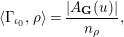 $$\begin{eqnarray}\langle \unicode[STIX]{x1D6E4}_{\unicode[STIX]{x1D704}_{0}},\unicode[STIX]{x1D70C}\rangle =\frac{|A_{\mathbf{G}}(u)|}{n_{\unicode[STIX]{x1D70C}}},\end{eqnarray}$$
where $\unicode[STIX]{x1D704}_{0}=({\mathcal{O}}_{\unicode[STIX]{x1D70C}}^{\ast },\overline{\mathbb{Q}_{\ell }})\in {\mathcal{V}}_{\mathbf{G}}^{\text{uni}}$
and
$\unicode[STIX]{x1D704}_{0}=({\mathcal{O}}_{\unicode[STIX]{x1D70C}}^{\ast },\overline{\mathbb{Q}_{\ell }})\in {\mathcal{V}}_{\mathbf{G}}^{\text{uni}}$
and $u\in {\mathcal{O}}_{\unicode[STIX]{x1D70C}}^{\ast }$
is a class representative.
$u\in {\mathcal{O}}_{\unicode[STIX]{x1D70C}}^{\ast }$
is a class representative.
Proof. Before proving the result we will need the following reduction argument. Assume $\unicode[STIX]{x1D70B}:\mathbf{G}\rightarrow \widetilde{\mathbf{G}}$
is a regular embedding. If
$\unicode[STIX]{x1D70B}:\mathbf{G}\rightarrow \widetilde{\mathbf{G}}$
is a regular embedding. If $\widetilde{\unicode[STIX]{x1D70C}}\in \text{Irr}(\widetilde{G})$
is an irreducible character then the restriction
$\widetilde{\unicode[STIX]{x1D70C}}\in \text{Irr}(\widetilde{G})$
is an irreducible character then the restriction $\unicode[STIX]{x1D70C}=\text{Res}_{G}^{\widetilde{G}}(\widetilde{\unicode[STIX]{x1D70C}})$
is also irreducible because
$\unicode[STIX]{x1D70C}=\text{Res}_{G}^{\widetilde{G}}(\widetilde{\unicode[STIX]{x1D70C}})$
is also irreducible because $Z(\mathbf{G})$
is connected, see [Reference LusztigLus7, Section 11]. As in the proof of Lemma 14.12 we have for any unipotent element
$Z(\mathbf{G})$
is connected, see [Reference LusztigLus7, Section 11]. As in the proof of Lemma 14.12 we have for any unipotent element $u\in G$
that
$u\in G$
that
 $$\begin{eqnarray}\langle \unicode[STIX]{x1D6E4}_{u}^{\widetilde{G}},\widetilde{\unicode[STIX]{x1D70C}}\rangle _{\widetilde{G}}=\langle \unicode[STIX]{x1D6E4}_{u}^{G},\unicode[STIX]{x1D70C}\rangle _{G}.\end{eqnarray}$$
As $Z(\mathbf{G})$
and
$Z(\mathbf{G})$
and $Z(\widetilde{\mathbf{G}})$
are both connected we have
$Z(\widetilde{\mathbf{G}})$
are both connected we have $\unicode[STIX]{x1D70B}$
induces an isomorphism
$\unicode[STIX]{x1D70B}$
induces an isomorphism $A_{\mathbf{G}}(u)\rightarrow A_{\widetilde{\mathbf{G}}}(u)$
and a bijection between the unipotent conjugacy classes of
$A_{\mathbf{G}}(u)\rightarrow A_{\widetilde{\mathbf{G}}}(u)$
and a bijection between the unipotent conjugacy classes of $G$
and
$G$
and $\widetilde{G}$
. Hence, we easily see that the result holds for
$\widetilde{G}$
. Hence, we easily see that the result holds for $\mathbf{G}$
if and only if it holds for
$\mathbf{G}$
if and only if it holds for $\widetilde{\mathbf{G}}$
.
$\widetilde{\mathbf{G}}$
.
Now, let $\unicode[STIX]{x1D70B}:\widetilde{\mathbf{G}}\rightarrow \mathbf{G}$
be a surjective isotypic morphism as in Lemma 14.13 (see [Reference LusztigLus2, Section 8.8]). The map
$\unicode[STIX]{x1D70B}:\widetilde{\mathbf{G}}\rightarrow \mathbf{G}$
be a surjective isotypic morphism as in Lemma 14.13 (see [Reference LusztigLus2, Section 8.8]). The map $\unicode[STIX]{x1D70B}$
induces an isomorphism
$\unicode[STIX]{x1D70B}$
induces an isomorphism $A_{\widetilde{\mathbf{G}}}(u)\rightarrow A_{\mathbf{G}}(u)$
for any unipotent element
$A_{\widetilde{\mathbf{G}}}(u)\rightarrow A_{\mathbf{G}}(u)$
for any unipotent element $u\in \widetilde{\mathbf{G}}$
because the kernel of
$u\in \widetilde{\mathbf{G}}$
because the kernel of $\unicode[STIX]{x1D70B}$
is connected. Let us denote by
$\unicode[STIX]{x1D70B}$
is connected. Let us denote by $\widetilde{\unicode[STIX]{x1D70C}}=\text{Inf}_{G}^{\widetilde{G}}(\unicode[STIX]{x1D70C})$
the inflation of
$\widetilde{\unicode[STIX]{x1D70C}}=\text{Inf}_{G}^{\widetilde{G}}(\unicode[STIX]{x1D70C})$
the inflation of $\unicode[STIX]{x1D70C}$
. From the definition it is clear that
$\unicode[STIX]{x1D70C}$
. From the definition it is clear that $n_{\widetilde{\unicode[STIX]{x1D70C}}}=n_{\unicode[STIX]{x1D70C}}$
and by the proof of Lemma 14.13 we see that
$n_{\widetilde{\unicode[STIX]{x1D70C}}}=n_{\unicode[STIX]{x1D70C}}$
and by the proof of Lemma 14.13 we see that $\langle \unicode[STIX]{x1D6E4}_{\unicode[STIX]{x1D704}_{0}}^{G},\unicode[STIX]{x1D70C}\rangle =\langle \unicode[STIX]{x1D6E4}_{\unicode[STIX]{x1D704}_{0}}^{\widetilde{G}},\widetilde{\unicode[STIX]{x1D70C}}\rangle$
. Therefore, we may and will assume that the derived subgroup
$\langle \unicode[STIX]{x1D6E4}_{\unicode[STIX]{x1D704}_{0}}^{G},\unicode[STIX]{x1D70C}\rangle =\langle \unicode[STIX]{x1D6E4}_{\unicode[STIX]{x1D704}_{0}}^{\widetilde{G}},\widetilde{\unicode[STIX]{x1D70C}}\rangle$
. Therefore, we may and will assume that the derived subgroup $\mathbf{G}_{\text{der}}$
is simply connected.
$\mathbf{G}_{\text{der}}$
is simply connected.
Now according to [Reference LusztigLus2, Section 8.8] we can find two connected reductive algebraic groups $\widetilde{\mathbf{G}}$
and
$\widetilde{\mathbf{G}}$
and $\mathbf{H}$
and a pair of regular embeddings
$\mathbf{H}$
and a pair of regular embeddings
 $$\begin{eqnarray}\mathbf{G}{\hookrightarrow}\widetilde{\mathbf{G}}{\hookleftarrow}\mathbf{H}\end{eqnarray}$$
such that the following holds: $\mathbf{H}$
is a direct product
$\mathbf{H}$
is a direct product $\mathbf{H}_{1}\times \cdots \times \mathbf{H}_{r}$
such that
$\mathbf{H}_{1}\times \cdots \times \mathbf{H}_{r}$
such that $Z(\mathbf{H}_{i})$
is connected and the derived subgroup of
$Z(\mathbf{H}_{i})$
is connected and the derived subgroup of $\mathbf{H}_{i}$
is simple and simply connected for all
$\mathbf{H}_{i}$
is simple and simply connected for all $1\leqslant i\leqslant r$
. Applying twice the first reduction argument we see that the result holds in
$1\leqslant i\leqslant r$
. Applying twice the first reduction argument we see that the result holds in $\mathbf{G}$
if and only if it holds in
$\mathbf{G}$
if and only if it holds in $\mathbf{H}$
. In particular, we may assume that
$\mathbf{H}$
. In particular, we may assume that $\mathbf{G}$
has the same form as
$\mathbf{G}$
has the same form as $\mathbf{H}$
.
$\mathbf{H}$
.
Using the same arguments as in the proof of Theorem 14.10 it is clear that we need only prove the statement assuming that $Z(\mathbf{G})$
is connected and the derived subgroup of
$Z(\mathbf{G})$
is connected and the derived subgroup of $\mathbf{G}$
is simple and simply connected. We start with the case where either
$\mathbf{G}$
is simple and simply connected. We start with the case where either $\mathbf{G}$
is
$\mathbf{G}$
is $\text{GL}_{n}(\mathbb{K})$
or the derived subgroup is not of type
$\text{GL}_{n}(\mathbb{K})$
or the derived subgroup is not of type $\mathsf{A}$
. Let us denote by
$\mathsf{A}$
. Let us denote by $\unicode[STIX]{x1D70C}^{\ast }=\pm D_{G}(\unicode[STIX]{x1D70C})\in \text{Irr}(G)$
the Alvis–Curtis dual of
$\unicode[STIX]{x1D70C}^{\ast }=\pm D_{G}(\unicode[STIX]{x1D70C})\in \text{Irr}(G)$
the Alvis–Curtis dual of $\unicode[STIX]{x1D70C}$
. From the proof of [Reference Geck and MalleGM, Proposition 3.5] we see that
$\unicode[STIX]{x1D70C}$
. From the proof of [Reference Geck and MalleGM, Proposition 3.5] we see that
 $$\begin{eqnarray}\langle \unicode[STIX]{x1D6E4}_{\unicode[STIX]{x1D704}_{0}},\unicode[STIX]{x1D70C}\rangle =\langle \unicode[STIX]{x1D6E4}_{({\mathcal{O}}_{\unicode[STIX]{x1D70C}^{\ast }},\overline{\mathbb{Q}_{\ell }})},\unicode[STIX]{x1D70C}\rangle =\frac{|A_{\mathbf{G}}(u)|}{n_{\unicode[STIX]{x1D70C}}},\end{eqnarray}$$
which is applicable by Lemma 6.3 and Corollary 13.6. Note that we have ${\mathcal{O}}_{\unicode[STIX]{x1D70C}}^{\ast }={\mathcal{O}}_{\unicode[STIX]{x1D70C}^{\ast }}$
by [Reference LusztigLus9, Theorem 11.2]. Thus the result holds in this case.
${\mathcal{O}}_{\unicode[STIX]{x1D70C}}^{\ast }={\mathcal{O}}_{\unicode[STIX]{x1D70C}^{\ast }}$
by [Reference LusztigLus9, Theorem 11.2]. Thus the result holds in this case.
It remains to deal with the case where $Z(\mathbf{G})$
is connected and the derived subgroup
$Z(\mathbf{G})$
is connected and the derived subgroup $\mathbf{G}_{\text{der}}$
is isomorphic to
$\mathbf{G}_{\text{der}}$
is isomorphic to $\text{SL}_{n}(\mathbb{K})$
. For such a group we have
$\text{SL}_{n}(\mathbb{K})$
. For such a group we have $|A_{\mathbf{G}}(u)|=n_{\unicode[STIX]{x1D70C}}=1$
for all unipotent elements
$|A_{\mathbf{G}}(u)|=n_{\unicode[STIX]{x1D70C}}=1$
for all unipotent elements $u\in \mathbf{G}$
and irreducible characters
$u\in \mathbf{G}$
and irreducible characters $\unicode[STIX]{x1D70C}\in \text{Irr}(G)$
. Hence, the statement reduces to the statement that
$\unicode[STIX]{x1D70C}\in \text{Irr}(G)$
. Hence, the statement reduces to the statement that
 $$\begin{eqnarray}\langle \unicode[STIX]{x1D6E4}_{u}^{G},\unicode[STIX]{x1D70C}\rangle _{G}=1\end{eqnarray}$$
for all $u\in {{\mathcal{O}}_{\unicode[STIX]{x1D70C}}^{\ast }}^{F}$
. Now computing the multiplicity on the left we see by Frobenius reciprocity that
$u\in {{\mathcal{O}}_{\unicode[STIX]{x1D70C}}^{\ast }}^{F}$
. Now computing the multiplicity on the left we see by Frobenius reciprocity that
 $$\begin{eqnarray}\langle \unicode[STIX]{x1D6E4}_{u}^{G},\unicode[STIX]{x1D70C}\rangle _{G}=\langle \unicode[STIX]{x1D6E4}_{u}^{G_{\text{der}}},\text{Res}_{G_{\text{der}}}^{G}(\unicode[STIX]{x1D70C})\rangle _{G_{\text{der}}}.\end{eqnarray}$$
By [Reference LusztigLus7, Section 3] the restriction $\text{Res}_{G_{\text{der}}}^{G}(\unicode[STIX]{x1D70C})=\sum _{\unicode[STIX]{x1D70E}\in {\mathcal{A}}}\unicode[STIX]{x1D70E}$
is a sum of irreducible characters such that
$\text{Res}_{G_{\text{der}}}^{G}(\unicode[STIX]{x1D70C})=\sum _{\unicode[STIX]{x1D70E}\in {\mathcal{A}}}\unicode[STIX]{x1D70E}$
is a sum of irreducible characters such that ${\mathcal{A}}$
is an orbit under the action of the
${\mathcal{A}}$
is an orbit under the action of the $F$
-coinvariants
$F$
-coinvariants $Z(\mathbf{G}_{\text{der}})_{F}$
of the center of
$Z(\mathbf{G}_{\text{der}})_{F}$
of the center of $\mathbf{G}_{\text{der}}$
. Thus, it suffices to show that
$\mathbf{G}_{\text{der}}$
. Thus, it suffices to show that
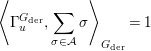 $$\begin{eqnarray}\left\langle \unicode[STIX]{x1D6E4}_{u}^{G_{\text{der}}},\mathop{\sum }_{\unicode[STIX]{x1D70E}\in {\mathcal{A}}}\unicode[STIX]{x1D70E}\right\rangle _{G_{\text{der}}}=1\end{eqnarray}$$
for any $Z(\mathbf{G}_{\text{der}})_{F}$
-orbit
$Z(\mathbf{G}_{\text{der}})_{F}$
-orbit ${\mathcal{A}}\subseteq \text{Irr}(G_{\text{der}})$
and
${\mathcal{A}}\subseteq \text{Irr}(G_{\text{der}})$
and $u\in {{\mathcal{O}}_{\unicode[STIX]{x1D70E}}^{\ast }}^{F}$
with
$u\in {{\mathcal{O}}_{\unicode[STIX]{x1D70E}}^{\ast }}^{F}$
with $\unicode[STIX]{x1D70E}\in {\mathcal{A}}$
some (any) representative of the orbit. This problem does not depend upon
$\unicode[STIX]{x1D70E}\in {\mathcal{A}}$
some (any) representative of the orbit. This problem does not depend upon $G$
so we may use any group to solve it. In particular, taking
$G$
so we may use any group to solve it. In particular, taking $\mathbf{G}=\text{GL}_{n}(\mathbb{K})$
we see that this is true by (15.5) and (15.6). This completes the proof.◻
$\mathbf{G}=\text{GL}_{n}(\mathbb{K})$
we see that this is true by (15.5) and (15.6). This completes the proof.◻
Corollary 15.7. Assume $Z(\mathbf{G})$
is connected and
$Z(\mathbf{G})$
is connected and $\mathbf{G}/Z(\mathbf{G})$
is an almost direct product of simple groups of type
$\mathbf{G}/Z(\mathbf{G})$
is an almost direct product of simple groups of type $\mathsf{A}$
. Then for any irreducible character
$\mathsf{A}$
. Then for any irreducible character $\unicode[STIX]{x1D70C}\in \text{Irr}(G)$
and any unipotent element
$\unicode[STIX]{x1D70C}\in \text{Irr}(G)$
and any unipotent element $u\in G$
we have
$u\in G$
we have
 $$\begin{eqnarray}\langle \unicode[STIX]{x1D6E4}_{u},\unicode[STIX]{x1D70C}\rangle =\left\{\begin{array}{@{}ll@{}}1\quad & \text{if}~u\in {\mathcal{O}}_{\unicode[STIX]{x1D70C}}^{\ast },\\ 0\quad & \text{if}~{\mathcal{O}}_{u}\not \subset \overline{{\mathcal{O}}_{\unicode[STIX]{x1D70C}}^{\ast }}.\end{array}\right.\end{eqnarray}$$
Proof. This follows immediately from the fact that, for such a group, $C_{\mathbf{G}}(u)$
is connected for any unipotent element
$C_{\mathbf{G}}(u)$
is connected for any unipotent element $u\in \mathbf{G}$
and that
$u\in \mathbf{G}$
and that $n_{\unicode[STIX]{x1D70C}}=1$
for any irreducible character
$n_{\unicode[STIX]{x1D70C}}=1$
for any irreducible character $\unicode[STIX]{x1D70C}\in \text{Irr}(G)$
.◻
$\unicode[STIX]{x1D70C}\in \text{Irr}(G)$
.◻
Acknowledgments
The author would like to thank Pramod Achar, Olivier Dudas, Simon Goodwin, Sebastian Herpel, Gunter Malle, Iulian Simion and Britta Späth for useful conversations/correspondence. We especially thank Simon Goodwin for pointing us toward [Reference Gan and GinzburgGG] and [Reference Bardsley and RichardsonBR], which formed important ingredients in this paper, and George McNinch both for useful discussions on Springer isomorphisms and for allowing us to include his proof of Lemma 3.3. Finally the author thanks the referee for their valuable comments, which have no doubt improved the quality of the paper.


