


Prader—Willi syndrome (PWS) is a disorder of genetic origin. About 70% of affected people have a deletion of 15q11-13, 30% have maternal uniparental disomy and a very small proportion of people have an imprinting error affecting genes in the q11-13 area of chromosome 15. It is characterised by a drive to overeat, short stature and hypogonadism in adults, with failure to thrive, hypotonia and feeding difficulty in the neonatal period. Reports have described associations between PWS and emotional and behavioural disorders, including abnormally frequent and severe outbursts of temper, mood abnormalities, psychotic disorders and obsessive—compulsive disorder (OCD) (Reference Whitman and AccardoWhitman & Accardo, 1987; Clarke et al, Reference Clarke, Boer and Chung1996, Reference Clarke, Boer and Webb1998; Reference Dykens, Leckman and CassidyDykens et al, 1996). We describe ritualistic, compulsive and similar symptoms documented during the first population-based study of PWS in the UK. Comparisons are made with a control group of people with similar severities of learning disability and high body mass indices.
METHOD
The Cambridge University population study of PWS aimed to identify everyone with PWS who resided in the counties of Bedfordshire, Berkshire, Buckinghamshire, Cambridgeshire, Norfolk, Northamptonshire, Oxfordshire and Suffolk. Details of the method of identification are given else-where (Reference Whittington, Holland and WebbWhittington et al, 2001). The study population consisted of about five million people (about one-tenth of the population of England and Wales). Contact was made with the families and carers of people with PWS and they were invited to participate in the study. The take-up rate was 64% and 65 people were identified. An additional 22 people with the syndrome were resident in the region but had moved there specifically to take up specialist services for people with PWS or were recruited specifically to take part in the study; all these additional people with PWS have been included in the present study.
Standard checklists of obsessive and compulsive symptoms were not used in this study in view of their lack of reliability and validity when used to assess people with intellectual disability. Some people with PWS included in the study had severe intellectual disability, making the assessment of aspects such as distress caused by OCD symptoms (required by most standardised checklists) almost impossible. Questions were asked in a semi-structured interview — the PWS Structured Interview Questionnaire (PWS—SIQ) — developed specifically for this survey (further details available from the author upon request). The interview lasted between 2.5 and 4 h and was, conducted with the main carer of the person with PWS. Carers were encouraged to describe all behaviours that they perceived as problematic. The questionnaire included items relating to diagnosis based on the consensus clinical criteria published by Holm et al (Reference Holm, Cassidy and Butler1993), behavioural problems, eating behaviour (including hoarding of objects as well as food), childhood psychiatric disorders (attention-deficit, hyperactivity and autistic disorders), schooling, physical health and receipt of medication. Informant versions of the Developmental Behaviour Checklist (DBC; Reference Einfeldt and TongeEinfeldt & Tonge, 1993), Aberrant Behaviour Checklist (ABC; Aman et al, Reference Aman, Singh and Stewart1985a ,Reference Aman, Singh and Stewart b ) and Vineland Adaptive Behaviour Scales (VABS; Reference Sparrow, Balla and CicchettiSparrow et al, 1984) were administered. Anecdotes and examples were sought and follow-up questions were used to clarify ambiguous statements. An appropriately trained investigator (J. W.) also spent time with the person with PWS and administered the appropriate Wechsler intelligence scales and tests of attainment in reading, spelling and arithmetic. This gave an opportunity to observe the person with PWS and his or her reactions to the test situation, and provided additional information about attention and concentration. In view of the eating disorder associated with PWS, repetitive, preoccupying thoughts relating to food have been excluded from the results presented; almost everyone with PWS who was seen seemed to spend a great deal of time thinking about food.
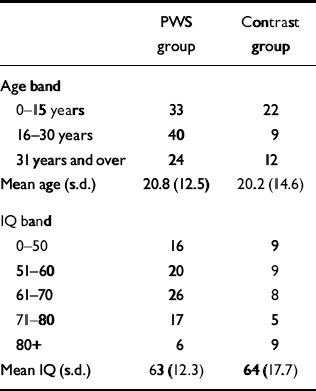
A comparison group has been used that consists of people with learning disability and people who had volunteered to take part in the epidemiological study but who were found on genetic or clinical grounds not to have PWS. Such a contrast group has the advantage of having similar overall severities of cognitive impairments and high body mass indices (see Table 1). The use of such a comparison group allows an estimate of the prevalence of obsessive and compulsive symptoms associated with PWS (rather than with obesity or intellectual disability). The same measures and assessments were used for the comparison group.
Characteristics of Prader—Willi syndrome (PWS) and comparison groups1
| PWS group | Contrast group | |
|---|---|---|
| Age band | ||
| 0-15 years | 33 | 22 |
| 16-30 years | 40 | 9 |
| 31 years and over | 24 | 12 |
| Mean age (s.d.) | 20.8 (12.5) | 20.2 (14.6) |
| IQ band | ||
| 0-50 | 16 | 9 |
| 51-60 | 20 | 9 |
| 61-70 | 26 | 8 |
| 71-80 | 17 | 5 |
| 80+ | 6 | 9 |
| Mean IQ (s.d.) | 63 (12.3) | 64 (17.7) |
The hypothesis that compulsive symptoms are associated with developmental delay, as suggested by Dykens et al (Reference Dykens, Leckman and Cassidy1996), would be consistent with an agerelated decline in such symptoms, or with a ceiling effect, such that development and compulsive symptoms ‘stick’ at a stage of development that unaffected children pass through. This hypothesis was tested in the present study by correlating compulsive behaviours with chronological age, with IQ (as a measure of mental age) and with the VABS score (a measure of socialisation age).
Two measures of compulsive symptoms were formed: a simple count of the number of symptoms from the list in Table 2, plus ‘needs routine’ and ‘anticipation’ (endorsed by informants), and a weighted count in which those behaviours rated as a severe problem were given a count of 2 whereas those rated as a problem were given a count of 1. The sample was divided into the age bands 5-12 years, 13-19 years and 20 years and over. The IQ was defined as the fullscale score on the age-appropriate Wechsler ability test. Socialisation age was defined as the age-equivalent score on the VABS. Obesity was assessed using the body mass index (BMI: weight in kilograms divided by height in metres squared). For adults, the maximum BMI also was recorded, where known.
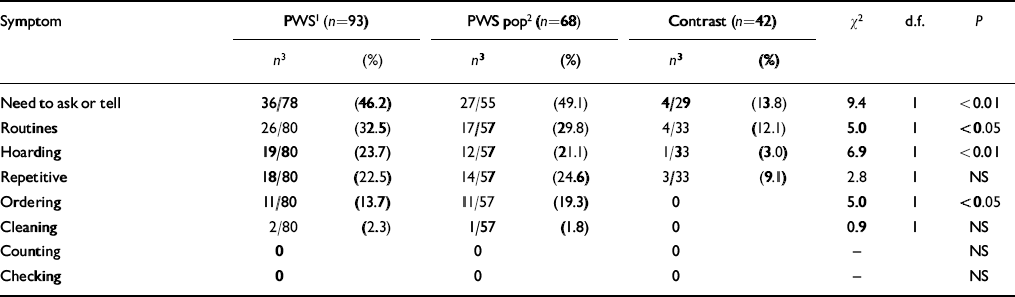
Obsessive—compulsive symptoms rated very frequent or very severe
| Symptom | PWS1(n=93) | PWS pop2(n=68) | Contrast (n=42) | χ 2 | d.f. | P | |||
|---|---|---|---|---|---|---|---|---|---|
| n 3 | (%) | n 3 | (%) | n 3 | (%) | ||||
| Need to ask or tell | 36/78 | (46.2) | 27/55 | (49.1) | 4/29 | (13.8) | 9.4 | 1 | <0.01 |
| Routines | 26/80 | (32.5) | 17/57 | (29.8) | 4/33 | (12.1) | 5.0 | 1 | <0.05 |
| Hoarding | 19/80 | (23.7) | 12/57 | (21.1) | 1/33 | (3.0) | 6.9 | 1 | <0.01 |
| Repetitive | 18/80 | (22.5) | 14/57 | (24.6) | 3/33 | (9.1) | 2.8 | 1 | NS |
| Ordering | 11/80 | (13.7) | 11/57 | (19.3) | 0 | 5.0 | 1 | <0.05 | |
| Cleaning | 2/80 | (2.3) | 1/57 | (1.8) | 0 | 0.9 | 1 | NS | |
| Counting | 0 | 0 | 0 | — | NS | ||||
| Checking | 0 | 0 | 0 | — | NS | ||||
Mood swings were assessed using the sums of scores of carer-rated items relating to ‘mood swings — ever’ on the PWS—SIQ (rated 0-4) and the score on the ABC item ‘mood changes rapidly’ (for adults) or the DBC item ‘mood changes rapidly for no apparent reason’ (for children). Anxiety and depression were assessed by the sums of the scores for items ‘ever had severe anxiety lasting more than a few days’, ‘ever had severe depression lasting more than a few days’, ‘ever had other nervous problem lasting more than a few days’ (all items from the PWS—SIQ), ‘exhibits excessive unhappiness’ (VABS) and ‘depressed mood’ (ABC for adults, DBC for children). Autistic traits were assessed using the sum of the scores from six PWS—SIQ items with the stem ‘hardly ever’: ‘initiates conversation’, ‘calls attention to things’, ‘smiles in response’, ‘cooperates in play’, ‘makes eye contact’, ‘shows imaginative play’ and the items ‘has repetitive talk’ and ‘has little emotional expression’.
RESULTS
The male/female ratio was 1.29:1 for the PWS group and 1:1 for the intellectual disability contrast group. The mean BMI was 31.6 kg m-2 (s.d.=11.8) for the PWS group and 28.3 kkg m-2 (s.d.=10.1) for the intellectual disability comparison group. Information regarding the ages and IQs of the PWS and contrast groups is summarised in Table 1. The prevalence of compulsive symptoms in the PWS and contrast groups is compared in Table 2.
Compulsive symptoms did not decline with age in the PWS sample and were not correlated with obesity (BMI or maximum BMI), with (long-term) anxiety/depression or with severity of eating behaviour. The latter finding may mask a ceiling effect because all people with PWS have some problems with appetite regulation. There were significant positive correlations with (short-term) mood swings (r=0.23 and P=0.05 for weighted compulsion count) and autistic symptoms (r=0.52 and P < 0.001 for weighted compulsion count). There were significant negative correlations with IQ (r=-0.30 and P=0.008 for weighted count) and socialisation age (r=0.30 and P=0.002 for weighted count). An examination of correlations between weighted compulsion counts and IQ, socialisation age and autistic symptoms individually, controlling for the effect of the other two variables, showed no significant correlations other than for autistic symptoms (controlling for IQ and socialisation) (r=0.34, P=0.005). No significant correlations were found for the contrast group. Some stereotyped and ritualistic behaviours were seen during direct observation of the people with PWS who took part in the study. No tics were noted.
DISCUSSION
Compulsions and Prader—Willi syndrome
The results of this first epidemiological survey of compulsive symptoms associated with PWS are broadly in agreement with an earlier study from the USA (Reference Dykens, Leckman and CassidyDykens et al, 1996). It seems likely that the compulsive behaviours associated with PWS are similar to the compulsions seen in early childhood in children without developmental disabilities. As in the earlier studies, very few obsessional thoughts were reported and the range of compulsive symptoms described was relatively restricted, with few symptoms such as counting, cleaning or checking. The paucity of obsessional symptoms noted in our study may reflect a difficulty for people with PWS and their carers in describing such symptoms, but the pattern of symptoms observed is similar to that seen in early childhood.
Compulsive symptoms were found to be much more prevalent in our study groups of people with PWS than in the contrast group of people with similar severities of intellectual disability, who were of similar ages and who had high BMIs. It is, therefore, unlikely that the high rate of compulsive symptoms is accounted for by the relative obesity of many people with PWS or by the presence of intellectual disability. Taken with other information about the clinical features and behavioural characteristics of populations of people with PWS, there is some evidence for a constellation of features (labile mood, vulnerability to loss of temper, ritualistic and compulsive symptoms, repetitive questioning and insistence on routine) similar to the attributes of children without developmental disability in early childhood.
Dykens et al (Reference Dykens, Leckman and Cassidy1996) described 91 people with PWS, aged 5-47 years (mean=18 years), with IQs ranging from 50 to 89 (mean=69) who were recruited at PWS Association meetings and through support groups. The findings were compared with those for 43 people who did not have intellectual disability but did have a clinical diagnosis of OCD and were recruited from three clinics for people with OCD. The PWS group were rated using a modified (informant) version of the Yale—Brown Obsessive Compulsive Scale (Y—BOCS; Goodman et al, Reference Goodman, Price and Rasmussen1989a ,Reference Goodman, Price and Rasmussen b ), completed by their main carer; the OCD group completed the standard (self-report) version of the Y—BOCS. In both versions of the instrument, 56 symptoms were rated as being present in the past week or ever (analyses being based on the ratings for the past week). Ten additional items in the Y—BOCS rated symptom severity, including the extent to which symptoms were time-consuming, distressful, out of control or causing social or occupational impairment. Informants reported high rates in the PWS group of compulsions concerning hoarding (58%), a need to tell or ask (53%) and ordering, arranging and repeating rituals (37-38%). Other compulsions reported included cleaning (24%), counting (17%) and checking (15%). Obsessions also were reported, but these were less prevalent. Informants reported compulsive behaviours causing ‘moderate’ or ‘severe’ distress in 64% of people, adaptive impairments in 80% and excessive time consumption in 45%, using the Y-BOCS scaling. Comparisons with the OCD clinic sample indicated significant differences (P < 0.05) for two compulsions that were more common in the PWS group: hoarding (79% v. 7%) and needing to tell or ask (51% v. 23%). Checking behaviour was less common in the PWS group (16% v. 55%); all other ratings did not differ significantly between the two groups.
The authors concluded that ‘increased risks of OCD are strongly indicated in people with PWS, based on the range and severity of symptoms encountered in this sample’. They noted also that some diagnostic criteria for OCD, including DSM—IV (American Psychiatric Association, 1994), do not include the criterion of the person's recognition that their symptoms are excessive or unreasonable in the case of children, and argued that people with PWS may have less insight into their OCD symptomatology because of their cognitive limitations. Dykens et al (Reference Dykens, Leckman and Cassidy1996) also noted that the pattern of symptoms they found to be associated with PWS loaded on only one factor (the principal factor) that emerged from a factor analysis of Y—BOCS ratings of 107 patients with OCD (Reference BaerBaer, 1993). This factor includes aspects such as hoarding, repeating rituals and concerns with symmetry, exactness, ordering and arranging. Feurer et al (Reference Feurer, Dimitropoulos and Stone1998) reported that analysis of the Compulsive Behavior Checklist (CBC) scores of people with PWS yielded only one general factor, with the exception of an item relating to ‘deviant skin-grooming—skin-picking’.
Compulsive symptoms and child development
The prevalence of obsessional and compulsive symptoms varies throughout childhood. Bedtime and dressing rituals are common in early childhood (Reference Gesell, Ames and IlgGesell et al, 1974). Other rituals and compulsive-like phenomena may occur later in childhood. The prevalence of obsessional disorders, as distinct from compulsive acts, has been estimated at between 0.2% and 12% of clinical populations of children and adolescents (Reference JuddJudd, 1965; Reference Hollingsworth, Tanguay and GrossmanHollingsworth et al, 1980). Zohar & Bruno (Reference Zohar and Bruno1997) studied 1083 schoolchildren aged 8-13 years in Jerusalem using the Maudsley Obsessive—Compulsive Inventory (Reference Hodgson and RachmanHodgson & Rachman, 1977). They found that obsessional ideas and compulsive behaviours were common among children at the age of 8 years, but were present in only a minority of children aged 13 years. Evans et al (Reference Evans, Leckman and Carter1997) used the Child Routines Inventory to assess compulsive-like behaviour in children and found that children between 2 and 4 years of age had higher rates of such behaviours than children aged below 1 year or above 4 years.
Goodman et al (Reference Goodman, Price and Rasmussen1989a ) reported the presenting symptoms among 70 consecutive children and adolescents with a primary diagnosis of OCD and found the most common obsessions to be those concerning contamination by dirt or germs (40%), worries about something terrible happening (24%) and worries about symmetry, order and exactness (17%). The most commonly reported compulsions were those concerning excessive or ritualised hand-washing, showering, bathing, tooth-brushing or grooming (85%), repeating rituals (e.g. going in and out of a door-way) (51%) and checking compulsions (46%). Compulsions regarding ordering or arranging were found in 17%, counting in 18% and hoarding or collecting in 6%.
These studies suggest a shift during childhood from relatively common rituals and compulsive-like behaviours in early childhood to low rates of obsessional and compulsive symptoms resembling those of adult OCD among vulnerable children later in childhood and in adolescence.
Serotonin and compulsive and ritualistic behaviours
Obsessive—compulsive symptoms or OCD may occur in the context of depressive illness, and its response to antidepressants such as clomipramine and specific serotonin reuptake inhibitors (SSRIs), as well as evidence from neurochemical studies, suggests the involvement of the serotonergic system in the genesis or maintenance of OCD (Reference Goodman, Price, Woods, Zohar, Insel and RasmussenGoodmanet al, 1991; Reference Riddle, Scahill and KingRiddleet al, 1992; Zohar et al, Reference Zohar, Mueller and Insel1987, Reference Zohar, Insel and Zohar-Kadouch1988). Although abnormalities in serotonergic systems seem to play a part in the genesis of some OCDs, it seems likely that the anti-obsessional effect of drugs acting on serotonergic systems may result from alterations in the balance between serotonin and other neurotransmitters, or changes in receptor functioning (Reference Murphy, Zohar and PatoMurphy et al, 1989). One study has reported abnormal serotonin turnover associated with PWS, with increased concentrations of serotonin metabolites in the cerebrospinal fluid of children and adolescents with PWS compared with comparison groups (Reference Åkefeldt, Ekman and GillbergÅkefeldt et al, 1998).
Oxytocin
Leckman et al (Reference Leckman, Goodman and North1994) reported elevated cerebrospinal fluid oxytocin concentrations in association with OCD in people without intellectual disability. A reduction in the number of oxytocin-containing neurons in the paraventricular nucleus of the hypothalamus has been found in post-mortem studies of some people with PWS (Reference Swaab, Purba and HofmanSwaab et al, 1995).
Genetics
Prader—Willi syndrome is thought to result from genomic imprinting, with the absence of the paternal contribution to genes in the q11q13 area of chromosome 15. The finding of high rates of ritualistic behaviour, together with other reports of psychiatric disorder associated with the syndrome, may be of relevance to understanding the genetic and metabolic basis of such disorders in the general population.
Clinical Implications and Limitations
CLINICAL IMPLICATIONS
-
• Prader—Willi syndrome (PWS) is associated with a relatively high prevalence of ritualistic behaviours but not with typical obsessive—compulsive disorder.
-
• The pattern of symptoms is similar to that seen in young children without PWS.
-
• Prader—Willi syndrome is caused by non-expression of the paternal contribution of genes in the q11q13 area of chromosome 15; the finding of high rates of ritualistic behaviour may be of relevance to understanding the genetic basis of compulsive and allied disorders.
LIMITATIONS
-
• A proportion of people included in the study had limited language ability, making the assessment of obsessional thoughts difficult.
-
• The study was carried out in England, and cultural influences on ritualistic and compulsive behaviours may affect the prevalence of such disorders associated with PWS in other countries.
-
• Prolonged observation to confirm carer reports was not possible.




eLetters
No eLetters have been published for this article.