


Introduction
In the second year of battling the Covid-19 pandemic, Austrian politics was confronted with increasing pandemic fatigue and protests against government-imposed behavioural restrictions. The start of vaccinations in spring raised hopes of turning the corner, leading to the abolishing of restrictions during the summer, but another big wave of infections in late autumn forced the government to impose first a partial lockdown for the unvaccinated and then a lockdown for all during some weeks again. A new right-wing party – Humans, Liberty, Justice/Menschen, Freiheit, Gerechtigkeit (MFG), opposed to the government's pandemic policies, successfully entered the regional Parliament of Upper Austria in regional elections in September.
Overall, 2021 was a bad year for Austria's largest party, the Austrian People's Party/Österreichische Volkspartei (ÖVP), in a coalition government with the Greens/Die Grüne (GRÜNE). Despite tensions, the coalition remained intact. Turnover in government was high on the ÖVP side, with two Federal Chancellors and several ministers being replaced. Judicial and parliamentary investigations turned Federal Chancellor Sebastian Kurz from a star politician into a liability for the party. Kurz stepped down as Federal Chancellor in early October and declared a complete retreat from politics in early December.
Election report
A single regional election was held in Upper Austria on 26 September 2021. It was the first electoral test for ÖVP Land governor Thomas Stelzer, who in April 2017 had succeeded long-time Land governor Josef Pühringer during the term. Pühringer had led the ÖVP in the previous election (in 2015) to first place again, but with a considerable loss of vote share.
The Ibiza Affair in the spring of 2019 plunged the Austrian Freedom Party/Freiheitliche Partei Österreich (FPÖ) into crisis and national politics into turmoil after Federal Chancellor Kurz ended the government coalition between the ÖVP and FPÖ (Jenny Reference Jenny2021). It also had repercussions in Upper Austria. Stelzer forced an FPÖ government member with radical views to step down as a condition for continuing a regional ÖVP–FPÖ coalition, which regional FPÖ party leader Manfred Haimbuchner was eager to maintain.
Four parties had held seats in the previous diet (Landtag): ÖVP (21 seats), FPÖ (18 seats), Social Democratic Party of Austria/Sozialdemokratische Partei Österreichs (SPÖ) (11 seats) and Greens (six seats). The new diet contains six parties (Table 1). The ÖVP slightly increased its vote share to 37.6 per cent (+1.2 percentage points) and won an additional seat (to 22) compared with the last election in 2015. The FPÖ vote share dropped to 19.8 per cent (–10.6 percentage points) and 11 seats (–7). The party suffered the expected late blow from the Ibiza scandal of 2019, but it also lost voters to a new rival party founded during the pandemic, the MFG, which won 6.2 per cent of the votes and three seats. The SPÖ remained at the same level with 18.4 per cent (+0.2 percentage points) of the votes and 11 seats. The Greens slightly increased their vote share to 12.3 per cent (+2.0 percentage points) and four seats (+1).
Results of regional (Upper Austria) elections in Austria in 2021

Source: Amt der Oberösterreichischen Landesregierung (2021), https://www.land-oberoesterreich.gv.at/Mediendateien/Formulare/Dokumente%20PraesD%20Abt_Stat/LT21-Wahlbericht.pdf.
NEOS – The New Upper Austria/NEOS – Das Neue Oberösterreich (NEOS) passed the entry threshold for the first time with 4.2 per cent (+0.8 percentage points) and received two seats. Due to the election result, the FPÖ also lost a seat in the Land delegation to the national Parliament's upper house to the ÖVP. The ÖVP and FPÖ decided to form a coalition government again. The allocation of Land government seats is proportional to the seat distribution in the diet, which gave five (out of nine) government seats to the ÖVP, two to the FPÖ, and one seat each to SPÖ and the Greens. Stelzer was elected Land governor again by the diet.
Cabinet report
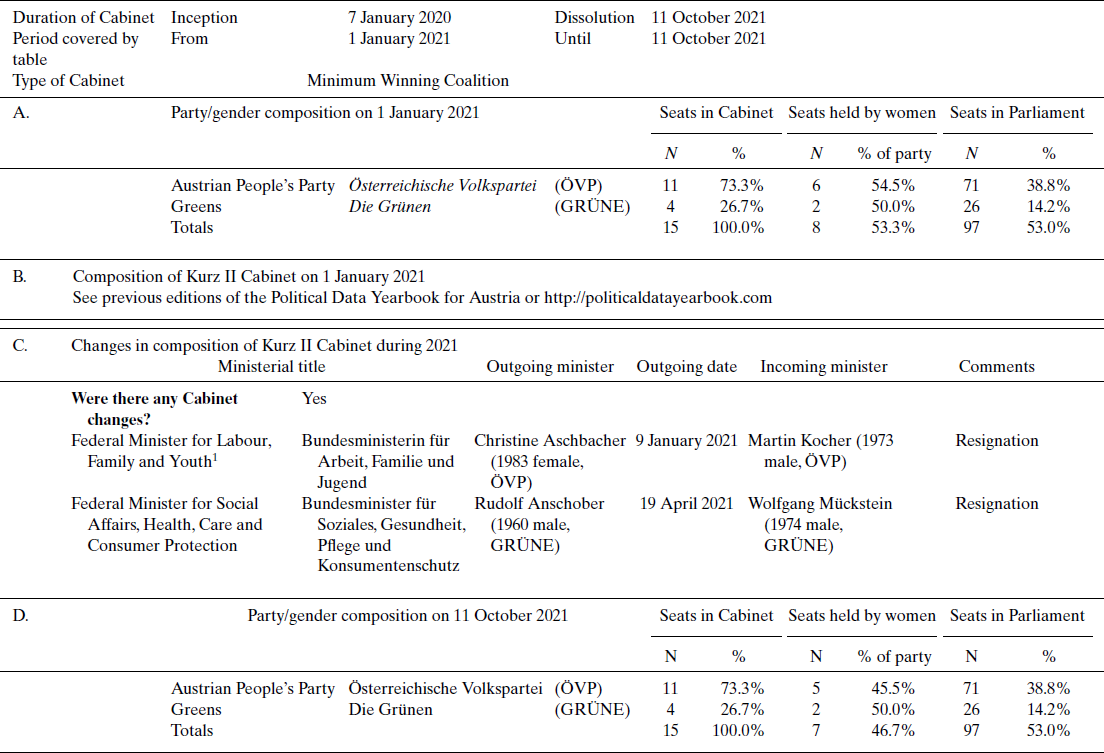
The Minister for Labour, Family and Youth, Christine Aschbacher (ÖVP), resigned on 11 January after a researcher raised plagiarism accusations regarding her academic degrees. Martin Kocher (ÖVP), the director of the postgraduate economic research Institute for Advanced Studies (IHS), became her successor as Minister for Labour. The portfolios for Family and Youth were reassigned to Federal Minister for Women Susanne Raab (ÖVP).
The Minister for Social Affairs, Health, Care and Consumer Protection, Rudolf Anschober (Greens), resigned on 19 April. Anschober cited health issues from dealing with the Covid-19 crisis during ‘15 months in office that felt like 15 years’ (Die Presse 2021a). Anschober held a large portfolio in the ÖVP–Greens coalition government. The pandemic made him the most important Cabinet minister, next to Federal Chancellor Kurz. He was central in public crisis communication and in the intra-coalition development and coordination of the government's increasingly unpopular policy responses. In the context of the Covid-19 pandemic, the Ministry of Health issued ministerial decrees on behavioural restrictions. Anschober became a frequent announcer of bad news, while Federal Chancellor Kurz, more than once, managed to communicate the good news of soon-to-be-lifted restrictions first. Anschober was succeeded by Wolfgang Mückstein (Greens), a general practitioner with no prior experience in politics. Mückstein held on to his predecessor's highly controversial compulsory vaccination bill. A private member's bill, based on a ministerial draft, was introduced to Parliament in December.
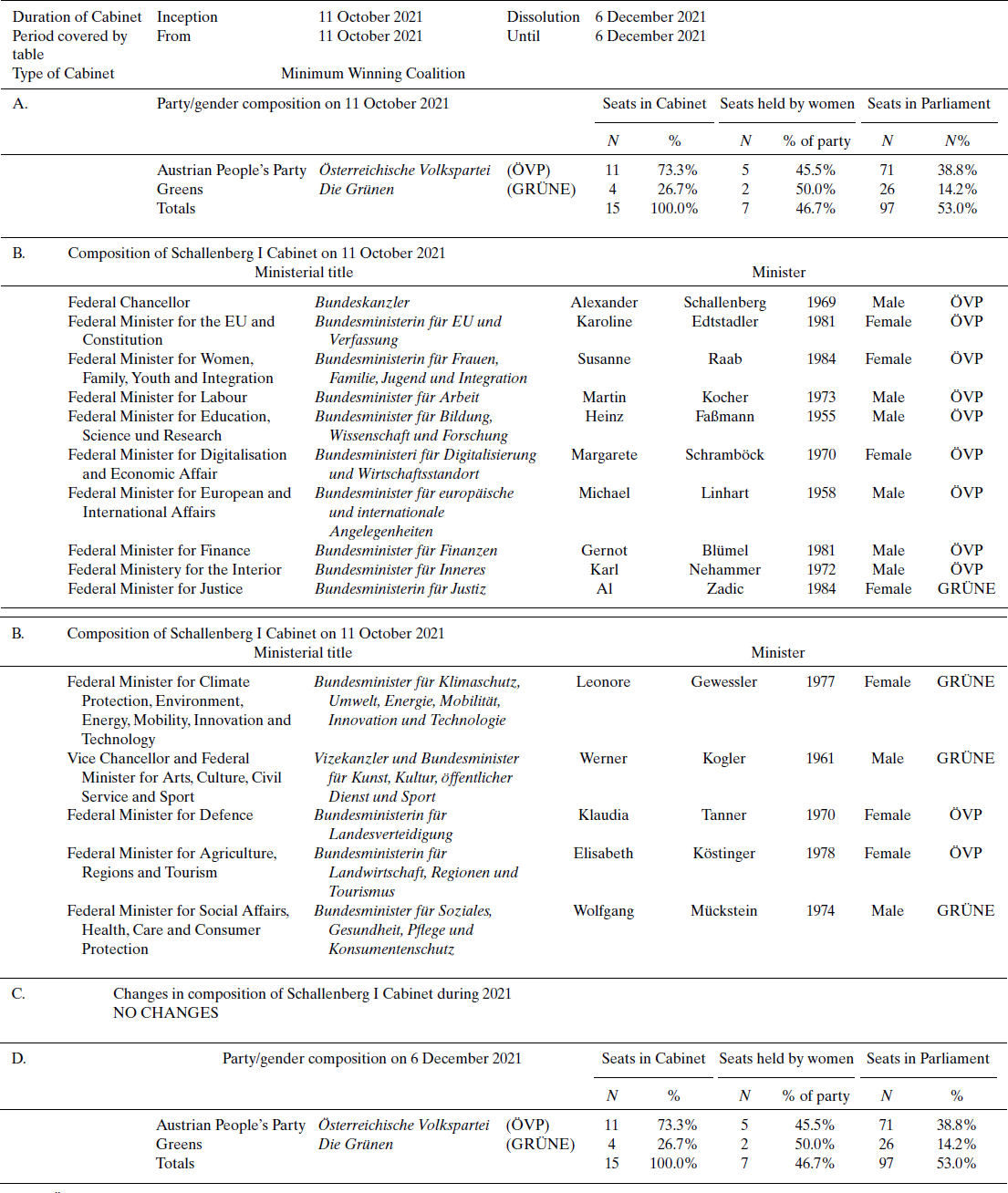
On 9 October, Sebastian Kurz publicly announced his resignation as Federal Chancellor (see ‘Issues in national politics’). Two days later, Foreign Minister Alexander Schallenberg, a loyal follower, was officially appointed new Federal Chancellor. Kurz returned to his seat in the National Council as nominal parliamentary party leader. It soon became apparent, however, that the new government leader, Schallenberg, did not do well in domestic policy disputes and that he lacked a power base in the ÖVP, which was still led by Kurz.
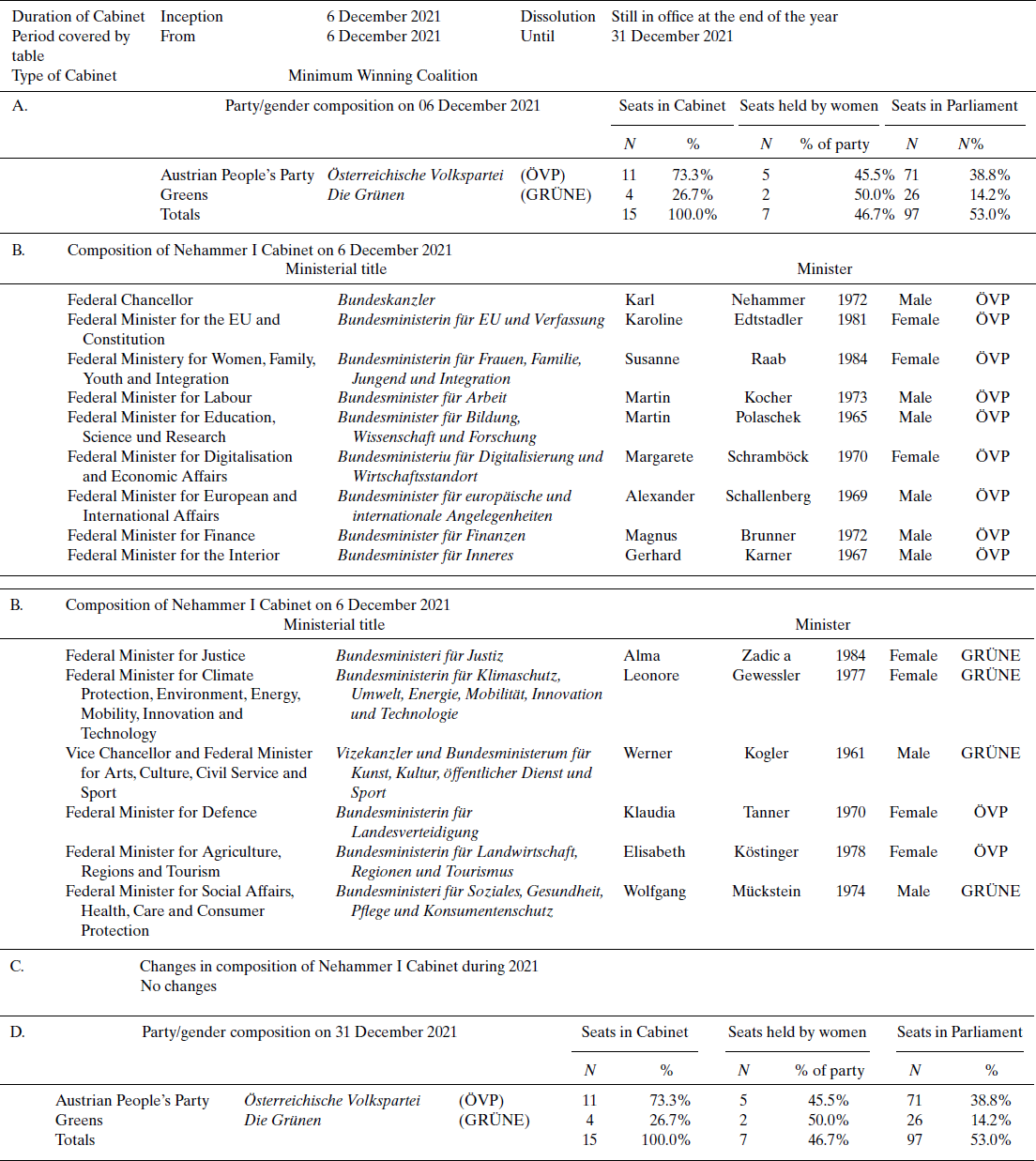
On 2 December, Kurz announced his complete retirement from politics. The Minister of Finance, Gernot Blümel, quickly followed with a similar announcement. Schallenberg declared he was stepping down as Federal Chancellor to enable the party to select a successor who could lead both government and party. He would return to the Foreign Ministry. The Minister of the Interior, Karl Nehammer, became acting party chairman and made changes to the party's government delegation. Nehammer was sworn in as Federal Chancellor on 6 December. Gerhard Karner succeeded him in the Ministry of the Interior. Alexander Schallenberg became again Minister for European and International Affairs (replacing Markus Linhart). Magnus Brunner, previously State Secretary, became the new Minister of Finance. Martin Polaschek became Minister of Education and Research (replacing Heinz Faßmann). Claudia Plakolm became the new State Secretary.
For data on Cabinet composition, see Tables 2–4.
Cabinet composition of Kurz II in Austria in 2021

Source: Österreichischer Amtskalender (2022), https://amtskalender.jurnet.at.
1 On 11 January Martin Kocher was sworn in as Federal Minister for Labour, Family and Youth. An amended Federal Ministries' Law moved Family and Youth to Federal Minister for Women and Integration Susanne Raab while Kocher became Minister for Labour on 1 February.
Cabinet composition of Schallenberg I in Austria in 2021

Source: Österreichischer Amtskalender (2022), https://amtskalender.jurnet.at.
Cabinet composition of Nehammer I in Austria in 2021

Source: Österreichischer Amtskalender (2022), https://amtskalender.jurnet.at.
Parliament report
The parliamentary committee of inquiry on alleged venality of the turquoise-blue federal government (in short, the Ibiza Committee of Inquiry) increasingly turned its investigations against ÖVP ministers and their Cabinet officials. Obstruction of proceedings by a committee member from the ÖVP and by summoned ÖVP witnesses was common. The three opposition parties SPÖ, FPÖ and NEOS also accused National Council president Wolfgang Sobotka (ÖVP) of partisan chairmanship. The tug of war between the opposition parties and the ÖVP (with its coalition partner Greens in between) included the topic of committee requests for information to ministries. The ÖVP successfully challenged some information requests before the Constitutional Court. A case that it lost ended with an exploration of a hitherto unused constitutional mechanism. The opposition had levelled an accusation of obstruction against Minister Blümel (ÖVP) for withholding requested emails of employees of the Ministry of Finance. Blümel cited privacy considerations. The opposition parties’ appeal to the Constitutional Court was decided in their favour, but the Finance Minister still stalled the delivery of the emails. The Constitutional Court then requested Federal President Alexander Van der Bellen to execute its decision. In the first-ever use of a little-known presidential power (Art. 146 B-VG), Van der Bellen authorized a penal court to act on his behalf and secure the requested documents (Office of the Federal President 2021). The ministry then rapidly sent them in. A parliamentary prosecution motion against Finance Minister Blümel was blocked by the government parties. The committee of inquiry concluded in September after the government parties refused another time extension. The interpretations of the final committee report differed strongly by the party.
Following the raid of the ÖVP party headquarters in October, the three opposition parties SPÖ, FPÖ and NEOS again used their minority right and launched a new committee of inquiry ‘to review corruption allegations against ÖVP government members’ (in short, the ÖVP Corruption Committee of Inquiry). The committee set the focus of its investigations on ex-Federal Chancellor Kurz's terms in office. It began its work in December.
After stepping down as Federal Chancellor, Kurz returned to the National Council on 14 October (he had been elected parliamentary party leader already a few days before). The same day, the special public prosecution office asked the National Council to lift his parliamentary immunity. The request was granted in mid-November. Three weeks later, Kurz completely withdrew from politics.
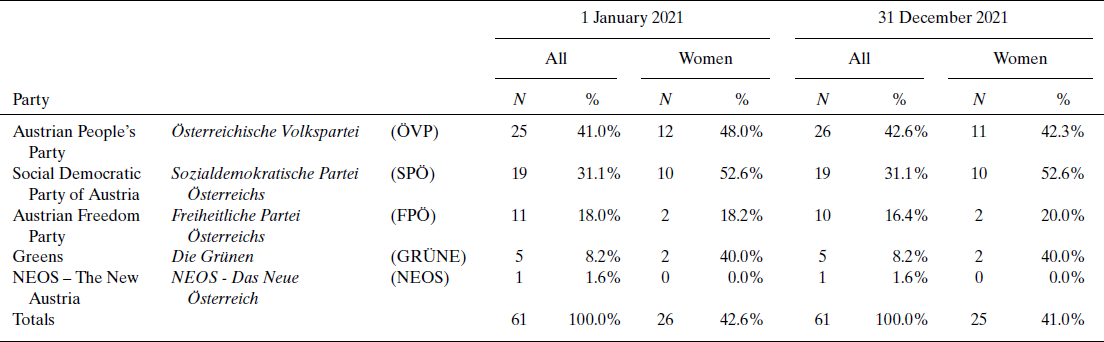
The loss of a second chamber seat by the FPÖ to the ÖVP in the regional elections in Upper Austria turned a previous single-seat majority for the combined opposition consisting of the SPÖ, FPÖ and NEOS into a single-seat majority for the government coalition of the ÖVP and Greens. The government coalition now controlled 31 out of a total of 61 seats in the Bundesrat. A veto by the second chamber against a Nationalrat decision prolongates the legislative process by several weeks, but does not end it.
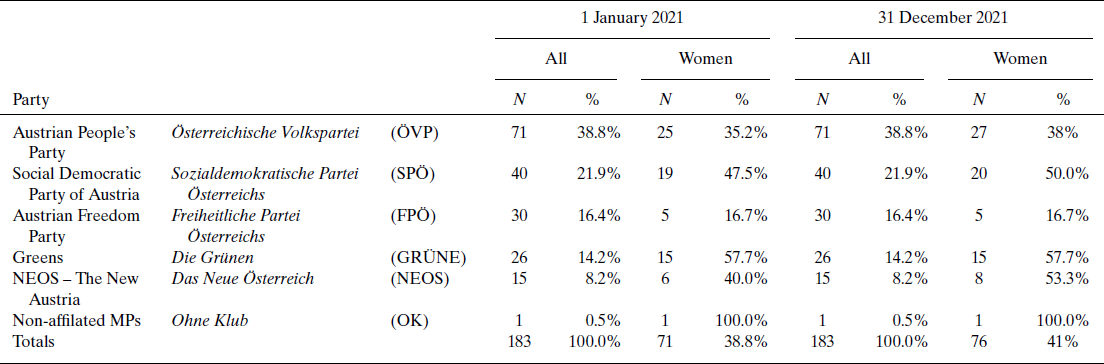
For the composition of both houses of Parliament in 2021, see Tables 5 and 6.
Party and gender composition of the lower house of the Parliament (Nationalrat) in Austria in 2021

Source: Austrian Parliament (2021a), https://www.parlament.gv.at/WWER/NR/AKT/index.shtml.
Party and gender composition of the upper house of the Parliament (Bundesrat) in Austria in 2021

Source: Austrian Parliament (2021b), https://www.parlament.gv.at/WWER/BR/MITGL/.
Political party report
Shortly before an upcoming party congress, FPÖ chairman Norbert Hofer suddenly resigned from office on 1 June. Tensions between party chairman Hofer and his outspoken parliamentary party leader Herbert Kickl had been apparent for some time. Hofer and Kickl disagreed regarding the party's course towards the federal government's Covid-19 policies. Hofer stood for a moderate opposition stance; Kickl for a more radical position. Kickl wanted the FPÖ to profit from social protests against restrictions, particularly ones differing for vaccinated and unvaccinated persons, and against the controversial idea of compulsory vaccination under debate. Kickl was elected as the new party chairman at a party congress on 19 June with 88.2 per cent of the party delegates’ votes.
ÖVP party leader Sebastian Kurz declared in a news conference on 2 December his resignation from his remaining political offices: as party chairman, as parliamentary party leader and as an MP, describing himself as ‘neither a saint nor a criminal’ (Die Presse 2021b). Kurz was followed by Karl Nehammer as interim party leader.
For information on changes in political parties in 2021, see Table 7.
Changes in political parties in Austria in 2021

Issues in national politics
In mid-May, the state's special Public Prosecutor's Office for Corporate Crime and Corruption (Wirtschafts- und Korruptionsstaatsanwaltschaft) announced the start of an investigation against Federal Chancellor Sebastian Kurz for giving false testimony to a parliamentary committee of inquiry (Ibiza Committee of Inquiry). The charge was filed by the opposition party NEOS after Kurz had denied in front of the committee that he had known how the General Secretary of the Ministry of Finance, Thomas Schmid, one of his close political associates, had managed to become director of the state's holding company ÖBAG. Schmid first tailored a job description fitting his own profile and was then appointed by the government to lead the ÖBAG in 2019. As part of the Ibiza scandal investigations, judicial authorities confiscated Schmid's mobile phone and recovered a large number of chat messages between Schmid, Kurz and other close associates. They provided evidence for investigations of government ministers and Cabinet officials. News reports on these chats revealed the partisan and self-serving motives of past government actions.
All six ÖVP Land governors initially proclaimed their support for Federal Chancellor and party leader Kurz. In the following weeks, party representatives accused the judicial branch of conducting a witch hunt against Kurz and the ÖVP. The country's association of judges called for respect for the rule of law. The simmering party scandal blew up at the beginning of October when the Public Prosecutor's Office ordered a search of the ÖVP party headquarters. Kurz was now under suspicion of bribery and embezzlement.
New revelations depicted a triangle of cooperation between ministerial and Cabinet officials, the owner of the major media group Österreich and the small opinion survey company Research Affairs. Their cooperation supported Kurz's rise to the top of the party while he was still Foreign Minister with ambitions to replace his party leader, Mitterlehner, and end the coalition with the SPÖ. General Secretary of the Ministry of Finance Schmid again held a central role. Schmid commissioned the survey company Research Affairs, led by Sabine Beinschab (whom former Family Minister Sophie Karmasin had brought in as contact) to undertake polls and other studies for the Finance Ministry. These studies were of marginal value to the ministry but provided a way to pay the survey company for unlawful services. Including party-related questions in government-commissioned surveys had been done previously. Modifying survey results on Cabinet officials’ orders in exchange for generously paid government contracts was a new level of malpractice. The third node of the triangle was publisher Wolfgang Fellner, owner of the tabloid newspaper Österreich. He arranged ample, friendly news reporting of these ‘survey results’ in exchange for adverts from government ministries (Nikbakhsh & Melichar Reference Nikbakhsh and Melichar2021). Government advertising in Austrian newspapers has been repeatedly criticized for incentivizing uncritical news reporting (for a recent empirical study of government adverts in Austria, see Medienhaus 2022).
Kurz publicly announced his resignation as Federal Chancellor on 9 October, and his complete retirement from politics on 2 December (see ‘Cabinet Report’).



 Open access

