


Introduction
Changing dietary patterns, rising food security issues, and the effects of climate change on our food supply call for creative solutions in the global food industry. New breeding methods have provided scientists with opportunities to improve traits in a wide range of crops and animals. Such improvements include increased crop yields, reductions in fertilizer and pesticide use, increased resilience of crops to heat, reductions in food loss and food waste, and improvements in nutritional attributes and taste (Zhang et al. Reference Zhang, Massel, Godwin and Gao2018; Kawall, Cotter and Then Reference Kawall, Cotter and Then2020). However, there remains significant resistance to foods produced with crops that use modern genetic modification techniques stemming from various groups, including consumers, farmers, and environmentalists (National Academies of Science, Engineering, and Medicine 2016; Caputo, Lusk and Kilders Reference Caputo, Lusk and Kilders2020).
For consumers, the sources of controversy are also numerous, ranging from ethical concerns (Loureiro and Hine Reference Loureiro and Hine2004) to food technology neophobia (Marette, Disdier and Beghin Reference Marette, Disdier and Beghin2021; Ortega, Lin and Ward Reference Ortega, Lin and Ward2022) to negative stigma (Jiang and Fang Reference Jiang and Fang2019) to a general aversion to the potential risks that have been reported to accompany modern breeding techniques (Costanigro and Lusk Reference Costanigro and Lusk2014). In addition, the lack of public acceptance for genetically engineered crops has limited the capacity for this technology to realize its full market potential, and this has fueled a concern that gene-edited food products may face similar barriers and suffer similar consequences (Qaim Reference Qaim2020; Alston et al. Reference Alston, Pardey, Barrett and Just2021; Lusk, Roosen, and Bieberstein Reference Lusk, Roosen and Bieberstein2014).
We have witnessed the emergence of laws that mandate food labels for products that use crops employing specific breeding methods worldwide. In the United States, food products produced using genetically engineered crops were required to be labeled beginning in 2022 (Ellis Reference Ellis2022), yet gene-edited organisms have been exempted from these regulations. This exemption is conditional on these organisms only containing combinations of genetic materials that otherwise could be developed through conventional breeding (Lassoued et al. Reference Lassoued, Phillips, Macall, Hesseln and Smyth2021). Moreover, the label mandate in the United States provides food manufacturers flexibility as they can communicate the presence of genetically engineered inputs in various forms, and ingredients that are derived from genetically engineered crops but are highly refined do not need to be labeled if no modified genetic material is detectable (see Reiley Reference Reiley2022 for details).
Our research focuses on two interrelated issues concerning label mandates for genetically modified food productsFootnote 1 in the United States. First, we examine consumer acceptance of a genetically modified product when the technology is applied to different ingredients. Second, we evaluate consumer response to claims about potential benefits from genetic modifications. The future of label mandates for foods produced with gene-edited crops remains unsettled (Selfa, Lindberg, and Bain Reference Selfa, Lindberg and Bain2021), and this is expected to continue to be a significant food policy debate worldwide.
Mandatory labels for specific genetic modifications often include minimum thresholds and allow for certain exemptions. In the United States, the labels become mandatory once the genetically modified material exceeds 5% of the total ingredients (NBFDS 2018), and food manufacturers do not need to label the food product if it only includes ingredients that are a highly refined version of genetically modified crops (USDA, 2022; Reiley Reference Reiley2022 ). In practice, it is only when specific unrefined ingredients are genetically modified that the final product is considered to be genetically modified, and the product is subject to the label mandate. When consumers observe a food product without a label about genetic modification, they may be unaware of ingredient exemptions and assume that none of the ingredients are genetically modified. Although some research suggests that consumers show greater trepidation towards genetic innovations of unrefined ingredients from animal and horticultural products (Alston Reference Alston2004; Frewer, Howard, and Aaron Reference Frewer, Howard and Aaron1998; Lusk, McFadden, and Rickard Reference Lusk, McFadden and Rickard2015), we expect that consumers, or a subset of consumers, may respond to a label about genetic modification for a processed food product regardless of whether the genetic modification applies to refined or unrefined ingredients. This question has policy implications for how the label mandate is implemented and the role of exemptions for genetically modified ingredients that have been highly refined.
Given the rise of claims (e.g., health, financial, and environmental) made directly on packaged food products or indirectly as part of an associated promotional message, we expect that consumers may be influenced by different claims related to genetic modifications. Restricting or enabling the use of such claims by food manufacturers as part of a labeling mandate is expected to have important industry implications.
Our research uses data from an online survey designed to elicit U.S. consumers’ likelihood to purchase two food products (potato chips and apple pie) manufactured using gene-edited ingredients. We considered scenarios where gene editing was applied only to the unrefined ingredient (potatoes in the case of potato chips and apples in the case of apple pie) and only to a highly refined ingredient (vegetable oil in both cases). In addition, we considered treatments to examine consumer response to two claims; one claim was about the potential benefits of gene-edited ingredients to human health, and the second claim was about the potential positive impact on food waste and the environment due to the use of gene-edited ingredients. Earlier evidence suggests that consumer acceptance of food produced using genetically modified crops increases if the product yields direct benefits to consumers, compared to improvements in agronomic traits, such as pest resistance and increased crop yield (Muringai, Fan and Goddard Reference Muringai, Fan and Goddard2020; Costa-Font, Gil and Traill Reference Costa-Font, Gil and Traill2008; Caputo, Lusk and Kilders Reference Caputo, Lusk and Kilders2020).
In the next section, we provide an overview of the research that has examined consumer response to labels for genetically modified food products, the impact of label mandate exemptions, and claims for gene-edited food products. In the third section, we present a detailed description of the survey used to collect our data. The fourth section outlines our empirical approach and presents the results. The final section offers both policy and industry implications from our research with a discussion on the potential ambiguity effects surrounding labels and the potential framing effects associated with product claims.
Background and motivation
Processed food products include a range of information on the package that may help consumer decision-making. This information includes i) production process attributes that provide details about the methods used in the production of the product and the ingredients in the product (e.g., organic production and genetic modifications), and ii) product attributes such as ingredient lists, nutrient content, and various (health, environmental, and financial) claims. In many countries, we observe laws that regulate both the production process attributes, and the product attributes, yet such laws have not been harmonized across countries. Mandatory labeling regulations have the capacity to affect consumer choices as they might send a signal that marked foods are somehow inferior or superior to non-labeled products (Costanigro and Lusk Reference Costanigro and Lusk2014; Qaim Reference Qaim2020; Kawall, Cotter and Then Reference Kawall, Cotter and Then2020).
Production process labels
Mandatory labels for production process attributes exist for processes that are viewed favorably by consumers (e.g., organic) and for processes that are viewed as less favorable by consumers (e.g., genetic engineering). Furthermore, depending on the nature of the mandatory label, the label can communicate properties for all of the ingredients in a food product (e.g., the USDA Organic Seal), but in other cases, the label communicates the presence of a trait for some, but not all, ingredients in a processed food product (e.g., genetic engineering). In the specific case of labels for genetically engineered food products in the United States, the mandate makes exemptions for genetically modified ingredients that have been highly refined.Footnote 2 Most label mandates for production process attributes do not require disclosure of the attribute across the ingredients used in the final product. For more favorable process attributes such as those communicated by the USDA Organic Seal, many food manufacturers will voluntarily list the ingredients that carry the attribute; this may provide a halo effect and further boost consumer demand even though the presence of the USDA Organic Seal requires that all ingredients be organic.Footnote 3
There is substantial evidence that consumers discount genetically engineered food items compared to conventional analogs, and more recent work has shown that the same is true for gene-edited foods (Ortega, Lin and Ward Reference Ortega, Lin and Ward2022; Caputo, Lusk and Kilders Reference Caputo, Lusk and Kilders2020). Recent work by Caputo, Lusk and Kilders (Reference Caputo, Lusk and Kilders2020) indicates that consumers’ willingness to pay for products with gene-edited ingredients is lower than that for products with genetically engineered ingredients, yet they also found that there was a very low awareness among consumers regarding gene editing compared to genetical engineering. Our research shares some similarities with Caputo, Lusk, and Kilders (Reference Caputo, Lusk and Kilders2020), but we also provide some extensions to their work studying ingredient-specific effects and the impact of product claims. Caputo, Lusk, and Kilders (Reference Caputo, Lusk and Kilders2020) consider consumer response to fresh and processed foods that use a gene-edited ingredient (as we do), but they do not consider the response across different ingredients for a given food product. They also examine the role of claims associated with foods produced using gene editing (e.g., environmental claims), but do not examine the implications of different types of claims (e.g., environmental claims versus health claims).
There is also evidence that although consumers discount gene-edited products compared to conventional items, the discount is not as significant as it is for genetically engineered products (Marette, Disdier and Beghin Reference Marette, Disdier and Beghin2021; Ortega, Lin and Ward Reference Ortega, Lin and Ward2022; Muringai, Fan and Goddard Reference Muringai, Fan and Goddard2020). Findings from meta-analyses of numerous studies indicate that, in general, consumers are willing to pay premiums to avoid genetically engineered foods (Lusk et al. Reference Lusk, Jamal, Kurlander, Roucan and Taulman2005; Clare, Dominic, and David Reference Clare, Dominic and David2006; Dannenberg Reference Dannenberg2009). The extent of consumer aversion to genetically engineered foods varies among products and across consumers, and this variation depends largely on the direct benefits perceived by consumers, their trust in government and regulatory agencies, and their level of knowledge of each breeding technique (Muringai, Fan and Goddard Reference Muringai, Fan and Goddard2020; Ortega, Lin and Ward Reference Ortega, Lin and Ward2022; Caputo, Lusk and Kilders Reference Caputo, Lusk and Kilders2020).
It is much less common for food manufacturers to list details of the ingredients when a less favorable attribute is the subject of the label mandate. For example, when a food product carries the label mandate for bioengineering (a genetically engineered product), the ingredient list does not disclose which ingredients are genetically engineered. Furthermore, exemptions for certain highly refined ingredients provide food manufacturers with additional opportunities not to disclose ingredients derived from genetically modified crops. In light of this, it is plausible that this lack of clarity over which ingredients are genetically modified, or derived initially from genetically modified crops, could be confusing for some consumers and may be a source of ambiguity. Additionally, full disclosure of the genetic composition of all ingredients may dampen overall demand for the food product, especially if consumers assume that the label mandate applies to all ingredients in a manufactured food product. Such ambiguity effects would warrant a re-examination of how label mandates are implemented, and how consumers would respond to alternative label mandates that did not allow for ingredient exemptions.
Product labels
In addition to a labeling mandate that specifies a production process attribute, many other sources of information displayed on food packaging can affect consumers’ food choice decisions. These include a wide range of claims about the product (notably regarding health, but also claims related to the environment and product value), and certain claims are also subject to regulation in some countries (Lalor and Wall Reference Lalor and Wall2011). Research analyzing consumer demand for genetically modified (both genetically engineered and gene-edited) potatoes among Canadian consumers found that acceptance depended on the stated product benefits, the type of breeding technology used, and the brand (Muringai, Fan and Goddard Reference Muringai, Fan and Goddard2020). Their results indicate a higher willingness to pay for genetically modified potatoes in the presence of a claim about health attributes (such as reduced acrylamide produced when potatoes are fried) and improvements in environmental attributes (relative to genetically modified potatoes without these benefits). Colson and Huffman (Reference Colson and Huffman2011) found that consumers were willing to pay more for vegetables with intragenic modifications when accompanied by claims about increased nutrient content compared to conventional products. Other research finds that consumer acceptance of genetically modified foods increases when there are claims highlighting specific direct benefits for consumers, such as improved health (De Steur, et al. Reference De Steur, Buysse, Feng and Gellynck2013; González, Johnson and Qaim Reference González, Johnson and Qaim2009), lower levels of acrylamide content (Harkness and Areal Reference Harkness and Areal2018; McFadden and Huffman Reference McFadden and Huffman2017), improvements in taste (Loureiro and Bugbee Reference Loureiro and Bugbee2005), mitigation of world food shortages (Moon and Balasubramanian Reference Moon and Balasubramanian2003), and an increase in environmental amenities (Frewer, Howard and Shepherd Reference Frewer, Howard and Shepherd1996).
The use of claims on food packages is a topic that has been controversial (Nocella and Kennedy Reference Nocella and Kennedy2012). Food manufacturers have a long history of using claims to affect consumer decision-making, and as a result, there continue to be discussions on the role of public policy in governing claims for food products (Roe, Levy and Derby Reference Roe, Levy and Derby1999). Research shows that consumers are more accepting of genetic modifications when these food products carry claims or are otherwise linked to information that states implicit benefits for consumers or the environment compared to information about agronomical benefits accruing mainly to producers (e.g., pest resistance). Here we extend this literature to focus on the role of health and environmental claims made by food manufacturers that could plausibly be associated with gene editing. The health-related claim follows earlier work and highlights the potential for gene-edited foods to deliver human health benefits. The environmental claim focuses on the potential for gene-edited crops to combat food loss and waste. Our environmental claim is motivated by some real-world promotional messages that explicitly link genetically engineered apples and potatoes to reductions in food loss and waste. Specifically, promotion messages released with the commercialization of the Arctic® apple noted that it has the capacity to reduce food waste (see https://arcticapples.com/about-us/). In addition, messages by Simplot released with the commercialization of the Innate® potato highlighted its ability to combat food loss (see https://www.innatepotatoes.com).
Motivation for the selected food products used in our survey
Gene editing has been applied to a number of crops, including camelina sativa, casava, flaxseed, grapefruit, maize, mushrooms, oranges, potatoes, rice, soybeans, tomatoes, and wheat (Zhang et al. Reference Zhang, Massel, Godwin and Gao2018). Given the expansion of interest in using gene editing by plant breeding programs and the number of gene-edited crops that are being developed and commercialized (Menz et al. Reference Menz, Modrzejewski, Hartung, Wilhelm and Sprink2020), there is a need for more research that examines consumer acceptance of gene editing. Our survey asked subjects to consider gene-edited ingredients in one of two manufactured food products: potato chips and apple pie.
We chose these manufactured products because (i) they both include an unrefined fruit or vegetable crop as the primary ingredient, (ii) they both include vegetable oil which is typically considered to be a highly refined ingredient derived from genetically modified crops but exempt from the U.S. label mandate, and (iii) apples and potatoes are two crops that have witnessed commercialization of genetically engineered varieties.
More research is needed to carefully understand the market potential for crops produced with this technology, as well as the effect that label mandates may have on consumers of manufactured products that use gene-edited ingredients. In particular, we seek to better understand how consumers respond to mandates that disclose the presence of genetically modified ingredients (unrefined ingredients and highly refined ingredients derived from genetically modified crops). We are also interested in food product claims and the potential framing effects; our survey includes treatments to study consumer response to product claims that report the benefits of gene editing to human health and the environment.
Survey design
A description of the survey
The data used in the analysis are from a longitudinal survey that asked a panel of consumers a wide range of questions related to food purchase and food consumption decisions.Footnote 4 The survey contained five sequential waves; wave 1 (n = 4,446) was distributed in mid-March 2020, wave 2 (n = 2,579) in late-March 2020, wave 3 (n = 1,613) in early-April 2020, wave 4 (n = 1,389) in late-April 2020, and wave 5 (n = 2,002) in October 2020Footnote 5 . Each wave contained a core set of recurring questions about food expenditures and food acquisition decisions (for more details see Ellison et al. Reference Ellison, McFadden, Rickard and Wilson2021), and then each wave included a unique set of supplementary survey questions. In wave 1, the supplementary questions elicited demographic details and food purchasing habits among the respondents. In waves 2 and 5 of the survey, we included unique questions to evaluate consumers’ responses to gene-edited food products. In wave 2, we included three questions to elicit consumers’ likelihood to purchase potato chips with and without gene-edited ingredients and with and without claims touting potential benefits from the gene-edited product. In wave 5, we replicated the supplementary questions used in wave 2, but here we used apple pie as the food product being studied.Footnote 6
Table 1 shows some descriptive statistics for the subjects from wave 2.Footnote 7 Reporting of the data from the U.S. Census Bureau (2020) does not align exactly with the variables we collected, which are shown in Table 1. However, there is substantial overlap between the summary statistics for our sample in wave 2 and the average values reported by the U.S. Census Bureau (2020) for gender, income, and region. Our sample is less racially diverse, older, and more educated. As shown in the Appendix, results from additional analyses of the data from wave 2 that include demographic variables as controls do not significantly affect our main results.
Demographic characteristics for subjects in wave 2 a

a There is substantial overlap between the summary statistics for our sample in wave 2 and the average values reported by the U.S. Census Bureau (2020) for gender, income, and region. Our sample is slightly less racially diverse, older, and more educated.
We pre-tested the survey with 10 respondents and hosted a focus group discussion to identify potential areas of confusion.Footnote 8 Our University’s Institutional Review Board granted ethical approval for the involvement of human subjects in our study (reference number blinded for review). All subjects in the survey gave informed consent via the statement: “I am aware that my responses are confidential, and I agree to participate in this survey”, where an affirmative reply was required to enter the survey; subjects were also able to withdraw from the survey at any time without providing a reason. In addition, we included a “cheap talk” screen at the start of the survey, and a quality check question within the survey, in an effort to reduce any hypothetical bias issues.
Survey questions
Figure 1 outlines the organizational flow for the survey questions included in waves 2 and 5. Each subject was asked, in three subsequent questions, to state their likelihood to purchase a food product on a 5-point Likert scale (where 1 = “Extremely Unlikely”, …, 5 = “Extremely Likely”). In wave 2 the food product is potato chips, and in wave 5 the product is apple pie. We used generic product names (i.e., no brand names) and package sizes to describe the products. We did not show product images to mitigate the confounding effects of brand-level preferences amongst the participants.
Between-subject survey design.
Note: The Manufactured product is either potato chips (sample sizes denoted with superscript p) or apple pie (sample sizes denoted with superscript a). The unrefined ingredient is potatoes for potato chips, and it is apples for apple pie; the highly refined ingredient is vegetable oil for both manufactured food products.

The first question (Q1) asks subjects about their likelihood to purchase the product with no gene-edited ingredients labeled. Data from wave 2 yielded 2,579 usable responses for Q1, and data from wave 5 yielded 2,002 usable responses from Q1.Footnote 9 In the second question (Q2), we ask subjects about their likelihood to purchase the same product shown in Q1 but with an ingredient labeled as gene-edited. Here approximately half of the subject pool is randomly selected to see the unrefined ingredient (potatoes or apples) labeled as gene-edited, and the other half sees the refined ingredient (vegetable oil) labeled as gene-edited. In the final question (Q3), we randomly split the samples in Q2 and asked subjects their likelihood to purchase the same product with the same gene-edited ingredient, but we included a claim that explains the potential benefits of the gene-edited ingredient. The third question that randomly divides the original sample into four groups creates the between-subject design in our survey. The order of the questions was not randomized but the subjects were randomly placed into the sub-questions for Q2 and Q3. We also performed a mean comparison of demographics across the treatment groups for wave 2, and the results indicate that there are no significant differences in terms of demographics across the four treatment groups.
In Figure 2, we provide an example of the three sequential questions that we asked subjects in one specific treatment group. The figure outlines the within-subject design of the survey. Here the subject is in wave 2 and asked about their likelihood to purchase potato chips; for Q2 they are randomly assigned to the group that is presented a label stating that the unrefined ingredient (potatoes) is gene-edited. Figure 2 also shows the third question (Q3) that subjects see in this specific case, which also includes information that the gene-edited potatoes have an environmental benefit due to their potential to reduce food waste.
An example of the within-subject survey questions.

Although not shown in Figure 2, subjects were also provided with the following details as part of the explanation about gene editing. These details were provided to subjects before they were asked to provide their response to the likelihood question in Q2. Below is the text shown to a subject (just prior to Q2) that was randomly placed in the group with gene editing applied to the unrefined ingredient.
Specific genes can be edited, but only using genes from that same plant. Using genes from other species isn’t allowed. The USDA recently proposed that plants produced using gene editing will be treated the same as conventionally bred plants. Potatoes produced using gene-editing may be labeled as organic (if other production requirements are satisfied) or GMO-free.
Furthermore, prior to answering their likelihood to purchase response to Q3, subjects were given details about gene editing and the specific treatment. Below is the text shown to a subject (just prior to Q3) that was randomly placed in the group with gene editing applied to the unrefined ingredient and the treatment that discusses the potential environmental benefits of gene editing.Footnote 10
Specific genes can be edited, but only using genes from that same plant. Using genes from other species isn’t allowed. The USDA recently proposed that plants produced using gene editing will be treated the same as conventionally bred plants. Potatoes produced using gene-editing may be labeled as organic (if other production requirements are satisfied) or GMO-free. Relative to conventional potatoes, gene-edited potatoes will contain less of an enzyme that causes the crop to deteriorate. Because the deteriorated portions of potatoes are not used in the manufacturing of potato chips, the use of gene-edited potatoes will reduce food waste.
Empirical approach and results
Respondents were randomized across groups that varied by food product (i.e., potato chips or apple pie), ingredient (i.e., unrefined or highly refined), and the benefit provided by gene-editing (i.e., reduced food waste or improved human health). After being randomized into a group, respondents were asked three questions measuring their likelihood to purchase (LTP). The first question (Q1) asked LTP for a conventional product, the second question (Q2) asked LTP for the same product with a gene-edited ingredient, the third question (Q3) included information about a possible benefit associated with the gene-edited ingredient when asking for the subject’s LTP.
Table 2 shows the mean LTP responses for Q1 and Q2, and here we see that consumer demand for both food products falls once it is revealed that an ingredient is labeled as gene-edited. From Table 2, it is not clear whether consumers are more hesitant to accept products with gene editing applied to the unrefined ingredient (potatoes/apples) or the refined ingredient (oil), but additional analysis will be used to examine this question. Table 3 builds on the information presented in Table 2, but here we present the mean LTP values for Q1, Q2, and Q3 across the treatment groups. The descriptive statistics in Table 3 indicate that the addition of claims in Q3 leads to a “rebound effect” in LTP relative to Q2, but the mean LTP for Q3 is still below the values reported in Q1.
Average likelihood to purchase across Q1 and Q2 by product and ingredient
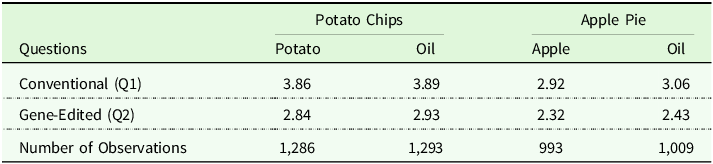
Note: Likelihood to purchase was measured on a five-point scale ranging from 1 = Extremely Unlikely to 5 = Extremely Likely.
Average likelihood to purchase across the three questions by product, ingredient, and group

Note: Likelihood to purchase was measured on a five-point scale ranging from 1 = Extremely Unlikely to 5 = Extremely Likely.
Consumer acceptance of gene editing across ingredients
Our design allows us to consider the effects of gene editing on consumers’ LTP across ingredients. This question is motivated by the policy debate surrounding the exemption of certain ingredients from the genetically engineered label mandate in the United States. In the following notation, we use subscript i to denote a respondent, j for an ingredient, k for a product claim, and l for a food product. The between-ingredient differences in LTP for a food product were determined by using the difference in Q2 and Q1 (each measured on a 5-point scale) as the dependent variable in a linear regression model that is specified in equation (1). As a reminder, and as described in Figure 1, Q1 asked LTP for a conventional version of the product and Q2 asked LTP for the same product with a gene-edited ingredient.
 $${\left( {{\rm{Q}}2 - {\rm{Q}}1} \right)_{il}} = {\delta _{0l}} + {\delta _{1l}}Oi{l_i} + {\varepsilon _{il}}$$
where ${\left( {{\rm{Q}}2 - {\rm{Q}}1} \right)_{il}}$
is the difference in LTP between Q2 and Q1 for respondent i and food product l.
${\left( {{\rm{Q}}2 - {\rm{Q}}1} \right)_{il}}$
is the difference in LTP between Q2 and Q1 for respondent i and food product l. $Oi{l_i}$
is an indicator variable equal to one if respondent i was randomized to a group making choices for oil products, and
$Oi{l_i}$
is an indicator variable equal to one if respondent i was randomized to a group making choices for oil products, and ${\delta _{1l}}$
estimates the ingredient effects relative to the unrefined ingredient (potatoes in the case of potato chips and apples in the case of the apple pie), and
${\delta _{1l}}$
estimates the ingredient effects relative to the unrefined ingredient (potatoes in the case of potato chips and apples in the case of the apple pie), and ${\varepsilon _{il}}$
is a normally distributed error term with a mean of 0.
${\varepsilon _{il}}$
is a normally distributed error term with a mean of 0.
The results in Table 4 show no statistically significant ingredient effects in either food product. This is an important result as it highlights that consumer LTP in a food product decreases regardless of whether the modification is for unrefined or highly refined ingredients. This finding suggests that consumers may behave differently in the marketplace in the absence of ingredient exemptions that currently exist within label mandates.
Estimated coefficients from the linear regression models to determine between-ingredient differences

Note: *** denotes a p-values < 0.01. Clustered standard errors are reported in parentheses. The baseline variable is the unrefined ingredient (Potato or Apple).
On the role of product claims
Next, we examine the consumer response to product claims that seek to communicate the potential benefits of gene editing. Within-group differences for LTP across the three questions were determined by estimating an ordered logistic regression model for each group. The LTP responses from the three questions were stacked, and the models can be specified by:
 $$\Pr (LTP_{ijkl}^*) = {\beta _{1jkl}}Q2 + {\beta _{2jkl}}Q3 + {\varepsilon _{il}}$$
where $LTP_{ijkl}^*$
is the latent score LTP for respondent i, ingredient j, claim k, and food product l.
$LTP_{ijkl}^*$
is the latent score LTP for respondent i, ingredient j, claim k, and food product l. $Q2$
and
$Q2$
and $3$
are indicator variables equal to one for the associated LTP responses,
$3$
are indicator variables equal to one for the associated LTP responses, ${\beta _{1jkl}}$
and
${\beta _{1jkl}}$
and ${\beta _{2jkl}}$
are estimated coefficients that determine whether LTP for Q2 and Q3 were different from LTP for Q1, and
${\beta _{2jkl}}$
are estimated coefficients that determine whether LTP for Q2 and Q3 were different from LTP for Q1, and ${\varepsilon _{il}}$
is a logistically-distributed error term. Wald tests were conducted post-estimation to determine differences between Q3 and Q2 (
${\varepsilon _{il}}$
is a logistically-distributed error term. Wald tests were conducted post-estimation to determine differences between Q3 and Q2 ( ${\beta _{2jkl}} - {\beta _{1jkl}}$
).
${\beta _{2jkl}} - {\beta _{1jkl}}$
).
Results in Table 5 show that LTP was less in Q2 and Q3 than in Q1 for all groups and ingredients for both food products. Additionally, the Wald test results show that information about the benefits of gene editing provided to respondents in Q3 increased the LTP relative to that from Q2. The magnitude of the Wald statistics in Table 5 highlights that there is a greater consumer response to the treatments focusing on health benefits. Therefore, in the next model, we examine the between-group differences in LTP for a food product. These were determined by using the difference in LTP in Q3 and Q2 as a dependent variable in a linear regression model that can be specified by:
 $$\eqalign{{\left( {{\rm{Q}}3 - {\rm{Q}}2} \right)_{il}} = & {\ \gamma _{0l}} + {\gamma _{1l}}Oil\_Healt{h_i} + {\gamma _{2l}}Product\_FoodWast{e_i} \cr & + {\gamma _{3l}}Product\_Healt{h_i} + {\mu _{il}}}$$
Estimated coefficients from the ordered logistic regression models to determine within-group differences

Note: ***denotes a p-value <0.01. Clustered standard errors are reported in parentheses. The baseline variable is the LTP for the Conventional Product collected in Q1.
where ${\left( {{\rm{Q}}3 - {\rm{Q}}2} \right)_{il}}$
is the difference in LTP between Q3 and Q2 for respondent i and food product l.
${\left( {{\rm{Q}}3 - {\rm{Q}}2} \right)_{il}}$
is the difference in LTP between Q3 and Q2 for respondent i and food product l. $Oil\_Healt{h_i}$
,
$Oil\_Healt{h_i}$
, $Product\_FoodWast{e_i}$
, and
$Product\_FoodWast{e_i}$
, and $Product\_Healt{h_i}$
are indicator variables equal to one if respondent i was randomized to the associated groups, and
$Product\_Healt{h_i}$
are indicator variables equal to one if respondent i was randomized to the associated groups, and ${\gamma _{1l}}$
,
${\gamma _{1l}}$
, ${\gamma _{2l}}$
, and
${\gamma _{2l}}$
, and ${\gamma _{3l}}$
estimate group differences relative to the base group (
${\gamma _{3l}}$
estimate group differences relative to the base group ( $Oil\_FoodWast{e_i}$
), and
$Oil\_FoodWast{e_i}$
), and ${\mu _{il}}$
is a normally distributed error term with a mean of 0. Again, Wald tests were conducted post-estimation to determine differences between groups with estimated coefficients (e.g.,
${\mu _{il}}$
is a normally distributed error term with a mean of 0. Again, Wald tests were conducted post-estimation to determine differences between groups with estimated coefficients (e.g., ${\gamma _{1l}} - {\gamma _{2l}}$
).
${\gamma _{1l}} - {\gamma _{2l}}$
).
Results in Table 6 show the differences in LTP from Q2 to Q3 for groups relative to the base treatment where subjects were presented with gene-edited oil and information that it had the potential benefit of reducing food waste. For the subjects in groups that received information about the health benefits of gene editing (for potato chips or apple pie) relative to base groups, the results show a positive and statistically significant effect on the LTP. Wald test shows that, for potato chips, the treatment focusing on health benefits for gene-edited potatoes also had a statistically significant increase in LTP relative to the group exposed to the treatment describing the food waste benefits for gene-edited potatoes. From the Wald tests for the apple pie treatments, there was no strong statistical evidence of other group differences not observed in the linear regression model results in Table 5. The results in Table 6 have important industry implications as they suggest that consumers do respond to product claims and that the claims about health benefits carry greater weight than claims about environmental benefits from gene editing.
Estimated coefficients from the linear regression models to determine between-group differences

Note: ***, **, and *denote p-values <0.01, <0.05, and <0.10 respectively. Clustered standard errors are reported in parentheses. The baseline variable is the refined ingredient (Oil) and the Food Waste claim treatment in Q3.
Our results align with, and extend, earlier work in this space. We find consumers responded more favorably to claims linking gene-edited foods to health benefits (versus claims related to food waste and the environment). Muringai, Fan, and Goddard (Reference Muringai, Fan and Goddard2020) also found that consumers are willing to pay more for gene-edited potatoes with health-related benefits (reduced acrylamide produced when potatoes are fried) compared with gene-edited potatoes that are resistant to pesticides. Overall, we find that U.S. consumers had lower LTP food with gene-edited ingredients, and this aligns with recent work, also focusing on apples, by Marette, Disdier, and Beghin (Reference Marette, Disdier and Beghin2021). In addition, Caputo, Lusk, and Kilders (Reference Caputo, Lusk and Kilders2020) also found a rebound effect in consumers’ willingness to pay for gene-edited foods after information highlighting potential benefits of gene editing was shared. Furthermore, Caputo, Lusk, and Kilders (Reference Caputo, Lusk and Kilders2020) find that demand for gene-edited foods varies across products and level of processing, but we add to research in this arena as we focus on differences across ingredients.
Additional results that include demographic variables
In the Appendix, we include three tables to showcase how our results are impacted by including demographic variables in the specification. In each case, we use demographic details for subjects in Wave 2 and provide a side-by-side comparison of the original results without control variables included (on the left) and with control variables included (on the right).
The first column in Table A1 replicates the results from Table 4 for Wave 2 on the left, and the second column shows the results from a specification that includes control variables for sex, race, income, age, education, SNAP usage, food pantry usage, and presence of children in the household. The results across the two columns are qualitatively similar. Table A2 compares the results from Table 5 for Wave 2 to a model that includes the same set of control variables, and Table A3 does the same exercise for the results in Table 6. The results in tables A1, A2, and A3 suggest that adding control variables for analysis of Wave 2 data does not alter the general thrust of our findings described above. Since we do not have demographic details for the subjects in Wave 5, and because we find that the results from Wave 2 are not significantly affected when control variables are included, we consider the results in Tables 4, 5, and 6 to be our main results.
Policy and industry implications
This research was motivated by policy debates concerning label mandates for genetically modified products in the United States and elsewhere. This includes the discussions about threshold levels, ingredient exemptions, the language used to describe genetic engineering, and the images used on the label, coupled with marketing efforts by the food industry to highlight some of the benefits of genetic modifications. Understanding how consumers will respond to the label mandates and the surrounding information is important to both policymakers and industry stakeholders, including food manufacturers, food retailers, and agricultural producers.
Studying consumer behavior as it relates to mandatory labels is particularly important for processed food products that contain multiple ingredients. We chose to focus on examining the impact of ingredient exemptions that are part of the genetically modified “bioengineered food” label in the United States. There exists a tension between the food industry and consumer advocate groups over these ingredient exemptions, in particular for the exemptions of highly refined ingredients that were derived from genetically modified crops. Results from data collected in our survey show that consumers respond negatively to labels that identify gene-edited ingredients, and furthermore, there are no statistically significant differences in their demand for the food product based on whether the gene editing is applied to an unrefined ingredient (currently subject to the label mandate) or a highly refined ingredient (currently exempt from the label mandate). This finding suggests that there are ambiguous effects associated with the current label mandate and that policymakers may need to revisit the ingredient exemptions in order to reduce consumer confusion in this arena.
We also examine the role of product claims that the food industry might use to promote consumer acceptance of genetically modified food products. Previous research has shown that claims related to consumer benefits would generate greater acceptance than claims describing benefits to the agricultural community. Here we look at two types of benefits to consumers: direct benefits to human health and indirect benefits, or social benefits, to the environment as they relate to the reduction of food waste. Somewhat surprisingly, we have witnessed promotional messages about the impact of genetic modification on food waste by plant breeding firms and business partners that developed genetically engineered potatoes and apples that have been deregulated and commercialized over the past decade. Our findings show that the claims we studied can affect consumer behavior; the treatments that introduced claims stating that gene editing has benefits to human health led to a larger consumer response compared to the treatments that claimed gene editing would reduce food loss and waste. In summary, these results suggest that framing effects are an important consideration for food manufacturers when food products with gene-edited ingredients are introduced to consumers.
Overall, results from our study can provide guidance for the ongoing debate concerning label mandates for genetically modified crops and food products, including the wide range of gene-edited crops that are expected to be commercialized in the near future. In addition, our results may shed new light on other related debates regarding food labels that describe production process attributes. For example, labels describing the country of origin for processed food products with multiple ingredients face many similar issues. Future research in this space could also examine consumer response to mandates requiring labeling of production process attributes on products and ingredient lists, similar to what we often observe for organic products.
Data availability statement
The data and code used in this study are available from the authors upon request.
Acknowledgments
The project was supported by Agricultural and Food Research Initiative Competitive Grant no. 2016-67023-24817 from the USDA National Institute of Food and Agriculture (NIFA), and through USDA Hatch project NYC-121864. Any opinions, findings, conclusions, or recommendations expressed in this publication are those of the authors and do not necessarily reflect the view of NIFA or the United States Department of Agriculture (USDA).
Competing interests
The authors do not have any information to disclose related to financial support or potential conflicts of interest.
Appendix. Additional results from models that include demographic variables
Estimated coefficients from the linear regression models to determine between-ingredient differences for wave 2: Without and with control variables

Note: *** denotes a p-values <0.01. Clustered standard errors are reported in parentheses. The baseline variable is the unrefined ingredient (Potato). Controls include sex, race, income, age, education, SNAP usage, food pantry usage, and presence of children in the household.
Estimated coefficients from the ordered logistic regression models to determine within-group differences for wave 2: Without and with control variables

Note: ***denotes a p-value <0.01. Clustered standard errors are reported in parentheses. The baseline variable is the LTP for the Conventional Product collected in Q1. Controls include sex, race, income, age, education, SNAP usage, food pantry usage, and presence of children in the household.
Estimated coefficients from the ordered logistic regression models to determine within-group differences for wave 2: Without and with control variables

Note: ***, **, and * denote p-values <0.01, <0.05, and <0.10 respectively. Clustered standard errors are reported in parentheses. The baseline variable is the refined ingredient (Oil) and the Food Waste claim treatment in Q3. Controls include sex, race, income, age, education, SNAP usage, food pantry usage, and presence of children in the household.


 Open access

