


Introduction
Even though the inherent added value of internationalising the curriculum (IoC) in higher education is undisputed, with the goal of producing “students who have changed perspectives on the world and their relationship to it” (Simm and Marvell Reference Simm and Marvell2017: 467) and who become “global citizens” (Killick Reference Killick2015), its realisation is not automatic even in an internationally diverse classroom or when the subject matter is already international in nature (Leask Reference Leask2014). The course “Theories of Cooperation and Conflict in International Relations”, which I have taught for six years, is a prime example of this. Although students came from diverse, often non-European countries, the course seminars revolved around the same (if updated) examples best suited to illustrating theory. Based on the end-of-course evaluation form, students perceived the discussions to be more between the lecturer and themselves about the theoretical points. They also felt that such a setting did not encourage discussing other examples, including ones they might better relate based on their own domestic/regional experience. Furthermore, I noticed that the learning via plenary discussions proved challenging for drawing on student experience. Time constraints also limited students to prioritising commonly known textbook examples rather than their personal experience. Students mimicked constructive criticism of the theories based on criticisms voiced in textbook examples, showing that they had acquired information, but falling short of evaluating the relevance of the criticism or constructing their own. There was a risk in adding additional non-mainstream literature with more examples that students would not relate to any better and the discussion limitations would persist. As a result, they failed to demonstrate the learning of higher-level skills as per Bloom’s taxonomy (Bloom Reference Bloom1956; Plack et al. Reference Plack, Driscoll, Marquez, Cuppernull, Maring and Greenberg2007) and to achieve the desired learning outcomes of the graduate-level course.
In response to these challenges, I introduced a systematic, student-driven internationalisation of the course curriculum. Besides giving more control to students over their learning, I actively utilised the diversity in the student body and the subject matter. I altered the format of student discussions and moved away from plenary discussions to an academic debate format with a small number of predetermined presenters (Brookfield and Preskill Reference Brookfield and Preskill2005: 124). In addition, students were explicitly instructed to try to utilise examples from their own experience/milieu in their position papers (PPs), presentations, and ensuing discussion when possible. This study investigates whether introducing such mechanisms that actively encourage students to draw on their experience in position papers and regular academic debates leads to a perceivable internationalisation of the curriculum, and ultimately improves students’ learning outcomes and experience. I employ a quasi-experimental analysis through data triangulation. Focussing on students’ course work, interactions, and perceptions, I offer a comprehensive mixed-methods analysis, which shows both the merits and limitations of the innovation when teaching about conflict and cooperation in international politics. This study is especially relevant for programmes and courses with an international student body and for instructors wishing to leverage this fact for progress in IoC.
Diversity-driven internationalisation in “Theories of Cooperation and Conflict in International Relations”
“Theories of Cooperation and Conflict in International Relations” is a compulsory, 8-ECTS-credit course for MA students. It meets once a week for thirteen weeks. Class sessions are 100 min long, alternating between interactive lectures and seminars. The intended learning outcomes are centred on students gaining competence in critically assessing breakdowns in cooperation and the dynamics of conflict in international relations (IR). The course is part of the exclusively English-language programme on IR and European politics at Masaryk University, Czechia. It is attended almost exclusively by students from abroad, including European and other countries such as Azerbaijan, Canada, Ecuador, Georgia, Egypt, Indonesia, Kazakhstan, Jordan, Mexico, Mozambique, Thailand, Turkey, and United Arab Emirates.
The course had underutilised the opportunities inherent in such a diverse international classroom and failed to exploit the potential of internationalisation to its maximum. Although the class design embodied Wit’s (Reference de Wit2011) and Teichler’s (Reference Teichler2017) conceptualisation of internationalisation as a function of the actual classroom composition or experience, which is the main focal point of mobilities and mixed programmes, it came short of internationalising the curriculum and teaching methods (Yemini and Sagie Reference Yemini and Sagie2016). Interactive lectures and plenary classroom discussions did not give incentives to students to think outside the assigned material and to share examples and experiences from their regional backgrounds, even though the field of International Relations would be particularly amenable to such an approach. This failed to facilitate student learning when it came to applying the studied theories to other cases, or to challenge those theories based on examples not cited in the literature.
Nonetheless, internationalising the curriculum assumes that the international and intercultural dimensions are purposefully incorporated into the curriculum for every student. This requires “a set of instruments and activities […] that aim to develop international and intercultural competences in all students […which] is specific to the context of a discipline and […] to a program of study” (Beelen and Jones Reference Beelen, Jones, Curaj, Matei, Pricopie, Salmi and Scott2015: 64). The benefits of student-driven IoC rest in actively building on student diversity in the classroom and personal experience that are not easily replaced by lecturer-chosen illustrative examples. While selected examples may be ideal types to develop theoretical debates, students are more likely to connect with and retain the lived experiences of their peers, and through them, better understand the subject matter (Pitts and Brooks Reference Pitts and Brooks2017). Hence, IoC is a form of peer learning (Boud et al. Reference Boud, Cohen and Sampson2001), and as such, it directly contributes to the building of students’ intercultural competence—which is important to the field of the course and the curriculum’s decolonisation by reflexive student learning (Silva, Reference Silva and (and Students for Diversity Now), 2018; Menon et al. Reference Menon, Green, Charbonneau, Lehtomäki and Mafi2021).
I used a student-driven approach to internationalise the curriculum of “Theories of Cooperation and Conflict in International Relations” (Sanderson Reference Sanderson2008). Student diversity-driven IoC (Leask Reference Leask2015: 89–119) exploits the opportunities in an international student body (Beelen and Jones Reference Beelen, Jones, Curaj, Matei, Pricopie, Salmi and Scott2015; Leask Reference Leask2009) by purposefully internationalising teaching and learning practices. Therefore, my innovation followed three principles: (1) restructuring the course to allow for culturally diverse adjustments from the input of students in the course (Trinh and Conner Reference Trinh and Conner2019); (2) encouraging interaction between students from vastly different cultural backgrounds (Arkoudis et al. Reference Arkoudis, Watty, Baik, Yu, Borland, Chang and Pearce2013); and (3) building intercultural competence in the area of expertise of the study programme where students are co-learners (Santoro Reference Santoro2013; Barnett Reference Barnett2004).
The major innovation applied to the course in 2021 was adjustments to the format of the seminars and the assessment of student learning. The interactive lectures and course content, including the topics and the reading material, remained unchanged. As for the seminars, while each student continued to prepare for the seminars by writing and submitting argumentative position papers on the assigned preparatory reading materials, the proceedings during the seminar changed. Formerly, the seminars included an open plenary discussion after all students briefly stated their stances on the assigned statement. This would inevitably create divisions among the students along various perspectives, which I was able to moderate via questions to focus on discrepancies or disagreements between the groups. The discussion was open to anyone to make contributions, and there were no designated students responsible for driving the debate.
In the innovated seminars, the discussion format was changed into an academic debate with two to three students presenting their positions for twelve minutes each. For example, students were assigned to read two texts expressing opposing views and then asked to take a stance on a statement such as “International coercive intervention into armed conflict backfires”. There were no predetermined positions; students had to develop their own argumentation utilising real-world examples. After the initial positions were laid out, the rest of the class participated by critically engaging with the stances of their classmates. Student background and experience could enrich the ensuing discussion and gave space to voice marginalised positions. For example, when discussing foreign interventions, students with several different kinds of experiences were present: those whose countries (1) have even recently intervened successfully, (2) have intervened unsuccessfully, and (3) have been the targets of such interventions, or a mixture of the three. Thus, there was potential to interject their own relevant experiences. Furthermore, students now were explicitly encouraged to utilise examples from their home countries’ foreign or domestic policy experiences as points or counterpoints in support of their arguments in their position papers, opening presentations, and during the follow-up academic debates with presenting panellists and amongst themselves.
To further support co-learning via the new seminar format, the calculation of the semester grade shifted from heavily weighting the PPs and the final exam to the presentation and critical engagement activity in the classroom debate, as per the logic of formative assessment (Shavelson et al. Reference Shavelson, Young, Ayala, Brandon, Furtak, Ruiz-Primo, Tomita and Yin2008) (Table 1). The new assessment criteria assigned much greater weight to the debates.
Comparison of student grade criteria in 2020 and 2021

As a result of the innovation, I expect that (H1) the treatment group will rely on their “own experience” more often when supporting their positions, and, due to deeper engagement with the topics through peer and personal experiences, (H2) their learning, understood as achieving the intended learning outcome, will improve compared to the control group.
Research design
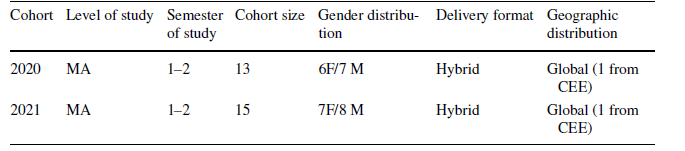
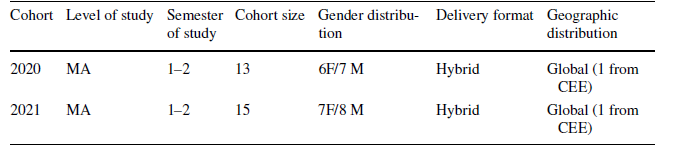
The study follows a quasi-experimental design comparing two subsequent course cohorts, with the 2020 cohort being the control group and the 2021 cohort the treatment group. The two cohorts are highly consistent in all respects other than the treatment including the study level, semester of study, cohort size, gender distribution, format of delivery, and distribution of geographic origin (Table 2). I taught both cohorts. Overall student performance, measured in grade averages on a five-point scale, shifted only slightly from 3.76 in 2020 to 3.66 in 2021—which is not a statistically significant difference (t = 2.11, df = 26, p-value = 0.83)—with very similar grade distributions. A comparative study is therefore suitable to evaluate whether or not the innovation succeeded in increasing the perceivable level of learning and internationalisation of the curriculum.
Comparison of the attributes of the control (2020) and treatment (2021) groups
Relying on data triangulation (Mertler Reference Mertler2017), I have used a combination of qualitative and quantitative indicators to evaluate my hypotheses. First, I used the position papers that students wrote in preparation for the debates to assess the use of their “own experience” and comprehension of the material. Since debates were based on PPs, students were unlikely to produce examples from their experience in debates if they did not elaborate them in their PP preparations. The PPs were analysed for references to “own experience” and considered having such references if the PP contained at least one such developed example (as opposed to a mere mention) relevant to the argument. The PPs were further evaluated according to Bloom’s taxonomy to see whether the use of own examples correlated with a higher order of student learning (Plack et al. Reference Plack, Driscoll, Marquez, Cuppernull, Maring and Greenberg2007: 287). The absence of such an example was easy to identify as students would either refrain from using any empirical example in their PP (focussing on theoretical debates) or default to one from the assigned or chosen literature.
Second, as students did not read each other’s PPs, debates were to be the main conduit for student-driven IoC in the classroom. Being the moderator of each debate, I observed and noted the use of “own experience” examples in the new 100-min panel-format debates. The mere mention of an example was not sufficient; an example only counted as an experience if the presenter elaborated on its relevance to the context or the group spent some time discussing the references to the personal experience. For example, a remark such as “yes, we know about this in Colombia” would not be counted as a case of IoC through “own experience” without further detail and time dedicated to it. Finally, the limitations of counting “own experience” examples must be noted: it is unrealistic to expect that every student will have relevant personal examples for all the debates. That is why this method was only used for research purposes, and the assessment of neither the PPs nor debate performance was tied to the number of “own experience” examples students used.
Third, the university offers an online student evaluation form, which uses a series of Likert scales and open-ended questions. For the purpose of this study, I used responses to the first question (“The subject has an educational value for me, it enriches me”) and students’ open-ended written feedback on the content of the course. The evaluation form was filled in by nine of thirteen students in the control and eight of fifteen students in the treatment group.
Fourth, I conducted seven interviews with students individually online. Three interviews took place with students from the control group a year after they had completed the course and four with students from the treatment group within two months of having concluded the course. The interviews were held with willing students from both cohorts. The interviews lasted up to fifteen minutes each with questions focussed on the content and diversity of the course, e.g. whether they felt the contents reflected varied global perspectives on the issues being covered, and their feelings about what may have been downplayed or omitted.
Fifth, for each cohort one debate was observed by the same colleague from my department, who was familiar with the course contents, the cohort, and the intention of the innovation. The observations were based on video recordings—rather than live attendance—of online classes, so the observer’s presence did not influence classroom proceedings. The colleague was asked to fill in a protocol with questions focussed specifically on student initiation of or engagement in IoC and subsequently debriefed with the lecturer.
Lastly, I compared student grades. I used unweighted assignment scores for key assignments (i.e. PPs, presentation, discussion engagement) in 2020 and 2021 to see if there was any improvement over the two cohorts in any of these assignments despite the lack of discernible difference between the overall grade averages. I used descriptive statistical measures and independent samples t test to analyse grades.
Results
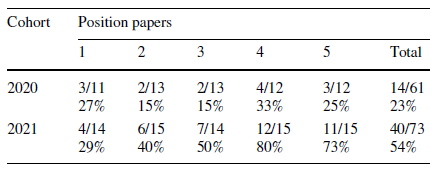
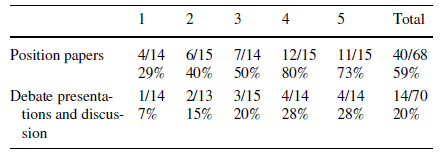
As for the first hypothesis on the number of “own experience” examples used in support of an argument as a vehicle of learning, the findings are mixed, based on the students’ written and oral work. When it comes to the position papers, there is a recognisable increase from 2020, before the innovation, to 2021, when the new debate format and the restructured assessment criteria were introduced (Table 3). In 2020, the number of examples referring to the students’ experience remained between 2 and 4 per PP for the entire class with no clear trend emerging during the semester. In 2021, this increased to 4–12 examples. The somewhat larger class size in 2021 is not responsible for the results, as the proportion of students whose PPs included a reference to a personal experience ranged between 15 and 33 per cent in 2020 and 29 to 80 per cent in 2021. In this, the written feedback that I gave each student within seven days of submitting a PP, and thus, seven days before the next, was likely influential. This was reflected in a steady increase in the number of PPs containing references to such examples during the course and a clear absolute increase compared to the previous semester.
References to “own experiences” in submitted position papers in the control (2020) and treatment (2021) groups

The level of detail in references to “own experience” differed across student position papers in both cohorts. More than a third of the references reported above did not involve making domestic experiences central to the construction of the argument but merely showed the relevance of the cases without deeper elaboration. On the other hand, some students did build their entire argument around a single case. For example, one student argued for international armed intervention based on non-humanitarian grounds in describing the logic of his country’s (Turkey) intervention in Syria, while a student from Thailand wrote an eloquent comparison of her country’s experience of transformation with that in Myanmar and poignantly identified the discrepancy with the liberal, European perception of outside roles in this process.
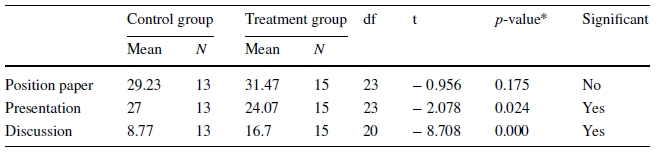
Crucially, position papers containing and elaborating examples of “own experience” ended up gaining more points as per the evaluation rubric (which did not reward the inclusion of such an example, but emphasised critical assessment, considered argumentation, and their synthesis with the theory under consideration). This also translated into the treatment cohort as a whole gaining more points for position papers (Table 4) and the average score for PPs (with a maximum of 8 points per PP) increasing from 5.8 in the control to 6.3 in the treatment.
Performance of control and treatment group students on individual assignments
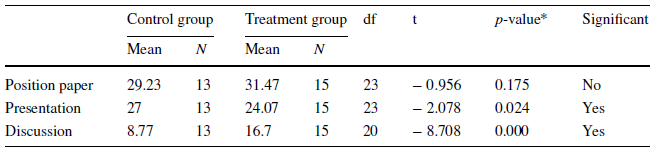
*One-tailed, p < .05
Utilising Plack et al.’s (Reference Plack, Driscoll, Marquez, Cuppernull, Maring and Greenberg2007: 287) categorisation based on the learning levels in Bloom’s taxonomy, PPs were assessed and sorted into three levels. Level I corresponded to comprehension, level II to analysis, and level III to synthesis and evaluation, marking the ability of the student to critically evaluate multiple perspectives on the statement and synthesise an argument (Plack et al. Reference Plack, Driscoll, Marquez, Cuppernull, Maring and Greenberg2007: 287). Level III was predominantly populated by PPs containing an “elaborate own experience” example (Table 5). As the inclusion of “own experience” was in no way factored into the grade, this attested to improved learning by students producing better quality arguments by confronting the studied theories with “own experience” along with textbook examples.
Percentage of position papers containing a developed “own experience” argument in submitted position papers in the control (2020) and treatment (2021) groups

However, the treatment group’s use of these examples in the debates and ensuing discussion was modest and disproportionate compared to the time dedicated to the debates and the encouragement given to students to build their personal experience into their oral arguments. There was an increasing trend in the use of these examples during the semester, but only twenty per cent of the time did students develop at least one “own experience” example during the debates (Table 6).
References to “own experiences” in position papers and debates in the treatment group

Thus, the number of times that students in the treatment group referred to “own experience” in seminars lagged behind the position papers. For instance, the fourth seminar was not only based on a controversial statement, but the majority of submitted PPs referenced “own experience”. Yet, during the discussion only two students challenged the presenters based on their experiences. Furthermore, three out of the five PPs exhibited very high potential for “camps” to form in the debate around examples from students’ personal experiences. However, only one led to a true student-driven IoC in the debate without my assistance. It challenged the Europeanised liberal stance on outside intervention in the internal affairs of developing states with voices from former targets of said interventions and a post-colonial criticism of Eurocentrism. In the interviews, the students said they saw this as a successful internationalisation exchange because it challenged the cultural underpinnings of the stances taken on the assigned statement: “I felt the critique [of a Western approach to humanitarian intervention] wasn’t coming from a theoretical perspective but just clearly a different lived experience. Not that we hadn’t discussed the critique, it just gained much more relevance” (Canadian student, 2021 cohort). There were other debate exchanges referencing the regional experiences of students, but this one stood out to most students as a “cultural clash” (Egyptian student, 2021 cohort).
Noticing the decrease in “own experience” examples from the PPs to the seminars, I attempted to steer rather than moderate the third debate, as was noted by my observing colleague, towards examples I knew students had written in their PPs, but with very limited success. Bearing in mind that debates should serve as collaborative learning environments enhanced by the international experience of the participants (Howard Reference Howard2015; Spaska et al. Reference Spaska, Savishchenko, Komar, Hritchenko and Maidanyk2021), this may have been overstepping and I took heed to not drive the later debates and ensuing discussions.
Despite not meeting all expectations about the use and impact of “own experience” examples, student learning improved (H2). First, the quality of their argumentation in position papers noticeably improved, especially when students utilised “own experience” alongside other examples to constructively criticise the studied theoretical approaches. On average, students in 2021 performed better in assignments related to the innovation (Table 4).
Second, while it may not have been the primary goal of the innovation, learning also improved in the direction of the associated learning outcomes (as defined by the graduate profile in the international relations study programme). Students recognised the presence of IoC and its impact on their intercultural competence. In the student evaluation, one student argued that they found it “stimulating to have varied examples and illustrations” of the studied theories and another noted that “it was great to have some of the difficult readings applied to what some of us went through”. These views were repeated in various forms in the interviews: “It was fun although [I felt] under pressure to be a presenter and sort of teach on my country’s stance” (Canadian student, 2021 cohort). “I could see the (my) perception was new to some in the class, and it was not as easy [for them] to take on board” (Mozambique student, 2021 cohort). These comments provide partial confirmation for hypothesis 2, by demonstrating the positive learning outcomes among students.
Finally, the treatment group saw their learning experience more positively than the control group. Students in the treatment group evaluated the course notably higher when asked about the educational value of the course in the student evaluation form: on a six-point scale, the average score was 5.8 for 2021 and 5.3 for 2020.
Discussion
The main factors that students in the control group mentioned during the interviews as limiting the utilisation of student diversity in their cohort—the format of the seminars, the time constraints, and lack of encouragement—were removed by the innovations. Due to the new debate format—presentations and discussion—the innovated seminars were now much more discussions among peers. There was also sufficient time to address many more examples brought to the group. With 100-min blocks, a maximum of 36 min was dedicated to the presenters (if there were three, even less if there were two) and the rest of the time could be used by the group to challenge or endorse the presented stances with additional examples (or enter into a more theoretical discussion). Lastly, students were repeatedly encouraged to include “own experience” examples and received positive feedback when they did so. Yet, in the debates, students cited examples from their countries’ past or present to support their arguments rather sparsely. While both performance and learning improved in the written assignments, no significant improvement could be identified in the overall grades.
Thus, the improvement in the PPs did not translate into the debates, despite an encouraging classroom atmosphere. When debates were held, the mood was quite relaxed, and all input was valued. The written feedback in the student evaluations supports this view. A student remarked that despite the difficulty of the material “it was easy to voice your opinion, also because it was demanded”. My colleague observing the class made similar observations in noting that “without having designated a discussant, students appear to be well prepared to discuss when prompted even by each other”. Students noted that they had a positive learning experience because of a supportive classroom atmosphere. Hence, the classroom atmosphere was not to blame for students using fewer examples in the debates than in the PPs.
Rather, it was a combination of a set of related factors that was responsible for such a development. When in the interviews students were asked why they did not use more examples from their countries, some felt it was more effective to rely on Western or European cases that their peers already knew: “By the time I’d explain the intricacies of armed groups in Myanmar and why the region is reacting so carefully I think I would have lost everyone’s attention—I think we were better off staying on the Balkan example which had assigned reading” (Thai student, 2021 cohort). In other cases, students found it difficult to support a position at all, not to mention doing so using an example from personal experience: “Military rule just works in some places, but to argue for it is hard” (Mozambique student, 2021 cohort). “I wanted to argue for an outright ban on interventions, we’ve only ever suffered by them, but it was clear I wouldn’t convince them” (Thai student, 2021 cohort).
The last statement points towards a more complex issue, student self-censoring. One of the students remarked how “It was easy voicing my opinion in your class to questions you posed but I didn’t feel comfortable challenging the panellists” (Egyptian student, 2021 cohort). Indeed, my observer colleague also noted that “I saw you had to push the critique forward onto students”. Certain cultures might refrain from direct confrontation or arguing with figures of authority (Kashima and Sadewo Reference Kashima, Sadewo, Jindal-Snape and Rienties2016), but the Egyptian student’s remark suggests that it was only arguing with peers that was the issue. They might have felt awkward engaging in a scholarly debate with fellow students with whom they frequently socialised outside the classroom. An argument supported by lived experiences would have made the argument look too personal, too emotional rather than theoretical. This might have led them to focus on examples which they felt the group would be more familiar with.
Self-censoring of a different kind points to the importance of decolonisation—i.e. “the purposeful critical engagement with entangled constructions” and “questioning the colonial roots of university practices and curricula” (du Preez Reference du Preez2018; Le Grange Reference Le Grange2016) even in an educational context where the host country has no colonial past. Some students sometimes willingly censored themselves on those stances and/or opinions which they feared could be considered provincial, backward, or otherwise inferior by Europeans, as confirmed by an interviewee who said it felt “like taking a morally inferior stance” (Mozambican student, 2021 cohort). Thus, students’ perceptions of and approaches to the academic debate showed that, as noted by Wimpenny et al. (Reference Wimpenny, Beelen, Hindrix, King and Sjoer2022), decolonisation may go hand-in-hand with the IoC. Self-censorship occurred on the part of non-Western students (due to the necessity to challenge norms and positions coming from textbooks) as well as Western students (due to shame/guilt related to reimposing or defending colonial positions and norms) (Menon et al. Reference Menon, Green, Charbonneau, Lehtomäki and Mafi2021). While the decolonisation of the curriculum is often discussed and demanded at Western universities, these instances of self-censoring point to the fact that what matters is not the location of the institution but the countries of origin and perspectives of the students. For example, only 44 per cent of Central Europeans wish to be seen as part of the “West” (Hajdu et al. 2022) and may therefore also perceive Western narratives to be external to theirs.
The key observation to this finding is that adequate preparation in the form of pre-submitted position papers, a relaxed atmosphere, reliance on the fact that many students are well-travelled or have international work experience, or that student-driven IoC would equalise the relevance of all peer voices are insufficient. Student-driven IoC should therefore seek to acknowledge and pre-empt these obstacles via the application of recommended decolonisation pedagogy methodologies such as those mentioned by Morreira (Reference Morreira2017), Cheang and Suterwalla (Reference Cheang and Suterwalla2020), and Zavala (2016). Thus, the Central and Eastern European milieu might particularly benefit from this observation, as decolonising the classroom has not yet become a mainstream of higher education here (unlike internationalisation), as affirmed by Shahjahan (Reference Shahjahan, Estera, Surla and Edwards2022) and, at the same time, Western IR narratives may not apply to the experiences of local students from the region.
Furthermore, the student comments show that it is equally likely that students also found the stakes simply too high under the new assessment structure, which put a much stronger emphasis on discussion participation. On the one hand, to challenge the positions of fellow students was likely understood by them as damaging to the grades of their colleagues. While this was in fact not the case, the feedback mechanism for the debates—where points were assigned individually and discretely through the university’s online information system to each student afterwards (along with the PP evaluation)—did not help to belie this misperception. On the other hand, the increased stakes seem to have had a paralysing effect (Molloy and Boud Reference Molloy, Boud, Spector, Merrill and Ellen2014), whereby students weighed very carefully if and when they would contribute to the discussion and challenge the panellists or each other. They might also have feared damaging their own grade if they used the wrong example. Lacking low-stake opportunities to trial the use of personal examples not only made the quieter students stay quiet but the bolder students calculated more than what was beneficial to the student-driven IoC innovation (Howard Reference Howard2015: 79–105).
Conclusions
This article investigated the effectiveness of a student diversity-driven internationalisation of the curriculum in an International Relations course. Students found the innovation meaningful for their learning and the treatment group did perform better on assignments than the control group, especially in noticeably improving position paper argumentation. The results show that the innovation did contribute to treatment group students relating their “own experience” to class content more often than members of the control group. While these findings are driven primarily by written student work, the improvement in internationalisation of the curriculum in the classroom—during the debates and the ensuing discussion—also experienced minor improvement. Hence, peer-learning did not reach its full potential, and there could be a variety of reasons for this—e.g. lack of decolonising the curriculum and the classroom, increased assessment weight on performance in the presentation and ensuing debate, individualised and therefore private feedback, and a few complementary reasons for self-censorship. Two obvious ways to enhance the internationalisation through peer learning are (1) to apply the principles of decolonisation to curriculum design and classroom diversity and inclusivity upfront and (2) providing a lower-stakes setting for the debate and discussion. This may be achieved by making the first debate ungraded and providing open feedback on performance and expectations, reverting a part of the assessment weight, or redirecting it towards PPs, or the use of various techniques to start the discussion, such as brainstorming on relevant cases, using post-it notes to list personal experience anonymously, or breaking up the group into pairs or group-work exercises. Indeed, the last recommendation was also voiced by the observer.
Finally, the findings suggest the need to reconsider the expectations for student-driven internationalisation of the curriculum even in a diverse MA-level cohort dealing with international issues. While the findings certainly endorse its application and positive impact, they show how much easier it might be for students to include personal experiences in writing with a single reader rather than introduce them into an oral debate environment with a much larger audience. Acknowledging up front the dominance of some narratives, and challenges to them, and thus openly addressing the impact of colonisation on education, appears to be a necessity even in a setting where (de-)colonisation has not been found hitherto relevant. The added assessment weight may further exacerbate this challenge and stifle rather than encourage the use of personal experiences by students from a variety of cultures. It is also important that students understand the purpose of giving their examples to peers, which is that they become more engaged with the material, provide novel information and alternate insights, and ultimately, enhance their learning (Boud et al. Reference Boud, Cohen and Sampson2001). None of this is automatic even in a diverse classroom, and I will continue to develop the course by building on these findings.
Acknowledgements
This work was supported by the Masaryk University under Grant Perspectives of European Integration in the Context of International Politics V: [Grant Number MUNI/A/1196/2022] and the work of CERPEK MUNI in “Effective Teaching for Internationalisation”.
Author contribution
Martin Chovančík received his PhD from the Faculty of Social Studies, Masaryk University on the topic of arms trade. He is currently an assistant professor at the Department of International Relations and European Studies. His research projects and publications focus on the European defence industry, arms trade, and international sanctions.
Funding
Open access publishing supported by the National Technical Library in Prague.



 Open access

