


Introduction
European society in the Middle Ages was patriarchal: key roles in political and religious institutions were occupied by men who controlled the dominant narrative, as well as governing rules and regulations. Of course, some privileged women such as abbesses, queens or particular noblewomen also had prominent roles. Nevertheless, it remains the case that much of medieval European society was male-dominated. This creates a problem relating to visibility, which is compounded by the lack of questions addressing gender within modern archaeological practice (Dempsey Reference Dempsey2019; Dempsey et al. Reference Dempsey, Gilchrist, Ashbee, Sagrott and Stones2020). Does this influence how we tell stories of women's lives at medieval castles? While there have been discussions of female agency and space in relation to power dynamics or spatial arrangements of buildings (Delman Reference Delman2019; French Reference French2020; Gilchrist Reference Gilchrist1999; Richardson Reference Richardson2003), the everyday life of women who lived or worked there remains under-explored. Optimistically, this absence reflects challenges surrounding archaeological evidence; worryingly, it also indicates the demands still made of gender scholars to prove the presence of women and other gendered identities. This often results in showing how women held powerful positions, as noted above. The challenge is to explore medieval women's gendered roles and their lived experience without falling prey to the trap of inserting women into the traditional narratives of male power (Dempsey Reference Dempsey, Bérat, Hardie and Dumitrescu2021b). How do we move beyond the current tension that exists between the need to represent the fragmentary archaeological evidence faithfully and the desire to understand lived experiences more fully?
An interdisciplinary framework is proposed here that draws on different pools of evidence and exploits a range of sources to establish a more rigorous methodology to examine the lived experience of elite medieval women in the garden. This combines a social and feminist archaeological approach (Gilchrist Reference Gilchrist1999; Wylie Reference Wylie2007) with studies of folklore and literature. Another interpretative layer incorporates evidence from ecological surveys carried out at castles in Britain and Ireland, which revealed the presence of relict medieval plants (Connolly Reference Connolly1994; MacGowan Reference MacGowan and Casey2015). It is acknowledged that there can be no certainties or direct connections in this framework: implicit links are made across a wide range of sources. Together, these provide an appropriate commentary on contemporary elite culture, thereby developing the scope of historic analogy (Wylie Reference Wylie1985). Questions can be addressed to the combined evidence in order to reveal more about the daily practices of elite medieval women living at medieval castles. The relational approach applied here highlights the entanglement of medieval castle gardens, plants, female piety and women's bodies, which facilitated the nurture, care and prayer aspects of their gender roles. In other words, this article is feminist archaeological theory-in-practice: it showcases how we can examine female agency outside women's relationship with men and beyond traditional male narratives of power, status, or warfare.
Medieval women and gardens
During the later medieval period, broadly 1100–1550 ad, similar models of spatial arrangements were visible at castle sites across Ireland, Wales, Scotland and England. These include the presence of an enclosed garden or hortus conclusus, typically a non-uniform space located within or immediately adjacent to the castle complex. Enclosed by masonry walls, they may once have contained water features, trellising and terraces, as shown in medieval manuscripts (e.g. Books of Hours) and referenced in historical sources (Cooper Reference Cooper2000; Delman Reference Delmanin press; Smith Reference Smith, Skinner and Tyers2018; Thorstad Reference Thorstad2019; Fig. 1). Examples such as Portchester, Richmond and Goodrich in England, Rhuddlan, Chepstow and Kidwelly in Wales, as well as Stirling, Falkland and Cawdor in Scotland are more certain than the potential gardens in Ireland such as Adare, Trim, and Cahir (Delman in press; Dempsey Reference Dempsey2021a; Gilchrist Reference Gilchrist1999; Guy Reference Guy2018; Smith Reference Smith, Skinner and Tyers2018).
The Little Garden of Paradise, c. 1415 (tempera on panel) by the Upper Rhenish Master (fifteenth century), combining allusion to Mary's virginity with the castle garden. 26.3×33.4 cm. (CC BY-SA 4.0 Städel Museum, Frankfurt-am-Main.)
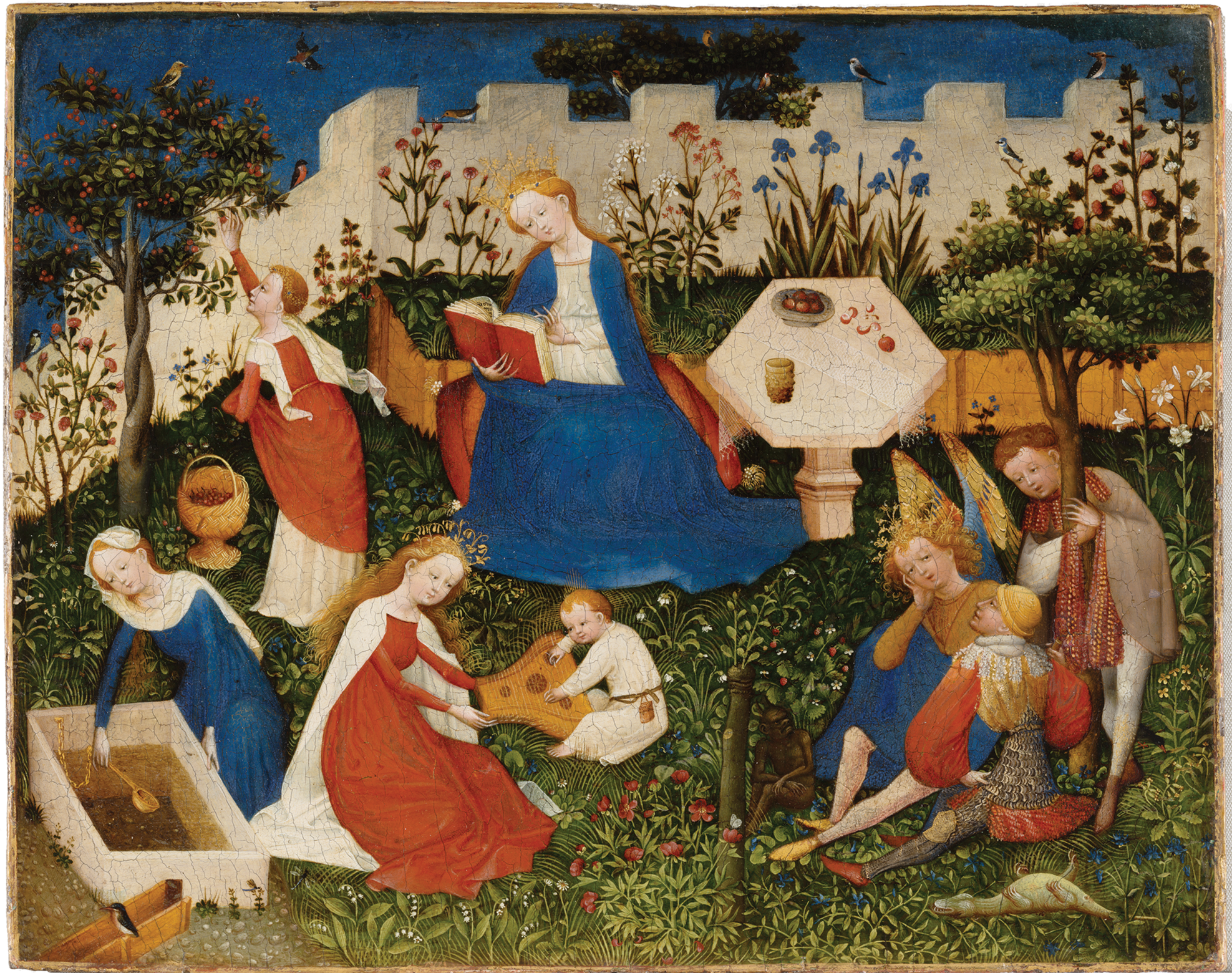
Within castle studies, discussions concentrate on establishing ownership, patronage and control: male space, authority and power versus female space and seclusion (see Dempsey Reference Dempsey2019 for discussion; Johnson Reference Johnson2002). Gendered studies have demonstrated that certain patterning, such as the spatial alignment of the chamber and garden, may indicate areas of pronounced female agency in terms of movement, access and design (Gilchrist Reference Gilchrist1999; Richardson Reference Richardson2003). This has not been developed further to include daily practices of people, especially women, in these spaces: who was doing what, where, and why? Scholarship assumes that women occupied their time in the chamber completing textile work, greeting visitors and performing hospitality (Johnson Reference Johnson2002); but there has been little speculation as to what women did in the garden, or what activities occurred there, including who tended or curated plants. Is this because the function or metaphorical role of the garden is still ‘contested’ (Gilchrist Reference Gilchrist1999)?
An abundance of medieval literature featured or was set in gardens: allegorical tales and plays overflow with references to the religious aspects of growing, gardening and nurturing that were culturally associated with the female body (Johnson Reference Johnson2002; Mellon Reference Mellon2008, 61). Gardens are viewed as symbols of fertility and renewal across the Abrahamic religions (Skinner & Tyers Reference Skinner, Tyers, Skinner and Tyers2018). The writings of many holy women are set in gardens (Herbert McAvoy Reference Herbert McAvoy, Skinner and Tyers2018). Female mystics used garden metaphors and imagery with intense sexual overtones in their writings (Herbert McAvoy et al. Reference Herbert McAvoy, Skinner and Tyers2019). The well-known biblical Song of Songs (4: 12) fuses women and the natural world: ‘my spouse, is a garden enclosed, a fountain sealed up. Thy plants are a paradise …’. But medieval homilies to the Virgin Mary, who was understood as a role model for some medieval women in Europe, also repeat similar phrases including mystical enclosed garden and marvellous herb (Dempsey Reference Dempsey2021a; Herbert McAvoy et al. Reference Herbert McAvoy, Skinner and Tyers2019). The example below is translated from middle Irish:
She is the fruitful earth in which … the marvellous herb which cured and healed every disease and sickness … in the world. She is the mystical enclosed garden … (Trinity College Dublin, H.2.16, MS 1318 fols. 839.19-843.52, YBL)Footnote 1
Here, a metaphorical fruitful garden complete with healing properties is conjured in place of the female body. These attributes were understood as metonyms for femininity or feminine capabilities of women. Particular plants and flowers such as roses or lilies were linked to chastity and devotion in later medieval writing and imagery (Delman in press; Larson Reference Larson2013; Skinner & Tyers Reference Skinner, Tyers, Skinner and Tyers2018; Tyers Reference Tyers, Skinner and Tyers2018). Metaphors also took material form in textiles, manuscripts and carvings: a thirteenth-century coffin or tomb chest lid at Beaumaris, Wales, comprises a semi-effigy of a noblewoman with her hands raised in prayer whose body is partially encased within a carved shroud of flora and fruit (Gray Reference Gray2014). This in often considered to be Siwan (Joan) of Wales (d. 1237), but more likely to be either her niece, Senana ferch Caradog (d. 1263), or in turn Senana's daughter-in-law, Eleanor de Montfort who died in childbirth on 19 June 1282 (Fig. 2; Gittos & Gittos Reference Gittos and Gittos2012; Gray Reference Gray2014; Smith Reference Smith, Skinner and Tyers2018).
A thirteenth-century coffin lid at Beaumaris, Wales, comprises an effigy of a noblewoman whose body is partially encased within a carved shroud of flora. (Photograph: courtesy of Gwynedd Archaeological Trust, © David Longley.)
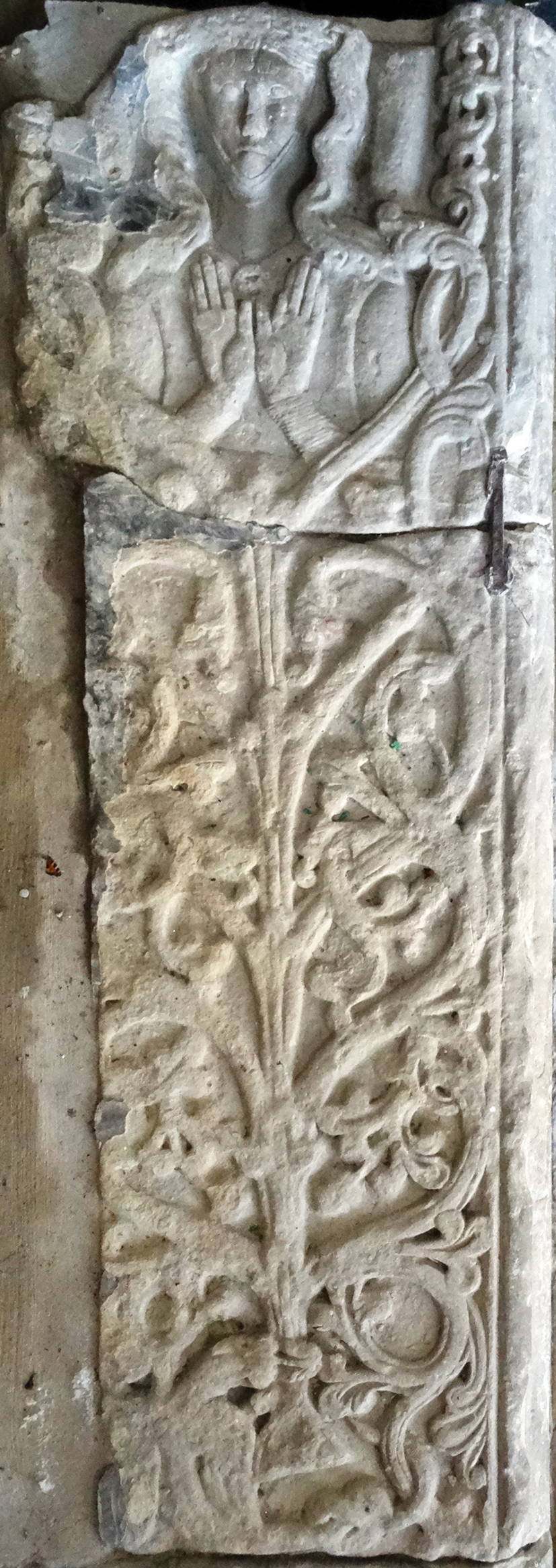
Elite ladies, throughout their life course, had particular responsibilities to their household which included healing, nurturing and praying for their well-being. The analogous language of growing/nurture/care shared between women, their bodies and gardens reveals the weight of cultural evidence connecting medieval women and their bodies with plants and fertility or lack thereof (Gilchrist Reference Gilchrist1999). We can accept that during the Middle Ages the garden had particular social meanings, which were entangled with the gendered roles of women. It appears that medieval people were alert to the embodied nature of the garden and its gendered implications for women. Are we to assume that medieval women tended the garden as a partial fulfilment of their gendered roles?
Relict plants, medieval castles and folklore
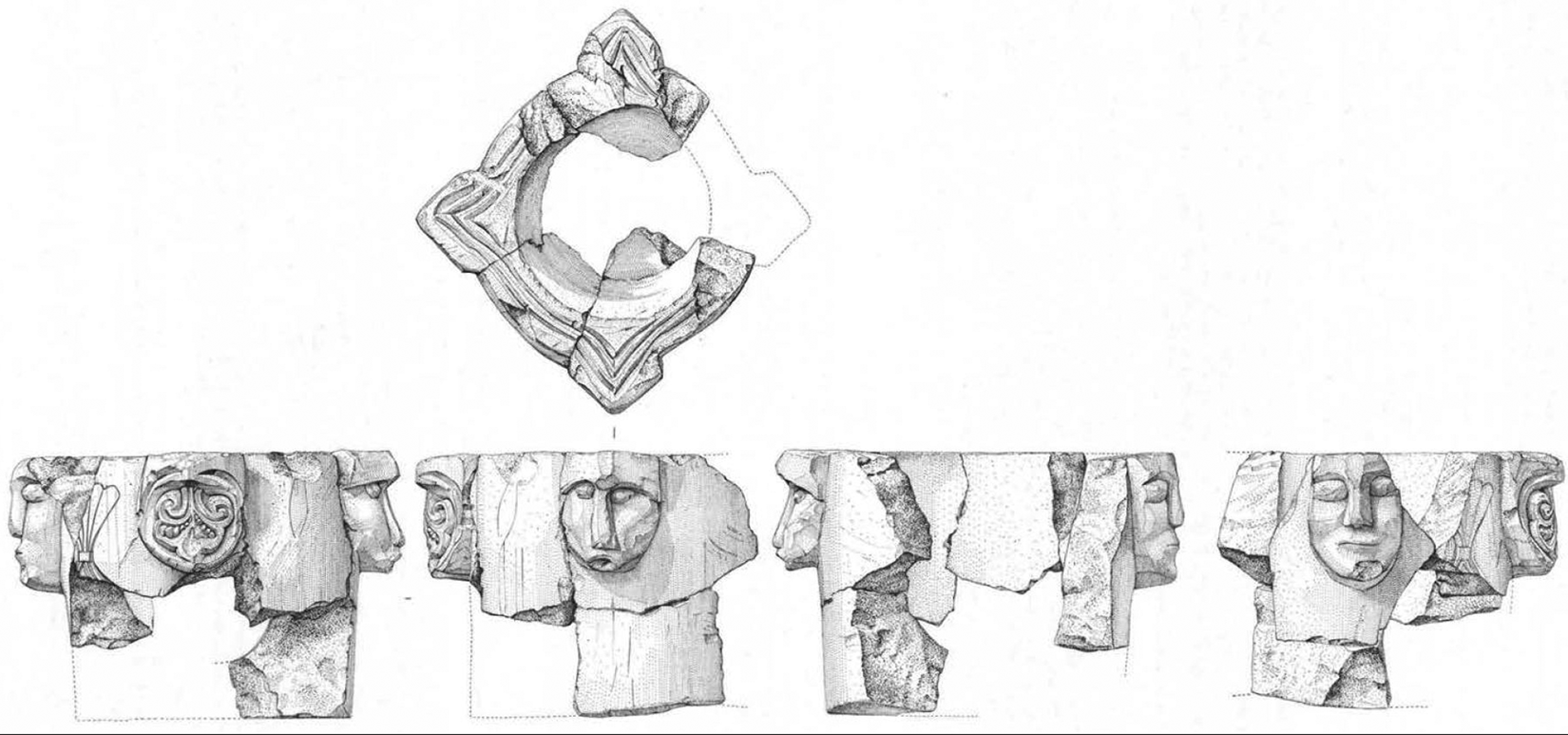
In the Middle Ages, plants were not just valued for their culinary, fragrant or medicinal properties: they were considered to have mental and spiritual benefits. It is worthwhile mentioning that three generalized aspects of medieval medicine included diet, regimen and piety (see Gilchrist Reference Gilchrist2012; Green Reference Green, Bennett and Karras2013; Huggon Reference Huggon, Gerrard and Gutiérrez2018; Rawcliffe Reference Rawcliffe1995). Medieval ‘wellness’ can be understood as the pursuit of health rather than the treatment of disease (Freedman Reference Freedman2015). Health practices are complicated to trace archaeologically: they may be invisible (i.e. spoken prayers/charms), associated material culture can be ambiguous (i.e. shears are multi-purpose) and plant remains may not survive in the archaeological record (Huggon Reference Huggon, Gerrard and Gutiérrez2018). However, direct archaeological evidence for distilling has been revealed at castle sites including Bodiam, Sussex, and Norwich, Norfolk, both in England (Booth Reference Booth2016). Mortars—a common medieval object—would have been suitable for grinding herbs to make poultices or medicines. A mortar of Caen limestone from Castle Rising, Norfolk, may have had such a special purpose: it is decorated when they tend to be plain, and these carvings comprise human faces interspersed with foliate designs (Morley & Gurney Reference Morley and Gurney1997; Fig. 3). Recipes survive for poultices and other types of healing remedies, some of which are found in medieval and early modern manuscripts (Bliss Reference Bliss1965; Cabré Reference Cabré2008; Leong Reference Leong2008). Women were active in healing, sometimes as herbalists, such as the well-known Benedictine abbess Hildegard of Bingen (d. 1179) (Osbern Reference Osbern, Dendle and Touwaide2008). Could the study of relict plants at medieval castle sites offer some new perspectives on elite women's roles in the garden?
Decorated stone mortar from Castle Rising. (After Morley & Gurney Reference Morley and Gurney1997, fig. 77.)
Relict plant studies involve the examination of present-day landscapes for the occurrence of plants that are non-native or rare to that particular location or region and absent from suitable surrounding terrain (Connolly Reference Connolly1994; Solberg et al. Reference Solberg, Breian, Ansebo and Persson2013). Non-native plants are known as archaeophytes, which are understood to have been introduced pre-1500 ad, or neophytes, which date post-1500 ad. For the medieval period, these botanical observations are complemented by documentary, architectural and archaeological research. It is slowly becoming established as a novel way to gain insights into past communities’ growing or cultivation practices, as well as potential medicinal and dietary concerns (Connolly Reference Connolly1994; Farstadvoll Reference Farstadvoll2018; Persson Reference Persson, Andréasson, Jakobsson, Gräslund Berg, Heimdahl, Larsson and Persson2014; Solberg et al. Reference Solberg, Breian, Ansebo and Persson2013; Synott Reference Synnott, Nelson and Brady1979). Castles and historic towns are a recurrent focus. Detailed botanical studies have been completed on sites across the Harz Mountains (Brandes Reference Brandes1996) and southern Germany (Dehnen-Schmutz Reference Dehnen-Schmutz2004) as well as West Slavic settlements and castles (Celka Reference Celka2011). Innovative work has been completed on combining relict plants with archaeological analysis from medieval monastic sites in Norway (Åsen Reference Åsen, Morel and Mercuri2009; Solberg et al.) and Iceland (Kristjánsdóttir et al. Reference Kristjánsdóttir, Larsson and Åsen2014). A recent study on a smaller scale was carried out at Bective Abbey, a twelfth-century Cistercian foundation in Co. Meath (Foley Reference Foley2016). On top of considering archaeological applications, The Nordic Genetic Resource Center project ‘Nordic Cultural Relict Plants’ has been working towards amplifying the heritage value and highlighting conservation issues for relict plants (Solberg et al. Reference Solberg, Breian, Ansebo and Persson2013).
Of note for this paper is a survey of Welsh monastic and castle complexes completed by ecologist Ann Connolly (Reference Connolly1994), which revealed that certain plants with known medicinal properties occur frequently at over 50 of these sites while being missing from the surrounding wider landscape (Table 1). These plants were located either on castle walls or in adjacent areas. This suggests relict status: these plants may be the successors of those cultivated by people in the (medieval) past (Connolly Reference Connolly1994). By taking a broad overview of the evidence collected by Connolly, coupled with a site-specific ecological survey of Lea Castle, Co. Laois, in Ireland (MacGowan Reference MacGowan and Casey2015), it is argued here that these plants—when contextualized within current understanding of medieval culture—are revealing of the health concerns and practices of elite households, and potentially some parts of the gender role of elite women.
Plant ecology at medieval castles (and abbeys) in Wales (after Connolly Reference Connolly1994).

Lea Castle is largely a thirteenth-century creation. It is likely that the initial earthwork castle and succeeding masonry buildings were constructed over a pre-existing Gaelic-Irish earthwork (Dempsey Reference Dempsey2016). The garden at Lea Castle is unidentified at present but may have been contained within the inner ward (Fig. 4; Dempsey Reference Dempsey2021a). The site is now very overgrown and neglected, but this proved beneficial as the ecological survey revealed the presence of many plants, some common both now and during the medieval period, but also others that are unusual to this area of Ireland (MacGowan Reference MacGowan and Casey2015; Fig. 5). For example, Meadowsweet (Filipendula ulmaria) had many uses: acting as a flavouring for beer, or combined with rushes to create a fragrant floor covering (Harvey Reference Harvey1985; Mabey Reference Mabey1996). It is also a source of natural aspirin (salicylic acid) and noted in twelfth-century medicinal recipes (for Welsh examples, see Henderson Reference Henderson1994). Other colourful plants noted were Lady's smock (Cardamine pratensis), thought to have been used as a dye for cloth for ladies’ clothes, and Silverweed (Potentilla anserina), which was also part of the excavated plant remains from Dryslwyn Castle in Wales (Caple Reference Caple2007).
Plan of Lea Castle, Co. Laois, Ireland. (Author.)

Medicinal plants found at Lea. (Fiona MacGowan.)
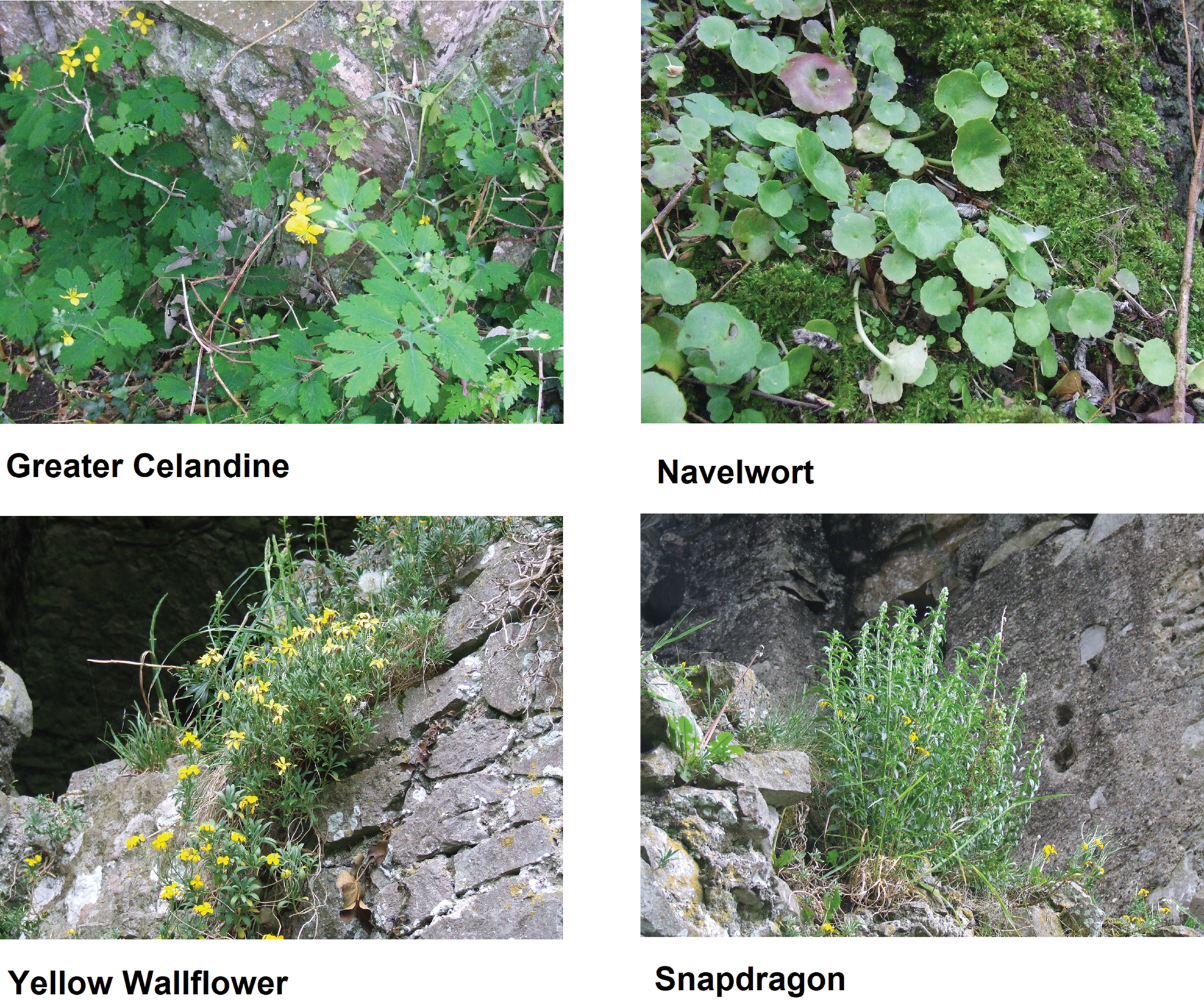
Apart from these slightly more common examples, three possible relict plants stood out at Lea Castle: Navelwort (Umbilicus rupestris), Yellow wallflower (Erysimum cheiri) and Greater celandine (Chelidonium majus). The latter two plants were also common across the surveyed sites in Wales (Connolly Reference Connolly1994; see Table 1). Greater celandine was found growing abundantly throughout the Lea Castle complex. It is non-native to Ireland and Britain, originating in continental Europe and north Asia (Allen & Hatfield Reference Allen and Hatfield2004, 79). It still remains relatively rare in Ireland today: the Botanical Society of Britain and Ireland mapping recorded only one other occurrence in Co. Laois at Rathdowney Castle (MacGowan Reference MacGowan and Casey2015). It featured frequently in old medicinal recipes—the combination of yellow flowers and juice has encouraged its use as a jaundice cure (Allen & Hatfield Reference Allen and Hatfield2004, 80; Mabey Reference Mabey1996, 55–6). The predominant associated folklore accounts highlight its curative properties for eyesight. A Welsh name of the plant is llym llygaid, meaning ‘sharp eyes’ (Allen & Hatfield Reference Allen and Hatfield2004, 80). However, medically it is known to cause severe conjunctivitis (Mabey Reference Mabey1996, 55–6; MacGowan Reference MacGowan and Casey2015).
Yellow wallflower is native to the eastern Mediterranean region (Allen & Hatfield Reference Allen and Hatfield2004). It occurs somewhat more widely in Wales on older walls, and is typical of castles (Connolly Reference Connolly1994). It was recorded growing on the walls at Lea Castle, and is common in Co. Laois (MacGowan Reference MacGowan and Casey2015). The plant presents with bright orange-yellow flowers. These blooms are highly fragrant and it is thought that they were planted under window ledges with the intention of their sweet-smell wafting in through the windows (Mabey Reference Mabey1996; MacGowan Reference MacGowan and Casey2015). Foul odours were believed to spread sickness (Rawcliffe Reference Rawcliffe2008), perhaps explaining why these golden, ripe-looking, perfumed flowers were placed near windows. Interestingly, a bright yellow was considered important as it was the colour of gold and thought to have embodied and transmitted the light of God (Woolgar Reference Woolgar2006; Reference Woolgar2018).
Navelwort was found growing on walls of Lea Castle. Despite being common in Britain and elsewhere in Ireland, it is not often found in the Midlands Region of Ireland. This limestone-rich landscape is not its favoured growing conditions (MacGowan Reference MacGowan and Casey2015). Folklore suggests this plant was grown on thatched roofs in Britain as a protective measure against lightning strikes and resultant fire; navelwort was also used as an ointment for burns and scalds (Mabey Reference Mabey1996, 171). Such dual apotropaic and healing function was common in the medieval world.
Absent from Lea Castle were rarer medicinal plants such as Henbane (Hyoscyamus niger) and Wild sage (Salvia verbenaca), both were found at Rhuddlan Castle, the earliest Edwardian castle in Wales with historical evidence for royal gardens (Connolly Reference Connolly1994; Smith Reference Smith, Skinner and Tyers2018; see Table 1). Henbane has an accepted pharmacological use as a sedative. Folkloric accounts range from its use as a painkiller in childbirth to cures for cancer (Allen & Hatfield Reference Allen and Hatfield2004, 198–9). Connolly's survey in Wales captured many other known medicinal plants: White dead-nettle (Lamium album) at Flint Castle and Wild rocket (Diplotaxis tenufolia), which was only found on the walls of Harlech and Carew Castles. This herb was noted in a compendium of three medieval treaties known as the Trotula from the medical school at Salerno, Italy, the second of which (De curis mulierum [Treatments for women]) was authored by a medieval woman, Trota of Salerno (Green Reference Green2008). This text noted ‘some women … have a sanious flux … with the menses. Such women we make … sit upon … wild rocket cooked in wine’ (Green Reference Green2002). There is potential here to suggest a network of women sharing medicinal knowledge related to women's health. Indeed, the remedies in this twelfth-century medical text feature many of the relict medicinal plants found at castles in Wales such as Poison hemlock (Conium maculatum) that was revealed in waterlogged remains at Dryslwyn Castle (Caple Reference Caple2007, 326). This was thought to encourage menstruation when combined with other herbs, such as sage (Green Reference Green2002, 68). Folklore from the Cambridge Fens indicates that hemlock was combined in a pill together with pennyroyal (Mentha pulegium) for the purpose of inducing abortions (Allen & Hatfield Reference Allen and Hatfield2004, 198–9).
Altogether, these plants are noteworthy for their known medicinal uses and association with medieval castles. Their presence in folkloric accounts indicates that a tradition of their use in medicine was long established. It is possible that they are relict from the medieval period when they were deliberately planted for well-being and medicinal uses by communities who lived at castles, including those who tended the garden. However, it cannot be stated with certainty that the relict plants were cultivated by medieval people. Neither is it possible to know if these plants were tended in situ, gathered from the wild, or if they were imported (Kristjánsdóttir et al. Reference Kristjánsdóttir, Larsson and Åsen2014, 560). Some plants, such as Greater celandine, are non-native to Ireland and Britain, but we cannot be sure of their exact introduction date. Yet there is much promise for studies of relict plants to become a fruitful area of research for castle scholarship when understood in tandem with archaeological, literary, historical and folkloric evidence (Breian & Solberg Reference Breian and Solberg2016). Weaving all of these threads together, we can see that not only were medieval people aware of the medicinal uses of plants, but that women in the household were entangled with the garden, both real and imagined.
Plants and people in the garden at medieval castles
Feminist archaeology explores the non-dominant narrative, paying particular attention to the micro-scales of daily life, in order to provide a way through which to examine the lived experience of gender (Battle-Baptiste Reference Battle-Baptiste2013; Conkey & Spector Reference Conkey and Spector1984; Gilchrist Reference Gilchrist1999; Wylie Reference Wylie2007). Here, the medieval garden is understood as a space that facilitated many of the gendered tasks of elite women including nurture, care and prayer. It was a provider of herbs (and food) for healthy diet; a space for good smells and sights, which were crucial to medieval ideas of well-being; and also a space for contemplation (Rawcliffe Reference Rawcliffe2008). The plants and flowers in this space had various forms of their own agency: they made demands and imposed their will. This included enticing bees seeking nectar to spread their pollen, or attaching burrs to animals in order to get a lift to a new location (Van der Veen Reference Van der Veen2014). Their vibrant colours, textures and smells impacted the world around them and can be understood in part by their desire to reproduce indicated by various forms of seed dispersal (see Van der Veen Reference Van der Veen2014). Their mutability enabled them to be particularly active in human lives from their ability to transform into soft furnishings (e.g. woven into mats), foodstuffs, medicine, or act in religious roles.
Flowers, in particular, were an integral part of medieval religious festivals such as Corpus Christi. They also played a role in women's lives: maidens’ hair was adorned with garlands at May Day, as were brides on their wedding days (Phillips Reference Phillips2016). Many of these customs persisted into the modern era and are recounted in folklore (Morris Reference Morris2003; O'Dowd Reference O'Dowd2011). Flowers needed to be acquired for these special occasions. For some people, this may have been as simple as gathering wild flowers from the surrounding landscape. However, this is less likely the case for the elite households of medieval castles. While it is understood that some elite households bought flowers and rushes for ritual and religious events (CDI iv, 98;Footnote 2 O'Dowd Reference O'Dowd2011), it is possible that at least part of the requirement was gathered from the garden potentially by women.
If women did tend the garden, as was metaphorically referenced in many aspects of medieval culture—where did the plants and flowers originate? The ecological surveys in Wales and Ireland suggest that some relict plants were deliberately grown at specific castle sites, as they do not occur naturally in the surrounding landscape. Nurseries were established at monasteries across Europe in the later medieval period; one existed in London by at least the late thirteenth century (Harvey Reference Harvey1985) and at Kilmainhaim, Ireland, during the early fourteenth century (Reeves-Smyth Reference Reeves-Smyth1999). It is not unlikely that a similar situation existed at other elite establishments. We know that medieval elite households were peripatetic; they processed through the territory of their lordships staying at different residences. Were plants mobile too? It is possible that they were transported (perhaps in pots) along with furniture, textiles and tablewares during the movements of households. Depictions of plants in pots are not uncommon in medieval manuscripts (Fig. 6). Certain castles such as Tintagel, Cornwall, were located within rugged landscapes, yet contained gardens despite the potential exposure to salt gales (Rose Reference Rose1994; Smith Reference Smith, Skinner and Tyers2018). Perhaps particular plants came and went with the household? At Dryslywn Castle in Wales, a rose from a watering can was revealed during excavation, suggestive of potted plant care or at least plants that needed regular watering (Caple Reference Caple2007).
Book of Hours (MS M.363), fol. 24v. Bruges, Belgium, between 1500 and 1526. Vellum, 14×9 cm. Detail featuring Pentecost with Virgin Mary; note the presence of flowers (possibly carnations) in pots. (The Morgan Library & Museum. MS M.363. Purchased by J. Pierpont Morgan (1837–1913) in 1909.)

Recent studies of plant aDNA have shown that it is possible to identify links between living plants and those grown in the past (Ramos Madrigal et al. Reference Ramos Madrigal, Wiborg Runge and Lacombe Bouby2019; Wales & Kistler Reference Wales and Kistler2019). Therefore, relict plants at castles could be genetically linked to occurrences at other sites as well as archaeobotanical remains from excavations. This has the potential to show linkages between gardens and gardeners. Leaving aside the more obvious future research possibilities this presents, what could be revealed of the daily lives of women? Is there room to investigate potential plant-sharing networks of medieval women? After her marriage to Edward I (d. 1307), Queen Eleanor of Castile (d. 1290) brought her own gardeners to England, but she also imported grafts of apple-trees from Aquitaine, a place with which her wider family were connected by birth and marriage (McLean Reference McLean1981, 102). In 1338 ad, Joan of Valois, Countess of Hainault (d. 1342), sent her daughter Queen Philippa of England (d. 1369) a treatise that she had commissioned on the health benefits of rosemary, plus a sprig for her to propagate (Harvey Reference Harvey1972; Keiser Reference Keiser, Dendle and Touwaide2008; see Delman in press for further exploration of plants and gift giving). Rosemary was native to southern Europe and noted for medicinal and healing uses including as an abortifacient and an inducer of menstruation (Keiser Reference Keiser, Dendle and Touwaide2008, 182). By the late fourteenth century, it featured in many housebooks, such as Le Ménagier de Paris, which among other things gave marital advice to women and contained a chapter dedicated to gardening (Harvey Reference Harvey1972). How common was this plant and plant-knowledge sharing practice? Did women take cuttings from plants or bring seeds from natal homes to be curated and nourished in a new place?
Performed piety: gardening as a lived experience of women's gendered role
By examining elite women's gender from a feminist perspective, we can try to disentangle women's and plants’ special relationship. This means acknowledging that during the Middle Ages the materiality of some female elite bodies was (in part) caught up with nurture and caregiving which included individual experiences of births, miscarriages and deaths as well as questions of fertility. This does not mean misrepresenting biological, social or historical interpretations in order to reinforce a false dualistic reading of women equalling nature with essentialized caring traits. It is about exploring how the materiality of female bodies converges with the lived reality of women's gender roles in the medieval world. Elite medieval women were expected to give birth, to be caregivers at a variety of scales and also to be especially devout whilst curating their figurative fruitful garden.
Gardens were viewed as devotional spaces for religious contemplation and healing within medieval religious houses and hospitals (Gilchrist Reference Gilchrist1995); it is also likely that they were considered part of the sacred geography of medieval castles. Acknowledging that a castle garden had dedicated staff, can we infer, based upon the different pools of evidence presented in this article, that within the space of a medieval castle an elite lady, possibly with her ladies-in-waiting, grew the mystical fruit and marvellous herbs in an enclosed garden as outlined or alluded to in many allegorical tales or religious teaching?
In medieval medicine, it was believed that both men and women contained ‘seeds’ which were key components in reproduction (Green Reference Green2008). It was women's religious duty to nurture this seed and for their womb to be fruitful. The Virgin Mary, a role model for Christian women, was miraculously implanted with God's seed. Her related religious and cultural iconography was entwined with the garden: the lily and rose were active in her devotional cult. We know that elite medieval women were socialized and encouraged to behave in an especially devout manner. Therefore, it is possible to suggest that tending the garden was a gendered devotional activity and health practice within which sowing literal seeds and nurturing plants was understood to have a sympathetic effect on fertility. If so, there is significance to the practices of gardening and its relationship to the performance of women's domestic spirituality and piety.
The gestures and materiality of gardening can be understood to mirror Christian religious practice and belief, in particular the gendered ideology surrounding women's roles as nurturers and carers. If we think of planting seeds as a form of material practice, then we can understand the deliberate planting of these in the ground or in pots as akin to structured deposition (see Garrow Reference Garrow2012 for overview and critique). This means that there is a meaningful action in the placement of the seed in soil. It is buried, with the hope it will spring to life. The seeds may have acted as material ‘prayers’ similar to votive deposits at medieval shrines. If the sowing of seeds can be read as deliberate deposition, then the movement of seeds and taking cuttings of flowers or herbs from significant places such as the garden of a natal home is akin to fragmentation (Chapman & Gaydarska Reference Chapman, Gaydarska and Tromzo2009; Matthews Reference Matthews2007). Once the collected seeds are redeposited or cuttings grafted, they subsequently grow to become plants or flowers.
The act of kneeling to cut or prune in the garden may have mirrored the acts of prayer in private or public devotion: it conflated mundane and divine in the domestic realm (Deane Reference Deane2013; Walker Bynum Reference Walker Bynum1988). It is possible to read a ritualized performance from cutting flowers or herbs with (possibly iron) shears. Shears are thought to be representative of a woman's role within her household (Gilchrist Reference Gilchrist2020; McClain Reference McClain, Badham and Oosterwijk2010). Medieval women could have worn shears on their girdles in a similar manner to books or keys. In a different cultural setting, the Sachsenspiegel, a German lawbook of c. ad 1220, shows shears as part of the essential ‘paraphernalia’ passed from mother to daughter (Bell Reference Bell1982). Images of shears were depicted on gravemarkers for medieval women in England (French Reference French2013, 201; McClain Reference McClain, Badham and Oosterwijk2010, 46). They are part of the common assemblage of material culture at medieval castle sites, although they do not occur in great numbers: e.g. two iron shears were found at Castle Acre, Norfolk (Coad & Streeten Reference Coad and Streeten1982). While much later in date, Scottish (and also Irish) folklore suggests that iron was understood to have an apotropaic function (Gilchrist Reference Gilchrist2020; Houlbrook 2015, 132). These objects certainly have a strong association with women, which may be owing to their likely use in obstetrics as well as textile work. In these two examples, the shears cuts the ‘thread’ of life. It is possible that the materiality of the iron shears may subtly reference that used as part of the Crucifixion. The cutting of the flowers, sacrificing them with iron shears, ties into a birth-life-death-resurrection cycle of Christ. The harvested (sacrificed) flowers and plants may have been specially selected as garlands for young maidens or brides (Phillips Reference Phillips2016), to be used in salves for the unwell (Dempsey Reference Dempsey2021a; Leong Reference Leong2008), or perfumes for peer-groups (Duggon Reference Duggon2008). Plants’ own agency and drive to reproduce or locomote is also wrapped up in this.
These transformations facilitate the reproduction and maintenance of social relations within the castle household and beyond, where plants (and seeds) of all kinds are integral to these exchanges (Ingold Reference Ingold1993; Van der Veen Reference Van der Veen2014). These ‘gifts’ create social ties and relate to the suite of socially enduring and reciprocal relationships of nurture and care, as was part of the gendered role of elite women. Through gardening, shared bonds of domestic devotion are created where female peer-groups are the foremost agents in growing mystical fruit and curing using herbs—literally and figuratively. Reductively, gardening could be viewed solely as a conformity to a particular gendered ideology that identifies women as nurturers and care-givers within Christian cosmology. But it is argued here that it was a place where women exercised their agency and control over their bodies, within societal constraints, and created a variety of networks with other people, particularly other women, as well as plants. Significantly, the potential transformation of cut herbs, flowers and plants into medicines, poultices to heal, or floral arrangements shows the dynamic relationship between plants and women as well as women and their own bodies. Furthermore, the arguments put forward in this paper begin to address human and plant relations within medieval castles. Future work must explore how the non-human agents (plants, flowers, gardens and built spaces) construct and participate in medieval, elite gender by engaging more fully with multi-species archaeology and an explicit post-human approach (Barad Reference Barad2007; Braidotti Reference Braidotti2011; Harrison Buck & Hendon Reference Harrison Buck and Hendon2018). Could plants be considered as companion species (Haraway 2019)?
Conclusion
Trying to understand the lived experience of people in the past is complicated, but we must take the necessary and risky steps to explore this question (Tringham Reference Tringham2018; Reference Tringham2019). Experimental narratives can be criticized for ‘story-telling’; however, evidence-based speculation, situated within an appropriate cultural context, helps us to understand the micro-scale of past lives. My methodological approach draws on a wide range of contemporary or related sources to create a framework that foregrounds elite women's lived experience within their contemporary social milieu. It provides a way of questioning the ‘sacrality’ of medieval gardening and potential seed-sharing networks. Noblewomen arguably used gardening as a devotional practice and as a way to further their own bodily agency through sympathetic medicine. This interpretation provides a way in which we can connect to the complex interior life of elite medieval woman and their own gendered identities. These conclusions are made more robust by linking relict plant studies with diverse medieval and appropriate early modern sources, which are then situated within wider archaeological thinking on materiality When all of these important elements are combined, they signpost social practices of elite women in the medieval world outside male power. This shows that while governing bodies and patriarchal practices desired to enforce a gendered role for women synonymous with ‘nature’, women exercised their own agency within this structure. Previous male-dominated narratives cast women as passively secluded in the castle. In sharp contrast, the active women presented here asserted their own agency in garden culture: they acquired and shared knowledge of culinary, fragrant, mental, medicinal and spiritual benefits of plants. As early feminist archaeology has shown, we will never recognize the significance of material evidence if we do not appreciate the benefit in asking new questions. We must all tend to our own gardens; prune the familiar norms, weed out assumptions and plant seeds of new thoughts that will germinate to form different sets of inquiry.
Acknowledgements
This article was written as part of my Marie Skłodowska-Curie Fellowship 2017–2019, entitled ‘HeRSTORY’, funded by the European Union's Horizon 2020 research and innovation programme under grant agreement number 74606. During this time, I was based at the Department of Archaeology, University of Reading, UK, where working with Professor Roberta Gilchrist I enjoyed unlimited opportunity to tend and nurture my own ideas. This paper adds to her work on the ‘Contested Garden’. Thanks to Professor Madeline Gray and Gwynedd Archaeological Trust for permission to use David Longley's images of the Beaumaris effigy. Dr Rachel Delman kindly shared the reference to rosemary as a gift-exchange with me. To develop further my research of relict plants studies at medieval castles, a new project ‘Sowing Seeds of Interdisciplinary Work’ is currently funded by a grant from The Castle Studies Trust (2020–2021).


 Open access

