


INTRODUCTION
Sir John Soane (1753–1837) is widely acknowledged as one of the most prolific and important architects of the Georgian era.Footnote 1 Over a long career his work ranged across projects large and small, for both public and private clients. Soane’s public buildings, churches and country houses have been well documented, as have his monumental achievements at the Bank of England.Footnote 2 However, for an architect of prodigious energy, the growing commercial and financial class in London also provided a steady stream of opportunities for smaller-scale work in the private sphere too. Whether modifying town houses or redesigning commercial premises, including counting houses, banks and insurance offices, Soane added considerably to the fabric of Georgian London.Footnote 3
Inevitably, Soane’s work for the Bank of England looms large. He was their architect for forty-five years and created an institutional home of national importance and global renown.Footnote 4 Yet, despite its ostensibly private status, it was an emergent central bank, with a monopoly on joint-stock organisation. Its scale and scope were closer to one of the great offices of the Georgian state. Until 1833 all other banks in the capital were limited to private partnerships of no more than six persons.Footnote 5 Soane’s career mirrored the era of private banking in the metropolis, and his influence on the development of an architectural style that expressed their increasing degree of financial specialisation deserves greater attention. Drawing on new evidence from Soane’s office, particularly in day books, bill books and accounts, this paper explores how Soane engaged with his private bank clients in the following ways: first, remodelling, where Ransom & Co. of Pall Mall and Down, Thornton & Free of Bartholomew Lane employed Soane to adapt their existing sites to meet changing requirements; second, rebuilding, where he worked for Prescott, Grote & Co. in Threadneedle Street to reconstruct their principal banking house and the partners houses into a private bank compound around a small City court; third, reimagining, where Soane was given free rein to design a new building for Praed & Co. in Fleet Street, unconstrained by pre-existing structures. In all these ways, Soane refined and refocused the Georgian town house model, integrating the banks’ public image with their distinctive requirements for business space and domestic residence inside.
REMODELLING
In the second half of the eighteenth century, Pall Mall emerged as a locus of West End private banking.Footnote 6 Ransom, Morland & Hammersley, the second private banking partnership located there, was established on 16 October 1782. The three founding partners were Griffin Ransom (d. 1784), William Morland (1739–1815) and Thomas Hammersley (c 1747–1812).Footnote 7 Ransom’s entry into banking came at the request of Richard Cox, banker and army agent of Craig’s Court, Whitehall. On 13 October 1782 Cox entered a bond with Ransom, indemnifying him for £5,000 on condition he took Hammersley into partnership. Hammersley had begun his career as a clerk with Herries & Co. in St James’s Street. Though Ransom was the driving force, his impact was short-lived as he died on 5 January 1784.Footnote 8 Morland and Hammersley continued together until the early 1790s, when George, 7th Lord Kinnaird (1754–1805), became more closely involved in the running of the bank. Kinnaird had married Ransom’s daughter Elizabeth in July 1777 and was an early customer too, receiving a substantial loan from his father-in-law to buy a town house in Lower Grosvenor Street in 1783.Footnote 9 In the later 1780s Kinnaird professed he had no direct role in the bank.Footnote 10 However, by 1795 he clearly exercised a substantial degree of control and by 1802 was described by a fellow partner, Henry Boase, as the head partner of the firm.Footnote 11 Despite this, neither his name, nor that of any member of his family, entered the bank’s title.
As Ransom and Morland were not obliged to attend the banking house on a regular basis, Hammersley took the lead. The co-partnership deed stipulated that the business ‘shod. be carr.d on at the House (no. 57) in Pall Mall or such other House as they shod. agree upon’; Hammersley would live on the premises rent free, receiving an allowance of a tenth of the net profits per annum for running the business.Footnote 12 57 Pall Mall was located on the north side of the street, two buildings east of George Dance the Younger’s Shakespeare Gallery and immediately west of Almack’s Tavern at number 56 (fig 1). The house, originally completed in 1762 by Joseph Dixon (d. 1787) and Henry Holland Senior (1712–85), was extensively remodelled by Soane for Ransom & Co. between 1791 and 1793.Footnote 13
Elevation of the houses on the north side of Pall Mall, 1814 by John Coney. Drawing: British Museum 1857,0613.9 © The Trustees of the British Museum.

Although Hammersley was the client, the commission was likely to have emanated from Morland or Kinnaird. Soane knew Morland well, building Chilton Lodge in Berkshire for him in 1789.Footnote 14 Kinnaird was a long-standing member of Soane’s circle and for a time a close neighbour when the latter owned a country house, Pitzhanger Manor, near Ealing.Footnote 15 Before his commission for Ransom’s, Soane had relatively little direct experience in commercial building. His appointment as architect to the Bank of England dated from October 1788, but involved only minor work until 1791. In any case, the work there was on a scale and for a purpose very different from that of a London private bank. He had designed some shops in Adams Place, Southwark, in 1781 and alterations and additions at 81 Guildhall Street, Bury St Edmunds, for the country banker James Oakes in 1788.Footnote 16 Otherwise, most of his early commissions were for country house clients.
The only visual evidence of the Pall Mall house is the pencil sketch by Coney, dated 1814 (fig 1). Records from Soane’s office reveal a project of much greater scope than previously recognised. Beyond the new offices mentioned by Stroud and Dean,Footnote 17 the front was remodelled, a new attic storey, roof and strong room were built, together with remodelled and new banking offices. Alterations to domestic and service accommodation for the resident partner and his family were also made, as Soane reworked an existing substantial West End town house into a building suitable for the twin purposes of private banking and gentleman’s residence. It possessed ‘a handsome shop-front of five arch-headed bays set in a Doric colonnade’.Footnote 18 This division between the ground floor as a place of business and upper floors containing domestic accommodation was a well-established model for banking houses, dating back at least to the 1750s.Footnote 19 The range of workmen employed, together with their bills, is shown in table 1.
Ransom, Morland & Hammersley. Work done altering and repairing the house in Pall Mall, 1791–92.

Source: SM, Bill Book 3
In June and July 1791 Soane produced new drawings of the elevation to Pall Mall and relied upon the mason Thomas Carter to carry out the work.Footnote 20 Carter, well-known in the literature as a sculptor, was also a stone mason who undertook substantial building work as a contractor, too.Footnote 21 He was variously engaged in taking down the ‘Rustic front’ and basement story, working on the top bed cornice of the upper front, altering the frieze, fixing balusters and mending the cornice.Footnote 22 One thousand six hundred and ten cubic feet (54.6m3) of Portland stone was used.Footnote 23 In July, the carpenters were taking out windows, fixing hoarding before the house and shoring up inside the basement, ground and first floor. Later they pinned and wedged up the front, took off the front roof and fixed the crib and rafters, boarding over skylights at each adjoining house before building up the party walls. Once the new attic was built, they fixed a new roof, with skylights, later covered with tinned copper.
Further remodelling of the front involved artificial stone supplied by Eleanor Coade, with thirty full and six half balusters, forming a balustrade above the principal cornice.Footnote 24 Windows had Eldorado sashes, with metal side mouldings, ‘ornamented and glazed compleat with best London Crown Glass’.Footnote 25 The extensive range of fanlights above the windows and doorway of the ground floor were of similar construction, all supplied by James Keir & Co. The dormer windows in the attic were of wooden construction. Smiths were commissioned to provide fifty-two feet (15.8m) of extra ornamented railings, containing ‘59 standard bars with spontoon heads’ and ornamented pilasters. Footnote 26 The railings contained lamp irons and vase lamps, together with lockable iron bar gates. Security was a central concern, though catered for as delicately as possible. Unusually, they were also asked for ‘an extra large brass door plate to order & engraving do. & fixing’, something many private bankers eschewed in a bid to maintain privacy and discretion. Footnote 27 In early May 1791 construction began on a new office in the yard, with flat roof and skylight, fitted out with desks and bookcases.Footnote 28
57 Pall Mall was a substantial property. Its frontage of thirty-four feet (10.4m), with five storeys above ground and basement, put it firmly within the category of a large townhouse.Footnote 29 Its dual function as a private bank and private residence influenced the distribution of rooms and functions by floor, although in general terms it followed well-established Georgian models.Footnote 30 Many houses, especially those with smaller frontages, were built with two rooms per floor, together with a staircase and perhaps a closet. After renovation, the Pall Mall house possessed at least three rooms per floor and in some cases more.
The basement comprised a kitchen, larder, butler’s pantry, scullery, housekeeper’s room and privies in the front vaults, across the open ‘area’ separating the basement from the street. There was also a small cloakroom, called Mr Hammersley’s Room, with a rail and cloak pins, probably used for outdoor clothing that could not be kept on the ground floor. A strong room, with a ‘full size remarkable stout wrought iron door and frame with valuable 5 bolt lock & key’, was also built there.Footnote 31
The ground floor was given over entirely to business, with front, middle and back offices substantially remodelled and the new room at the rear. The principal office at the front housed the public-facing activities of receiving deposits and paying cash and bills, whereas middle and back offices comprised the counting house for record keeping and spaces for more personal discussions between banker and client. The front office had a large cast iron stove and a range of mahogany desks fixed under the windows. It also possessed a strong room, probably a large safe, built of stone with a wrought iron door. The middle and back offices also contained stoves, and the latter a further strong closet.Footnote 32 Managing fire risk was a key concern, and ‘78 yards 8 ft 6 ¾ ins of copper fire plating …[was]… fixed in the banker’s shop’.Footnote 33
Creating substantial business areas on the ground floor meant the main domestic rooms, including two drawing rooms and a dining room, were located on the first floor. Both drawing rooms were extensively repaired, with new dado rails and plastering to the cornices. A separate mason, John Hickey, was responsible for a new ‘black and veind marble chimney piece …[with]… a fine stone hearth’ in the back drawing room, as well as a new mantle for the front drawing room chimney piece. As with the ground floor, ‘154 yd 1 ft & 11 ins of copper fire plating …[was]… fixed in the one pair floor’.Footnote 34 The second floor contained the principal bedrooms and Mr Hammersley Junior’s room. On the third were a further four bedrooms, together with a new dressing room. The attic provided several more bedrooms for servants. Soane’s work for Ransom & Co. was finished on 23 February 1793.Footnote 35 The total cost was £2,538 1s 4¼d, including Soane’s commission at £119 6s 6d, composition ornaments for the waiting room chimney piece (7s 6d), payment to the district surveyor (£1 15s 0d) and £30 0s 0d for clerk of works.Footnote 36
In the event, they only occupied their newly remodelled banking house for just over two years. In 1795 Hammersley left the partnership to set up on his own account as a banker at 76 Pall Mall.Footnote 37 Ransom’s relied upon Morland and Kinnaird for continuity.Footnote 38 Despite owning the lease, the remaining partners had to come to a settlement with Hammersley, who had used the house as his principal home. Ultimately, number 57 was conveyed to the banking firm of Paxton, Cockerell & Co. in 1801.Footnote 39 Meanwhile, Ransom’s moved next door to number 56, a much more substantial building, previously in operation as Almack’s Tavern, one of the pioneers of the London clubs (fig 1). Soane was approached again, his day book recording on 29 July 1795, under Earl Kinnaird: ‘Meyer left for him at Messrs Hammersley’s No 4 plans and some written particulars respecting the alterations at No 56 Pall Mall.’Footnote 40 It seems, however, that Soane took no further part. On 7 August he met with Morland and Donaldson ‘about repairs of House in Pall Mall’.Footnote 41 The reference is to James Donaldson, architect and district surveyor who lived in Bloomsbury.Footnote 42 Evidence in the Kinnaird Archive indicates it was Donaldson who oversaw the remodelling of number 56.Footnote 43
In the 1790s Soane was heavily involved with work at the Bank of England, notably in rebuilding three of Sir Robert Taylor’s public halls: the Brokers’ Exchange Rotunda, the Bank Stock Office and the Four Percent Office. Towards the end of the decade, he also designed and built the new Consols Transfer Office, completed in 1799.Footnote 44 There was no further work on private banking houses until 1801, when he was engaged by Down, Thornton & Free to alter their house in Bartholomew Lane.
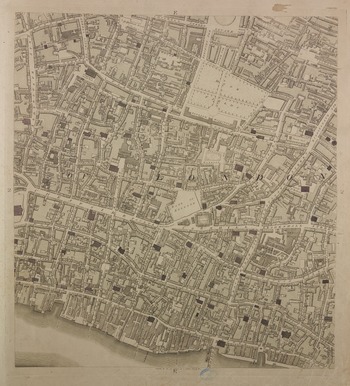
In its early years the bank was closely associated with Richard Down (1736–1814), who had come to London from Tiverton and had been a partner in the bank of Neale, James, Fordyce and Down at the time of its spectacular failure in June 1772.Footnote 45 A year later he was back in business, jointly establishing Marlar, Lascelles, Pell and Down at 10 Lombard Street in c 1773.Footnote 46 By 1776 they had moved to 1 Bartholomew Lane, a prime commercial site just across from the Bank of England and, from 1802, close to the London Stock Exchange in Capel Court (fig 2). In 1784 Henry Thornton (1760–1815) and John Free (d. 1802) joined the firm.Footnote 47 The central figure was Thornton. A biography of his daughter, Marianne Thornton, described him as ‘pious, benevolent, industrious, serious, wealthy, shrewd …[with]… outstanding intellect’.Footnote 48 These qualities, together with the likelihood of a substantial inheritance, made him a welcome addition to a banking house short on capital and experiencing strategic drift. Articles of partnership from 1808 indicate that, although Thornton was the largest shareholder, it was Richard Down who lived on the premises, receiving £300 per annum in lieu of the customary allowance for coals and candles and fifty guineas per annum for the board and lodging of each clerk.Footnote 49
Section from Horwood’s map of London 1799. Map: The London Archives (City of London Corporation).

In 1801 Soane was asked to make alterations to the first floor of the banking house for the resident partner, along with sundry other works including rebuilding the back front and extensive redecoration (table 2). No doubt the commission came via Thornton, whose brother Samuel was director, later governor, of the Bank of England and had close professional and social connections with Soane.Footnote 50
Down, Thornton & Free. Work done at the house in Bartholomew Lane, 1801.

Source: SM, Bill Book C
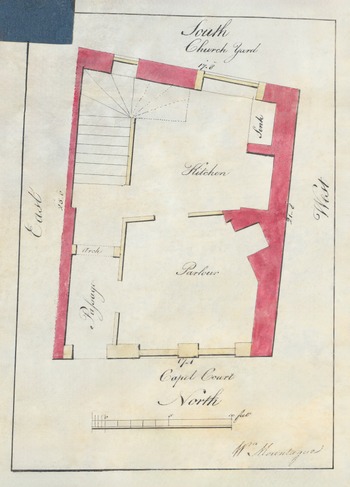
The bank’s site included a mixture of freehold and leasehold property. The freehold of the principal banking house at 1 Bartholomew Lane was secured for £2,500 on 30 and 31 May 1794, comprising a frontage of twenty-three feet (7.0m), with a depth of forty-two feet seven inches (13.0m) and a rear wall of twenty-two feet (6.7m).Footnote 51 Prior to this, on 24 July 1788, the bank leased number 1 Capel Court from the Charity for the Relief of Poor Widows and Children of Clergymen at £25 per annum (fig 3).Footnote 52
London Archives, A/CSC/0738, lease plan of 1 Capel Court, 24 July 1788. Plan: © The Clergy Support Trust, reproduced with kind permission.

On 10 November of that year the bank insured the two properties for £2,000, listed as ‘their now dwelling house & offices all communicating’.Footnote 53 By May 1791 the bank had added a further adjacent property in Capel Court, number 2, insuring for £3,000 ‘their dwelling house being three houses communicating … brick & tiled’.Footnote 54 By 20 April 1808 it appears Down & Co. were insuring their freehold property separately, and the Charity, owning the freehold of numbers 1 and 2 Capel Court, ‘two houses communicating … in the tenure of Downe & Co. Bankers’, insured them alone for £3,000.Footnote 55 A further lease, dated 29 August 1809, reveals both Capel Court properties had been effectively unified and leased as one, for £220 1s 2d per annum (fig 4).Footnote 56
London Archives, A/CSC/0743, lease plan of nos 1 and 2 Capel Court, 29 August 1809. Plan: © The Clergy Support Trust, reproduced with kind permission.

Fig 5 shows the front of Down & Co. to Bartholomew Lane in 1840. Although later than the period when Soane was working on the building, the dimensions and disposition of the front are likely unchanged. It also shows the location of the bank next to St Bartholomew-by-the-Exchange, then being demolished to make way for the new Royal Exchange completed in 1843. The gateway to Capel Court behind is also clearly visible to the left. The original architect is unknown, but the front is typical of a later-eighteenth century banking house, with the ground floor marked off as a place of business with ionic columns and entablature, together with a prominent doorway to the left and two arched windows admitting substantial quantities of light to the banker’s shop.
St Bartholomew-by-the-Exchange, R S Miles, 1840. Image: The London Archives (City of London Corporation).

Soane left the façade unaltered but did arrange for the mason Samuel Ireland to clean and repair it, with the cornice, string courses and capitals to the columns receiving new nine-inch cubed Portland stone. On completion, the old paving was re-laid in the street.Footnote 57 Meanwhile, the bricklayer took down and rebuilt the back front, referring to the second front running west to east facing into Capel Court.Footnote 58 He also put in windows onto the passageway between nos 1 and 2 Bartholomew Lane leading into the court, as well as sundry works on the chimney and roof. Ireland was also engaged here in fixing springers for an arch to the front in Capel Court and cleaning and resetting old Portland coping to the parapet.Footnote 59 The attention to the back front suggests that, given the location of the new stock exchange in the process of being built, Capel Court was becoming a place of commercial significance and prestige. Indeed, the fronts to the two houses leased by the bank had ‘stone keystones and stone stools to all the windows, stone coping to front and party walls …[and]… a wood dress to the door with fluted pilasters and an entablature’.Footnote 60 Soane worked to integrate the three separate properties into a unified whole.
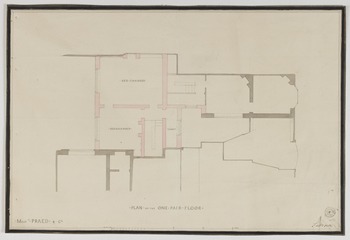
Between January and June 1801, the carpenter completed sundry work on the ground floor, including new architraves and sashes in the counting house, fire screen in the kitchen and doors to a bookcase in the back office.Footnote 61 Internally, however, most attention was paid to the first floor, shown in a plan of 12 June 1801 (fig 6).The following day, Thomas Sword, one of Soane’s assistants, worked up several more plans for alterations and ‘went to the bank and gave Gubbins Mr. Soane’s sketch for the chimney’.Footnote 62 This appears to have been a new chimney for the dining room against the party wall, marked by a pencil sketch of the breast and flues to the left of the double room running south to north beyond the first staircase. Gubbins, a carpenter, had already begun shoring up the first and second floors and, following Soane’s proposals, began further strutting up of walls and cutting away for the mason, revealing cracks in the party wall.Footnote 63
Down, Thornton & Co., 1 Bartholomew Lane. Plan of one-pair floor, 12 June 1801. Drawing: SM, 38/4/4, © Sir John Soane’s Museum.

Between June and November 1801 carpenters, masons and plaisteres worked on remodelling the dining room, adding a new chimney and hearth, whilst re-fixing the chimney piece and surrounds. They also placed a door in the partition and fixed new shutters. While the dining room received most attention, the drawing room shown in fig 6 was also extensively redecorated and given a new floor and door. Other work included redecorating rooms in the upper floors, principally bedrooms on the second floor for Down and his family and further bedrooms for servants in the attic.Footnote 64 The integration of nos 1 and 2 Capel Court brought further domestic accommodation and office space, both being formerly independent houses of four storeys, plus basements. The schedule attached to the lease of 1809 notes on the ground floor an office, inner office, with window to the churchyard, and a strong room with brick walls and groined arches (fig 4).Footnote 65 Although Soane’s work for Down & Co. was moderate in scale, he displayed his customary skill in unifying disparate property units, creating further commercial office space to house the expanding business of the bank. The bill, totalling £537 9s 6½d, was sent to Down for payment on 28 October 1802.Footnote 66
REBUILDING
The banking partnership of Prescott, Grote, Culverden and Hollingworth opened for business on 1 January 1766.Footnote 67 George Prescott (c 1711–90) came from a wealthy Cheshire family of lead merchants, whilst Andrew Grote (1710–88) was a Dutchman who came to London in 1731 and founded the agency house of Kruger & Grote in Leadenhall Street.Footnote 68 He brought a capital stock of £10,000 to the partnership.Footnote 69 Little is known of the other two original partners. John Hollingworth died in 1787 and a year later his son, also called John, became a partner. William Culverden retired in 1798. From the 1770s onwards, the Prescott and Grote families provided successive partners for the bank. The bank first owned a house at 57 Threadneedle Street, close by the Bank of England.Footnote 70 Just over ten years later, on 9 October 1776, the opportunity arose to buy the freehold of 62 Threadneedle Street, with adjoining properties behind in Sun Court, for £5,500 (fig 2). These had been in the possession of the banker Sir George Colebrooke, when his financial empire collapsed in the early 1770s.Footnote 71 Due to a protracted legal dispute, full title was not secured until 6 June 1821, some forty-five years after the initial purchase.Footnote 72
The partners of Prescott, Grote were not part of Soane’s wider social circle as other private banker clients had been.Footnote 73 However, given the bank’s location close to the Bank of England, sharing a party wall with Down & Co., it would be surprising if they were not on professional terms. Soane became a personal customer of the bank and George Grote was a firm supporter of his in later years.Footnote 74
No drawings or plans of Prescott, Grote survive, although a lease between Colebrooke and the surgeon John Belchier, for a messuage in Sun Court dated 2 September 1762, contains a useful plan showing the counting house and adjoining properties (fig 7).Footnote 75 Soane was commissioned by the bank to survey and value their freehold premises in July 1810.Footnote 76 A note, undated but before October 1810, gave a figure of £19,250. The purpose of the survey became clear in April 1811, when Soane provided an estimate of £14,000 to build a new banking house on the site, ‘erected in the most substantial manner’. He also calculated the freehold value of the various properties as £2,602 for the Banking House site, £836 for Mr Grote’s House and £1,809 for the ‘other premises’. At £19,247, this approximated his earlier valuation. He calculated the footprint of the current banking house site as a twenty-four foot (7.3m) square, or 576 square feet (53.5m2), in area.Footnote 77 Clearly the bank decided against a new building, as nothing more was done until 1818, when Soane began an extensive programme of alteration and renovation.
Lease plan of 62 Threadneedle Street and Sun Court. Plan: LA, M/93/460, © Orphan Works Licence 000462.

The work was conducted in two phases: the first between February 1818 and March 1821; the second between June 1827 and April 1831. The work in the first phase was the most substantial and included remodelling and rebuilding the banking house, where the Prescott family and between twelve and fifteen junior clerks lived.Footnote 78 No fewer than four assistants, in addition to Soane, worked on the project, producing plans and drawings for the ‘alterations of the shop and house’.Footnote 79 James Cook, clerk of works, also went to the site for the first time on 20 February 1818.Footnote 80 By the end of the month the team had produced several plans of proposed alterations of the chamber floors. Later, between 10 and 13 May 1819, Charles Papendick spent several days ‘drawing part of the Front Elevation’.Footnote 81 However, beyond these few details, the precise nature of building work is unrecorded. The closest contemporary visual evidence is an engraving by George Hollis of the churches of St Bartholomew and St Benet Fink (fig 8). The front of Prescott’s Bank can just be discerned as the fifth property from the corner of Bartholomew Lane and Threadneedle Street, two properties further east from the Cock Tavern marked by a prominent rooftop statue of that bird.Footnote 82 As Horwood’s map shows (fig 2), the property line is slightly recessed here and Prescott’s is further identifiable by the deeply projecting cornice and, at ground floor level, an ornate York lantern with spiral iron work. The frontage, at seventeen feet (5.2m), was narrow even by City standards.Footnote 83
St Bartholomew-by-the-Exchange, Threadneedle Street, G Hollis, 1840. Image: The London Archives (City of London Corporation).

It seems likely that Soane remodelled part of the front. Three hundred and seventy-seven cubic feet (10.7m3) of Portland stone was used on the building, and 409¾ days’ work by masons and 273½ by labourers was recorded.Footnote 84 Substantial iron work was undertaken, too, including railings, gate and steps, an intricate fanlight and a new door. Behind the façade were both business and domestic spaces over several floors. A basement, separated from the rest of the house by a green baize door, contained the main service rooms of kitchen, scullery and butler’s pantry. There was also a cellar, wine cellar and strong room. According to a contemporary description c 1815, the ground floor was ripe for modernisation where ‘massive oak doors opened into a dimly lit banking hall, as elsewhere known as “the Shop”, where clerks dealt with customers over an ancient oak counter’.Footnote 85 The banking hall was given substantial top-lighting by Soane via an oblong metal skylight, measuring fifty-six feet five inches (17.2m), with gabled ends (fig 9). Beyond was a large office for clerks, a back office and several private offices for the partners. There were three upper floors given over to domestic rooms, including two drawing rooms, a range of principal and secondary bedrooms, dressing rooms and a nursery; the attic storey provided further bedrooms for the large number of resident clerks.Footnote 86
Prescott, Grote & Co., 62 Threadneedle Street. Banker’s shop c 1866. Photograph: NWGA, PRE/146, reproduced by kind permission of NatWest Group © 2026.

Further evidence of the scale of the work is given by the bricklayer’s accounts. Between 16 February 1818 and 10 February 1821, the following quantities of bricks and tiles were used: 86,330 grey stocks; 978 seconds; 933 paving bricks; 9,580 plain tiles; 150 ridge tiles; twenty-six pantiles; forty-two foot tiles; sixteen ten-inch tiles; twenty cutters; sixty Welch fire bricks; 236 red rubbers. Labour was itemised by season: in summer 930¼ days’ work by bricklayers and 1,260½ by labourers was recorded; in winter the figures were 350¾ and 485, respectively.Footnote 87 To put this in context, Cruickshank and Burton estimated that each large Georgian town house in the terrace at nos 5–13 Queen Anne’s Gate, Westminster, built between 1770 and 1771, contained about 85,500 bricks.Footnote 88 For this reason alone, Soane’s work for Prescott & Co. is more appropriately considered a rebuilding, rather than a remodelling.
By far the largest expenditure on the Threadneedle Street site in the first phase was, however, on carpentry (table 3). Given the role of carpentry and joinery in Georgian building, for both structural and decorative applications, a high figure is not altogether surprising, though its obvious prominence here points to a very large-scale, intensive labour process. The work also involved fitting out the offices with desks, counters and screens. Over the three-year period no fewer than 5,052¼ days labour in carpentry were recorded.Footnote 89 The total cost of the first phase, at £9,765 10s 11½d excluding architect’s fees, closely approximated the £8,796 for rebuilding Martins Bank in Lombard Street in the 1790s.Footnote 90 On 8 January 1822 the partners wrote to Soane thanking him for ‘his great care & attention in finishing the repair of their House, with which they have to express themselves completely satisfied’.Footnote 91 Soane’s fee was £495 15s 11d.Footnote 92
Prescott, Grote & Co. Work done at the house in Threadneedle Street, 1818–21.

Source: SM, Bill Books H and I
The second phase began in June 1827.Footnote 93 This period of work, though lasting nearly four years, was much less extensive than the first phase (table 4). A key development was the rebuilding of the party wall between the rear of the banking house and the Alliance Marine Assurance Company’s new offices in Capel Court. The company had acquired the premises of Down, Thornton & Co., following their collapse in the banking crisis of 1825–6, and their architect Thomas Allason was liaising with Soane from September 1829.Footnote 94 Elsewhere, most attention was paid to fitting out an expanded set of banking rooms on the ground floor, with new desks and counters fixed in the banking hall or shop, a new Country Office and various private offices. A dedicated cabinet maker, John Robins, was employed to fit out the shop, including constructing ‘a Mahogany counter, 18 ft long with 27 drawers & partitions fitted on 3 Pedestals with drawers & money Dishes’.Footnote 95 The front to Threadneedle Street (fig 8) received new iron railings with spikes and a large square York lantern with fancy metal tube fitted over the new front door. The work came to £1,539 16s 4d.
Prescott, Grote & Co. Work done at the house in Threadneedle Street, 1827–31.

Source: SM, Bill Book K
Domestic arrangements at Threadneedle Street were distinctive. Harriet Grote noted how in the 1820s:
each of the three partners had a private residence at the banking-house; young Prescott living with his father and mother in the largest house of the three, in which also slept and boarded, some twelve or fifteen of the younger clerks, at the expense of the Firm … George and his wife occupied the third house, the elder Grote keeping the centre house in the court, with a couple of servants, for his own use when it suited him to sleep in town.Footnote 96
Fig 7 indicates the layout of properties in Sun Court around the time the bank acquired them in 1776. The house occupied by the Prescotts was part of the banking house itself, whilst the smaller house occupied by George Grote and his wife was across the court, marked on the plan as Mr Spencer’s. George Grote Senior occupied the centre house formerly leased to the surgeon John Belchier. Table 5 shows the workmen employed by Soane on the two houses occupied by the Grotes.
Prescott, Grote & Co. Work done at the houses in Sun Court, Threadneedle Street, 1818–31.

Source: SM, Bill Books H, I and K
Most of the work was decorative, with only minor material repairs and no substantial structural alteration. By far the biggest items were for painting and paperhanging. The total cost of all works and associated fees at 62 Threadneedle Street and Sun Court, between 1818 and 1831, came to £12,623 19s 0½d.Footnote 97
REIMAGINING
The banking house of Praed & Co. was formed on 1 January 1802.Footnote 98 The driving force behind the bank was William Praed (1747–1833), son of the banker and MP Humphrey Mackworth Praed (c 1718–1803).Footnote 99 Praed married Elizabeth Backwell, who had inherited the family seat at Tyringham in Buckinghamshire in June 1778. In 1792 Soane was commissioned to rebuild the house and outbuildings, widely considered one of his most successful projects.Footnote 100 Praed became involved in banking from 1776, when he joined Cocks, Biddulph of Charing Cross.Footnote 101 Three years later he also became a junior partner in the Cornish Bank at Truro, whilst between 1793 and 1821 he was chairman of the Grand Junction Canal Company.Footnote 102 A logical next step was to establish his own private bank in London.
In addition to his son, William Tyringham Praed (1780–1846), the other founding partners included Philip Box, a mercer and banker based in Buckingham, and associate of Praed’s in the canal,Footnote 103 Kenelm Digby of Park Street and Oxford Street, London, and Benjamin Babbage (d. 1827) of Fleet Street, London. By 1805 Babbage had left the partnership to be replaced by another stalwart of the Buckinghamshire political and banking community, Scrope Bernard (1758–1830).Footnote 104 Perhaps more than any other private bank at the turn of the nineteenth century, Praed & Co. were identified symbolically with their new banking house. Strikingly, the new partnership had the house built before they commenced business. Given Praed’s earlier connection with Soane and the developing friendship between the two men, it was natural the commission would go to him. In his other banks, Soane was primarily involved in rebuilding. Here, at last, he had a blank sheet to formulate an architectural solution to the problem of what a banking house for a private banker should look like.
The idea for a bank in Fleet Street went back to November 1800, when Soane, Digby and Praed met.Footnote 105 On 15 June 1801 a plan of ‘some ground adjoining Messrs North & Co’s in Fleet Street’ was taken (fig 10).Footnote 106 The site, owned by the tea warehouse of North, Simpson, Graham & Co., currently housed Mrs Salmon of the Wax Works Dépôt.Footnote 107 Typical of City plots, the site was irregular and possessed a narrow frontage with a deep extension behind. There were multiple issues to negotiate, including a curved party wall and the rights of existing neighbours on three sides, but the location was a prime one, just inside Temple Bar, giving access to both City and West End markets, as well as the legal community in the immediate vicinity.
Praed & Co., 189 Fleet Street. Plan of ground, 26 June 1801. Drawing: SM, 40/2/9, © Sir John Soane’s Museum.

Soane worked on designs in the second half of June 1801. An early attempt (fig 11) revealed a three-bay façade with cornice, balustrade and ornamentation, innovative in removing the break between the ground floor as a place of business and upper domestic storeys. The entrance was placed on the left, leading to a narrow corridor giving access to two major banking rooms on the right, rooms at the rear and stairs to the upper storeys (fig 12), but the curved party wall to the west disturbed the harmony of the ground floor plan. Soane refined his design by moving the doorway to the right, allowing the curved wall to maximise space where ‘the front banking room of the narrow plot could be increased in width, but kept symmetrical’ (fig 13).Footnote 108
Praed & Co., 189 Fleet Street. Proposed elevation, 16 June 1801. Drawing: SM, 40/2/36, © Sir John Soane’s Museum.

Praed & Co., 189 Fleet Street. Proposed ground floor plan, 16 June 1801. Drawing: SM, 40/2/31, © Sir John Soane’s Museum.

Praed & Co., 189 Fleet Street. Revised elevation, 24 June 1801. Drawing: SM, 40/2/38, © Sir John Soane’s Museum.

The back room became square on plan (fig 14). The revision necessitated changes to the façade, where an attic storey was also added. On 29 June Soane ‘met Mr. P at Lord Buckingham’s from 9 to 11 produced their plan – Plan A finally settled’.Footnote 109 Plan A refers to design No 1 (figs 13 and 14) and figure 14 is annotated ‘June 29 1801 Shown to Lord B. & fully approved’. Buckingham was a close associate of Soane, well versed in classical architecture having made the Grand Tour in 1774.Footnote 110 Soane rebuilt two houses in Pall Mall for him in 1790, creating Buckingham House. Later he designed a gothic library and vestibule at Stowe to house his Saxon manuscripts.Footnote 111
Praed & Co., 189 Fleet Street. Revised ground floor plan, 24 June 1801. Drawing: SM, 40/2/16, © Sir John Soane’s Museum.

The freehold was purchased for £2,703 5s 8d on 7 July 1801.Footnote 112 Less than a week later construction began and was significant enough to capture the attention of the national press. The Times noted on ‘Monday was laid, in Fleet Street, the first stone of a new Banking House. At the head of the firm is Wm, Praed’.Footnote 113 Demolishing the Wax Works Dépôt necessitated shoring up and rebuilding the party walls of neighbouring properties. To the east lay North & Co., where Soane rebuilt the moiety of the adjoining wall, together with the east and north fence walls of the yard.Footnote 114 On the west was an old house owned by Bridewell Hospital, in the occupation of Messrs Calvert & Co., tobacconists. Here no party wall existed, only an ‘insecure wood partition’, and Soane wrote to the Bridwell Committee on 30 June 1801 requesting leave to replace this with a solid party wall.Footnote 115 Negotiations took some months and on 6 November Soane was compelled to write again about ‘the state of the House in Fleet Street next the new House’, the front being ‘very old & rickety and very much out of an upright’.Footnote 116
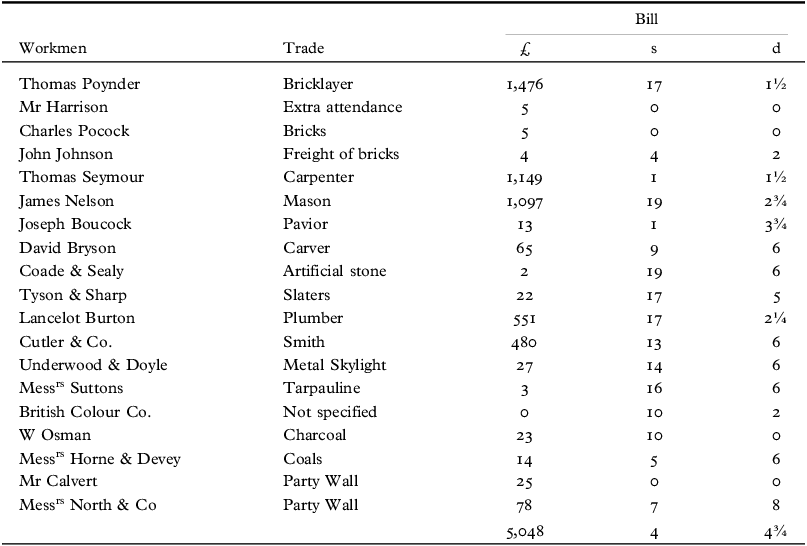
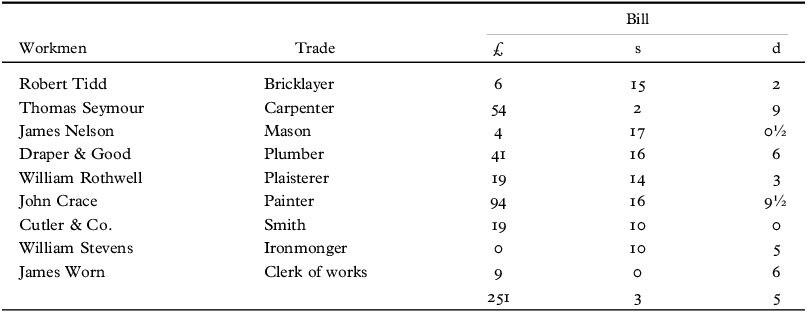
Building the shell of the new banking house came to £5,048 4s 4¾d (table 6), whilst the cost of finishing it, including freehold and architect’s fees, was £4,981 16s 1d (table 7). At £10,030 0s 5¾d, the total cost was comparable with Dance’s rebuilding of 68 Lombard Street and Soane’s later work for Prescott, Grote. Only an abstract of bills survives for the original building.Footnote 117 The stone front was substantial, with masonry amounting to about 20 per cent of the cost of building the shell. Soane paid close attention to decorating the façade, with ‘incised pilaster strips and panels of Greek fret’, motifs that reappeared some years later on his own house in Lincoln’s Inn Fields (fig 15).Footnote 118
Praed & Co. Work building the shell of the house in Fleet Street, 1801–03.

Source: SM, Ledger D
Praed & Co. Work finishing the house in Fleet Street, 1801–03.

Source: SM, Ledger D
1Adjustment for earlier overpayment
Praed & Co., 189 Fleet Street. Elevation and section, with alterations, August 1801. Drawing: SM, 40/2/43, © Sir John Soane’s Museum.

Abramson argues Soane’s work at Fleet Street and the Bank of England, as well as Dance’s rebuilding for Martins, was part of a wider search for a proper architectural character for modern commerce, using simplified flat surfaces, plain round arches, grooved pilaster strips and reduced orders.Footnote 119 In similar vein, Darley remarks how Praed’s Bank ‘represented an image of enterprise and modernity and Soane responded’.Footnote 120 Decorative detailing was undertaken by David Bryson (fl. 1800–6) and the plaster figure maker Benjamin Grant (fl. 1775–1809) made ‘molds & casts of the ornament for the top of Fleet Street’.Footnote 121
The three-bay front was carried down into a basement. Annotation on fig 14 reveals important details: the vaults were to be placed under the street, facing the house across ‘the area’, covered by an iron grate with access for coals and other supplies; no vaults were to be built under the house itself. The basement (fig 16) reflected the asymmetry of the site, varying between twenty-four feet six inches (7.5m) and twenty-two feet ten inches (6.9m), over a depth of twenty-six feet seven inches (8.1m). The ground floor was given over exclusively to the needs of the bank (fig 17). Access to the front shop, with long counter for routine banking business, was gained left from a small lobby behind the principal entrance. A door at the rear of the lobby gave access to the back shop, with strong closet adjoining, a further small office and stairs to the rest of the house.
Praed & Co., 189 Fleet Street. Plan for basement and vaults, 13 October 1801. Drawing: SM, 40/2/23, © Sir John Soane’s Museum.

Praed & Co., 189 Fleet Street. Ground floor plan, 23 July 1801. Drawing: SM, 40/2/28, © Sir John Soane’s Museum.

Unlike many of London’s private banks, there is no clear evidence a partner made the house his principal residence. Domestic space was limited and probably the partners rotated in their use of these facilities. The first floor comprised a substantial drawing room and dining room (fig 18), whilst the chamber floor contained two substantial bedrooms, one with an adjoining dressing room (fig 19). The attic contained space for further bedrooms, shared or sub-divided for servants and clerks (fig 20).
Praed & Co., 189 Fleet Street. Plan of one-pair floor, 1 September 1801. Drawing: SM, 40/2/20, © Sir John Soane’s Museum.

Praed & Co., 189 Fleet Street. Plan of chamber floor, 1 September 1801. Drawing: SM, 40/2/19, © Sir John Soane’s Museum.

Praed & Co., 189 Fleet Street. Plan of the attics, 22 October 1801. Drawing: SM, 40/2/14, © Sir John Soane’s Museum.

As the partners had substantial town houses in the West End of London, and their country estates were nearby, Praed’s were arguably forging a new modernity in choosing not to live ‘above the shop’. The footprint of the bank was small and, given its purpose-built nature, there was less need to accommodate to the large Georgian town house model. The specialised nature of the building was further underlined by a sketch of the entrance doorway dated 29 September 1801 (fig 21). Clearly shown between the top of the door frame and the fanlight are the names of the bankers in large capital letters.
Praed & Co., 189 Fleet Street. Designs for entrance, 29 September 1801. Drawing: SM, 77/4/4, © Sir John Soane’s Museum.

Soane completed the bank in very quick time. On 9 December 1801 Praed wrote to him about the opening on 1 January 1802, ‘when I expect to find myself in the character of a London Banker seated in full form in the most elegant & convenient House in the City of London’.Footnote 122 The Times agreed, noting ‘that elegant new Building just erected in Fleet-street, was last week opened as a Banking House, with the Firm of Praeds, Digby, Box, Babbage & Co’.Footnote 123
In 1806 further work was undertaken, comprising redecorating, repairs and minor remodelling (table 8). The bill book clarifies the use of the first floor, where the drawing room was referred to as at the front, presumably swapped with the dining room, now at the rear.Footnote 124 In 1812–13, Soane built a substantial two-storey extension at the rear, which pointed to the lack of capacity in the original structure.Footnote 125
Praed & Co. Work done at the house in Fleet Street, 1806.

Source: SM, Bill Book H
The extension to the ground floor provided a second entrance, via Bull Head Court and the passage to Clifford’s Inn (fig 22). A second lobby gave access to a customer waiting room, clerk’s sitting room, water closet and several unmarked office spaces. There was also a stair to the first floor that provided further domestic accommodation (fig 23). The cost was £1,778 14s 10¼d and involved substantial bricklayers’ work for new foundations and party walls with Sergeants Inn, Clifford’s Inn and the rear of Calvert’s property (table 9). In addition, the kitchen and two pantries in the original house basement were updated. In total, Soane’s work for Praed in Fleet Street came to £12,059 18s 9d. The final payment, to the painter William Watson for work done at the additional offices, was made on 20 March 1816.Footnote 126
Praed & Co., 189 Fleet Street. Ground floor plan of rear extension, February 1812. Drawing: SM, 40/2/4, © Sir John Soane’s Museum.

Praed & Co., 189 Fleet Street. Plan of one-pair floor, rear extension, February 1812. Drawing: SM, 40/2/6, © Sir John Soane’s Museum.

Praed & Co. Work building additional rooms to the house in Fleet Street, 1812–1813.

Source: SM, Bill Book G
An engraving of the bank survives from the mid-1840s, one of a series of Fleet Street buildings by the artist James Findlay (fig 24). It shows a façade very close to Soane’s final working drawing of August 1801 (fig 15), though his favoured Greek scroll coping, centrally placed upon a plinth at the top, has been omitted. It gives a sense of the depth of ‘the area’ between the bank and the street and shows substantial decoration of the projecting east wall of North & Co.’s tea warehouse. It is not clear when or if this was carried out; if so, it was long after Soane had completed his work.
Praed & Co., 189 Fleet Street. View, James Findlay, c 1845. Image: The London Archives (City of London Corporation).

CONCLUSION
Soane was responsible for more private banking houses than any other architect in Georgian London. In part this stemmed from his influential post as architect to the Bank of England, which placed him in regular contact with many of capital’s private bankers. He was also an assiduous networker, forging friendships with members of the aristocracy and gentry, who opened further doors to potential clients. Darley argues that ‘Soane’s personal relationship to his patrons and clients was the key to the quality of his architecture’.Footnote 127 Soane was a customer of three of the banks for whom he worked and had professional links with all four. Such relationships did not always run smoothly. When Ransom & Co. mooted new premises in Regent Street, Soane was furious not to be asked to design it. Notoriously thin-skinned, he fell out with Lord Kinnaird and, despite attempts to talk him round, closed his account and never banked with them again.Footnote 128 Generally, though, his relations with business clients were harmonious, as with his workmen. He demonstrated great loyalty to the craftsmen he employed and rightly felt in return they would meet his high professional standards.Footnote 129 Many names frequently reappear in his various ledger and bill book entries. Soane relied on a committed group of office assistants in all his building projects, too. Similar principles applied in deploying trusted clerks to oversee the detailed building work and architectural assistants to take plans and finish drawings from his own sketches and preliminary surveys.Footnote 130 This degree of professionalism and his own hard-headed approach to costs, made him the ideal architect for Georgian private bankers.
Soane was committed to innovation in the use of materials, too. He made extensive use of bricks, reserving stone primarily for areas on public display. His private banks, to varying degrees, required a significant public image and all were faced in Portland stone. The degree of external decoration varied, but was generally significant and Soane used artificial Coade stone where he needed to keep a lid on costs,Footnote 131 but he preferred employing master plasterers and masons for important architectural sculpture, as the bill books for Praed’s Bank confirm.Footnote 132 In the early 1790s, Soane, together with contemporaries in the Association of Architects, agreed to investigate fire prevention. One method deemed effectual was the use of plates of metal nailed to floors and ceilings, a technique employed extensively by Soane at Ransom’s remodelled banking house in Pall Mall.Footnote 133 Another contribution to fire-proofing was the metal window. Soane was an early exponent, initially employing James Keir and later his successor James Cruikshank, as well as Messrs Underwood & Doyle, to supply Eldorado sashes, fanlights and skylights in all his banks.Footnote 134 Internally, Soane was more conservative. Chimneypieces were carved to order and specialist decorators, such as the noted paperhangers Duppa and Slodden, were used to adorn principal domestic rooms.Footnote 135 For the business areas, especially the shop, fine woods such as mahogany were relied upon for the counters, desks and bookcases.
Abramson argues that Soane’s main façade at the Bank of England ‘failed to establish a legacy in the history of bank architecture’.Footnote 136 Was the same true for his private banks? His work for Praed might have seemed the most obvious model to copy, where Booker notes ‘Soane did what Taylor and Dance had not … masking the interior division between bank and living area by unifying external decoration and the use of round-headed windows in the shop, first floor, and attic’,Footnote 137 but it would be a mistake to see the four banks he remodelled, built or rebuilt as stages in a teleological trajectory. Each project had unique elements, whether of location, topography or client, as well as common features related to exterior expression, interior planning and technology. Indeed, his clearest architectural statement of the private banking house came mid-career with Praed’s Bank in 1801, rather than with Prescott, Grote in the 1820s and 1830s.
Given Soane was an architect of great originality, with a strong streak of idiosyncratic individualism, it was unlikely there would be many direct copies of his work.Footnote 138 Private bankers were generally conservative in their architectural tastes and, although they appreciated the value of a fine building as a form of advertising, they were cautious not to seem reckless with lavish ornamentation. Where they came close, it was generally in West End banking houses, which placed a higher premium on style and were situated in high-status neighbourhoods, but Soane’s influence went beyond issues of style. He had long demonstrated great skill in adapting commercial premises to the growing needs of business. Many of the City’s private banks grew incrementally in this way and Soane was a key exponent of integrating separate property units, often on constricted and irregular sites, into a larger unity.Footnote 139 Whether City or West End, all private bankers struggled with the need for light to illuminate the banker’s shop. Soane proved masterly in working through design solutions for top-lit halls at the Bank of England and he brought this skill and experience to the private banking houses he remodelled or built.Footnote 140 A common theme was the insertion of large skylights to provide daylight for the benefit of clerks and customers alike. Praed’s Bank saw a further innovation, with the relocation of the entrance from centre to side allowing the counter to be laid perpendicular to the street to avoid the blockage of light.
Many private banks built after Soane’s work for Praed adopted this technique and, by the mid-Victorian building boom in the City of London, such practical solutions to the architecture of banking had become established practice.Footnote 141 Whether remodelling, rebuilding or reimagining, Soane’s work for his private banker clients contributed significantly to the wider development of more specialised financial architecture in the modern metropolis, as long-established private banking partnerships gave way to the public corporate culture characteristic of joint-stock banking organisations.Footnote 142
ACKNOWLEDGEMENTS
I would like to thank the staff of Barclays Group Archives, the London Archives, Lambeth Archives, Lloyds Banking Group Archives, NatWest Group Archives and Perth & Kinross Archives for allowing access to their records and providing generous advice and support. I am very grateful to Sue Palmer, archivist and head of Library Services at Sir John Soane’s Museum, who facilitated many visits and responded to my frequent queries throughout with patience and good humour. I would also like to thank Rev Ben Cahill-Nicholls and the Clergy Support Trust for their kind permission to reproduce lease plans deposited at the London Archives. Two anonymous peer reviewers provided very perceptive comments and advice, which helped improve the final version significantly. All remaining errors are my own.
ABBREVIATIONS AND BIBLIOGRAPHY
Abbreviations
- BGA
-
Barclays Group Archives
- LA
-
London Archives
- LbA
-
Lambeth Archives
- LBGA
-
Lloyds Banking Group Archives
- NWGA
-
NatWest Group Archives
- PKA
-
Perth & Kinross Archives
- SM
-
Sir John Soane’s Museum, London










 Open access

