


I. Introduction
The global financial crisis exposed the close link between credit institutions and their domestic governments, the so-called sovereign-bank nexus, as a major cause of financial instability and an obstacle to economic growth.Footnote 1 In several countries, banking crises were followed by a rise in government debt because of bailouts, fiscal emergency measures and widening of government bond spreads. The unfavourable interconnectedness between the domestic banking system and national governments is a defining feature of modern economies, with currency unions particularly vulnerable, as the euro debt crisis has shown.Footnote 2
While the economic literature has addressed the banking-sovereign nexus for some time and with focus on feedback effects between financial institutions and sovereigns dubbed as “doom loops,”Footnote 3 the international financial law literature has addressed roots and solutions to financial instability through different strands: one scholarship addresses the optimal design of organisation of supervision in order to account for a better focus on systemic risks,Footnote 4 another strand elucidates the trade-off between financial integration and financial stability,Footnote 5 and focus has also been laid on the role of global and regional financial institutions and the key sources (the Basel III regulatory framework, inter alia) in mitigating risk to financial stability.Footnote 6 However, the sovereign-bank nexus has not featured saliently in these strands of literature, a lack that has been decried as the “failure of legal scholarship on international financial regulation” in addressing the banking-sovereign nexus. In response, some work aimed at widening the scope with a view to including the linkages among private banking sectors (subject to the Basel Committee’s regulations) and the public finances of sovereign governments (under the purview of the IMF).Footnote 7
This article seeks to uncover the relationship between international financial regulation and the rules governing public finances by addressing one remaining perennial flaw in banking regulation – the privileged treatment of sovereign bonds.Footnote 8 Basel capital rules require banks to hold capital for all asset classes based either on a given regulatory risk weight or internally modeled default probabilities. However, while this principle of the Basel Accord has been rigorously applied to lending to corporations, its application in relation to sovereigns is generally much softer. In the US, federal government bonds are treated as zero weights, and bonds of US states and municipalities are assigned a weight of 20%.Footnote 9 In the EU, banks are even permitted to assign a zero-risk weight for sovereign debt of all EU Member States, and thus do not hold capital against any of the sovereign exposures. While it is well-known that this privileged treatment causes a potential capital shortfall when a country’s creditworthiness deteriorates,Footnote 10 less attention has been given to how the privilege affects fiscal behavior and rule compliance.
We study the interaction between international financial regulation and public finance by assessing whether the sovereigns’ regulatory risk-weight privilege aligns with the constitutional fiscal rules. Under both US and the EU rules, a no-bailout clause governs the relationship between sovereigns. In principle, this clause bans governments or federal states from assuming the financial liabilities of sub-federal jurisdictions or other states, with the US federal level banned from rescuing US states just as the EU or any of its Member States must not bailout another Member State. By extension, the no-bailout logic implies that the regulatory treatment of government debt must not be designed to undermine fiscal discipline. The interaction between banking and fiscal rules thus rests on an empirical research question: Does the risk-weight privilege lead sovereigns to lower fiscal discipline and undermine the purpose of fiscal rules? Our hypothesis is that zero-risk weight undermines fiscal discipline (and hence fiscal rules) in times of fiscal distress, exacerbating the sovereign-bank nexus and financial and fiscal stability. To answer this question, in the empirical part of our analysis, we use an econometric technique called local projections to examine the reaction of the sovereigns’ fiscal position to a restrictive intervention in macroprudential capital regulation. This allows us to disentangle the effect of capital market regulation on fiscal performance. We focus on euro area member countries, because the availability of US states fiscal data is severely restricted.Footnote 11 Our results show that the governments in the euro area peripheral countries increase their debt after a restrictive macroprudential capital regulation intervention. The primary balance ratio, that is, the cyclically adjusted primary balance as a percentage of gross domestic product (GDP), deteriorates. The worsening in this ratio is related to discretionary decisions as a consequence of a lower government bond rate. Moreover, fiscal stress increases, suggesting that sovereign risk rises due to higher borrowing, thus highlighting the interaction between capital market regulation and the fiscal no-bailout clause.
By integrating legal and empirical analyses, this study seeks to connect to two strands of legal and economic literature: we extend the international financial law literature focusing on the sovereign-bank nexus and connect it with the literature on economic federalism. First, as mentioned above, while economic literature on the sovereign-nexus is abundant, financial law literature on this phenomenon is rather scarce.Footnote 12 We seek extending the legal literature emphasising linkages between private banking sectors and public finance,Footnote 13 which has however not further explored the interaction of the sovereign-banking nexus with fiscal rules binding sovereigns. This contribution thus ultimately offers insight on proper design and interpretation of prudential regulation.
Second, our analysis connects to the legal literature on fiscal federalism that examines the design of no-bailout clauses. Both in the US and the EU, the financial crisis gave rise to a discussion on how no-bailout regimes should be applied to financially distressed US states and euro area member countries. In the US, fiscal federalism is determined by the historical experience of sovereign solvency crisis of the 1840s which gave rise to a regime of fiscal rules that extends until today,Footnote 14 while Europe is characterised by its own sovereign debt crisis and the fiscal governance crafted as response to it.Footnote 15 The legal literature discusses how the market logic of the no-bailout principle can be reconciled with various instruments granting fiscal support in federal relationships.Footnote 16 In any case, the interaction between banking regulation and fiscal federalism is a blind spot in the legal literature. While legal scholarship discusses the role of macroprudential regulation from a doctrinal perspective,Footnote 17 the connection between macroprudential regulation and fiscal rules has not been addressed. The broader contribution of this article is to make progress toward a more integrated perspective on international financial regulation, which looks past formal categories and legalistic distinctions to identify fundamental underlying dynamics.
The study is structured as follows: Section 2 outlines the legal framework and highlights the treatment of sovereign bonds under capital regulation as well as the fiscal governance regimes in the US and the EU. Section 3 presents our empirical analysis and discusses the results. Based on the empirical findings, Section 4 elucidates the legal implications for regulation and fiscal rules, while Section 5 presents the conclusion.
II. Fiscal rules and macroprudential regulation
1. No-bailout rules and budgetary market exposure of sovereigns
By focusing on the effect of banking regulation on constitutional rules, we hypothesise that a zero-risk weight privilege in sovereign regulation is a regulatory treatment potentially conflicting with the market discipline concept of the no-bailout clause. Zero-weight privilege confers economic advantages to credit institutions to the extent that it exempts financial institutions from backing these loans with their own funds, an advantage which ultimately undermines market pressure. At the same time, both the US and the EU have fiscal rules that aim at strengthening market pressure in different ways – through debt ceilings and no-bailout clauses, or both, like in the US.Footnote 18
2. No-bailout regime in the US
No-bailout clauses play a pivotal role in federations where interlinkages exist both horizontally between sub-federal units as well as vertically between the sub-federal and the federal level. The US constitution does not stipulate an explicit no-bailout clause, but there is an established and credible regime of not bailing out US States and municipalities.Footnote 19 This implicit no-bailout regime exposes US states and municipalities to market pressure, incentivising them to maintain fiscal discipline.Footnote 20 The importance of this implicit no-bailout regime can be understood in historical perspective. Historically, US states increased their debt levels since the mid-1820s, mainly because of too heavy investments in infrastructure, creating a bubble that finally burst in 1837.Footnote 21 The federal level intervened for some time, buying up a great deal of the states’ bonds but finally pursued a strict no-bailout policy. Since Congress allowed several states to default in the 1840s, its no-bailout commitment has been perceived as highly credible.Footnote 22 The financial crisis revived the debate on the US federal government stepping in to bail out US states at risk of default, but overall the US no-bailout regime, despite its lack of explicit address in the US constitution, has been viewed as largely effective and credible.Footnote 23
3. No-bailout regime in the EU
Similar to the US, the EU Treaties are built on the notion of fiscal responsibility and market exposure of sovereign states. The historical evolution of the EU from an internal market towards an Economic and Monetary Union was characterised by establishing a currency union subject to a fiscal regime. Introducing a common currency was made conditional on the implementation of a bailout prohibition and a tight fiscal regime.Footnote 24 Unlike in the US, there is an explicit ban on Member States to assume the debt of a Member State (Article 125 TFEU). The interpretation of Articles 125 TFEU aiming at keeping budgetary discipline is widely shared in legal literature.Footnote 25 In Pringle, the ECJ has confirmed that the no-bailout principle aims at ensuring that Member States are held liable for their fiscal conduct through market pressure.26 In this vein, the no-bailout rule prohibits financial assistance because it would undermine fiscal responsibility.
However, EU treaty-makers did not only see the risk of sovereigns bailing out other sovereigns, but they acknowledged, which is relevant for our analysis, that financial institutions may likewise be able to grant non-market conditions to EU Member States. This inspired a prohibition explicitly laid down in the EU Treaties banning EU Member States from enjoying privileged access to financial institutions (Article 124 TFEU). In other words, financial institutions must not lend to EU member states at non-market rates in order to allow markets to exert budgetary pressure on the sovereign entity. Hence, EU rules forbid any measure that establishes privileged access by EU institutions and the central government.Footnote 26
Thus, US and EU constitutional rules share the notion of enforcing market logic to incentivise budgetary discipline. They let market forces work, with lower interest rates rewarding fiscal soundness and rising interest rates signaling budgetary caution. To render these constitutional rules effective, financial markets are supposed to assess the default probability of each Member State individually. This logic however is impaired by granting economic advantages to financial institutions, which in turn create or are intended to create advantages for the public sector on the financial market.
4. The zero weight (un)logic
The empirical question is whether banking regulation, when granting a preferential treatment to certain government bonds, loosens the constitutional fiscal constraints governing public finances discussed above. The regulatory treatment of sovereign bonds is determined by Basel capital requirements, the international regulatory accord that introduced a set of reforms designed to mitigate risk within the international banking sector.Footnote 27 In essence, they require banks to maintain certain minimum leverage ratios and to observe certain levels of reserve capital on hand. Member States participating in the Basel accord are obliged to implement these rules in their domestic legal orders.Footnote 28 As a consequence of the Basel rules, banks must hold capital for all asset classes, either based on a given regulatory risk weight under the standardised approach or internally modeled default probabilities. The rationale behind these capital requirements is to ensure that higher risks are backed by stronger collaterals. Depending on the risk assessment by rating agencies, risk weights vary between 0% and 150% and are applicable to the standardized approach.Footnote 29 The underlying logic is that a good debtor creditworthiness results in low capital requirements, whereas low creditworthiness leads to high capital requirements; in theory, this regulatory approach follows the fiscal logic of no-bailout described above. However, as a deviation from this principle, Basel rules establish a special regime for sovereign bonds distinct from corporate bonds by subjecting the former to a privileged set of rules. These rules offer leeway at national implementation level that lower risk weight can be applied to banks’ sovereign exposures, or exposures to their central bank, if they are denominated and funded in domestic currency.Footnote 30 The zero-risk weight of sovereign bonds hence does not follow the otherwise mandatory risk-based valuation requirement.Footnote 31
The US and EU have implemented Basel capital requirements differently in their respective prudential rules (as the Basel rules are themselves non-binding, they require implementation domestically). We are interested in the treatment of sub-federal entities (euro area Member States and US states), as they have no control over their currency and cannot simply print money to service their debts. For sub-federal entity this implies that when monetary and fiscal authorities are separate entities, the default risk of sovereign sub-federal entitities’ debt is not zero. Under US banking regulation, obligation exposures to US states, municipalities and other political subdivisions of the US have a weight of 20%.Footnote 32 In contrast, the EU constitutional rules implementing the Basel framework assign a 0% risk weight to exposures vis-à-vis Member States denominated and funded in the domestic currency.Footnote 33 Hence, unlike in the US, exposure to EU Member States is considered risk free regardless of the ratings assigned by rating agencies.Footnote 34 Sovereign bonds receiving a zero-risk weight in capital regulation are thus exempted from the large exposure requirements, and they are also classified as highly liquid in the liquidity regulation framework.Footnote 35 Therefore, even if a bank’s internal risk model determines the risk weight of these exposures to be above 0%, the credit institution in the EU may assign a 0% risk weight. This makes investing in sovereign bonds more attractive compared to other asset classes. It is this privileged treatment in implementing the Basel rules, that is, the more favourable conditions for sovereign bonds (both in the EU and the US) that motivate our analysis and which we claim to have an empirical effect on the relevant fiscal indicators.
III. Empirical analysis
We base our analysis on the local projection method,Footnote 36 which has become a popular tool in empirical macroeconomics. Local projections are a sequence of regressions where the variables of interest, dated at increasingly time horizons, are regressed on an innovation, for instance, in our case a restrictive intervention in macroprudential capital regulation.Footnote 37 An advantage of the local projection method is that the results can be displayed graphically in the form of so-called impulse responses.
We estimate the local projections for the euro area periphery countries, that is, Ireland, Italy, Portugal and Spain, using panel techniques.Footnote 38 This estimation allows us to identify how governments react to a change in prudential regulation applying to financial institutions. We thus want to understand the causal chain starting from prudential regulation, through a reaction on the side of financial institutions, which then has an impact on government fiscal conduct. We consider the period 2005Q1-2018Q4. This period is suitable because during this period the periphery countries of the euro area fell into fiscal distress. This allows us to study the effects that occurred following changes in prudential regulation.
Our empirical analysis unfolds in two steps. First, we estimate local projections to examine the reaction of the banks’ exposure to domestic sovereign debt to a restrictive prudential capital regulation intervention. Second, we investigate the reaction of fiscal policy to changes in banks’ demand for public debt in response to a tightening of macroprudential capital regulation. The appendix contains the relevant technical information, notably the empirical model, the data and the estimation of local projections based on a surprise in bank capital regulation.
1. Results of a bank regulation shock
For the euro area periphery countries, Figure 1 summarises the results represented by the estimated impulse responses to a restrictive intervention in macroprudential capital regulation. The responses measure the deviation from the steady state, that is, the status quo before the intervention.
Periphery impulse responses to a restrictive capital regulation innovation.
Notes: The figure shows impulse responses to a restrictive capital-based macroprudential policy intervention. The dashed lines denote the estimated impulse responses. The shaded areas reflect the 90% error bands and 95% error bands, respectively. The reaction of the banks’ domestic government bond holdings ratio is measured in percent. The reactions of the government bond rate and the spread are measured in percentage points.

Figure 1 Long description
The image contains three line graphs that illustrate the impulse responses to a restrictive capital-based macroprudential policy intervention in euro area periphery countries. The first graph, titled 'Banks dom. government bond holdings ratio,' shows the reaction of the banks' domestic government bond holdings ratio measured in percent. The second graph, titled 'Government bond rate,' displays the reaction of the government bond rate measured in percentage points. The third graph, titled 'Government bond rate spread,' presents the reaction of the government bond rate spread, also measured in percentage points. The dashed lines in each graph denote the estimated impulse responses. The shaded areas reflect the 90% error bands and 95% error bands, respectively. The x-axis of each graph ranges from 0 to 10, while the y-axis varies depending on the specific metric being measured. The graphs collectively show how these metrics respond over time to the policy intervention.
We observe that banks in the periphery increase their exposure to domestic government debt in response to a tightening in capital regulation. In line with the empirical literature,Footnote 39 the domestic government bond holdings ratio increases gradually, becoming significant three quarters after the intervention. Thus, the share of domestic government bond holdings in total assets rises, which means that banks buy more domestic government bonds. Moreover, the results show that the government bond rate declines significantly in response to the shock. The maximum drop is about twenty base points.Footnote 40
Overall, we find that the peripheral banks’ share of domestic government bond holdings in total assets moves in opposite direction to the sovereign yield spread after the adverse macroprudential intervention related to bank capital regulation. This suggests that changes in banks’ demand for public debt contribute to bringing down the government bond rate, hence making it cheaper for governments to borrow.Footnote 41
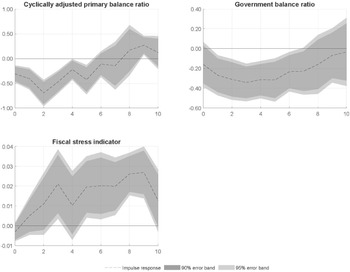
Next, we analyze how fiscal policy in euro area periphery countries reacts to changes in banks’ demand for domestic sovereign debt in response to a tightening of macroprudential capital regulation. To this end, we compute impulse responses of important variables related to fiscal policy to a restrictive capital-based macroprudential policy intervention. Specifically, we are interested in the effect on the primary balance ratio (ie, the difference between government’s revenue (what it is earning) and its non-interest expenditure), the government balance ratio (ie, the balance of government revenue and expenditure), and the fiscal distress, measured by a fiscal stress indicator. Figure 2 documents the results.
Periphery impulse responses to a restrictive capital regulation innovation.
Notes: The figure shows impulse responses to a restrictive capital-based macroprudential policy intervention. The dashed lines denote the estimated impulse responses. The shaded areas reflect the 90% error bands and 95% error bands, respectively. The reactions of the fiscal policy variables are measured in percentage points. The reaction of the fiscal stress indicator is measured in percent. A positive value of the cyclically adjusted primary balance ratio and the government balance ratio denotes an improvement, while a negative value reflects a deterioration.

Figure 2 Long description
The image contains three line graphs showing impulse responses to restrictive capital regulation innovations. The top left graph displays the cyclically adjusted primary balance ratio, with values ranging from negative one to positive one. The top right graph shows the government balance ratio, with values ranging from negative zero point six to positive zero point four. The bottom graph illustrates the fiscal stress indicator, with values ranging from negative zero point zero one to positive zero point zero four. Each graph includes a dashed line representing the estimated impulse response and shaded areas indicating the ninety percent and ninety-five percent error bands. A positive value in the cyclically adjusted primary balance ratio and government balance ratio indicates an improvement, while a negative value reflects deterioration. The fiscal stress indicator is measured in percent.
The findings show that peripheral governments increase their debt at their own discretion in response to a tightening in capital regulation. The cyclically adjusted primary balance ratio is in deficit after the intervention, reaching a maximum decrease of approximately 0.7 percentage points, which may be associated with the incentive to increase borrowing because of the reduction in the government bond rate (see Figure 1). In addition, the government balance ratio deteriorates at the same time. Thus, the structure of the government budget is realigned toward higher public borrowing in response to a restrictive capital-related macroprudential policy innovation. Finally, the fiscal stress indicator rises after the shock, suggesting that sovereign risk increases with higher debt.
The political economy of this chain of effects suggests that euro area peripheral governments have an incentive to tweak capital regulation to favour their own fiscal space. This exacerbates the time inconsistency problem that fiscal rules intend to address. Fiscal rules intend to prevent governments from short-term borrowing because governments tend to ignore the long-term negative effects of overspending. However, capital regulation may be an instrument in the hands of governments that is particularly powerful when governments control or are identical to regulators in order to offset the desired effect of fiscal rules.
IV. Reviewing the legal governance of zero weights
Our empirical analysis sought to elucidate the spillover channel from banking regulation to fiscal conduct and the conflict it engenders with fiscal rules. While it is well established that undercapitalised banks have an incentive to effectively undertake regulatory capital arbitrage or gamble for resurrection by shifting their investment towards higher yielding but zero risk-weighted assets,Footnote 42 our empirical section demonstrated that this gambling encourages government spending at inefficient high levels. This is so because credit extensions to the government may become more attractive because of the zero-risk weight, which ultimately engenders a deterioration of the cyclically adjusted primary balance and an increase in fiscal stress as highlighted by the European debt crisis.Footnote 43 Just as peripheral euro area banks gambled by fortifying the bank-sovereign nexus through buying excessively domestic sovereign bonds, the peripheral countries’ governments continued the gamble by taking advantage of a restrictive shock to capital regulation by increasing borrowing.
Tying our empirical results back to the legal governance, we can draw several conclusions on why the regulatory or fiscal governance has an adverse interaction between regulation and fiscal stance. First, our empirical evidence highlights that zero weighting is at odds with the idea of market pressure on sovereigns as enshrined as foundational principle of constitutional no-bailout clauses. While the primary concern of lawyers has been that the market-undermining effect of budgetary pressure would be caused by inter-state practices such as the expectation within the euro area to be bailed out by other EU members,Footnote 44 the novelty here is that this relief of market pressure can be generated through regulatory privileged access by governments to financial institutions. In that regard, the study adds to existing literature strands that hitherto have not integrated the sovereign-bank nexus into the public finance analysis. It expands the limited research devoted to exploring the linkages among private banking sectors and the public finances of sovereign governmentsFootnote 45, by elucidating market-based reactions to macroprudential interventions and their impact on public finance. It also offers new insight to the sovereign-nexus literature which has focused on feedback effects between financial institutions and sovereigns with contagion channels working from crisis-struck banks to solvency of sovereigns.Footnote 46 Our interest in the nexus works in a different direction: from regulation to inducing financial institutions to engage in sovereign bond purchases. Finally, our contribution has contributed to the literature exploring the Basel III regulatory framework to mitigate financial instability by widening the angle to assess the effect on fiscal stability.Footnote 47
By not requiring core capital for holding sub-national government bonds, market pressure is lifted and budgetary discipline reduced. This is so because banks are induced by this regulatory treatment to buy sub-national state bonds irrespective of the solvency of the state. Unlike the EU, the US incorporates the logic of its constitutional no-bailout clause at least to some extent into the macroprudential treatment by requiring a 20 % risk weight for obligations of US states, while the EU implements a zero-risk weight.Footnote 48 The zero-risk treatment would be sensible if these bonds were risk free, something that seems to have underpinned the intention of the drafters of EU zero-risk regulations. Indeed, the EU legislator opined that “public debt paper is usually relatively liquid and the government is, in principle, a good debtor because of its prerogative to raise taxes, so that it is justified to make sure that financial institutions observe certain prudential measures leading to the holding of public debt paper.”Footnote 49 The law-makers reasoning thus builds on the assumption that government bonds are risk free, which is – from both a theoretical and empirical perspectiveFootnote 50 – not plausible in the context of currency areas such as the US or the euro area, when the debtor government (US states or EU Member States) has no power to create and print money to serve its debt, but where this authority lies with the federal or supranational level.Footnote 51 When monetary and fiscal authorities are separate entities, default risk on sovereign debt is not zero.Footnote 52 Our analysis showed that this is a concern for fiscally distressed countries, like the euro area periphery. The zero-risk weight exacerbates the risk of fiscal instability and ultimately the risk of bailout, as pressure to bail out EU Member States increases considerably if a state default causes a European banking crisis. As long as the zero-risk weight privilege and thus the sovereign-bank nexus exists, the credibility of the no bailout clause is reduced.Footnote 53
One might argue that prudential regulation should trump fiscal rules. Indeed, while EU law reinforces the no-bailout principle by not allowing financial institutions to give EU members the kind of fiscal release that is forbidden under the no-bailout clause (Article 124 TFEU), this provision allows an explicit exception to the prohibition – the law provides that “prudential considerations” can apply and make preferential treatment necessary for financial stability reasons. On that basis, one might argue that financial stability concerns vested in macroprudential regulations should have primary concerns over budgetary effects. “Prudential considerations” are considered measures designed to promote the soundness of financial institutions to strengthen the stability of the entire financial system and the protection of the customers of those institutions.Footnote 54 Indeed, macroprudential policy aims to strengthen financial stability, particularly through capital-based instruments.Footnote 55 However, there is an abundant empirical evidence that puts in question that zero-risk weight privilege stabilises financial stability. Banks in the periphery increase their exposure to domestic government debt in response to tighter capital-based regulatory measures, making them more vulnerable to sovereign risk,Footnote 56 and at the same time lower the costs for government debt. Losses the banks suffer from the write-off of sovereign debt because of a deterioration in the sovereign’s creditworthiness weakens their capital position. Consequently, banks become undercapitalised if they fail to build a sufficient capital buffer.Footnote 57 As a result, what would be permissible under law, can hardly be argued from an economic perspective.
This finding informs the existing financial law literature to the extent that it requires financial law to adopt a more integrated understanding of the rules governing banking regulation and public finances.Footnote 58 With the empirical interaction of bank and state solvency risks, financial law should take account of its impact on the effectiveness of fiscal rules. In fact, our finding goes against what has been financial regulation advice: namely that adequate fiscal space is a prerequisite for financial stability, even when a debt crisis does not originate from public sector borrowing. Fiscal space dampens the vicious circle that propagates any adverse event that hits the banking sector, making financial crises less likely.Footnote 59 Yet, prudential regulation that induces governments’ inclination for fiscal spending goes against this insight and risks to further doom loops. Our analysis thus offers an additional reason for eliminating the zero-risk approach of sovereign bonds. It is not only important in order to curtail channels of contagion from fiscal insolvency to the banking sector, but it is just as important for not inducing a negative contagion to invite government overspending (which ultimately could engender fiscal instability and sovereign insolvency risks).
V. Conclusion
Banking regulation drew the attention of economic scholarship in particular from the perspective of financial stability and economic growth, a literature that found its legal corollary in contributions focusing on the regulatory framework and on how to organise effective supervision of financial institutions.Footnote 60 Less attention has been paid to the unintended side effects of banking regulation and sovereigns’ fiscal conduct, in particular the interaction of prudential regulation with constitutional fiscal rules. We hypothesise that banking regulation conflicts with constitutional rules to the extent that regulatory privileged treatment of sovereign bonds held by banks invites governments to be fiscally less prudent than they should. If fiscal rules cannot contain this effect, the result is overborrowing. This is particularly relevant with regard to the regulatory treatment of bonds of sub-federal entities in currency unions, as currency areas stipulate no-bailout regimes, establishing the primacy of market pressure on sovereign bonds.
Our empirical results suggest that treating two legal areas – prudential regulation and fiscal rules – in isolation of each other neglects the interdependence of these rules. Banking regulation implementing zero-risk weight for sub-federal levels ignore possible solvency risks. Put differently, (banking) regulation has the potential to undermine (constitutional) fiscal rules. In case of zero-weight bonds, banking regulation invites domestic banks to increase their holdings of government shares. The ensuing government overborrowing is particularly pronounced for countries in fiscally difficult situation, notably the euro periphery countries in the aftermath of the global financial crisis. Legal analysis should not look at these effects in isolation from each other: prudential regulation should be determined in view of its effects on governments fiscal space determined by fiscal rules, and vice versa.
With regard to adapting banking regulation, the integration of the interaction with fiscal rules suggests some policy implications: A first is to remove the zero-weight privilege. Removing the privilege is not only imperative in view of the well-established repercussions of the privilege of sovereigns in macroprudential regulation on financial stability and economic activity.Footnote 61 It is also necessary to avoid negative spillovers on fiscal conduct and to avoid undermining national fiscal rules. However, in the EU sovereign risk on bank balance sheets has still not been tackled, in contrast to other risk mitigation measures introduced by the Banking Union.Footnote 62 The zero-risk weight remains the “elephant in the room.”Footnote 63 The pandemic with its surge in public debt has further highlighted the need for reform.Footnote 64 A solution would be a big leap forward but would require supervisors and politicians to introduce inconvenient restrictions on self-serving prudential regulation.
A second recommendation is to strengthen fiscal space and constitutional no-bailout clauses to avoid governments to gamble by taking advantage of cheap borrowing that does not reflect fiscal sustainability risks. Possible measures include fiscal buffers integrated into fiscal rules that would leave sufficient fiscal space to absorb a banking crisis or amendment of tax systems that typically favour debt over equity.Footnote 65
Finally, we can infer political economy implications regarding the fact that both the banking regulator and the fiscal decision-maker could be government representatives. If the regulator is also the borrower, or if political decision-makers are in a position to exercise influence over lenders to reallocate credit in their interest, there is a malincentive to remove the access to cheap money and to retain the zero-weight privilege.Footnote 66 Political pressures may limit the ability of regulators to “lean against the wind” suggesting that political pressures may inhibit regulators’ ability to implement prudential policies.Footnote 67 This offers a rationale to separate banking regulatory and fiscal rulemaker in order to avoid their incentives to align towards using prudential regulation to ease constraints on government expenditure.
Supplementary material
For supplementary material accompanying this paper visit https://doi.org/10.1017/err.2025.10041
Financial support
This research is supported by a grant of the French National Research Agency (ANR), “Investissements d’Avenir” (LabEx Ecodec/ANR-11-LABX-0047).



 Open access

