


“Thus for the first time since his creation man will be faced with his real, his permanent problem – how to use his freedom from pressing economic cares, how to occupy the leisure, which science and compound interest will have won for him, to live wisely and agreeably and well.” (Keynes, Reference Keynes1930, p. 367)
In 1930, economist John Maynard Keynes wrote that the economic problem of humanity, or the perennial “struggle for subsistence” that had been endemic to every century of human striving, “may be solved, or be at least within sight of solution, within a hundred years” (p. 366). In his essay, “Economic Possibilities for our Grandchildren,” Keynes opined that the accumulation of capital, gains in efficiency and productivity, and a far higher standard of living would mean the end of the “economic problem.” Such advances would result in dramatically less work needing to be performed: “three-hour shifts or a fifteen-hour week.” Highlighting the significance of this transformation, Keynes described it as “the greatest change which has ever occurred in the material environment of life for human beings in the aggregate” (p. 372).
Not needing to spend so much time working would present a fundamentally different problem though. Deprived of our “traditional purpose,” we would be faced with the dual challenges of deciding how to spend our time and find meaning in our daily lives without engaging in traditional forms of working. Such challenges would be “a fearful problem for the ordinary person” and thus require gradual adjustment, Keynes suggested. “For many ages to come the old Adam will be so strong in us that everybody will need to do some work if he is to be contented” (pp. 368–369). Eventually, though, we would transition to “cultivate into a fuller perfection”; thus, Keynes recommended that the contemporaneous readers of his essay prepare for the time when such “abundance” would come.
Now, nearly 100 years after Keynes wrote this well-known essay, we can evaluate the accuracy of his predictions. In doing so, we see that Keynes was right about much—at least for high-income countries (i.e., “the Global North”), which are the focus of this article. Economists have described Keynes’ prediction about change in per capita income in such countries as “eerily accurate” (Ohanian, Reference Ohanian2008), and he also was correct that technological advances over the coming century would result in efficiencies reshaping entire industries (e.g., food production, agriculture). Additionally, gains in “material things—like transport and housing, and the like”—have been more dramatic than he perhaps could have imagined. In many wealthy countries, one can visit a remarkably inexpensive “all-you-can-eat restaurant”; almost every household has a television, computer, and cellphone; and access to washing machines and dishwashers is widespread (e.g., Pew Research Center, 2019).
And yet, in other ways, Keynes’ predictions have proven incorrect. Of interest here are his forecasts about how little future generations would be working and the resultant problem of how to spend our leisure time. Although it is true that working hours in developed countries have decreased in the past 100 years,Footnote 1 full-time work is still the societal norm, and full-time workers in high-income countries still generally work 35–42 hours per week on average (Bick et al., Reference Bick, Fuchs-Schündeln and Lagakos2018)—more than double what Keynes projected. Moreover, this decline in work hours was most pronounced in the earlier- and mid-20th century and has plateaued in recent decades, despite continuing, even accelerating, technological development (Lukács & Antal, Reference Lukács and Antal2022). Also, gains in income, education, and productivity sometimes have paradoxically translated into increased, not decreased, work hours (Bick et al., Reference Bick, Fuchs-Schündeln and Lagakos2018). All in all, the “abundance” of leisure time that Keynes foresaw seemingly has not manifested. In some cases, in fact, the contrary seems to be true. Over 80% of Americans report “never having enough time,” and, in some cases, people earning more, not less, money report being especially “time poor” (Whillans et al., Reference Whillans, Weidman and Dunn2016). Many employees report time-based conflicts between work and nonwork life domains, such as family (Allen & French, Reference Allen and French2023). Thus, Keynes’ formulation seems to be wrong in fundamental ways.
In this focal article, we address the question of why Keynes’ prediction about work time has not yet been realized—at least not fully. From an industrial-organizational (I-O) psychology perspective, we explore various reasons why full-time workers in developed countries continue to work 35 or more hours a week. But we also go beyond this question, using it as a window to explore other fundamental topics regarding work. These include societal norms and power structures, the psychology of working, and psychological needs and motives more generally.
Addressing Keynes’ prediction that gains in technology would allow individuals to choose to work fewer hours and the reasons for its failure to fully materialize seem timely. Not only are we nearing a century since his essay, but several recent occurrences and phenomena suggest changes in our relationships with work. Perhaps chief among them is the dramatic rise of automation and its implications for work (see Autor, Reference Autor2015; but see Wajcman, Reference Wajcman2017). As others have noted (Braverman, Reference Braverman1974), there is a seeming contradiction, if not irony, when this “automation anxiety” about machines replacing human workers is juxtaposed with Keynes’ prediction that technology will free people from work. In a related vein, Graeber (Reference Graeber2018) argued that many present-day jobs exist simply so that people have jobs; the work itself is unnecessary and meaningless at best; in many cases, it is psychologically and socially harmful. And there are those who—far from being anxious about humans losing jobs to technology—look forward to it and envision “fully automated luxury Communism” (Bastani, Reference Bastani2019).
In any case, much continues to change in where and how work is done. The COVID-19 pandemic has resulted in an increase in remote work (Parker et al., Reference Parker, Horowitz and Minkin2022), and terms such as “the Great Resignation,” “quiet quitting,” and Tang Ping (“lie flat”) suggest a global societal rethinking of the meaning of work could be afoot. These perspectives perhaps reflect a desire for greater autonomy and humanization at work than work’s outright abolition (as suggested by the “antiwork” movement; Alliger, Reference Alliger2022) or perhaps the existence of a mismatch between the jobs that are available and the jobs that people want. Regardless of the magnitude of these phenomena or their ultimate longevity, their mere existence suggests a heightened consciousness about work’s role in one’s life and in society. Similarly, recent policy discussions about a 4-day workweek, along with positive pilot results (e.g., Lewis et al., Reference Lewis, Stronge, Kellam and Kikuchi2023), and the provision of an unconditional basic income (Hüffmeier & Zacher, Reference Hüffmeier and Zacher2021) imply a greater consideration about the relationships among work, time, and money. In sum, the present time seems apt for exploring modern-day implications vis-à-vis this prediction.
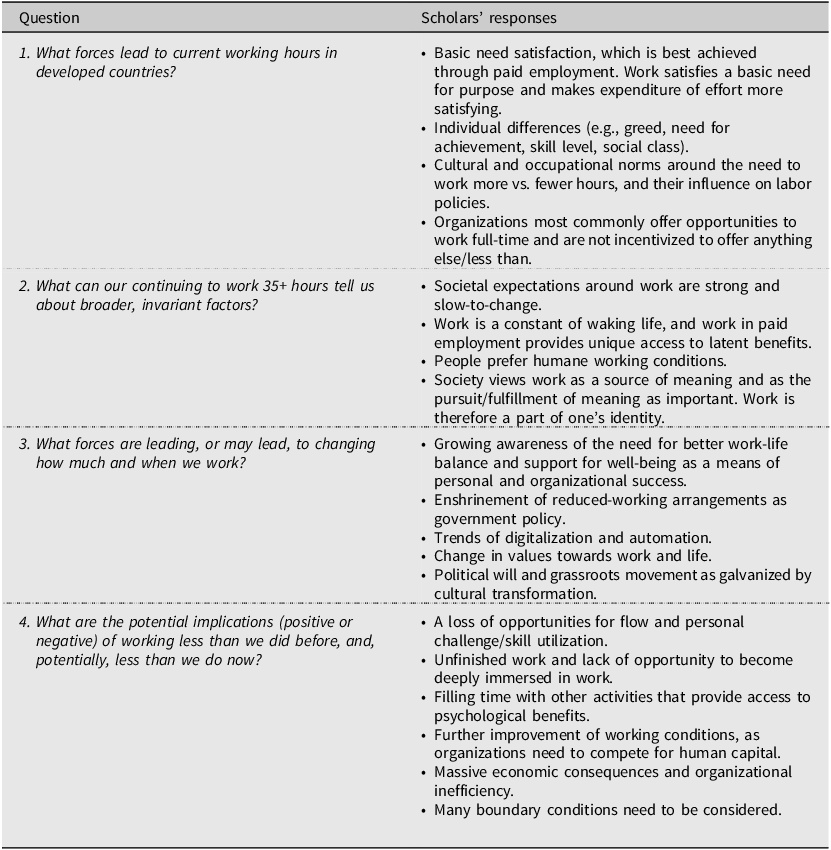
In the remainder of this focal article, we first provide a brief historical account of Keynes’ prediction. We note that this is not meant to be a detailed historical account. Rather, we use the prediction as a springboard to discuss other, related issues about the place of work in modern-day society in developed countries. Next, we pose four questions associated with Keynes’ prediction and its failure to come to full fruition. Four scholars in organizational psychology or related fields (e.g., organizational behavior) provide responses to each question. We conclude the paper by summarizing themes in the responses across the four questions and then proposing specific ideas for future organizational research. Table 1 lists the four questions addressed and provides a summary of the main points the scholars raised in their responses.
Summary of Scholars’ Responses to the Four Questions Related to Keynes’ Predictions

Before proceeding with the substance of this focal article, we emphasize at the outset that our discussion represents a tiny fraction of the perspectives that could be brought to bear in this discussion. Our goal here certainly is not to provide a comprehensive account of why individuals in developed countries work 35+ hours per week. Scholars in other fields also have addressed this seeming paradox (e.g., see Cowen, Reference Cowen2017 for a more economics-based perspective). We doubt that a book or even several books could provide a complete treatment. Rather, our objective here is to adopt and offer a certain perspective—one informed by I-O Psychology (and related fields) —and to stimulate broader discussion around fundamental questions about the nature of work. These questions include “Why do we work?” “How much should we work?” and “What should work look like?”
A brief overview of Keynes’ predictions
Keynes (Reference Keynes1930) certainly was not the first to portray a “life of leisure.” Indeed, the Bible depicts Adam and Eve enjoying a restful existence in the Garden of Eden before their expulsion, which meant that they had to work to survive. In More (Reference More1516), Sir Thomas More described a utopian society with 6 hour-long workdays. Portending a future where machinery lessens the need for work, Oscar Wilde (Reference Wilde1891) opined, “There is no doubt at all that this is the future of machinery, and just as trees grow while the country gentleman is asleep, so while Humanity will be amusing itself, or enjoying cultivated leisure—which, and not labour, is the aim of man—or making beautiful things, or reading beautiful things, or simply contemplating the world with admiration and delight, machinery will be doing all the necessary and unpleasant work.”
However, Keynes’ predictions stand out. Whereas accounts like More’s were fantastical and Wilde’s wistful, Keynes’ thoughts were grounded in the extraordinary scientific and technological developments occurring in the late 19th and early 20th centuries. During this “Second Industrial Revolution,” the first telephone was patented, the steam turbine was developed, the light bulb became common, the first automobile was patented, and the first major infrastructure for electricity was developed. Furthermore, developments in agricultural technology and processes led to massive increases in output; the same was true with respect to advances in machinery and factory processes (e.g., the Bessemer steel process). Railways to transport these goods also improved significantly, becoming more sophisticated and safer. Collectively, these developments meant that much of (though certainly not all) the population in wealthy countries had access not only to wonderful new technologies but, more importantly, to enough food to eat (see DeLong, Reference DeLong2022, for a thorough discussion).
However, in the early 1900s, Great Britain (where Keynes lived) and much of the rest of the developed world faced a substantial economic downturn (e.g., Frydman et al., Reference Frydman, Hilt and Zhou2015). It was this decline, and the resulting pessimism about future economic prospects, to which Keynes was responding in his essay. He begins the piece by asserting that such negativity is unwarranted, as the current economic circumstances were temporary. They were not a harbinger of a return to the economic times pervading human history to that point (i.e., when obtaining food was the primary challenge). Keynes argues that, in fact, just the opposite is true. In the longer term, humanity would not merely avoid returning to the hunger and despair of the past millennia but instead would enjoy a future of excess and leisure.
Looking forward, he believed continued profound scientific and technological advances would yield lives for future generations (i.e., for “our grandchildren”) unimaginable throughout human history. In practice, this meant that obtaining the necessities of life (food, in particular) would not be the primary problem facing humankind: “the economic problem may be solved, or be at least within sight of solution, within a hundred years. This means that the economic problem is not—if we look into the future—the permanent problem of the human race” (p. 366).
Instead of this economic problem, the main one Keynes foresaw was an excess of leisure time. To the people reading his essay at the time, this notion likely would have seemed bizarre. Keynes acknowledges that his readers will find it, “more and more startling to the imagination the longer you think about it.”
A discussion of Keynes’ predictions
Keynes’ prediction of main interest here is that individuals would be able to work considerably fewer hours. Second, and relatedly, he forecasted that filling that now-liberated time would be the primary challenge. As noted above, the first prediction has manifested to some degree, though not nearly to the extent Keynes estimated. Moreover, most of this change (i.e., decrease in work hours) occurred by 1970; the decline has been considerably less steep since that time, despite innovations in manufacturing, agriculture, and the like (Lukács & Antal, Reference Lukács and Antal2022).
Below, we discuss these predictions. We go beyond Keynes’ predictions though, using them—and their failure to fully materialize—as a springboard for a broader discussion about work. We explore what the fact that we work 35-plus hours a week can tell us about seemingly invariant aspects of both human psychology and power structures, and about what changes in economic and cultural conditions have meant, and yet may mean, for work. For the following section of the article, four scholars were asked to address (up to) four central questions related to Keynes’ predictions. We asked each scholar to respond in writing to as many of the questions as they felt comfortable answering. Thus, the format of the following section could be described as a virtual panel discussion.Footnote 2
Question 1: What forces lead to current working hours in developed countries?
George Alliger
From the point of view of psychology, we probably need to think first in terms of needs common to human beings. As Maslow maintained, the human “is a perpetually wanting animal” (Maslow, Reference Maslow1943, p. 370). And, in particular, people have a drive to meet the most basic needs, such as physiological and safety needs, for example, as identified by Maslow. As long as labor (whether physical, emotional, or cognitive) is the primary means to address those needs, people will work. From a Marxist point of view, capitalism functions as effectively as it does because it takes advantage of this psychology of needs via the dynamics of employment (see also Jahoda, Reference Jahoda1982, for a similar point). French economist Frédéric Lordon (Reference Lordon2014, p. 17) puts it this way: “As the provider of money within the capitalist social structure, the employer holds the key to the basal desire, the desire to survive.”
Now, the question arises whether, in the developed economies we are considering, such a fundamental leveraging of needs is the reason for working many hours per week. For many this is certainly true, as in the case of precarious jobs where it is difficult in fact to meet the basic needs of housing, food, and safety. Holders of other jobs, however, would seem to be working far more than required simply to live. In these latter cases, we need to invoke other psychological motives. A recent study of the individual difference of dispositional greed is relevant in this regard (interestingly, showing it is normally distributed; Zeelenberg & Breugelmans, Reference Zeelenberg and Breugelmans2022). Or there is the idea that those who start working simply tend to stay working—a kind of work inertia (cf. the concept of “job embeddedness”; William Lee et al., Reference William Lee, Burch and Mitchell2014). Too, it is likely that people, without being greedy, define basic needs upward—that is, increase the baseline for what they feel is satisfactory or sufficient—as they achieve some security.
We would be remiss not to add to these reasons for “why we work more than needed” some well-known and generally positive traits, such as the need for achievement (McClelland et al., Reference McClelland, Atkinson, Clark and Lowell1976) and other intrinsic motivations. And there is the natural desire to use those skills and knowledge into which we have invested time, effort, and money to obtain.
Timothy Ballard
In some ways, we are wired to work. The concept of the effort paradox (Inzlicht et al., Reference Inzlicht, Shenhav and Olivola2018) highlights that effort, despite typically involving some form of physical or mental exertion, is rewarding. In many cases, we are more satisfied with the product of our work when we put in more effort to achieve it (Hernandez Lallement et al., Reference Hernandez Lallement, Kuss, Trautner, Weber, Falk and Fliessbach2014). There is evidence to suggest that money earned through effort is valued more than money won or otherwise obtained without effort (Arkes et al., Reference Arkes, Joyner, Pezzo, Nash, Siegel-Jacobs and Stone1994). At a neurobiological level, dopamine plays an important role in this process (Mohebi et al., Reference Mohebi, Pettibone, Hamid, Wong, Vinson, Patriarchi, Tian, Kennedy and Berke2019). It is released when we expect or receive rewards and motivates us to put in effort and pursue goals that are likely to be rewarding. In essence, we are wired to do things that are effortful.
Work can help satisfy a very basic drive for purpose and achievement. But it also has other benefits. At a higher level, it often offers a sense of social connection, gives us a sense of meaning, and provides structure to our lives. It is important to note, however, that these benefits are not exclusive to paid employment. Unpaid work, volunteer work, hobbies, and social and family roles can also provide these outcomes. So, while we may be wired for work, there is no immediately obvious reason this work must take the form of a traditional paid job.
Why then do we often see full-time paid work as the norm? To answer this, we must consider the broader forces shaping the societal role of work. Even when societies do not need everyone to work full-time to fulfill essential needs, cultural norms often come into play. Work is highly valued as a virtue in many cultures, with long hours frequently equated with discipline and commitment. The high regard for industriousness may stem from religious influences (e.g., the “Protestant work ethic”) or because it is seen as a precursor to economic success. Moreover, professional roles often intertwine with personal identity and social status, potentially leading to a stigma associated with working fewer hours. This is evident in pervasive “ideal worker” norms that employees are expected to prioritize work above all else. For example, a junior investment banker might be expected to work upwards of 80 hours a week, with those clocking fewer hours sometimes perceived as less committed. Similarly, a medical resident’s willingness to work extended shifts can be viewed as a testament to their dedication and resilience, even if it comes at the expense of personal health and well-being. Structural factors, such as the limited availability of part-time roles, further entrench the norm of full-time work. Despite technological advancements facilitating remote and flexible work arrangements, traditional working hours and physical presence remain a requirement in many industries and roles. This is particularly true for high-status jobs, where significant demands, expectations, and the pressure to always be “on” contribute to the perpetuation of the full-time workweek.
Hannes Zacher
Work contracts with approximately 36–40 hours per week are still the norm in many developed countries, although this norm is increasingly questioned (e.g., discussion about 4-day workweek, antiwork movement). This suggests that there are still “enough” work tasks available in organizations that can or have to be completed during that time by full-time employees (although it can be debated whether these tasks are really important for the organization or society or not; Graeber, Reference Graeber2018). From an economic perspective, full-time work currently seems to be the most effective and efficient way to organize the completion of tasks, otherwise companies would likely not issue such contracts (indeed, the number of actual work hours is often higher than the number of contractual hours). At the same time, part-time employment (especially among women; Landivar, Reference Landivar2015) is on the rise, and many employees would like to work fewer hours, even if that meant reduced pay. However, most companies will only support a significant reduction of work hours if it helps them to reduce costs or retain valued employees (i.e., flexibility that benefits employers but not necessarily employees).
There also is a growing divide in many developed countries between more and less skilled employees. There seems to be plenty of work to do for employees who are highly skilled, and many of these employees find meaning in their work and thus often do not mind work weeks of 40 hours or more. In contrast, mostly due to automatization, lower skilled workers increasingly work in precarious service jobs rather than in production, struggle to find work, or remain unemployed for longer than 1 or 2 years. Research on the lottery question, which asks people whether and how they would continue working if it was not financially necessary for them (Morse & Weiss, Reference Morse and Weiss1955; Paulsen, Reference Paulsen2008), suggests that many workers in precarious jobs would probably stop working or work fewer hours if they were not dependent on the income.
Blake Allan
As my colleagues pointed out, there are many reasons why people continue to work 40 hours per week, and the answer is different for different populations. For example, people with higher social class are more likely to use work as a means of obtaining satisfaction, self-actualization, and self-expression, whereas people with lower social class often have less choice in employment and therefore primarily use work to support themselves and their families (Allan et al., Reference Allan, Joy, Murphy and Walsh2023). Similarly, people with lower social class can have divergent experiences—on the one hand, they can want more hours than they are currently working because they are not earning enough part time (underemployment); however, on the other hand, they can be working more hours than they want because they have two or three low-wage jobs (overwork; Allan et al., Reference Allan, Duffy and Blustein2016). Regardless, for people without freedom and choice in the labor market, working hours are not so much a choice as a necessity that follows from public policy.
To explain further, I will narrow this section’s question: As the richest country in the world, why do workers in United States (1791 hours/year) work 100 hours more per year than workers in Canada (1685 hours/year) and over 400 hours more than workers in Germany (1349 hours per year; OECD, 2023)? This likely is a direct result of policy decisions in the United States, which flow out of a cultural environment of hyperindividualism, neoliberalism, and a focus on economic growth and competition as well as decades of anti-union policies, such as right to work laws, which have hampered union power and collective bargaining rights.
Specifically, there are several notable policies that lead workers to work more hours per year. First, minimum wage laws have stagnated since the 1970s, with the real adjusted minimum wage declining since then, which means people often have to work second or third jobs to meet their survival needs. Second, the United States is the only OECD country with no mandated minimum level of annual leave or paid sick days; it has no federally mandated paid family leave, and (unpaid) federal leave does not apply to companies with less than 50 workers (e.g., Sawhill & Guyot, Reference Sawhill and Guyot2020). Likewise, the United States has shorter vacations and fewer public holidays than comparable nations, and close to 25% of all US workers have no paid time off (Maye, Reference Maye2019). Other examples are unemployment insurance, which is much shorter compared to countries like Germany (∼6 months versus 1–2 years), and health insurance, which is connected to employment and locks people into jobs. Together, these and other policies force low-wage and precarious workers to work more hours to put food on the table and to pay rent and bills.
Question 2: What can our continuing to work 35+ hours tell us about broader, invariant factors?
Alliger
Societal norms do not change overnight, and the expectation that work is normal and good remains quite strong; the Protestant work ethic seems to be a hardy one. Negative views of unemployment are the obverse of the work-is-good norm and are also widespread, as the psychological sufferings caused by unemployment attest. That recently unemployed people lose a kind of status (Jahoda, Reference Jahoda1982) associated with work seems to be a dynamic that is not going to go away soon. Even gaps in one’s otherwise work-filled resume can raise the eyebrows of prospective employers.
And, as per Keynes, our work has already begun to be greatly reduced by technology. Is it possible that, in our dedication to the work ethic, we are threatened by this future? The metaphors we use to understand ourselves at work (human computers, motors; Rabinbach, Reference Rabinbach1992) suggest that we are hoping at some level to turn ourselves into machines that can compete with real machines.
For Keynes’ vision to come to pass, such societal expectations, pressures, and insecurities will need to change. I imagine that this can only happen over generations, as each successive generation’s shared reality changes. This may be why Keynes’ estimated 100 years until the 15-hour work week, because that would allow the passage of three or four generations. We are seeing “green shoots” in this regard, as in the 4-day work week pilot tests currently underway (e.g., Lewis et al., Reference Lewis, Stronge, Kellam and Kikuchi2023).
Zacher
It is important to define what we mean by “work”—work does not only take place in the context of paid employment. In a broader sense, work also refers to many other goal-directed activities in life (Zacher & Frese, Reference Zacher, Frese, Ones, Anderson, Viswesvaran and Sinangil2018). It is our human nature to set and pursue meaningful goals, and we do not only do that during those 35+ hours in the workplace but also during our awake time in the morning, during breaks, in the evening, and on the weekend. Caring for young children or frail relatives, volunteering or activism, and leisure time pursuits, such as gardening or training one’s daughter’s soccer team, are also forms of work; however, they typically are not paid work. Thus, in a broader sense, humans are working most of their awake time; some of that is paid work.
According to Jahoda (Reference Jahoda1982), work that is part of paid employment is one of the few life domains that reliably allows people to experience the “latent functions” of work (as opposed to the “manifest function” of pay), including time structure, social contact, collective purpose, status, and activity (see Aitken et al., Reference Aitken, Cannon, Kaplan and Kim2023). Experiencing these latent functions is linked to better health and higher well-being, and, therefore, a majority of people (approximately 70%) indicate consistently over decades that they would want to continue to work even if there was no economic necessity for it (see research on the “lottery question;” Highhouse et al., Reference Highhouse, Zickar and Yankelevich2010). However, research also shows that approximately half of those who want to work would prefer to do so under different conditions, such as somewhat fewer work hours or better job characteristics (Paulsen, Reference Paulsen2008). Overall, this research suggests that people want to work, but the work has to be humane: executable, not harmful, not straining, and supportive of personal development (Hacker, Reference Hacker2003).
Allan
As noted by my colleagues, people have a fundamental need to accomplish meaningful goal-directed activities and meet other higher order psychological needs. Building off work by Jahoda (Reference Jahoda1982), studies based on vocational theories like psychology of working theory have demonstrated that work meets a host of interpersonal, meaning-making, and self-determination needs, which would facilitate the desire to work (Blustein, Reference Blustein2013).
However, market employment has not always been a major source of psychological need fulfillment. Rather, the modern Western idea that work is honorable forms a central part of identity and should ideally be meaningful and enjoyable derives from the protestant reformation in the 14th and 15th centuries (Donkin, Reference Donkin2010). During this period, Martin Luther argued that work was not limited to survival and absolution but could be a calling that serves sacred purposes on earth (Donkin, Reference Donkin2010). These ideas became an integral part of modern Western society (particularly in the United States), but as society became more secular, people increasingly turned to their work or organizations as a source of meaning (Ashforth & Vaidyanath, Reference Ashforth and Vaidyanath2002). Likewise, moving into postindustrialism, societies further shift away from industrial values of stability and loyalty to values of self-actualization, well-being, and meaningfulness (Inglehart, Reference Inglehart2008). This transition to a postindustrial, digital economy accelerated in the 1980s and included disruptive factors like globalization, neoliberalism, income inequality, and the growth of technology, which created more instability and individual risk in the labor market (Allan et al., Reference Allan, Autin and Wilkins-Yel2021). In this context, workers must be self-directed, adaptable, and meaning driven to be successful, further reinforcing work as a part of identity and life purpose.
Taken together, work in the 21st century exists in a sociohistorical context that places work as a primary way to meet social and psychological needs, which would translate into the desire to work more hours. In short, if society had a goal to work fewer hours, this would require a complete cultural transformation and a reconstruction of how people meet higher order needs.
Question 3: What forces are leading, or may lead, to changing how much and when we work?
Ballard
Our future norms regarding working hours are being shaped by forces operating on multiple levels. At the individual level, change is emerging from the ground up. There is a growing awareness of the need for better work-life balance, driven in part by the COVID-19 pandemic and resultant shifts in working patterns. Increasingly, individuals are expressing a preference for reduced working hours, seeking out jobs that offer such arrangements, or negotiating shorter working weeks with current employers. In a push for larger systemic change, many are also advocating for policy reforms for shorter working hours at the governmental level.
Organizational dynamics are also playing a significant role in this shift. Many companies are recognizing the benefits of promoting work arrangements that prioritize employee well-being (Tay et al., Reference Tay, Batz-Barbarich, Yang and Wiese2023). Among these is the results-only work environment (ROWE) approach, where employees are evaluated based on outcomes rather than hours spent at work. By adopting strategies like ROWE or shorter workweeks, companies aim to improve their employees’ mental health, giving employees autonomy to decide how they spend their time and ensuring they have sufficient time for rest and recovery. In many cases, shorter working weeks come at no cost to productivity. In the UK, a recent 6-month trial of the 4-day work week involving 61 companies showed no change in revenue during the trial, and 92% of these businesses planning to continue with a 4-day work week following the trial (Lewis et al., Reference Lewis, Stronge, Kellam and Kikuchi2023). Campbell (Reference Campbell2023) reviewed scientific studies of the 4-day work week and found that most studies reported favorable outcomes beyond productivity alone, such as increased job satisfaction and morale. Ultimately, however, the success of the 4-day work week rests on whether employees can adapt their working routines and whether such adaptations ensure the continued profitability of the organization (Moen & Chu, Reference Moen and Chu2023). Additionally, many organizations see the potential benefits for recruitment and retention. A company that supports its employees in maintaining a healthy work-life balance is attractive to applicants. Eventually, we may reach a tipping point where offering such arrangements becomes a business necessity.
Last, policymakers also have an important role to play in encouraging healthier work practices. For example, as of late 2022, Belgian employees can opt in to perform their full work week in 4 days as opposed to 5 (Jongh, Reference Jongh2023). Other countries, including Sweden, Spain, and Iceland have experimented with reduced work-hour policies. In Australia, the government is tackling broader contributing factors to work-related stress and burnout. New legislation mandates employers to proactively manage the risk of psychosocial work hazards, including excessive working hours. Taken together, these initiatives suggest that we may be moving toward a collective reevaluation of the norms around working hours.
Zacher
Keynes’ prediction may become reality, but it may take longer than he thought. For instance, due to increased automatization and efficiency in production, Germany introduced the 5-day workweek in the 1950s, which was beneficial for worker well-being, work–family balance, and productivity (Hobner, Reference Hobner1961). Economic downturns and restructuring of companies may lead to involuntary reductions in work hours in the future. For example, the German car manufacturer Volkswagen introduced the 4-day workweek in 1993 (until 2006) to avoid layoffs. With accelerating digitalization, automatization, and algorithmization, there may be less work available even for highly skilled employees over the next decades. Although the number of work hours of full-time employees has remained remarkably stable over the past 30 years, people’s work values and priorities in life may change in the future. Surveys in Germany suggest that many employees would like to spend more time with family and have more time for themselves, even if this meant reduced pay. Unions in Germany are increasingly supporting and striking for the idea of a 4-day workweek. Thus, we may see reductions in average weekly hours to around 32 hours within the next decades.
In Germany, there has been a continuous, albeit rather weak, decline in work hours over the past decades among all employees (by 3.7 hours since 1991 to now 38.4 hours per week on average; Statistisches Bundesamt, 2023). Interestingly, however, this trend is mainly influenced by the growing number of part-time employees (from 14% in 1991 to 29% in 2021), who are mostly female. In contrast, work hours of full-time employees have remained at a constant level since 1991 (approximately 41 hours per week). The world of work is changing dramatically, but work contracts of full-time workers have stayed the same. However, in the last few years there has been an increased discussion of policies such as the 4-day workweeks and unconditional basic income among union and company representatives, politicians, and in the media and the public.
Allan
Per my earlier arguments, I believe that a meaningful reduction in working hours would require political will based on a strong grassroots movement, which itself needs to be catalyzed by a cultural transformation. Although the COVID-19 pandemic forced people to reevaluate their work, this is unlikely to last without a sustained change in goals and values. For example, the metrics we use to assess the health of the economy (e.g., Gross Domestic Product, stock market, unemployment rate) do not prioritize worker well-being. One multidimensional metric of the labor market that could serve as a goal is worker flourishing, which includes worker well-being and mental health, the strength of the social safety net, social justice and equity, human rights and dignity, decent work, worker protections and voice, and fulfilling work (Allan, Reference Allan, Blustein and Flores2023). If similar goals were adopted and measured in place of status quo indices, working hours might decline as people could exercise more freedom over how much and when they worked.
Question 4: What are the potential implications (positive or negative) of working less than we did before, and, potentially, less than we do now?
Alliger
The idea of living “wisely and agreeably and well” while working little seems appealing, especially insofar as work always has at least a subtle coercive quality (Alliger, Reference Alliger2022). It is easy to imagine a kind of psychic freedom generated by the cessation of trading one’s time for money, and an experience of a kind of wealth measured in time available rather than in dollars gained. Nonetheless, I would like to suggest three possible negatives arising from working 15 hours a week, or 3 hours a day. These are loss of “flow” opportunities, a paradoxical invasion of work into nonwork time, and—again paradoxically—inefficient use of work time.
First, the experience of flow at work is a pleasurable absorption into challenging tasks in which time itself seems in a sense to disappear (see Csikszentmihalyi et al., Reference Csikszentmihalyi, Khosla, Nakamura, Oades, Steger, Fave and Passmore2017). Flow is not something that one can cause to happen at will. Rather, one can create the conditions where such an experience might occur (e.g., a task that is “in one’s wheelhouse,” that is, interesting and challenging but doable, with few or no interruptions). Keynes (who seems to have been very extraordinary) indeed may have been able to simply sit down and write, entering such a state more or less immediately. In a case like that, a 3-hour workday might seem ideal. However, I believe for ordinary mortals in ordinary jobs, flow states may be less frequent. For those of us in this camp, we may need to work longer than 3 hours to maximize our flow opportunities.
Second, I believe that limiting work to, say, a 3-hour duration could cause some of the same problems that labor work rules can cause a conscientious individual. We have heard of those cases where in a union shop the quitting horn goes off and (by rule) all work activity must cease immediately. This is designed to safeguard workers from working when they are not paid. However, when a laborer is not allowed to finish tightening the bolt that she has started to tighten, will she take into her leisure time the nagging thought of having to finish the task the next morning? Something like this is what Gestalt psychologist Bluma Zeigarnik (Reference Zeigarnik and Ellis1938) proposed in in her article “On Finished and Unfinished Tasks.” Unfinished tasks are, she found, more remembered than finished tasks. Thus, they can follow us into our nonwork life (Syrek et al., Reference Syrek, Weigelt, Peifer and Antoni2017). My thought then, is that a 3-hour workday (at least opposed to a more flexible day where one is of the mind to work as many hours as needed) might be apt to generate such effects.
Finally, I draw from my own experience to discuss what might be termed “project ramp up time.” This is the time that it takes to address initial project concerns and minutiae before full work engagement is possible. That is, it is rarely possible to begin working at full capacity immediately on beginning a task (except possibly for Keynes). So, in this sense a 3-hour day would be extremely inefficient, requiring ramp-up time, in effect, every day, with less actual work getting done than if the days were longer. This ties in with the limitation that such a schedule would presumably impose on flow states, mentioned earlier.
An obvious counter to these points is that 15-hour weeks need not be divided evenly across 5 days, resulting in 3-hour workdays. True. Yet this is what Keynes apparently envisioned (see above). But perhaps, following from my points here, containing those 15 hours to 2 days would be better. Although then 2 days hard at work may feel less like a vacation from work than the more distributed 5-day version. This might be the case if working 8 hours straight for 2 days is more tiring than 5 days of 3-hour work. Too, one’s schedule might feel less flexible, because if I am going to work 8 hours today, I had better get started!
Ballard
How individuals might respond to a reduction in working hours largely depends on why they’re working less. Let us explore two possibilities. The first is a more extreme scenario in which people are compelled to work fewer hours. The second scenario is one where people have the choice to reduce their work hours but can opt to work more if they prefer.
In the first scenario, where we are hypothetically limited to a 15-hour workweek, our relationship with paid work would undoubtedly change. Given the decreased time spent at work, deriving benefits like a sense of purpose, social connection, and structure would be challenging, as I noted above. However, if we accept the premise that paid employment is not the only avenue for fulfilling these needs, this shift might not be so problematic. People actively craft work and leisure activities to pursue optimal functioning (de Bloom et al., Reference De Bloom, Vaziri, Tay and Kujanp€a€a2020). With increased leisure time, people may seek out activities that provide similar benefits outside of paid work, such as volunteering, participating in creative pursuits, or attending social events. This additional free time could provide people more autonomy to do such crafting, choosing how best to fulfill their needs, which may result in those needs being better fulfilled.
In a society where a 15-hour work week is seen as the norm, but more hours can be worked if chosen, we would likely see quite a variety in how people choose to allocate their time. Some individuals might relish the extra free time, prioritizing personal pursuits, hobbies, and social connections outside of work. On the other hand, there would still be those who derive significant satisfaction and fulfillment from their paid work, and these individuals might choose to work more hours. The key factor here is autonomy; the individual gets to decide how to best use their time, and that choice is likely to result in increased satisfaction.
Additionally, there could be an argument made that the overall quality of work might improve in a society that embraces a shorter workweek as the norm. If work becomes more of a choice and less of a necessity, people have greater discretion when selecting their employment. This puts the onus on the employer to provide work that is about more than just the paycheck. It could mean that employers will need to focus more on creating work environments that are engaging, supportive, and appealing to employees, or risk recruitment and retention challenges.
Zacher
If many people decided to work less than 35–40 hours a week (e.g., because they received a basic income, which would allow them to live comfortably without working), this could, in the short term, negatively affect companies and the economy (Hüffmeier & Zacher, Reference Hüffmeier and Zacher2021). An economic downturn and decreased productivity and innovation would also have detrimental consequences for individuals (e.g., reducing standard of living). For many organizations, reductions in work hours could lead to production inefficiencies, difficulties in scheduling, and increased administrative burdens. For instance, this is why Volkswagen, after introducing the 4-day workweek in 1993 to avoid layoffs, returned to the 5-day week in 2006.
At the same time, from a psychological perspective, working less than 40 hours or more per week could also benefit individuals and families. Working long hours is associated with poorer health, including increased likelihood of coronary heart disease (Wong et al., Reference Wong, Chan and Ngan2019). Moreover, working less could lead to improved work–family balance, which is also associated with health (Ng & Feldman, Reference Ng and Feldman2008). Indeed, changing from a 5-day workweek to a 4-day workweek might have similarly positive effects as the switch from the 6-day workweek to the 5-day workweek in the 1950s in Europe (Schmid, Reference Schmid1961). Reductions in work hours could also benefit families and communities because individuals would have more time available for caregiving responsibilities, volunteering, and civic engagement (Hüffmeier & Zacher, Reference Hüffmeier and Zacher2021).
Allan
There are many potential political, sociological, psychological, and economic effects of working less as a population, but a critical question is how this would affect mental health and well-being. Not surprisingly, studies have consistently found that working more hours is associated with poorer health in a dose–response relationship. For example, a recent meta-analysis found that long working hours (> 50 hours/week) were associated with poorer mental health, physiological health, and peripheral health factors (e.g., sleep, energy level) but that this varied by gender, social class, country of origin, and other factors (Wong et al., Reference Wong, Chan and Ngan2019). For example, Denmark, Finland, and Sweden had no significant relationship between long working hours and occupational health, the United States had the strongest relation between these variables among the Western countries examined, and long working hours were only related to peripheral health factors for blue-collar workers. In other words, the effects of number of hours worked depends on many factors, and a key reminder is that many workers need to work more hours to pay their bills. For example, parents of young children often need greater flexibility with when and how much to work, but underemployed temp agency workers often need more hours as well as stability and predictability. Taken together, this is a complex yet understudied area in psychology, and boundary conditions will be critically important for research moving forward.
General discussion
Keynes’ prediction that most people would be working only 15-hour workweeks has largely not been realized. This fact can illuminate much about the nature of work itself, as we have discussed throughout the focal article. Moreover, much has changed in the world of work since 1930—for better and for worse—and much will continue to change, meaning that a version of Keynes’ predicted social reality may emerge in the future. We discussed possible mechanisms that can achieve that reality as well as its possible consequences.
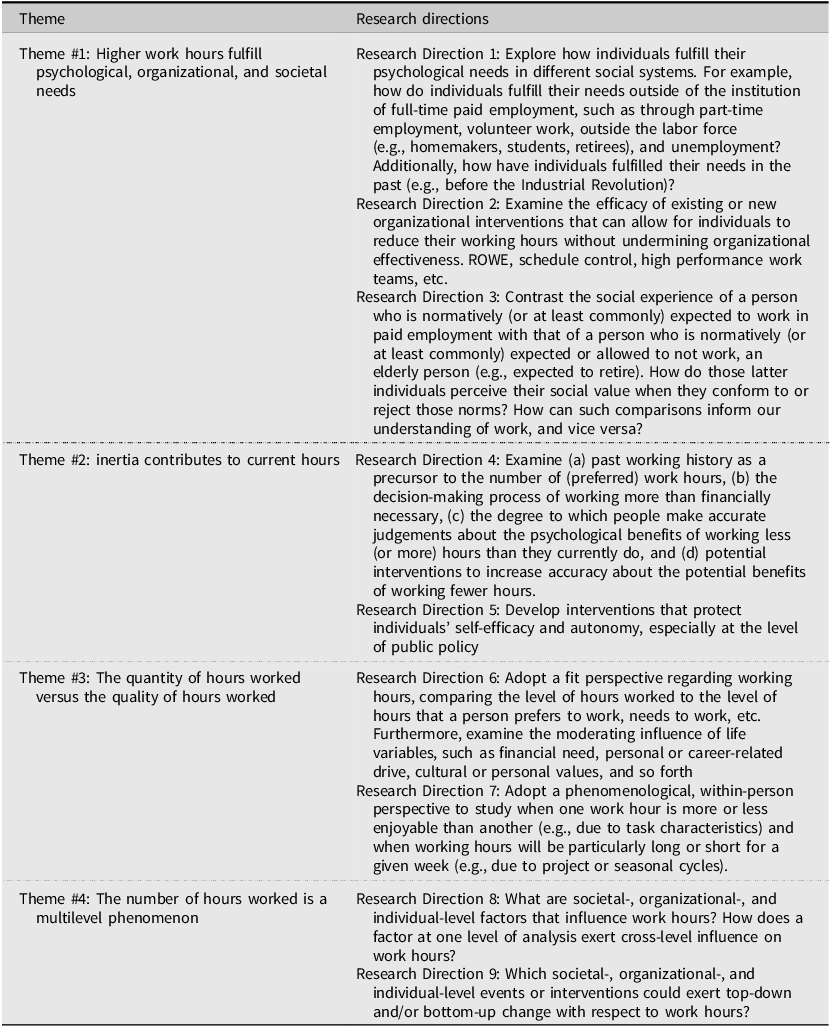
Thus far, our discussion has been focused on (some of) the evidence we have about the current reality of work. But part of our purpose in writing this focal article is to stimulate a larger dialog with future research directions. In this final section of the paper, we discuss the themes that emerged in the responses above and offer future research directions in Table 2. Our goal in offering these directions is to help inform scholarly and policy-related research regarding the role of paid employment for individuals, organizations, and societies. To help structure and guide this discussion, we categorize future research directions according to different themes that emerged in the discussion of the questions above.
Proposed Research Directions

Theme #1: Higher work hours fulfill psychological, organizational, and societal needs
One point that several of the scholars raised is that work fulfills various needs beyond financial or material ones. Several comments described needs that might be subsumed as needs for “purposeful effort,” which are fulfilled by the execution and achievement of tasks. They include the need for achievement (Alliger), the experience of flow (Alliger), a need to be active (Zacher), and a sense of purpose (Ballard), and others mentioned above. Although some other needs mentioned (e.g., social contact) presumably could be met more easily elsewhere, work remains the primary institution through which most of our purposeful task-directed effort occurs (Aitken et al., Reference Aitken, Cannon, Kaplan and Kim2023; Jahoda, Reference Jahoda1982).
This notion that humans are, and need to be, purposeful creators—person as homo faber—has evolutionary and cultural backing (Ihde & Malafouris, Reference Ihde and Malafouris2019).Footnote 3 Humans make things (e.g., ideas, plans, structures) and create their social environments, instead of just adapting to them (Berger & Luckmann, Reference Berger, Luckmann and Luckmann1966). This portrayal corresponds with the implication of the dopamine system in motivation and reward to which Ballard alludes. If we define work in this way—as purposeful effort—people choosing to work more hours is not surprising. Of course, this is not to say that the dominant models of labor and employment are necessary or optimal ones to facilitate such purposeful effort. Our tendency to engage in meaningful task work ostensibly predates the modern organization of work by millennia (Ihde & Malafouris, Reference Ihde and Malafouris2019). But, as Alliger points out, capitalism is a system through which these needs are met. Of note, Keynes recognized these (or similar) needs (in the form of “the old Adam” in us), but he predicted that work no longer would be the means to satisfy those needs. His prediction here seems inaccurate insofar as work hours continue to be much higher than he anticipated. On the other hand, at least one recent study is consistent with Keynes’ view, showing that those working only a few hours a week report life satisfaction and mental health levels comparable to those working 40-hours per week (Kamerāde et al., Reference Kamerāde, Wang, Burchell, Balderson and Coutts2019). As discussed below, there are several factors that likely moderate this finding.
Current work hours also fulfill organizational-level needs. As Ballard and Zacher noted, organizations still mainly employ people in full-time positions. This is partly because having fewer people do more work versus more people each do less work is economical and efficient for organizations (Zacher). People who seek part-time work often have difficulty finding it. Moreover, the part-time jobs that are available disproportionately pay poorly and do not provide the same benefits as full-time jobs (Kalleberg et al., Reference Kalleberg, Reskin and Hudson2000), making them less attractive options even among those who would like to work less. Also, as noted above, the low pay associated with many part-time jobs means that individuals who otherwise would be satisfied working a moderate number of hours (e.g., 15 hours per week) for what full-time workers get paid instead must work multiple part-time jobs to earn the same income. In sum, organizational cost and efficiency considerations mean people generally work more hours unless/until leaders decide that reducing hours and/or staff is financially necessary or beneficial.
Finally, we turn to how working more hours meets societal needs. One particular need that the scholars raised here was that for social status or regard. Although work as a source of status is part of Jahoda’s influential theorizing (e.g., 1982), the notion that working more hours specifically grants one higher status is different. To not work when able to do so implies laziness and sloth (see points above; but also see Cowen, Reference Cowen2017). In contrast, to work long hours denotes self-sufficiency and perseverance, if not even salvation (Zacher). In this way, work largely has become the societal arbiter of value. Insofar as there are evolutionary, economic, and/or cultural forces necessitating the different valuation of people (e.g., to determine allotment of shared resources), work largely both defines and provides the metrics for such valuation. Right or wrong, for better or worse, work is the primary system of valuation and distribution of means. The real and psychological consequences of this valuation system imply that people will continue working many hours.
Theme #2: Inertia contributes to current hours
Another factor mentioned (by Alliger) that likely contributes to current work hours is the idea of inertia; people continue to work the same number of hours they have been working, until some exogenous or opposing force necessitates a change in work hours or schedule. This idea bears some resemblance to the idea of “shocks” in the turnover literature (e.g., Lee et al., Reference Lee, Mitchell, Wise and Fireman1996). Inertia in work hours seemingly could stem from various factors. For instance, one might argue that many people continue working more hours than “necessary” because they do not “know” the pleasures that working considerably less could provide. Put simply, we do “not know what we are missing” by working less. Or perhaps we cannot imagine how free time might be filled. Anecdotes from retirees who wish they had stopped working sooner than they did seem supportive of this idea. This idea also would seem to imply that individuals who have worked fewer hours in the past (e.g., perhaps being in a culture that works less) would choose to work fewer hours going forward. Of course, some individuals do not have such discretion about how much they work. But many people do have discretion in their work hours (e.g., Balderson et al., Reference Balderson, Burchell, Kamerāde, Wang and Coutts2021). How people recognize (or do not recognize) such discretion and how they think about it seems a fruitful avenue for future research, especially given that recent research indicates that individuals underestimate the benefits of more leisure time versus greater income (see Whillans et al, Reference Whillans, Weidman and Dunn2016).
The idea of inertia as a force in maintaining longer work hours also would seem to apply at higher levels of analysis. This is evident in the continued prioritization of work and work’s role in shaping our other daily activities. Owing especially to technological changes in communication (e.g., email, texting), an expectation of “always being available,” and both partners working, work permeates and intrudes upon other life domains and activities (e.g., Kühner et al., Reference Kühner, Rudolph, Derks, Posch and Zacher2023). Although this prioritization of work reflects economic concerns—for the worker and the employer—we do not suspect such concerns are greater now than they were at the times of Keynes’ writing. Rather, for various reasons including, perhaps ironically, technological developments associated with accessibility, external forces compel us to work. Individuals perceive little discretion in the matter but rather work as if on a hamster wheel that they cannot get off (see also research on workaholism; Di Stefano & Gaudiino, Reference Di Stefano and Gaudiino2019).
Theme #3: The quantity of hours worked versus the quality of hours worked
Another theme we felt important to highlight is that the construct of work hours likely means something very different today than when Keynes wrote (at least for many jobs). In the early 20th century, most people worked in agriculture or factories (Wyatt & Hecker, Reference Wyatt and Hecker2006). Today, a small minority of people work in these industries. In the U.S., for instance, less than 2% of all workers are employed in agriculture, and about 8% work in manufacturing (Bureau of Labor Statistics, 2023). In contrast, the percentage of people holding professional jobs and administrative jobs has increased dramatically since the time of Keynes’ writing (Wyatt & Hecker, Reference Wyatt and Hecker2006). For people in these latter positions, work time often is variable, boundaryless, and unpredictable (Schor et al., Reference Schor, Attwood-Charles, Cansoy, Ladegaard and Wengronowitz2020). The number of hours working has not increased in recent decades, but people experience significant strain because they are “always on”; the concept of “being off the clock” looks very different than it once did for many people. Furthermore, workers in knowledge jobs are expected to be thinking about work problems and innovations and to be accessible during nights and weekends (see Giurge & Bohns, Reference Giurge and Bohns2020). In these ways, the total amount of time spent working is both more difficult to measure and also not as useful of a metric as are other indicators of work experience (see Campbell & Van Wanrooy, Reference Campbell and van Wanrooy2013). Similarly, workers in the rising services and healthcare industries likely have very different experiences of given “hours worked” compared to (earlier) farmers and factory workers (and to those currently in professional and administrative roles). Also, research indicates that preferred number (vis-à-vis actual working hours) may be a better predictor of significant outcomes than is work hours (e.g., Angrave & Charlwood, Reference Angrave and Charlwood2015). For these reasons, just looking at the number of work hours obfuscates more psychologically meaningful phenomena.
Another theme apparent in several of the scholars’ responses is the need to consider the issue of work hours separately for different groups. We feel this point is essential because conclusions about work hours “in general” or “on average” often seem to obscure tremendous variability across individuals and groups. Although we should not discount the “main effects” (e.g., that work hours have decreased significantly since Keynes’ writing or that higher work hours predict strain; see Allan’s comment), much of “the story” lies in the moderators.
Following from arguments above, there is likely great variability among different groups in terms of the impact of work hours on other variables (e.g., productivity, well-being). How people spend their time at work varies wildly across jobs—presumably much more so than during Keynes’ time. For example, in some jobs (e.g., healthcare providers, truck drivers, fast food workers), task activity is constant (Giurge & Bohns, Reference Giurge and Bohns2020). In other jobs, there are frequent periods of downtime or idle time, when workers either are not expected to (or cannot) perform any task or are expected to engage in tasks with minimal value to the organization’s goals (e.g., participating in irrelevant meetings; e.g., Lei et al., Reference Lei, Kaplan, Dye and Wong2019). Distinctions like these mean that findings about the nature and importance of work hours miss much of the nuance.
Also, the importance of working more or fewer hours also varies among demographic groups. Allan describes a recent meta-analysis showing that the effect of long working hours on various health outcomes varied across several demographic characteristics (Wong et al., Reference Wong, Chan and Ngan2019). Consistent with this notion, a recent study using several large datasets showed that working fewer hours was associated with lower life satisfaction for men but not for women (Schröder, Reference Schröder2020). The author provides evidence that these effects are not due to income; it is the act of working itself that seems important. Clearly, more research on effects like this one is needed.
Going forward, we call for a much greater focus on the phenomenology of working instead of just the quantification of it. This means not only examining different jobs but also looking within jobs at the day-to-day lived experiences of workers. For example, the phenomenology of busy versus down time, of the within-day patterns encompassing such work episodes, and the predictability of each type of episode recently have become topics of research focus (see Lei et al., Reference Lei, Kaplan, Dye and Wong2019). More of this research is necessary. More generally, we need qualitative (e.g., think aloud) studies about how people feel and behave in situ, as they think about, feel during, and act—these are the minutes of work lives. From this perspective, we must also consider that the number of hours spent working may differ drastically from the actual hours of work (e.g., due to downtime, inefficiency, etc.). Importantly, we see practitioners (e.g., consultants) as playing a leading role in this endeavor. Practitioners can employ diverse methodologies such as using big data techniques to document the “rhythms” of working lives (e.g., by assessing patterns of e-mails, etc.) and using qualitative approaches (e.g., interviews) to understand people’s work as they perform it.
Finally, and following the point above, we emphasize that research on work hours must prioritize why people are working more or fewer hours. Illustrative of this point, the research on how income relates to work hours is complex, with findings varying within and across and countries (Bick et al., Reference Bick, Fuchs-Schündeln and Lagakos2018). In most countries, people who are paid less tend to work more hours. However, in richer countries, this often is not the case (Bick et al., Reference Bick, Fuchs-Schündeln and Lagakos2018). As Allan discusses, this largely is because those with lower SES in richer countries generally lack the opportunity to gain the skills necessary to acquire the types of jobs now available. In contrast, professionals in wealthier countries report working more than they would like (Giurge & Bohns, Reference Giurge and Bohns2020). Yet, even this is finding bears qualification, as some professionals choose to work more than 60 hours a week because of the enjoyment the work brings (Brett & Stroh, Reference Brett and Stroh2003). Findings like this one indicate that although demographic variables certainly can account for some of the variance in work hours, trying to account for work hours is a complex affair, requiring consideration of several levels of analysis. Thus, we conclude the paper with that theme.
Theme #4: The number of hours worked is a multilevel phenomenon
Among the foremost conclusions we drew from the four scholars’ comments is that work hours in paid employment is a multilevel phenomenon influenced by a multitude of factors. These factors cut across many levels of analysis and across various academic disciplines, offering an opportunity for integration. As implied in our review of the comments, these various factors do not exist isolated from one another but rather inform and interact with each other to impact work hours and, more generally, how work functions in societies.
Here, we take a step toward integration, identifying factors and catalyzing events that influence work hours at various levels of analysis in Figure 1. We note, however, that this integration is meant to catalyze discussion as a preliminary framework upon which we hope others will add and revise. We describe this framework in more detail below.
Multilevel Factors and Events That Influence Work Hours.
Note: “Change” arrows depict the possible directions of effects of events depending upon their level in the hierarchy (i.e., on the level at which they have their impact, or at which they originate). Events at the societal level can have top-down effects, events at the organizational level can have top-down and/or bottom-up effects, and events at the individual level can have bottom-up effects.

First, the three most focal levels of analysis regarding work hours seem to be the societal, organizational, and individual levels. At the societal level, there are macrolevel factors that influence the shape of organizational competition and the utilization of human capital in the working world, such as population size and age (James & Wooten, Reference James and Wooten2022), the provision of psychological benefits and monetary benefits outside of paid employment and within other social institutions (Jahoda, Reference Jahoda1982), and the extent to which a society is individualistic versus collectivistic. At the organizational level, organizational culture and human resource systems seem especially relevant, as they will most likely shape formal and informal performance requirements as well as mechanisms for granting autonomy to the worker (e.g., via remote work or flexible work arrangements) and for organizational control (e.g., via electronic performance monitoring). At the individual level, there are many demographic characteristics, individual differences, and needs or preferences that seem likely to influence the number of hours a person is likely to work—perhaps in general but also for any given week.
Second, as should be clear, work hours can be influenced through cross-level impacts. Lower level factors can impact work hours through their impact on higher level factors. For example, individual differences and mentalities toward their work can influence participation in unions or other instances of collective action at higher levels of analysis (Badaan et al., Reference Badaan, Jost, Fernando and Kashima2020). In this regard, although lower level factors may have a relatively limited influence on work hours, individual actions and mindsets (e.g., individual emancipation; Alvesson & Willmott, Reference Alvesson and Willmott1992) can be effective in the aggregate as individuals change organizations and organizations change societal norms. The same, of course, can apply to the influence of higher level factors on work hours through lower level factors. Organizations promoting flexible work arrangements and an employee-oriented performance management systems can influence work hours by changing individual attitudes toward their work, whereas overly restrictive human resource systems can create strong situations that nullify individual influence on work hours.
Beyond the multilevel determinants or factors that can explain why individuals work more or less hours in paid employment, it is also important to consider the occurrence of events and the deployment of interventions at different levels that can exert a top-down or bottom-up influence on work hours over time. We see these as factors that can change work hours in the future, potentially achieving Keynes’ vision even if it is unfulfilled at the current moment.
Event system theory (EST) seems to be a useful framework to organize research directions in this regard. EST defines events as “discrete, discontinuous ‘happenings,’ which diverge from the stable or routine features of the organizational environment” (Morgeson et al., Reference Morgeson, Mitchell and Liu2015, p. 519). Morgeson and colleagues suggested that events can vary in strength (i.e., novelty, disruption, criticality) and can occur at different places in the hierarchy of organizations (i.e., environment, organization, team, individual). Applied to the current discussion, certain events can occur, either due to purposeful intervention or to a confluence of trends, at the societal, organizational, and/or individual level that impact work hours. In Figure 1, we identify a few possible events (or interventions) that may be likely candidates for changing work hours.
At the societal level, echoing Keynes himself, we suggest that changing patterns in industries (perhaps due to climate change especially) and technological innovation seem especially likely to disrupt economies and have major downstream impacts on the working world. At the organizational level, policymakers may draft legislation that enforces certain allowances for workers, such as the provision of a universal basic income, healthcare, or paid leave—all of which may diminish organizational control (e.g., Manza, Reference Manza2023). Indeed, governmental regulation has historically played a pivotal role in improving employment, especially because organizations’ engagement in voluntary self-regulation may be derailed by their opportunism (King & Lenox, Reference King and Lenox2000). At the individual level, job loss seems to be an especially salient discrete event that can prompt reconsideration of work values and one’s career trajectory (Brand, Reference Brand2015). Furthermore, job crafting represents a set of behaviors by which a person expands or restricts their role (De Bloom et al., Reference De Bloom, Vaziri, Tay and Kujanp€a€a2020), possibly increasing or decreasing their work hours or the efficiency of time spent working.
The collective action of these events at and across different levels of the working world may bring about changes in working hours and work more generally. Specifically, such forces may promote cultural changes and economic incentives that influence individuals’ thoughts and responses toward the coercive nature of work, the availability of additional and more flexible working arrangements, and organizations’ usage of human capital.
Conclusion
In this focal article, we put forth several reasons why work hours remain far higher than Keynes predicted they would. We used this prediction as springboard to discuss central questions about the nature of work and how it is changing and may change in the near future. Our hope is that this focal article can stimulate further ideas and research on issues that seem fundamental yet receive surprisingly little attention in the areas of I-O psychology, management, and related fields.
Author contribution
Blake A. Allan, George M. Alliger, Timothy Ballard, and Hannes Zacher are contributed equally to this manuscript.


 Open access

