

It is absolutely without question that coal will always be the most important single resource in the Appalachian Region.
(John D. Whisman, Executive director of the Appalachian Governors Conference, 1960)Footnote 1
Introduction
In his seminal book Night Comes to the Cumberlands (Reference Caudill1962), Harry Caudill eloquently denounced the exclusion of Appalachia from the United States’ postwar growth. Caudill, a lawyer and ex-member of the Kentucky legislature, had been a vocal advocate of federal intervention to address the region’s poverty and underdevelopment. Caudill was not alone, as local elites and citizen groups alike had expressed similar concern about the problems facing their region.Footnote 2 The shared challenges of Appalachian states had become evident, and the need for federal intervention to address them was increasingly being recognized.
Local advocacy efforts eventually bore fruit. In April 1963, John F. Kennedy instituted the President’s Appalachian Regional Commission (PARC) at the request of the Conference of Appalachian Governors. Two years later, as part of Lyndon B. Johnson’s War on Poverty agenda, this commission became permanent under the Appalachian Regional Development Act (ARDA). As the original text of the ARDA explains:
Congress finds and declares that the Appalachian region of the United States, while abundant in natural resources and rich in potential, lags behind the rest of the Nation in its economic growth and that its people have not shared properly in the Nation’s prosperity. The region’s uneven past development, with its historical reliance on a few basic industries and a marginal agriculture, has failed to provide the economic base that is a vital prerequisite for vigorous, self-sustaining growth.Footnote 3
In fulfilling its mandate, the ARC deployed resources to build infrastructures like roads and an electric grid. To bolster the region’s economy, coal mining was identified as a strategic sector. As part of a “coal consensus” in the US, its promotion soon appeared as the primary solution to Appalachia’s underdevelopment (Chowkwanyun Reference Chowkwanyun2022, 191). Against common understandings, however, this consensus did not motivate the initial expansion of coal mining in Appalachia but rather emerged in its aftermath. In the 1950s, the future of coal was severely questioned by the expansion of oil, natural gas, and nuclear power (Kahle Reference Kahle2019). Yet, by 1975, President Gerald Ford was promising that:
While I am President, the fate and the future of America will not be left to undependable foreign sources of energy. I promise you that. In the next 25 to 50 years, oil and gas – constituting more than two-thirds of the fuel we now use – may be far too costly to burn at any price. But our national coal reserves have more potential and are more precious to our future and your children’s futures than all the Middle East reserves of fuel and all the fuel throughout this vast globe.Footnote 4
The coal consensus was first a solution to Appalachian underdevelopment, but then quickly became embedded into a political project with implications for nation-building and development in many regions of the US. By 1980, President Jimmy Carter was going even further in stating that “America indeed is the Saudi Arabia of coal, and my goal as President of the United States is to see on the world energy markets Arab oil replaced with Illinois coal” (emphasis mine).Footnote 5 In the span of about two decades, coal had shifted from being one of multiple energy alternatives to a national political project tied to economic development and energy sovereignty. Why did this shift occur?
The fact that coal was just one of multiple energy alternatives in the immediate postwar era has major analytic implications. In recent discussions about energy transitions, an oft-discussed determinant of policy outcomes is the power exercised by incumbent energy interests. For instance, scholars emphasize the ability of fossil fuel lobbies to have their way in policy processes and defeat environmentally friendly groups to slow down transition to clean energies (Brulle et al. Reference Brulle, Timmons Roberts and Spencer2024; Farrell Reference Farrell2016; Stokes Reference Stokes2020; Wetts Reference Wetts2023). But the fact that coal interests were not truly prevalent vis-à-vis their oil, gas, or nuclear competitors at the time suggests that corporate power was not the decisive factor in the emergence of a national consensus around coal. This compels us to focus on why coal interests became so dominant. In this article, I argue that this was not the result of market forces but of political articulation propelled by the ARC: Through its work in addressing Appalachian underdevelopment, the agency brought together political constituencies around coal as a readily available solution to both the regional underdevelopment crisis and the national energy crisis of the 1970s. This set coal onto its path to becoming the focus of energy production and consumption in the US.
This article highlights the role bureaucratic agencies can play in political articulation processes as they find solutions to problems they are mandated to address by legislators. Relatedly, it advances our understanding of the conditions that make energy transitions possible. Extant literature highlights that the policy trajectories of natural resources reflect broad political-economic considerations: they are inscribed in modes of production (Jorgenson et al. Reference Jorgenson, Clark and Thombs2023; Malm Reference Malm2016), are shaped by state-industry relationships (Urquhart Reference Urquhart2018), and respond to imperatives of regional economic dependence (Bodenhamer Reference Bodenhamer2016; Freudenburg and Frickel Reference Freudenburg and Frickel1994). Existing research also documents the weight of previous decisions over subsequent ones, which shape energy policy trajectories in a path-dependent manner (Unruh Reference Unruh2000). I extend these accounts by examining the role bureaucratic agencies can play in articulating the interests of a diverse set of actors and consolidate coalitions of support for policy orientations and projects. The main means of articulation at the disposal of bureaucratic agencies is found in their crafting of policy solutions that bring constituencies together.
Coal before the ARC
Coal interests are often presented as a consistently dominant force in the US political landscape throughout the twentieth century, most visibly in the provocative figure of “King coal” (Bell Reference Bell2016; Bodenhamer Reference Bodenhamer2016). In light of this view, the development of a national consensus around coal may not appear particularly puzzling. There are, however, two overlooked facts in these accounts. First, coal’s position in the national energy mix was by no means guaranteed until the late 1960s, and it did not become the primary energy source in US markets until the early 1980s. In the first half of the twentieth century, the coal economy was on the verge of collapse due to competitive pressures from oil and gas. Appalachia suffered from socioeconomic problems associated with the overdevelopment of its mining industry, whose production capacity reflected seasonal peaks in demand and led to massive layoffs during slowdowns. High profits generated during the First World War spawned hopes for the industry’s prospects. These were quickly disappointed, precisely because of the failure of coal to compete with domestic and foreign oil and gas (Bradshaw Reference Bradshaw1992, 20–23). This induced lower wages, unemployment, underfunding of infrastructures, and massive outmigration from Appalachia.Footnote 6
After the Second World War, competitive pressures from oil and gas were felt again. As locomotives shifted to diesel engines and home coal furnaces were being replaced by oil, gas, and renewable alternatives, domestic prospects for coal consumption declined.Footnote 7 This time, the rise of nuclear power created an additional pressure. The “modernization” promise of atomic energy put shadow on coal, which was comparatively viewed as an outdated energy source.Footnote 8 Another impediment to the coal economy was self-inflicted. Mine mechanization in the 1950s significantly reduced employment opportunities.Footnote 9 Employment fell more than threefold in 15 years, from 415,000 coal mining jobs in 1950 to 130,000 in 1964 (Judkins Reference Judkins1986, 50). This decline in production and employment, in turn, worsened socioeconomic conditions in mining counties. Under these cumulative pressures, the substantial rise in total demand for electricity likely saved the coal industry from total collapse (Kahle Reference Kahle2019, 35–36).
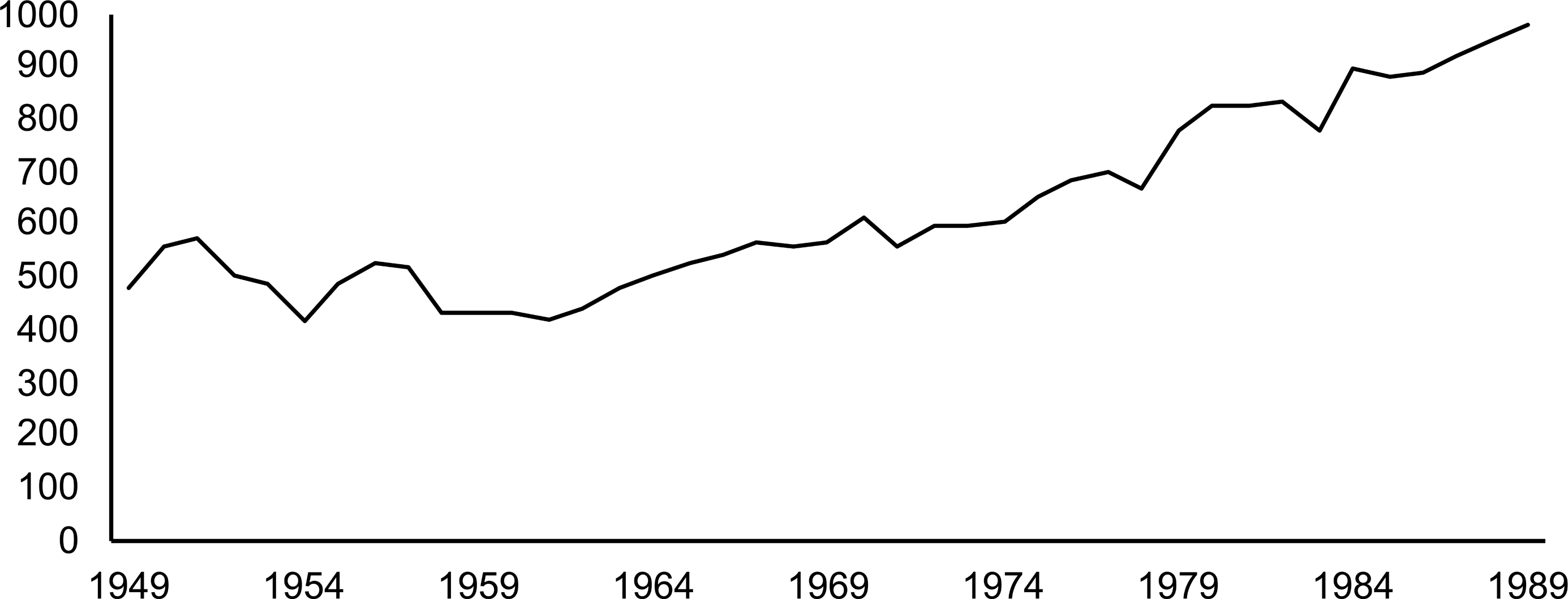
Distress in the coal industry from the 1930s to the 1960s is surprising in light of its later prominence. Figure 1, which presents the evolution of the US coal sector from 1949 to 1989, hints at the solution to this puzzle. Panel A suggests that coal did not outgrow all other alternatives combined until the early 1970s. Panel B suggests that, from the 1960s, growth in coal production accelerated at a new, heightened pace, which further accelerated in the late 1970s. The rise of coal’s unchallenged prominence in the US is thus better understood as the result of a postwar shift in which it definitively surpassed its alternatives (Kahle Reference Kahle2019).
Panel A. Evolution of the US coal sector in the postwar era. Panel A: US net electricity generation, in million kWh, 1949–1989.
Data, Panel A: US Energy Information Administration, Table 7.2a Electricity Net Generation: Total (All Sectors), Monthly Energy Review, January 2024, https://www.eia.gov/totalenergy/data/monthly/#electricity.

Panel B. Evolution of the US coal sector in the postwar era. Panel B: Total US coal production, 1949–1989.
Data, Panel B: US Energy Information Agency. 2023. Annual Coal Report, Table ES1. Coal Production, 1949–2022. https://www.eia.gov/coal/annual/pdf/acr.pdf.

Second, in the first half of the twentieht century, federal political elites did not cater to coal interests as much as might be assumed. The coal lobby was remarkably effective in shaping public discourse (Aronczyk and Espinoza Reference Aronczyk and Espinoza2022) and consistently exercised cultural power in mining-reliant areas (Gaventa Reference Gaventa1982; Shriver et al. Reference Shriver, Adams and Messer2014). Its direct influence on policymaking, however, was more modest. From the 1920s to the 1940s, federal interventions in the coal economy in the form of interstate tariffs, price-fixing, and wage regulation for non-unionized miners were adopted even in the face of widespread opposition from producers and hard-fought campaigns on their behalf by regional coal operators’ associations across the country.Footnote 10 Despite King coal’s power over public discourse, then, it was unable to move the needle on national energy policy.
Political apathy towards coal interests was also the result of the bad reputation of miners and their main union, the United Mine Workers of America (UWMA). Unionization attempts and contract negotiations in the first half of the twentieth century were characterized by unrest and violence. This fomented widespread disregard for miners.Footnote 11 This reputation only got worse during the Second World War. The 1942–1943 UMWA collective bargaining and ensuing strikes were met by resistance from coal operators but also from the government and the general public. Some viewed the union’s leverage of the war for bargaining purposes as unpatriotic.Footnote 12
In the 1950s, some pitted coal and nuclear interests against each other, speaking of a clash between the two lobbies.Footnote 13 In that clash for federal political attention, nuclear power easily prevailed early on. As the single authorized purchaser of uranium, the Atomic Energy Commission (AEC) guaranteed a steady demand for uranium and established fixed-term contracts with companies across mining states. As the AEC moved to expand its civilian activities (i.e., domestic energy production) under the nuclear program in the 1960s, coal companies and the UMWA were increasingly worried about the advantage that government-induced demand provided to the nuclear industry, which they suggested was unfair competition.Footnote 14
Existing accounts overlook the puzzling development of the US coal consensus by accepting the dominance of coal as a given. However, the coal economy could plausibly have continued its prewar stagnation without favorable policy interventions, and the oil, gas, and nuclear alternatives could well have surpassed it. Why wasn’t it the case? I argue that the ARC was the catalyst for a project that killed two birds with one stone. Coal mining was first packaged as an organizing principle to address Appalachian underdevelopment in the 1960s. Coal then emerged as a remedy for the looming national energy crisis in the 1970s. The ARC articulated federal, regional, and third-party interests and facilitated the integration of these two policy problems under a coherent national political project.
The articulatory role of bureaucratic agencies
To make sense of the role played by the ARC in the trajectory of coal, I turn to the concept of articulation from the political parties’ literature. Political articulation is “the process by which parties ‘suture’ together coherent blocs and cleavages from a disparate set of constituencies and individuals, who, even by virtue of sharing circumstances, may not necessarily share the same political identity.” (Leon et al. Reference Leon, Desai, Tuğal, de Leon, Desai and Tuğal2015, 2). In articulation processes, parties naturalize common interests between segments of the electorate and make cohesive blocks out of social groups (De Leon et al. Reference De Leon, Desai and Tuğal2009). This can be accomplished by bringing in constituencies that already share similarities or by enhancing solidarities between groups with otherwise competing interests (Chouhy Reference Chouhy2022; Leeds Reference Leeds2024, 2). In these processes, parties also elaborate ideas and projects and thus become central “to the constitution of the social because they give a specific logic to the reproduction of social formations.” (De Leon et al. Reference De Leon, Desai and Tuğal2009, 194).
I reinterpret political articulation to understand how bureaucratic discourse and practices participate in the formation of policy ideas and organize underlying coalitions that make these ideas politically viable. Political articulation emerged out of a critique of “reflection” models, in which parties are viewed as a vehicle for promoting already existing cleavages and interests. In the alternative proposed by articulation models, parties can assemble existing social groups into new ones “in their struggle to remake social order” (Lotesta and de Leon Reference Lotesta, de Leon, Janoski, de Leon, Misra and Martin2020, 646–47). I apply this argument to bureaucracies.
While some have recognized the articulatory role of civil society actors (Lotesta and de Leon Reference Lotesta, de Leon, Janoski, de Leon, Misra and Martin2020, 653; Gershenson Reference Gershenson2020), little work explores how other actors might participate in articulation processes (Hertel-Fernandez Reference Hertel-Fernandez2017). These conceptual developments have but rarely spilled over to the study of bureaucracies. A notable exception is found in Wang (Reference Wang2021), who highlights how multiple competing bureaucracies may attempt to articulate policy priorities to better align with their own jurisdictional competencies. While this contribution takes interest in bureaucratic forms of articulation, it primarily focuses on inter-bureaucracy dynamics. One explanation for this gap is that, unlike parties, bureaucracies are rarely treated as autonomous political organizations (Merriman and Pacewicz Reference Merriman and Pacewicz2022, 1228). Bureaucracies are indeed frequently viewed as simply responding to executive or legislative demands. In this hierarchical model inherited from Weber (Reference Weber2019), they are not powerful or agentic enough to play a decisive role in the development of political ideas. As the executive power in the US undertook to tame bureaucratization in the late twentieth century, this agency-as-enforcer model became even more widely accepted (Maggetti and Verhoest Reference Maggetti and Verhoest2014).
An early counterweight to this model is found in what Mann (Reference Mann1993, 53) terms “foul-up” state theories, in which it is viewed as a chaotic and balkanized sets of units with competing interests (e.g., Rueschemeyer and Evans Reference Rueschemeyer, Evans, Peter, Rueschemeyer and Skocpol1985). This approach builds on a tradition in organizational studies that focuses on self-preservation as a key structuring force of bureaucracies (Selznick Reference Selznick1949). As they specialize, agencies develop their own interests, which may compete with broader state interests. Agency-as-enforcer models of bureaucratic power suggest that their action is but a mere reflection of policymakers’ interests and priorities. What is often underestimated, however, is the political role bureaucracies play as they engage with other actors to implement political priorities. Dobbin (Reference Dobbin1994) shows how political institutions produce policy choices not only through organizational resources but also through the provision of “principles of causality” about these choices. In other words, institutional practices provide rationales and strategic reasons for pursuing choices – they provide necessary meaning structures for pursuing a policy option among a given set of alternatives (Dobbin Reference Dobbin1994, 218). As the boots-on-the-ground for the ideation and implementation of institutional practices, bureaucracies are a vehicle for meaning-making. Just like parties (De Leon et al. Reference De Leon, Desai and Tuğal2009, 194), bureaucracies are thus able to give specific logics to state action.
One important mechanism of bureaucratic political influence comes from policy studies, where implementation gaps, or distortions between initial policy goals and how they are enacted on the ground, are commonly found (Hupe and Hill Reference Hupe and Hill2016; Pressman and Wildavsky Reference Pressman and Wildavsky1973). Recent studies identify further mechanisms through which bureaucracies assume a political role. Merriman and Pacewicz (Reference Merriman and Pacewicz2022) show that they can shape outcomes when they implement policy through partisan lens. Others show that organizational cultures can foster bureaucratic activism directed towards the promotion of a specific policy project (Hysing et al. Reference Hysing, Olsson and Dahl2016; Pacewicz Reference Pacewicz2018). Yet others highlight the role of policy entrepreneurs who, through their individual mastery of procedures or unique expertise, can enact change from within (Anderson Reference Anderson2021). Most literature on bureaucratic influence frames it as a departure from expectations, whether it be through distortions, politicization, activism, or entrepreneurship. Ways in which bureaucracies may shape political processes in non-exceptional cases remain understudied. If at all, how do bureaucracies assume a decisive political role under expected conditions of exercise?
I locate the ability of bureaucracies for political articulation in their work as they address the problems they are tasked to solve by policymakers. The means of articulation at the disposal of bureaucracies may be more restricted than those usually in the hands of political parties – especially governing parties (Leon et al. Reference Leon, Desai, Tuğal, de Leon, Desai and Tuğal2015, 3). As I show here, however, bureaucracies play an articulatory role when they help develop policy solutions that bring constituencies together. This is especially true when changing structural conditions redefine social cleavages and require new policy solutions. This view emulates Eidlin’s (Reference Eidlin2016, 496) revised articulation model, in which it rests on previously existing constituencies and is not simply an effect of the articulating force. Structural constraints are important to understanding the pathways through which parties bring together segments of the electorate (Eidlin Reference Eidlin2016). Re-articulation of boundaries and lines of contention between groups is more likely during periods of social transformation (Laxer Reference Laxer2018, 948). Economic transformations with widespread ramifications are also especially conducive to articulation projects (Ackerman 2017, cited in Lotesta and de Leon Reference Lotesta, de Leon, Janoski, de Leon, Misra and Martin2020, 652).
Organizations like bureaucracies diffuse ideas through brokering, whereby they act as a coordinator of interests, resources, and information (Engle Reference Engle2021). As is the case when studying parties, one must pay attention to the organizational types and institutional contexts in which they operate. For instance, Ackerman (Reference Ackerman and Ackerman2022, 31) highlights that articulation is best associated with contemporary mass parties who seek to bridge gaps between various electorates than with elite parties who respond to a narrower coalition. Independent agencies’ political posture is closer to mass parties than most bureaucracies, who usually are more narrowly responsive to the executive. Some agencies have a unique position in the provision of services and expertise to multiple governmental and nongovernmental publics at once. In that position, they can act as a catalyst for enhancing of cooperation between these publics, which in turn contributes to articulating otherwise disjointed sets of actors. For the ARC, this unique position is borne to its role as a federal-regional agency. Policy coordination between federal and federated entities is source of frustration for both government orders since the preferences of neither can fully be respected (Webb Reference Webb1995, 11) and often fails because priorities differ in practice (Benz and Sonnicksen Reference Benz and Sonnicksen2015, 15). In a federal political system that generally curtails coherence between government orders (Pacewicz Reference Pacewicz2023, 135), one of the strengths of the ARC for articulation purposes is its position as an intermediary between federal and regional actors.
In this article, I argue that, from its founding in 1965, the ARC articulated the coal consensus by allowing other actors to view coal industrial development as a solution to both Appalachian underdevelopment and the energy crisis. This articulation process occurred at the intersection of the interests and priorities of regional elites, workers, industrial interests, civil society organizers, and federal policymakers. The ARC’s role in advancing the coal consensus highlights how bureaucracies can provide opportunities for multi-scalar coalition-building under unifying policy projects.
Data and analysis
The objective of this article is to understand why the coal consensus came to be articulated against other energy alternatives. To address this puzzle, I trace the trajectory of coal in the US from the 1950s to the late 1970s through chronological narrative analysis, which centers on accounts of temporally ordered events to assess causal processes (Lange Reference Lange2013). From this narrative, I develop a formation story, that is, an explanatory account of how social objects are “brought into being” (Hirschman and Reed Reference Hirschman and Reed2014, 268). The role of the ARC in this formation story is necessary but insufficient, meaning that the coal consensus may have emerged otherwise, but would not have been shaped in the same way were it not for the ARC-led articulation process.
I mainly draw from archival research at the University of Kentucky and Berea College. I visited these sites in the winter 2023 and complemented these visits with online reproduction orders from spring 2023 to summer 2025. I also use archives from the University of Wyoming and University of Colorado Boulder that I visited in the summer of 2025. Table 1 summarizes my use of archival sources.
Archival sources

Documents include reports, personal correspondence, memoranda, conference proceedings, and governmental studies. In total, I surveyed approximately 30,000 pages of archival documents. In addition to these archives, I draw on an extensive search in the Congressional record, as well as secondary materials.
Solving Appalachian underdevelopment
In the early 1960s, the Kennedy administration faced widespread criticism for its management of what became labeled the “Appalachian underdevelopment” problem. The 1961 Area Redevelopment Act (ARA) was criticized for lack of regional coordination. In March 1963, major flooding in Central Appalachia magnified already mounting political pressures. The Kennedy administration sought a quick remedy to the problem that would ease up these pressures. At the request of the Conference of Appalachian Governors, the administration instituted the PARC, a temporary task force agency, in April 1963. That Fall, Franklin D. Roosevelt Jr., the newly appointed head of PARC, visited Appalachia. Upon his return, he immediately ordered the hiring of more public health officials, the implementation of a school lunch program, and an increase in surplus food distribution. He recognized Appalachia as “the worst depressed area in the United States.”
PARC’s February 1964 report to the President recommended stronger federal action to alleviate social problems in the region. It acknowledged a contrast between the “natural advantages” of the region in terms of resources on the one hand and its underperforming economy on the other. The report noted that coal was still the region’s most valuable asset, “capable of economic production as well as of further development,” and that “the most promising opportunities for industrial diversification within the region appear to be in localized processing and utilization of coal in conjunction with other resources.”Footnote 15 In short, development was to stand on the shoulders of giant coal. The report advised that Congress should increase its support to the Office of Coal Research, that mineral exploration should be prioritized by the Department of Interior, and that cooperation between states, the coal industry, and federal agencies should be favored.
This report mirrored prevailing views at the state level. As a 1961 Raleigh County, West Virginia, report stated, “Since coal is our greatest single payroll, whatever efforts were put forth on behalf of the coal industry would naturally be reflected in an increased number of job opportunities. If the quotas on residual oil could be reduced, this would create additional job opportunities. If there were a reduction of tariffs on low-volatile coal shipped to Europe, this would provide additional job opportunities.”Footnote 16 At a conference on Appalachian development in Berea, Kentucky, in April 1964, panelists came to similar conclusions, albeit with an important caveat. Berea College Dean Louis Smith argued that economic growth and increased work opportunities were an absolute necessity, but could not be based on “reckless, rapid, and wasteful depletion of regional resources.”Footnote 17 At the federal level, some were even more cautious. In his comments on the Appalachia Regional Development Act (ARDA) before the House of Representatives in May 1964, Secretary of Interior Stewart Udall suggested that “new diversified economic opportunities within Appalachia, retraining of displaced miners, and reemployment of some miners in other mining regions are the appropriate remedial actions.”Footnote 18
The initial version of the ARDA reflected this mitigated view. Namely, it did not specify how the newly created Appalachian Regional Commission (ARC) would contribute to the coal economy. The main focus of the ARDA was the development of a highway system in the region, much in continuity with the ARA. Its other programs were only weakly outlined and, as Bradshaw (Reference Bradshaw1992, 47) notes, were quite limited in scope compared to what the PARC report promised. The ARDA nevertheless stated that public investments “shall be concentrated in areas where there is a significant potential for future growth and where the expected return on public dollars invested will be the greatest.”Footnote 19 In a region where coal and other natural resources were the most readily available levers for economic development, this paved the way for coal mining to become a programmatic priority. In accordance with existing state-level practices (Gaventa Reference Gaventa1982, 138–41), the agency also refused to tax coal to achieve redistributive goals in the region (Isserman and Rephann Reference Isserman and Rephann1995, 350). In doing so, it put aside the issue of “economic colonialism” (Gaventa Reference Gaventa1982, 163), which was so central to the concerns of reformists like Harry Caudill.
Through increased gubernatorial participation, agency officials hoped states would buy into the ARC from the start.Footnote 20 Beyond accepting it as a tool for economic development, some state-level political elites, like Governor George Wallace of Alabama, welcomed it as a “states’ rights” institution (Schwartzman Reference Schwartzman2021, 75). The very delimitation of the agency’s geographical scope was skewed towards mining-reliant communities at the detriment of others and, as Schwartzman (Reference Schwartzman2023) shows, its boundaries favored majority white populated areas over many majority black areas as a byproduct. In its emphasis on subregional autonomy and federal-state coequal management (Conn Reference Conn1983, 51), the ARC enabled Central Appalachian state governments, which were more amenable than federal legislators to coal interests, to use its program to promote coal mining. This inclusion of state representatives was viewed favorably by federal officials. President Johnson saw it as a strategic opportunity to display its “creative federalism” approach, in which states would actively contribute to national policymaking. At the same time, it was also viewed as “limited in money, time, and scope,” which required a narrower focus from the agency on projects that would be attractive for industry (Wolfe Reference Wolfe2003). The parsimonious language of the first ARDA allowed coal interests to be brought forward from below. The National Coal Policy Conference, the product of a coalition between coal producers and the UMWA, was key in promoting the need for a federal policy that would enhance energy sovereignty. The ongoing Cold War certainly made energy sovereignty more appealing, as “Russian oil” became a political undesirable.Footnote 21 These arguments found a sympathetic ear at the ARC.
The ARC’s initial approach did not threaten any preexisting power structure in the region (Conn Reference Conn1983, 54). In that role, however, the agency was much more than an enforcer, as its early projects actively furthered coal capital development. Building infrastructure was viewed as a first-order priority to facilitate extractive industries.Footnote 22 Crucially, projects like the development of the highway system came at a very low political cost, because it did not explicitly favor one industry over another nor did it compromise any established industrial interest in the region (Wood Reference Wood2006, 122). In practice, however, the coal industry had the most to gain from greater regional integration through the highway system, and after-the-fact evidence suggests that it did benefit extensively from increased domestic export opportunities (Bradshaw Reference Bradshaw1992, 64). New highways contributed to the coal economy by enhancing opportunities for out-of-state consumption, a vital tool in its competition with other energy alternatives.Footnote 23 In effect, the majority of highway projects were adjacent to major coal fields.Footnote 24 Although the road and transportation system was the primary concern of the ARC in its infancy, programs to support the development of natural resources were the next priority. To do so, the ARC increased resources for vocational training and education in coal communities and funded research on the management of land degradation and water contamination caused by coal mining.Footnote 25
By the end of the 1960s, because of ARC’s role as an intermediary between regional and national interests, federal stakeholders had caught onto the idea that the coal economy should be the main priority of Appalachian regional development. To that effect, a 1970 Public Land Review Commission stated that “mineral exploration and development should have preference over some or all other uses on much of our public land.”Footnote 26 Meanwhile, views of ARC’s personnel on the matter remained mixed. For instance, ARC Director Ralph Widner wondered what would happen to the region if future prospects for coal failed to meet expectations. He also questioned whether the economic benefits of coal mining truly outweighed its human and environmental costs.Footnote 27 With a sweeping energy crisis on the horizon, these concerns were soon to fade into the background.
Solving the energy crisis
Throughout the 1960s, proposals for a national energy policy emerged from industrial groups as a remedy for the coal crisis. Yet, energy supply more broadly was not in crisis. That would abruptly change in the early 1970s. The Oil shock of October 1973 transformed energy policy debates and paved the way for coal to definitively surpass energy alternatives. The Appalachian problem would be included as a corollary issue early on. In a statement before the House in December 1973, ARC Director Ralph Widner foresaw Appalachia’s role in this emerging crisis: “Appalachia currently produces about 70 percent of the Nation’s coal, and obviously, that coal has become terribly important once again.”Footnote 28 Beyond its economic potential, federal agents most importantly recognized coal’s convenience, as they believed it to be a “readily available domestic energy source.”Footnote 29 Federal interventions to address energy and development in conjunction to prevent unemployment that would result from long-term fuel shortages soon felt necessary.
This shift spilled over onto the ARC’s priorities, which became more explicitly lenient towards coal. The 1974 Subregional development strategy for Central Appalachia stated that supporting the coal economy constituted “an immediate base for expanding employment and generating a higher level of secondary employment.”Footnote 30 To attain this goal, coal had to be integrated with other regional economic sectors and infrastructure investments had to be made to ensure that the long-term effects of coal development were beneficial for mining communities. The ARC expanded its ties with experts, policy, and industrial actors, notably through inter-sectorial conferences. These brokering opportunities allowed the agency to shape public debate by choosing the questions on the agenda and those who were best suited to address them. At a May 1974 ARC conference on regional development, V. Lawrence Parsegian of the Rensselaer Polytechnic Institute argued that optimal coal industrial development was unlikely without financial support from governments as well as scientific and technological support from universities.Footnote 31 The ARC’s statement on energy policy in September 1974 built on this view and framed the national energy crisis as an opportunity for enhanced regional development.Footnote 32 While pushing for the expansion of federal intervention into coal development, the ARC used existing grant and loan programs to help the mining industry stay afloat in the meantime (Marley and Fox Reference Marley and Fox2014, 270).
In federal-state relationships, not only did the ARC act as a broker for the exchange of ideas but also actively shaped the federal executive’s view. In preparation for a public conference and a meeting with the Conference of Appalachian Governors in October 1975, federal co-chairman Donald W. Whitehead prepared a brief for President Ford that outlined talking points on controversial regional issues. This brief bridged the gap between federal and regional views in three ways. First, it provided rationales for some of the President’s decisions that met public opposition, like his veto of surface mining regulation bills in 1974 and 1975:
The President is committed to meeting the Nation’s energy needs with due regard to the necessity for protecting our environment. He and members of his Administration have made clear that the President supports the principle of surface mining regulation. On the other hand, after long and fruitless negotiations with the Senate and House Interior Committees, it proved impossible to agree on all details.Footnote 33
Second, against critiques that the ARC did not provide enough immediate support for depressed areas, the memo reaffirmed a vision of the agency that emphasized capital investment over welfare: “The Commission is not a poverty agency nor is it running a welfare program. Its mission is to promote the economic development of Appalachia by guiding the capital investment in public works and infrastructure which will make the Region more attractive to tax-paying, good wage-paying, stable industry.”Footnote 34 Third, in talking points for the President’s meeting with the Conference of Appalachian Governor, the brief highlighted common political interests between governmental orders:
Governor Carroll may also speak to the need for Federal agencies to be more responsive to the views of States. This issue is the essence of the proposed resolution now being discussed by some of the governors for possible action at the Commission meeting with the President. It is my view, that the President should indicate his strong support for mechanisms that provide input from State and local governments to the Federal decision-making process.Footnote 35
This suggests the ARC was front and center in framing policy problems, putting forward solutions, and finding common ground between federal and regional actors. To do so, the ARC leveraged its knowledge of state-level politics to smooth out potential differences of opinion.
In a meeting with President Ford leading up to the 1975 reauthorization of the ARDA, the ARC further committed to organizing its activities around the growth of coal:
Recognizing that to sustain the massive acceleration in coal production needed in the Region will require the development of roads, housing, schools and other community facilities and programs […] The Appalachian Regional Commission recognizes the critical role of the Region in meeting national energy goals. To help the Region carry out this role, the Commission commits itself to revise its development strategies, reorder priorities, and reprogram available funds to give higher priority to energy-related public investments and to provide for the Region’s energy work force while at the same time protecting its environment.Footnote 36
The 1975 reauthorization of the ARDA reflected this pro-coal attitude and explicitly tied its mission to national energy needs. The very purpose of the ARDA was amended to include the following:
[coordinating] Federal, State, and local efforts toward (1) anticipating the effects on the region of alternative national energy policies and practices, (2) planning for the growth and change generated through environmental well-being of the region, and (3) implementing the activities of Federal, State, and local governments in the region to better meet the special problems generated in the region through national energy policies.Footnote 37
These amendments were drafted by ARC staff with the explicit goal of enhancing the agency’s autonomy and narrowing down its work towards energy development.Footnote 38 More so than being a sheer tool for economic development, coal development became an organizing principle for the agency.
The reauthorization act passed on December 31st, 1975, with bipartisan agreement that an increased focus on energy development was necessary. Senator Howard H. Baker (R-TN) argued that the coal issue had changed since the ARC’s inception and that the agency thus had to adapt to this new reality. He also noted that this brought a change in the role of the region on the national scene: “As the most important producer of our country’s largest domestic source of energy, Appalachia now confronts the future in the context of this new relationship to the Nation” (emphasis mine).Footnote 39 Many highlighted that this increased focus was aligned with the initial ARC’s mission of solving Appalachian underdevelopment. Senator Jennings Randolph (Democrat-West Virginia) tied coal’s potential as a solution to the energy crisis to Appalachian development and underlined the role of the ARC in managing coal’s economic prospects for long-term regional growth:
Just as a decline in the coal industry contributed to the decline of Appalachia’s general prosperity, so has a recent revival of the demand for coal contributed to economic advancements in the region. Coal booms of the past have left few improvements behind when they subsided. Indeed, a number of the Commission’s programs were designed specifically to remedy problems caused by past coal mining operations. Through the Appalachian Commission, however, the region now has the capacity to plan and manage the new energy potential that we witness today so that it furthers both the national interest and the development and conservation of the region’s resources.Footnote 40
This bipartisan agreement also reflected the balance the ARC had been able to strike between national and regional priorities. Notably, the bill retained an emphasis on state autonomy in the spending of ARDA funds, which allowed for enhanced investment in rural mining and nonmining counties (Eller Reference Eller2008, 203).
Towards the coal consensus
From its reauthorization, the ARC bolstered its role in articulating its partners’ priorities. In June 1976, the agency co-sponsored the Appalachian Minerals Evaluation Conference with the National Science Foundation, which brought together 65 experts and industry representatives. In his opening statement at the event, ARC Federal Cochairman Donald Whitehead summarized the agency’s view regarding intersectoral partnerships: “one of the strengths of American society is the readiness of industry and academia to counsel with government when professional advice and technical assistance are critical in the development of public policy. In this country we have a long tradition of encouraging such cooperation and innumerable mechanisms for achieving it.”Footnote 41
This conference looked at how to enhance mineral development prospects through infrastructure arrangements, zoning laws, tax structures, and stable regulatory environments. Amid the energy crisis, agency staff recognized its role as the common ground for regional, federal, and coal interests. As future ARC director Francis Morawitz then argued, “the Appalachian Regional Commission has demonstrated that if called upon it can help out a national energy policy, calling for increased coal production. For example, the Commission can serve as an effective broker between industry, labor, and government for the purpose of meeting the housing and community service demands for new mine workers.”Footnote 42 By repurposing already existing ties to further its renewed mandate, the ARC cultivated a reputation for effective problem-solving. In turn, it became recognized for developing solutions to the national energy crisis “packaged to contribute to the growth of a region.”Footnote 43
The election of the Carter administration in 1976 allowed for the idea of a national energy policy to reach the top of the legislative agenda. Carter saw energy as one of the defining issues of his Presidency (Richardson and Nordhaus Reference Richardson and Nordhaus1995). While coal production increased in the aftermath of the 1973 Oil shock, industry stakeholders still wanted federal intervention to ensure stability going forward. This was easy for the ARC to get behind, as steady growth precluded the deleterious impacts of boom-and-bust cycles on unemployment and poverty.Footnote 44 The need to address the future of coal in conjunction with the energy crisis led to the passage of the 1977 Inland Energy Development Impact Assistance Act and the 1978 National Energy Act. These bills addressed power production and supply but were also framed by their proponents as advancing national security through energy sovereignty. These reforms sought to double coal production to 1.2 billion tons by 1985, in recognition that coal represented 90% of national energy reserves but fulfilled only 18% of domestic needs.Footnote 45 They also provided fiscal incentives for industrial conversion from oil to coal, thereby not only ensuring abundant supply but also consistent demand.
In Congressional hearings, the ARC was instrumental in outlining how this federal intervention reconciled national and regional interests. As ARC Federal Cochairman Robert W. Scott put it: “the national energy policy now being fashioned by the Administration and the Congress proposes to commit the nation to the use of coal as our major source of energy over the next quarter of a century. The location, quantity, quality and availability of Appalachian coal means that the Appalachian states must be involved in meeting this national commitment.”Footnote 46 Scott highlighted the need for these reforms to serve the interests of Appalachia in return: “If we are to produce the coal the nation needs, we must have the assurance of participation in a shared decision-making process that will provide the nation the energy it so urgently needs, and for the people of Appalachia the quality of life they deserve.”Footnote 47
In parallel, the ARC contributed to addressing the environmental harms of coal, perhaps the most important obstacle to a regional consensus on the matter (Chowkwanyun Reference Chowkwanyun2022, ch. 5). Throughout the 1960s, the work of elite figures like Harry Caudill and local activists like Ollie Combs had shed light onto the environmental problems caused by coal mining (Eller Reference Eller2008, Ch. 4). Coal miners’ health had partially been addressed by the 1969 Federal Coal Mine Health and Safety Act, but the issue of environmental degradation remained. Amid the fast-paced expansion of surface mining activities, air and water contamination problems caused by coal had only worsened. At the 1972 National Conference on Strip Mining, a proposal for the abolition of surface mining emerged among parties. Prominent Democratic Party figures like Senator George McGovern (South Dakota), Governor Jay Rockefeller (West Virginia), and Representative Ken Hechler (West Virginia) supported this proposal. But it was also met with strong opposition. Coal corporations and the UMWA were vehemently opposed to any additional regulations of surface mining, fearing that it would lead to economic slowdown.Footnote 48 Their opposition was so powerful that, after introducing a bill to ban surface mining in 1972, Ken Hechler feared his reelection campaign was compromised: “I don’t mind telling you, I’m in trouble,” he wrote to Harry Caudill and his wife Anne.Footnote 49 Successive surface mining legislation was vetoed by President Ford in 1974 and 1975 out of fear that they would hurt the industry and lead to price surges (Menzel and Edgmon Reference Menzel and Edgmon1980, 82).
Between proposals for the abolition of surface mining and a push for the status quo, the ARC stood as representative of a third way. The agency had been preoccupied by the future of Appalachian coal since its inception. At the same time, it also had been engaged in limiting environmental degradation, notably by funding mining site restoration projects. It was important for the agency that coal interfere as little as possible with the aspiration of the region to thrive on its other resources, especially water. The ARC’s 1977 strategic plan reiterated this view in light of rising criticisms of surface mining.Footnote 50 The 1977 Surface Mining Control and Reclamation Act answered some environmental concerns, although many – President Carter being the first among them – hoped for more stringent regulations. This bill instituted the Office of Surface Mining, responsible for rulemaking and oversight, created funding programs for research on best practices and technologies to promote environmental preservation, and developed an abandoned mining site cleanup program. It pursued the third way articulated by the ARC: surveillance of surface mining to limit its detrimental effects, while at the same time limiting reputational threats to the industry. Importantly, it located primary regulatory responsibilities with states. This consecrated the long-standing ARC view that emphasized bottom-up participation from federated entities – a key principle of the “creative” and “new” federalisms promoted by successive federal administrations in the 1970s, even if that meant sacrificing some regulatory clarity and efficiency (Menzel and Edgmon Reference Menzel and Edgmon1980, 82–90).
The 1977 Surface Mining act may have been the last missing piece to promote the coal consensus in face of rising public concerns over pollution. Critiques still remained at the local level. Strip mining was significantly contested by activist groups like the Appalachian Group to Save the Land and People or Save Our Kentucky (Montrie Reference Montrie2003, 85; Glen Reference Glen1993). At core, activists were challenging the increasingly central narrative under which Appalachia’s fate was intertwined with that of coal (Turman Reference Turman2016, 866). Furthermore, local activists were disappointed by national environmental groups and their willingness to adhere to the third way advanced by the ARC (Eller Reference Eller2008, 217). Rising tensions between compromising and uncompromising views of strip mining legislation significantly weakened pro-ban activism in the lead up to the bill’s passage (Turman Reference Turman2016, 860). This middle-ground legislation thus contributed to the fading of local militant activism. On the one hand, activists lacked a “unified vision on the future of coal and mining in Appalachia after the act” (Witt Reference Witt2011, 146). On the other hand, after the legislation was enacted, these groups shifted their attention to remediate other environmental issues in Appalachia (Ibid).
In the span of two years, the 1977 Inland Act and the 1978 National Energy Act, key pieces of legislation which respectively incentivized domestic coal demand through fiscal and regulatory means and reduced competition from foreign oil, transformed the conditions under which the coal industry operated. The 1977 Surface Mining Act furthered coal interests in its own right by limiting some of its visible externalities. Together, these three pieces of legislation set seemingly immovable precedents for a consensus to flourish in the following decades.
What was the coal consensus, then? Its first layer was its approach to the development of mining regions. Coal country was thought to suffer most from instability and boom-and-bust cycles. The solution to that problem was policies that fostered stable growth, which would promote the benefits of the coal economy and limit some of its drawbacks. The policy environment promoted by the ARC delivered on that front. In the first three decades of the agency’s existence, growth in the mining sector surpassed that of any other industry in Appalachia, and coal-producing counties developed faster than non-coal-producing counties (Isserman and Rephann Reference Isserman and Rephann1995, 358–62). The second layer of the coal consensus covered new political understandings of what had happened after the Oil shock. Mainstream accounts came to view the expansion of coal as inevitable or, as the Government Accountability Office described it, “a matter of necessity rather than choice.”Footnote 51 This new understanding concealed the political conditions that made coal development seem like the best option out of multiple alternatives, and the work of the ARC in making federal, regional, and third sector constituencies buy into that option. Its third layer concerned the eventual rise of national myths around coal as the long-standing backbone of the United States economy and a central part of American identity, which are still prevalent today (Bell and York Reference Bell and York2010; Mayer Reference Mayer2022).
Discussion and conclusion
In this paper, I argued that the ARC articulated a consensus around coal’s prominence. Through its work in addressing Appalachian underdevelopment, the agency organized the interests of key partners and linked federal and regional concerns. Coal was initially a tool to address Appalachian underdevelopment, but it lacked national appeal and was challenged by its alternatives. In its infancy, the ARC emphasized the advantages of coal for solving Appalachian underdevelopment and facilitated its development in the region. While coal interests lobbied early on for a national energy policy, there was no corresponding national energy crisis for it to become a salient political idea. After the 1973 Oil shock, it finally gained traction. What it lacked then was a vision of how it also advanced regional interests. At this political juncture, the ARC was instrumental in tying Appalachian underdevelopment to growing domestic energy needs.
This paper shows the articulatory role that bureaucratic agencies can play when solving policy problems as they bring together actors with loosely related interests, provide meaningful opportunities for multi-scalar coalition-building, and ensure that key actors buy into proposed solutions. As Dobbin (Reference Dobbin1994) puts it, institutions can provide the meaning structures that are necessary to consolidate policy choices. The second iteration of the ARDA was a form of institutional “layering” (see Streeck and Kathleen Reference Streeck, Kathleen, Streeck and Thelen2004), whereby similar logics persisted but new rules were introduced – which in this case heightened the focus of the ARC on coal. This layering was largely made possible by the agency, whose discourse and actions provided a rationale for coal to be integrated as a joint solution to Appalachian underdevelopment and the energy crisis.
This paper thereby delineates a pathway through which bureaucracies can play a decisive role in the formation of a consequential political idea. Following Morgan and Orloff (Reference Morgan, Shola Orloff, Orloff and Morgan2017), I disaggregated units of the state to highlight how interactions between these units and non-state actors as well as among units can steer political orientations of the state as a whole. My focus on the ARC highlights how units like bureaucracies, which are often not viewed as politically autonomous, can become essential drivers of change. The ARC was key in articulating the problems to be solved, tailoring coal solutions to its regional development mandate, and reassuring critiques of coal by pushing for social and environmental compromise. Ascribing political autonomy to bureaucracies should not lead to underplaying the ways in which their action is constrained by decisions from executive and legislative bodies. One of the conditions for the ARC’s articulatory role is that it fitted evolving governmental priorities, especially that of the Carter administration. Nevertheless, this paper highlights how agencies incorporate their own interests, constraints, and ties in addressing the problems they are tasked to solve, and how this in turn shapes possibilities for other actors.
Last, this paper advances our understanding of the conditions that make energy transitions possible. A growing body of work examines this question by focusing on current attempts at moving away from fossil fuels. Scholars note the challenges of dealing with resistance from industrial lobbies and advocate groups (Farrell Reference Farrell2016; Stokes Reference Stokes2020), and the electoral dilemmas involved for parties who seek to enact change (Bolet et al. Reference Bolet, Green and González-Eguino2024; Colantone et al. 2024; Mayer Reference Colantone, Di Lonardo, Margalit and Percoco2022). Focusing on the transition to largely unchallenged coal development in the U.S., this paper highlights the importance of coalition-building across sectors, which has been previously identified in scholarship on labor-environment coalitions (Obach Reference Obach2004; Mayer Reference Mayer2009). In the case of the ARC, most of this bridging work was accomplished between governmental orders, which can prove to be especially difficult in federal systems. This focus on multi-scalar coalitions adds to previous accounts that look at cross-sector bonds. In addition, this paper emphasizes the advantages of tying transitions to broader political projects to make them legible to a larger set of constituencies.
In the 21st century, coal’s place in the energy mix has significantly declined. In 2016, for the first time since national data have been compiled, coal was not the primary source of electricity in the U.S. Nevertheless, the coal consensus has not completely fallen apart, and continued support for coal has become largely divided along partisan lines. The coal consensus was not historically inevitable, and our current transitions to new sources of energy are not either. This paper reiterates the need for scholars to analyze energy transitions as the result of a selection process between competing ideas and interests, not simply as a mirror of economic, political, and environmental conditions.
Harry Caudill spent most of his career criticizing coal interests for their disregard for miners and land, and regional political elites for their complacency towards the coal industry. In the decades following the creation of the ARC, progressive reforms did materialize in that sense. Yet, for advocates like Caudill, these were bitter victories at best. In the last few years before his death in 1990, he wrote about the necessity for his home state of Kentucky to phase out coal and radically rethink its development model.Footnote 52 He believed that Appalachia was otherwise doomed to remain “America’s Exploited Colony.”Footnote 53
Was he right? As the 50-year anniversary report of the ARC (2015) notes, although progress has been made, Appalachia still lags behind on key socioeconomic measures. The region still suffers from higher poverty and unemployment and still has poorer health and educational outcomes than the rest of the U.S.Footnote 54 Most evidently, the coal consensus did not solve Appalachian underdevelopment. But there is hope for the region. From the 1998 revisions to ARDA, the ARC has more consistently promoted a broader array of development tools. Since 2015, the ARC has implemented the Partnerships for Opportunity and Workforce and Economic Revitalization initiative, which co-sponsors development projects across coal-impacted communities. To date, this initiative has led to 421.6 million in investments on 507 projects in 365 counties.Footnote 55 In an age of energy transitions, an unprecedented opportunity opens for Appalachia to reimagine itself.
Acknowledgements
I thank Axel van den Berg and Joshua Basseches for their insightful remarks on previous versions of this manuscript. This paper greatly benefited from the comments of attendees at the Natural Resource Economies session at the 2024 Social Science History Association meeting. I also acknowledge the important work of numerous archivists, including Sarah Coblentz, Tim Binckley, and Peter Morphew, who made data collection possible.



 Open access

