





Introduction
The reception and distribution of asylum seekers is one of the most salient and polarising issues in European politics. At the heart of the debate lies a fundamental question: how should protection responsibilities be fairly shared among European countries? The persistence of this question was starkly evident in November 2025, when the Commissioner for Home Affairs and Migration of the European Union (EU) launched the first Annual Migration Management Cycle by emphasising that the European asylum system must be not only ‘firm’ but also ‘fair’, particularly in supporting ‘Member States facing the most disproportionate pressures’ (EC 2025). Yet despite decades of efforts in building a common policy framework, member states have repeatedly failed to agree on binding responsibility-sharing mechanisms, and the distribution of asylum seekers across the EU remains highly unequal.
Any institutionalised system of responsibility sharing requires clear procedures and criteria to allocate asylum obligations to states (Czaika Reference Czaika2009; Lutz, Stünzi and Manser-Egli Reference Lutz, Stünzi and Manser-Egli2021). The European Union rests on the principle of mutual solidarity but faces significant collective action problems in asylum governance where each member state has incentives to minimise their refugee intake (Thym Reference Thym and Thym2022: 18). The close interdependence of European countries with open internal borders creates strong incentives for cooperation and a governance framework that ensures effective responsibility sharing. Yet such a framework is only feasible if it rests on broad political consensus that requires not only interstate agreement but also public legitimacy. Public opinion both constrains policy-making and is itself shaped by political communication and media coverage. This raises a critical empirical question: what do EU citizens consider to be a fair distribution of asylum responsibilities among European countries?
This study builds on and extends a long-standing tradition of empirical justice research that investigates how people understand and apply fairness principles in real-world contexts (eg Konow Reference Konow2003; Liebig, Sauer and Friedhoff Reference Liebig, Sauer and Friedhoff2015). While normative theories of justice provide competing criteria for what a fair distribution should look like, empirical justice research seeks to uncover what individuals actually perceive as fair, how these perceptions vary across contexts, and to what extent they are shaped by self-interest or impartial reasoning. This approach has been widely applied to redistributive policies within states (eg Rodon and Sanjaume-Calvet Reference Rodon and Sanjaume-Calvet2020; van Hootegem Reference Van Hootegem2022) and to the international governance of climate change mitigation – a policy issue characterised by a strong international collective action problem – often using conjoint experiments and game-theoretical methods (eg Lange, Löschel, Vogt et al. Reference Lange, Löschel, Vogt and Ziegler2010; Bechtel and Scheve Reference Bechtel and Scheve2013; Gampfer Reference Gampfer2014; Schleich, Dütschke, Schwirplies et al. Reference Schleich, Dütschke, Schwirplies and Ziegler2014; Bergquist and Jagers Reference Bergquist and Jagers2022). This research demonstrates that fairness perceptions are context-dependent, shaped by the principles people consider relevant and by how these principles are weighed against one another. The context dependency of perceptions of fairness raises a challenge when these perceptions need to be reconciled across contexts, as is, for instance, the case in supranational decision-making.
In asylum governance, fairness has also been a key concern, but research has primarily focused on it as an objective of responsibility sharing and on criteria for distributing protection obligations among states (Czaika Reference Czaika2009; Lutz, Stünzi and Manser-Egli Reference Lutz, Stünzi and Manser-Egli2021), rather than on how the public perceives fairness in this domain. Despite the centrality of fairness to the legitimacy of asylum policies and their political salience in EU politics, we still know relatively little about which fairness principles citizens endorse when it comes to refugee protection. Previous studies suggest that public attitudes are indeed sensitive to fairness considerations: Bansak, Hainmueller and Hangartner (Reference Bansak, Hainmueller and Hangartner2017) find broad support for proportional responsibility sharing, and Solodoch (Reference Solodoch2024) shows that perceptions of a fair distribution system can increase public willingness to admit refugees. Dražanová and Ruhs (Reference Dražanová and Ruhs2024, Reference Dražanová and Ruhs2025) present a conjoint experiment which demonstrates that various features of asylum policy influence fairness perceptions among citizens in Italy and Germany. Blasco et al. (Reference Blasco, Cabeza, Icardi, Krawczyk and Seiger2025) establish that only a small minority (less than 20%) of EU citizens consider the way that asylum seekers are currently distributed among EU countries to be ‘even’. At the same time, they also find majorities in all eight EU countries surveyed maintaining that the share of asylum seekers hosted by their own country is too high.
These findings indicate that fairness considerations play a crucial role in shaping citizens’ attitudes towards refugees and preferences on asylum policy. Whether citizens are willing to support European solidarity and the Common European Asylum System (CEAS) may thus depend on whether they perceive the system as fair. However, it remains an open question which fairness principles the public actually supports in the context of European responsibility sharing and whether EU citizens can converge on a common set of principles. Do Europeans agree on key fairness principles, or is the emergence of a legitimate collective system of responsibility sharing hindered by deep divisions in public opinion?
This study seeks to fill this gap by exploring how citizens in different member states understand fairness in refugee protection and how they believe asylum seekers should be distributed across the EU. Drawing on the responsibility-sharing literature, we distinguish between distributive and procedural conceptions of fairness and examine public support for different fairness principles using a large-scale population survey (N = 10,200) conducted in six European countries representing Northern destination countries, Eastern European member states, and Southern frontline countries. This allows us to systematically examine both the structure and variation of fairness preferences within and across countries, assess to what extent citizens converge on a shared conception of fair allocation, and determine to what extent differences reflect national self-interest in limiting protection responsibilities or broader normative convictions. Taken together, our findings reveal which fairness principles EU citizens endorse and whether there is ground for convergence on a shared conception of fair allocation.
Fairness in European asylum governance
The number of asylum seekers that a country receives and processes directly affects the share that other countries face. This interdependence is particularly pronounced in the European Union, where internal border controls have been abolished, allowing asylum seekers to move freely between member states. Under these conditions, refugee protection becomes a collective obligation and shared challenge that requires international cooperation. In the absence of cooperation, states may seek to minimise their individual contributions, while continuing to benefit from the public good of refugee protection provided by others. This creates incentives to free-ride on the efforts of other states, resulting in the under-provision of refugee protection and the proliferation of deterrence strategies. Such self-centred approaches, however, are ultimately self-defeating: refugee movements do not disappear, and uncoordinated responses exacerbate the pressure on the system as a whole. States therefore stand to gain from agreeing on common principles for distributing protection responsibilities (Thielemann Reference Thielemann, Jones, Menon and Weatherill2012). Without such cooperation, they remain trapped in competing self-interests, unable to overcome the collective action problem at the heart of international asylum governance. For this to change, asylum governance needs to be conceived as a matter of shared responsibility, one that requires taking the positions and interests of others into account. This, in turn, makes the distribution of refugees a matter of fairness.
In theory, the EU offers the ideal institutional context for such responsibility sharing. It combines supranational institutions, harmonised asylum rules, and a founding commitment to solidarity among its member states (Bauböck Reference Bauböck2018). Functional pressures to share responsibilities are also particularly strong in the EU: member states are strongly interdependent, maintain open internal borders that allow asylum seekers to move freely, and experience highly asymmetric patterns of refugee arrivals. These asymmetries heighten the need for cooperation by placing disproportionate strain on certain states, even as they complicate agreement on equitable responsibility sharing. The Dublin System, introduced as the core of the CEAS, was designed to address these cooperation challenges. Its primary objective is to ensure that each asylum application is processed by a single member state – typically the one of first irregular entryFootnote 1 – thereby avoiding both ‘asylum shopping’ (multiple applications in different member states) and ‘refugees in orbit’ (where no state takes responsibility).
While the Dublin system was primarily designed to bring order and clarity to responsibility allocation in European asylum governance (Guild, Costello, Garlick et al. Reference Guild, Costello, Garlick and Moreno-Lax2015), its distributive principle – the first-entry rule – has long been contested. It places disproportionate responsibility on border states, particularly in Southern Europe, that register most irregular arrivals on EU territory. Already at the system’s inception in 1990, alternative principles such as allocating asylum seekers based on refugee preferences or member state capacity were considered (Lott Reference Lott2023), but none of these materialised. Initially, Mediterranean states considered the burden imposed by the first-entry rule acceptable in the context of their broader benefits from joining the Schengen system and the European Single Market. Over time, the allocation rule became institutionally locked-in (Scharpf Reference Scharpf1988): while few defend the fairness of the existing rule, asymmetric interests have prevented a consensus on alternatives – and member states have generally preferred the certainty of having a common rule over the uncertainty of no rule at all. A short-lived and ultimately failed capacity-based distribution key was agreed in 2016, while fundamental reforms have repeatedly stalled. Even the EU’s New Pact on Migration and Asylum, adopted in 2024 and hailed as a breakthrough, ultimately preserves the substance of the first-entry rule, despite aspirations to put ‘Dublin to bed’ (Euronews 2020).
As is often the case in EU politics, there is a gap between the widespread recognition of the general need for collective solutions and the political disagreement on the substance of such a collective arrangement (Scharpf Reference Scharpf1999; Höpner, Schmidt and Seikel Reference Höpner, Schmidt and Seikel2025). Responsibility sharing requires a broad political coalition, one that is unlikely to emerge without public support for a common understanding of fairness. Yet what fairness requires in this context is contested. Governments regularly invoke different fairness rationales to justify their divergent positions – but how do citizens themselves think about fairness in refugee distribution?
The concept of responsibility sharing in asylum governance, and its aim of achieving a fair and equitable distribution of protection responsibilities among states, often remains vague in its substantive meaning. While this study analyses the perceptions of citizens, the fairness assessments we ask them to make pertain to the distribution of protection responsibilities among states. Hence, the question here is a question of ‘justice between states’ (Gibney Reference Gibney2015), which involves recognising states as moral agents within the international system, each possessing legitimate interests and claims that must be balanced against one another. Obviously, this perspective offers only a partial view of the broader normative considerations at stake in asylum governance. Most notably, our analysis sidesteps ‘fairness to refugees’, which concerns the interests, needs, and preferences of individuals seeking protection.Footnote 2
Theorising fairness preferences
We approach the question of how EU citizens perceive fairness in refugee protection in three steps. First, we query whether EU citizens engage with the distribution of refugees among EU member states as a question of fairness in the first place. Second, we identify the potentially relevant fairness principles and the public support they can command. Third, we analyse the drivers of the fairness principles that EU citizens endorse and the sources of variation in these preferences.
Grounding fairness judgements
Even if the functional arguments for perceiving the distribution of asylum seekers as a shared responsibility are stark, it is not self-evident that citizens recognise the allocation of refugees within the EU as a question of fairness. Rather than assuming that fairness-based reasoning has purchase in public opinion, we first seek to establish whether and to what extent citizens interpret refugee allocation within the EU as a question of fairness.
A first aspect concerns citizens’ evaluation of the status quo. Under the existing rules, the member state of first entry is typically responsible for processing an asylum claim. The burdens that this puts on certain EU member states and the struggles of frontline countries like Greece and Italy are widely reported. Scholars have criticised existing arrangements for creating and reinforcing structural imbalances, thereby undermining rather than fostering equitable responsibility sharing (Czaika Reference Czaika2009; Guild, Costello, Garlick et al. Reference Guild, Costello, Garlick and Moreno-Lax2015; Holtug Reference Holtug2016). Citizens who perceive the current distribution as problematic may be more inclined to engage with fairness-based alternatives.
A second aspect involves citizens’ normative orientation toward refugee distribution. Here the critical question is which aim citizens expect the EU’s asylum policy to serve: do they see it as serving a collective aim of fairness or only as a means to keep the number of refugees in their own country at a minimum (Blasco et al. Reference Blasco, Cabeza, Icardi, Krawczyk and Seiger2025). Citizens who adopt a purely instrumental perspective may be less likely to engage in such reflective reasoning.
A third aspect concerns the institutional locus of responsibility. EU member states have committed to deep cooperation in key areas, including the single market, free movement, and, more specifically, the CEAS. These commitments give rise to relationships of mutual obligation, particularly in domains like refugee protection that involve questions of distributive justice. In this context, states bear a fairness obligation toward one another, grounded in interstate solidarity and a shared responsibility toward refugees (Milazzo Reference Milazzo2023). For fairness-based approaches to gain traction, citizens must accept that the allocation of asylum seekers is a task appropriately coordinated at the EU level, for instance, through a commonly agreed distribution key.
The conception of EU-level coordination can be challenged from two sides. The principle of state choice holds that asylum policy should remain an exclusive national prerogative, with no obligation to coordinate with other EU states. Many governments continue to defend asylum policy as a core aspect of national sovereignty (Dauvergne Reference Dauvergne2004; Genschel and Jachtenfuchs Reference Genschel and Jachtenfuchs2018). From this perspective, fairness emerges not from supranational rules but from voluntary, nationally defined commitments, assuming that states are best placed to determine their own obligations.
At the opposite end of the spectrum lies the principle of refugee choice, which asserts that asylum seekers themselves should have the right to choose their destination country. This position reflects a cosmopolitan commitment to the rights and agency of individuals, framing the issues as one of justice to refugees rather than among states. From this standpoint, any EU-level allocation mechanism is inherently unfair, as it restricts individual (refugee) choice. Most political theorists nonetheless agree that asylum seekers do not hold an absolute right to choose their country of asylum and that states may legitimately assign the responsibility for asylum claims among themselves (Gibney Reference Gibney2015: 458; Holtug Reference Holtug2016: 283).
Public opinion plays a pivotal role in determining which of these competing views – an EU-level key, state choice, or refugee choice – garners wider legitimacy.Footnote 3 Understanding how citizens position themselves along these dimensions is therefore essential for assessing both the prospects and normative grounding of responsibility sharing in the EU.
In sum, to characterise how EU citizens engage with refugee distribution as a question of fairness, we examine three questions:
-
1. Evaluation of the status quo: Do EU citizens perceive refugees to be fairly distributed?
-
2. Normative orientation: Do they think that fairness should be a leading objective in the distribution of refugees?
-
3. Institutional locus: Do they view the distribution of refugees as an issue that needs to be handled at the EU level?
Conceptualising fairness principles for EU asylum governance
If the assignment of asylum seekers is regarded as a matter of common European concern, either on principled grounds or as an inevitable consequence of the common market and the abolition of internal border controls, then a collective formula based on one or multiple allocation criteria is required to guide this assignment. A well-defined and well-justified distribution key is essential for realising responsibility sharing, as it ensures predictability, impartiality, and the legitimacy of joint decision-making. To identify plausible criteria capable of fulfilling this role, we draw on both policy practice and normative theory.
We identify five key principles according to which refugees can be distributed across countries: population size, national wealth, unemployment rate, past refugee admissions, and reception costs.Footnote 4 Four of these, all except reception costs, featured in the distribution formula that the European Commission (2015) proposed in its European Agenda on Migration at the height of the so-called ‘refugee crisis’.Footnote 5 These criteria reflect distinct normative logics recognised in the responsibility-sharing literature (cf. Lutz, Stünzi and Manser-Egli Reference Lutz, Stünzi and Manser-Egli2021).
The first is egalitarianism, which departs from the intuition that no state is inherently more deserving than another and that burdens should therefore be shared equally. When applied to justice between states, egalitarianism must account for differences in state size. The most straightforward operationalisation is population size: distributing refugees proportionally across member states reflects the idea that responsibility should be shared equally among all EU citizens.
The second logic centres on capacity – the idea that responsibilities should be distributed according to states’ ability to fulfil them. Matthew Gibney (Reference Gibney2004: 241, Reference Gibney2015) captures this with the concept of integrative capacity: a state’s ability to offer asylum seekers meaningful protection and integration. This concept admits multiple operationalisations. National wealth (GDP) offers the most direct measure: wealthier states are better equipped to bear the financial costs of reception and integration. Labour market conditions provide another indicator: countries with low unemployment should have greater capacity to absorb refugees than those where employment opportunities are scarce.
The third logic centres on merit, reflecting a conception of fairness rooted in desert. The operationalisation is a country’s past record of refugee admissions (Bauböck Reference Bauböck2018: 145). States that have received many refugees in the past have fulfilled their fair share and deserve relief; those that have admitted few should now bear a greater burden. While capacity is forward-looking, merit looks backward to what states have already contributed and balances efforts over time.
The fourth logic centres on cost-sharing – the idea that refugees should be hosted where the costs of doing so are lowest, equalising the financial burden of protection across member states. The operationalisation here is reception costs. Although a standard fairness logic in the responsibility-sharing literature, this principle is more contested in practice: lower hosting costs may also reflect lower standards of protection (OECD n.d.), which likely explains its absence from the Commission’s distribution formula.
Importantly, these criteria are not mutually exclusive and can be combined within a composite distribution key by assigning different weights to each. Indeed, the formula proposed by the European Commission (2015) in its European Agenda on Migration illustrates the possibility to combine criteria and to weigh them against each other.
In what follows, we draw on these five distributive principles to examine whether a consensus exists on which a European regime of asylum governance might rest, whether rooted in the current arrangement or based on other principles. Mapping support for each principle allows us to gauge whether consensus is emerging or whether citizens remain divided – and if so, whether divisions cut across member states or align with national borders and interests. Understanding these patterns is essential: if citizens of certain member states perceive the prevailing regime as unfair, this threatens not only the asylum system itself but could undermine broader European cooperation (Baute Reference Baute2023). Before turning to the empirical analysis, however, we first theorise the drivers of citizens’ fairness preferences and derive hypotheses about the variation we expect to find.
Explaining fairness preferences: values or self-interest?
While much of our study focuses on mapping citizens’ fairness preferences across the EU, we also aim to explore some theoretical expectations about the factors that shape these preferences on principles of distributive and procedural fairness. A general expectation is that both values and interests inform fairness judgements. Importantly, these elements are not merely individual attributes but are embedded in political debates: governments justify their positions on EU asylum governance by invoking national interests while simultaneously appealing to European solidarity and equitable responsibility sharing. Existing research suggests that public preferences on European migration policy are strongly shaped by these debates and policy dynamics, as citizens’ positions tend to align closely with those of their national governments (Wasserfallen and Woeffray Reference Wasserfallen and Woeffray2025) and reflect member states’ relative exposure to refugee arrivals (Lutz Reference Lutz2024). To what extent public support of fairness principles can be explained by different normative perceptions and national interest remains an open question.
First, we turn to procedural fairness and consider which people are more likely to be critical of the current first-arrival rule and would want to replace it by a regime that assigns the responsibilities in allocating asylum seekers across EU member states on a different basis. Procedural principles do not mechanically determine the distribution of asylum responsibilities across states. Real-world outcomes depend on how the rules interact with the behaviour of key actors: states may try to deflect responsibility, refugees may strategically navigate the system, and different degrees of compliance and enforcement affect implementation. This applies to all main allocation procedures – first-arrival rule, state choice, refugee choice, or EU-level distribution.
Research on output legitimacy stresses that individuals evaluate institutional rules partly based on the fairness of the outcomes they generate (Scharpf Reference Scharpf1999; Tyler Reference Tyler2006). In the case of EU asylum governance, the Dublin first-arrival rule is widely perceived as producing unequal burdens across member states and has therefore become a focal point of critique. Previous studies suggest that fairness perceptions are central to public support for international responsibility-sharing arrangements (Bansak, Hainmueller and Hangartner Reference Bansak, Hainmueller and Hangartner2017) and that individuals who perceive outcomes as unfair are more likely to favour alternative procedures promising greater equity (Bechtel and Scheve Reference Bechtel and Scheve2013).
Building on this literature, we argue that perceptions of unfairness in the current distribution of asylum responsibilities should translate into specific procedural preferences. The first-arrival rule of the Dublin system is closely associated in public discourse with the unequal distribution of responsibility, especially between border and non-border states. It serves as a symbolic anchor for the perceived dysfunction of the system. Individuals who consider the present allocation unfair are thus expected to reject the first-arrival rule and instead support alternatives that promise greater fairness.
H1: Individuals who perceive the current distribution of refugees among member states as more unfair are more likely to support alternative allocation procedures over the first-arrival rule.
Next, we turn to the kind of distributive principles that EU citizens are likely to prefer. While fairness is a normative value, individuals’ support for specific fairness principles may be influenced by self-interest. In an ideal Rawlsian scenario, preferences would be formed under a ‘veil of ignorance’ – without knowing one’s country’s structural position in the European migration regime – and would therefore reflect impartial fairness judgements. In practice, however, citizens are likely to be aware of their country’s position and potential asylum responsibilities (see Lutz Reference Lutz2024). This awareness creates scope for a self-serving bias in fairness reasoning.
Previous research shows that, while many citizens endorse the idea of fair asylum allocation, they simultaneously prefer policies that minimise their own country’s responsibilities and reduce refugee intake (Thielemann and Armstrong Reference Thielemann and Armstrong2013; Blasco et al. Reference Blasco, Cabeza, Icardi, Krawczyk and Seiger2025). Vrânceanu, Dinas, Heidland et al. (Reference Vrânceanu, Dinas, Heidland and Ruhs2023) find that support for EU-wide asylum reforms (eg mandatory relocation quotas) is high in principle, but declines when individuals become aware that their country would be required to admit more asylum seekers. In contrast, Bansak, Hainmueller and Hangartner (Reference Bansak, Hainmueller and Hangartner2017) report robust support among Europeans for a proportional allocation of refugees, even when this would mean that their own country must receive more people seeking asylum. These mixed findings highlight the ambivalence between principled support for fair responsibility sharing at the EU level and reluctance to bear its practical costs at the national level.
Does this suggest the existence of a ‘fairness bias’, where individuals – consciously or not – interpret and apply fairness principles in ways that align with their own material or political interests (Johansson-Stenman and Konow Reference Johansson-Stenman and Konow2010)? Evidence of such bias has been documented in other policy domains. For instance, Lange, Löschel, Vogt et al. (Reference Lange, Löschel, Vogt and Ziegler2010) and Kriss, Loewenstein, Wang et al. (Reference Kriss, Loewenstein, Wang and Weber2011) demonstrate that fairness preferences in climate change mitigation are shaped by national wealth: citizens of richer countries are less supportive of fairness based on countries’ wealth, while those in poorer countries are more supportive. Just as fairness preferences in climate policy tend to reflect economic self-interest, we may observe a similar pattern in asylum governance, where individuals support fairness principles to the extent that these reduce the burden on their own country. The dominant interpretation of national self-interest in European asylum governance is that states seek to minimise their refugee intakes, which are perceived as economically burdensome and politically costly (Owen Reference Owen2016: 147; Thym Reference Thym and Thym2022). If individuals are guided by such national self-interest, then we would expect them to endorse distributive fairness principles selectively – namely, when these principles imply lower protection responsibilities for their own country. This would reflect a self-interest-driven fairness bias.
H2: Individuals are more likely to support a given fairness principle when it results in their country accepting fewer refugees.
Data and method
We conducted a population survey in November and December 2024 in six EU member states: Denmark, Germany, Italy, Greece, Poland, and Hungary (pre-registered hypotheses and survey design; see online Appendix I for detailed documentation). This country selection ensures variation in structural positions within the European migration regime (cf. Lutz and Karstens Reference Lutz and Karstens2021) and thus captures the broad spectrum of national interests regarding the distribution of asylum seekers across member states. The Southern countries of Italy and Greece are two frontline states receiving large shares of asylum seekers entering Europe. Denmark and Germany are Northern destination countries, and Poland and Hungary are Eastern countries with few refugee arrivals from outside of Europe (see Figure A14 in the Appendix for the distribution of asylum applications at the time of the survey). In each country, we collected N = 1,700 responses, using quota sampling for age, gender, and education, adding up to a total sample size of 10,200 respondents.Footnote 6
The survey measures three types of public attitudes toward responsibility sharing in the CEAS: fairness perceptions, allocation rationales, and fairness preferences. First, we ask respondents to evaluate how fair they consider the distribution of asylum seekers among EU member states to be, using a seven-point Likert scale ranging from strong disagreement to strong agreement.Footnote 7 Second, we capture allocation rationales through two items asking respondents to indicate the extent to which they agree that the distribution of asylum responsibilities across EU member states should be guided by (a) fairness, understood as approximating an even distribution of asylum responsibilities across member states, and (b) self-interest, understood as keeping refugee intakes in one’s own country minimal. Responses are recorded using the same response scale. Third, we measure fairness preferences – that is, the principles respondents believe should guide the allocation of asylum responsibilities. This is done using two item batteries: one capturing preferences for distributive principles (allocation based on population size, wealth, unemployment, reception costs, or past refugee intakes), and another capturing preferences for procedural principles (allocation through an EU-level distribution key, by member state decisions, or by refugee choice, and the principle of first arrival).Footnote 8 Respondents were not made aware of the distributional consequences of different fairness principles nor which allocation procedure reflects the policy status quo. This avoids priming respondents to think about those principles in terms of national self-interest and thus allows for a conservative test of our hypotheses.
Our analysis proceeds in three steps. First, we use descriptive statistics (comparison of sample means and correlation analyses) to explore the overall distribution of fairness perceptions and preferences, both across countries and within countries. The variation across countries is assessed to determine whether it corresponds to the theoretical expectations in terms of countries’ distinct structural positions within the European migration regime. Within countries, we explore how fairness perceptions and preferences vary by ideological predisposition (support for refugee protection).
Second, we test our first hypothesis by examining whether the perceived fairness of the European refugee distribution predicts support for an alternative allocation procedure over the status-quo principle of first arrival. Using linear regression models with country fixed effects and clustered standard errors, we assess whether fairness perceptions are associated with support for changes away from the current system, such as an EU-led redistribution key. To ensure robustness, we estimate all models with controls for socio-demographic characteristics and political orientation. In additional checks, we test whether the association holds across countries and explore alternative model specifications using continuous support measures and interaction terms.
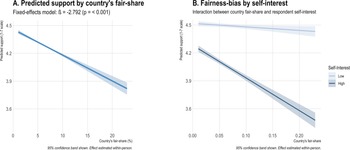
Third, to test our second hypothesis of a fairness bias in respondents’ preferred principles of refugee distribution, we estimate whether public support for a given fairness principle depends on its distributional consequences for the respondent’s country. Specifically, we assess whether support decreases when the principle would result in a larger national share of asylum seekers. These effects are operationalised as the country’s proportionate share (in percentage points) under each principle: population size, national wealth (total GDP), unemployment rate, previous refugee intakes, and reception costs (see Figure A10 in the Appendix).
Population size and GDP are translated directly into proportional country shares. For indicators that do not inherently reflect country size – unemployment, previous intakes, and reception costs – we calculate proportional fair shares using an inverse measure, adjusted for country size.Footnote 9 Specifically, unemployment is expressed as employment capacity (the inverse of the unemployment rate multiplied by population), previous intakes are converted into per-capita contributions and inverted, and reception costs are calculated as per-refugee expenditures and inverted. All shares are then normalised so that they sum to one across the EU. This approach ensures that countries with higher unemployment, larger past intakes, or higher reception costs receive proportionally lower fair shares. Population, GDP, unemployment, and previous intake data are drawn from Eurostat, while reception costs are based on OECD-reported in-donor refugee expenditures divided by the number of asylum seekers received over the preceding five years.
To examine how support for different fairness principles relates to the country’s proportionate share, we estimate a within-respondent fixed-effects model pooling all principles and including respondent fixed effects. This design compares support across principles within the same individual, thereby isolating the effect of the implied proportionate share while controlling for unobserved, time-invariant characteristics.Footnote 10 Standard errors are clustered at the respondent level, and robustness checks assess effect stability. In addition, we probe the assumed mechanism using an interaction with respondents’ concern for national self-interest in refugee allocation.
Results
We organise the presentation of results following the structure of the theoretical section. First, we examine whether citizens recognise the allocation of refugees across EU member states as a matter of fairness at all and the three sub-questions we formulated in that regard. Next, we investigate public support for different principles of distributive fairness. Finally, we test the hypotheses concerning the nature and drivers of fairness preferences formulated above.
Do citizens recognise the EU distribution of refugees as a question of fairness?
We begin with descriptive analyses to assess the validity of the three dimensions of fairness reasoning outlined above. A first stand-out finding, that speaks directly to the evaluative dimension, is that large majorities across Europe perceive the current distribution of refugees as unfair. The differences between the countries are also limited. The share of respondents that assess refugee distribution as rather fair varies between 17% in Greece and 26.5% in Poland. A clear pattern emerges: In countries more exposed to refugee arrivals – Greece (17%), Italy (21.1%), and Germany (20.9%) – perceived fairness is lower than in the less exposed countries of Poland (26.4%), Hungary (24.9%), and Denmark (25.4%).
On the normative dimension, we find that a substantial majority of respondents agree that European migration policy should be designed to ‘ensure that the distribution of refugees within Europe is as fair as possible’. Specifically, 71.2% of respondents endorse fairness as an important aim for asylum policy. This pattern of endorsement is consistent across countries, though the level of agreement varies somewhat and resembles the previous distribution: Exposed countries care more about fairness – Greece (87.1%), Italy (86.7%), and Germany (84.7%) – than those receiving a smaller number of refugees – Denmark (68.2%), Hungary (66.2%), and Poland (66.3%). These findings indicate that fairness as a guiding principle for refugee distribution resonates broadly with the public, albeit with regional variation reflecting differences in national experiences and interests within the EU asylum regime.
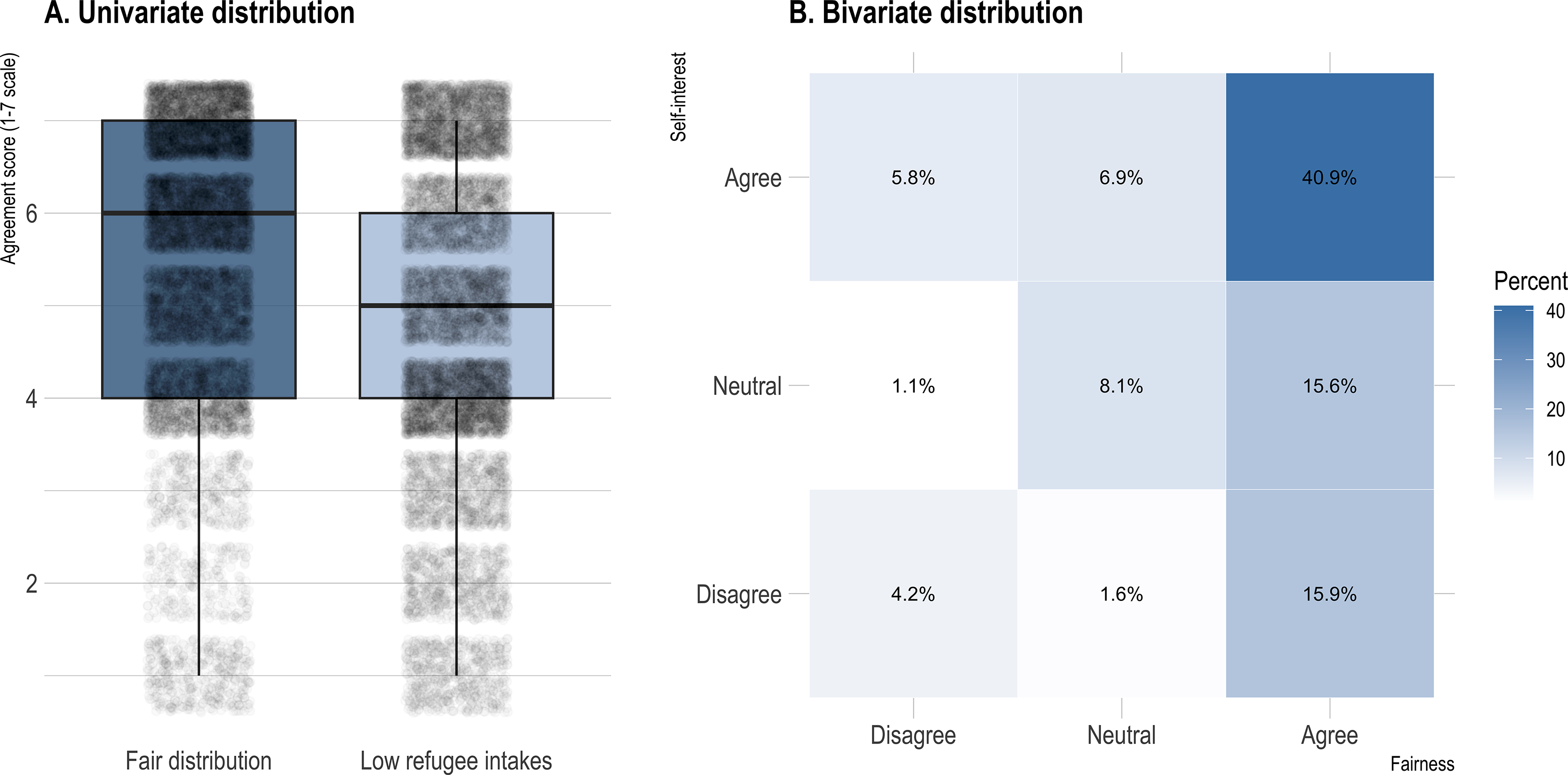
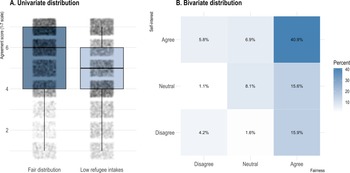
Notably, however, a preference for fairness does not preclude respondents from also agreeing that European migration policy should aim to minimise the number of refugees in their own country. While support for this self-interest aim is significantly lower than support for the fairness aim, many respondents simultaneously endorse both rationales (40.9%) (Figure 1). The share of respondents that agrees with the fairness principle while explicitly rejecting the minimisation goal is 15.9%. By contrast, the groups who support only national self-interest of minimal refugee intake or who reject both rationales are much smaller. Overall, the weak correlation between the two items (Spearman’s ρ = 0.06) suggests that fairness and national self-interest are perceived as largely independent principles in public opinion.
Support for fairness and self-interest in refugee distribution.
Note: Plots showing the univariate (box plot) and bivariate (heatmap) distribution of public support of allocation rationales (fairness and self-interest) in refugee distribution. The boxplot uses the original variables based on the seven-point Likert scale, and the heatmap recodes the variable into agree (above four), neutral (four), and disagreement (below four).
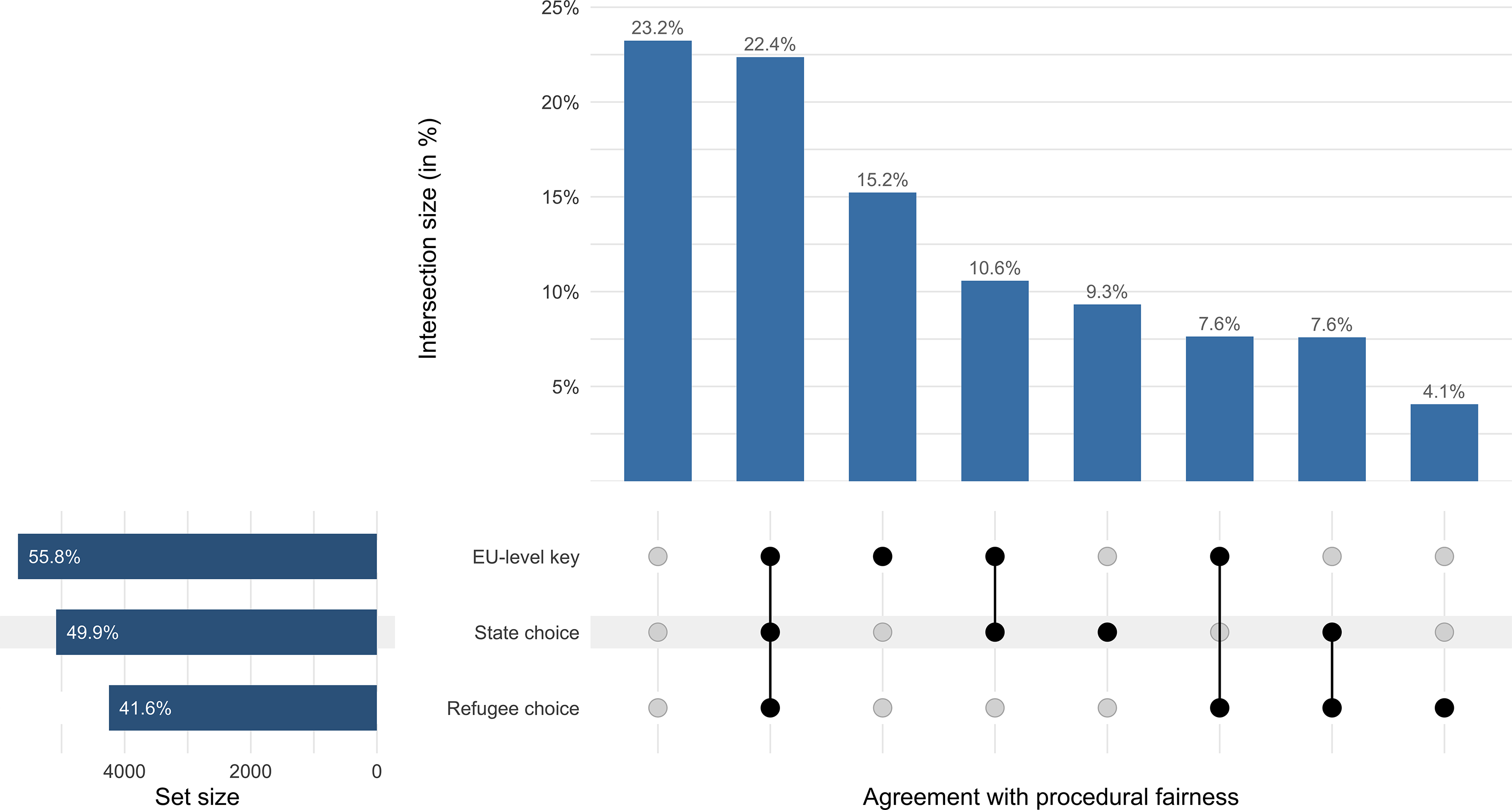
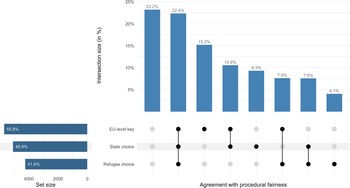
We then examine the institutional dimension of fairness judgements: whether citizens view the distribution of refugees as a matter best handled at the EU level or whether they prefer a system in which allocation decisions are left to individual states or to refugees themselves. As shown in Figure 2, citizens do not appear to perceive these principles as mutually exclusive. In fact, there is substantial support for all three (even though of all possible combinations, the single most popular one is the one in which none of the modes is supported). Crucially for our analysis, the EU distribution key receives the most consistent endorsement and is the only principle with clear majoritarian support. State choice is the second most popular principle and refugee choice the least supported one. This preference ranking becomes even more pronounced when looking at the share of respondents that strictly prefer each principle (Appendix: Figure A3).
Preferred mode of refugee distribution.
Note: The UpSet plot shows how respondents combine support for different procedural fairness principles (a binding EU-level distribution key, a model of sovereign state choice, and a free choice model based on the preferences of refugees). The vertical bars (top) indicate the share of respondents who agree with each combination of principles. The connected dots below each vertical bar indicate which principles are included in that combination: a black dot means the principle is supported in that combination, and a grey dot means it is not supported. The bars on the left show the total number of respondents agreeing with each individual principle.
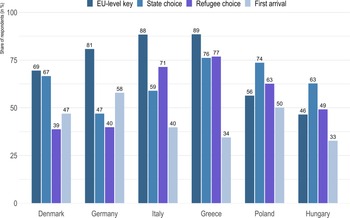
There are significant differences between the six countries on which actors should be central in deciding over the way refugees are allocated (Figure 3). An EU-level distribution key is the most preferred option in Greece, Italy, Germany, and Denmark. In contrast, in Poland and, especially, Hungary the state choice principle is the most preferred principle, and even refugee choice still ranks above an EU-level distribution key. In general, in the Southern countries, Greece and Italy, respondents seem keen to embrace any principle to replace the current first-entry rule. In contrast, the Northern Europeans are much less supportive of the principle of refugee choice. These strong divergences between EU countries in their support for an EU-level distribution key is bound to complicate the possibility of member states being able to agree on such a key (even regardless of which exact criteria this key should be based on).
Procedural fairness preferences by country.
Note: Bar plots displaying the share of respondents that support a fairness principle (ignoring neutral responses) with rounded annotated percentages (to full percentage points), grouped by country.
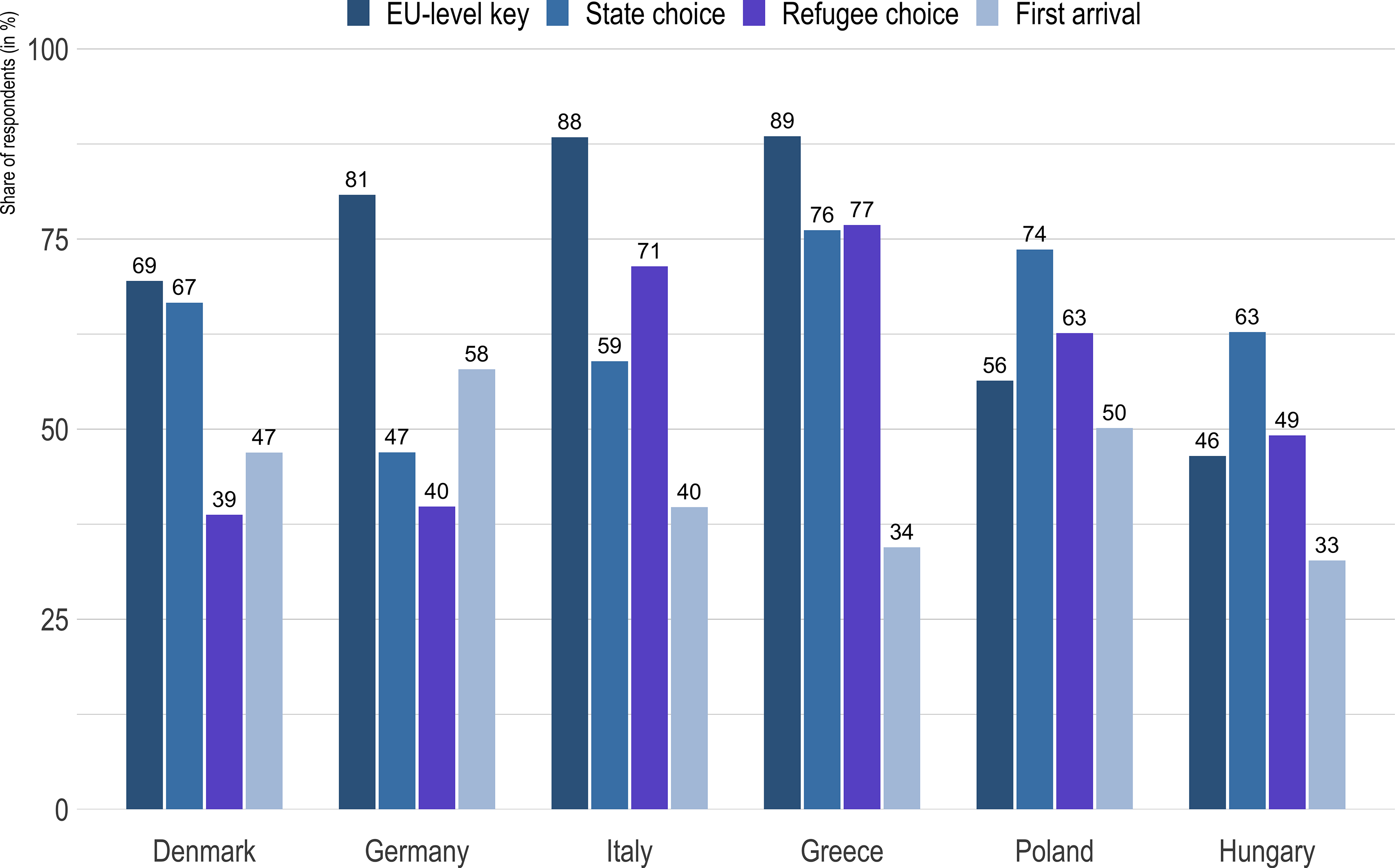
The current rule of first-entry is clearly the least popular among all options. Opposition is biggest in the frontline countries, not only Greece and Italy but also Hungary. Only in Germany, there is a firm majority in support of the current rule of first entry. Notably, this is also the only country where the first-entry rule still ranks higher than the alternatives of state choice or refugee choice.
Which distributive principles are supported?
Having established that citizens engage with refugee distribution as a question of fairness, we now turn to the kinds of normative principles that citizens support for distributing refugees among states (Figure 4). All five distributive principles receive majority support, indicating that endorsement of one principle does not preclude support for others.Footnote 11 Nevertheless, support levels vary by roughly 15 percentage points. Refugee allocation based on wealth attracts the highest support, followed by reception costs and previous intakes, while unemployment and population size receive the lowest support. This ranking of different principles remains largely the same when using the mean values of the support scale instead of the percentage of respondents that support the principles or when considering the share of respondents that rank each principle as their most preferred (see Figures A2 and A3 in the Appendix).
Support for principles of distributive fairness.
Note: Bar plots displaying the share of respondents that support a fairness principle (ignoring neutral responses) and rounded annotated percentages (to full percentage points), grouped by country. For further descriptive statistics on these fairness preferences, see Figures A1 to A9 in the Appendix.
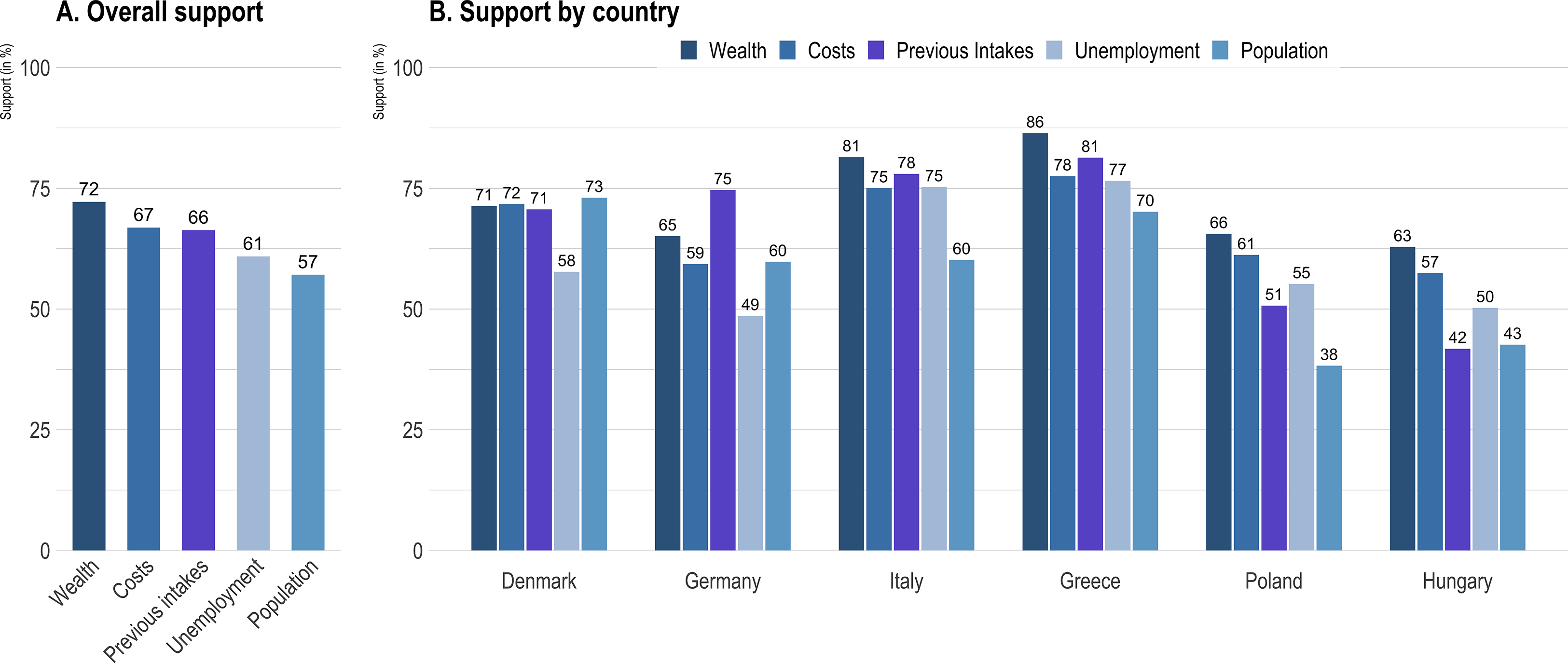
Figure 4. Long description
Panel A: A bar graph comparing overall support for different principles of distributive fairness. The horizontal axis lists categories: Wealth, Costs, Previous Intakes, Unemployment, and Population. The vertical axis measures support in percent. The bars are vertical and grouped. Wealth has the highest support at 72 percent, followed by Costs at 67 percent, Previous Intakes at 66 percent, Unemployment at 61 percent, and Population at 57 percent. Panel B: A bar graph comparing support by country for the same principles. The horizontal axis lists countries: Denmark, Germany, Italy, Greece, Poland, and Hungary. The vertical axis measures support in percent. The bars are vertical and grouped. Each country has five bars representing Wealth, Costs, Previous Intakes, Unemployment, and Population. Denmark shows support values of 71 percent for Wealth, 72 percent for Costs, 71 percent for Previous Intakes, 73 percent for Unemployment, and 65 percent for Population. Germany shows support values of 65 percent for Wealth, 59 percent for Costs, 75 percent for Previous Intakes, 60 percent for Unemployment, and 49 percent for Population. Italy shows support values of 81 percent for Wealth, 78 percent for Costs, 75 percent for Previous Intakes, 75 percent for Unemployment, and 60 percent for Population. Greece shows support values of 86 percent for Wealth, 78 percent for Costs, 81 percent for Previous Intakes, 77 percent for Unemployment, and 70 percent for Population. Poland shows support values of 66 percent for Wealth, 61 percent for Costs, 51 percent for Previous Intakes, 55 percent for Unemployment, and 38 percent for Population. Hungary shows support values of 63 percent for Wealth, 57 percent for Costs, 42 percent for Previous Intakes, 50 percent for Unemployment, and 43 percent for Population.
Examining variation across the six countries, we find that majorities in all six countries examined support the economic principles, wealth, and reception costs, with the support for the wealth principle exceeding 60%, also in the wealthier countries. Respondents from Greece and Italy, closely followed by those from Denmark, are the most supportive of all principles presented, except for population size, which sees less support among the Italians. It is also the respondents from these countries that drive the overall high support of the principles of wealth and costs. In contrast, respondents from the Eastern European countries, Poland and Hungary, are less supportive of all distributive principles across the board, but only for previous intakes and population does support in these countries fall below the fifty percent line. The German respondents stand out because the most favoured principle among them is previous intakes, and they are much more sceptical about the other principles compared to, for instance, the Danes. Overall, the aggregated preferences are still mostly similar within the regions. This variation is a first indication of a ‘fairness bias’ in preferring the principles that are most likely to minimise the number of refugees allocated to one’s own country, which we examine more systematically below.
These findings suggest that the main differences between the countries are actually in the levels of support for any distributive principle and less so in the order in which principles are preferred. To formally test whether the structure of fairness preferences is indeed equivalent across the six European countries, we use multi-group confirmatory factor analysis (CFA) (see Appendix II for the detailed results). The ten fairness criteria were modelled as two latent factors (distribution and procedures). Results indicate configural invariance, meaning that respondents in all countries distinguish between distributive and procedural fairness. However, metric and scalar invariance do not hold, suggesting that the relative importance of each criterion and baseline endorsement levels vary between countries. This implies that, while there are some similarities in the ways people think about the structure of fairness, there are significant cross-national differences in how fairness is understood substantially.
Probing our data a bit more, we find that fairness preferences tend to follow the same pattern regardless of ideological predisposition. We focus on two in particular: general attitudes toward refugee protection and support for fairness and self-interest as guiding principles for refugee distribution. Comparing fairness preferences by support for refugee protection reveals that anti-refugee respondents express systematically lower support for fairness principles (Figure A9 in the Appendix). Still, the relative ranking of principles is broadly consistent across groups, with the exception that anti-refugee respondents place greater emphasis on state choice as an allocation procedure.
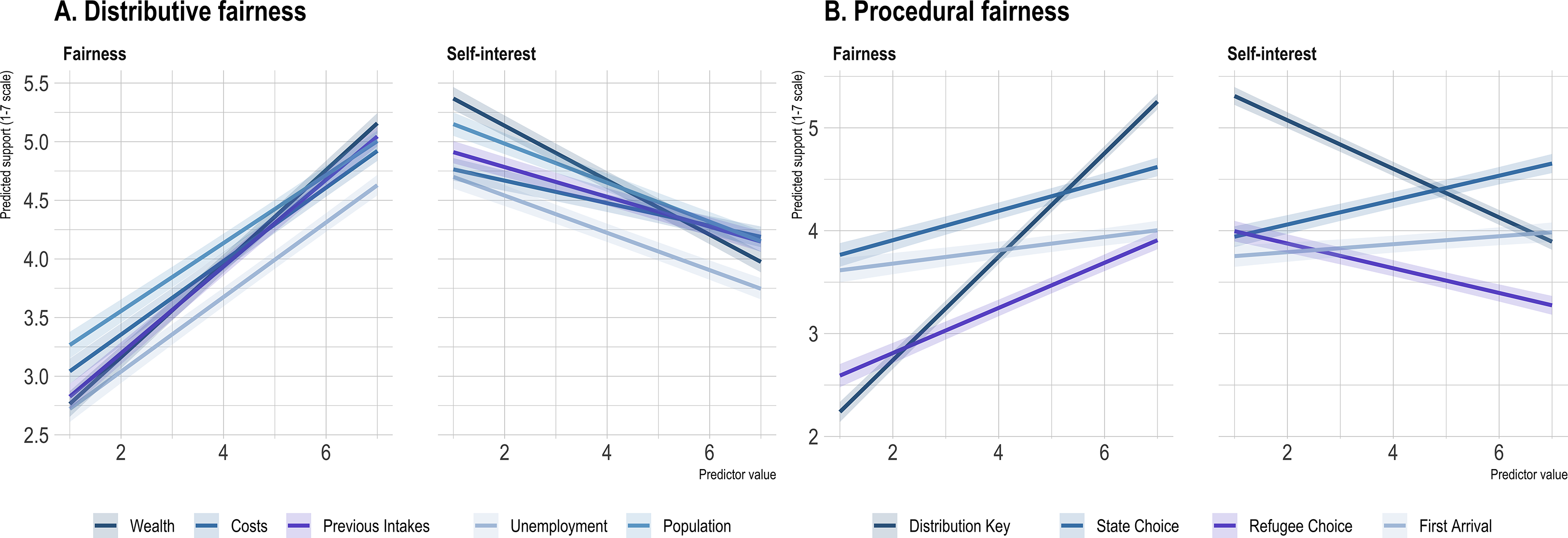
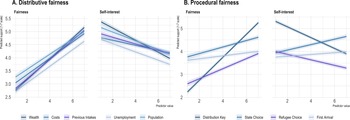
Similarly, the fairness–self-interest dimension has little impact on the way people order their preferences for the different principles. While fairness concerns increase support for fairness principles, self-interest concerns reduce it, with the fairness effect being roughly twice as large as the self-interest effect (Figure 5). For distributive fairness, the two allocation rationales shape support in almost identical ways, while procedural fairness shows greater variation with the strongest effect on support for an EU-level distribution key. Furthermore, and against the general pattern, self-interest concerns tend to increase support for the principle of state choice and for the status-quo principle of first arrival.
Effect of allocation rationales on support of fairness principles.
Note: Predicted probability plots with 95% confidence intervals based on linear regression models with country fixed effects. For model output, see Table A1 in the Appendix.
Testing the explanatory hypotheses
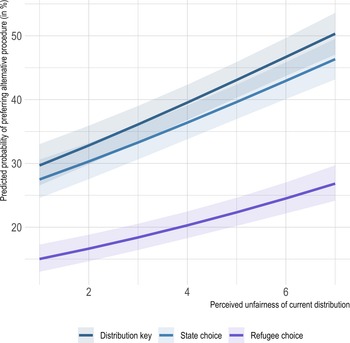
To explain public preferences for different allocation procedures, our first hypothesis states that the more people perceive the distribution of refugees as unfair the more they prefer alternative fairness procedures over the status quo of the Dublin system’s first-arrival rule. This expectation is confirmed for all alternative allocation procedures, with effects of similar size (Figure 6). Moving from perceptions of maximum fairness to perceptions of maximum unfairness almost doubles the probability of supporting an alternative allocation procedure over the status quo. Still, the level for all alternatives remains below 50%. This is primarily because there is a significant share of respondents that prefers neither the status quo nor the proposed alternative, while those preferring any alternative still exceeds those preferring the status quo (Appendix: Figure A13). Also, these results are robust to the inclusion of socio-demographic control variables (age, gender, education) and the use of a continuous operationalisation of support instead of a dichotomous one (see Figure A11 in the Appendix).
Effect of unfairness perceptions on support for alternative allocation procedures.
Note: Coefficient plot based on a logistic regression model, with 95% confidence intervals based on country-clustered standard errors, predicting support (binary) for alternative procedures of refugee distribution over the status quo of the first-arrival rule in dependence of respondents’ perceived unfairness of the current distribution of refugees, controlling for age, gender, education, and refugee attitude. Model outputs in Table A2 in the Appendix.
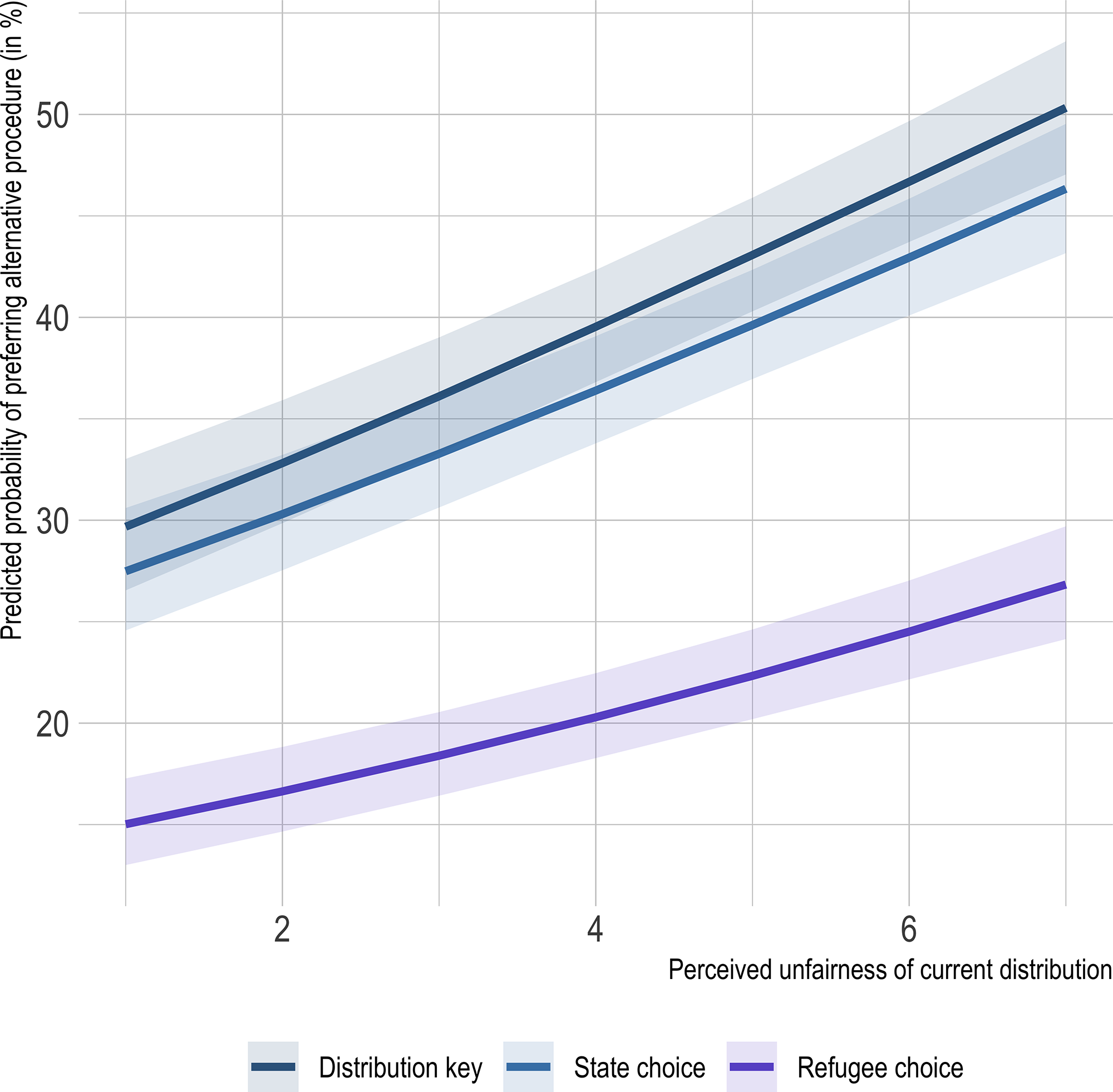
This finding suggests that the asymmetric distribution of refugees across European countries has the potential to mobilise public support for policy reform; the more people object to the current situation, the more open they are to alternative criteria. Still, the fact that this criticism drives both support for an EU-level distribution as well as for the principle of state choice also indicates that a shared aversion of the present situation does not necessarily lead to consensus on a preferable alternative. While perceived unfairness shifts relative preferences against the status quo, it also associated with increased skepticism toward the concrete fairness principles, highlighting the broader challenge of securing policy legitimacy among those critical of refugee admission.
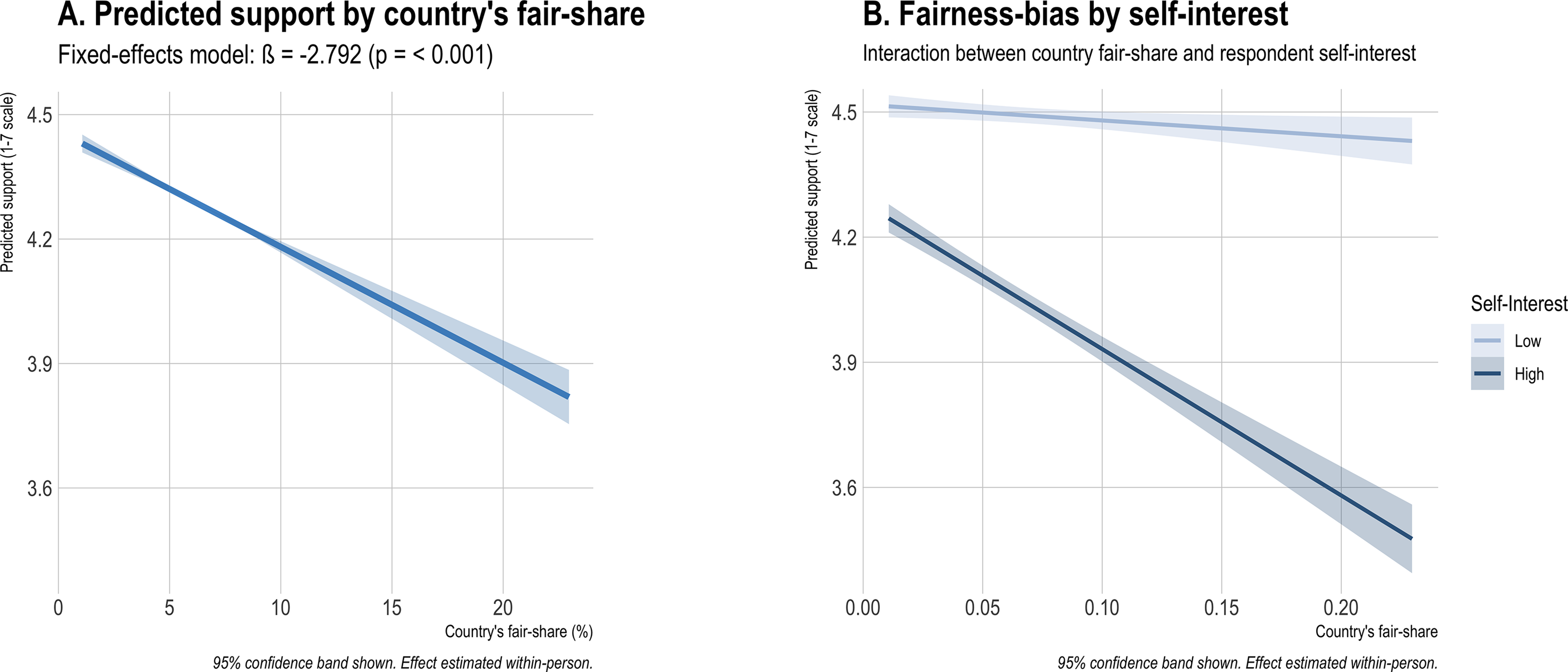
With respect to our second hypothesis, the descriptive findings already show that both the level and relative ranking of support for fairness principles vary systematically by states’ geographic position. This suggests that respondents may be biased in preferring principles that reduce the share of refugees that their own country is expected to take. To test the hypothesis that national self-interest shapes fairness preferences, we estimate regression models predicting respondents’ support for different fairness principles from their country’s hypothetical proportionate share under each principle (Figure 7A). Results show a statistically significant negative association between the size of the hypothetical share and support for the corresponding principle, indicating that respondents are more likely to support principles that minimise their country’s burden.Footnote 12 The hypothetical fair share does thus influence whether the reported attitudes tend towards support (>4) or opposition (<4) of a given fairness principle. This confirms the presence and substantive importance of a ‘fairness bias’.Footnote 13 To further validate this interpretation, we assess effect heterogeneity based on respondents’ national self-interest concern of burden minimisation (Figure 7B). Respondents that do not support national self-interest in refugee allocation show a relatively high and stable support level regardless of the proportionate share that their country would need to shoulder. In contrast, respondents that consider the reduction of their country’s refugee intakes important in refugee allocation significantly reduce their support for fairness criteria that would imply a higher share for their country. This pattern supports the assumed mechanism that the estimated fairness bias is indeed driven by perceived self-interest.
Effect of hypothetical share of refugees on support of fairness principle.
Note: The figure on the left shows the predicted level of support for fairness principles as a function of a country’s fair share of asylum seekers derived from those principles. Predictions are based on a fixed-effects regression model that controls for individual respondent and country-level unobserved heterogeneity. The dark blue line represents the estimated linear effect, while the shaded area indicates the 95% confidence interval. The figure is restricted to the range of observed data. Model output is Table A3 in the Appendix. The figure on the right shows the predicted support levels of fairness principles in dependence of respondents’ self-reported self-interest (ie concerned with burden minimisation in their own country when it comes to refugee allocation). Self-interest is measured on a 1–7 scale. ‘Low’ and ‘High’ indicate respondents below (values 1–4) vs. above (values 6–7) the sample median. The underlying variable is mean-centred for estimation.
Conclusion
Establishing international responsibility sharing in refugee protection by distributing asylum seekers across countries is a matter of fairness between states. Yet it remains unclear whether European publics agree on what share of protection responsibilities each country should take and which principles should guide that allocation. This study addresses this question by examining fairness preferences among citizens in six EU member states. While most Europeans strongly support the idea of a fair distribution of asylum seekers, they also tend to prefer keeping their own country’s intake to a minimum. This tension reflects a classic collective action problem in asylum governance: reconciling a shared commitment to refugee protection with the desire to minimise one’s own costly contributions.
Our findings reveal a widespread agreement on the unfairness of the status quo, but a divergence on the desirable change. Across all surveyed countries, large majorities view the current distribution of refugees as unfair, and the prevailing first-arrival rule emerges as the least popular policy option. In contrast, a clear majority supports an EU-level distribution key, which is the most popular allocation procedure in most countries – except in Eastern Europe, where citizens express higher support for discretionary national control. Citizens who perceive refugees being unfairly distributed are generally more supportive of alternative distributive principles relative to the status quo. However, their preferred alternatives often go in different directions. Variation is significant in public preferences over possible distributive criteria: economic indicators such as national wealth and reception costs enjoy the strongest support, whereas a simple proportional rule based on population size is least popular. Notably, the comparative analysis reveals a fairness bias: respondents tend to endorse those principles that would reduce their own country’s share of protection responsibilities. The effect remains, however, modest and confined to a subset of respondents, as large proportions of the population tend to support fairness principles that are not conducive to minimising refugee intakes.
The surface-level consensus on the desirability of fair and equitable responsibility sharing masks deeper divergences. While Bansak, Hainmueller and Hangartner (Reference Bansak, Hainmueller and Hangartner2017) have suggested that Europeans share the same fairness ideas when it comes to the allocation of protection responsibilities, our analysis reveals that not only does the level of support for fairness principles vary significantly by states’ geographic position – systematically lower in Eastern Europe and systematically higher in Southern Europe – but also the relative ranking of different fairness principles varies significantly. These divergences are not merely ideational; they are driven in part by regional and self-interested considerations. In other words, while there is convergence on the diagnosis, there is divergence on the cure. These results are in line with established empirical justice research (Konow Reference Konow2003; Schleich, Dütschke, Schwirplies et al. Reference Schleich, Dütschke, Schwirplies and Ziegler2014; Liebig, Sauer and Friedhoff Reference Liebig, Sauer and Friedhoff2015; Rodon and Sanjaume-Calvet Reference Rodon and Sanjaume-Calvet2020), confirming that fairness perceptions are in many respects context-dependent. It also mirrors the politics of European asylum governance, where the abstract commitment to ‘solidarity’ and ‘fair sharing’ enjoys wide support, but the concrete operationalisation and implementation of these principles is precisely where resistance among governments and segments of domestic electorates emerges.
It remains a formidable political challenge to find a model of refugee distribution that can command wide support among EU publics. Public preferences on European migration policy tend to align with those of national governments (Wasserfallen and Woeffray Reference Wasserfallen and Woeffray2025), suggesting that political elites play an important role in shaping opinion in this domain. Our findings indicate that governments seeking to build support for responsibility sharing can draw on fairness principles that find broad public endorsement across member states. At the same time, any pathway toward consensus will remain subject to political competition between parties prioritising the minimisation of national intakes and those advocating a fair distribution model. Moreover, survey preferences may not translate straightforwardly into policy support when citizens are confronted with concrete trade-offs and competing political messages.
With these dynamics in mind, our findings nonetheless offer some pointers. Politicians can depart from the widely shared perception that refugees are distributed in an unfair manner. In forging an alternative, they can exploit the fact that respondents across regions seem open to multi-faceted approaches: a common key can weigh together multiple criteria, taking into account different fairness considerations (cf. Gan Reference Gan2026). In that respect, the formula envisaged in the New Pact on Migration and Asylum points in the right direction, even if it combines what we find to be the least popular criterion (population size) with the most popular one (wealth). A more precise calibration between criteria that speak to the concerns of different regions may help build broader coalitions. Incorporating wealth indicators may resonate more with Southern European countries, while factoring in past refugee intake could appeal to Northern Europe’s sense of fairness. In the case of Eastern Europe, the most resistant region, including cost-related considerations or limited exemptions for state discretion may be necessary, as long as they do not undermine the integrity of the overall system. Ultimately, any such complex mechanism will require supportive political elites willing to communicate why it constitutes a fair arrangement. This requires communicating to domestic constituencies how incorporating different criteria is justified by the legitimate concerns of citizens in other EU member states (cf. Savage and Weale Reference Savage and Weale2009).
Building on the broad consensus that the current refugee allocation system and resulting distributive outcomes are unfair – but with persistent divisions over viable alternatives – future research should explore citizens’ openness to considering fairness principles beyond their immediate preferences. Interactive experiments or focus groups could be valuable to expose participants to alternative allocation principles and perspectives from other countries. A limitation of our study is that we cannot distinguish whether fairness perceptions are based on accurate or inaccurate knowledge of the actual distribution of refugees. Future research could examine the role of factual knowledge and information provision in shaping these perceptions. Given that progress in reforming and implementing the refugee allocation regime is stalling largely due to disagreements among EU member states and their publics, understanding how deeply entrenched these views are, and which opinions may be more amenable to change, is essential for paving the way toward greater cooperation and fairer responsibility sharing.
Supplementary material
The supplementary material for this article can be found at https://doi.org/10.1017/S1475676526101595
Data availability statement
The data and replication code necessary to reproduce the analyses in this article are available as supplementary materials accompanying the published article.
Acknowledgements
The authors gratefully acknowledge insightful comments on the survey provided by Oskar Chmiel, Jascha Grübel, Maria Kourpa, Rafael Labanino, Matilda Rosina, Tanja Schweinberger, Renata Stefańska, and Natascha Zaun. Previous versions of this article have been presented at the 22nd IMISCOE Annual Conference (1–4 July 2025, Institut Convergences Migrations, Aubervilliers–Paris) and the ECPR General Conference 2025 (26–29 August 2025, Aristotle University of Thessaloniki). We are grateful in particular to Nieves Fernández Rodríguez and the three reviewers for the helpful feedback.
Funding statement
This work was supported by the Schweizerischer Nationalfonds zur Förderung der Wissenschaftlichen Forschung (208858).
Competing interests
None.
AI use disclosure
AI tools (GPT-5) were used to assist with language editing and statistical coding.
Ethics approval
Full IRB approval by the University of Geneva (CUREG-2024-07-87).



 Open access

