





Introduction
In the neighborhood of Curtis Bay in South Baltimore, residents have been caught between zealous industrial polluters, public and private waste management facilities, and an apathetic regulatory agency for over a century. Beginning with a guano factory in the late 1800s, the once lush hinterlands now known as Baltimore’s industrial peninsula were rapidly reshaped to house and dispose of the city’s undesirables: hazardous industries, toxic waste, southern Black migrants, and Eastern European immigrants (Fabricant Reference Fabricant2022). Predictably, wartime industries, segregated substandard housing, and political and economic neglect followed. Today, the area hosts dozens of polluting industries, including a medical waste incinerator, a coal terminal, a hazardous waste landfill, a wastewater treatment plant, and petroleum and other chemical plants. While the neighboring communities of Fairfield and Wagner’s Point have been engulfed by and sacrificed to industry, the residents of Curtis Bay remain. The community is still racially heterogenous and low income, and most of the development that happens is industrial. Residents’ daily lives include the constant sounds of high-speed truck traffic, the putrid odors of waste and chemicals, and a layer of fine black dust that coats their homes. In December 2021, an explosion occurred at the CSX coal terminal in Curtis Bay. It was felt throughout many parts of the city, but the residents closest to the blast were the most impacted. Homes were shaken and had windows blown out, people were terrified and confused, and answers were hard to come by. What caused the explosion? Would it happen again? Would the state do anything?
After the explosion, the Maryland Department of the Environment (MDE) secretary contacted Greg Sawtell, an environmental justice organizer at the South Baltimore Community Land Trust (SBCLT), to open a dialogue about environmental polluters in Curtis Bay. In many environmental justice communities, organizers find ways to document and study pollution on their own in the absence of an engaged regulatory agency, so by the time MDE reached out, SBCLT had already organized a team of public health researchers committed to studying the cumulative impacts of pollution in the neighborhood (O’rourke and Macey Reference O’rourke and Macey2003). The team of researchers and organizers, called the cumulative impacts group, began meeting with representatives from MDE every other week.
As lawyers and scholars grapple with the role of the law in mitigating and responding to climate change, it is essential to remember that this global issue is often rooted in local injustices. Industrial manufacturing, burning fossil fuels, and waste incineration pose threats not only to our global climate but also to the communities in which they are located, and these communities frequently attempt to mobilize the law to fight back. This article contends with the hyperlocal nature of climate change by analyzing a case of legal mobilization by a Baltimore-based grassroots environmental justice organization. I show that environmental justice activists made legal claims in a state regulatory venue, and by doing so, they were able to learn the state’s enforcement norms and logic and use that understanding to sharpen their organizing strategies.
It is no secret that the Environmental Justice Movement has seen minimal legal success. While activists have been able to stop permits from being issued, they rarely win legal cases and have not been able to achieve the ultimate goal of creating healthier communities by removing polluters (Eady Reference Eady, Agyeman, Bullard and Evans2003; Konisky Reference Konisky2015; Roberts and Melissa Reference Roberts and Melissa2001; Walsh and Warland Reference Walsh and Warland2010). Pulido and her co-authors argue that these failures are inevitable because it is impossible to use the existing legal mechanisms of the state to achieve environmental justice (Pulido et al. Reference Pulido, Kohl and Cotton2016). Social movement scholars have long argued that working with or through the state can force movement actors to compromise their goals and claims to fit the available political structures and processes (Davenport Reference Davenport2015; Lima Reference Lima2021; Rojas Reference Rojas2010). Mobilization can open movements up to co-optation – when more powerful actors adopt the language of a movement but dilute its radical claims and ideas – by funders, lawyers, corporations, and regulators who have their own agendas and legal ideas (Blumberg Reference Blumberg1967; Cummings and Eagly Reference Cummings and Eagly2000; McMillan Reference McMillan2011).
However, assuming that any turn to the state by environmental justice groups will result in co-optation underestimates organizers’ creativity, adaptability, and ingenuity. Through meeting with state environmental regulators, SBCLT organizers gained insider knowledge about the black box of regulation, a strategy that helped shape their demands and tactics. I term this strategy co-optation from below, highlighting the power asymmetries that usually leave groups vulnerable to co-optation by the state and powerfully positioned private actors.
The rest of the paper proceeds as follows. In the first section, I bring together literature on legal mobilization, environmental regulation and co-optation to contextualize state regulatory agencies as venues for legal mobilization. In the second section, I offer a brief history of the Environmental Justice Movement and how it has been co-opted. In the third section, I discuss my methodological approach and my position as a participant ethnographer with SBCLT. In the fourth section I present a narrative analysis of SBCLT’s legal mobilization, showing how the process led to strategic shifts by the organization. In the final section, I conclude with some implications of this study for environmental justice organizing and studies of legal mobilization.
Legal mobilization, environmental regulation, and co-optation
Scholarship on legal mobilization is attentive to how social movement groups articulate their demands as claims to legal rights and how these claims shape popular and institutional conceptualizations of the law (Lovell Reference Lovell2006; McCann Reference McCann2006, Reference McCann1994). The legal mobilization framework requires us to attend to the complexity of interactions between social movements, law, institutions, and politics, including the various institutional contexts through which movements might mobilize the law (Boutcher and Chua Reference Boutcher and Chua2018; Lehoucq and Taylor Reference Lehoucq and Taylor2020; McCann Reference McCann2006).
Most studies of legal mobilization focus on litigation, the extent to which the courts can produce significant social change, and the impacts of litigation on social movements. Proponents of the “dynamic courts” view emphasize the deliberative capacity of courts and the fairness of access. They argue that formal legal action has been used by social movements to expand rights to excluded groups, achieve policy reform, and generate major cultural shifts (Cummings and Rhode Reference Cummings and Rhode2009; Epp Reference Epp1998; Lehoucq and Taylor Reference Lehoucq and Taylor2020; McCann Reference McCann1994; Woodward Reference Woodward2015). The process of mobilization can also be educative for movement actors, and lead to an increase public legitimacy as they come to be perceived as subject experts (Gallagher and Yang Reference Gallagher and Yang2017; Kim and Arrington Reference Kim and Arrington2023).
Those skeptical about the power of the courts emphasize gaps between the law as written and the law as practiced, showing how lackluster enforcement often undermines legal decisions (Edelman Reference Edelman2016; Larkin Reference Larkin2007; Lauren et al. Reference Lauren, Sally Riggs Fuller and Mara-Drita2001; Pedriana and Stryker Reference Pedriana and Stryker2017). They argue that the judiciary lacks the authority to translate court decisions into action and that public interest litigation can only lead to incremental reforms (Galanter Reference Galanter1974; Handler Reference Handler and Handler1978; Rosenberg Reference Rosenberg2008). The limited nature of constitutional rights constrains courts; they are not responsible for policy implementation or enforcement, they are susceptible to political pressures, and they favor influential repeat players (Galanter Reference Galanter1974; NeJaime Reference NeJaime2011). Activists also must consider legal precedents, political opportunities, and social norms, which often force them to dilute their claims or frame legal challenges as individual rather than collective (Goldberg Reference Goldberg2014; Leachman Reference Leachman and Sarat2013; McCammon et al. Reference McCammon, Hearne, McGrath and Moon2018; Pedriana and Stryker Reference Pedriana and Stryker2017; Rubenstein Reference Rubenstein1996). Movement leaders can face internal backlash from members who disagree with litigation tactics (NeJaime Reference NeJaime2011; Vanhala Reference Vanhala and Sarat2011). The costly process of litigation can divert resources away from other social movement activities used to generate change, and litigation success can lead to demobilization (Francis Reference Francis2019; Southworth Reference Southworth1998; Vanhala Reference Vanhala and Sarat2011). Mobilizing rights claims through formal legal channels is not always a feasible option, as Chua shows in her study of gay rights mobilization in Singapore, and activists must make strategic choices about what contexts to mobilize the law in (Chua Reference Chua2012).
This article contributes to a growing body of literature examining how movement groups mobilize the law at the point of enforcement. Barnes and Burke’s study looks at organizational responses to mobilization around disability access laws across the public, private, and nonprofit sectors (Jeb and Burke Reference Jeb and Burke2012). Woodward’s study of legal mobilization by the National Organization for Women (NOW) applies McCann’s framework to the context of a federal agency by looking at how NOW worked to change how the EEOC interpreted and enforced Title VII (Woodward Reference Woodward2015). Similarly, Pedriana and Stryker argue that the EEOC became a proactive enforcement agency because of targeted mobilization by civil rights movement actors (Pedriana and Stryker Reference Pedriana and Stryker2004). Gordon’s work focuses on how immigrant workers mobilize for the enforcement of labor laws and fair working conditions (Fine and Gordon Reference Fine and Gordon2010; Gordon Reference Gordon1995).
State regulatory agencies are a unique and severely understudied institutional context for legal mobilization. They are tasked with transforming often vague laws into “effective and sensible social controls” and seek to strike a balance between social benefits and compliance costs (Kagan Reference Kagan1989, 9). Where courts are weak, regulatory agencies are quite strong.
As legal mobilization scholars note, they interpret laws and have the powers to enforce them – they control the sword and the purse (Rosenberg Reference Rosenberg2008). Rather than being bound by legal precedent and the law as written, they have the flexibility to determine how the law is practiced (Eady Reference Eady, Agyeman, Bullard and Evans2003; Gauna Reference Gauna1998; Liévanos Reference Liévanos2012). Federal law provides minimum standards that state agencies must enforce. However, many states have enacted their own environmental justice laws in the face of stalled federal efforts, so state regulations are often more stringent than federal (Paul et al. Reference Paul, Pellow and Timmons Roberts2009).
Regulators also face considerable political and economic pressure to limit their interference with industry (Faber Reference Faber2008). Enforcement styles vary between states, neighborhoods, cities, and counties (Kagan Reference Kagan1989; Konisky et al. Reference Konisky, Reenock and Konisky2015; Konisky and Reenock Reference Konisky and Reenock2018). The “race to the bottom” thesis argues that to compete for business investments, states avoid passing more restrictive environmental policies than their neighbors (Woods Reference Woods2006). Similar to industries, which choose to site hazards in the communities they believe will offer the least political resistance, state agencies take fewer enforcement actions where they face (or believe they will face) less pushback (Cole and Foster Reference Cole and Foster2001; Konisky and Reenock Reference Konisky and Reenock2013; Wilson et al. Reference Towers2008; Towers Reference Towers2000). When environmental justice groups pressure them to take action, they refuse to close facilities that are in violation or claim they have no regulatory levers to pull (Pulido et al. Reference Pulido, Kohl and Cotton2016; Richter Reference Richter2018). Thus, environmental racism – intentionally polluting specific communities – is compounded by compliance bias – ignoring violations in those communities (Konisky and Reenock Reference Konisky and Reenock2013).
At face value, state environmental agencies do not seem like promising venues for environmental justice groups to make their claims. Their mandates are confusing at best, and the political will behind them is inconsistent. Due to state agencies’ discretion in determining and taking enforcement measures, the risk of industry capture is even higher (Cummings and Rhode Reference Cummings and Rhode2009). Civil society checks – watchdog groups, journalists, and public interest organizations – have evolved to monitor the federal administrative state as it has grown but have not proliferated at the state level (Seifter Reference Seifter2018). In contrast, private interest groups and their lobbyists have become highly influential in state and local lawmaking (Anzia Reference Anzia2022).
However, state environmental agencies are more proximate to environmental justice communities than the Environmental Protection Agency (EPA) and are responsible for how residents experience environmental policy. State agencies receive the same federal mandates but operate in different political contexts, under state-specific laws, and with less direct oversight. This flexibility and accessibility makes them a likely institutional context for mobilization, and worthy of closer study.
Co-optation presents a threat to social movements across the stages of legal mobilization and institutional venues. Social movement and sociolegal scholars show how powerfully situated private actors and the state co-op the language of movements and deradicalize their aims. For example, the Black Power Movement’s expansive demands for Black cultural studies rooted in community-education at universities were institutionalized as departments and curricula that largely mimicked preexisting disciplines (Rojas Reference Rojas2010). Similarly, the Civil Rights Movement’s campaign to end lynching was abandoned because funders were more comfortable prioritizing school desegregation (Francis Reference Francis2019).
Sociolegal scholars have shown that powerful industry actors can often shape the interpretation and enforcement of laws intended to regulate their activities, rendering law endogenous to private organizations rather than an exogenous set of rules. Legal endogeneity theory contends that regulated organizations imbue the law with meaning as their own ideas and practices come to be perceived as symbolizing rationality and compliance (Edelman et al. Reference Edelman, Krieger, Eliason, Albiston and Mellema2011, Reference Edelman, Uggen and Erlanger1999). For example, automobile manufacturers in California undermined consumer protection laws by creating their own institutional venues to address disputes, and convincing legislators that these venues provided a legitimate and rational path to resolution without requiring court interference (Talesh Reference Talesh2009). In the field of employment law, the legal endogeneity process has led the courts to view the presence of organizational grievance policies and procedures as indications of legal compliance and to defer to these structures in rulings (Edelman Reference Edelman2016; Lauren et al. Reference Lauren, Sally Riggs Fuller and Mara-Drita2001). Organizational structures that claim to address employee discrimination and sexual harassment complaints are more likely to symbolize compliance than enforce it, insulating firms from legal accountability but failing to protect employees (Edelman and Cabrera Reference Edelman and Cabrera2020). Enforcement of Title IX protections at colleges and universities has followed a similar path, with organizational structures defining compliance and courts deferring to them and constricting the options for legal claims making by victims (Gualtieri Reference Gualtieri2020).
Environmental regulators depend heavily on technical experts and their calculation of generalized risk to guide enforcement (Gwen and Cohen Reference Gwen, Cohen, Ottinger and Cohen.2011; Jasanoff Reference Jasanoff1995, Reference Jasanoff1992). This allows scientists outside the regulatory regime to act as “compliance professionals” and shape regulation by interpreting statutes, creating enforceable standards, and managing compliance (Dobbin and Kelly Reference Dobbin and Kelly2007; Edelman Reference Edelman2016; Edelman and Talesh Reference Edelman, Talesh, Parker and L. Nielsen2011; Scoville Reference Scoville2022). The highly technical nature of environmental regulation both obscures the implementation of environmental law from the public and gives business interests an advantage in shaping enforcement (Konisky and Reenock Reference Konisky and Reenock2018; Seifter Reference Seifter2018). The ability of regulated firms to influence policymaking to interpretation and enforcement can lead to regulatory capture, marked by policy consistently favoring regulated industries over public good or cooperative stasis between regulators and industry (Adler Reference Adler2007; Li Reference Li2023; Shapiro Reference Shapiro2012; Zinn Reference Zinn2002).
Co-optation of the Environmental Justice Movement
In 1987, the United Church of Christ Commission for Racial Justice published the report Toxic Wastes and Race in the United States, which documented nationwide disparities in the siting of hazardous waste facilities. This seminal report placed the blame for the disproportionate environmental threats faced by communities of color and low-income communities not only on the private companies that targeted specific neighborhoods but also on the political and legal institutions that failed to protect these communities (Commission for Racial Justice, United Church of Christ 1987).
While mainstream environmental organizations had set their sights broadly on ecological preservation, environmental justice activists argued that the burdens of waste and industrial production, along with the dangerous jobs they entail were intentionally concentrated in the communities that government and industry officials determined least likely to resist, in violation of their constitutional rights (Bullard Reference Bullard2000; Bullard and Johnson Reference Bullard and Johnson2000; Bullard et al. Reference Bullard, Mohai, Saha and Wright2008). In communities where hazardous facilities caused high rates of cancer, lead poisoning, reproductive disorders, neurological disease, and respiratory illnesses, activists worked to document these disparities and use the information to mobilize residents (Bullard Reference Bullard1993; Cole and Foster Reference Cole and Foster2001).
The federal government’s response came in the form of the President Clinton’s Executive Order 12898, entitled “Federal Actions to Address Environmental justice in Minority Populations and Low-Income Populations.” The order instructs all federal agencies to “make achieving environmental justice part of its mission by identifying and addressing, as appropriate, disproportionately high and adverse human health or environmental effects of its programs, policies, and activities” (Clinton Reference Clinton1994). Instead of creating any new enforcement mechanisms, the order encourages the pursuance of environmental justice through the use of Title VI of the Civil Rights Act of 1964 or the National Environmental Policy Act (NEPA). Title VI enables federal agencies to bring cases against any state agency receiving federal funding that engages in discrimination, and NEPA requires federal agencies to consider and produce reports on the environmental impacts of all major federal actions (Gross and Stretesky Reference Gross, Stretesky and Konisky2015; Torres Reference Torres1995).
Since EO 12898 was issued, the courts and federal agencies have largely failed to advance environmental justice despite the EPA’s continually espousing its commitment to doing so (Bullard et al. Reference Bullard, Mohai, Saha and Wright2008; Gordon and Harley Reference Gordon and Harley2005; Gross and Stretesky Reference Gross, Stretesky and Konisky2015; Pulido et al. Reference Pulido, Kohl and Cotton2016; Torres Reference Torres1995). In simple terms, the environmental justice that organizers have demanded since the 1980s is conceptually very different from the environmental justice the federal government aims to deliver.
The nature of the environmental justice paradigm is transformative, demanding major structural and ideological changes (Taylor Reference Taylor2000). It recognizes that discrimination against specific populations results in environmental harms; land, air, and water pollution by governments and corporations are not just crimes against the natural world, but abuses of specific groups of people. The justice demanded by the movement has procedural, distributive, and corrective elements (Konisky Reference Konisky2015). Procedural justice would grant equal decision-making power to environmental justice communities about the distribution of benefits and burdens (Konisky Reference Konisky2015). Distributive justice would require fair distribution of burdens and benefits, and corrective justice would involve fair punishment for environmental and public health violations and compensation for damages inflicted on communities (Konisky Reference Konisky2015).
Executive Order 12898 did little to create enforcible paths for achieving any of these types of justice, and across different “waves” of environmental justice policy, the EPA has failed to even concretely define environmental justice or give states consistent guidance for identifying environmental justice communities (Holifield Reference Holifield2012). Instead of procedural justice, the order encourages participatory inclusion, which the EPA and state environmental agencies have institutionalized by increasing opportunities for public input without sharing decision-making power (Lewis and Owley Reference Lewis and Owley2014; Eady Reference Eady, Agyeman, Bullard and Evans2003; Harrison Reference Harrison2016; Konisky et al. Reference Konisky2015; Gauna Reference Gauna1998). More public participation and opportunities for review have not had any significant impact on facility siting or permitting decisions, both of which would contribute to achieving distributive justice (Daley and Reames Reference Daley, Reames and Konisky2015; Eady Reference Eady, Agyeman, Bullard and Evans2003; Gauna Reference Gauna and Konisky2015; Lewis and Owley Reference Lewis and Owley2014; Pulido et al. Reference Pulido, Kohl and Cotton2016). Scholars have also found that environmental justice considerations have had very little impact on regulatory design and enforcement at the federal level and have not led to a meaningful increase in enforcement actions by state regulators (Konisky Reference Konisky2009; Vajjhala et al. Reference Vajjhala, Szambelan and Van Epps2008).
Mobilizing environmental justice claims in the courtroom has not led to corrective justice either (Kaswan Reference Kaswan2013). In the 2001 Alexander v. Sandoval case, the Supreme Court ruled that individuals have no private right of action to sue the government for discriminatory impacts under Title VI and would have to prove discriminatory intent – a standard that has rendered civil rights laws virtually impotent (Eady Reference Eady, Agyeman, Bullard and Evans2003; Pedriana and Stryker Reference Pedriana and Stryker2017; Pulido et al. Reference Pulido, Kohl and Cotton2016). The EPA’s Office of Civil Rights accepts Title VI complaints in theory but has years of backlogged complaints and has not found a single complaint worthy of withdrawing federal funding from an agency (Gross and Stretesky Reference Gross, Stretesky and Konisky2015; Pulido et al. Reference Pulido, Kohl and Cotton2016). Environmental justice complainants have also filed suits appealing to the Equal Protection Clause of the 14th Amendment, but the courts’ stringent evidentiary requirements have made these challenges ineffective (Gross and Stretesky Reference Gross, Stretesky and Konisky2015).
In sum, for the Environmental Justice Movement, co-optation has led to a host of symbolic declarations, programs, and policies that are billed as advancing environmental justice but are not designed to further the goals of environmental justice activists (Eady Reference Eady, Agyeman, Bullard and Evans2003; Harrison Reference Harrison2017; Holifield Reference Holifield2012; Lewis and Owley Reference Lewis and Owley2014). The EPA has introduced several environmental justice grant programs to support community-based organizations. However, they deter applicants from designing projects meant to reduce pollution through increased regulatory enforcement or industry removal (Harrison Reference Harrison2015). Money for environmental justice communities is intended to support economic empowerment, research, and remediation, but not redistributing environmental burdens (Buchanan and Wozniak-Brown Reference Buchanan and Wozniak-Brown2023; Holifield Reference Holifield2004).
In its institutionalized form, creating environmental justice has meant managing communities and their complaints but not improving them (Holifield Reference Holifield2004).
Understandably, activists and scholars look at the Environmental Justice Movement’s limited successes and the institutional expressions of environmental justice that disregard the movement’s radical principles and argue that the state cannot respond effectively to environmental justice claims. I cannot disagree with this sentiment, which people often articulate by referring to Audre Lorde’s essay “The Master’s Tools Will Never Dismantle the Master’s House.” However, when people quote the essay’s title, they miss the complexity Lorde injects later in the work. She says,
For the master’s tools will never dismantle the master’s house. They may allow us temporarily to beat him at his own game, but they will never enable us to bring about genuine change. And this fact is only threatening to those women who still define the master’s house as their only source of support. (Lorde Reference Lorde2003, 27)
If we take this seriously, we should avoid resigning ourselves to a false dichotomy – either you work with the state or you work against it – and question how organizers might use the state to their advantage. The concept of environmental justice has been co-opted, and state expressions of environmental justice do not meet the movement’s demands. Why, then, might organizers turn to the state for redress? Are there still gains to be made from mobilizing claims to environmental justice in state agencies?
Methodology
This article is based on 18 months of participant ethnography with SBCLT. When I approached the leaders of SBCLT about a research partnership, I asked them to allow me to observe their organizing work as an ethnographer while simultaneously taking on whatever responsibilities they wanted to give me as an always-on-call volunteer. I think of this as a hybrid research model that pulls from frameworks in political science, sociology, and anthropology.
Civically engaged research (CER), participatory action research (PAR), and activist research models all hinge on the reimagining of the relationship between the researcher and “the subject.” They demand we rethink disciplinary assumptions about how we formulate questions, who produces knowledge, and where we locate expertise. CER is a “big tent” in political science, which describes research that “seeks to solve social problems by engaging community partners” (Jackson et al. Reference Jackson, Shoup and Howell Williams2021). PAR has more specific parameters, including; the co-creation and co-execution of the research design with the community partner, co-learning and co-production of theoretical interventions, and collaborative action for social change (Fahlberg Reference Fahlberg2023). In anthropology, activist research is a similar mode of critical engagement that enables a researcher to support social justice goals and produce rigorous research. Hale says, “These dual political commitments transform our research methods directly,” as researchers collaborate with groups to determine questions, methods, and accountability structures (Hale Reference Hale2006, 104).
My research model does not fit perfectly within these parameters but relies on similar underlying logic. My research ethics include commitments to epistemic justice, mutual aid, transparency, and further social justice goals. These commitments cannot be disaggregated from my personal experiences and “position” in relation to my research. As a Black woman from multigenerational midwestern poverty, I am aligned with community organizing work by and for racially and economically marginalized populations. My partnership with SBCLT was built on the understanding that I wanted to organize with them while doing ethnographic research related to the organization.
There are trade-offs to an approach like this. When I first wrote up a research design for my work with SBCLT, I proposed interviewing residents about their experiences with the coal explosion to create a public archive for SBCLT and explore how residents’ politics were shaped by their proximity to industry. That project did not come to fruition because it was not what the organization needed me to dedicate my time to. Rather than my research capacity, they came to rely on my public relations, graphic design, and organizing skills. Because I made myself available to assist with their organizing work, I had more opportunities to collect data. In other words, this article results from my being in the places my co-organizers asked me to be, not the result of a cocreated research design.
Ethnographic and interpretive approaches are useful for understanding how people experience and make sense of their sociopolitical lives and their relationships to the state (Fujii Reference Fujii2017; Hulst and Merlijn Reference Hulst and Merlijn2008; McCann Reference McCann2006; Paris Reference Paris2001; Soss Reference Soss, Schwarts-Shea and Yanow2015). Much of what state governments do happens far from the view of the public and researchers, and comprehensive data can be nonexistent or difficult to acquire, but ethnography can allow us to observe political processes and encounters that are not usually visible (Baiocchi and Connor Reference Baiocchi and Connor2008; Pachirat Reference Pachirat and Schatz2009; Seifter Reference Seifter2018). Interpretive approaches have also been foregrounded in studies of legal mobilization because legal concepts and ideas are inherently malleable and cocreated through social interaction (Boutcher and Chua Reference Boutcher and Chua2018; Calvin et al. Reference Calvin, Tyson, Edelman and Arum2010; McMillan Reference McMillan2011).
I relied on abductive reasoning – continuous tacking back and forth between literature and observation – to make sense of the puzzles that emerged (Schwartz-Shea and Yanow Reference Schwartz-Shea and Yanow2013; Soss Reference Soss, Simmons and Smith2021). Soss refers to this as casing a study rather than studying a case because the researcher starts with an interest area rather than looking for a case of a specific phenomenon. The study is “cased” as the researcher finds synergies between the data and the literature (Soss Reference Soss, Simmons and Smith2021). As other scholars have noted, abductive reasoning is compatible with flexible research designs and allows researchers to build theory from empirical data (Timmermans and Tavory Reference Timmermans and Tavory2012).
One of the first assignments SBCLT gave me was to attend meetings with state regulators, take notes, and relay tasks to organizers and researchers. Between May and December 2022, I attended biweekly meetings with MDE and strategy meetings with the SBCLT team, hearings, rallies, and events related to the coal explosion in Curtis Bay, which amounted to more than 45 h of participant observation. In meetings, I took technical and interpretive notes – what was said and the context in which it was said – and shared the technical notes with the organizers. I used my accounting of what happened and my observations of the “meta-data” in each meeting in my retrospective analysis of the process (Fuji and Fujii Reference Fujii2017; Pachirat Reference Pachirat and Schatz2009). I used publicly available data – hearing recordings, email blasts, and news articles – to cross-check my ethnographic notes when available. I also continued to participate in any other activities my co-organizers asked me to be a part of, regardless of their potential for data gathering. As a volunteer, I door-knocked with them, helped plan their annual fall celebration, phone banked, gave rides, designed flyers, and more. This study is not considered research with human subjects because I focus on the organization and its tactics. However, after a discussion of the trade-offs of de-identification with Greg, Meleny, and Shashawnda, they requested not to have their names changed in my writing.Footnote 1
In the next section, I present my study of legal mobilization by the SBCLT as a narrative analysis of the process. I rely on chronology rather than thematic organization to show how the process unfolded through strategic shifts by organizers responding to interactions with regulators. While I hope “storytelling” will be more engaging, it is ultimately an epistemological choice. Doing epistemic justice means recognizing that knowledge is produced through organizers’ engagement in political struggle, whether a researcher is present or not, and narrative analysis is attentive to this process (Hale Reference Hale2006; Kelley Reference Kelley2022).
Co-optation from below in South Baltimore
When I asked Greg how the meetings with MDE started, he explained that the secretary reached out to SBCLT and said the agency realized they had dropped the ball in the neighborhood, and they wanted to hear about everything – not just the coal explosion. Though they had ignored residents’ complaints for years, they wanted to create a new line of communication with residents and hear what they had been dealing with. Greg understood this as an invitation to discuss the cumulative impacts of pollution in Curtis Bay and a sign that the agency was interested in taking environmental justice seriously. These meetings and the informational hearings the city held about the explosion presented an opportunity to mobilize demands for a safer, cleaner, and healthier neighborhood.
The first hearing was in May 2022, 5 months after the blast, but both CSX and MDE were absent. After the hearing ended, Councilwoman Phylicia Porter, who represents South Baltimore, told us she planned to schedule another hearing and find a way to force CSX to attend. We spent the intervening weeks knocking on doors in Curtis Bay and talking to residents about the blast. We heard how their lives and families had been affected not just by the blast but also by the constant presence of coal dust that accumulates in and on their homes and vehicles, how it coats their sidewalks and porches, how it contaminates the air they breathe and taints the beads of sweat they wipe from their children’s faces when they play outside. One resident told us,
When that explosion happened it blew my front windows and one of my back windows out. My grandson is three-years-old and he is autistic and he hit the floor panicking because it scared the living shit out of him. So I’d like to know, you know, what can be done about my windows at this point in time and what really caused that explosion.
The initial strategy organizers had for engaging with public officials was to amplify residents’ voices. We tried to convince people to attend the hearing and make themselves heard and recorded testimonies from people who could not attend so that we could play them on our phones.
At the second hearing, the city council made an exception to the 2-min rule for public testimony to allow a presentation from the cumulative impacts team about the air monitoring work and preliminary findings. However, before the data visualizations about P.M. 10 and P.M 2.5 particles, Ray Conaway from the Community of Curtis Bay Association spoke about the human impacts of pollution in the neighborhood. He talked about the neighborhood having a lower life expectancy than wealthy white neighborhoods in the city, how coal dust is a constant nuisance, and how the coal pile is only 700 feet from the neighborhood recreation center. He showed photos from the aftermath of the explosion – a resident’s face speckled with small pieces of coal, a white car covered in black dust in which someone wrote “I survived the coal blast” – and talked about the trauma and uncertainty that remained unaddressed in the community.
The remainder of the hearing consisted of about 3 hour’s worth of questions, finger-pointing, and blame-shifting between the company, MDE, and city council members. Through the rest of the questions asked and CSX’s short presentation, we learned that the explosion was caused by a buildup of methane gas in one of the tunnels used to transport coal from the trains that bring it into the ships that export it. The company representatives explained the solution they crafted to prevent a future explosion; they would start venting an unknown quantity of methane gas out of the tunnels. When questioned about the constant presence of coal dust in the neighborhood, they claimed they were a good partner to the community, that they were responsive to neighbors’ complaints, and that the other polluting industries in the area were responsible for the black dust residents see. By the end of the meeting, Councilwoman Porter called for operations at the CSX facility to be shut down until investigations into the fugitive dust and (newly discovered) methane gas could be completed.
In our next internal meeting, we focused on what we had learned from the hearing and debated the next steps. We had three new pieces of information that seemed significant. First, we discovered that federal preemption prevented the city from shutting down CSX’s operations. Second, we learned that the facility would emit unknown amounts of methane gas to prevent another explosion. Third, we knew that MDE found out about the methane produced by the coal facility at the same time we did and that greenhouse gas emissions were not accounted for in the operating permit it had granted CSX. This information shaped our strategy for meeting with MDE later that day, and we settled on about a dozen questions to ask that would emphasize how little the agency knew about methane emissions from the facility and their responsibility to consider how this would add to pollution levels in the neighborhood. Most of the meeting with MDE was dedicated to discussing the permit CSX had applied for to rebuild the damaged parts of the terminal. Despite the outcry from Baltimore City Council members at the hearings, MDE was already reviewing the permit that would allow CSX to go back to operating at full capacity. The officials said they faced pressure from the company and federal government to approve the permit quickly because the coal exported from Baltimore was supplementing European countries while the war in Ukraine caused supply chain interruptions. The air and radiation management director explained that there was no rule to regulate methane from coal facilities and that it could take years to promulgate one. They would fine the company for the dust scattered by the explosion but could not stop it from operating. The disappointing consolation prize they offered was a voluntary public meeting about the permit the following week. They informed us that public participation was not required for the construction permit application but they believed the company owed answers to the public, so they would hold a voluntary hearing and give us 5 days to submit written comments afterward.
In our prep meeting before the permit hearing, we scrambled to figure out a strategy that might lead to a satisfactory outcome. The challenge was to choose between outright opposition to the permit being issued and attempting to have more stringent requirements built into the fugitive dust plan CSX was required to submit. We discussed how the concept of “public participation” was being used against us. We knew MDE would approve the construction permit; they had told us that. They were afraid to open themselves up to legal action by stalling, so the best they could do was add more requirements related to fugitive dust management. They told us they would consider comments from the hearing and review our suggestions, but they would not make any huge changes before approving the permit. Therefore, our attending the hearing could be received as a tacit acceptance of the performative rather than substantive role they expected us to play in regulatory and administrative processes. And if we skipped it, residents of Curtis Bay would be subjected to the pejorative assumptions used to justify their exclusion from decision-making in the first place.
In low-income minority communities like Curtis Bay, residents can amass what Nuamah calls a collective participatory debt from being overburdened with participatory processes that do not generate democratic responsiveness (Nuamah Reference Nuamah2022). The residents who had shown up for the informational hearings were disappointed after, feeling like they were not taken seriously, and we did not want to ask them to repeat the process. Greg said,
There’s a lot of engagement in the community right now and potential energy, and we want to be able to tell people what to do with that other than call the air pollution tip line that MDE set up. People are making the observations that there’s dust in the air, bad smells, etc., and we want to tell them how to translate their lived experiences into evidence that can be used for the community. (Field Notes, 09/01/2022)
He relayed this to MDE at the hearing, explaining that we came to object to the construction permit being issued but that we did not ask residents to come. “Just think about what it means as a resident to go through this entire process and get to this point and be told, yeah you can show up but it’s not a legal requirement of the government that we have to listen to you” (Field Notes, 09/01/2022).
After MDE and CSX presented the rebuild plans and safety measures required by the permit, we were allowed to comment. Shashawnda redirected the conversation to the community costs of failed regulation, saying,
It is MDE’s job to make sure that residents aren’t suffering in this way. Residents went to the hospital when this happened because they didn’t know what they were exposed to. The horror and trauma of the explosion isn’t being discussed. What is it gonna take? Another explosion, a bigger explosion to realize we shouldn’t just be giving out permits? (Field Notes, 09/01/2022)
By refusing to encourage broad public engagement with a process that felt disingenuous and making this clear to MDE, the SBCLT team showed that the community they represent would not be content with the mere performance of democracy.
We’re being asked to celebrate that our state regulators are just now requiring air monitoring. We’ve been reporting coal dust for decades, there’s been no action taken. There is no data analysis of the methane emissions. No one can make an informed statement about the amount of methane being emitted and yet our government is letting this continue. Human beings were affected by this catastrophic event. (Field Notes, 09/01/2022)
The second informational hearing about the explosion had given us hope that city and state officials might be able to shut down operations at CSX based on the unknown and unregulated quantities of greenhouse gas the facility would be emitting. The construction permit hearing only a week later confirmed that we needed to develop a new strategy. When the cumulative impacts group met to re-evaluate after the permit was approved, we debated how to move forward. The question guiding the meeting was, “How valuable is this collaboration with MDE?” Our transparency and data sharing were not reciprocated, and MDE had lost the group’s trust. Meleny argued that the agency officials were only meeting with us to check a community input box, and Greg said the agency’s ultimate goal was to get us to join hands and get along with CSX so that we would not take legal action. We talked about other ways we could try to get the facility shut down, where we could apply additional political pressure, and whether we should end the collaboration with MDE. We realized that the agency officials we had been meeting with were not taking our environmental justice demands seriously and that we had very few options for legal recourse. We decided to keep attending the meetings and gathering what information we could, but realizing MDE was not our ally in the environmental justice struggle, we began to plan more confrontational tactics outside the meetings.
Most of our meetings over the following months were spent discussing the air monitoring network that SBCLT had organized with help from public health researchers. In each meeting, the public health team would present the data gathered from air monitors and cameras placed throughout the neighborhood, and MDE officials would point out flaws in the network. We needed monitors in more locations, we needed to find out if our PM10 monitors could be corrected for fog in real time, we needed long-term data, we needed cameras, we needed to be able to differentiate between coal dust and other sources of pollution. When I asked Shashawnda why she hardly talked in the MDE meetings, she explained that she hated going because they (MDE officials) treated organizers and scientists much differently. She joked that not caring about anything other than data must be a prerequisite for getting a job with MDE.
While regulators are familiar with the technical aspects of environmental pollution, they are not trained to account for the social, economic, and historical contexts in which pollution occurs (Yang Reference Yang2002). For decades, environmental justice studies have documented racial and socioeconomic disparities in toxic exposure and protection through regulatory enforcement (Wilson Reference Yang2008; Bullard Reference Bullard2000; Bullard and Johnson Reference Bullard and Johnson2000; Cole and Foster Reference Cole and Foster2001; Coyle et al. Reference Coyle, Lavelle and Maclachan1992; Downey Reference Downey2006; Gibbs Reference Gibbs2002; Konisky and Reenock Reference Konisky and Reenock2018; Towers Reference Towers2000; Wright Reference Walsh and Warland2010). However, the technocratic nature of environmental policy enforcement has led to extreme scrutiny of these studies and a fixation on the appropriate technical parameters needed to define and measure disproportionate adverse impacts (Eady Reference Eady, Agyeman, Bullard and Evans2003; Holifield Reference Holifield2012; Liévanos et al. Reference Liévanos, London, Sze, Ottinger and Cohen2011). Because it falls outside the state’s definition of science, the qualitative and context-specific evidence that Black and brown residents have gathered using citizen science techniques is often not considered valid or actionable by regulators (Brown Reference Brown2007, Reference Brown1992; Brown et al. Reference Brown, Zavestoski, McCormick, Mayer, Morello‐Frosch and Gasior Altman2004; Richter Reference Richter2018). Though MDE claimed to be interested in hearing about residents’ experiences, they were not prepared to take action based on that alone.
MDE had promised that the upside of the construction permit approval was that CSX was required update its plan for controlling fugitive coal dust and begin doing fenceline monitoring to gauge whether dust was leaving the facility. After they received a draft of the plan, an official told us, “They went above and beyond what would be minimally acceptable based on what’s in the permit. They’re taking this seriously, and they’ll welcome your comments as well. I’m pretty impressed with what they put together” (Field Notes, 11/17/2022). When our team criticized the plan, arguing that it did not include any new measures to reduce fugitive dust or a method for sharing data with the community, MDE officials consistently responded by calling the plan a “living document” that could grow over time. However, they were unwilling to use the process to create new enforcement opportunities. When we asked if the new fence line monitoring equipment could be relied on to trigger an inspection or review of the plan, they only vaguely committed to reviewing it after 6 months. In the end, CSX only purchased the monitoring equipment they had planned to buy and none of the equipment suggested by our experts. In fact, the new fenceline monitoring plan would maintain the same loophole that had been confounding our air monitoring efforts – the equipment could not differentiate coal dust from other particulates. When we expressed our disappointment, officials from MDE reminded us that the facility’s operating permit would be up for review the following year, and we could push for more comprehensive changes then.
We aired our frustration with the lack of regulatory initiative in the street in November and December. Our meetings with MDE included a lot of expectation management and no action, and we used this to mobilize people against the agency and the company. Before the first rally, SBLCT sent out an email blast that read, “It’s clear that CSX and MDE aren’t taking residents seriously. It’s time for us to take a stand and make ourselves heard.” Other local organizations helped to plan and increase turnout at the rallies, and both were well-attended and covered by multiple local news outlets. We chanted “no coal for Christmas” while marching from the Curtis Bay Recreation Center to the gate of the coal terminal (Boteler Reference Boteler2022; CBS 2022). At the second rally, marchers carried signs shaped like lumps of coal and zip-tied them to the fence. We had learned that regulation would not provide a quick solution and shifted to demanding that the company transport something other than coal – that would not endanger residents’ health – through Curtis Bay.
By the end of the year, Greg felt that our full team meetings with the agency had stopped being useful. He said, “We cannot put MDE in the position of defining a good outcome for the community” (Field Notes, 12/15/2022). The agency did not have the will or the power to deliver the outcomes we were fighting for. They had fined CSX and let the company return to business as usual. They seemed to expect us to be happy that they planned to redirect $100,000 to the community for a Supplemental Environmental Project (SEP). Greg explained that SBCLT would continue pushing CSX to transport goods other than coal and look for other political pressure points. Since the air monitoring network was up and running and MDE had won a grant to do more monitoring, our public health team would keep meeting with them to fine-tune the network and review data.
A few months after we stopped meeting with MDE, Greg spoke with environmental justice organizers in Richmond about their similar struggle against coal dust. He found out that we could send samples collected using tape strips to a lab in Pennsylvania to confirm that the black dust layered on homes in Curtis Bay was, in fact, coal. His voice had a mixture of excitement and exasperation when he explained this to me. “For $30,000, we could validate 100 years of lived experience. Why the hell have we waited so long?” (Field Notes, 04/06/2023). The “we” he referred to was not just organizers but also MDE. He believed that with undeniable evidence of fugitive dust escaping the coal terminal, MDE would be forced to implement much stricter permit requirements for CSX.
SBCLT held an Earth Day event in April of 2023, where they screened a video documenting a 100-year history of industrial disasters in Curtis Bay. The newly appointed Secretary of MDE and other agency officials attended the event. Along with more than 60 community members, they sat through a video that detailed their agency’s failures and acknowledged them. While much of what they said to the room felt like the same empty promises people have heard for decades, they also listened to the angry comments and questions from residents. After a year of working to mobilize residents, the attendance at the Earth Day celebration was more than four times what it had been the previous year.
Greg and Shashawnda decided to expand upon the air monitoring and do more collaborative research with MDE. With help from university researchers, they created a summer internship program and hired and trained a group of high school students from Curtis Bay to collect dust samples throughout the neighborhood using tape strips. This new data proved that coal dust was constantly present in the neighborhood and showed how far from the facility it was being spread. Including MDE in the effort made it impossible for the agency to dismiss the study, so the group released a written report entitled “Collaborative Investigation of Coal Dust, Air Pollution, and Health Concerns in Curtis Bay, South Baltimore, Maryland, USA, 2022-2023” and disseminated the findings widely before CSX’s operating permit was supposed to be renewed in September 2024. After the coal study was completed, the agency postponed the permit renewal to consider the results. In MDE’s announcement about the study, the secretary is quoted saying, “We will let the science and data identified in this study lead the way as we consider a new permit for the Curtis Bay coal terminal through the lens of environmental justice” and they refer to the study as “the most advanced community-led air quality monitoring project ever undertaken in Maryland” (Maryland Department of the Environment 2023). Local and national news stations later covered the work, and the youth organizers were interviewed by National Public Radio for a podcast episode (Condon and Mullan Reference Condon and Mullan2023; Parker et al. Reference Parker, Hersher, Stein, Qureshi, Mortada, Banerjee and Retting2023).
While we attended the MDE meetings, we also held our internal biweekly meetings, where we strategized, theorized, and planned based on the data we gathered. We learned what kind of evidence officials believe they can take seriously and what they believe are the limitations of their role. While we had conceptualized MDE as an agency responsible for protecting public health, they understand their job to be enabling industry to operate safely. This is consistent with the environmental law paradigm but not conducive to furthering environmental justice goals. So why did we spend so many hours meeting with them? Greg explained that it was part of a broader power-building strategy, which I call co-optation from below. As we learned how the agency operated, and the logics it relied on to guide enforcement, we adjusted our strategies. Though agency officials initiated meetings with SBCLT and claimed to be taking environmental justice seriously, we learned that their idea of doing environmental justice was incompatible with our claims. Table 1 illustrates the process I have discussed in this article, from the demands made by the Environmental Justice Movement to the strategic responses from SBCLT. The first column shows the three elements of justice demanded by the movement. The middle two columns indicate how the EPA and MDE interpreted and applied these demands as environmental enforcement measures. The final column presents SBCLT’s strategic responses to learning how MDE functioned.
Co-optation from below
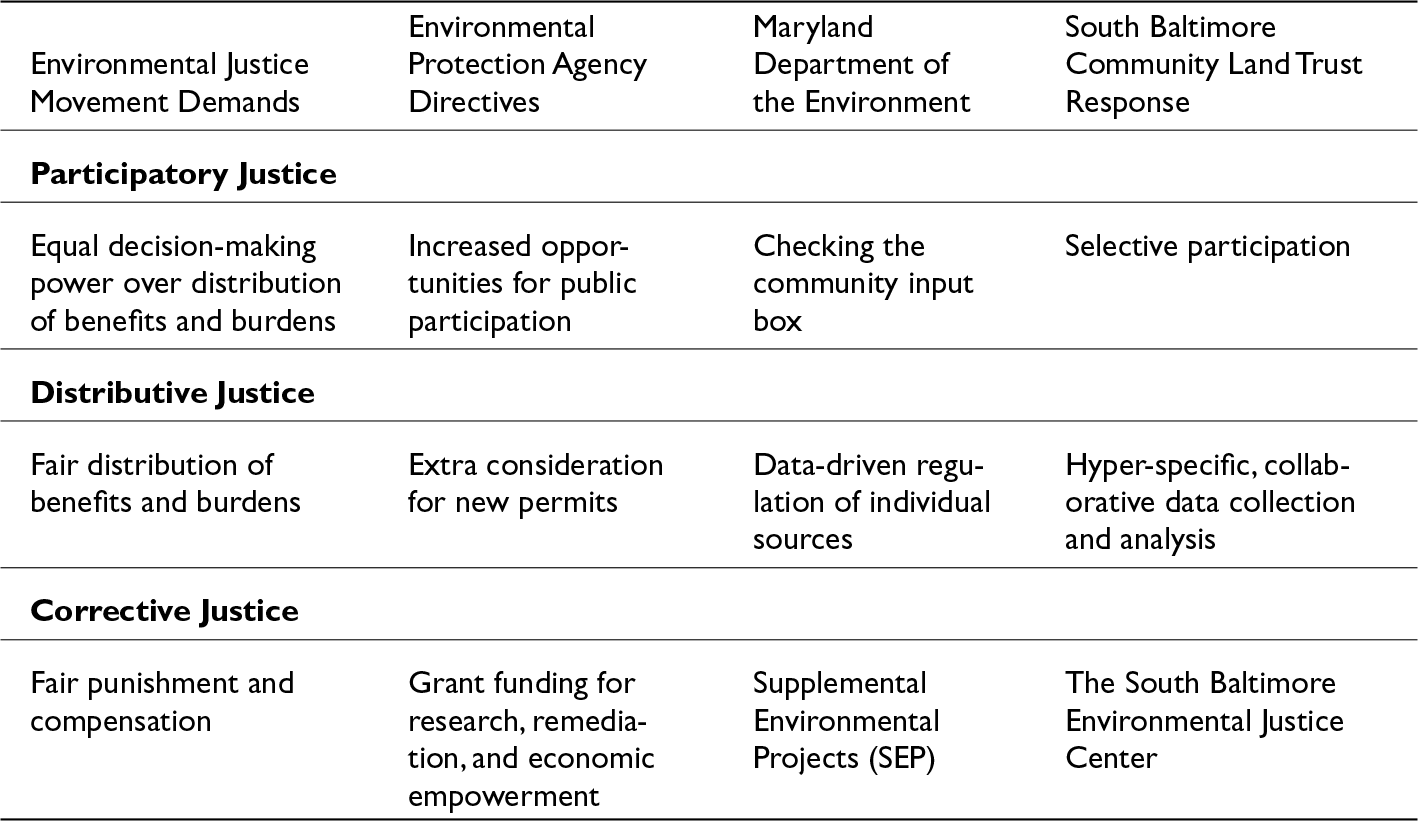
State co-optation of the concept of environmental justice has led to regulatory guidance that betrays the principles of the movement. Instead of creating enforcement mechanisms that can deliver participatory, distributive, or corrective justice, the federal government urges agencies to take additional steps in the permitting process and consider environmental justice in their decisions. MDE’s interpretation of this mandate led to opportunities for public participation that were performative rather than substantive. When we realized they were simply checking a box by asking for our thoughts, we refused to let them waste residents’ time. Instead, we began engaging in selective participation by submitting written testimony for the official record and expressing our dissatisfaction with a sham process. We also increased pressure on the agency by holding public demonstrations that explicitly identified the agency as a target rather than an ally. When MDE officials came to the Earth Day event in Curtis Bay, we set the rules for participation. There was no 2-min speaking limit, and people could ask officials direct questions.
The EPA has spent decades trying to create measurement mechanisms for defining environmental justice communities. This is emblematic of the highly technocratic nature of environmental regulation, which relies on scientific expertise and data collection to determine the most efficient way to balance human health and industrial wealth. For MDE, this meant that neither resident testimony nor their espoused commitment to environmental justice would supersede “the science.” However, by meeting with them and collaborating, we learned how to fine-tune our measurement strategies and present them with evidence they could not dismiss. We were also able to capitalize on the agency’s commitment to scientific expertise and desire to uplift examples of sound science by including them in the coal study. This has continued to shape organizing strategies, and SBCLT and community members have been working to document violation events at Curtis Bay Energy, another major polluter in the area.
The EPA and the courts have failed to deliver corrective justice to communities overburdended by environmental pollution. Instead, the EPA has created grant and investment programs meant to economically uplift and placate those communities. MDE funding an SEP followed the same logic; they redistributed money from CSX to the community without doing anything to rectify the impacts coal pollution. Rather than accepting the money as a payoff, SBCLT put it toward creating the infrastructure to sustain ongoing environmental justice efforts. They purchased a 3,000sf vacant building in Curtis Bay, which will become the South Baltimore Environmental Justice Center – a hub for community-led research, organizing, and development.
Conclusion
In this article, I have provided an account of legal mobilization in a regulatory setting, which shows that turning to the state can be a learning strategy. Grassroots organizing is an inherently adaptive and inconclusive endeavor. Organizers strategize iteratively, responding to the openings they encounter and creating and using tools that meet the challenges presented. When a catastrophe created an opportunity to talk to state regulators, the leaders of SBCLT used that opening to make a legal claim in a regulatory institution. When the state did not respond by working to secure the right to a healthy environment for residents in Curtis Bay, their focus shifted to learning rather than claiming. By engaging in what I’ve termed co-optation from below, the organization learned how the regulatory agency interpreted and implemented environmental justice and adjusted their organizing strategies in response.
It is reasonable for scholars and activists not to believe environmental justice will be achieved by working with the state. The radical claims made by the movement have found no foothold in policy, though plenty of initiatives are billed as environmental justice-focused (Li Reference Li2023). While the ultimate goals of the Environmental Justice Movement cannot be realized without a complete re-imagining of environmental law and protection, communities face emergent issues that require immediate responses. In order to respond, organizers must have strategies that can be used within the extant system, and turning to the state can improve those strategies.
Recent social movement scholarship has been more attuned to the creative ways organizers build strategic capacity and people power (Han et al. Reference Han, McKenna and Oyakawa2021). Groups compensate for information asymmetries and shortages of material resources by relying on their unique knowledge and skills (Ganz Reference Ganz2000). They build power by cultivating an ability to adapt and respond to changing circumstances (Han et al. Reference Han, McKenna and Oyakawa2021). SBCLT organizers used the meetings with MDE to build strategic capacity among leadership in order to increase the choices available to them and inform their decision-making.
This study has implications for organizers and advocates as well as sociolegal scholars. Organizing for social change entails a variety of strategies and tactics that often occur alongside each other. However, many of us have accepted a dichotomy that paints institutional and extra-institutional tactics as incompatible. The fear of state co-optation is well-founded but should not stop organizers from learning how the state operates when possible and using that information to their advantage. Pulido and her co-authors say, “Instead of seeing the state as a helpmate or partner, it [the environmental justice movement] needs to see the state as an adversary and directly challenge it” (Pulido et al. Reference Pulido, Kohl and Cotton2016). I would add that environmental justice organizers should take every opportunity to learn how regulators work in their specific context. More broadly, I suggest that when organizers find that legal institutions are not receptive to their claims, they probe the disconnect between their understanding of the law and how their target institution conceptualizes it. They may find ways to adjust or refine their strategies within that disjuncture.
For scholars who study how groups mobilize the law, it would be useful to expand our institutional purview laterally and vertically and continue to analyze outcomes beyond wins and losses. In a federal system where the power to make, interpret, and enforce laws is divided across three federal branches and between federal and state governments, legal mobilization can occur in many institutional venues. The courts and federal agencies receive far more scholarly attention than state agencies, but many social movement battles are fought at the state and local levels. These contests shape and are impacted by national and even global outcomes. If scholars want to understand how legal mobilization matters, we should look to groups that mobilize the law in different contexts and ask how mobilization fits into their strategic arsenal. This study illustrates the value of in-depth descriptive studies of legal mobilization in local contexts. Understanding the nuanced ways that groups mobilize legal claims outside of the courts can help us build new theories about the purposes and outcomes of legal mobilization.
I have argued that legal claims-making by SBCLT was strategically used to co-opt the state regulatory agency. They were able to hone strategies for engagement by learning how the agency’s application of environmental justice concepts diverged from the demands of the movement. Future studies can look for similar patterns in other issue areas, locales, and institutional contexts. In particular, we should look for this type of strategic mobilization around laws that resulted from social movement pressure but lack robust enforcement. For example, demands for increased and improved housing by civil rights activists in the 1960s was institutionalized as the Fair Housing Act (FHA). The law notoriously lacked enforcement provisions and failed to lead to investments in housing in Black neighborhoods or end discrimination in housing. However, that only accounts for the first two columns of the co-optation from below table for the FHA. Investigations of legal mobilization processes by local housing justice or civil rights organizations could potentially complete the table. This study suggests that the ambiguity of laws like the FHA can create opportunities for groups to learn how their local agencies understand and apply the law and use that knowledge stragically. As scholars and practitioners continue to look for ways the law can be used to advance social justice causes and respond to the daunting ecological and environmental challenges of the 21st century, we should be attentive to the dynamics of legal mobilization in a variety of contexts and the nuanced outcomes they can lead to.
Acknowledgements
This article was significantly improved by the thoughtful feedback of the journal editors and reviewers, as well as several friends and colleagues. I am so appreciative of Chuck Epp, Lauren Foley, Steve Teles, Marcus Johnson and Vesla Weaver for their support and guidance. And of course, this work wouldn’t exist without the incredible organizing efforts of Greg Sawtell, Shashawnda Campbell, and Meleny Thomas, and I am infinitely grateful for the trust that they have placed in me.
Raychel Octavia Gadson is a PhD candidate at Johns Hopkins University in the Department of Political Science.


 Open access

