


Key points
-
– Question: What current regulations and legislation govern pelvic examinations in the U.S.?
-
– Findings: According to this systematic review, twenty states have pelvic examination laws that apply to examinations performed on anesthetized or unconscious patients. Thirteen additional states have proposed pelvic examination laws; the remaining seventeen states have not proposed nor passed any pelvic examination laws.
-
– Conclusion: Reasonable laws that protect patient autonomy and the care provided by health care providers and educators clearly exist across the U.S. Their proliferation will hopefully continue in the coming years consultation with physicians and other health care professionals.
Introduction
The pelvic examination is an integral part of the physical examination for patients with obstetric and gynecologic (“OBGYN”) complaints. Medical students learn how to perform pelvic examinations via several modalities, (e.g., practicing examination techniques on standardized patients and simulation trainers). A medical student might also learn to perform a pelvic examination in the operating room, on the body of an unconscious patient who has been anesthetized for a separate medical procedure.Footnote 1 Although the popularity of this controversial practice is waning, it is not uncommon.Footnote 2 Two studies performed in the early 2000s found that most medical students who performed pelvic exams on unconscious patients did not know whether consent had been obtained prior to the examination. In five medical schools in Philadelphia, 90% of medical students were unsure if consent was obtained,Footnote 3 while in Oklahoma, nearly 75% of medical students were unsure if consent was obtained.Footnote 4
The performance of pelvic exams conducted without prior express consent can, and should, be regulated. California was the first state to use legislation to address the practice of unauthorized pelvic exams in these circumstances: in 2003, the state passed a law that forbade practitioners from performing pelvic examinations on anesthetized or unconscious patients without prior written consent.Footnote 5 Since then, many states have followed suit, and a significant contingency of states have proposed similar bills within the past two years specifically.Footnote 6 Although there is known variation in how these laws are enforced and what types of exams are covered, no formal review of proposed and existing pelvic exam laws has yet been performed. Thus, the aim of this study is to provide a comprehensive resource for physicians, medical students, health care providers, lawmakers, and potential patients to use in order to educate themselves about the variety of legal frameworks surrounding this issue.
Methods
Each of the fifty states’ pelvic examination laws (or lack thereof) were included in the study. There were no exclusion criteria. Preferred Reporting Items for Systematic Reviews and Meta-Analyses (PRISMA) guidelines were followed. Laws were identified from legiscan.com, law.justia.com, and individual state government websites. Research terms included “pelvic examination laws,” “pelvic examination,” “pelvic exam law(s),” “pelvic exam,” “rectal exam laws,” “rectal exam,” and “medical examination.” Search dates ranged from January 1, 1970 to November 22, 2022.
Each record retrieved from each state’s government database was independently screened to ensure the legislation met inclusion criteria. Pertinent data were extracted from the laws, including data pertaining to whether pelvic exam laws existed in a particular state, the type of examination defined, exceptions to the laws, to whom the laws applied (physicians, nurse practitioners, physician assistants, medical students), the type of consent required, to whom consent requirements applied (multiple physicians (including medical students) versus one physician or student), and word definitions. All sections of each law pertaining to pelvic examination were then reviewed and entered data into a spreadsheet by state.
The primary question that this study sought to address was whether any pelvic or rectal exam laws exist in the U.S. Additional data items collected for each state were whether any proposed legislation existed not yet signed into law, the specific law code, year the law went into effect, which type of examination was defined (pelvic, rectal, prostate, breast), anesthetized or unanesthetized, who the law applied to (physician, nurse practitioner, physician assistant, medical student), word definitions, exceptions to the law, type of consent required, and whom the consent applied to (multiple physicians and medical students versus one individual). For each of the collected data items, descriptive statistics were performed, including frequencies of each variable amongst the fifty states.
The primary limitation of this study is the potential absence of relevant law. There exists a narrow risk that the authors failed to capture each individual piece of pelvic-exam legislation when searching states’ legislative databases. To combat this risk, the authors utilized broad search terms in their research.
Additionally, this study seeks only to identify and catalog the pelvic exam laws in effect. It does not seek to assess the global impact of these laws on medical practice, nor their effects on states’ standards of care.
Results
The landscape of pelvic exam laws in the U.S.
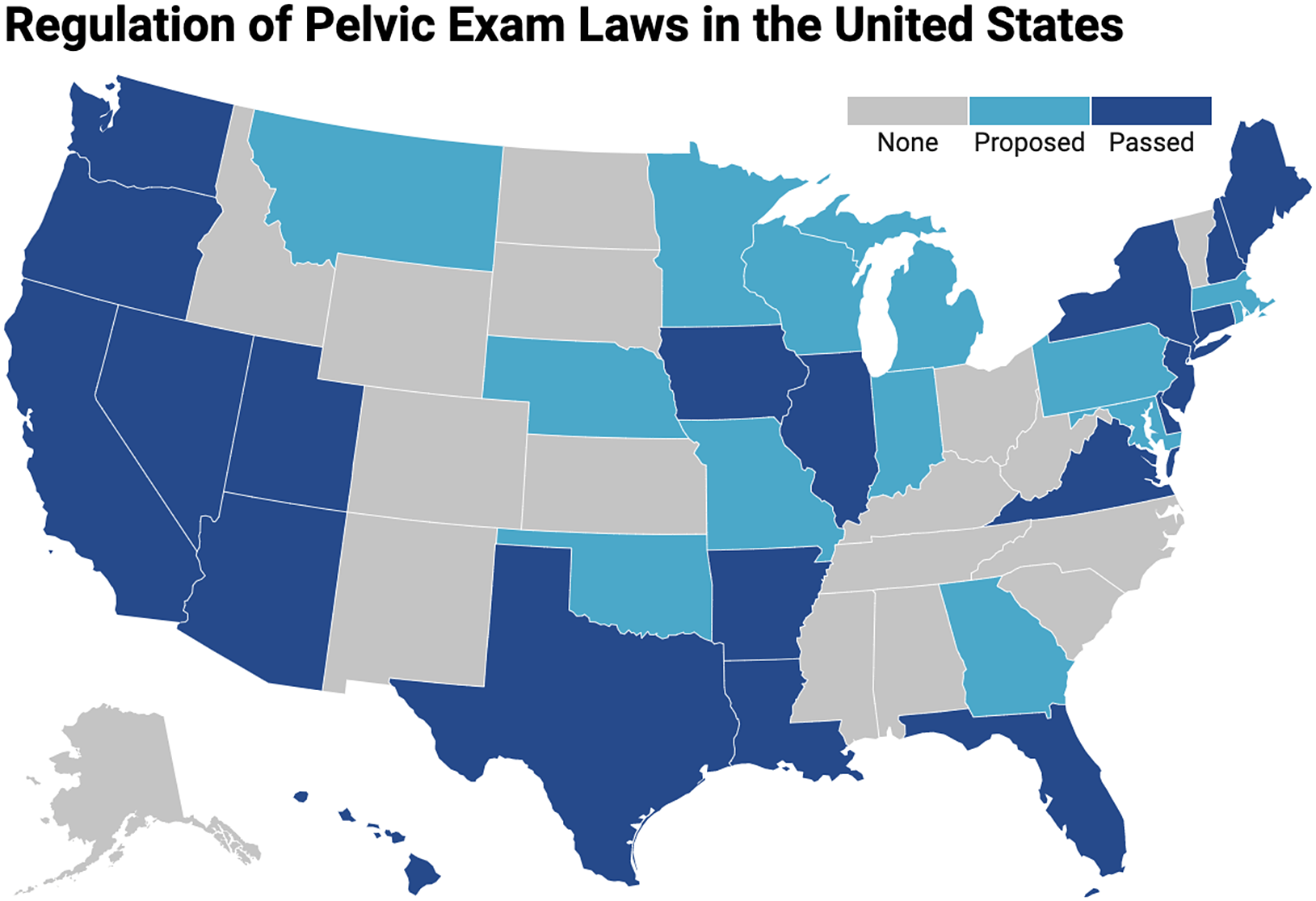
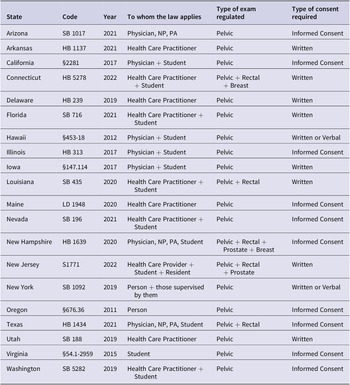
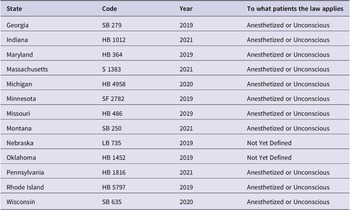
All fifty states’ pelvic and rectal examination laws were reviewed. State regulation varied from no laws or regulations to laws pertaining to pelvic and rectal examination performed in any context. As of November 22, 2022, there are twenty states (40%) with pelvic examination laws (Arizona, Arkansas, California, Connecticut, Delaware, Florida, Hawaii, Illinois, Iowa, Louisiana, Maine, Nevada, New Hampshire, New Jersey, New York, Oregon, Texas, Utah, Virginia, Washington), all of which only apply to patients anesthetized or unconscious (Table 1).Footnote 7 An additional thirteen states (26%) have proposed pelvic exam laws (Georgia, Indiana, Maryland, Massachusetts, Michigan, Minnesota, Missouri, Montana, Nebraska, Oklahoma, Pennsylvania, Rhode Island, Wisconsin), of which eleven only pertain to anesthetized or unconscious patients.Footnote 8 The two proposed bills from Nebraska and Oklahoma do not yet define the parameters of their proposed laws completely.Footnote 9 There are seventeen (34%) states (Alabama, Alaska, Colorado, Idaho, Kansas, Kentucky, Mississippi, New Mexico, North Carolina, North Dakota, Ohio, South Carolina, South Dakota, Tennessee, Vermont, West Virginia, Wyoming) that have not passed any laws regarding pelvic examinations under anesthesia or unconscious patients. (As discussed below, Florida was noted to have the broadest definition of “pelvic examination” until a revision was passed in July of 2021:Footnote 10 prior to this revision, a practitioner could not administer a pelvic exam in the state of Florida without informed consent, even on fully conscious patients.Footnote 11)
Summary of Pelvic Examination Laws in States Where They Exist

Type of examinations defined and regulated
Fifteen of twenty states’ laws (75%) applied only to pelvic exams, and not to breast or rectal exams (Table 1). The remaining five states (Connecticut, Louisiana, New Hampshire, New Jersey, Texas) specify in the language of their laws that they apply to “pelvic exams and rectal examination” [emphasis added].Footnote 12 Connecticut and New Hampshire also include “breast examinations” in their laws’ list.Footnote 13
To whom the laws apply
Laws’ applications ranged from “person” to “health care provider” (which states define differently) to the all-inclusive “physician + nurse practitioner + physician assistant + student” combination (Table 1). Virginia’s was the only pelvic exam law that applied to medical students and not to all health care providers.Footnote 14 Fourteen out of twenty states specifically included “student” or “medical student” in their language (Table 1).
Definitions
States’ laws varied in how they defined “health care provider” and “health care professional,” (and with the exception of Virginia’s law, all definitions included licensed physicians in some formFootnote 15). Prior to being revised, Florida’s original pelvic exam law from 2020 defined “pelvic examination” as “examination of the organs of the female internal reproductive system including the vagina, cervix, uterus, fallopian tubes, ovaries, rectum, or external pelvic tissue.”Footnote 16 (Additionally, prior to its revision, Florida’s law required health care practitioners to obtain explicit consent before performing any pelvic exams, including routine exams being performed on fully conscious patients.Footnote 17) Texas defined “pelvic examination” as a “physical examination of a patient’s external and internal reproductive organs, genitalia, rectum.”Footnote 18 Louisiana defined “examination” as “pelvic or rectal examination.”Footnote 19 Utah defined “patient examination” as “medical examination that requires contact with the patient’s sexual organs.”Footnote 20 Connecticut defined “intimate examination” as any inpatient or outpatient pelvic, prostate, or rectal examination.Footnote 21 The remaining laws did not specifically define pelvic examinations.
Exceptions
Every state’s pelvic exam law requires that informed consent be obtained prior to the examination, and that the exam is performed within scope of surgery or diagnostic exam, within the applicable standard of care, or for necessary diagnostic or treatment purposes. Exceptions to these requirements, which vary by state, include pelvic exams performed during emergency services or care, pelvic exams performed pursuant to court order, pelvic exams required under criminal investigations (i.e., investigations of child abuse, neglect, or sexual assault), and forensic pelvic exams.Footnote 22
Type of consent required
Eight states’ laws specify that providers must obtain patients’ written consent” prior to performing pelvic exams.Footnote 23 Two states, New York and Hawaii, require ”written or verbal consent.”Footnote 24 Ten states require “informed consent,” but do not specify whether verbal consent is adequate (Table 1).Footnote 25
To whom consent applies
Florida’s law specifies that “one consent form applies to multiple health care practitioners or students” and thus does not require the patient to sign multiple consent forms where multiple practitioners are involved in the pertinent exam.Footnote 26 Connecticut and New Jersey also imply that one written consent form would cover medical students and anybody else practicing under the primary physician.Footnote 27 Other states do not specify whether a single signed consent form applies to one individual practitioner or multiple individuals.
Discussion
Regulation of pelvic examinations has become an increasingly important issue over the past few years in response to growing concerns of patient autonomy and the ethical issues raised by such sensitive examinations, in addition to high profile cases of health care providers committing acts of sexual assault. Twenty states have passed laws prohibiting the performance of pelvic examinations on anesthetized or unconscious patients; thirteen more states have proposed bills with similar regulations as of November 22, 2022 (Table 1, Table 2, Figure 1). Although many of these states’ laws are detailed, other states have no passed regulation—or introduced bills proposing regulation—at all. Existing pelvic examination laws also vary significantly amongst each other, including variations the contexts or circumstances in which the laws apply; to whom the laws apply to (physicians versus medical students versus nurses versus other staff); exceptions to the laws; types of consent required; and the number of health care staff members to which obtained consent applies.
Proposed Pelvic Examination Laws

Comparison of states that have pelvic examination laws, those that have proposed pelvic examination laws, and those that have no laws proposed or passed as of November 22, 2022.
Two important dimensions of existing pelvic exam laws are (1) their exclusive applicability to pelvic exams (and in some cases, rectal and breast exams) performed when the patient is anesthetized or unconscious and (2) the requirement that the exam be within the scope of the surgery or diagnostic exam, or is necessary for diagnostic or treatment purposes. These components provide patients with protection and autonomy while undergoing surgeries in teaching hospitals.
These laws do not impede medical education or create barriers in patient care, since exams performed pursuant to any sort of emergency (e.g. obtaining a rectal temperature in a potentially septic patient, inserting foley catheter, pelvic examination for a hemodynamically unstable bleeding patient) or low-risk intervention (Pap smears, sexually transmitted illness testing, etc.) is excluded from the laws’ written consent requirements. Florida’s revised pelvic exam law, as well as Connecticut’s and New Jersey’s, go one step further in their efforts to ensure that medical education does not suffer under regulatory increase, allowing one written consent form to apply to multiple members of the medical team, thereby improving efficiency in a teaching setting by not requiring a long consent form to be signed for each exam performed over the course of a given surgical procedure.Footnote 28
Conclusions
Laws regulating patient care are an essential component of protecting patients and doctors alike. They should be made to protect health care providers and health care consumers without creating unnecessary barriers to care. Reasonable pelvic examination laws that balance patient protection and autonomy with the needs of caregivers and educators clearly exist; hopefully, state legislatures will continue to introduce and pass these laws in consultation with physicians and other health care professionals.

 Open access

