

Introduction
“When we are wise, we know enough to defer on matters [involving health and safety issues]. When we are wise, we know not to displace the judgments of experts, acting within the sphere Congress marked out and under Presidential control, to deal with emergency conditions. Today, we are not wise.” 1
The judiciary has long served as an important arbiter of the boundaries of public health authority, shaping the extent to which public health officials can impose restrictions on individual liberty in the name of protecting the population’s health. Even before the Supreme Court issued its seminal 1905 decision in Jacobson v. Massachusetts, 2 upholding the state’s ability to mandate smallpox vaccination, courts widely accepted that the states could use their police powers, 3 reserved by the Tenth Amendment, to protect the public’s health.Reference Adler 4 The Jacobson Court, however, also recognized that courts had a role to play in assuring that states did not misuse their public health powers in ways that were “so arbitrary and oppressive in particular cases,” or “cruel and inhuman in the last degree.” 5
In the century plus that followed Jacobson, federal and state courts usually afforded public health officials broad authority to respond to public health threats and crises, often citing their own lack of expertise as well as the practical need for swift, science-driven intervention.Reference Mello and Parmet 6 Although public health measures were, at times, deeply problematic,Reference Molina 7 the judiciary’s broad acceptance of public health measures allowed for a wide range of legal measures that protected health, such as required childhood vaccination schedules, expanded cancer and disease screening requirements, motor vehicle safety measures, lead poisoning prevention, tobacco control, and emergency preparedness and response.Reference Gostin and Wiley 8 In the twentieth century, life expectancy in the US increased by over 30 years, with 25 of those years being attributable to public health advances.Reference Bunker, Frazier and Mosteller 9
Law played an important role in this significant increase in life expectancy. For example, vaccinations for diseases like measles, polio, and smallpox led to 100 percent declines in morbidity rates. 10 Vaccination rates were high in part due to public health campaigns and vaccine mandates, especially state law mandates for kids in school.Reference Malone, Hinman and Goodman 11 After the publication of the 1964 Surgeon General’s report linking smoking to cancer, major public health education, advocacy, and legal efforts caused smoking rates to decline, preventing 1.6 million deaths between 1964 and 1992 alone. 12 More recently, public health responses, including legal responses, to the COVID-19 pandemic helped to save millions of lives.Reference Ioannidis 13
The judicial deference to public health agencies and officials that was essential for upholding officials’ authority to implement many of these measures has eroded in recent years, with many judicial decisions limiting public health authority and failing to recognize public health officials’ expertise.Reference Gostin and Adler 14 By eroding authority and deference, courts have played a more significant role in shaping the effect and impact of public health measures.
This paper will examine the recent doctrinal shifts that have eroded deference and highlight some recent court decisions that have impacted the capability of governments and health institutions to improve health equity. The paper concludes with a call to action for new efforts to advance public health in the courts through information sharing, research, a coordinated litigation plan, engagement with the judicial selection process, communication, and funding. The public health field and its allies must work together to make the case for public health to both the courts and the public so that the field can continue its work to protect the health of our communities.
Recent Doctrinal Shifts Impacting Public Health
Although there were signs of a decline in judicial deference to public health authorities prior to COVID, the trend accelerated during the pandemic,Reference Parmet and Khalik 15 as federal and state courts increasingly ruled that public health orders exceeded statutory and constitutional limits.Reference Adler 16 Litigation over mask mandates, business closures, limitations on gatherings, and vaccination requirements revealed a growing willingness by the courts to entertain claims involving religious liberty and challenging agency expertise.Reference Adler 17 These doctrinal shifts, which have been well-documented in the literature,Reference Parmet and Khalik 18 affect numerous areas of public health practice. For present purposes, three broad categories of decisions can be noted: (1) decisions favoring free exercise challenges, (2) decisions limiting deference to administrative agencies and the scopes of their authority, and (3) decisions undermining equal protection and attempts to broaden civil rights protections.
Favoring Free Exercise Challenges
In early 2020, at the start of the COVID-19 pandemic, courts generally rejected most challenges to public health orders, including claims brought under the Free Exercise Clause of the First Amendment, which protects religious liberty.Reference Adler 19 However, plaintiffs bringing such claims were more successful than those bringing any other type of individual rights claims.Reference Parmet and Khalik 20
Such claims gained greater traction after Justice Amy Coney Barrett replaced the late Justice Ruth Bader Ginsburg on the Supreme Court in November 2020. With Barrett on the bench, the Supreme Court blocked public health orders that restricted gatherings based on religious liberty claims 21 — first in New York 22 and then in California. 23 In these cases, the Court applied strict scrutiny —the highest standard of judicial review — to plaintiffs’ claims that secular activity had been favored over religious activity, whereas before, courts had used a lesser standard of review, the so-called rational basis test. 24 Specifically, in these challenges to COVID restrictions, the Court held that states violate the First Amendment if a religious activity is not treated as favorably as at least one “comparable” secular activity, 25 in effect granting religious liberty objectors a type of “most favored nation” status.Reference Rothschild 26 These rulings “opened the door to religious liberty challenges to vaccine mandates.”Reference Parmet and Khalik 27 Such challenges have recently been plentiful and include challenges to both COVID vaccine mandates and childhood vaccine laws. 28
Since these doctrinal shifts, the Supreme Court has not ruled on a claim challenging state childhood vaccine mandates on religious liberty grounds, but it may. An issue that was once settled law has seen a mix of opinions from lower courts, 29 increasing the likelihood of SCOTUS’s future involvement. This shift in deference is also exacerbated by current federal action, with America’s top health official — Health and Human Services Secretary Robert F. Kennedy — promoting anti-science agendas and spreading vaccine misinformation.Reference Gostin and Reiss 30 Moreover, vaccine opponents continue to bring legal challenges, including a recent petition to the Supreme Court to prevent enforcement of California’s school vaccination requirements because they lack a religious exemption. 31 That request was denied,Reference Reichmann 32 but a future Supreme Court decision siding with these religious arguments could have a significant adverse effect on health, as studies associate religious exemptions with lower vaccination rates.Reference Mello 33 The current multistate measles outbreak illustrates the danger of lower vaccination rates.Reference Bendix and Edwards 34
Limiting Deference to Administrative Agencies and the Scope of Their Authority
In recent years, the Supreme Court has started using other methods to narrow or strike down federal public health orders, including by using the “major questions doctrine” and ending Chevron deference. 35 The once-novel “major questions doctrine” requires federal agencies to have clear Congressional guidance and/or explicit statutory authority before acting on a major question of “economic or political significance.”Reference Chemerinsky 36 The Supreme Court used this doctrine to strike down multiple Biden-era policies during the COVID-19 pandemic, including the Centers for Disease Control and Prevention’s (CDC’s) eviction moratorium 37 and an emergency temporary Occupational Safety and Health Administration rule that required large employers to require vaccinations or have policies requiring testing and masking. 38 Lower federal courts also subsequently applied the doctrine to block vaccine mandates for federal contractors and CDC’s mask mandate on public transportation. 39 The impacts of using this doctrine are far-reaching — with agency responses to significant health threats almost always resulting in social and economic consequences — and could leave agencies waiting on an often slow, politically polarized Congress to act, endangering population health in the process.Reference Gostin and Radhakrishnan 40 Interestingly, to date, the Supreme Court has not employed the doctrine in any cases challenging the Trump Administration’s expansive use of executive authority.
In addition to limiting agencies’ capacity to regulate so-called major questions, in a 2024 case, Loper Bright v. Raimondo, 41 the Court overturned one of the most foundational precedents to administrative authority: Chevron USA Inc. v. Natural Resources Defense Council. 42 Chevron required courts to defer to agency interpretations of statutes that were ambiguous about the question at issue.Reference Parmet 43 In Loper Bright, the Court reversed and held that lower courts should not generally defer to agencies, but must instead determine on their own whether a statute authorizes a specific agency regulation or interpretation.Reference Parmet 44
The end of Chevron deference means that judges can more easily strike down regulations based on their own viewpoints rather than agency expertise.Reference Katz 45 This decision could impact all areas of law including legal issues relating to consumer rights, the environment, tobacco, food safety, and emergency response.Reference Katz 46 Theoretically, this decision could also impact the law where agencies are withdrawing regulations that promote health. Indeed, Loper Bright at least raises the possibility that deference won’t be granted in such cases.
Unfortunately, the adverse impact on laws that promote health is already being felt, with Loper Bright being cited in thousands of decisions including cases on emergency treatment, Medicare, regulation of certain medical products, and hospital payments.Reference Hodge and Lauzon 47 Further magnifying Loper Bright’s potential impact, the Supreme Court in Corner Post v. Board of Governors held that the statute of limitations for challenging agency action doesn’t begin to run until a regulation affects the challenger. 48 As a result, the door for challenging agency action now remains perpetually open.Reference Gostin and Radhakrishnan 49
Undermining Equal Protection and Attempts to Broaden Civil Rights Protections
Alongside its yearslong dismantling of the administrative state, the Supreme Court has also made significant strides in undermining the Equal Protection Clause of the Fourteenth Amendment and Title VI of the Civil Rights Act of 1964. The Supreme Court’s 2022 landmark decision in Students for Fair Admissions (SFFA) v. Harvard, 50 which prohibited race-conscious admissions in higher education, instills a colorblind conception of the Equal Protection Clause. As Justice Sotomayor explained in her dissent, colorblindness fails to acknowledge that “opportunity is dispensed along racial lines … [and] racial equality cannot be achieved without making room for underrepresented groups that for far too long [were denied opportunity by force of law].” 51 Prior to the SFFA decision, the Supreme Court had ruled that institutions of higher education did not violate the Equal Protection Clause or Title VI of the 1964 Civil Rights Act if they considered race as part of a “holistic” admissions evaluation and not just an effort to fill quotas. 52 The colorblind narrative being weaponized by SFFA ignores the reality of racism in the US and is the same harmful narrative that has been used to justify bans on “critical race theory” and diversity, equity, and inclusion (DEI) programs — all with huge implications for health equity.Reference Shaw 53
LGBTQI+ rights have also faced renewed attacks in the courts. In 2020, in Bostock v. Clayton County, the Supreme Court ruled that Title VII of the Civil Rights Act of 1964 barred discrimination on the basis of sexual orientation and gender identity in the employment context. 54 But when the Biden Administration issued new rules and guidance to expand discrimination protections based on Bostock, federal district courts struck them down.Reference Twinamatsiko and Osaghae 55 Then, in U.S. v. Skrmetti, the Supreme Court upheld the constitutionality of Tennessee’s ban on gender-affirming care for minors, finding it did not discriminate on the basis of sex. 56 The Skrmetti decision may contrast with a forthcoming Supreme Court decision in Chiles v. Salazar that could find conversion therapy — a scientifically discredited and harmful practice — for LGBTQI+ youth to be lawful on the basis of free speech. 57
These doctrinal shifts, alongside the growing political attacks on LGBTQI+ rights and DEI, are already having real-world implications on public health.Reference Akré, Rapfogel and Miller 58 To monitor these shifts in the courts, in 2022, Northeastern University School of Law’s Center for Health Policy and Law (CHPL) started monitoring and tracking litigation that affects public health authority and health equity. Over the last three years, the team has prioritized tracking challenges to government and health institution efforts to improve health equity and vaccination initiatives. CHPL recently started working with ChangeLab Solutions to track health equity litigation, and this culminated in a 2025 report. 59 The methodology and findings are summarized below.
Recent Litigation Has Negated Governmental & Institutional Health Equity Efforts
A team of legal researchers from CHPL and ChangeLab Solutions identified 30 lawsuits 60 that were initiated between January 2024 and May 2025 challenging governmental and health institution (e.g., hospitals, medical schools) interventions to improve health equity, with a majority of the lawsuits’ outcomes negatively impacting health equity initiatives. To find the health equity lawsuits, the legal research team searched several legal databases and websites 61 for lawsuits using key terms and phrases. Even though such lawsuits are relevant to health equity, the research team excluded lawsuits centering reproductive health and the environment, as these issues are tracked by other organizations. Additionally, lawsuits regarding individual employment claims were excluded.
The methods and criteria used may not have captured all relevant actions or lawsuits because of the search terms used, because of the inconsistent inclusion of state court dockets in legal databases, and because the research team did not look for threats of litigation like demand letters that resulted in proactive compliance before a lawsuit was filed. Moreover, as noted, there was some subjectivity in deciding which health equity cases to include. 62 Despite these limitations, this sampling of lawsuits is still a useful indicator of litigation trends within the courts and among advocacy groups around the topic of health equity.
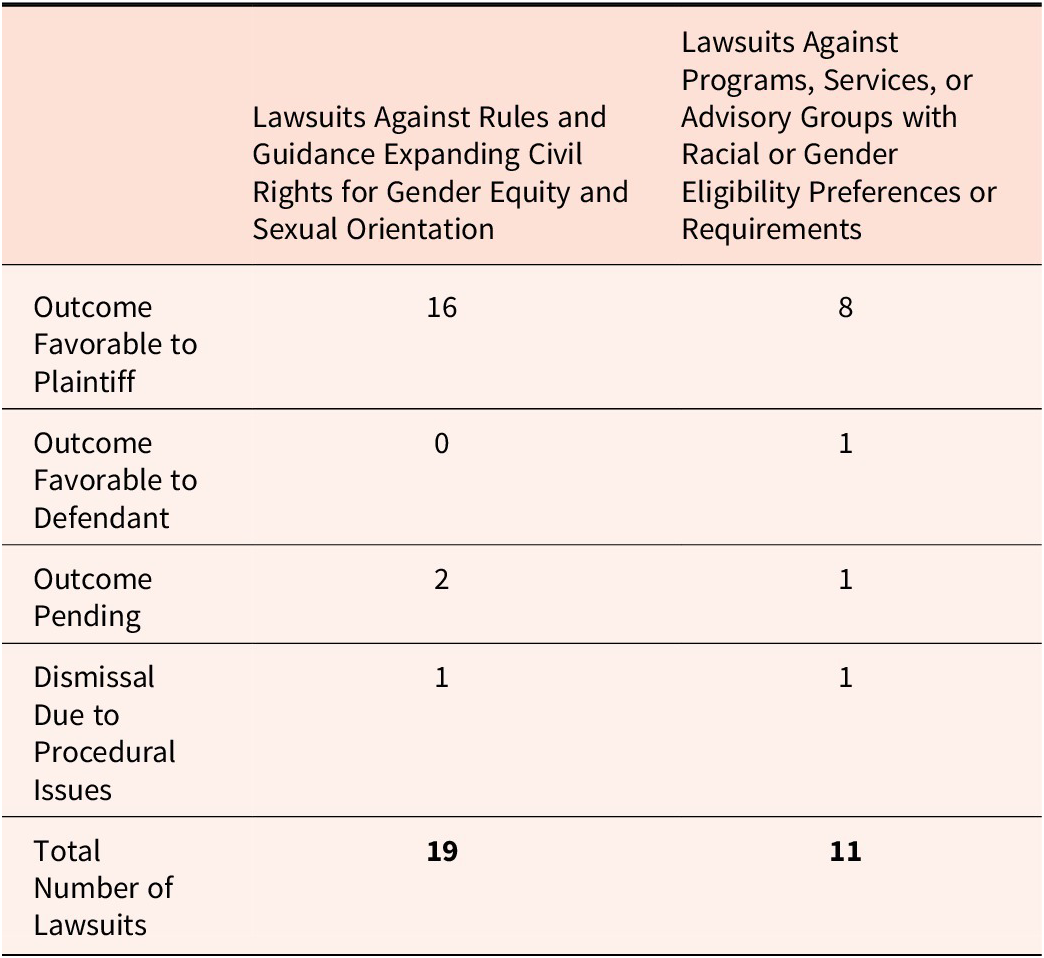
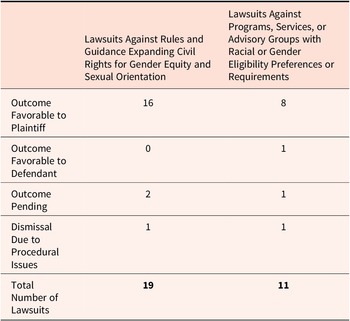
The lawsuits identified by the study focused on two topic areas: challenges to rules and guidance issued by the Biden administration to expand civil rights protections for gender identity and sexual orientation based on the Bostock decision (19 lawsuits); and challenges to programs, services, or advisory groups with racial or gender eligibility preferences or requirements (11 lawsuits). In the 19 gender identity and sexual orientation lawsuits, judicial decisions on the merits were issued in 13, with the rules and guidance enjoined in all of them. In 3 other lawsuits, some or all of the rules and guidance were no longer being implemented because of an injunction in another lawsuit or because the Trump administration rescinded the challenged Biden rules and guidance. Two lawsuits were pending, and 1 was dismissed. Of the 11 lawsuits against programs, services, or advisory groups with racial or gender eligibility preferences or requirements, 7 lawsuits were dismissed; 6 of the 7 were dismissed because the race or gender eligibility preferences or requirements were removed. Four other lawsuits were pending at the end of the study period.
Courts Struck Down Rules and Guidance Aimed at Expanding Civil Rights Protections for Gender Identity and Sexual Orientation
As introduced above, following the Supreme Court’s Bostock decision, the Biden administration issued new rules and guidance to expand discrimination protections across several federal departments and agencies including the Department of Health and Human Services, the Centers for Medicare and Medicaid Services, the Department of Agriculture, the Equal Employment Opportunity Commission, the Department of Education, and the Administration for Children & Families. 63 These new rules and guidance strengthened protections against sex-based discrimination and harassment and clarified protections for LGBTQI+ people under Title IX of the Civil Rights Act of 1964 (which prohibits sex discrimination by educational institutions that receive federal dollars), the Affordable Care (ACA), and the Americans with Disabilities Act, among other laws.Reference Twinamatsiko and Osaghae 64
The research team identified 19 lawsuits alleging that civil rights protections for sex-based discrimination should not include gender identity or sexual orientation. 65 Of the 19 identified lawsuits, 11 were filed against a Department of Education Title IX rule.
The lawsuits often included multiple claims within the complaint. All 19 lawsuits claimed violations of the Administrative Procedure Act, 16 claimed violations of the Constitution’s Spending Clause, 13 claimed violations of the major questions doctrine, 11 claimed First Amendment free speech violations, eight claimed violations under the Constitution’s enumerated powers/separation of powers clauses, and seven claimed violations under the nondelegation doctrine and the Tenth Amendment. 66
A majority of the lawsuits were brought by conservative state attorneys general, with Texas being the most active, followed by Tennessee, Oklahoma, and Missouri. Other plaintiffs included clinics and school boards or districts. The Alliance Defending Freedom was the most common attorney of record across all 19 lawsuits. 67
One or more judicial opinions on the claims were issued in 13 of the 19 lawsuits, and in all 13, a district or appellate court enjoined the rules and/or guidance from taking effect (one district court denied plaintiffs’ motion for a preliminary injunction, but an appellate court stayed that decision). 68 In striking down the rules or guidance, the courts relied on a variety of grounds, including:
-
1. That the department or agency didn’t have the statutory authority to issue the rules or guidance,
-
2. That the rules or guidance were:
-
a. contrary to law (often citing Title IX),
-
b. arbitrary and capricious,
-
c. violated the major questions and nondelegation doctrines and the Spending Clause, and
-
d. implicated freedom of speech and freedom of religious expression concerns.
-
Twelve of the 13 lawsuits with judicial opinions on the claims referenced the Bostock decision, and in all 12, the judicial opinions stated that the defendants’ reliance on that decision was misplaced and/or that they misinterpreted the decision (one district court’s opinion did not hold that the department misapplied or misinterpreted Bostock, but the appellate court did). 69
The outcome of these 13 lawsuits exemplifies the dangers posed by Loper Bright, 70 which has ushered in a new level of judicial review of agency actions where a court must “‘independently’ determine the ‘best meaning of a statute,’” as opposed to deferring to agencies.Reference Twinamatsiko and Osaghae 71 So while federal agencies interpreted “discrimination on the basis of sex” to include gender identity and sexual orientation — as supported by Bostock — under the Loper Bright approach, 72 courts in these cases decided that federal agencies were not entitled to deference.Reference Twinamatsiko and Osaghae 73 According to these courts’ interpretations, since Title IX was enacted in 1972 when “sex” was understood to mean “biological sex,” that is what Title IX must be read to mean — a narrow interpretation denying the applicability of Bostock. The result is fewer protections for LGBTQI+ people.Reference Twinamatsiko and Osaghae 74
Of the remaining six lawsuits, five were pending and one was dismissed. Of the pending lawsuits, some claims were dismissed against specific parties or the lawsuits were stayed because the Trump Administration rescinded the Biden Administration’s rules and guidance and issued new guidance stating that the Biden rule(s) didn’t carry the force of law. 75 The remaining lawsuit was dismissed due to the plaintiff failing to serve the defendants in a timely manner.
Going forward, the Supreme Court’s decision in Skrmetti, discussed above, is likely to have a further significant impact on gender equity litigation.
Challenges to Programs, Services, and Advisory Boards with Racial or Gender Eligibility Preferences or Requirements Based on the Equal Protection Clause are Succeeding
As noted above, the Supreme Court’s approach to the Equal Protection Clause shifted in SFFA, 76 where the Court overturned 50 years of precedent and claimed it was time for a colorblind conception of Equal Protection.
While the Court’s decision in SFFA was specifically about higher education, several groups, including the nonprofit legal advocacy groups Do No Harm and the Pacific Legal Foundation, have relied on it to bring or support lawsuits aimed at striking down racial considerations across a broad swath of sectors, including in health care and public health.
In the health equity litigation report, 77 the legal research team identified 11 lawsuits in which the plaintiffs claimed that programs, services, or advisory groups with racial or gender eligibility preferences or requirements were illegal. In these lawsuits, the plaintiffs generally argued that the defendant lacked a compelling reason for excluding or disfavoring a white individual from a program. One of the lawsuits raised similar claims pointing to eligibility criteria that prioritized women.
The lawsuits often included multiple claims within the complaint. Of the eleven lawsuits identified, seven claimed violations of the Equal Protection Clause of the Fourteenth Amendment, three claimed violations of the Citizenship Clause of the Fourteenth Amendment, three claimed violations of Section 1981 of the 1866 Civil Rights Act, three claimed violations of state laws, two claimed violations of Title VI of the 1964 Civil Rights Act, and one claimed violations of Section 1557 of the ACA.
Seven lawsuits were dismissed, while four were still pending, without any judicial ruling on the claims. Of the seven dismissed lawsuits, four were dismissed because the defendants successfully worked to change state law to remove eligibility preferences or requirements, and two were dismissed because the parties agreed to a stipulation that removed the eligibility preferences or requirements. One lawsuit was dismissed because the plaintiff failed to produce the required discovery documents. Do No Harm was a plaintiff in eight of the eleven lawsuits, and the Pacific Legal Foundation provided legal representation in seven of the eleven lawsuits.
The six lawsuits that were dismissed because a state or program changed eligibility standards challenged a variety of equity initiatives: Arkansas removed racial diversity mandates from a state statute that had required diversity on state boards like the State Occupational Therapy Examining Committee and Board of Examiners in Counseling, 78 Tennessee removed racial quotas from a state statute regarding racial preferences on medical licensing boards, 79 Montana removed state statutory language about gender- and race-based preferences for state boards and commissions which will impact the state Board of Medical Examiners, 80 South Carolina removed racial requirements from a state statute that required a majority of members of the Commission for Minority Affairs to be African American, 81 a diversity scholarship program to help fund education costs for students doing emergency medicine removed its requirement that the program only be open to students of color, 82 and a diversity scholarship program for women pursuing professional degrees (this case focused on medical students) removed its requirement that the women be from historically underrepresented ethnic minority groups. 83 These decisions by states and programs to end racial eligibility requirements in light of the litigation limit society’s ability to ensure that underrepresented groups have the same opportunities to succeed in systems where they’ve been historically disadvantaged by the law.
In the still-pending cases, complaints were made against a University of Pennsylvania Health System “Black Doctors Directory,” 84 a Minnesota statute requiring racial diversity on the Minnesota Health Equity Advisory Board, 85 a Louisiana statute requiring a certain number of minorities on the Louisiana Board of Medical Examiners, 86 and a scholarship program designed to increase minority representation in health care that was only open to minorities. 87
While the health equity litigation report focused on cases related to public health and health care, plaintiffs have made similar arguments in cases targeting the fields of housing and real estate, education, business, finance, and social work, all areas that impact the social determinants of health and health equity. 88 In one case, a lawsuit challenging an Alabama state law that required the Alabama Real Estate Appraisers Board to have at least two racial minorities was dismissed. 89 A trade association for Black real estate professionals, the Broker’s Association, used experts to show the lasting impacts of historical and current discrimination in their industry and how discrimination can be mitigated by diversity efforts. 90 The Association argued that the statute was lawful because of Alabama’s interest in remedying past and current racial discrimination. 91 Alabama Governor Kay Ivey maintained that the racial requirement was unconstitutional and that she wouldn’t enforce it, and the Broker’s Association maintained that the requirement was constitutional. 92 The parties agreed to settle (details are private) and dismiss the lawsuit, which keeps the racial requirement law intact. 93 This example shows what can happen when groups push back against these lawsuits and provide historical and current data to show the continuing harms faced by certain individuals, groups, and industries.
Lawsuit Updates Since Health Equity Litigation Report
Since the publication of the health equity litigation report, there have been some significant developments. There have been substantial developments in three of the five pending cases relating to gender. In the Rapides Parish School Board lawsuit, which challenged Biden-era guidance on federal civil rights protections against sex-based discrimination, plaintiffs have argued that even with the Trump administration’s executive orders (EOs) calling for a narrow reading of the challenged regulations, these governing regulations remain in place and require only that agencies make changes to those regulations themselves. 94 HHS has argued that plaintiffs have no standing to bring their action given the EOs. 95 The court ordered oral argument on all pending motions on October 6, and the outcome of that hearing is not currently publicly available. 96 Two other lawsuits have seemingly been permanently stayed, with the parties asking the court “not [to] disturb the current stay” in one and the court citing the nationwide preliminary injunction in the other. 97 The fourth lawsuit has had no significant change. 98 The final pending lawsuit, which was against the Department of Education’s Title IX rule, was dismissed as moot on July 29, 2025 because the rule is no longer in effect. 99
In sum, of the 19 lawsuits in which the plaintiffs claimed that rules and guidance aimed at expanding civil rights protections for gender identity and sexual orientation were illegal, approximately 84 percent, or 16 of the 19, resulted in the rules and/or guidance being enjoined or no longer being enforced. Of the remaining 3 cases, 1 was dismissed for a procedural issue and 2 are pending.
Since the completion of the health equity litigation report, three out of the four racial equity cases that were pending at the time of the report have since had some type of resolution; in two of the three, the defendant is no longer enforcing the challenged racial preference. In the University of Pennsylvania Health System lawsuit 100 where the Black Doctors Directory was at issue, the defendants offered to change the name of the directory to a race neutral name and to make the directory open to all physicians who demonstrate a commitment to underserved communities, regardless of race. 101 The plaintiff accepted the offer and this judgement was entered against the health system. 102 The lawsuit regarding the Louisiana Board of Medical Advisors was dismissed. The court held that because Louisiana’s governor stated that he would not enforce the statute to include a certain number of minorities on the Board, he was not the proper defendant. 103 On September 30, 2025, the plaintiffs appealed this decision to the Fifth Circuit. 104 In the lawsuit regarding the Minnesota Health Equity Advisory Board, 105 the Minnesota legislature amended the statute to include the italicized language below. 106 The plaintiffs argued that this change didn’t resolve the unconstitutional violations, but nevertheless voluntarily dismissed their lawsuit with prejudice. 107
“The health equity advisory and leadership (HEAL) council consists of 18 members appointed by the commissioner of health, including but not limited to members who will provide representation from the following groups…” 108
The final lawsuit, regarding scholarships to increase minority representation in health care, is still pending.
In sum, of the 11 lawsuits in which the plaintiffs claimed that programs, services, or advisory groups with racial or gender eligibility preferences or requirements were illegal, approximately 73 percent, or 8 of the 11, resulted in the preferences or eligibility criteria being removed or not being enforced. In another case, the preferences were maintained with slight modification. Of the final 2 cases, 1 is pending and 1 was dismissed due to a procedural issue.
The table above summarizes the outcomes of all 30 cases.
Summary of Outcomes of Lawsuits Against Health Equity
Conclusion and Next Steps
Doctrinal shifts, primarily by the Supreme Court, that have favored free exercise challenges, limited deference to and authority of administrative agencies, and shifted conceptions of Equal Protection have weakened public health authority and the capacity of governments at all levels to protect health, especially the health of socially marginalized groups. As litigation and court decisions continue to impact public health’s ability to do its job, there is a dire need for new efforts to advance public health and health equity in the courts. A May 2024 report 109 from Act for Public Health 110 devised an action plan “to help the public health law community and its allies build and maintain a jurisprudence that supports the fair, effective, evidence-based exercise of public health authority.” 111 The plan includes six components: (1) a single access point for sharing information and communications; (2) doctrinal research and development; (3) a coordinated litigation plan; (4) engagement with the judicial selection and election process; (5) story and message sharing; and (6) sustainable funding. 112
CHPL and its partners have been working to implement this plan. Through the Public Health Law Watch, 113 a partnership between CHPL and the George Consortium (a network of public health law academics and practitioners), 114 litigation that impacts public health authority, vaccines, and health equity has been tracked and regularly shared with the public. CHPL and other groups are also working to enhance coordination among public health experts, community groups, legal scholars, and practicing attorneys to respond to and guide litigation impacting the field, including through the filing of amicus briefs to present the public health perspective to the courts.
The public health field must also work to restore trust. Public health is more vulnerable in the political and legal arenas when it lacks the public’s support and respect.Reference Parmet and Khalik 115 The field must expend resources to effectively communicate with the public about what public health is, the value it brings, the impacts it has made, and the effects of recent court decisions on health. Communication methods must be tailored to reach multiple audiences. This is especially important in the current climate of mis- and disinformation and extreme partisanship.
Working together as a field to chart a new path forward in the court system will not be easy, especially now, but it is necessary to ensure that public health can carry out its work:
Public health promotes and protects the health of all people and their communities. This science-based, evidence-backed field strives to give everyone a safe place to live, learn, work and play. 116
Acknowledgements
This article builds upon an earlier health equity litigation tracking report. The authors thank Linda Tvrdy and the Northeastern University School of Law Research Assistants, including coauthor Madison Lee, and Cooperative Legal Education Program Co-ops for their valuable research assistance and for tracking relevant litigation.
Disclosure
The work discussed in this publication was funded, in part, by the Robert Wood Johnson Foundation as part of grants made to Northeastern University School of Law and ChangeLab Solutions.

 Open access

