





Introduction
Since its formal emergence in European Union (EU) policy debates in 2013, European strategic autonomy (ESA) has increasingly become a central strategic concept shaping the European Union’s approach to global affairs. In essence, ESA is mainly about the EU’s ability to act cohesively and collectively and, if necessary, independently, and navigate an increasingly complex international environment. Within this broader strategic vision, China has consistently positioned itself as a strong supporter of European integration and, more recently, of the EU’s pursuit of strategic autonomy. Over the past 50 years, China has long portrayed itself as a firm supporter of European integration. This support also applies to the EU’s recent pursuit of ESA. In a group meeting with European diplomatic envoys to China in December 2023, Chinese Foreign Minister Wang Yi reaffirmed the long-held policy position that China has always regarded Europe as an ‘important pole in the process of multipolarization’ and supported ‘European integration and Europe’s strategic autonomy’ (MFA of PRC 2023). In his visit to Europe in May 2024, Chinese President Xi Jinping further endorsed this stance by promoting a more solid relationship between China and a ‘strategically more autonomous and united Europe’ (MFA of PRC 2024). The official statements of the highest level reflect how Chinese leadership perceives the EU’s pursuit of strategic autonomy as aligning with China’s interests. An EU that is strategically autonomous and independent constitutes a substantive global actor within a multipolar world. According to the Chinese expectation, both China and the EU regard the intensification of bilateral cooperation as essential to counterbalancing the United States, which endeavors to preserve its unipolar dominance (Yan Reference Yan2021).
Yet this rhetorical convergence masks a growing divergence between China’s expectations and the EU’s own interpretation and implementation of strategic autonomy, leading to some observations that China has misunderstood ESA (Wong Reference Wong2024). As one European Parliament policy paper points out, ‘EU strategic autonomy denotes the EU’s ability to operate independently, free from reliance on other nations, in key policy domains’, referring particularly to China (Brinza, Berzina-Čerenkova, Le Corre et al. Reference Brinza, Berzina-Čerenkova, Le Corre, Seaman, Turcsanyi and Vladisavljev2023: 66). Recent EU measures aimed at economic decoupling from China have signaled a discernible hardening of its China policy, creating challenges for bilateral relations. The Russian invasion of Ukraine represents a further significant turning point in the EU’s pursuit of strategic autonomy, particularly in the realm of foreign and security policy. The EU has interpreted China’s neutral stance in the Russo-Ukrainian War as de facto support for Russia. Furthermore, facing protectionist policies from the Trump administration, the EU’s actions have appeared to lack strategic coherence and autonomy. Rather than pursuing strategic autonomy, the EU has been criticized for its acquiescence to pressure from the Trump administration. These policy decisions have engendered disappointment among some Chinese policymakers and analysts, who had initially envisioned a more independent European approach to strategic autonomy (Zhao Reference Zhao2023b).
As this gap between Chinese expectations and EU practices has widened, a discernible sense of disillusionment has emerged among Chinese policymakers and analysts. This stems from the perception that the EU is increasingly aligning with US economic and security frameworks, a trajectory that, in Beijing’s view, undermines the EU’s potential to act as a legitimate global power and a long-term strategic partner (Feng Reference Feng2023c; Xia Reference Xia2020). Despite increasing attention to EU policy adjustments, two critical questions remain under‑examined in existing scholarship. How has Chinese scholarly discourse on ESA evolved, and to what extent does the resulting gap between China and the EU regarding ESA signal a reshaping of China’s understanding of the EU and its implications for China-EU relations? The present study addresses the questions by mapping the current state of scholarly research on ESA in China. It assesses whether evolving discourse within Chinese academia reflects a reshaping of Beijing’s understanding of ESA, potentially prompting policy adjustments and influencing the future trajectory of China-EU relations.
To address these questions, this article analyzes Chinese scholarly literature as a partial proxy for China’s foreign policy deliberations. This research design aligns with a growing body of research demonstrating the significant influence of international relations (IR) scholars and experts in reflecting policymaking and shaping political decisions through various channels (Feng and He Reference Feng and He2016; Feng, He and Yan Reference Feng, He and Yan2019; Pu and Wang Reference Pu and Wang2018). Methodologically, this research combines systematic bibliometric analysis with in-depth documentary analysis to capture both structural patterns and substantive debates within the Chinese IR scholarship. This research indicates that Chinese IR researchers have increasingly viewed ESA with disappointment, shifting from initial optimism to a more realistic assessment. This shift is attributed to the EU’s reliance on the US for security, its economic dependence, and internal disagreements. The geopolitical dimensions of ESA are increasingly recognized as significant for the future of China-EU relations. Chinese scholars generally agree on the need for greater engagement with Europe to foster a more positive relationship, but also suggest that China should refine its policy instruments and strategic approach (Feng Reference Feng2023b). Shifts in epistemic understandings within the academic community reflect and influence China’s foreign policy orientation, driven by the interplay between the IR academia and policymaking. This study, therefore, offers both a comprehensive review of Chinese scholarship on ESA and valuable insights into how China approaches the EU within its foreign policy decision-making processes.
To substantiate these arguments, the article proceeds as follows. The next section provides the background of the research topic to highlight its relevance and necessity. Sections Research designand Data analysis elaborate on the research method and results of data analysis, respectively. After that, five major findings and their policy implications for China-EU relations are discussed in Section Research findings and discussion. This article is finalized with a short concluding remark.
ESA reshapes the fundamentals of EU-China relations
ESA denotes the EU’s capacity to act autonomously in key policy areas including defense, energy, digital infrastructure, and critical supply chains (Tocci Reference Tocci2021). As an idea, ESA dates back over 20 years, to the 1998 British-French St Malo declaration. The concept was first adopted by the December 2013 Foreign Affairs Council of the EU, encapsulating an intellectual and political framework aimed at navigating a rapidly transforming global landscape. Since the Global Strategy of 2016, ESA has been articulated more explicitly as a strategic ambition within EU policymaking. Since the Russia-Ukraine war, the notion has gained further prominence, becoming central to the EU’s discourse on strengthening its strategic interactions with major global powers, such as the United States and China.
At the World Economic Forum in January 2024, European Commission President Ursula von der Leyen mentioned the need to ‘de-risk’ the EU’s economic and trading dependency on China (WEF Forum Agenda 2024). The EU decided to freeze the ratification of the EU-China Comprehensive Agreement on Investment (CAI) in 2021. As the immediate cause, of course, the freezing of the CAI happened after China decided to put sanctions on a few members of the European Parliament (MEPs) as a response to the EP sanctions on China over Xinjiang. In effect, this was a result of growing political disagreements and an increasing strategic split between the EU and China (Yan Reference Yan2021). Probably driven by the increasingly imbalanced relations between the two sides, especially in the economic domain, the EU increasingly perceives China as an ideological rival, indicating a significant alteration of the fundamentals of EU-China relations (Babic, Dixon and Liu Reference Babić, Dixon, Liu, Babić, Dixon and Liu2022; Casarini Reference Casarini2022; Gehrke Reference Gehrke2022; Politi Reference Politi2023). This is also revealed through a tripartite branding of China as ‘partner’, ‘competitor’, and, more seriously, ‘systemic rival’ simultaneously (European Commission 2019). To some European leaders, de-risking, or in other words, recalibrating its relations with China, is a way to realize strategic autonomy (Huang Reference Huang2024).
The European Parliament elections in June 2024 saw centrist parties suffer losses to far-right groups, signaling potentially more conflicting policy perspectives within Europe (Mudde Reference Mudde2024). This evolving dynamic was underscored by a series of developments in the latter half of 2024 and early 2025. On June 12, 2024, the European Commission imposed provisional tariffs on electric vehicles (EVs) originating from China (Khaleel, Nassar, El-Khozondar et al. Reference Khaleel, Nassar, El-Khozondar, Elmnifi, Rajab, Yaghoubi and Yaghoubi2024). Subsequently, on January 29, 2025, European Trade Commissioner Maroš Šefčovič stated the EU’s willingness to collaborate with the US on addressing economic security concerns stemming from China’s industrial policies. Further demonstrating this shift, the EU imposed a €530 million fine on TikTok on May 2, 2025, citing unlawful data transfers of European user data to China and insufficient safeguards against access by Chinese authorities (China Briefing 2025). Reflecting a continued erosion of mutual trust, the EU-China 50th Anniversary Summit in July 2025 was reduced from a two-day to a one-day event.
China, by contrast, considers a strategically autonomous EU a more plausibly decisive pole and reliable partner in constructing a multipolar world order, envisioned as more enduring, equitable, and stable than the current US-led ‘liberal international order’. Cooperation with such an EU could provide China with more room for strategic maneuver (Gurol-Haller Reference Gurol-Haller2022; Ling and Kirchner Reference Ling, Kirchner, Chaban, Niemann and Speyer2020). However, the recent reality does not correspond to Chinese expectations (Feng, Reference Feng2023a). The EU, in its pursuit of strategic autonomy, is becoming assertive and muscular towards China. Meanwhile, China has expressed its profound disappointment, signifying its reduced confidence in the foundational principles of bilateral cooperation, long characterized by China as ‘mutual benefit, complementarity, dialogue, and cooperation’ (MFA of PRC 2025a). At the EU-China 50th Anniversary Summit, despite China’s adherence to high-level diplomatic protocols in hosting EU officials, President Xi notably urged EU leaders to ‘manage differences and frictions’ between China and the EU (MFA of PRC 2025a). He further cautioned that ‘building walls and barriers’ and ‘decoupling’ damage the China-EU relations (MFA of PRC 2025a). These remarks reflect Beijing’s dissatisfaction with the EU’s apparent conflation of strategic autonomy with economic and political decoupling from China. Moreover, they suggested that the EU, under these conditions, is unlikely to achieve what Beijing considers ‘genuine’ strategic autonomy.
In the evolving context of EU-China relations, marked by a gap between China’s expectations and the EU’s practice of strategic autonomy (SA), it is crucial to understand how China’s currently positive view and supportive stance towards the EU’s pursuit of SA might shift towards a more pragmatic or even negative approach. This question remains underexplored in the IR scholarship. Furthermore, it is important to investigate whether potential shifts in Chinese perceptions of ESA would translate into substantial policy changes, and whether these responses could escalate or mitigate existing EU-China tensions. Existing studies largely focus on the EU’s perceptions of China and its subsequent policy adjustments (Gaenssmantel Reference Gaenssmantel2023; Poutala, Sinkkonen and Mattlin Reference Poutala, Sinkkonen and Mattlin2022; Yang Reference Yang2024), the power imbalance between China and the EU (Csernatoni Reference Csernatoni2022; Lavery et al. Reference Lavery, McDaniel, Schmid, Babić, Dixon and Liu2022; Telo Reference Telo2021), the role of the United States (Bermann Reference Bermann2022; Feng Reference Feng2023c; Higgott and Reich Reference Higgott and Reich2021), and the broader implications of a multipolar world (Yan Reference Yan, Attinà and Feng2023).
With access to China’s foreign policy decision-making process being highly restricted, it is difficult, if not impossible, to analyze how and why China makes particular policy decisions at certain times as well as when and under what conditions China will alter its foreign policy (Feng and He, Reference Feng and He2016). In fact, Chinese IR scholars have certain capacities to use their knowledge and professions to influence official policies through diverse and complex channels: their direct and personal connections with policy circles, ‘mirroring’ the orientation of Chinese policymakers, and testing and signaling some bold and controversial policy ideas and proposals (Feng, He and Kan Reference Feng, He and Yan2019; Yu Reference Yu2009). The relationship between Chinese IR scholarship and foreign policy-making suggests that analyzing scholarly discussions and debates within Chinese IR can offer insights into China’s foreign policy processes and responses. Therefore, this study goes beyond a mere literature review of Chinese scholarly perspectives on ESA. Rather, it seeks to generate valuable insights into Chinese foreign policy debates of ESA and its wide policy implications.
Research design
To investigate academic discussion within Chinese IR scholarship, existing research generally relies on qualitative document analysis of scholarly publications and individual interviews (Feng and He Reference Feng and He2016; Feng, He and Kan Reference Feng, He and Yan2019; Loh Reference Loh2024). Notably absent are comprehensive systemic and large-N quantitative inquiries. Examining in a more comprehensive way, this study employs a bibliometric analysis powered by computational analytical software CiteSpace 6.4.R1. It intuitively retrieves, compiles, and visualizes scholarly literature from various perspectives, revealing research hotspots, their phased/chronological changes, and potential research trends (Chen Reference Chen2006). More importantly, this study is based on a database with original Chinese literature, and among the currently widely used bibliometric visualization tools, CiteSpace is one of the only options that can properly retrieve and analyze Chinese data.
That being said, a bibliometric analysis mainly serves to reveal the general trends in the research field, but it cannot explore the detailed arguments of specific articles. As a partial remedy for this shortfall, we further conduct a documentary analysis of representative publications selected from the CiteSpace data as well as Chinese scholars’ discussions of ESA at academic conferences and symposiums. The representative publications are manually selected based on the view and citation counts. Information on academic conferences and symposiums is obtained through the Internet. They are carefully examined and interpreted to obtain more in-depth information about the arguments, analytical perspectives, and possible implications. This combination of bibliometric analysis and documentary analysis provides a deepened understanding of Chinese scholarly literature on ESA by relating facts, patterns, and emerging intellectual trends with relevant policy debates (Ellegaard, Reference Ellegaard2018; Ohlan, Ohlan, Chhikara et al. Reference Ohlan, Ohlan, Chhikara and Singh2025). Hence, this methodological approach is instrumentally valuable for facilitating a comprehensive, evidence-based synthesis that moves from mapping the macro-level contours of the scholarly landscape to excavating its micro-level substance, thereby directly substantiating this paper’s core argument about the evolution, drivers, and implications of Chinese scholarship on ESA.
Research data is obtained through the China National Knowledge Infrastructure (CNKI) database (https://www.cnki.net/). Advanced searching was carried out with ‘European Union Strategic Autonomy’ (oumeng zhanlve zizhu) and ‘European Strategic Autonomy’ (ouzhou zhanlve zizhu) as main search keywords, and ‘European Union’ (oumeng) and ‘Strategic Autonomy’ (zhanlve zizhu) as secondary search keywords. The data language is Chinese (including Chinese and English extensions). A total of 143 publications, including academic journal articles, dissertations, conference articles, and books, are selected under the category of Politics and International Relations, published between 2017 and 2024.Footnote 1 This study prioritizes Chinese-language literature for two key reasons. First, engagement with English-language scholarship has historically been limited among Chinese IR scholars, though this is beginning to shift (Chang and Pieke Reference Chang and Pieke2018). Second, and crucially, research disseminated in Chinese offers a more nuanced understanding of the strategic objectives that shape foreign policy formulation (Feng, He and Kan Reference Feng, He and Yan2019).
During the data analysis process, selected publications were imported and then processed through the software. The imported data contains the title, author(s), academic institution, abstract, keywords, publication year, and publication journal of the collected files. They were subjected to the analysis of authorship, keyword co-occurrence and clustering, and keyword time view. After visualization, we compared parameters (such as module value and average silhouette value in cluster analysis) to ensure the credibility and significance of the results, according to the guidelines of CiteSpace (Chen Reference Chen2006). As the software can only process Chinese literature in the Chinese language, the labels are manually translated into English in visualized figures. Our analyses are consistent and reproducible, supported by bibliometric reliability coefficients generated by the software. This study employs a positivist methodology to analyze academic discourse concerning ESA within the Chinese context, relying on quantifiable and reproducible evidence from scientific analytical tools.
Data analysis
Authorship analysis
Authorship analysis entails scrutinizing the authorship distribution and institutional affiliations of the authors within this research topic of ESA. Overall, about 99 authors have published articles related to ESA. Most of the research was published in 2022 and 2023, with 32 and 28 articles, respectively. The top ten scholars with the highest number of publications on ESA are affiliated with major universities and research institutes/think tanks in China, with research focused on European studies. Although ESA is a relatively new research topic, it has attracted attention from Chinese IR scholars.
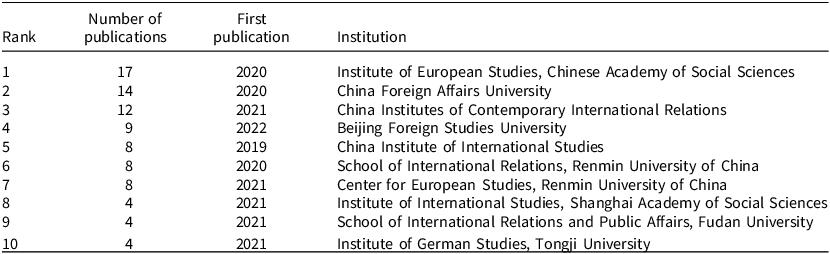
Among the most productive institutions, as shown above in Table 1, the Institute of European Studies affiliated with the Chinese Academy of Social Sciences (CASS) rank first, which is commensurate with its role as a hub of European studies in China. It is worth noting that China Institutes of Contemporary International Relations, affiliated with the Ministry of State Security, and China Institute of International Studies, affiliated with the Ministry of Foreign Affairs, both appeared on the list. The institutions on the list are predominantly based in Beijing, followed distantly by Shanghai. It suggests that in conformity with their role as major centers of higher education and academic research, Beijing and Shanghai serve as hubs of Chinese IR scholarship, including European studies. However, their research attention on this topic only began in 2019, which is three years after inclusion of ‘strategic autonomy’ in the EU Global Strategy, and two years after it was first noticed by Chinese IR scholarship in 2017 (Mi Reference Mi2017). A lapse, therefore, exists between Chinese scholars’ research attention to ESA and its actual implementation by the EU.
Top 10 institutions with a high number of publications on the topic of ‘ESA’

Keyword analysis
In CiteSpace, keyword co-occurrence and cluster analyses are performed to visualize the hotspots and trends of the research field. As shown in Figure 1, each node represents a keyword. The co-occurred keywords in one article are linked with a curve. The thickness of each curve indicates the frequency of co-occurrence of two keywords. The larger the node appears, the higher the frequency that keyword co-occurs with others. Overall, there are 128 nodes and 204 links with a network density of 0.0251, indicating the relatively scattered networks of nodes (Chen Reference Chen2016).
Map of keyword co-occurrence.

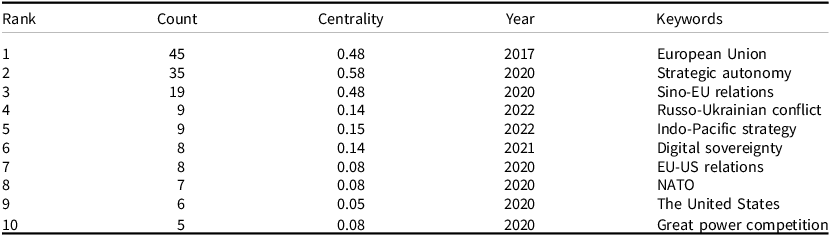
The top 10 keywords in terms of frequency of occurrence are listed in Table 2. It is noteworthy that most of these keywords are largely notions and terms about geopolitics, such as ‘Russo-Ukrainian conflict’, ‘Indo-Pacific strategy’, and ‘great power competition’.
Frequency and centrality of keyword co-occurrence

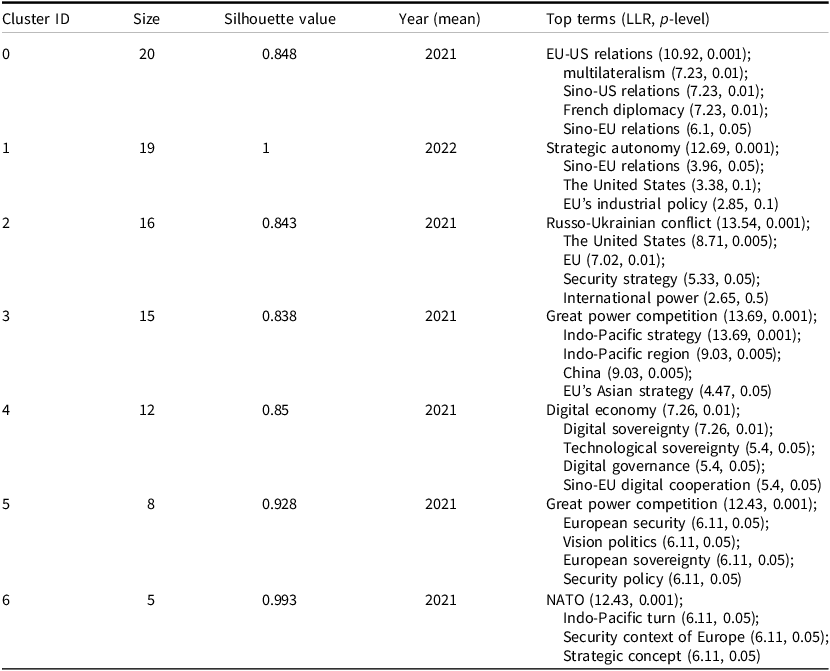
‘China-EU relations’ and ‘China-US-EU’ are also keywords that frequently co-occur with ‘strategic autonomy’. We further conducted the cluster analysis by link state routing (LSR) algorithm to aggregate closely related and often concurrent keywords together. Detailed information is summarized in Table 3. By doing so, the connection and underlying knowledge base of keywords within and across clusters can be visualized.
Summary of keyword clusters

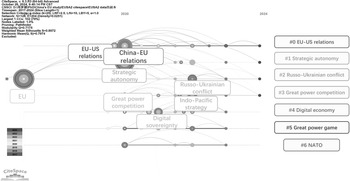
Figure 2 shows that some of the clusters overlap, such as ‘#3 great power competition’ and ‘#4 digital economy’, indicating that keywords under these clusters are used correlatedly in Chinese scholarly literature. One example is an article by Yan and Xin (Reference Yan and Xin2023), inferring that digital technologies are key to geopolitical competition between great powers in the current international landscape. Defining itself as a digital standard-maker with authority and capacity to establish and export normative rules, the EU aims to develop a comprehensive digital strategy that advances strategic autonomy in the realm of digital governance.
Map of keyword clustering.

The listed keywords in Table 3 may confirm the findings in Figure 2 that in discussions on ESA, and especially its connections with China, Chinese scholars are prone to discussing the EU’s growing presence in the Indo-Pacific region, its geo-politicization of a wide set of issues, and the implications for China, especially threats to China’s security and economic interests (Wang Reference Wang2022a; Zhao and Fu, Reference Zhao and Fu2022; Zhao and Zhang Reference Zhao and Zhang2023). In examining the geopolitical turn of the EU’s policies, the US factor is also highly emphasized by Chinese scholars.
Timing analysis
With timeline and keyword burst analysis, researchers can analyze historical spans of keyword sets in Chinese scholars’ discussion of ESA. As shown in Figure 3, the number at the top represents the timespan, and the words under the timespan are the keywords that appeared in this period. The higher frequency of keywords indicates that these keywords are the hotspots of discussion of ESA within this period.
Timeline view of keywords.

Overall, Chinese scholars’ focus on this topic has shifted from early discussion of the content and underlying logic of ESA (Ge Reference Ge2020; Xia Reference Xia2020) to its policy substances and wider implications (Ding and Wang, Reference Ding and Wang2023; Feng Reference Feng2023c; Song and Chang, Reference Song and Chang2023; ZhaoReference Zhao2023a; Zhang and Wang Reference Zhang and Wang2023). As such, Chinese IR scholars currently understand ESA as a concept and initiative, in relation to maintaining the EU’s position in the current world order, rather than merely pertaining to its strategic culture and normative identity.
With more discussion of the EU’s policy practices, skepticism about ESA is growing amongst Chinese IR scholars. It is evident that the term ‘multilateralism’ has hardly been mentioned in discussions on ESA over the past two years, although it was frequently discussed in 2019 and 2020.
Keyword bursts reflect changes in research topics and hotspots in a field. Figure 4 shows keywords with the strongest research interest burst within Chinese scholars’ discussion. It confirms a discernible evolution in the Chinese academic reception of ESA, marked by an increasingly skeptical and realistic inflection. The initial burst of keywords such as ‘strategic culture’ and ‘security strategy’ reflects an early phase of scholarly engagement primarily focused on interpreting the conceptual content and normative underpinnings of ESA. However, a pivotal shift is observable from 2020 onward. The subsequent bursts of keywords, like ‘China-US competition’, ‘geopolitics’, and ‘great power game’, signal a reorientation in the analytical lens to re-frame ESA through a geopolitical and realpolitik prism. Specifically, the simultaneous burst of research interests in ‘the US’ and ‘European sovereignty’ in 2020 implies that Chinese scholars considered the EU’s pursuit of ESA to be a sign that European politicians are dissenting from US manipulation of European security through transatlantic mechanisms, namely NATO (He Reference He2020).
Top keywords with the strongest citation bursts.

Research findings and discussion
Growing Chinese disillusionment with ESA
With more observations of ESA in practice, Chinese IR scholars are becoming increasingly disappointed with and skeptical about its implications for China-EU relations. Although Chinese scholars continue to affirm that China and the EU have no fundamental conflict, more people now admit that the two sides are diverging over a widening range of issue areas. For instance, early Chinese discussions mainly characterized ESA as the EU’s pursuit of autonomy from the US (He Reference He2020). However, Chinese scholars soon realized that they may have misunderstood the concept and its policy implications, due to an ‘asymmetric expectation’ (Yang Reference Yang2024). Zhenlin Wang (Reference Wang2022b) observes that the EU’s pursuit of SA is leading to the geo-politicization of a broad range of policy areas, including economics and trade, science and technology, digital policy, and environmental sustainability. The increasing prominence of terminology such as ‘digital sovereignty’ within EU policy suggests a growing trend toward the geo-politicization of digital technologies. Chinese scholars contend that this development poses a challenge for China, potentially exacerbating existing tensions in China-EU relations, which are already complicated by US-China rivalry (Feng Reference Feng2023b).
This shift in understanding ESA is also evidenced in scholarly discussions at two academic symposiums held respectively in 2021 and 2024. In the 2021 symposium ‘EU Strategic Autonomy: Background, Progress and Response’ organized by the Institute of International and Strategic Studies at Peking University, scholars agreed that
ESA could help forge a new EU identity that it should not be a subordinate and vassal of the US in international politics. This is what China would like to see. From the security perspective, the strategic autonomy of the EU is aimed at the US and poses no threat to China. China should therefore seize the opportunity and strive to become an active partner of the EU in seeking strategic independence. (Xu Reference Xu2021).
In contrast, at the 2024 ‘International Symposium on the Transformation of the Global Order and China-EU Relations’, held by the School of International Relations and Public Affairs at Fudan University, senior scholars like Jin Ling and Zheng Chunrong raised concerns about the potential ‘great power turn’ in the EU’s pursuit of ESA, leading to the EU’s shifted attitudes toward China, and thereby overshadowing further cooperation between the two sides (Yang and Shi Reference Yang and Shi2024). To Chinese scholars, therefore, the EU is drastically readjusting its China policy from pragmatic engagement to systemic competition (Zhao Reference Zhao2023b). This reorientation is characterized by the rising primacy of normative concerns over practical cooperation. The EU’s heightened emphasis on SA has been frequently manifesting in advocacy for ‘de-risking’ or reducing strategic dependencies vis-à-vis China. From this scholarly perspective, ESA itself emerges as a double-edged sword in China-EU relations, simultaneously representing a European quest for agency and a potential vector for divergence and rivalry.
Based on this renewed mindset, Chinese IR scholars have been concerned about the EU’s seeming geo-politicization of a wide range of issues in economy and trade, digital technologies, climate actions, and even public health. They therefore suggested that China must restructure its EU policy and actively respond to an increasingly assertive and muscular EU (Ding and Wang Reference Ding and Wang2023).
EU’s securitization of China
Chinese scholars increasingly interpret the EU’s recent policy practices as pursuing SA through ‘securitizing’ China. They contend that economic consideration was no longer the main driver of the EU-China relations from the EU perspective (Yang and Shi Reference Yang and Shi2024). Rather, security and geopolitical concerns are prioritized. The EU has repositioned itself from a normative power to a geopolitical power (Zhao and Zhang Reference Zhao and Zhang2023). To Chinese scholars, the abuse of securitization will jeopardize not only bilateral economic relations, but also the mutual interests and trust between the EU and China (Feng Reference Feng2023b; Xu Reference Xu2021). Within Chinese scholarly discourse, the term ‘securitization’ (anquanhua, 安全化) often carries a distinct meaning, diverging from its theoretical genesis in Western IR theory by Ole Wæver and the Copenhagen School (Buzan and Wæver Reference Buzan and Wæver1997). It is primarily used in a more descriptive, policy-oriented sense to denote a process whereby security concerns are elevated to the highest priority within the foreign policy agenda. The Chinese academic application emphasizes observable policy reorientation towards security. Therefore, it is unsurprising that there is a growing concern of ESA as a barrier to China’s interactions with the EU (Yang and Wang Reference Yang and Wang2024).
In the beginning of EU-China diplomatic engagement, it was particularly in politics areas like the tech sector, climate and energy security, and counter-terrorism, that bilateral cooperation had unfolded most smoothly and fruitfully (Gurol-Haller Reference Gurol-Haller2022). For China, bilateral cooperation in these low-sensitivity, functional domains has traditionally been an effective way to cultivate mutual trust and common interests, and facilitate economic interdependence, thereby helping to establish the long-term foundation of China-EU relations, which has demonstrated notable resilience, stability, and endurance despite recurrent political tension (Men Reference Men2025). However, a recent and pronounced EU policy shift towards the ‘geo-politicization’ and ‘securitization’ of its external engagement directly challenges this established logic of China-EU interaction. The setback of China-EU relations is highly likely, as the longstanding foundations of trust and common interest, built through cooperation in these very domains, are being systematically eroded (Zhao and Zhang Reference Zhao and Zhang2023).
As a response to this major shift, the role of cooperation in low-politics areas, such as ‘China-EU digital cooperation’, is discussed less by Chinese scholars. On the contrary, they recommend establishing systematic and strategic partnerships with the EU in areas of security, finance, and investment. Some of them suggested that China should consider further opening up to Europe by lifting restrictions on investment in areas such as telecommunications, IT, education, and medical care for European investors and strengthening legal and IP protections for EU enterprises, thereby raising China-EU cooperation in both high-politics and low-politics areas to a new height (Lu Reference Lu2024).
Persistent US factor in EU-China relations
The US has long been an important factor in understanding fluctuations in bilateral engagement between China and the EU (He and Yu, Reference He and Yu2023). As Xia (Reference Xia2020) and Jin (Reference Jin2020) argue, the EU’s pursuit of ESA demonstrated its determination to act independently from the US. Xuxu Zhang (Reference Zhang2023) further indicated that, by pursuing ESA, the EU has proposed its own version of Indo-Pacific strategy, aiming to maintain its position as a key global actor in the world economy, geopolitics, and technology amid the US-China great power competition. In these early discussions, the US was considered a source triggering the EU’s pursuit of ESA. Against the backdrop of Donald Trump’s unilateralism and the ensuing transatlantic rift, Tian argues (Reference Tian2021) that achieving genuine autonomy would enable the EU to contribute more effectively to world peace and development, potentially opening avenues for China to consolidate and deepen cooperation with the EU and collaboratively foster a more favorable multipolar world order. Echoing this perspective, Huaipu Zhao (Reference Zhao2023a) posited that China’s engagement with a strategically autonomous EU should be understood in the context of managing competition with the US.
More recently, however, Chinese scholars have found that, since transatlantic ties were generally restored during the Biden era, the EU has reverted to being one of Washington’s major geopolitical chess pieces (Zhang and Wang Reference Zhang and Wang2023; Zhao and Tang Reference Zhao and Tang2024). As Hua Xin remarked at a symposium organized by the Shanghai Academy of Social Sciences in 2023, instead of distancing itself from the US, the EU’s recent policies have revealed its intention to strengthen transatlantic coordination (SIES 2023). A growing body of Chinese scholarship expresses concern regarding the increasing alignment of US and EU strategies and policies (Ding and Zhang Reference Ding and Zhang2024; ZhaoReference Zhao2023b). Scholars argue that the EU is departing from its historically established identity as a ‘normative power’ and pursuing a more assertive, geopolitically driven agenda that increasingly mirrors US policy toward China. Consequently, these scholars contend that China must adapt its EU policy within the context of intensifying Sino-US competition (Sun Reference Sun2024; Sun and Zou Reference Sun and Zou2024).
Following this logic, Chinese scholars agree that China should deal with the EU in the broader context of China-US-EU triangular strategic dynamics (Sun and Zou Reference Sun and Zou2024; Yan and Xin Reference Yan and Xin2023; Zhao Reference Zhao2023a). They recognized the necessity of maintaining cooperation with the EU as a counterbalance to the US, as stable relations with the EU could prevent the latter from completely emulating the US’s aggressive China policy. That said, they also notice that stabilizing Sino-US relations is also vital to China-EU relations because escalations in the Sino-US competition may push the EU further to the side of the US, its key security ally. Nevertheless, a consensus has emerged among Chinese IR scholars that the trajectory of China-EU relations remains fundamentally contingent upon the US factor. As Ding and Luo (Reference Ding and Luo2025) point out, after the return of the Trump administration in January 2025, the transatlantic relationship underwent a fundamental evolution toward a more competitive dynamic defined by interest-based transactionalism, while simultaneously introducing new strategic imperatives that could recalibrate China-EU engagement (Yang Reference Yang2025).
Some reservations about the prospect of the ESA
Besides the growing disillusionment, Chinese scholars debate whether EU member states can achieve a consensus on pursuing strategic autonomy. Feng Zhongping, director of the Institute of European Studies, CASS, believed that although the EU and its member states have different understandings of how to handle the strategy of ‘de-risking’ with China, they agree to equate specific policy measures, including outbound investment screening and export controls as a way to realize SA toward China (Reference Feng2023b). However, some others are reserved about the EU’s internal cohesion in realizing ESA. For instance, Jian Zhang (Reference Zhang2022) instead posited that sluggish economic and social development in Europe is exacerbating disagreement and disunity among EU member states. Unlike France and Germany, which actively pursue economic security agendas, Central and Eastern European countries hold divergent interests. Most prioritize transatlantic relations with the US, while Hungary opposes ‘de-risking’ from China (Ding and Zhang Reference Ding and Zhang2024).
The divergence between the ‘New Europe’ and the ‘Old Europe’ is particularly highlighted (Song and Chang Reference Song and Chang2023). After the outbreak of the Russo-Ukrainian war, Central and Eastern European countries have actively turned to the US for military and security protection. Instead of building strategic autonomy led by the ‘Old Europe’, they prefer to develop a closer strategic partnership with the US and NATO. As such, from the perspective of security and the military, the EU is facing a new security dilemma: on the one hand, the war has strengthened its willingness and pace to pursue ESA. On the other hand, many of its member states turn to the US and NATO, rather than the EU, for military and security reliance (Huang Reference Huang2024).
A possibly new approach to the EU
Adopting a pragmatic, skeptical, and power politics-oriented mindset to understand ESA, some Chinese scholars advocate for a novel approach to engagement with the EU. For instance, Sun and Zou (Reference Sun and Zou2024) suggest that China could selectively promote the implementation of specific provisions of the CAI in some more ‘friendly’ European countries. This reflects a broader argument that China should tailor its engagement with European nations based on their varying attitudes towards China (Sun Reference Sun2024; Zhang Reference Zhang2023). However, the EU generally perceives such a strategy as an attempt to exploit divisions among its member states. Chinese scholars, conversely, frame this as a nuanced and flexible application of differentiated diplomacy. They argue that member states with higher levels of economic interdependence with China could potentially mitigate the EU’s broader trend towards ‘de-risking’ from China, thereby creating a more favorable context for bilateral relations.
On multiple occasions, Chinese leaders have emphasized that China has consistently viewed and managed its relations with Europe through a ‘long-term strategic perspective’, supporting European integration, the pursuit of strategic autonomy, and Europe’s role as a significant pole in a multipolar world (MFA of PRC 2019). Recent diplomatic statements from China, particularly during the EU-China Summit commemorating the 50th anniversary of diplomatic relations, reflect a pronounced shift in rhetorical framing. Whereas previous pronouncements often called for a ‘joint effort’ to strengthen ties between China and Europe, recent appeals have increasingly focused on unilateral calls for European action (MFA of PRC 2025b). This linguistic evolution signals a more pragmatic, calculated, and realistic approach to EU-China relations under the current Chinese leadership.
While no fundamental reversal in policy is anticipated, China’s concrete support for European initiatives, such as the ESA, will now be contingent upon clear evidence of reciprocal actions from Europe. For Beijing, maintaining constructive ties with Europe remains integral to its broader diplomatic strategy. However, China’s engagement will be carefully calibrated and conditional on tangible European actions rather than mere rhetorical commitments.
Conclusion
This study analyzed Chinese academic research on ESA because scholarly discussion in China serves as an important proxy for knowledge of perception and understanding of the Chinese foreign policy apparatus. While it can be regarded as a systematic literature review, this study utilizes computational analysis to generate empirically grounded insights into Chinese academic discourse on EU-China relations. Rather than relying on a specific theoretical framework, the analysis identifies a predominantly rationalist perspective among Chinese IR scholars regarding the impact of EU-China relations on China.
The above analysis has revealed a notable discrepancy between the EU’s practice and China’s perception of ESA. Chinese analysts initially held high expectations that a strategically autonomous EU would be a reliable partner in China’s pursuit of an alternative multipolar world order. Chinese IR scholars interpreted the EU’s pursuit of strategic autonomy as an opportunity to elevate mutually beneficial cooperation between China and the EU to a higher level and wider scope, transcending the economic domain, fostering greater consensus and cooperative foundations in strategic and normative issues, thereby further deepening China-EU relations.
In implementing its ESA, however, the EU has actually readjusted its China policy from a pragmatically cooperative to a more competitive approach. Based on how Chinese scholars have discussed ESA over time, the EU’s hardening stance is an ‘unexpected’ outcome that contradicts their understandings. Chinese scholars have also found that due to its reliance on the US in security and military matters and its domestic divergence, the EU is unlikely to realize ESA in a manner that meets Chinese expectations.
The discrepancy in question is now widely recognized in Chinese scholarly literature, where analysts express disappointment and realism regarding the ESA, particularly concerning its implications for China-EU relations. The return of the Trump Administration in January 2025 has significantly disrupted transatlantic relations. Trump began the dispute with a 20% ‘reciprocal’ tariff on nearly all EU exports to the US (McKibbin, Noland and Shuetrim Reference McKibbin, Noland and Shuetrim2025). The 15% tariff ceiling agreement rather brought more issues, which could lead Trump to reverse course again. Since concluding the trade deal, the US has threatened more tariffs in response to the EU tech regulation of American companies operating inside the EU. Trump’s fixation on acquiring Greenland, an autonomous territory of NATO member Denmark, has escalated into a transatlantic imbroglio, with his threats of sweeping new tariffs and even taking Greenland by military force (Blake Reference Blake2026). These cumulative frictions reveal the scale of the disruption that Trump 2.0 has unleashed across trade, alliances, and even the global order. This shift may also present opportunities for China-EU cooperation as leverage to secure future responses to Trump’s volatility and unpredictability. However, to Chinese scholars, the foundations of China-EU relations are being eroded, with competitive dynamics now clearly overshadowing the previous logic. Even though under Trump 2.0 and transatlantic unpredictability has become the norm, Europe has not meaningfully pivoted toward China or sought to align with Beijing.
It is anticipated that the EU and China will continue to cooperate and compete in their bilateral relations, with these dynamics intertwined. As Chinese policymakers adopt a more realistic, pragmatic, and opportunistic approach towards the increasingly geopolitically minded EU, the overall China-EU relationship is likely to become increasingly complex and unpredictable.
Data availability statement
The data that support the findings of this study are openly available in the Chinese National Knowledge Infrastructure (CNKI) at https://www.cnki.net/. And it is further explained in the Research Method section of this article.
Acknowledgements
The authors wish to thank Guo Qiu and Sibei Sun for their helpful assistance in this work. We also thank the three anonymous reviewers for their constructive feedback on earlier versions of this paper and the editor for the excellent handling of the manuscript. The usual disclaimer applies.Funding statement
Funding statement
This research is funded by the University of Macau research grant, MYRG2023-GRG2023-00017-FSS.
Competing interests
The authors declared no potential conflicts of interest with respect to the research, authorship, and/or publication of this article.
Ethical standards
This research did not require ethical approval because it did not involve direct interaction with human subjects or access to personally identifiable information.
Weiqing Song is Associate Professor of International Relations at the University of Macau and a two-time recipient of the Jean Monnet Chair in EU Foreign Policy (2018–2021 & 2024–2027). Prof. Song’s research spans Chinese foreign policy, European politics, and Sino-European relations, alongside thematic interests in discourse, norms, and power dynamics within international relations. He has published widely on these topics.
Mengdie Zhou is a PhD candidate in political science, University of Macau. He has an academic interest in Global IR, East Asian international order, and political discourses. His research has been published in reputable journals in the field, including Alternatives: Global, Local, Political and International Journal: Canada’s Journal of Global Policy Analysis.
Ziqing Yang is a PhD candidate in political science, University of Macau. She has academic interests in European studies, East Slavic studies, and Eurasian studies.




 Open access

