

This article centers on the collaborative experience of a student-collector research team that worked to retroactively document both the archaeological landscape of the Baca National Wildlife Refuge (BNWR, or the Baca) in the San Luis Valley of Colorado and the critical role of archaeological ethnography in such collaborations. The Baca is located on the ancestral lands of the Ute, Jicarilla Apache, several Rio Grande Puebloan groups, and the Diné (Mitchell and Krall Reference Mitchell, Krall, Beeton, Saenz and Waddell2020), and it was home to various private ranching activities in the nineteenth and twentieth centuries. In 2003, the land was purchased by the US Fish and Wildlife Service, and the BNWR has been steadily expanding in land and protections ever since (Pearson-Good Reference Pearson-Good2020). Over the course of its ownership, archaeologists and land managers at the US Fish and Wildlife Service have partnered with local collectors and descendant communities to better understand its 100,000-acre expanse (Figure 1).
View of the BNWR toward the Sangre de Cristo Mountain Range and BNWR offices in the background (photograph by author).

This research project highlights the complexities of working with collectors and the detriments involved when collaborations are unilateral, and it offers a path forward for archaeologists to engage meaningfully in collaborative research through archaeological ethnography. The research team, led by me (a then undergraduate student at Colorado College) and Bob and Judy Bunker (a long-time ranching and collecting couple in the Valley), was a continuation of efforts initiated in 2003 by regional archaeologists and land managers. Through archaeological ethnography, our research team investigated the barriers faced by collectors in professional partnerships and employed methods of collaborative research that provide a practical model for future collaborative efforts.
As defined in the Society for American Archaeology's (SAA) statement on collector ethics (Society for American Archaeology [SAA] 2018), the Bunkers are “responsible and responsive stewards” (also known as “RRS”) who do not excavate, who do not buy or sell artifacts, who have collected through legal means, who have knowledge to share, and who are willing to learn (SAA 2018). They have exhibited their commitment to preserving history by engaging in a multitude of local learning opportunities over the years, sharing their collection and regional knowledge with countless students, and communicating willingness to meet with leaders of local Native tribes. For these reasons, and others that the article will discuss, the Bunkers are vital partners in preserving the cultural knowledge of the San Luis Valley and the chosen partners for this collaborative research.
Although the decision to collaborate exclusively with the Bunkers and not local descendant communities was largely the result of time and accessibility constraints inherent to an undergraduate thesis project, it nevertheless leaves out a crucial partner in the research process. To increase our project's visibility, I reached out to Cassandra Atencio and Garrett Briggs—the Native American Graves Protection and Repatriation Act (NAGPRA) coordinators for the Southern Ute Indian Tribe—to share details of the project and learn about their ancestral history in the San Luis Valley. Due to the circumstantial limitations, there was not ample time to facilitate a three-way partnership within the scope of this project, but this article lays a foundation for further work bringing both descendant communities and collector communities together. Although “responsible and responsive” collectors (SAA 2018) have a duty to continue stewarding their portions of the archaeological record, it is primarily the responsibility of archaeologists to further expand the academic discourse through methods such as archaeological ethnography—presented in this article—and to open space for the multiplicity of archaeological partners and their worldviews, experiences, and backgrounds.
Although this article functions as both an archaeological investigation and ethnographic report, its initial aim was to understand the cultural landscape of the BNWR. Until early 2000, the Baca had been home to privately owned ranches, commonly referred to as the “Baca Ranch.” While living and working on the Baca Ranch, the Bunkers were given express permission by the owners to collect any artifacts on the privately owned land. The Bunkers, alongside other ranching families, legally collected thousands of artifacts during their time on the ranch. The Baca landscape has shifted ownership multiple times since the days of Baca Ranch, and it is now federally owned and protected. To aid the federal archaeologists and land managers in scoping the cultural resources of the BNWR, the Bunkers and I spent several months documenting objects they had collected and walking the landscape to relocate the associated sites.
To frame our partnership, I employed archaeological ethnography, an approach to archaeological investigation that actively seeks to diversify methodologies that broaden engagement and discourse (Hamilakis and Anagnostopoulos Reference Hamilakis and Anagnostopoulos2009). Our approach included utilizing collaborative inquiry to inform the direction and scope of our work, collecting oral histories of the Bunkers and of the San Luis Valley broadly, and engaging in a standard pedestrian survey for the US Fish and Wildlife Service (Colwell-Chanthaphonh and Ferguson Reference Colwell-Chanthaphonh and Ferguson2008; Hamilakis and Anagnostopoulos Reference Hamilakis and Anagnostopoulos2009). Not only had the Bunkers collected artifacts for decades but also had accumulated various collaboration experiences with professionals in the region. The stories documented in this article are crucial to improving collaboration efforts and understanding how to build sustainable models for future partnerships.
BARRIERS TO COLLABORATIVE WORK
In order to expand our understanding of collaboration generally, professional archaeologists need to acknowledge the harm that has been perpetrated through exclusive and dismissive research practices and the subsequent barriers that have been created between the professional field and other potential research partners. In North America, these practices have excluded the voices and perspectives of Indigenous peoples and their claim to land, as well as avocational or amateur archaeologists with knowledge of the field and interest in protecting the past. The restrictive and selective nature of academia risks estranging potential partners such as Bob and Judy and prevents them from participating in the archaeological discourse (Pitblado et al. Reference Bonnie, Shott, Brosowske, Butler, Cox, Espenshade and Neller2018:15). As Foucault (Reference Foucault and Sheridan1972:49) writes, “Discourses” are not “a mere intersection of words and things” but instead “define the topics that are worth discussing and, most importantly, who can speak on them with authority.” Similar gatekeeping of the academic discourse was noted during research conducted by the SAA “Statement on Collaboration with Responsible and Responsive Stewards of the Past” Task Force. It found that elitism in the field has been an immense barrier to many forms of collaboration and operates to further devalue and alienate potential partners (Pitblado et al. Reference Bonnie, Shott, Brosowske, Butler, Cox, Espenshade and Neller2018:15).
This critique is similar to sentiments shared when discussing the impacts of excluding Indigenous knowledge in archaeological work. By reaffirming mainstream evaluations of archaeological work and omitting interpretations of culturally related peoples (Layton and Wallace Reference Layton, Wallace, Scarre and Scarre2006:67; McGuire Reference McGuire2008:3), the field continues to reproduce unrepresentative hegemonic work (Colwell-Chanthaphonh and Ferguson Reference Colwell-Chanthaphonh and Ferguson2008:3; Pitblado Reference Pitblado2014:341; Watkins Reference Watkins, Gnecco and Lippert2015:25). Archaeological practices, such as listening as archaeological method (Mrozowski Reference Mrozowski, Schmidt and Kehoe2019:70), simultaneously serve tribal needs as well as academic institutions, creating more diverse and comprehensive archaeological work. Co-created projects utilizing methods of collaborative inquiry hold great potential for partnering with other related communities such as collectors and students (Colwell-Chanthaphonh and Ferguson Reference Colwell-Chanthaphonh and Ferguson2010:329; Ferguson et al. Reference Ferguson, Koyiyumptewa and Hopkins2015). The power of student collaborations is demonstrated in the collaborative work conducted at the Stewart Indian School in Nevada by former students, field school students, various local tribes, and archaeologists. Through true collaboration with Indigenous students and communities, archaeologists remove the barriers to access, thereby widening the discourse and expanding meaningful impact tenfold (Watkins Reference Watkins, Cowie, Teeman and LeBlanc2019:xvii).
Students, not unlike collectors, have not consistently been invited to contribute to leading-edge archaeological work. At the time of our research, I was an undergraduate student working toward my bachelor's degree in anthropology at Colorado College. There, I learned the contentious history of the field while simultaneously conducting independent research, uniquely positioning my work to include contemporary innovations at an accelerated rate. Not only are students quick to learn and highly adaptable, but they are most often transient scholars who exist within and outside of the discourse, bringing an openness to new methodologies and innovations that those deeply entrenched in the discourse may not easily recognize. When it comes to furthering new methodology, specifically in collaborating with a diversity of communities, students are invaluable partners. As seen in the Stewart Indian School sites, when students are empowered to contribute to the research process in a meaningful way, collaborative efforts are more impactful for shaping the future of the discipline (Cowie et al. Reference Cowie, Teeman and LeBlanc2019).
THE PROJECT AREA: THE BACA NATIONAL WILDLIFE REFUGE
This project was proposed in 2017 by Angie Krall, the Heritage Program Lead / Tribal Liaison for the US Forest Service in the region, in partnership with the Regional Historic Preservation Officer for the BNWR Meg VanNess, assistant professor of anthropology at Colorado College Scott Ingram, and BNWR manager Ron Garcia. The Bunkers have long assisted Krall, VanNess, and Garcia with various projects across the San Luis Valley, ranging from informal site visits to full-scale research projects (Crawford and Krall Reference Crawford and Krall2011). Although there is some breadth to research in the San Luis Valley, it remains one of the “least studied parts of Colorado,” especially the northern half, which is where this project lies (Mitchell et al. Reference Mitchell, Falk, Johnson and Newton2012:10). This section briefly describes the history of the San Luis Valley to ground the work within the appropriate cultural context.
The San Luis Valley is the largest inhabited alpine valley in the continent. It lies at 2,286 m (7,500 ft.) above sea level and is home to eight of Colorado's famed “fourteeners” (4,267 m, or 14,000 ft. mountains). It is one of the largest and highest valleys in the world that can sustain agriculture (Beeton et al. Reference Beeton, Saenz, Waddell, Beeton, Saenz and Waddell2020:4) and has been used for a wide range of human activities for over 12,000 years. Material evidence spans human history from early hunter-gatherers to the Ute tribes, which remained the dominant cultural group in the region for hundreds of years (Blackhawk Reference Blackhawk2007:731). As descendants of the Uto-Aztecs and speakers of Shoshonean, a dialect of the Uto-Aztec people, the Ute have deep ancestral ties to the San Luis Valley landscape. The predominant tribal unit in the region is the Caputa band, which, along with the Mouache band, make up the Southern Ute Tribe (Southern Ute Indian Tribe 2021).
After the US-sanctioned forced removal and massacre of Indigenous groups in the country, many of these descendant groups lost their territory in the San Luis Valley. However, tribes such as the Ute Mountain Ute and the Southern Ute have maintained their ancestral connections to the landscape and continue to steward their ancestral homelands (Mitchell and Krall Reference Mitchell, Krall, Beeton, Saenz and Waddell2020:326).
The Baca: Ranch and National Wildlife Refuge
The Baca National Wildlife Refuge, previously known as the Baca Ranch, is located in the northeastern region of the San Luis Valley and runs between the Rio Grande National Forest to the north and the Great Sand Dunes National Park and Preserve to the south (Figure 3). The Baca land parcel, or “Luis Maria Baca Grant No. 4,” was a 100,000-acre parcel given to the Luis Maria Baca heirs after the Mexican-American War of 1848. As Indigenous peoples were forcibly removed from their homelands across the San Luis Valley in the nineteenth century, the parcel was sold between private mining and ranching companies that employed many of the homesteading families new to the region (Christman and Short Reference Christman and Short2013:11). During this time period, there were thousands of Native artifacts across the landscape due to centuries of trade routes and settlement use. Collecting these artifacts became a widespread practice for many of the settler families.
By the end of the twentieth century, large-scale ranching had declined, and the land was purchased by the federal government. To properly manage and protect the cultural resources on the newly acquired landscape, BNWR manager Ron Garcia turned to the expertise of locals who had previously lived, worked, and collected on the Baca.
Collecting on the Baca Ranch
Collecting artifacts on the Baca Ranch while it was privately owned by the Arizona Ranch & Cattle Company was a legal and communal practice among the working families of the area. For some, collecting was a simple pastime, and for other families, such as the Bunkers, collecting artifacts was an accessible form of scientific inquiry. Although they did not utilize a traditional scientific method structure, the Bunkers’ interest in artifact collection stemmed from a desire to learn about human history in the area and find answers to questions that had not yet been formally investigated. Their collecting practice is reflective of their socioeconomic sphere, and as dedicated stewards of history, they took it upon themselves to preserve archaeology in the most appropriate way they could.
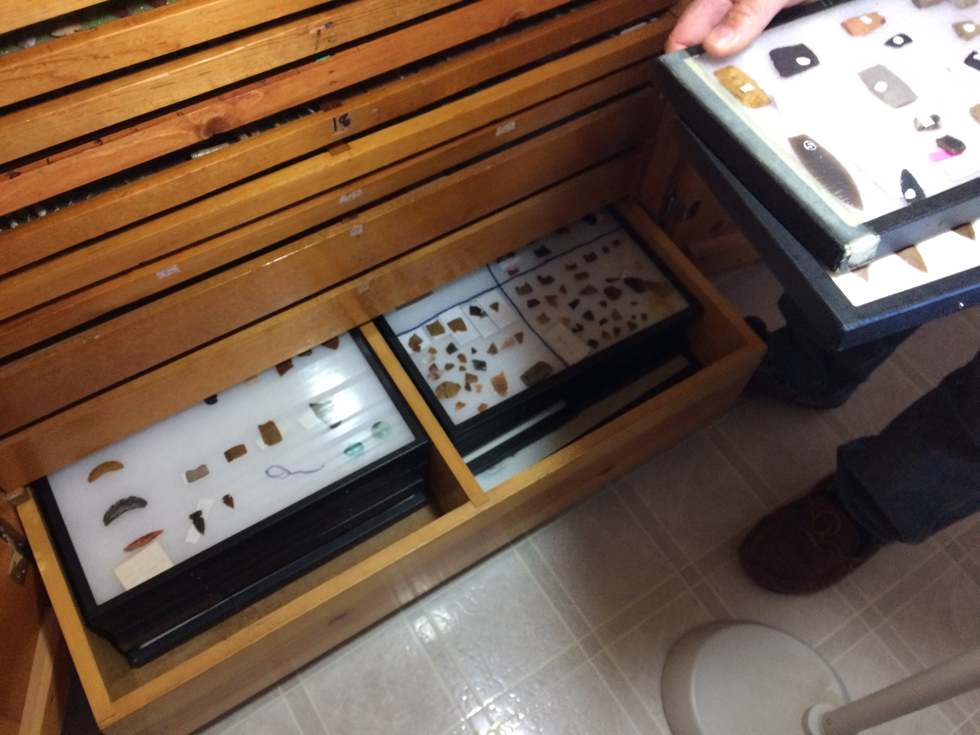
Over their decades of living and working on the Baca Ranch, the Bunkers and their immediate family collected artifacts and housed them in two custom-built cabinets measuring 1.2 m × 0.6 m (4 ft. × 2 ft.) with glass-protected trays, often organized by site or material (Figure 2). Between both cabinets, the Bunkers have amassed approximately 3,000 artifacts. The amount of material the Bunkers removed is startling, but through archaeological ethnography, archaeologists can recognize the motivations and narratives underlying their collecting mentality and acknowledge the historical context within which they collected (Colwell-Chanthaphonh Reference Colwell-Chanthaphonh2004:594; Sawaged Reference Sawaged1999:86). Meaningful interviews can also guide archaeologists to valuable scientific understandings based on the Bunkers’ decades of collecting in the area. Through mutual education, archaeologists can deepen regional archaeological knowledge and cultural understandings, and collectors can develop greater stewardship practices to protect cultural sites.
Assorted artifacts organized in the Bunkers’ custom-built drawers (photograph by author).
Map of federal lands in the San Luis Valley (digitized by author).

METHOD AND THEORY
The goal of utilizing archaeological ethnography was to (1) continue bolstering collective knowledge of the BNWR landscape by documenting the Bunkers’ collection as it related to the Refuge and (2) understand the Bunkers past partnerships with professionals in the region by recording their oral history of collecting and collaborating in the San Luis Valley. To conduct our research, we specifically utilized methods of oral history collection, collaborative inquiry, and pedestrian survey techniques.
Archaeological Ethnography
Archaeological ethnography, distinct from ethnohistory or ethnoarchaeology, is an approach that draws from both sociocultural anthropological methods and archaeological methods to create a distinct lens for conducting comprehensive archaeological work (Hamilakis Reference Hamilakis2011). Archaeological ethnography is a framework that cultivates a transcultural space where practioners from multiple backgrounds with various types of knowledge coexist simultaneously (Hamilakis Reference Hamilakis2011:405; Hamilakis and Anagnostopoulos Reference Hamilakis and Anagnostopoulos2009). For any given archaeological research question, there is room for the voices of not only archaeologists but also literary scholars, historians, Indigenous artisans, religious leaders, engineers, and many other communities that are affected by or interested in archaeological work. By incorporating differing perspectives and publics, archaeologists can facilitate cultural boundary crossing that fosters dialogues and creative negotiations (Hamilakis Reference Hamilakis2011:406) and, ultimately, generates large networks of archaeological stewards.
To further conceptualize the impacts of these “contact zones” or multifaceted networks of thought, Yannis Hamilakis (Reference Hamilakis2011:406) draws a parallel between tourists crossing a physical barricade of an archaeological site and the theoretical boundary-crossing of diverse peoples across subjective lines of academia. As the tourists cross the metaphoric barricade, conflict between them and the working archaeologists will arise. Although the concept of “contact zones” is primarily used to describe a physical space of contact, such as a museum or field site, the model is helpful in conceptualizing collaborative work and the ensuing dialogues and cross-cultural negotiations that occur.
As Indigenous leaders and private collectors cross boundaries of their perceived realms of expertise, tensions will likely surface. Archaeological ethnography challenges archaeologists to see these points of conflict as opportunities for generative conversations that push the normative boundaries of the archaeological field itself. These moments of contact between a diversity of collaborators often elude archaeologists, therefore limiting potential for collaboration and mutual growth. Through formal and informal meetings, interviews, conversations, and ultimately partnerships, archaeologists as ethnographers can conduct impactful work that transcends multiple publics (Hamilakis Reference Hamilakis2011:405; Laluk Reference Laluk2017:98) and harnesses the greatest stewardship potential. In practice, this project utilized archaeological ethnography to bridge our transcultural partnership between an undergraduate student and rural collectors. We engaged in mutual storytelling, collected oral history, employed collaborative inquiry, and utilized various methods of archaeological survey to understand the collected and uncollected landscape of the BNWR.
Oral History and Storytelling in Practice
By using listening as an archaeological ethnographic method, we engaged in open dialogue that led to particularly illuminating findings (Mrozowski Reference Mrozowski, Schmidt and Kehoe2019:70). An example of the effectiveness of this method was demonstrated early on in our partnership. Bob described his experience in an avocational certification class 20 years prior, in which the instructing archaeologist had touched on ethics. Jokingly, Bob told me that he had given the archaeologist “a deaf ear.” I leaned into my uneasiness and inquired further. Bob said that, at the time, he and Judy were so frustrated by feeling dismissed and ignored by professionals that the concept of archaeological ethics seemed hypocritical. As I listened, I gained deeper insight into the Bunkers’ prior experiences that led to their skeptical view of archaeological ethics. This created space to hold meaningful dialogue on the strides archaeology has made in the past decades to remedy these hypocrisies, and deepened our capacity as partners to have constructive conversations.
As I learned more about the Bunkers and their experiences with professionals, I recognized the need to record their oral history in its entirety to understand the deep impacts of these previous partnerships. Oral history, distinct from basic storytelling, is a method of formally collecting one's story through a historical lens, centering the contextualized experiences of an individual (Ritchie Reference Ritchie2003:19). This method allowed us to record a timeline of the Bunkers’ experiences with archaeologists in the region, as well as the larger epistemological shifts within the discipline over time. Due to the fluidity of archaeological ethnographic work, I was able to consensually widen the scope of our project to incorporate their oral history, and I ultimately recorded over a dozen interviews with the Bunkers.
Collaborative Inquiry in Practice
Collaborative inquiry is a team-oriented method of research that widens the definition of “researcher” to foster a sense of agency and intellectual ownership for all partners involved in the work. For our purposes, rather than orienting collectors as “subjects,” collaborative inquiry integrates collectors as co-researchers within the professional partnership, collaboratively creating and executing the research (Colwell-Chanthaphonh and Ferguson Reference Colwell-Chanthaphonh and Ferguson2008:9).
Together, the Bunkers and I chose the scope of our fieldwork based on what was both relevant to the needs of the US Fish and Wildlife Service on the BNWR and interesting and important to the Bunkers and to me. By co-creating the aim of the study and maintaining transparent goals, all partners developed a strong sense of ownership of the work and belonging in the discourse. Collaborative inquiry also requires constant acknowledging of biases and perceptions (Bray et al. Reference Bray, Lee, Smith and Yorks2000:10), which further enabled us to have illuminating and honest conversations regarding professional archaeology and avocational practices alike.
Fieldwork and Lab Work in Practice
Archaeological ethnography allowed space for our team to conduct field and lab work akin to a standard pedestrian survey, utilizing the Bunkers’ knowledge of the past and present. Together, we chose four sites that were of interest to all research partners, and the Bunkers and I conducted fieldwork across the BNWR. During our field visits, we walked across each of the four selected sites and mapped the boundaries, surface finds, and relevant natural features with a GPS unit. The Bunkers would reminisce about collecting particular artifacts decades earlier from very specific areas within site. These data and photos were incorporated into the maps and site write-ups we completed.
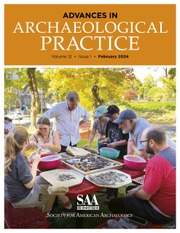
The lab work was conducted in the Bunkers’ home, where we identified and photographed artifacts in their collection as they related to each of the four field sites (Figure 4). Through diligent note-taking and informal and formal recorded interviews, we compiled a complete report linking their collected artifacts to the BNWR sites and submitted it, along with preservation recommendations, to the US Fish and Wildlife archaeologist for further corroboration.
Bob Bunker in our homemade lab (photograph by author).

RESULTS
We ultimately recorded two separate datasets: the first was the results from the Bunkers’ collection documentation and associated site surveys and maps; the second consisted of the Bunkers’ oral history recorded through archaeological ethnographic inquiry. Both of these datasets are included here to demonstrate the scope of work the team embarked on, but the latter will be the central focus for the remainder of the article.
Four New Sites
The Bunkers and I documented roughly 2,000 artifacts from their collection and linked each artifact to one of the four sites from which they had collected in the decades prior. These four sites (5SH4970–5SH4973), although previously identified by the Bunkers, had no formal record, so each site was given a Smithsonian site number. At three of the four sites (5SH3970, 5SH4971, 5SH4972), cultural resources were still visible on the surface, and two of those three sites (5SH4970 and 5SH4972) had a dense amount of groundstone, flakes, and cores. Even with this small dataset, it is clear that there are still many undocumented cultural resources across the landscape of the BNWR, and further work collaborating with the Bunkers and other locals in the area will ensure their future protection and preservation. A Class II Cultural Resource Survey report was submitted to the US Fish and Wildlife Service documenting the four sites and further contextualizing their oral history as it relates to the Bunkers’ collection (Mills Reference Mills2018).
The Stories of Bob and Judy Bunker
Using the archaeological ethnographic approach, I collected an oral history from the Bunkers about their past experiences with professional archaeologists in the San Luis Valley to better understand the complexities of such partnerships. The resulting stories, followed by discussion, are shared so that professionals can learn from them, so that collectors and avocational archaeologists can recognize themselves in them, and to further widen the field of archaeology by incorporating the backgrounds, experiences, and knowledges of nontraditional partners. These stories, shared with permission from the Bunkers, shed light on the nuances of collaboration with the ultimate goal of promoting mutual growth among all participants. To protect the identities of those with whom the Bunkers worked, pseudonyms have been used, and minor details have been altered.
The 1960s: Museums Collect Too
The Bunkers’ earliest experience with a professional in archaeology was while they were high schoolers in the 1960s. They pulled over to help a stranded driver on the side of the road and noticed artifacts in his trunk. The driver, Edward Baker, was an employee at a local museum who had come down to the San Luis Valley for the week to conduct research. He invited the Bunkers to visit the sites he was working on, and the three developed a lifelong friendship. Baker spent weekends raking sand hill sites in the Valley and brought his findings back to the museum for further analysis. Bob and Judy were frequently invited to the museum, and Baker gave them a tour of its immense archives. The Bunkers recount those museum days with deep appreciation, an indication of the positive and lasting impacts of public archaeology. They partially modeled their home archival system on the museum's techniques. This early endeavor shaped their archaeological education, and the two continued to pursue their interest in the field.
The 1970s: Conversations in Avocational Spaces
In the 1970s, Bob and Judy joined a chapter of the Colorado Archaeological Society (CAS) to contribute to an avocational community of archaeologists and better protect sites in the Valley. They had witnessed a construction job destroy a site well known to them, and they were concerned that other development projects in the Valley would demolish more history. When they revisited this particular site, the bulldozer had leveled the roadway, removing the bottoms of three inverted black-on-white pots and leaving only the rims on the surface. In his years of collecting, Bob said that site was the only place they had found black-on-white pottery in the Valley.
The Bunkers had high hopes for the CAS community, but their enthusiasm for the program soon waned when they found that talking about collecting was taboo. Feeling alienated and excluded, the Bunkers quit the society. At that time, CAS and the wider archaeological community did not have the language about “responsible and responsive collectors” (SAA 2018) that exists now, and this restricted them from opening a dialogue. Even though it was avocational, this instance was the first time the Bunkers blatantly experienced gatekeeping of the field—a feeling that was further complicated when they developed a partnership with Marilyn Martorano, a local professional whose parents belonged to the CAS group.
Martorano and the Bunkers collaborated numerous times in the Valley, and most recently, the Bunkers helped her gather “lithophones”—a lithic instrument—from various collectors in the community (Martorano Reference Martorano2018). Even though the Bunkers’ experience with CAS had been frustrating, their relationship with a local professional bolstered their sense of intellect within the field, and they continued their archaeological involvements. When an avocational archaeologist course was offered to them in the years after CAS, they accepted, and when researchers and students passed through the Valley, they made themselves available. By the 1980s, Bob and Judy had helped on multiple projects, including with a minor report for the University of Denver.
A Collaboration Gone Wrong
By the 1990s, the Bunkers’ collection was well known to academics in the region. A team of archaeologists who had ventured to the San Luis Valley to research precontact sites reached out to them, and the Bunkers happily offered their collection and regional expertise. The team's research lasted years, and during that time, the archaeologists partnered with the Bunkers, swapping stories and growing their collective knowledge of the region. When the archaeologists asked to borrow part of the Bunkers’ collection—a cache of blades and scrapers—to bring back to the museum for further analysis, the Bunkers willingly agreed. Bob shared that he had been excited to be contributing to their research and eager to hear the resulting data. However, years passed, and the team never reached back out to the Bunkers about their research. Phone calls and letters went unanswered, and the Bunkers assumed that the collection they had loaned the archaeologists was lost forever. Feeling spurned, the Bunkers became more distrustful of professional partnerships, and they have grown more protective of their collection.
In an effort of reciprocity, and with permission from the Bunkers, I decided to inquire about this particular cache. In the summer of 2018, I visited the museum and met with one of the head curators. By then, she had already scoured databases for this missing collection but to no avail, so we instead spoke at length about private collectors and her hope for museums to find ways to incorporate collections for public display. A few weeks later, I received an e-mail with the news that she had located the collection. She confirmed that no formal research had been done on this collection, nor were there plans to display it. Consequently, it was ready to be sent back. After virtual corroboration exchanges, the cache was packaged and mailed back to the Bunkers, who expressed their sincerest appreciation.
The actions of this archaeological team, although likely pragmatic at the time, ultimately further endangered the archaeological record by jeopardizing future partnerships with the Bunkers and the possible curation of their collection. Although donating their collection is still an ongoing conversation, the Bunkers continue to develop new partnerships with a multitude of professionals and researchers in the San Luis Valley.
LESSONS OF COLLABORATION: CONCLUSION
Not only is archaeological ethnography a powerful framework for conceptualizing and structuring a collaborative research team, but it also allows for next steps in the process beyond the data to reflect and internalize lessons learned, tackle new lines of inquiry, and promote creative compromises and solutions to larger anthropological questions. Although the stories gathered in this project are at times highly specific to the Bunkers’ backgrounds and life experiences, they also hold generalizable lessons to be integrated into the larger conversation around collector collaborations and the complexities of partnership.
Lesson 1: Avocational Spaces Are Important
The impacts that public archaeology and avocational learning spaces had on the Bunkers and their educational trajectory speak to the importance of these communities. Groups such as the Colorado Avocational Society—or avocational certification courses—are often the first and most accessible archaeological communities that responsible and responsive collectors find. If these communities are not equipped to hold the multitudes of backgrounds and peoples who may be interested in archaeology or who have not had accessible guidance from professionals in the field, they may alienate potential partners or engage in outdated archaeological practices. However, if these communities are offered support and direction in dialogues that incorporate responsible and responsive collectors, are included in conversations on current ethics, and are instructed on contemporary noninvasive technological advances in the field, avocational arenas will flourish.
To offer productive and sustainable guidance for avocational and public archaeology in general, professional partners need to take greater responsibility for modeling inclusive and ethical behavior that contributes to the cultural shift of the academic discourse. With advances in language around responsible and responsive collectors, as well as new innovations in collaborations and co-creation of research projects, professionals are more equipped than ever to aid in expanding the discourse. Avocational spaces may then develop into vast communities of regional experts that in turn reciprocate by offering professional partners, deeper regional knowledge, access to cultural material collections, and greater research opportunities.
Lesson 2: Sustained Partnership Is Invaluable
The collections of private collectors along with their sustained partnership and knowledge are essential to stewarding the material record. Two distinct instances of the Bunkers’ decades of working with professionals in the San Luis Valley exemplify both the adverse effects of professionals focusing solely on the material collection and the mutually beneficial long-term outcomes of continued partnership.
When the team of archaeologists left the Valley with the Bunkers’ cache of knives and scrapers, the impacts were far more detrimental to the archaeological record than the team likely considered. The Bunkers had long contemplated donating their collection, but due to both the broken trust of these professional partners and the growing perception of museums as unreliable artifact voids, they have grown more hesitant to donate. When archaeologists focus too closely on the materiality of the archaeological record, it is easy to alienate these contemporary partners and risk losing not only access to the collection but an invaluable and dependable partner as well.
In contrast, when both the material collection and the partnerships are valued, the long-term benefits are profound. The BNWR land manager and regional archaeologists have maintained a strong relationship with the Bunkers for years. Through this sustained collaboration with the Bunkers and other regional collectors—as well as local Indigenous leaders and educational institutions—these agency archaeologists and land managers have developed an extensive network of archaeological stewards across the San Luis Valley. This network has been essential in supporting and executing a variety of archaeological research projects in the area, and its sustained efforts will continue to generate greater research opportunities, with high potential for creative and equitable curation and public archaeology opportunities.
Lesson 3: Demonstrating Reciprocity Is Essential
Reciprocity within the archaeological community is crucial to maintaining long-term partnerships, and it is possibly one of the most complicated elements of this research project. This lesson was not revealed in the Bunkers’ stories. Instead, it was discovered during self-reflection at the conclusion of the project. When I initially inquired about returning the missing cache of scrapers and knives, I was acting out of a desire to regain the Bunkers’ trust and instill confidence that, should they choose to donate their collection in the future, these institutions would respect their needs. However, once the artifacts were successfully returned to the Bunkers, a very different question about future reciprocal partnerships arose: What would the return of this Native artifact collection to Anglo collectors look like to our Indigenous partners of the San Luis Valley archaeological community?
For Indigenous tribes and descendant communities in the United States, obtaining artifacts or repatriating objects is a complex process requiring years of research and lobbying (Colwell Reference Colwell2019), exposing a blatant inequity between private collectors’ and Indigenous peoples’ access to the material past. Although laws such as NAGPRA are a vital step toward recognizing Indigenous ownership, there are still multitudes of other ways Indigenous histories and personhoods need to be better protected, respected, and integrated into the wider archaeological discourse. Returning a collection of Native artifacts to an Anglo homesteading family may have helped heal one relationship, but it may also have jeopardized the trust of the local tribes that were not brought into the process earlier. Had I reached out to the Southern Ute tribe at the beginning of the process, or other culturally tied groups in the area, I may have been able to better serve the greater archaeological community by connecting the Bunkers and local tribal leaders.
NETWORKS OF STEWARDS: DISCUSSION
More than ever, the field of archaeology is experiencing the growing pains of evolving beyond a Eurocentric field into a postcolonial discourse that honors and serves all people. The need for professional archaeologists to serve as models and guides in this process has become more apparent, and in order to be authentic leaders, archaeologists have to unsettle latent structures of settler colonialism within the field, reconcile past transgressions and problematic practices, and actively advocate for a different future of archaeological inquiry (Kelvin and Hodgetts Reference Kelvin and Hodgetts2020). As demonstrated in this work, archaeological ethnographic modes of research, along with collaborative methods of data collection, are a few approaches to actively diversify and infuse more voices into the discourse.
Creative archaeological projects that incorporate myriad collaborators will hold relevance for all people and endure through time (Ferris Reference Ferris2003:175). Professional partners within these projects and cooperative spaces must serve as a bridge when contentious issues or frictions surface, simultaneously holding the needs of Indigenous communities, responsible and responsive collector communities, and other relevant regional or academic partners. By moving through the discomforts and challenges, professional partners can build mutually beneficial and reciprocal networks that are specifically tailored to the needs of a particular archaeological landscape.
When archaeologists function as ethnographers, they hold the power to unite students, private collectors, tribal leaders, local landowners and managers, government officials, the general public, and many other potential allies. All roles are important in creating inclusive archaeological work that protects and preserves the past for our future. With the resources and privilege of functioning within professional archaeology, paired with the dedication to mutual growth for all, archaeologists can become not only stewards of the past but mediators of the past, present, and future—bringing all stakeholders of archaeology together to tell the most expansive story of human history.
Acknowledgments
I would like to express my deepest gratitude to my research partners, Bob and Judy Bunker, for their willingness to share their story, home, and time with me. I am deeply grateful to my professor Scott Ingram for asking difficult questions and believing in my ability to take on this project. I would also like to thank Angie Krall for her efforts and support, Meg VanNess for her guidance throughout, and Ron Garcia for his willingness to share the history of the Baca National Wildlife Refuge—as well as his office space. I am also grateful to the Southern Ute NAGPRA coordinators, Cassandra Naranjo and Garrett Briggs, for their generosity of time and storysharing, and all those, past and present, with ancestral claim to the Colorado landscape. I would also like to thank Bonnie Pitblado for her tireless efforts in helping this article evolve and the work she has done to improve collaborative work for all. Finally, I would like to thank Gabriel Fine for his endless encouragement and edits, the members of the Anthropology Department at Colorado College for their dedication to each student's success, and the Colorado College Kathleen A. Jones Memorial Fund for providing funding for this research.
Data Availability Statement
All field notes and copies of photographs, recordings, and maps are archived at the Colorado College Department of Anthropology. For access, call (719) 389-6358 or write to Colorado College Department of Anthropology, 14 East Cache La Poudre St., Colorado Springs, CO 80903.



 Open access

