

1. Introduction
For developing economies, the question of whether to further liberalize trade often hinges on the potential impact of trade liberalization on the domestic agricultural sector. The outsized role played by this sector in employment, economic production, and social security means that governments tread rather carefully when assessing what types of agriculture-related concessions to offer in exchange for gains in other sectors. This is especially the case for small economies that lack the ability to shape world prices.
In the course of opening up agricultural markets, governments in small economies are faced with two competing concerns. On the one hand, they fear that prices for agricultural goods may suddenly drop, leaving farmers exposed to negative income shocks. On the other hand, they also worry that prices may suddenly spike, triggering inflationary concerns and harming consumers. To guard against these concerns, some governments chose to liberalize trade while simultaneously retaining some form of a price range system (PRS) that helps insulate the domestic market from fluctuations in word prices.
By far the more common policy discussed in this context is the notion of a price band system (PBS). It may be worthwhile, at the onset, to distinguish between a PRS and a PBS, especially since the terms are sometimes used interchangeably. While both policy instruments seek to mitigate the local effects of fluctuations in global prices by keeping the price of imports within a given band/range, their exact mechanics differ slightly.
Under a PBS, the government sets a particular floor and ceiling price. Whenever the import price falls below this range, an additional tariff is imposed equal to the difference between the floor price and import price, bringing the local price of the import back up to the floor price. Similarly, whenever the import price exceeds the ceiling price, a tariff rebate equal to the difference between the import price and ceiling price is issued. This brings the local price of the import back down to the ceiling price. The additional tariff/rebate may be subject to additional adjustments, as necessary. Overall, it should serve to keep the price of the imported good within the desired price band.
A PRS operates in much the same way as a PBS, except that the adjustments are not made on a transaction-specific basis. Again, the government sets a floor and ceiling price, which may be altered over time. Instead of comparing the floor and ceiling prices against the actual import price, however, the comparison is made against a reference price. The reference price is set periodically through reliance on some external benchmark or a pre-determined formula. It may be tweaked with time, at an interval different than that of the floor and ceiling prices. Whenever the reference price falls below the floor price, an additional tariff is imposed equal to the difference between the floor price and reference price. Similarly, whenever the import price exceeds the ceiling price, a tariff rebate equal to the difference between the import price and ceiling price is issued. Again, the additional tariff/rebate may be subject to further adjustment, as necessary.
Note that unlike a price band, the additional tariff/rebate associated with the PRS does not vary with each given transaction. Instead, it is fixed for a given period of time – i.e., the period for which the reference price is constant, regardless of the actual import price. It only changes if the reference, floor, and/or ceiling prices are altered. Nevertheless, the PRS fulfills a similar objective of tweaking duties to keep the price of imported goods within a given price range. In doing so, the PRS allows a government some degree of control to guard against the unwelcome effects of agricultural trade liberalization.
Not surprisingly, such systems are not without controversy. A PRS seeks to alter price artificially and therefore distorts trade away from the market-equilibrium level. By revising duties in conjunction with the ceiling and floor price, the policy artificially limits gains for foreign producers within the given market. Some trading partners may therefore naturally view the policy as a protectionist scheme cast in the guise of a price stabilization instrument.
To date, PRS regimes have not received much attention in the academic legal literature, particularly with respect to agricultural trade and developing countries in which they are most commonly found. Much of the existing scholarship has focused on other forms of trade-related distortions in global agricultural markets, such as subsidies and export taxes, that are more commonly imposed by developed countries. Yet, as the recent Peru–Agricultural Products disputeFootnote 1 demonstrates, PRS policies also can give rise to trade distortions that harm farmers in other developing countries.
Why would a small developing country choose to implement a PRS? Does such a policy always represent a rent transfer to special interest group(s) that is overall welfare-reducing? Or can it be welfare-enhancing under particular conditions? We demonstrate that in the canonical model of a small open economy with risk-neutral consumers and producers that take world prices as given, a PRS is sub-optimal. This is because a PRS supported by fluctuating tariffs reduces the extent to which the local price in a country differs from its autarkic price and therefore reduces its expected gains from trade.
However, a PRS does ensure that the welfare of consumers and producers does not fall below a certain minimum threshold as a result of agricultural trade liberalization. We argue that a PRS can be welfare-enhancing in the presence of significant risk aversion on the part of either group. If some factors of production are immobile ex-post and insurance markets are incomplete, some level of trade protection can be optimal for a small open economy facing fluctuating terms of trade (Eaton and Grossman Reference Eaton and Grossman1985). Thus, a PRS serves as an imperfect substitute for the lack of insurance and can help ensure that the welfare of consumers and producers exceeds a certain minimum threshold. Nevertheless, we note that a PRS does not constitute a first-best solution for redistributing income across domestic groups.
In light of this argument, we discuss two sets of questions related to how a PRS is treated under the laws of the World Trade Organization (WTO). First, we examine open questions in WTO jurisprudence with respect to whether a PRS could ever be designed to comply with WTO rules. Second, if a PRS is WTO-inconsistent but a country nevertheless wishes to preserve its flexibility to employ this instrument, we consider whether a WTO member can do so through a preferential trade agreement. To what extent can a free trade agreement (FTA) serve as a work-around solution to existing WTO rules? And what significance, if any, should be attached to the signing of such agreements as opposed to their ratification?
We use Peru's PRS and the resulting WTO legal dispute as the basis for the questions to be explored in this article. Section 2 discusses how a PRS operates and why it is controversial under WTO law. Section 3 assesses the economic implications of a PRS. Section 4 highlights several open questions in terms of whether the WTO affords policy flexibility to design a PRS consistent with WTO rules. Finally, Section 5 examines the question of whether a WTO member may use an FTA to preserve its ability to implement a PRS, even if it contravenes WTO law.
2. How a PRS works and why it poses a potential WTO legal controversy
Recent studies have demonstrated that the economic impact of agricultural trade liberalization varies both within and across developing countries, with outcomes dependent on the country's factor endowments and the precise contours of liberalization (Bouet et al., Reference Bouet, J.-C. Bureau, Decreux and Jean2005). Not all agents in developing countries necessarily gain from liberalizing trade in agriculture. As a result, some countries might choose to impose policies designed to safeguard certain groups against any potential negative impacts resulting from opening up their agricultural sector to increased foreign competition.
We examine measures taken by the Peruvian government in the early 2000s as a case study of how a developing country might utilize a PRS to advance its policy objective. We then highlight how such an instrument might give rise to trade tensions with other developing countries that are agricultural exporters.
2.1 The case study: Peru's price range system
During the 1990s, the Peruvian economy underwent a massive program of structural adjustment and economic liberalization. As part of this program, and in conjunction with Uruguay Round commitments, Peru lowered its tariffs and other trade barriers on agricultural products (Trivelli, Reference Trivelli2003: 5). This trade liberalization exposed Peruvian farmers to increased competition from world markets.
Worried about the negative impact on its farmers, Peru established a PRS in June 2001.Footnote 2 The PRS covered 45 agricultural products, which were separated into four general categories: milk, yellow maize, rice, and sugar.Footnote 3 The PRS operated as follows:
• Within each category, there was one tariff line designated as the ‘marker’ product and all others are designated as ‘associated’ products.
• A floor and ceiling price were determined for each marker product on the basis of monthly average f.o.b. (freight on board) prices for the past 60 months on the international reference market for that marker product. These prices were to be updated semi-annually and converted to a c.i.f. (cost, insurance, and freight) floor and ceiling prices.Footnote 4
• In addition, a reference price was to be calculated every two weeks, reflecting the average international market price for the product.Footnote 5
• The reference price was then compared to the c.i.f. floor and ceiling prices to determine whether a ‘variable additional duty’ should be levied or a ‘tariff rebate’ should be issued.
Whenever the international reference price (denoted by pR) fell below the c.i.f. floor price p, a ‘variable additional duty’ was levied against the imported good. Letting b denote the import costs associated with marker products, the additional variable duty AD was calculated according to the following formula:
 $$AD = (1+b)\; ({\underline p} - p^R)$$
Assuming that the additional cost associated with the variable additional duty was passed on to the consumer, this policy kept Peruvian prices for the good above world market prices. It therefore protected Peruvian farmers from negative price shocks on the global market.
In contrast, whenever the reference price rose above the c.i.f. ceiling price  $\bar p$, a tariff rebate was issued to the importer. The tariff rebate was calculated as follows:
 $$TR = \left( {1\; + \; b} \right)\; \left( {\,p^R - \bar p} \right)$$
Assuming that the tariff rebate was passed on to the consumer, this policy kept Peruvian prices for the good below world market prices. It therefore served to protect Peruvian consumers from undesired price increases on the global market.
The stated objectives of the Peruvian PRS were three-fold:Footnote 6
First, the PRS was designed to counter the adverse effects to domestic agricultural production on account of ‘distortions … due, in particular, to the agricultural policies implemented by the main food producing and exporting countries’ and as ‘reflected in the uncertainty and instability of domestic prices’.
Second, the PRS was ‘a stabilization and protection mechanism that makes it possible to neutralize the fluctuations of international prices and limit the negative effects of the fall in those prices’.
Third, the PRS constituted ‘an appropriate means of improving the levels of competitiveness of domestic producers, by giving the market clear signals with regard to trends in prices, thereby allowing economic agents to operate efficiently and productively’.
In this sense, Peru's PRS serves as a quintessential example of a small developing country's government's employment of an instrument to safeguard against undesired price fluctuations associated with increased agricultural trade liberalization. Peru's Ministry of Economy and Finance noted that the PRS was intended to protect both domestic producers and consumers, through the establishment of a floor and ceiling prices for calculating a variable additional duty or tariff rebate, as necessary, to fulfill its various stabilization and competitiveness objectives.Footnote 7
2.2 Potential WTO legal controversy arising due to an agricultural PRS
A PRS, however, encounters potential problems when examined in the context of the WTO's Agreement on Agriculture. The drafters sought to limit the types of border measures designed to restrict the volume or distort the price of imports of agricultural products.Footnote 8 To that end, they decided it would be best to require that border measures and other non-tariff barriers designed to restrict agricultural imports be converted into ordinary customs duties.
Article 4.2 of the Agreement on Agriculture states: ‘Members shall not maintain, resort to, or revert to any measures of the kind which have been required to be converted into ordinary customs duties, except as otherwise provided for in Article 5 and Annex 5.’ Article 4.2 includes a footnote 1 that provides an illustrative list of the types of measures that might violate this provision. These include ‘quantitative import restrictions, variable import levies, minimum import prices, discretionary import licensing, non-tariff measures maintained through state-trading enterprises, voluntary export restraints, and similar border measures other than ordinary customs duties’.
To date, the bulk of WTO cases interpreting Article 4.2 have concerned quantitative import restrictions applied against agricultural imports.Footnote 9 The PRS, however, does not act as a quantitative restriction. Instead, the two types of measures that it most closely approximates are (1) variable import levy, and (2) minimum import price.Footnote 10
Through 2013, only one WTO dispute, Chile–Price Band System, has opined on these issues. The Appellate Body (AB) found that Chile's PBS, which shared similarities with Peru's PRS, was inconsistent with Article 4.2 of the Agreement on Agriculture.Footnote 11
2.3 Background on the Guatemala‒Peru FTA and subsequent WTO dispute
Anticipating potential legal problems with its PRS, Peru sought guarantees from its PTA partners that they would not challenge the PRS through WTO dispute settlement. One example is the Guatemala‒Peru FTA, signed on 6 December 2011. Article 9 of Annex 2.3 explicitly recognizes Peru's right to maintain its PRS.Footnote 12 The FTA also clarified that in the event of an inconsistency between the FTA and WTO agreements, the FTA ‘shall prevail to the extent of the inconsistency, unless otherwise provided in this Treaty’.Footnote 13
More than a year later, neither party had ratified the treaty. On 12 April 2013, Guatemala proceeded to file a WTO challenge, alleging that Peru's PRS violated several WTO commitments:Footnote 14 These included:
• Article 4.2 and footnote 1 of the Agreement on Agriculture, to the extent that the additional duty constitutes and encompasses elements of a variable import levy, a minimum import price, or a measure similar to the two;
• Article II:1(b) of the GATT 1994, since the measure constitutes a duty or charge other than an ordinary customs duty that was not included in Peru's schedule of concessions;
• Article X:1 and X:3(a) of the GATT 1994, regarding failures in the publication and administration of the trade regulations related to the PRS.
Should the Panel find that the duties arising from the PRS are ordinary customs duties, Guatemala argued, in the alternative, that Peru's actions would then amount to a violation of Articles 1, 2, 3, 5, 6, and 7 of the Customs Valuation Agreement.
Why did Guatemala bother to marshal resources to challenge Peru's PRS when it had previously agreed to recognize its legality in the bilateral FTA? The overall economic stakes were not large.Footnote 15 Based on our analysis of available data, bilateral trade was significant in only two sugar products subject to the PRS.Footnote 16 The WTO litigation appears then to reflect the lobbying power of Guatemala's sugar producers.Footnote 17
By the time the Panel was composed in September 2013, neither party had yet ratified the FTA, although Guatemala's Congress gave approval two months earlier. Guatemala initiated ratification procedures in December 2013, with Peru receiving a communication on 5 March 2014.Footnote 18 At that point, had Peru's President simply initiated ratification procedures and sent notice to Guatemala, the FTA would have entered into force. Peru's FTA ratification process does not require Congressional approval, only Presidential action.Footnote 19 Peru's President refused, viewing the filing of the WTO dispute as having ‘created uncertainty with regard to the existence of the balance negotiated’ in the FTA.Footnote 20 Thus, the bilateral FTA, as of this writing, has not yet entered into force.
On 27 November 2014, the Panel issued a report finding Peru to have violated Article 4.2 of the Agreement on Agriculture because the duties arising from the PRS constitute a variable import levy that was not permissible under the Agreement.Footnote 21 In addition, the Panel also ruled that the duties arising from the PRS violated GATT Article II:1(b) because they are not ordinary customs duties and were not declared as other duties or charges.Footnote 22 The Panel exercised judicial economy with respect to the GATT Article X:1 and X:3(a) claims.Footnote 23 Finally, the Panel did not find it necessary to rule on Peru's argument that the FTA modified the rights between the two parties with respect to the PRS, resulting in Guatemala's waiver of its WTO rights concerning the PRS; the Panel emphasized that the FTA had not yet entered into force and therefore its provisions were not legally binding.Footnote 24 Both Peru and Guatemala filed a notice of appeal. The Appellate Body ruling, issued on 20 July 2015, largely upheld the Panel's rulings except with respect to the Panel's ruling concerning the similarity of the PRS to a ‘minimum import price’ within the meaning of the Agreement on Agriculture.Footnote 25
3. The economic impact of a PRS on a small open economy
Why would a small economy, such as Peru, so adamantly seek to preserve its right to impose a PRS? In the Introduction above, we mentioned two reasons why a government might choose to implement the PRS: as a price stabilization policy for farmers to guard against the negative income effects of price shocks and as a price stabilization policy for consumers to guard against price increases. But what if a PRS is evaluated on the basis of aggregate economic welfare as opposed to the welfare of individual groups? Does a PRS enhance a country's overall economic welfare?
Below, we provide a formal analysis of the effects of a PRS in the standard trade model of a small importing nation. Since this analysis raises questions about the optimality of a PRS, we next discuss some modifications in the underlying assumptions of the standard model that can help explain why a small importing country might want to institute a PRS.
3.1 A stylized model of a small importing nation
Suppose Peru institutes a PRS under which it adjusts the additional duty applied to an imported commodity (call it sugar) so as to ensure that the domestic (tariff-ridden) price always lies within the interval  $[{\underline p}, {\bar p}] $. Let the world price p w of sugar fluctuate between three different states.Footnote 26 In the high state (i = H) p w = p H, in the medium state (i = M) p w = p M, and in the low state (i = L) p w = p L, where the following relationships hold (i) p H ⩾ p M ⩾ p L, (ii) $p_H \gt \bar p$, (iii) $p_M \in [{\underline p}, {\bar p}]$, and (iv) p L < p. Thus, by design, the high price p H exceeds the upper bound ${\bar p}$ of the PRS, the low price p L lies below the lower bound p while the medium price p M lies strictly inside the interval $[{\underline p}, {\bar p}]$.
Let θi denote the probability of state i so that we have:
 $$p^w {\rm \;} = \left\{ {\matrix{ {\,p_L \; {\rm with\; prob}\; {\rm \theta} _L} \cr {\,p_M \; {\rm with\; prob}\; {\rm \theta} _M} \cr {\,p_H \; {\rm with\; prob}\; {\rm \theta} _H = 1 - {\rm \theta} _L - {\rm \theta} _M} \cr}} \right.$$
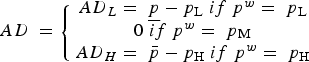
Let AD i denote the additional duty applied by Peru in state i. Then, the variable duty imposed by Peru under its PRS is given by:
 $$AD{\rm \;} = \left\{ {\matrix{ {AD_L = \; {\underline p} - p_{\rm L} \; if\; p^w = \; p_{\rm L}} \cr {0\; if\; p^w = \; p_{\rm M}} \cr {AD_H = \; {\bar p} - p_{\rm H} \; if\; p^w = \; p_{\rm H}} \cr}} \right.$$
 Observe that AD H < 0 < AD L; i.e. the variable levy is positive when the world price is low, whereas it is negative when it is high. Finally, when the world price falls within the price band  $[{\underline p}, {\bar p}]$ established by the PRS, the additional duty imposed by Peru equals zero.Footnote 27
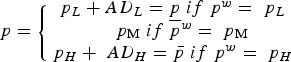
Treating Peru as a small open economy (i.e. as a country that takes world prices as given), the domestic (tariff-included) price in Peru under various states of the world is simply the sum of the world price and the duty applied:
 $$p = \left\{ {\matrix{ {p_L + AD_L = {\underline p} \; if \; p^w = \; p_L} \cr \quad {p_{\rm M} \; if\; p^w = \; p_{\rm M}} \cr {p_H + \; AD_H = {\bar p}\; if\; p^w = \; p_H} \cr}} \right.$$
 Thus, by design, the variable duty imposed ensures that the domestic price always stays within the PRS band [ $\bar p$, p].
Let domestic (inverse) demand function in Peru for sugar be given by:
 $$d\left( p \right) = a - \; p$$
and the domestic supply function by:
 $$s\left( p \right) = \; p$$
Then, Peru's import demand curve for sugar is the difference between domestic demand and supply:
 $$m\left( p \right) = d\left( p \right) - s\left( p \right) = a - 2p$$
In the absence of trade, we would have m(p) = 0 which yields p* = a/2 as the autarkic equilibrium price in Peru. Given the nature of the dispute, we assume m(p i) > 0; i.e. Peru imports the good under all states of the world, an outcome that is guaranteed by the inequality p H < p*, which we assume holds.
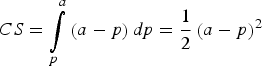
Given a domestic price p, the surplus consumers enjoy from the good equals:
 $$CS = \mathop \int \limits_p^a \left( {a - p} \right)dp = \displaystyle{1 \over 2}\left( {a - p} \right)^2 $$
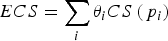
so that expected consumer welfare can be written as:
 $$ECS = \mathop \sum \limits_i \theta _i CS\left( {\,p_i} \right)$$
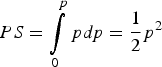
Similarly, the surplus of domestic producers equals:
 $$PS = \mathop \int \limits_0^p pdp = \displaystyle{1 \over 2}p^2 $$
which gives expected producer surplus as:
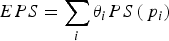 $$EPS = \mathop \sum \limits_i \theta _i PS\left( {\,p_i} \right)$$
The tariff revenue collected by Peru under each state of the world equals:
 $$TR = \left\{ {\matrix{{t_L m( {\underline p} ) = ( {\underline p} - p_L )m( {\underline p} )\; if\; p^w = \; p_L} \cr {0\; if\; p^w = \; p_{\rm M}} \cr {\; t_H m\left( {\bar p} \right) = - \left( {\,p_H - \bar p} \right)m\left( {\bar p} \right)\; \; if\; p^w = \; p_H}\cr}} \right.$$
which yields expected tariff revenue as:
 $$ETR = \theta_L ( {\underline p} - p_L )m( {\underline p} ) - \theta_H (\,p_H - {\bar p})m\left( {\bar p} \right)$$
We can now write down Peru's expected total welfare under the PRS as a weighted sum of consumer surplus, producer surplus, and tariff revenue:
 $$EW = \mathop \sum \limits_i \theta _i {[CS\left( {\,p_i} \right) + \lambda PS\left( {p_i} \right)]} + \lambda [ {\theta_L ( {\underline p} - p_L} )m( {\underline p} ) - \theta_H (p_H - {\bar p} )m( {\bar p} )]$$
where the parameter λ ⩾ 1 measures how much extra weight the government puts on producer interests and tariff revenue relative to consumer surplus. When λ = 1, the government weights all components of welfare equally, and, as λ increases, the relative weight placed on consumer welfare declines while that placed on other components increases.
Using the formulae in (6) through (13), we can directly calculate:
 $$\displaystyle{{\partial EW} \over {\partial {\underline p}}} \vert_{\lambda = 1} = - 2\theta_L \left( {\underline p} - p_L \right) \lt 0$$
i.e. if the government weights all components of welfare equally (λ = 1), then it is optimal to reduce the lower bound of the PRS to its minimum possible value. This implies that it is optimal for Peru not to impose any minimum price on the commodity. Similarly, we have:
 $$\displaystyle{{\partial EW} \over {\partial \bar p}} \vert _{\lambda = 1} = 2\theta _H \left( {\,p_H - \bar p} \right) \gt 0$$
i.e. it is optimal for Peru to raise the upper bound of the PRS band. It is worth emphasizing that equations (14) and (15) imply that in the standard trade model it is optimal for a small importing nation to allow maximum variability in its local price if its objective is to maximize expected national welfare.
Thus, in the canonical trade model of a small open economy, the mere presence of price fluctuations does not generate a welfare-based rationale for the use of a PRS like the one employed by Peru so long as the objective of the government is to maximize expected aggregate welfare. The intuition for this result is that the gains from trade enjoyed by an open economy depend upon whether and how much the world price of a commodity differs from its autarkic price. In our simple model above, the autarkic price equals p* = a/2. Imagine the world price equals Peru's autarkic price, i.e. p w = p* = a/2. Would it gain from trade? The answer is a clear no since domestic production and consumption under free trade would exactly equal that under autarky. Now, consistent with the dispute, suppose p w < p*. Then, under free trade, Peru would import this commodity and enjoy gains from trade. While domestic producers would lose, the increase in consumer surplus would dominate their loss. Indeed, the lower the world price relative to Peru's autarkic price, the larger would be its gains from trade. A PRS band supported by fluctuating duties reduces the extent to which the domestic price in Peru differs from its autarkic price and therefore reduces its overall gains from trade.
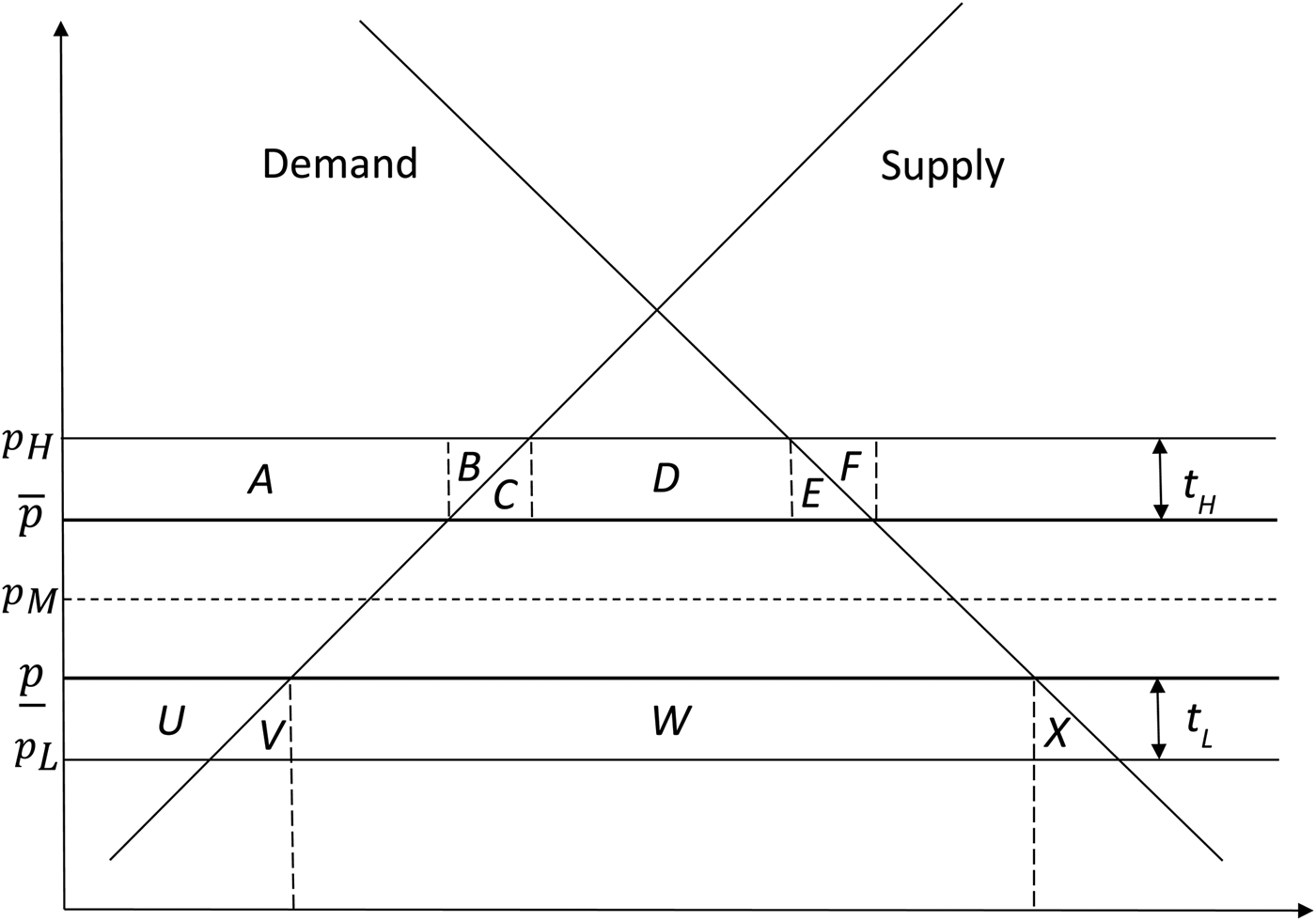
The careful reader may observe that the above discussion seems to ignore the fact that the duties applied raise revenue. While revenue is part of domestic welfare, for the case of a small open economy, the burden of an import duty is borne entirely by local consumers ‒ see the formula for the domestic price in equation (3). As a result, from an aggregate welfare perspective, the variable duty system instituted to support the PRS simply redistributes income within Peru. When p w = p L, the duty t L raises the domestic price in Peru to p and redistributes income from consumers to producers and the government; whereas when p w = p H, the rebate t H benefits local consumers at the expense of the other two groups by lowering the domestic price to  $\bar p$.
Figure 1 in the appendix provides a graphical illustration of why the expected welfare of a small importing nation declines when it puts in place a PRS to lower domestic price variability. When p w = p L, the duty t L raises the domestic price to the minimum acceptable price p and consumer surplus declines by the amount U + V + W + X. Domestic producer surplus increases by U and government collects revenue equal to area W. The net welfare loss suffered by Peru when p w = p L then equals U + W − (U + V + W + X) = −V − X, which is simply the deadweight loss of the duty t L. Now consider the case where p w = p H so that the rebate t H lowers the local price to  $\bar p$. Then, when p w = p H consumers gain the area A + B + C + D + E due to the rebate that lowers the domestic price to p; producers lose A + B; while the government loses B + C + D + E + F in order to cover the subsidy payments needed to lower the local price to p. Adding these gains and losses together, we find that the net welfare effect of the PRS on Peru is once again negative and it equals − (B + F). Thus, regardless of whether the world price is below or above the PRS interval $[ {\underline p}, {\bar p} ]$, the net welfare of a small importing nation declines due to the PRS.
Effects of the PRS system on a small open economy

The above analysis has focused on the case where the government cares equally about all components of welfare (i.e. λ = 1). In the real world, it is possible that the government weighs producer interests and tariff revenue more than consumer surplus. Suppose the importing government weighs producer interests and revenue more than consumer surplus (i.e. λ > 1). Then, the first-order conditions  $\displaystyle{{\partial EW} \over {\partial {\underline p}}} = 0$ and $\displaystyle{{\partial EW} \over {\partial \bar p}} = 0$ can be solved for the endpoints of the optimal PRS band. We have:
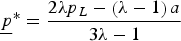 $${\underline p}^{\ast} = \displaystyle{{2\lambda p_L - \left( {\lambda - 1} \right)a} \over {3\lambda - 1}}$$
where p* is increasing in λ and:
 $${\underline p}^{\ast} - p_L = \displaystyle{{\left( {\lambda - 1} \right)\left( {a - p_L} \right)} \over {3\lambda - 1}}$$
from which it follows that:
 $${\underline p}^{\ast} \gt p_L \Leftrightarrow \lambda \gt 1$$
so that it is indeed optimal for the government to impose a PRS that raises the minimum price p Lto p* if it weighs producer surplus and revenue more than consumer surplus. However, at the same time, we have:
 $${\underline p}^{\ast} - p_H = \displaystyle{{\left( {\lambda - 1} \right)\left( {a - p_H} \right)} \over {3\lambda - 1}}$$
i.e. if λ > 1, it is optimal for the government to also raise the maximum price p Hto p*. In other words, if p* > p L, it must also be the case that p* > p H. Thus, the mere presence of political economy pressures that cause the government to weight producer interests (and revenue) relatively more than consumer welfare cannot yield a PRS that raises the domestic price when the world price is low while also lowering it when the world price is high. Allowing for λ > 1 only causes the government to raise the domestic price in all states of nature so that it cannot account for a PRS that offers a rebate to local consumers when the world price is high.
3.2 Some other relevant economic considerations
Given the results yielded by the standard model of a small importing nation, it is worth asking whether certain modifications in the assumptions of this model can make a PRS welfare-improving. The model makes two important assumptions that may be suspect in the context of agricultural trade. First, it assumes that all agents are risk neutral. In the context of agricultural commodities, consumers as well as producers might be risk averse. Second, the standard model assumes that production is completely flexible and can be adjusted up and down seamlessly depending upon the observed world price. We next investigate whether altering these assumptions can provide a rationale for why a small importing nation might want to lower fluctuations in the domestic price via import tariffs.
Consider first the role of risk aversion. In their analysis of Chile‒Price Band System, Bagwell and Sykes (Reference Bagwell and Sykes2004) note that since a PRS insulates the domestic economy from price fluctuations it would be attractive to local producers (as well as the government) if producers care not only about the average or expected price but also about its volatility.Footnote 28 The standard model of a small open economy presented above ignores the effects of price volatility since all agents (producers, consumers, as well as the government) are assumed to be risk neutral and their welfare can be evaluated in terms of their expected payoffs.
Indeed, greater price variability is actually beneficial in the standard model because it increases a country's expected gains from trade by causing the world price to diverge more from its autarkic price. If risk-averse producers are willing to sacrifice high price episodes in order to avoid low price ones, a PRS can be optimal from a domestic viewpoint. However, since a PRS suppresses the overall expected gains from trade, for a PRS to increase welfare the benefits of reduced price variability would need to be sufficiently large ‒ i.e., a small amount of risk aversion on the part of local producers will generally not be enough to overcome the lower expected gains from trade implied by reduced price variability under a PRS.Footnote 29
A well-established strand of the rather extensive literature on price stabilization measures argues that to identify the full impact of such measures one needs to examine their effect on not just the country instituting the system but also the rest of the world. The model presented above cannot capture such external effects since, by definition, a small country has no impact on the rest of the world. Bagwell and Sykes (Reference Bagwell and Sykes2004) have argued that for the case of a large importing country, not only could risk-averse domestic producers be better off under a PBS relative to a fixed conventional tariff but the trading partner may also prefer a PBS if it leads to a lower average tariff. But, as Bagwell and Sykes (Reference Bagwell and Sykes2004) note, while reducing price volatility in the domestic market a PBS may simultaneously amplify fluctuations in the net price received by foreign exporters. Thus, for such a system to be optimal from a joint welfare perspective, domestic producers would need to be more risk averse than foreign exporters so that shifting risk abroad would be efficient. Bigman (Reference Bigman1987) considers a two-country framework in which the free trade relative price is endogenous and shows that the use of variable levies by one country causes price instability to be exported from its market to that of its trading partner, on the basis of which he argues that variable levies can ‘destabilize thy neighbor’. In other words, reduced variability in one country's market is achieved at the expense of increased variability in its trading partner's market. If this spillover leads the trading partner to also institute a price stabilization measure of its own, then both countries can be worse off relative to a scenario where neither uses such measures. Indeed, price variability can even increase when price stabilization measures are used by both countries relative to when they are completely absent, thereby making such measures counter-productive.Footnote 30
As Turnovsky (Reference Turnovsky1974) notes, the classical argument in favor of price variability in competitive markets formalized by Oi (Reference Oi1961), Massell (Reference Massell1969), and Waugh (Reference Waugh1966) rests on an important assumption: i.e. though producers (and consumers) face uncertainty, they make supply and demand decisions based upon actual prices whereas in the real world many critical production decisions need to be made before the resolution of price uncertainty. This is particularly true in the context of agricultural commodities where farmers make a variety of decisions well before actual prices for their crops are revealed. Thus, while the results of the simple model presented above clearly illustrate the benefits of price variability, they do not adequately capture the impact of uncertainty on production decisions. Eaton and Grossman (Reference Eaton and Grossman1985) show that free trade is not optimal for a small open economy facing uncertain terms of trade provided some factors of production are immobile ex-post and insurance markets are incomplete. In such an environment, tariff protection can serve as an incomplete substitute for the lack of insurance. In a similar vein, a PRS like the one instituted by Peru can help insure that the welfare of consumers and producers does not fall below a certain minimum threshold. But as Eaton and Grossman (Reference Eaton and Grossman1985) note, trade policy intervention does not constitute a first-best solution to the problem of income redistribution; for example, an income tax is preferable because it can redistribute income without distorting prices faced by domestic agents.
To summarize, although the canonical model of a small open economy suggests that a PRS is always welfare sub-optimal, this may not be the case once certain underlying assumptions of this model are altered. In particular, the economic justification for a PRS in a small open economy turns on whether producers and/or consumers are risk averse, factors of production are immobile, and insurance markets are incomplete. In the presence of such factors, a PRS may prove to be welfare-enhancing, albeit it is not necessarily the first-best option.
4. Policy flexibility for implementing a PRS under WTO law: open questions
Having explained why a small open economy might want to institute and then defend its PRS, we turn to the question of whether WTO law grants flexibility for countries to maintain such policies. In Section 2.2, we explained how WTO law forbids the use of a variable import levy and minimum import price. For a WTO member to preserve policy flexibility, it must convince the AB that its PRS is not similar to either of these.
Could a WTO member ever succeed? The ongoing dispute raises several interesting questions that we highlight below. The dispute offers the AB an opportunity to clarify if and how a PRS could be designed to be WTO-consistent.
Variable import levy
In Chile–Price Band System, the AB explained the nature of a ‘variable import levy’ which is disallowed under WTO rules. Variability alone is not determinative.Footnote 31 The AB declared that ‘the presence of a formula causing automatic and continuous variability of duties is a necessary, but by no means a sufficient, condition’.Footnote 32 Instead, the AB emphasized the need for ‘additional features’ including ‘a lack of transparency and a lack of predictability’ that ‘contribute to distorting the prices of imports’.Footnote 33
A first question raised by this line of jurisprudence is the frequency with which a duty must change in order for it to be considered variable. The AB's past language refers to a formula which changes ‘continuously’. The Panel found that Peru's PRS, which employed a mathematical formula that resulted in duty changes every two weeks, met this condition.Footnote 34 But suppose that the reference price employed in the PRS formula were tweaked monthly, quarterly, or annually? At what point, if any, would the change be infrequent enough such that the PRS formula would no longer meet the ‘automatic and continuous variability’ requirement?
A second question is whether the introduction of some degree of discretion in the application of the formula would matter. What if the PRS formula did not result in a set duty, but instead merely set a range from which authorities could choose? Suppose the PRS formula, instead of arriving at an absolute additional duty, churned out a range, mandating that the additional duty lie between the interval [AD L, AD H], where AD L represents the lower bound for the additional duty and ADH represents the upper bound. The upper and lower bound for the range are to be calculated through the use of different coefficients (c L, c H), to be added to the formula discussed in Section II.1, where c L < c H. In other words, AD L = (1 + b + c L)(P floor − P r) and AD H = (1 + b + c H)(P floor − P r). The implementing authority, whether an agency within the executive branch or the legislature itself, is free to select any duty rate within that range as the additional duty. The same notion of an upper and lower bound would exist for the tariff rebate. After selecting the duty/rebate rate, the authority would then publish the rate in a gazette for a fixed period of time to provide advance notice before it is enacted. Would such a scheme provide the necessary discretion for the PRS to not be considered an automatic formula? And, if so, would this matter in considering whether a PRS is a ‘variable import levy’?
These hypotheticals suggest that the concept of a variable import levy, as elaborated upon in Chile–Price Band System, requires further clarification.Footnote 35 By explaining the concept further, the AB can give guidance as to how, if ever, a WTO member could design a PRS scheme that is not a ‘variable import levy’ deemed illegal under Article 4.2 of the Agreement on Agriculture.
Our view is that a shift toward emphasizing the design, architecture, and structure of the PRS as determinative may be the right direction in which to guide the jurisprudence.Footnote 36 This continues to allow for consideration of whether the formula results in automatic and continuous changes in which the results are predictable and transparent, but also opens the possibility for consideration of additional factors beyond what is laid out in Chile–Price Band System. It also falls in line with the AB's approach toward examining duty schemes under other circumstances, most notably GATT Article III:2.Footnote 37
4.2 Minimum import price
In order to stand, a PRS must also not be similar to a minimum import price. In Chile–Price Band System, the AB clarified that ‘[t]he term ‘minimum import price’ refers generally to the lowest price at which imports of a certain product may enter a Member's domestic market’.Footnote 38 It further noted that the Panel had clarified that ‘[these] schemes generally operate in relation to the actual transaction value of the imports’.Footnote 39 This notion was further reinforced during the dispute's compliance proceedings.Footnote 40
Because a PRS operates in relation to a reference price and not the actual transaction price, it is possible, at least in theory, for imports under a PRS to enter a market below the floor price set by a PRS. For example, consider a scenario where the actual transaction price (P t) is lower than the floor and the reference price, i.e. P t < P r < P floor. This may occur if prices continue to decline in the intervening period following when the reference price was last readjusted. So long as the difference between the transaction price and floor price is larger than the sum of the original duty plus the additional duty, then the actual transaction price will fall below the floor price. Whether this proposition holds true depends, in part, on the difference between the transaction and reference price. The greater this divergence, and the lower the rate of the original duty, the more likely it is that this will hold.
Thus, the proper assessment is not whether a PRS imposes a minimum import price but whether it is similar to such a policy. In assessing similarity, the AB's jurisprudence suggests that one considers two factors: (1) the structure and design of the PRS, and (2) its effects.Footnote 41
Unlike the Panel in Chile–Price Band System, the Panel in Peru–Agricultural Products found that the measure imposed by the PRS was not similar to a minimum import price.Footnote 42 Guatemala has appealed this ruling.Footnote 43
While the Chilean and Peruvian schemes employ different names (PBS vs. PRS), a closer examination reveals that the structure and design of the two systems are largely similar. Peru also occasionally refers to its scheme as a bando de precios (PBS). However, three points of contrast are worth noting in the two schemes' design: First, the Peruvian reference price is updated every two weeks, as opposed to weekly for the Chilean reference price. Second, the Peruvian reference price is based on the price in a pre-designated market, whereas the Chilean reference price is the lowest price found of several markets in relationship to one another. Third, the Peruvian scheme requires reference prices be converted to c.i.f. terms, thereby incorporating freight and insurance costs, whereas the Chilean reference price is left on lower f.o.b. terms. All three differences increase the likelihood that the actual transaction price will diverge from the reference price by a greater degree when prices fall.
The Panel, however, did not emphasize these differences in its ruling. Instead, it focused primarily on the second factor – its actual effects. Whereas Chile conceded that it was ‘unlikely’ for imports to enter the Chilean market at a price below the floor price,Footnote 44 Peru submitted evidence that in approximately 57% of the fortnightly periods since the PRS came into force, various transactions entered Peru at a price lower than the reference price and floor price.Footnote 45 These amounted to more than one-third of trade transactions recorded over these periods.Footnote 46 The Panel found this evidence to be decisive in illustrating that the PRS did not impose a de facto threshold and was therefore not similar to a minimum import price.Footnote 47
The Panel's points to three questions for the AB to clarify:
First, did the Panel erred in treating this analysis as primarily an effects-based test?Footnote 48 As noted above, the Panel ruling failed to elaborate upon on the design elements of the Peruvian PRS that make it more likely for actual import transactions to occur below the implicit threshold stipulated in the PRS. The AB may wish to clarify the level of analysis that a Panel must undertake if it is to find that the structure and design supports the respondent's argument that a PRS is not similar to a minimum import price.
Second, when it comes to considering how the PRS affects the price of actual transactions, how ought the effect of the PRS be measured? The evidence may be expressed in terms of the percentage of total import volume (in either value or quantity), the percentage of total transactions, and/or the percentage of days/weeks/other periods in which imports priced below the threshold enter into the market. Are all of these acceptable metrics? Or should greater emphasis be placed on one over the other? Note that Peru submitted evidence only with respect to the latter two metrics, but not with respect to total imports (except for sugar).Footnote 49
Why does the exact metric matter? At first glance, it may seem impressive that below-threshold transactions occurred in 57% of the fortnightly periods in which the PRS was in effect. But whether this is truly the case depends, in our view, on the percentage of total import volume represented by such transactions rather than the actual number of transactions themselves or the percentage of periods in which they occurred. In the one instance (sugar) where Peru submitted statistical evidence on the total volume of trade, only 3% of imports entered below the alleged threshold price.Footnote 50 We believe that the AB ought to require a respondent to demonstrate effect through data highlighting total volume of trade (rather than the other two metrics) and set forth a brighter line for the percentage of total trade exceeding the alleged threshold price.
Third, should the respondent, when seeking to prove the actual effect of a PRS, be asked to present evidence on a product-specific level? For a PRS to not amount to a measure similar to a minimum import price, the respondent ought to demonstrate that imports below the alleged de facto threshold entered the market with some regularity for all of the tariff lines. In this case, Peru appears to have focused its evidence on the four marker products rather than on the associate products.Footnote 51 The AB would do well to scrutinize the data submitted for the other products to ensure that transactions below the alleged threshold price exist for all 45 affected tariff lines.
To summarize, the Peru–Agricultural Products dispute raises a number of pressing questions over the evidentiary burden necessary for a WTO member to demonstrate that a PRS does not give rise to a measure similar to a variable import levy or minimum import price. In clarifying these questions, the AB will make clearer how a WTO member ought to design such a scheme and what types of statistical evidence it ought to collect, if it hopes to employ a PRS in line with Article 4.2 of the Agreement on Agriculture.
5. Circumventing WTO obligations through subsequent agreements: can a WTO-illegal PRS be preserved in a free trade agreement?
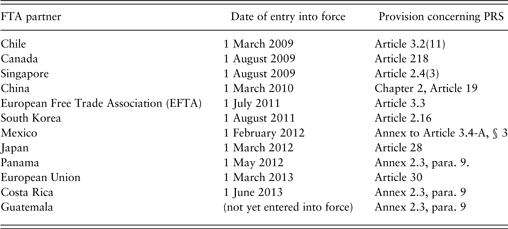
The preceding section demonstrated the difficulty of developing and maintaining a PRS in line with a country's obligations under the WTO's Agreement on Agriculture and GATT 1994. Cognizant of the possibility that a PRS might run afoul of WTO rules, Peru sought an explicit guarantee from several of its trading partners of its flexibility to maintain its PRS. Between 2005 and 2013, Peru signed a number of FTAs.Footnote 52 Our examination of the text of Peru's FTAs suggests that in at least 12 of these agreements, Peru managed to negotiate the inclusion of a provision that explicitly recognized its right to retain the PRS. The most notable exception is the US‒Peru FTA.
Table 1 provides a list of the specific provisions found within the 12 FTAs.Footnote 53 Only the Guatemala‒Peru FTA has yet to enter into force.
Provisions in Peru's FTAs addressing the PRS
Two questions arise from this attempt of a WTO member to utilize FTAs to safeguard a measure that may be WTO-inconsistent: First, should a provision of an FTA concluded between two countries factor into the interpretation of the WTO obligations of the two countries to each other? Second, does the answer change if the FTA is one that has not yet entered into force?
In prior case law, the AB has recognized that WTO members may modify the obligations between themselves.Footnote 54 However, the question arises as to which mechanisms employed by WTO members to modify the obligations must be recognized by WTO adjudicators. Guatemala argued that modifications of WTO rights and obligations can only be done through the procedures established in Article X of the WTO Agreement and not through a bilateral treaty.Footnote 55 Guatemala further argued that for a Panel to examine (a) whether there is an inconsistency between an FTA and the WTO Agreement and (b) if the FTA modified the WTO rights of a party would fall outside of a Panel's terms of reference, since Panels cannot consider matter outside of the WTO covered agreements.Footnote 56 Guatemala's views were shared by the United States as a third party.Footnote 57
Peru, on the other hand, suggested that WTO treaty provisions are to be interpreted pursuant to the Vienna Convention on the Law of Treaties (VCLT). An FTA concluded pursuant to GATT Article XXIV serves as a form of permissible modification under VCLT Article 41.Footnote 58 Where the provisions of the FTA clash with the WTO Agreement, Peru argued the provision of the FTA should prevail as it represents a subsequent agreement.Footnote 59
Brazil and the European Union (EU), as third parties, agreed that an FTA may modify the rights and obligations of a WTO agreement, but suggested that the scope for doing so is more limited. Brazil argued that only FTAs that have entered into force may modify the rights and obligations between two WTO members.Footnote 60 The EU argued that a modification arises in the WTO context only if the FTA includes a specific commitment that a party will refrain from initiating a WTO challenge to the other party's measure.Footnote 61
This question of whether a ratified FTA may alter the terms of obligations between WTO members remains very much an open point of dispute. The AB, however, may opt not to address this question directly in the pending appeal.Footnote 62 Because the Peru‒Guatemala FTA had not yet entered into force, it does not acquire the formal status of a modification made pursuant to VCLT Article 41. It does not acquire the status of a subsequent agreement, relevant for interpretation pursuant to VCLT Article 31(3)(a).
Pauwelyn (Reference Pauwelyn2014) has suggested that Peru should instead have relied on the International Law Commission (ILC)'s Articles on Responsibility of States for Internationally Wrongful Acts when making its argument. Article 20 states, ‘Valid consent by a State to the commission of a given act by another State precludes the wrongfulness of that act in relation to the former State to the extent that the act remains within the limits of that consent.’ Pauwelyn notes that such an argument turns the question into a factual inquiry into whether Guatemala has provided consent in allowing Peru to keep its PRS.
Indeed, Peru appears to have adopted Pauwelyn's suggested tactic in its appeal. Peru's appeal contends that even if the FTA is not a subsequent agreement per VCLT Article 31(3)(a), it is nevertheless a ‘relevant rule of international law’ within the meaning of VCLT Article 31(3)(c).Footnote 63 This is on the basis of ILC Articles 20 and 45 of the ILC Articles on State Responsibility as rules of international law.
While this argument raises a series of interesting issues for the AB to consider in the appeal, it is still unclear to us that Peru will prevail. In US–Line Pipe, the AB made clear that the ILC Articles on State Responsibility ‘do not constitute a binding legal instrument as such’.Footnote 64 Consequently, the AB adopted a two-part approach of analyzing whether a particular provision of the ILC Articles on State Responsibility ought to be considered when interpreting a WTO provision. First, it examined whether the particular provision of the ILC Articles is relevant to the analysis. Then, it examined whether that particular provision rose to the level of customary international law.
On both fronts, the appeal presents the AB with an opportunity to clarify when exactly the ILC Articles ought to be consulted in interpreting WTO law.Footnote 65 On the question of relevance, the AB's past jurisprudence has required a tight nexus between the particular provision of the ILC Articles and the provision of the WTO covered agreement whose interpretation is in doubt. In US–Line Pipe, Article 51 of the ILC Articles spoke directly to the issue concerning the proportionality of countermeasures relevant for interpreting Article 5.1 of the Safeguards Agreement.Footnote 66 Similarly, in US—Anti-Dumping and Countervailing Measures (China), Article 4 of the ILC Articles spoke directly to the issue of how to consider state organs, regardless of their formal position in the organizational structure, when interpreting the term ‘public body’ in Article 2 of the SCM Agreement.Footnote 67 It remains to be seen whether the nexus is sufficiently tight for ILC Articles 20 and 45 to be relevant for interpreting the legal provisions at issue in this dispute.
Even if they are relevant, the AB must also find that the particular provisions amount to customary international law. The AB has made clear that the analysis is to be done on a provision-by-provision basis.Footnote 68 Because the ILC Articles are not an international agreement, the AB cannot resort to the typical approach of examining the breadth of its signatories and whether the particular parties to the dispute have ratified the agreement. Instead, the AB has relied upon consideration of two other factors to determine whether a particular provision amounts to customary international law.Footnote 69 First, has the particular provision been cited as such in another international judgment? Second, has the WTO member against whom the provision is being invoked either explicitly or tacitly acknowledged the provision as such? Again, it remains to be seen whether this can be shown for Articles 20 and 41 of the ILC Articles on State Responsibility.
Even if the AB agrees that Articles 20 and 45 are ‘relevant rules of international law’, it still faces interesting questions over how those provisions are to be interpreted. Article 20 speaks to ‘valid consent’ that ‘precludes the wrongfulness of the act … to the extent that the act remains within the limits of that consent’. Article 45 speaks to the waiver of a claim by the injured party. How ought the AB consider what amounts to ‘valid consent’ and ‘waiver’ in a context where an FTA has only been ratified by one party and has not yet entered into force?
Although Guatemala did ratify the FTA during the course of the dispute, it is unclear that this ratification represents an absolute consent as opposed to a contingent consent. The ratification process does not oblige Guatemala to consent unilaterally to all that it has agreed to in the FTA, including its explicit recognition of WTO-inconsistent measures enacted by Peru, without any action on the part of Peru. Rather, Guatemala's consent is only contingent upon Peru's ratification. In the absence of such notice, Guatemala would not appear to have provided explicit consent.
A similar argument can be made with respect to the question of waiver. Again, Guatemala will likely argue that its ratification does not require it to waive claims against Peru upon the moment of ratification, but instead is contingent upon Peru's ratification. Without this reciprocal action, nothing has been waived.
Finally, there is the question of the treaty language that the FTA must employ in order for a WTO member to consent to a WTO-illegal act and/or waive its right to WTO dispute settlement. The EU has put forward the position that the language must be explicit and refer specifically to an agreement to refrain from initiating a WTO challenge. Peru, on the other hand, will likely contend that consent and waiver can be implicit, even without direct treaty language in the FTA concerning WTO challenges. The appeal also presents the AB with an opportunity to decide this question, if it desires.
Most likely, the AB will choose to confront only a subset of the questions identified above. Because the Guatemala‒Peru FTA has not entered into force, the facts of this dispute are unusual. The appeal may not serve to definitively answer the question of how FTAs between WTO members should factor in a subsequent WTO challenge involving those parties, but it is a question that clearly lurks over the WTO. As WTO members negotiate increasing numbers of FTAs with one another, additional clarity into whether WTO members can circumvent WTO rights through FTAs – and, if so, what treaty language is necessary – will be of benefit to the system as a whole.
6. Conclusion
Because of the sensitivities associated with the agricultural sector, a PRS continues to be viewed as a potentially attractive policy instrument to complement agricultural trade liberalization. This may be particularly the case with small open economies that take world prices as given. A PRS offers it the ability to restrain prices for agricultural products in its domestic market, even after opening up its market to trade.
This article suggests that from an economic welfare standpoint, a PRS represents a sub-optimal policy intervention for a small open economy that seeks to maximize its expected welfare. However, under certain conditions, a government may nevertheless choose to implement a PRS in order to ensure that, with agricultural trade liberalization, the welfare of consumers and producers does not fall below a certain minimum threshold in light of significant risk aversion on the part of either group in the presence of incomplete or missing insurance markets.
WTO law, and in particular the obligations of Article 4.2 of the Agreement on Agriculture to convert non-tariff barriers to tariffs, present a number of significant legal constraints on the PRS. The structure and design of a PRS create an implicit minimum price threshold, and the duties generated by a PRS can operate as a variable import levy. Thus, a WTO member seeking to prove that a PRS is consistent with its WTO obligations faces a heavy burden. The Panel ruling in the Peru–Agricultural Products dispute gives rise to a number of unanswered legal questions as to what is required of WTO members that seek to preserve the flexibility to implement a PRS; the Appellate Body may seek to clarify some of these questions in the ongoing appeal.
Finally, the particular zeal with which Peru has sought to preserve its right to maintain the PRS through explicit recognition in preferential trade agreements raises interesting questions about the relationship between provisions in FTAs and WTO agreements. In this case, the Panel was able to avoid providing an answer outright because of the fact that the applicable FTA had not yet entered into force. But given the expanding nature of preferential trade agreements and the stalled multilateral round, it is simply a matter of time before WTO adjudicators are confronted with this question outright. We would all do well to consider carefully how we envision these multiple treaty schemes to intersect with one another in the realm of WTO dispute settlement.
Appendix
Peru's imports of HMS 170111 (Cane Sugar), current $, thousands
Peru's imports of HMS 170199 (other cane or beet sugar), current $, thousands