


Introduction
While Yugoslav composers of electroacoustic music were pursuing the same interests and trends in the 1960s as were current in Europe and the US, they had limited means to develop their skills. Constrained by the lack of access to professional facilities and technologies, postwar economic hardships, and Yugoslavia’s cultural isolation of the 1950s, all experimentations in electronic music during this period, of which there were very few, were in the domain of tape music. Thus, when innovations in electronic music in Yugoslavia are examined within the broader context of explorations taking place in other countries, Yugoslav composers lagged behind Europe and the US. Yet, within the context of the Yugoslav music scene alone, these tape compositions were considered the most extreme kind of avant-garde. These early electronic composers were not necessarily “shocking” or “avant-garde” due to their sound, medium, or techniques, but rather because they challenged the widely accepted currents of traditionalism and neoclassicism. Mirjana Veselinović-Hofman defines this phenomenon as a “local type of avant-garde,” a movement that changes the musical environment in which it appears due to local musical, psychological, and social contexts.Footnote 1 Because of the new medium’s perceived “shock effect,” the traditionalists objected to electronic music, associating it with concepts of alienation and dehumanization.Footnote 2
During the 1960s, Yugoslav composers were still under the political pressure imposed by the lingering ramifications of a socialist doctrine and overall resistance toward any modern trends in the arts. For instance, while Rajko Maksimović was interested in electronic and avant-garde music in the 1960s, after returning to Belgrade from his residency at the Columbia-Princeton Electronic Music Center, he completely abandoned the electroacoustic medium and, eventually, all avant-garde tendencies. He conformed to the conservativism of the Music Academy, where he was on the composition faculty, which, like all art institutions in the country, was heavily traditionally oriented. He was convinced that it was impossible to convey any musical ideas in electroacoustic or avant-garde styles, affirming that “in electronic music, there is no communication!”Footnote 3 Maksimović’s stance accurately aligns with the attitudes of music critics and most Yugoslav composers at the time.
However, from the 1960s onward, Yugoslavia was culturally opening up toward European and American currents through radio broadcasts of experimental and avant-garde music on the Third Program of Radio Belgrade (founded in 1965) from festivals at Darmstadt, Paris, Warsaw, and Yugoslavia’s own successful Music Biennale Zagreb. At last, with access to the newest compositional trends from abroad, conditions in Yugoslavia were improving for the acceptance of electroacoustic music. A small number of Yugoslav composers, dedicated to originality and innovation in music, maintained the course of explorations of modern techniques and various media. Among them, two pioneers of electronic music notably stand out: Ludmila Frajt, Yugoslavia’s first woman composer in this medium, and Vladan Radovanović, a visionary and a leading figure in the Yugoslav avant-garde music and art scene, founder of the Electronic Music Studio in Belgrade,Footnote 4 and one of the earliest Yugoslav electronic music composers.
Ludmila Frajt
Ludmila Frajt (1919–1999), a Serbian composer of Czech descent, came from a prominent musical family. Most notably, her grandfather, Václav Frajt, played the bassoon in the theater orchestra in Plzeň under Bedřich Smetana and the National Theater Orchestra alongside Antonin Dvořák.Footnote 5 Her father, Jovan (Jan) Frajt, who settled in Belgrade in 1903, was an active violinist, conductor, composer, and organist and the founder of the first music publishing house in the Balkan region, Edition Frajt. Her brother, Vojteh, was an internationally renowned violinist.Footnote 6 Ludmila Frajt acquired her first musical experiences at home, often participating in musical events at the family residence, which featured performances by her family members as well as Czech musicians who lived in Belgrade. They played music in a variety of genres and styles, from classical and jazz to Czech, Serbian, Macedonian, and Dalmatian folk music.Footnote 7 These early childhood musical experiences served as a foundation for Frajt’s affinity toward folk idioms, and, as Jelena Novak notes, her “vivid preoccupation with the contemporaneousness of the sound experiences she lived with” pushed the limits of how she understood musical sound, free of stereotypes.Footnote 8 Frajt’s affinities toward folklore were further affirmed during her studies at the Music Academy in Belgrade with Miloje Milojević and Josip Štolcer-Slavenski, both of whom meticulously wrote down and kept a record of folk songs, which they often incorporated into their music.Footnote 9
Frajt started her official music studies in composition, piano, and conducting in 1938 at the Music Academy in Belgrade, which was founded in 1937, making her one of the first composers trained in the country, and certainly the first woman to matriculate with a professional music degree. Her professors at the Academy were the most prominent composers in Yugoslavia at the time, who were educated in Prague: Petar Konjović, Stevan Hristić, and Kosta Manojlović, in addition to Milojević and Slavenski. Even though all her professors at the Academy composed in a traditional, neoclassical style, they knew contemporary techniques, which they had learned abroad. Frajt’s exposure to modernist techniques during her formative years was critical to her pursuit of and curiosity toward new sounds.
Immediately after graduating from the Music Academy in 1946, Frajt was appointed chair of the Music Department at Avala Film, the first Yugoslav postwar film production company, where she remained until 1952.Footnote 10 As a member of the Communist Party, Frajt held powerful positions in the music and film industries. From 1952 until 1958, she became deputy editor-in-chief of Radio Belgrade, and from 1958 until her retirement in 1972, she was secretary of the Music Commission at the Yugoslav Radio Television. Her experience working for film and radio allowed her to experiment with unusual musical ensembles. For instance, she added the sound of silver spoons to her string quartet Silver Sounds (1972), children’s toys in a Lullaby (1971), and prerecorded taped sounds to the choral piece Bells (1981).
Frajt’s achievements represent some of the many firsts for women composers in Yugoslavia (and the Balkan region). She was the first woman to graduate from a university with a degree in composition. Self-taught in the genre of film music, Frajt was the first woman in Yugoslavia to write soundtracks and elaborate film scores, comprising thirty-five collaborations, one long-motion picture soundtrack, and eleven documentary film scores.Footnote 11 While newer scholarship is finally starting to recognize the role women played in the creation and shaping of the first electronic music centers in the 1950s and 1960s – such as the BBC Radiophonic Workshop and Columbia-Princeton Electronic Music Center – Frajt was the first woman in the Balkan region to write electroacoustic music, and one of the first composers in the country to study at Darmstadt.
Even though Frajt was a member of the Communist Party, her expressions and experimentations were not driven by the demands of the Party and its doctrine. That is, no composition in Frajt’s oeuvre bears any characteristics or influences of the pressures of socialist realism – as Ivana Medić notes, these types of compositions aggrandized Tito, communism, the National Liberation War, or the reconstruction of Yugoslavia.Footnote 12 Rather, Frajt’s use of Serbian folk elements in her music, for instance, is born out of her sincere affinity toward folklore, a style to which she was exposed as a child, especially the vocal tradition. Frajt organically adopted these traditions as part of her contemporary musical expression, as evident in Tužbalica [Lamentation] (1973), Kres [Bonfire] (1973), and Ekloga [Eclogue] (1974).
Frajt was driven to push the limits of musical sound and broaden the medium of her musical expression. It is this curiosity (with support from the Yugoslav Radio Television) that led Frajt to study at Darmstadt in the early 1960s and then at the Experimental Music Studio of Czechoslovak Radio Plzeň in 1967. Although Frajt never moved within any avant-garde music circles, she applied certain avant-garde techniques to her works. She was particularly drawn to Lutosławski’s aleatory textures, Penderecki’s use of clusters and nonstandard treatment of instruments, and Ligeti’s micro-polyphony. Thus, Frajt’s music is imbued with both modernist and folk techniques. For instance, in her works, the harmony is dissonant (closer to expressionist sound, but also modal and polymodal), with a prominence of the major second, a characteristic of Serbian vocal folk music. Her music often features clusters and micropolyphony, but unlike Ligeti’s mass sound, Frajt’s clusters are based on the heterophonic treatment of melodies, which she derives from the vocal folk idiom. Frequent metrical changes in her works are characteristic of both folk and modernist tendencies. Also, her application of aleatory techniques, such as the use of an untampered harmonic system and heterophony, also derives from Balkan folk music.
Frajt is primarily known for her works based on folk idioms, music for children, and film scores. She is somewhat recognized in Serbia for her remarkable ability to combine avant-garde techniques with her lyrical and intimate style, use of folklore, and the expansion of sound sonorities. Nonetheless, her contribution to electroacoustic music remains mainly unexplored.
Nokturno (1975)
After her studies in Plzeň, where she composed her first electroacoustic piece, Asteroids (1967),Footnote 13 Frajt realized three other electroacoustic works at the Electronic Studio (EMS) Radio Belgrade: Nokturno (1975), Figure u pokretu [Figures in motion] (1979), and Zvona [Bells, for choir and tape] (1981). All three works mirror postserial structures in electronic media, whereas Nokturno and Figures also evoke “pointillist techniques.”Footnote 14
Nokturno is the first work composed by a woman using the Synthi 100 at the EMS Radio Belgrade. Very little is known about this work, other than a general observation that it evokes a “nocturnal” atmosphere, as implied by the title of the work, an effect that Frajt sought in several of her other works, such as Pesme noći [Songs of the night] (1970), Silver Sounds (1972), and Three Nocturnes (1982).Footnote 15 The review of Nokturno by Pavle Stefanović, following its performance on the Third Program of Radio Belgrade in 1976, illustrates how little even the most prominent critics and writers of new music understood electronic music.Footnote 16 Without discussing any technical aspects, Stefanović rather describes a vivid picture these electronic sounds evoked in his mind:
Suddenly, on the last night of the Festival, Lida [Ludmila] Frajt presents her electronically recorded Nokturno. While she does not write programmatic music, she nonetheless invites me, the listener, to a faraway Asian jungle. On a hot evening, monkeys, always scared, grin from the tree tops high above, frightened birds chirp, insects buzz, the beasts growl, and imaginary night fairies rustle their legendary wings. The night of dreams and silence is full of noise. Here I am, suddenly, thanks to Lida, in the mystery of the night, in the eternal poetry of our human, living world, which will one day cease to exist, which will die out. Thus, suddenly, here is tenderness and comfort for all the pain in the world, an authentic human tenderness [realized] through notoriously “inhumane” electronic music!Footnote 17
Stefanović’s vivid (and absurd) imagery tells us absolutely nothing about the piece or Frajt’s innovative techniques. Hristina Medić offers a bit more detail about this work, noting that the four-tone clusters that form the foundation of the piece flow throughout the entire work and change their color. Various spatially dispersed events appear on top of the continuous cluster, evoking the atmosphere of the night with its “visions, dreams, and pronounced emotional tone.”Footnote 18 Some of the sounds are purely electronic, while others are recognizable sounds from nature, such as a bird screech or a thunderstorm (although some of these are also electronically derived).
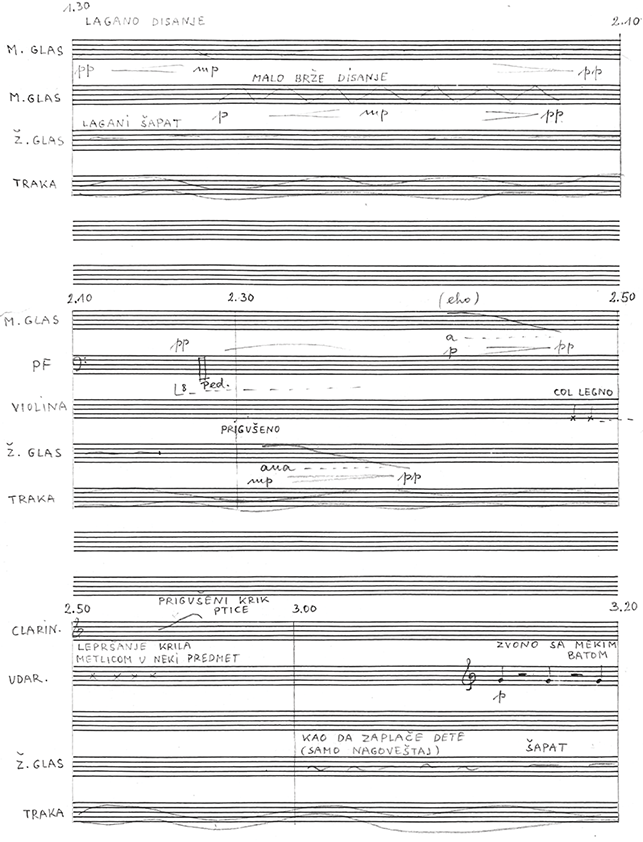
While very few documents pertaining to Nokturno survive, three pages from Frajt’s autograph documents shed some light on the composer’s creative process. On page two, starting at the 1’30” mark of the roughly nine-minute piece (Example 5.1), we observe Frajt’s use of electronically simulated sounds, a technique that is, as Svetlana Maraš notes, “aesthetically, if not technically linked to the sound world of musique concrète.”Footnote 19 On the top of the page, Frajt inscribes “light breathing” [lagano disanje] for the male voice [m. glas], while the female voice [ž. glas] (third system), produces “a light whisper” [lagan šapat]. A few seconds later, another male voice enters with an annotation, “a bit faster breathing” [malo brže disanje]. All three voices are layered on top of continuous electronic clusters produced by the tape [traka]. Events emerge and disappear in various instruments, all evoking nocturnal sounds – effects that are either quiet or muted with such designations, or sounds one would hear at night, such as the muffled cry of a bird, the fluttering of the wings, a child crying, and rain with thunder.
Ludmila Frajt, Nokturno (1975), autograph score, p. 2.
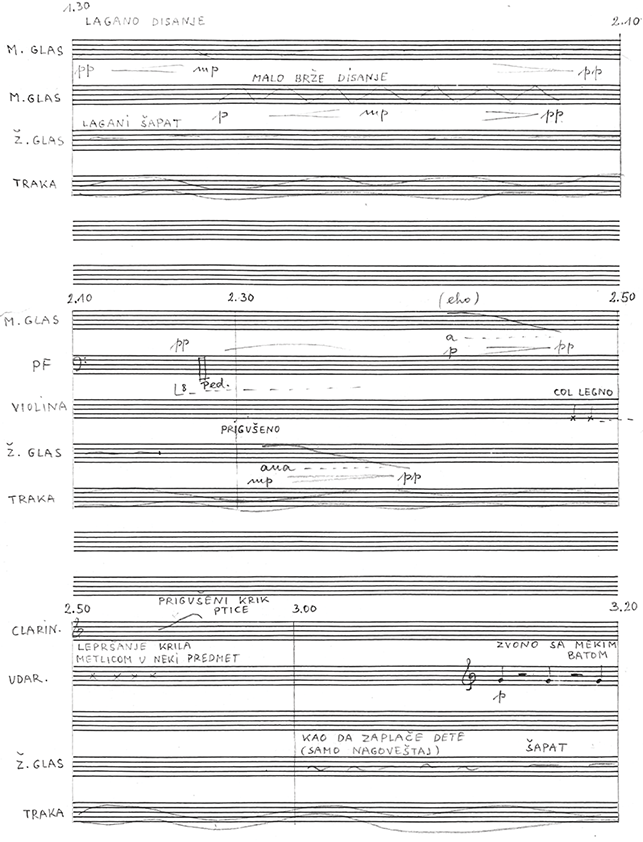
Example 5.1 Long description
The notation on this 18-stave paper is sparse, with only three notated pitches and rests and a handful of non-pitched noteheads. The page features verbal annotations, as well as dynamics, crescendo, and decrescendo annotations, and dotted and wavy lines.
Nokturno was only Frajt’s second electronic work, and with it she already demonstrated a clear departure from her rudimentary Asteroids by greatly expanding the sound palette of electronically produced sounds (both musique concrète and pure electronics) that evoke the aesthetic of the nocturnal.Footnote 20
Figures in Motion (1978)
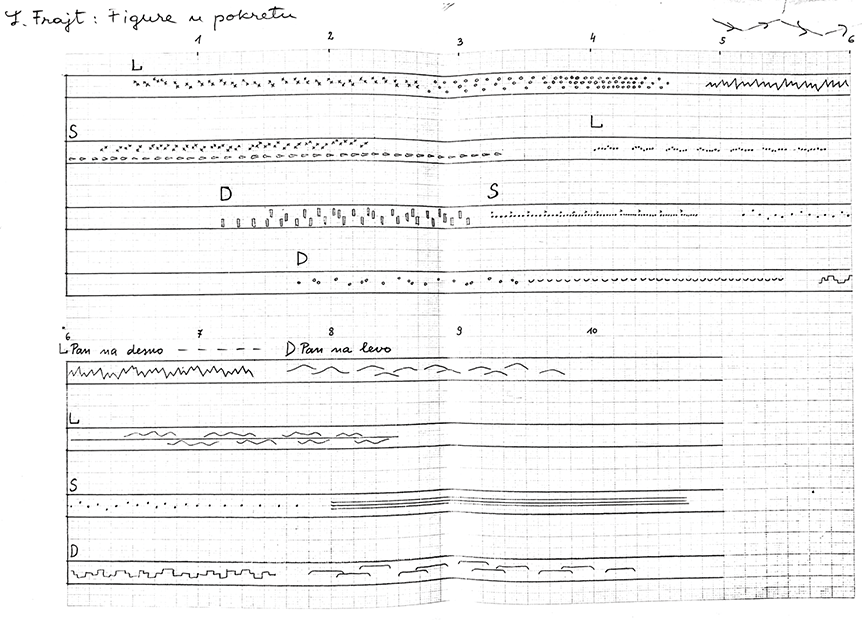
Figures in Motion is Frajt’s electroacoustic composition in which she incorporates repeated patterns and aleatory elements. The drastic departure from her previous works in this medium is apparent just by looking at the score (Example 5.2) – unlike in Asteroids and Nokturno, the score for Figures lacks any conventional musical notation.Footnote 21 Instead, the score is entirely characterized by visual drawings of shapes, that is, “figures” that represent a variety of melodic and timbral patterns we hear in this work. The annotations “L” (for levo, Serbian for left), “D” (desno for right), and “S” (sredina for “middle”) illustrate how the figures “move” in various directions as the piece progresses, giving a sense of “organized chaos.” The repetitive patterns in Figures, recorded on eight channels (indicated by numbers 1 through 8 on the score), change in timbre, rhythm, melodic range, sound density, and dynamics.
Ludmila Frajt, Figure u pokretu [Figures in motion] (1978), autograph score, p. 1.
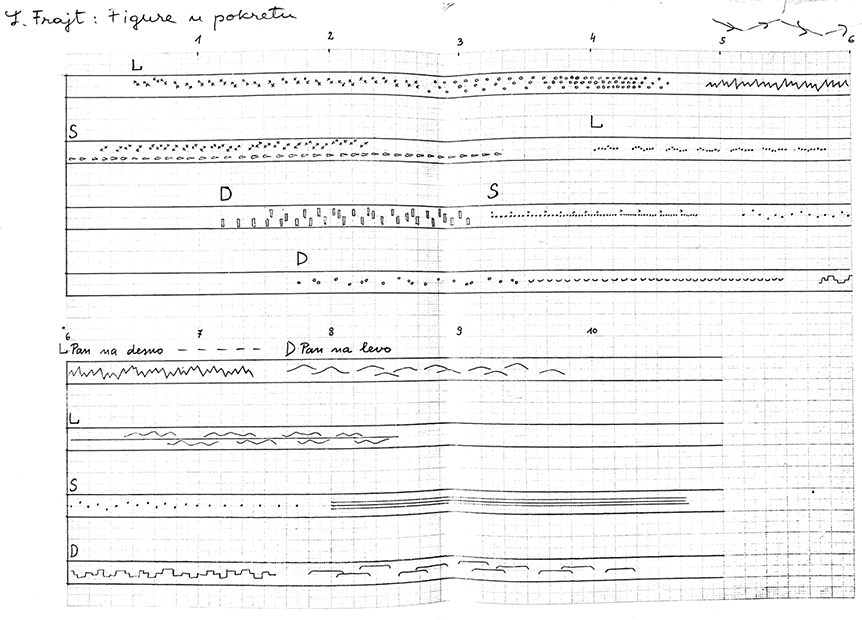
Example 5.2 Long description
Drawn on a grid paper, it shows different shapes for each effect, such as dots, pebbles, small Xs, squiggly lines, oval lines, wave lines, square lines, and so on.
Figures in Motion is characterized by an interplay between aleatory and control – the changes in the repeating patterns are sometimes achieved by applying aleatory techniques, and at other times, they are preprocessed. While the use of the machine (computer) may contradict the notion of indeterminacy, Frajt explores the concept of randomness in machine realizations. The steadiest pattern in the work occurs at the very beginning, indicated by a small, oval “pebble” figure (second system, bearing the annotation “S”); here, the simulated sound of the piano plays a repeating pitch, B3, at a steady interval of four seconds. The last occurrence of this regularity, or any other display of steadiness or (predetermined) control, occurs about three minutes into the piece, evoking a sense of randomness.
Figures in Motion exemplifies how Frajt effectively assimilated many techniques of the Western avant-garde, including aleatory, Klangmusik, and electronic medium.Footnote 22 More specifically, by incorporating both determinacy and indeterminacy in carefully constructed pattern changes, Frajt illustrated her full control of each event. Unlike musique concrète works,Footnote 23 which by nature imply a precise control over each individual event, composers at the EMS Radio Belgrade could achieve works like Figures in Motion only after Radovanović’s Elektra (1974) – the first electronic composition realized at the Belgrade studio.
Bells for Mixed Choir and Tape (1981)
Zvona [Bells] is the only work in Frajt’s oeuvre in which the composer combines live performance (mixed choir divided into two groups) with prerecorded tape music. The song is set to the poem “Bells” by a Serbian poet, Svetozar Brkić (1916–1993), who dedicated it to Frajt. The tape part simulates the sounds of the heartbeat and bells, with which Frajt evokes the sounds that Brkić had experienced during his recovery at a hospital after suffering a cardiac arrest.
In this work, Frajt exploits many oppositions, such as live performance featuring natural voices versus the prerecorded tape music of electronically derived sounds, and determinant factors, such as specific pitches and rhythms or the durational intervals measured in seconds versus unmetered motives and indeterminate pitches (for instance, whispers or the heartbeat from the tape). She also juxtaposes male and female voices in various registers, as well as solo and tutti sections. Her textures grow from solo voices to up to sixteen polyphonic lines, with contrasts in the dynamics. The length of phrases (and musical material) features both short, abrupt motives comprising a couple of pitches, to longer, sustained, melodic lines. Frajt also explores the superimposition of avant-garde methods (such as aleatory, clusters, and the electronic medium) with traditional (a choral work in which textures alternate between heterophony and free polyphony) and folk (such as the predominant use of the interval of the second, which characterizes folk songs in the region, especially when used in two parts).Footnote 24
Ivana Medić observes that one of the main features of Frajt’s oeuvre is her interest in the sound of the human voice, more specifically of female voices and high, resonant pitches that we perceive as metaphors of silver sounds (as in Silver Sounds for string quartet and spoons, 1972) or children’s toys (Lullaby for soprano and children’s toys, 1971).Footnote 25 In Bells, the evocation of the sound of the bells is metaphoric – especially in the last section of the piece, where female voices sing in seconds and thirds while sounding the word zvonjava [ringing] – but also literal, with the electronically created sound of the bells emitting from the tape.
Vladan Radovanović
Vladan Radovanović (1932–2023) occupies a truly unique position in the Yugoslav artistic sphere. A pioneer of electronic music and polymedia art, and overall a leading figure in the country’s avant-garde music and art scene, he was always driven by the need “to express himself by doing what no one else has done before,”Footnote 26 never succumbing to the restrictions and demands of socialist realism.
Radovanović’s oeuvre, spanning seven decades, pushed the outermost limits of numerous art forms most innovatively and comprehensively, as Melita Milin suggests.Footnote 27 That is, in addition to his original compositional technique of hyper-polyphony and advances in the domains of electronic, electroacoustic, and computer music, Radovanović pursued many interests in other arts and media, as well as in their syntheses. An award-winning poet and an accomplished artist, Radovanović started synthesizing various parameters of music, painting, figurative drawings and abstract structures, transparent pictures, photography, literature, and poetry.Footnote 28 His research in the domain of the vocovisualFootnote 29 – a synthesis of the poetic and the visual – first resulted in works that synthesize word, sound, and image in a two-dimensional space, such as Portret-pejzaž [Portrait-landscape] (1954), which invites the observer to rotate the work by 180 degrees to read it, and the book Pustolina [Wasteland] (1968),Footnote 30 which combines the visual, spatial, and tactile features with the acoustic sphere.Footnote 31 Pustolina led to Radovanović’s three-dimensional creations in the vocovisual domain, including Poliedar [Polyhedron, 1968] and Kugla s tekstom [A sphere with text, 1971–1974]. In his other works, Radovanović also incorporated kinetic parameters, created conceptual projects (such as stream of consciousness, visions, improvisations, projects of events that examine their own creation), syntheses that entail word-picture, word-gesture, and polymedia. He also devised working with the body as an object, tactile, plastic, and meta-art, as well as transmedia, transmodalism, and metamusical projects.Footnote 32 Most of these innovations were created before they could even be achieved, performed, or understood in Yugoslavia.Footnote 33
Radovanović’s Hyper-polyphony
During the 1950s, the period when most Yugoslav composers rejected all modernist tendencies and composed in neoclassical styles, Radovanović was developing his own serial method – hyper-polyphony (or polyphony of polyphonies), which he first called “a principle of frequencies of non-repetition of tones.” Hyper-polyphony is a compositional style with several instrumental and/or vocal groups, in which not only are different parts within one group written in a highly polyphonic style, but the groups themselves are also polyphonically related. These pieces are typically maximalist in character, with a thick texture of many choral and instrumental parts. Their incredible complexity, in the way instruments and groups relate polyphonically, evokes the style of Ligeti’s “sound mass” compositions. Radovanović’s first composition written in this style is a radiophonic work, Sferoön (1960–1964), which Radovanović continued to regard as his “most avant-garde composition.”Footnote 34 Set to the text from Pustolina, the piece is scored for mixed choir, recitative choir, filtered piano, and electric organ. The title of the work implies “sound spheres” of each of these instrumental or choral groups, which can partition and combine in various ways, and sonically penetrate one another, as the composer explains in the score:
Segments of the same colour belong to the same structural layer. In the score of this realization of Sferoön, the filtered piano is green, the organ is shown in blue, the choirs in red, and the recitative in yellow.
Each sheet of the score, denoted with a Roman numeral, represents a segment of one of the four structural layers. The position of any segment relative to the other segments can be varied. A segment can also be divided into smaller fragments, provided this is technically feasible.
If it is desired to reorganize the score, segments whose position is to be changed can be simply cut out of the cellophane strip and stuck onto another strip.
In the recitative segments, the horizontal lines denote notes whose pitch is arbitrary unless otherwise indicated (but stays the same from the beginning to the end of the line). The only requirement is that when there are a number of lines together, each line should correspond to a different pitch.
In the recitative segments, a dot denotes a syllable spoken short, and a thick dash is a longer syllable whose consonant is emphasized.Footnote 35
The polyphony in this work (and all other subsequent compositions implementing this method) is guided by specifically defined verticalities. The principal vertical interval is a tritone, while perfect intervals are entirely avoided because, sonically, they do not appeal to Radovanović. Further, Radovanović avoids the repetition of an interval in the same register, allowing pitches to recur only after an adequate amount of time, with a specific system of interval succession.Footnote 36
While Radovanović’s method of hyper-polyphony results in works with an incredibly dense polyphony, similar to the works of Ligeti or Lutosławski, his compositions do not result in Ligetian clusters, glissandi, or canons.Footnote 37 Radovanović maintains (and often finds himself forced to reiterate) that he was not familiar with the method of micro-polyphony at that time, which Ligeti was developing in Apparitions (1958–1959).Footnote 38 However, even though during the period of Yugoslavia’s cultural isolation in postwar years Radovanović did not have any means to travel abroad to attend festivals and seminars on avant-garde music (like Darmstadt or the ISCM Festival in Cologne, where Apparitions premiered in 1960), or to participate in international discussions and the exchange of ideas, he did attend the Music Biennale Zagreb in 1961 and 1963, where the works of Ligeti, Lutosławski, Penderecki, and the “Polish School” avant-gardists were performed. Nonetheless, some Serbian musicologists argue that Radovanović worked in solitude and would only later find out that another composer had done something similar in another part of the world.Footnote 39 Milin similarly posits that Radovanović never achieved international recognition because he did not have the opportunity to present his hyper-polyphony at Darmstadt – by the time his “mass compositions” were presented in Warsaw at the 1968 ISCM, that aesthetic had already been introduced by others.Footnote 40 Through Radovanović’s explanations of his method of hyper-polyphony, as well as the score analysis, we see that the meticulously devised particularities of his method may be differentiated from Lutosławski’s or Ligeti’s. For instance, while in Ligeti’s micro-polyphonic works like Apparitions and Atmosphères (1961) the interval of the minor second predominates, Radovanović tends to work with wider vertical intervals and retain a clear intervallic relation between all parts. Even though Radovanović’s ideas are evident in the works of composers like Xenakis, Ligeti, Penderecki, and Lutosławski of this period, Radovanović’s notes and analyses reveal that he worked out the techniques meticulously, systematically, and thoroughly on his own.
Radovanović and the Electronic Studio Radio Belgrade
Already at the start of his professional career in the 1950s, and more specifically after hearing Stockhausen’s Studie II (1954), Radovanović became fascinated by electronic music. Shortly after, he started his experimentations in this domain with Inventions and Sferoön, despite the limited means available to Yugoslav composers at the time. Radovanović spent six months at the Polish Radio Experimental Studio in 1966–1967, where he completed his Electronic Study. With a clear vision and a strong determination, he founded the Electronic Studio Radio Belgrade, single-handedly changing the trajectory of Yugoslav avant-garde and electroacoustic music. Equipped with the “third-generation” digital-analog technology, it quickly became the national and regional center for experimentation in the electroacoustic medium. The Studio started its operation in December of 1971, and by 1972, it signaled a new period of electroacoustic music composition and collaboration in Yugoslavia.
The first composition that Radovanović created and realized at the EMS Radio Belgrade was Elektra (1973). Rather than employing a true synthesis of concrete and vocal-instrumental sound, Radovanović sought to create an illusion of such synthesis through a purely electronic source. Other notable vocal-instrumental electroacoustic works followed, including Vokalinstra, Audiospacijal, and Fluks for mixed choir and electronics (1989), as well as electroacoustic compositions Undina (1985), Timbral (1987), Yuevents (1990), Miks (1992), Ansambl (1993), and Nova 98 (1998).Footnote 41
In the early 1970s, Radovanović used the term “polymedia art” to describe the syntheses of arts in his projects. His earliest form of art synthesis was the recording of his dreams in the form of verbal text and a drawing. Radovanović started recording his dreams in 1953 and envisioned this act as a lifelong activity, seeking to produce the most faithful verbal and visual descriptions of his dreams as he remembered them. Radovanović had recorded over 2,000 dreams, and in about one-third of them, he synthesized the verbal-semantic and visual media elements.Footnote 42 Radovanović was not interested in the meaning or interpretation of his dreams but rather in how their recording reveals the presence of the “consciousness” of their poetic dimension and meaning. As such, these recordings are a symbol of the creativity of the unconscious and subconscious being made “aware” of their own selves.Footnote 43
In 1984, Radovanović realized his dreams in a radiophonic form, resulting in his musical-poetical polymedia work, Malo večno jezero [Small eternal lake], scored for actors, choir, orchestra, and electronics.Footnote 44 Small Eternal Lake captures Radovanović’s innovative and creative thinking. It is based on the composer’s transcription of his dreams, with the sound deriving from several acoustic and electronic sound sources: three actors (a woman, a man, and a Dreamer/narrator); SATB choir with soloists and orchestra (these sections often use the material from his previous works, Elektra, Evolucija [Evolution] for 18 strings [1970], Sonora, Vokalinstra, and Audiospacijal, as well as musical quotations from other composers’ piecesFootnote 45); two types of electronic sounds (pure electronic and nonelectronic sounds that are transformed in their frequency, amplitude, and timbre; and recorded ambient sounds that are not transformed, other than being transposed). All these heterogeneous sounds – vocal, instrumental, and electronic – are edited to convey the dreamlike state of the narrator, that is, the narrator’s transformation from the Dreamer’s subconsciousness into the composer’s consciousness. Thus, the sounds are manipulated, fragmented, and intertwined to differentiate between the internal and the external worlds of the dreamer, as well as the space between dreams.
For this composition, Radovanović selected several dreams from his collection Noćnik (1972), some of which exist only in prose, and a handful of others he had previously illustrated.Footnote 46 The sound of a ticking clock delineates the six continuous sections of this piece, namely, the transitions from one dream to another. These transitory sections represent the conscious and subconscious states of the Dreamer – the internal (dream world) and the external (real world). As the music and text (narration) during these transitions thins out, Radovanović superimposes the recorded “ambient sounds” from the Dreamer’s external world, such as the ticking of the clock, the blowing of the wind, the sound of traffic, sirens, or footsteps, into the internal world. These ambient sounds represent the external sounds the Dreamer subconsciously hears from the real world and absorbs into his dreams.
The piece opens with several “recorded ambient sounds” – a ticking clock [kucanje sata], which indicates that the Dreamer is falling asleep, traffic noise [šum saobraćaja], and wind hitting the window [vetar | udar okna], all of which occur in the external world of the dreamer. They quickly disappear once the Dreamer falls asleep, which is signaled by the audible sound of his breathing [disanje spavača]. Following this introductory setting, the first dream, “A Humongous Building” [Ogromna zgrada], is revealed. It is one of five dreams selected for Small Eternal Lake that Radovanović had previously illustrated (in 1954). Almost written in the style of a stream of consciousness, its description reads:
I am lying with my back against a protruding hill. My legs are hanging over the abyss, which pulls downward. The sand crumbles towards the abyss. In the distance, a steep hill with two peaks. On the lower one, a wooden cross. From the higher one, a mountaineer rolled down, so they buried him there. And then I see: behind the mountain, behind the horizon, behind the clouds, a huge building that rises. I am scared to look at its peak, it pierces the sky, which, together with the clouds, soars upward with a crashing sound. They ascend faster and faster toward the summit, which is so high that it now leans over me.
The Dreamer (labeled S in the score), who narrates the events in this dream, is joined by pure electronic sounds (E) and voices (female [Ž] and male [M]), who, via text painting, musically illustrate the events as they unfold in the dream. For instance, as the words read, “they ascend [uspinju se] … faster and faster towards the summit [sve brže ka vrhu],” the music rises in pitch and speeds up. The dream ends with a dramatic drop in frequency and density of electronic sounds, now reduced to a single low pitch, signaling the disappearance of the tall building from the Dreamer’s subconscious and our view (and hence the end of the dream).
Radovanović depicts the end of this dream not only sonically but also visually by using spatiality as a special effect. That is, for the listener to experience the impression of the deep space that the dreams imply, the sounds, voices, and effects are differently placed so that “one [sound] could be at the front, and the other one very far away” in order to create the effect Radovanović calls “presentness.”Footnote 47 With the electronic manipulations of tone properties and qualities, it is precisely this effect of spatiality that the listener feels at this moment of the Humongous Building – first, the overpowering height of the building, then its sudden vanishing from view with a steep drop as the dream abruptly ends.
One of the three radiophonic works in Radovanović’s opus (together with Sferoön and Yuevent),Footnote 48 Radovanović’s Small Eternal Lake goes beyond synthesizing different types of media to create art. It explores a dream world in order to portray events that cannot be reached while awake. As such, Radovanović’s sound structure in this piece, and its sonic manifestation of the conscious, the subconscious, and the state of being between external and internal worlds, allows the listener to access the Dreamer’s (i.e., Radovanović’s) inner self.
Radovanović’s Art Synthesis
By the early 1990s, Radovanović started applying the term “art synthesis” to his polymedia works, in an effort to emphasize the individuality, interdependence, and determinacy between the various media components. In postwar Yugoslavia, most of Radovanović’s radically innovative and complex avant-garde projects could not be performed (or understood even if they were) at the time they were conceived. As Ivana Medić remarks, these projects were created at the “right” time but in the “wrong” place; that is, Medić speculates that had Radovanović developed these concepts in one of the big European centers rather than in postwar communist and socialist Yugoslavia, he would have undoubtedly had a much greater public presence and a wider international recognition.Footnote 49
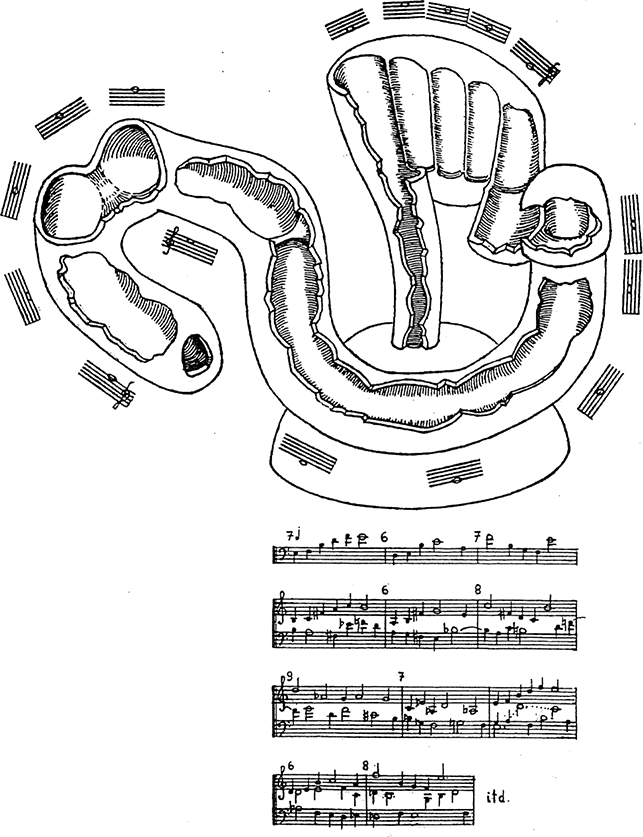
In addition to visual art media, Radovanović’s synthesis projects also employ light, kinetics, sound, and tactility, whose interaction exploits both complementary and oppositional relations of each element. Radovanović’s earliest art synthesis project is Taktizon–pokret–zvuk [Tactility–movement–sound], which, although created in 1957, remains unrealized.Footnote 50 As the title of the work implies, it involves three media elements: tactile, kinetic, and musical. For this project, Radovanović envisioned a partially lit, irregularly shaped winding tunnel with photocells on its walls. The participants would move through the tunnel (by crawling, walking, tumbling, sliding, etc.) and in the process activate the sound via photocells. Once they had reached a spherical chamber at the end of the tunnel, they would be able to listen to a fugue on a subject generated by the sounds they activated while moving through the tunnel (Example 5.3).Footnote 51
Vladan Radovanović, Taktizon–pokret–zvuk [Tactility–movement–sound] (1957).
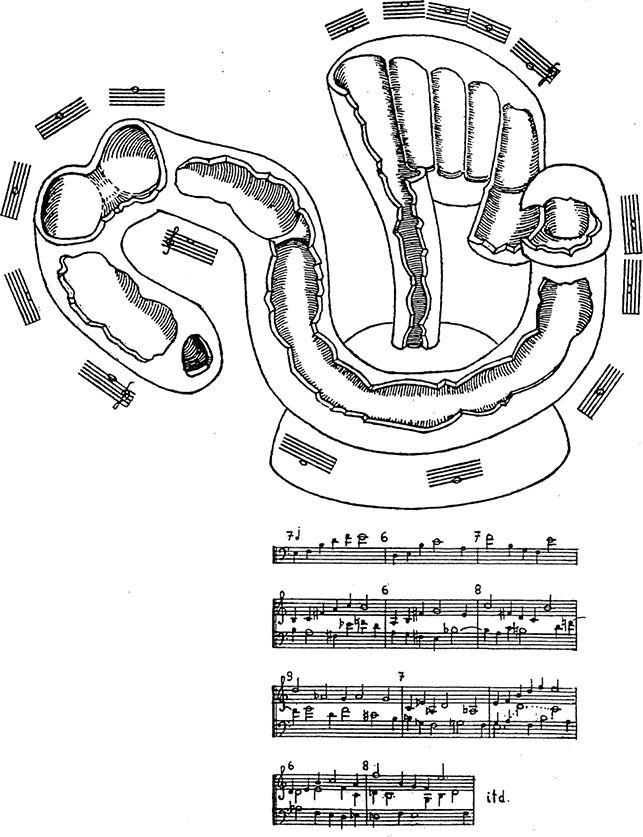
Example 5.3 Long description
This page of the score contains two components. On top is a drawing of a tunnel that first curves upwards, then downwards and across, then upwards and across with five zig-zagging compartments, before a steep drop straight down in the center. Above each component of the tunnel are individual staves with a single whole note on them, outlining the theme of a fugue. Below the drawing is a music score. The top staff features the theme of a fugue, and below it, the theme is developed into a two-part and three-part counterpoint.
Several other unrealized polymedia works followed: Mali zvučni taktizon [Small sound tactility] (1963), Putanje [Trajectories] or Polim 2 (1969), Polim 3 (1971), and Elektrovideaudio (1976–1980). For instance, Polim 2 applies the visual, kinetic, and musical elements. The project involves four performers, each carrying a cassette player that emits precomposed electronic music. The performers move around an area of seven by seven meters and follow a path that is lit by spotlights (in four colors – red, yellow, blue, and green). The spotlights, installed on the ceiling or the floor, are controlled by operators who follow a visual score – a drawing of a participant’s trajectory path and a general duration of each light beam.Footnote 52
Radovanović’s ensuing projects illustrate the composer’s unceasing innovative thinking, searching for ways to incorporate new media components and the ways in which they can interact. For instance, in Lažno ogledalo [A false mirror] (1986), in addition to music, image, and movement, Radovanović adds gesture as another element. The music component itself is complex, comprising a live quintet, a prerecorded performance by the quintet, and prerecorded electronic music. The visual-kinetic element, likewise, involves multiple layers: five performers, who play, sing, walk around, and make certain gestures, both live and while being transmitted on the screen as a prerecorded video. At first, the movements of live performers replicate the movements on the screen, before they gradually begin to diverge. It is this gesture that represents the metaphor of the mirror – a reflection that presents an altered image of what it reflects.
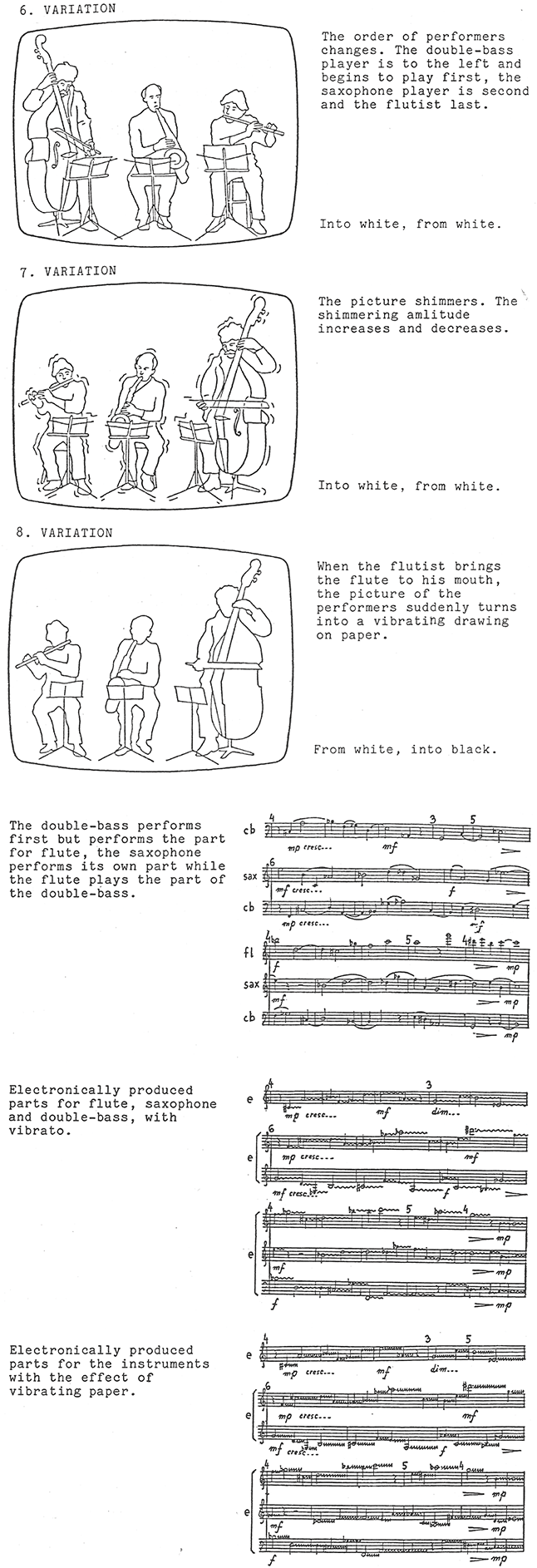
Radovanović includes the medium of the video (i.e., a moving image) in his Varijacije za TV [Variations for TV], composed in 1977 and realized (broadcast on TV) in 1985. The music medium in this project comprises music written for three performers (flute, saxophone, and double bass), and altered music for the same three instruments, plus electronics and speech. On the right side of the audio-video score, Radovanović shows the notated parts with verbal directions. The top system is for the live performers, the middle is for the electronically produced altered parts for the three instruments, and the bottom is for electronic music (Example 5.4). The theme of variations is based on a twelve-tone series, which is then altered through nineteen variations according to various principles of imitation, inversion, fragmentation, and so on. Radovanović also explores the notion of imitation in the spoken text – for instance, in the word “muzika” [music], Radovanović removes certain letters to derive new words and symbolic meanings, such as “muka” [pain] and “muk” [silence], playing out the relation between sound, silence, and image.Footnote 53
Vladan Radovanović, Varijacije za TV [Variations for TV] (1977, realized in 1985), a page from the audio-visual score.
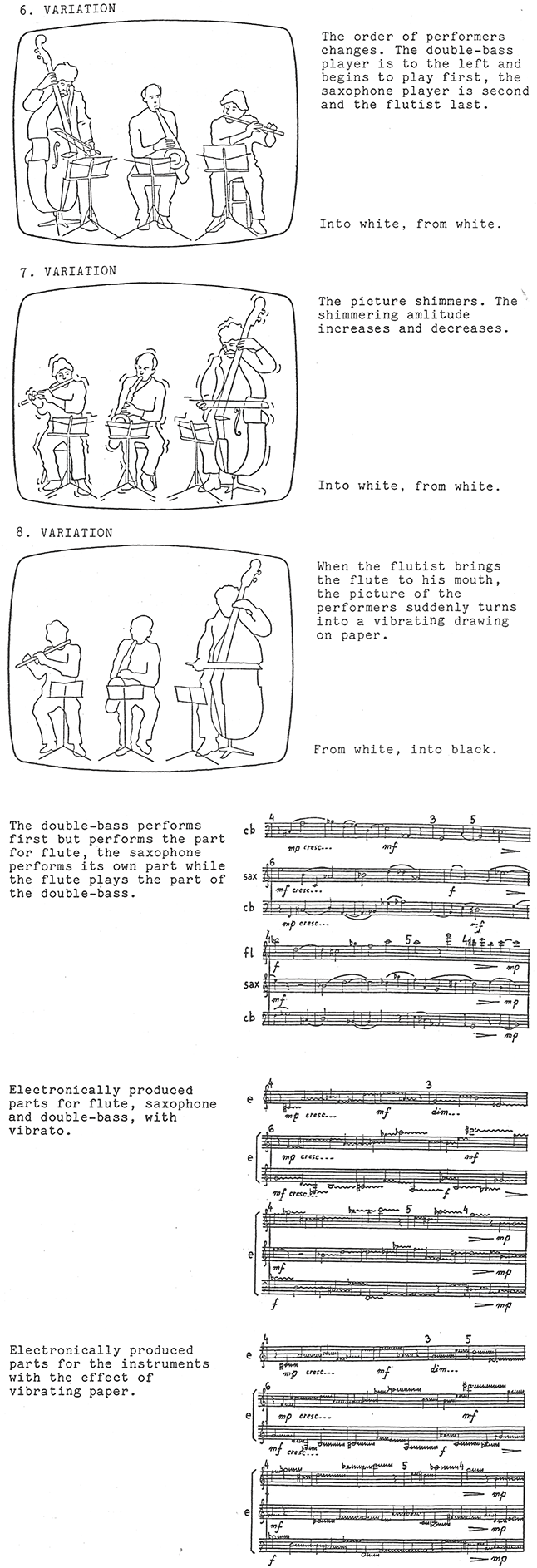
Example 5.4 Long description
On the left side of the page are three rows of drawings of a TV screen with three performers inside each, a bassist, a saxophonist, and a flutist, one for each variation, six, seven, and eight. Next to each TV screen is a text with instructions written in English. The top screen in Variation 6 says, The order of performers changes. The double bass player is to the left and begins to play first, the saxophone player second, and the flutist last. On the right is a music score for each instrumentalist with further directions, The double bass performs first, but performs the part for flute, the saxophone performs its own part, while the flute plays the part of the double bass. The middle screen, depicting Variation 7, reads, The picture simmers. The shimmering amplitude increases and decreases. On the right, next to the music score, the instructions read, Electronically produced parts for flute, saxophone, and double bass, with vibrato. The bottom screen, showing Variation 8, instructs, When the flutist brings the flute to his mouth, the picture of the performers suddenly turns into a vibrating drawing on paper. On the right, the composer indicates, Electronically produced parts for the instruments with the effects of vibrating paper.
Radovanović continued to create innovative and remarkable art synthesis projects throughout his career, each one notably different from the other, with this last project, A Galaksija odasvud sija [Galaxy A beams from everywhere], completed and realized in 2022, shortly before his death in 2023 at the age of ninety.Footnote 54
Conclusion
It is bewildering that some of the greatest and most original innovators of the postwar Yugoslav avant-garde have been neglected by scholars (even within the region) and shunned by critics, audiences, and institutions. Despite Frajt’s incredible achievements in the fields of electroacoustic and film music, there is virtually no scholarship on her oeuvre, even in her native Serbia. Aside from the four studies cited in this chapter, all in Serbian – Varsaković’s article about the ritual and nocturnal elements in Frajt’s music, Adžić’s analysis of Eclogue (1975), Ćirić’s article on Frajt’s film music, and Ivana Medić’s overview of Frajt’s catalog, only the latter one written in English – the noteworthy achievements by this remarkable woman remain unexplored, even within the borders of former Yugoslavia.Footnote 55 A principal reason for this omission, during the existence of Yugoslavia, is that there was a stark lack of interest and a strong disapproval of this type of music in socialist Yugoslavia. Consequently, peers and audiences lacked any understanding of the genre, and critics were unprepared to intelligently and cohesively write about it. Many composers of the older prewar generation, who now held prominent positions in universities and programming committees, shared the view of Dragutin Gostuški, a composer and music critic, who despised any avant-garde tendencies in music. In his 1959 article, he comments on the unpreparedness of the Yugoslav music scene to receive and understand new music (both serial and electronic):
Dodecaphony is beginning to appear in our country, either as a natural aspiration toward the enrichment of musical expression (as some think) or as an attempt toward forced solving of inner creative crisis (as I think). Be that as it may be, electronic (or concrete) music in our country is indirectly forbidden because practically there are no conditions for its creation. If dodecaphony is one step toward the contemporary, electronic music is at least two steps, and it seems it has bigger perspectives and more useful applications. If music has to be mechanized, then it should become mechanical at once.Footnote 56
While political and historical context offers explanations for why Yugoslav avant-gardists were ignored and rejected at the time, it in no way justifies such neglect in the scholarly community today. Radovanović’s creative force was not adequately recognized until Mirjana Veselinović’s 1991 monograph on his musical output.Footnote 57 Art historian Borka Božović most accurately sums up the general reasons for the neglect of Radovanović’s work in scholarship: “the lack of information, indifference, ignorance, fascination with foreign artists and with the latest fads, misunderstanding.”Footnote 58 Božović continues to marvel at the level of exclusion Radovanović faced:
In isolation, he created his own world and built a sophisticated art system. … There were no critics that could explain, observe, promulgate, or support Radovanović’s experiments, innovations, ideas, drawings, objects, photographic works, or video works. Even when some institutions for new art practice were formed, Radovanović was rarely invited to present his work.Footnote 59
As Ivana Medić remarks, while it is striking in itself that a remarkable avant-garde oeuvre such as Radovanović’s emerged in the conservative environment of postwar Yugoslavia, it is even more fascinating that even in such an environment, Radovanović persevered.Footnote 60 Serbian philosopher Milorad Belančić employs the term nesuđena avangarda (“nesuđena” translating to something that is just not meant to be) to describe Radovanović’s artistic will, drive, and calling.Footnote 61 Medić further adds three additional terms (i.e., factors) to describe the “impossibility” of Radovanović’s avant-garde in Yugoslavia: (1) “the unrecognized avant-garde,” referring to the fact that Radovanović’s truly innovative oeuvre was at complete odds with the social and cultural environment in Yugoslavia at a time when the country did not yet possess institutional or discursive tools necessary to acknowledge and validate his poetics; (2) “the invisible avant-garde,” concerning Radovanović’s “too abstract” avant-garde output, which did not and could not express the desired ideological values of socialist realism; and (3) “the irrelevant avant-garde,” implying that by living and creating his work in a culturally isolated socialist Yugoslavia, it was impossible for Radovanović to make his mark in any significant way.Footnote 62 But Radovanović’s intention was never to “make his mark” in history books nor to create a political statement by not adhering to socialist values and resisting the pressure from his conservative peers. Rather, his extraordinary oeuvre is the result of his continuous drive and persistence to create something new and push the boundaries of what is already there.
Within the borders of Yugoslavia, Radovanović’s works were groundbreaking. But even when viewed within a wider international context, his originality is remarkable. For instance, Dejan Đorić notes that Radovanović’s Pričinjavanja [Seemingness] from 1955 and Ležanje [Reclining] from 1957, and other projects that work with the idea as a material, accentuating the mental, or self-reflective, precede Henry Flynt’s “concept art” (1961) and Joseph Kosuth’s “conceptual art” (1965). Further, Đorić continues, Pravljenje svoga tela [The making of one’s body], created in 1957, two years after Kazuo Shiraga’s Challenging Mud (1955), is one of the earliest examples of physical art.Footnote 63 In the domain of visual arts, Đorđe Savić observes that Radovanović was the first artist who photographed a photograph of photographic paper and exhibited it.Footnote 64 Milin argues that Radovanović’s works in the domain of art synthesis constitute “a worthy complement to the oeuvres of artists who, from the 1950s onward, started to reflect on different ways of achieving a synthesis of the arts.”Footnote 65 As a case in point, Milin points out that although Radovanović may have been unaware of Edgard Varèse’s multimedia work Poème électronique (1958) or the architect Le Corbusier,Footnote 66 he was moving in the same direction independently with his own projects, most notably in Taktizon–pokret–zvuk (1957), which precedes Poème électronique. Whether we evaluate Radovanović’s creative output retrospectively or currently, both within Yugoslav and in broader contexts, it cannot be denied that he was a true visionary.

 Open access