


Social media summary
Ecosystems can help us adapt to climatic impacts but robust policy targets that benefit people and nature are needed.
1. Introduction
According to the World Economic Forum (2020) Global Risks Report, failure to mitigate and adapt to climate change presents the greatest risk to the global economy in terms of severity of impact. Meanwhile, extreme weather – which is exacerbated by climate change (National Academies of Sciences, Engineering, and Medicine, 2016) – is listed as the risk most likely to damage the economy. Identifying and implementing robust climate change adaptation approaches that are cost-effective and build resilience across a range of potential future climates is therefore critical. The prevailing approach across the world has involved a mix of direct, engineered (or ‘grey’) interventions such as sea walls, levees or irrigation infrastructure, and indirect (or ‘soft’) interventions such as early warning systems (Enríquez-de-Salamanca et al., Reference Enríquez-de-Salamanca, Díaz, Martín-Aranda and Santos2017). However, there is widespread recognition that nature-based (or ‘green’) solutions (NbS) can complement these approaches in both rural and urban contexts (Global Commission on Adaptation, 2019; Hobbie & Grimm, Reference Hobbie and Grimm2020; Royal Society, 2014).
A specific type of NbS targeting human adaptation to climate change is widely referred to as ecosystem-based adaptation (EbA). This is defined by the Convention on Biological Diversity (CBD) as “the use of biodiversity and ecosystem services … to help people adapt to the adverse effects of climate change” (Secretariat of the Convention on Biological Diversity, 2009). Examples include: protecting natural wetlands and forests in upper catchments to reduce the impacts of flooding downstream; restoring mangroves and salt marshes to protect communities and infrastructure from storm surges and to reduce coastal erosion; and planting trees amongst crops or crops within forest to maintain or even enhance yields in drier, more variable climates. For specific examples of NbS for climate change adaptation, or EbA, see Box 1 (adapted from Seddon et al., Reference Seddon, Chausson, Berry, Girardin, Smith and Turner2020). EbA is often described as an alternative to ‘grey’ engineering. However, in reality, there is a spectrum of interventions, some including components of both (i.e., hybrid or “grey–green” approaches) (Browder et al., Reference Browder, Ozment, Rehberger Bescos, Gartner and Lange2019; Royal Society, 2014). Reports from projects implemented by non-governmental organizations and United Nations (UN) institutions suggest that EbA can provide low-risk, low-cost protection from a range of climatic impacts, whilst also delivering other vital ecosystem services (e.g., Reid et al., Reference Reid, Hou Jones, Porras, Hicks, Wicander, Seddon and Roe2019; Rizvi, Reference Rizvi2014; Osti et al., unpublished data). However, although project-specific accounts of the benefits of EbA are increasingly backed up by more systematic research, there is a need for robust scientific synthesis (Seddon et al., Reference Seddon, Chausson, Berry, Girardin, Smith and Turner2020).
Examples of nature-based solutions for climate change adaptation (taken from Seddon et al., Reference Seddon, Chausson, Berry, Girardin, Smith and Turner2020 with permission of Royal Society Publishing).
Protection from soil erosion
• Ethiopia: Farmer-managed natural regeneration of 2728 ha of degraded native forests with living tree stumps in Humbo reduced soil erosion and flash flooding and increased groundwater recharge, which was associated with higher crop productivity. In 2006–2036, the project will remove an estimated ~870,000 tonnes of CO2 equivalent, while diversifying livelihoods (Brown et al., Reference Brown, Dettmann, Rinaudo, Tefera and Tofu2011).
• China: A combination of afforestation, reforestation and conservation of existing natural forests over 25 years in the Poyang Lake basin halved heavy soil erosion while increasing net carbon sequestration five-fold and net income for local farmers six-fold (Huang et al., Reference Huang, Shao and Liu2012). Meanwhile, restoration of natural herbaceous and shrubland vegetation on the Loess Plateau reduced soil erosion to a comparable or significantly greater extent than low-diversity tree plantations across a range of soil erosion indices. Compared to afforested slopes, these naturally re-vegetated slopes also had 1.3–2.0 times higher soil water content (Jia et al., Reference Jia, Zhu and Luo2017).
Protection from inland flooding
• Europe: Restoration of all but one of six rivers reduced flood damage and was associated with increased agricultural production, carbon sequestration and recreation, with a net societal economic benefit over unrestored rivers of €1400 ± 600. Interventions included floodplain re-wetting, restoration of riparian vegetation, assisting upstream fish migration and the re-meandering and re-connection of channels (Vermaat et al., Reference Vermaat, Wagtendonk, Brouwer, Sheremet, Ansink, Brockhoff and Giełczewski2016).
• Canada: Reforestation in the headwaters of a river basin significantly reduced peak stream flows compared to an adjacent deforested basin, offering greater protection against flooding during spring snow melt (Buttle, Reference Buttle2011).
• USA: Natural regeneration of mixed-species hardwood watersheds following forest clear-cutting reduced flood risk in lowland areas, reducing stream flows during periods of high precipitation by >104 L/ha/day (Kelly et al., Reference Kelly, McGuire, Miniat and Vose2016).
Buffering natural resources against drier and more variable climates
• Panama: Agroforestry systems yield up to 21% higher economic returns than farm mosaic approaches (i.e., where trees and crops are on separate parcels), including under a climate change scenario of more frequent droughts, in models that account for market and climate uncertainty (Paul et al., Reference Paul, Weber and Knoke2017).
• Europe: Agroforestry has reduced erosion, increased soil fertility, increased precipitation and reduced temperatures, with greatest effects in hotter, drier regions such as the Mediterranean basin (which is suffering from soil damage through increasing aridity under climate change) (Torralba et al., Reference Torralba, Fagerholm, Burgess, Moreno and Plieninger2016).
Protection from coastal hazards and sea-level rise
• Global: Natural coastal habitats significantly reduce wave heights, with coral reefs and salt marshes being most effective, causing a reduction of 70%, followed by seagrass and kelp beds (36%) and mangroves (31%). Across 52 sites harnessing these habitats in coastal defence projects, nature-based solutions were two to five times more cost-effective at lowering wave heights and at increasing water depths compared to engineered structures (Narayan et al., Reference Narayan, Beck, Reguero, Losada, van Wesenbeeck, Pontee and Burks-Copes2016). Globally, mangroves protects 15 million people from flooding every year and provide over US$65 billion in flood protection services (Menendez et al., Reference Menéndez, Losada, Torres-Ortega, Narayan and Beck2020).
• Gulf of Mexico: Construction of ‘living shorelines’ by aiding the natural recruitment of oyster reefs can reduce vegetation retreat by 40% compared to unprotected sites, stabilizing the shoreline from the effects of waves and erosion and increasing the abundance and diversity of economically important species (Scyphers et al., Reference Scyphers, Powers, Heck and Byron2011).
Moderating urban heatwaves and heat island effects
• Global: Green spaces are on average 0.94°C cooler in the day than urban spaces, with stronger effects the larger the green space, according to a meta-analysis of 47 studies comparing the cooling effects of green spaces in cities (parks, areas with trees) with those of purely urban areas (Bowler et al., Reference Bowler, Buyung-Ali, Knight and Pullin2010).
Managing storm-water and flooding in urban areas
• Italy: The establishment of wetlands and green recreational space has been effective at reducing flood risks, with a 10% higher reduction of downstream flooding and 7.5% higher reduction of peak flow compared to potential grey infrastructure alternatives. Nature-based solutions also outperform grey infrastructure in terms of water purification and provide greater social-ecological benefits such as recreation and habitat for biodiversity (Liquete et al., Reference Liquete, Udias, Conte, Grizzetti and Masi2016).
2. Nature-based solutions for adaptation in the Paris Agreement
As the evidence base for the efficacy of NbS strengthens, so ecosystems are receiving attention in international climate change policy fora. Of particular importance, the Paris Agreement of the United Nations Framework Convention on Climate Change (UNFCCC) recognizes the importance of ecosystems for mitigation and adaptation. It calls on all Parties to acknowledge “the importance of the conservation and enhancement, as appropriate, of sinks and reservoirs of the greenhouse gases,” and to “note the importance of ensuring the integrity of all ecosystems, including oceans, and the protection of biodiversity.” It then includes in its Articles several references to ecosystems, forests and natural resources (Seddon et al., Reference Seddon, Sengupta, García-Espinosa, Hauler, Herr and Rizvi2019a). For example, Article 5.2 encourages Parties to adopt “…policy approaches and positive incentives for activities relating to reducing emissions from deforestation and forest degradation, and the role of conservation and sustainable management of forests and enhancement of forest carbon stocks in developing nations; and alternative policy approaches, such as joint mitigation and adaptation approaches for the integral and sustainable management of forests, while reaffirming the importance of incentivizing, as appropriate, non-carbon benefits associated with such approaches” (UNFCCC, 2016).
2.1. Analysis
In order to determine the extent to which this has translated into high-level national intent, we conducted a comparative analysis of the prominence of NbS in the Nationally Determined Contributions (NDCs) that were submitted to the UNFCCC by signatories of the Paris Agreement, with a particular focus on the those 142 NDCs that included adaptation components. Full details of our methodology can be found in the Supplementary Materials, while all of the data are available to explore on an interactive web platform, the Nature-based Solutions Policy Platform (www.nbspolicyplatform.org). We focused on the NDCs, rather than other policy documents (e.g., National Adaptation Plans), because the Paris Agreement has considerable political momentum, meaning that NDC targets are often in the limelight and under scrutiny. Furthermore, unlike any other policy processes, the Agreement has an inbuilt ratchet mechanism for increasing ambition: every 5 years, progress towards targets set out in the NDCs must be reported on, monitored and compared with other nations. We focused on adaptation because this has not been fully addressed in prior research on NbS in the NDCs. Instead, most studies to date have examined the extent to which nations have incorporated forestry, agriculture and/or forest landscape restoration (FLR) for the purpose of increasing sinks and reducing sources of greenhouse gas emissions (Forsell et al., Reference Forsell, Turkovska, Gusti, Obersteiner, den Elzen and Havlek2016; Grassi et al., Reference Grassi, House, Dentener, Federici, den Elzen and Penman2017).
In our detailed analysis of the text of the adaptation components of the NDCs, we make a distinction between nature-based ‘visions’, ‘actions’ and ‘targets’ for NbS. A vision was defined as a high-level pledge or statement of recognition of the importance of NbS for adaptation. An action was defined as tangible, locally relevant action or intervention in a particular habitat or the development/implementation of a specific and relevant policy or process that is being implemented or planned for. We considered an action to be broadly ‘nature-based’ if it referred to the protection, restoration or management of ecosystems, including assisted natural regeneration, reforestation and afforestation. We defined a target as either a time-bound or quantitative target linked to an adaptation action that could, in theory, be tracked over time. We make a distinction between nature-based interventions aimed at delivering direct positive adaptation outcomes and other socioeconomic benefits through ecosystem services (i.e., ecosystem-based adaptation (EbA)) and those aimed at delivering positive outcomes for species or habitats (which, for simplicity, we refer to as conservation). For full details, see Supplementary Materials.
2.2. Results
2.2.1. Global recognition that ecosystems are both vulnerable to climate change and can support human adaptation
We found that two-thirds of all NDCs (112/168) acknowledge that ecosystemsFootnote i are vulnerable to climate change (Figure 1(a)). Some nations highlight negative impacts on ecosystems in general (China's NDC states that “climate change has significant impacts on global natural ecosystems”), while others focus on specific contexts (Morocco's NDC states that “climate change will have an impact on how vibrant and dynamic forest ecosystems are, on their ability to regenerate and to adapt to regular climate fluctuations, their biodiversity, their consistency, and their spatial distribution”).
Overview of how biodiversity and/or ecosystems are included in the adaptation components of the Nationally Determined Contributions (NDCs) submitted to the United Nations Framework Convention on Climate Change (UNFCCC) by signatories of the Paris Agreement. (a) Those sectors most commonly described as being vulnerable to climate change impacts; biodiversity and/or ecosystems are ranked fourth (green bar). (b) Common reasons given for developing a climate change adaptation plan; protecting biodiversity and/or ecosystems is ranked fifth (green bar). For data and more information on the inclusion of nature-based solutions in the NDCs, see www.nbspolicyplatform.org.

The protection of ecosystems is a declared motivation for adaptation planning in 63% of NDCs (106/168) and was the fifth most frequently mentioned intended outcome of adaptation planning (ranked below increased resilience, protection against extreme events, food security and water security, but above protection of the economy or human health; Figure 1(b)). Indeed, ecosystems feature in climate change adaptation ‘vision statements’ in 58% (97) of the NDCs (Table S1; for all adaptation vision statements in the NDCs that referred to ecosystems, see www.nbspolicyplatform.org). For some nations, the aim is to address impacts on ecosystems directly (e.g., the Republic of Congo's NDC emphasizes the “protection of natural heritage, biodiversity, forests and fishery resources, through an adaptation approach rooted in the protection of ecosystems”). Others are instead explicit that protecting ecosystems is for the benefit of human communities (e.g., Cambodia's NDC commits to “promoting and improving the adaptive capacity of communities, especially through community based adaptation actions, and restoring the natural ecology system to respond to climate change”).
Of those nations that articulated a broadly ‘nature-based’ vision for adaptation in their NDCs, most (79; i.e., 81%) go on to propose a range of actions to achieve their vision. However, a small number (18) have nature-based visions but no associated tangible actions (Table S1). Those with NbS actions describe the restoration and/or protection that fall within five broad types of ecosystems and/or the implementation of nature-based agricultural practices such as agroforestry (Figure 2). Specifically, we found that the adaptation component of the NDCs of 70 nations (42% of NDCs) include actions that appear to have the characteristics of EbA as defined by the CBD (Secretariat of the Convention on Biological Diversity, 2009) (see Supplementary Materials). For example, El Salvador states it will establish and manage 1 million ha through an integrated approach “where forest areas will be rehabilitated and conserved, biological corridors will be established through the adoption of resilient agroforestry systems and transformation of agricultural areas with low carbon sustainable practices.” An additional 34 nations (20% of NDCs) outline conservation activities such as the establishment of protected areas or habitat restoration without any explicit links to promoting social or ecological resilience to climate change or the involvement of local communities. For example, Bahrain refers to “a mangrove transplantation project for the cultivation of plants and planting mangrove seedlings in order to rehabilitate degraded coastal areas,” and Tunisia commits to “conservation of the ecological functions of low-lying coastal areas.” Twenty-seven additional nations, though lacking reference to EbA or conservation in the adaptation components of their NDCs, refer to such actions or broad commitments in the mitigation component. For example, Vietnam seeks to “manage and develop sustainable forests, enhance carbon sequestration and environmental services.”
Regional variation in the types of ecosystems included in the adaptation component of the Nationally Determined Contributions (NDCs). Shown are numbers of NDCs within in each of four geographical regions that include nature-based actions in one or more of the following five broad and non-mutually exclusive ecosystem types: (1) river catchment habitats (includes references to watersheds, wetlands, lakes, rivers, etc.); (2) grasslands and rangelands (includes lowland grasslands, shrub land, savanna, tundra); (3) terrestrial forests and woodlands (excludes mangroves); (4) coastal and marine habitats (includes mangroves, seagrass meadows, coral or shellfish reefs, dune systems, coastal wetlands and salt marshes); and (5) montane habitats (includes a range of habitats at elevation). Also shown are the numbers of NDCs in each region that refer to nature-based agricultural practices (includes agroforestry, conservation agriculture and permaculture).

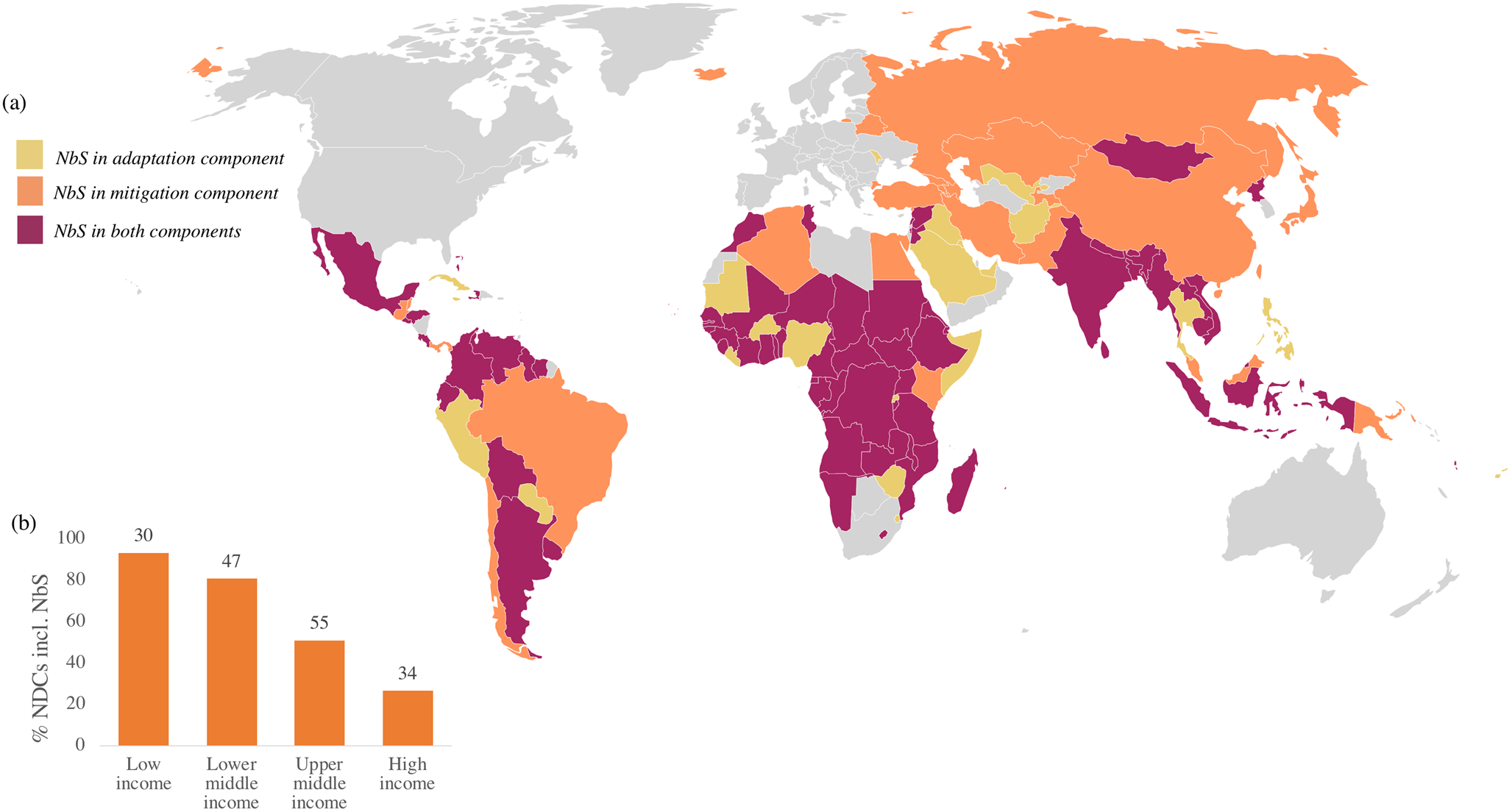
In total, 104 nations include EbA and/or conservation actions in the adaptation components of their NDCs, 77 nations include them in both their adaptation and mitigation components and an additional 27 nations include them as part of their mitigation plans only (Figure 3(a)). In other words, 131 nations – or 66% of all signatories to the Paris Agreement (78% of NDCsFootnote ii) – have articulated intentions of working with ecosystems, in one form or another, to address the causes and consequences of climate change. However, we found that there is much variation among nations, regions and ecosystems in the extent to which NbS are included in the adaptation component of the NDCs (Figure 2 & 3).
(a) Global distribution of nations that include nature-based solutions (ecosystem-based adaptation and/or conservation) in the adaptation and/or mitigation component of the first iteration of their Nationally Determined Contribution (NDC). (b) The percentages of NDCs from nations from each of the four World Bank income groups that include nature-based solutions in their adaptation components (numbers above bars show how many nations fall within that income group).
2.2.2. Regional variation in inclusion of NbS in climate change adaptation plans
A high proportion of the world's poorest nations include NbS as an adaptation tool in their NDCs. Specifically, we found that NbS are referred to in the adaptation plans of 28 of the 30 nations classified as ‘low income’ by the World Bank (with 22 including EbA specifically) and all but 4 of the 47 nations classified as ‘least developed’. In contrast, NbS actions are included in only 9 (26%) of 34 high-income nations (12% include EbA) (Figure 3(b)).
The ecosystems most commonly referred to in the adaptation components of the NDCs are terrestrial forests or woodlands (i.e., their protection, restoration (reforestation) or afforestation (planting trees in naturally treeless environments)); these are highlighted in the adaptation components of 69 NDCs (i.e., 41%) (Figure 2). There was variation among geographical regions in the types of ecosystems most commonly referred to (Figure 2). The protection and/or restoration of coastal or marine habitats appear in 48 NDCs (29% of the total, but 37% of NDCs from nations with coasts), followed by similar actions in river catchments, including wetlands (28% of NDCs). Much less common are references to working with grasslands and rangelands (10% of NDCs) or montane habitats as an adaptation approach (4% of NDCs). Almost all examples of grassland or rangeland NbS adaptation actions come from Africa (Figure 2), despite the extensive presence of these habitats in other regions. Nature-based agricultural practices, such as agroforestry, were included in the adaptation components of 40 NDCs (i.e., 24%), most of which are from African nations (i.e., 27 NDCs) (Figure 2).
2.2.3. Targets for NbS
While many nations outline a theoretical commitment to NbS as an adaptation tool, this rarely translates into clear targets in their NDCs. Of the 104 NDCs that include nature-based adaptation actions, only 30 provide measurable (i.e., time-bound, quantitative) targets; the remainder provide broad goals, which are difficult to measure (for all NbS adaptation targets in the NDCs, see www.nbspolicyplatform.org). For example, Morocco aims to protect “natural heritage, biodiversity, forestry and fishery resources, through an ecosystem-based adaptation approach,” and South Sudan will strive to “develop forest reserves and management plans to protect watersheds and improve future water availability.” Although such goals are important, without more context-specific, measurable targets and suitable indicators, it will be difficult to determine the extent to which they are being achieved.
Even where measurable NbS adaptation targets exist in the NDCs, they tend to focus on the extent of lands to be afforested, reforested or restored, rather than the quality of those lands or the adaptation outcomes of the actions. Afforestation accounts for 22% of the 64 adaptation targets included in 30 NDCs, and the protection and/or restoration of specific areas of habitat (usually forest) within given time frames account for 48% of targets (Table S2). For example, Bolivia states that it will “increase forest areas with integrated and sustainable community management approaches with 16.9 million hectares in 2030, in reference to 3.1 million hectares by 2010,” Burundi states it will increase “forest cover by 20% by 2025,” and Mongolia includes an intention to increase forest area “to 9% by 2030 through reforestation activities” (NBSPP, 2020). Meanwhile, only 31 nations include intentions in their NDCs to improve ecosystem resilience (e.g., Kenya's adaptation vision is to “enhance the resilience of ecosystems to climate variability and change”). None go on to outline how this might be achieved in practice, and only two NDCs explicitly link ecosystem resilience with biodiversity. Jordan states that “adaptation strategies and measures in biodiversity should be prepared and implemented in order to achieve sustainable, healthy and resilient ecosystems in the future under threats of climate change and other stressors” (emphasis added), and Rwanda “intends to use mixed-species approaches which contribute greatly to the achievement of both mitigation objectives and adaptation benefits of ecosystem resilience and biodiversity.”
3. Discussion
NbS are prominent in the first iteration of the NDCs submitted to the UNFCCC by the signatories of the Paris Agreement. We found that 131 nations – or 66% of all signatories to the Paris Agreement – outline intentions of working with ecosystems, in one form or another, to address climate change. However, our detailed assessment of the adaptation components of the NDCs revealed that national intentions to deliver NbS for climate change adaptation vary by level of economic development, region and habitat type, and rarely translate into measurable evidence-based actions and targets. Here, we discuss possible reasons for these findings and the problems associated with them.
3.1. Prominence of NbS in the climate adaptation plans of developing nations
The world's poorest nations currently experience the most severe socioeconomic impacts from climate change and are in urgent need of robust cost-effective adaptation action (IPCC, 2018). These nations also more commonly include NbS as an adaptation tool in their NDCs compared to Annex 1 nations. This may reflect greater dependency of the rural poor on natural resources (Uy et al., Reference Uy, Shaw, Takeuchi, Shaw and Tran2012) and the generally lower economic costs of implementing NbS compared to engineered alternatives (Narayan et al., Reference Narayan, Beck, Reguero, Losada, van Wesenbeeck, Pontee and Burks-Copes2016; Royal Society, 2014). It may also reflect the role of local and international conservation and development organizations in the programming and mainstreaming of EbA in lower- and middle-income nations over the past 10 years (e.g., Reid et al., Reference Reid, Hou Jones, Porras, Hicks, Wicander, Seddon and Roe2019; Rizvi, Reference Rizvi2014; Osti et al., unpublished data). We note that no Annex 1 nations (i.e., industrialized Organisation for Economic Co-operation and Development (OECD) members and economies in transition) include NbS in the adaptation component of their NDCs, even though a number are implementing NbS on the ground. For example, many European nations are restoring rivers with the aim of reducing flood risk (e.g., Giełczewski, Reference Giełczewski2016); the UK and Germany are both implementing managed coastal realignment to deal with flooding and erosion (e.g., Rupp-Armstrong & Nicholls, Reference Rupp-Armstrong and Nicholls2007); and in the USA, a wide range of NbS activities are being undertaken, including to protect coasts from erosion, such as saltmarsh restoration and oyster reef rehabilitation (e.g., Narayan et al., Reference Narayan, Beck, Wilson, Thomas, Guerrero, Shepard and Trespalacios2017; Scyphers et al., Reference Scyphers, Powers, Heck and Byron2011). These nations may not have featured such information in their NDCs because the requirement to include an adaptation component came after they had compiled their NDCs. Equally, they may not have viewed the NDC as a relevant vehicle to communicate adaptation intentions: the Kyoto Protocol emphasized stringent mitigation commitments by Annex 1 nations in particular, and in the decade leading up to the Paris Agreement, adaptation was largely ignored. Consequently, the recognition of the role of NbS in adaptation is more global than is indicated across the current iteration of NDCs. As these are revised, and as the climate impacts on Annex 1 nations intensify, so we may see a greater balance between mitigation and adaptation planning by all nations, with NbS recognized as an important means by which to achieve synergy between them.
3.2. Emphasis on forestry and agroforestry
The widespread inclusion of nature-based agricultural practices such as agroforestry in the NDCs of African nations likely reflects their low cost and multiple benefits compared to industrial agriculture (Scherr & Sthapit, Reference Scherr and Sthapit2009; Waldron et al., Reference Waldron, Garrity, Malhi, Girardin, Miller and Seddon2017), especially for smallholder farmers who have a long history of working with nature (Mbow et al., Reference Mbow, Van Noordwijk, Luedeling, Neufeldt, Minang and Kowero2014). Meanwhile, the emphasis on forest and forestry in general across the NDCs may simply reflect the fact that forests are high on the agenda in international negotiations and in national policy-making contexts (e.g., Reduced Emissions from Deforestation and Degradation (REDD), New York Declaration on Forests and the Bonn Challenge) (Seddon et al., Reference Seddon, Turner, Berry, Chausson and Girardin2019b). The policy focus on forests to date has largely been framed in terms of their value for mitigation (i.e., as carbon sinks). Nevertheless, it may have created awareness among policy-makers of, for example, sustainable forest management, arguably paving the way for the inclusion of such actions in adaptation plans. Forests are also regarded as a valuable economic resource (i.e., for timber and non-timber forest products), whereas the direct economic value of other habitats is perhaps less clear to policy-makers. An emphasis on forests in the NDCs may also reflect a more extensive evidence base for the effectiveness of these habitats in providing key regulating services, in particular erosion control along coasts (Temmerman et al., Reference Temmerman, Meire, Bouma, Herman, Ysebaert and De Vriend2013) and in river catchments (Dadson et al., Reference Dadson, Hall, Murgatroyd, Acreman, Bates, Beven and O'Connell2017; Huang et al., Reference Huang, Shao and Liu2012). Conversely, fewer studies have rigorously determined the extent to which grasslands or montane habitats protect communities from climate change impacts (www.naturebasedsolutionsevidence.info).
The focus on forests and (agro)forestry is problematic for at least two major reasons. First, it can encourage the establishment of low-diversity plantations of fast-growing non-native species (Brancalion & Chazdon, Reference Brancalion and Chazdon2017; Lewis et al., Reference Lewis, Wheeler, Mitchard and Koch2019). For example, according to Lewis et al. (Reference Lewis, Wheeler, Mitchard and Koch2019), 45% of the 350 Mha currently pledged for reforestation to meet the Bonn Challenge is set to be achieved through commercial plantations (but see Dave et al., Reference Dave, Maginnis and Crouzeilles2019).” While fast-growing single-species plantations may sequester carbon and reduce vulnerability to specific climate change impacts in the short term, their capacity to support human adaptation or store carbon over the long term may be impaired by changing conditions and disturbances that are becoming more severe under climate change (Frank et al., Reference Frank, Reichstein, Bahn, Thonicke, Frank, Mahecha and Beer2015).
Second, forestry plantations sometimes comes at the expense of vital naturally occurring ecosystems, such as natural grasslands and peatlands (Veldman, et al., Reference Veldman, Overbeck, Negreiros, Mahy, Le Stradic, Fernandes and Bond2015), which may be more resilient to climate change impacts and/or support human adaptation in other ways (Brancalion & Chazdon, Reference Brancalion and Chazdon2017). Evidence of forest dieback across the globe as a result of climate stress (in particular drought and the increased frequency of pests and wildfires) (Allen et al., Reference Allen, Macalady, Chenchouni, Bachelet, McDowell, Vennetier and Gonzalez2010) suggests that afforestation might not be a viable long-term adaptation solution in some regions. Instead, scientific research increasingly suggests that areas allowed to regenerate naturally can deliver a wider range of climate change adaptation services with fewer trade-offs (Brancalion & Chazdon, Reference Brancalion and Chazdon2017; Morecroft et al., Reference Morecroft, Duffield, Harley, Pearce-Higgins, Stevens, Watts and Whitaker2019) and be more cost-effective than afforestation (Crouzeilles et al., Reference Crouzeilles, Beyer, Monteiro, Feltran-Barbieri, Pessôa, Barros and Matsumoto2020). For example, although large-scale afforestation projects have reduced soil erosion in China (e.g., Liu et al., Reference Liu, Li, Ouyang, Tam and Chen2008; Ouyang et al., Reference Ouyang, Zheng, Xiao, Polasky, Liu, Xu and Jiang2016; but see Cao, Reference Cao2008), the plantations have higher rates of evapotranspiration compared to natural vegetation (Cao et al., Reference Cao, Zhang, Chen and Zhao2016). This has resulted in water shortages (e.g., Zhang et al., Reference Zhang, Ding and Luo2017) and may have threatened the survival of the plantations themselves (Cao et al., Reference Cao, Chen and Yu2009). Such plantations have also had negative effects on biodiversity (Hua et al., Reference Hua, Wang, Zheng, Fisher, Wang, Zhu and Wilcove2016; Xu et al., Reference Xu2011). Conversely, areas allowed to regenerate naturally (e.g., into herbaceous cover and shrubland) provide comparable levels of erosion control without compromising soil moisture or biodiversity (Jiao et al., Reference Jiao, Zhang, Bai, Jia and Wang2012) (also see Box 1).
Climate change policy, whether articulated in the NDCs or other national plans, should not prioritize forestry plantations at the expense of other ecosystems such as grasslands or wetlands that, in context, provide effective adaptation and contribute to mitigation. Those advocating for increased ambition for nature in climate change policy need to be more inclusive in how they describe the value of NbS. Taking into account the potential value of all ecosystems is likely to lead to more balanced and effective nature-based components of adaptation and mitigation strategies (Seddon et al., Reference Seddon, Turner, Berry, Chausson and Girardin2019b).
3.3. Improving targets for NbS
For ecosystems to provide services to people, they must themselves be able to resist, recover and/or adapt to change. Such resilience is, in turn, strongly determined by habitat connectivity, heterogeneity and diversity (Oliver et al., Reference Oliver, Heard, Isaac, Roy, Procter, Eigenbrod and Proença2015). Connectivity allows for migration and range shifts to track moving ecological niches as an adaptive response to climate change (McGuire et al., Reference McGuire, Lawler, McRae, Nuñez and Theobald2016). Diversity, meanwhile, allows for sustained productivity through extreme floods and droughts (Hutchinson et al., Reference Hutchison, Gravel, Guichard and Potvin2018), pests and diseases (Jactel et al., Reference Jactel, Bauhus, Boberg, Bonal, Castagneyrol, Gardiner and Brockerhoff2017) via the buffering effects of multiple species, which differ independently in their responses to similar environmental conditions (Loreau & de Mazancourt, Reference Loreau and de Mazancourt2008). Genetic diversity also safeguards the evolutionary potential for adaptation to a changing environment (Mijangos et al., Reference Mijangos, Pacioni, Spencer and Craig2015).
If NbS targets are to deliver positive outcomes for adaptation and/or mitigation over the long term, they should therefore encourage actions that sustain or enhance these ecological attributes. Meanwhile, to deliver long-term benefits for people dealing with climate change impacts, targets should also encourage working with nature in such a way as to: (1) reduce exposure (e.g., limit coastal or inland flooding); (2) build adaptive capacity (e.g., empower local communities to manage their natural environment); and (3) reduce sensitivity to the impacts of climate change (e.g., secure diverse portfolios of livelihoods to increase resilience to climatic shocks) (Lavorel et al., Reference Lavorel, Colloff, Locatelli, Gorddard, Prober, Gabillet and Peyrache-Gadeau2019; Ostrom, Reference Ostrom2009). In other words, targets must derive from an understanding of the effectiveness of NbS not only for dealing with direct climate change impacts, but also for their capacity to provide positive outcomes for ecosystems and people in a rapidly changing world (Morecroft et al., Reference Morecroft, Duffield, Harley, Pearce-Higgins, Stevens, Watts and Whitaker2019; Seddon et al., Reference Seddon, Chausson, Berry, Girardin, Smith and Turner2020).
The dynamic and complex nature of social-ecological systems (Ostrom, Reference Ostrom2009) makes it challenging to identify such targets, especially those that work across scales. However, on the basis of the best available evidence from science and practice, broadly speaking, NbS targets for both mitigation and adaptation should involve protecting and/or restoring a wide range of naturally occurring, intact ecosystems, supporting the diversity within them and ensuring connectivity between them (Seddon et al., Reference Seddon, Chausson, Berry, Girardin, Smith and Turner2020). Compared to degraded or artificially created ecosystems (e.g., low-diversity tree plantations), intact ecosystems are more resilient (Hutchinson et al., Reference Hutchison, Gravel, Guichard and Potvin2018; Jactel et al., Reference Jactel, Bauhus, Boberg, Bonal, Castagneyrol, Gardiner and Brockerhoff2017), store more carbon (Maxwell et al., Reference Maxwell, Evans, Watson, Morel, Grantham, Duncan and Wang2019; Osuri et al., Reference Osuri, Gopal, Raman, DeFries, Cook-Patton and Naeem2020) and offer greater protection to people from climate change impacts (Martin & Watson, Reference Martin and Watson2016; Watson et al., Reference Watson, Evans, Venter, Williams, Tulloch, Stewart and McAlpine2018). However, the means by which protection and/or restoration are achieved are critically important, and most evidence to date shows that full engagement and consent of local communities and Indigenous Peoples in the design and implementation of NbS are needed if they are to deliver their intended benefits over the long term (Woroniecki, Reference Woroniecki2019; Woroniecki et al., Reference Woroniecki, Wamsler and Boyd2019). Therefore, nations would benefit from emphasizing in their NDCs NbS targets that support locally led ecosystem stewardship with robust social safeguards.
The metrics or indicators by which we measure progress towards meeting the national targets included in the NDCs and other national policies need to be locally relevant. They need to be context specific and drawn from an understanding of the effects of different nature-based interventions on social-ecological systems and their resilience under different climate change scenarios. Devising such metrics is an urgent priority for the research community and will require a huge interdisciplinary effort that brings together knowledge systems from science and practice (see below).
4. Enhancing ambition for NbS in adaptation policy
On the basis of the foregoing findings and discussion, we provide a set of recommendations as to how national governments, practitioners and researchers can together enhance ambition for NbS for climate change adaptation in the NDCs and in general (see Box 2). Here, we expand on the specific role of the research community in this process and highlight the importance of building communities of science, policy and practice.
Recommendations for enhancing ambition for nature-based solutions (NbS) to climate change impacts in the Nationally Determined Contributions (NDCs).
A. Recommendations for national governments
Building on growing global recognition of the importance of ecosystems and biodiversity for addressing climate change mitigation and adaptation, national governments are encouraged to:
1) Rank NbS alongside other key elements of sustainable development and incorporate NbS in development planning processes.
2) Fully integrate NbS in future NDCs without lowering the level of ambition in other sectors.
3) Increase investment in NbS actions that address both climate change adaptation and mitigation while supporting biodiversity. This would enable integrated climate, development and biodiversity agendas and action plans. To this end, nations could prioritize the protection of intact ecosystems.
4) Increase investment in NbS actions in a wide range of naturally occurring intact ecosystems, not only terrestrial forests. Currently, high-level multilateral pledges for nature focus on forests, but other ecosystems, such as peatlands, mangroves, estuaries, seagrass, natural grasslands and soils, are often as rich or richer in carbon and support high levels of biodiversity.
5) Avoid investment in large-scale afforestation with monoculture or low-diversity commercial tree plantations, especially non-native species. These generally have lower or less stable rates of carbon sequestration, little or no biodiversity value compared to restoring natural ecosystems, release much of their stored carbon when harvested and are often more susceptible to damage and loss from pests, diseases, drought, fire and climate change than primary intact natural forests
6) Align NDCs with other national plans and international processes, such as National Adaptation Plans and National Adaptation Programmes of Action, as well as with other relevant international policy processes outside of the UNFCCC and the Paris Agreement, with common frameworks and indicators for reporting and tracking NbS-related actions under these.
B. Agencies revising NDCs
To help track the level of ambition for NbS for climate change adaptation more systematically, revised or new NDCs would benefit from including information on:
1) Ecosystem dependencies, i.e., ways in which human communities benefit from healthy, functioning ecosystems, including the biodiversity they support and are supported by.
2) Adaptation synergies and linked benefits of mitigation actions, i.e., be explicit about the degree to which mitigation actions using NbS will deliver adaptation benefits, and quantify the mitigation benefits of NbS for adaptation so that the full values of NbS are clear and can be monitored
3) How NbS actions address specific vulnerabilities to climate change, i.e., whether they reduce exposure and sensitivity to the impacts of climate change such as flooding, erosion or droughts, and/or whether they increase resilience and adaptive capacity.
Those revising NDCs are also encouraged to include measurable nature-based adaptation targets and indicators that:
4) Are drawn from the best available knowledge of the socioeconomic and ecological effectiveness of NbS from science and/or local expertise and consultation.
5) Encompass a wide range of naturally occurring ecosystems, not only forests, but also grasslands, wetlands, peatlands, drylands and coastal and marine ecosystems.
6) Are implemented with the engagement and consent of Indigenous Peoples and local communities.
7) Sustain or enhance biodiversity and reflect the quality of ecosystems protected or restored (not just the extent).
C. Recommendations for practitioners
Practitioners implementing NbS projects across the globe have considerable understanding of how nature can support human adaptation to climate change. They are encouraged to:
1) Scale-up monitoring and evaluation of NbS projects and share knowledge on what makes NbS effective for people and nature, as well as share learning on failure. Of particular importance to share is knowledge on the types of interventions, scales and/or social-ecological contexts in which NbS do and do not help people adapt whilst also supporting biodiversity, and on the enabling conditions for scaling-up.
2) Consult with local communities and Indigenous Peoples and enable traditional knowledge to inform the design, implementation and monitoring of NbS.
3) Help policy-makers identify robust targets for NbS during the redrafting of the NDCs in 2020 and beyond.
4) Work closely with other practitioners from different sectors and with researchers to align standards or principles about successful, sustainable NbS to climate change adaptation and communicate these clearly to decision-makers in business and government.
D. Recommendations for the research community
Researchers from the natural and social sciences and economists are encouraged to work together to ensure that the current momentum for NbS is informed by the best available evidence. In particular, researchers need to:
1) Align definitions around NbS and establish consensus terminology for different types of nature-based interventions as well as for monitoring and evaluation.
2) Build a strong evidence base for the effectiveness and long-term socioeconomic and ecological outcomes of NbS, compared to other adaptation options, to facilitate the development of targets, costed plans and mainstreaming of NbS into national policy, where appropriate.
3) Develop locally relevant, context-specific metrics or indicators with which to measure measure progress towards meeting national targets. These need to be based on a deep understanding of the effects of different nature-based interventions on social-ecological systems and their resilience under different climate change scenarios.
4) Engage in two-way knowledge exchange with end-users of their research. In particular, they would benefit from joining communities of practitioners and policy-makers to ensure stakeholder knowledge needs are understood, addressed and communicated in the most suitable format.
4.1. Increasing engagement from the research community
Researchers from the natural and social sciences and economists need to work together to build a strong evidence base for the socioeconomic and ecological effectiveness of NbS compared to other adaptation options and to facilitate the development of targets and costed plans for the NDCs. To promote consistency and comparability of adaptation planning across the globe, researchers also need to align methods for evaluating the effectiveness of NbS and work with agencies revising the NDCs to ensure information is available in a useful format. In addition to consolidating existing evidence, the research community also needs to address major knowledge gaps in the evidence underlying NbS (Seddon et al., Reference Seddon, Chausson, Berry, Girardin, Smith and Turner2020). In particular, studies are needed into how the performance of NbS relative to alternatives varies across different temporal and spatial scales, levels of urgency, socioeconomic contexts and ecological settings, and the extent to which they are ‘climate proofed’ (Calliari, Reference Calliari, Staccione and Mysiak2019; Lavorel, Reference Lavorel, Colloff, Locatelli, Gorddard, Prober, Gabillet and Peyrache-Gadeau2019). There is also uncertainty about how different climate change adaptation services trade off against one another and over what scales, and around how climate impacts interact with other stressors (e.g., land-use change) to influence the flow of services and determine tipping points beyond which ecosystem functions fail and cannot recover. At the same time, there is an urgent need to develop more robust mechanisms for evaluating and contrasting the performance of different approaches and for defining, measuring and tracking the effectiveness of NbS, taking future climate change into account (Calliari, Reference Calliari, Staccione and Mysiak2019; Lavorel, Reference Lavorel, Colloff, Locatelli, Gorddard, Prober, Gabillet and Peyrache-Gadeau2019). New research is also needed to identify novel forms of financing and incentivizing the implementation of NbS, and of the economic and governance implications of these instruments (Seddon et al., Reference Seddon, Chausson, Berry, Girardin, Smith and Turner2020).
To address such knowledge gaps demands a transdisciplinary approach, one that integrates knowledge from across the natural, physical and social sciences, from finance, governance and political ecology, as well as from local and traditional knowledge (e.g., Nalau et al., Reference Nalau, Becken, Schliephack, Parsons, Brown and Mackey2018). Even if future research reduces uncertainty about the contexts and scales at which nature can support human adaptation, without appropriate governance structures in place and suitable flows of finance, NbS will not be implemented on the ground.
4.2. Building communities of science, policy and practice for NbS
For the adaptation needs of communities and ecosystems to be met by NbS, policy targets should aim to be clearly informed by scientific and local indigenous knowledge about ecosystems, their sustainable management and their local dependencies. To enable this, NbS communities made up of researchers, practitioners and policy-makers will need to be developed locally and globally. Such communities enable researchers to better identify not only the knowledge needs of different NbS stakeholders, but also the form of knowledge most relevant and understandable to them. Although such NbS ‘communities of practice’ exist, they currently either focus on adaptation and disaster risk reduction in Europe (e.g., OPERANDUM (www.operandum-project.eu), ThinkNature (www.think-nature.eu) and NATURVATION (www.naturvation.eu)) or, if more global, place greatest emphasis on learning from practice (e.g., weADAPT (www.weadapt.org)). Moving forward, we need to create NbS communities that can establish and improve an evidence base that draws together scientific, traditional and experiential knowledge about the scales and contexts in which NbS are effective (Kabisch et al., Reference Kabisch, Frantzeskaki, Pauleit, Naumann, Davis, Artmann and Zaunberger2016). Such communities are particularly needed at the national level, where unique combinations of socioeconomic, political and ecological conditions require finely tuned approaches and targets, with suitable metrics or indicators by which we measure progress towards meeting those targets.
Greater integration of researchers, local communities and, where relevant, Indigenous Peoples also helps to foster local participation in implementation and makes NbS more equitable and inclusive NbS (Brink & Wamsler, Reference Brink and Wamsler2018). These factors, in turn, are key determinants of successful sustainable NbS, as they reduce the likelihood of unintended and inequitable outcomes on the ground such as increased burden of labour, reinforced marginalization or increased vulnerability (Woroniecki, Reference Woroniecki2019; Woroniecki et al., Reference Woroniecki, Wamsler and Boyd2019).
5. Conclusions
The potential of NbS to address the climate crisis currently has much political traction. NbS were highlighted in the Intergovernmental Science-Policy Platform on Biodiversity and Ecosystem Services (IPBES) Global Assessment (IPBES, 2019), the Climate Change and Land Report of the Intergovernmental Panel on Climate Change (IPCC, 2019) and the Global Commission on Adaptation Report (Global Commission on Adaptation, 2019). They were included as one of nine key action tracks at the 2019 UN Climate Action Summit (www.un.org/en/climatechange/un-climate-summit-2019.shtml) at which there were several high-profile endorsements of NbS in the corporate sector, as well as by the UN and other national governments. For example, the NbS Coalition grew to encompass 32 nations, the EU Commission, 21 civil society organizations and 8 private-sector groups, all of whom signed the Nature-based Solutions for Climate Manifesto (2019). Meanwhile, a group of six nations (Costa Rica, the Seychelles, Mozambique, Gabon, the United Arab Emirates and Monaco) formed a new High Ambition Coalition for Nature and People and committed to protect 30% of the planet's natural ecosystems by 2030. Several major new funding streams for NbS were announced at the summit (Nature4Climate, n.d.), while in early January 2020, the Trillion Trees Platform (www.1t.org) was launched by the World Economic Forum in Davos.
A growing body of science demonstrates the interdependency of the climate and biodiversity crises and increasingly supports the key role of NbS in addressing both (IPBES, 2019). Therefore, this broad recognition of NbS by governments and businesses is to be welcomed. However, much of the recent focus has been on the role of NbS for mitigation rather than adaptation, with the emphasis often being placed on afforestation (Lewis et al., Reference Lewis, Wheeler, Mitchard and Koch2019) and numbers of trees to be planted. However, as discussed above, the protection and restoration of intact ecosystems play more important roles than afforestation in climate change mitigation, especially in tropical nations (Griscom et al., Reference Griscom, Busch, Cook-Patton, Ellis, Funk, Leavitt and Gurwick2020). Moreover, it is vital that the current emphasis on tree-planting as a ‘climate solution' does not distract from or delay ambitious action to decarbonize our economies (Seddon et al., Reference Seddon, Chausson, Berry, Girardin, Smith and Turner2020)
As nations revise their NDCs in 2020 and beyond, policy-makers need support if they are to enhance ambition for both climate change mitigation and adaptation. Such support should include much greater engagement by the research community, including two-way knowledge exchange, making use of the opportunities and incentives provided by international initiatives such as the Nairobi Work Programme of the UNFCCC. To align high-level ambition with local action, the science, practitioner and policy communities must: work together to clarify and properly disseminate information on what makes NbS effective for people and nature; build practitioners’ capacity to develop robust adaptation plans that are retuned to local social-ecological contexts; and access suitable levels of adaptation finance and/or technical support.
With incentives such as the Bonn Challenge, the New York Declaration on Forests, the Aichi Biodiversity Targets and the CBD post-2020 Biodiversity Framework, growing numbers of nations are pledging to work with, protect and restore their ecosystems. Provided these pledges are met by actions that are informed by the best available knowledge from science and practice, they will help nations deliver on international commitments with limited finance, and ultimately achieve sustainable and equitable development in a warming world.
Supplementary material
To view supplementary material for this article, please visit https://doi.org/10.1017/sus.2020.8
Author contributions
N. Seddon, E. Daniels, R. Davis and R. Harris collated the NDC data and conducted the analyses. N. Seddon and E. Daniels wrote the manuscript, with significant input from R. Davis; all co-authors commented.
Financial support
This study was supported by a Natural Environmental Research Council Knowledge Exchange Fellowship to N. Seddon, with additional funding from the University of Oxford (John Fell Fund, Department of Zoology and Wadham College). The study also formed part of the International Climate Initiative (IKI) project ‘Ecosystem-Based Adaptation: Strengthening the Evidence and Informing Policy’, coordinated by the International Institute for Environment and Development, the International Union for Conservation of Nature and the World Conservation Monitoring Centre of the United Nations Environment Programme. The German Federal Ministry for the Environment, Nature Conservation and Nuclear Safety (BMU) supports the IKI on the basis of a decision adopted by the German Bundestag.
Conflicts of interest
None.
Ethical standards
This research and article complies with Global Sustainability's publishing ethics guidelines.


 Open access

