


Developed as a dyadic theory of leadership, one of the core assertions of leader–member exchange (LMX) theory is that leaders have limited resources to accomplish the work allocated to them by the organization. As such, effective leaders differentiate the quality of exchange relationships with subordinates such that some members of a work unit have higher-quality relationships with the leader while others have lower-quality relationships with the leader (Liden, Sparrowe, & Wayne, Reference Liden, Sparrowe, Wayne and Ferris1997; Martin, Thomas, Legood, & Dello Russo, Reference Martin, Thomas, Legood and Dello Russo2018). Through these differential exchange relationships, leaders can allocate the available resources at their disposal in the most effective manner for accomplishing organizational goals. Empirical studies have shown the importance of having high-quality LMX relationships for both employees and organizations. For example, recent studies have shown that LMX is positively related to psychological empowerment (Kwak & Jackson, Reference Kwak and Jackson2015), employee creativity (Kong, Xu, Zhou, & Yuan, Reference Kong, Xu, Zhou and Yuan2019; Yıkılmaz & Sürücü, Reference Yıkılmaz and Sürücüin press), team innovation (Yang, Reference Yang2020), and organizational commitment (Loi, Mao, & Ngo, Reference Loi, Mao and Ngo2015).
From a social exchange perspective, the extant literature argues that employees who have higher-quality LMX relationships will reciprocate by engaging in positive behaviors towards their leader and organization (Matta & Van Dyne, Reference Matta, Van Dyne, Bauer and Erdogan2015). One of the most prevalent forms of positive behaviors that employees engage in is interpersonal citizenship, which refers to behaviors that extend beyond employees' formal job descriptions (Podsakoff, Whiting, Podsakoff, & Blume, Reference Podsakoff, Whiting, Podsakoff and Blume2009). These include, for example, going out of the way to welcome new employees, helping colleagues when they are overloaded, and making an effort to show concern toward coworkers (Lee & Allen, Reference Lee and Allen2002; Van Dyne, Cummings, & Parks, Reference Van Dyne, Cummings and Parks1995). As such, interpersonal citizenship is a valuable outcome for leaders and their organizations that is associated with having high-quality LMX relationships (Podsakoff et al., Reference Podsakoff, Whiting, Podsakoff and Blume2009; Spanouli & Hofmans, Reference Spanouli and Hofmans2020). In support of these arguments, studies have documented the positive relationship that LMX has on interpersonal citizenship (e.g., Anand, Vidyarthi, & Rolnicki, Reference Anand, Vidyarthi and Rolnicki2018; Tang & Naumann, Reference Tang and Naumann2015).
The general conclusions from dyadic LMX research have suggested, for the most part, that there are ‘seemingly ubiquitous benefits of high-quality LMX’ (Yu, Matta, & Cornfield, Reference Yu, Matta and Cornfield2018: 1159). However, scholars have acknowledged that LMX relationships do not exist in isolation and are nested within a system of informal relationships in organizations (Sparrowe & Liden, Reference Sparrowe and Liden2005). In other words, the beneficial outcomes that are often associated with high-quality LMX for one employee may come at a cost to others (Choi, Kraimer, & Seibert, Reference Choi, Kraimer and Seibert2020; Yu, Matta, & Cornfield, Reference Yu, Matta and Cornfield2018). Indeed, scholars have recognized that differences in LMX relationships are both salient and observable to group members (Rosen, Harris, & Kacmar, Reference Rosen, Harris and Kacmar2011; Tse, Lam, Lawrence, & Huang, Reference Tse, Lam, Lawrence and Huang2013). This triggers social comparison processes amongst individuals, as group members evaluate their relative standing within the workgroup (Matta & Van Dyne, Reference Matta and Van Dyne2020; Vidyarthi, Liden, Anand, Erdogan, & Ghosh, Reference Vidyarthi, Liden, Anand, Erdogan and Ghosh2010), leading to an informal hierarchy emerging where higher quality LMX members are part of a leader's ‘in-group,’ and lower quality LMX members are part of a leader's ‘out-group’ (Cogliser & Schriesheim, Reference Cogliser and Schriesheim2000; Liden, Sparrowe, & Wayne, Reference Liden, Sparrowe, Wayne and Ferris1997).
This recognition creates an interesting dilemma for leaders who, on the one hand, want to be as effective as possible in accomplishing organizational goals, which is best done directly through differentiation (Liden, Sparrowe, & Wayne, Reference Liden, Sparrowe, Wayne and Ferris1997; Yu, Matta, & Cornfield, Reference Yu, Matta and Cornfield2018). Yet, on the other hand, differences in LMX relationships can trigger social comparison processes that cause employees to evaluate their relative standing in a group's informal hierarchy (Bolino & Turnley, Reference Bolino and Turnley2009; Matta & Van Dyne, Reference Matta and Van Dyne2020), leading to detrimental collective attitudes and group processes (Yu, Matta, & Cornfield, Reference Yu, Matta and Cornfield2018). This tension has reinvigorated LMX research and led to a burgeoning interest amongst scholars to understand and, at times, even challenge the prior conclusions drawn from the existing LMX literature.
In light of the emerging recognition that LMX can influence how individuals evaluate their relative standing in a group's informal hierarchy, the purpose of this study is to integrate the recent advances from social hierarchy research to shed new light on the relationship between LMX and interpersonal citizenship. In doing so, we contribute to the existing literature in several ways. First, we develop novel theoretical insights into how the psychological experience of power and status, the two prominent and distinct bases of social hierarchy, can explain the relationship between LMX and citizenship behaviors. Second, we identify a critical boundary condition (i.e., citizenship pressure) that can alter these relationships, thereby challenging the conclusion that higher-quality LMX relationships are related to more interpersonal citizenship. Finally, we discuss the implications of our findings for theory and practice. Figure 1 presents our conceptual model.
Conceptual Model
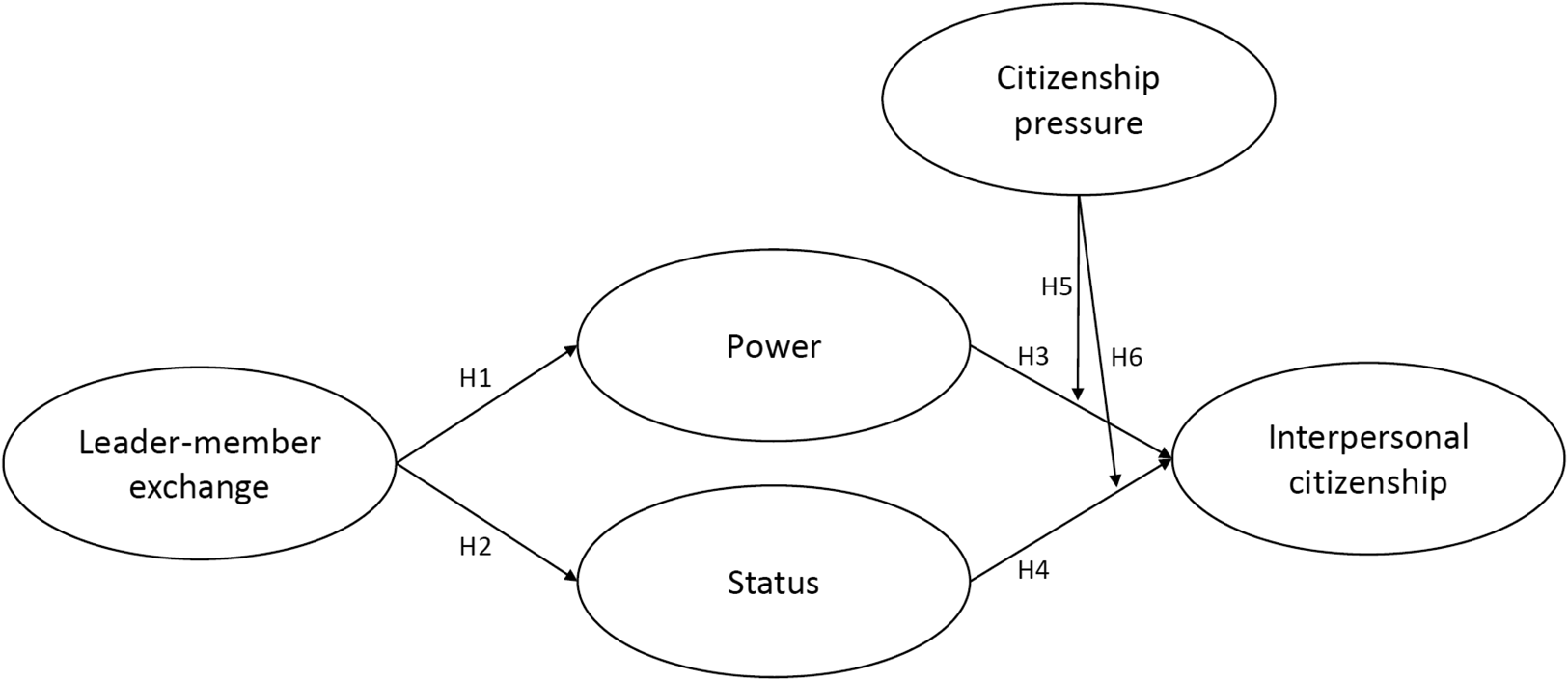
Theoretical background & hypothesis development
Power and status as prominent bases of social hierarchy
A social hierarchy refers to an implicit or explicit ordering of individuals along a socially valued dimension within a specific context (Magee & Galinsky, Reference Magee and Galinsky2008). Power refers to one's access to or control over valued resources, and psychological power relates to one's perceived capacity to exert influence through such valued resources (Anderson, John, & Keltner, Reference Anderson, John and Keltner2012; Keltner, Gruenfeld, & Anderson, Reference Keltner, Gruenfeld and Anderson2003). It is important to note that the two concepts are often interrelated, but are far from the same. In other words, simply having access to or control over resources within social relationships does not equate to experiencing psychological power. For example, in parent-children relationships, it is the parent that has more power over the child, yet research has shown that parents can often feel psychologically ‘powerless’ within these relationships (Bugental & Lewis, Reference Bugental and Lewis1999). Similarly, individuals who hold the role of ‘manager’ or ‘supervisor’ can have direct access and control over resources from the organization, whereas their subordinates do not. However, a lack of confidence or inability to effectively enact managerial skills can render the same individuals powerless within their supervisor-subordinate relationships (Anderson, John, & Keltner, Reference Anderson, John and Keltner2012).
In contrast to power, status is based upon the subjective value judgments of the individuals that exist in a social context (e.g., a society, an organization, or a workgroup; Ridgeway, Reference Ridgeway, Hogg and Tindale2001). For example, a society may hold the profession of a ‘doctor’ in high esteem, an engineering firm may value a ‘specialist’ more than a ‘generalist,’ and a sales team may view those with the personality trait of ‘extraversion’ as more desirable than ‘introversion.’ As such, contemporary hierarchy scholars have defined status as the respect, recognition, and importance afforded to an individual by others within a specific context (Blader & Chen, Reference Blader, Chen, Cheng, Tracy and Anderson2014; Fiske, Reference Fiske, Fiske, Gilbert and Lindzey2010). As with structural power and psychological power, the status associated with a social position or formal role is interrelated with, but not the same as, the psychological experience of status, which refers to one's perception of their relative status within a given context. Evidence of this distinction is shown in Yu, Hays, and Zhao (Reference Yu, Hays and Zhao2019), where the authors conclude that there is a ‘degree of alignment’ between self- and other-perceptions of status, with the correlations ranging from .36 to .89 across different samples.
The above discussion suggests that integrating the contemporary framework of social hierarchy into various streams of organizational research (e.g., LMX) can be complex. As the initial study that integrates these two literatures, the focus of our research question is on understanding how LMX relationships are related to the psychological experience of power and status. In doing so, we assume that a ‘member’ within each leader–member dyad (the focus of our research question) does not hold a formal position or job role that is higher than others in the group (who report to the same leader). This, we believe, is a reasonable assumption to make within most work contexts and is aligned with the perspectives taken in the LMX literature. Thus, when discussing power and status in the remainder of this study, we are referring to an employee's psychological experience of power or status.
Power in the context of LMX relationships
In the context of LMX relationships, the implicit ordering of members based on the quality of their LMX relationships with the leader creates an informal hierarchy within the group (Sparrowe & Liden, Reference Sparrowe and Liden2005). That is, group members who have relatively higher LMX relationships with the leader gain benefits including, for example, preferential treatment or access to crucial information (Boies & Howell, Reference Boies and Howell2006; Marstand, Martin, & Epitropaki, Reference Marstand, Martin and Epitropaki2017), feelings of autonomy or empowerment at work (Hill, Kang, & Seo, Reference Hill, Kang and Seo2014; Kwak & Jackson, Reference Kwak and Jackson2015), as well as reduced role ambiguity (Sears & Hackett, Reference Sears and Hackett2011). These benefits give members with higher quality LMX a greater sense of psychological power relative to other members of their workgroup.
Indeed, theory and research have long held that those with high-quality LMX relationships are viewed as the ‘trusted assistants’ of leaders and are tasked with more important responsibilities, expected to contribute more to the group's successes, and take on more difficult tasks (Liden, Wayne, & Sparrowe, Reference Liden, Wayne and Sparrowe2000; Zhou, Wang, Chen, & Shi, Reference Zhou, Wang, Chen and Shi2012). These members are viewed as more capable and allocated more resources from the leader, suggesting that high-quality LMX members would be ranked higher in a group's informal power hierarchy. There are numerous findings from existing studies on LMX that indirectly support these arguments. For example, LMX has been found to be positively related to psychological empowerment (Hill, Kang, & Seo, Reference Hill, Kang and Seo2014), access to information (Rosen, Harris, & Kacmar, Reference Rosen, Harris and Kacmar2011), leader trust (Rockstuhl, Dulebohn, Ang, & Shore, Reference Rockstuhl, Dulebohn, Ang and Shore2012), and participation in decision-making (Vecchio & Brazil, Reference Vecchio and Brazil2007). Thus, integrating the conceptual arguments from social hierarchy research into the LMX literature leads to our first hypothesis:
Hypothesis 1: Leader–member exchange (LMX) is positively related to power.
Status in the context of LMX relationships
In addition to greater access to a leader's resources and leading to an elevated sense of psychological power, the informal hierarchy that emerges due to differences in LMX is also observable and salient to individuals (Tse et al., Reference Tse, Lam, Lawrence and Huang2013), albeit at varying degrees (Liden, Erdogan, Wayne, & Sparrowe, Reference Liden, Erdogan, Wayne and Sparrowe2006; Rosen, Harris, & Kacmar, Reference Rosen, Harris and Kacmar2011). This is due to the lack of objective information for determining one's LMX quality with their leader (Matta & Van Dyne, Reference Matta and Van Dyne2020). In the absence of objective information, individuals evaluate themselves using subjective information derived from the social environment via social comparison processes (Buunk & Gibbons, Reference Buunk and Gibbons2007; Festinger, Reference Festinger1954). The subjective nature of evaluating one's LMX quality relative to other coworkers creates an informal status hierarchy amongst members of a workgroup. As ‘trusted assistants’ of the leader, higher-quality LMX members informally occupy a more central role within the workgroup that elevates their visibility and influence over their coworkers (Sparrowe & Liden, Reference Sparrowe and Liden2005).
These assertions are aligned with arguments within the extant LMX literature. For example, in their highly cited theoretical paper on LMX structures and processes, Sparrowe and Liden (Reference Sparrowe and Liden1997) articulate how employees with higher-quality LMX relationships have greater visibility relative to lower LMX members. This visibility is associated with elevated prominence, respect, and influence within the workgroup and broader organization (e.g., Gajendran and Joshi, Reference Gajendran and Joshi2012), all of which are correlates of status (Blader & Chen, Reference Blader, Chen, Cheng, Tracy and Anderson2014). Empirical studies on LMX also indirectly support these arguments. For example, Zagenczyk, Purvis, Shoss, Scott, and Cruz (Reference Zagenczyk, Purvis, Shoss, Scott and Cruz2015) found that members with high-quality LMX are more trusted by their peers, affording them greater social influence. Finally, Sparrowe and Liden (Reference Sparrowe and Liden2005) conducted their field study in a manufacturing firm and a telecommunication company, finding evidence that LMX is positively associated with being more prominent in the advice networks. Thus, integrating the conceptual arguments from social hierarchy research into the LMX literature leads to our second hypothesis:
Hypothesis 2: Leader–member exchange (LMX) is positively related to status.
Power, status, and interpersonal citizenship
Research on the psychological effects of power has explained how feeling powerful can enhance one's approach-oriented attitudes and behaviors (Keltner, Gruenfeld, & Anderson, Reference Keltner, Gruenfeld and Anderson2003; Pike & Galinsky, Reference Pike and Galinsky2020). This is because power increases ‘the awareness that one can act at will without interference or serious social consequences’ (Keltner, Gruenfeld, & Anderson, Reference Keltner, Gruenfeld and Anderson2003: 269), and as a result, greater power leads one to think and act in more approach- or action-oriented ways (Galinsky, Gruenfeld, & Magee, Reference Galinsky, Gruenfeld and Magee2003; Smith & Bargh, Reference Smith and Bargh2008). In support of this idea, experiments have revealed that power leads to an increased tendency to engage in risk-seeking behaviors (Anderson & Galinsky, Reference Anderson and Galinsky2006), are more attentive to goal-relevant information (Guinote, Reference Guinote2008), and are less averse to potential losses (Inesi, Reference Inesi2010).
Along with the approach- and action-oriented nature that feeling powerful affords individuals, power also increases one's social distance from others (Magee & Smith, Reference Magee and Smith2013). These arguments suggest that power may have a self-orienting effect on an individual. For example, feeling powerful has been found to reduce one's tendency to take others' perspectives or to be concerned about the welfare of others (Blader, Shirako, & Chen, Reference Blader, Shirako and Chen2016; Galinsky, Magee, Inesi, & Gruenfeld, Reference Galinsky, Magee, Inesi and Gruenfeld2006). Additionally, studies have shown that power can lead to a number of self-oriented consequences, such as self-interested behaviors (Rucker, Dubois, & Galinsky, Reference Rucker, Dubois and Galinsky2011) and unethical acts (Lammers, Stapel, & Galinsky, Reference Lammers, Stapel and Galinsky2010; Liu, Chen, Bell, & Tan, Reference Liu, Chen, Bell and Tan2019; Pitesa & Thau, Reference Pitesa and Thau2013), particularly when these behaviors benefit oneself (Dubois, Rucker, & Galinsky, Reference Dubois, Rucker and Galinsky2015). Taken together, these studies demonstrate the psychological consequences that the experience of power can have on one's attitudes and behaviors towards others.
Despite the majority of prior studies having well-documented the self-orienting effects of power, a growing number of studies have highlighted that power does not necessarily lead to negative interpersonal behaviors. The psychological effects of power can, at times, lead one to behave in interpersonally sensitive ways towards others, under the condition that these actions are aligned with the self-interested nature of experiencing power (Schmid Mast, Jonas, & Hall, Reference Schmid Mast, Jonas and Hall2009; Wang, Reference Wang2020). For example, feeling powerful has been associated with a greater sense of responsibility, leading to a desire to interact with others (Smith & Hofmann, Reference Smith and Hofmann2016). When the role of a powerholder is tied to others (e.g., leadership), feeling powerful has been found to enhance one's sensitivity towards others (Schmid Mast, Jonas, & Hall, Reference Schmid Mast, Jonas and Hall2009), leading the powerholder to look out for the long-term interests of others (Tost, Wade-Benzoni, & Johnson, Reference Tost, Wade-Benzoni and Johnson2015). Taken together, these studies suggest that the relationship between psychological power and behaviors towards others can be complicated. Thus, the direct relationship between power and interpersonally sensitive behaviors, such as interpersonal citizenship, remains unclear. This leads to two competing hypotheses:
Hypothesis 3a: Power is positively related to interpersonal citizenship.
Hypothesis 3b: Power is negatively related to interpersonal citizenship.
In contrast to power's self-orienting effects, research on the psychology of status has argued that status increases one's outward orientation towards others. More specifically, status has been argued to be a fundamental human need (Anderson, Hildreth, & Howland, Reference Anderson, Hildreth and Howland2015) and is, by definition, more malleable than power because it is conferred upon an individual through others within their social environment (Fiske, Reference Fiske, Fiske, Gilbert and Lindzey2010; Magee & Galinsky, Reference Magee and Galinsky2008). Those who have status are more vigilant of how their attitudes and behaviors are seen by those around them, as losing status is psychologically distressing (Marr & Thau, Reference Marr and Thau2014; Pettit, Yong, & Spataro, Reference Pettit, Yong and Spataro2010). Therefore, to obtain and maintain status, individuals are not only incentivized to contribute to the collective in ways that go beyond typical expectations, but also that their actions need to be observable and oriented toward others (who are the source of one's status).
Empirical studies provide evidence of the outwardly orienting nature of status that leads individuals to act in more interpersonally sensitive ways. For example, studies have found evidence that status can enhance one's perspective-taking (Blader, Shirako, & Chen, Reference Blader, Shirako and Chen2016), empathic concern (Yu, Hays, & Zhao, Reference Yu, Hays and Zhao2019), and generosity (Hardy & Van Vugt, Reference Hardy and Van Vugt2006; Hays & Blader, Reference Hays and Blader2017) towards others. Status has also been found to increase one's preferences for enacting fairness (To, Leslie, Torelli, & Stoner, Reference To, Leslie, Torelli and Stoner2020) and equality in resource allocations (Blader & Chen, Reference Blader and Chen2012), which are salient and observable behaviors that afford one respect in the eyes of others. It should be noted that there are emerging studies showing important boundary conditions for status' effects on psychological and behavioral outcomes. As a specific example, Doyle, Lount, Wilk, and Pettit (Reference Doyle, Lount, Wilk and Pettit2016) found evidence that individuals' social distance may reduce the level of helping that employees engage in. Although these studies suggest that some differences may strengthen or weaken the effects of status on interpersonal behaviors, as an aggregate the existing literature indicates that status will generally lead one to behave in more interpersonally sensitive and helpful ways towards others. Thus, the accumulated evidence on the psychology of status leads to our fourth hypothesis:
Hypothesis 4: Status is positively related to interpersonal citizenship.
The moderating role of citizenship pressure
Thus far, we have focused on how LMX relationships are related to the psychological experience of power and status and, subsequently, interpersonal citizenship in the workplace. Contemporary hierarchy scholars have also highlighted the need to better understand the boundary conditions that qualify the psychological effects of power and status. An important boundary condition to consider when studying interpersonal citizenship in the workplace is the role of citizenship pressure. Citizenship pressure refers to a subjective individual perception that captures the ‘specific job demand in which an employee feels pressured to perform OCBs’ (Bolino, Turnley, Gilstrap, & Suazo, Reference Bolino, Turnley, Gilstrap and Suazo2010: 836). Although citizenship behaviors are, by definition, not a formal requirement of one's prescribed job role, there is an increased recognition that employees may feel the need to perform citizenship as a required part of their job (Bolino, Klotz, Turnley, & Harvey, Reference Bolino, Klotz, Turnley and Harvey2013; Lin, Savani, & Ilies, Reference Lin, Savani and Ilies2019). For example, Bolino et al., (Reference Bolino, Klotz, Turnley and Harvey2013) discuss how employees choose to engage in interpersonal citizenship to ‘stand out’ from their coworkers, and how this choice, over time, becomes a generally accepted way for employees to obtain rewards or achieve desired work outcomes (e.g., promotions, developmental opportunities).
As discussed previously, individuals with an elevated sense of power are more approach- or action-oriented in their mindsets and less inhibited by constraints that can prevent them from achieving their own goals (Keltner, Gruenfeld, & Anderson, Reference Keltner, Gruenfeld and Anderson2003; Pike & Galinsky, Reference Pike and Galinsky2020). In environments where citizenship pressure is high, engaging in interpersonal citizenship will seem less discretionary to employees. Those that engage in more citizenship behaviors are given more approval, faster promotions, and favorable evaluations (Bolino, Hsiung, Harvey, & LePine, Reference Bolino, Hsiung, Harvey and LePine2015). As such, the self-interested nature of power becomes aligned with helping others when citizenship pressure is higher because engaging in citizenship would align with the informal expectations and rewards that are desirable for the powerholder. In contrast, when citizenship pressure is low, the explicit link between citizenship and work-related rewards is less salient to an employee that is higher within a power hierarchy. Behaving in helpful ways toward coworkers becomes more of an altruistic or other-oriented act, and the self-interested nature of power suggests that powerholders will be less inclined to engage in citizenship under such conditions.
In contrast to the effects of power, the research on the psychology of status suggests that status will increase the extent that individuals act in more interpersonally sensitive ways toward others (Blader & Chen, Reference Blader and Chen2012; Blader & Yu, Reference Blader and Yu2017). This is because the respect, recognition, and importance afforded to an individual are linked to how they behave toward those around them. As such, status hierarchies serve as an incentive system that can motivate individuals to ‘excel in their jobs and even go the extra mile (e.g., engage in extra-role behaviors and organizational citizenship behaviors) to promote organizational success’ (Halevy, Chou, & Galinsky, Reference Halevy, Chou and Galinsky2011: 35). However, when citizenship pressure is high, citizenship behaviors become less discretionary and more of an implied expectation for employees. This context reduces the status-based incentives that drive individuals to go the extra mile for other coworkers, and instead becomes a compulsory part of one's job roles that ‘must’ or ‘should’ be performed (Bolino et al., Reference Bolino, Turnley, Gilstrap and Suazo2010; Lin, Savani, & Ilies, Reference Lin, Savani and Ilies2019). We argue that citizenship pressure will reduce the willingness of higher-status individuals to engage in citizenship when citizenship pressure is higher. Thus, those who are higher in status will reduce their citizenship behaviors. The discussion related to the moderating effects of citizenship pressure leads to two predictions:
Hypothesis 5: Citizenship pressure moderates the relationship between power and interpersonal citizenship, such that the relationship is more positive when citizenship pressure is high and more negative when citizenship pressure is low.
Hypothesis 6: The positive relationship between status and interpersonal citizenship is moderated by citizenship pressure, such that the relationship is weaker when citizenship pressure is high and stronger when citizenship pressure is low.
Method
Sample and procedures
We invited 317 employees who were enrolled in a business course at a large West Coast university in the United States to participate in our research study. This included two surveys separated by a two-week interval to reduce issues associated with common methods bias by separating the predictor-organizational criterion variables across two data collection time points. The first survey captured employee reports of LMX, power, and status, and the second survey captured citizenship pressure and interpersonal citizenship. At the conclusion of the study, participants were offered an opportunity to enter a random draw for one of four gift cards to an online retailer.
The first survey included a description of the study and a consent form. Participants were only allowed to continue the study if consent was given by clicking on the ‘Yes, I agree to participate’ option at the bottom of the consent form. Out of the total number of participants invited, 263 completed the first survey, of which 235 also completed the second survey. Thirteen responses were removed due to incomplete data after matching the two surveys, resulting in 222 participants in the final usable sample. The average age of these participants was 31.3 years (SD = 11.5), and 56.3% were female. In terms of the ethnicity participants most identified with, 30.6% were Asian, 24.3% were Caucasian, 33.8% were Hispanic/Latino(a), and the remaining 11.3% identified as African American/Black, Middle Eastern, Pacific Islander, or other (two participants preferred not to respond).
Measures
Leader–member exchange (LMX)
The original instrument for LMX was originally developed by Dansereau, Graen, and Haga (Reference Dansereau, Graen and Haga1975) and later adapted into the popular LMX-7 version by Graen, Novak, and Sommerkamp (Reference Graen, Novak and Sommerkamp1982). However, three of these items included different scale anchors, which can create confusion when using the scale. To address this, Liden, Wayne, and Stilwell (Reference Liden, Wayne and Stilwell1993) adopted a seven-point scale ranging from 1 = strongly disagree to 7 = strongly agree scale, which we use in this study (α = .90). Sample items include ‘My supervisor recognizes my potential’ and ‘My supervisor has enough confidence in me that s/he would defend my decisions if I were not present to do so.’
Power and status
Magee and Galinsky (Reference Magee and Galinsky2008) differentiated power and status as interrelated but distinct bases of social hierarchy. However, operationalizations of power and status often included items that confound these two prominent bases of social hierarchy, leading to mixed empirical findings within the literature (Anderson & Brown, Reference Anderson and Brown2010). More recently, Yu, Hays, and Zhao (Reference Yu, Hays and Zhao2019) resolved this issue by developing a psychometrically sound instrument to reliably capture the psychological experience of power and status. Because of the relative recency of this instrument, we use the same items that were developed in their study. All items were measured on a seven-point scale ranging from 1 = strongly disagree to 7 = strongly agree. Sample items for power include ‘I have a great deal of power at work’ and ‘My job role allows me to access a lot of resources’; and sample items for status include ‘Others seek my opinion because they respect me’ and ‘I have a good reputation among those I work with.’ Both power and status had good internal consistency, as indicated by reliability estimates of α = .91 and α = .90, respectively.
Citizenship pressure
To measure citizenship pressure, we used three items (α = .86) from Bolino et al. (Reference Bolino, Turnley, Gilstrap and Suazo2010)Footnote 1. We note that the original measure was developed as an 8-item unidimensional scale, which has been found to be internally consistent and validated in the existing literature (Bolino et al., Reference Bolino, Hsiung, Harvey and LePine2015; Horn, Mathis, Robinson, & Randle, Reference Horn, Mathis, Robinson and Randle2015; Lin, Savani, & Ilies, Reference Lin, Savani and Ilies2019; Liu, Zhao, & Sheard, Reference Liu, Zhao and Sheard2017). Sample items include ‘I feel a lot of pressure to work beyond my formal job duties for the good of my work unit’ and ‘Simply doing your formal job duties is not enough to be considered a good employee in this work unit.’ Items were measured on a seven-point scale ranging from 1 = strongly disagree to 7 = strongly agree.
Interpersonal citizenship
We used eight items (α = .93) from Lee and Allen (Reference Lee and Allen2002) to measure interpersonal citizenship. Sample items include ‘To what extent do you willingly give your time to help others who have work-related problems?’ and ‘To what extent do you show genuine concern towards coworkers, even under the most trying business or personal situations?’ Items were measured on a seven-point scale ranging from 1 = Never to 7 = Always.
Controls
We included employee gender as a control variable because prior research has shown significant differences between men and women regarding their preferences for power and status (Hays, Reference Hays2013). Gender was coded as 0 = male, 1 = female. We also controlled for managerial status to account for the explanation that those who are in a higher-ranking position in an organization will experience heightened levels of power and status from their roles (Yu, Hays, & Zhao, Reference Yu, Hays and Zhao2019).
Common method variance
The research question in our study relates to how individual experiences of psychological power and status relate to their propensity to engage in citizenship towards others. This research question is best examined from the perspective of the individual, thus making common method variance (CMV) via the ‘common rater effect’ a possible threat to the validity of our findings (Podsakoff, MacKenzie, Lee, & Podsakoff, Reference Podsakoff, MacKenzie, Lee and Podsakoff2003). Although it is difficult, if not impossible, to eliminate all elements of CMV, we take several steps in our research design to minimize its effects. First, we temporally separate the measurement of our predictor and criterion variables by using a two-wave survey design. The independent variable and mediator were measured in the first survey, and the moderator and the dependent variable were measured two weeks later in the second survey. Second, our instruments were derived from measures that have been validated in prior research.
We also ran several tests to examine whether common methods are of significant concern in our data. Results from a Harman one-factor test (Podsakoff et al., Reference Podsakoff, MacKenzie, Lee and Podsakoff2003) indicate the presence of five distinct factors with eigenvalues greater than one. The first factor of the unrotated solution explained only 27.41% of the total variance amongst the items, suggesting that common methods bias is not of significant concern. We also followed the procedures from Serrano Archimi, Reynaud, Yasin, and Bhatti (Reference Serrano Archimi, Reynaud, Yasin and Bhatti2018) to conduct a common latent factor (CLF) test to examine the amount of common variance amongst all observed variables. The results from this test indicate that the difference between the standardized regression weights between a model including the CLF and a model without are all less than .20, which suggests that common methods bias is not a serious concern. Lastly, we followed the recommendations from Liang, Xue, Pinsonneault, and Wu (Reference Liang, Xue, Pinsonneault and Wu2019) to compare the amount of variance explained by the CLF vs. the variance explained by our theoretical constructs. The results from this test reveal that, on average, the CLF explained 2.96% of the variance amongst the items, whereas the theoretical constructs explained an average of 60.51%. This, again, provides another indication that common method bias is not of significant concern.Footnote 2
Results
Table 1 presents the descriptive statistics and correlations of study variables. Table 2 presents the results of regression analyses. We found a positive correlation between LMX and power (r = .22, p < .05) and this relationship remained significant when we included our control variables (b = .24, p < .05), which provides support for Hypothesis 1. We also found a positive correlation between LMX and status (r = .31, p < .05), and this relationship also remained significant when we included our control variables (b = .32, p < .05), thereby providing support for Hypothesis 2.
Descriptive statistics and correlations
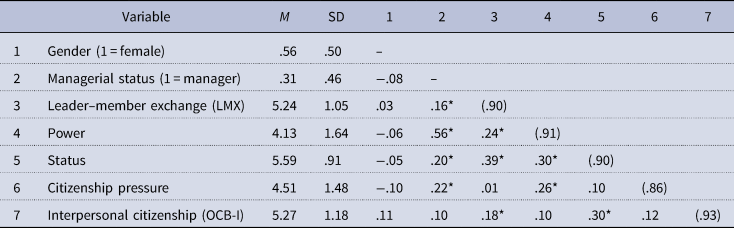
Notes: N = 222; reliabilities on diagonal; *p < .05.
Results of regression analyses
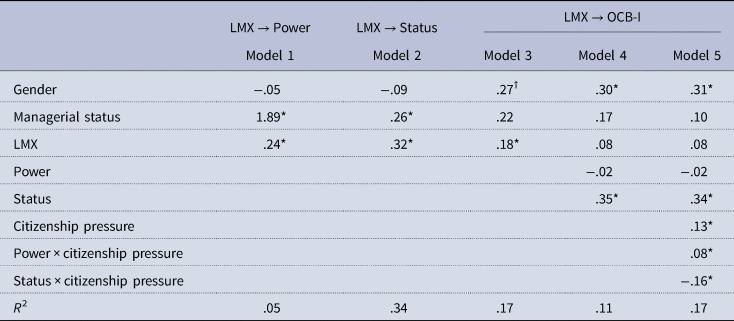
Notes: N = 222; †p < .10; *−p < .05.
Hypothesis 3 asked whether the relationship between psychological power and interpersonal citizenship was positive or negative. Our results did not reveal a significant relationship between power and interpersonal citizenship (r = .10, p = .13), and this relationship remained as such when we included our control variables (b = −.02, p = .73). Thus, neither Hypothesis 3a nor 3b was supported. In support of Hypothesis 4, we found a significant positive relationship between status and interpersonal citizenship (r = .30, p < .05) and this relationship remained significant when we included our control variables (b = .35, p < .05).
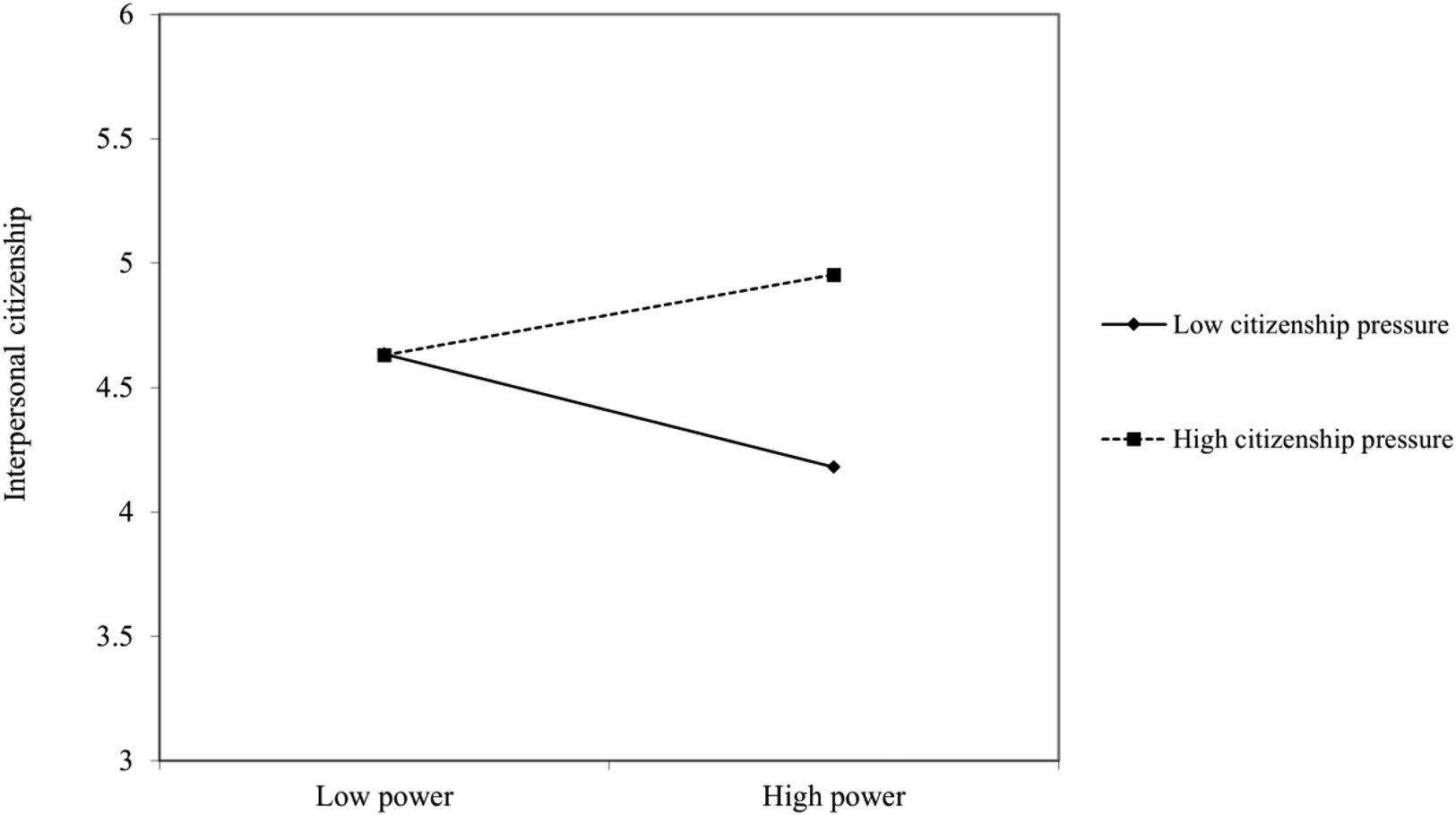
Hypothesis 5 predicted the interactive effects of psychological power and citizenship pressure would be related to more (less) citizenship when citizenship pressure was higher (lower). In support of this hypothesis, we found that the interaction between power and citizenship pressure had a significant effect in predicting interpersonal citizenship (b = .08, p < .05; see Figure 2). Specifically, the pattern of results indicates that when employees experience a high sense of psychological power, high citizenship pressure is associated with more interpersonal citizenship, whereas low citizenship pressure is associated with less interpersonal citizenship.
Interaction of power × citizenship pressure predicting interpersonal citizenship.
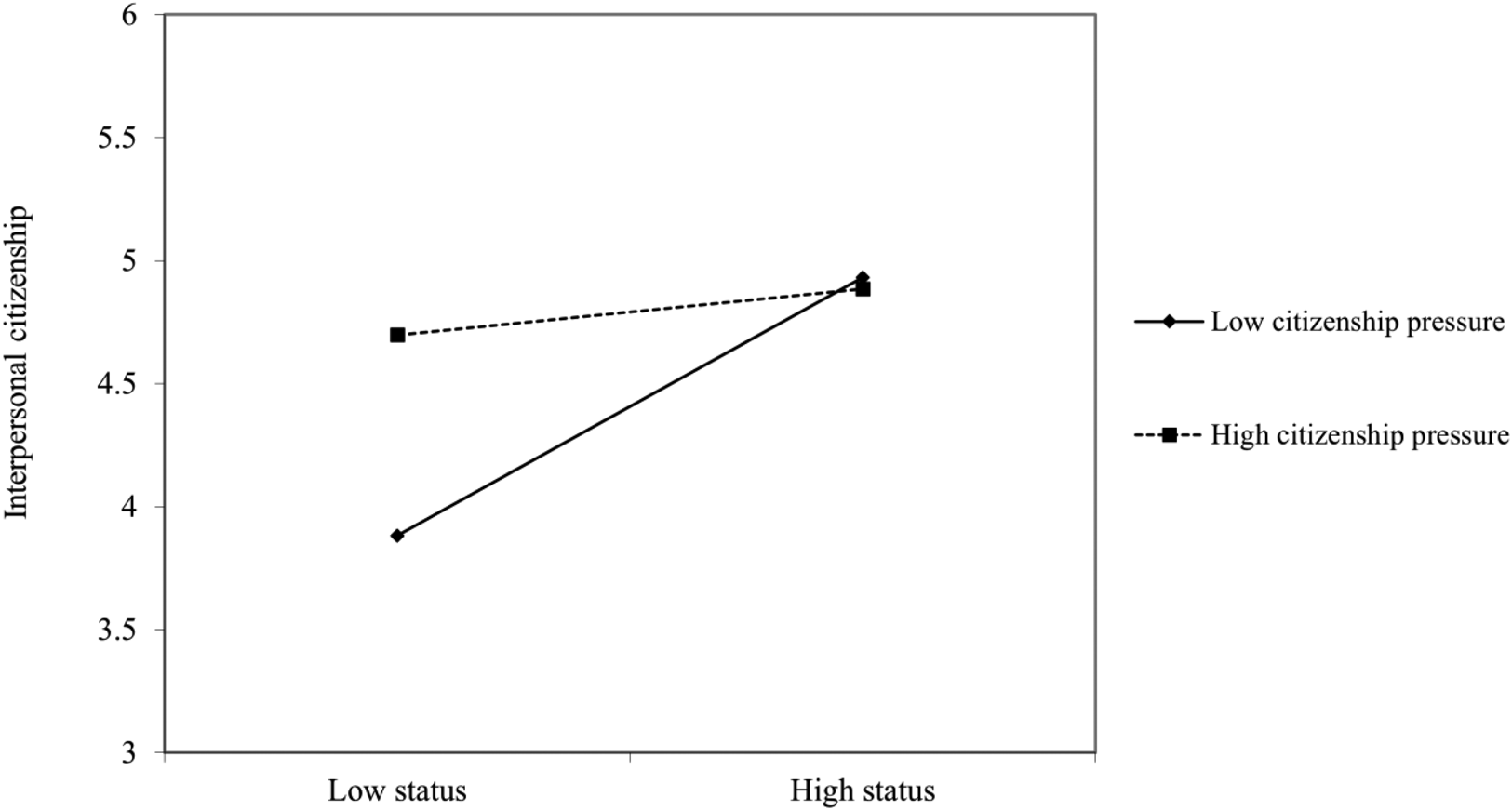
Finally, Hypothesis 6 predicted that the positive effects of psychological status on interpersonal citizenship would be strengthened (weakened) when citizenship pressure was lower (higher). Our results suggest that the interaction between status and citizenship pressure had a significant effect in predicting interpersonal citizenship (b = −.16, p < .05; see Figure 3). Specifically, the pattern of results indicates that when employees perceived themselves as having high status, low levels of citizenship pressure are associated with more interpersonal citizenship. However, contrary to our expectations, our results revealed that interpersonal citizenship was higher under high citizenship pressure conditions, regardless of whether employees perceived themselves as lower or higher in status. Therefore, we found partial support for Hypotheses 5 and expanded upon these findings in the discussion section.
Interaction of status × citizenship pressure predicting interpersonal citizenship.
Post-hoc analyses
To test the mediation effects implied in our conceptual model (Figure 1), we used Edwards and Lambert (Reference Edwards and Lambert2007) approach to combine moderation-mediation and followed the procedures outlined in Preacher and Hayes (Reference Preacher and Hayes2004). We tested the conditional indirect effects using the popular SPSS macros PROCESS (Hayes, Reference Hayes2022), which is an OLS regression-based path analysis approach. To assess the significance of the indirect and conditional indirect effects, we used the bootstrap sampling method with 20,000 replications to create our 95% bias-corrected confidence intervals to examine the significance at different levels (±1 SD) of our moderator (Preacher, Rucker, & Hayes, Reference Preacher, Rucker and Hayes2007). Results of these analyses are shown in Table 3.
Moderated-mediation results for citizenship behaviors across levels of citizenship pressure
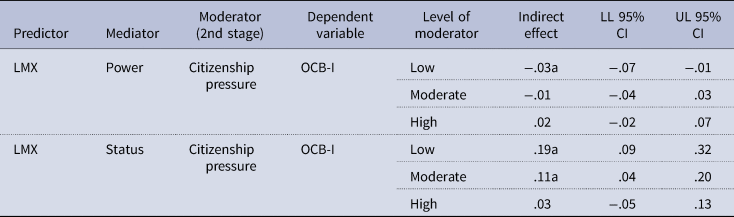
Notes: N = 222; CI, confidence interval; LL, lower limit; UL, upper limit; Unstandardized coefficients are reported. Mediation is supported when the confidence interval excludes zero (20,000 bootstrap replications).
a p < .05.
We found that the indirect relationship between LMX and interpersonal citizenship was mediated through power only at low levels of citizenship pressure (b = −.03, 95% CI [−.07 to −.01]). We also found that this indirect relationship that LMX has with interpersonal citizenship was mediated through status. This occurred at both low levels of status (b = .19, 95% CI [.09–.32]) and moderate levels of status (b = .11, 95% CI [.04–.20]). These analyses provide evidence that the effects of LMX on interpersonal citizenship are transmitted through the two prominent bases of social hierarchy, and that these effects are contingent upon varying levels of citizenship pressure.
Discussion
An important question for organizational researchers stemming from the LMX literature is how LMX relationships are perceived differently by employees (Choi, Kraimer, & Seibert, Reference Choi, Kraimer and Seibert2020) and how this can influence one to help others at work. Contemporary hierarchy research outlines power and status as the two prominent bases of social hierarchy, both of which have distinct psychological effects to influence one's attitudes and behaviors. The purpose of this study is to integrate these perspectives to shed light on taken-for-granted conclusions about the relationship between LMX and interpersonal citizenship. Our findings reveal that LMX was positively related to employees' psychological power and psychological status. Psychological status, in turn, was positively related to employees' interpersonal citizenship, whereas no direct relationship was found between power and interpersonal citizenship. In addition, we identify and test our proposition that citizenship pressure as an important boundary condition for our proposed relationship, finding evidence of its moderating effects.
Contributions to theory and research
Our findings offer important theoretical implications for the LMX literature. Previous LMX research relies upon a critical assumption that the benefits (i.e., greater access to leaders' resources and mutual respect) of a high-quality LMX relationship elicit employees' reciprocation in similar ways. By integrating the propositions from social hierarchy research into the LMX literature, our study elucidates power and status as two distinct psychological processes that influence employees' desire to engage in reciprocation behaviors. Results from our study indicate that the benefits of high-quality LMX can trigger distinct psychological processes in employees. The increased access to a leader's resources that a high-quality LMX member is afforded can lead to an elevated sense of psychological power. At the same time, high-quality LMX members also perceive themselves as having higher status within the workgroup. To date, our study is the first to theoretically integrate social hierarchy perspectives into LMX research and empirically test these relationships.
In addition, we identify the role that citizenship pressure has as an important boundary condition of these relationships. This is aligned with calls from scholars for more research on the effects that the work context can have on LMX relationships (e.g., Dulebohn, Bommer, Liden, Brouer, and Ferris, Reference Dulebohn, Bommer, Liden, Brouer and Ferris2012). Our findings demonstrate the harmful effects that citizenship pressure can have in weakening the positive indirect relationship LMX has on interpersonal citizenship via psychological status. Simply said, employees who attribute higher LMX to an elevated status in the workgroup are motivated to maintain their status, and thus do not need further role pressures to engage in citizenship. In contrast, we found evidence suggesting that employees who attribute LMX to a greater sense of psychological power are only motivated to engage in citizenship when role pressures to do so were high. Under low citizenship pressure conditions, psychological power was negatively associated with interpersonal citizenship. These results support the emerging narrative that exists within the psychological power literature that suggests power is not universally good or bad, but that there are contextual factors that can play an important role in determining how one thinks and behaves.
Practical implications
Interpersonal citizenship behaviors are important if not necessary for effective interpersonal (Bowler & Brass, Reference Bowler and Brass2006) and workgroup performance (Spitzmuller, Van Dyne, & Ilies, Reference Spitzmuller, Van Dyne, Ilies, Cooper and Barling2008). It is therefore important for organizations to understand how to promote such behaviors. Our research suggests that individual perceptions of power and status, LMX, and citizenship pressure are all related to interpersonal citizenship. These results have important implications for the roles that managers and employees play when it comes to developing interpersonal citizenship in their organizations.
Managers and organizations can help employees develop perceptions of perceived power by providing them access to resources that are needed to complete their work effectively (Yu, Hays, & Zhao, Reference Yu, Hays and Zhao2019). At the same time, employees develop a sense of perceived status when they feel respected and competent, which can be developed to the extent that managers and organizations offer regular feedback (Pichler, Reference Pichler2012). Managers and coworkers can be important sources of feedback and, hence, perceptions of power and status for employees (Bear, Cushenbery, London, & Sherman, Reference Bear, Cushenbery, London and Sherman2017). Thus, organizations should strive to create a feedback-rich environment (Rosen, Levy, & Hall, Reference Rosen, Levy and Hall2006) in which managers, coworkers, and teams share information, provide feedback, and empower each other. These are all healthy ways by which organizations can promote employee perceptions of power and status. Our results suggest that it is important to do so while attending to citizenship pressures: Interpersonal citizenship behavior is higher when citizenship pressures are high – regardless of perceived status and across levels of perceived power. Organizations may accordingly want to consider for themselves appropriate norms regarding citizenship pressure and encouraging extra-role behavior (Cates, Mathis, & Randle, Reference Cates, Mathis and Randle2010).
Additionally, it is important to consider the social context of interpersonal citizenship (Settoon & Mossholder, Reference Settoon and Mossholder2002), especially in the context of LMX (Spitzmuller, Van Dyne, & Ilies, Reference Spitzmuller, Van Dyne, Ilies, Cooper and Barling2008). The premise of LMX is that leaders develop differentially high- and low-quality relationships with employees based, in part, on the characteristics of individual follower employees. To this point, employees themselves can enhance LMX to the extent that they develop perceptions of trustworthiness and high performance or potential among their supervisors (e.g., Bauer and Green, Reference Bauer and Green1996). In an effort to encourage managers to develop high-quality exchanges with all of their employees, organizations can implement LMX training programs (Graen, Novak, & Sommerkamp, Reference Graen, Novak and Sommerkamp1982), as well as diversity training. High-quality LMXs are more common when organizations effectively manage diversity (Douglas, Ferris, Buckley, & Gundlach, Reference Douglas, Ferris, Buckley, Gundlach and Graen2003) because managers are better able to understand the employees that they manage.
Limitations
As with all studies, several limitations should be noted when interpreting our results. First, our research design can be viewed as a partially cross-sectional design since we did not separate the measurement of our independent variable and mediators (Maxwell & Cole, Reference Maxwell and Cole2007). This can lead to systematic biases in measurement error from common methods variance (Podsakoff et al., Reference Podsakoff, MacKenzie, Lee and Podsakoff2003). To account for the potential of common methods bias, we conducted several empirical tests, all of which indicate that methods bias is unlikely to be a significant concern in this study. In addition, the causal ordering of constructs in our conceptual model was guided by the extensive literature on team leadership that has long viewed leadership as more of an input that influences group member cognitions, attitudes, and behaviors (Ilgen, Hollenbeck, Johnson, & Jundt, Reference Ilgen, Hollenbeck, Johnson and Jundt2005; Mathieu, Maynard, Rapp, & Gilson, Reference Mathieu, Maynard, Rapp and Gilson2008). Future research examining the relationships between LMX and social hierarchy should aim to separate the measurement of these constructs over time to confirm the validity of our findings.
Second, the goal of this study was to integrate propositions from social hierarchy research as a novel theoretical lens to understand the relationship between LMX and interpersonal citizenship. The constructs that were included in our conceptual model reflect these goals. However, we acknowledge that there are likely to be other theoretical perspectives that propose alternative mediating mechanisms to these relationships. Thus, we encourage future research to continue identifying and incorporating various perspectives when examining LMX relationships.
Lastly, our sample size was more on the side of minimally sufficient for testing the proposed moderated-mediation relationships implied in our conceptual model. Given that our study is the first, to our knowledge, to test these relationships, we caution researchers from drawing definitive conclusions about the generalizability of these results from this study alone. Researchers should see to examine the pattern of our findings using larger samples to enhance the validityof our findings.
Conclusion
LMX remains one of the most popular leadership theories to study the importance of leader–member relationships and their effects on work outcomes. The purpose of our study was to integrate a novel theoretical perspective derived from contemporary social hierarchy research to understand the LMX-citizenship relationship. In doing so, we present a more nuanced understanding of not only why the psychological experience of power and status serve as important explanations for these relationships, but also identify citizenship pressure as an important boundary condition. Importantly, it is revealed that under certain conditions, the taken-for-granted conclusion that LMX is positively related to citizenship may not necessarily hold true, thereby challenging the existing status quo in the literature.
Conflict of interest
The author(s) declare none


 Open access

