

Introduction
‘Militant democracy’ has long been the core concept of research focusing on democratic responses to political extremism.Footnote 1 It was coined by Karl Loewenstein to capture the range of measures that democratic states could employ to prevent anti-democratic movements – predominantly fascists and communists – from abusing liberal democratic freedoms to destroy those freedoms.Footnote 2 This traditional conception of militant democracy has been re-examined in light of recent developmentsFootnote 3 but also criticised on grounds such as its overly legalistic conception of responses to extremism,Footnote 4 its narrow focus on movements that no longer constitute a ‘threat’ to democratic politics,Footnote 5 and a tendency for ‘concept-stretching’ when applied to capture responses to new threats like international terrorism.Footnote 6 Some have sought to replace it with alternative, more comprehensive concepts such as ‘defensive democracy’.Footnote 7 Others have sought to reconceptualise it as one of a number of types of democratic response to extremism, including responses of the ‘preventive’ or ‘counter-terror’ stateFootnote 8 or a ‘legitimacy paradigm’ that aims to deny extremist parties the legitimacy accorded by access to the electoral arena rather than those aiming to take over the democratic state.Footnote 9
While conceptual debates have blossomed, less attention has been given to empirical analysis of the attributes of militant democracy. We lack systematic empirical knowledge on aspects of party ban practices deemed relevant in conceptual debates, namely: party ban practices in democracies at varying stages of consolidation, with different experiences of non-democratic rule and varying constitutional traditions, or studies including both activist states more prepared to marginalise extremists and those adopting passive stances against extremists. Lack of empirical knowledge helps explain why so few scholars have plausibly accounted for variation in the legal rules and practices democratic states employ in response to political extremism.Footnote 10 To lay the foundations for such research, we survey party bans practices in 37 European democracies in the post-World War II period, focusing on legal and political conditions under which bans occur.Footnote 11
High-profile party ban proceedings have occurred in recent years in countries such as Germany, Spain, Belgium, Turkey, the Czech Republic and Ukraine. More importantly, the proscription of political parties constitutes the ‘most restrictive and visible of militant laws’.Footnote 12 It poses the strongest democratic dilemma inherent in democratic responses to extremism: party bans fundamentally challenge free association and expression, political representation and principles of tolerance and pluralism. We focus on Europe because of its varied legal and political traditions, including experiences of authoritarian rule and democratisation. Furthermore, the number of party ban cases, and the supervisory role of the European Court of Human Rights, means more data was available on European practices than those elsewhere.
We begin by discussing current explanations for party bans. We then aim to evaluate the plausibility of these explanations with reference to the nature of banned parties (ideological orientation and salience), the nature of banning states (degree of democratic consolidation and historical experience of authoritarian rule) and legal traditions (substantive versus procedural democracies and proscription based on anti-democratic ideas or behaviour). We then draw on recent developments in legal scholarship on party bansFootnote 13 in order to explore variation with reference to entrenchment and use of party ban rationales in constitutional and legal acts.
Explaining party bans: political and legal contexts
The challenges a party ban poses for core democratic practices make banning a party a grave act for a democracy. It is thus reasonable to expect that democracies will only ban anti-system parties,Footnote 14 or parties that undermine the legitimacy of the democratic system, would change it fundamentally if they had a chance, or that reject one or more core sets of democratic practices.Footnote 15 Furthermore, some argue that democracies are more inclined to ban small parties, either because larger parties have a stronger claim to legitimate status or because proscribing larger parties might provoke significant political upheaval.Footnote 16
The extent of democratic consolidation may affect party ban decisions.Footnote 17 ‘New democracies’, or those in transition from an authoritarian to a democratic regime, typically face political problems that make proscribing parties more compelling, such as polarisation, political tension and the possibility that anti-democratic forces may gain control.Footnote 18 ‘Incomplete democracies’ begin democratic reform processes, obtain some, but not all, features of consolidated democracies: major power-holders may be appointed through relatively fair elections but democratic politics may be ‘defective’ due to limited respect for constitutional liberalism; domains of power may remain shielded from democratic competition, or certain groups may be systematically excluded. These ‘defects’ may make party bans more likely in incomplete democracies than established democracies. Footnote 19 Established democracies are those with consistently high ‘democratic quality’ scores, and where democracy constitutes ‘the only game in town’.Footnote 20
Many also argue that countries with historical experience of authoritarianism (Nazism, Fascism or Communism) or military rule are more likely to employ militant measures such as party bans against extremists. Footnote 21 Such authors have emphasised a desire to avoid past errors and to establish symbolically significant ‘uncrossable’ boundaries between an authoritarian past and democratic future. Other scholars have looked to constitutional traditions, particularly contrasting traditions of ‘substantive’ and ‘procedural democracies’.Footnote 22 A ‘procedural model’ draws on Schumpeter’s conception of democracy as an institutional arrangement for choosing leaders and determining the political preferences of majorities. Majority rule is the basis for legitimacy, which limits state authority to select from among competing views. Tolerance is a transcendent norm and there are no guarantees that democracy will always prevail. This ‘rough approximation of actual state practice’Footnote 23 takes concrete form in specific constitutional features, principally a lack of restrictions on the scope of constitutional change.Footnote 24 In a ‘substantive democracy’, by contrast, democratic procedure is conceived as a means for creating a society where citizens enjoy core rights and liberties. It draws on Mill, Rawls and others in its insistence that rights should not be used to abolish other rights, and that a democracy need not tolerate the intolerant when its core values are at stake. A substantive democracy’s legal system characteristically prohibits amendment of core constitutional commitments to democracy (or other core principles such as territorial integrity or secularism). Arguably, the very definition of procedural democracies - characterised by a commitment to ‘open debate and electoral competition among all ideological factions’Footnote 25 - and its contrasts with a substantive democracy, generate the expectation that procedural democracies are less likely to ban political parties.Footnote 26
Some scholars have similarly contrasted measures addressing the Sein or ‘being’ of a party or group – the ideological character of the party – and its Handeln or ‘acting’ – which mainly regards the illegal or violent nature of political behaviour and strategies.Footnote 27 In light of this distinction and given democratic commitments to freedom of expression, pluralism and tolerance, on the one hand, and to the rule of law and non-violent negotiation of political differences on the other, it is reasonable to expect that democracies will be more reluctant to ban parties for their anti-democratic ideology than for any anti-democratic behaviour.
We now examine the plausibility of these explanations by analysing the results of our survey on political and legal conditions under which European democracies ban parties. It has been compiled using various sources, including the existing literature, European Court of Human Rights cases, a 1998 Council of Europe survey on party bans, correspondence with country party experts and state interior ministries conducted by the authors, and the Leiden University database on Party Law in Modern Europe.Footnote 28
Banned parties and banning states in Europe: the political context
Party bans vary in form and in the degree to which the targeted party is excluded from the public sphere. The most punishing form of party exclusion is dissolution. It denies a party the right and means to participate in public life through measures such as exclusion from electoral contests, removal from office or representative positions, seizure of assets, closure of offices, or criminalisation of leaders. Non-registration involves denial of a new party’s right to formally exist as a party, acquire associated privileges or to participate in elections. Rights denial involves the withdrawal of rights and privileges - such as the right to stand in elections - of already existing parties, even though the party, as such, is not to be formally dissolved. A lapsed ban occurs when the state fails to prevent a successor from taking on the mantle of a banned party. In this article, we focus on the first type of party ban, dissolution, because its impact on the party system is likely to be the most pronounced.
Defining ‘political party’ is notoriously difficult, given the range of historical and political contexts in which they have operated and the varying normative assumptions about the functions parties ought to perform. Our focus is on political parties operating in liberal democracies that, following Ware, can be defined as organisations that typically ‘seek influence in a state’, often, if not always, fielding candidates in elections in order to occupy positions in government at various territorial levels.Footnote 29 They ordinarily pursue goals through non-violent and legal means, although some may secretly employ illicit means or have close links to violent or clandestine groups.
Table 1 provides an overview of party bans in Europe since the end of World War II. It excludes cases where party ban proceedings were initiated but subsequently failed, such as a 1992 case against the Turkish minority party in Bulgaria, the Movement for Rights and Freedom; the 2003 and 2017 cases against the National Democratic Party of Germany; or the Czech government’s failed first attempt to ban the extreme-right Workers’ Party in 2008. We also exclude parties banned on technical grounds such as insufficient membership, financial irregularities or failure to contest elections. Although we acknowledge these reasons for banning parties may be used inappropriately to marginalise political opponents, this is rare in the cases we examine. We therefore focus on parties banned for engaging in political violence, or for political rationales such as espousing anti-democratic ideologies or threatening the current political order (see Table 2 below).
Party bans in Europe 1945 to 2015

Notes:
1 In the case of Germany, we excluded the far-right Free German Workers Party and National List from our list of banned parties because the Federal Constitutional Court ruled that these were associations.
2 It is a grey area whether NVU was actually banned. It was characterised as a prohibited association in 1978, but the Dutch Supreme Court later ruled that because it was not formally dissolved it could no longer be excluded from participating in elections.Footnote 80
3 This list of party bans in Spain does not include parties that were denied registration on the grounds that they were successors to Batasuna (such as Abertzale Sozialisten Batasuna or Sortu (the latter non-registration was overturned by the Constitutional Court in 2012), or party lists or lists of electoral coalitions banned prior to electoral contests for the same reasons (such as Demokrazia Hiru Milioi or Bildu).
4 The KPU was the same party banned in 1991 but permitted to re-emerge in 1993. The ban in 2015 was due to party’s separatist goals and for purportedly undermining constitutional values.
Legal rationales for banning parties in Europe
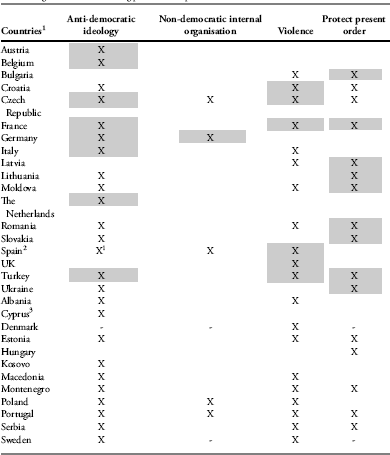
Notes: Shaded cells indicate that these rationales have been used in the post-war period to ban political parties.
1 It was not possible to classify Switzerland due to the vagueness of constitutional and legal provisions, which nevertheless appear to permit the proscription of parties, e.g. Article 36(1) of the 1999 Swiss Constitution, which refers to the need for a legal basis and clear and present danger to justify limitations on fundamental rights and freedoms, and Article 78 of the Swiss Civil Code which permits the dissolution of associations that are ‘unlawful or immoral’.Footnote 81
2 It should be noted that According to Law 6/2002 a party may be dissolved, according to Article 10(2)(b), ‘when the party continuously, repeatedly and seriously infringes the requirement of a democratic internal structure and operation’. However, it cannot be declared ‘illegal’ according to Article 9(2) of the law.
3 With the exception of anti-system ideology relating to promoting and inciting racial discrimination, it is difficult to categorise party ban rationales in Cyprus given the vagueness of justificatory concepts.
In the cases of Turkey and France, the list of banned parties included in Table 1 is not exhaustive. For Turkey, we only included cases after 1983, which saw the initiation of the longest period of (semi-) democratic rule in Turkish modern history. In the case of France, because it was difficult to distinguish between banned parties and banned associations, authorities invoke a single legal procedure to ban both these organisational types.Footnote 30 Moreover, many small, rather obscure organisations have been banned in France, whose political goals and practices require detailed historical knowledge beyond the scope of this article. In Table 1, we include a sample of parties that preliminary investigation, or organisational title, suggested were political parties.
Following the general line of the existing literature, we also include the rather ambiguous case of Vlaams Blok (Flemish Block) in our list of banned parties.Footnote 31 As Bale argues, this case constitutes an additional category of party ban – the ‘effective (if not technical)’ party ban.Footnote 32 The Belgian courts ruled that the party violated anti-racism legislation, a decision that could have led to withdrawal of state funding and limits on access to the media, public buildings and even the postal service.Footnote 33 The party then dissolved itself and re-emerged as Vlaams Belang (Flemish Interest). We also include as party ban cases those approved by the appropriate domestic authorities, even if the European Court of Human Rights subsequently declared the cases in violation of the European Convention of Human Rights (e.g. UMO Ilinden-Pirin and various Kurdish parties in Turkey).
The majority – 20 out of 37 – of European democracies in our sample have banned a party at some time since the end of World War II, suggesting that proscription of parties is more common than is usually recognised.Footnote 34 There were 52 concluded individual party ban cases. We count the proscription of each successor party as a separate party ban case because both initial and subsequent bans require separate acts of formal assent by public authorities. In the article’s analysis of the nature of banned parties, we exclude all French ban cases, the total number of which could not be verified and which were included in Table 1 for illustrative purposes. Acknowledging the significance, but also overrepresentation, of Turkish ban cases in the sample - 16 of the total 52 party ban cases (31%) – we calculate two scores where relevant, one with and one without Turkish party bans.
Nature of banned parties
According to Capoccia, ‘ideological anti-systemness’ can be defined as synonymous with ‘anti-democraticness’ if a clear definition of democracy is established alongside an indication of how an anti-system party may violate this. To this end, Capoccia adopts Collier and Levitsky’sFootnote 35 definition of democracy as a political system that, at a minimum, includes: (a) fully contested elections; (b) full suffrage and an absence of massive fraud; (c) effective guarantees of civil liberties, underpinned by notions of political equality for all citizens regardless of religion, race, colour, age etc.; and (d) elected governments with a strong capacity to govern. Capoccia does not specifically address the issue of violence, but we might reasonably add the additional criterion (e) commitments to pursue parliamentary representation and government office through exclusively non-violent means. Baches’ discussion of religious/secularist extremisms suggests a final criterion, namely (f) commitments to balance goals of religious freedom and secular foundations of the constitutional state.Footnote 36 Essentially, if a party rejects one, some or all of these aspects of liberal democratic systems, it will be considered an anti-system party.
In our sample, banned parties cluster around a small number of ideological categories consistent with conceptions of anti-system parties as defined above. Excluding Turkish cases, extreme-right parties are the largest category of party bans (42%, 15 cases) and extreme-left is the third largest category of banned parties (22%, 8 cases). In Turkey, four parties were banned for religious fundamentalism. It is noteworthy that a large number of substate nationalist parties have also been banned in Europe. Indeed, if Turkish and the other cases are taken together, substate nationalist parties are the largest category of banned parties (together 44%, 21 cases) and in Western Europe alone, proscription of minority nationalist parties is relatively high (44%, 11 cases). The European Court of Human Rights has ruled, in cases dealing with attempts to ban separatist parties in Turkey and Bulgaria, that that promoting a change in the legal constitutional structure of the state was not sufficient grounds for legitimate party bans.Footnote 37 Nevertheless, in our sample, almost all the banned substate nationalist parties were proscribed primarily due to anti-system ideologies (e.g., extreme right character of Vlaams Blok in Belgium) or claims that they were linked to violent groups (e.g. Basque, Irish and Kurdish nationalist parties). There is thus a strong case for the argument that democracies primarily ban anti-system parties, although it should be recalled that many fascist, neo-Nazi and far-right parties, cold war and post-cold war communist parties, religious fundamentalist and some substate nationalist parties linked to violent groups have nevertheless escaped proscription.
Ideally, we would measure party size with reference to actual electoral results in national or regional elections. This is problematic in practice because some banned parties are very small and have made little impact in electoral terms, while others, such as former ruling authoritarian parties, were enormously powerful but did regularly face fair electoral contests. We therefore employ nominal categories to evaluate the relevance of party size. As expected, most banned parties (50%, 26 cases) are minor parties only able to capture, at most, one or two percentage points of the vote when banned. Without Turkish parties included, this figure falls but is still high (38%, 14 cases).
Nevertheless, about a quarter of banned parties were salient parties (27%, 14 cases), whose vote share potentially permitted them to influence the dynamics of electoral behaviour, party competition or government formation at the national level, or in federal or semi-federal states, at the regional level.Footnote 38 These were the Communist Party of Germany, which won 5.7% of the vote in the 1949 West German elections, seats in eight Lander parliaments, and up to 14% of the vote in 1947 North Rhine-Westphalia Land elections prior to proscription; the Socialist Reich Party in Germany, whose best result was 11% of the vote in 1951 Lower Saxony Land elections; Herri Batasuna and various successors, which routinely won between 10 and 18% of the vote in Basque Autonomous Community elections between 1980 and 2005; the Welfare Party in Turkey, which was the largest party after 1996 elections (with 22% of the vote) and part of a coalition government in Turkey for nearly a year; Flemish Block, which had become the second largest party in the Flemish parliament with over 24% of the vote by 2004; and the Communist Party in Greece, whose success can be estimated by the electoral success of its tolerated successor, the United Democratic Left, which won 14% on average in the six elections it contested before the Communist Party was legalised. While Kurdish parties have generally struggled to win representation in the Turkish parliament, two parties, the People’s Democracy Party and Democratic Society Party won around 4% of the vote respectively in 1995 and 1999, as well as in the 2007 national elections, and have been successful in local elections. Furthermore, seven ban cases (13%) targeted ‘hegemonic parties’, or former ruling mass fascist parties banned in Austria and Italy immediately after World War II and the communist parties banned in Latvia, Lithuania, Moldova and Ukraine. Four parties in Belgium, The Netherlands and Norway were banned for collaborating with Nazi occupiers, although their influence varied and is difficult to quantify.Footnote 39 Leaving aside the rather indeterminate category of collaborator bans, the combined frequency of salient and hegemonic party bans (38%, 20 cases) challenges the expectation that only minor parties are banned.
Nature of banning states
A party ban is classified as a ‘new democracy ban’ if it takes place five to seven years after the first multiparty elections held after a period of autocratic rule.Footnote 40 Indeed, as expected, new democracy bans have been relatively frequent (19%, 10 cases). In Western Europe, new post-war democracies in Germany, Austria and Italy banned parties, as did the post-communist ‘new democracies’ in Latvia, Lithuania, Ukraine, Moldova and Croatia. Not surprisingly, eight of the ten parties banned by new democracies were former ruling parties or their successors, with proscription of the Communist Party in Germany and Serbian Democratic Party in Croatia as the only exceptions. Nevertheless, when the states not represented in Table 1 are taken into account, it becomes apparent that a larger number of new democracies did not ban parties. Of new democracies, the following states in our survey did not ban parties: Bulgaria, Czech Republic, Romania, Slovakia, Spain, Albania, Bosnia-Herzegovina, Estonia, Hungary, Kosovo, Macedonia, Montenegro, Poland, Portugal, Slovenia and Serbia.
In our sample, ‘incomplete democracy bans’ are the largest category of bans (44%, 23 cases), also confirming expectations generated in the existing literature. While Turkish party bans represent the largest part of this category, there were also eight party bans elsewhere: in Ukraine (in the case of the 2014 and 2015 bans), Greece (prior to 1975) and Northern Ireland (between 1922 and 1972, if not the United Kingdom as such). In established democracies, 19 parties (37%) were banned. Interestingly, incomplete democracies have been more inclined to ban substate nationalist parties (61%, 14 out of 23 cases). Established democracies, on the other hand, have been less tolerant of extreme-right parties (58%, 11 cases), including the above-mentioned collaborationist parties in Belgium, The Netherlands and Norway, the Nazi successor party in Austria (National Democratic Party) and more recent party bans in Belgium (Flemish Block), The Netherlands (Centre Party ’86), the Czech Republic (Workers’ Party) and Slovakia (Slovak Community-National Party). Nevertheless, if we again take into account the experiences of incomplete democracies in our survey but not listed on Table 1, it can be seen that fewer incomplete democracies have banned parties than those that have not banned parties. Of the European states we surveyed, only three (Turkey, Ukraine and Moldova) classed as ‘partially free’ according to Freedom House scores in 2014 had ever banned a party; Montenegro, Macedonia, Kosovo, and Bosnia-Herzegovina had never banned parties, while the communist party ban in Moldova could be considered a ‘new democracy ban’ given its proximity to the first democratic elections held in that country.
Against all expectations to be had from the literature, data in Table 1 suggests that countries with historic experiences of authoritarian rule other than short-term occupation are equally likely to ban parties as those who have not had such experiences. Citizens in most European democracies have lived in states that have experienced significant periods of authoritarian or military rule (70%, 26 countries). Nevertheless, similar ratios of states have banned parties in states with such experiences (15 countries out of 26) and those without (5 countries out of 11).
In the next section, we turn to the legal context in which party bans occur. We do so with reference to Bourne’s typology of party bans.Footnote 41 This has the advantage of bringing together data on both constitutional traditions associated with procedural and substantive conceptions of democracy, and party ban practices distinguishing between proscription on the grounds of anti-democratic behaviour (such as violence) and anti-democratic ideas (such as racism). It also examines the legal context in democracies that do and do not ban parties.
Tolerant and intolerant democracies: the legal context
Bourne’s typology builds on a critique of Fox and Nolte’s seminal research on party bans and their distinction between ‘tolerant’ and ‘intolerant’ democracies.Footnote 42 To Fox and Nolte’s focus on (a) the distinction between procedural and substantive democratic constitutional traditions and (b) whether or not democracies ban political parties, Bourne’s typology adds a third dimension focusing on (c) whether bans sanction ‘anti-system ideology’ or ‘anti-system behaviour’. In Figure 1, we categorise all 37 of the European democracies surveyed according to these variables.
Tolerant democracies, intolerant democracies and party bans in Europe (2015) Note: AL Albania, AT Austria, BE Belgium, BG Bulgaria, BIH Bosnia and Herzegovina, CH Switzerland, CY Cyprus, CZ Czech Republic, DK Denmark, DE Germany, EE Estonia, EL Greece, ES Spain, FI Finland, FR France, HR Croatia, HU Hungary, IT Italy, IE Ireland, LV Latvia, LT Lithuania, MD Moldova, MK Macedonia, MNE Montenegro, NL Netherlands, NI Northern Ireland, NO Norway, PL Poland, PO Portugal, RKS Kosovo, RO Romania, SE Sweden, SK Slovakia, SLO Slovenia, SRB Serbia, SW Switzerland, TR Turkey, UA Ukraine, UK United Kingdom

Democracies are first categorised according to whether or not they could be considered procedural or substantive democracies following definitions provided earlier. While acknowledging that categorisation of distinctive political systems may be open to interpretation by legal scholars and indeed the judiciary,Footnote 43 we employ constitutional amendment procedures as indicators of a tradition of either procedural democracy (no formal limits on constitutional change) or substantive democracy (existence of formal limits on constitutional change). We then categorise states according to whether those democracies that do ban parties do so: (a) only for anti-democratic or anti-system behaviour, such as association with violent groups; or do so (b) also, or only, for holding anti-democratic or anti-system ideologies.
The line between what constitutes anti-system ideology and anti-system behaviour may sometimes be rather fuzzy. Symbolic action may deliver clear ideological messages; a refusal to condemn publicly acts of political violence may communicate support for political violence; or expressing racist ideas may incite others to commit acts of violence against ethnic minorities. Nevertheless, as mentioned above, there is a tradition among scholars of state responses to political extremism to contrast measures addressing the ideological character of the party or its behaviour. Mudde, for instance, has distinguished an ‘American’ from a ‘German’ model of response to extremism using similar criteria.Footnote 44 The American model permits ‘all ideas’ in the democratic ‘marketplace of ideas’ whether they are democratic or not, but does not accept all actions, especially those of violent groups. In contrast, the ‘German model’ severely punishes anti-democratic actions and ideas opposed to the fundamental principles of the free democratic order. Similarly, Issacharof contrasts action-oriented proscription by states, like Spain, which ‘prohibit parties that are deemed to be fronts for terrorist or paramilitary groups’ with the approach employed by ‘states that forbid the formation of parties hostile to democracy, as Germany has done in banning any successors … to the Nazi or Communist parties’. He also distinguishes action-oriented proscription from that in states that ‘impose content restrictions on the views that parties may hold, as with the requirement in Turkey of fidelity to the principles of secular democracy as a condition of eligibility for elected office’ or Israel which, ‘through its Basic Law, excludes from the electoral arena any party that rejects the democratic and Jewish character of the state, as well as any party whose platform is deemed an incitement to racism’.Footnote 45
We then classify according to whether democracies in the survey actively employ available legal rules to ban extremist political parties on the one hand, and those that have no such rules, or have them but do not implement them in practice on the other. More specifically, the typology distinguishes between ‘intolerant democracies’ or those that actively employ the tool of proscription against extremist parties and ‘tolerant democracies’ or those that abstain from employing this tool. The second, abstentionist category includes two subcategories: democracies that adopt a permissive stance by choosing not to adopt legal instruments permitting proscription of extremist parties at all; and democracies that remain passive in the face of extremist parties, even though equipped with legal instruments for proscription. In Figure 1, we group tolerant democracies together in the centrally located shaded segment. In order to focus on relatively recent party ban practices, we focus on party ban cases that have occurred since 2000.Footnote 46
As Figure 1 shows, there are twice as many procedural democracies (25 countries) in Europe as substantive democracies (12 countries). Figure 1 also makes it clear that both substantive (4 democracies) and procedural democracies (5 cases) have relatively recently banned political parties, which is insufficient to support the expectation that procedural democracies are more likely to ban political parties. Nevertheless, there is a much stronger case for arguing that procedural democracies are more likely to be tolerant democracies of the passive kind, with provisions permitting proscription remaining unused. Indeed, 20 of the states categorised as tolerant democracies were procedural democracies, while only 8 were substantive democracies. (Similar numbers of procedural (six cases) and substantive democracies (four cases) are classed as intolerant democracies). Figure 1 also makes it clear that more parties have been banned for anti-system ideas (6 cases) and/or behaviour than anti-system behaviour alone (3 cases), although the total number of cases overall is rather small (9 cases).
In order to probe deeper into patterns of variation in party ban practices we now turn to recent legal scholarship and classify the 37 European democracies according to varying political rationales for party bans entrenched in constitutional and legislative acts and the evolution of those rationales.
Evolving rationales for party bans and procedures for proscription
High-profile ban proceedings in Germany, Spain, Turkey and the Czech Republic and controversial rulings from the European Court of Human Rights have led legal scholars to reflect more systematically on party bans, particularly the nature of ban rationales and their evolution over time.Footnote 47 In this literature, Brems’ work has been the most comprehensive and has the advantage of examining both active and more passive orientations to party bans.Footnote 48 Brems distinguishes six legal justifications for banning a party. They aim either to prevent ‘potential harm’, which could occur if the parties’ political programmes were to be realised, and/or ‘actual harm’, which are measures designed to ‘defend’ democratic states from those who would undermine them. Brems’ legal justifications for banning parties relate to: (a) a party’s anti-democratic ideology; (b) the democratic quality of its internal decision-making procedures; (c) party name; (d) a party’s orientation to political violence and its role in fermenting social unrest; (e) protecting the present order and (f) technical regulation of access to the democratic process.
Contemporary rationales for banning parties
Anti-democratic ideology
Party bans on these grounds may derive from laws which specifically prohibit the re-creation of an anti-democratic party. For example, the 1948 Italian Constitution (XII Transitory and Final Provision) forbids re-emergence of the dissolved National Fascist Party, provisions developed further in the Scelba Law (20 June 1952, no. 645), providing for the definition and punishment of associations wanting to recreate a fascist party. Similarly, in Austria the 1945 Verbotsgesetz prohibited any kind of National Socialist activity, legislation employed in the immediate post-war period to ban the National Socialist Workers Party and later the National Democratic Party of Austria in 1988.Footnote 49
Anti-democratic ideology bans may also derive from more broadly formulated rules permitting proscription of all parties threatening the democratic system. For example, Article 21.2 of the German Basic Law permits proscription of ‘Parties that, by reason of their aims or the behaviour of their adherents, seek to undermine or abolish the free democratic basic order or to endanger the existence of the Federal Republic of Germany’. It authorised proscription of the Nazi successor party, the Socialist Reich Party, and the Communist Party of Germany, and more recently has been unsuccessfully invoked against the extreme-right National Democratic Party of Germany (in a case rejected by the Federal Constitutional Court in 2017Footnote 50 ). The Slovak Community-National Party was dissolved on these grounds because its party programme – in a section titled ‘Corporatist State’ – advocated restricting suffrage.Footnote 51
Bans on the grounds of anti-democratic ideology may also derive from rules permitting the ban of parties threatening core constitutional principles. For example, Article 68.4 of the Turkish Constitution states, among other things, that neither statutes, programmes nor the activities of political parties can be in conflict with: the independence of the state; its indivisible integrity; human rights; the principles of equality and rule of law; the sovereignty of the nation; the principles of the democratic and secular republic.Footnote 52 In its ground-breaking ruling supporting Turkish proscription of the Welfare Party, the European Court of Human Rights clarified its view that party bans were justified if a party pursues a policy ‘which fails to respect democracy or is aimed at the destruction of democracy and the flouting of rights and freedoms recognized in a democracy’, even where the party only uses legal means to pursue its goals.Footnote 53 Similarly, Article 4 of the French Constitution requires that parties respect the principles of national sovereignty and democracy.
And finally, anti-democratic ideology may also be grounds for party bans in cases where parties are banned for racism or incitement to hatred.Footnote 54 In the Netherlands, the racist Centre Party ’86 was banned in accordance with Article 2.20 paragraph 1 of the Dutch Criminal Code, which permits dissolution of legal entities ‘in opposition to the public order’.Footnote 55 In addition to its use of violent means to pursue its political objectives (see below), the Czech extreme-right Workers’ Party was banned in 2010 for its racist attitudes to ethnic minorities (particularly, but not exclusively, Roma), in violation of Article 4 of the Party Law (No. 424/1991).Footnote 56
Non-democratic internal organisation
While many countries require parties to organise themselves democratically, in relatively rare cases failure to do so can lead to proscription, namely the Czech Republic, Germany, Spain, Poland and Portugal. It has only been invoked in the case of the Socialist Reich Party in Germany in 1952 (prior, in fact, to enactment of the 1967 Party Law formally requiring internal democratic functioning).
Party names
Party names may cause harm if they incite racism, or if they strongly resemble another party’s name. However, when examining the case of the United Communist Party of Turkey, the European Court of Human Rights ruled that an inappropriate name was insufficient to legitimise a party ban.Footnote 57 Proscription on these grounds usually takes the form of non-registration, rather than dissolution of already existing parties,Footnote 58 and for this reason we do not discuss it further here.
Party orientation to violence
Parties may be banned if they promote violence, which European Court of Human Rights rulings have established may involve both explicit calls for violence or ambiguity about the appropriateness of violence for achieving political ends.Footnote 59 For example, the secessionist Serbian Democratic Party, which mobilised against Croatian independence and employed violence in establishing the breakaway Serb Republics, was banned in the early 1990s. Parties may also be banned for supporting a terrorist organisation. In Spain, the radical Basque nationalist parties, Herri Batasuna and its successors were banned under Article 9 of the 2002 Party Law (6/2002) on the grounds of their integration in the terrorist group Euskadi Ta Askatasuna. In the United Kingdom, Sinn Féin, Republican Clubs and Fianna Uladh were banned as ‘unlawful associations’ in Northern Ireland under the Civil Authorities (Special Powers) Act of 1922 because of involvement in terrorist organisations, the Irish Republican Army and, in the case of the Fianna Uladh, Saor Uladh.Footnote 60 Currently, violent organisations in the UK may be listed as ‘proscribed organisations’ under the Terrorism Act 2000. In Turkey, the People’s Democracy Party was banned for allegedly supporting the Kurdistan Workers’ Party, a military organisation founded in 1978 to obtain the self-determination of the Kurds. Parties that do not use or advocate violence may nevertheless be banned in some states for fear that it will lead to societal unrest and perhaps violent conflict. Footnote 61 For instance, alongside commitments to respect fundamental democratic principles, the Czech constitution (Article 5) requires parties to ‘renounce force as a means of promoting their interests’, as does Czech Party Law (no. 424/1991). In addition to inciting racial intolerance, the Worker’s Party was banned for refusing to renounce, glorifying and inciting, violence.Footnote 62
Protecting the present order
Parties may be banned for threatening the existence of the state as such, either through promotion of policies such as secession, or policies that undermine the independence of the state.Footnote 63 Pertinent examples include the proscription of the United Macedonian Organisation/Ilinden-Pirin, a Macedonian minority party banned in Bulgaria in 2001 for its secessionist goals, or both the Russian Bloc and Russian Unity, which were banned in Ukraine in 2014 for, respectively, promoting the integration of Ukraine or parts of Ukraine into Russia. The greatest number of examples can be found in Turkey where up to ten parties have been banned for promoting Kurdish nationalism and/or violating the principle of national unity. The (amended) 1976 Portuguese Constitution and Law 2/2003 (amended) governing Political Parties prohibit regional parties, while various separatist or pro-independence parties and movements have been banned in France, including Basque, Breton, Corsican and Algerian parties. As mentioned above, however, the European Court of Human Rights has sought to limit the scope of such provisions. In addition, communist parties were banned in Latvia, Lithuania, Moldova and Ukraine in 1991 for threatening the consolidation of these former Soviet Republics into newly-independent states. More specifically, the pro-Soviet communist parties in these new states were banned for explicitly supporting the August 1991 putsch attempt against Soviet Union President, Mikhail Gorbachev.
Technical requirements regulating access to the democratic process
Parties may be banned if they do not meet certain formal requirements, such as a minimum number of members or candidates presented in elections, or for violation of rules regarding the financing of a party. We focus on the political rationales for party bans, but it is noteworthy that many (32%, 12 countries) in our survey permitted proscription of parties on such grounds (Bulgaria, Czech Republic, Latvia, Lithuania, Romania, Turkey, Estonia, Finland, Hungary, Poland, Portugal, Slovenia). In Romania, for example, the Republican Party was dissolved in 2007 for failing to obtain a sufficient number of votes. In Turkey, the Kemalist People’s Party was dissolved in 1991 for using the name and symbols of the Republican People’s Party, which was banned in 1980; the Green Party was dissolved when it failed to submit its annual accounts; and the extreme-right/pan-Islamist Revival Party was dissolved for not participating in two consecutive elections (in contrast to other Islamist parties, which were formally dissolved for anti-constitutional ideology).
Table 2 lists the legal rationales for banning parties written into current constitutional or legislative acts in the European democracies surveyed (marked with an X) and which justifications have been invoked when banning parties (marked with a grey-shaded cell) either in accordance with current or previous legislation. Where legal rationales could have been classified in more than one category, we categorised rationales according to what we interpreted as primary rationales for proscription. A small number of states (16%, 6 cases) are excluded from Table 2 because they have no legal provisions to dissolve parties on the grounds of anti-democratic ideologies, undemocratic internal functioning, violence, or protecting the present order (Bosnia Herzegovina, Finland, Greece (since 1975), Ireland, Norway (since 1945) and Slovenia).
Just under half of the states surveyed currently have legislation that has been used to ban parties on one or another of these political grounds for banning parties (49%, 18 cases), although there are also many states that have legal provisions to ban parties but do not use them (41%, 13 cases). Most European democracies surveyed permit proscription of parties on ideological grounds (65%, 25 cases), a small majority permits proscription for violent activity (56%, 20 cases), many permit proscription to protect the present political order (44%, 16 cases), but very few permit proscription for undemocratic internal functioning (14%, 5 cases).
Focusing again on the practice of actually banning parties (indicated by the grey-shaded cells on Table 2), a new dimension of variation can be observed. This second dimension differentiates between the practices of Western European democracies surviving World War II or re-established in the early post-war period on the one hand, and those post-communist democracies emerging after the collapse of the Soviet Union in the 1990s on the other. It can be observed in relation to the two categories where legal provisions were most often invoked to ban parties, namely for anti-democratic ideology and to protect the present order. While 6 out of 8 of the states invoking anti-democratic ideologies as grounds for banning parties were Western democracies, 8 out of the 9 states invoking protection of the present political order as grounds for banning parties were post-communist democracies. In terms of the use of constitutional and legal provisions, it is also striking that all but one of the states that permit party bans in order to protect the present political order are post-communist democracies, while similar numbers of Western and post-communist countries have legal provisions for the other party ban rationales.
Evolving rationales for party bans: Weimar and legitimacy paradigms
Various scholars have observed that official rationales for the proscription of parties have changed over time, although Bligh’s distinction between ‘Weimar’ and ‘legitimacy’ ban paradigms are the most extensively-developed argument in this regard.Footnote 64 Weimar-inspired, ‘militant democracy’ rationales ban ‘parties that seek to abolish democracy wholesale’ and aim to ‘prevent anti-democratic parties from coming to power and implementing their anti-democratic agenda’.Footnote 65 It applies to Nazi, fascist and communist parties, and more recently to Islamist parties which explicitly seek to dismantle democratic regimes.Footnote 66 Bligh argues, however, that the Weimar paradigm is inadequate for most contemporary party bans because many extremist parties do not openly promote anti-democratic ideologies or stand a real chance of winning governmental power.Footnote 67 With the exception of religious fundamentalist parties, ‘explicit anti-democratic ideologies are out of fashion’ and, with the exception of transitional democracies in the Middle East, ‘stable democracies are currently not challenged by parties that offer a serious alternative to the democratic ideology’.Footnote 68 Rather, a ‘legitimacy paradigm’ has emerged justifying proscription if parties ‘threaten certain elements within the liberal constitutional order, such as the commitment to equality and non-discrimination, the absolute commitment to a nonviolent resolution of disputes or secularism’.Footnote 69 In most cases, the banned parties do not stand a ‘realistic chance of winning an election…[and in all recent cases there was] no imminent threat that they will come into power and implement their agenda’.Footnote 70 These bans aim ‘to deny extremist parties the forum of institutional expression, the legitimacy, and the aura of respectability that is naturally granted to political parties in modern democracy’.Footnote 71
Classification of banned parties according to the more traditional ‘Weimar’ party ban paradigm or the more contemporary ‘legitimacy’ party ban paradigm is listed in the final column of Table 1 and has been plotted into a line graph in Figure 2 below. We exclude data on France again, as well as the 2015 case of the proscription of the Communist Party of Ukraine due to its ambiguity.
Evolution of party ban rationales: ‘Weimar’ and ‘legitimacy’ paradigms

Data presented in Figure 2 supports the observation that over the long term, the Weimar party ban paradigm has largely been replaced by the legitimacy paradigm, especially if practices in the early decades of the post-war period are compared with those in the most recent two decades. An important exception here is the late 1980s and early 1990s, when the Weimar paradigm re-emerged as justification for proscription of communist parties in the newly democratising states of Latvia, Lithuania, Moldova and Ukraine, an occurrence not acknowledged in Bligh’s research, due to its primary focus on party bans in established democracies.
Conclusion: directions for future research
In this article, we lay the foundations for further analysis of variations in the practice of militant democracy. Our analysis supports various expectations about the political and legal conditions under which democracies ban parties. Analysis of the ideological orientation of banned parties showed that in most cases, banned parties have been anti-system parties of the extreme-right and left, substate nationalist parties purportedly pursuing secession by violent means, or religious fundamentalist parties. It lent support to the expectation that ‘incomplete democracies’ are more likely to ban political parties than ‘established democracies’, proabably because of the former’s underdeveloped commitments to constitutional liberalism and other ‘defective’ aspects of democratic practice. Although our research confirmed that both procedural and substantive democracies ban parties, our research lends support to the argument that procedural democracies are more likely to be ‘tolerant democracies’ that not only eschew party bans but avoid using existing legal provisions to ban parties. There was some, albeit limited, evidence, based on relatively recent ban experience, that contemporary democracies are less likely to ban parties for anti-democratic ideas alone.
Our analysis, nevertheless, challenges certain commonly-held assumptions about party bans. While it confirmed that proscription in ‘new’ and ‘incomplete’ democracies were important classes of party ban, it also showed that there were more cases of new and incomplete democracies that did not ban parties. Indeed, it could be argued that restrictions on democratic competition during periods of authoritarian rule actually favour tolerant attitudes to anti-system parties, as appears to have been the case in South Africa.Footnote 72 Similarly, as Niesen observes, many Warsaw Pact states did not ban former ruling communist parties because ‘the communists were in all cases inevitable negotiation partners’,Footnote 73 supporting the argument that modes of transition are important explanations for why some new democracies ban parties but others do not.Footnote 74 An explanation for why some incomplete democracies – such as Montenegro, Kosovo, Macedonia and Bosnia-Herzegovina in our survey – have not banned parties may be the ‘taming influence’ of international tutelage, including prospects of eventual EU membership, an influence arguably reduced in the case of Turkey due to the ambiguous attitude of the Turkish authorities to EU membership, and in the case of Ukraine due to EU caution in the context of a civil war.Footnote 75
Our analysis also contradicts expectations that democracies will only ban minor parties. This was the largest category of banned parties in our survey, but a significant portion – whether salient at national level, salient at regional level in regionalised or federal states, or hegemonic former ruling parties – have been subject to proscription. While the proscription of hegemonic, former authoritarian ruling parties may be accounted for as instances of new party bans, the fact that any salient parties were banned at all is striking. Such bans are, in theory, problematic given the fundamental role that parties are assigned for the representation of citizen interests and the reasonable assumption that banning salient parties is more likely to provoke political upheaval. Indeed, the problematic nature of salient party bans may contain its own explanation in certain cases: all but two of the salient party bans have occurred in incomplete democracies, namely Greece prior to 1975, and Turkey. The ambiguity of the Belgian case, in which the Flemish Block was permitted to quickly re-emerge as Flemish Interest, also suggests that case specific explanations may be relevant.
And finally, our analysis challenged the common assumption that historic experiences of authoritarian rule other than short-term occupation makes party bans more likely, given our finding that similar ratios of states with and without such experiences have banned parties. This should not be interpreted as an argument that historical experiences are not relevant for explaining party bans, but rather as an indication that more nuanced understanding of the role of historical memory and its mobilisation for political ends is called for. Indeed, as suggested above, historical experiences may lead democratic communities to respond to the dilemmas of proscription by rejecting party bans.Footnote 76 Art’s conclusion that varying responses to the extreme-right in Germany and Austria were the product of ‘dramatically different ways in which German and Austrian elites confronted the Nazi past’ provides important support for such a nuanced approach.Footnote 77
Our analysis of party ban rationales, their evolution, and the procedures for executing party ban decisions suggests a number of directions such a nuanced approach to understanding the role of historical experiences might take. It also suggests a way to account for the fact that while most banned parties are anti-system parties, many anti-system parties nevertheless escape proscription. It is clear from the above discussion that the most important rationales for proscription entrenched in constitutional and legal frameworks and used in practice address various dimensions of security: security of democratic communities against those who seek to undermine them, of vulnerable groups (such as ethnic minorities) against rights violations, of the state from violent groups and, for better or worse, of national communities from challenges to core identities and values. This raises the possibility that the proscription of anti-system parties may follow a process of securitisation, perhaps drawing on historical experiences in the process of threat construction.Footnote 78 According to the seminal work of Buzan et al., a public issue is securitised when ‘presented as an existential threat, requiring emergency measures and justifying actions outside the normal bounds of political procedure’.Footnote 79 Variation in party ban rationales captured in Bligh’s distinction between Weimar and legitimacy party ban rationales points to the malleability and evolving nature of security concerns underpinning party bans, and thereby the suitability of approaches, such as securitisation theory, focusing on discursive processes by which democratic communities negotiate their way through the dilemmas posed by the proscription of political parties. Differing conceptions of security, shaped by varying historical experiences, may also help account for the tendency of Western European democracies surviving World War II, or re-established in the early post-war period, to ban parties in accordance with Brems’ conception of anti-democratic ideology, and post-communist states to invoke protecting the present political order as grounds for banning parties. Such questions could be examined in more detailed case studies of the party bans highlighted here, or examined in relation to the practices of democracies in other parts of the world and during other time periods.



