

With the rapid evolution of the Internet and the widespread use of social media platforms, internet memes have gained immense popularity and virality across the digital landscape. In recent decades, as global cultural interchange and international connections have deepened, cross-language internet memes have emerged as a prevalent element in online communication. Examples such as duck 不必, a homophone of dàkěbùbì 大可不必 ‘totally unnecessary’, and bon不jour, a homophone of bēngbùzhùle 绷不住了 ‘can’t take it anymore’, are frequently shared on various social platforms, forming a burgeoning landscape of multimodal symbols.
Internet memes, characterized by their use of signs, have garnered significant attention within the academic community. Previous studies, based on extensive case collections, have elucidated the diffusion patterns of memes and the factors contributing to their popularity. Knobel and Lankshear (Reference Knobel2007, 209–16) have identified three key factors influencing a meme’s spreadability: humor, intertextuality, and incongruity. Some scholars have also noted the role of well-connected journalists and media organizations in facilitating the early dissemination of internet memes (Johann and Bülow Reference Johann2019, 18). Regarding memes’ functions, Huntington (Reference Huntington2013, 3) views them as a form of rhetoric that creates meaning in a subversive and representational way. Marino (Reference Marino2015, 65) has explained the semantic features of memes act as hooks for user engagement and agency. In an alternative analytical approach, Grundlingh (Reference Grundlingh2018, 163) posits that certain memes essentially function as speech acts for conveying messages online. In terms of research on the semiotic aspects of internet memes, Cannizzaro (Reference Cannizzaro2016, 582) has proposed the applicability of semiotic analysis to internet memes in the new media era. Kearney (Reference Kearney2019, 88) has applied semiotic concepts like intertextuality to examine how memes have become integrated into the political landscape. Recent studies have delved into the internal mechanism of internet memes, exploring the linguistic humor that arises from the interaction between their visual and textual elements (Vásquez and Aslan Reference Vásquez2021, 105–7).
Previous research has shed light on the linguistic, pragmatic, and social functions of memes, contributing significantly to our understanding of this emerging form of discourse. However, these investigations have primarily centered on monolingual memes, potentially overlooking the more innovative realm of cross-language memes. These unique memes, characterized by the fusion of visual imagery and bi-/multilingual textual components, rely on users’ intricate semiotic competence for interpretation and interpersonal communication. This distinctive phenomenon warrants attention from the academic community. In light of this, our study aims to explore user opinions regarding cross-language memes and, in doing so, uncover the semiotic mechanisms at play. Our objective is to expand the horizons of meme research and provide valuable insights for future inquiries in this field.
Data Analysis of the Questionnaire
In this study, we distributed and collected questionnaires on Sojump (问卷星), an online questionnaire platform in China, between December 2022 and January 2023. We received a total of 320 valid responses, which provided valuable insights into the acceptance and reasons behind the use of cross-language memes.
Analysis of the Utilization of Cross-Language Memes
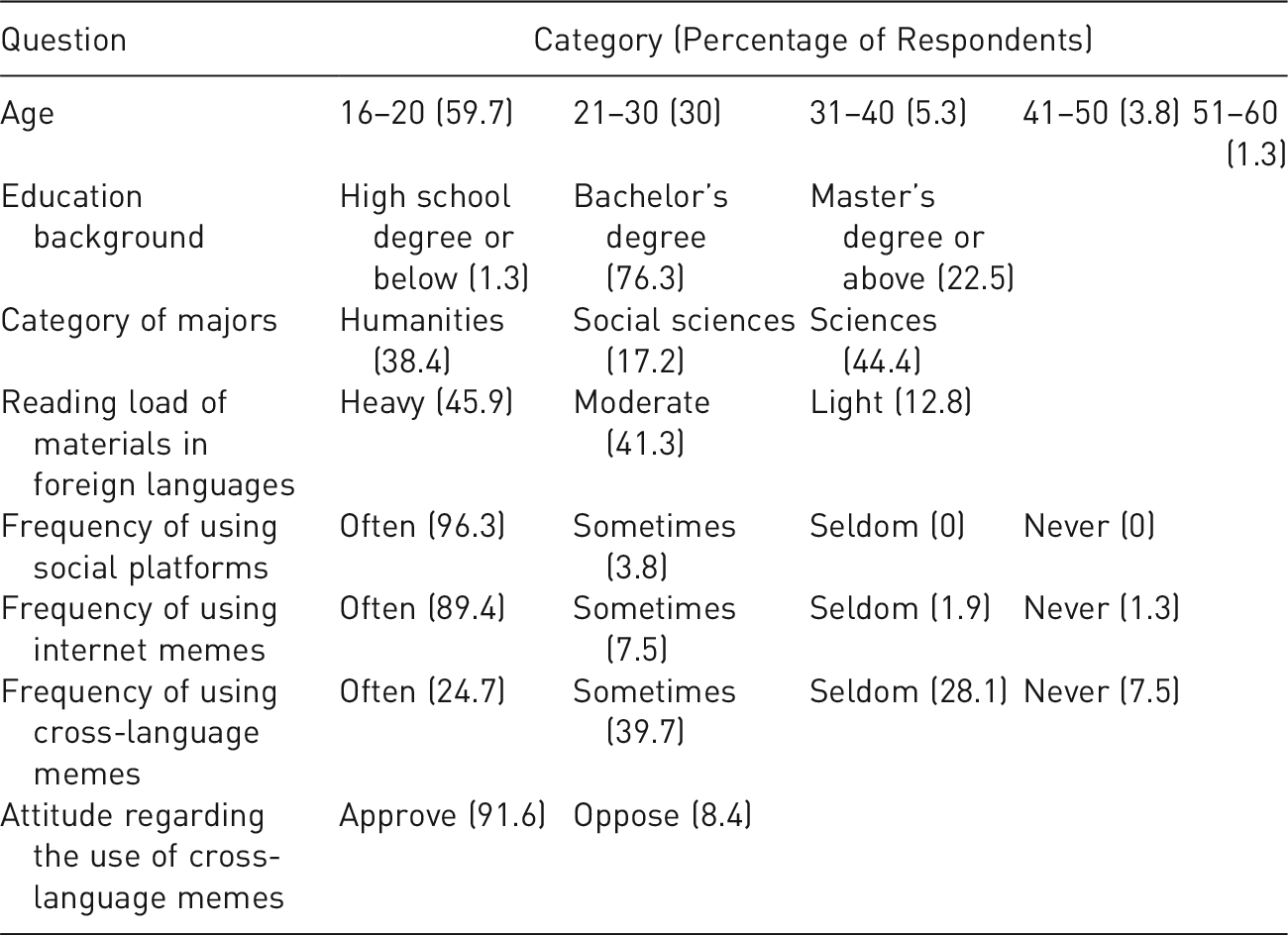
The survey results indicate that a majority of the respondents fall within the age bracket of 16–30 years old. Among these, the largest group comprises individuals ages 16–20, totaling 191 respondents, accounting for 59.7 percent of the sample. Furthermore, 96 respondents are ages 21–30, representing 30 percent of the total. In terms of educational background, 76.3 percent of the respondents hold a bachelor’s degree, while 22.5 percent have achieved a master’s degree or higher. An overwhelming majority, 96.3 percent, report frequent use of social media platforms, with 89.4 percent expressing a penchant for memes. This attests to the widespread popularity of memes among the surveyed individuals.
Regarding the utilization of cross-language memes, 24.7 percent of respondents claim to frequently employ them, while 67.8 percent use them “sometimes or occasionally.” When considering the recipients of meme-based communication, the respondents primarily use memes with friends (97.6 percent) and classmates (86.4 percent), whereas fewer respondents reported using memes with teachers (8.3 percent) and colleagues (12.6 percent). In summary, the data suggests that the majority of respondents are well-educated young individuals, and cross-language memes are more frequently integrated into everyday communication within peer groups (see table 1).
User information of cross-language memes
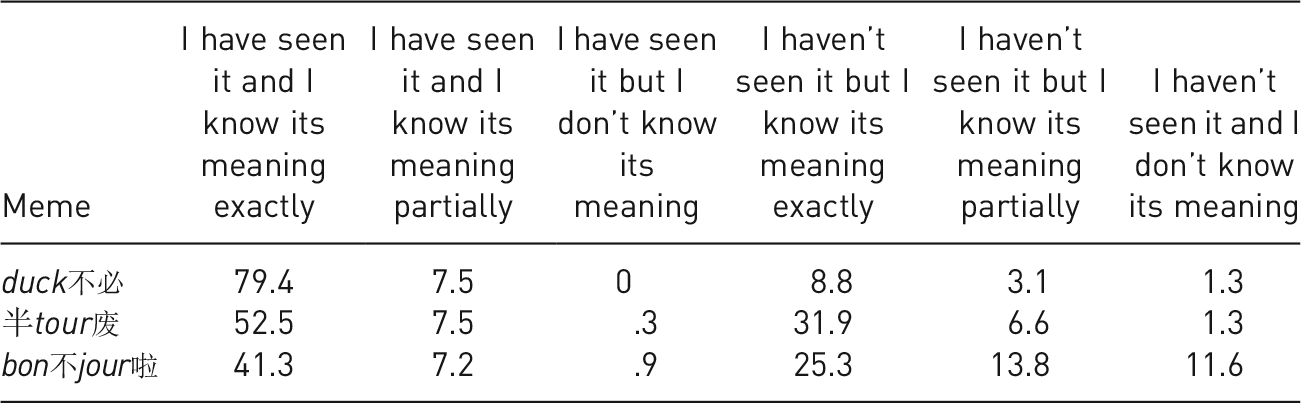
Furthermore, for the questionnaire, we selected three cross-language memes with varying levels of comprehension difficulty (as illustrated in table 2 and fig. 1) and employed SPSS Statistics software analysis to explore the factors influencing the comprehension of these cross-language memes. In general, the three chosen cross-language memes are relatively comprehensible and have achieved widespread recognition: 58.8 percent of the respondents reported having seen and understood at least two of these memes. Remarkably, over 77 percent of respondents could grasp at least some meaning from the memes, even if they hadn’t encountered them previously.
Understanding of Cross-Language Memes
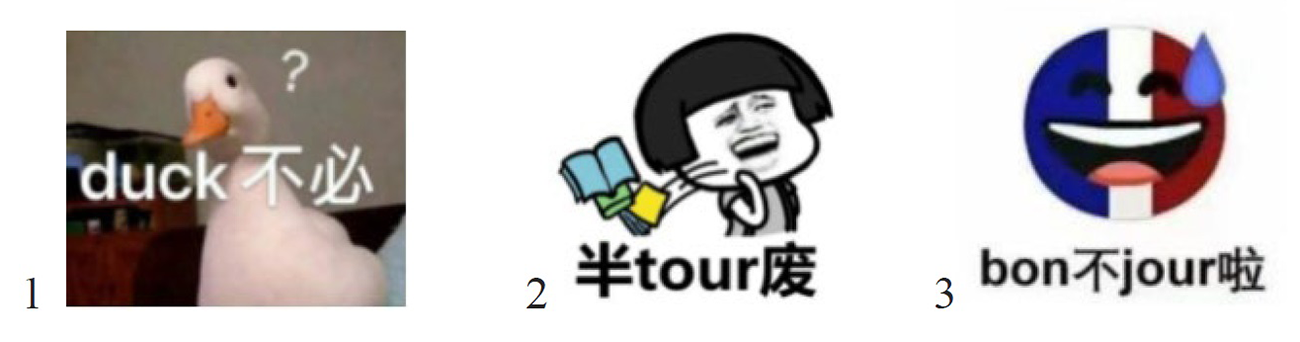
Three cross-language memes used in the survey. Meme 1, duck 不必, is a homophone of dàkěbùbì 大可不必 ‘totally unnecessary’, often used to express a refusal. Meme 2, 半tour废, is a homophone of bàntúérfèi 半途而废 ‘to give up halfway’. Meme 3, bon不jour, is similar to the pronunciation of bēngbùzhùle 绷不住了 ‘can’t take it anymore’, often used to express strong emotion.
Interestingly, while it is commonly assumed that the use of cross-language memes is primarily limited to foreign language learners due to language prerequisites, this study reveals a divergence from this belief. The data shows that the respondents’ academic majors are not significantly correlated with their frequency of cross-language meme usage. Specifically, 69 percent of respondents majoring in science and engineering and 65.5 percent of those majoring in social sciences frequently or occasionally use cross-language memes. The SPSS analysis further corroborates this finding, indicating that the overall frequency of cross-language meme usage does not exhibit a significant correlation with respondents’ professional categories (p value: .087). While assessing the familiarity and comprehension of the meme bon不jour啦, we observed a weak correlation with respondents’ academic majors (correlation coefficient: .148, p value: .008). In contrast, the familiarity and comprehension of the other two memes demonstrated no significant correlation with respondents’ majors (p value: .501 and .996, respectively). This distinction may arise from the inclusion of French in the meme bon不jour啦 (see fig. 1), leading to a lower comprehension rate among respondents majoring in social sciences and science and engineering compared to those majoring in humanities.
Conversely, the comprehension and acceptance of cross-language memes exhibit a correlation with age. The correlation analysis reveals significant relationships between the degree of familiarity and understanding of the three memes and respondents’ age, with correlation coefficients of .372, .202, and .319, respectively, all at the p < .01 significance level. Additionally, the pertinent options demonstrate good reliability and validity. Similarly, the frequency and attitude toward using cross-language memes are also influenced by the age of users, with correlation coefficients of .301 and .245, respectively, both significant at the p < .01 level. The data from the sample indicate that, overall, individuals of older age are less acquainted with and have a poorer grasp of cross-language memes, leading to a tendency to be less supportive of their use.
Analysis of the Acceptance of Cross-Language Memes
The questionnaire also sheds light on the motivations behind the utilization of cross-language internet memes, as presented in table 3. In general, respondents primarily seek emotional expression and vibrancy when opting for these memes. In contrast to monolingual internet memes, an overwhelming 98.6 percent of respondents find cross-language ones to be more captivating, while 70.3 percent appreciate their capacity to convey richer and nuanced meanings. Merely 10.9 percent consider showcasing individual language abilities as the primary advantage of cross-language internet memes, implying that language prowess is not their central purpose.
Users’ Attitude toward Cross-Language Internet Memes
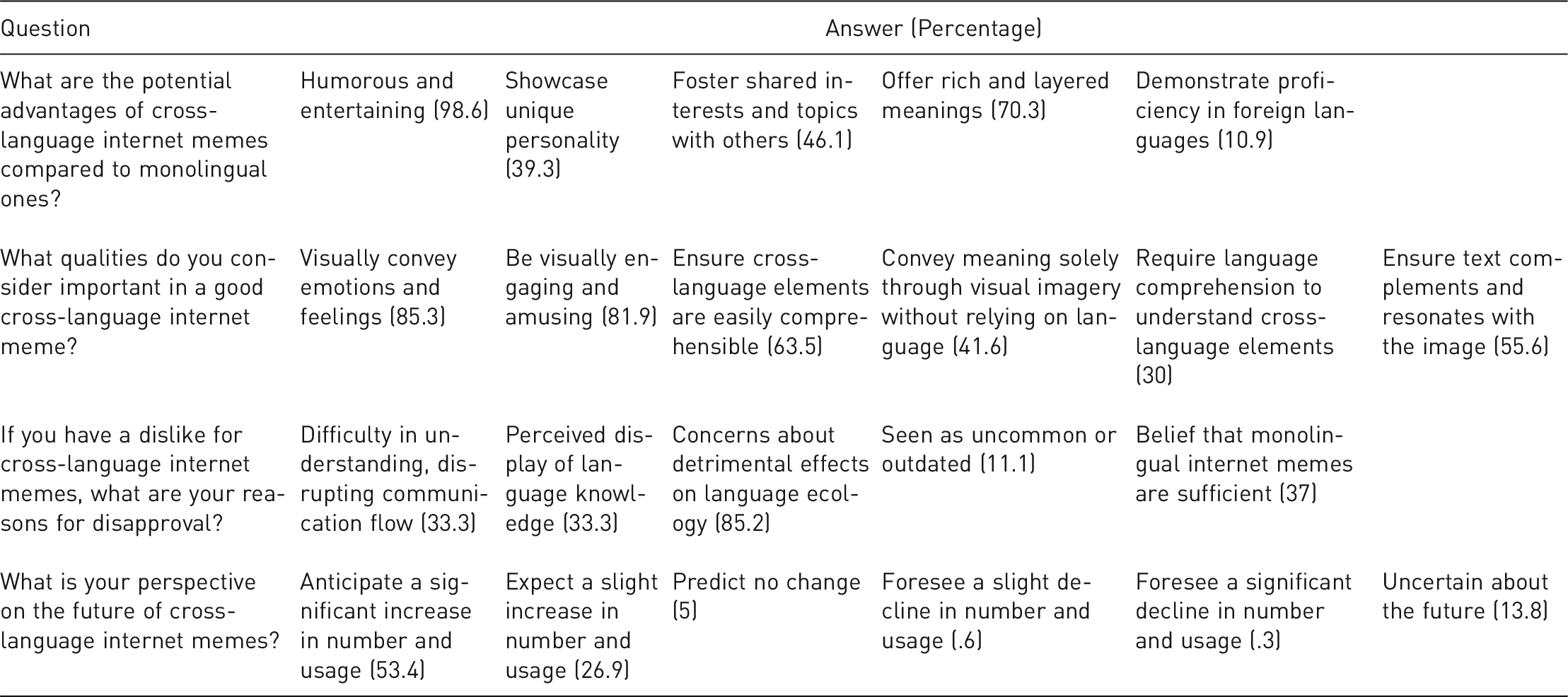
Simultaneously, 85.3 percent of participants assert that effective cross-language internet memes should accurately convey emotions, and 81.9 percent expect them to be engaging and amusing. In terms of the interplay between text and images, 55.6 percent believe that these elements should complement each other, and 63.5 percent insist that cross-language components should be easily discernible, highlighting the need for comprehensible visual language, akin to emojis. In essence, respondents express multifaceted semantic expectations for cross-language internet memes: (1) interlingual meaning, pertaining to the construction of meaning within the symbolic system, encompassing the fusion of images and text; (2) referential meaning, emphasizing the ease of recognition for cross-language elements and image interpretations; (3) pragmatic meaning, signifying the desire for liveliness, humor, and the display of individuality. Among these, liveliness, humor, and rich meanings emerge as particularly emphasized attributes.
The results of the questionnaire shed light on respondents’ perceptions of the future of cross-language internet memes. An overwhelming 80.3 percent of participants hold a positive outlook, with 53.4 percent firmly believing that the use of such memes will continue to increase in the near future. A notable 13.8 percent remain undecided about this phenomenon, while only 0.9 percent predict a decline in the use of cross-language internet memes in online communication. In addition to forecasting their future development, respondents exhibit diverse attitudes toward using memes containing different languages. Supporters argue that these memes are intriguing and humorous, with some describing them as “fun” and “vivid,” capable of “livening up the atmosphere in online communication.” They also emphasize that such memes enhance the depth of conversations and may become an integral part of mutual affection and shared interests within groups. These memes are seen as embodying cultural diversity and facilitating communication in foreign exchange contexts.
However, some opponents believe that cross-language memes could contaminate the Chinese language, with 85.2 percent expressing concerns about their potentially disastrous impact on linguistic ecology. Another 33.3 percent view the use of multilingual memes as a display of language mastery, while the same percentage believes it may disrupt the flow of online conversations. Respondents raise concerns about how cross-language memes could disrupt the linguistic environment, comparing them to homophonic advertising slogans and suggesting they might mislead language learners. In addition to linguistic challenges, some respondents find cross-language memes difficult to understand and acknowledge their limited applicability, especially in interactions with older individuals who may not fully comprehend them.
In summary, cross-language internet memes have become a favored symbolic form among young people, yet their development and usage remain contentious. Supporters view them as products of cultural interaction that add fun to communication. Conversely, opponents argue that they are hard to understand and pose a threat to language ecology, advocating against their use. In the era of multilingualism and multimodality, further research is warranted to unravel the reasons behind the prevalence of cross-language internet memes. The subsequent sections will analyze representative Chinese internet memes and extract their developmental trends from a semiotic perspective.
Semiotic Interpretation of Cross-Language Internet Memes
The questionnaire results underscore that cross-language internet memes, as a subtype of online memes, possess considerable expressive potential. In this section, we delve into their semiotic aspects, particularly focusing on the multimodal construction of meaning and the user group’s identity, as inferred from the questionnaire responses.
Multimodal Meaning Construction
Through the lens of social semiotics, cross-language internet memes can be viewed as a form of multimodal discourse—comprising the amalgamation of diverse semiotic modalities within a communicative tool or event (Van Leeuwen Reference Van Leeuwen2005). Cross-language internet memes epitomize this multimodal discourse, boasting enhanced representational features due to the incorporation of a second linguistic sign. Questionnaire respondents noted that cross-language internet memes “enhance the fun of communication,” “enliven the atmosphere,” and “enrich the interest of online chatting.” In the context of multimodal discourse’s functions, cross-language internet memes construct meaning holistically through the representational meaning, interactive meaning, and compositional meaning (Kress and Van Leeuwen Reference Kress1996, 119) inherent in their image systems.
The representational meaning of images corresponds to the ideational function in functional linguistics, encapsulating the communicative or conceptual relationships among characters, places, and events depicted in the images (Kress and Van Leeuwen Reference Kress1996, 119). In cross-language internet memes, images often serve a narrative representational role, portraying the actions and behaviors of individuals within the depicted scenarios. For instance, in the 半tour废 internet meme, the act of throwing a book embodies a narrative representation, conveying a dynamic sequence during this narrative process. Concurrently, the text fulfills the roles of “anchorage (ancrage)” and “relay (relais)” (Qu and Li Reference Qu2018, 46). On the one hand, it directs the viewer’s interpretation of meaning, elucidating and expounding on the image’s content. On the other hand, it complements and extends the image information, sometimes generating fresh connotations linked to the visual content. Unlike monolingual emoticons or simplistic images, cross-language internet memes demand more intricate cognitive interpretation and open up expansive meaning realms due to their multilingual elements. For instance, bon不jour啦 in figure 1 borrows from the prevalent internet phrase bēngbùzhùle 绷不住了 ‘can’t take it anymore’, signifying intense emotional impact, and superimposes French bonjour ‘hello’ to create a homophonic antonymous effect. The presence of the French flag and an emoji featuring a grinning face with sweat in the background picture further guide the direction of meaning interpretation. At this juncture, the image and text within the cross-language internet meme transcend the traditional concept of “text anchoring images” and instead exist in a state of mutual anchoring, awaiting mutual explanation and elaboration.
The interactive meaning of images corresponds to the interpersonal function in functional linguistics. Similar to other internet memes, cross-language internet memes serve as symbols of interpersonal communication, employing text and images for a “first-person narrative” (Qu and Li Reference Qu2018, 46). Their interactive meaning centers around the interpersonal dynamics between the sender and the receiver. Interactive meaning is primarily established through three fundamental elements: “contact,” “distance,” and “perspective” (Kress and Van Leeuwen Reference Kress1996, 114–34). “Contact” refers to eye contact. When an image maintains direct eye contact with the viewer, it shortens the spatial distance between the viewer and the image, fostering a sense of interpersonal engagement. “Distance” refers to establishing the relationship between participants and viewers by representing the size of the participant’s frame (Tian and Pan Reference Tian2018, 26). Close-ups and medium shots can be used to represent intimate relationships, while more distant relationships can be depicted with waist-up or full-body shots. “Perspective” refers to the selection of angle which can be used to express certain attitudes of the meme creators or users. A low-angle perspective signifies that the participant in the image holds a dominant position, whereas a high-angle perspective suggests that the viewer of the image is in a dominant role. An illustrative example is the duck不必 meme in figure 1. The low-angle show of the duck in the image implies that the participant holds a dominant position, thereby evoking a sense of oppression. When coupled with the text at the bottom, this conveys the meme user’s skepticism about something.
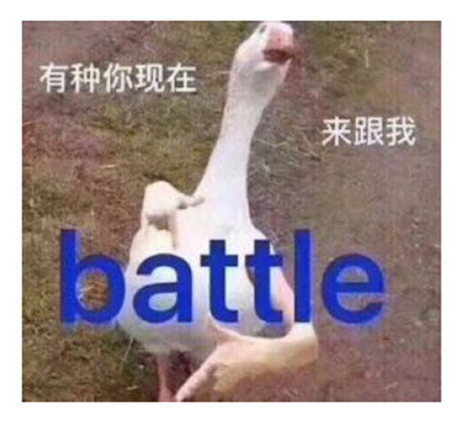
The compositional meaning of an image bears resemblance to the textual function in functional grammar, emphasizing the meaning conveyed by the overall image layout. In cross-language internet memes, compositional meaning is predominantly achieved through the concepts of “information value” and “salience” (Kress and Van Leeuwen Reference Kress1996, 177). Information value revolves around the positioning of elements based on their informational significance within the image. Central placement signifies high importance, while elements on the edges denote lower significance. Salience encompasses relative size, color, brightness of image components, and their placement in the foreground or background, all of which influence their ability to capture viewer attention (Li Reference Li2003, 7). Cross-language internet memes are typically designed following the principle of diminishing information value from the center to the edges. They position elements with the highest informational weight in the central foreground, utilizing typography, image size, and other techniques to draw the audience’s focus to core elements. For example, the meme in figure 2 conveys the core message of provocation by centralizing the key element “battle” with a large, vibrant font and a bright color. In contrast, secondary language elements are placed above in a smaller white font.
“Battle” meme. Translation: If you dare, come to “battle” with me now
In essence, cross-language internet memes harness the synergy between text and image modalities to craft the representational, interactive, and compositional meanings within multimodal discourse. This expanded range of expression within multimodal discourse serves as a resourceful tool. These symbolic resources not only facilitate emotional exchanges among users through interaction and dissemination but also enable the creation of shared cultural memories. Consequently, they play a pivotal role in shaping and reinforcing community identity construction.
Identity Construction within Online Communities
An important feature of internet memes is the anonymity and complexity of their author identity, also known as “multiparticipant” (Shifman Reference Shifman2014, 177). Cross-language internet memes, in particular, do not originate from authoritative institutions; instead, they are collaboratively crafted by various netizens and users. The original author typically does not assume a dominant role in the dissemination of these memes, and the initial meaning of a meme can undergo alterations at various nodes. As scholars have noted, “in meme culture, flow takes primacy over origin, as the creator of an object and even the conditions in which it was made often remain unknown to the legions of users who remix it and pass it on” (Nooney and Portwood-Stacer Reference Nooney2014, 250).
Engaging in the creation or utilization of internet memes is more than just a collective process of meaning generation; it is also a means of identity construction and the establishment of online community bonds among internet users. From a collective standpoint, internet memes that gain prominence within a certain sphere establish norms through a process of collective symbolization. These norms are not enforced by any specific individual but rather must be embraced and upheld by interpretive communities (Mei Reference Mei2018, 18). With the diversified evolution of memes, many popular memes, besides conveying their literal meanings, have acquired additional layers of coding and norms. For instance, memes like smiley faces, hē hē 呵呵 (literally ‘ha-ha’), wǒ zhēn de huì xiè 我真的会谢 (literally ‘I should really say thank you’), and shuān Q 栓Q (a homophone of thank you) have gradually strayed from their original conceptual meanings to express a mocking and disdainful attitude. These subsequently assigned codes are not necessarily embraced by the general public but may instead be embraced by niche and subcultural groups. The rules prevailing within these groups then serve as markers for identifying group boundaries (Peng Reference Peng2019, 107).
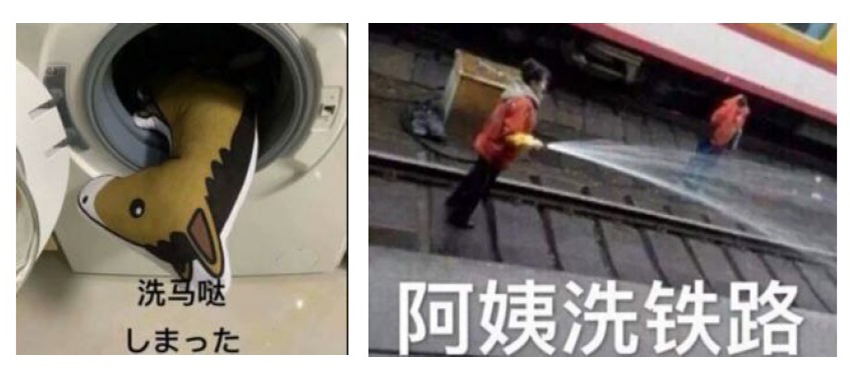
In the utilization and dissemination of cross-language internet memes, the cross-language element naturally becomes a form of “encoding.” For example, certain cross-language internet memes require an understanding and usage of the Japanese language, either directly or indirectly (fig. 3). The first meme, 洗马哒しまった, employs Japanese in a straightforward manner, with the Japanese shimatta しまった ‘darn it’ juxtaposed with its Chinese homophone xǐ mǎ dā 洗马哒 ‘wash a horse’, corresponding to the image. The second meme triggers cross-lingual awareness through the Chinese phrase ā yí xǐ tiě lù 阿姨洗铁路 ‘aunty cleaning the railway’, corresponding to the image, while the true meaning lies in its Japanese homophone aishiteru 愛してる ‘I love you’. In these memes, cross-lingual elements demand a certain level of language proficiency and background knowledge, rendering them more likely to circulate within bilingual user communities. Cross-linguistic elements in memes carry a distinct sense of purpose and exclusivity, thereby bolstering collective identity within the online community.
Cross-language memes using Japanese
From an individual standpoint, group identity implies the internalization of the group’s standards and rules as one’s own behavioral norms. Jenkins (Reference Jenkins1992) introduced the concept of “participatory culture,” suggesting that group members can “poach” different media texts and craft cultural products belonging to the group itself. These creations are then shared and propagated within the group. The act of members utilizing and disseminating memes within the group is also a process of shaping their individual identities. This process strengthens the relationships among users who initially congregated based on shared interests and emotional resonance, fostering tighter bonds and reinforcing their mutual identification (Xiong Reference Xiong2019, 48).
As per our survey findings, 49.1 percent and 39.3 percent of respondents stated that their reasons for using cross-language internet memes are to “create common topics with people around them” and “showcase their personal traits.” The utilization of cross-language memes empowers individuals to foster a sense of belonging and identity within the group. In a way, cross-language memes assist users in “crafting a unique identity and image, actively constructing their ‘selves’” (Shifman Reference Shifman2014, 33–34).
Semiotic Reflection on Cross-Language Internet Memes
The graphical and textual characteristics of cross-language internet memes inherently reflect their developmental trajectory, which evolves in tandem with the evolution of Internet language. This article identifies two key developmental characteristics of internet memes that manifest in the interplay between diverse semiotic systems and languages within cross-language internet memes.
From Monomodal to Multimodal Semiotic Activity
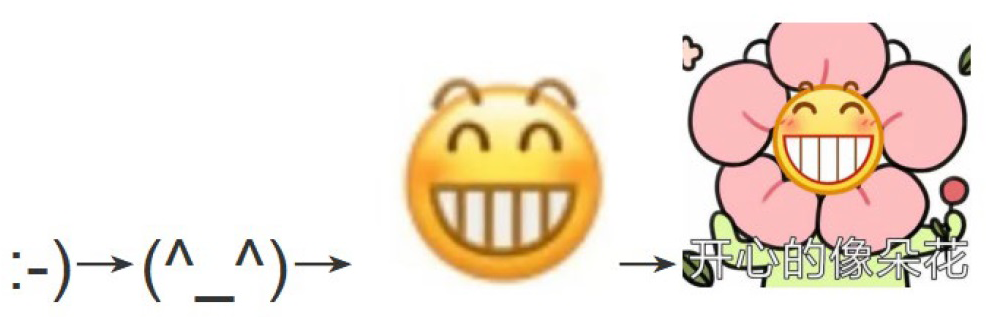
Multimodality is “a phenomenon of interaction using multiple approaches and semiotic resources including language, image, sound, and motion” (Zhang Reference Zhang2009, 4). As media and information technology have matured, multimodal discourse has emerged as an increasingly essential semiotic resource, reshaping the way people communicate from a predominantly monomodal form to a multimodal one. The evolution of internet memes exemplifies this trend. Over the past two decades, internet memes have evolved from simple derivatives of the language system into intricate amalgamations that encompass images, music, and various other signs. They have transcended the realm of mere “wordplay” within language systems to incorporate emoticons, emojis, image macros, as well as audio and video components, giving rise to the diverse forms of expression observed today. An illustrative example is the development of memes to convey the emotion happiness (see fig. 4). Initially, memes merely mimicked smiles through specific punctuation marks. Over time, memes evolved to encompass a broader array of forms, utilizing various punctuation marks and eventually incorporating images. Today, memes harness a range of semiotic resources to enhance clarity and expressiveness.
The development of memes expressing “happiness”
The multimodal nature of cross-language internet memes offers distinct advantages in terms of both effectiveness and expressive impact. Regarding effectiveness, the interplay between various signs within an internet meme broadens its meaning, surpassing the confines of pure language expression. This maximizes the conveyance of meaning within a meme unit, thereby enhancing expressive efficiency. Concerning the expressive impact, the incorporation of multimodal symbols extends the expressive potential of internet memes in two directions. First, multimodal discourse collaborates with the language system, intensifying the expressive impact of the original text by adapting and harmonizing with the language system. The second approach involves the separation or even distortion of multimodal discourse and the language system, achieving humorous effects through the discordance between images and text.
In summary, the presence of multimodal symbol systems in cross-language internet memes creates significant room for ongoing innovation in their form. This drives them to continually sustain their vitality as a means of communication.
From Monolingual to Multilingual Semiotic Creation
The inclusion of cross-language elements in internet memes is not a recent phenomenon. Even in the early stages when memes were primarily composed of textual signs, a fusion of different language systems occurred. For instance, Chinese 吃饭ing ‘eating’ combines the Chinese verb for eat (吃) with the English present participle suffix -ing. During the early days of internet memes, the structure of “Chinese + foreign language affix + numbers + emoticons” became a popular trend for a substantial period (Cao Reference Cao2009, 120). Early network memes were predominantly presented in text form, with cross-language elements often used to aid Chinese expression and supplement Chinese semantic structures. These elements included the use of the English suffix -ing to convey the present tense or the Korean modal particle sī mì dá 思密达 (homophone of seumnida 습니다 in Korean) as a form of wordplay. However, later cross-language internet memes involve more intricate interactions between semantic and phonetic systems, as seen in examples like 半tour废 mentioned earlier. Moreover, cross-language elements can serve to dilute expressed meanings and deconstruct serious discourse (Liu and Yuan Reference Liu2021, 82). By introducing unfamiliar foreign languages and increasing cognitive load, cross-language internet memes mitigate usage risks, reduce discourse intensity, and promote meme dissemination.
The trend toward multilingualism in internet memes reflects several linguistic phenomena. First, it signifies the general improvement of Chinese individuals’ foreign language proficiency. As evidenced by the questionnaire, 87.2 percent of respondents indicated a requirement to have knowledge of English in their studies and work, fostering an environment conducive to the use of cross-language memes. Second, it underscores the growing prevalence of translanguaging in the internet era. Translanguaging involves the dynamic integration of different linguistic modalities and sensory linguistic resources to serve communicative purposes (García Reference García2011, 7; Wang Reference Wang2020, 58). In contrast to code-switching, which emphasizes switching between languages unidirectionally, translanguaging practices focus on the fluid integration of linguistic resources, regardless of linguistic boundaries and societal constraints. Likewise, cross-language internet memes freely draw from intralingual, interlingual, and multimodal linguistic resources to convey information and express values. These memes break down barriers not only between languages but also between languages and other symbolic resources, creating a flexible and open “translanguaging space.” This embodies the trend of multilingual and multimodal interaction in translanguaging practices, deserving further study.
In summary, the development of cross-language internet memes signifies a shift from monomodal to multimodal and from monolingual to multilingual. This evolution results in richer content and greater creativity, ensuring that internet memes remain a vital contemporary communicative form on the internet.
Conclusion
This study, conducted through a questionnaire involving 320 respondents and analyzed using SPSS, aimed to examine user demographics, reasons for using cross-language internet memes, and their evolving trends. The research explored the semiotic aspects, meaning potential, and user identity within this context, shedding light on the evolving nature of internet memes. The findings from the questionnaire revealed several key insights: (1) Young people constitute the primary user group for cross-language internet memes. (2) The interpretation and acceptance of these memes are influenced by the age of users. (3) Expressing emotions, humor, and vividness are essential qualities expected from these memes. Drawing on these results, this article discussed the ideographic function and user group identity construction of cross-language internet memes from a semiotic perspective. It identified two distinctive features characterizing the development trend of internet memes: a shift from monomodality to multimodality and from monolingualism to multilingualism.
However, it is important to acknowledge the limitations of this research. The questionnaire was primarily distributed within personal social networks, resulting in a sample mainly consisting of college students and teachers in Chinese universities. Therefore, the usage patterns observed may not be representative of a broader population. Additionally, the study focused exclusively on Chinese internet memes, neglecting those originating from other countries. These limitations underline the preliminary nature of this research and open avenues for more sophisticated studies in the future.
In conclusion, cross-language internet memes serve as both ideographic tools for internet users and agents subtly influencing people’s thought processes and language habits. Clarifying the semiotic characteristics and meanings of cross-language internet memes holds significant value for understanding the communication dynamics of internet discourse. This research lays the groundwork for further exploration of cross-language internet memes and their impact on people’s semiotic activity.



