

Introduction
The Archean lithospheric mantle forms a thick, buoyant root that extends 200–250 km beneath cratonic crust. It is composed predominantly of highly refractory harzburgite, generally interpreted as the residue of high-degree partial melting during early mantle differentiation. However, a puzzling feature of peridotitic xenoliths from Archean cratons is their variable silica content. Silica-enriched peridotites with abundant orthopyroxene, are common in the Kaapvaal and Siberian cratons (Kelemen et al., Reference Kelemen, Dick and Quick1992; Herzberg, Reference Herzberg1993; Boyd et al., Reference Boyd, Pokhilenko, Pearson, Mertzman, Sobolev and Finger1997; Kelemen et al., Reference Kelemen, Hart and Bernstein1998; Zhang et al., Reference Zhang, Xu, Liu, Green and Dobrzhinetskaya2011; Brey and Shu, Reference Brey and Shu2018), whereas silica-poor, olivine-dominated peridotites frequently occur in the Tanzanian and North Atlantic cratons (Rhodes and Dawson, Reference Rhodes, J.B, Aherns, Dawson, Duncan and Erlank1975; Rudnick et al., Reference Rudnick, McDonough and Orpin1994; Bernstein et al., Reference Bernstein, Kelemen and Brooks1998; Chesley et al., Reference Chesley, Rudnick and Lee1999; Lee and Rudnick, Reference Lee and Rudnick1999; Bizzarro and Stevenson, Reference Bizzarro and Stevenson2003; Bernstein et al., Reference Bernstein, Hanghoj, Kelemen and Brooks2006; Wittig et al., Reference Wittig, Pearson, Webb, Ottley, Irvine, Kopylova, Jensen and Nowell2008; Sand et al., Reference Sand, Waight, Pearson, Nielsen, Makovicky and Hutchison2009). Partial melting experiments demonstrate that the silica content of a peridotite residue after melting generally increases with depth, due to peritectic reactions involving orthopyroxene and olivine: below ∼2 GPa, olivine crystallizes at the expense of orthopyroxene (Baker and Stolper, Reference Baker and Stolper1994), while above ∼3.5 GPa, orthopyroxene crystallizes at the expense of olivine (Walter, Reference Walter1998). However, the silica contents observed in natural cratonic peridotites extend beyond bulk residue compositions formed by isochemical melting (Herzberg, Reference Herzberg2004), suggesting that open-system melt–rock interaction might have modified the lithospheric mantle. Textural observations support this hypothesis. Garnet- and spinel-facies xenoliths show evidence for melt-present reactions, such as embayed olivine and poikilitic orthopyroxene (Simon et al., Reference Simon, Carlson, Pearson and Davies2007; Baptiste et al., Reference Baptiste, Tommasi and Demouchy2012; Daczko et al., Reference Daczko, Kamber, Gardner, Piazoloc and H.E2025; Kaekane et al., Reference Kaekane, Tomlinson and Hoare2026). Oxygen isotope compositions of silica-rich cratonic peridotites are mantle-like (Regier et al., Reference Regier, Mišković, Ickert, Pearson, Stachel, Stern and Kopylova2018), and their trace element signatures lack evidence for subduction-related fluids or metasomatism (Wasch et al., Reference Wasch, van der Zwan, Nebel, Morel, Hellebrand, Pearson and Davies2009; Branchetti et al., Reference Branchetti, Zepper, Peters, Koornneef and Davies2021). This implies that the reacting melt was of mantle, rather than recycled origin. Moreover, the refractory nature of these xenoliths excludes low degree melts and instead indicates ultramafic melts. Thermodynamic modelling further supports this interpretation, showing that interaction between peridotite and komatiitic melts can drive silica enrichment in peridotite (Tomlinson and Kamber, Reference Tomlinson and Kamber2021; Walsh et al., Reference Walsh, Kamber and Tomlinson2023).
Komatiites are ultramafic volcanic rocks and are predominantly found on Archean cratons and so are a natural candidate for the infiltrating ultramafic melt. The high eruption temperatures and high MgO contents of komatiite lavas reflect high degree melting that consumed both olivine and orthopyroxene (Takahashi, Reference Takahashi1986; Takahashi et al., Reference Takahashi, Shimazaki, Tsuzaki and Yoshida1993; Herzberg, Reference Herzberg2016; Sossi et al., Reference Sossi, Eggins, Nesbitt, Nebel, Hergt, Campbell, O’Neill, Van Kranendonk and Davies2016). Three principal komatiite types are recognized: aluminium-depleted and aluminium-undepleted, interpreted to reflect melting of a fertile to moderately depleted peridotite source with garnet in the residue or extending beyond garnet exhaustion, respectively, whereas Al-enriched komatiite is considered to be the product of melting of highly depleted mantle (Nesbitt et al., Reference Nesbitt, Sun and Purvis1979; Arndt et al., Reference Arndt, Lesher and Barnes2008). The Al-depleted komatiite variety, with its low Al and Ca, has been invoked as the agent of silica enrichment in the cratonic lithosphere (Tomlinson and Kamber, Reference Tomlinson and Kamber2021), as its composition should not stabilize additional garnet upon reaction. Komatiite compositions span a broad silica range, with silica-rich compositions reported from Commondale, South Africa (Wilson, Reference Wilson2019; Otto et al., Reference Otto, Stevens, Moyen, Mayne and Clemens2025) and silica-poor varieties from Pyke Hill and Alexo in the Abitibi belt, Canada (Herzberg, Reference Herzberg2016). This variability could reflect polybaric melt evolution and/or melt–rock reaction with depleted lithosphere during ascent.
Reaction experiments for basalt–peridotite systems at 1–2 GPa have demonstrated that porous melt reaction consumes pyroxene and precipitates olivine leading to the formation of dunite in the reaction interface and driving the melt to more silica-rich compositions (Daines and Kohlstedt, Reference Daines and Kohlstedt1994; Falloon et al., Reference Falloon, Danyushevsky and Green2001; Morgan and Liang, Reference Morgan and Liang2003, Reference Morgan and Liang2005; Van den Bleeken et al., Reference Van den Bleeken, Müntener and Ulmer2010; Tursack and Liang, Reference Tursack and Liang2012; Saper and Liang, Reference Saper and Liang2014; Yu et al., Reference Yu, Xu and Wang2014). Conversely, at >3 GPa, the basalt–peridotite reaction consumes olivine and precipitates pyroxene (Yaxley, Reference Yaxley2000). Reaction with more evolved melts (e.g. andesite) leads to the formation of pyroxene at the expense of olivine (Kelemen et al., Reference Kelemen, Dick and Quick1992; Kelemen et al., Reference Kelemen, Hart and Bernstein1998; Morgan and Liang, Reference Morgan and Liang2005; Mallik and Dasgupta, Reference Mallik and Dasgupta2012). In contrast, experimental investigations of melt–peridotite interaction at higher pressures are scarce and focus on reaction with carbonate or silicic slab-derived melts. The paucity of relevant experiments means that the effect of komatiite–peridotite interaction on the composition of the Archaean lithosphere and of the reacting melt remains poorly constrained, regardless of increasing recognition of the importance of such processes in generating variability in mantle composition.
In this study, we present a series of high-pressure experiments at 5 GPa investigating the interaction between Al-depleted komatiite-like melts and both fertile and moderately depleted peridotite. We employ two experimental designs: (1) hybrid experiments, where melt and peridotite powders are pre-mixed, simulating pervasive porous flow; and (2) reaction-couple experiments, where komatiite melt infiltrates a pre-sintered peridotite rod, intended to simulate channelized melt flow and discrete reaction fronts. These experiments provide new constraints on the mechanisms and consequences of melt-driven silica enrichment in the Archean lithospheric mantle and offer a process-based explanation for the silica variability observed in cratonic xenolith suites.
Experimental method
A critical challenge in experimentally replicating Archean mantle melting is that natural melting typically occurs along polybaric paths, involving decompression and evolving melt compositions over a wide pressure range (Kelemen et al., Reference Kelemen, Dick and Quick1992; Kinzler, Reference Kinzler1997; Asimov et al., Reference Asimov, Hirschmann and Stolper2001; Asimov and Longhi, Reference Asimov and Longhi2004). Komatiites are widely interpreted to originate from high-degree melting of deep mantle sources (>5–6 GPa), followed by further modification as the melts ascend and interact with progressively shallower lithologies (e.g. Walter, Reference Walter1998; Herzberg, Reference Herzberg2016). These melt evolution paths are inherently difficult to replicate within a single fixed-pressure experiment.
In this study, we circumvented that limitation by using a komatiitic melt composition derived at 7 GPa from the experiments of Takahashi (Reference Takahashi1986), simulating the behaviour of a melt derived at greater pressure that interacts with overlying peridotite at 5 GPa. Though this does not capture the full polybaric melting column, it isolates a key stage: the interaction of a deep-derived, ultramafic melt with residual lithospheric mantle. This approach allows us to probe melt–rock reactions that occur after primary melt generation but before melt extraction or eruption. Combined with mineral compositional data and reaction modelling, our fixed-pressure experiments serve as a proxy for interpreting critical steps in polybaric melting and lithosphere modification.
Starting material preparation
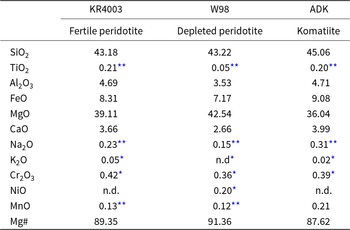
We investigated interaction of ascending Al-depleted komatiite melt with fertile and moderately depleted peridotite starting compositions (Table 1): (1) fertile peridotite based on natural spinel lherzolite powder KR4003 (Walter, Reference Walter1998); (2) moderately depleted peridotite, based on the residue after 20% partial melting of fertile peridotite KR4003 at 6 GPa and 1740°C (run 60.07; Walter, Reference Walter1998); and (3) Al-poor komatiite (ADK), based on the melt produced after ∼70% melting of fertile peridotite KLB-1 at 8 GPa and 1900°C, which left olivine and garnet in the residue (run 78; Takahashi, Reference Takahashi1986).
Composition of synthetic starting powders normalized from the ICP-OES analysis conducted by Actlabs after lithium metaborate/tetraborate fusion

Notes: ADK – Al-depleted komatiite; n.d. = not detected
* Elements were not analysed by Actlabs.
** Elements were below detection limits at the Actlabs laboratory. Reported values are from the starting material calculated composition.
Synthetic starting materials were prepared using a stoichiometric mixture of reagent-grade oxides to replicate the three distinct bulk compositions. FeO was introduced as fayalite (Fe2SiO4) powder which was pre-synthesized by grinding dried Fe2O3 and quartz powders together in an agate mortar. All water-sensitive oxides (e.g. MgO) were fired in air at 1000°C overnight prior to weighing. Oxide powders were weighed sequentially, starting with lower masses, using a balance with precision to 6 decimal places for weights below 0.1 g and one with precision to 4 decimal places for higher masses. Once weighed, oxides were ground together in an agate mortar with ethanol for one hour to produce a fine-grained, homogeneous mixture. The two peridotite powders were pressed into individual pellets and sintered in a furnace at 1 atm with a heating cycle reaching 1000°C to achieve decarbonation. Subsequently, the pellets were reduced at 1200°C for 24 hours at 1 atm in a gas-mixing furnace, maintained at two log units below the QFM buffer, using a CO2:CO gas mixture ratio of 60:40. This step ensured effective reduction following decarbonation. The recovered pellets were re-powdered under ethanol and ground in an agate mortar for approximately one hour to ensure homogenization. For the komatiite composition, the powder was poured into a platinum crucible and melted in a 1 atm furnace at 1650°C for 30 minutes. The molten material was then quenched in ice-cold water. The resulting glass was ground to a fine, homogeneous powder in an agate mortar. All starting materials were analysed via ICP-OES at Actlabs following fusion with lithium metaborate/tetraborate and digestion of the fused bead in 5% HNO3 (method 4B).
High pressure experiments
All experiments were conducted at 5 GPa and temperatures ranging from 1600 to 1690°C, conditions well within the garnet stability field and above the peridotite solidus. These pressures and temperatures are consistent with the formation conditions inferred for orthopyroxene in silica-enriched peridotites from the Kaapvaal Craton, South Africa (Tomlinson and Holland, Reference Tomlinson and Holland2021; Kaekane et al., Reference Kaekane, Tomlinson and Hoare2026).
High-pressure, high-temperature experiments were performed at the Bayerisches Geoinstitut (BGI) using the 1200-tonne Sumitomo multi-anvil press, equipped with a 6–8 Kawai-type split-sphere guide block system. The pressure medium consisted of a Cr2O3-doped MgO octahedron with an 18 mm edge length, compressed between tungsten carbide cubes with 11 mm truncations. Heating was provided by a graphite furnace, and temperatures were monitored using a W97/Re3-W75/Re25 thermocouple. No corrections were applied to the thermocouple electromotive force (emf). All runs followed standard BGI procedures: cold pressurization was followed by rapid heating (∼100°C/min) to the target temperature. Isobaric quenching was achieved by switching off the power supply, followed by slow decompression. Cooling rates were on the order of 200–250°C/s.
Multi-anvil press experiments are subject to a typical temperature uncertainty of ±100–150°C due to limitations in thermocouple (Tc) accuracy and thermal insulation. Though this level of uncertainty is generally acceptable, it becomes critical in peridotite melting experiments where the temperature window between the solidus and liquidus can be as narrow as 50–80°C. Consequently, achieving precise partial melting conditions is inherently difficult. Moreover, within the experimental charge temperatures away from the thermocouple may deviate by hundreds of °C from the Tc reading because of temperature gradients (e.g. van Westrenen et al., Reference van Westrenen, Van Orman, Watson, Fei and Watson2003). Large assemblies, such as the 18/11 used in this work generally show smaller axial T gradients of ∼50 to 80°C/mm (Frost et al., Reference Frost, Poe, Trønnes, Liebske, Duba and Rubie2004; Man et al., Reference Man, Fei, Kim, Néri, Xie and Frost2024). We took advantage of the inherent thermal gradient across the 2 mm graphite capsule to investigate melt–rock reactions over a range of temperatures in a single charge. This method was developed in Japan and then adopted for melting experiments in order to determine how the crystalline phase chemistry evolves throughout the melting interval from liquidus and solidus (Herzberg and Zhang, Reference Herzberg and Zhang1996, and references therein). To constrain better the internal temperature distribution in the capsule, one run was conducted using the Al-in-periclase thermometer (Man et al., Reference Man, Fei, Kim, Néri, Xie and Frost2024). A 2 mm graphite capsule was completely filled with a MgO–Al2O3 mixture and run at 5 GPa and 1650°C. After quench, the capsule contents were measured via electron microprobe and the Al2O3 in periclase was converted to temperature using the Man et al. calibration at 5 GPa. The resulting temperature map (Fig. S1) shows a ∼50°C gradient within the capsule, with a cold spot at the bottom and a hot region towards the top and along one side. The hottest temperatures yield T ≈ 1616°C which is ∼34°C lower than the setpoint indicating very good agreement and confirming the magnitude and polarity of the internal gradient.
In order to constrain the partial melting behaviour of fertile and depleted peridotite mixed with komatiite both as a fully homogeneous melt and as melt percolated through pre-existing lithosphere, five distinct sets of experiments were performed (Table 2). Each set utilizes a slightly different setup, as detailed below.
Run conditions and recovered phases in the different experimental conditions
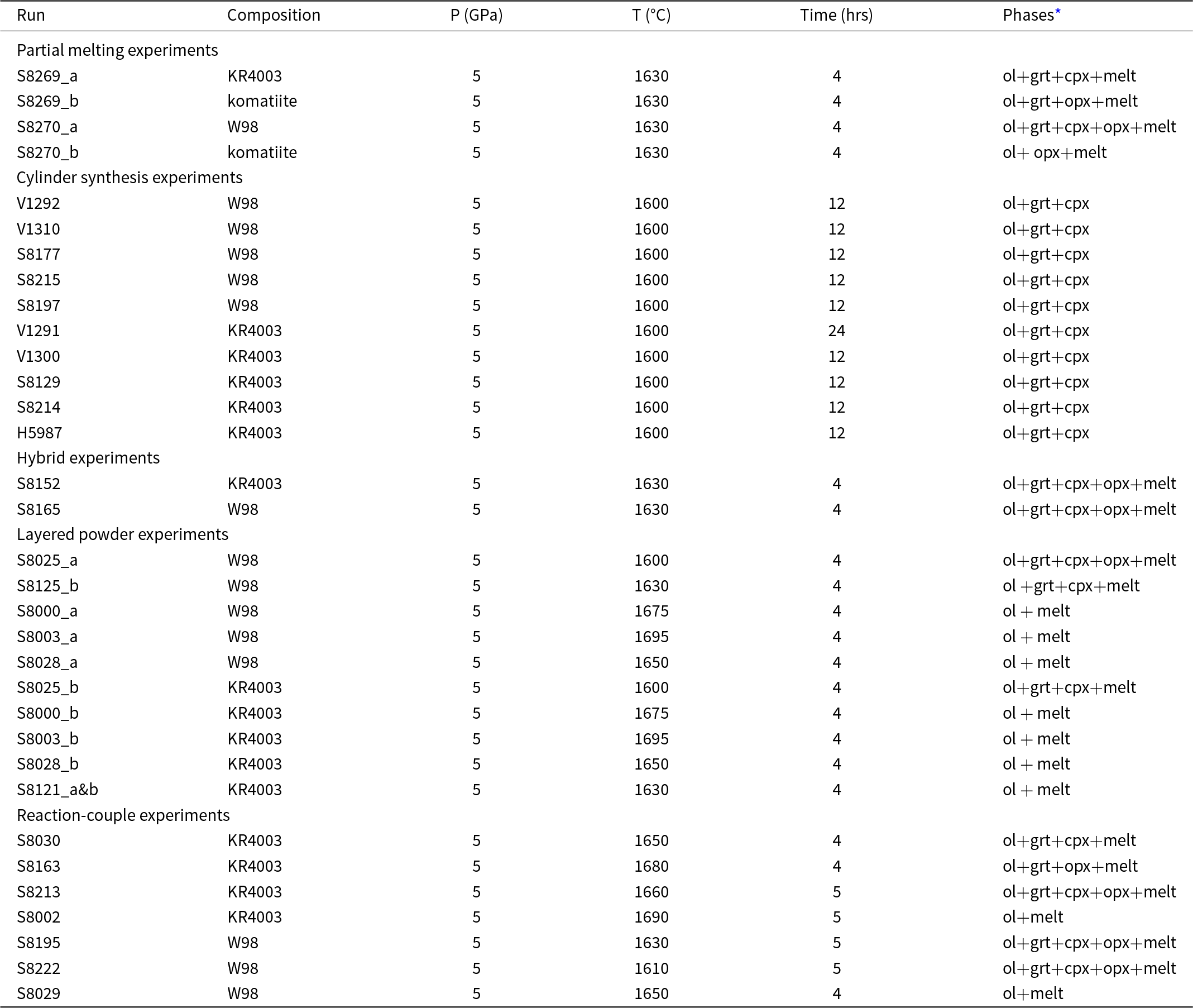
* The distribution of the phases is not homogeneous in the recovered samples, but distributed into zones.
Partial melting experiments
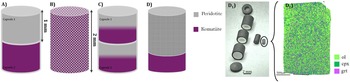
We undertook partial melting experiments on each of the starting mixtures in order to benchmark the behaviour of the end-member chemical systems at the relevant experimental conditions. In each run, two 1 mm long capsules were loaded in the graphite heater of the 18/11 assembly. In the top capsule peridotite powder was loaded (fertile or depleted), whereas the bottom one was filled with komatiite powder (Fig. 1A).
Experimental configurations used in this study. (A) Partial melting: paired 1 mm capsules loaded with peridotite (top) and komatiite (bottom). (B) Hybrid mixing: 2 mm capsule filled with a 50:50 peridotite–komatiite powder mixture. (C) Layered (powder–powder) reaction: 1 mm capsule with basal komatiite powder overlain by peridotite powder (50:50). (D) Reaction couple: solid, pre-synthesised peridotite cylinder placed above komatiite powder. All experiments were performed in an 18/11 assembly at 5 GPa; details in Table 2. D1 – Internal components of the 18/11 BGI standard high-pressure assembly, including a graphite heater, a 2 mm graphite capsule, and a representative synthesized peridotite cylinder. D2 – Energy-dispersive X-ray (EDX) phase map of the peridotite cylinder. In the phase map, garnet is shown in purple, clinopyroxene (cpx) in dark green, and olivine in bright green.

Hybrid experiments
Two hybrid experiments were performed to investigate the behaviour of a fully equilibrated peridotite–komatiite system. For these experiments, peridotite and komatiite powders were homogenized in an agate mortar to create a uniform 50:50 mixture. Powder mixtures were produced using both fertile and depleted peridotite. The mixed powders were loaded into 2 mm long graphite capsules and run at 5 GPa and 1630°C (Fig. 1B).
Layered experiments
To simulate the interaction of an ascending komatiite with mantle peridotite, we conducted high-porosity reaction experiments using powdered komatiite and peridotite. In this setup, samples were loaded in 1 mm long graphite capsules. A layer of komatiite powder was placed and overlain by a layer of fertile or depleted peridotite powder, maintaining a 50:50 ratio. In each run two capsules were stacked within the same furnace piece to allow both peridotite compositions to be run simultaneously at comparable pressure and temperature conditions (Fig. 1C).
Reaction-couple experiments
To investigate additional textures resulting from komatiite percolation through solid peridotite, layered experiments were designed in which a solid, pre-synthesized peridotite cylinder was stacked on top of a layer of komatiite powder (Fig. 1D). These experiments provide both textural and compositional insight into the effects of melt percolation through solid peridotite.
Peridotite cylinders (Fig. 1D1) were produced by loading the 2 mm graphite capsule with peridotite powder (either fertile or depleted) and running at 5 GPa and 1600°C, with a 12-hour heating plateau followed by a controlled, slow decompression rate (∼490.3 kPa/h). The synthesized rods were recovered and shortened by cutting a thin disk from both the top and the bottom part of the cylinder to a final length of ∼1.3 mm or ∼1.8 mm, in order that the rods can be juxtaposed against komatiite powder in a 2 mm capsule for subsequent reaction experiments, with the length chosen to allow the desired komatiite:peridotite ratio. The recovered disks or fragments were subsequently embedded and polished to allow the investigation of texture and phase relations within the peridotite cylinder (Fig. S2). In addition, cylinder S8214 (fertile peridotite) was cut in half along its long axis to assess texture and phase distribution along the length of the peridotite rod (Fig. 1D2). The sample shows homogeneous distribution of olivine (60%), clinopyroxene (25%) and garnet (15%) with only minimal melt, orthopyroxene is absent (Table S2). These samples present a well-equilibrated granular texture with average grain sizes between 30 µm and 40 µm for the olivine grains. For the garnets the size of the grains is ∼10 µm throughout the samples and the cpx sizes vary between 10 and 30 µm.
For the reaction-couple experiments, the shortened peridotite rods were placed into 2 mm long graphite capsules over a layer of komatiite powder to replicate ascent of the komatiite melt (Fig. 1D). The peridotite:komatiite ratio was varied between 80:20 and 60:40. Reaction-couple experiments were run at 5 GPa and temperatures ranging between 1610°C to 1680°C (Table 2).
Analytical methods
Recovered experimental runs were cut in half longitudinally along the middle and both halves were embedded in epoxy and polished for textural and geochemical characterisation.
High-resolution SEM maps
The samples were analysed using two field emission scanning electron microscopes (FE-SEMs) in the iCRAG Lab at Trinity College Dublin. The machines were a Tescan Tiger Mira3 FE-SEM operating under high vacuum conditions, fitted with two Ultim Max 170 mm2 EDX detectors, and a Tescan S-8000 FE-SEM operating under high vacuum conditions, fitted with four 170 mm2 Ultim Max EDX detectors. Both SEMs operate using the Oxford Instruments AZtec microanalysis software version 6.1 and both were setup at 20 kV, 3 nA and a process time of 2 s. The working distance of 12 mm (S-8000) and 15 mm (Tiger) was employed, and the standardisation protocol outlined by Guyett et al. (Reference Guyett, Chew, Azevedo, Blennerhassett, Rosca and Tomlinson2024) was applied for each sample measurement.
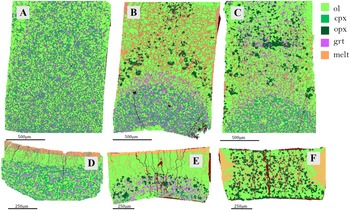
For each sample back-scattered electron (BSE) images and energy dispersive X-ray spectroscopy (SEM-EDX) maps were collected. Each map is comprised of several frames montaged together and subsequently analysed. The settings utilized for each frame were a field of view of 200 × 150 µm and 10 µs per pixel for BSE and 200 µs per pixel (S-8000) or 400 µs per pixel (Tiger). The increased pixel dwell time on the Tescan Tiger was necessary to allow for comparable counts per pixel with the maps produced on the Tescan S-8000. The high-resolution maps were used to assess the distribution of phases within the sample cells and to guide quantitative analysis. Representative phase maps for each experimental series are shown in Fig. 2.
Representative EDX maps from each experimental setup. (A) Cylinder synthesis experiment (sample S8214); (B) Hybrid experiment (sample S8152); (C) Reaction-couple experiment (sample S8222); (D) Layered powder experiment (sample S8025_A); (E) Partial melting of depleted peridotite (S8270_A); (F) Partial melting of komatiite (S8270_B). In all phase maps, garnet (grt) appears in purple, clinopyroxene (cpx) in dark green, olivine (ol) in lime green, orthopyroxene (opx) in forest green, and melt in orange.

Modal calculations
Phase maps were acquired by SEM-EDX and processed in Oxford Instruments AZtec microanalysis software version 6.1. The TruMap function applies peak deconvolution and background removal to each pixel in the EDX map. The Phase Analysis tool then performs a statistical analysis on the EDX data by comparing the measured spectra with user-defined groups and tolerance levels (e.g. garnet is identified by the presence and intensity of the Al and Cr peaks) in order to identify phases on a pixel-by-pixel basis. For the pre-synthesized peridotite rods, the entire mapped area was used. For reaction-couple and hybrid experiments, each capsule was subdivided into 2–5 zones based on phase assemblage, which varies along the capsule because of both the reaction front and the temperature gradient (Fig. S3); additional large-area maps were collected to capture systematic variations across the charge. Volumetric modal proportions (vol.%) were measured from the phase maps by pixel-based classification in ImageJ (Schindelin et al., Reference Schindelin, Arganda-Carreras, Frise, Kaynig, Longair, Pietzsch, Preibisch, Rueden, Saalfeld, Schmid, Tinevez, White, Hartenstein, Eliceiri, Tomancak and Cardona2012).
From the defined zones, average compositions were extracted by SEM-EDX (Fig. S3) to calculate local phase relations. Between 2 and 18 mapped fields (∼2500–10,000 µm2 each) were analysed per sample in the different zones. Quantitative modal estimates were then obtained by linear mass balance following Walter (Reference Walter1998) using major element oxides (SiO2, Al2O3, FeO, MgO, CaO). Between two and five phases were solved per area, depending on observed assemblages. In areas with high melt contents and many coexisting phases, particularly where pyroxene is involved, mass balance accuracy was reduced due to both analytical uncertainty and challenges in capturing true melt compositions. In addition, for the layered reaction-couple experiments, the absolute accuracy of the mass-balance solutions is limited by uncertainty in the komatiite:peridotite proportions during preparation of the capsules; this uncertainty propagates directly into the modal estimates. In such cases, pixel-based estimates are reported in parallel and used as a comparative check (see Table S2). ImageJ pixel-based values are reported in parallel for zones with high melt contents or complex phase assemblages and are used preferentially in those cases. Across most areas, the two approaches agree closely, supporting the combined methodology.
Quantitative geochemical analysis
Mineral and melt compositions were determined using a JEOL JXA-8200 electron microprobe analysis (EMPA) with five wavelength-dispersive spectrometers at the Bayerisches Geoinstitut. The calibration standards were olivine (Mg, Si, Fe), ilmenite (Mn, Ti), NiO (Ni), orthoclase (K), albite (Na), MgCr2O4 (Cr), and augite (Al, Ca). Matrix corrections were applied using the ZAF algorithm. Analytical conditions included a 15 kV accelerating voltage and 30 nA beam current. Beam diameter was adjusted between 1–5 µm depending on grain size.
The quenched melt regions were analysed with a defocused beam with a spot size of 5–20 µm with ∼50 spots per sample to minimize the effect of heterogeneous quench textures. Experimental charges are known to be affected by thermal compaction (see Lesher and Walker, Reference Lesher and Walker1988; Walter, Reference Walter1998) where the thermal gradient induces compaction of the melt away from the solid. This creates pools of quenched melt that segregated to the hot portions of the charge and the quenched product is typically composed of fine-grained quench crystals. Measuring the melt composition in the experimental charges is tricky and calls for a rigorous selection of the melt composition excluding outliers relying mainly on the FeO/MgO distribution coefficient (KD) between olivine and melt. Calculated KD values significantly outside the expected ratio of 0.35 ± 0.10 (6σ), the average value obtained during the high-pressure peridotite melting experiments of (Walter, Reference Walter1998), were excluded, the large deviation from the equilibrium value is attributed to melt migration within the cell. Quantitative compositional analyses for all the experimental runs are reported in Supplementary Table 1.
Results and discussion
Phase relations
Initial experiments were conducted at the higher end of the temperature range (1650–1690°C), guided by the thermodynamic hybrid models of Tomlinson and Kamber (Reference Tomlinson and Kamber2021). However, these experiments were too hot and yielded simple phase assemblages consisting exclusively of olivine + melt for all peridotite: komatiite ratios and experimental configurations (Table 2). Due to the narrow temperature interval between solidus and liquidus at 5 GPa, these phase relations are consistent with crystallization just below the liquidus. Recovered charges exhibit high modal olivine (up to 65–70 vol.%) and large melt fractions (up to ∼35 vol.%). Although these experiments record minimal phase diversity, they provide critical constraints on the near-liquidus behaviour of the komatiite–peridotite system at 5 GPa. In all recovered runs, temperatures exceeded the peridotite solidus; consequently, the reported residue and melt compositions reflect both reaction and partial melting, obscuring the boundary between komatiite and peridotite in the reaction cells.
Partial melting experiments
The two komatiite-only 1 mm capsules (Fig. 2F and Fig. S4C and D) show broadly similar phase assemblages dominated by olivine, orthopyroxene and melt. In both runs, olivine and orthopyroxene coexist with interstitial melt, with modal olivine contents ∼41%, orthopyroxene between 16–21%, and melt between 37–44%. In run S8269_B, minor garnet (∼9 vol.%) is also present, suggesting a slightly lower average temperature compared to S8270_B. These experiments provide important information on komatiite fractionation in absence of peridotite.
In contrast, the peridotite partial melting experiments establish a critical baseline for peridotite partial melting at 5 GPa. There has been relatively limited experimental coverage of phase relations during peridotite partial melting at this pressure, with Walter (Reference Walter1998) reporting only a limited dataset, and more recent work extending to a mildly depleted GKR-001 peridotite (Rodrigues et al., Reference Rodrigues, Yaxley and Kamber2025). The fertile peridotite 1 mm capsule (S8269_A) shows clear zoning (Fig. S4A). In the coldest portion of the capsule, a subsolidus assemblage of olivine + clinopyroxene + garnet is present. This transitions into a narrow zone containing only garnet and olivine, and finally, in the hottest region, to olivine + melt. These variations reflect the response of the peridotite protolith to the internal thermal gradient, with a progressive shift from subsolidus stability to near-solidus partial melting. The depleted experiment (S8270_A) shows the presence of a similar subsolidus assemblage in the colder area of the capsule, but in contrast to the fertile sample, orthopyroxene is observed (12 vol.%), in equilibrium with garnet, olivine and minor melt (Fig. S4B). These experiments provide a baseline against which the hybrid dataset is compared.
Hybrid experiments
In the 2 mm long capsules used for the hybrid experimental runs, the temperature gradient was exploited intentionally to study phase relations in the hybrid peridotite and komatiite system as a function of temperature. The temperature gradient is estimated at ∼30°C/mm for the 18/11 BGI standard assembly (Fig. S1) based on Al in periclase thermometry (Man et al., Reference Man, Fei, Kim, Néri, Xie and Frost2024), and is independently confirmed by variations in olivine forsterite content (Fo# = 100 Mg/(Fe+Mg) mol.) within a single capsule, which indicates a thermal range of ∼80°C within the charge.
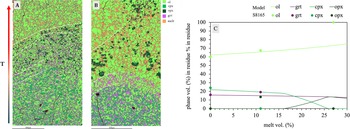
Both samples display a clear evolution in the phase assemblage from the cold to the hot zones (Fig. 3A and B). At lower temperatures, the observed mineralogy includes olivine, garnet and clinopyroxene and is melt free. With increasing temperature, clinopyroxene is exhausted and replaced by orthopyroxene, stabilizing an olivine + garnet + orthopyroxene + melt assemblage. At the highest temperatures, garnet is also consumed, leaving only olivine + orthopyroxene + melt or olivine + melt. Olivine is commonly included in orthopyroxene, whereas orthopyroxene forms an interstitial phase in contact with the melt. The hottest regions contain up to 30 vol.% melt in equilibrium with olivine.
High-resolution EDX maps of hybrid experiments for (A) depleted (S8165) and (B) fertile (S8512) peridotite compositions. White lines delineate temperature equilibration zones. Phase assemblages evolve from olivine (lime green) + garnet (purple) + clinopyroxene (dark green) at lower temperatures, to ol + grt + orthopyroxene (forest green) at intermediate temperatures, to olivine ± orthopyroxene + melt (orange) at the highest temperatures (up to 30 vol.% melt) (C) vol.% of the phases vs melt% for the 50:50 mix of depleted peridotite and komatiite showing both the experimental (S8165) and the THERMOCALC model output for the same bulk composition (calculated with THERMOCALC using tc350beta (Powell and Holland, Reference Powell and Holland1988) and the peridotite thermodynamic dataset of Tomlinson and Holland (Reference Tomlinson and Holland2021).

The phase evolution observed in both fertile and depleted runs broadly follows the predictions of the thermodynamic modelling (Fig. 3C). At low temperatures, the presence of komatiite stabilizes additional clinopyroxene relative to the komatiite-free experiments. As temperatures rise beyond the peridotite solidus, clinopyroxene and olivine melt incongruently, and orthopyroxene crystallises. Thus, the presence of komatiite leads to an increase in the volume of peritectic orthopyroxene. This reaction sequence with clinopyroxene exhaustion, and orthopyroxene appearance is clearly recorded along the capsule length and correlates with increasing melt volume and phase redistribution (Fig. 3C). However, the overarching observation is that the abundance of peritectic orthopyroxene is higher in the peridotite–komatiite hybrid experiments (∼20 vol.%) than in peridotite-only experiments at the same conditions (∼12 vol.%; S8270_A).
When compared to the phase abundances predicted by thermodynamic modelling of peridotite–komatiite mixing there is good agreement between the observed and modelled phase abundances at low to moderate melt fractions. However, at higher melt fractions, the experimental system produces pure dunite at conditions whereas the model predicts a harzburgite residue. The thermodynamic dataset used has been shown to reproduce accurately phase abundances produced during high-pressure melting of peridotite, however the model does predict that garnet is stable to higher degrees of melting than is observed in experiments (Tomlinson and Holland, Reference Tomlinson and Holland2021), probably explaining the mismatch in that phase. However, we infer the mismatch at high melt fraction principally reflects underestimation of melt volume produced in the pure olivine zone as a result of using modal estimates based on 2D compositional maps from cylindrical capsules, which may not accurately reflect the true 3D phase proportions, and in particular as a consequence of migration of melt out of this zone, indeed a pure melt pocket is observed in the upper margins of the capsule. In contrast, the thermodynamic model assumes idealized equilibrium and bulk homogenization.
Reaction-couple experiments
The reaction-couple experiments were designed to investigate interface-controlled interaction between fertile peridotite and ascending komatiitic melt at high pressure (5 GPa). As we have images and high-resolution maps of the pre-synthesised cylinders used in these runs, we are able to compare the phase assemblages and textures before and after reaction. The reacted runs consistently exhibit systematic phase zonation along the imposed thermal gradient, with phase distributions consistent with those observed in the hybrid experiments (Fig. S5). Assemblages evolve from subsolidus olivine + garnet + clinopyroxene in the cooler end of the capsule to melt-bearing regions dominated by olivine + orthopyroxene at higher temperatures.
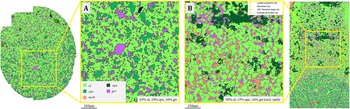
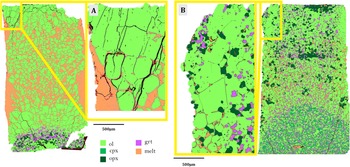
In the pre-reaction peridotite cylinder (Fig. 4A), the assemblage is dominated by olivine (65 vol.%), with significant clinopyroxene (19 vol.%) and garnet (16 vol.%). After reaction with the komatiitic melt (Fig. 4B), clinopyroxene has been completely consumed, and the residue now contains olivine (58 vol.%), orthopyroxene (15 vol.%), and garnet (16 vol.%), excluding the melt. Orthopyroxene occurs as large poikilitic grains that commonly enclose olivine and garnet, indicating crystallization from a melt phase rather than solid-state replacement. Phase abundances suggest a reaction of the form: melt1 + ol + cpx = opx + melt2. For the example shown in Fig. 4B, mass balance calculations support a reaction of ∼80 cpx + 29 ol + melt1= 63 opx + melt2. This leads to a net gain in orthopyroxene modal abundance well beyond what is expected from partial melting of peridotite under similar pressure conditions (e.g. S8270_A where ∼10% opx is observed; see also Walter, Reference Walter1998).
Phase maps from reaction-couple experiments illustrating melt–rock interaction textures. (A) Unreacted peridotite (65 vol.% olivine, 19% clinopyroxene, 16% garnet). (B) Reacted zone showing clinopyroxene loss, development of poikilitic orthopyroxene (15%) enclosing resorbed olivine (58%) and garnet (16%), and preserved melt (orange). Corner insets show the full recovered-run map for each sample; the enlarged panels correspond to regions outlined by white rectangles.

Olivine enriched zones
In both the hybrid and reaction-couple experiments, olivine-rich zones formed in both at the top and upper margins of the experimental capsule, the hottest regions as indicated by the temperature map in Fig. S1. Within these regions, olivine can reach 90–95 vol.% (Fig. 5) forming either dunite or opx-poor garnet harzburgite. The abundance of melt within these olivine-rich zones, is minor (<10%) and melt typically occurs as small inter-grain pockets. The olivine grains are large, reaching 500 μm, even in relation to adjacent orthopyroxene and garnet grains (where present).
Both fertile (A) and depleted (B) compositions show olivine (lime green)-rich assemblages in the hotter areas of the experimental capsule (see Fig. S1). In these regions, melt (orange) is minor (<10 vol.%) and occurs as small inter-grain pockets; even at higher temperatures, where melt increases slightly, olivine (lime green) still constitutes ∼85–95 vol.%.

Comparison with cratonic peridotites
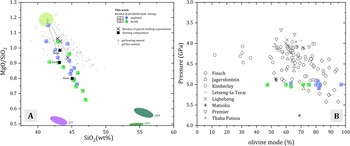
Natural peridotites undergo sub-solidus re-equilibration during cooling from the solidus to the geotherm and might also undergo a change in pressure. As a result, we cannot compare the phase assemblages of our experimental residues with natural peridotites and must instead use bulk compositions. Residue compositions were evaluated using a projection of SiO2 (wt.%) versus MgO/SiO2 (Fig. 6A).
(A) SiO2 (wt.%) versus MgO/SiO2 for experimental residues recalculated on a melt-free basis. Diamonds = residues; squares = starting composition of both peridotites and the komatiites powders; crosses = composition of the partial melting experiments for both peridotite composition and the komatiite. The arrow shows the residue trend for the peridotites and the komatiite without mixing. Natural garnet-bearing and garnet-free cratonic peridotites are shown for comparison (Canil and Lee, Reference Canil and Lee2009; Tomlinson and Kamber, Reference Tomlinson and Kamber2021). Fields for orthopyroxene (opx); clinopyroxene (cpx); garnet (grt) and olivine (ol) are also displayed. (B) Modal abundance of olivine with depth in the Kaapvaal cratonic lithosphere, olivine modes from the original publications (Boyd and McCallister, Reference Boyd and McCallister1976; Shee et al., Reference Shee, Gurney and Robinson1982; Cox et al., Reference Cox, Smith, Beswetherick and Nixon1987; Skinner, Reference Skinner1989; Boyd et al., Reference Boyd, Pearson, Nixon and Mertzman1993; Schulze, Reference Schulze1995; Saltzer et al., Reference Saltzer, Chatterjee and Grove2001; Simon et al., Reference Simon, Irvine, Davies, Pearson and Carlson2003; Maier et al., Reference Maier, Peltonen, Juvonen and Pienaar2005; Grant et al., Reference Grant, Ingrin, Lorand and Dumas2007; Simon et al., Reference Simon, Carlson, Pearson and Davies2007; Gibson et al., Reference Gibson, Malarkey and Day2008; Katayama et al., Reference Katayama, Suyama, Ando and Komiya2009; Lazarov et al., Reference Lazarov, Woodland and Brey2009; Wasch et al., Reference Wasch, van der Zwan, Nebel, Morel, Hellebrand, Pearson and Davies2009; Peslier et al., Reference Peslier, Woodland, Bell and Lazarov2010; Peslier et al., Reference Peslier, Woodland, Bell, Lazarov and Lapen2012), pressure calculated using the orthopyroxene-garnet barometer of Nickel and Green (Reference Nickel and Green1985), calculated iteratively using the Ca-in-orthopyroxene thermometer of Kohler and Brey (Reference Kohler and Brey1990). Residues of peridotite–komatiite reaction experiments are plotted for comparison.

All experimental residues plot within the triangular field bounded by the constituent mantle phases (olivine, pyroxene and garnet), as expected for internally consistent experimental charges. Most residues lie within the region defined by the melting trends of the starting materials (grey arrows), indicating that the dominant control is progressive melting within the peridotite–komatiite mixtures. However, a subset of residue zones extend to higher SiO2 and lower MgO/SiO2 than the bulk capsule starting materials, lying outside of the expected melting trend in the opposite direction to its trajectory. We interpret these Si-rich bulk compositions to result from olivine fractionation elsewhere in the capsule, as was observed in the high-temperature regions of the experimental capsules. Olivine fractionation drove the effective bulk composition of the rest of the cell to more Si-rich compositions.
The most Si-rich residues reach SiO2 contents of 47 wt.% and a maximum ol:opx ratio of 1.5 (or 60% olivine to 40% orthopyroxene). These ol:opx ratios are comparable to those found in cratonic peridotites from the Kaapvaal craton (Canil and Lee, Reference Canil and Lee2009; Tomlinson and Kamber, Reference Tomlinson and Kamber2021) particularly those equilibrated at <5 GPa (Fig. 6B). It is notable that natural silica-rich peridotites are typically sampled from a depths of <150 km (< 5 GPa) within the Kaapvaal craton. Our experimental residues lie on a steeper trend than that of natural, silica-rich peridotites. Kaapvaal and Siberian bulk peridotite compositions lie along a trend defined by the olivine–orthopyroxene mixing line, consistent with having formed as garnet-poor (or garnet-free) residues. In contrast, our residues contain significant garnet, so that our melting trends lie on a mixing line between olivine and opx–garnet. Our residue zones also have higher Al2O3 and FeO than natural cratonic peridotites. The higher FeO content of our bulk residues relative to natural cratonic peridotite is a result of the starting compositions used, both of the fertile and only moderately depleted peridotite combined with the relatively Fe-rich komatiite. The higher Al2O3 content and resulting large garnet abundances of our residues relative to cratonic peridotites are also intrinsically imposed by the choice of peridotite starting composition. Had we used a more depleted (garnet poor) peridotite starting composition more representative of the depleted cratonic lithosphere, we would expect the Al2O3 and garnet contents of the residue zones to be lower. However, it is notable that both the hybrid and reaction-couple experiments retain significant garnet in the residue (∼18% at 10% melting and ∼10% at 20% melting, with higher garnet modes reached locally in reaction-couple experiments) to higher degrees of melting than seen during partial melting of fertile peridotite at the same pressure, and more similar to residues of melting at 6 or 7 GPa. This suggests that a komatiite melt generated at high pressure can re-equilibrate at lower pressure and retain its Al-depleted garnet signature, potentially relaxing the pressure constraints on forming Al-depleted komatiites (e.g. (Waterton and Arndt, Reference Waterton, Arndt, Homann, Lyons, Ernst, Heubeck, Stüeken, Webb, Papineau, Mason, Mazumder and Altermann2026).
At the top of the capsule, the olivine-rich zones resemble high Mg# garnet dunites from Finsch, South Africa, reported by several authors (Skinner, Reference Skinner1989; Gibson et al., Reference Gibson, Malarkey and Day2008; Lazarov et al., Reference Lazarov, Woodland and Brey2009). Geothermobarometry of the Finsch dunites indicate derivation from the deep (>5 GPa), high-temperature region of the Kaapvaal cratonic lithosphere, however the dearth of xenoliths from this depth range at other locations obscure our knowledge of the deep lithosphere across the broader Kaapvaal craton.
Microtextures
Hybrid experiments
The main textural observations come from the reaction-couple experiments, even within the hybrid experiments it can be seen that peritectic orthopyroxene grains are large and are spatially associated with melt.
Reaction-couple experiments
Textural observations from the reaction-couple experiments provide evidence for transformation of the starting peridotite assemblage via interaction with an infiltrating komatiitic melt (Fig. 4). The runs can be divided in two main zones based on the observed phase abundances, with ol+opx+grt+melt at moderate temperature and ol+melt at high temperature (opx and garnet are exhausted at approximately the same point). In the moderate temperature zone, olivine displays widespread resorption textures, including embayed margins of matrix olivine and rounding of inclusions within orthopyroxene. Garnet is largely preserved and potentially redistributed. Partial resorption is evident where garnet is enclosed by, or adjacent, to orthopyroxene. Orthopyroxene exhibits cuspate and lobate morphologies that intrude into resorbed olivine, especially near melt pools (orange phase in Fig. 4B). These textures indicate dissolution of olivine and garnet and precipitation of orthopyroxene. Notably, orthopyroxene–olivine–olivine triple junctions show low dihedral angles, and thin orthopyroxene films wet or partially enclose olivine grains that are both classic signatures of melt-assisted grain boundary reactions (e.g. Vernon, Reference Vernon, van Reenen, Kramers, McCourt and Perchuk2011). The direct association of these features with preserved melt in the experimental charge allows us to link mineral textures with melt–rock reaction progress. This provides rare, unambiguous confirmation that the observed textures result from active reaction with melt, rather than post-solidus annealing or exsolution.
In the olivine-rich zones, olivines are large, and olivine–olivine–olivine intersections have straight boundaries meeting at ∼120° triple junctions, regardless of the presence of melt elsewhere in the capsule. Such near-120° junctions are the hallmark of textural equilibrium of the solid framework and indicate that intergranular melt did not wet those specific grain boundaries at quench (i.e. locally ‘dry’ solid–solid–solid junctions), consistent with melt residing in isolated pockets or channelized pathways rather than as continuous films along every boundary (Toramaru and Fujii, Reference Toramaru and Fujii1986; von Bargen and Waff, Reference von Bargen and Waff1986; Holness, Reference Holness2005). The combination of large olivine grain size and low local melt abundance is compatible with high-T annealing/coarsening of an olivine framework coupled with melt segregation away from these domains (Lesher and Walker, Reference Lesher and Walker1988; Walter, Reference Walter1998).
Comparison with textures in natural cratonic peridotites
The presence of melt lenses, cuspate reaction fronts, and poikilitic orthopyroxene mirrors microstructural features commonly described in natural samples including melt-infiltrated xenoliths from the Kaapvaal Craton (Simon et al., Reference Simon, Carlson, Pearson and Davies2007; Baptiste et al., Reference Baptiste, Tommasi and Demouchy2012; Daczko et al., Reference Daczko, Kamber, Gardner, Piazoloc and H.E2025; Kaekane et al., Reference Kaekane, Tomlinson and Hoare2026) and ophiolitic peridotite (e.g. Rampone et al., Reference Rampone, Borghini and Basch2020). These observations can imply that the peridotite–komatiite interaction in our experiments may have proceeded via reactive porous flow, wherein komatiitic melt not only infiltrated depleted peridotite but also drove localized dissolution–precipitation reactions, producing a silica-enriched residue through orthopyroxene formation.
Melt compositions
The compositions of melts and crystalline residues from all experiments are considered together in the following sections. A distinction is made between experiments involving komatiite–peridotite interaction and those representing simple partial melting, where only olivine remains in equilibrium with the melt.
Olivine-melt Fe–Mg exchange equilibrium
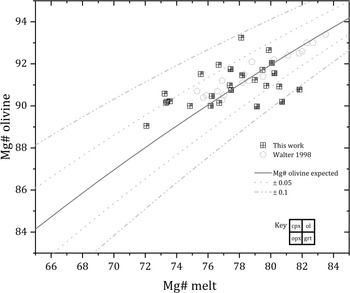
The relationship between measured olivine Mg# and coexisting melt Mg# in our experiments was evaluated using the Fe–Mg exchange partition coefficient (KD), following the expression: Mg#ol = 100/[1 + 0.35 × (100 – Mg#melt)/Mg#melt]. This formulation assumes Fe2⁺-dominated, high-temperature mantle melts. The KD value of 0.35 is the average value from the experiments of Walter (Reference Walter1998), and reflects equilibrium conditions for olivine-mafic/ultramafic melts in high-pressure systems (Toplis, Reference Toplis2005; Mibe et al., Reference Mibe, Fujii, Yasuda and Ono2006; Matzen et al., Reference Matzen, Baker, Beckett and Stolper2011) and has been widely applied in both experimental and natural contexts (e.g. Kelemen et al., Reference Kelemen, Dick and Quick1992). While we acknowledge that liquid composition can significantly affect KD values (Ford et al., Reference Ford, Russell, Craven and Fisk1983; Gee and Sack, Reference Gee and Sack1988; Kushiro and Walter, Reference Kushiro and Walter1998; Kushiro and Mysen, Reference Kushiro and Mysen2002), which might limit the applicability of any specific value, the 0.35 coefficient provides a reasonable approximation for our high-pressure, Mg-rich experimental melts.
Experimental olivine–melt pairs show systematic variation in their proximity to the predicted equilibrium line (Fig. 7). Assemblages containing olivine + orthopyroxene + garnet + melt cluster tightly within the ± 3σ uncertainty (light blue band), indicating near-equilibrium Fe–Mg exchange achieved during prolonged melt–rock interaction. The olivine + melt-only assemblages plot well within the equilibrium curve, ensuring equilibration of this sample set as well. Three experimental runs, namely S8028-A, S8003-A, S8000-A and S8025B showed disequilibrium (i.e. plotted outside 6σ), these are therefore excluded from the plots and from the following discussion. High melt-fraction zones in runs S8222, and S8152A plot outside 3σ, which we attribute to melt mixing and mobilization. It is possible that the quenched melt in the defined zone might not be the exact composition of the melt that equilibrated with the olivine measured in the recovered run. Nonetheless, the residual sum of squares (Rss) of the mass balance calculations based on the mixed bulk composition shows reasonable results, therefore all those datapoints are further considered.
Mg# of olivine versus Mg# of coexisting melt in experimental run products. The solid black line represents the equilibrium Fe–Mg exchange between olivine and melt based on a partition coefficient KD = 0.35, with envelopes at 3σ and 6σ, where σ = one standard deviation based on the experiments of Walter (Reference Walter1998). Data symbols indicate the phases coexisting with melt identified by the coloured boxes as described in the key on the lower right; open pentagons = experiments from Walter (Reference Walter1998).

What we do not observe is a clear correlation between olivine Mg# and melt Mg# throughout the dataset. As we see no evidence for crystallisation of olivine during quenching (olivine grains euhedral with no evidence for compositionally distinct rims), we attribute this to melt mobilisation and pooling along the thermal gradient in the experimental capsule. As the liquid moves and segregates by porous flow and compaction, the quenched melts are most likely to be partially displaced from the site of the original crystal–liquid exchange, whereas coexisting olivine may preserve an earlier local melt composition (Lesher and Walker, Reference Lesher and Walker1988; Kelemen et al., Reference Kelemen, Dick and Quick1992; Walter, Reference Walter1998).
Major element compositions
Because the melt is the mobile phase, the bulk mineralogy observed at quench is an unreliable predictor of glass composition. For this reason, the melt compositions from the komatiite–peridotite experiments show no systematic dependence with either mineralogy or melt fraction (F). In our dataset, melt compositions correlate most coherently with Mg# (100·Mg/(Mg+Fe2⁺) mol.) (Fig. 8). As expected for peridotite-derived liquids, SiO2 increases with increasing Mg# (a proxy for increasing melt fraction), whereas CaO, Al2O3, TiO2 and Na2O all decrease, yielding consistent inverse trends across the dataset.
Experimental melt compositions from partially molten peridotite–komatiite mixtures (squares) are plotted separately for fertile (green) and depleted (blue) systems. The filled squares indicate the coexisting phases with the melt following the key. (A) CaO vs. MgO (wt.%) for experimental melts from this study compared with natural komatiite compositions and previous high-pressure experimental data. (B) Melt compositions from experimental runs plotted as SiO2 vs MgO (wt.%). Starting materials are presented as stars. Vertical lines approximate typical compositional boundaries between komatiite (>17 wt.% MgO), picrite (13–20 wt.%), and tholeiitic basalt (<13 wt.%). Grey symbols show partial melting experiments from Takahashi (Reference Takahashi1986); Hirose and Kushiro (Reference Hirose and Kushiro1993); Takahashi et al. (Reference Takahashi, Shimazaki, Tsuzaki and Yoshida1993); Walter (Reference Walter1998); Rodrigues et al. (Reference Rodrigues, Yaxley and Kamber2025) for comparison. Coloured fields highlight the compositional envelopes of the Commondale (yellow) and Barberton (purple) komatiites (Sossi et al., Reference Sossi, Eggins, Nesbitt, Nebel, Hergt, Campbell, O’Neill, Van Kranendonk and Davies2016; Wilson, Reference Wilson2019). (C) CaO vs MgO and (D) SiO2 vs MgO for experimental melts; symbols are coloured by melt Mg# = 100·Mg/(Mg+Fe2+) mol.

The experimental melts range from picrite to komatiite with increasing Mg#. In MgO–CaO–SiO2 space (Fig. 8A, B), the experimental melts can be observed to define three compositional regimes that track the residual phase assemblage. At high CaO (>13 wt.%) melts are picrites with low MgO (<16 wt.%). The compositional vector is shallow and lies parallel to clinopyroxene, suggesting that this is the dominant phase contributing to the melt at low melt fraction (Mg#<79). The SiO2 content of the melt is relatively low in this interval, consistent with removal of silica during the peritectic orthopyroxene forming reaction. At moderate CaO <13 wt.%, the melt appears to steepen slightly as melts evolve to higher MgO and lower CaO, the trend is best explained by the increasing contribution of orthopyroxene and garnet as melt fraction increases (Mg# >89). Melts in this interval are picrites and komatiites with MgO >16 wt.%. SiO2 content increases with increasing melt fraction, consistent with the consumption of orthopyroxene. The melt achieves its highest SiO2 content in this interval, reaching 49 wt.% for experiments using fertile peridotite and 51 wt.% for those using depleted peridotite These SiO2-rich melts are typically observed within or immediately adjacent to opx-bearing reaction zones. At low CaO (<11 wt.%), melts are komatiites with high MgO (>19 wt.%) and low SiO2 (<46 wt.%) and the experimental runs contain only olivine, indicating exhaustion of pyroxene and garnet at high melt fraction. Therefore, we see that a komatiite–peridotite reaction can produce picrite, while at the same time leading to orthopyroxene enrichment at a low melt fraction then, at a higher melt fraction reaction produces Si-rich komatiite. These inferences are consistent with komatiite petrogenesis frameworks in which high-T parental melts evolve during ascent via early olivine control coupled with open-system exchange (Arndt et al., Reference Arndt, Lewin and Albarède2002; Herzberg, Reference Herzberg2016).
Melts produced in our short-cell fertile and depleted peridotite melting experiments are similar to published melts produced at comparable pressures (Walter, Reference Walter1998; Rodrigues et al., Reference Rodrigues, Yaxley and Kamber2025). Relative to these partial melts of peridotite, melts produced during peridotite komatiite reaction extend to lower MgO, reaching picritic compositions – a field typically reached by peridotite melting only at ≤3 GPa (Walter, Reference Walter1998). This is, in part, due to the lower MgO content of the bulk komatiite–peridotite system relative to that of peridotite alone. However, the melts also extend to higher CaO and (to a lesser extent) higher Al2O3 than partial melts of peridotite produced at similar pressure, even though the concentrations of these elements are only slightly higher in the peridotite–komatiite experiments than in pure peridotite, requiring an additional explanation. We attribute the elevated CaO and Al2O3 to fractionation of olivine, as was observed in the hottest part of the experimental cells, this also contributes to the depletion in MgO. Early olivine fractionation is indicated by the large size of the olivine grains and by the observation that olivine is included in orthopyroxene in hybrid experiments (e.g. Fig. 5B). The hybrid melts also extend to higher Si than melts of pure peridotite. The appearance of Si-rich picrite and komatiitic melts in our 5 GPa experiments is attributed to a combination of olivine fractionation, and the greater productivity of orthopyroxene forming reactions in the hybrid bulk composition, and the subsequent dissolution of this orthopyroxene into the melt.
Comparison with intraplate komatiitic and picritic melts
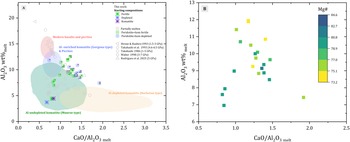
Komatiites and intraplate magmas can be classified using their CaO–Al2O3 systematics, because the Al2O3 content of a melt decreases, and its CaO/Al2O3 ratio increases with increasing depth due to the presence of garnet in the residues of high-pressure melting. The quenched glasses from both hybrid and reaction-couple charges at 5 GPa occupy Al2O3 ∼ 6 to 12 wt.% and CaO/ Al2O3 ∼ 0.7 to 1.7 wt.%. The lowest-Ca, highest-Mg melts obtained in the higher temperature experiments that left only olivine in the residue, overlap with the Al-undepleted komatiite arrays (Sossi et al., Reference Sossi, Eggins, Nesbitt, Nebel, Hergt, Campbell, O’Neill, Van Kranendonk and Davies2016). Lower degree melts, those with picritic to komatiitic compositions, lie above the Al-undepleted komatiite field in CaO–Al2O3 space (Fig. 9). The Al2O3 content of glasses produced in the hybrid and reaction-couple experiments is higher than is expected for melts produced at 5 GPa (Walter, Reference Walter1998). We suggest that this is due to olivine fractionation in our 2 mm experimental capsules, which concentrates excluded elements into the melt, increasing Al2O3 while having minimal effect on CaO/Al2O3. Our experiments were isobaric, with olivine fractionation taking place in the hot zone of the capsule at 5 GPa. In the natural system, olivine fractionation is likely to occur at greater depth where garnet is on the liquidus (Wei et al., Reference Wei, Trønnes and Scarfe1990); fractionation of garnet at higher pressure would reduce the Al2O3 content of the melt. In addition, the high CaO/Al2O3 ratio of the experimental melts may be an artifact of our choice of fertile and moderately depleted peridotite starting compositions, both of which contained clinopyroxene. In practice, the Archaean lithosphere was highly refractory, and melts produced during reaction of komatiite with this more depleted, CaO-poor substrate may shift the compositional field to lower CaO/Al2O3 so that reacted melts more closely resemble natural komatiites in Al2O3–CaO space.
(A) Plot of melt compositions from this study in CaO/Al2O3 vs. Al2O3 (wt.%) space. Also shown are experimental melt compositions from previous peridotite melting studies; grey symbols (Takahashi, Reference Takahashi1986; Hirose and Kushiro, Reference Hirose and Kushiro1993; Takahashi et al., Reference Takahashi, Shimazaki, Tsuzaki and Yoshida1993; Walter, Reference Walter1998; Rodrigues et al., Reference Rodrigues, Yaxley and Kamber2025). Coloured fields represent typical komatiite types: Barberton-type Al-depleted komatiites (orange), Munro-type Al-undepleted (green), and Gorgona-type Al-enriched komatiites and picrites (blue) and the compositional field of modern basalts and picrites (red) (Robin-Popieul et al., Reference Robin-Popieul, Arndt, Chauvel, Byerly, Sobolev and Wilson2012; Herzberg, Reference Herzberg2016; Wilson, Reference Wilson2019). (B) CaO/Al2O3 vs. Al2O3 (wt.%) for experimental melts; symbols are coloured by melt Mg# = 100·Mg/(Mg+Fe2+) mol.

Natural komatiites show variable SiO2 for a given MgO. The extremes can be represented by the silica-rich Commondale komatiite, whose parental magma has ∼49% SiO2 at MgO 36.1 wt.% (Wilson, Reference Wilson2019). The Si-rich character of the Commondale komatiite has been attributed to melting of silica-rich peridotites (Wilson, Reference Wilson2019) or melting of a previously depleted source (McKenzie, Reference McKenzie2020). Melt modification via olivine fractionation and/or reactive porous flow of komatiite through previously depleted mantle may provide another mechanism for producing variability in komatiite major element composition.
Though melts produced by reaction of komatiite and fertile peridotite are broadly comparable to simple melts of fertile peridotite with respect to Al2O3–TiO2 systematics, melts produced by reaction of komatiite with depleted peridotite have low TiO2 (0.12–0.32 wt.%) and have Al2O3/TiO2 ratios that extend to 65, more similar to melts of depleted peridotite (Rodrigues et al., Reference Rodrigues, Yaxley and Kamber2025). Komatiites with low TiO2 and Al2O3/TiO2 >25 are relatively rare but are found in most cratons (Kamber and Tomlinson, Reference Kamber and Tomlinson2019), and have been termed Ti-depleted and/or Al enriched komatiite (Sproule et al., Reference Sproule, Lesher, Ayer, Thurston and Herzberg2002). The generation of Ti-poor komatiites has been attributed to melting of a refractory source (Sproule et al., Reference Sproule, Lesher, Ayer, Thurston and Herzberg2002; Wilson, Reference Wilson2019), however our experiments suggest that they may also be produced by reaction of komatiite with depleted lithosphere.
Discussion and conclusions
Our experiments demonstrate that high-temperature interaction of deep-derived, Al-depleted komatiitic melt with peridotite at 5 GPa produces silica-rich peridotite residues via two mechanisms. Firstly, fractionation of olivine in the hottest part of the cell forms dunite zones and drives the melt to more silica-rich compositions. This silica-rich komatiite then reacts with olivine elsewhere in the cell to form orthopyroxene and silica-rich peridotite zones. Microtextural observations of small, resorbed olivine partially or wholly enclosed in large orthopyroxene grains with high-energy grain boundaries support the reaction ol + melt = opx. Secondly, the addition of komatiite to peridotite increases the bulk silica content and fertility of the system, stabilising additional orthopyroxene at the expense of olivine. The bulk SiO2 contents of orthopyroxene-rich zones within the sample cells approach those of the most silica-rich peridotites from moderate depths within the Kaapvaal cratonic lithosphere, while the olivine-rich zones resemble dunite from the deepest parts of the Kaapvaal lithosphere. In our closed system, these opx-rich zones are adjacent to cpx-rich zones stabilised at lower reaction temperature. Enrichment of cpx is, at least relatively, rare in the Kaapvaal lithosphere, this requires that the natural system is open and that the reacting komatiite, rather than freezing, escapes to shallower mantle and beyond (Daczko et al., Reference Daczko, Kamber, Gardner, Piazoloc and H.E2025).
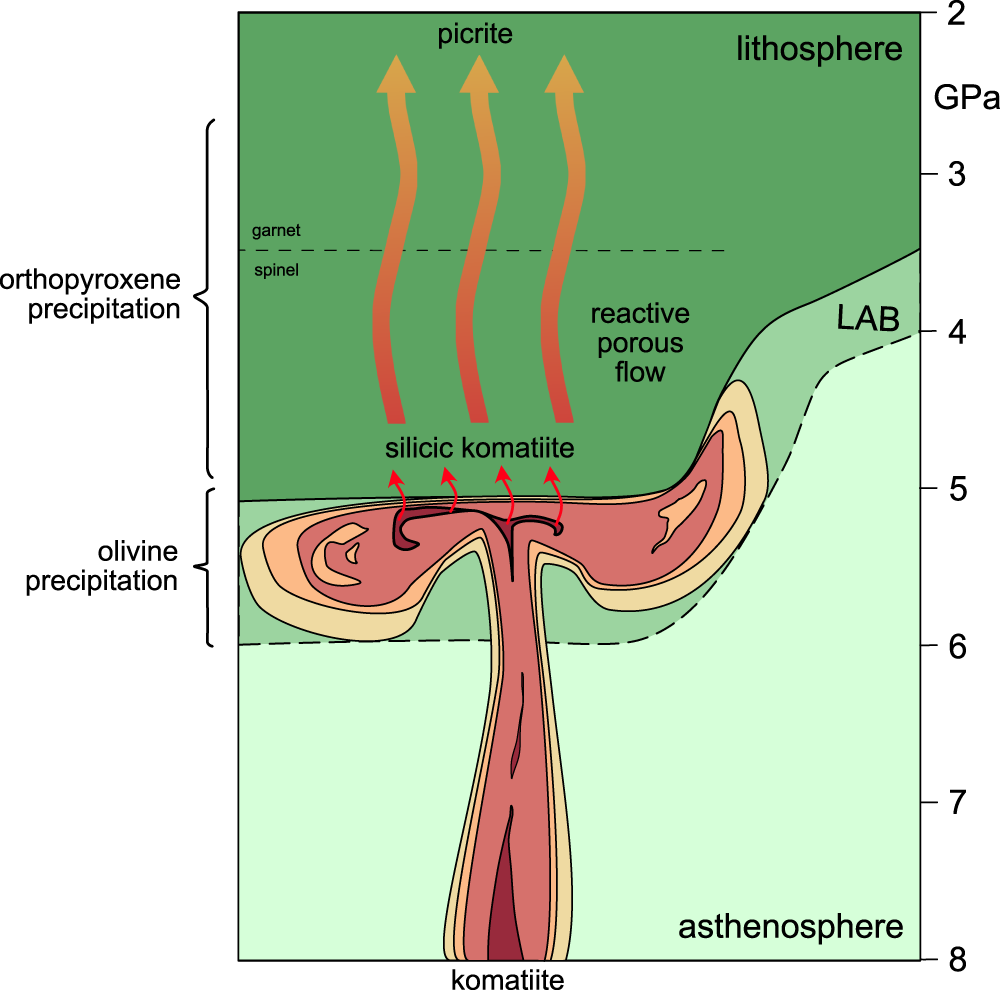
We propose that reactive porous flow of komatiite through the depleted cratonic lithosphere was able to produce a variety of peridotite compositions, from silica-poor to silica-rich. At high temperature, fractionation of olivine and/or reaction of komatiite to form olivine at the expense of orthopyroxene (Daczko et al., Reference Daczko, Kamber, Gardner, Piazoloc and H.E2025) leads to the formation of olivine-rich lithologies in the deep mantle. Olivine is on the liquidus in Al-depleted komatiite to ∼9 GPa (Wei et al., Reference Wei, Trønnes and Scarfe1990), and so is the first phase to fractionate from the melt during cooling. Olivine phenocrysts formed at deep mantle conditions within ascending komatiite (Wilson and Bolhar, Reference Wilson and Bolhar2021) testify to the possibility of high-pressure olivine fractionation. The importance of deep fractionation of olivine may be somewhat masked by ubiquitous shallow olivine fractionation in most komatiite flows (e.g Waterton and Arndt, Reference Waterton, Arndt, Homann, Lyons, Ernst, Heubeck, Stüeken, Webb, Papineau, Mason, Mazumder and Altermann2026). Reactive crystallisation of olivine from the ascending komatiite progressively modified the melt to a more silica-rich, orthopyroxene saturated composition. Eventually, the silica content of the melt reached the peritectic in the incongruent forsterite–enstatite–quartz system, and the melt began to react with peridotite to form orthopyroxene at the expense of olivine, producing silica-rich peridotites. Based on the modern-day vertical distribution of silica-rich peridotites in the Kaapvaal lithosphere (Fig. 6B), we suggest this occurred at ∼5 GPa. Mantle modification during reactive porous flow of komatiite is expected to obscure or obliterate any systematic geochemical trends related to original lithosphere formation.
Reactive percolation also alters the composition of the melt leading to increased compositional variability. Our experimental melts change from komatiite to high-silica komatiite and high-silica picrite to picrite as we form first olivine and then orthopyroxene with decreasing reaction temperature (Fig. 10). Modification of the melt composition during reactive porous flow provides one mechanism for reconciling the observation that, while silica enrichment appears to be pervasive in the Kaapvaal cratonic mantle, the volume of komatiitic lavas erupted at the surface is relatively small. Such a process may also provide one mechanism for reconciling the high proportion of preserved Archaean basalts with the expectation that deep mantle melting predominantly produces komatiitic liquids (Walter, Reference Walter1998).
Schematic model showing the effect of reactive porous flow of komatiite through depleted cratonic lithosphere.

Though our experiments demonstrate two key mechanisms whereby reactive porous flow of komatiite through the depleted lithosphere could produce peridotite and komatiite with variable silica contents, direct comparison with natural compositions is hampered by our choice of experimental starting materials. The peridotites used are too fertile, being too rich in CaO and Al2O3 such that the experiments stabilise a significant proportion of garnet and clinopyroxene. A garnet-free depleted peridotite (Mg# 92–93) composition would more closely replicate the composition of the cratonic lithosphere prior to melt–rock reaction. Secondly, our komatiite composition is too Fe-rich, suppressing the bulk Mg# of the residue and melt and contributing to the stabilisation of garnet and clinopyroxene. Finally, use of a more silica rich komatiite (e.g. higher degree melt) would have also increased orthopyroxene productivity. Future experiments will investigate the interaction of komatiite with depleted, cratonic-like peridotites compositions.
Supplementary material
The supplementary material for this article can be found at https://doi.org/10.1180/mgm.2026.10206.
Acknowledgements
This research was funded by the European Union (ERC-CoG-2020 LITHO3, 101044276 to ELT). Views and opinions expressed are however those of the authors only and do not necessarily reflect those of the European Union or the European Research Council. Neither the European Union nor the granting authority can be held responsible for them. The iCRAG SEM-EDX and LA-ICP-MS laboratories at Trinity College Dublin received funding from Science Foundation Ireland (SFI) awards 13/RC/2092 and 13/RC/2092-P2. We thank Raphael Njul for sample preparation, Detlef Krauße for assistance with EMPA, and Lianjie Man for support with experiments quantifying the temperature gradient. We are also grateful to Balz Kamber for discussions of the early experiments and to François Faure and Pedro Waterton for constructive reviews.
Competing interests
The authors declare none.



 Open access

