

I Introduction
Based on the descriptive analysis of the economic, social, and political context in Part I of this volume, and the various thematic studies in Part II, this final chapter provides an overall institutional diagnostic of Benin. This is done in three stages. First, we provide a summary of each previous chapter, broadening it in some instances to strengthen the conclusion and emphasising the institutional implications. Placing these summaries side by side makes it is possible to draw up a shortlist of the key institutional weaknesses that hinder Benin’s development. Second, the analysis goes a step further by reflecting on the proximate causes of these weaknesses, and the deep factors behind them. This reflection thus provides a reasonably complete diagnostic of the institutional challenges faced by Benin. This diagnostic then feeds, in Section IV, into an exploration of possible and feasible policy reforms to address some of the challenges in order to promote sustainable and inclusive economic development in Benin. Given the uncertainty at the time of writing about possible drastic changes in the political and administrative landscape due to the rise of Patrice Talon to the presidency, some tentative reflections have been added to this section under the title “Are We Witnessing a Regime Change?”
Before getting into the crux of the matter, several warnings are necessary about the scope of the diagnostic.
The first warning concerns the need for the diagnostic to focus on Benin per se and not on Benin as comparable to or very different from other countries in the same region and at a comparable level of development. It is always tempting to establish a diagnostic of a case by comparing it to other cases that would constitute a kind of norm. In Chapter 3 of this volume, Benin was compared to neighbouring sub-Saharan countries in an attempt at identifying features that would be specific of Benin. Few strong differences were observed. Likewise, the in-depth analysis in Chapters 4–8 may point to institutional weaknesses that are not necessarily specific to Benin. At this stage of the analysis, however, this is not an issue. What matters is to what extent those institutional weaknesses are obstacles to faster and more inclusive development in Benin, the focus of our diagnostic. What prevents Benin from doing better may well be common with other sub-Saharan countries. As long as these countries cannot be considered as uniformly more successful than Benin on their development path, or as models that should be imitated, it matters little for all those concerned by Benin’s development.
The second warning is somewhat related to the previous one, although of more conceptual relevance. The kind of institutional diagnostic we are about to draw goes from institutions to development. It tries to identify institutional weaknesses that hinder development, their causes, and, possibly, directions of institutional reform. When analysing proximate causes and deep factors behind those weaknesses, however, it cannot be ignored that low development itself may be responsible for institutional weaknesses. As emphasised by many authors – see in particular the introductory chapter in Baland et al. (Reference Baland, Bourguignon, Platteau and Verdier2019) – the relationship between development and institution is circular. There is a clear cross-country correlation between the level of development, roughly measured by gross domestic product (GDP) per capita, and the quality of institutions, as estimated by synthetic indicators in international databases. The correlation is still stronger when using cross-country panel data. But the causality clearly goes in both directions. Low development is an obstacle to institutional improvement and weak institutions hamper economic development. Benin is no exception. Yet, the effectiveness and policy relevance of the diagnostic exercise to be undertaken must focus precisely on whether the institution–development circularity may be broken on the institutional side and how. This, of course, does not prevent recognition of the constraints that development may impose on institutional reforms.
The last warning is about the status of policy recommendations in an analytical framework where the political economy consequences of the institutional setting of a country are fully taken into account, as could be seen in several of Chapters 4–8. There is a kind of ‘political economy curse’ in economic analysis. No policy recommendation can really be made given that policy decisions are completely endogenous. There is thus a risk that policy conclusions can be considered as wishful thinking.
There are various cases where this risk is limited, though. First, there may exist reforms that would improve the welfare of most actors in society, if not in the short run, at least over not too distant a horizon. If so, identifying them and introducing them into the public debate is of prime importance. Second, a desirable reform for faster and more inclusive development may be opposed by powerful groups of interest today. Yet, the distribution of political power may change in the future and it matters very much that those who could get more control over policy should be aware of such a reform. Third, external factors – donors, neighbouring countries’ policies, commodity prices, and so on – play a role in shaping the set of politically feasible reforms. It is important to be aware of what possible changes these factors may imply.
II Identifying Institutional Constraints on the Development of Benin
This section provides a summary of the previous chapters of this volume that emphasises key institutional weaknesses that are likely to hinder economic development. In some cases, additional considerations are offered that broaden or generalise the analysis and its conclusions. The same organisation is used as in the previous chapters of this volume, with the first three summaries describing the socio-economic and socio-political context of development in Benin and the following five focusing on critical areas of that development. The section ends with a list of the main institutional weaknesses, which forms the basis of our institutional diagnostic of Benin’s economic development in Section III.
A The Socio-political, Economic, and Institutional Context of Development in Benin
1 The Socio-political Context
Chapter 1, by Jean-Philippe Platteau, emphasises the multiplicity of ethnic groups in Benin, some of which also live beyond the country’s borders. The question therefore arises as to whether such a high degree of ethnic diversity is an impediment to the long-term development of the country. Here, it is useful to distinguish between economic and political effects. Regarding the former, the idea that a potential advantage of ethnic diversity lies in skill complementarities between ethnic groups applies well to Benin, where groups such as the Yoruba and the Bariba have over time developed useful skills and experience in all sorts of trading business while many other groups have specialised in agriculture, for example.
Turning now to the political effect, ethnic diversity can create political instability, and, in this respect, the proliferation of political parties formed on an ethno-regional basis may appear worrying. Such an instability was particularly pronounced in the first decade after independence, and even during the subsequent Marxist–Leninist period, despite the authoritarian rule that was observed then. It was only in 1990, with the Renouveau Démocratique (Democratic Renewal), that the political system apparently stabilised into a liberal democratic regime, for which Benin has often been praised by donors. The democratic regime (with the economic liberalisation that goes with it) seems to have been stable, because it restored former post-colonial trade-and-wealth clusters attached to some prominent ethnic groups, which was reassuring for the donor community. It is noteworthy that, since the change of regime initiated by the Renouveau Démocratique, four presidents have succeeded each other in democratic elections, never violating the two successive mandates ceiling imposed by the constitution. On the other hand, the rotation at the highest levels of political power (presidency, parliament, and ministerial positions) of personalities belonging to different ethnic groups and regions offers a reassuring picture.
Behind the democratic façade, however, a fierce struggle opposes several wealthy men, who lead political factions based on ethnic and regional affiliations, but also based on other identity markers. Especially destabilising is the opposition between the three main branches of the dominant ethnic group (the Adja-Fon): struggles inside a group may thus be more damaging than tensions between various groups and, in the case of Benin, the Yoruba, the Bariba, and the Atacora (the three other main ethnic groups) have continuously played a key refereeing role since the time of independence, whether in an authoritarian or a democratic setting. Towards the members of their faction the Big Men or oligarchs behave as genuine patrons, implying that in return for their support and loyalty they are committed to distributing various kinds of advantages down the vertical chain at the apex of which they operate. Because they consider state power as a privileged instrument to advance their particular business interests, they seek to take control of it. Their preferred tactic to achieve that aim consists of gaining the support of a professional politician by financing his campaign expenses, or directly competing for high political positions, including the presidency. Given the multiplicity of factions, they need also to strike alliances with several other factions and small political parties, which they generally do by encouraging their regrouping under the umbrella of a wider political bloc or confederation.
Alliances are typically unstable and generate unstable policies. This feature of Benin’s political landscape is essentially explained by two factors: (1) the lack of mutual trust between the oligarchs and the resulting lack of credibility of their promises; and (2) the existence of multiple oligarchs naturally tempted by the short-term gains of coalition shifts and outmanoeuvring of rivals. An example of the resulting policy instability is provided by the wavering between public and private management of the cotton sector over the last ten years or so. Policy instability and the consequent infeasibility of long-term planning are not the only deleterious consequences of the patrimonial conception of the state among multiple greedy oligarchs and politicians. Another perverse consequence is a demoralising effect on the population, which witnesses a succession of obscure political manoeuvres as well as scandals whose most common manifestations are sheer favouritism, abuse of public positions, tax evasion, and the embezzlement of public resources. Accusations of embezzlement and rent capture concern not only prestigious construction projects, but also programmes that are critical for the well-being of the population and the long-term development of the country (such as water, electricity, and other vital infrastructure projects). In a context where most of the misdeeds and extortions stand unpunished or uncorrected, it is not surprising that the people of Benin have a particularly deep mistrust of tax authorities and the judiciary system. The positive effect of a legacy of pre-colonial centralised state organisations is thus undermined by an opaque political game in which key business actors play a major role.
The suggestion has been made that people’s mistrust of public administrations in Benin is the consequence of interpersonal distrust, possibly due to the ethnic fragmentation and as a legacy of widespread slave trading. Based on rough comparative evidence from the Afro Barometer, this seems to be untrue: if the citizens of Benin have a comparatively strong mistrust in some important institutions, they do not exhibit particularly strong distrust in their day-to-day interpersonal relations.
Major institutional hurdles, to which we shall return in Section III of this final chapter, seem to be the environment of policy instability, deep inequalities, and widespread corruption that characterises Benin. Behind this adverse environment lies a neo-patrimonial political system over which no single figurehead has exerted complete control until recently (2016). With the accession of a business oligarch, Patrice Talon, to the presidency and the concentration of powers in his hands, a major transformation of the country’s political scene has occurred. Whether the new situation can be a game changer is an important question to which we return at the very end of this chapter.
2 The Economic Development Context
Benin is a poor country whose development since the turn of the present century has lagged behind many low-income countries, including in sub-Saharan Africa. As is stressed in Chapter 2, by Romain Houssa and Paul Reding, its comparative advantage lies in two key sectors: cotton exports and illegal re-exports of manufactured imports to Nigeria. The latter has its roots in the long and porous border with Nigeria and the protection of manufacturing industry being substantially higher there than in the West African Economic and Monetary Union (WAEMU) customs union to which Benin belongs. This allows Benin to share the oil rent of its giant neighbour. Together with the importance of cotton exports, this actually gives Benin some of the qualities of a resource-rich country, including being dependent on world commodity prices and experiencing Dutch disease – through illegal imports from Nigeria, the counterpart of Benin re-exports, which crowd out some domestic activity – as well as its governance problems.
Even though cotton exports and the cross-border trade with Nigeria virtually make Benin a commodity exporter, there is a substantial difference with other developing countries sharing that characteristic. It is that the diverted oil rent is exploited by the informal sector and thus benefits directly a large segment of the non-agricultural unskilled labour force. Thus, there is a dualism between the two major sectors of the economy: a rather formal organisation of the cotton sector versus necessarily informal arrangements within the cross-border trade with Nigeria. This dualism is a key specific feature of the Beninese economy.
Natural resources or primary commodities rarely provide exporters with a stable long-run engine of development. Benin’s growth performance over the recent past has been mediocre. The ten-year mean annual rate of growth of GDP per capita has fluctuated at around 1.1 per cent. Labour productivity has grown roughly at the same pace, essentially as the result of labour movements out of low-productivity agricultural activities towards more productive sectors. Yet, this did not prevent productivity from declining in most of these sectors, whereas it remained stagnant in agriculture.
This poor growth performance partly originates in the two major sectors of the economy: cotton production and cross-border trade with Nigeria. Cotton production in Benin has long been trailing that of other West African countries, mostly because of institutional instability in the organisation of production and commercialisation. On the other hand, re-exports to and illegal imports from Nigeria have created a huge low-productivity informal sector that may have crowded out better economic opportunities. Informality is indeed markedly higher in Benin than in most countries in the region.Footnote 1
Low rates of labour productivity growth in the other sectors of the economy are a major concern too. Whereas in the informal segment of these sectors (which is huge) low labour productivity is caused by a lack of capital, in the formal segment it stems from low capacity utilisation and inefficient organisation. An additional issue is land tenure insecurity. The problem seems particularly important in urban and peri-urban settings, as well as in rural areas in which significant migrant groups coexist with the native population. The response of the state has been hesitant and numerous changes have been made to the 2013 Land Law, which has faced many enforcement difficulties.
Prospects for faster and more stable growth in Benin lie in the diversification and restructuring of the economy. This might be possible in agriculture, as exemplified by the recent surge in pineapple exports. Some land is still available in the north of the country while yields are still low throughout the country and could certainly be improved. Progress would require more efforts in enhancing agricultural productivity and developing transport infrastructure, notably rural roads in the north. Exporting transport services through modernising the Cotonou port and transforming it into a major hub for the whole region, including Nigeria and Benin’s hinterland, is also envisaged. Progress on these diversification fronts is presently limited. If more were to be done, however, Benin’s long-run development would remain essentially based on commodity exports, with all their shortcomings.
Development strategies anchored in more knowledge-intensive activities offer better and less volatile returns than traditional activities based on raw agricultural products. However, such a re-orientation of the economic development strategy would represent a drastic change, as it necessitates huge investments in human capital to allow the country to move up the technological ladder. Over the last decades Benin has made noticeable progress on the educational front and this is a step in the right direction. Yet, this positive assessment must be qualified in two ways. First, Benin started from a very low basis, and its achievements in terms of the literacy of the population remain very disappointing. Second, much of the educational progress is in the form of rising gross enrolment in primary (and post-primary) schooling. However, the quality of education has not been improved, and has probably deteriorated during the period of increasing admissions into the schooling system.
Diversifying activity away from raw agricultural commodity exports would also require noticeable investments in infrastructure, like power supply and telecommunications. Benin is among the countries with the lowest consumption of electricity per capita, and much below the sub-Saharan median in terms of internet servers per inhabitant.
Benin’s development is not only slow, it is unequally distributed. The coastal cities of Porto Novo and Cotonou, and their hinterland, constitute the growth pole of Benin’s economy. It is in their tiny departments that poverty is kept under control, unlike in many other parts of the country where it remains intolerably high. Overall monetary poverty seems to have increased over the last decade, the same being true of inequality in consumption expenditures. Development in Benin thus appears to be unbalanced and to be marked by big spatial disparities. The northern part of the country, in particular, suffers from a lack of critical public investments, in spite of the fact that its political representatives have not been consistently deprived of access to the highest levels of state power. Lopsided spatial development has been the result.
One of the most pressing concerns regarding the development pattern of Benin is its sustainability in the medium and long run. As it stands, the economy remains heavily dependent on external financial flows, and official development assistance in particular. Although slowly decreasing, the latter still amounts to more than 6 per cent of GDP – above the median of sub-Saharan countries. The ongoing structural transformation of the Beninese economy does not offer the prospect of a foreseeable reduction in such dependence on external financing. Indeed, the significant decrease in the share of agriculture in domestic value-added has not been associated with a corresponding increase in the share of tradeable manufactured goods, but rather with a rapid increase in the share of non-tradeable services. Directly related to this weakness is the low diversification in export goods.
It is difficult not to relate Benin’s poor development performance and prospects to the way institutions have been working and still work today. Even under a so-called Marxist regime, the general long-term interest did not prevail, as key sectors of the economy, banks and financial institutions in particular, were simply appropriated by President Kérékou and his northern clique for their own short-term benefit. Albeit in more subtle forms, this kleptocratic system survived through the ensuing Democratic Renewal period, as witnessed by the continuing meddling of politicians in the economy and of businessmen in politics: the oligarchs acting behind the scenes of formally democratic institutions make key decisions in, and appear to be the effective owners of, parastatals and independent private corporations formally outside their control. This is especially patent in the case of the cotton sector, but really affects the whole economy.
Such a characterisation of Benin’s development is fully consistent with what is observed on the poverty and inequality fronts. The comparability of data over time is generally limited in this area. But, based on household surveys, few countries have seen an increase in the proportion of poor people in the population over the last ten years or so. Still fewer have witnessed the strong and continuous increase in inequality observed in Benin since the turn of the millennium.
3 Appraisal of the Quality of Benin’s Institutions
Three types of evidence on the quality of institutions in Benin and the way they could affect development performance are considered in Chapter 3, by Romain Houssa and François Bourguignon: synthetic indicators, as available in cross-country databases; a specific opinion survey among various types of local decision makers; and an analysis of the institutional implications of identified binding economic constraints in several recent growth diagnostic exercises. These various sources converge in pointing out several institutional weaknesses that hamper an acceleration of development in Benin, even though they may not always agree on the severity of these institutional constraints.
Corruption is unanimously seen as the most serious impediment to the good functioning of institutions and a favourable development context. It is found to affect practically all sectors of the economy at all levels of responsibility. This is recognised and duly emphasised by both the respondents to the opinion survey and the authors of growth diagnostic exercises. However, comparison with other countries in West and Central Africa or countries that have outperformed Benin over the last decades is less conclusive. If the World Bank Enterprise Surveys find that, from the point of view of business, the situation in Benin is substantially worse than in the average sub-Saharan country, country-by-country comparison leads to different conclusions. As can be appraised through synthetic indicators, the degree of corruption in Benin turns out to be roughly comparable to that in neighbour countries. It might even be lower than in several countries that nevertheless grew faster than Benin over the last twenty years, this being true today as well as ten or twenty years ago, when the GDP per capita was much smaller. Such findings may reflect the conceptual imprecision of synthetic corruption indicators, but they also call for a more nuanced analysis of the effects of corruption on the development of a specific country. Corruption may have other deleterious effects on development but, even when sizeable, it may not prevent fast GDP growth in an economy endowed with a solid exogenous engine of growth, as is the case in several Asian countries that rely on labour-intensive manufacturing exports.
Weak public management is the second unanimously recognised source of hindrance in the process of development. Of course, this may partly be the consequence of corruption. Here too, the cross-country difference in synthetic indicators of the quality of public management across countries is not strongly unfavourable to Benin. Yet, some sectors are singled out as particularly weak by survey respondents and analysts. Three of them are repeatedly singled out. The tax system is found to be complex and the tax administration grossly inefficient in collecting tax revenues, with clear adverse consequences for the dependency of Benin on foreign finance. The power sector, run by a state-owned monopoly, is found to perform badly due to weak or ineffective regulation.Footnote 2 Finally, if the delivery of social services, especially education, is found to have made progress in quantity, this is not the case for quality. Benin underperforms compared to other sub-Saharan countries by a wide margin and, from that point of view, lags very much behind the countries that have grown faster despite having the same initial level of income as Benin twenty years ago.
The opacity of government policy making with respect to the public is another weakness stressed by survey respondents. This is probably to be imputed to weak public management, but it is also a sign of deficient political institutions, generally regarded as weaker than in other sub-Saharan countries. On this point, however, survey respondents are somewhat ambivalent. On the one hand, many of them tend to trust constitutional institutions and are confident about the success of some current reforms. On the other hand, most also agree that the whole system is deeply corrupt and, because of this, often dysfunctional. Such a severe judgement even appears in the opening remarks of the official Country Partnership Framework, a cooperation agreement between the Government of Benin and the World Bank.
Available statistics show that informality is more developed in Benin than in the average sub-Saharan country. Growth diagnostic analyses suggest that it has a cost in terms of tax revenues, job precariousness, and lack of control over the economy. This is not a point that appears strongly in the opinion survey, maybe because of the presence of a substantial group of informal firm managers in the sample. It is not a dimension of institutions that appears explicitly in the synthetic indicators provided by international databases either. The reason why informality is more developed in Benin than in most developing countries, including in sub-Saharan Africa, is clear: it is more the result of the importance of the illegal cross-border trade with Nigeria than the result of some specific institutional failure. Yet, its consequences for the functioning of institutions are serious.
A last area deserves mention, even though it is not prominent in the opinion survey and not explicitly covered by synthetic indicators: it is the way land allocation is managed. One of the growth diagnostic studies of Benin mentions that land is becoming scarce in the southern part of the country, so that managing it efficiently will become more and more crucial in the future. As in the other sub-Saharan countries, land operations raise difficulties in Benin because of the uncertain status of ownership and the legacy of customary practices. A reform was advanced in 2013, which, according to the opinion survey, is found to be complex and does not really resolve the sources of land conflict. Land laws and their implementation show weaknesses whose economic consequences may be considerable in the future, especially in a country with a comparative advantage in agriculture.
B Some Critical Areas
1 Business and Politics: A Clear Case of Complete State Capture
Benin does not differ from many other countries in the collusion that exists between business and politics. Yet, it may be exceptional in the extent of that collusion, as illustrated by top businesspeople having now captured not only the economy but also the executive, and possibly legislative power.
The original piece of research by Rafael Ch Duran, Matthias Coffi Hounkpe, and Léonard Wantchekon in Chapter 4 focuses on local governments and the deals they make during electoral periods with businesspeople who often end up in full control of local politics. By interviewing some 189 candidates in local and legislative elections about the way their campaign was financed and the kind of agreement made when business was involved, they show the importance of business finance in an electoral democracy where public campaign funds are limited or even non-existent and electoral institutions are weak. They also analyse the levers that business thus acquires in relation to the local economy.
The average cost of a local election campaign is around US$36,000 and US$160,000 in rural and urban areas, respectively. On average, these amounts are equivalent respectively to eighteen and eighty times GDP per worker; that is, a campaign costs roughly the equivalent of employing eighteen to eighty workers during a full year. Business support is on average around 50 per cent of these amounts, the rest being contributed by party or party coalition funding. In exchange, politicians, if elected, must compensate firms through various channels, including policy concessions and public procurement in their favour, patronage, or the awarding to funding firms of some control over the recruitment of local political executives.
Chapter 4 also makes use of the natural experiment provided by the electoral reform undertaken by the present administration a few months before the 2019 local legislative election. This reform aimed at reducing the number of competing parties by forcing them to regroup. It was justified on the grounds of the extensive fragmentation of parties in Benin, which bears a relation to the ethnic diversity of the population. At the time of the reform of the electoral code, some 250 parties were listed! Whether due to frictions in the adjustment process or deliberate political strategy, it turned out that only two party groupings were validated for the 2019 election. For that election, the pre-existent multiparty system had collapsed to a two-party bloc competition.
The natural experiment arises from the fact that, prior to the 2019 election, many communes had a multiplicity of parties competing with each other, as was observed in the 2013 election. Since no more than two contenders were allowed in the new election, complying with this rule drastically reduced the extent of electoral competition. In some other communes, however, it was already the case that the competition was between the two new party coalitions, as could be judged from the 2013 election. In the absence of signs suggesting that the competition had changed by 2019, the latter communes thus provided an interesting ‘control’ group to be compared to the other communes where the reform was exogenously modifying political competition.
If the reform is interpreted as reducing the uncertainty about who is going to win the election, sponsoring firms should spend less on protecting their vested interest and/or impose weaker conditions in case of victory. It may also be surmised that, with fewer contenders, firms will spend less on supporting the candidates and, because they have less to recoup, they will be less demanding in case of victory. In other words, there should be less state capture, or less control over local governments’ action, in the communes affected by the reform. This is indeed what was observed. Funding firms were less insistent on having allies appointed in key executive positions in local governments. Irrespective of the reform, the same observation could be made in communes where the previous election was less contested – that is, where the incumbent had won with a large margin.
These results are very interesting because they shed light on the extent of state capture by business interests, and on some of the determinants of state capture. Clearly, more public funding of candidates, a cap on private funding or on the total cost of campaigns, or strict requirements of transparency of campaign funding should all contribute to reducing the influence of private business on electoral outcomes and state capture. The sheer ability of business to influence political outcomes would thus be reduced and its secretive interventions would be publicly exposed, with the effect of reinforcing the political opposition.
The discussant of this chapter, Cesi Cruz, is right in stressing that the relationship between local politicians and firms may be more complex than described by candidates to local elections when we notice that both local politicians and firms are part of networks – political parties, multiunit firms, and their network of suppliers. Deals might thus be at the network level; that is, between national- or regional-level politicians or parties and big firms.
Extending the analysis in that direction would be a formidable undertaking. Without going so far, it may simply be stressed that the business–politics relationship analysed at the local level in Chapter 4 clearly generalises at the national level. The rise of a major businessman, Patrice Talon, to the presidency in the 2016 election, and the circumstances of that election, perfectly fit that analogy.
State capture by private interests in Benin is observed at both the local and the central levels, even though Chapter 4 suggests that the 2018 electoral reform may have weakened it somewhat at the local level. At the national level, however, the rise of Talon to power may indeed be considered the ultimate stage of state capture. That he was a candidate in the first place is easily understood given the animosity that had developed with President Yayi, despite having been the main financial supporter of his re-election in 2011. Being practically impeached in Benin, and wary that this situation would endure if the candidate of continuity, Lionel Zinsou, were elected, the conquest of the presidency was a rather logical move. Here is a radical form of political strategising on the part of the business elite. The rival business tycoon, Sébastien Ajavon, was also a candidate for precisely the same reasons; that is, to regain rents initially confiscated by the previous government. Eventually, the latter joined forces with Talon in the run-off of the election, despite their long-lasting rivalry.Footnote 3 Beninese politics had been overwhelmed by big business.
A deep cause of this rather successful capture of the state by business, at both local and central levels, may lie in the relative weakness of central political power due to the political fragmentation of the population: 250 political parties and 48 candidates at the last presidential election. Even under the democratic presidency of a seasoned ruler like Kérékou between 1996 and 2006, party coalitions in power were fragile and prone to corruption, whereas securing alliances to win an election was particularly costly. Indeed, the number of major corruption ‘affairs’ involving high-level politicians over the last fifteen years or so is quite impressive. Although less publicised, it is likely that such affairs occur in large numbers at the local government level.
Another conclusion of this reflection on business and politics in Benin is the absolute necessity of effective transparency in electoral financing, at both the national and local levels. In effect, a law does exist that limits the total amount that can be disbursed in a campaign, and official campaign accounts are required from candidates. These accounts are audited, and candidates may be charged for having spent more than the maximum amount allowed on their campaign.Footnote 4 Practically, however, the system remains extremely opaque and/or is gamed by the main actors.
It would be difficult to conclude this brief analysis of the relationship between business and politics without mentioning the political consequences of the 2018 reform of the electoral code for the April 2019 parliament election. Because of the noise created by a reform that forced some regrouping of parties within bigger alliances, only two groups, both favourable to President Talon, were finally allowed to compete in that election. The election was boycotted by the opposition, which strongly condemned this de facto breach of democracy. A political crisis unfolded, betraying an unexpected fragility in the institutions of a country that was praised precisely for its respect of the rules of democracy.
2 The Management of the Cotton Sector
Cotton is the backbone of the formal Beninese economy. As mentioned in the first paragraph of Chapter 5 on the cotton sector by Barthélemy Honfoga, Romain Houssa, and Houinsou Dedehounaou, it accounts for 13 per cent of GDP, 60 per cent of (formal) export revenues, 45 per cent of taxes – excluding tariffs – and 60 per cent of manufacturing output – through ginning and seed oil extraction factories. Overall, it is estimated that around a third of the Beninese population depends on the cotton sector. The growth rate of GDP is very much influenced by the cotton activity. Over the last ten years or so, more than 40 per cent of the variation in the growth rate of GDP was explained by the variation in the growth rate of the production of cotton. Yet, cotton can hardly be considered as a growth engine for Benin’s economy. After substantial growth from 1980 to the mid-1990s, production did not grow for the next twenty years – it even fell dramatically in the mid-2000s. It is only during the late 2010s that production has been able to overtake its 1996 record level, but data are still provisional.
Of course, the institutional set-up of the sector is of prime importance for its performance and dynamism. From that point of view, the history of cotton in Benin since independence is that of a succession of supposedly deep reforms. Overall, however, they only amounted to a change in the lead actor of the sector. While this actor was the state back in the Marxist–Leninist period of governance, it is close to a single private conglomerate today, a conglomerate that happens to belong to the current president. Except for this, and despite the liberalisation that took place – as in the rest of the economy – after 1990, the organisation of the whole sector has remained pretty much the same, sheltering most actors against the competitive pressures of the market.
Production by farmers is controlled through the allocation of inputs – cotton seeds, fertilisers, and pesticides – that results from coordination mechanisms and bargaining within the Interprofessional Cotton Association (AIC). The production of seed cotton is allocated to the eighteen existing ginneries, again through a process that results from bargaining among the main actors of the sector. The price of inputs and the allocation of credit to farmers are set within the AIC and subsidised by the government. The farmgate price is also largely decided by the AIC, even though formally set by the government. It depends only very loosely on international prices – for example, after a substantial increase in 2011, the price paid to producers has practically not changed over the following seven years, despite international prices having increased by more than 50 per cent in local currency.
Variation in the management of the cotton sector over time concerned mostly the provision of inputs upstream, and the ginning of cotton and its commercialisation downstream. The management structure has thus gone through various transformations during the last twenty-five years. A state company, Société Nationale pour la Promotion Agricole (SONAPRA), was initially responsible for all the preceding activities. Then some liberalisation took place in the early 1990s for the provision of inputs, an activity in which a businessman, who would much later become President of Benin, Patrice Talon, soon acquired a dominant position. The ginning market was opened a bit later, with eight new ginneries being created, several of them controlled again by Talon’s group. Still later, the coordination of the whole sector, initially under the responsibility of SONAPRA, was privatised and entrusted to the AIC. In the process, Talon was able to strengthen his grip on the whole sector by controlling the ten ginneries initially operated by SONAPRA. Partly because of the disorganisation created by this succession of liberalisation reforms, production fell dramatically. The AIC was then dismantled in the early 2010s and the management of the whole sector was re-nationalised. The state-owned company SONAPRA then regained its initial coordination and central planning role. However, a few years later, and soon after Talon’s election to the presidency in the circumstances that were discussed earlier, the management of the sector was re-privatised and the AIC was re-activated.
Today the whole sector is mostly private, even though the amount of public subsidies on inputs and several key decisions of the AIC – the level of producer prices in particular – must be formally approved by the government. However, the sector is clearly dominated by a single private actor, who controls the supply of inputs, the collection of cotton seeds, the operation of most ginneries, and hence the commercialisation of cotton. The public monopoly system of the 1980s has thus been transformed into a market structure close to a private monopoly, and one that today has established strong links with the executive.
This chaotic evolution of the cotton sector and its present structure would not be a problem if they had little impact on production, its rate of growth, and its present efficiency. This is not the case, however. As emphasised in Chapters 2 and 5, total production practically stagnated during the two decades from the mid-1990s to 2016. It is true that international prices have not always been favourable and adverse climatic conditions have sometimes affected production. There is no doubt, nevertheless, that the privatisation process and the disorganisation it created had a very negative impact on the whole sector during the 2000s. The disastrous harvests of 2005 and 2010, partly due to these disorders, tragically attest to the inept approach to the sector’s reform. If the re-nationalisation of 2012 was followed by a recovery of the whole sector, it is hard to say whether this was due to public management per se or simply to the stabilisation of the organisational structure of the whole sector.
After bad results in 2015, production surged in 2016, the year during which private management through the AIC was re-activated, so much so that it again reached the levels observed 20 years before. It then reached a record level in 2017. The question arises as to whether this was the result of favourable conditions for cotton production or better terms granted to producers with the return to private-sector management – and this despite the monopolistic structure of the sector.
Comparison with neighbouring cotton producers is instructive here. The two lead producers in West Africa are Mali and Burkina Faso. The general organisation of the cotton sector in these two countries is comparable to that observed in Benin, except for the public/private nature of the main operators: a national company is in command of the whole sector (except production) in Mali, whereas in Burkina Faso there is an AIC type of structure, with three semi-private companies in charge of input provision, ginneries, and commercialisation in three distinct geographical zones. Even producer prices are comparable across countries. The instability observed in Benin in the management structure of the whole sector has been responsible for production there trailing the two other countries from 1995 and 2015. The gap went from zero to 42 per cent during that period! It has only slightly decreased over the last years, since it was still as high as 35 per cent in 2017. Yet, the rate of decline of the gap is now accelerating, but whether this is attributable to the stabilisation of the management structure in Benin and thus to growth recovery, or to the private nature of management, is difficult to say at this stage.
As stressed by Véronique Thériault in her discussion of Chapter 5, cross-country evidence on the effect of the management structure of the cotton sector, especially its public/private nature, is rather inconclusive. Coordination, through the provision of inputs and credits to producers, works better in publicly managed systems, whereas competition offers higher output prices to producers in private systems. This distinction is not really relevant among West African countries, however, since competition barely exists in the only country with a privatised structure; that is, Benin. It would be tempting to say that the main difference between a public and a private monopoly stems from different objective functions of the operators, and from varying levels of efficiency in management operations. In the case of Benin, objectives might well converge in maximising the growth of production for a while. However, it may take time before the efficiency advantage of private operators manifests itself. When it does, moreover, it will most likely benefit private rather than public interests.
This last remark raises the issue of the distribution of the rent arising in cotton exports. It turns out that available statistical sources do not permit us to estimate how much of the value-added in the cotton sector is going to the various operators in the sector, including farmers and the state through taxes. The uncompetitive organisation of the sector, from the allocation of inputs and credits to farmers to the allocation of cotton seeds to ginneries, which are the actual exporters, suggests that the rent – when there is indeed a rent thanks to sufficiently high foreign prices – is shared among the various types of operators. For instance, farmers would be constantly trading off cotton against other crops if there was no rent attached to the production of cotton. This is known to have occurred in some cases, but is not systematic. The main point, however, is that no estimate is available about the operations of the company that provides inputs and credit or about the operations of ginneries and exporters. Despite that opacity, the fact that producer prices have remained practically constant over the last eight years even though there was a 50 per cent increase in international prices suggests a rather unequal allocation of the rent.
Several lessons may be drawn from the evolution of the management structure of cotton in Benin. First, there is the effect of institutional instability on the growth of a sector that is of primary importance for the whole economy: twenty years of stagnation in a sector that represents more than 10 per cent of GDP amounts to a non-negligible loss of overall growth. The second lesson is that the institutional instability of the sector was very much caused by political economy factors. The rise of the ‘king of cotton’, as Talon is often nicknamed, coincided with an intensification of rivalrous influences of public decision makers regarding the organisational structure of the whole sector. This rivalry was actually responsible for the chaotic trend in production during that period. The third lesson is that the way the reform process was handled led to the capture of a key sector of the economy by practically a single actor. Such a situation is essentially unsound, even though it may have brought stability and ensuing expansion of production. Although it may contribute to economic progress overall, this will be the case only as long as private and public objectives are aligned. This may not last.
3 State Capacity and Tax Effort in Benin
As emphasised in the recent economic literature on institutions – see, for instance, Besley and Persson (Reference Besley and Persson2009) – state capacity is a key determinant of development. A major difficulty, however, is that few indicators are available that satisfactorily measure this institutional feature, except for advanced countries.Footnote 5 The tax/GDP index is often used as a convenient proxy of state capacity. It has the advantage of being simple and reflecting two dimensions of government action: the administrative capacity of the government to collect taxes and its financial capacity to deliver public services. Various tax-based indicators are available in the literature – see, for instance, the review by Rogers and Weller (Reference Rogers and Weller2014). In Chapter 6, Emilie Caldeira and Grégoire Rota-Graziosi have chosen non-resource tax/GDP to account for the fact that taxing the export of natural resources in developing countries does not require as much administrative capacity as raising VAT, import duties, or income tax.
Using a stochastic frontier approach estimated on forty-two sub-Saharan countries between 1961 and 2015, Caldeira and Rota-Graziosi measure the non-resource ‘tax effort’ as the ratio of the actual non-resource tax/GDP ratio to the maximum that should be attainable at the frontier. Of course, this frontier depends upon the specificity of national economies and moves over time as they grow and their structure changes. At the end of the period the tax effort of Benin is 68 per cent of the frontier, whereas the tax effort of countries like Rwanda, Senegal, or Malawi is close to 75 per cent. Togo, Benin’s western neighbour, even reached 78 per cent in 2015. With a non-resource tax/GDP ratio around 13 per cent at that time, this means that Benin could increase its tax revenues by 1.9 per cent of GDP if it had the same capacity as Togo, and three times that amount if it were to approach the frontier. It would then get close to the 20 per cent objective set by the WAEMU.
This rough proxy of state capacity is an interesting diagnostic tool that shows how much progress can be made in a country on the tax policy and the tax collection front. At the same time, the discussant of the chapter, Nicaise Médé, is right in stressing that the average tax rate of an economy reflects not only state capacity but also policy choices, based on the premise that lower tax rates provide powerful incentives for work and investment. This may be true, but lowering the overall rate of taxation in an economy also lowers the capacity of the government to finance investments that could accelerate growth and more than offset the distortive effects of the tax. This is precisely why the tax/GDP ratio is indicative of state capacity.
The analysis developed in Chapter 6 on taxation goes further in trying to identify some of the factors that explain why Benin is farther away from the frontier than neighbouring Togo. A first possible factor may be tax expenditures. It seems the case, in particular, that Benin grants more favourable tax conditions to foreign companies in terms of both the income tax and VAT. A second factor is the structure of taxation and the tax base. It happens that both countries take advantage of the heavy protectionism of Nigeria, their giant neighbour. This is possible because their overall taxation rate of imports – that is, duties plus VAT – is lower. Goods are thus imported by Benin and Togo that are re-exported – or, in frequent cases, smuggled – across the porous Nigerian border. These re-exported goods generally benefit from low duties when entering the country but are subject to VAT. As Benin and Togo belong to the WAEMU, they apply the common tariff on imports. They also have comparable VAT rates. They thus can compete only by lowering the reported, or taxable, value of imported goods, second-hand cars for instance. Because trade is relatively more important in Benin, this may explain why tax revenues are relatively smaller than in Togo relative to GDP. Whether through tax expenditures or because of the tax status of re-exports, the difference in tax/GDP ratios between Benin and Togo might reflect strategic choices more than differences in state capacity.
There may also be institutional factors that are directly responsible for the less efficient tax collection system in Benin than in Togo. Caldeira and Rota-Graziosi mention two of them. The first is that Togo has recently (2014) reorganised the tax collection system into a Semi-Autonomous Revenue Authority (SARA), a structure that is somewhat independent from the rest of the public sector and is essentially responsible for the collection of all taxes and customs duties. Such a structure offers the advantage of not being constrained by public employment management rules, thus allowing for original incentive schemes and some clear synergy between the collection of taxes and customs duties. But it also offers some disadvantages, in particular a possible conflict between tax collectors and tax policy makers. According to Fjeldstad (Reference Fjeldstad2007), who closely followed these reforms in several sub-Saharan countries, the advantage of the SARAs would seem to vanish after a few years, mostly because most actors progressively learn how to game the new system.
In his comments, Nicaise Médé notes the strong propensity of the present government to create semi-autonomous agencies along the model of SARAs for the production or management of several public services, with the purpose of delivering services more efficiently – because they are less constrained than state administrative units typically are. That the same model was not applied to tax collection is a political choice that reflects a certain degree of faith in the standard incentivising and auditing instruments available in the tax administration. Time will tell whether progress in tax collection occurs significantly faster in Togo than in Benin.
Thanks to better wage incentives and monitoring facilities, agencies like SARAs are more efficient in their fight against corruption than fully centralised tax authorities as we usually know them. Nowadays, variation in the perception of corruption between Benin and Togo is minor (see Transparency International, 2019). It will be interesting to see whether this changes in the future because of a different management structure of tax collection and tax policy making.
The last factor that could explain the tax/GDP advantage of Togo over Benin is the size of the tax collection and policy administrative unit. Rather surprisingly, while the Direction Générale des Impôts counts roughly 1,500 employees, or a little more, in the former country, it relies on only 500 officials in the latter. Here too, there are probably trade-offs, yet such a large gap in the personnel of the tax management system is surprising and most likely reflects severe understaffing in the case of Benin.Footnote 6
In summary, what lessons can be drawn from that comparative analysis of the tax effort, considered as a proxy of state capacity, between Benin and other sub-Saharan countries, and Togo in particular? First, the importance of tax revenues for the development of Benin need not be underestimated. Benin, like many other sub-Saharan African countries, is over-dependent on foreign funds for the preservation of its level of investment in physical as well as human capital (see Chapter 2). Its external debt has increased substantially faster than GDP over the last decade. That evolution, and the uncertainty about the level of future foreign flows, can only be neutralised by higher tax effort if investment in public infrastructure is to be maintained, if not increased. Yet, the tax/GDP ratio has stopped increasing over the last ten years. It has even fallen since 2015. Improving tax revenues, both by using existing policy levers and building up state capacity, is thus essential.
Second, the general organisation of the tax collection system is a major obstacle to higher tax revenues. It is difficult to identify precisely how much of the present level of tax effort is constrained by voluntary tax policies and how much is structural and due to inefficient organisation. That countries that have adopted a SARA system of tax collection have been able to make progress on the tax revenue front, at least temporarily, shows that the institutional structure of the sector matters. In a country where the perception of corruption is high by regional standards, it is also difficult to believe that this factor does not affect public revenues negatively. Finally, although we lack precise criteria relating tax revenues to the size and organisation of the tax authority, it is equally hard to believe that a country with half the number of staff devoted to tax collection as are devoted to it in a neighbouring country can be as efficient, especially when the size of the public sector is comparable. Restructuring the public sector to reinforce the tax apparatus may have a cost in the short run, but it should permit faster progress in state capacity in the longer run.
One last remark is in order. It refers to the determinants of the frontier used to evaluate the maximum tax effort likely to be supplied by a country. It turns out that a key determinant is the level of GDP per capita. If the analysis shows that Benin does not do as well as some other countries at a comparable level of income, it should be kept in mind that, in all these countries, state capacity is actually constrained by the availability of resources. In Benin, as in Togo or in Rwanda, the tax/GDP ratio is low not only because it would be possible to do better with existing resources, which the analysis actually shows, but more fundamentally because resources – equipment, skills, complementary public agencies – are limited. That state capacity is as much the consequence as the cause of a low level of development should not be ignored when conducting an institutional diagnostic.
4 Land Rights
Chapter 7 by Philippe Lavigne Delville provides a detailed and comprehensive picture of the efforts of the Government of Benin to reform land tenure rights in the country’s urban and rural settings. The approach belongs to the field of social anthropology of public policy (of which legal anthropology is a key component), as the discussion centres around the various pillars of the legal framework and the positioning of various interest groups assessed from qualitative interview material. The approach is also dynamic in the sense that it carefully reports the back-and-forth moves of the law maker, giving the overall impression of continuous wavering under the influence of these groups.
Since the account provided in Chapter 7 is very detailed, we offer a summary based on that account that sketches the main stages in the evolution of land legislation in Benin. The reader who went through Chapter 7 can skip that first part of our discussion and go directly to the next two parts. There we first attempt to extract the most meaningful lessons that emerge from the experience of Benin in matters of land regulation. Thereafter we provide additional insights that can be gleaned from recent economic studies that use the methodology of randomised control trials (RCTs).
A Sketchy Overview of the Evolution of Land Legislation in Benin
There were three main stages in the reform process. The need to reform land tenure seems to have arisen from widespread land appropriation by state agents and state-connected elites under the revolutionary regime of Kérékou. The first stage was initiated in the early 1990s and was formalised in a law enacted in 2007. Based on a participatory process aimed at documenting and formalising customary rights at village level, it consists of two key steps. The process starts with a community-based land demarcation scheme called a Plan Foncier Rural (PFR, Rural Land Holding Plan), whereby a village committee identifies and demarcates all parcels situated on its territory, which includes the mapping of customary ownership in the form of a full land survey, and the laying of the cornerstones to explicitly secure parcel boundaries. Thereafter, customary land ownership is formally and legally documented in the form of transferable and collateralisable ‘land certificates’, which may be individual or collective. All the land transfers have to be registered at the level of so-called Sections Villageoises de Gestion Foncière (Village Sections of Land Management). An important feature is that community-based land demarcation is undertaken on demand: only those communities that feel the need for a survey of village lands and their certification are eligible. On the other hand, the law provides for the possibility that owners of uncultivated rural lands are forced to rent them out.
The second stage, which telescoped the preceding reform, was initiated in 2004–2005 under the impulse and with the support of the Millennium Challenge Corporation (MCC). Intended to end legal dualism, and to streamline and centralise the administration of land rights, the Code Domanial et Foncier (Land Code) was established in 2013. Responsibility for its implementation was vested in a newly created agency, the Agence Nationale du Domaine et du Foncier (ANDF), itself relying on fourteen regional offices. The central idea was to promote the titling of land parcels (in 2004, only 14,606 land certificates had been issued, for a population of 6,769,914) by transforming rural land certificates and urban residence permits (permis d’habiter) into full-fledged titles. This reform was pushed with especial vigour after the coming to power of President Talon in 2016, yet it was only in 2018 that the ANDF was able to start issuing new titles. The preparation of a national cadastre and the digitisation of all available spatial data demarcating land parcels are part of this ambitious project, which was an explicit part of the 2005 reform. Aware that the issuance of titles is a time-consuming process that is necessarily gradual, the law maker replaced all the existing land documents (residence permits, administrative certificates, rural land certificates) by a new single document, named certificat de propriété foncière in the 2013 law. For rural areas, however, a special document known as the attestation de détention coutumière (certificate of customary ownership) was allowed to replace the previous administrative certificate. Its status was intended to be temporary. As for sales conventions, they continued to coexist with officially sanctioned contracts.
A critical aspect of the 2013 reform, however, was that it provided for a transitory period of five years during which a claim to land ownership materialised in a title can be contested. Whereas before the party reckoned to have been hurt in the issuance of a title (which often follows a land transaction) could only receive an indemnity to compensate for his or her loss, he or she could now get the disputed land parcel back. Note, however, that the ownership confirmation requirement was not mandatory for rural lands as long as no land alienation was involved. When a sale took place, it should have been registered by a notary in an official act, instead of giving rise to a sale convention sanctioned at the level of the commune as was previously the case. The better protection that the law provided against fraudulent sales (double sale deals, sales by people with no legitimate rights to the land, etc.) that are frequent in certain areas – urban and peri-urban areas in particular – was nonetheless opposed by certain actors on the grounds that the five-year transition period imposed by the law maker creates a lot of confusion, ambiguity, and uncertainty. Among these actors, professionals (auctioneers, architects, notaries, barristers, surveyors, and bailiffs) played a prominent role and stressed that a major flaw of the law was that it did not take into account the actual administrative practices, including those run by the genuine land mafia operating at the level of local communities. An oft-mentioned problem was the possibility of customary rights holders waiting until the last moment to contest a sale. Eventually, the law was amended in 2017 and the contentious restriction was removed.
In the new law, any fraud or error can only entitle the aggrieved party to an indemnity paid from a special fund held by the state. The latter may then sue the party guilty of fraud. Another innovation is the provision that attestations of customary ownership should be delivered by municipalities – no longer by the regional offices of the ANDF. Also, as a way to fight land speculation, the new law keeps the 2013 law provision that any buyer of a rural land parcel exceeding two hectares must seek an official authorisation and obtain approval of an exploitation plan. The new law, moreover, keeps the provision of the 2007 law that allows for the possibility of forcing owners of uncultivated rural lands to sign a rental contract. Finally, the 2017 law requires that any land sale be automatically registered before a notary. This is consistent with the 2013 law, which allowed a five-year transitory period before a sale had to be officially recorded before a notary (in practice, this meant that sales conventions sanctioned by local mayors were still prevailing), implying that any land sale concluded from 2018 onwards would have to be the object of an official certification. This legal injunction of the 2017 law was obviously unenforceable, if only because it takes time to establish the decentralised offices in charge of the task and to deploy the required notary throughout the territory. The law maker had therefore to backtrack by extending the transitory period by another five years (so that the law provision will apply only from 2023).
What Lessons Do We Learn?
From an institutional point of view, the sequence of reforms since the 2007 land law raises two types of issues. The first is the process itself; that is, the successive modifications that do not leave enough time for people to get used to a reform and for the administration to conduct rigorous evaluation. Second is the issue of the economic implications of the law itself as regards individual behaviour and the land allocation process.
As far as the first point is concerned, one pivotal lesson that can be drawn from the account of land reforms presented in Chapter 7 is that the reform process has been complex, volatile, and non-monotonous. Many changes have occurred, not only with respect to the provisions of the successive laws but also with respect to the institutions in charge of their implementation. Regarding the first source of instability, it seems that the relative bargaining power of various interest groups regularly shifts, with the consequence that the law remains largely unpredictable in two senses: (1) there is uncertainty about whether and to what extent the current law is going to be implemented; and (2) there is uncertainty about whether the current law will be replaced by a different law in the (near) future. In the case of some provisions, such as the authorisations required to buy rural land, the obligation to officially record rural land transactions, or the possibility of forcing the owner of uncultivated rural land to rent it out, it is rather evident that they cannot be seriously enforced (a reality that one of us could testify to on the basis of personal field investigations). In the case of others, however, genuine uncertainty is created by the instability of the legal framework regulating land tenure rights in Benin. To some extent, the issue here is the misalignment of the law with respect to state capacity: a complex law is enacted for which the state does not have the administrative resources required to effectively implement it.
Regarding the second source of instability, the fact is that many institutional choices appear to be the outcome of fierce struggles among rival administrative entities. This is particularly evident at the highest level of the state, where there has been constant wavering about whether to assign the responsibility for land regulation to the Ministry of Agriculture, the Ministry of Town Planning, or the Ministry of Finance. Another example is the strong resistance of rural municipalities against attempts to reduce their prerogatives in land matters. Their resistance paid off, since the right to deliver attestations of customary ownership, which belonged to the ANDF under the 2013 law, was shifted to municipalities under the 2017 law. Rural municipalities also successfully opposed the complete suppression of sale conventions, through the requirement that land transactions must be instantaneously registered by notaries. Finally, the professional bodies that earn incomes from land regulation, notaries, barristers, architects, and land surveyors in particular, played a decisive role in killing the provision of the 2013 law regarding the five-year confirmation period.
We are thus left with the strong impression that the legal and institutional framework for land regulation in Benin is driven by political economy considerations rather than by economic efficiency motives. The critical question is how far away the outcome of the reform process is from the first best outcome, assuming that the latter can be precisely defined. Philippe Lavigne Delville does not conceal that his preference is for the 2007 law over the 2013 law, and for the 2013 law over the 2017 law. This ranking naturally rests on his analysis that a great deal of flexibility, decentralisation, and respect for informal arrangements is desirable in land matters, especially in the context of rural areas. In the context of heterogeneous societies governed by a plurality of norms, the ambition of the state to regulate such a complex matter as land tenure rights in a top-down and uniform manner, without due consideration for the role of local agencies and semi-formalised mechanisms (such as land certificates and attestations of customary ownership defined within the framework of a proper surveying process), is doomed to end in disappointment and failure.
Given the lack of clear quantitative evidence, it is impossible to assess Lavigne Delville’s claims thoroughly, although we believe that the main thrust of his argument is correct. It is thus worth stressing that the decentralisation of land registry services, as provided under the 2007 law and as experimented with through the innovative PFRs, supplied convenient and fast services for obtaining legal proof of land-holding rights and for carrying out land transactions. Moreover, the need for land documents is particularly strong in areas where population density is high and where migrants coexist with autochthonous farmers, and is weaker in lowly populated and homogeneous village communities. While land alienation to ‘strangers’ is quite likely in the former, the opposite is true for the latter. It is thus not coincidental that even in villages where a community-based land demarcation took place, the proportion of land certificates to the total number of parcels surveyed was typically low (as at March 2015, less than 20 per cent of demarcated land parcels were accompanied by land use certificates), except when migrants formed a significant portion of the local population. This suggests that local demand for land documents varies greatly depending upon the specific context of rural communities. It is therefore important that priority is clearly given to the officialisation of land rights in areas that most need it: urban and peri-urban areas, as well as densely populated rural areas, especially when they are inhabited by migrant and autochthonous groups living side by side.
Concerning the economic implications of the sequence of reforms leading to formal titling, the real question is whether land documents should take the most advanced form of land titles. The answer to that question requires the collection of systematic information about the relative advantage of titles over less formalised land certificates, and about the cost-effectiveness of titling in various contexts. Because to this date Benin has little experience with titling, the required data are non-existent. Even the institutional innovation of land certificates has not really taken root in Benin’s countryside. That said, Benin has experience with community-based land demarcation and the issuance of land certificates by local agencies, and we are fortunate enough to have available a few rigorous economic studies of their impact along various dimensions, several of which are summarised in the discussion of Chapter 7 by Kenneth Houngbedji. It is important to take stock of their findings, keeping in mind that impact is assessed through the rigorous use of an RCT methodology.
Complementary Insights
The first study, by Goldstein et al. (Reference Goldstein, Houngbedji, Kondylis, O’Sullivan and Selod2018), is actually cited in Chapter 7 and discussed by Houngbedji. Yet, in view of the paucity of Benin-specific evidence in this area, it is useful to insist on a few additional points.
Owing to the slow pace of certificate issuance in villages where a community-based land demarcation took place, the authors could only estimate the impact of the demarcation operation on the investment behaviour of farming households. Nevertheless, this is an interesting exercise insofar as the process surrounding land demarcation – whereby each community works to resolve competing and overlapping claims to land rights, thus clarifying uncertainty over land claims – is a necessary prerequisite of the establishment of valid ownership rights. To begin with, the authors check whether land demarcation has had the effect of establishing clear borders, considered as a proxy for tenure security (the implantation of cornerstones endows the landholder with a visible marker of security from encroachment and expropriation). As expected, they find strong evidence of a higher share of parcels with clear borders in demarcated villages (considered as the treatment villages). Yet, it is noteworthy that, albeit strongly significant, the intention-to-treat effect of demarcation is far from complete: the programme increases the likelihood of having clear borders by less than 30 percentage points relative to parcels in non-demarcated villages (the control villages), where the mean is 6 per cent. Most likely, this result reflects the fact that the boundaries of land parcels were often clear even in the pre-intervention situation. Land conflicts are not primarily about land delimitation but about inheritance, intra-family disputes, and encroachments by neighbours in full knowledge of their trespassing behaviour. Demand for better land security therefore varies, even within demarcated communities, as a function of circumstances that do not (necessarily) depend upon the formalisation of boundaries.
The next step consists of looking at the effects of land demarcation activities on investment and productive behaviour. Here, the results are mixed: if there is a positive significant effect on investment, as measured by tree planting and the cultivation of perennial crops, there is no effect on agricultural output, farm yields, or input use. This absence of effects on outputs and inputs is attributed by the authors to the time lag that separates long-term crop investment and productivity gains. Finally, the authors find that female-managed land-holdings in demarcated villages are more likely to be left fallow, which they regard as an important soil fertility investment. Women, but not men, would thus respond to an exogenous tenure security improvement.
A follow-up survey was conducted in 2015, four years after the initial impact year (see Gender Innovation Lab, 2019). Households in the demarcated villages that benefited from a PFR continued to report significantly higher rates of perennial crop cultivation and, moreover, they increased their demand for hired labour to support their agricultural production. Despite the observed increases in investment, however, no average effects on output or farm yields were observed in 2015, casting doubt on the explanation adduced by the authors for a similar lack of effect in 2011. Also challenging is the finding that selection in the PFR villages widens the gender gap in agricultural yields. Yet, there is no significant gender difference in impact on self-reported land size, cultivation use, farm labour input intensity, or fertiliser/improved seed use in either 2011 or 2015.
Another impact study is more specifically focused on the situation of widows (Botea et al., Reference Botea, Goldstein, Houngbedji, Kondylis, O’Sullivan and Selod2019). It shows that improved tenure security following land demarcation acts as a defence against expropriation and enables widows to better retain their homes and land-holding several years after their husband’s death. Moreover, their ability to stay on is no longer contingent on having male children. Finally, the land intervention led to a change in planned inheritance patterns, reducing gender gaps.
A last study deserves to be mentioned in brief (Wren-Lewis et al., 2020). It concludes that there is no evidence of anticipatory deforestation or negative spill-overs to other, non-demarcated areas. The delimitation of land parcels reduced farmers’ incentives to extend agricultural activities through slash-and-burn activities.
It bears emphasis that all the effects discussed were obtained in the absence of titles, as a result of an innovative policy experiment that relies on a highly decentralised system of land registry services. This system, it seems, is able to provide sufficient legal proof of land-holding rights to significantly enhance tenure security. If we believe the aforementioned studies, however, community-based demarcation of land parcels is not a sufficient condition for either fast delivery of land use certificates to land-holders (progress on this level has been actually quite slow), or significant increases in farm yields and production.
Regarding the former effect, we need to better understand the extent to which demand or supply factors are behind the slow pace of certificate delivery. It is indeed possible that there is less demand than expected for the new proposed certificates, perhaps because a large number of households feel that they have enough tenure security in the prevailing conditions, or because they do not find that obtaining the certificate is cost-effective (although the nominal price of a certificate is low, €2–3). But in theory, supply bottlenecks at the level of the municipal administration can also be a constraining factor. What our field investigations in the pineapple-growing part of the country reveal is nevertheless that the demand-side explanation is probably the most relevant.
As for the effect on land yields, the studies by Goldstein et al. (Reference Goldstein, Houngbedji, Kondylis, O’Sullivan and Selod2018; Gender Innovation Lab, 2019) attest that agricultural production increases are not exclusively or even mainly determined by the existence of complete private property rights (in the sense of land rights certified by a title). To recall, no increase in agricultural output and farm yields was detected several years after the tenure security intervention. There are good grounds to think that investment and production incentives are critically influenced by complementary factors, such as sufficiently high profitability of the crops cultivated, technical progress, the existence of good marketing outlets, effective input delivery channels, and the availability of credit (Platteau, Reference Platteau2000, ch. 4).Footnote 7
5 Benin’s Informal Trading with Nigeria
Cross-border trade with Nigeria, Benin’s large and oil-rich neighbour, has developed into an important segment of Benin’s economy. As developed in Chapter 8 by Stephen Golub and Amahdou Aly Mbaye, it has two facets: (1) Benin has a huge unofficial re-export activity to Nigeria; and (2) it fraudulently imports a sizeable share of key imports from Nigeria. A common characteristic of cross-border trade with Nigeria is its illegal nature. Goods re-exported to Nigeria face stiff tariffs there, or are banned from import. They are imported into Benin in a legal way. However, the destination of these goods that is declared at customs is that of neighbouring land-locked countries, for which import taxes and custom duties are low, or else the domestic market. Once customs have been cleared, the goods are diverted to Nigeria via a network of informal intermediaries who organise their transportation and smuggle them over the border. Similarly, the large flow of goods imported by Benin from Nigeria, like petroleum products, which are heavily subsidised there, or other consumer, intermediate, or capital goods, are smuggled into the country, thus escaping tariff duties, and sold on the domestic market through informal channels similar to those operating in the re-export sector. It is the illegality of this trade that implies its informality. Because this illegal trade is carried out on a large scale, bribery and corruption are pervasive at each stage of the process.
Golub and Mbaye provide a thorough and detailed analysis of the nature, the extent, and the institutional and logistical organisation of this informal cross-border trade (ICBT), as well as an assessment of its implications for Benin’s development strategy. They report that, at peak times of the trade, Benin’s estimated gross value of imports of products typically destined to be re-exported to Nigeria has represented more than twenty-five times the gross value of Benin’s official exports to Nigeria. Still more strikingly, the authors estimate the contribution of ICBT to Benin’s GDP at about 20 per cent, including customs and other tax revenues (6 per cent of GDP). The largest part of this total contribution comes from the unofficial re-export activity (18 per cent of GDP). Direct data being unavailable, their calculations are based on a series of apparently reasonable assumptions. A tentative approach sketched out in Chapter 2 assesses the implications of this estimate for employment in the sectors most likely affected by ICBT. Based on respective productivity levels, it suggests that the 20 per cent estimate for the effect of ICBT on GDP stands at the upper level of a plausible range. Whatever the precise estimates, one cannot avoid the conclusion that ICBT is a major sector of activity and provider of informal jobs in Benin.
Nigeria’s heavy protectionist import substitution policy for cars, rice, poultry, and textiles, as well as the low efficiency of its ports and the porosity of its land borders, have set the stage and provided the incentives for the deployment of a profitable network of unofficial re-export trade on the Beninese side of the border. Nigeria’s subsidy policy for the price of fuel has had the same effect for the largest part of the import side of ICBT. In effect, it is Nigeria’s oil rent that feeds ICBT: Benin’s re-exports are driven by Nigerian demand, which is heavily dependent on oil revenues. On the other hand, Benin’s cross-border imports are partly driven by the share of the oil rent that Nigeria decides to allocate to the subsidising of its domestic oil prices. Thus, Benin shares the oil rent with Nigeria, including through low gas prices.
The importance of ICBT is the result of a two-way game, played out between two unequal partners, Benin and Nigeria. Each country could stop ICBT by deciding to enforce strict border control: Nigeria on goods smuggled from Benin and Nigeria on goods smuggled from Nigeria. Yet, neither does so, either because controlling their lengthy border would be too costly or because decisive actors find that their interests are served in this ICBT equilibrium.
Given the unequal size of the two players, it can be said that Benin, the smaller player, has decided to adopt the follower strategy in this game. Starting soon after the first oil shock in the 1970s, it embarked on exploiting the opportunities offered by Nigeria’s domestic policies. Benin has also developed its institutions in such a way that they can accommodate its ‘entrepôt state’ strategy. Re-export activities benefit from specific tax rates and customs procedures, from large public and private infrastructure, and from easy access to import financing. All of this would be consistent with a development project focused on the transformation of the country into a regional trading hub centred on the Cotonou port. However, the ultimate target of the strategy is Nigeria. And it is an open secret that goods imported into Benin in a fully official and legal way will be de facto diverted to Nigeria in fraudulent ways. Benin’s strategy is thus clearly not only to tolerate, but also to encourage, this informal and fraudulent re-export trade. Things are different on the import side of the trade, however. There, a Dutch disease phenomenon is at work. Importing Nigerian gas and other products duty free may be detrimental to Benin’s development, by crowding out some domestic activity. In his comments on the chapter, John Igué mentions formal gas distribution, cement factories, and breweries as sectors that have been partly driven out of business in Benin. It must be also mentioned that the tax loss on account of the informality of the trade based on imports from Nigeria and the ensuing loss suffered by outcompeted Beninese formal activities are to be subtracted from the revenue gain generated by the re-export activity.
In the aggregate, Benin is clearly a net gainer in this game, at least in the short and medium run. Buying goods and reselling them at a higher price leave a net profit even when taking into account the operational cost of handling those goods and smuggling them across the border. Because these operations are labour intensive, they benefit a large number of people and undoubtedly contribute to reducing poverty. At the same time, because they also require financial facilities, they benefit the business elite too. Owing to the essentially informal nature of that activity, however, it is difficult to guess how much is accruing to each side. In the longer run, the Dutch disease effects of illegal imports may have to be taken into account.
On the Nigerian side, ICBT benefits consumers, who get goods at lower prices, at the cost of less revenue for the government and a crowding-out of domestic production. Firms, on the other hand, may benefit from some extension of their market to Beninese customers. It is not clear that the net gain is positive, but illegal importers are probably able to convince the state to keep its eyes shut. Moreover, the respective size of the two economies is such that the impact of Benin’s re-exports on Nigeria is probably very small.
An important drawback for Benin is the vulnerability ICBT creates to changes in the economic conditions of Nigeria, since a decrease in the oil rent and the accompanying depreciation of the currency directly reduce Nigerian demand for Benin’s re-exports. Igué documents the impact that the current oil-based crisis in Nigeria has on Benin. The long-term sustainability of the strategy is also questionable. Nigeria could quickly reverse its distortionary protectionist policies or put an end to the highly profitable illegal cross-border trade through better control of its border. Such a scenario is, however, downplayed by Golub and Mbaye, on the grounds that earlier announcements by both Benin and Nigeria that they will combat smuggling have never had lasting effects on the trade. This suggests a low credibility of repressive policies. It also reflects a high reactiveness of the informal trade network, the strength of which derives from close ethnic and cultural ties between Beninese and Nigerian participants. In addition, powerful interest groups in Nigeria have strong incentives to maintain the status quo. This could nevertheless change in the more distant future if the longer-term inefficiencies of these import protection and price subsidy policies were finally recognised by Nigerian authorities and acted upon. In other words, the oil rent Benin extracts from Nigeria should be considered as a non-renewable resource. Hence, preparations for its ultimate exhaustion should be seriously considered.Footnote 8 Besides the likely crowding-out of domestic activities in tradeable sectors, ICBT may bias trade flows and deprive Benin of its comparative advantages at a regional level. More subtly, but as importantly, the informality implied by ICBT nurtures tax evasion in the rest of the economy, and undermines any reform designed to incite firms to become formal. Corruption can also be identified as a major cost: it is an indispensable attribute of ICBT and it involves civil servants and government officials, as well as big players with contacts at high political levels and who are active in other sectors of the economy. The ensuing erosion of norms and neglect of the rule of law have contagious effects across the whole economy, its institutions, its business climate, and its attractiveness to foreign investors.
For Golub and Mbaye, the way forward for Benin is to progressively move away from smuggling and towards formal trade. Benin could aim to become a competitive, efficient regional centre for legal trade and services to its hinterland countries, as well as to Nigeria. Once Benin has definitely opted to privilege formal trade above smuggling, political relationships with Nigeria might become more serene and new avenues of cooperation could then be explored. To achieve this transition, Benin needs to adopt an ambitious agenda to upgrade the quality of its port logistics and communication infrastructure, to significantly enhance accountability and transparency within customs and the civil service, and to improve its business climate. Such a move towards increased formality and a more attractive business environment has an important pre-condition: it requires from the legislative, executive, and judicial spheres a strong and sustained determination to fight corruption and to enforce full respect for Benin’s institutions and the rule of law. These tasks currently present a huge challenge. Full control of the border with Nigeria is practically impossible and the main ICBT actors would have too much to lose for them not to exert heavy pressure on the executive to prevent the adoption of such a policy.
Yet, the main obstacle to ending ICBT with Nigeria on the Beninese side lies in the fact that re-exports to Nigeria are a net and practically riskless gain, as long as the difference between tariffs in Nigeria and in Benin remains large enough. It has drawbacks in the sense that, being necessarily informal, it cannot be taxed and thus used by the state for development purposes. It also has some negative spill-over effects on the rest of the economy. Alternatives are riskier, however. They require investments with uncertain return and long gestation delays: a bad substitute for a quick, riskless gain.
C The Main Overall Institutional Weaknesses That Affect Benin’s Development
Ex post, it is somewhat remarkable that the in-depth analysis of critical areas for the economic development of Benin fully confirms the rough institutional diagnostic derived from the synthetic indicators, and the results of the opinion survey discussed in Chapter 3 and summarised previously in this chapter. Overall, four general weaknesses appear throughout the preceding thematic studies that affect the efficiency of Benin’s economy under different forms depending on the area being considered. They are corruption, weak public management, opacity of public decision-making and its results, and excessive informality. Of course, these weaknesses are not independent of each other, and more will be said in what follows on the deep factors behind them. Also, they take different forms depending on the area one is looking at.
Corruption really is ubiquitous, even though it does not always appear as such when diagnosing institutional failures. Corruption is evidently as much behind the domination that big business exerts over politicians and policy making as it is behind the inefficiency of public management, the lack of independence of magistrates or tax collectors, or the pervasiveness of informality. How corruption should be fought depends on which of those channels is being considered. A key point, however, is that they are strongly tied to each other. For instance, it might be difficult for the government to impose order on tax collection if, at the same time, a public procurement scandal breaks out that involves top public management.
To be sure, corruption per se does not necessarily hinder development. Several fast-developing countries are known to be very corrupt, for instance Bangladesh, China, Vietnam, and it was seen in Chapter 3 that Benin was found to be less corrupt than countries that grew much faster from the same base in several international databases on governance. The real question is whether a sustainable and vigorous growth engine is available or not. If it is, corruption is very much a way of appropriating a larger share of an increasing pie. It may slow down growth but it does not turn off the engine. If it is not, however, the same corrupt behaviour may make the economy inefficient and prevent growth opportunities from being seized. The analysis in this volume, as summarised in the preceding sections, unfortunately suggests that Benin better fits this scenario.
The weakness of public management appears in many different forms in the thematic studies presented here. The weak enforcement of the law, possibly due in some cases to the complexity or ambiguity of the law, appears very clearly in the case of land rights. The absent or ill-adapted regulation of key sectors is patent in the cotton sector, but also in the ICBT with Nigeria. If direct regulation of an informal and illegal activity is difficult, something is likely to be achieved, indirectly, through controlling import duties and taxes for re-export. State coordination – that is, the capacity of various government ministers or agencies to act together – is shown to be poor again in the administration of land issues. State capacity is notoriously low in the management of land issues and in tax collection. Given the importance of that particular state function, this suggests that the same may hold in other public departments. Finally, the very low quality of education and the deficient management of the power sector are signs that priorities in the delivery of public services are inadequate. All of these deficiencies of public management are strong and are likely to weigh heavily on the efficiency of the whole economy.
Opacity may be considered as one of the weaknesses of public management, or possibly a consequence of them. The unaccountability of the governing bodies entails the lack of evaluation of policies and hence prevents the correction of inefficiencies and accentuates the mistrust of the public with respect to government action. Be it land laws, the management structure of cotton, or the educational system, no rigorous evaluation is available that could suggest effective directions of reform.
Informality is the last main weakness stressed repeatedly in the preceding analyses. Benin is one of the countries in sub-Saharan Africa where informality is most widespread. It is the huge size of the illegal cross-border trade between Benin and Nigeria that generates that high level of informality. Even though this activity brings easy gains to Benin, it has negative spill-over effects on the rest of the economy. These spill-over effects disincentivise firms from formalising, they reduce tax revenues, and they encourage corruption. They also prevent Benin from seeking more sustainable and dynamic development alternatives.
We now turn to the factors that are ultimately responsible for these weaknesses. Together with the preceding list, this constitutes the core of our institutional diagnostic of Benin. Reform directions that might partly correct these weaknesses or neutralise some of their effects will be suggested afterwards.
III Institutional Diagnostic of Benin: A Compact View
In light of the list of institutional weaknesses impeding Benin’s long-term development outlined in Section II, we are now in a position to present a compact view of the institutional diagnostic of Benin. This is done in two steps. We first devise a synthetic ordering of the institutional factors impeding long-run development, where identified institutional weaknesses are traced back to proximate and ultimate (deep) causes, while in the other direction we unfold the economic consequences of these weaknesses (see Table 9.1). In the second step, we emphasise the critical role of political economy factors, around which we articulate many of the elements of the compact diagnostic. We are then ready to move on to Section IV of this chapter where we consider the most important policy implications of our institutional analysis; that is, we highlight what seem to be the best ways to help overcome or circumvent the institutional barriers to development in Benin.
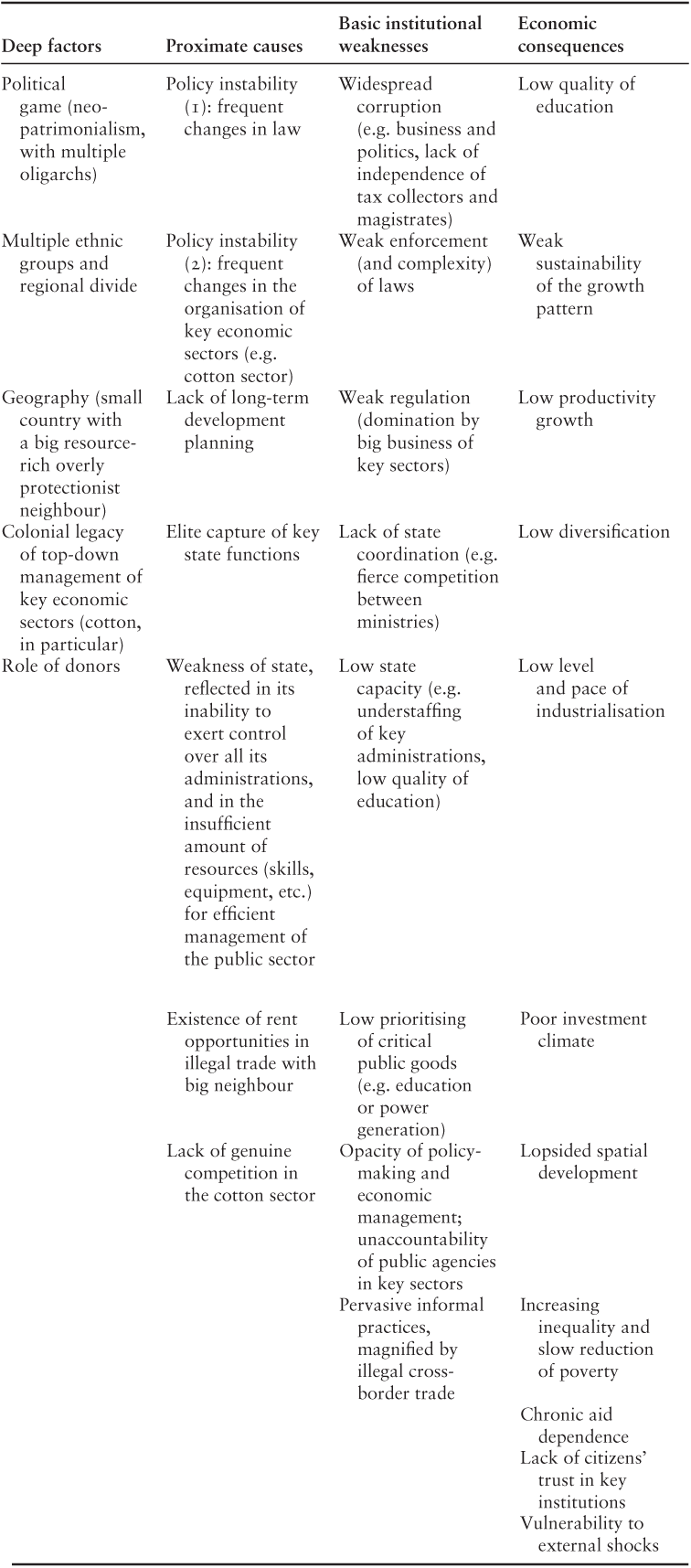
A An Ordering of the Institutional Barriers and Their Economic Consequences
The main results of our comprehensive approach to Benin’s institutional weaknesses are summarised in Table 9.1.
In our view, five deep factors ultimately help to account for the key institutional weaknesses detected in Benin: (1) a political system that is characterised by a neo-patrimonial logic and where there are multiple contenders; (2) a social landscape in which multiple ethnic groups have coexisted for a long time; (3) a geographical/neighbourhood landscape in which Benin appears as a small country that possesses a long border with a big neighbour (Nigeria); (4) a legacy of centralised management of key economic sectors (the cotton export sector, in particular) dating back to the French colonial period; and (5) the heavy presence of aid agencies that evinces a rather lenient attitude towards the dysfunctional aspects of the political system. Factor 1, the way the political system influences the institutional set-up of Benin, is complex and deserves a more detailed analysis, to which we will soon turn. Factor 2, which points to a legacy of multiple ethnic groups combined with a strong regional (north–south) divide, provides an important source of identity around which competing factions and divided loyalties are formed. Factor 3 determines the existence of considerable rent opportunities or profits from informal, illegal trade with Nigeria – opportunities that have actually been seized by entrepreneurs, Big Men in particular. Factor 4 is a legacy of centralised management of key economic sectors (the cotton export sector in particular) dating back to the French colonial period. Finally, factor 5 explains the low level of external disciplining pressures exerted on the country’s public actors.
A series of proximate institutional problems generated by neo-patrimonialism and ethno-regional fragmentation can be regrouped around the syndrome of policy instability. They are manifested in frequent changes of law (e.g. land laws) and the unenforceability of some legal provisions (see, for example, the land law of 2017), as well as in frequent changes in the organisation of key economic sectors (the cotton sector in particular). The lack of long-term economic planning is also a consequence of a political system in which competition among Big Men who are uncertain about their future political standing is not governed by clear rules. Competition is especially fierce, and uncertainty especially great, because of the division of Beninese society into multiple ethno-regional groupings. Beside policy instability, there is the problem that key state functions are captured by the dominating faction(s), resulting in a weak state that is unable to exert control over all its administrations, a difficulty that is compounded by a lack of administrative resources (skills, staff, and equipment). This situation of low effectiveness in the management of the public sector and unfair distribution of the country’s rents is not adequately mitigated by the pressures emanating from external donor agencies or international (African) institutions. It is not mitigated either by pressures for opening up key economic sectors (the cotton sector in particular) to competition, owing to a long tradition of public monopoly that is easily transformed into private monopoly. As for geography, the presence of Nigeria at the border of Benin gives rise to considerable opportunities for rent that can be earned through illegal trade.
The basic institutional weaknesses that the proximate factors have created are essentially those mentioned in Section II, A.3 and C. Frequent changes of law and the unenforceability of some legal provisions make for weak implementation of the law, while frequent changes in the organisation of key economic sectors make for weak regulation of big business. Elite capture of key functions of the state gives rise to opaque policy-making and economic management, as well as to the unaccountability of the agencies in charge of key economic sectors. It also gives free rein to widespread corruption and, in particular, makes tax collectors and magistrates susceptible to political pressures. In addition, the weakness of the Beninese state causes low state coordination, as reflected in its inability to discipline the sometimes fierce competition that opposes certain ministries (think of the Ministry of Finance and the Ministry of Agriculture in matters related to the formalisation or semi-formalisation of land rights). The same weakness also means a low state capacity, such as is manifested in the understaffing of key administrations (the tax collection department in particular). It is moreover evident that the lack of long-term planning and development perspectives that give sufficient weight to sustainability considerations implies that sectors such as education and power generation do not receive the priority they deserve. Finally, pervasive informal practices, magnified by illegal cross-border trade, directly result from the existence of vast rent opportunities in illegal trade with Nigeria, the big neighbour.
The last column of Table 9.1 depicts the main economic consequences of these institutional failures. The growth pattern, centred on a product (cotton) the future prospects of which are uncertain and on a cross-border trade that narrowly depends on Nigerian policies, is not sustainable in the long run. In addition, the slow productivity growth and the slow pace of industrialisation, combined with pervasive inefficiencies in the running of the state, make Benin chronically dependent on foreign resources. At the same time, a bad investment climate results from poor governance, widespread corruption, and confusing and loosely enforced laws and regulations. Since foreign direct investment is therefore deterred, foreign aid is the buoy that keeps the country’s finance afloat. All these effects, as well as other effects that include lopsided spatial development, increasing inequality, slow reduction of poverty, and lack of citizens’ trust in key institutions, can be traced back to Benin’s political economy. We now elaborate on this point in some detail.
B The Key Role of Political Economy Factors
The neo-patrimonial system at work in the country has numerous effects that bear upon almost all of the institutional weaknesses detected in our diagnostic. It is true that some weaknesses cannot be uniquely explained by the prevailing political economy of Benin, as attested by the aforementioned roles of geography, ethno-regional fragmentation, and donors’ behaviour. Yet, a central lesson from our whole analysis is the following: it is impossible to reach a correct understanding of the institutional barriers to Benin’s long-term development without bringing political economic factors to the foreground and placing them at the heart of the diagnostic.
Behind the façade of an apparently well-functioning democracy, Benin has a fundamentally unstable policy-making machine, which goes a long way towards explaining why its government announces and enacts many reforms while being unable to carry them out. Let us look at the underlying political system more carefully. The post-independence period was chaotic, characterised by successive coups and counter-coups. These abrupt shifts of power were the outcome of an all-out war between strong personalities representing different regions and ethnic groups. Then came the authoritarian Marxist regime of Mathieu Kérékou, a man from the northern region. He was obviously incapable of bringing order and political stability in spite of the relative long duration of his rule. This is attested by the numerous attempts to overthrow him that punctuated his regime, including attempts from the same quarter of the army from which he emanated. In spite of the official ideology of socialism, Kérékou’s regime was deeply corrupt and anchored in factional clientelism. It was marred by numerous scandals that reflected the lust for private wealth accumulation among his inner circle. After its demise came the Renouveau Démocratique and its promise of a more transparent and competitive political game that would put an end to kleptocratic practices and blatant favouritism. Unfortunately, these hopes were soon shattered as the old game continued to be played by new actors. In essence, the political system remained patrimonial, in the sense that wealth and power were narrowly intertwined. At this stage, it is useful to remember the definition of (neo-)patrimonialism proposed by Michael Bratton and Nicolas van de Walle (Reference Bratton and Van de Walle1997):
In neo-patrimonial regimes, the chief executive maintains authority through personal patronage, rather than through ideology or law. As with classical patrimonialism, the right to rule is ascribed to a person rather than to an office. In contemporary neo-patrimonialism, relationships of loyalty and dependence pervade a formal political and administrative system and leaders occupy bureaucratic offices less to perform public service than to acquire personal wealth and status. The distinction between private and public interests is purposely blurred. The essence of neo-patrimonialism is the award by public officials of personal favors, both within the state (notably public sector jobs) and in society (for instance, licenses, contracts and projects). In return for material reward, clients mobilise political support and refer all decisions upward as a mark of deference to patrons.
Célestin Monga (Reference Monga1997, p. 56) has rightly pointed out that this form of patrimonialism has evolved in sub-Saharan Africa: ‘Even the most extreme forms of African patrimonialism have undergone revision. Far from being a system of mere privilege trafficking and influence peddling, patrimonialism is attuned to the social exigencies of the times and seeks to craft a type of power that is less direct and primitive, more equilibrated, and in a certain sense, interactive’. The fact remains that the basic feature of the system, namely the lack of separation between political power and private wealth accumulation, is enduring.
These excerpts deal with the functioning of the (neo-)patrimonial rule once it is in place. But we also need to understand how power is accessed. In the absence of a well-enforced rule governing electoral campaigning, or in the absence of a strong man who dictates the rules to make sure he is ‘elected’, competition for state power is rather wild. Adopting a Coasian framework in which bargaining with compensatory transfers is feasible among the contenders yields the following conclusion: a stable agreement may be reached between two contenders provided that a certain number of critical conditions are satisfied. Among these are the absence of negotiation costs, the credibility of promises or threats, and perfect information about the net gains associated with the exercise of power. It is evident that in many circumstances at least some of these conditions are violated. Lack of trust between the Big Men jeopardises their ability to strike a sustainable agreement, while (too much) divergence regarding the benefit of holding power prevents them from conceiving of a mutually agreeable way of sharing the spoils of power. For instance, the Big Man who would hold central power finds the compensation required by his rival excessive given his own assessment of the cost of remaining out of power. As a result, agreements are difficult to reach or, if they are reached, they are difficult to maintain. To illustrate the latter situation, consider the case where two Big Men have enough mutual trust and sufficiently converging information to make a deal. After the deal is made, new elements of information come out that lead one of the parties to revise his evaluation of the worthiness of the deal from his own standpoint, or to call into question the trust he has placed in the rival contender. The deal may then swiftly collapse.
When there are more than two contenders, the situation is worse in the sense that, even assuming that trust is well established and information about the benefits of an agreement is common to everybody, a stable agreement may be impossible to conclude (see Chapter 1).Footnote 9 Theory shows that an endless series of such coalitions and counter-coalitions may unfold, thereby creating a situation of continuous instability (Shapley and Shubick, Reference Shapley and Shubik1969). If we define a Big Man or an oligarch as a faction leader deeply involved in business while being tightly connected to the high spheres of politics, whether or not business involvement preceded or followed engagement in politics, the description of a political game with more than two players is a good fit for the political stage of Benin. We should therefore not be surprised that policy instability has characterised the country for most of its post-independence period, as epitomised by the dance between the private and the public status of the firms or agencies in charge of the cotton sector since 2000.
There is another feature of Benin that needs to be emphasised at this point. Although it does not possess abundant natural (mineral and non-mineral) resources that typically give rise to the well-known resource curse problem, two sectors of its economy are potential sources of huge rents and practically make Benin akin to a resource-rich country: the cotton sector, which represents a sizeable part of the economy and where vast rents can be reaped in a monopoly situation; and illegal trading with Nigeria, where high profits can be made by big operators, especially those in control of the customs system. In a world where state power confers considerable economic privileges on its holder and his clique, the existence of these huge potential rents makes it immensely attractive, thereby justifying fierce struggles for its conquest. Behind the screen of formally democratic institutions, the oligarchs make key decisions in, and act as if they were the effective owners of parastatals and private entities formally independent from them. This is especially patent in the case of the privatised cotton sector, but it also holds true for the large unofficial sector organised around cross-border trade, and for external trade organisations (customs, regulatory bodies for the issuing of import licences, etc.).
Benin’s neo-patrimonial political system with multiple oligarchs (Big Men) produces a number of important adverse effects, static and dynamic, that reduce economic efficiency. They are detailed in the following. Overall, they suggest a picture of a country that has been weakly governed, structurally stagnant, ill adapted to the challenges of long-term development, aid dependent, and vulnerable to external shocks.
1 Lack of Attention to General Public Goods
A first negative consequence of the political system at work in Benin is directly associated with widespread clientelistic practices. Particularised privileges and the prioritising of public goods targeted at specific groups mean that general public goods, such as education, nationwide communication, and power infrastructure, as well as key administrative departments, have not received the attention that they deserve. It is true that efforts have recently been made to fill some of these gaps, yet they still do not reflect sufficient awareness of the critical role these factors play in sustained growth and development. Thus, while the construction of roads is essentially financed by external aid, the expansion of education has largely been conceived in quantitative terms, implying that its quality has probably even deteriorated. This is worrisome because, since it is deprived of mineral and non-mineral resources, Benin’s long-term growth path will have to rest on the emergence and rapid development of sectors that create substantial added value, whether in the processing of agricultural goods, in the production of manufactured goods, or in services. On the other hand, the understaffing of the tax collection administration has not been remedied and, combined with the low efficiency of its mode of operation, this probably explains the disappointing performance of Benin in matters of tax collection. The same holds true of the administration of justice: judicial and legal officers are in very short supply and, by causing stresses and delays in the system, this shortage contributes to increasing the mistrust of the population.
2 Allocative Inefficiencies
A second negative upshot of Benin’s political economy system lies in significant distortions in the allocation of resources. This is especially evident in the case of the two sectors that dominate the national economy: the cotton sector and illegal trading with Nigeria. In the former, distortions are the result of a deliberate suppression of competition, and the gradual takeover of the whole sector by a single private actor controlling the various stages of the value chain, from input supply to marketing through processing (ginneries). Unregulated private monopolies are rarely economically efficient, and, in any case, they have unfair distributional consequences.Footnote 10 This evolution has taken place through various successive transformations of the sector’s organisational structure during the last twenty-five years. Such transformations were chaotic and largely reflected a cut-throat struggle for the control of this vital sector, rather than a continuous search and experimentation aimed at greater efficiency. So far, the outcome has proven disastrous for the country. Organisational instability over those years made production lag behind competitors and growth be under potential.
Regarding the second key sector of the Beninese economy, the ICBT with Nigeria, there are potential distortions arising from both the illegal import side and the re-export side of this trade. For the former, illegal imports thrive on artificial price differences – in fact, the equivalent of the WAEMU import duty rates to which Benin is committed and which are foregone. There is also the possibility of a crowding-out of private and public resources that could have been put to better use in the agricultural value chain or the manufacturing sector. As far as re-export activities are concerned, the price difference consists of the difference between prevailing duty rates in Nigeria and Benin (the WAEMU common tariff). The numerous advantages enjoyed by re-export activities (specific tax rates and customs procedures, large public and private infrastructures, and easy access to import financing) are likely to create further distortions, with the consequence that trade flows are biased away from the pattern that would result from the official protection regime. The same advantages granted to, or invested in, other activities could have produced a more sustainable and possibly faster regime of growth.
All this being said, there cannot be any doubt that, in the aggregate, Benin benefits from the ICBT: it buys from abroad at 100 and resells at 120! But three issues arise: (1) this is not sustainable, as Nigeria at any moment may align its tariffs with those of the WAEMU; (2) even though it may lift numerous workers out of poverty, the gain may be badly distributed, accruing mostly to a few tycoons; and (3) illegal trade and informality spill over to other sectors. In fact, Benin is exactly in the situation of the resource-rich countries exporting minerals, except for the fact that the rent generated by this activity is essentially informal, this also being true of the jobs that it creates. The alternative development strategy is uncertain, however, and it would be difficult to do without this rent. The main issue here is that, as in resource-rich countries, the rent should be used to prepare for the future, which is not the case.
3 Lopsided Spatial Development
If faction leaders were only Big Men benevolently representing the interests of their region or ethnic group, the balanced rotation of high political positions (presidency, members of the executive and the parliament) between various regions and ethnicities in Benin could create a situation in which inter-regional inequalities are moderated. As seen earlier, however, political factions tend to be articulated around the business interests of their leaders and their clique. Since business opportunities are concentrated in essentially two regions that benefit from the presence of two growth poles, in the form of the two biggest commercial cities of the country (Cotonou and Porto Nuovo), it is not surprising that economic growth, inequality, and poverty reduction tend to primarily occur in a few privileged regions. The other regions – remote regions in particular – are bypassed or do not receive the special efforts that they require. In particular, they suffer from an acute shortage of teachers and medical personnel while richer areas have a surplus of them. The result is lopsided spatial development, economic inequality, and concentration of poverty in the neglected areas of the country. Alternative strategies might yield more balanced development.
4 Vulnerability to External Shocks
A fourth negative effect of the country’s political system is vulnerability to external shocks, and the consequent unpredictability of the environment on which the sustainable growth of its key sectors depends. For the cotton sector, unpredictability takes the form of both natural hazards at a time of rapid climatic change, and the quick development of substitute products (synthetic fibres). More generally, the economy remains heavily dependent on the export of a few raw agricultural products (among which cotton stands foremost), which are highly vulnerable to swings in international commodity prices. As far as cross-border trade with Nigeria is concerned, it is obviously at the mercy of the giant neighbour’s policies, since it is its oil rent and the way its government decides to use it that determine the scope of the gains achievable by Benin. While Benin’s re-exports respond to Nigerian demand, which is heavily dependent on oil revenues, cross-border imports are driven by the share of the oil rent that Nigeria decides to allocate to the subsidising of its domestic oil prices and the protection it wants to provide to its manufacturing industry. Alternatively, given the peg of Benin’s currency – the CFA Franc – to the Euro, re-exports also depend on the fluctuations of Nigeria’s own currency – the Naira – with respect to the Euro or hard currencies in general.
5 Vulnerability to Political Changes and Lack of Structural Transformation
To these strictly external sources of unpredictability, one must add a source that is only partly external to economic agents: namely, political instability in a context where rulers tend to follow a winner-takes-all approach. The intense struggle for state power and the attached economic privileges implies that long-term development strategies are hard to devise and enforce. Those who suffer are not only ordinary economic agents who need the support of such strategies, but also the big business leaders who fear the consequences of abrupt changes of personnel at the highest levels of state power. In the case of the Big Men themselves, this uncertainty typically encourages the adoption of short-term behaviour that involves the quick accumulation of wealth at the expense of long-term profitability. Lack of structural transformation of the Beninese economy, which is the expected consequence of this short-sightedness, is acutely reflected in the following: the significant decrease in the share of agriculture in domestic value-added has not been associated with a corresponding increase in the share of tradeable manufactured goods, but with a rapid increase in the share of non-tradeable services, which often act as a last-resort employer. Note that smuggling in and out of Nigeria is a ‘tradeable service’, but the snag is that it may be unsustainable and it generates negative externalities.
6 Poor Business Environment and Perverse ‘Morale Effects’
We must also consider all the adverse consequences of a general climate of weak governance involving huge elite capture and corruption. The first aspect is the poor business environment it creates, with all the attendant implications for investment incentives. In particular, weak governance and corruption deter foreign investment,Footnote 11 thus causing a lack of capital and low productivity growth. Combined with stagnant yields in agriculture, low productivity growth in the manufacturing and tertiary sectors makes for slow progress in per capita income. A second aspect is the ‘morale effect’: when rent capture is blatant and corruption is widespread and involves civil servants and government officials, the citizens of the country have low trust in their elites and in national institutions. The citizens then try to escape the grip of the elites and, if this is impossible, they nurture a feeling of anger and powerlessness that may one day be vented in open and violent demonstrations. Lack of trust is especially evident in the case of judicial and tax collection institutions. Regarding the former, courts are the place where executive authorities and their cronies intervene to distort settlements in their own favour, using corrupt magistrates to obtain the verdict they want. As for the latter, they are a privileged source of discriminatory treatment and undue privileges that directly translate into economic inequality: rich people are easily exempted from paying the taxes rightfully due, whereas ordinary people like farmers and small traders are illegally taxed by unscrupulous officials whenever the opportunity arises (like when they transport goods to the market). These illegal taxes are imposed in spite of the fact that special notices displayed at local police offices explicitly forbid them. Finally, a third aspect is the fragmentation of loyalties and ethno-regional divisiveness that elite capture and corruption encourage when they obviously promote particular, faction-based interests.
Note that in the illegal cross-border trade with Nigeria, bribing and corruption are pervasive at each stage of the process, and this is especially noxious because the trade is carried out on a large scale. Moreover, this sector of activity encourages a tax evasion habit, which is the direct result of its outright illegality, and its actors are therefore inclined to resist and undermine any attempt to formalise their operations.
7 Chronic Aid Dependence
Turning now to the seventh effect, the approach to statehood in Benin means that two options are precluded: (1) state capitalism or socialism whereby state resources are mobilised in a big way to meet the challenges of modernisation and development; and (2) a (competitive) market-based strategy involving the taming of the state so that the dynamism inherent in private entrepreneurship and risk-taking can be unleashed. When none of these options is available and elite capture of state power dominates, a third option becomes very attractive because it helps absorb and conceal the effects of the ensuing inefficiencies: dependence on foreign aid. Benin has no doubt entered into such dependence, on external financial flows and official development assistance in particular. A disturbing sign of excessive external dependence is the growth of external debt as a percentage of GDP after the major debt write-off that took place in the early 2000s. Unfortunately, the prospects of the Beninese economy as already highlighted do not hold out the promise of a foreseeable change in this situation. Strong dependence on external financing seems to be accepted as an unavoidable consequence of maintaining the prevailing political system.
Relying systematically and massively on foreign support may be costly because the consequent loss of independence and autonomy may mean that the donor’s priorities take precedence over the national ones. A vivid illustration of this possibility is provided by the three successive Structural Adjustment Programmes (SAPs) implemented between 1989 and 1999. Sponsored by the International Monetary Fund and the World Bank, these programmes pursued valuable objectives, yet at the cost of severe austerity measures, some of which have had adverse effects on long-term economic development. In particular, the education and health sectors were hit by the fiscal restraint of adjustment, and the need for training and upgrading of the staff of government departments was largely ignored by the three SAPs. Especially hurtful was the total discontinuation of teacher training schools, which caused a severe shortage of teachers in many parts of the country, particularly in the poor north where outsized classes and substitution of poorly trained teachers for the missing qualified personnel entailed a substantial fall in the quality of basic education.
8 Confusing and Changing Laws and Policies
When state power is unstable, in the sense that the current holders of high offices in the executive, legislative, judiciary, and administrative spheres are uncertain about the duration of their mandate, they tend to be vulnerable to the pressures of various groups on whose cooperation they rely. This creates fertile ground for policies and laws that betray a clientelistic approach to the resolution of national problems. However, in the presence of supporting groups that are in conflict on a particular issue, a tempting strategy for the political elite consists of trying to please all or most of them at the same time. This has the frequent effect of producing policies and laws that are inconsistent and so complex as to create confusion, unintelligibility, and unenforceability. Moreover, a direct effect of changes of personnel at the highest levels of the state system is that policies and laws are often rescinded or amended over successive periods of time, with the same consequence of creating confusion and unpredictability. Land laws offer a striking illustration of this predicament. To add further complexity, and as seen earlier, they are also the outcomes of fierce struggles among rival administrative entities that are eager to appropriate to themselves the various gains and advantages of managing land issues.
IV Policy Implications
We now present a number of policy implications that follow from our institutional diagnostic. In so doing we draw attention to potential ways of overcoming or circumventing the prevailing institutional barriers to long-term development. The points are grouped around two major themes: overcoming Benin’s political ills, and overcoming its economic ills.
A Overcoming the Political and Governance Ills: Internal Regulation and External Pressures
Since our diagnostic has highlighted the key role of political economy factors, it is logical to think of means of countering their noxious influence. Several mechanisms come to mind. One obvious mechanism consists of regulations regarding the financing of electoral campaigns. These include the effective capping of the amount allowed for the purpose, and obligations of transparency with respect to not only the amount of the donations received but also their sources. The problem with such rules is that in weakly governed countries, they tend to be ignored whenever they are enacted. This is illustrated by Benin, where they do indeed exist but are not strictly enforced. The same restriction probably applies to all rules prescribing rigorous impact evaluations of public-sector actions in order to achieve greater accountability of major actors at the state level. And it also applies to many laws, decrees, and regulations that ban day-to-day malpractices, such as the taking of bribes or petty corruption and money extortion by local officials.
The conditionality mechanism that external aid providers can put into place offers still another (theoretical) solution to political dysfunction. Here, what bears noticing is that this mechanism has not been effectively used in the case of Benin, in spite of all the scandals revealed by the press attesting to large-scale corruption, frequent fund embezzlements, and widespread cronyism. To our knowledge, there are only a few exceptions to this rule, namely the (temporary) suspension of aid delivery by the Dutch government following clear evidence of embezzlement in a water infrastructure project, and the (temporary) suspension of the Millennium Challenge Account II funding on the grounds that the Doing Business indicator for Benin fell below a pre-determined threshold.
The question therefore arises of why big international organisations such as the World Bank and the International Monetary Fund have so far abstained from sanctioning state-level malpractices. A plausible explanation lies in the appearance of democracy that the country presents, which seems to receive a disproportionately positive weighting in the evaluation of the country’s performances by the international donor community. This may itself be due to two different causes: either the governance indicators are excessively based on measures of formal aspects of institutions, thereby overlooking their real functioning; or the donors are well aware of this functioning, yet deliberately decide not to pay too much attention to it. Evidence in support of the first interpretation is the fact that the Country Policy and Institutional Assessment (CPIA) World Bank measure on the control of corruption works out at 3.5 for Benin, slightly above the mean among low-income countries. It is hard to believe that Benin can enjoy such a good relative ranking in light of the numerous scandals that have taken place in recent decades. As for the second interpretation, donors who decide to ignore disturbing evidence of bad governance may be driven by considerations of political expediency, including geo-political considerations. Or they may consider that if they sanctioned a country like Benin, by refusing to release budgeted aid tranches, they would have to mete out the same treatment to many other poor countries, in sub-Saharan Africa in particular, and their mission would thus be seriously jeopardised. This can be linked to a general budget pressure problem, understood as the need to spend money allocated to aid, regardless of the effects generated. This interpretation is supported by the exceptional character of permanent aid disruption: the main impression we are left with is that threats of aid cancellation in the event of serious malpractices are not generally credible – warnings may be issued, sanctions may (rarely) be imposed, but, ultimately, the objective of both the donor and the beneficiary is to restore the aid relation, through superficial or perfunctory accommodating measures if necessary.
If overemphasis on the formal aspects of institutions in the indicators of governance used is the most important problem, then a rethink of these indicators is the logical conclusion of this discussion. If this is not the only problem, a key implication is that donors must avoid giving aid for budget supportFootnote 12 and concentrate on project and programme aid. This does not relieve them of the need to carefully monitor the actual use of the aid and to act upon the conclusion reached in any monitoring exercise. At the same time, it remains essential that donors are guarded against the danger of imposing their own development agenda on a weakly governed country that is prompted to accept any aid proposed, whatever its compatibility with the priorities, needs, and constraints as perceived by local actors. This is particularly evident in the case of programmes aimed at formalising land rights.
B Overcoming the Economic Ills: Towards Greater Economic Diversification and Upgrading
To get out of underdevelopment and to increase average income per head, the Beninese economy must be drastically transformed. This implies a sectoral transformation of its structure and determined efforts to improve labour productivity in key sectors.
Regarding the first dimension, a realistic strategy consists of promoting agro-processing industries outside the cotton sector. This involves (1) the identification of agricultural products for which the country’s natural conditions are appropriate and which can generate enough added value; and (2) the integration of their producers and intermediaries into a value chain that includes input and credit supply; collection of the produce; and its transportation, storage, processing, packaging, and marketing up to the final consumer points in rich countries if needed. In a country like Benin, where there are many experienced traders and intermediaries (including those of Indian or Pakistani origin who crisscross the country), this is best done through a great deal of market activation or facilitation. On the part of the state, the main tasks required are the construction and maintenance of rural feeder roads that can be branched off into the main grid, and the effective suppression of all the money-extorting posts placed on the routes used by producers and traders.
Valuable efforts have actually started to be made in this direction. Thus, for example, schemes for the production and export of pineapples and pineapple products (like juice) have recently been launched under the impulse of the present government and with the financial and logistical support of several aid agencies and development cooperation programmes (French, Belgian, Canadian, etc.). The organisation of the value chain up to a European supermarket company (Carrefour in France), the high quality of the product, and the quick supply response from the farmers in the Allada region are important advantages for the success of this initiative. To the extent that fertiliser use is almost non-existent in the cultivation of pineapples in Benin, a promising niche is the market for biologically produced, fresh pineapples. Yet, success will be eventually achieved only if a number of serious problems are resolved. First, pineapples grown in Benin have a shape and a colour to which European consumers are not accustomed. Second, they are more difficult to transport and conserve than pineapples from competing countries (Costa Rica, for example). Third, cultivation of pineapples is concentrated in one of the richest parts of the country, not far from the two main commercial cities in the south. This is not without creating a problem of its own, since many young people are tempted to move to these cities, thereby creating tensions on the local labour market.
Fourth, there arise the typical problems of many outgrower schemes (also observed for cashew nuts): when several traders compete among themselves for access to the producers, and when they provide the latter with inputs and credit, there is a high risk that contracts will be violated by opportunistic producers. In most cases, this moral hazard problem takes the following form: a producer receives inputs on credit from a trader-cum-lender against the promise to deliver his or her harvest to him or her at a pre-determined price; if the former is approached by a competing trader who offers him or her a higher price, the temptation is great to ignore the original contract and accept the new deal. This clearly points to a market failure that needs to be carefully monitored. The alternative is to have a buyer, whether public or private, who enjoys a monopsonistic position, such as is observed in the cotton sector. The problem then lies in the fact that the buyer is likely to be tempted to abuse his or her privileged position. This risk is to be weighed against the benefits of an organisation that can contractually provide the producers of the raw produce with credit and modern inputs in addition to a guaranteed sale outlet. In the case of cotton, thanks to long experience accumulated since the pre-independence times, these benefits are substantial. Assuming that the present organisation of the cotton sector proves satisfactory in the years to come, the question is thus whether its organisational set-up should be replicated in other parts of the agricultural sector, or at least inspire efforts to improve their organisational efficiency.
Note that the first two problems mentioned do not arise when pineapples are processed into juice or jam. Here, expansion is mostly constrained by foreign competition, especially in the European markets where Chinese and Thai exporters presently have a price advantage. Beninese firms must therefore look for closer foreign markets, such as Burkina Faso and Nigeria, until they improve their competitiveness (through the development of by-products, for example).
The choice of pineapples is not coincidental. Not only has the government put a priority on their development, but they also illustrate the sort of difficulties that need to be surmounted before a new value chain can be solidly established in the present state of world-level competition. Detection of profitable opportunities, organisation of effective linkages with distant markets, and research and development destined to improve the quality of the product and uncover promising by-products are complex tasks that require appropriate skills, learning by doing, exposure of the management staff to foreign experiences, and a well-functioning infrastructure (adequate harbour facilities, uncorrupted customs, good roads, reliable internet and mobile phone services, and a regular supply of electricity) in which the government has a key role to play.
As we have pointed out, pineapple expansion is confined to the southern part of the country. A big challenge is how to encourage the same type of initiative in the northern part, lest the north–south income gap should widen and inter-regional tensions increase. Admittedly, some initiatives have taken place in the north as well, for example around rice production in the region of Natitingou. But these efforts need to be extended and pursued with the same determination as in the south, especially so because two south–north highways will soon be available. Moreover, one central lesson from the analysis of land reforms is that the issuing of land certificates is not sufficient to ensure significant production increases in agriculture: the profitability of land investments must be demonstrated, and this precisely necessitates that new crops with higher added value and new production techniques are disseminated throughout the countryside.
Increasing labour productivity in industrial ventures is another pressing challenge for Benin. This requires not only that more efficient production techniques and capital equipment are used, but also that better management systems are put in place. The most effective way to attain this objective is to mobilise FDI, but that requires, in turn, that governance conditions are improved in the country so as to reassure potential investors. This takes us back to the first aspect of our policy implications.
It must also be stressed that the development of these new activities may compete with old activities, in particular the two major ones, cotton and ICBT. Land is apparently still available in the north of the country and transport infrastructure may encourage investment in new agricultural production there, provided appropriate feeder roads are available. As for other inputs, trade-offs do exist and decisions must be taken, something particularly difficult in the presence of a huge informal sector like ICBT. Regulating it may thus prove a necessary condition for the unavoidable diversification of the Beninese economy. Membership of the WAEMU may be another constraint, since the fixity of the exchange rate with hard currencies may in some cases weaken foreign competitiveness.
Finally, productivity gains also require major progress to be achieved in education. If significant efforts have been made to increase enrolment, much remains to be done to improve educational quality in order to reach decent standards, even at the primary school level. In the absence of significant improvements in educational quality, it is difficult to see how Benin could gradually move to an economy intensive in skilled labour, as befits a country that is deprived of mineral and non-mineral resources. Furthermore, technical and professional schools must be created to help fill up the prevailing skill gaps on the labour market, as has now been well understood by the government. The educational challenge is especially pressing because an increasing number of rural residents from the younger generations aspire to enjoy an urban life and hold an urban occupation.
Benin must be seen as a promising country endowed with entrepreneurial people and well-experienced traders and merchants, as well as good climate and fertile agricultural lands in certain parts of its territory. It has a comparative advantage not only in traditional products such as cotton, but also in new agricultural products that can be processed and sold at remunerative prices in the international, regional, and domestic markets. In other words, Benin has potential for development that could be unleashed if only the right institutional and policy environment could be established. No deep constraint condemns it to stagnation. What is needed is first and foremost that a country that has succeeded in laying down and enforcing rules regarding democratic elections and the duration of political mandates also succeeds in breaking the link between business and politics that has poisoned its political life since independence. Relatedly, the state must reinforce its tax-collecting capacity, create attractive conditions for FDI, and enhance its ability to coordinate the actions of its various administrative departments. Public money should be used in the pursuit of long-term objectives, which means that a significant part of it should be devoted to the development of high-quality human capital and the construction and proper maintenance of physical infrastructure. Finally, the state should aim at more sustainable or autonomous development in the sense of reducing the country’s vulnerability to external shocks and foreign aid. These are formidable challenges but, given the stakes involved, they deserve the utmost attention and determined actions.
C Are We Witnessing a Regime Change?
Things have been moving quickly since Patrice Talon rose to supreme power in 2016. His winning gamble caused the defeat of the old political elite, considered to be too obstructive and unreliable by the country’s top businessman and most ambitious entrepreneur. The question then arises of whether this major political change can be a game changer. On the one hand, because Talon has succeeded in consolidating his power and taking firm control of the polity and the economy of Benin, democracy has suffered. This causes a major stir in a country where freedom of expression is highly valued and where free elections and changes of incumbents had become a regular feature of the political scene during the last decades. On the other hand, precisely because Talon holds key decision-making levers in his hands, he could become an enlightened autocrat eager to promote his fame and reputation as the man who rescued his country from stagnation and pervasive corruption.
It is true, however, that a priori the profile of a president-cum-oligarch raises serious doubts about his ability to design enlightened policies that give priority to common good considerations. But it could be retorted that precisely because he exerts wide control over the economy, and has now secured the vast wealth that he owns, he does not need to bother about accumulating more of it. Therefore, he can devote his energies to a high-order mission that will bring him superior satisfaction.
It is of course too early to form a judgement on such a thorny issue, and the near future will be particularly interesting to watch. In addition to avoiding the great waste of resources and the political instability caused by Big Men’s internal struggles, three facts tend to indicate that the combination of politics and business in a single figurehead could achieve results in the specific context of Benin.
First, Talon has surrounded himself with a team of highly competent collaborators, some of whom work in an office directly attached to the presidency and specially dedicated to the task of designing economic and social policies (the Bureau d’Analyse et d’Investigation).
Second, there is no denying that the new president has established clear priorities and so far shown a determined willingness to launch important reforms. Overall, the priorities chosen go in the right direction, as they are addressing key constraints that hamper the country’s economic development (in fact, they match most of our policy implications stated in Section III). Especially worth singling out are the reforms of the education system (with an emphasis on the creation of technical schools and training institutions), plans for infrastructure expansion (including improvement of the generation and distribution of electricity, considered as a critical constraint on industrialisation), and measures intended for diversifying the economy in the sense of adding value to agricultural and raw material (e.g. cotton) products.
Third, a war against corruption has been declared and in just a few years the petty corruption that was so extensively observed under all the previous regimes appears to have been significantly reduced as a result of drastic sanctions introduced by Talon. Since day-to-day extraction of bribes by officials (by the police in particular) hits poor and ordinary people particularly hard, any step in that direction is bound to earn him popular support, among those people especially.
Taking all this into account, it remains to be seen how a president-cum-oligarch can surmount the numerous conflicts of interests that necessarily confront him. For example, how can a man who privately controls the customs end corruption in that vital part of the revenue collection system? How can his monopoly position in key sectors of the economy (including the retail distribution of petroleum products) be made to work for the general good? And how can one be assured that tax avoidance by members of his business entourage will be actively fought against?
Those are the sort of issues that unavoidably arise when an authoritarian ruler is simultaneously a successful oligarch. In sum, they revolve around the following central question: will the president-cum-oligarch have the wisdom to accept sacrifices when his private business interests will run counter to the public interest, and will he be able to impose similar sacrifices on his fellow businesspeople? For the strong rule of Talon to be truly enlightening and widely supported by the population, this challenge must be met.
This is not the only challenge that Talon must face up to. The abrupt closure of the border with Nigeria has disrupted the (illegal) cross-border trade on which the country’s economy depends to a great extent. The lucrative import-and-re-export business centred around the port of Cotonou is not the only sector of the economy affected. Also undermined are the export opportunities for products that the new regime itself is promoting, such as pineapples and pineapple juice. A fall in the market price of fresh pineapples has occurred that may eventually discourage farmers from continuing to invest in this product, especially if the output price decreases are accompanied by rising input prices (including wage increases for agricultural labour), thus creating a nasty ‘price scissor’ effect.
The adverse external shock caused by the closure of the Nigerian border confirms that, as repeatedly stressed in this book, Benin is highly vulnerable to events occurring beyond its big neighbour’s frontier and to policies implemented by the Nigerian government. How to transform the proximity of a giant economy from a source of vulnerability into an economic advantage is one of the most difficult and pressing problems that any ruler of Benin must solve with a long-term horizon in mind. In the long run, instead of relying on the benefits of illegal trade, Benin must develop comparative advantages that lead to an intra-regional specialisation benefiting the two countries.


 Open access