We partner with a secure submission system to handle manuscript submissions.
Please note:
You will need an account for the submission system, which is separate to your Cambridge Core account. For login and submission support, please visit the
submission and support pages.
Please review this journal's author instructions, particularly the
preparing your materials
page, before submitting your manuscript.
Click Proceed to submission system to continue to our partner's website.
To save this undefined to your undefined account, please select one or more formats and confirm that you agree to abide by our usage policies. If this is the first time you used this feature, you will be asked to authorise Cambridge Core to connect with your undefined account.
Find out more about saving content to .
To send this article to your Kindle, first ensure no-reply@cambridge.org is added to your Approved Personal Document E-mail List under your Personal Document Settings on the Manage Your Content and Devices page of your Amazon account. Then enter the ‘name’ part of your Kindle email address below. Find out more about sending to your Kindle.
Find out more about saving to your Kindle.
Note you can select to save to either the @free.kindle.com or @kindle.com variations. ‘@free.kindle.com’ emails are free but can only be saved to your device when it is connected to wi-fi. ‘@kindle.com’ emails can be delivered even when you are not connected to wi-fi, but note that service fees apply.
This study aimed to compute the pooled prevalence of diabetes mellitus and other underlying conditions in patients with coronavirus disease 2019 associated rhino-orbito-cerebral mucormycosis.
Method
A systematic literature review was performed in PubMed, Scopus, Web of Science, Embase and Google Scholar. The cross-sectional studies that reported the frequency of diabetes mellitus in patients with coronavirus disease 2019 associated rhino-orbito-cerebral mucormycosis were included.
Results
Eighteen eligible studies with a total number of 3718 patients were included in the current study. The pooled prevalence of diabetes in patients with coronavirus disease 2019 associated rhino-orbito-cerebral mucormycosis was 89 per cent and with new-onset diabetes was 32 per cent. The pooled prevalence of steroid use was high (79 per cent) too. The all-cause mortality rate was 24 per cent.
Conclusion
Diabetes mellitus was the most frequent underlying condition in patients with coronavirus disease 2019 associated rhino-orbito-cerebral mucormycosis. The second most frequent underlying condition was steroid use during coronavirus disease 2019 infection. The appropriate control of hyperglycaemia and rational prescription of steroids during the treatment of coronavirus disease 2019 associated rhino-orbito-cerebral mucormycosis is recommended.
Management of head and neck cancer patients provides unique challenges. Palliation serves to optimise quality-of-life by alleviating suffering and maintaining dignity. Prompt recognition and management of suffering is paramount to achieving this. This study aimed to assess perceived confidence, knowledge and adequacy of palliative training among UK-based otolaryngologists.
Method
Eight multiple-choice questions developed by five palliative care consultants via the Delphi method were distributed over five weeks. Knowledge, perceived confidence and palliative exposure among middle-grade and consultant otolaryngologists were assessed, alongside training deficits.
Results
Overall, 145 responses were collated from middle-grade (n = 88, 60.7 per cent) and consultant (n = 57, 39.3 per cent) otolaryngologists. The mean knowledge score was 5 out of 10, with 22.1 per cent (n = 32) stating confidence in palliative management. The overwhelming majority (n = 129, 88.9 per cent) advocated further training.
Conclusion
A broad understanding of palliative care, alongside appropriate specialist involvement, is key in meeting the clinical needs of palliative patients. Curriculum integration of educational modalities such as simulation and online training may optimise palliative care.
Superior semi-circular canal dehiscence syndrome is a disorder characterised by auditory and vestibular symptoms that can significantly impact quality of life, and yet it has no disease-specific quality of life instrument.
Method
Thirty-six patients who underwent transmastoid superior semicircular canal resurfacing and plugging were included from an initial cohort of 60 surgically managed patients. A sub-cohort of 19 consecutive patients completed validated symptom and quality of life questionnaires before and after surgery. Of the 36 patients, 31 participated in a telephone semi-structured interview post-operatively.
Results
Following surgery, there was a statistically significant improvement in autophony index score (p = 0.02), symptom severity score (p < 0.001) and sound hypersensitivity (p = 0.01). Thematic analysis of telephone interviews suggested three main symptom themes: auditory hypersensitivity, dysequilibrium, headache and concentration difficulties. Dysequilibrium was found to persist post-operatively.
Conclusion
Surgery improves overall symptoms and quality of life. However, important symptom themes may be overlooked using the outcome measures that are currently available. A unified disease-specific outcome measure is urgently required to better understand the impact of symptoms and measure treatment effects.
To determine if otolaryngologists and audiologists of the American Academy of Otolaryngology – Head and Neck Surgery have noticed an increase in the incidence of sudden sensorineural hearing loss during the coronavirus disease 2019 pandemic.
Methods
A questionnaire was developed for the purpose of providing a cross-sectional descriptive analysis of perceived association between the coronavirus disease 2019 pandemic and an increase in the incidence of sudden sensorineural hearing loss.
Results
Of respondents, 63.0 per cent did not notice an increase in sudden sensorineural hearing loss during the coronavirus disease 2019 pandemic. There was a weak positive correlation between patients identified with sudden sensorineural hearing loss and the percentage of coronavirus disease 2019 positive patients reported by each medical care provider (Spearman correlation = 0.20, 95 per cent confidence interval = 0.05–0.33). There was no association between geographical location and perceived increase in sudden sensorineural hearing loss (p = 0.38).
Conclusion
The majority of respondents did not perceive an increase in the incidence of sudden sensorineural hearing loss during the coronavirus pandemic, regardless of geographical region.
To examine the role of salvage intratympanic steroid injections in patients presenting with idiopathic sudden sensorineural hearing loss following a poor response to initial oral steroid treatment.
Methods
A retrospective analysis of patient records over the course of four years was conducted, and pure tone thresholds were reviewed before treatment, after oral steroid therapy and six weeks after intratympanic steroid injection therapy.
Results
After oral steroid therapy alone, there was a mean average threshold change of 6.2 dB HL (range, −13.8–33.8 dB). This change was statistically significant for severely affected patients (those with an average presenting threshold of over 71 dB). The mean average threshold improvement following intratympanic steroid injection therapy was 2.9 dB (range, −22.5–61.3 dB); this was not statistically significant.
Conclusion
Some patients experienced moderate improvement following intratympanic steroid injection therapy; however, no specific subgroup was identified to benefit more from intratympanic steroid injection therapy.
This study aimed to determine the probability of hearing recovery in patients with idiopathic sudden sensorineural hearing loss following salvage intratympanic steroids
Method
A retrospective review of all patients receiving salvage intratympanic steroid injections for idiopathic sudden sensorineural hearing loss was performed (January 2014 to December 2019). Twenty-two patients were identified, of whom 15 met inclusion criteria. Pre- and post-treatment audiograms were compared with the unaffected ear. Hearing recovery was categorised based on American Academy of Otolaryngology Head and Neck Surgery criteria.
Results
Only 1 patient out of 15 (6.7 per cent) made a partial recovery, and the remainder were non-responders. The median duration of time between symptom onset and first salvage intratympanic steroid treatment was 52 days (range, 14–81 days). No adverse reactions were observed.
Conclusion
‘Real world’ patients with idiopathic sudden sensorineural hearing loss present differently to those in the literature. Sudden sensorineural hearing loss should be diagnosed with care and intratympanic steroid injections initiated early if considered appropriate. Patients should make an informed decision on treatment based on prognostic factors and local success rates.
This study aimed to determine the implications of including tympanometry in the Rapid Assessment of Hearing Loss survey protocol. A comparative study design was employed, with findings from otoscopy compared with the results of tympanometry.
Method
A population-based survey of the prevalence and causes of hearing loss among adults aged over 35 years in The Gambia was conducted. Clinical assessments included air conduction audiometry, otoscopy and clinical history. Otoscopy outcome was recorded and for those with hearing loss, a probable cause was assigned. Following otoscopy, tympanometry was completed. Otoscopy outcome was not changed as a result of tympanometry. Clinician assigned cause was compared to the results of tympanometry. The proportion of causes potentially misclassified by excluding tympanometry was determined.
Results
Among people with hearing loss, including tympanometry led to a higher proportion diagnosed with middle-ear conditions.
Conclusion
The value of adding tympanometry to population-based survey protocols is a higher estimated proportion of hearing loss being attributed to middle-ear disease rather than sensorineural causes. This can inform service needs as more people will be classified as needing medical or surgical services, and a slightly lower number will need rehabilitative services, such as hearing assistive devices. It is highly recommended that tympanometry is included in the protocol.
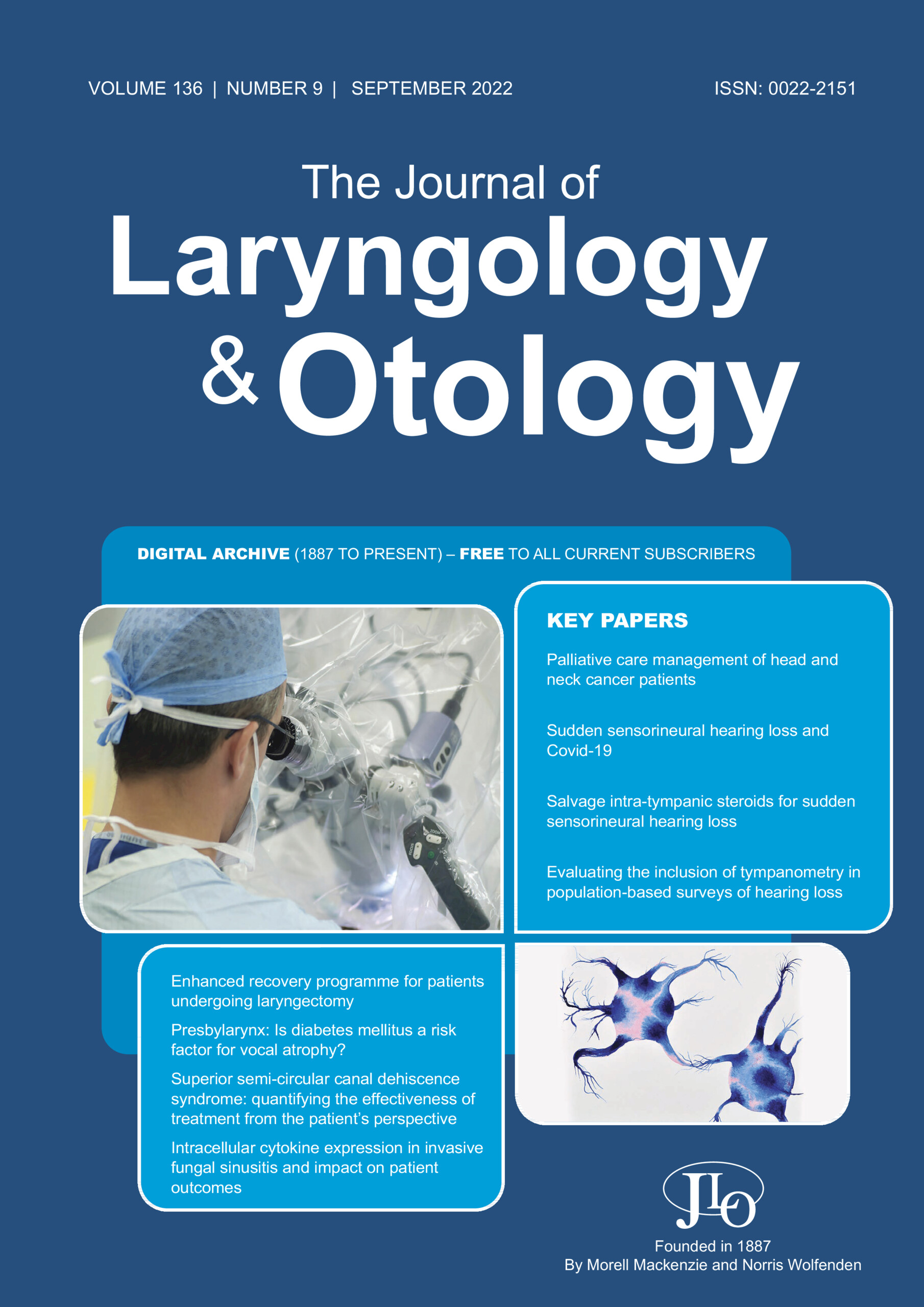
Enhanced recovery programmes have been widely adopted in other surgical disciplines but are not commonplace in head and neck surgery. The authors of this study created a pathway for post-operative laryngectomy patients.
Method
A multidisciplinary working group reviewed the literature and agreed standards of care. A retrospective audit was conducted to measure current practice against our new pathway; after programme implementation our performance was reaudited in two prospective cycles, with an education programme and review after the first prospective cycle.
Results
Statistically significant improvement in performance was realised in catheter and surgical drain removal, opiate analgesia use, mobilisation, and timeliness of swallow assessment. The rate of hospital acquired pneumonia reduced from 23.1 to 9.5 per cent and length of stay reduced by a median of 5.2 days to 14.8 days (non-significant).
Conclusion
The programme improved consistency of patient care across most areas that were measured. Improving patient stoma training needs to be prioritised.
Cell-mediated immunity plays an important role in host defence against fungal pathogens, regulated by differentiation of lymphocytes towards T-helper 1 or 2 cells. This study reports intracellular cytokine variation in terms of invasive fungal sinusitis type and outcome.
Methods
The mononuclear leukocytes of 15 patients with invasive fungal sinusitis (mucormycosis in 8, aspergillus in 7) were stained with antibodies against intracellular cytokines, after fungal antigen stimulation and culture, and immunophenotyped. Patients were followed up for six months, with clinical course categorised as improvement, worsening or death.
Results
The mean percentages of mononuclear cells producing interleukins 4, 5, 10 and 12, and interferon-γ, in the mucormycosis group were 0.575, 0.284, 8.661, 4.460 and 1.134, respectively, while percentages in the aspergillosis group were 0.233, 0.492, 4.196, 4.466 and 1.533. Cells producing interleukin 4 and 10 were higher in the mucormycosis group, while those producing interleukin-12 and interferon-γ were lower. Cells producing interleukins 4 and 12 were higher in patients with a poor outcome (p-values of 0.0662 and 0.0373, respectively), while those producing interferon-γ were lower (p = 0.0864).
Conclusion
Adaptive cell-mediated immunity is expressed differently in two categories of invasive fungal sinusitis, and the cytokine expression pattern is related to prognosis.
This study investigated the relationship between physical dimensions of the Eustachian tube and the emergence of primary attic cholesteatoma.
Methods
A total of 31 patients with unilateral attic cholesteatoma were selected for radiological comparison. Standard point measurements as well as specific measurements were performed using imaging software. The length, narrowest diameter and bony segment volume, and pharyngeal orifice diameter of both sides of the Eustachian tube (attic cholesteatoma and healthy control ears) were measured and compared.
Results
Comparison of the values did not reveal any statistically significant difference between the attic cholesteatoma ears and the healthy control ears in terms of: Eustachian tube height, narrowest diameter, bony segment volume or pharyngeal orifice diameter.
Conclusion
No statistically significant difference was found between the cholesteatoma ears and the healthy control ears in terms of the osseous Eustachian tube size. The findings indicate that the Eustachian tube bony segment dimensions and pharyngeal orifice diameter are not factors in attic cholesteatoma development.
To evaluate the prevalence of diabetes mellitus type 2 in subjects with presbylarynx.
Method
A case–control, prospective study was carried out on consecutive subjects who presented to the otorhinolaryngology department.
Results
The study comprised 174 subjects (60 males and 114 females) with a mean age of 73.99 years (65–95 years). Presbylarynx was identified in 71 patients (41 per cent). Among patients with diabetes mellitus type 2, 20 patients (77 per cent) exhibited endoscopic signs of presbylarynx. A statistically significant difference was found between presbylarynx versus no presbylarynx concerning diabetes mellitus type 2 (p < 0.001). Subjects with diabetes mellitus type 2 were approximately eight times more likely to have presbylarynx compared to subjects without diabetes mellitus type 2.
Conclusion
In this study, 77 per cent of patients with diabetes mellitus type 2 had endoscopic signs of presbylarynx. A multivariable analysis, which took into account co-morbidities of the elderly, identified diabetes mellitus type 2 as a possible risk factor for presbylarynx. Many physiopathological mechanisms might explain this result, as diabetes mellitus type 2 is known to affect muscular, neurological and vascular systems.
The excision of a giant mastoid process osteoma can be challenging. In such situations, the three-dimensional exoscope intra-operative optic may be a promising tool.
Case report
This paper provides a technical description of a giant mastoid osteoma excised under three-dimensional exoscope magnification. A fragmented excision by intralesional curettage was adopted to prevent peri-tumoural damage. This technique had been previously described for the excision of large osteomas of the sinus.
Conclusion
The three-dimensional exoscope magnification tool had excellent applicability during surgery of a rare mastoid osteoma. In complex anatomical areas, the cavitation and fragmented excision of the tumour may prevent complications and is therefore recommended.
Reconstruction of a pharyngoesophageal defect remains a challenging problem, especially with involvement of the neck skin. This study aimed to demonstrate the surgical technique of utilising a butterfly modification of the anterolateral thigh flap.
Results
Reconstruction of the pharyngoesophageal defect was accomplished using the butterfly modification of the anterolateral thigh free flap. The flap was tubed on the leg while still being attached to the pedicle, to minimise the ischaemia time.
Conclusion
Butterfly anterolateral thigh free flap allows for multi-layer closure of the neopharynx and can be utilised for reconstruction of pharyngoesophageal and neck skin defects.
Spontaneous regression is defined as the partial or complete disappearance of a malignant tumour proven by microscopic examination in the absence of any substantial treatment. This paper presents the case of an older woman whose advanced-stage tonsillar squamous cell carcinoma was noted to have spontaneously regressed at seven months.
Case report
A 66-year-old woman presented with a 4-month history of dysphagia and odynophagia in September 2020. An exophytic tumour was seen on the right tonsil; this was diagnosed radiologically and histologically as a squamous cell carcinoma of the tonsils, with tumour–node–metastasis staging of T4aN0M0. The patient received best supportive care. Seven months later, the oropharyngeal lesion had disappeared, with no treatment. Subsequent computed tomography imaging showed radiological resolution of the previously noted right-sided oropharyngeal lesion.
Conclusion
Several mechanisms of spontaneous regression are discussed. Further studies should review this case in conjunction with other reports of spontaneous tumour regressions, to elucidate underlying mechanisms.