





Introduction
Among the many theoretical approaches to feminist movement unity and fragmentation, two conflicting strands emerge as especially distinctive: feminist institutionalism and feminist post-structuralism. The first one emphasizes how gendered power operates through structures, rules, and organizations. Women’s non-governmental organizations (NGOs) and transnational networks are understood here as collective actors capable of shaping institutions and diffusing empowering norms, as illustrated by the global spread of electoral gender quotas or the inclusion of women’s issues in development agendas (Htun and Weldon Reference Htun and Weldon2018; Mazur et al. Reference Mazur, McBride and Hoard2016; Prügl Reference Prügl2015; True Reference True2020). The second strand, by contrast, refuses to treat ‘women’ as a unified category. It foregrounds discourse, context, and the multiplicity of identities, stressing how race, class, nationality, sexuality, and other dimensions shape women’s varied experiences (Crenshaw Reference Crenshaw1989; Narayan Reference Narayan1997; Scott Reference Scott1988). On this account, the power dynamics permeate the feminist movements themselves and can silence some voices while privileging others, whether through the neoliberal co-optation of feminist claims (Fraser Reference Fraser2020) or the narrowing of intersectionality into exclusionary practices (Christoffersen and Emejulu Reference Christoffersen and Emejulu2023).
Feminist institutionalists documented that transnational women’s organizations and networks can be forceful drivers of change (Htun and Weldon Reference Htun and Weldon2018; Mazur et al. Reference Mazur, McBride and Hoard2016; True Reference True2020), yet feminist post-structuralists remind us that not all women’s organizations pursue the same goals or wield power equally (Narayan Reference Narayan1997; Scott Reference Scott1988). Similar critiques emerge from materialist, decolonial, and antiracist perspectives (Lugones Reference Lugones2007; Yuval-Davis Reference Yuval-Davis2006). Is the global feminist movement’s success based on the ideological unity or division of its organizations, not just their number or presence? Until now, we have not had the empirical tools to map the ideological fault lines of transnational feminist activism over time and across countries. The FEMPOWER dataset aims to fill this gap.
Existing global datasets on women’s organizations have illuminated important aspects of transnational feminist activism but have not directly addressed ideological differences. For example, the Women’s International Nongovernmental Organizations (WINGO) dataset provides country-level counts of memberships in international women’s NGOs over time (1950–2013), offering a quantitative measure of global women’s civil society ties (Hughes et al. Reference Hughes, Paxton, Quinsaat and Reith2018). However, WINGO data focus on the density of organizational ties and do not classify organizations by their political or ideological orientations. Similarly, the Transnational Social Movement Organization (TSMO) dataset (Smith et al. Reference Smith, Plummer and Hughes2017, Reference Smith, Wiest and Hughes2019) collects data on hundreds of transnational social movement organizations, including many women’s organizations, and records characteristics like founding year, organizational aims, and country memberships. Yet the TSMO data, while rich in structural variables, also falls short of coding the ideological agendas of organizations. Crucially, neither the WINGO nor the TSMO datasets disaggregate activity by country-year for each organization. Most importantly, these prior datasets have not focused on ideological fragmentation, a gap that FEMPOWER specifically aims to fill.
The stakes of this dataset are both theoretical and practical. Transnational feminist advocacy has had mixed success in achieving policy change, seemingly depending on both the issue area and context. While we observe broad improvements (often with support from international NGOs and networks) in relatively ‘less contested’ issues like gender quotas or girls’ education, more contentious arenas such as reproductive rights or economic justice have proven resistant to change (Htun and Weldon Reference Htun and Weldon2018; Moghadam Reference Moghadam2013).
One hypothesis is that fragmentation, such as differences between more neoliberal, professionalized women’s NGOs and more radical, grassroots feminist groups, can undermine the movement’s collective ability to pursue transformative agendas (Mazur et al. Reference Mazur, McBride and Hoard2016; Moghadam Reference Moghadam2020). Furthermore, external actors can also exploit or exacerbate internal divides (Fraser Reference Fraser2020). Governments and international institutions may co-opt certain strains of feminism while neglecting other, more radical ones (Prügl Reference Prügl2015; Rottenberg Reference Rottenberg2018).
It is especially pronounced when neoliberal development agencies embrace women’s empowerment rhetoric that seeks to emphasize entrepreneurship and labor force participation rather than address structural inequalities (Calkin Reference Calkin2015; Fraser Reference Fraser2020; Prügl Reference Prügl2015). Even the United Nations’ Sustainable Development Goals, while declaring gender equality as a worldwide goal, still operationalize ‘empowerment’ primarily in terms of market inclusion, neglecting unpaid care obligations and power inequalities in decision-making (Belda-Miquel et al. Reference Belda-Miquel, Boni and Calabuig2019).
Such trends have led some critics to argue that global feminist discourse has been steered onto a neoliberal track, privileging technocratic solutions over more radical transformation (Elson Reference Elson2017; Rottenberg Reference Rottenberg2018). If it is the case, the movement draws a new divide between organizations that embrace neoliberal discourses and those that oppose them.
The FEMPOWER dataset was designed to resolve this puzzle by systematically collecting information on the ideological orientations, strategies, and scope of women’s transnational organizations worldwide from 1980 to the present. By mapping the internal landscape of the global women’s movement, FEMPOWER enables scholars to assess whether and how ideological fragmentation may be weakening the movement’s capacity for unified action or, alternatively, how diversity in perspectives might be harnessed as a strength. In doing so, the dataset provides an empirical foundation for bridging the gap between institutionalist and post-structuralist understandings of feminist mobilization.
Dataset theoretical framework: feminist institutionalism and post-structuralism
The FEMPOWER dataset is theoretically based on the contradiction between feminist institutionalist and feminist poststructuralist theories. Each offers a distinct lens on the ideological fragmentation of women’s organizations and its role in women’s empowerment. The title of the dataset brings together the notions of fragmentation and empowerment.
Feminist institutionalism emphasizes the gendered aspect of political and social institutions, including formal regulations, informal norms, and organizational structures (Htun and Weldon Reference Htun and Weldon2018; True Reference True2020). Scholars in this line believe that institutions include power hierarchies and ‘gender regimes’ that determine resource access and decision-making authority. Feminist institutionalist analysis investigates how election systems, state bureaucracy, and international organizations affect women’s agency and outcomes (Mazur et al. Reference Mazur, McBride and Hoard2016; Prügl Reference Prügl2015). Institutional players like women’s NGOs, transnational networks, and advocacy groups can lobby, develop transnational norms, and change policy. This approach has shown that powerful, autonomous women’s movements anticipate progressive legislative change on problems like violence against women and family law (Htun and Weldon Reference Htun and Weldon2018).
In cross-national studies of the feminist institutionalist stream, the presence of feminist organizations has been linked to gains in women’s political representation and rights, controlling for other factors (Paxton et al. Reference Paxton, Hughes and Green2006; Htun and Weldon Reference Htun and Weldon2018). Such findings underscore an institutionalist argument: the structure and strength of women’s organizations are relevant for women’s empowerment. Consequently, feminist institutionalists have invested in gathering data on women’s organizational presence. For instance, the WINGO dataset (Hughes et al. Reference Hughes, Paxton, Quinsaat and Reith2018) provides country-year counts of women’s international nongovernmental organizations (INGOs), while the TSMO dataset (Smith et al. Reference Smith, Plummer and Hughes2017, Reference Smith, Wiest and Hughes2019) focuses on the women’s category of transnational social movement organizations. Furthermore, I can mention the composite indices of feminist mobilization (Forester et al. Reference Forester, Kelly-Thompson and Lusvardi2022). Such datasets were based on the assumption that more organization and networking generally equate to greater influence on policy and society.
The institutionalist lens’s focus on quantitative institutions and outcomes can obscure women’s movement heterogeneity. Feminist post-structuralism offers a crucial counterweight. Feminist post-structuralists believe power shapes identities and interests through speech and knowledge, which institutional accounts must consider (Narayan Reference Narayan1997; Scott Reference Scott1988). According to them, ‘women’s empowerment’ and ‘gender equality’ convey diverse meanings depending on ideology (Fraser Reference Fraser2020; Rottenberg Reference Rottenberg2018).
Post-structuralists ask: Which women’s voices are highlighted, and which are marginalized in a movement? How do gender, race, class, and other identity dimensions influence women’s priorities (Crenshaw Reference Crenshaw1989)? How do global power relations, such as colonial legacies and North-South inequalities, influence transnational feminist networks (Mohanty Reference Mohanty1988; Narayan Reference Narayan1997)? Here, the internal conflicts and power imbalances are the central forces shaping the feminist movements (Fraser Reference Fraser2020; Scott Reference Scott1988). Subsequently, a larger number of women’s NGOs or a vast institutional reach will not necessarily empower women, because they support elite interests or depoliticize feminist demands (Christoffersen and Emejulu Reference Christoffersen and Emejulu2023; Narayan Reference Narayan1997). Some scholars noted that neoliberal NGOs have split feminist activity into professionalized, fragmented arenas, diminishing its radical potential (Fraser Reference Fraser2020; Prügl Reference Prügl2015). Therefore, to assess the impact of women’s organizations, we must consider their ideology and program statement framing, rather than their mere existence or number.
FEMPOWER combines these ideas to offer a more detailed understanding of the transnational feminist movement. It recognizes, along with feminist institutionalism, that women’s organizations are influential agents in global politics. Thus, it is important to systematically collect data on their presence, strategies, and connections. But it also heeds the lesson of feminist post-structuralism: that all women’s organizations are not the same. Their underlying ideologies, goals, and modes of engagement can differ dramatically, leading to potential fragmentation even as they ostensibly pursue a common aim of ‘women’s empowerment’.
Rather than assuming a monolithic global women’s movement, the dataset allows researchers to distinguish, for instance, a transnational NGO that champions market-friendly individual empowerment from one that advocates for collectivist, rights-based social transformation. By empirically mapping these distinctions, FEMPOWER provides a way to investigate how differences in ideology might correlate with differences in outcomes, helping to answer questions such as whether countries hosting more social-justice-oriented organizations observe greater progress on gender equity than those dominated by neoliberal-oriented organizations, or whether a highly fragmented movement (with many competing ideologies present) is less effective at achieving policy change than a more ideologically unified movement.
Dataset sources and scope
The dataset focuses on transnational women’s organizations, which refer to any non-governmental organization, network, or movement collective that (a) explicitly focuses on women or gender equality and (b) operates in multiple countries (Hughes et al. Reference Hughes, Paxton, Quinsaat and Reith2018; Smith et al. Reference Smith, Plummer and Hughes2017, Reference Smith, Wiest and Hughes2019). This concept explicitly covers official NGOs and looser international networks or federations. Women’s NGOs (organizations that develop or provide services to women) and feminist advocacy networks that mobilize politically are included. I also include organizations that focus on women’s roles but do not call themselves feminist (even conservative or religious groups that aim to improve women’s status or well-being). Most groups in the dataset work to improve women’s rights, status, or opportunities, but not all are progressive or feminist (Forester et al. Reference Forester, Kelly-Thompson and Lusvardi2022; Jayawardena Reference Jayawardena2016).
The Union of International Associations (UIA) Online Yearbook is FEMPOWER’s main data source (Union of International Associations 2023). The massive UIA Yearbook catalogues international organizations, including NGOs and transnational networks, with thorough profiles. I identified women-related groups using the UIA Yearbook, following WINGO and TSMO datasets’ coding (Hughes et al. Reference Hughes, Paxton, Quinsaat and Reith2018; Smith et al. Reference Smith, Plummer and Hughes2017, Reference Smith, Wiest and Hughes2019). These keywords for searching in the UIA Yearbook included generic terms (‘women’, ‘female’, and ‘feminist’) and related terms to capture variants (‘wife’, ‘wives’, ‘mother’, ‘girl’, and ‘gender’, among others). This broad search method sought groups that address women’s issues, even if their titles did not include the word ‘women’. The names, founding years, objectives, activities, organizational structure, links with other organizations (including consultative status with UN bodies), and thematic classifications (such as subject area and relevant UN Sustainable Development Goals) are listed in UIA profiles. This stage was necessary to identify groups that directly improve women’s position or rights, rather than generic development NGOs that mention women.
I also looked for international scope, meaning the organization has members, chapters, or major operations in three or more countries (UIA types B, C, and D). In certain circumstances, a ‘national’ organization was the hub of an international coalition or had special consultative status at the UN (UIA categories G or E). To avoid biasing the data toward currently active groups, I retained historical organizations that were active from 1980 to 2023 but thereafter disbanded or became inactive (UIA types H and U).
Notably, FEMPOWER is a country-year dataset. Each organization is recorded in each country for each year of activity. FEMPOWER seeks worldwide reach. It includes organizations from Europe, North America, Latin America, Africa, the Middle East, and Asia-Pacific. Around 9,000 organizations from 190 nations are covered. The dataset includes entries for each unique combination of organization, country, and year of activity in that country. Researchers can evaluate data at different levels, such as a single organization’s trajectory, a country’s constellation of firms, or worldwide trends by year. The country-year format allows merging with country-level data on women’s empowerment or other national indicators to analyze how certain types of women’s organizations affect country outcomes like gender equality indices, social policies, and women’s protests.
I chose 1980–2023 as a dataset timeframe to balance historical coverage and data availability. Since 1980, worldwide feminist organizations have grown alongside the UN Decade for Women (1975–1985) and the World Conferences on Women, and 2023 marks the present. Some international women’s groups were founded in the 1950s–1970s, and UIA records go back further, but continuous global coverage of a wide range of organizations begins in the 1980s. Including the 1980s and 1990s shows how late Cold War and post-Cold War geopolitical developments (eg the development of NGOs, neoliberal policies, human rights discourse) affected women’s transnational action. It covers the 2000s and 2010s, including the growth of intersectional and LGBTQ+-inclusive feminist networks and the formalization of gender equality principles in global governance (eg UN Women’s foundation, the Sustainable Development Goals (SDGs)).
The UIA Yearbook, while the most comprehensive source for transnational organizations, has inherent limitations. Organizations self-report their data, which creates potential gaps in coverage. Nationally significant women’s organizations that do not prioritize international networking or lack resources to submit their profiles may be underrepresented. The dataset thus captures organizations with a transnational orientation and visibility in international databases rather than the complete universe of women’s organizations in each country. Researchers using FEMPOWER should be aware that coverage may vary across countries and that the dataset is best suited for analyzing patterns among internationally oriented women’s organizations rather than national-level organizational landscapes. Consistent with Hughes et al. (Reference Hughes, Paxton, Quinsaat and Reith2018), the dataset reflects the continued dominance of the Global North in transnational women’s organizing: the majority of organizations are headquartered in North America and Western Europe. The theoretical framing adopted here reflects debates that have shaped this organizational field.
Code structure with variables
The FEMPOWER dataset codes each organization’s ideological, strategic, and structural traits. These variables make theoretical concerns observable. Starting with organizational strategy (service vs. mobilization), I divide organizations into service-oriented and mobilization-oriented groups. Service-oriented groups provide education, health clinics, microfinance, and cultural preservation for women. They frequently follow the ‘NGO’ service delivery or capacity-building paradigm. Mobilization-oriented organizations, including worldwide feminist networks, advocate for policy reforms, organize protests, and raise awareness of women’s rights. Women’s movement literature distinguishes between ‘practical gender interests’ met by service provision and ‘strategic gender interests’ sought through advocacy (Alvarez Reference Alvarez1999; Molyneux Reference Molyneux1985). I coded the organizations based on their main activities in the UIA profile. An organization was service-oriented if its description focused on programs, services, or non-political community activity. Mobilization-oriented content focused on campaigning, lobbying, or movement-building. Thus, the mobilization-oriented approach captures an essential aspect of fragmentation: whether women’s organizations operate within systems to improve conditions or challenge them through activism. The coding captures primary orientation based on dominant activities described in each organization’s profile; organizations combining both approaches are coded by their predominant emphasis.
Coding for engagement (individual vs. group) identifies if an organization prioritizes individual or group empowerment in transformation. Individually oriented engagement is a liberal humanist approach that empowers women through personal development, entrepreneurship, leadership training, or protecting individual rights, treating each woman as an autonomous agent regardless of group identity. Collectively oriented engagement, on the other hand, is based on group solidarity and structural change. As with strategy, the coding captures predominant emphasis in organizational self-presentation.
The key focus of the FEMPOWER dataset is the ideological orientation of the women’s organizations, which is coded along significant feminist disputes. Feminist theory and practice have long been divided along three axes: neoliberalism vs. social justice, sameness vs. difference feminism, and intersectionality.
The neoliberal vs. social justice orientation axis distinguishes organizations with neoliberal feminist goals from those with social justice feminist goals. The neoliberal organizations focus on market-based solutions, individual achievement, and women’s incorporation into economic systems without fundamentally confronting power inequalities. Neoliberal organizations may promote women’s entrepreneurship, corporate leadership, ‘financial literacy’ and inclusion, or gender equality, as smart economics. Their emphasis on efficiency, choice, and empowerment aligns with global development organizations’ neoliberal gender objectives (Calkin Reference Calkin2015; Prügl Reference Prügl2015).
Instead, social justice emphasizes structural inequality and collective rights. Social-justice organizations address redistributive policies, labor rights, poverty, violence, and structural discrimination using a human rights or anti-capitalist perspective (Basu Reference Basu2010). They want social change, not just improved women’s integration. Neoliberal and social justice were opposite extremes of a scale; thus, I categorized organizations that strongly reflected one end. Some organizations advocate for women’s economic opportunity and childcare policy change, but I tried to capture their main focus. This coding lets academics quantify the global women’s movement’s market-friendly versus radical economic/political methods in each country-year. As with other ideological variables, the coding captures predominant framing in organizational mission statements.
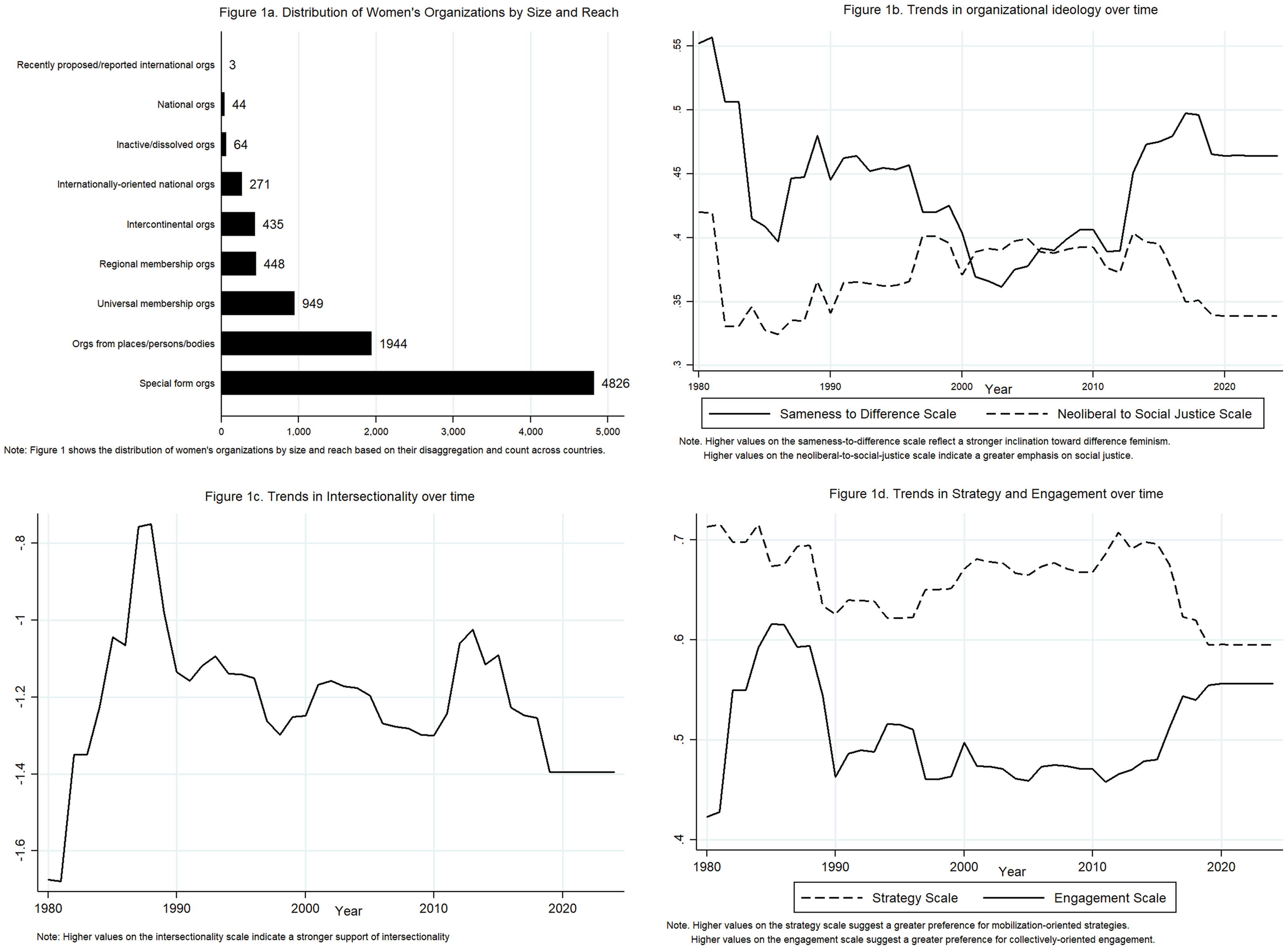
The ‘sameness’ vs. ‘difference’ feminism axis depicts the traditional feminist theoretical dispute over whether gender neutrality or gender specificity promotes equality (Capps Reference Capps1996; Scott Reference Scott1988). Sameness feminist organizations believe women should be treated equally and given equal opportunity under the same standards. Based on the assumption that women and men have equal talents, they demand gender-blind legal equality, equal education and employment, and the removal of discriminatory barriers (Capps Reference Capps1996). In contrast, difference-oriented organizations argue that gender-neutral treatment can perpetuate disadvantage given women’s socially constructed positions, thus advocating for gender-specific policies such as maternity protections or workplace accommodations (Fraser Reference Fraser2020; Scott Reference Scott1988). Following Scott’s (Reference Scott1988) deconstructive reading, ‘difference’ here refers to structural asymmetries rather than essentialist claims about women’s nature. The coding captures organizational framing, and its empirical utility is demonstrated by temporal variation in Figure 1B.
Descriptive statistics of women’s organizations in the FEMPOWER dataset

The final set of ideological coding addresses intersectionality: how organizations directly confront multiple oppressions. Subcategories included the intersections of gender with ethnicity/race, sexuality, and class. For example, an organization was considered intersectional gender–ethnicity if it focused on empowering women from specific ethnic or racial groups or on fighting racial and ethnic inequities (Crenshaw Reference Crenshaw1989; Yuval-Davis Reference Yuval-Davis2006). The gender-class intersection includes organizations that connect women’s empowerment to labor, poverty, and economic injustice, such as those pushing for workers’ rights, fair salaries, and access to economic resources (Fraser Reference Fraser2020). The gender–sexuality intersection code captures organizations explicitly oriented toward lesbian, bisexual, and/or trans women, for whom gender and sexuality are structurally co-constituted (Crenshaw Reference Crenshaw1989; Yuval-Davis Reference Yuval-Davis2006). Organizations not oriented toward women as a category are not included.
Since ideological codes overlap, one organization may obtain multiple codes. An organization of Afro-descendant women advocating for land rights may be social-justice, difference feminist, and intersectional. Another organization may be neoliberal, sameness-focused, and without an explicit intersectional orientation.
To ensure reliability, ideology was coded abductively using deductive and inductive methodologies. I started with theoretical expectations about significant transnational feminism debates from global feminism and feminist theory literature and developed the categories based on organizational purpose declarations. In practice, I examined each organization’s aims and activities and highlighted common themes, checking for pre-identified categories or suggesting new ones. Illustrative coding examples are provided in the online Supplementary Materials.
Although the dataset mainly focuses on ideological fragmentation, the size and reach matter too. A small regional feminist collective and a global NGO network may both exist in a country, but their influence may differ. Therefore, FEMPOWER categorizes organizations based on size and worldwide reach, following the UIA’s typology. For example, Type A organizations are large universal bodies (excluding the UN, which is intergovernmental), Type B are federations with global membership, Type C are international organizations covering multiple regions, and Type D are regional organizations. These variables can be used to weight impact or analyze whether certain types of organizations (eg large international NGOs) lean toward certain ideologies (some hypothesize that donor influence makes larger organizations more neoliberal; cf. Berkovitch and Gordon Reference Berkovitch and Gordon2008).
It also notes the number of countries an organization operates in (in its peak or final year) and if it has formal consultative status with intergovernmental organizations (such as UN ECOSOC) to measure international embeddedness. The count of how many international NGOs or IGOs are associated with, and how many UN consultative statuses they have, for those having data, quantifies an organization’s worldwide integration.
FEMPOWER provides a multidimensional profile of each transnational women’s organization, including their name, founding year, country-year entries, service or mobilization, individual or collective focus, and ideological orientation. The dataset captures these subtleties, making it ideal for scientifically studying the worldwide women’s movement fragmentation.
FEMPOWER dataset description
Trends in fragmentation
Figures 1A–D illustrate the trends in evolution and adaptation of women’s organizations via structural, ideological, and strategic changes over time. Figure 1A depicts the evaluation of the size and reach of women’s organizations. The greatest categories are organizations emanating from ‘places, persons, or bodies’ (1,944) and ‘special form organizations’ (4,826), indicating the movement’s flexibility and niche approach. Intercontinental (435) and regional membership organizations (448) suggest cross-border networks, while internationally focused national groups (271) are more prominent. The 949 universal membership organizations have a genuine global scope of action.
Figure 1B shows ideological fragmentation from 1980 to 2020 along the sameness-to-difference and neoliberal-to-social justice axes. The sameness-to-difference scale dropped until the early 2000s but surged rapidly around 2010, implying difference feminism, before stabilizing. Neoliberal orientations waned in the early 2000s as social justice frameworks gained prominence, but after 2010 social justice support dropped, suggesting a return to neoliberalism or alternative paradigms.
Figure 1C includes intersectionality. Sameness feminism was criticized in the early 1980s for ignoring race, class, and sexuality. Intersectional awareness peaked in the late 1980s (Crenshaw Reference Crenshaw1989) and declined in the 1990s. Millennial feminism rose in 2010, but it plummeted in the following decade, presumably due to exhaustion with intersectional frameworks or neoliberal pressures (Rottenberg Reference Rottenberg2018).
Figure 1D compares organizational strategy (service-oriented to mobilization-oriented) and engagement (individual to collective). In the 1980s, mobilization strategy dominated, but service-oriented approaches took over and stabilized in the 2000s. Engagement shifted from an individual to a collective one in the early 1990s, declined during the 2000s, and then recovered after 2010. Higher levels of collective engagement by 2020 would suggest renewed organizational solidarity.
Ideological fragmentation across the continents
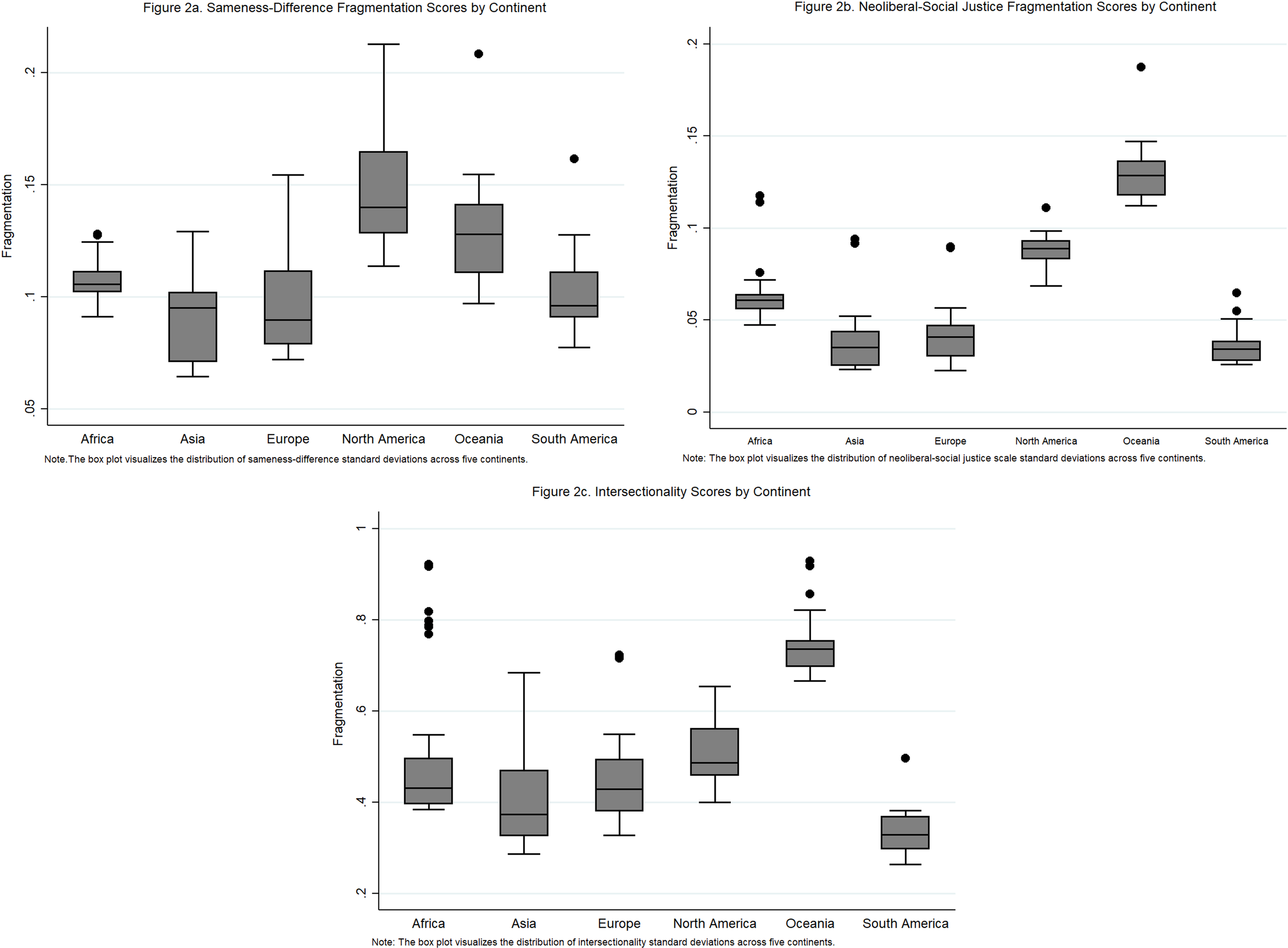
Figures 2A–C point to some clear regional contrasts in how women’s organizations differ ideologically. Women’s organizations in North America and Oceania appear to be the most ideologically fragmented. On all three dimensions – sameness-difference (Figure 2A), neoliberal-social justice (Figure 2B), and intersectionality (Figure 2C) – they show not only high median scores but also expansive ranges. In practice, it means that organizations in these regions often adopt competing frameworks, sometimes leaning toward sameness, other times toward difference, and frequently mixing neoliberal and social-justice paradigms. Their approaches to intersectionality are also diverse, ranging from simple two-fold concerns, such as gender and class, to much more complex understandings of multiple intersected inequalities.
Ideological fragmentation of women’s organizations by continent
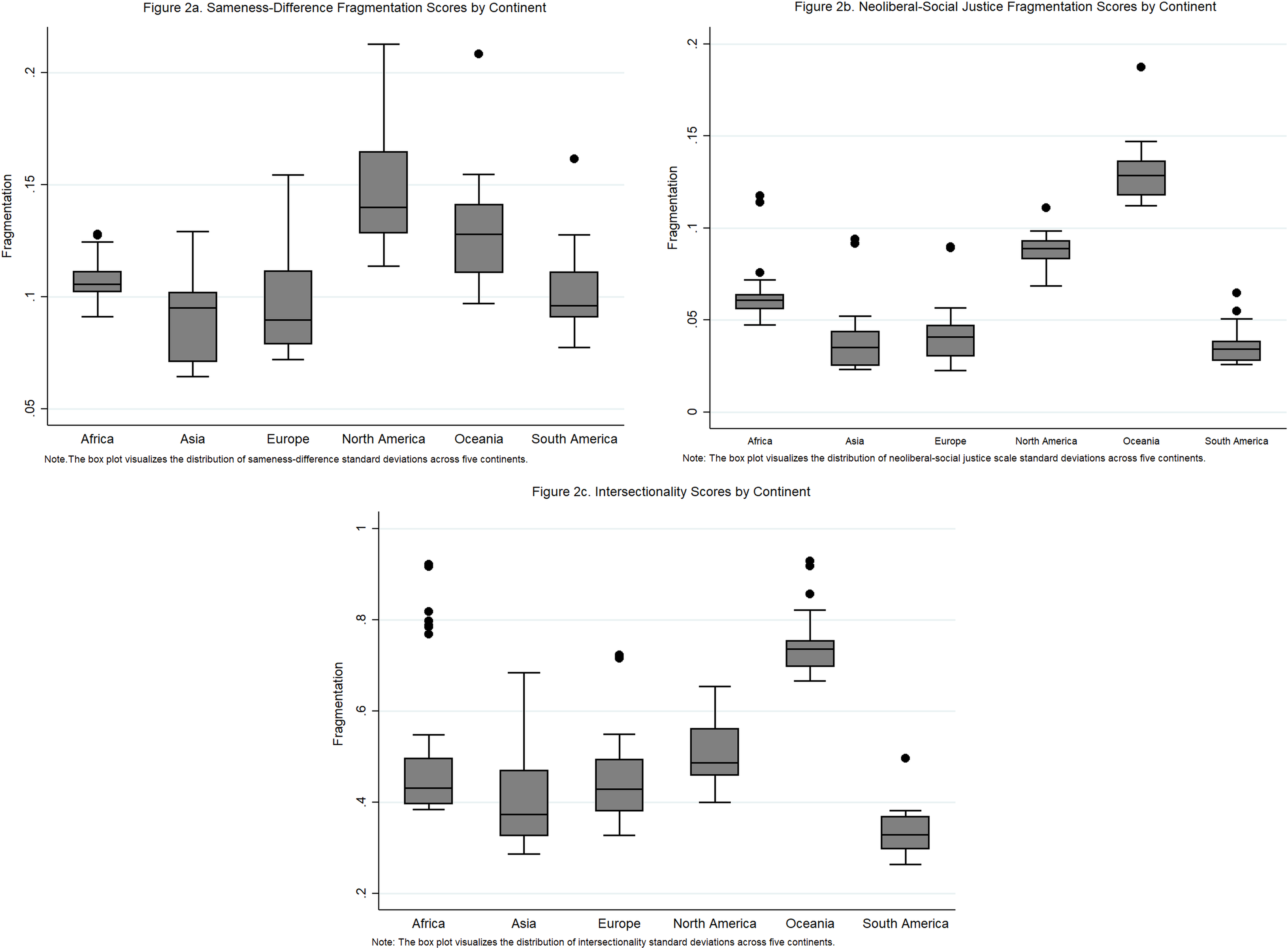
The picture is almost the opposite in Africa and South America. Across Figures 2A–C, their scores remain low and tightly clustered, which suggests that groups there prefer more unified strategies and common goals rather than experimentation. This type of cohesion probably reflects both contextual pressures and the need to present a consolidated movement front.
Europe falls somewhere in between. Its organizations show moderate fragmentation across all the dimensions. It is not as diverse as North America and Oceania, but not as uniform as Africa or South America either. Asia stands out for its consistent fragmentation scores in all the dimensions. Especially in sameness-difference (Figure 2A), the range is minimal, pointing to a strong adherence to similar ideological positions with very little variation.
Novelty and comparison with existing datasets
FEMPOWER represents a significant advancement over earlier datasets in this domain. Unlike prior data, which predominantly measured the quantity of women’s organizations or connections, FEMPOWER delves into the ideological orientations of those organizations. For example, the WINGOs dataset counts women’s international NGO memberships per country-year (Hughes et al. Reference Hughes, Paxton, Quinsaat and Reith2018), but it does not inform about the ideological bent of those NGOs. The TSMO dataset catalogs organizations and their issue areas (Smith et al. Reference Smith, Plummer and Hughes2017, Reference Smith, Wiest and Hughes2019), yet it does not indicate whether women’s organizations within it took diverging approaches on programmatic issues. The FEMPOWER dataset explicitly categorizes ideological tendencies, a novel feature that enables research into questions of internal movement ideological dynamics that could not be addressed before.
Furthermore, FEMPOWER’s structure – disaggregating organizations by country and year – is innovative. Previous datasets often treated transnational NGOs as unitary actors on the world stage. In contrast, by situating each organization in each country of operation annually, researchers can observe diffusion and growth patterns. They can examine how quickly new feminist ideologies spread to different countries or how the presence of certain types of organizations in a country changes over time. For instance, one could trace the entry of intersectional feminist NGOs into post-communist Eastern Europe in the 1990s or compare the trajectory of neoliberal vs. social justice feminist organizing in Latin America during the structural adjustment era. This local-level granularity is crucial because global movements do not impact countries evenly. They interact with domestic contexts. FEMPOWER thus helps connect the global and local levels of analysis.
In terms of scope, FEMPOWER is also more up-to-date and wide-ranging. WINGO and TSMO data ended in 2013 and were limited to 12 time points. The FEMPOWER dataset provides annual coverage from 1980 to 2023. To illustrate the dataset’s utility, consider a comparison of FEMPOWER with WINGO and TSMO on a concrete point. The WINGO’s dataset might tell us that country X had memberships in, say, 10 international women’s NGOs in 2005. FEMPOWER can reveal which ten they were and whether they were mostly, for example, service-oriented, neoliberal-leaning NGOs, or mobilization-oriented, social-justice feminist networks, a distinction that could be consequential for understanding outcomes in country X. Similarly, TSMO might list a women’s organization and note it works on ‘women’s rights’, but FEMPOWER would further indicate if that organization approaches women’s rights from a humanitarian aid perspective, an economic empowerment perspective, or a rights-based advocacy perspective (thanks to our coding of strategy and ideology). In short, FEMPOWER adds ideological details to the data on women’s transnational activism.
Conclusion
This paper introduces the FEMPOWER dataset, a new resource that can significantly enhance research on the ideological fragmentation of women’s transnational organizations and their role in global gender politics. FEMPOWER incorporates ideological and strategic dimensions, enabling scholars to go beyond treating the international women’s movement as a monolithic entity and instead scrutinize its internal conflicts and composition. There are several potential applications and implications of the dataset.
First, the dataset enables analysis of how ideological fragmentation might influence movement effectiveness. Scholars can investigate whether countries or times characterized by a more fragmented constellation of women’s organizations (ie organizations pulling in very different ideological directions) experience slower progress on women’s rights compared to contexts where women’s groups share a more unified agenda. Beyond quantitative analysis, FEMPOWER provides qualitative information – organization names, stated goals, and detailed typologies – that enables case study selection, comparative qualitative research, and mixed-methods designs. Researchers can use the dataset to identify organizations for in-depth interviews, trace specific organizations’ trajectories over time, or select theoretically relevant cases based on ideological profiles.
Second, FEMPOWER provides a platform for more comprehensive testing of theories related to NGO co-optation and neoliberalism in global feminism. Researchers critical of the feminism ‘NGO-ization’ have argued that the influx of donor funding and professionalization since the 1990s led many women’s NGOs to adopt depoliticized, neoliberal frames, prioritizing service delivery or entrepreneurial approaches over contentious politics (eg Alvarez Reference Alvarez1999; Roy Reference Roy2015). The dataset provides empirical leverage to examine this trend: one can track whether the proportion of organizations coded as neoliberal-oriented rose over time or whether countries heavily dependent on foreign aid have movements skewed toward service/individual empowerment models. Conversely, FEMPOWER allows identification of counter-trends, such as the persistence or resurgence of radical and social justice-oriented feminist groups even in a neoliberal era. Furthermore, it can trace how international policy paradigms (eg UN gender mainstreaming, SDGs) influence language and mission statements of the women’s organizations, revealing the interaction between external institutional pressures and internal ideological currents.
Third, FEMPOWER contributes to a more intersectional global perspective by cataloging organizations focusing on marginalized subgroups of women. It allows the analysis of questions like, in which regions or times have women-of-color feminist or Indigenous women’s networks been most active? How has the global women’s movement engaged with LGBTQ+ issues over time, as indicated by the presence of queer/trans-inclusive organizations? Quantification of these organizations brings intersectional feminism from abstract theory to concrete data points, which can facilitate dialogues between quantitative and qualitative scholars. The quantitative data corroborate case study findings that the actions of Black and Indigenous women, frequently marginalized, have been pivotal in influencing feminist fights globally, demonstrating constant patterns of transnational networking (Basu Reference Basu2010). The FEMPOWER also encourages mainstream indicators of women’s empowerment to incorporate a more intersectional focus.
Finally, the dataset’s design bridging local and global levels means it can help answer macro-level questions with more granularity. For example, those interested in regime type or context could merge this dataset with other contextual datasets like the Varieties of Democracy (Lindberg et al. Reference Lindberg, Coppedge, Gerring and Teorell2014) and explore whether authoritarian regimes tend to allow only certain types of women’s NGOs (perhaps more service-oriented, less political ones) while democracies host a greater variety, or conversely, whether some authoritarian contexts see the rise of more radical transnational feminist underground networks as a form of resistance. The data might also reveal regional patterns of fragmentation: for example, do Western European countries have less ideological fragmentation due to a stronger institutionalization of feminism, whereas regions like North America or Oceania exhibit a wide ideological range?
In conclusion, FEMPOWER equips researchers to empirically evaluate the oft-noted trade-off between movement unity and fragmentation: is the feminist movement’s strength found in speaking with one voice or in its many voices? The future studies using this dataset will shed new light on how feminist movements negotiate their internal conflicts and coalitions to achieve change (or why they sometimes fail to). Understanding fragmentation patterns helps identify ways to build solidarity between institutionalized NGOs and grassroots groups while recognizing the multiplicity of women’s experiences, as emphasized by post-structuralist feminism.
Supplementary material
The supplementary material for this article can be found at https://doi.org/10.1017/S1682098326100460
Data availability statement
The dataset and its codebook are available at https://doi.org/10.7910/DVN/VMD7RK
Funding statement
This paper was supported by the National Science Centre, Poland, in the framework of the grant ‘Fragmentation of Women’s Organizations and the Expression of Women’s Political Power Worldwide, 1999–2020’ (Contract number: UMO-2021/40/C/HS6/00150) and the grant ‘Gender Gaps in Political Participation: Examining the Relationships Between Gender Equality and Gender-Role Attitudes in Europe, 1999–2021’ (Contract No. UMO-2023/51/D/HS6/00026).
Competing interests
The author declares none.
Ethics standards
Ethical approval and informed consent were not required for this study because it is based exclusively on publicly available, anonymized secondary data and did not involve human subjects.
Permission to reproduce material from other sources
No permissions were required for this study as it did not reproduce material from other sources.


 Open access

