


The United Nations has highlighted the significance of co-operatives by declaring 2025 the International Year of Co-operatives. While co-operatives may not be the dominant form of business enterprise, they can play a significant role in local and regional economies. Yet recognition of the contribution of co-operatives to the economy and business is underdeveloped in a key area of business history—business collaboration and co-operation. By including co-operatives in the development of business history theory, we not only develop business history but also provide further insights into the history of co-operatives.
There is a growing recognition among business historians that firms do not operate in isolation but co-operate with other firms to achieve more favorable market outcomes. This co-operation can be traced back to medieval guilds.Footnote 1 It has been recognized in studies of multi-national corporationsFootnote 2 and economic clustering where there is “cooperative competition” between rival firms.Footnote 3 This recognition challenges the conventional approach of economists that “competition, not co-operation” is “the driving force of business.”Footnote 4
Key business history concepts that recognize this collaboration are Business Groups (BGs) and Business Interest Associations (BIAs). While BGs can cover a wide range of types of business collaboration, the business history focus tends to be on holding companies. BIAs relate more to trade associations and peak business organizations, both at a national and international level.Footnote 5
Although the BG literature has recognized co-operatives, particularly co-operative wholesale societies, the BIA literature has not explored peak national co-operative associations (PNCAs). Peak organizations, whether for labor, employers, or business entities, are inter-entity organizations “directed towards furthering common interests … by jointly-determined strategies.”Footnote 6 PNCAs play an important role in promoting all co-operatives at a national level. They raise the profile of the co-operative movement and lobby governments for favorable legislation. While co-operative researchers recognize the significance of PNCAs,Footnote 7 the concept is underdeveloped in the co-operative theoretical literature.
This paper first explores the concepts of groups in the business history literature, focusing particularly on the concept of BIAs. It highlights the different types of BIAs and examines current theoretical explanations for their formation. The paper next examines co-operative literature that has attempted to provide a general framework for understanding the formation and survival of peak co-operative national associations. It then briefly examines the history of two long-standing PNCAs in the UK and the US, which were established in 1869 and 1916, respectively. Both the UK and the US co-operative movements had a significant influence on the Australian co-operative movement.
The paper then focuses on the Australian experience which has been one of limited progress until recently. The earliest attempt at national organization failed in the 1920s. There were three examples that followed, based mainly on peak state co-operative associations, but these also eventually became moribund or went into liquidation. Since 2013 two further examples have emerged, both of which rejected the peak state federation model. The paper will explore the explanations for the successes and failures of these various efforts at forming national peak federations, which aim to act as a voice for all types of co-operatives within a country, in Australia. These include a state rather than a federal legislative framework for co-operatives, the growth of separate peak national industry organizations for financial co-operatives, and the rise of Neoliberalism. Neoliberalism challenged the collective ethos that underpinned co-operatives. Overall, the paper aims to bring PNCAs into the business history literature generally and develop the BIA theoretical framework in light of the Australian experience. The paper highlights the dramatic rather than gradual way in which BIAs can form in response to changing circumstances and their dependence on recognition by governments.
Business Groups and Business Interest Associations in Business History
A very broad definition of BGs by Granovetter is that they are “legally separate firms bound together in persistent formal and/or informal ways.”Footnote 8 The level of binding is intermediate and excludes short-term strategic alliances and those firms legally consolidated into a single entity. Despite Granovetter’s broad definition of BGs, there is a tendency for business historians to use the term to cover a specific type of firm alliance. Fruin distinguishes BGs, which have more centralized ownership and control with limited autonomy for organizational sub-units, from interfirm networks. Within these networks sub-units enjoy more autonomy regarding ownership control and operations.Footnote 9 BGs are firms that work together because of common ownership and control. Examples of BGs include the British Trading Company and the Kikkoman, which is a Japanese family-based BG. Examples of interfirm networks include inter-industry federations of firms in Japan which offer a range of services including banking, information technology, and engineering to related firms.Footnote 10 Colli and Vasta highlight this narrower definition of BGs by defining them as “particular corporate forms based upon a ‘parent’ company holding control stakes in and exerting co-ordination activities over subsidiaries.”Footnote 11 They argue that these BGs are historically significant as large firms have adopted them as one of the dominant forms of organization since the Second Industrial Revolution.
This narrower definition of BGs excludes a range of other business associations such as Trade Associations (TAs) and Employers’ Organizations (EOs). Lanzalaco describes them as BIAs and argues that they have been largely neglected as a focus of academic study through much of the twentieth century.Footnote 12 TAs have a vertical dimension by bringing together particular interests of specific groups of firms, while EOs are generally horizontal as they reflect the geographical boundaries of the labor market. TAs meet firm needs such as marketing, research, finance, and the regulation of competition. They are also a pressure group that lobbies governments to ensure that their interests are heard by governments. EOs focus on industrial relations issues such as collective bargaining, strikes, and dealing with industrial tribunals. Examples of TAs include Zentralverband der Deutschen Industriallen , which was formed in Germany in 1876, and the Japan Economic Federation, which was formed in 1922. Examples of EOs include Sveriges Industriforbund , founded in 1910, and the National Federation of Industrial Organisations, founded in 1916 in the UK. There are BIAs that perform both the functions of TAs and EOs, such as the National Association of Manufacturers (NAM), founded in the US in 1895.Footnote 13 As Eichenberger, Rollings, and Schaufelbuehl have noted, BIAs are also a feature of international business and not restricted to national boundaries.Footnote 14
While some business historians view BIAs as less historically important than BGs, they have played a significant role in shaping capitalism. The NAM, for example, shaped and rationalized US industrial capitalism, with occasional setbacks such as its failure to stop the passage of the Wagner Act.Footnote 15 Keith Middlemas noted that during the 1930s and 1940s in the UK TAs transformed from “interest groups” to “governing institutions” with a significant impact on the state. These TAs responded to members’ interests in dealing with the state but also used their relationship with the state “to justify themselves to their members” as representative organizations.Footnote 16 More recent work has argued that while political activity by a business may bring short-term benefits it may lead to a dependency on the state that can lead to its demise in changing circumstances.Footnote 17
Lanzalaco highlights two important issues relating to BIAs at a national level—their formation and their survival. The foundation of a national peak BIA occurs at a critical juncture or an event which defines capitalists’ common interest not only at a national level but also at the international level. Like all political organizations, national peak BIAs emerge in two ways—diffusion and penetration.Footnote 18 They can be formed by diffusion when smaller BIAs at a regional or provincial level progressively integrate into national organizations. There is sectoral diffusion, such as the Confederation of British Industry, where previously sector-specific organizations form a national peak organization. There is territorial diffusion where the non-specific BIAs that were organized on a local, regional, or provincial basis form a national peak BIA. They can also be formed by penetration where a previously formed national peak BIA conquers new “domains” by forming new BIAs. Penetration can also be either on a sectoral basis or geographical basis. There can also be internally and externally legitimized BIAs. The former arises from the autonomous and spontaneous action of capitalists. The latter arises from a range of external actors including churches, political parties, and even the state. National peak BIAs that are formed through diffusion tend to be weak as the territorial and sectoral organizations have consolidated and resist encroachments upon their authority. Those national peak BIAs that arise from penetration are stronger if the source of legitimization is internal rather than external.Footnote 19
While the literature on BIAs focuses on capitalist firms, there is no discussion of the co-operative business model. By contrast there is some recognition of co-operatives in the BG literature such as co-operative wholesalers and Mondragon, a worker co-operative in Spain.Footnote 20 The next section will examine how the co-operative literature deals with PNCAs.
Peak National Co-operative Associations—The Conceptual Literature
The co-operative is a Member Owned Business (MOB) as opposed to an Investor Owned Business (IOB). Members can work for the co-operative as in the case of a worker co-operative. They can consume goods and services such as groceries as in the case of a consumer co-operative, or grain storage facilities as in the case of an agricultural co-operative. Birchall has defined an MOB as a:
business organization that is owned and controlled by members who are drawn from one (or more) of three types of stakeholders – consumers, producers and employees – and whose benefits go mainly to these members.Footnote 21
MOBs provide goods and services to members and while they are sometimes considered to be “non-profit” they must make a surplus to cover costs and provide for future capital investments. MOBs are contrasted to IOBs, with the focus of the former being on people and the latter on money. Investors can appropriate profits and increases in share value. By contrast, members can take the surpluses and give priority to other objectives such as quality of service, community assistance, and better conditions for employees. More generally the existence of a member-owned sector provides more choice for members who may value the benefits of membership over the goods and services.Footnote 22
Co-operatives are governed by a set of principles. Birchall notes that there were nine fundamental principles that were set out in the early rules and publications of the Rochdale consumer co-operative movement in the UK in the mid-nineteenth century. The first principle is related to democracy. The Rochdale consumer co-operatives differ from other businesses in that management is based on the democratic principle of “one member one vote” rather than one vote for each share. This means that someone holding 100 shares has the same number of votes as someone holding one share. Other principles included: open membership; the distribution of the surplus as a dividend on purchases; cash trading; fixed and limited interest on capital; selling only pure and unadulterated food; education; political and religious neutrality; and the disposal of net assets without profit to members.Footnote 23 As Wilson, Webster, and Vorberg-Rugh note, the “principles of this model both spread across the world and survived to the present as the ‘ideal.’”Footnote 24
The International Co-operative Alliance (ICA), an international co-operative peak association founded by co-operatives in 1895, became a forum from 1930 to redefine the Rochdale principles considering the wide variation of practice by co-operatives.Footnote 25 The ICA after an extensive survey of its members in 1995 came up with the following seven fundamental principles to define the co-operative identity: voluntary and open membership; democratic member control; member economic participation; autonomy and independence; education, training, and information; co-operation among co-operatives; and concern for community.Footnote 26 The ICA broadly defines a co-operative as “an autonomous association of persons united voluntarily to meet their common economic, social and cultural needs and aspirations, through a jointly owned and democratically controlled enterprise.”Footnote 27 It further notes that “co-operatives are based on the values of self-help, self-responsibility, democracy, equality, equity and solidarity.”Footnote 28
The co-operative model became a movement with an ideology built around collective self-help, economic democracy, and community obligation.Footnote 29
One significant ICA co-operative principle is “co-operation among co-operatives” which challenges the concept of competition among traditional firms. While this principle was adopted by the ICA in 1966, it had been long practiced by the co-operative movement. This co-operation among co-operatives has taken a number of forms including co-operative wholesalers and consortia. Co-operative wholesalers are BGs formed by retail co-operatives to source goods to prevent co-operatives bidding against one another for wholesale goods. They also overcome the problems of boycotts by wholesalers and manufacturers unsympathetic to the co-operative business model. A notable example of this is the English Co-operative Wholesale Society formed in 1864 and still trading as the Co-operative Group in the UK.Footnote 30
One form of co-operation among co-operatives is PNCAs, which are BIAs that can also be called co-operative unions and co-operative associations. They are generally overlooked in typologies of co-operatives, which tend to focus on the business activities of co-operatives.Footnote 31 Ammirato recognizes single co-operatives as primary co-operatives but notes the formation of second-tier co-operatives. They are formed by primary co-operatives to “provide services or any required input to co-operatives so that they can achieve economies of scale whilst remaining small.”Footnote 32 While PNCAs could be second-tier co-operatives, formed directly by primary co-operatives, they could also be a third-tier co-operative. These are formed by peak regional, state, or provincial co-operatives representing primary co-operatives as in Australia in 1943.Footnote 33 They could even be fourth-tier co-operatives formed by peak national industry co-operatives representing a variety of different types of co-operatives such as consumer or worker co-operatives as in Italy.Footnote 34
There is limited specific theoretical literature analyzing what these PNCAs do. They are not concerned with commercial trading like a co-operative wholesaler, which as previously noted has been classified as a BG by business historians. One very early study, by Carr-Saunders and his colleagues, examining the Co-operative Union (CU) in the UK, still provides the most comprehensive overview of what PNCAs do. They identify five functions. Firstly, “it formulates policy, speaks on behalf of the movement, and acts a defence organization.”Footnote 35 Secondly it provides a framework for shaping opinion about the movement. Thirdly, it acts as a mediator of disputes between members to avoid legal action. Fourthly, membership of the PNCA is a signal that the member is a genuine co-operative. Finally, the PNCA provides specific services to members including technical assistance, legal, statistical, educational, and publicity.Footnote 36 Subsequent studies recognize their role in lobbying governments, maintaining internal cohesion in the national co-operative movement, raising public awareness of co-operatives, co-operative education, international co-operative development, and publicity.Footnote 37
There is also limited literature on how PNCAs develop as BIAs. Watkins in his history of the ICA noted that the tendency for co-operatives to form associations and federations is “a natural line of evolution.” This arises because the “attempt to solve common problems by combined action is the essence of Co-operation.”Footnote 38 As previously noted, co-operation among co-operatives is a long-standing co-operative principle. He noted, however, that the evolutionary process is not without “stresses and strains arising from short-term or superficial conflicts.”Footnote 39 These conflicts, he argues, are essential for the recognition of complementary interests that underpin the long-term stability of these associations and federations.Footnote 40
Birchall takes a more “pragmatic” view than Watkins in that co-operative associations or federations form because of “strength in numbers.” He noted that co-operatives, however, give up some autonomy when they associate or federate. They give federal bodies authority over defined and limited areas. Co-operatives will only give “up as much sovereignty as is needed to meet common goals” and the federations exist only “as long as their member societies gain more from them than they lose.”Footnote 41 Birchall, like Watkins, recognizes that conflicts of interest can threaten the path towards federation.Footnote 42
The desire to preserve local autonomy, political divisions, and religious beliefs has undermined PNCAs. This occurred in Europe during the first decades of the twentieth century. The growing influence of Social Democracy split the German co-operative movement. The Allgemeiner Verband der auf Selbsthilfe beruhenden deutschen Erwerbs- und Wirtschaftsgenossenschaften was concerned at the growing influence of the social democrats and trade unions in the consumer co-operative movement. It expelled 98 consumer societies and their wholesaler in 1902. The expelled societies formed their own Zentralverband deutscher Konsumvereine and quickly became the most dynamic part of the German co-operative movement. The socialist-influenced co-operative wholesale society in Hamburg became the largest co-operative wholesaler in continental Europe prior to the outbreak of World War I. The Italian movement began in 1886 with a unified peak national co-operative. Co-operatives, however, linked with the Catholic Church, decided in 1919, once there was Vatican approval, to exit from the peak national co-operative and to create the Confederazione Nazionale della Cooperative. The Confederazione aimed to include all types of co-operatives linked to the catholic movement and can be seen as an example of an externally legitimized BIA. The Fédération des Sociétiés Coopératives Belges , by 1910, covered only half of the eligible societies. Some socialist Belgian consumer co-operatives refused to affiliate to preserve their autonomy. These divisions undermined the extension of co-operatives into wholesaling and manufacturing.Footnote 43
Peak National Co-operative Associations—The UK and US
Two examples of long-standing peak national co-operative federations are Co-operatives UK and the National Co-operative Business Association (NCBA) in the US. Both the UK and US co-operative movements had a significant influence on the shape of the Australian co-operative movement, especially regarding consumer co-operatives and credit unions.Footnote 44 Co-operatives UK’s predecessor was the CU. It arose from a Co-operative Congress held in London in 1869 during a period of growth of consumer co-operatives with the formation of the Co-operative Wholesale Society (CWS) that provided a critical juncture for the establishment of the CU.Footnote 45 The CU was a democratic organization, representing co-operatives of all kinds including producer co-operatives and building societies in Britain and Ireland. Representation was based on the size of the co-operative’s membership. The formation of the CU was spontaneous and does not fit the BIA diffusion or penetration models. It was not built on pre-existing co-operative peak organizations but brought together dispersed elements in the co-operative movement. The CU became a debating forum through its running of the Annual Congresses. It engaged in political lobbying on behalf of the movement. It also provided business services such as accounting and co-operative education. As early as 1874, it published a two-volume handbook providing general information about the co-operative movement. The handbook included an article defining a “true co-operative.” By 1913, the CU membership represented 1,272 co-operative societies with a membership of 2,874,574. It included 84 percent of all co-operative societies and 95 percent of all co-operative members in the UK.Footnote 46
The CU faced challenges within the UK co-operative movement. It became a rival center of potential national leadership to the CWS. Both bodies developed their own visions for the best way forward for the UK co-operative movement. In 1914, for example, the CU launched a strategic review of the co-operative sector, entitled the General Co-operative Survey. The CWS, however, refused to participate possibly because of under-representation on the governing committee. This weakened the credibility of the project. The complexity of the UK co-operative movement was highlighted by the creation in 1932 of the National Co-operative Authority. This body brought together the CU, co-operative wholesalers, the Co-operative Party, and various auxiliary co-operative organizations. The Co-operative Party was formed in 1917 and developed an ongoing alliance with the Labour Party. In 2001, the CU merged with the Industrial Common Ownership Movement, which represented worker co-operatives, to become Co-operatives UK. It is now the PCNA for all types of co-operatives in the UK. It had a membership of 998 organizations as of December 31, 2023, including 3,500 co-operatives represented through peak industry co-operatives such as the Confederation of Co-operative Housing.Footnote 47
The NCBA’s predecessor was the Co-operative League of the USA (CLUSA). Dr. James and Agnes Warbasse held a meeting in their Brooklyn home in January 1916 that launched CLUSA. It aimed to promote co-operative education and bring together the co-operative movement. James Warbasse was President of the League from 1916 until 1941 and Agnes served as educational director from 1916 to 1928. The critical juncture for the CLUSA was World War I, which assisted both its formation and early development. There was growing support for co-operatives from farmers and trade unions in the face of rising prices, profiteering, and a declining standard of living. Like the CU it was not built on pre-existing co-operative regional or state federations and was spontaneous. Early CLUSA leaflets cautioned against the dangers of co-operatives giving credit to their members. They also warned co-operative members of the pitfalls of shopping at other stores to obtain cheap bargains for the future financial health of the co-operative. CLUSA published The Co-operative Consumer and organized its first national conference in September 1918 that attracted 185 delegates from 386 co-operatives. CLUSA joined the ICA in 1921 and in 1922 adopted the Circle Pines or Twin Pines seal, showing two pines surrounded by a circle.Footnote 48
CLUSA faced two major historical challenges. There had been Communist interest since 1921 in capturing the co-operative movement. Warbasse, however, was opposed to Communism and strictly followed the Rochdale principle of political neutrality. The issue came to a head at the 1930 CLUSA Congress, after a Communist organizer openly attacked Warbasse and CLUSA. Communist delegates withdrew not only from the Congress but also from the co-operative movement. There were some splits at a regional level and some co-operatives joined the Communists. The bulk of the co-operative movement, however, remained committed to the principle of political neutrality and the Communists failed to undermine CLUSA.Footnote 49
The second major challenge arose from tensions between consumer and agricultural co-operatives. E.R. Bowen, a former sales executive for a farm machinery company, became CLUSA chief executive on January 1, 1934. He broadened CLUSA to embrace the farmers’ purchasing associations and improve its financial position, reducing its dependency on Warbasse’s philanthropy. CLUSA also developed the Rochdale Institute, which was formed in 1937, to provide educational and business training courses. Warbasse conflicted with Bowen particularly over the extension by Bowen of the definition of consumer co-operative to include co-operative purchasing by farmer’s organizations. This change shifted the League membership majority from industrial workers to farmers. It also led to factions built around Bowen and Warbasse. Warbasse ultimately resigned as CLUSA President in 1941.Footnote 50
CLUSA continued to expand. It broadened its focus in August 1945 to organize all types of co-operatives including credit unions, housing co-operatives, and medical co-operatives. Following lobbying from CLUSA, with the support of Democrat President Jimmy Carter, Congress established the federally funded National Consumer Co-operative Bank (NCCB) in 1978 to provide cheap finance to co-operatives. The administration of President Ronald Reagan moved to close the NCCB as part of budget cuts but agreed to privatize the NCCB in 1981 after the co-operatives raised close to $200,000,000 in capital for the Bank. CLUSA became the National Co-operative Business Association (NCBA) in 1985, and its membership still covers all forms of co-operatives. It conducts education programs, provides international co-operative aid, and lobbies Congress on behalf of co-operatives. In 1991, the NCBA successfully lobbied Congress to establish the Rural Co-operative Development Grants program to encourage new co-operative businesses in rural areas. As of December 2022, the NCBA had 255 members, of which 220 were co-operatives. Its members include individual co-operatives, state credit union leagues, and peak national industry co-operatives such as the US Federation of Worker Co-operatives.Footnote 51
Pulsford and the All-Australian Congresses—A Spontaneous Formation
Ins contrast to the UK and the USA, Australia had difficulties establishing a PNCA. An early attempt to form an Australian PNCA does not readily fit the diffusion or penetration model of BIAs but was spontaneous. Its attempted formation occurred at a critical juncture. There was a surge of consumer and farmer co-operatives fueled by inflation and social unrest during World War I and its immediate aftermath. Within this context there were two national co-operative congresses organized by Frank Pulsford. Pulsford was a Congregationalist minister and member of the Balmain consumer co-operative in Sydney. He saw co-operation as “applied Christianity” and an answer to the worst aspects of capitalism. His Co-operation & Co-partnership was the first Australian book to explore the development of co-operatives both in Great Britain and Australia.Footnote 52
Pulsford organized the first All-Australian Co-operative Congress in Sydney in April 1920 with representatives of 78 co-operatives, and a second Congress in Melbourne in October 1922 with only 29 delegates. While the Conferences were dominated by consumer co-operatives, the First Congress passed a resolution to establish an Australian Co-operative Union with state branches. Like the UK it would bring together all co-operatives and associated organizations in a PCNA.Footnote 53
These conferences did not have any major consequences. Pulsford’s efforts to organize a national co-operative organization died with him while giving a Church sermon in Melbourne in 1923. There were also ideological divisions between federalists and individualists. Federalists believed in the subordination of production to consumption, a co-operative wholesale organization, and the loyalty of tied stores. Individualists emphasized the primacy of production and preferred autonomous local consumer co-operatives. These autonomous co-operatives were linked voluntarily through a wholesale co-operative democratically controlled by a Co-operative Union. Pulsford was an individualist while the influential New South Wales Co-operative Wholesale Society (NSWCWS) was a federalist. Finally, the surge in co-operative formation reached a peaked in 1924 and the co-operative movement entered a period of relative stagnation.Footnote 54
The Co-operative Federation of Australia—Territorial Diffusion?
Toward the end of World War II there was a move again to form an Australian PNCA. There was a critical juncture with an expanding wartime economy and a surge of interest in co-operatives. A Commonwealth Consumers’ Co-operative Conference met in the national capital, Canberra, in December 1943. The Conference had delegates of agricultural and consumer co-operatives from all six states. The delegates believed that the Australian co-operative movement had a vital role in post-War reconstruction. They even suggested that co-operative principles should form the basis of that reconstruction. The conference passed several significant resolutions. They included a call for the representation of consumer co-operatives on all Commonwealth Government boards dealing with the retail and wholesale trade. A permanent PNCA secretariat in Canberra known as the Co-operative Federation of Australia (CFA) and state co-operative federations were to be established. The Co-operative Federation of Western Australia (CFWA), a successful state co-operative peak federation formed in 1919, organized the Conference. There was limited territorial diffusion, however, as there were no equivalent organizations in four other states. It was hoped that similar state organizations to the CFWA would follow.Footnote 55
There was a major expansion of the co-operative movement, particularly credit unions, following the Second World War and peaking in the 1970s. However, the CFA, which relied on support from the CFWA, remained weak and fluctuated in its level of activity. Its Canberra office closed in 1946 and did not reopen until 1975. It became moribund in 1986.Footnote 56
The CFA was a TA that joined the ICA and relied upon the ICA and the state to sustain its activities. ICA initiatives such as the International Co-operative Trading Organization (ICTO), despite CFA representation, gained little Australian co-operative enthusiasm until 1974. This changed when the Whitlam Labor Government supported the ICTO and assisted the CFA. In 1969, the CFA, along with the Australian Department of Foreign Affairs, developed an international co-operative study course. The course drew students from Africa, Asia, the South Pacific, and Papua New Guinea. The CFA organized the All-Australian-Co-operative Congress in Sydney in June 1957 and three Co-operative National Conventions in 1973–1975 in Canberra.Footnote 57
Why did the CFA not survive? It faced four challenges that weakened its standing as a PNCA for Australia. Firstly, there was conflict between the NSWCWS and CFWA for dominance in CFA. The NSWCWS claimed the right to represent NSW, Australia’s largest state in population, rather than the Co-operative Institute (NSW). The Institute was formed in 1945 to foster co-operative ideals and organization through education and research. The NSWCWS supported federal co-operative legislation while the CFWA supported state legislation. The decline of consumer co-operatives in Australia after the Second World War weakened the NSWCWS, which eventually ceased operations in 1979. Secondly, while there were state organizations in Queensland and Western Australia, the peak state co-operatives in South Australia, New South Wales, and Victoria took longer to consolidate. The South Australian federation functioned from 1946 to 1952 but was reformed in 1974 after becoming moribund. A New South Wales co-operative conference in April 1964 initiated the reorganization of the Co-operative Institute (NSW) into the Co-operative Federation of New South Wales (CFNSW). The CFNSW was similar to the CFWA with the NSWCWS as a member. The Victorian federation collapsed by 1955 but was eventually reformed as the Co-operative Federation of Victoria (CFV) in 1970. A co-operative federation in Tasmania, the sixth and smallest Australian state in terms of population, failed to get started. Thirdly, the legislation on co-operatives was state based with peak state co-operatives focusing their limited resources on state jurisdictions rather than the federal legislature.Footnote 58
Finally, financial co-operatives, which experienced massive growth following the Second World War, formed their own peak organizations. Co-operative Building Societies in New South Wales and Co-operative Housing Societies in Victoria obtained housing finance and were government guaranteed. Their state organizations formed the Australian Council of Co-operative Building and Housing Societies in June 1956 to encourage the spread of these societies throughout Australia. Permanent Building Societies formed a New South Wales Association in 1962 and an Australian Association in 1964. Victorian Catholic parish credit unions formed the Association of Catholic Co-operative Credit Societies (ACCCS) in 1957 to develop credit societies in other Catholic parishes. After several failed attempts, in 1956 the New South Wales credit unions formed a Savings and Loan Co-operative Association, the predecessor of the New South Wales Credit Union League Co-operative. The ACCCS eventually joined with other Victorian credit unions to form the Victorian Credit Co-operative Association in 1966. There were associations in other states. Credit unions formed a national body in 1966, known as the Australian Federation of Credit Union Leagues, later the Australian Federation of Credit Unions Limited (AFCUL). The national body, despite various state splinter groups, generally represented most credit unions and their members. The credit unions through their associations eventually obtained specific state credit union legislation. They also secured amendments to the federal Income Tax Assessment Act in 1974 that extended the mutuality principle to credit unions, freeing them from taxation payments on income received from members’ loans.Footnote 59
Australian Peak National Co-operative Associations 1986–2013—Territorial Diffusion
The CFNSW, with some Queensland co-operatives, tried to fill the void with the inactivity of the CFA through territorial diffusion. In 1986 they formed the Australian Association of Co-operatives. They claimed it was a “National Membership and Trade Association representing Australia’s Co-operative Sector.”Footnote 60 The CFV joined in 1987 after a period of decline as the Victorian Division of the AAC. The state federations in Queensland, South Australia, and Western Australia did not join. The AAC eventually collapsed in 1993, when it had 339 affiliates and 30 employees. This arose from financial problems associated with its internal banking services to New South Wales members and co-operatives lost money. The AAC had made some bad loans to a struggling consumer co-operative at Singleton in New South Wales, which also went into liquidation. In the wake of the collapse of the AAC, the CFNSW and CFV were reformed, with CFV membership growing from 14 in 1993 to 84 in 1999.Footnote 61
The CFA was revived by the state co-operative federations in August 1993. It was renamed the Co-operatives Council of Australia (CCA) in 1996. Territorial diffusion continued with the peak state co-operatives retaining internal autonomy and the CCA acting as a TA. The CCA was active in promoting co-operative issues during the first decade of its operations, relying upon its relationship with the state to ensure its relevance. For example, it called for consistent co-operative legislation for the various legal jurisdictions in Australia. In September 2001, the CCA did not support the transferring of co-operative legislation from the states to federal jurisdiction or incorporating co-operatives under federal Corporations Law. There was, however, a breakdown in the relationship with the ICA, with the CCA in October 1999 rejecting ICA affiliation as there was no benefit for Australia.Footnote 62
The CFWA by 2005 was concerned that the CCA need to be reactivated. The “absence of a functioning national peak body” was a “significant shortcoming in having co-operative company issues addressed at a national level.”Footnote 63 There were no meetings from May 2003 to May 2007. A major limitation for resuscitating a national peak organization remained the weakness of the state federations. The demutualization of larger co-operatives, particularly in agriculture, contributed to a significant decline in state federation membership.Footnote 64 The CFNSW faced financial difficulties, noting in May 2005 that “it does not receive sufficient fees to fund its current level of operations.”Footnote 65 The CFV and the Co-operative Federation of South Australia (CFSA) had no paid staff in May 2007. The CFSA earned just over $2,000 in membership fees in the previous financial year. There was still opposition to affiliating with the ICA due to cost and a lack of common interests with the Asian region of the ICA, where Australian co-operatives would be located.Footnote 66
The CCA was renamed Co-operatives Australia (CA) in November 2008, an unincorporated body with all state federations affiliating. CA, like its predecessors, relied upon the state to maintain its relevance to members. It lobbied the Australian Government to expand the co-operative sector to meet the challenges of the Global Financial Crisis. It also challenged federal legislative discrimination against co-operatives, such as the Wheat Marketing Act 2008, which excluded co-operatives from being eligible for export accreditation. It continued to lobby for consistent co-operative legislation for all Australian jurisdictions. The CA showed an interest in affiliating with the ICA subject to cost. It took part in activities to celebrate the declaration by the UN in 2012 as the International Year of Co-operatives. Despite this, the CA went into decline and became moribund. This was associated with the rise of the Business Council of Co-operatives and Mutuals (BCCM) after 2013. State federations either became moribund or wound up in Victoria, South Australia, and Queensland.Footnote 67
There were two main factors underlying the failure of PNCAs from 1986 to 2013. Firstly, the major divisions between financial co-operatives, such as credit unions, and other co-operatives continued. Credit unions created a new national body in January 1992, CUSCAL. The pre-existing Credit Union Financial Services of Australia became its financial services subsidiary, and the state credit union associations were liquidated. In December 2005, CUSCAL became Cuscal, but a Credit Union Industry Association (CUIA) was maintained as an advocate for credit unions. In 2009 CUIA and the Australian Association of Permanent Building Societies merged to form the Association of Building Societies and Credit Unions (ABACUS). ABACUS became the Customer Owned Banking Association (COBA) in 2013.Footnote 68
Secondly, the co-operatives faced ideological challenges from the rise of Neoliberalism during the 1980s. Neoliberalism questioned the economic validity of the collective ethos that underlay the co-operative business model. With very few exceptions, the enthusiasm for privatization in Australia related to the conversion of state assets to IOBs rather than mutual ownership. Policy makers generally viewed corporations rather than co-operatives as more efficient entities. Professor Allan Fels, Chair of the federal Australian Consumer and Competition Commission from 1995 to 2003, criticized co-operatives in 1995 for being anti-competitive, as they represented an agreement among competitors. Federal Treasurer Peter Costello in May 1999 saw demutualization as an important trend in helping major sectors of the Australian economy respond to increased competition and structural reform. With a general decline in the number of Australian co-operatives, demutualization hit significant co-operatives in agriculture and finance. The estimated level of demutualization fluctuated over the period with peak years being 1987, 1995, 2002, 2005, and 2009, and the last year being the highest. The demutualization from 1975 to 2009 constituted an estimated 58 percent of all Australian demutualizations since 1846.Footnote 69 The CCA believed that demutualization threatened “the establishment, development and continuation of the co-operative business model.”Footnote 70
The Formation and Growth of the BCCM—Spontaneous Formation
Since 2013 there have been two organizations that have broadened co-operative organization beyond a particular state—the BCCM and the Co-operative Federation (CF). One is an example of spontaneous formation, while the other was an example of territorial diffusion. There were two factors that favored national organization. They were the questioning of Neoliberalism that followed the Global Financial Crisis and the movement towards national uniform co-operative legislation. The Global Financial Crisis began in the USA in 2007 and quickly spread to other economies due to the growing integration of trade and finance in the world economy. While the Australian economy was less affected than other economies, the Crisis globally led to a questioning of the Neoliberalism and the demutualization. It was also recognized that co-operatives fared relatively well during the Global Financial Crisis relative to other business models. The declaration by the UN of 2012 as the International Year of Co-operatives reinforced this questioning of the Neoliberal paradigm. It highlighted the significance of co-operatives as an alternative business model to IOBs. The International Year also provided external international legitimization for the Australian co-operative movement.Footnote 71
While companies had achieved national regulation in 1992, co-operatives were governed by eight legal jurisdictions. Robyn Donnelly, former New South Wales Co-operatives Registry legal manager, noted that the eight government co-operative registries had a diversity of cultures. Some registries did not have sufficient resources to help draft national legislation.Footnote 72 Both the CFA and the AAC had unsuccessfully lobbied for uniform co-operative legislation to remove legislative inconsistencies. The Ministerial Council for Consumer Affairs (MCCA) brought together the respective Consumer Affairs Ministers in each Australian jurisdiction. It agreed in 2007 to have uniform legislation based on a template law to overcome the legal inconsistencies between the states and encourage co-operatives to operate beyond their own state. The MCCA released a draft CNL in December 2009 for public comment. New South Wales and Victoria had the first CNL to come into effect in March 2014. Queensland became the last state to adopt the CNL in December 2020.Footnote 73
The International Year of Co-operatives in 2012 provided the critical juncture for the formation of the BCCM. Its origins lay in Social Business Australia (SBA), which was active as early as April 2009 and was registered as a business name in New South Wales in July 2009. It promoted social business through education programs, greater capital investment, and raising public awareness. The SBA established a UN IYC National Steering Committee Meeting in May 2010 to organize preparations for the year. A founding director of the SBA was Trent Bartlett, the Chief Executive Officer (CEO) of the Capricorn Society. This was a Western Australian business co-operative for the automotive industry. Capricorn was an Australian affiliate of the ICA from 2005. Through Bartlett, Capricorn promoted and provided significant funding for the celebration of the International Year of Co-operatives in Australia in 2012. Bartlett and Greg Wall, Bartlett’s successor as Capricorn CEO, were chairs of the Australian IYC 2012 Secretariat. This organization was formed to co-ordinate the Year’s activities and registered as a company in Western Australia in January 2011. Melina Morrison, who had worked in London on the ICA Digest, was a founding director of SBA and the Secretariat. Morrison played a significant role in the International Year’s activities.Footnote 74 Morrison and others were aware of the need to build a “legacy” on the International Year of Co-operatives by forming a peak national organization to represent the interests of the entire social business sector in the future.Footnote 75
The International Year of Co-operatives Secretariat eventually transformed in March 2013 itself into the BCCM. It was launched on July 29, 2013, to represent the whole sector with Melina Morrison as the inaugural CEO and Greg Wall as the inaugural chair.Footnote 76 Wall was determined to have “Business” in the title of the BCCM to ensure they were recognized as an alternative business model. He also wanted the Board to consist of CEOs to ensure that key decisions were made without the need to refer to more senior co-operative and mutual managers. Capricorn also initially provided office space and support for the BCCM.Footnote 77
There were several features of the BCCM’s approach to membership that departed from previous PNCAs. It was not a federal organization built on peak state co-operatives. It followed neither the diffusion nor penetration models of BIAs. It formed quickly and not gradually. Further, it did not involve previously formed national peak co-operative associations penetrating new “domains” by forming a new BIA. Second, it did not aim to recruit all co-operatives as members. Melina Morrison believed that the aim of BCCM growth was “not to have all 2000 co-operatives and mutuals members of the council because many of them would be better to deploy their surplus back into their communities, but enough in the council that we can genuinely claim to be a peak body.”Footnote 78 Thirdly, the BCCM covered mutuals as well as co-operatives. Mutuals, such as health insurance funds, are MOBs like co-operatives. They are not registered under co-operative legislation and include passive membership organizations. Voting rights can be restricted to a small number of “governing members,” who elect directors at AGMs. Mutuals like co-operatives faced an unfavorable environment with the rise of Neoliberalism and demutualization. Five mutual life insurers in 1985 owned 60 percent of the Australian industry’s assets. By 1998, the total industry assets held by mutual life insurers had fallen to less than one per cent.Footnote 79
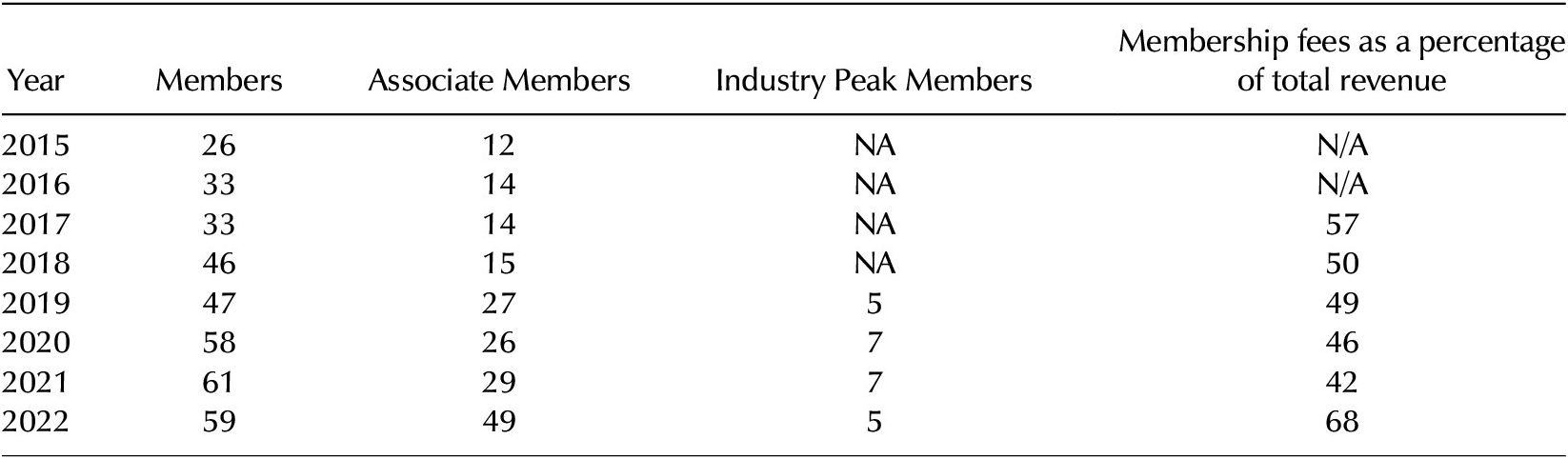
While in 2013, BCCM began with 10 members, it grew by August 2023 to 60 members and 42 associate members. The full members had one vote each. There are also five peak industry organization members including Co-operatives WA, formerly CFWA, and COBA. The membership is dominated by large co-operatives, such as CBH, a Western Australian grain farmers’ co-operative, Capricorn, and mutuals. They generally had considerable resources available to fund the BCCM and its activities. As Table 1 indicates full membership doubled between 2015 and 2020 with a peak of 61 in 2021. Membership fees made a significant contribution to the BCCM overall revenue. The BCCM employed staff and engaged consultants to achieve its objectives. In 2013 the BCCM had the equivalent of one full-time staff member. By August 2023 the BCCM employed five full-time staff and two part-time staff. Recent appointments included a part-time policy officer on Indigenous and housing co-operatives and a full-time communications officer.Footnote 80
BCCM Membership 2015–2022 as of June 30

Table 1. Long description
The table has five columns labeled Year, Members, Associate Members, Industry Peak Members, and Membership fees as a percentage of total revenue. From top to bottom, the rows are as follows. For 2015, Members 26, Associate Members 12, Industry Peak Members NA, Membership fees N/A. For 2016, Members 33, Associate Members 14, Industry Peak Members NA, Membership fees N/A. For 2017, Members 33, Associate Members 14, Industry Peak Members NA, Membership fees 57. For 2018, Members 46, Associate Members 15, Industry Peak Members NA, Membership fees 50. For 2019, Members 47, Associate Members 27, Industry Peak Members 5, Membership fees 49. For 2020, Members 58, Associate Members 26, Industry Peak Members 7, Membership fees 46. For 2021, Members 61, Associate Members 29, Industry Peak Members 7, Membership fees 42. For 2022, Members 59, Associate Members 49, Industry Peak Members 5, Membership fees 68. NA and N/A indicate data not available.
Source: BCCM Annual Reports.
The Function of the BCCM—Trade Association and Dependence on the State
While the formation of the BCCM did not follow the diffusion or territorial model, the BCCM has functioned as a TA rather than EO. The BCCM has been dependent on the state in terms of delivering outcomes for members. It has played an important role in placing co-operatives and mutuals on the Australian political agenda and achieving favorable legislation. The BCCM in 2014, through its chair Andrew Crane, was invited to join the Prime Minister’s organizing committee for the Business 20 or B20. This was the G20 discussion forum for the global business community. The appointment allowed co-operatives and mutuals for the first time to have a direct input through the BCCM to highlight their role in delivering G20 GDP growth targets. Andrew Crane, as the CEO of CBH, also represented agriculture. The BCCM through Melina Morrison established networks of sympathetic politicians from a range of political parties to raise political awareness of co-operatives. It formed parliamentary friends’ groups in the federal parliament in 2017 and in New South Wales in October 2022.Footnote 81 Andrew Leigh, a chair of the federal parliamentary friends’ group, from the Opposition Labor Party, encouraged the Turnbull federal Liberal-National Government to pass more favorable legislation for co-operatives and mutuals.Footnote 82
In March 2015 following the lobbying by the BCCM and its members, the Federal Senate voted to hold an inquiry into the operation of co-operatives and mutuals in the Australian economy.Footnote 83 The Senate Committee issued its report in March 2016 and called for a level playing field for co-operatives and mutuals. The Committee noted that there were “restrictive practices” in government grants and funding mechanisms that disadvantaged co-operatives “against other types of business structures.”Footnote 84 The 17 recommendations of the Senate report became the basis of the BCCM’s legislative strategy to promote co-operatives and mutuals and gain political party support in the lead-up to the 2016 Federal election. Major political parties such as the Labor Party adopted the Senate recommendations as party policy, including the collection of national statistics on co-operatives, better access to capital raising, and co-operative education programs.Footnote 85
One issue highlighted by the Senate’s report was the legislative impediments on Australian co-operatives and mutuals to raising capital. In the wake of the Senate report the BCCM, in collaboration with COBA, Mutuo UK, and BCCM member mutuals, successfully lobbied for a more favorable legislative environment. In March 2017, Scott Morrison, the then Federal Liberal Treasurer, commissioned Greg Hammond to undertake a review into how mutuals could have better access to capital. Hammond was a commercial lawyer with experience in the financial, charities, and not-for-profit sectors. The Turnbull Liberal-National Government accepted all 11 recommendations of the Review and the Treasury Laws (Mutual Reforms) Act was enacted in May 2019. The legislation defined a “mutual” in the Corporations Act for the first time. It also created new Mutual Capital Instruments (MCI) that can only be issued by mutual entities to attract capital investment while protecting capital investment structures. The BCCM launched the Capital Partners Project to take full advantage of the MCI. It promoted meetings between capital market experts and co-operatives and mutuals considering options for raising external capital. It held the first in a series of webinars in July 2020. Australian Unity became the first mutual to use the MCI when it announced in November 2020 an offer of MCI to raise $100 million.Footnote 86
The BCCM relied upon the state to expand agricultural co-operatives. The Federal Government accepted a BCCM recommendation to the Agricultural Competitiveness White Paper to fund a co-operative education and information program. The Farm Co-operative and Collaboration Pilot Program, known as Farming Together (FT), was launched by the Nationals Deputy Prime Minister Barnaby Joyce in April 2016. It was a A$14.9 million two-year program to encourage farmer collaboration, including the formation of new farmer co-operatives. The program reached 730 groups comprising 28,500 farmers throughout Australia, providing financial support for 51 projects and more than 1,000 consultancy advisory projects. FT was involved in the formation of over 70 agricultural co-operatives and there was growth in the number of agricultural co-operatives during 2016–2018. The BCCM subsequently launched a Co-operative Farming Project in 2020, with federal funding of $2.5 million, to encourage the formation of new agricultural co-operatives and foster the growth of existing agricultural co-operatives. The project included information sessions in regional centers to raise awareness among farmers, fishers, and foresters of the co-operative model and the development of legacy educational resources. A feature of the project was Co-operative Conversations, which could be viewed online and included roundtable conversations with Australia’s leading farmers, growers, and producers. Through the Program the BCCM provided 689 bursary-supported places across 58 workshops, approved courses, and conferences. The project also funded the documentary “Fightback Farmers: Feeding Australia Together” to highlight the resilience of agricultural co-operation. It screened on ABC (Australia) television on June 15, 2021, and reached 400,000 viewers. The Co-operative Farming Project, however, against the background of the economic disruption of COVID, did not stop a slight decline in agricultural co-operatives from 2018 to 2023.Footnote 87
As with agricultural co-operatives, the BCCM relied on state support to promote social co-operatives and mutuals. They would meet deficiencies in both the private sector and the state in delivering social services by providing for home-based and residential care for the disabled.Footnote 88 The federal Royal Commission into Aged Care Quality and Safety released its report in February 2021 and concluded that the aged care system was not “producing the best outcomes for those in need.”Footnote 89 Melina Morrison noted that the “The Aged Care Royal Commission was a rallying call for everyone who cares about a future-looking dignified and safe way to deliver a transparent and world class aged care system.”Footnote 90 Against this background the BCCM signed a Memorandum of Understanding with Aged and Community Services, a peak national body for aged and community care providers, on August 30, 2021. The Memorandum allowed that aged care providers could find out more about the benefits of the co-operative and mutual models. In 2023, the BCCM commenced to encourage the formation of social co-operatives and mutuals through the Co-operative and Mutuals Support Program (Care Together). This was a $7 million 2.5-year project funded by the Australian Department of Health and Aged Care. The BCCM co-designs social care projects with communities in areas deemed by the Aged Care Royal Commission to be most in need. These communities included Indigenous Australians, for example.Footnote 91 While this Program was originally announced by the Morrison Liberal-National Party Coalition Government, the BCCM obtained the continued support of the newly elected Albanese Labor Government. This highlights the bi-partisan political support for the BCCM.Footnote 92
The BCCM has also mobilized the sector and lobbied the state during a series of crises since 2019. It responded to the Australian bushfire emergency in 2019–2020 by directing more than $385,000 donated by co-operatives and mutuals in Australia and overseas to the Australian Mutuals Foundation Bushfire Appeal. It lobbied governments during the COVID 19 Pandemic to secure air freight support for co-operative exports. It ensured that government stimulus packages such as Jobkeeper and insolvency protection covered co-operatives and mutuals. It was a member of both New South Wales and Commonwealth COVID roundtables to ensure that the sector was represented in policy discussions. It commissioned research on how leading co-operatives and mutuals were dealing with the economic and social shock of the COVID-19 pandemic. The research found that co-operatives and mutuals avoided retrenchments during the Pandemic, adapted quickly to social distancing measures, and were less reliant on Government support to survive. The BCCM also released a report in October 2021 that highlighted the important role that agriculture co-operatives played in community resilience and recovery following a crisis. The report was the basis for a call by the BCCM for the Federal Government to give co-operatives a role in any discussions regarding planning for resilience and recovery.Footnote 93
The BCCM also engaged with federal and state governments to improve the profile and regulatory treatment of co-operatives. The BCCM commissioned the first national audit of government funded business services, including on-line sites, in 2015. It concluded that the information on co-operatives was inconsistent and cursory. The BCCM also lobbied, for example Commonwealth, South Australian, Tasmanian and New South Wales public servants and Ministerial advisors to ensure greater visibility for co-operatives on their websites. The BCCM entered discussions in 2017 with the Queensland Government about the adoption of the CNL, which occurred in December 2020. Following BCCM advocacy, in 2021 the Commonwealth Government included co-operatives with other business models on its main business website. The Commonwealth Government also recognized that business co-operatives were different from traditional franchises by exempting them from the Franchising Code. The BCCM also raised with government agencies examples of unequal treatment of the sector such as delays in the registration process.Footnote 94
While the BCCM has engaged in successful political lobbying, it has assisted co-operatives and mutuals in several other ways. It promoted networking and sector culture and launched the first annual Industry Leaders Dinner and Business Summit in November 2014 in Sydney. The first Summit incorporated the first Taste of Australia Dinner, which highlighted co-operative produce such as Geraldton Fishermen’s Co-operative lobsters and dessert wines provided by the Independent Liquor Group. The Summits also subsequently reinforced the sector’s culture in 2017 by creating a virtual hall of fame, the BCCM honor roll, which recognizes outstanding leaders in the sector and honors their contributions to industry. It has forged international links by affiliating with the ICA in 2016.Footnote 95 The BCCM also promoted co-operative education by developing its own education programs aimed at directors, executives, and employees in co-operatives and mutuals. Melina Morrison saw “education as a vital tool in helping co-ops and mutuals to build internal capacity and to engage and retain staff whilst supporting their organizational mission and goals.”Footnote 96 By 2022 the BCCM had its own education manager and had developed further partnerships with several organizations including the Institute of Chartered Accountants of Australia and New Zealand. The courses ranged from induction to strategic development programs and reached out to professionals such as lawyers and accountants.Footnote 97
The BCCM has developed significant research relationships with both the University of Western Australia (UWA) and Monash University. From 2014 the BCCM began publishing a National Mutual Economy Report (NMER) in partnership with UWA. The Report highlighted the importance of the sector to the Australian economy and overcame a lack of a reliable data set on the sector. This data was important for lobbying politicians as it highlighted the economic and political significance of the sector. Monash University hosted a panel event in June 2017 that looked at measuring the social impact and performance of the third sector and included CEOs from BCCM members, Bank Australia, and CUA. This collaboration grew into the Mutual Value Measurement Project, initially a two-year project. The Project brought together the BCCM, Monash University, and leading co-operatives and mutuals, with $Aus 1.1 million in funding, including $Aus0.6 million in contributions from industry partners. The project developed the Mutual Value Measurement (MVM) Framework for the Sector. The MVM was launched at the Annual Leadership Summit in Perth in November 2019. The BCCM introduced an MVM accreditation process in 2021 with four BCCM members receiving MVM accreditation in the first 12 months. The relationship with Monash University developed further in August 2023 with the launch of the Mutual Value Impact Lab, a new research center that focuses on the operation and potential benefits of co-operatives and mutuals.Footnote 98
In July 2022, the BCCM launched a co-operative development fund called the Bunya Fund to help early-stage co-operatives and mutuals to develop their businesses. The founding members of the Fund included CBH, two mutual banks, and Co-operative Power, a BCCM associate member. They provided the initial $Aus137,000 for the fund which is expected to grow to $A500,00 per year. There were ten successful applicants in November 2022 including the Coota Co-op, which was formed in the New South Wales rural town of Cootamundra in 2020 following the closure of a Country Target, the last department store in the town. The second round of grants in June 2023, which received support from Australian Unity, Bank Australia, and CBH, focused on three housing co-operatives against the background of Australia’s housing crisis. Another recipient was the Broomehill Village Co-operative in Western Australia, which was formed to revive a closed local pub.Footnote 99
The Co-operative Federation—Territorial Diffusion and Trade Association
There has been another movement besides the BCCM towards a PNCA that followed the BIA model of territorial diffusion on a geographic basis. While the Co-operatives WA is a BCCM associate member, the CFNSW withdrew from the BCCM. Sam Byrne, the CFNSW Secretary, noted that the BCCM was not seen as pursuing issues of importance to CFNSW members.Footnote 100 Byrne was a former Greens Mayor of the Sydney suburb of Marrickville and was involved in the Alfalfa House food co-operative. He was a part-time secretary from 2016 and eventually became full time.Footnote 101
The CFNSW found co-operatives beyond New South Wales were approaching it for assistance. It rebranded itself as the Co-operative Federation (CF) in October 2019, organizing beyond New South Wales into the Australian Capital Territory and the eastern states of Queensland, Victoria, and Tasmania, where there were no longer any active state federations. It aimed to have a “strong association” with the CFWA and the BCCM. The CF does not have state divisions and co-operatives affiliate directly. With some fluctuations its membership increased dramatically from 79 in March 2012 to 176 in June 2023. While a few of the CF members are also BCCM members, the growth of the CF highlights the growing awareness of co-operatives in Australia fueled by the BCCM’s activities since the International Year of Co-operatives and gaps in the BCCM’s organizing model.Footnote 102
Like other Australian PNCA, the CF functions as a TA and relies on state recognition to sustain its membership. The CF gained experience in organizing agricultural co-operatives through consulting work arising from the FT program. The CF’s activities range from educational programs, assisting new co-operatives through the registration process, lobbying state and territory governments rather than the federal government, and organizing co-operative conferences. The CF was directly involved in organizing new co-operatives such as the Hotline Courier worker co-operative in Sydney, with the assistance of a City of Sydney Council grant, and the Pecan Farmers’ Co-operative in Lismore, NSW. Relative to the BCCM the CF’s membership consists of smaller co-operatives, who are concerned with “nitty gritty” issues relating to regulation and planning. The CF has limited resources, with Byrne having the support of a part-time communications and business development officer by June 2023.Footnote 103
Conclusion
Overall, the Australian case study of PNCAs has major implications for business history and the theoretical framework of BIAs. Firstly, it reinforces the growing recognition among business historians that firms do not operate in isolation but collaborate with other firms to achieve more favorable market outcomes. This challenges the conventional approach of economists that competition rather than collaboration by firms is the major driving force of business.
Secondly, it broadens the focus of the existing BIA literature to include co-operatives, which are a significant business model. PNCAs as BIAs play a significant role in the co-operative movement, mobilizing political support and providing significant services such as co-operative education. Thirdly, BIAs may be fragile in terms of organizational survival. There are successful examples of long-term PCNAs such as Co-operatives UK and NCBA, which were formed at critical junctures in the history of their national co-operative movements. The Australian experience, however, was one of repeated failure. There were divisions arising from ideological conflict, the desire for autonomy by both state and sector-based organizations, a decentralist legal framework, and broader social and economic developments such as Neo-Liberalism.
Fourthly, there are Australian PCNAs that do not fit into the BIA diffusion model or the penetration model. Both the proposed peak PCNA that followed World War I and the BCCM could be described as examples of a spontaneous model of BIA development that quickly brings together dispersed elements of a business sector in response to a major event. For the BCCM the event was the UN International Year of Co-operatives which highlighted the need for co-operatives to develop a new approach to defend and enhance their sector. The spontaneous model does not only occur in Australia but also occurs with the CU in the UK and CLUSA in the US.
Fifthly, territorial diffusion can be more complex than Lanzalaco describes. There are Australian examples of territorial diffusion such as the reforming of the CFA in 1993. However, the initial formation of the CFA was organized by the CFWA without peak co-operative federations existing in some states. There was a hope that similar state-based organizations would follow. They did eventually in New South Wales, South Australia, and Victoria.
Sixthly, both Lanzalaco and Middlemas have highlighted the significance of the state in legitimizing BIAs. The PCNAs in Australia were TAs. As with earlier PCNA’s and the CF, the BCCM’s survival has depended on its recognition by the major political parties in Australia. They recognized the BCCM as a voice for the sector and were willing to fund BCCM projects that assisted the sector. This in turn ensured the continued support of members for the BCCM by delivering outcomes for them.
Finally, neither the current BCCM nor the CF perfectly fits the ideal of a PCNA or national BIA. One gap in the BCCM is its focus on larger co-operatives and mutuals as members to maximize its financial resources. The CF fits the BIA model of geographical penetration. It expanded its coverage in 2019 to go beyond New South Wales but leaves the CFWA to represent Western Australia. It does not have state divisions and individual co-operatives directly affiliated with it. The presence of the BCCM and the CF in the Australian co-operative landscape, however, provides the co-operative movement with a significant voice both at the state and national levels of government not seen previously. Bibliography of Works Cited

 Open access

