





Introduction
Since the euro crisis (2009–2015), national stereotypes have often been present in the political and media discourse on European Union (EU) economic governance. As debates between creditor and debtor countries became entangled in the rhetoric of Northern ‘saints’ and Southern ‘sinners’, cultural attitudes on public spending assumed a central role (Matthijs and McNamara Reference Matthijs and McNamara2015). At the height of the crisis, many national politicians invoked stereotypical images of themselves or of other EU nations to justify policy positions (Khan and McClean Reference Khan and McClean2017; Sierp and Karner Reference Sierp and Karner2017). As German Chancellor Angela Merkel urged EU countries in financial difficulties to follow the model of the ‘Swabian housewife’ and adopt an economical approach to public budgets (Kollewe Reference Kollewe2012), members of the Greek government complained about their weak negotiating position vis-à-vis Germany by referencing the Nazi occupation during the Second World War (Fuhrmans Reference Fuhrmans2010). Likewise, the Covid-19 pandemic led to the emergence of the ‘frugal four’ (Austria, Denmark, the Netherlands, and Sweden), a group of countries that used a self-ascribed adjective to signal virtue against the spendthrift countries of the South (Bialasiewicz Reference Bialasiewicz2020). In summary, while stereotypes have existed in Europe for centuries – often in a satirical form (Connelly Reference Connelly2014) – they acquired a new significance in the context of deepening European integration and increasing redistribution among EU Member States.
Yet, despite the frequency of national stereotypes in political rhetoric and media coverage, we know little about their prevalence in public opinion or in connection with citizen preferences on EU redistribution. In social psychology, there is extensive research on the content of stereotypes in circulation, the process of stereotyping, or the importance of in-group favouritism for stereotype perceptions (Cuddy et al., Reference Cuddy, Fiske, Kwan, Glick, Demoulin, Leyens, Bond, Croizet, Ellemers, Sleebos, Htun, Kim, Maio, Perry, Petkova, Todorov, Rodr´ıguez-Bail´on, Morales, Moya, Palacios, Smith, Perez, Vala and Ziegler2009; Koomen & Bähler, Reference Koomen and Bähler1996; PeabodyReference Peabody1985; Poppe and Linssen, Reference Poppe and Linssen1999). However, given divergent disciplinary interests, such studies rely on student participants and do not engage with citizen preferences on EU policy. In political science and public administration, there is recent work on the stereotypes of national bureaucrats concerning EU citizens (Adam et al. Reference Adam, Fernández-i-Marín, James, Manatschal, Rapp and Thomann2021; Scheibelhofer and Holzinger Reference Scheibelhofer and Holzinger2018), especially when the latter seek to access social benefits in another member state (Blauberger and Schmidt Reference Blauberger and Schmidt2014). Elsewhere, imagologists and critical discourse theorists have long analysed European cultural stereotypes in art, media, and political discourse (Barkhoff and Leerssen Reference Barkhoff and Leerssen2021; Mamadouh Reference Mamadouh2017), but their research is not about the link between stereotypes and policy attitudes.
Conversely, there are many public opinion studies on EU redistribution connected with the concept of transnational solidarity (for an overview, see Kriesi et al., Reference Kriesi, Moise and Oana2025; Reinl, Reference Reinl2022). Within this literature, scholars have highlighted the significance of both individual (Kleider and Stoeckel Reference Kleider and Stoeckel2019; Kuhn and Kamm Reference Kuhn and Kamm2019; Verhaegen Reference Verhaegen2018) and situational factors (Bremer et al. Reference Bremer, Genschel and Jachtenfuchs2020; Katsanidou et al. Reference Katsanidou, Reinl and Eder2022) in driving support for EU redistribution. Moreover, scholars dedicated a lot of time to studying the role of crises in public opinion, finding higher support for transnational solidarity during the Covid-19 pandemic compared to the euro crisis, largely due to different perceptions of deservingness and threat (Afonso and Negash Reference Afonso and Negash2024; Baute et al. Reference Baute, Nicoli and Vandenbroucke2022; Ferrara et al. Reference Ferrara, Schelkle and Truchlewski2023). While notions of deservingness could easily be linked to stereotypes, existing literature has not explored this relationship systematically.
Against this background, we set out to investigate the relationship between national stereotypes held by EU citizens and their policy preferences on EU redistribution during ‘normal’ economic times. In doing so, we address two sets of questions. First, which national stereotypes are prevalent among citizens from different EU regions? And second, how do these stereotypes influence public preferences on redistribution at the EU level? We focus on national stereotypes as opposed to broader cultural stereotypes for the sake of specificity and recognisability, keeping in mind that people might have different understandings of culture (taken to include one’s region, religion, ethnicity, etc.), whereas nationality is generally a clear-cut category. Building on standard definitions from social psychology (Correll et al. Reference Correll, Judd, Park and Wittenbrink2010: 46), national stereotypes are understood as automatic cognitive shortcuts through which individuals attribute specific traits to social groups based on their nationality, e.g., the lazy Greeks, the stingy Dutch, the corrupt Romanians, and so on. However, in the universe of stereotypes in circulation among European nations, only some stereotypical traits will be relevant for citizen preferences on EU redistribution. For instance, if Germans associate Greeks with laziness, are they less likely to support EU measures to reduce inequality between member states?
Our analysis is based on a representative survey conducted in July–August 2024 in four countries capturing regional differences in the EU: Germany (Western Europe), Italy (Southern Europe), Romania (Eastern Europe), and Sweden (Northern Europe). Overall, we find that respondents who identify more positive economic stereotypes (e.g., trustworthy, hardworking, efficient) about other EU nationalities tend to be more supportive of economic redistribution in the EU. By contrast, those who identify more negative economic stereotypes (e.g., corrupt, lazy, thief) about other EU nationalities tend to support economic redistribution less. We also find strong heterogeneity between country samples. In Germany, both positive and negative stereotypes are significantly associated with EU redistribution preferences in the expected directions. In Romania, support for general EU solidarity is significantly associated only with positive stereotypes, while our two more concrete measures of economic redistribution are only associated with negative stereotypes. In Italy, some associations run counter to our expectations; we speculate that this is due to how Italians experienced the euro crisis, which likely influenced both attitudes toward redistribution and stereotypes about other EU citizens. In Sweden, which is outside the Eurozone, both positive and negative stereotypes are associated strongly with preferences for general EU solidarity, but not with the more specific redistribution measures.
Turning to the profile of the country being stereotyped, we find few systematic differences in support for general solidarity based on the perceived economic strength of the country being stereotyped – suggesting that Germany and Sweden may be seen as needing solidarity just as much as Italy and Romania. However, when it comes to attitudes regarding explicit economic policies such as reducing inequality and supporting a European welfare state, the strongest associations appear for stereotypes about citizens from economically weaker countries, particularly among respondents in wealthier member states. At the same time, respondents from these countries (Germany and Sweden) show lower overall support for explicit EU-wide redistribution. In other words, stereotypes have a greater influence when individuals perceive themselves as likely to bear the financial burden for reducing inequality. This finding aligns with prior research on the role of perceived deservingness in shaping attitudes toward redistribution (Gilens Reference Gilens2009; Gugushvili et al. Reference Gugushvili, Lukac and van Oorschot2021; van Oorschot Reference van Oorschot2006), suggesting that stereotypes are likely long-standing, unconscious cognitive schemes that precede and inform conscious narratives of deservingness.
The article is structured as follows. The first section gives an overview of the literature on deservingness and public preferences for redistribution. Next, we introduce the specific focus on stereotypes and our contribution to this literature, borrowing from social psychology to theorise the relationship between stereotypes and redistribution. The third section outlines our hypotheses, combining insights from Social Identity Theory with the specific dynamics of the EU. After describing our research design, we present our analysis and main findings. The final section summarises the conclusions and discusses their implications.
Public support for redistribution across borders: Who deserves what?
The concept of deservingness is central to the literature on public preferences for redistribution within and across countries. In welfare state research, scholars have consistently linked lower support for welfare spending to perceptions of beneficiaries as responsible for their own misfortune – most commonly, by being seen as lazy rather than unlucky (Petersen Reference Petersen2012). This association has been documented within different cultural settings, including African Americans in the United States (US) (Gilens Reference Gilens2009: 161–162), immigrants and asylum-seekers in Western Europe (van Oorschot Reference van Oorschot2006), and the unemployed and the working poor in former communist regimes (Gugushvili et al. Reference Gugushvili, Lukac and van Oorschot2021).
Typically, operationalisations of deservingness encompass multiple dimensions. For example, the so-called CARIN model outlines five criteria according to which people judge the deservingness of others: (1) control (are potential recipients to blame for their situation?), (2) attitude (do they show gratitude for receiving social benefits?), (3) reciprocity (have they contributed to the welfare state in the past or are they likely to contribute in the future?), (4) identity (are they part of the same cultural in-group as contributors?), and (5) need (are they genuinely in need of welfare support?) (Meuleman et al. Reference Meuleman, Roosma and Abts2020; van Oorschot Reference van Oorschot2000). More recently, scholars have proposed grouping these criteria into two broader dimensions: a situational dimension, capturing the level of need and responsibility for one’s adverse circumstances, and a relational dimension, comprising elements of (self-)identification and reciprocity within a shared political community (Heermann et al. Reference Heermann, Koos and Leuffen2023). Depending on their research aims, studies tend to emphasise one or several of these criteria in national settings or across borders.
In the context of international redistribution, much of the literature focuses on the EU, where scholars often use the term transnational solidarity to capture public support for redistribution among EU member states (Kriesi et al. Reference Kriesi, Moise and Oana2025; Reinl Reference Reinl2022). Regarding situational factors, research has repeatedly shown that perceptions of need and control are key drivers of public preferences for EU redistribution. First, citizens are more willing to redistribute when other countries are perceived as poorer relative to their own or as economically vulnerable at a certain moment in time (Afonso and Negash Reference Afonso and Negash2024; Katsanidou et al. Reference Katsanidou, Reinl and Eder2022; Reinl et al. Reference Reinl, Nicoli and Kuhn2023). Second, blame attribution strongly conditions perceptions of need, as citizens are more supportive of transnational solidarity when countries‘ economic problems are viewed as exogenous or linked to EU membership rather than as self-inflicted (Baute and Pellegata Reference Baute and Pellegata2023; Clasen Reference Clasen2024). This logic helps explain why support for EU solidarity was higher during the Covid-19 pandemic compared to the euro crisis (Ferrara et al. Reference Ferrara, Schelkle and Truchlewski2023; Katsanidou et al. Reference Katsanidou, Reinl and Eder2022; Reinl et al. Reference Reinl, Nicoli and Kuhn2023). Moreover, the design of solidarity instruments – for example, whether they are conditional or framed as mutual investments – can further influence public support for redistribution (Baute et al. Reference Baute, Nicoli and Vandenbroucke2022; Bechtel et al. Reference Bechtel, Hainmueller and Margalit2017; Bremer et al. Reference Bremer, Kuhn, Meijers and Nicoli2024).
At the same time, relational factors are also important determinants of transnational solidarity. Regarding identity, studies have found that individuals are more willing to support EU redistribution when they feel geographically or linguistically closer to other countries (Afonso and Negash Reference Afonso and Negash2024), when they show strong attachment to Europe and support for European integration (Kuhn and Kamm Reference Kuhn and Kamm2019; Verhaegen Reference Verhaegen2018), or when they endorse cosmopolitan values more broadly (Kleider and Stoeckel Reference Kleider and Stoeckel2019). Other studies highlighted the role of perceiving the EU as a bounded community that differentiates insiders from outsiders (Oana and Truchlewski Reference Oana and Truchlewski2024) or as a political community united by shared norms (Heermann et al. Reference Heermann, Koos and Leuffen2023). Similarly, regarding reciprocity, scholars have found that redistribution is more acceptable when recipients are depicted as ‘ready to do their bit, if other people – when they are capable – are also ready to do their bit’ (Baute et al. Reference Baute, Nicoli and Vandenbroucke2022: 722). Elsewhere, reciprocity has been operationalised through close economic ties – such as trade – which strengthen the sense of mutual dependence (Afonso and Negash Reference Afonso and Negash2024) or in terms of past contributions to EU solidarity schemes (Heermann et al. Reference Heermann, Koos and Leuffen2023). Depending on the study, relational factors function either as moderators or as primary drivers of public support for EU solidarity.
While stereotypical perceptions are not an explicit focus of this literature, they are implicitly present in portrayals of [un-]deserving individuals. In the US, for example, women of colour stereotyped as ‘welfare queens’ are depicted as exploiting honest taxpayers through their dependence on state support (Gilman Reference Gilman2014). Because the concept of deservingness emphasises a group’s responsibility for its own economic hardship, such portrayals often centre on policy outcomes or specific behaviours. However, stereotypes are generalised perceptions about groups that can exist independently of knowledge about particular policies or behaviours. Returning to the example above, stereotypes of African Americans as lazy are rooted in the legacy of slavery (Gilens Reference Gilens2009: 154) and thus predate political debates about the welfare state. From this perspective, the process of stereotyping precedes – and often informs – perceptions of deservingness. To understand this process more fully, we turn to the social psychology literature and highlight the long-standing presence of national stereotypes in Europe.
The role of stereotypes in public support for redistribution
In social psychology, the study of stereotypes has a long tradition of over a century (Nelson Reference Nelson2016). Cognitively, stereotypes have been linked to automaticity and the unconscious mind (Dijksterhuis Reference Dijksterhuis, Fiske, Gilbert and Lindzey2010): by allowing the rapid categorisation of people and events, stereotypes function as ‘energy-saving devices’ that help systematise and simplify information (Macrae et al. Reference Macrae, Milne and Bodenhausen1994). While stereotypes are often associated with prejudice, the concept is broader and more neutral; for instance, one may be aware of a negative stereotype without endorsing it (Devine Reference Devine1989). Beyond facilitating information processing about other groups, stereotypes also serve a justificatory function, enabling individuals to rationalise why they treat some groups in specific ways (Crandall et al. Reference Crandall, Bahns, Warner and Schaller2011). Once the element of justification appears, stereotypes have shifted from the unconscious to the conscious mind – as explanations of existing prejudice.
The difference between the unconscious and the conscious use of stereotypes is crucial for understanding their connection to deservingness and public preferences for redistribution. By definition, the notion of deservingness assumes a conscious narrative of blame attribution: ‘People in group X are at fault for their adverse situation, and therefore are not entitled to welfare benefits’. Transposed to debates about redistribution in the EU, this narrative was particularly visible during the euro crisis – even at the highest level of EU institutions. A striking example comes from the Eurogroup, a Council body responsible for making key decisions on financial assistance. In 2017, its then-president Jeroen Dijsselbloem – the Dutch Finance Minister – remarked that Southern Europeans ‘spend all the[-ir] money on drinks and women and then ask for help’ from the EU (Khan and McClean Reference Khan and McClean2017). This narrative of undeservingness alluded to accusations of financial mismanagement by the Greek government prior to the crisis (Vasilaki Reference Vasilaki2018) and illustrated the conscious use of stereotypes about fiscal irresponsibility to justify strict conditionality in financial assistance.
By contrast, unconscious stereotypes tap into essentialist and identity-based logics that are often independent of any knowledge of past economic or policy-relevant behaviour. In Europe, national stereotypes have circulated for centuries, long before the euro crisis. On a continent comprising a mosaic of nation states, stereotypes developed as people started to associate ethnic or entire national groups with certain attributes, which could be either positive or negative (Leerssen Reference Leerssen2018). Present in art, literature, and the media, national stereotypes were often satirical, focusing on character traits that made other groups appear dysfunctional in some way (Mamadouh Reference Mamadouh2017). Common examples include the frivolous French, the humourless Germans, the tax-dodging Italians, the heavy-drinking Poles, and so forth (Fenn, Reference Fenn2012; Hidasi, Reference Hidasi1999). While some stereotypes have evolved over time, many of them have proven remarkably resilient (Barkhoff and Leerssen Reference Barkhoff and Leerssen2021; Connelly Reference Connelly2014). In the context of public preference for redistribution, long-standing unconscious stereotypes are in theory much more problematic owing to their resistance to change, disconnected from perceptions of specific behaviours at a given moment in time.
Theoretically, the role of unconscious stereotypes can be understood with the help of Social Identity Theory (SIT) (Brown Reference Brown2000; Harwood Reference Harwood2020) – which has become an umbrella term for a set of theories on intergroup behaviour. The original proponent, Henri Tajfel, defined social identity as ‘that part of an individual’s self-concept which derives from his knowledge of membership in a social group (or groups) together with the value and emotional significance attached to that group membership’ (Tajfel Reference Tajfel1974: 255). According to SIT, the tendency to categorise people into groups is a natural cognitive process based on our inclination to group things together (Oakes Reference Oakes2003). In doing so, we also categorise ourselves as belonging to some of those groups – a process known as self-identification (Harwood Reference Harwood2020: 11). Once we identify with a group (the so-called ‘in-group’), we look for ways to derive positive emotions from that membership. In fact, the need for a positive self-concept or self-esteem is a basic assumption of SIT (Abrams and Hogg Reference Abrams and Hogg1988). One way to do this is by perceiving our in-group more favourably than other groups (which become ‘out-groups’). This desire for positive distinctiveness within our in-group helps explain why people develop negative stereotypes toward out-groups, which can lead to prejudice and, eventually, discrimination (Turner and Reynolds Reference Turner and Reynolds2003).
Moreover, SIT is concerned with the psychological consequences of a group’s status on its members and in relation to other groups. In this context, status is not an objective resource at one’s disposal but a subjective measure of how groups evaluate themselves in comparison to others (Tajfel and Turner Reference Tajfel, Turner, Hatch and Schultz2004: 286). Two dimensions are key to understanding status: (1) how people perceive the location of their own group within a social structure (high vs low status) and (2) the perceived nature of that social structure (legitimate vs illegitimate, stable vs unstable) (Turner and Reynolds Reference Turner and Reynolds2003: 134). While one might intuitively expect high-status members to derive positive feelings from in-group favouritism, empirical studies have shown that in some instances, low-status members display out-group favouritism because they have internalised the existing social structure as legitimate and stable (Brown Reference Brown2000; Tajfel Reference Tajfel1974). In the context of public debates on redistribution, the literature on class stereotypes is particularly useful because it defines status as the possession of relevant resources such as wealth, income, educational level, titles, or job prestige (Fiske Reference Fiske2017: 6).
Transposed to the EU, SIT helps us identify potential dynamics of national stereotypes at play against the background of increasing demands for redistribution in European integration. We describe the mechanism of this logic in the next section.
Key expectations
Our starting point is that unconscious national stereotypes – formed over centuries of nation-state building in Europe – have created a baseline distinction between national in-groups and out-groups in the EU. Following SIT (Brown Reference Brown2000; Tajfel Reference Tajfel1974), citizens remain generally likely to attribute more positive stereotypes to their national in-group (‘us’) compared to national out-groups (‘them’) (see H0 in the online Appendix). However, while some individuals define their in-group exclusively based on nationality, others have expanded it to include other countries perceived as similar or even the EU as a whole (see studies on European identity, e.g., Kuhn Reference Kuhn2015). Likewise, perceptions of what constitutes a high-status country vary: some might focus on wealth, others on democratic governance or influence in Brussels (Mälksoo Reference Mälksoo2009; Matthijs and McNamara Reference Matthijs and McNamara2015). In all cases, individuals tend to assign positive stereotypes to those perceived as high-status – who may or may not be part of their national in-group. In relation to preferences for redistribution, we expect that this updated set of positive stereotypes will mirror favouritism patterns established in SIT. As described above (Brown Reference Brown2000; Tajfel Reference Tajfel1974), individuals have an automatic cognitive tendency to favour individuals associated with positive stereotypes – either because they are seen as in-groups or as out-groups with high status. If we consider support for redistribution an extension of group favouritism, then we can expect individuals to be willing to help the people they regard positively – i.e., those associated with positive stereotypes. Conversely, negative stereotypes will reduce citizens’ support for redistribution.
Second, we expect conscious narratives of deservingness and blame attribution to draw on pre-existing unconscious stereotypes. Support for redistribution will hence be lower when narratives of poor economic behaviour align with pre-existing negative stereotypes about out-groups. In this context, the euro crisis has likely amplified some stereotypes already in circulation at the national level. During the crisis, both politicians and mass media have constructed an image of a continent divided by work ethos, with honest, hardworking Northern Europeans on the one side and corrupt, tax-evading Southern Europeans on the other (Sierp and Karner Reference Sierp and Karner2017). The deservingness of Southern European countries was often questioned in the media – as captured in the offensive abbreviation PIGS, referring to Portugal, Italy, Greece, and Spain (Van Vossole Reference Van Vossole2016). Tabloids frequently used stereotypes to create sensational headlines: in 2014, the German newspaper Bild published a front-page article titled ‘Less taxes, more pensions and real estate: Greeks richer than us!’ (Bild 2014), while in 2020, during discussions about the pandemic recovery fund, the Dutch weekly magazine EW published a cover that contrasted industrious Northern Europeans to lounging, siesta-enjoying Southern Europeans, with the caption ‘not a penny more to southern Europe’ (Weekblad Reference Weekblad2020).
In 2013, the Pew Research Center conducted a study about the consequences of the euro crisis on public opinion in different member states and found that Germans consider themselves the ‘most trustworthy’ among several European nations, while Greeks/Italians are seen as the ‘least trustworthy’ (Pew 2013). Interestingly, in line with SIT, the Greeks held the opposite view: they ranked themselves as the ‘most trustworthy’ and the Germans as the ‘least trustworthy’. Yet, perceptions of status also clearly played a role, as other nationalities surveyed – French, Italians, Spaniards, Poles, Czechs – also ranked Germans as ‘most trustworthy’ and listed Greeks or Italians as the ‘least trustworthy’ (Pew 2013).
Against this background, the question becomes which pre-existing national stereotypes align with deservingness narratives about a country’s poor economic behaviour and can thus be turned into conscious narratives during political debates. From this perspective, higher support for redistribution will be associated with positive economic stereotypes, and lower support with negative economic stereotypes:
H1a: The more positive stereotypes people hold about the economic behaviour of other European nationalities, the higher their support for economic redistribution at the EU level.
H1b: The more negative stereotypes people hold about the economic behaviour of other European nationalities, the lower their support for economic redistribution at the EU level.
Conceptually, positive economic stereotypes may refer to perceptions of a strong work ethic (‘hardworking’), trustworthiness (‘honest’), competence (‘skilled’), agency (‘independent’), law-abidingness, generosity, and other similar traits. In practice, operationalisation depends on the specific context and existing stereotypes in circulation, as discussed in the next section.
Research design
To test our hypotheses, we conducted an observational survey in four countries capturing regional variation in the EU: Germany (Western Europe), Italy (Southern Europe), Romania (Eastern Europe), and Sweden (Northern Europe). The element of geography was seen as relevant for EU policy positions more generally: for instance, research on the Council has shown that national governments often form coalitions along regional lines due to similar interests across issues (Naurin and Lindahl Reference Naurin, Lindahl, Naurin and Wallace2008). Furthermore, the debate about redistribution was expected to be more salient in euro-area countries (Germany and Italy) as opposed to non-euro-area countries (Sweden and Romania). An additional factor referred to the status of a Member State as a beneficiary of the EU budget (Romania) as opposed to a net contributor (Germany, Italy, and Sweden). Among net contributors, Italy is a special case owing to its consistent high levels of public debt and reliance on quantitative easing by the European Central Bank (ECB 2021), which makes it perceived as a ‘debtor’ country despite never having received financial assistance formally (European Stability Mechanism 2019). As a result, we expected Italians and Romanians to be, on average, more in favour of EU redistribution than Germans and Swedes. Below we describe our survey design and measurement.
The survey
Our pre-registered survey was fielded in July–August 2024 and administered through the survey firm Bilendi, which allowed us to recruit a representative sample of 4000 respondents (1000 per country). The sample was stratified by age, gender, and income. The main survey was preceded by a pilot conducted with 200 respondents from Germany, with the goal to check the clarity and potential effects of survey questions. The questionnaire started with basic demographic questions on participants’ age, gender, education, income, type of employment, and citizenship. Next, we collected data on people’s ideological self-placement (left-right panel), support of EU membership and further integration, feelings of identity (national/European), and trust in political institutions. Moving to policy preferences, we included questions on participants’ views on economic redistribution between richer and poorer Member States and solidarity in the EU in the area of social policy.
After the policy questions, we reached the crucial part of the survey on participants’ knowledge about the characteristics and traits that people commonly associate with different nationalities in the EU. We asked the stereotype questions after questions regarding political attitudes so as to not prime individuals to think about stereotypes, thus potentially biasing their responses to attitude questions. By default, stereotype research is prone to social desirability bias, i.e., respondents avoid articulating or admitting to stereotypical thinking because they do not want to be perceived as prejudiced (Durrheim Reference Durrheim, Tileagă, Augoustinos and Durrheim2021). Such bias is potentially stronger in the EU, which celebrates ‘united in diversity’ as its official motto (Europa.eu 2022). To reduce the problem, the common practice in survey questions is to phrase questions in a way that implies distance from the subjects, e.g., ‘some people feel that…’ (Bos et al. Reference Bos, Madonia and Schneider2018). Borrowing from research in social psychology (Cuddy et al., Reference Cuddy, Fiske, Kwan, Glick, Demoulin, Leyens, Bond, Croizet, Ellemers, Sleebos, Htun, Kim, Maio, Perry, Petkova, Todorov, Rodr´ıguez-Bail´on, Morales, Moya, Palacios, Smith, Perez, Vala and Ziegler2009), we phrased our question to explicitly distinguish between participants’ own beliefs and their knowledge of stereotypes in circulation among fellow citizens. The choice was reinforced by the pilot study conducted on the German sample, which showed that respondents indicate more positive stereotypes when asked directly about their own beliefs. Consequently, we opted for the following phrasing:
‘We will now ask you a couple of questions about the characteristics and traits that people commonly associate with different nationalities in the European Union. Here we are not interested in your personal beliefs, but in how you think the majority of German/Romanian/Swedish/Italian citizens perceive people from these nationalities. Using the tables below, please indicate which characteristic or trait is commonly associated in Germany/Romania/Sweden/Italy with people from the listed nationalities. You can choose multiple nationalities per characteristic/trait or select “none”’.
The choice for this phrasing has the advantage of reducing social desirability bias while offering a plausible proxy for testing the connection between national stereotypes and policy preferences. The core assumption that allows us to draw a connection between the stereotypes considered widespread in a country and citizens’ own beliefs is that individuals are more likely to recognise and identify stereotypes in which they themselves believe. This assumption derives from the so-called ‘false consensus bias’, a well-known psychological phenomenon (Krueger and Clement Reference Krueger and Clement1994). Numerous psychological studies have found that individuals tend to (often wrongly) assume that their own beliefs reflect the general societal consensus (Marks and Miller Reference Marks and Miller1987). Given this bias, individuals will, on average, tend to believe that the stereotypes they themselves hold are also stereotypes that the general population of their home country holds. Consequently, we consider our measure a plausible proxy for individuals’ personally held stereotypes while minimising social desirability bias.Footnote 1 Note that, as we are using a proxy measure for stereotypes held by respondents, we expect there to be measurement error. Assuming that this measurement error is random with a mean of 0, it will bias our results in a way that makes associations between stereotypes and outcome variables appear smaller than they are. Thus, all results should be seen as lower bounds of the magnitude of the actual associations.
Next, the selection of 25 stereotypes presented in the survey was a multi-step process. To narrow down the list of stereotypes, we started from the SeeGULL dataset, a recent inventory of national stereotypes around the world generated with Large Language Models (LLMs) and validated by human annotators (Jha et al. Reference Jha, Davani, Reddy, Dave, Prabhakaran and Dev2023). Since we were interested in stereotypes in circulation even before the euro crisis, this approach had the advantage of drawing on LLMs trained on a wide range of texts, including older cultural references, which can capture long-standing national stereotypes. The dataset includes 237 stereotypes about the 27 EU Member States; however, many of them are irrelevant for EU policy because they refer to satirical traits (e.g., ‘the boring Swedes’, ‘the humourless Germans’) or personal hygiene and appearance (‘the dirty Romanians’, ‘the effeminate French’), which are not pertinent for decision-making at the EU level. In addition, we eliminated stereotypes whose meaning was ambiguous (e.g., ‘the sombre Czech’) and deleted duplicates for adjectives that overlapped across countries (e.g., the label ‘lazy’ applied to both Greeks and Spaniards). We hence narrowed down the list to 25 stereotypes applied to eight different nationalities across the EU (two per region). As such, we included in our list the Germans and the French (for Western Europe), the Italians and the Greeks (for Southern Europe), the Romanians and the Poles (for Eastern Europe), and the Swedes and the Finns (for Northern Europe). Since we wanted respondents to be able to identify stereotypes about themselves, we made sure to include stereotypes about the four countries in our sample. The resulting list of stereotypes was presented in six tables, including seven/eight rows and five columns – the latter listing four nationalities as well as the option to select ‘none’ in case participants thought that some adjectives did not apply to any of the nationalities mentioned. Based on our pilot, this presentation of data did not lead to respondent fatigue and allowed us to test a relatively high number of stereotypes (25).
Our final set of questions concerned different international experiences which respondents have had and which could be relevant for stereotype beliefs (such as living abroad, speaking other European languages, living in diverse neighbourhoods, working with foreigners, or having family members or friends from other countries/abroad).Footnote 2 In addition, the survey included a long debriefing section that explained the potential dangers of stereotyping in connection with discrimination, as well as what could be done to combat stereotypical thinking.
For our analysis, we excluded those participants who did not carefully answer the questions. While we did not use explicit attention checks in the survey, we excluded any speeders who took less than half of the median response time of their country sample to answer the survey (372 in total). Second, any respondents who ‘straight-lined’, i.e., always picked the same country for all stereotypes, were excluded. Lastly, any respondents who named no country for any stereotype or always named all countries for each stereotype were excluded. These criteria led to the exclusion of a further 143 respondents. After these exclusions, 3596 participants remained in our sample.Footnote 3 In the online Appendix, we replicate our main results using the full sample of respondents and show that excluding low-quality participants does not substantially alter our findings.
Selecting stereotypes
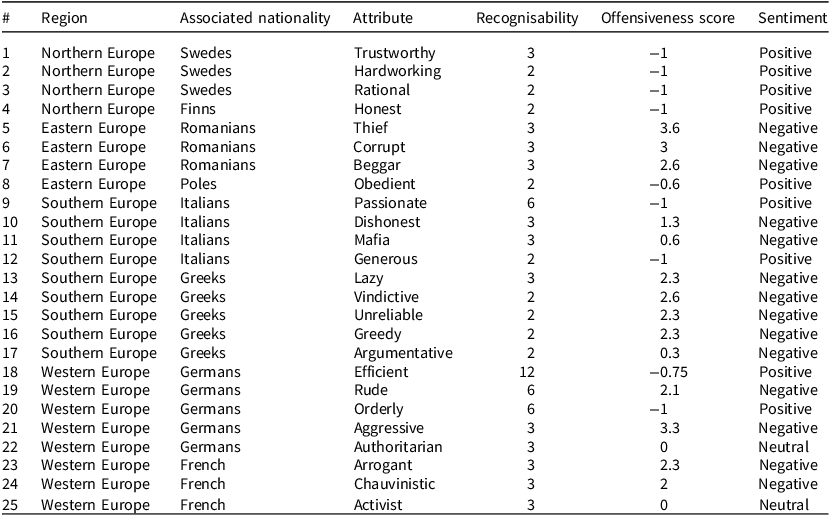
The first goal of the survey was to identify which stereotypes were prevalent among respondents from different countries at a given moment in time (July–August 2024). Based on the logic above, we used the SeeGULL dataset (Jha et al. Reference Jha, Davani, Reddy, Dave, Prabhakaran and Dev2023) to compile a list of stereotypes relevant for EU policy-making (see Table 1). The higher number of stereotypes about Southern and Western Europe reflects their proportion in the SeeGULL dataset, where – as can be expected – there are also more stereotypes about larger member states. For instance, Germans alone are associated with 43 of the 237 EU-specific stereotypes identified in the dataset. By testing only 25 stereotypes in our survey, we wanted to confirm the patterns found in the SeeGULL dataset, and more generally, we aimed to explore who had stereotypes about whom and how much variation was present in the four samples (Sweden, Romania, Italy, and Germany).
Stereotypes retrieved from the SeeGULL dataset
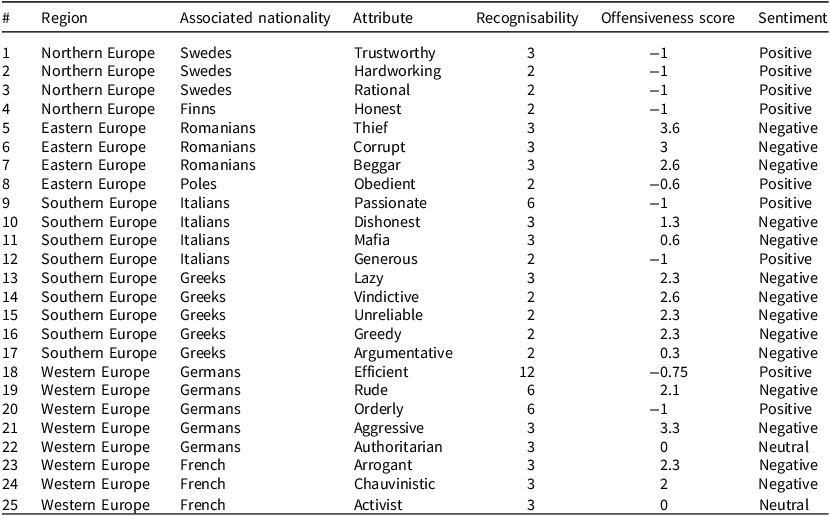
Stereotypes retrieved from the SeeGULL dataset (Jha et al. Reference Jha, Davani, Reddy, Dave, Prabhakaran and Dev2023).
a) recognisability = number of human annotators from Europe who recognised the stereotype.
b) offensiveness = mean of scores given by human annotators who categorised the attribute as offensive.
The categories ‘recognisability’ and ‘offensiveness score’ were taken from the SeeGULL dataset, whereas the column ‘sentiment’ was added for our purposes to capture whether stereotypes were positive or negative (in inverse correlation with the offensiveness score).
In general, when it comes to stereotypes in circulation among citizens across the four countries in our sample, we expected to corroborate the results of the SeeGULL dataset – finding predominantly positive stereotypes about Northern Europeans, predominantly negative stereotypes about Eastern and Southern Europeans, and mixed stereotypes about Western Europeans.
Dependent variables
Attitudes towards economic redistribution were measured using a Guttman-scale approach, drawing on Reinl’s arguments in favour of survey wording which becomes increasingly specific with each question (Reinl Reference Reinl2022). Having observed that public support for EU solidarity declines as the concept is more concretely operationalised, Reinl proposes to measure solidarity using a gradual approach. Following this logic, our first question asks whether respondents think the EU should promote solidarity between member states – a deliberately broad, abstract formulation, disconnected from any specific instruments (such as bilateral assistance) or any policy field (fiscal, refugee, etc.). The second question asks whether respondents support reducing the economic disparities between rich and poorer EU countries, even if this requires higher contributions from richer countries. The third question asks about support for creating a European welfare system for all European citizens, even if this entails higher national taxes (Reinl Reference Reinl2022: 1382). Although not tied to ongoing political debates, the last question prompts respondents to consider tangible consequences of supporting solidarity so as to reveal actual preferences for economic redistribution.
Independent variables and methodology
To explore the relationships between stereotypes and attitudes toward economic redistribution, we run OLS regression models with robust standard errors. While we used survey quotas for data collection, the sample may not be perfectly nationally representative, especially after excluding inattentive respondents. We therefore run all regression analyses using demographic weights for age, income, and gender. Our models specify stereotypes in four different ways:
-
1. The mean number of countries (excluding one’s own) named across all stereotypes;
-
2. The mean number of countries (excluding one’s own) named for all economic stereotypes classified as negative;
-
3. The mean number of countries (excluding one’s own) named for all economic stereotypes classified as positive;
-
4. The number of countries (excluding one’s own) named for each individual stereotype.
The first measure captures the overall effect of stereotypes about other nationalities. The second and third measures distinguish between negative and positive economic stereotypes, respectively. We classify ‘economic’ stereotypes as those referring to traits relevant for productivity and the effective implementation of economic policy. Based on the stereotypes retrieved from the SeeGULL dataset, positive ‘economic’ stereotypes include trustworthy, hardworking, rational, generous, efficient, orderly, and honest. Conversely, negative ‘economic’ stereotypes include thief, corrupt, beggar, dishonest, lazy, unreliable, greedy, and mafia.Footnote 4 The fourth measure gives us a fine-grained view of which stereotypes matter, which is largely exploratory.
For each relationship, we run both simple regressions with only the independent variable of interest and regressions with appropriate control variables, including demographics and potentially correlated attitudes. Demographic controls include age, gender, income quintiles, employment status, and level of education. Since over 20% of respondents did not report their education, we created three categories – post-secondary education, no post-secondary education, and non-response to the education question – to avoid losing a significant share of the sample.
We also control for attitude variables that may be correlated with stereotypes and co-determine preferences for EU redistribution. First, we control for national identity. Following the standard Eurobarometer approach (Commission Reference Commission2024), we ask respondents to describe themselves – with answers ranging from only as nationals of their country to only as European. We subsequently code responses on a 1 to 5 scale, where higher values indicate a stronger European identity. We expect that respondents with a stronger European identity will be more supportive of EU redistribution.
Second, we create control variables that capture political trust using a battery of questions in which respondents rate their trust in various institutions from 0 (no trust) to 10 (full trust). We then construct two measures of political trust: trust in national political institutions is calculated as the mean of trust in the national government and the national parliament and coded as a categorical variable that takes the value ‘high trust’ if the mean is five or higher and ‘low trust’ otherwise. Similarly, trust in the EU is calculated using the mean of trust in the European Parliament and the European Commission and creating an equivalent categorical variable.Footnote 5 However, since answering the political trust questions was not mandatory, over 30% of our sample had at least one missing response, preventing the calculation of mean trust variables. We believe that this non-response is unlikely to be distributed randomly. Consequently, we avoid dropping these participants from the sample – which could introduce selection bias – and instead create a third category of non-response for each trust variable.
Finally, we control for whether participants voted in the 2024 European Parliament elections, and if so, the position of the party they voted for on the left-right spectrum. Considering that respondents’ interpretation of the left-right dimension may differ by country, and our focus is on economic preferences for EU policy, we prefer to use this party-based measure to respondents’ self-placement on the left-right spectrum. The baseline category is non-voting. Accordingly, voters are categorised as having voted for the Far-Right (parties affiliated to the Europe of Sovereign Nations (ESN) or Patriots for Europe (PfE) groups in the European Parliament), the Right (parties in the European People’s Party (EPP) group or the European Conservatives and Reformists (ECR) group), the Centre (parties in Renew), the Left (parties in the Progressive Alliance of Socialists and Democrats (S&D) or the Greens/European Free Alliance (Greens/EFA) groups), or the Far-Left (parties in The Left).Footnote 6 We run all regressions on a pooled sample of all participants, as well as separately by country. When pooling across all samples, we include country-fixed effects in models with control variables.
Who holds which stereotypes?
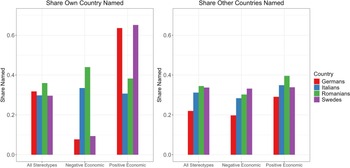
We first present descriptive results regarding the distribution of stereotypes in our sample. Figure 1 shows how often respondents named their own and other countries in connection with all, positive, and negative stereotypes. On average, each country is named for about one-third of the stereotypes presented. One pattern that emerges is that German and Swedish respondents are more likely to identify their own country in connection with positive stereotypes and less likely to identify their own country in connection with negative stereotypes. Italians and Romanians, by contrast, name their own countries slightly more often for both positive and negative stereotypes. This does not necessarily mean that they think less of their countries, but it reflects a recognition that Italy and Romania are more often linked to negative stereotypes.
Histograms of the frequency with which respondents name their own vs. other countries in relation to different stereotypes.
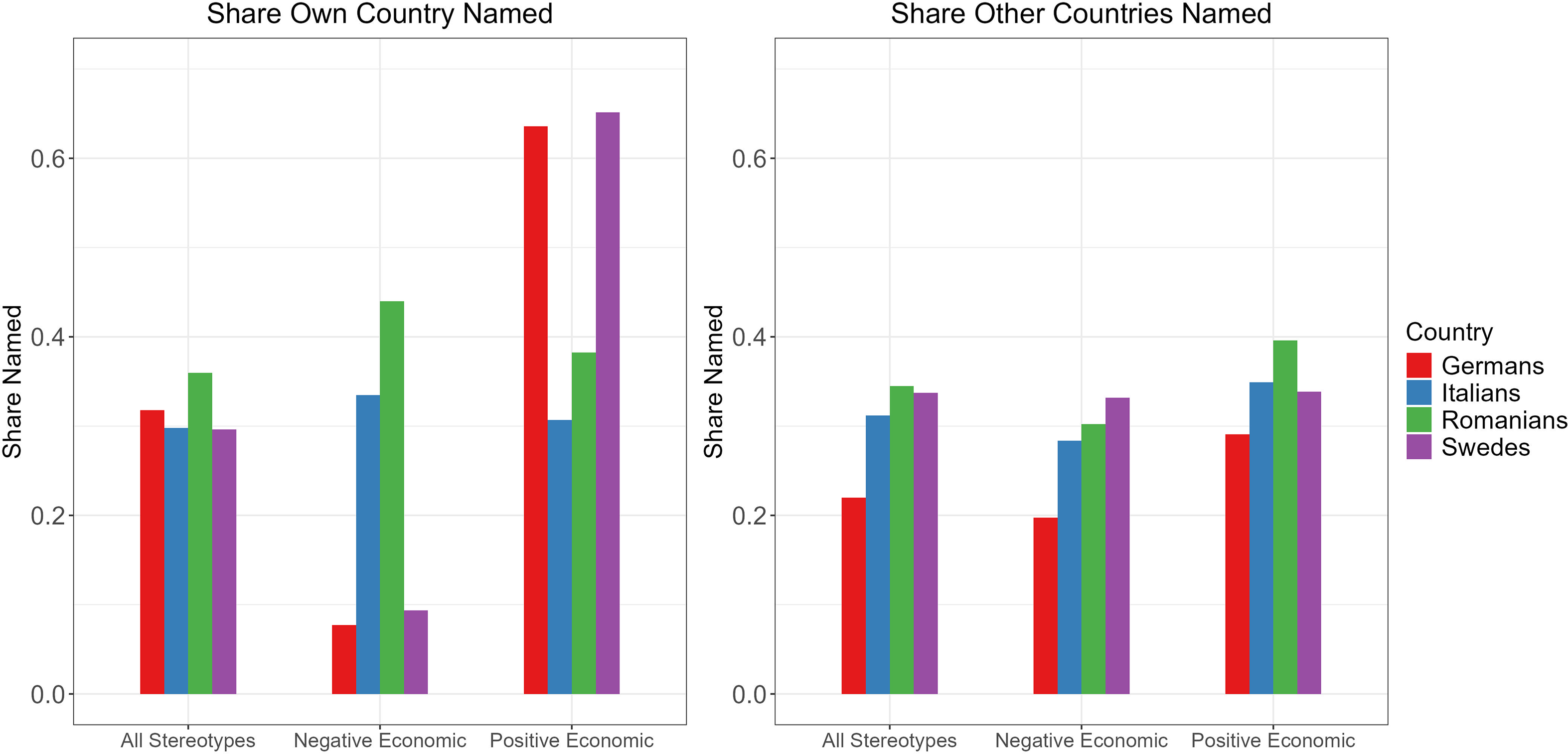
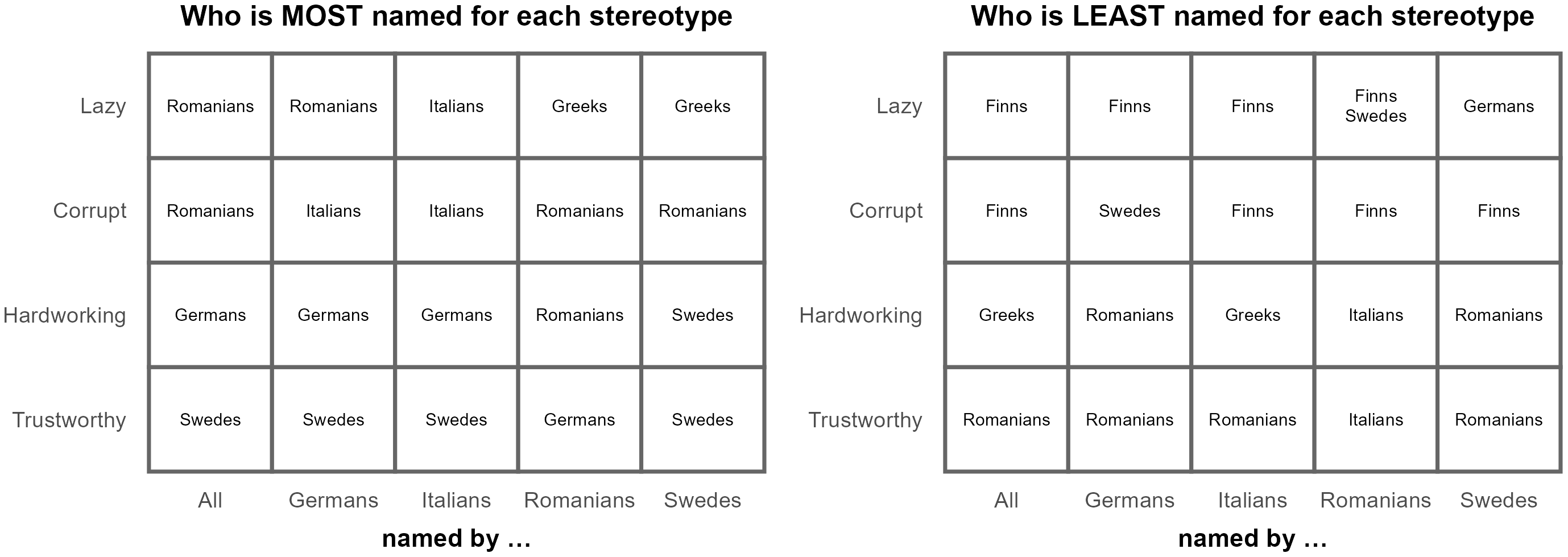
Figure 2 illustrates the distribution of some important economic stereotypes. It shows which countries were named the most and least often as trustworthy, hardworking, corrupt, and lazy. What we find generally aligns with the SeeGULL attribution of stereotypes to countries. Swedes are most often named as trustworthy, and Romanians least often – except in Romania, where Germany is named trustworthy most and Italy least. On hardworking, respondents generally name their own country most often – except Italians, who point to Germans. Greeks receive the fewest mentions as hardworking in the pooled sample, consistent with dynamics observed during the Euro crisis (Pew, 2013).
Most and least named countries for key stereotypes.
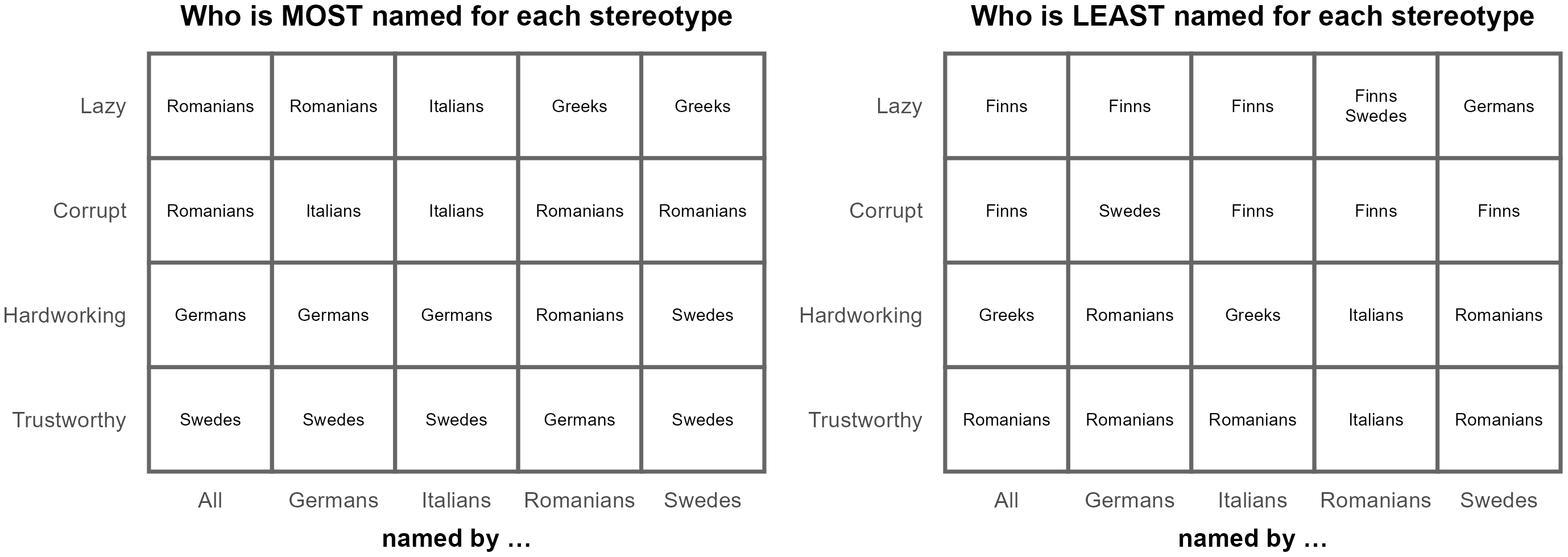
For corruption, Romanians are named most frequently, followed by Italians. Both name their own countries as corrupt, while Nordic countries are generally least associated with corruption. Romanians are also most frequently associated with laziness. Again reflecting the stereotypes circulating during the Eurozone crisis, Greeks are also often labelled as lazy, while Italians name themselves most frequently in connection with laziness. Nordic countries and Germany are named ’lazy’ the least frequently.
Stereotypes and support for economic redistribution
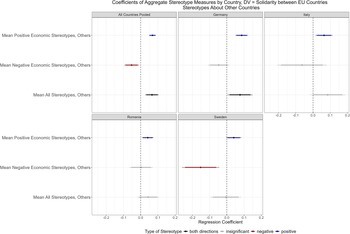
Next, we examine how stereotypes are associated with preferences for redistribution, taking each measure of such preferences in turn. We start with the most general dependent variable, which measures participants’ agreement with the statement that ‘The EU should promote solidarity between its member states’ on a four-point Likert scale. Figure 3 shows the regression coefficients for our aggregate stereotype measures based on regressions with control variables; the full regression table can be found in the online Appendix. We find that positive economic stereotypes have strong associations with support for solidarity. On average, naming one additional country (other than one’s own) per positive economic stereotype is associated with a 0.069-point decrease in support for solidarity on a four-point scale. While this may seem small, the numbers imply that holding two more positive stereotypes about other EU countries has roughly the same effect as moving from low to high trust in EU institutions – which is equivalent to increasing support for solidarity by 9% of a standard deviation. Another way to contextualise these associations is to compare them to baseline differences in country samples. Country-fixed effects reveal that Romanian respondents show the highest support for EU solidarity, followed by Italy, with Swedes and Germans showing lower support.Footnote 7 Our regressions predict that a German respondent who names an average of three positive economic stereotypes about other countries will, on average, support EU solidarity at the same level as an Italian who names no positive economic stereotypes about others.
Coefficients of aggregate stereotype measures, by country, DV = Solidarity between EU countries.
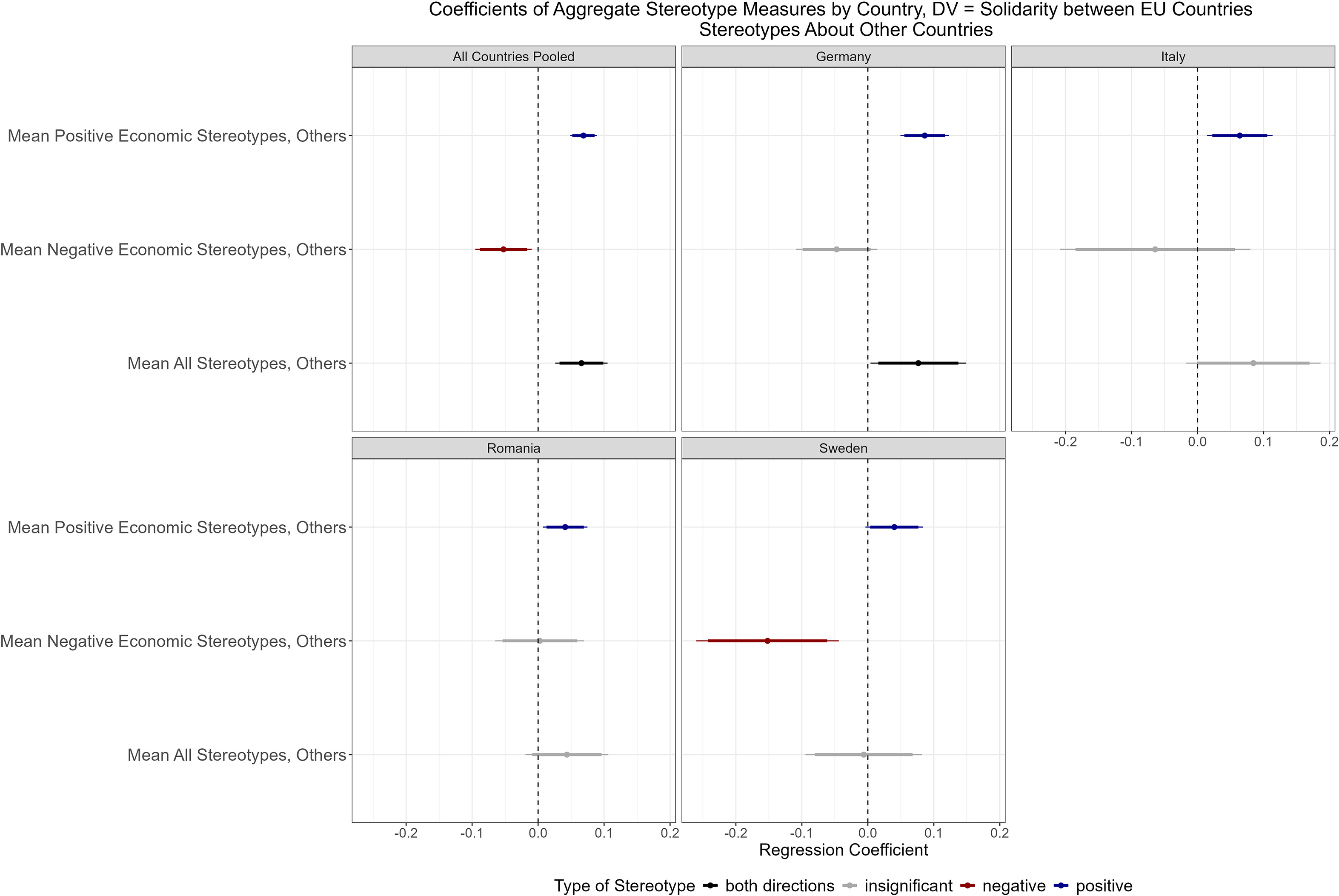
Negative economic stereotypes are, as expected, significantly and negatively associated with preferences for solidarity. Naming one additional country (excluding one’s own) for a negative economic stereotype is associated, on average, with a 0.052-point increase in solidarity support, or 7% of a standard deviation. Again, the predicted difference between those who hold no stereotypes and those who hold many negative stereotypes is larger than the baseline difference between country samples. Our regressions predict that an Italian respondent who names an average of three negative economic stereotypes about other countries will, on average, support EU solidarity less than a German who names no negative economic stereotypes. The measure that combines all stereotypes – positive and negative – also has a positive and statistically significant association with support for solidarity, suggesting that positive stereotypes seem to matter more than negative stereotypes in explaining support for solidarity. Note that, as mentioned above, these estimates are likely lower bounds of the magnitude of associations between stereotypes and attitudes, because measurement error using our proxy should bias our results toward zero.
Results for control variables, reported in the online Appendix, are all in the expected directions. We find that having a stronger European identity is strongly positively associated with support for EU solidarity, while low trust in EU institutions is strongly negatively associated with support for solidarity. We also find that, compared to the baseline of not voting, voting for parties on the left or centre in the European Parliament election is strongly positively associated with support for more solidarity, while voting for far-right parties is strongly negatively associated with support for more solidarity.
As shown in the country-specific panels of Figure 3, there is some heterogeneity between country samples. For Sweden, both negative and positive stereotypes are significantly associated with support for solidarity in the expected directions: among Swedes, negative stereotypes are significantly associated with less support, while positive stereotypes are associated with more support for general EU solidarity. For Germans, positive stereotypes are significantly associated with support for solidarity, while the coefficient for negative stereotypes is negative and almost, albeit not quite, statistically significant. In contrast, in our Italian and Romanian samples, only positive economic stereotypes are statistically significant, with coefficients for negative stereotype measures close to zero. One possible explanation for these differences is that German and Swedish respondents expect their countries to be net contributors to EU solidarity. They might be worried about both the positive and negative traits of recipient countries that could influence perceived deservingness and how well the provision of help, financial or otherwise, is used by recipients. Conversely, Romanian and Italian participants might expect to receive help as part of solidarity, be it in the form of economic help or – especially in the case of Italy – other types of help, such as the redistribution of refugees. Consequently, they might be more concerned with how generous, well-meaning and honest the providers of the help are.
One way to further probe the origin of these aggregate effects is to look at stereotypes regarding specific countries. In the online Appendix (Figures B.7 through B.21), we present replicas of Figure 3, where we calculate the association between positive and negative stereotypes about specific countries and attitudes toward solidarity. Aggregated across all survey participants, we find little clear-cut differentiation between countries by economic wealth: negative and positive stereotypes about Germany and France have similar coefficient sizes as negative and positive stereotypes about Romania and Poland. However, we observe some interesting heterogeneity when focusing on respondents from specific countries. While most results are consistent with our hypotheses, one unusual finding stands out. In the Italian sample, negative stereotypes about countries affected by the Eurozone crisis – Greece and Italy itself – are positively associated with support for solidarity, whereas negative stereotypes about the non-Eurozone country Poland are negatively associated with support for solidarity. This suggests a potentially complex relationship between stereotypes and attitudes towards EU solidarity among Italian respondents. Periods of heightened political salience, such as the euro crisis, may have affected both attitudes toward intra-EU solidarity and stereotypes in a way that our control variables cannot easily capture. Specifically, those Italians who had a particularly negative experience with the euro crisis might have both increased their demand for within-EU solidarity and updated their knowledge about stereotypes. After their experience of the euro crisis, these participants might now be more likely to recognise the negative stereotypes about Italy (and Greece) that circulated during the crisis. Beyond country-fixed effects, we do not have control variables that allow us to capture the potential omitted variable of negative euro crisis experiences.
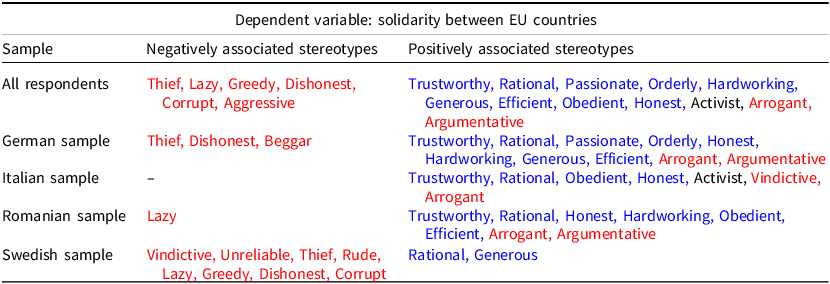
Table 2 lists the individual stereotypes by sample whose association with our solidarity outcome variable is statistically significant (at the 10% level or beyond). Appendix Figure B.2 shows the underlying regression coefficients. Most of our findings on individual stereotypes go in the expected direction. When pooled across participants from all countries, the attributes trustworthy, rational, passionate, orderly, honest, hardworking, generous, and efficient are all positively associated with support for solidarity in the EU. In contrast, the stereotypes thief, lazy, greedy, dishonest, and corrupt are associated with less support for solidarity in the EU. In line with the heterogeneity found above, we also find that both positive and negative stereotypes are statistically significant in the German and Swedish samples, while we find fewer negative associations between negative stereotypes and support for solidarity in the Italian and Romanian samples. While the bulk of these findings align with our hypotheses, there are a few surprising results. For example, arrogant and argumentative are positively associated with support for solidarity across all respondents.
Negatively and positively associated stereotypes by sample, DV solidarity
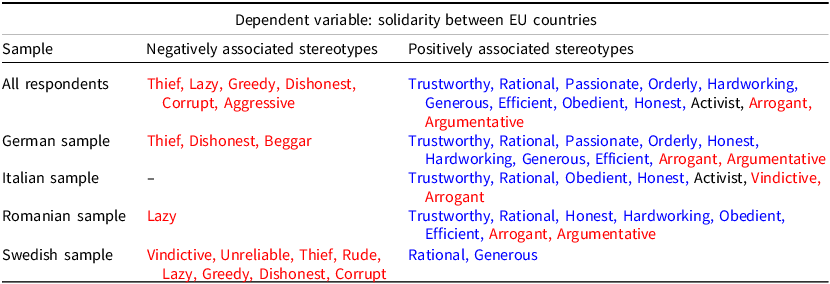
Type of stereotype: [black color] both directions, [red] negative, [blue] positive.
Another puzzling finding is that in the Italian sample, naming more countries as vindictive is associated with higher support for solidarity. One explanation for this may be linguistic: the Italian translation of vindictive (‘vendicativo’) is uncommon in everyday use. Another possible explanation is substantive, pointing to an important omitted variable of ‘euro crisis experience’ – as discussed above. Italians who felt particularly disadvantaged by the crisis may both call for more solidarity and ascribe more negative stereotypes to countries perceived as having treated Italy poorly during the crisis.
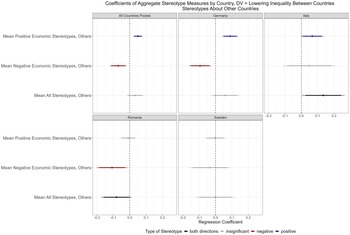
Of course, solidarity could be interpreted as economic solidarity or as solidarity in other areas, such as defence or migration. We therefore turn next to two outcome variables that measure preferences for economic redistribution specifically. First, Figure 4 presents the regression coefficients of our three aggregate stereotype measures, where the dependent variable captures respondents’ support for lowering economic inequality between EU member states. The figure is based on weighted OLS regressions with covariates; the corresponding regression table is in the online Appendix.
Coefficients of aggregate stereotype measures, by country, DV = Reduce inequality between countries.
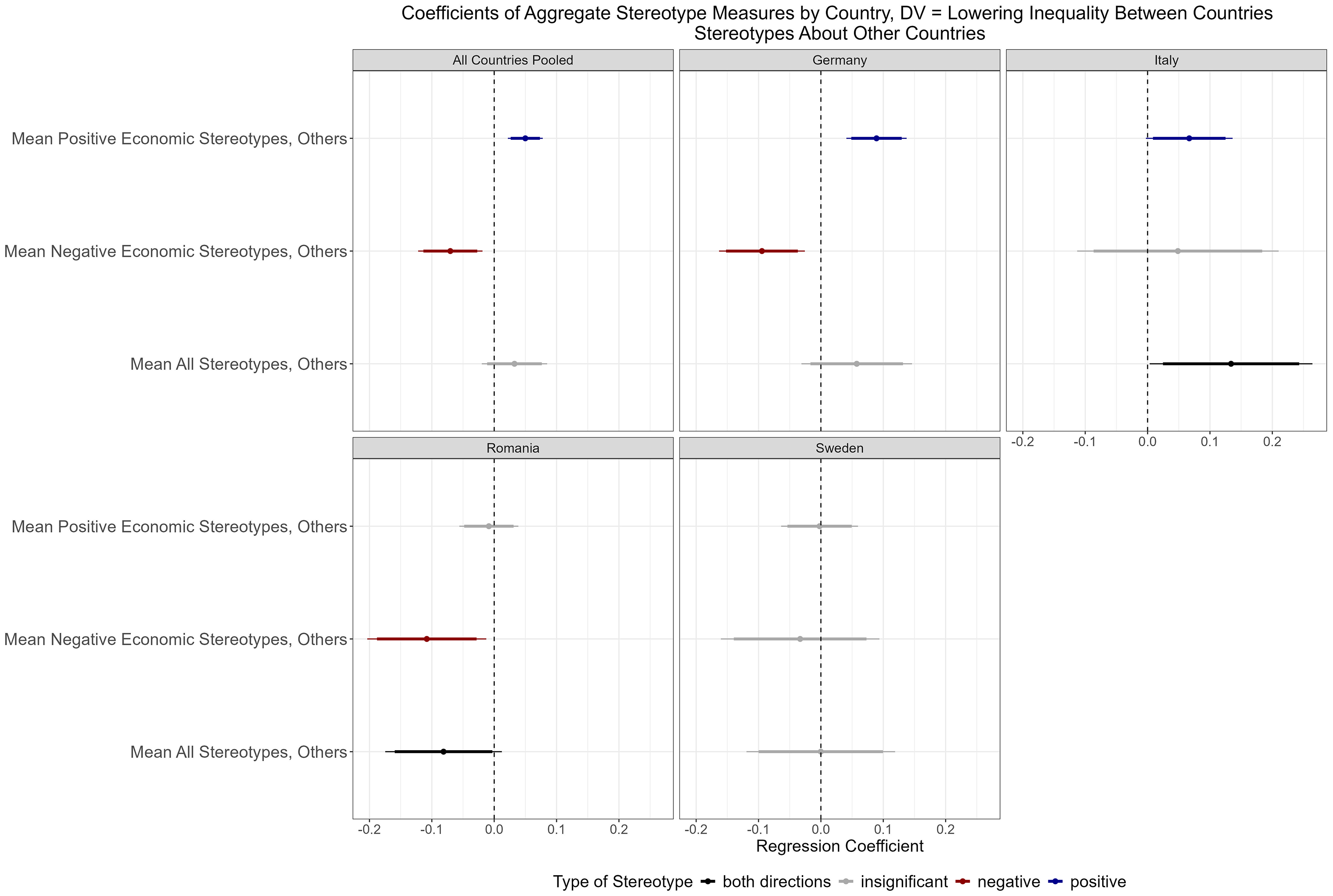
Across our pooled sample of respondents, both negative and positive stereotypes are significantly associated with support for lowering economic inequality between EU member states. As expected, the number of countries (excluding one’s own) linked to negative economic stereotypes is negatively associated with support for lowering economic inequality. Naming, on average, one additional country when asked about negative economic stereotypes is associated with a 0.070-point decrease in support on a four-point Likert scale. This coefficient is statistically significant. Conversely, positive economic stereotypes are positively associated with support for lowering income inequality, with one additional other country named corresponding to a 0.05-point increase, also statistically significant. We find no significant effect for the overall number of countries named across all stereotypes, likely because positive and negative stereotypes cancel each other out in the aggregate measure of all stereotypes.
As before, results for control variables show expected patterns. A stronger European identity, more left-wing voting, and higher trust in the EU all correlate with greater support for lowering inequality between EU countries. Among country samples, Romanians are most supportive of reducing inequality, on average, followed by Italians, Germans, and lastly the Swedes (see Figure C.1 in the online Appendix).
Country-specific results again reveal substantial heterogeneity. As Figure 4 illustrates, the aggregate effects are driven largely by the German sample, where both positive and negative stereotypes have statistically significant associations in the expected directions. For Romania, only negative economic stereotypes are significantly associated with less support for redistribution at the 10% level of significance, but positive economic stereotypes have no significant effect. For Italy, only positive stereotypes are significantly associated with support for lowering inequality. For Sweden, we find no strong associations, despite the fact that Swedish respondents report a similar number of stereotypes as others. This likely reflects Sweden’s non-Eurozone status, as Swedes may simply not think that the financial burden of lowering inequality is likely to fall on them, so their stereotypes about other EU nationalities are less relevant. By contrast, for the general measure of solidarity discussed above, Swedish respondents likely thought that this affects their country directly, as Sweden is contributing to defence (having just joined the North Atlantic Treaty Organization (NATO) and has taken many refugees in the last decade.
As for our solidarity measure, we present equivalent results regarding stereotypes about specific countries in the online Appendix (Figures C.7 through C.21). In line with our expectations, the aggregate and German sample findings are driven by positive and negative stereotypes about presumed net recipient countries: Italy, Greece, Romania, and Poland. By contrast, in most cases, stereotypes about Germany, Finland, or Sweden show no significant association with attitudes toward lowering economic inequality in the EU.
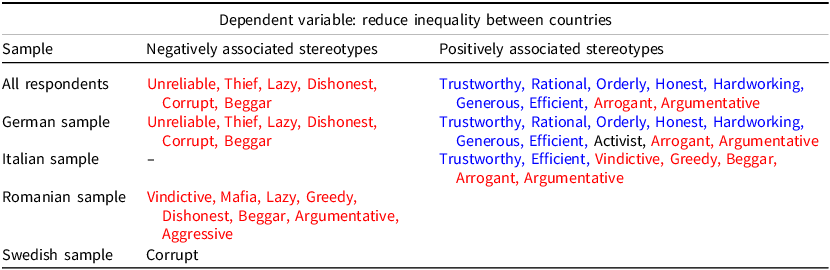
Finally, we examine how individual stereotypes relate to support for lowering inequality between EU countries, as shown in Table 3. In the pooled sample, the stereotypes that are positively and statistically significantly associated with support for lowering inequality are unsurprising, including trustworthy, rational, orderly, honest, hardworking, generous, and efficient. Similarly, the list of stereotypes that are negatively and statistically significantly associated with support for lowering inequality also aligns with expectations, including the traits unreliable, thief, lazy, dishonest, corrupt, and beggar.
Looking at individual countries, we again find strong heterogeneity. For Germany, both positive and negative economic stereotypes are statistically significantly associated with support for lowering inequality, generally in the expected directions. For Romania, only negative stereotypes are significant, while for Sweden, almost no individual stereotypes are statistically significant. Italy again presents an interesting deviation, as the largest statistically significant and positive coefficient is for the stereotype ‘beggar’. The disaggregation of effects by target countries in the online Appendix shows that Italy’s unexpected result for ‘beggar’ is driven by respondents who associate it with Germany and, to a lesser extent, Finland. As before, we interpret this as a backlash against Italy’s treatment during the Eurozone crisis: Italians who experienced the crisis more negatively might now be more supportive of EU redistribution and may, at the same time, perceive other countries as vindictive, greedy, or beggars based on their treatment of debtor countries during the crisis.
Our results for the third dependent variable – support for an EU-wide social welfare system – echo our results for reducing economic inequality. To avoid repetition, we present these results in the online Appendix.
Throughout this discussion, we have been careful to speak of ’associations’ rather than making causal claims. This is because our survey design cannot rule out potential reverse causality, where preferences for EU solidarity or economic redistribution influence stereotypes. While this is possible, we believe that the hypothesised direction – stereotypes shape attitudes – is more plausible in most cases. As explained in The role of stereotypes in public support for redistribution section, stereotypes tend to be long-standing, often unconscious beliefs that are more likely to start the causal chain that ultimately shapes attitudes. Now that we have identified important stereotypes in circulation that correlate with attitudes, future experimental work could verify whether the relationships we identify are truly causal.
Conclusion
In this article, we examined the prevalence of national stereotypes in different EU countries and investigated their relationship with attitudes towards economic redistribution in the EU. In line with previous work and our expectations, we found that stereotypes are widespread and that people generally ascribe more positive stereotypes to wealthier member states such as Sweden, Finland, and Germany and more negative stereotypes to less affluent member states, such as Greece, Poland, and Romania. At the same time, individuals are more likely to attribute positive stereotypes to their own nationality than to others.
Turning to the relationship between stereotypes and attitudes toward redistribution, we generally found a strong association: negative stereotypes correlate with lower support for economic redistribution within the EU, while positive stereotypes correlate with higher support. For the broad solidarity measure – formulated without explicit reference to economic issues – we observed no clear differences based on the countries targeted by stereotypes. By contrast, for our more specific measures of economic redistribution related to reducing inequality, we found clearer differentiations between stereotypes about net recipients and contributor countries. This was largely driven by stereotypes held in net contributor countries – especially Germany – about people from potential net recipient countries. Moreover, we found strong heterogeneity across country samples, where Eurozone membership and experience with stereotypes during previous economic crises appear to shape whether and how stereotypes correlate with attitudes towards redistribution.
From a theoretical perspective, our results suggest that the relationship between national stereotypes and policy attitudes reflects citizens’ perceptions of their member state’s high or low status in the EU (net contributors vs. recipients of redistribution) and their role in the potential redistribution framework (Eurozone vs. non-Eurozone members). Moreover, citizens of some perceived lower-status countries (e.g., Romania) appear to have internalised the legitimacy of the social structure and share the views of high-status members, while others push against it – at least partially (e.g., Italy). From a political and policy perspective, the findings suggest that increasing public support for EU redistribution requires actively promoting positive national stereotypes about net recipient countries – particularly in member states where support is already lower. Yet, this is easier said than done: according to our theoretical account, long-standing national stereotypes in Europe – consolidated over centuries – are far more resistant to change than transient behaviours or policy outcomes related to a specific event (such as the euro crisis). This dynamic paints a rather bleak picture, implying that politicians have limited scope to alter entrenched stereotypes in the short term. Only concerted efforts through public discourse and popular culture over time are likely to yield meaningful change.
As with any study, our analysis is not without limitations, which, however, point to promising avenues for future research. First, our findings are based on observational data at a single moment in time, so we do not make any claims about causal identification or the evolution of stereotypes. Future research could employ survey experiments to examine causal mechanisms between unconscious stereotypes and conscious narratives of deservingness or explore the role of framing and context in activating different stereotypes. Additionally, scholars could assess the longevity of stereotypes by investigating their persistence across time and contexts. Second, because our study relied on a pre-existing dataset of stereotypes in circulation – SeeGULL – we excluded other potentially relevant traits such as perceived competence (e.g., ‘skilled’, ‘educated’), agency (e.g., ‘self-sufficient’, ‘independent’) or explicit deservingness (e.g., ‘deserving’, ‘victims of fate’), etc. Future studies could therefore expand the range of traits included and test the relevance of different stereotype categories. Third, for practical reasons of survey design, we limited the number of stereotypes shown to respondents and deliberately excluded satirical traits, assuming they were less relevant for redistribution preferences. However, one could plausibly link satirical traits to more ‘serious’ stereotypes, which would make another interesting avenue for future research. Taken together, these extensions would shed further light on how national stereotypes shape public support for redistribution in the EU and – if at all – how they can be overcome.
Negatively and positively associated stereotypes by sample, DV reduce inequality
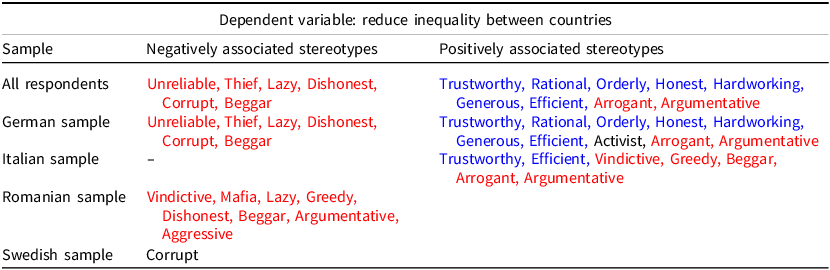
Type of stereotype: [black color] both directions, [red] negative, [blue] positive.
Supplementary material
The supplementary material for this article can be found at https://doi.org/10.1017/S1475676526100802.
Acknowledgements
The authors would like to thank Björn Bremer, Josh Robison, and participants in the lunch seminar at Leiden’s Institute of Political Science for helpful comments on previous versions of the manuscript. Special thanks to Natália Kubalová for excellent research assistance on the survey.
Author contributions
Dr Adina Akbik is an associate professor of European politics at Leiden University. Her research focuses on the role of cultural stereotypes in EU governance, decision-making and accountability in the Economic and Monetary Union, and the enforcement powers of EU agencies. Among other outlets, her work has been published by Cambridge University Press (2022), Comparative Political Studies and the European Journal of Political Research. [a.akbik@fsw.leidenuniv.nl] ORCID: https://orcid.org/0000-0002-8183-5055.
Dr Christina L. Toenshoff is an assistant professor of European politics and political economy. Her research focuses on interest group politics and public opinion in the areas of European economic and environmental policy. Among other outlets, her work has been published in Comparative Political Studies and Business & Politics and has been accepted for future publication (2026) at Cambridge University Press. c.l.toenshoff@fsw.leidenuniv.nl] ORCID: https://orcid.org/0000-0003-3790-3265.
Funding statement
This work was supported by the European Research Council (grant agreement number: 101116035). Open access funding provided by Leiden University.
Competing interests
No potential conflict of interest was reported by the authors.
Ethics approval
The study has been approved by the Ethics Review Committee of the Social Sciences at Leiden University on 4 June 2024 under the name ‘The stereotypical national in Europe: A public opinion survey (EUROTYPES 1.0)’.


 Open access

