
Introduction
The Neolithic mine at Kleinkems, on the upper Rhine, was among the first to be discovered where flint was extracted from solid limestone. At other previously known sites miners exploited deposits in softer sediments that were easier to work. Kleinkems also provides some of the earliest evidence for 'firesetting', a mining technique commonly used up to the nineteenth century AD. So far the Kleinkems mine has been thought to have been in use sometime before the fourth century BC with no definitive dating available. Now radiocarbon dating provides more certainty.
Nodules of chert were extracted from Jurassic limestone deposits where they occur concentrated in four layers (Reference SchmidSchmid 1980: fig. 121). According to recent measurements on some specimens these nodules are about 107 ± 38 mm long, 83 ± 27 mm wide, 55 ± 17 mm thick, and on average weigh 660 ± 422g (mean ± standard deviation).
To make extraction easier Neolithic miners at Kleinkems practised firesetting, a mining technique commonly in use up to the nineteenth century AD (Reference WeisgerberWeisgerber & Willies 2001). The rock surface was heated by fire set against it and subsequently quenched with water. This made the lime stone brittle and easier to break. As a result large quantities of burnt rock and charcoal are still found at the site today. The Kleinkems material forms some of the earliest evidence for the employment of firesetting.
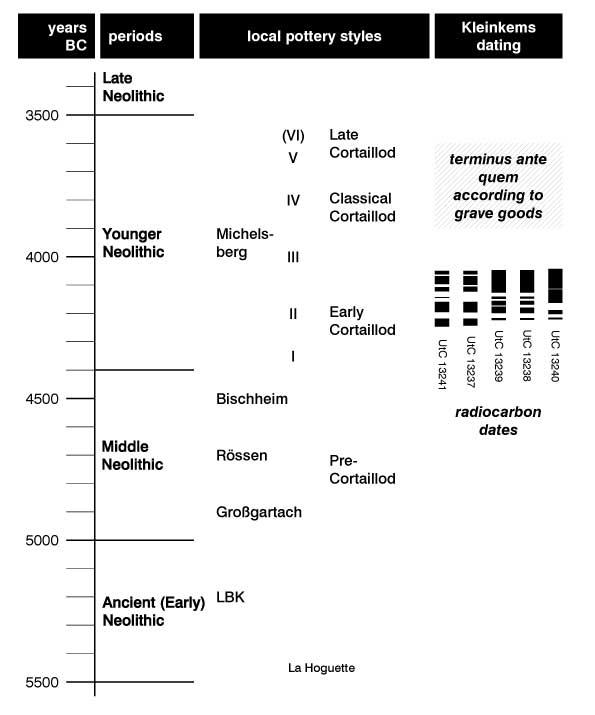
Up to now the site has been approximately dated by two interments which were found in a cave artificially formed by chert extraction (Reference LaisLais 1948). Grave goods comprised pottery of late Michelsberg type and a bowl made of antler bone. Such bowls or beakers (Hirschhornbecher) are typically found together with classical Cortaillod ceramics and occur in alpine lake shore settlements from 3900-3700 BC (Reference SchiblerSchibler 1997: 215; Suter 1981: 61, fig.135). As the bodies were buried directly in the mining debris the mine must have been closed down at the time of burial (Reference PapePape 1981). These findings therefore constitute a terminus ante quem for the mine's active period (figure 2).
The presence of charcoal from firesetting at the site obviously suggests the possibility of radiocarbon dating. During early excavations carried out in the 1950s charcoal samples were collected and analysed to find the types of wood burnt in firesetting (Reference SchmidSchmid 1980: 162). However, as radiocarbon dating had not yet been established as a standard technique these samples were later discarded. In 2003 and 2004 the prehistory department at the University of Basel carried out a reinvestigation of the mine in order to take appropriate samples and finally establish a reliable date for the Neolithic mining activity at Kleinkems.
Regional setting and impact
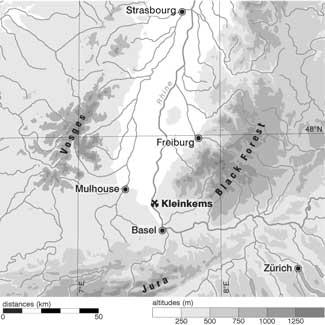
Kleinkems is an industrial village situated about 15km north of Basel (Switzerland) and 100km south of Strasbourg (France, figure 1). The Neolithic flint mine was discovered in 1939 during construction works on the local railway line. Two major investigations explored the site, one in 1940 (Reference LaisLais 1948) and another from 1951 to 1956 (Reference SchmidSchmid 1952, Reference Schmid1980)(For references in English see Reference DiethelmDiethelm 1997 or www.flintsource.net (last accessed on 23 July 2005)). Unfortunately most of the original documentation from the 1950s has been lost but the bulk of finds are still accessible.
Geographical situation of the Neolithic mining site at Kleinkems on the upper Rhine.

Dating of the Neolithic mining site at Kleinkems in relation to local and regional chronologies. The two interments are dated by grave goods (hatched area) and were set into the mining debris, thus constituting a terminus ante quem for the actual mining activities which must have happened earlier. Their dating is assessed by radiocarbon analysis of charcoal samples. The possible age ranges figured out in calibration are represented by black boxes and the individual samples are labelled with their laboratory numbers (cf. table 1). The chronological systematisation follows the framework set out by Reference LÜningLüning (1996). Some of the local pottery styles have been added according to Reference Stöckli W.E.Stöckli et al. (1995).

Conclusions
All radiocarbon dates obtained from the five analysed samples are of remarkable uniformity. As a result they are highly reliable in dating the formation of the layers of debris under investigation to sometime during the 200 years between 4250 and 4050 BC.
Still unknown, however, is the period of time during which flint extraction took place at the site. The fact that two trial trenches failed to produce archaeological material gives proof that the mine was exploited to a lesser extent than envisaged by Reference SchmidSchmid (1980). Obviously, several detached places on a distance of about two kilometres along the slope offered access to flint deposits. These may not have been exploited at the same time. Furthermore studies on the distribution of raw materials in some adjacent regions suggest that production might have happened on a fairly limited scale. These are indications suggesting that mining might have continued for a long period of time.
This also affects the question if the location of the two burials might have been chosen in conscious reference to flint mining on the site. The trial trench from which the charcoal samples have been taken has about the same altitude as the burial place but lies about 25m away from it. Large parts of the area in between have been excavated and it seems that all of it has been mined extensively in the past. Again, this must not have happened in one go. There is actually evidence for several phases of extraction as piles of debris were partly removed to gain access to chert nodules that had been ignored before. Therefore it is possible that at the burial location mining was still in progress later than indicated by radiocarbon dating. Still a direct relation between the industrial process of mining and the ritual act of burial is not at all evident. The radiometric and archaeological dates are 150 to 650 years apart.
Future research might shed more light on the chronological relationships between different phases of extraction. A second excavation campaign in 2004 has investigated layers of mining debris that are stratigraphically distinct from the ones dated so far (Reference CarlucciCarlucci & Siegmund 2005). The two bodies of material originate from mining different concentrations of chert nodules. A set of selected charcoal samples from the newly discovered layers is currently being processed. There is also a chance to limit the scope of possible calibrated age ranges for the radiocarbon dates. Based on a better understanding of the site's stratigraphy, wiggle-matching might enable well-founded estimates of more precise dating.
The discovery of the Kleinkems flint mine came as a surprise. Most ancient mines known before exploited deposits in sediments that were comparatively easy to remove, e.g. chalk. Extracting flint nodules from the solid limestone at Kleinkems on the contrary must have required extensive efforts. This led scholars to assume substantial production and to regard the site as a major flint source during the Neolithic.
Recent research on the use of raw materials, however, has shown that chert from Kleinkems did not play a major role in the manufacturing of tools either in the Jura mountains (Reference AffolterAffolter 2002) or in the region north-east of the site (Kaiser forthcoming) (cf. figure 1). In fact it is debatable how large an area was actually mined in prehistoric times as it is unclear what has been lost due to modern industrial restructuring of the direct surroundings. On the other hand there are still regions adjacent to the site where the distribution of Kleinkems chert has not been explored, notably to the west across the Rhine. The recent excavations carried out by the University of Basel should help to assess the technical aspects of the mining and the quantities of chert produced.
2003 excavation season
In 2003 the Seminar of Prehistoric Archaeology at the University of Basel started a reinvestigation of the Kleinkems site which was to be terminated the following year (Reference SiegmundSiegmund & Engel 2004). The work had two major aims:
-
1. To procure fresh charcoal samples for radiocarbon dating.
-
2. To produce a record of the site's stratigraphy substituting the 1950s field documentation which has since been lost.
Five trenches were dug about 25 to 60m north of where the two interments had been found in 1939 (Reference LaisLais 1948). This region was known from surveys carried out in 1951 to yield prehistoric remains (Reference SchmidSchmid 1980: 144).
In two places Neolithic mining debris appeared right underneath the surface. There were layers of limestone fragments which were often coloured in shades of red and violet as an effect of heating and had undulations on their surfaces due to heavy percussion (see Reference SchmidSchmid 1980: fig. 149 for illustration). They also contained charcoal in varying densities. This rubble was covered with loess soil which had slid down from the upper slope after mining activities had ceased. Displaced loess soil also separated bodies of mining debris suggesting that there were phases in which no mining work was done. In one trench a lime stone surface was discovered displaying negative imprints of flint nodules and traces made by stone tools during removal.
A third trench also revealed traces of mining activity though no actual debris was found. The two trial trenches furthest to the north, however, cut down to the bed rock without producing any signs of human activity.
Radiocarbon dating
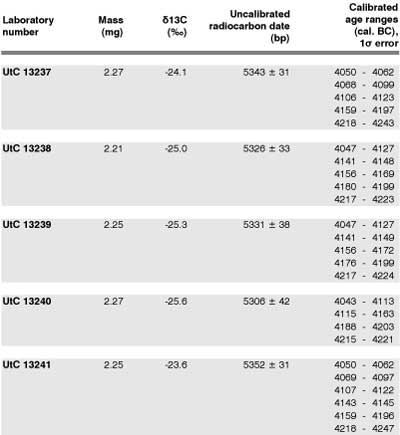
In 2003 about 50 charcoal samples were collected from the mining debris. Five of these have been subjected to an AMS radiocarbon analysis at the University of Utrecht. The results are summarised in table 1.

All the analysed samples come from the same trench about 25m north of where the interments were found. The samples carrying the numbers UtC 13237, UtC 13238, UtC 13239, and UtC 13241 were collected from layers of mining debris that were formed at about the same time. Number UtC 13240 has been taken from a loess layer which stratigraphically might be older. However, this could not be confirmed as all samples yield very similar dates ranging within the fourth quarter of the fifth millennium BC (figure 2).
Acknowledgements
The archaeological excavations at Kleinkems benefited from infrastructure at the local cement factory. We thank the Holcim company and its representative Mr Peter Schlobies for these generous provisions and continuing support. Mr Hugo Schuhmann who is also involved in the management of the factory buildings shared important technical advice. Funding was provided by two institutions at Basel: Freiwillige Akademische Gesellschaft and Fonds zur Förderung von Forschung und Lehre. Last but not least this work has been made possible by the physical labour and merry spirit contributed by students of Basel University.