


Introduction
Violence in intimate unions has been widely researched since the 1970s and gained momentum after Makepeace pioneered a study on violence among dating couple (Makepeace, Reference Makepeace1981). In the 1980s, cohabitation as a form of first union started rising in both developed and developing countries. Indeed, cohabitation is said to be influencing nuptiality patterns as a first co-residential union in recent times (Kiernan, Reference Kiernan1991, Reference Kiernan2001; Mokomane, Reference Mokomane2005, Reference Mokomane2013; Posel & Rudwick, Reference Posel and Rudwick2013). In response to these trends, recent research on family demography has become increasingly interested in understanding differences between cohabitation and marriage along several dimensions. Accompanying this paradigm shift is the argument in the emerging literature that, because of their characteristics, cohabiting unions are more violent than marital unions (Kenney & McLanahan, Reference Kenney and McLanahan2006; Wong et al., Reference Wong, Choi, Fong, Choi, Wong, So, Lau and Kam2016). In a study conducted in Peru, Flake reported cohabitating union as a family-level risk marker to increase a woman’s likelihood of abuse (Flake, Reference Flake2005). In Uganda, as in many parts of Africa, both violence in intimate unions and cohabitation are on the rise. For instance, the proportion of women aged 15–49 in cohabiting unions increased from 14% in 2001 to about 27% in 2011 (Uganda Bureau of Statistics (UBOS) & ICF International Inc., 2012; Lwanga et al., Reference Lwanga, Kalule-Sabiti and Ayiga2018). Notable, however, is the increase in the proportion (27%) of intimate partner sexual violence among women (Wandera et al., Reference Wandera, Kwagala, Ndugga and Kabagenyi2015).
While, on the one hand, cohabitation can offer intimacy and a family-like environment with egalitarian family structures, on the other it offers a lower level of economic consolidation and a weakened relationship short of an intrinsic barrier against union separation. As a result, less violence among women in cohabiting unions than in the married would be expected. Previous studies have demonstrated the contrary – that cohabiting women have an increased risk of experiencing violence in union than married women (Wong et al., Reference Wong, Choi, Fong, Choi, Wong, So, Lau and Kam2016). Using data from Hong Kong medical charts between 2010 and 2014, Wong et al. also found cohabiting women to be nearly two times as likely as married women to experience multiple injuries and physical violence. Nock (Reference Nock1995) theorizes that the difference in the level of intimate partner violence (IPV) among cohabiting and married unions is that marriage is governed by an institution whose relationship is enforced by social and legal rules unlike cohabitation. Ellis, for instance, argues that the presence of marital norms and greater investment in union common among the married contribute to lower levels of violence in marriage (Ellis, Reference Ellis1989). Prior research has also been consistent. Wilson and Daly (2021), for example, argue that the social and financial costs of ending a marriage are higher than the costs of ending a cohabiting relationship, thus the marrieds invest a lot in developing strategies used to mitigate IPV.
In Uganda, where research on cohabitation and IPV is relatively new, past research on the relationship between cohabitation and violence in union has been limited. However, available studies typically involve investigating cohabitation and union dissolution (Lwanga et al., Reference Lwanga, Kalule-Sabiti and Ayiga2018). With regard to intimate violence, past research has examined the link between empowerment, partners’ control and IPV (Kwagala et al., Reference Kwagala, Wandera, Ndugga and Kabagenyi2013, Reference Kwagala, Nankinga, Wandera, Ndugga and Kabagenyi2016; Wandera et al., Reference Wandera, Kwagala, Ndugga and Kabagenyi2015; Gashaw et al., Reference Gashaw, Schei and Magnus2018; Gubi et al., Reference Gubi, Nansubuga and Wandera2020). Elsewhere, there have been attempts to link IPV and pregnant women (Gashaw et al., Reference Gashaw, Schei and Magnus2018). However, less studied is whether being in a cohabiting union is, at first sight, a licence to intimate partner physical violence; and whether the relationship varies between birth cohort. Numerous studies have investigated the relationship between IPV among women and empowerment, modern contraception, maternal health services and partner’s behaviours. However, there is no known study that has specifically focused on the study of violence against intimate female partners. The current study used self-reported data on physical aggression against currently married or cohabiting women extracted from the 2016 Uganda Demographic and Health Survey (UDHS) to examine whether IPV is more pronounced in cohabiting than in married unions; to assess whether the association varies between birth cohorts; and to examine other factors that influence physical violence among women in union.
Theoretical consideration
A number of theories and research findings on how cohabitation or marriage may influence IPV among women have been inconsistent and inconclusive. According to the social learning theory, observations of how parents and significant others in intimate relationships behave provide an initial learning of behavioural alternatives appropriate for such relationships (McLanahan & Sandefur, Reference McLanahan and Sandefur1994; Clarkberg et al., Reference Clarkberg, Stolzenberg and Waite1995; Axinn & Arland, Reference Axinn and Arland1996). This theory fails to separate the effect of witnessing and experiencing violence in the natal family. However, the argument behind it suggests that, if a family of origin managed stress and frustration by using anger and violence, children from such a home environment would be at a great risk of exhibiting the same behaviours, witnessed or experienced when growing-up. This argument is consistent with the intergeneration theory of violence (Besemer, Reference Besemer2017). In the present context, the theory exposes children to violence and also teaches them the use of partner violence as being acceptable and an effective way of solving problems. This description is consistent with patriarchal norms as well as beliefs that are the foundation of male-to-female partner violence enshrined in the male-peer support theory, where anticipated rewards seem to be greater than social and non-social costs (DeKeseredy & Schwartz, Reference DeKeseredy and Schwartz2016). The social context theory posits that lack of social support to integrate cohabiters in society and the lower support from family and friends than for marriage, can lead to intimate violence (Skinner et al., Reference Skinner, Bahr, Crane and Call2002). They argue that because parents and kin are not involved in the decision to cohabit, they are unlikely to be engaged whenever there is union instability. In addition to reduced social support, cohabiters have other issues, such as lack of commitment, which inhibits couple investment and creates a context for diminishing relationship quality among cohabiters; and this contextual explanation appears to be related to the differential selection perspective. As cohabiting unions become larger and more children are born within such relationships, cohabitation may be taking on more of the functions of marriage (Cherlin, Reference Cherlin2004; Perelli-Harris et al., Reference Perelli-Harris, Hoherz and Lappegård2019).
The three study hypotheses were: first, that there is no significant difference in IPV between cohabitation and marriage unions; second, that where differences do occur, they are likely to be across birth cohorts; and third, that couples with higher levels of education are likely to have lower rates of violence.
Methods
With permission from the ICF International website, data were obtained from the 2016 Uganda Demographic and Health Survey (UDHS). The DHS surveys are currently part of the worldwide survey programmes, and are a source of nationally representative data capturing individual- and household-level socio-demographic, health and sexual activity, maternal and child health, mortality, fertility, family planning and nutrition data. The Uganda DHS was implemented by the Uganda Bureau of Statistics (UBOS) with technical assistance from ICF International and funded by the United States Agency for International Development (USAID). Data were collected from a sample of female respondents aged 15–49 and male respondents aged 15–54, selected from 112 administrative districts (UBOS & ICF, 2018). The survey was based on a probabilistic sample originating from multistage cluster sampling and was stratified by rural and urban areas. The DHS programme has been collecting information on intimate partner violence in Uganda since 2006 using a domestic violence module which addresses women’s and men’s experience of interpersonal violence (UBOS & Macro, 2007).
In violence-related studies, it is more likely for one partner to report having experienced violence than for both to agree that they have ever experienced it (Szinovacz, Reference Szinovacz1983). This is based on the claim that individuals are more likely to report no violence where it has been experienced than to report violence where it hasn’t. This is particularly true in a patriarchal society where anecdotal information has it that women believe that a husband is justified in beating his wife. In response to this assertion, the study’s dependent variable (the indicator of violence) was constructed using couple data. Couple data were obtained by merging data from women and their partners living within the same household yielding a sample size of 2479 couples.
Measures of outcome variable
Physical intimate partner violence (IPPV) is a dummy variable created from a general question asked to all men who had ever been or who were currently in a union: ‘Have you ever hit, pushed or shook, slapped, punched with fist, arm twisted, kicked or dragged, strangled or burnt, or done anything else to physically hurt your (last) (wife/partner) at times when she was not already beating or physically hurting you?’ Based on the man’s response, a dummy variable was created indicating whether he physically violated (less severe or severe) his wife or partner. In this paper, whoever perpetuated ‘less severe’ or ‘severe’ violence was coded as 1 (Yes) and as 0 otherwise.
Measures of explanatory variables
The main explanatory variable was marital status categorized as ‘married’ or ‘living with a partner’ (cohabiting). This was included in the model as a categorical variable indicating whether a women was married (coded as ‘0’) or living with a partner (cohabiting; coded as ‘1’). Other independent variables included birth cohort, wealth index, education, type of residence, region, children ever born, working status, religion and a wife/female partner earns more than her husband/male partner. These variables were selected based on previous studies (Wong et al., Reference Wong, Choi, Fong, Choi, Wong, So, Lau and Kam2016). The variable ‘birth cohort’ was generated from current age, categorized as 2001–2005, 1996–2000, 1991–1995, 1986–1990, 1981–1985, 1976–1980, 1971–1975 and 1966–1970. The wealth index was based on couples’ combined income grouped as poorest, poorer, middle, richer and richest. Education level was categorized as no education, primary, secondary and post-secondary but modelled as less than secondary education, those with secondary education and those with above secondary education. Religious affiliation was categorized as Catholic, Anglican, Pentecostal, Seventh Day Adventist (SDA) and other. Type of residence was grouped as rural and urban; employment was coded as working and not working. A separate dummy variable for whether the female respondent earned more than her husband/partner was grouped and re-coded as yes and no; and years since union (cohabitation or marriage) was grouped as 0–4, 5–9, 10–14, 15–19, 20–24, 25–29 and 30+ years.
Statistical analysis
Frequency distributions were used to describe and summarize the characteristics of the women in the sample. Then, the characteristics of cohabiting and married women were compared. The relationship between the dependent variable measured whether or not a woman was physically abused and explanatory variables were established at a bivariate level and tested using the chi-squared test, set at p<0.05. In the data, about 29% of men reported having perpetrated physical violence, indicating that this is a rare event and a possibility of biases resulting from perfect separation and the maximum likelihood estimation method (Firth, Reference Firth1993; Coveney, Reference Coveney2008; Rahman & Sultana, Reference Rahman and Sultana2017). Perfect separation usually happens when the outcome variable separates the predictor variable. For these two reasons Firth’s panelized logistic regression models were used with explanatory variables to examine the context of physical (IPV) associated with women in cohabiting union in comparison with the married (Heinze & Schemper, Reference Heinze and Schemper2002; Coveney, Reference Coveney2008).
The results for the panelized model are presented in the form of odd ratios (OR) with their corresponding 95% confidence intervals. While it is important to apply weights to account for complex survey design, clustering and stratification, this was not done because Firth-logit estimates do not support the svy prefix (an acronym used to instruct STATA to account for the complex survey design used in data collection). The fitted model was subjected to the link-test to examine whether the explanatory variables were specified correctly and also assess the goodness-of-fit of the model (Cleves et al., Reference Cleves, Gould, Gutierrez and Marchenko2010; Hilbe, unpublished; Kohler & Kreuter, Reference Kohler and Kreuter2012). The test uses the hat and _hat-squared statistic. When the model describes the data correctly and is appropriate, the hat-squared should not be significant (_hat-squared, p>0.05). Before fitting the model, a multi-collinearity test among explanatory variables (results not presented) was conducted. The variable ‘duration in a relationship’, though significant at bivariate level (results presented in Table 2), was found to be highly correlated with the variables ‘children ever born’ (r=0.6649) and ‘birth cohort’ (r=0.8126). The interest in this variable (duration in a relationship) was to create an interaction effect with the variable ‘current marital status’, which would help to test for selection bias. However, since the main explanatory variable (current marital status) was not significant, the interaction term would most likely not be significant, thus in modelling this variable was dropped. Relatedly, the variables ‘children ever born’ and ‘birth cohort’ had a positive correlation (r=0.5993), when attempts were made to remove birth cohort and keep the number of children ever-born in the model there was a negligible change in the model diagnostic test results, with _hat-squared still being insignificant. Consequently, the variable (birth cohort) was put back in the model. In statistics literature, missing data in logistic models influence regression coefficients, standard errors and statistical power. However, in this study it was assumed that missing data were missing completely at random (MCAR) and did not bias inferences (Houchens, Reference Houchens2015; Mohamed Reda & Mohamed Gamal, Reference Mohamed Reda and Mohamed Gamal2018).
Results
Distribution of respondents by socio-demographic characteristics
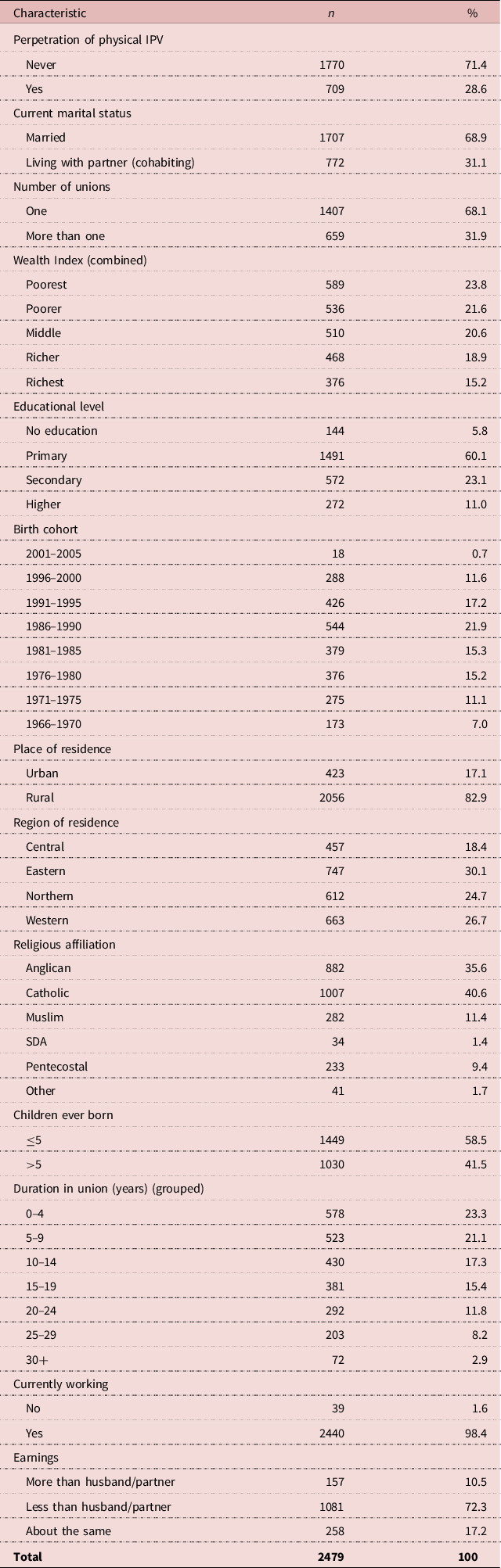
Table 1 presents the distribution of respondents by socio-demographic factors. Nearly 29% of the male respondents in the couple sample had perpetrated physical violence against their partners. Among all women included in the couple data, approximately 41% of the respondents were affiliated to the Catholic and 3% to other minority religious groups. The distribution of the women by wealth index shows that nearly 24% were in the poorest category and 15% were in the richest tertile of income. The majority of the women had primary education (60%) while 6% had no education. The majority of the women (69%) were born between 1976 and 1995, and had given birth to no more than 5 children. Approximately 18% lived in the Central and 27% in the Western regions. Nearly 23% of the women had been in union for no more than 4 years and 3% for more than 30 years. The majority of the female respondents (98%) were working. About 11% of female respondents reported earning more than their partners/husbands and 72% said that they earned less.
Percentage distribution of selected characteristics of respondents
Differentials in experience of intimate physical violence by socioeconomic characteristics
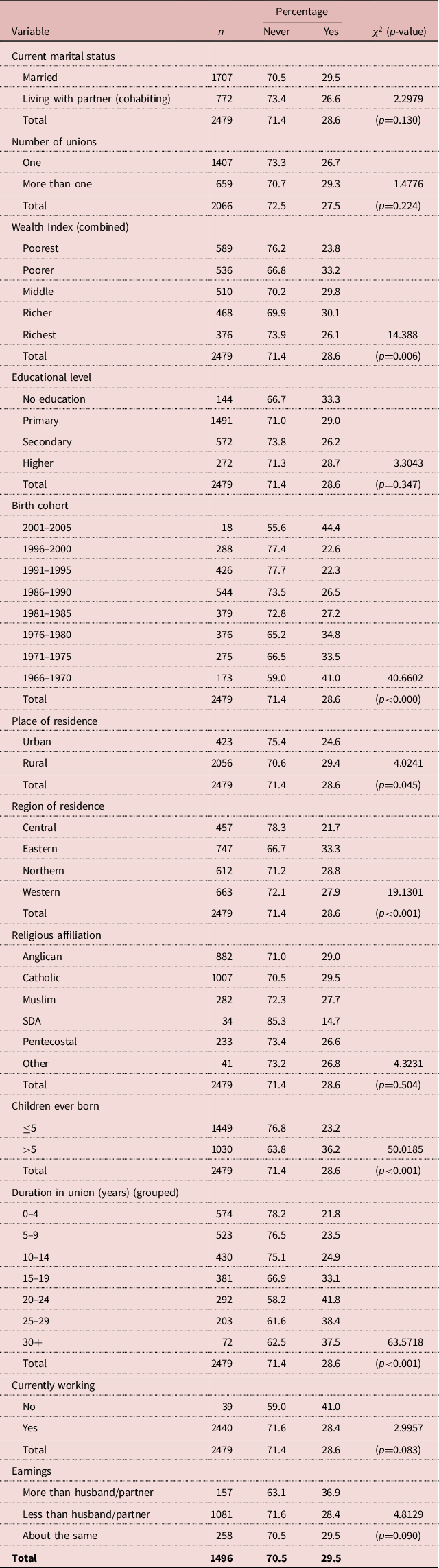
Table 2 presents the differentials in victimization by selected socioeconomic variables. Whether married or cohabiting, number of unions, education level and religious affiliation were not significantly associated with physical IPV. The prevalence of the perpetration of physical violence by married men was nearly 30% and about 27% by cohabiting men. Physical violence varied significantly by wealth status (χ 2=14.3, p=0.006), birth cohort (χ 2=40.6, p<0.001), type of residence (χ 2=4.02, p=0.045), region of residence (χ 2=19.13, p<0.001), number of children ever-born (χ 2=50.01, p<0.001) and duration in union (χ 2=63.5, p<0.001); but was weakly associated with women who were working (χ2=2.99, p=0.083) and wives/female partners earning more than the husbands/male partners (χ 2=4.81, p=0.090).
Differentials in respondents’ experience of physical IPV victimization for women in Uganda by socioeconomic characteristics
Multivariate results
In isolating the net effects of each independent variable on physical IPV, a final model was built based on the identified predictors explained by the bivariate analysis. In this case, all significant independent variables at the bivariate level were included in the model, in which the dependent variable was the perpetration of physical violence in union. These included wealth index, birth cohort, type of place of residence, region of residence, children ever born, currently working and woman earns more than her husband/partner. Education level and religious affiliation were not significant; however, education level and religious affiliation were found to be significant in Uganda among married women (Wandera et al., Reference Wandera, Kwagala and Odimegwu2018). Current marital status was not significant, but it was found to be significant in Hong Kong (Wong et al., Reference Wong, Choi, Fong, Choi, Wong, So, Lau and Kam2016), and this is central to the main argument behind this study. Based on these studies, current marital status, education level and religious affiliation were also included in the final model. Table 3 presents the results of the Firth-logistic model. The table shows that the odds of women in the poorer wealth tertile experiencing physical violence were 1.96 times higher (95% CI=1.29–2.98, p=0.001); 1.75 times significantly higher for the middle income tertile; and 2.0 times higher for the richer income tertile (95% CI=1.28–3.13, p=0.002) relative to women in the poorest category.
Odds ratio estimates for physical violence for victimization for women in Uganda
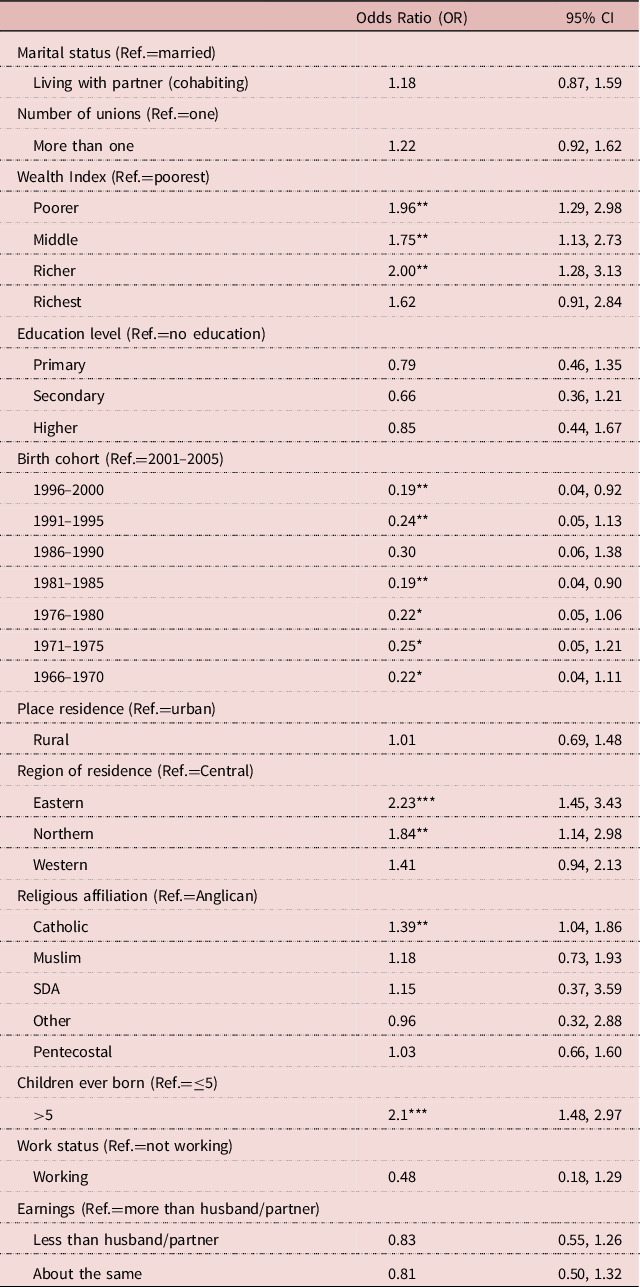
*p<0.1; **p<0.05; ***p<0.001; Ref.=Reference Category; CI=Confidence Interval.
The odds of experiencing physical violence decreased among women born in 1996–2000 (OR=0.19; 95% CI=0.04–0.92, p=0.04), 1991–1995 (OR=0.24; 95% CI=0.05–1.13, p=0.07), 1981–1985 (OR=0.19; 95% CI=0.04–0.90, p=0.036), 1976–1980 (OR=0.22; 95% CI=0.05–1.06, p=0.059), 1971–1975 (OR=0.25; 95% CI=0.05–1.21, p=0.084) and 1966–1970 (OR=0.22; 95% CI=0.04–1.11, p=0.067) compared with those born in 2001–2005.
Furthermore, there was increased likelihood of experiencing physical violence among women from both the Eastern (OR=2.23; 95% CI=1.45–3.43, p<0.001) and Northern (OR=1.84; 95% CI=1.14–2.98, p=0.013) regions compared with the Central region. Women affiliated to the Catholic Church were more likely to experience physical violence than those affiliated to the Anglican Church (OR=1.39; 95% CI=1.04–1.86, p=0.026). In addition, women with six or more children were nearly two times more likely to be victims of physical violence relative to those who had fewer than six children (OR=2.1; 95% CI=1.48–2.97, p<0.001). Although there was no significant difference between married women and those in cohabiting union, women in cohabiting relationships were 1.18 times more likely to be victims of physical violence (95% CI=0.87–1.59, p=0.287). Regarding the diagnostic test of the model, the specification error results demonstrate that the Firth-logit model was well specified, as predicted by the hat and hatsq statistics (hat: p=0.019; _hatsq: p=0.254).
Discussion
This study addressed three questions: ‘Is intimate partner violence (IPV) more pronounced in cohabiting than in married unions?’; ‘Does the association between marital status and IPV vary across birth cohorts?’; and ‘What other factors influence physical violence victimization among women in union?’. No significant difference was found in physical IPV victimization between women in cohabiting and married unions. These results contradict the findings of Wong et al. (Reference Wong, Choi, Fong, Choi, Wong, So, Lau and Kam2016) in Hong Kong, who found cohabiting women to be 2.0 times more likely to suffer from physical violence than married women. The insignificant difference in the level of physical violence experienced by cohabiting compared with married women may be understood from four arguments. The first is the transition of the Ugandan society from being highly patriarchal to become more egalitarian. This has led to status compatibility, which negates the power-control theory (of status incompatibility in intimate relationships). The second is that an increase in cohabitation is currently being experienced in Uganda, implying that marital status is undergoing social change. The implication of this, as suggested by Kiernan (Reference Kiernan2001), is that the stages of cohabitation can be described as a partnership transition. Traditionally, it was taken to be a deviant phenomenon practised by a small group of people; then as a probation stage to assess couple’s commitment to marriage; later as a socially accepted alternative to marriage; and finally, as indistinguishable to marriage. In recent decades, the growing tolerance of cohabitation by the Ugandan society might also explain the insignificant difference in experience of physical violence in cohabiting compared with married women. Third, in the Ugandan context, entry into cohabitation or marriage is unlikely to depend on natural selection theory, where partners showing low level or no violence would enter marriage and those in abusive relationships enter cohabitation, as it used to be in the past. Fourth, as cohabiting unions become larger and children are born within a relationship, cohabitation may be taking much of the functions of marriage, which suppresses the would-be difference in IPV (Cherlin, Reference Cherlin2004; Perelli-Harris et al., Reference Perelli-Harris, Hoherz and Lappegård2019).
It is surprising to find that women of poorer or middle income status, or those of richer income status, were more likely to suffer from physical violence than those of poorest income status. This may be explained by two arguments. First, women of poorest income status may share available family income between family expenditure and investment, or may engage in a joint family business with their partners, but as women become financially better-off, they may decide to be financially independent. As a result, such women may follow the equality principles for power in a relationship and if there is tension and conflict, it could increase or worsen into physical violence. Second, social status and access to income might affect the distribution of power and control within a relationship, leading to status incompatibility and reversal. If this is in favour of women in a patriarchal society, where they are taken to be inferior, it might make them vulnerable to IPV. The reason is that men can feel threatened by wives/partners who outrank them economically and socially (Buzawa et al., Reference Buzawa, Buzawa and Stark2015; Meizer, Reference Meizer2002).
The lower levels of physical violence victimization for older cohorts compared with younger ones is not surprising and might be explained by two perspectives. The first is the life course development viewpoint. In Uganda, as with other societies, older people are more likely to possess positive relationship skills than younger ones. In addition, they are less likely to use violent behaviour when dealing with conflicts in intimate or romantic partnerships (Wekerle & Wolfe, Reference Wekerle and Wolfe1999). Second, younger women might be in different types of relationships with varying levels of intimate partner violence and commitment (Wiersma et al., Reference Wiersma, Cleveland, Herrera and Fischer2010). The study found that women from Eastern and Northern Uganda were at a higher risk of experiencing physical violence than those in the Central region. The risk was 2.23 times for the Eastern and 1.84 times for the Northern region. This is not surprising given that these two regions have high rates of child marriage (marriage before 15 years) compared with either the Central or Western region. In this case, the inequitable gender norms that give rise to child marriages may increase the risk of conflict and physical violence (Kidman, Reference Kidman2017).
Some characteristics of women might increase the risk of experiencing physical violence. Results from this study show that being affiliated to the Catholic faith is a risk factor for IPV, the odds increasing by 39% compared with being affiliated to the Anglican faith. The effect of other religious denominations was not significant. This is surprising because one would expect religious people to have lower rates of IPV victimization. Increased risk among Catholics could be explained by the difference between religious affiliation and religiosity. Women could be affiliated to the Catholic faith, but attendance at religious services, which has been shown to be associated with lower rates of IPV, could be low. Women with six or more children were found to suffer from physical violence more than those with five or fewer children. Three perspectives are advanced to explain this finding. First, an increase in number of children might cause emotional and economic strain. Second, it could mean that child care attention is divided; and third, it might coincide with advance in age, which is often associated with men having extramarital relations. All these might lead to conflict and consequently physical violence. In most societies in Uganda, issues regarding physical violence are always limited to the couple and to the paternal aunt.
In summary, this study used couple data and the Firth-logit model to assess whether physical intimate partner violence victimization is more pronounced among women in cohabiting union than those in married couples. It also assessed whether the association varied across birth cohorts, and whether other factors influence physical violence among women in married and cohabiting unions. These results will be useful to inform policy dialogue and formulation, given the rising trend in domestic violence in Uganda. Future studies should endeavour to collect more data to explore further the linkage between cohabitation as a form of union, education, type of place of residence, work status, women’s income being higher than husband/partner’s and physical violence. There are some limitations that can be addressed for future studies. First, this study used self-reported data, and in this case IPV perpetration could be lower due to recall bias, sensitivity of reporting violence perpetration and the humiliation of doing so. Some of the perpetrators could have withheld information regarding their private experiences because of the culture of silence concerning IPV and union. Second, the data used were cross-sectional in nature and therefore the reported results are associations only, and do not imply a causative relationship.
In conclusion, there is no evidence that a woman in a cohabiting relationships has an increased risk of experiencing physical violence compared with women in marriage in Uganda. The study findings suggest that IPV victimization among women in Uganda is influenced by birth cohort, wealth, residing in Eastern and Northern regions, affiliation to the Catholic faith and have six or more children.
Acknowledgments
The authors extend their sincere gratitude to ICF International website for allowing them to access the 2016 Uganda Demographic and Heathy Survey (UDHS) data.
Funding
This study received no specific grant from any funding agency, commercial entity or not-for-profit organization. However, the primary author is grateful to the College of Business and Management Sciences (CoBAMS), Makerere University, for the institutional grant, as research facilitation support, for staff.
Conflicts of Interest
The authors have no conflicts of interest to declare.
Ethical Approval
This study used secondary data and the authors declare that all procedures contributing to this work conform with the ethical standards of the relevant national and institutional committees on human experimentation and with the Helsinki Declaration of 1975, as revised in 2008.


 Open access

