


Introduction
I know from life how it feels when you are stuck in the middle of this addiction, how difficult it is, especially in the first year, when you change your life then and all the things you have to face. And I can use my experience to encourage a client: Here, go through it, it’s worth it, and it can be done. (Transcript 1, Pos. 8)Footnote 1
Getting people with personal experiences of mental and addictive disorders involved in support and counseling structures is gaining increasing importance within mental health institutions and other sectors of the social system—both in Germany and internationally. The term peer support describes a type of assistance provided by persons who have gone through similar experiences or similar life situations as those receiving it (Lanquentin, Reference Lanquentin, Gebrande, Melter and Bliemetsrieder2017, p. 119). In the context of mental health, this means involving people who have experienced mental disorders themselves, but have managed to stabilize their life situation and are willing to share their experience with others in order to support these others’ recovery in turn (Solomon, Reference Solomon2004, p. 392; Gillard et al., Reference Gillard, Gibson, Holley and Lucock2015; Bartone et al., Reference Bartone, Bartone, Violanti and Gileno2019, p. 138). The central assumption underlying peer support approaches is that similar experiences facilitate trustful relationships and encourage communication “at eye level” (Mead et al., Reference Mead, Hilton and Curtis2001, p. 136; Cabassa et al., Reference Cabassa, Camacho, Vélez-Grau and Stefancic2017, p. 81). The transmission of personally lived through experiences, which differ from and exceed knowledge-based expertise, can lead to new perspectives and new hope (Lawn et al., Reference Lawn, Smith and Hunter2008, pp. 498–499). Furthermore, peer support presents a central means to transform service delivery, implement recovery orientation, and both change and complement regular service employees’ perspectives and attitudes (Repper, Reference Repper2013, pp. 4–6; Hurley et al., Reference Hurley, Cashin, Mills, Hutchinson, Kozlowski and Graham2018, pp. 187–188). Empirical research shows that clients who participate in peer support programs experience a high level of satisfaction with the support they receive (Brauckmann et al., Reference Brauckmann, Heimer, Jordan, Maetzel, Schreiner and Wansing2017, p. 99; Dennis, Reference Dennis2003, p. 122). When measuring its impact specifically, several studies have found positive effects on clients’ self-efficacy and empowerment (Burke et al., Reference Burke, Pyle, Machin, Varese and Morrison2019, pp. 352–353; Gillard et al., Reference Gillard, Gibson, Holley and Lucock2015, pp. 440–441) and a general improvement in their living situation and quality of life (Davidson et al., Reference Davidson, Bellamy, Guy and Miller2012, p. 125). Furthermore, some studies hint at a reduction in illness-related symptoms (Rüsch et al., Reference Rüsch, Staiger, Waldmann, Dekoj, Brosch, Gabriel, Bahemann, Oexle, Klein, Nehf and Becker2019, p. 335) and hospital admission rates (Chinman et al., Reference Chinman, George, Dougherty, Daniels, Ghose, Swift and Delphin-Rittmon2014, pp. 438–439; Sledge et al., Reference Sledge, Lawless, Sells, Wieland, O'Connell and Davidson2011, p. 543).
The term peer support unites a wide range of different approaches—extending from rather informal settings of mutual support to highly formalized counseling settings (Lloyd-Evans et al., Reference Lloyd-Evans, Mayo-Wilson, Harrison, Istead, Brown, Pilling, Johnson and Kendall2014, p. 2). Therefore, it is necessary to characterize the specific approach referred to in this article.
Institutional Setting: Employment Promotion in Germany
The institutional setting for the peer support approach presented here is Germany’s so-called job centers [Jobcenter]. These institutions are a product of reforms in 2005 aiming to introduce activation elements into German labor market policy (Osiander & Steinke, Reference Osiander and Steinke2011, p. 7). Their main purpose is to promote work integration and provide income support for unemployed people who are not entitled to unemployment insurance benefits. Counseling strategies in job centers contain both supporting and demanding elements and emphasize the client’s active contribution to job search with the option of sanctioning in the case of noncompliance (Kupka & Osiander, Reference Kupka, Osiander, van Berkel, Caswell, Kupka and Larsen2016, p. 90). Empirical findings show that especially the target group of unemployed people with mental and addictive disorders often does not find supportive structures within job centers, but is at risk of experiencing permanent exclusion from the labor market and other areas of society (Oschmiansky et al., Reference Oschmiansky, Popp, Riedel-Heller, Schwarzbach, Gühne and Kupka2017, p. 184; Wabnitz et al., Reference Wabnitz, Hemkendreis, Ostermann, Kronmüller, Erdsiek and Nienaber2019, p. 94).
These findings form the conceptual background for a model projectFootnote 2 that integrates peer support in the job centers’ counseling practices for clients with mental or addictive disorders. Peers, who experienced mental illness or addiction themselves, receive a 5-day training and work on a voluntary basis. The voluntary nature of the engagement is ensured by the connection to an external association and the peer support volunteers can end their commitment at any time without negative consequences. They support the participants in a one-on-one setting and perform a mixture of counseling elements, support in everyday life, and joint activities. In addition to their direct relationship with the client, peer support volunteers collaborate with caseworkers at the job center and introduce their perspective into the counseling structures. The project’s main aim is to promote clients’ opportunities for social and occupational participation. Positive evidence in favor of peer support approaches in other mental health contexts suggests that they will also have positive effects in the field of employment promotion (Rüsch et al., Reference Rüsch, Staiger, Waldmann, Dekoj, Brosch, Gabriel, Bahemann, Oexle, Klein, Nehf and Becker2019, p. 336).
This qualitative study focuses on the motives of peer support volunteers: What motivates them to support others, and what functions does their voluntary engagement fulfill for themselves? Findings on this subject will contribute to gaining a deeper understanding of peer support approaches und underlying motives. Especially regarding the innovative field of employment promotion, insights into motivational structures will make it possible to retrace implementation processes of peer support. Furthermore, exploring people’s motivations provides information on what conditions and framework they need in order to engage voluntarily on the basis of their own expectations and ideas.
Theoretical Background: Functional Approach
The article addresses the motives for voluntary engagement among the peer support volunteers in the aforementioned project. Clary et al.’s (Reference Clary, Ridge, Stukas, Snyder, Copeland, Haugen and Miene1998, pp. 1516–1530) functional approach to the motivation of volunteers serves as the theoretical background. They derived their approach from Katz’s (Reference Katz1960, pp. 163–168) functional approach to attitudes and tested it empirically on the motives of volunteers. A basic assumption is that people volunteer because engagement fulfills certain functions for them: These functions can differ interindividually, leading to a variety of underlying functions even among people engaging in the same field (Jiranek et al., Reference Jiranek, Kals, Humm, Strubel and Wehner2013, p. 522). Moreover, Clary et al. also stated that the motivation to volunteer often cannot be traced back to a single function, but to a specific combination of different functions. The authors identified a nonexhaustive system of six functional areas for voluntary work. The first is the function of understanding: Volunteers use their engagement to make new experiences, develop their personality, and gain a better understanding of themselves and the world around them. Second, voluntary work provides the function of expressing values—for example, by helping others or showing compassion. The third functional area, the social function, describes a mechanism of adaption through voluntary work: If volunteering is perceived as an expectation that is present in one’s own social environment—for example, if family members engage “traditionally” in a specific field of voluntary work—volunteering can strengthen the integration into groups. The fourth function is career-related: Voluntary work allows the volunteers to advance their occupational careers by establishing important contacts, developing new skills, and trying out different career options. Fifth, volunteering can be associated with protective functions such as distracting from one’s own worries or reducing feelings of loneliness. The last function is termed enhancement and means that voluntary work conveys the impression that one is being useful and contributing something meaningful. Additionally, it describes the potential to increase feelings of self-esteem and the opportunity to get to know new people (Clary et al., Reference Clary, Ridge, Stukas, Snyder, Copeland, Haugen and Miene1998, pp. 1517–1518).
As Clary et al. claimed that their list of functional areas is nonexhaustive, other researchers have found further functions of volunteers’ engagement, for example in terms of a function of political and social responsibility (Bierhoff et al., Reference Bierhoff, Schülken and Hoof2007, p. 16) and an event- or excitement-related function (Güntert et al., Reference Güntert, Neufeind and Wehner2015, p. 702). One aspect that turns out to be relevant in the present context is the function of social justice identified empirically by Jiranek et al. (Reference Jiranek, Kals, Humm, Strubel and Wehner2013). These authors argue that the six traditional functions are mainly self-oriented. In their studies, they discovered an additional “other-oriented” function that motivates people to volunteer (Jiranek et al., Reference Jiranek, Kals, Humm, Strubel and Wehner2013, p. 525). In concrete terms, they propose that voluntary work presents an opportunity to promote social justice, mainly in the sense of promoting equality (Jiranek et al., Reference Jiranek, Wehner, Kals, Wehner and Güntert2015, p. 106).
Although the functional approach is not free from criticism due to the loose theoretical foundation of the functions, their unspecified number, and a varying level of generality (Wilson, Reference Wilson2012, p. 181), it is judged to be an appropriate theoretical perspective for the present study because it allows motives to be reconstructed on a multidimensional and multifunctional level.
Methods
The present research question is part of a larger study on the peer support approach presented here. The database is 23 qualitative interviews with peer support volunteers conducted before their actual voluntary work began. The aim was to explore their motivations at a point of time when they were not yet influenced by institutional aspects and structures, but could express their expectations freely. Since the interviews were conducted during the initial period of the project presented, all peer support volunteers who had already been acquired at that time were approached regarding an interview. One person declined to participate, and interviews were conducted with the remaining 23 persons between July and October 2020. The interviews lasted between 20 and 65 min. Three questions in the interview guideline provided the central data on motives for volunteering in peer support:
– How did you gain access to the project?
– What motivates you to participate?
– How do you expect your engagement as a peer support volunteer will impact on your personal life situation?
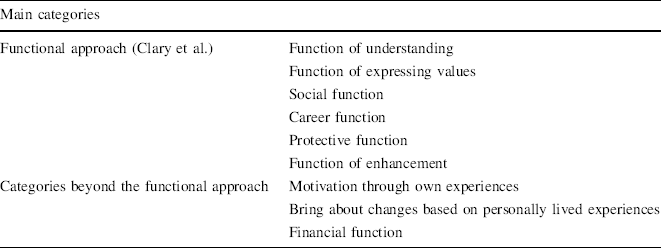
The interview material was analyzed following the principles of qualitative content analysis described by Mayring (Reference Mayring2014, p. 39). This method allows a systematic und structured analysis based on a prescribed theoretical perspective and is at the same time open for inductive expansion of the theoretical framework. In our analysis, Clary et al.’s functional areas served as the deductive main categories. Due to the qualitative approach, the functions were not operationalized in advance. Instead, the questions were posed in an open-ended manner in order to focus on the subjective relevance of the interview partners. Subcategories and further main categories, which go beyond the functional approach, were developed inductively from the material. Here, interview partners’ statements about their motivation to volunteer, which did not comply with Clary et al.’s function, were condensed systematically. Two independent persons coded the whole material and discussed divergences in joint coding sessions.
Results
Findings are presented in terms of the main categories developed through qualitative content analysis. After a short description of central characteristics of the interview partners, the functional areas of Clary et al. form the structural frame of the results presentation followed by categories going beyond this approach. Table 1 gives an overview of the main categories.
Category system

Main categories |
|
|---|---|
Functional approach (Clary et al.) |
Function of understanding |
Function of expressing values |
|
Social function |
|
Career function |
|
Protective function |
|
Function of enhancement |
|
Categories beyond the functional approach |
Motivation through own experiences |
Bring about changes based on personally lived experiences |
|
Financial function |
|
Own representation
Characteristics of the Interview Partners
The first result is that the data showed a broad heterogeneity not only within the group of volunteers but also in terms of their motivations and underlying functions. In total, 23 peer support volunteers participated in a qualitative interview before the actual beginning of their voluntary engagement. Eight were female and fifteen were male.
Regarding means of access to the project, thirteen interview partners reported having received the information via already existing voluntary engagement in different contexts—above all, in self-help groups, initiatives, and associations as well as in other peer support contexts such as clinics. Seven interview partners said that they were clients of the job centers themselves and were recruited by their caseworkers. The remaining three people accessed voluntary engagement through personal acquaintances or newspaper articles about the project.
The majority of thirteen peer support volunteers had primarily experienced addiction with a focus on alcohol and other substance-related addictions. Seven reported experiences with other mental disorders such as depression or anxiety disorder. The remaining three people could not be assigned to a specific focus either because of equally intense experiences in both fields or because they did not speak about their own health issues. The analysis of the interview material showed that the disease background of the interview partners was not a decisive criterion for their motivation to become involved as peer support volunteers. Therefore, this article makes no distinction between peer support volunteers with mental versus addictive disorders, although the authors are well aware that this may relate to different experiences.
Function of Understanding
The function of understanding, as Clary et al. put it, played an important role for about half of the interview partners in their narrations about their motivation. They expected to gain new experiences, develop competencies, and expand their knowledge. Communication skills, dealing with crises, and learning about job-center-related topics—such as mechanisms within the social security system or concerning labor market integration—were mentioned as examples. Furthermore, interview partners mentioned anticipating that they would be able to use the acquired knowledge in a broader context such as their private family life or in other fields of voluntary engagement:
That I myself can better deal with the situations that will come my way at some time or other: in everyday life, at home, with friends. That I, even though it is currently a second profession on the side, can simply learn from such situations, and then I will be better at mastering one or the other situation. (Transcript 21, Pos. 96)
Particularly, peer support volunteers who lead self-help groups reported on their plans to link these fields of engagement and benefit from synergy effects: for example, by using their newly gained knowledge in self-help contexts, by recruiting new members for the groups, or by using supervision and opportunities for reflecting on both fields.
Function of Expressing Values
Nineteen interview partners expressed their aim of expressing values through their engagement. Regarding this function, two basic directions could be derived from the interview material: On the one hand, peer support volunteers wanted to express general altruistic values such as the importance of helping each other and contributing to society. In addition, some kind of reciprocity principle could be found here: Interview partners talked about wanting to return some of the support and help they had received during their own recovery process by volunteering. These functions can be classified as rather individual-related.
On the other hand, interview partners expressed values connected directly to the context of peer support in a field of mental health. Here, engaging as a peer support volunteer enabled them to work on a different approach to mental health.
But addicts and the mentally ill [pause] are still not listened to, still don’t have a voice; and also in society—and I’ve actually felt this for so many years—they’re often seen as being like lepers and as people who are simply too stupid to cope with this life. And that is unfair, that is not the way it is. (Transcript 13, Pos. 25)
The interview partners aimed to reduce stigmatization, promote acceptance and appreciation of people with mental illness, and shift the focus away from deficits and on to resources and individual needs. In this sense, the function of expressing values presents a more society- and other-related function of voluntary engagement.
Social Function
A few of the peer support volunteers reported that somebody else asked them to participate in the project. They perceived this as an appreciation of their capabilities that contributed to their motivation to engage voluntarily. Apart from this aspect, the social function of volunteering as a means to fulfill expectations present in one’s own social environment was clearly underrepresented in the interview material. None of the peer support volunteers reported an adaptive social motivation—as identified by Clary et al.—underlying her or his engagement. This reveals a clear discrepancy compared to other forms of voluntary engagement.
Two interview partners recounted a contrary phenomenon instead: They wanted to become engaged as peers despite their friends’ and relatives’ concerns that it would potentially be too stressful for them:
My girlfriend said: “When are you going to fit that in?” Then I said, “Well, in principle, that’s what I do. Only I am doing it two or three times a month with someone, and I also get a bit of money for it. And with that bit of money, we might be able to go on vacation once a year. She said, “As long as you can manage it, if you can fit it in, go ahead. But if it becomes too much for you, stop.” (Transcript 15, Pos. 54)
Career Function
Six interview partners mentioned functions related to expected benefits to their own occupational careers. Acquiring and developing occupational skills such as counseling techniques, social work skills, and methods of providing professional support represents a first aspect. Second, the peer support volunteers hoped to gain access to new occupational fields, try out new work-related activities, and gain practical experiences—for example, in connection with university studies, occupational training, or professional reorientation.
And I see this as a chance to start a new career. That is very clear for me: I have goals. So, it’s not kind of on the side, like some people do it to fill up their time or something; but for me, it’s a goal: I want to do something new, completely, and change my working career. (Transcript 21, Pos. 4)
A few interview partners said they expected to transform voluntary work into regular employment and become job center employees. Some of these criticized the construct of “voluntary work” for peer support. They argued that peer support is equivalent to support provided by job center staff and therefore deserves equal working conditions and pay.
Currently it’s voluntary. And I don’t really understand that, because I’m basically doing [hesitates], basically working on the same level. Where’s the difference in that? I'm also a member of the staff; so, in that sense, the question is why is it like that? (Transcript 3, Pos. 94)
In contrast, other interview partners emphasized the advantages of voluntary work compared to regular employment. They expected to be independent of institutional interests, could build closer relationships to clients, and that they would find it easier than regular staff members to end the relationship if difficulties arose. They felt free to make their own decisions and to implement their own ideas.
Well, the client is dependent on the job center and the job center has more or less rigid guidelines, laws that they have to adhere to in order to authorize payments. And I am actually, yes, not free to make my own decision, but I am not dependent on the job center. I can work on my own ideas with the client. And, yes. I am responsible to the client, but not to the job center. That's actually what’s so exciting. (Transcript 23, Pos. 18)
Results on the career function were very heterogeneous. In terms of individual characteristics, the interview partners’ current employment situation was decisive: For persons with a stable job or those not seeking labor market integration because of retirement, a career function played a minor role or no role at all in their motivation to engage voluntarily. In contrast, career functions were of major importance for interview partners who were unemployed, in occupational training and looking for a professional perspective, and those wanting to change career.
Protective Function
Fourteen interview partners talked about the positive feelings that arise through supporting others, receiving positive feedback, and appreciating their own life situation compared to the problematic constellations in clients’ lives. Furthermore, they expected voluntary work to serve as a means of structuring daily life and reducing feelings of being alone. It was particularly people whose everyday lives were not structured by regular, full-time employment who emphasized this aspect.
And because I am at home at the moment, 24 hours a day, I think this is also a task for me that I can enjoy, that will also fill me up again, fill me up more than currently; that I can simply say: I’ve got something to do. That is also an aspect that is good for me. I think I get gain as much from it as the client. I’m always happy when there are meetings . . . That’s good, it’s also good for me and for my own illness. (Transcript 22, Pos. 59)
Another important protective function that was mentioned addressed the own health situation: Some interview partners expected a further stabilization through voluntary work and supporting others. In this sense, peer support would serve as an element of personal recovery for both clients and peer support volunteers. At the same time, some interview partners considered that voluntary work could potentially be over stressful and lead to crises or relapses. This revealed a clear ambivalence regarding the functions of voluntary peer support. Interview partners emphasized the importance of supervision, self-care, and collegial advice in this context.
Function of Enhancement
Regarding the function of enhancement, seven interview partners expected to improve their own self-esteem and self-confidence by taking over responsibility, contributing to society, and experiencing a sense of achievement. Moreover, the perception that professional employees in the job centers take their opinions and estimations seriously was also an important aspect regarding the function of enhancement.
Absolutely, well, that’s on a level, it’s not somehow that you simply say, “ok,” but that you also feel important here, accepted, not just simply “yes, you are now the one who helps out a bit,” but you are really included. That’s great. (Transcript 8, Pos. 37)
Meeting interesting people, expanding social networks, and experiencing positive interactions is another aspect that the interview partners mentioned with regard to their motivation. Some emphasized the importance of building up networks in order to use them in other areas of life—for example, in other settings of voluntary engagement or in private contexts. Furthermore, the fact that the project was new and innovative and left space to actively shape and co-design structures and processes added to the motivation of some interview partners.
Motivation Through Own Experiences
Almost all interview partners emphasized the major importance of their own experiences for their engagement as peer support volunteers, because these constituted a major part of their expertise. Regarding their motivation to volunteer, the experiences they made during their own course of recovery also played an important role. In the course of the analysis, it became apparent that this aspect can only be inadequately represented in the functions according to Clary et al. and is therefore presented in a separate category here. About half of the interview partners argued that they would have longed for someone like a peer support volunteer to support them in difficult situations. In this sense, voluntary engagement in peer support fulfills the function of “filling a gap” and enabling other people to experience a form of support that is subjectively perceived as being more helpful or more effective than regular support programs. Here, a different way of understanding another person’s life situation becomes apparent: from the perspective of one’s own experiences and coping, which differs from a professional point of view based on specific knowledge and institutional requirements:
We counsel, encourage, and assist. That is actually what I often wished I’d had in my time as an addict. To meet someone who speaks my language, who understands me when I say: I can’t today. I don’t want to today. Or leave me alone with this shit [laughs]. And who doesn’t immediately say: No, but you have an obligation, if you don’t stick to it, then you can’t carry on in this way, or you will be sanctioned or, or, or. (Transcript 13, Pos. 10)
Accordingly, one function of voluntary engagement as a peer support volunteer is the opportunity to provide a form of support to other people that one would have wished for oneself in the same situation. This enables a different level of empathy, perspective taking, and communication based on mutual understanding.
Another function in this field is the opportunity to share and pass on own experiences as a means to build up trustful relationships with clients. It leads to a reinterpretation and reframing of illness and stigmatization. Instead of perceiving these aspects with an exclusively negative connotation, peer support presents the opportunity to use these experiences in a positive and constructive way in order to support others.
And this experience that I gather, that’s what I have all around me [pause], what makes me what I am, and it is what I grow through. So, I also say that my addiction is also what makes me what I am. If I hadn’t had it, I wouldn’t be sitting here. Like this. Who earns money with their own illness? So, it doesn’t get any better than that [laughs briefly]. (Transcript 1, Pos. 38)
Mental illness and addiction were therefore perceived as an element within the own life course that had both negative and positive effects. It was embedded in a process of personal development, and experiences were perceived as a chance to grow and develop one’s own identity.
Bring About Changes Based on Personal Life Experiences
Along with the major importance of personal life experiences, especially interview partners who had experienced German job centers from the client perspective reported that the aim of changing counseling structures constituted a major part of their motivation to volunteer. Nine interview partners observed a lack of human values such as respect and appreciation of the individual person in regular counseling procedures at job centers. Through peer support, they hoped to reduce pressure and the fear of sanctions. Interview partners planned to establish a form of support that would enable them to take the individual life situation of each client into account and react according to specific needs. This idea of “person-centered” counseling was presented as an alternative concept to the conventional, standardized processes that follow institutional rather than individual aims.
To finally see a possibility of being able to help these people, being able to really help them, and not: Ah, I have to fulfill a quota now. I have to do this and that now. (Transcript 8, Pos. 35)
Another aspect for interview partners was the aim to advocate for justice within counseling structures. Central elements here were improving communication and making changes in the hierarchy: Peer support volunteers wanted to promote communication “at eye level.” This refers to the unequal power relations between counselors and clients. They saw themselves as “intermediaries” or “translators” who would facilitate the relationship between caseworkers and clients as third persons.
Telling their own life and recovery stories to job center staff was perceived as a further means of changing existing structures within job centers. Peer support volunteers hoped to change the staff’s perspectives and professional attitudes by sharing their experiences as clients of the mental health system and the social security system—including job centers.
That staff are also made aware of how this is taken in in any way, yes, whether this is taken in at all. So, it’s not just about dissatisfaction, but it has to do with the question: What is still fair and what is already unfair? And especially in this precarious situation [hesitates], the boundaries are very narrow. (Transcript 3, Pos. 28)
Financial Motivation
Another functional area distinct from Clary et al.’s approach was a financial motivation to volunteer in the field of peer support. Four interview partners mentioned that the financial compensation in the form of expenses that they would receive for their voluntary engagement contributed to and enhanced their motivation to volunteer.
And this is the first voluntary position I’ve held in ages in which I have a few cents left over at the end of the day as an expense allowance. The only thing where you say, okay, that was already an incentive, that they said: You get a few euros per hour for it. Of course, that was also an incentive. If you look at it over the year, maybe it will pay for a vacation. (Transcript 15, Pos. 52)
The additional money was perceived as an opportunity to engage in consumption beyond basic needs in daily life such as vacation trips.
Discussion
This study reveals a large variety of functions underlying peer support volunteers’ motivations to engage voluntarily. The following discussion classifies the identified functions into four areas: rather “typical” functions of voluntary engagement that correspond to Clary et al.’s approach, peer-specific functions, functions related to the institutional context of the approach, and financial functions.
Especially regarding functions of understanding, enhancement, and expressing general altruistic values, the interview partners’ narrations correspond to the characteristics of the functional approach. They report “typical” motives for voluntary engagement such as gaining new skills and knowledge, experiencing positive effects on self-esteem, expanding social networks, and expressing their objective to help people. These aspects of voluntary peer support correspond to motives found in research on other forms of voluntary work (Oostlander et al., Reference Oostlander, Güntert, Wehner, Wehner and Güntert2015, p. 65). Findings on the career functions of voluntary peer support also partly match Clary et al.’s empirical findings. Whereas some interview partners do not mention career functions at all (e.g., because of retirement), for a small group of them, it plays a major role in their motivation to volunteer. These interview partners hope to gain access to new occupational fields, develop their career-related skills, and gain practical experiences.
As a second area, the interview data reveal peer-specific functions and specificities of the functional approach categories. Here, one first aspect is expressing values on the understanding and perception of mental health and mental illness and the active contribution of a user perspective. This corresponds to concepts that describe peer support as a means to establish a recovery orientation within institutions, to change the attitudes of staff, and to convey a more positive image of people with mental disorders in society (Mead et al., Reference Mead, Hilton and Curtis2001, p. 134; Kieser & Kieser, Reference Kieser and Kieser2015, p. 81).
A discrepancy compared to other forms of voluntary work emerges regarding the social function of volunteering. Clary et al. describe volunteering as a means to adapt to the expectations to be found in peoples’ own social environment—for example, when family members “traditionally” engage in a specific field of voluntary work. However, in the interviews with peer support volunteers, no such effect can be found. On the contrary, interview partners mention their relatives’ or partners’ doubts concerning their engagement, based on their fear of excessive stress and relapses. From this perspective, peer support appears to be a field of volunteering that requires very specific experiences (concerning mental health issues) that can therefore not be “passed on” from one generation to the next or within social groups. Because access to working as a peer support volunteer requires own experience of mental disorders, it also contains potential stigmatization. Therefore, it might be challenging for volunteers in this field to justify their engagement to their social environment.
Findings on the protective function of voluntary work point in a similar direction: Interview partners express their hope that their engagement will contribute to stabilizing their own life situation. At the same time, they express a risk of excessive demands because of the emotionally challenging nature of support activity. As a means to cope with this ambivalence, interview partners emphasize the importance of self-care, supervision, and collegial advice and support. Empirical findings underline these aspects and refer to supervision and other forms of reflective support as necessary requirements for implementing peer support programs (Hermes & Rösch, Reference Hermes and Rösch2019, p. 69; Sledge et al., Reference Sledge, Lawless, Sells, Wieland, O'Connell and Davidson2011, p. 542).
Finally, the peer support volunteers emphasize their own experiences as an important factor in their motivation. Providing other people with the kind of support they would have wished for while experiencing critical situations enables them to apply their experiences in a positive, constructive way; and it provides a new frame for experiences of illness within the own life course. Here, own experiences can be seen as a central element of peer approaches (Walker & Bryant, Reference Walker and Bryant2013, p. 28). The present data show that they play an important role—not only as a means to convey a different perspective and build up trustful relationships to the participants but also as a motivational factor for the peer support volunteers themselves.
Context-specific functions of voluntary peer support can be identified as a third area. Here, the counseling setting in German job centers is of major importance. Interview partners express their goal to bring about substantial changes regarding humane values, person centeredness, communication, power imbalances, and perceived injustices. These ideas and experiences correspond with representative empirical findings on the counseling situation in German job centers. Kupka and Osiander (Reference Kupka, Osiander, van Berkel, Caswell, Kupka and Larsen2016, pp. 96) have summarized research on the counseling situation and caseworkers’ roles and point to the specific characteristics of an enforcement context. Counseling is often shaped by a high level of standardization, the dominance of the caseworker in the conversational situation, restricted opportunities for clients to participate in goal setting and sanctioning in the case of noncompliance. The present interview data show that some of the interview partners experienced the job centers in this way and that these experiences form a part of their motivation to volunteer—in the sense of perceiving voluntary engagement as an opportunity to actively change structures and attitudes. This aspect relates to the social justice function of voluntary work that Jiranek et al. found to complement Clary et al.’s functional approach. Jiranek et al., (Reference Jiranek, Wehner, Kals, Wehner and Güntert2015, p. 106) argue that voluntary engagement presents an opportunity to promote social justice mainly in the sense of equality. Peer support as a form of voluntary engagement clearly meets these criteria, because the volunteers aim to promote social participation, equal opportunities, and access to relevant social systems.
A financial motivation, based on compensation for expenses, is another aspect mentioned by a few interview partners. Regarding research on voluntary work in general, financial motivation is a rather subordinate subject. For one thing, this is based on the problem of defining how far an engagement can still be termed “voluntary” if people receive monetary expenses for it (Klie et al., Reference Klie, Stemmer and Wegner2009, p. 12). Moreover, surveys on voluntary engagement reveal clear effects of social desirability. Volunteers tend to emphasize altruistic motives, whereas they less often address egoistic motives such as financial motivation (Shye, Reference Shye2010, p. 186). Nonetheless, Klie et al.’s (Reference Klie, Stemmer and Wegner2009, pp. 62–64) empirical study does show a trend toward monetization in the German voluntary work sector. Therefore, monetary aspects of volunteering play an increasing role within the discourse and should be taken into account by researchers. The special case of peer support volunteers shows that financial compensation can be perceived as an appreciation of the engagement and as a recognition of growing professionalism—partly with the aim to create regular employment and thus fully recognize peer support workers’ expertise. This argumentation is embedded in a discourse on the professionalization of peer support that is leading to an increase in the number of regularly employed peers in mental health institutions (Utschakowski, Reference Utschakowski, Utschakowski, Sielaff and Bock2012, p. 77; Vandewalle et al., Reference Vandewalle, Debyser, Beeckman, Vandecasteele, van Hecke and Verhaeghe2016, p. 235). Compared to Anglo-Saxon countries, Germany lags behind in this development (Mahlke et al., Reference Mahlke, Schulz, Sielaff, Nixdorf and Bock2019, p. 214). Regarding the important aim of changing institutional counseling structures, an ambivalence becomes visible: In order to provoke institutional changes, the interview partners emphasize being independent from the organization in question as an advantage or even as a necessity. From this point of view, the construct of voluntary work seems to be appropriate to fulfill the identified functions of changing organizational structures and establishing a different form of support “from the outside.” Turning peer support into regular employment would lead to a different constellation of roles and power relations and to a more dependent relation between peer support and institution.
Conclusion
Studies using the functional approach according to Clary et al. as a theoretical perspective show that the importance of the different functions differs for various groups of volunteers. For example, Okun and Schultz (Reference Okun and Schultz2003, pp. 237—238) have been able to show that the social function gains in importance with increasing age, while the career function and function of understanding become less important. The present study suggests that for the interviewed peer support volunteers, the function of expressing values and the protective function were particularly important for their motivation to volunteer. Here, connections were repeatedly drawn to the situation of people with mental illness—both on a personal level with regard to stabilizing their own everyday lives and on a societal level with regard to attitudes and assumptions about mental health and illness. For many of the respondents, these led to a motivation to effect direct changes in the institutional counseling setting in the way of communicating and dealing with each other through volunteering. The career function and the function of understanding played a significant role for a rather small subgroup within the interview partners—depending on their employment status. For the majority of them, the further development of their own (professional) skills played a subordinate role or no role at all due to retirement, reduced earning capacity or a fixed professional situation. The function of enhancement was also attributed a rather subordinate importance in the interviews. A clear difference to other forms of volunteering can be seen regarding the social function. None of the interview partners perceived the activity as a peer support volunteer as an opportunity to fulfill expectations from their own social environment. Instead, lived experiences are a central prerequisite for voluntary peer support as both a central part of their expertise and an important component of their motivation to get involved. These cannot simply be passed on in social groups, but are individually linked to life courses. Another motivating factor that does not appear in Clary et al.’s approach, but was mentioned by some of the peer support volunteers interviewed, is receiving financial compensation for volunteering. This was discussed in terms of coverage of costs arising from the activity and as “extra money” for expenditures outside daily needs. Financial compensation was perceived as a means of appreciation and recognition of peer support and contributed to other motivational factors.
Based on these findings, practical implications can be derived for organizations that aim to include voluntary peer support in their procedures. In order to fulfill the functions of expressing values, sharing experiences, and effecting change, peer support volunteers need scopes of action and of decision-making in order to convey their own perspective and to deliver a support based on their understanding of counseling: person-centered, “at eye level,” easy to access, and oriented toward the clients’ individual goals and needs. Furthermore, offers of supervision and collegial advice are regarded as important in order to be able to deal with stressful situations and to ensure the protective function of volunteering. Voluntary offers of qualification, further training and certification can contribute to meeting expectations concerning career and qualification aspects of peer support. Moreover, the interview results showed the importance of lived experiences as a central prerequisite for voluntary peer support, which are linked to individual life courses and cannot be passed on in social groups. For organizations that want to implement peer support volunteers, this means that acquisition strategies cannot—as in other areas of volunteering—be directed at activating members of the social environment of those already active. Instead, individual contexts of experience and, if necessary, stigmatization processes associated with the activity must be taken into account.
Limitations
Some limitations are worth noting: Although the qualitative research design provides a deep insight into a very specific field of peer support, it does not allow generalization of the results to other voluntary peer support settings. In particular, the setting of the job centers turned out to be one very specific factor influencing the volunteers’ motivations in the present model project. This may well differ from other contexts of peer support. Furthermore, interviews were conducted at a time when peer support volunteers were not yet actively engaged. This point of time was chosen deliberately because the objective was to record motivations and expectations before they were influenced by actual engagement-related circumstances. As a result, the present study cannot lead to any assumptions concerning the length and sustainability of the engagement and the satisfaction that peer support volunteers have with their activity. Future research should therefore draw connections between the peer support volunteers’ motives, which they expressed beforehand, and the conditions and sustainability of their actual engagement in order to allow statements on causal relations.
Funding
Open Access funding enabled and organized by Projekt DEAL, funded by the Deutsche Forschungsgemeinschaft (DFG, German Research Foundation) – 490988677 – and the University of Applied Sciences Bielefeld. Projekt BEA: Beraten–Ermutigen–Assistieren (“counsel–encourage–assist”). Funding line: rehapro–Innovative Wege zur Teilhabe am Arbeitsleben (“rehapro–innovative approaches concerning participation in working life”). Funding agency: Bundesministerium für Arbeit und Soziales (BMAS) (Federal Ministry of Labour and Social Affairs Germany) Grant Number: 661Z0761K1. The funding agency BMAS did not influence the design of the study, the collection, analysis and interpretation of data, and the writing of the manuscript. The study received no further funding.
Declarations
Conflict of interest
The authors report no potential conflict of interest.
Ethical Approval
The ethics committee of the “Institut Mensch, Ethik und Wissenschaft” (IMEW) Berlin voted in favor of the study. The interview partners participated on a voluntary basis and gave written informed consent concerning their participation. The authors anonymized the transcripts of the interview material and ensured that the final manuscript allows no conclusions about personal data of the interview partners. The manuscript has not been submitted or published anywhere. It will not be submitted elsewhere until the peer review process is completed. All authors contributed to the study conception and design. Gudrun Dobslaw, Michael Stricker, Johannes Wegner, and Klara Lammers performed material preparation and data analysis. Klara Lammers was responsible for data collection and wrote the first draft of the manuscript. All authors commented on previous versions of the manuscript and read and approved the final manuscript.

 Open access

