



Management Implications
Climate change poses many new challenges for management, including shifts in the ranges of invasive species. While this new threat is daunting, range-shifting invasive plants also create a rare opportunity for proactive invasive plant management. The identities of problematic invasive plants in the United States are already known, and tools such as the Invasive Range Expanders Listing Tool (https://www.eddmaps.org/rangeshiftlisting) can project which species may soon arrive. Thus, in terms of range-shifting invasive plants, every state or management area is currently at the earliest stage of the invasion curve: prevention. This paper identifies 22 range-shifting invasive plants known to have negative impacts on native species diversity in ecosystems common to New England. Of these, 16 species also have known negative impacts on agriculture, economies, or human health. Because these species are not widespread (and in many cases not present) across the Northeast, managers and policy makers could work to proactively prohibit their introduction and develop protocols for early detection and rapid response when these species are first detected. First, regulatory boards and councils in Northeast states that inform prohibited plant and/or seed laws should include these 22 high-impact species in future weed risk assessments. This would prohibit the deliberate sale and planting of high-risk species as ornamentals and/or seed imports. Second, Northeast invasive species managers should learn about management and control strategies for high-impact, range-shifting species. Expanding networks to engage practitioners in southern New England and the mid-Atlantic will be critical for exchanging information about effective treatments and common pathways of spread. The reshuffling of species distributions with climate change means that practitioners in northern states will soon be dealing with species that are well known to their southern neighbors.
Introduction
Climate change is creating new risks from invasive species (Dukes and Mooney Reference Dukes and Mooney1999; Walther et al. Reference Walther, Roques, Hulme, Sykes, Pyšek, Kühn, Zobel, Bacher, Botta-Dukát, Bugmann, Czúcz, Dauber, Hickler, Jarošík and Kenis2009). One of the most prominent concerns of natural resource managers is the threat posed by novel invasive species shifting their ranges into new areas with climate change (Beaury et al. Reference Beaury, Fusco, Jackson, Laginhas, Morelli, Allen, Pasquarella and Bradley2020). As the climate warms, the ranges of many invasive species will also shift, creating new risk in some regions (Bradley et al. Reference Bradley, Blumenthal, Wilcove and Ziska2010). The U.S. Northeast, in particular, is projected to become a hot spot for range-shifting invasive plant species (Allen and Bradley Reference Allen and Bradley2016). However, range-shifting species include scores of plants that are unknown to managers, creating a challenge for proactive monitoring and management because of the sheer number of novel species (Rockwell-Postel et al. Reference Rockwell-Postel, Laginhas and Bradley2020).
Controlling high-impact invasive plant species is a management priority. Invasive species can vary in their magnitude of ecological and socioeconomic impacts (Blackburn et al. Reference Blackburn, Essl, Evans, Hulme, Jeschke, Kühn, Kumschick, Marková, Mrugała, Nentwig, Pergl, Pyšek, Rabitsch, Ricciardi and Richardson2014), but are known to alter native communities and ecological processes (Pyšek et al. Reference Pyšek, Jarošík, Hulme, Pergl, Hejda, Schaffner and Vilà2012) and reduce ecosystem services (Milanović et al. Reference Milanović, Knapp, Pyšek and Kühn2020). Invasive plants can also cause harm through loss of crop and forest productivity (Fried et al. Reference Fried, Chauvel, Munoz and Reboud2019; Nikolić, Reference Nikolić2018), economic costs of management and control (Pimentel et al. Reference Pimentel, Zuniga and Morrison2005), and hazards to human health (Potgieter et al. Reference Potgieter, Gaertner, Kueffer, Larson, Livingstone, O’Farrell and Richardson2017; Pyšek and Richardson Reference Pyšek and Richardson2010). Consequently, range-shifting invasive plants with the potential to cause substantial harm to ecosystems and/or socioeconomic systems are a top management concern.
Preventing the introduction, establishment, and subsequent harm from invasive species has substantial cost savings (Keller et al. Reference Keller, Lodge and Finnoff2007). However, achieving these cost savings will require prioritizing species that pose the greatest risk (Koop et al. Reference Koop, Fowler, Newton and Caton2012; Roy et al. Reference Roy, Rabitsch, Scalera, Stewart, Gallardo, Genovesi, Essl, Adriaens, Bacher, Booy, Branquart, Brunel, Copp, Dean and D’hondt2018). Although invasive plant risk assessments differ substantially between states (Buerger et al. Reference Buerger, Howe, Jacquart, Chandler, Culley, Evans, Kearns, Schutzki and Riper2016), identifying species known to cause ecological impacts is a consistent priority (Koop et al. Reference Koop, Fowler, Newton and Caton2012; Roy et al. Reference Roy, Rabitsch, Scalera, Stewart, Gallardo, Genovesi, Essl, Adriaens, Bacher, Booy, Branquart, Brunel, Copp, Dean and D’hondt2018). The Environmental Impact Classification for Alien Taxa (EICAT) is a protocol supported by the International Union for Conservation of Nature (IUCN) to measure and assess the impacts of alien species based on the published literature. Leveraging the peer-reviewed literature allows the EICAT protocol to remain objective and transparent in its analysis (Blackburn et al. Reference Blackburn, Essl, Evans, Hulme, Jeschke, Kühn, Kumschick, Marková, Mrugała, Nentwig, Pergl, Pyšek, Rabitsch, Ricciardi and Richardson2014; Hawkins et al. Reference Hawkins, Bacher, Essl, Hulme, Jeschke, Kühn, Kumschick, Nentwig, Pergl, Pyšek, Rabitsch, Richardson, Vilà, Wilson, Genovesi and Blackburn2015). EICAT allows for consistent comparison both within and between invasive taxa and has been used to evaluate alien birds (Evans et al. Reference Evans, Kumschick and Blackburn2016), amphibians (Kumschick et al. Reference Kumschick, Measey, Vimercati, Villiers, Mokhatla, Davies, Thorp, Rebelo, Blackburn and Kraus2017), mammals (Hagen and Kumschick Reference Hagen and Kumschick2018), and plant species (Canavan et al. Reference Canavan, Kumschick, Roux, Richardson and Wilson2019; Rockwell-Postel et al. Reference Rockwell-Postel, Laginhas and Bradley2020). EICAT is also comprehensive, utilizing all available impact studies for a given species from around the globe (Kumschick et al. Reference Kumschick, Bacher, Bertolino, Blackburn, Evans, Roy and Smith2020); this provides additional information about the variety of ecosystems likely to be impacted by the invasive species.
Here, we assessed the ecological and socioeconomic impacts of 87 species projected to shift their ranges into northern New England (the states of Maine, New Hampshire, and/or Vermont) by midcentury (Allen and Bradley Reference Allen and Bradley2016). These species are currently absent from one or more of these states, making early detection and rapid response a feasible management tool for high-priority species. This study complements Rockwell-Postel et al. (Reference Rockwell-Postel, Laginhas and Bradley2020), who evaluated species projected to shift into southern New England (Connecticut, Massachusetts, New York, and/or Rhode Island). We used EICAT assessments to identify species with impacts on ecosystems and socioeconomic systems, ultimately creating a short list of high-impact, range-shifting invasive plants. The list of high-impact, range-shifting plants identified here and in Rockwell-Postel et al. (Reference Rockwell-Postel, Laginhas and Bradley2020) provides a priority set of species for Northeast states to evaluate for regulation.
Materials and Methods
We used the Invasive Range Expanders Listing Tool (https://www.eddmaps.org/rangeshiftlisting) based on Allen and Bradley (Reference Allen and Bradley2016) to identify invasive plant species likely to expand into northern New England states (Vermont, New Hampshire, and/or Maine) by 2050. This tool was created based on Maxent species distribution models (Phillips et al. Reference Phillips, Anderson and Schapire2006) created for 896 terrestrial, nonnative invasive plant species in the conterminous United States. These distribution models were then projected onto 13 distinct climate model projections for 2050 (Allen and Bradley Reference Allen and Bradley2016). The Invasive Range Expanders Listing Tool identifies a watch list of range-shifting invasive plants for a given state using user-selected criteria for amount of climate model agreement and a search radius for the nearest occurrence point in EDDMapS (Bargeron and Moorhead Reference Bargeron and Moorhead2007). We chose species currently located within 1,600 km (1,000 mi) of one of the three target states and projected to expand into the region based on at least 10 of 13 climate models used by Allen and Bradley (Reference Allen and Bradley2016) to estimate invasive plant range shifts in the continental United States. We chose a large search radius to acknowledge that many invasive plants are readily available as ornamental plants and could be rapidly introduced by people as climate warms (Beaury et al. in press). We chose a threshold of 10 or more climate models to ensure that there was high agreement that future climate conditions would become suitable for the establishment of the resulting species.
These criteria produced a list of 113 species. Seven species [Foeniculum vulgare Mill., Lactuca serriola L., Lolium perenne L., Momordica charantia L., Oryza sativa L., Poncirus trifoliata (L.) Raf., and Ricinus communis L.] were excluded, because they are cosmopolitan species that are already present in all three states according to the USDA Plants Database. Nineteen species [Achyranthes japonica (Miq.) Nakai, Anthriscus caucalis M. Bieb., Araujia sericifera Brot., Asclepias curassavica L., Cardaria chalepensis (L.) Hand.-Maz., Centaurea virgate Lam., Cestrum diurnum L., Cruciata pedemontana (Bellardi) Ehrend., Daphne laureola L., Hedera hibernica (G. Kirchn.) Bean, Hibiscus tiliaceus L., Leontodon taraxacoides (Vill.) Mérat, Ludwigia grandiflora (Michx.) Greuter & Burdet, Oplismenus hirtellus (L.) P. Beauv., Poncirus trifoliata (L.) Raf., Quercus acutissima Carruthers, Sesbania punicea (Cav.) Benth., Urochloa distachya (L.) T.Q. Nguyen, and Vitis vinifera L.] had already been evaluated by Rockwell-Postel et al. (Reference Rockwell-Postel, Laginhas and Bradley2020) using the same methods and were not reevaluated here (Supplementary Table S1). We used the EICAT protocol to evaluate the remaining 87 species.
We searched the Web of Science Core Collection using the name of each target species as well as all synonyms recognized by the Integrated Taxonomic Information System (https://www.itis.gov). We scanned titles and abstracts to identify any that might report negative impacts on ecosystems or socioeconomic systems. Because our goal was to inform regulatory assessments, which consider negative ecological and socioeconomic impacts (Quinn et al. Reference Quinn, Barney, McCubbins and Endres2013), we did not include papers reporting positive impacts. Searches were performed from July 2019 to August 2020.
We assessed negative ecological impacts of range-shifting invasive plant species using an adapted version of the EICAT protocol (Blackburn et al. Reference Blackburn, Essl, Evans, Hulme, Jeschke, Kühn, Kumschick, Marková, Mrugała, Nentwig, Pergl, Pyšek, Rabitsch, Ricciardi and Richardson2014; Hawkins et al. Reference Hawkins, Bacher, Essl, Hulme, Jeschke, Kühn, Kumschick, Nentwig, Pergl, Pyšek, Rabitsch, Richardson, Vilà, Wilson, Genovesi and Blackburn2015). We categorized all reported impacts into nine impact mechanisms relevant to terrestrial plants: chemical impact, competition, disease transmission, hybridization, interaction, physical impact, parasitism, poisoning/toxicity, and structural impact (Hawkins et al. Reference Hawkins, Bacher, Essl, Hulme, Jeschke, Kühn, Kumschick, Nentwig, Pergl, Pyšek, Rabitsch, Richardson, Vilà, Wilson, Genovesi and Blackburn2015). Impacts were rated on a scale of 1 to 4, following Rockwell-Postel et al. (Reference Rockwell-Postel, Laginhas and Bradley2020): 1 = minimal concern, defined as having discernible impacts, but no effects on individual fitness of native species; 2 = minor, defined as reducing the fitness of individuals, but having no impact on population total; 3 = moderate, defined as causing a reduction to one native species’ population, but not to community composition; 4 = major, defined as causing a reduction to the native community composition (a decline of multiple native species or loss of native richness or diversity). We scored every paper in terms of its reported impact mechanism and magnitude of impact. If a study reported multiple impact mechanisms or magnitudes of impact (e.g., multiple studies within a single paper), we scored them separately.
We also included negative socioeconomic impacts on agriculture, economies, or human health. While a comparable framework for categorizing the magnitude of socioeconomic activity exists (SEICAT; Bacher et al. 2017), the SEICAT framework focuses on changes in activity. Change in activity (e.g., abandonment of agriculture) was rarely reported, as scientific papers generally focused on phenomena such as crop losses. Following Rockwell-Postel et al. (Reference Rockwell-Postel, Laginhas and Bradley2020), we instead marked negative socioeconomic impacts as “present” but extracted relevant text in the database to support additional evaluation. We categorized socioeconomic impacts as affecting human health (negative impacts on health not associated with crop losses), economic (negative impacts on infrastructure not associated with crop losses), and agriculture (negative impacts on crop yield, livestock, or disease transmission to crops). We categorized socioeconomic impacts into the same nine impact mechanisms used to categorize the ecological impacts.
In addition to impact information, we also extracted additional data from each impact paper that could guide manager decision making. Our reports include the species information (scientific name, common name, growth form, USDA code), the citation information for every paper reporting impact (first author, year, journal, DOI, citation), as well as other information that allows the reader to evaluate vulnerable native habitats. This includes the country where the study took place, the habitat code of the affected ecosystem (based on the IUCN Habitat(s) Classification Scheme; IUCN 2012), the study’s maximum extent, plot size, and number of plots/samples, and whether or not the site was managed before the beginning of the study. While the EICAT system has a confidence score assigned to each study, we decided not to include it, as we found the description of the confidence score to be subjective, making interpretation likely to be inconsistent across multiple evaluators. However, the study-specific information included in each species’ report provides enough information for end users to quickly determine whether they have confidence in the study and whether they agree with the way the study was scored. We also included data from Beaury et al. (in press) to determine whether or not an evaluated species is sold as part of the horticultural trade.
We identified high-impact, range-shifting invasive species as those with documented negative impacts on native communities (an EICAT score of 4) and the potential to affect habitat found in northern New England. We identified high-impact species as high priority if they were documented as having impacts in one or more of the following habitat types present in northern New England: forest, temperate forest, shrubland, temperate shrubland, grassland, temperate grassland, wetlands, permanent rivers/streams/creeks, ponds, marine–coastal/supratidal, arable land, and urban areas (IUCN 2012).
Results and Discussion
We evaluated a total of 343 publications reporting ecological or socioeconomic impacts for the target species. Ecological impacts were reported in the literature for 30 of the 87 range-shifting species (Table 1). Of the species with ecological impacts, 24 species had community-level impacts and the remaining 6 had impacts on single-species populations or individuals. Sixteen of the species with ecological impacts also had one or more socioeconomic impacts (Table 2). All but one of the 24 species (Datura inoxia Mill.) were available for purchase online or in nurseries, making it possible that high-impact species could arrive quickly as climate conditions become more suitable. An additional 28 species had one or more socioeconomic impacts but did not have any reported ecological impacts (Table 2). Twenty-nine species were data deficient (no impact papers were found; Supplementary Table S2). Summary reports for all species are presented in Appendix 1 (a data file stored in the permanent repository of UMass Scholarworks: https://doi.org/10.7275/8r30-c179).
List of species and impact scores across each mechanism. a
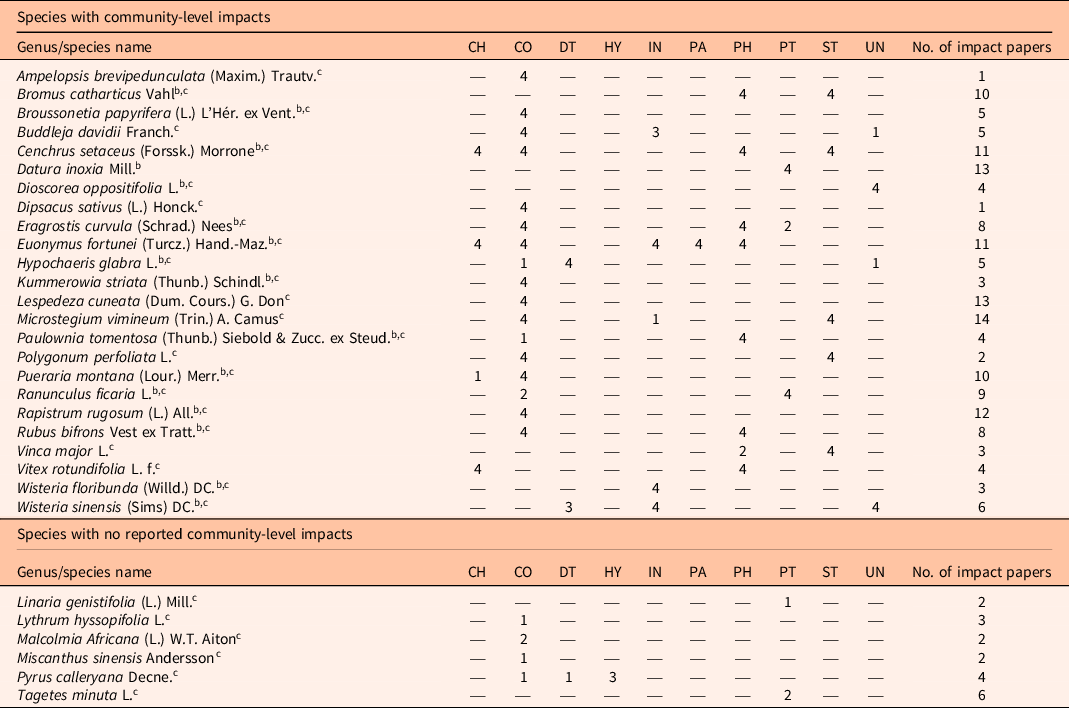
a For mechanisms: CH, chemical impact; CO, competition; DT, disease transmission; HY, hybridization; IN, interaction; PA, parasitism; PH, physical impact; PT, poisoning/toxicity; ST, structural impact; UN, unknown, no mechanism was reported.
b Species also has socioeconomic impacts (see Table 2).
c Species is available for sale as an ornamental or seed.
List of species with impacts on socioeconomic systems and the mechanism of impact. a
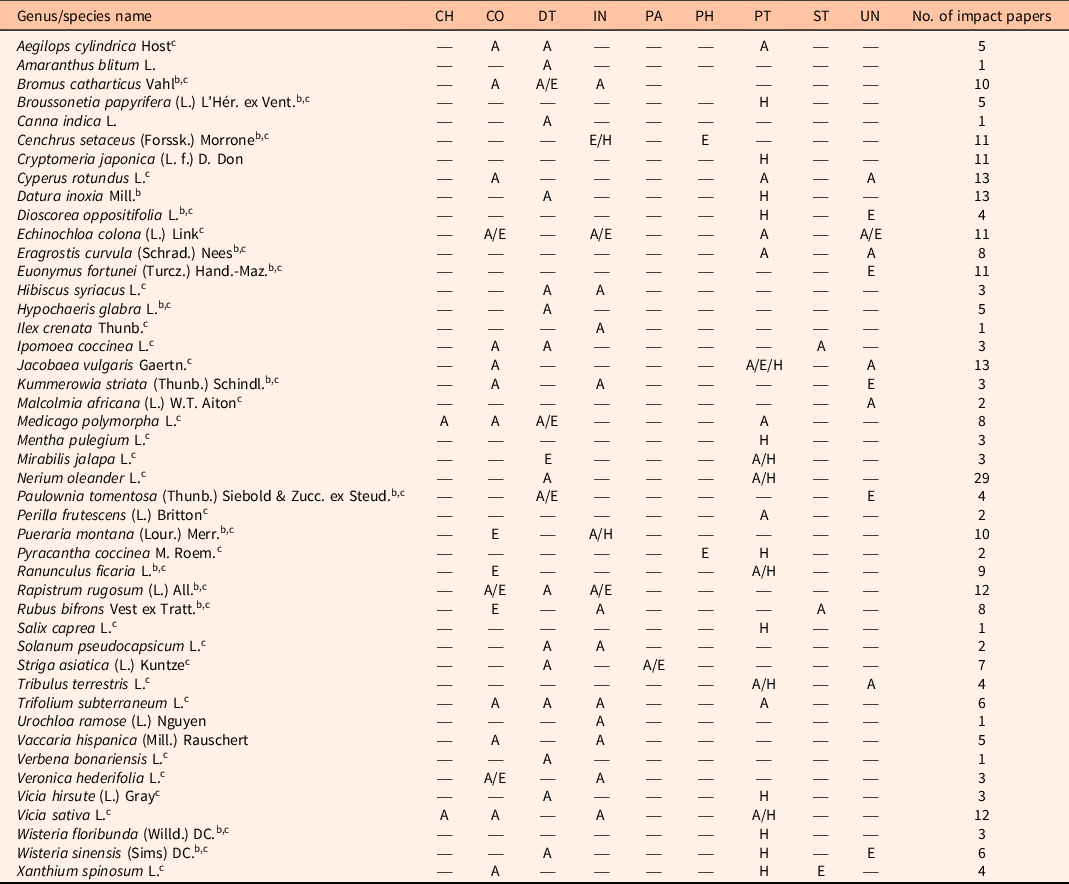
a A, agricultural impact; E, economic impact; H, human health impact. For mechanisms: CH, chemical impact; CO, competition; DT, disease transmission; IN, interaction; PA, parasitism; PH, physical impact; PT, poisoning/toxicity; ST, structural impact; UN, unknown; no mechanism was reported. No socioeconomic impacts were reported through hybridization.
b Species also has community-level ecological impacts (see Table 1).
c Species is available for sale as an ornamental or seed.
Of the 30 species with reported ecological impacts (Table 1), competition (outcompeting native plants) was by far the most common impact mechanism (21 species, 70%), followed by physical impacts (such as altered fire regimes, water cycling, or soil erosion) (8 species, 27%). All other mechanisms were associated with five or fewer species (≤16%).
Of the 45 species with socioeconomic impacts (Table 2), agricultural impacts were the most common and were found for a large majority of species (36 species, 82%). Agricultural impacts typically involved loss of crop yield. Economic impacts, losses caused in nonagricultural systems (such as recreation or horticulture), were found for 19 species (43%). Human health impacts (such as allergic reactions or poisonings) were found for 19 species (43%).
Of the 24 species with community-level impacts, the most commonly affected habitat types found in northern New England were forests/temperate forests (13 species, 54%), followed by arable land (8 species, 33%) and shrublands (7 species, 29%; Table 3). All other habitats were associated with fewer than five species (<21%). Most species (20 species, 83%) affected one or two habitat types. Two species were not reported as impacting any ecosystem found in New England [Dipsacus sativus (L.) Honck. and Wisteria floribunda (Willd.) DC.].
List of IUCN Habitat(s) Classification Scheme for species with community-level impacts.
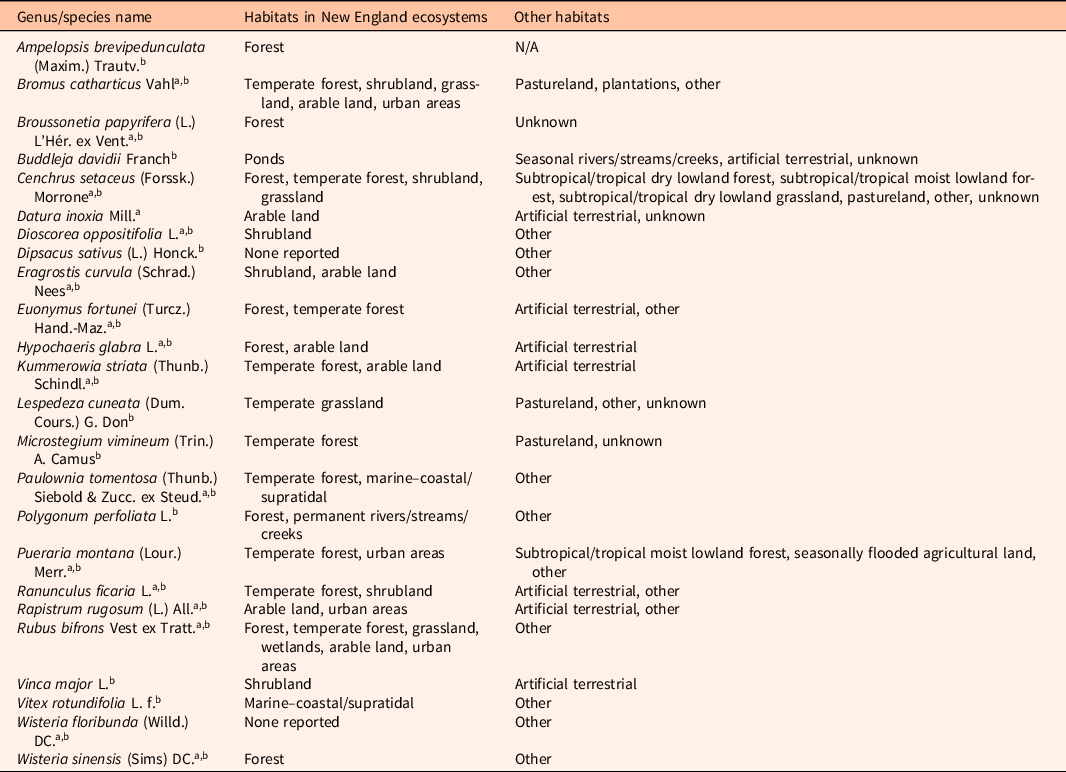
a Species also has socioeconomic impacts (see Table 2).
b Species is available for sale as an ornamental or seed.
Natural resource managers consistently report that lack of funding and personnel stymie their efforts to effectively manage invasive species (Beaury et al. Reference Beaury, Fusco, Jackson, Laginhas, Morelli, Allen, Pasquarella and Bradley2020). A new landscape of range-shifting invasive species will further stretch existing resources. While the identity of many invasive plants likely to shift into northern New England states is known (Allen and Bradley Reference Allen and Bradley2016; https://www.eddmaps.org/rangeshiftlisting), the sheer number of new species demands some level of prioritization.
Whether an invasive plant is likely to have negative ecological or socioeconomic impacts is considered a vital part of identifying high-risk species (Blackburn et al. Reference Blackburn, Essl, Evans, Hulme, Jeschke, Kühn, Kumschick, Marková, Mrugała, Nentwig, Pergl, Pyšek, Rabitsch, Ricciardi and Richardson2014; Davidson et al. Reference Davidson, Fusaro, Sturtevant and Kashian2017; Vilà et al. Reference Vilà, Gallardo, Preda, García-Berthou, Essl, Kenis, Roy and González-Moreno2019). Potential impacts are commonly included in weed risk assessments employed by states to identify invasive species and inform regulated plant lists (Booy et al. Reference Booy, Mill, Roy, Hiley, Moore, Robertson, Baker, Brazier, Bue, Bullock, Campbell, Eyre, Foster, Hatton-Ellis and Long2017; Koop et al. Reference Koop, Fowler, Newton and Caton2012; Quinn et al. Reference Quinn, Barney, McCubbins and Endres2013). While individual states might include additional criteria in weed risk assessments, prioritizing the evaluation of high-impact species is a good strategy given scarce resources. Based on our impact assessments, we narrowed a list of 87 species down to 22 priority species that have community-level ecological impacts and are reported to invade habitat found in northern New England (Table 3). To this list of 22, we suggest adding L. grandiflora, which was prioritized by Rockwell-Postel et al. (Reference Rockwell-Postel, Laginhas and Bradley2020) based on the same criteria and is projected to expand into northern New England (Allen and Bradley Reference Allen and Bradley2016; https://www.eddmaps.org/rangeshiftlisting).
It is important to note that other components of risk assessment will also be important for evaluating these high-impact species. EICAT should be used alongside other assessments to provide a comprehensive overview of a particular species (Kumschick et al. Reference Kumschick, Bacher, Bertolino, Blackburn, Evans, Roy and Smith2020). Other aspects of risk that Roy et al. (Reference Roy, Rabitsch, Scalera, Stewart, Gallardo, Genovesi, Essl, Adriaens, Bacher, Booy, Branquart, Brunel, Copp, Dean and D’hondt2018) recommend be considered include vectors of introduction for a given species and the status of threatened ecosystems or species. Another important factor in risk assessment is the speed at which an invader may spread. While none of the high-priority species are currently widespread in northern New England, they may arrive quickly if readily available for sale as an ornamental.
Beaury et al. (in press) showed that 61% of invasive plants remain available for purchase through ornamental plant vendors. However, the plant trade industry was responsive to state-prohibited plant regulations, with only 7% of sales occurring within states where the species was listed as invasive. A comparison of our list with Beaury et al. (in press) shows that the vast majority of species identified here as high impact are also available for sale. Thus, proactive regulation of these high-impact, range-shifting plants could go far toward reducing future invasions and associated ecological impacts.
While we identified “major,” community-level impacts for 24 invasive plants, the remaining 63 species could also pose ecological threats. Twenty-nine species (33%) were data deficient and 6 (7%) did not have reports of community-level ecological impacts. Additionally, impact assessments tend to be biased toward studies that evaluate plant competition, while rarely considering effects on ecological processes (Hulme et al. Reference Hulme, Pyšek, Jarošík, Pergl, Schaffner and Vila2013). Absence of data on community-level impacts should not be interpreted as an absence of impact (Kumschick et al. Reference Kumschick, Bacher, Bertolino, Blackburn, Evans, Roy and Smith2020), but rather as an unknown, requiring further research and future reevaluation. Similarly, the large proportion of competitive impacts should not be used to conclude that this is the only mechanism of invasive plant impact.
Identifying range-shifting invasive plants is a priority for natural resource management in the context of climate change (Beaury et al. Reference Beaury, Fusco, Jackson, Laginhas, Morelli, Allen, Pasquarella and Bradley2020). Here, we identify 22 high-impact species likely to expand into northern New England and affect New England ecosystems as temperatures continue to warm. Many of these species are present but rare in southern New England and should be considered for regulation there as well. By proactively evaluating these species for regulation and gathering information about management strategies, northeast states have an opportunity to get ahead of the invasion curve and prevent future impacts.
Supplementary material
To view supplementary material for this article, please visit https://doi.org/10.1017/inp.2021.10
Acknowledgments
We thank C. Curtis for help with data collection and N. Olmstead for feedback on an earlier version of this article. This research was funded through the 2017–2018 Belmont Forum and BiodivERsA joint call for research proposals, under the BiodivScen ERA-Net COFUND program, with the funding organization being the National Science Foundation ICER-1852326; and by the National Institute of Food and Agriculture, U.S. Department of Agriculture, the Massachusetts Agricultural Experiment Station, and the Department of Environmental Conservation under project no. MAS00033.
Data availability statement
Appendix 1, the database of impact assessment summaries for all 87 species, is available in the UMass Scholarworks repository at https://doi.org/10.7275/8r30-c179.
No conflicts of interest have been declared.



