

1. Introduction
Pension funds offer services which come close to so-called experience goods, as participants have to wait until retirement to ascertain whether the premiums one paid during employment were well spent. And some might even say that these services are more like credence goods: it is virtually impossible to ascertain these services accurately and participants have to believe that they made the right choice earlier in life (Dulleck and Kerschbamer, Reference Dulleck and Kerschbamer2006). In short, uncertainty is a distinctive mark of pension provision and considering the fact that accumulated pension savings are the largest sum of money for most people, trust in your pension provider must play a large role in handling this nest egg. The prime function of trust was once aptly described by Gärling et al. (Reference Gärling, Kirchler, Lewis and Van Raaij2009) as ‘the experience of certainty where no real certainty can exist’. Despite the large role of trust, in most economic treatises on pension finance the issue of trust is taken for granted or presumed to exist. However, in the board rooms the role of trust seems to be the core of a pension fund's mission. Once people sense that promises made earlier are no longer feasible, trust in their pension fund is likely to falter which in turn can undermine its credibility and financial stability as people may switch pension providers. And in case of mandatory pension arrangements the lack of trust may cause even more disruption as people lack the option to vote with their feet and absence of an exit option may lead to increasing distrust, which may in the end undermine the laws or rules on which a pension system is based.
The research field on trust in organizations tries to understand trust by focusing on determinants of trustworthiness of pension organizations or trustees and the characteristics of trustors like pension participants or citizens (Vickerstaff et al., Reference Vickerstaff, Macvarish, Taylor-Gooby, Loretto and Harrison2012; Van Raaij, Reference Van Raaij2016; Van Dalen and Henkens, Reference Van Dalen and Henkens2018). Perceptions of financial stability, competence, or fairness play a large role in the trusting financial institutions and pension funds in particular. However, the missing link in this literature is the connection between trust and objective data relating to the services offered by pension funds. Policy makers and CEOs often assume that certain financial actions or regulatory measures will increase trust. Whether this assumption is valid remains an open question and this paper tries to answer this question by examining how the trust of participants in their pension fund is related to the financial health of their fund.
We analyze this question for the case of the Netherlands, a country whose pension system is considered being one of the best pension systems in the world (cf. Mercer global pension index 2021) or one of the sophisticated designed systems (Barr, Reference Barr2012). It is also a country where financial indicators play a large role in pension fund regulation and which are regularly reported and discussed by pension funds in their reports, newspapers, and mailings to their participants. The so-called funding ratios of pension funds (defined as the level of assets/level of liabilities, i.e., the current and future pension benefits to be paid out) are often headline news in the Dutch media because these ratios signal to participants whether pension funds are allowed to index their pensions or not. And in case of underfunding they will need to cut benefits or raise the pension premium. The central question will therefore be: is trust in one's pension fund affected by the funding ratio and, if so, to what extent? Answering this question will be done with the help of survey data collected in October 2021 among pension fund participants. To make the connection between trust and the financial state of their pension fund we employ registered data on funding ratios of individual pension funds as collected on a regular basis by the pension regulator the Dutch central bank (DNB). In other words, we did not ask the state of financial health directly from participants, but we took advantage of the fact that the participants in our sample are connected with 85 different pension funds. By focusing on these groups of participants we will be able to see how trust varies between participants by the funding ratio of their fund. An additional research question is whether this connection between trust and the funding ratio differs by broad age groups that traditionally display distinct levels of pension awareness or interest. It is well established in the retirement planning literature that planning activities, awareness, and financial knowledge increases with age (Hershey et al., Reference Hershey, Henkens and Van Dalen2010; Alessie et al., Reference Alessie, Van Rooij and Lusardi2011; Van Raaij et al., Reference Van Raaij, Huiskes, Verhue and Visser2011).
This study offers novel evidence on the connection between trust in one's pension fund and an objective financial indicator of the financial health of their pension fund. We show first of all, that a tight positive relationship exists between the trust of participants of funds and the officially registered financial health of their pension fund. And second, that the marginal effects of belonging to a pension fund with a higher or a lower funding ratio in terms of trust of the old are substantial, whereas this connection is weak or non-existent among the younger age group.
The setup of this paper is as follows. First, we will offer in Section 2 some pension context to this question, as each country has its own specificities in designing and regulating its pension system and the Netherlands is no exception. Next, we will introduce a short section (3) on how we understand trust in a pension setting, to be followed by Section 4 describing the data and methodology, after which we will discuss in Section 5 the research results that shed light on the central question. Section 6 concludes.
2. Dutch pension context
In order to understand the issue of trust in the Dutch context it is necessary to keep in mind the key players that figure prominently in the Netherlands in the provision of pensions. In the Netherlands, most employees save and accumulate pension rights within a three-tier (or pillar) system: (1) a basic public pension plan (the so-called ‘AOW’) provided by the government; (2) a mandatory supplementary pension plan provided by pension funds; and (3) voluntary individual pension savings. Up and till this day the public pension – financed on a pay-as-you-go basis – in combination with the supplementary pension provisions are for most Dutch citizens the basic elements of what citizens consider ‘their pension’. Both the public and supplementary pension have been defined in terms of benefits, with premiums and taxes endogenously derived, whereas by 1 January 2023 a new pension system will gradually replace the current defined benefit (DB) system, which is expected to give rise to a more volatile pension benefit than is currently the case.
To regulate the pension sector two organizations are active to supervise pension funds and insurers: The Dutch Central Bank (De Nederlandsche Bank DNB) and the Dutch Authority for the Financial Markets (AFM). Under the Pensions Act and the Financial Supervision Act, the DNB closely monitors the financial and management operations of the pension providers. The task of the AFM is more limited but may gain more prominence in the new pension system. By law, pension providers are obliged to provide certain information to their stakeholders. The AFM checks that pension providers are meeting these requirements. An often-used financial indicator in regulating the pension funds is the funding ratio, i.e., the ratio of assets and liabilities. The 21st century has been a volatile period for pension funds, which is a result of both the credit crisis and the subsequent crash on the stock market as well as the fall of interest rates to historically low levels. The past ten years pension funds have witnessed funding ratios between 100 and 110. Figure 1 presents the distribution of funding ratios for all pension funds in the Netherlands in 2021.
Distribution of funding ratios pension funds in the Netherlands, Q4 2021.
Source: DNB pension statistics (2022). NB: this refers to the nation-wide set of pension funds. To offer a balanced overview we excluded in this histogram two outlier pension funds Calpam and HAL (Holland Amerika Lijn) which are pension funds with less than 50 active participants and funding ratio of 190 and 187. The participants in the current survey were not connected to these two pension funds.

Although the picture looks bright for a large number of pension funds, one should bear in mind that the two largest pension funds (ABP and PZFW) were situated in the danger zone in 2021. Under the current rules of the pension law with a funding ratio of 104 or lower pension funds should take corrective action in accordance with the Dutch pension regulator to bring the funding ratio to a safer level (between 104 and 110). And pension funds are allowed to index for inflation once the funding ratio has reached the level of 110 or higher. For example, the pension fund ABP (with 3.1 million participants, including deferred members) in the year 2021 had a funding ratio of 103%, which was even lower (88%) in 2020. This necessitated a corrective plan of action as stipulated by DNB which is still in force. For instance, the largest pension fund in the Netherlands, ABP, had to draw up a plan to restore the funding ratio in 10 years' time: increasing it from 93% in 2021 to 130% in 2032.
3. Trust in pension settings
The credibility of the pension fund is assumed to be a key driving force of the trust it generates with its participants. Especially competent management of assets and liabilities may enhance that credibility. Pension fund CEOs and regulators believe that buffers for times of decline offer grounds for trust. As the OECD (2021) recounts in its recent evaluation of financial indicators used within the OECD pension systems, buffers are one of the elements of a pension system that can help build or restore trust in a system (cf. OECD, 2021, p. 87). However, it is generally acknowledged that when it comes to understanding the minds and behavior of people when it comes to handling their pension affairs, bounded rationality, ignorance, and imperfect information are the rule (Kahneman et al., Reference Kahneman, Odean and Barber2005; Benartzi and Thaler, Reference Benartzi and Thaler2007; Bodie and Prast, Reference Bodie and Prast2012). An open question in this regard is whether actual financial indicators of pension funds have an impact on the trust level of individual participants. A positive outcome – indicators matter – would appear to fly in the face of the empirical fact that most participants are ill-informed and often not financially literate to understand the ins and out of pension finance. However, when financial indicators have clear consequences, like increasing or decreasing pension benefit levels, one might expect that financial indicators are tightly associated with the trust of its participants. In other words, though participants may not understand the precise calculations and content of such indicators, they may very well suspect or experience what the consequences are if certain financial thresholds are surpassed and hence deduce whether their pension fund is ‘fine’ or ‘in trouble’. The central research question is therefore whether and, if so, to what extent trust in a pension fund is connected with its objectively stated financial health. As shown in Van Dalen and Henkens (Reference Van Dalen and Henkens2018), perceived stability is one of the most important predictors of trust in pension funds. For a more solid test of the relationship between financial soundness and trust we need to incorporate actual financial indicators that are specific to individual pension funds. Hence, the central hypothesis in this paper is:
Trust-financial health nexus hypothesis: Financial soundness of a pension fund as approximated by its funding ratio is a direct driver of the trust participants have in their pension fund.
A second question refers to the issue whether the life cycle of participants matters in expressing trust. One of the aspects that pervades attitudes and behavior in issues of pensions is the element of engagement and interest in pension issues across ages. In general, among the young an interest in their own pension rights, pension savings, or the economics behind pension finance is generally low (Foster, Reference Foster2017), whereas one generally sees that this interest becomes real and substantial once the retirement date comes in sight. Certainly once people have retired, the interest and awareness is high because retirees depend for their income on their pension benefit (Van Raaij et al., Reference Van Raaij, Huiskes, Verhue and Visser2011; Prast and Van Soest, Reference Prast and Van Soest2015). An expression of trust or distrust is therefore expected to be related with the level of interest in pension issues (cf. Deetlefs et al., Reference Deetlefs, Bateman, Dobrescu, Newell, Ortmann and Thorp2019). Hence our second hypothesis focuses on the differential impact of funding ratios on trust among younger and older participants. Assuming that older participants have a stronger interest in and awareness of pension issues than younger age groups we formulated the following hypothesis:
Pension awareness/interest hypothesis: Trust of young and middle-aged participants in pension providers is less responsive to the level of the funding ratio among older/retired participants.
The financial planning literature (Hershey et al., Reference Hershey, Henkens and Van Dalen2010) shows that older age groups are generally more concerned about their pension because they notice directly whether their pension rights change, whereas the young and middle-aged participants of a pension fund are expected not to take direct notice whether their pension rights have changed. An obvious reason why the latter group may not be so vigilant as pensioners is that changing pension rights are not made explicit or are difficult to detect in pay checks or other notices. An alternative reason why young participants may be lukewarm about financial information about their pension funds is that the young may think they have enough time on their hands to repair setbacks, like when pension funds abstain from (inflation) indexation.
4. Data and methodology
We used data collected by a survey held on October 2021 in the Netherlands. The fieldwork was carried out by the CentERdata of Tilburg University through the LISS panel, a panel that consists of 5,000 households, comprising approximately 7,500 individuals that complete online questionnaires every month. All individuals were selected on the basis of a true probability sample of households drawn by CentERdata from the population register by Statistics Netherlands. For this particular study a sample of 2,118 individuals were selected of which 83% responded and filled in a complete survey (N = 1,761), which was divided in two separate parts with different sample sizes: (1) a part focusing on pension issues for the population at large (N = 1,761); and (2) a subsample focusing on those connected to pension funds and insurance companies (N = 1,112). Of this subsample, 114 (10.3%) did not remember or know to which fund/insurer they were connected. Within this sample we only used data on employees who stated that they are connected to a pension fund (N = 940); the number of participants connected to insurance companies was too small to offer reliable insights for matters of comparison. For all pension funds of the participants in this sample (85 in total) we could track the funding ratios as registered by DNB on a quarterly basis.
Our central measures of trust concern the question whether respondents trust their current pension fund, as captured by the question: ‘Please indicate how much you trust your current pension fund/insurer in managing your pension money and rights?’, with answer categories: (1) no trust; (2) little trust; (3) neutral; (4) some trust; and (5) a lot of trust. Distrust is defined as the state where respondents express either no trust or little trust (1–2), and trust is the state where they express some or a lot of trust (4–5). Pension funds were identified in the survey by a list of 212 pension funds/insurers as registered by the DNB for that particular year. Respondents could choose their pension provider. In case they had more than one pension provider, they were instructed to choose the provider at which they had accumulated most of their pension rights.
In our model we control for the following set of individual variables: (1) age; (2) gender; (3) partner status (with partner or not); (4) highest attained educational level divided in three broad categories (low, middle, higher education); and (5) their estimated net household wealth (market value own house, savings, stocks, and bonds minus private debts/mortgages) with answer categories covering seven intervals. To control for the fact that the type of pension fund may affect trust we use a binary variable registering whether the pension fund is firm-based ( = 1) or sector-based/professional group-based ( = 0). The latter category was too small to be covered separately and because we expect that ties between a firm-based fund and the participants are more intimate or less anonymous than those of sector based or professional groups-based funds this dummy variable will capture some of the variability in trust among the participants in the sample (see Bikker and De Dreu (Reference Bikker and De Dreu2009) for overview of costs and benefits of these types of funds).
The central explanatory variable is the funding ratio as reported by the pension regulator (DNB) for individual pension funds.Footnote 1 Table 1 provides an overview of the descriptive statistics of the variables used.
Descriptive statistics pension fund participants

Notes: aFunding ratio is the ratio of assets/liabilities of pension funds as registered by the Dutch Central Bank (DNB), the minimum funding ratio of the 85 pension funds in this sample is 87.2% and the maximum 138.6%.
b Trust in own pension fund is based on the survey question: To what extent do you trust your current pension provider in managing your pension money and rights? (1) No trust; (2) little trust; (3) neutral; (4) some trust; (5) a lot of trust.
c Net wealth is the estimated wealth by respondents of their assets (value house, savings, investments, etc.) minus the value of debts/mortgages.
The methodology used to analyze the central research questions is instrumental variables (IV) ordered probit regression analysis. The use of instrumental variables is used to correct for potential endogeneity of the funding ratio. For instance, it could be that the financial indicator used is highly correlated with state of the economy and to correct for this we used the funding ratio lagged by one year as an instrument. To correct for differences in the variance due to arbitrary correlation within the group of respondents belonging to the same pension fund robust standard errors are presented.
5. Results
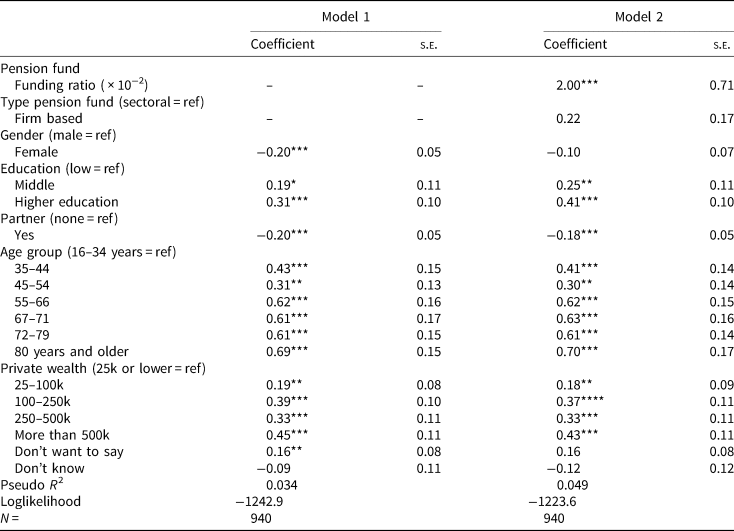
The results of the IV probit analyses explaining the level of trust in individual pension funds are presented in Table 2 in two steps. The first column contains the results for a model containing relevant socio-economic variables excluding the funding ratio and the second column contains the full model (including the funding ratio).
Trust of pension participants in their pension fund, including sectoral or firm-based pension fund type
Note: IV ordered probit with instruments funding ratio lagged by one year, robust standard errors reported clustered at individual pension fund level. ***p < 0.01; **p < 0.05; *p < 0.10.
The most important results of model 2 are that trust in one's pension fund and its funding ratio are positively correlated, which offers support for the first hypothesis. Furthermore the inclusion of the funding ratio improves the explanatory power of the model considerably compared to model 1. The other explanatory variables in model 2 suggest that having trust is also connected more to older age groups, the wealthy, and higher educated. The coefficients for the various age groups show that beyond the age of 55 trust is more or less uniformly higher than it is among the younger age groups, which suggests that interest in pension affairs is connected with the second half of one's life. Although the coefficient for the age group 45–54 displays a remarkable lower level of trust compared to the younger 35–44 age group this difference is not statistically significant.
Wealth (100k and higher) is also positively correlated with trust in pension funds. Wealthy participants are possibly in a better position to cover fluctuations in the pension income provided by their pension fund. Finally, higher educated in particular have far more trust in pension funds than the lower educated, which may be connected to higher paid jobs and better pension incomes, but it is also likely to generate some level of financial literacy that facilitates understanding the peculiarities of the Dutch pension system.
To see how various funding ratios affect the trust among the total group of respondents we calculated the marginal effects based on the parameters of model 2 of Table 2. Figure 2 shows the positive association between the funding ratio and the level of trust that participants have in their pension funds. Even a slightly higher funding ratio is associated with considerable higher trust level: participant of a fund with a funding ratio of 100 has a trust level of 47%, whereas a similar participant of a fund with a funding ratio of 105 (which is close to the sample average) has a considerable higher level of trust (51%). And if the funding ratio reaches levels that were normal in the 1990s and early 2000s like 125%, a large majority (66%) expresses trust toward their own pension fund.
Marginal effects of variation of funding ratios and its relation with trust in individual pension funds.
Note: Distrust is the sum of the categories (1) no trust and (2) little trust; trust is the sum of the categories (1) some trust and (2) a lot of trust. Calculations based on model 2 in Table 2.

The second hypothesis predicting that trust of young and middle-aged participants is less responsive to the level of the funding ratio than older workers and retired participants is tested by subgroup analyses. We have split the sample of model 2 (of Table 2) into two age groups in Table 3: one that represents age groups that are (potentially) aware or interested in pension issues – the older workers (55 + ) and retired – versus a group that is not aware or interested in pension issues – the young and middle aged up to 54 years.
Trust of pension participants in their pension fund, working age (16–54 years) versus older participants (55 years and older)

Note: IV ordered probit with instruments funding ratio, resp funding gap lagged by one year, robust standard errors, clustered at individual pension fund level. ***p < 0.01; **p < 0.05; *p < 0.10.
The results on the differences between these age groups show a clear divide: the ‘older’ group has a higher trust coefficient (2.31) with respect to the funding ratio than the younger age group (0.98); a coefficient that is statistically insignificant. This result basically tells the story of trust that pension funds receive from its participants: for younger age groups the link between the funding ratio of their fund and their level of trust is much weaker than for the older age group, a group that depends for its income on how their pension fund performs and hence can be assumed to have a natural interest in the financial state of their provider.
To make the calculations above with respect to the funding ratio more transparent, we also present the marginal effects for specific outcomes with respect to variations in the funding ratio in Table 4. The results reveal that a higher funding ratio is clearly associated with a higher likelihood being in the outcome categories ‘some trust’ and ‘a lot of trust’ and a lower likelihood being in the ‘neutral’ and ‘little trust’ or ‘no trust’ categories. This holds for the total sample as well for the older sub-population and the respective marginal effects are all statistically significant. For the younger sample the effects are not significant.

Other aspects that are worth noticing in Table 3 are the differences in coefficients across the two models for pension fund type and education. A novel finding in the literature on pension funds is that firm-based funds can count on a bit more trust than sector-based/professional group funds among the older age group. Apparently these types of pension funds engender some form of solidarity that the other types of funds cannot attain. But this effect may be also the result of the fact that firm-based funds can cater their facilities more to the needs of their participants than sector-based funds which have to rely on one-size-fits-all approach (Bikker and De Dreu, Reference Bikker and De Dreu2009). For the more older and presumably more interested group the role of education plays a bigger role than it does among the younger group. This could very well be a reflection of the fact that financial literacy or pension awareness is generally higher among the higher educated (Van der Cruijsen et al., Reference Van der Cruijsen, de Haan and Roerink2021; resp. Van Raaij et al., Reference Van Raaij, Huiskes, Verhue and Visser2011) and this ‘fact’ may well explain the higher level trust among the higher educated.
As a robustness test we have examined alternative age groupings that could explain the divide we present in the Appendix A1, a split between working-age participants (16–66 years) and the retired (67+). The reason for this alternative split is based on the fact that employees as a group may have to base their trust on expectations: they have to wait and see how their savings will be transformed into a stream of pension benefits. Pensioners on the other hand see how this promise of pension funds materializes: they see the living proof on their banking account. Of course, compared to the split in Table 3 one includes the older workers group (55–66) in the ‘employees’; a group that has a clear interest in pension issues, thereby raising the average level of (potential) awareness. In a way that affects the results slightly compared to Table 3: a higher funding ratio is associated with a slightly lower level of trust for the older participants (coefficient of 2.24 instead of 2.31) and a slightly higher association among the working age population (coefficient 1.59 instead of 0.98). The latter coefficients are by the way both statistically insignificant.
6. Conclusion and discussion
The capacity of pension funds to smoothen income streams has been put to the test in the past 10–20 years: stock markets crashed, capital markets have shown unprecedented low interest rates, and steadily but forcefully the impact of population ageing becomes more visible in the age structure of firms and pension funds. DB promises of the past no longer seem to hold and something had to be done as trust in pension funds and pension institutions in general has dwindled and distrust has grown. Most governments in the OECD are trying to reform their pension system and adapt it to changing labor markets and population ageing. The Netherlands is no exception. The government is very concerned about the trust that the population has in the pension system, which as they state is ‘teetering’. Only a fundamental pension reform can stop this decline, or as they explain: ‘Without innovation, the chances are high that trust in our pension system will erode even further’ (p. 4, Ministry of Social Affairs and Employment, 2020).
The insights from this study on Dutch pension participants suggest that an increase in trust is certainly within reach as long as the funding ratio of pension funds increases. Hence one can be tempted to conclude that when it comes to trusting their own pension fund participants seem to live by the rule ‘it's all about the money’ and in a way this is of course true as the core task of pension funds revolves around consumption smoothing over the life course and insurance, in particular of longevity risk (Blake, Reference Blake2006; Barr, Reference Barr2012). This is primarily an economic and financial issue, and hence it should not surprise us that differences in trust are based on differences in funding ratios, as the credibility of pension funds depends on making good on one's promises and this is embodied in this ratio.
The conclusion about the importance of financial soundness should, of course, be qualified on three grounds. First, economic psychological research shows that trust in financial institutions revolves around more than simply money. Perceptions of competence, fairness, or honesty and aligned interests matter too (Gärling et al., Reference Gärling, Kirchler, Lewis and Van Raaij2009; Van Esterik-Plasmeijer and Van Raaij, Reference Van Esterik-Plasmeijer and Van Raaij2017; Van Dalen and Henkens, Reference Van Dalen and Henkens2018). Second, the current study is cross-sectional, so we are not able to analyze how specific individuals change their perception of trust over time when the financial health changes remain unknown. Third, to show a tight relationship between trust and a financial indicator comes with a strong ceteris paribus condition: everything else needs to be kept constant in terms of promises or, more formally, the terms of the prevailing pension contract. And because of this conditionality, there are limits to what financial indicators can measure and this will prove even more difficult now the Dutch pension system is in transition. For decades the system has basically functioned under a DB system but that is in the process of moving to a DC system.Footnote 2 The funding ratio as an instrument of pension regulation will therefore disappear in the new pension regime, because essentially the funding ratio will be 100 by definition for a pure DC contract and risks are shifted more to the employees in dealing with the ups and downs in financing a pension. The focus will probably shift toward the premium – how much pension can you expect and the portfolio choices by default or by one's own choice and hence the rate of return on investment will become more prominent. The importance of ‘looking under the hood’ of pension funds and the products they offer can become more important because financial indicators, such as rates of return, can be deceivingly simple and may not show the risks that are tied to certain investments strategies (cf. Admati and Hellwig, Reference Admati and Hellwig2014).
The strong connection between trust and the funding ratio of pension funds can also be a dangerous trait for the near future as the Dutch pension landscape is expected to change drastically. The Dutch participants seem almost ‘conditioned’ to look at funding ratios as the thermometer of their pension funds' health.Footnote 3 One can imagine that in case of a radical pension reform that moves from a DB to a DC types of contract (like the Dutch case), this type of transition can cause discomfort among a clientele that expects their pension funds to carry buffers and to report regularly on its financial health, whereas in actual fact they should primarily be looking at their own investment/pension account or at their pension premium. In short, given that pension awareness and financial literacy are often in short supply among many citizens (Lusardi and Mitchell, Reference Lusardi and Mitchell2011), a radical pension reform bears the risk of becoming ‘an accident in the making’ as people fail to see the new risks for which they have become the prime owner.
Acknowledgements
In this paper we make use of data of the LISS (Longitudinal Internet Studies for the Social sciences) panel administered by Centerdata (Tilburg University, The Netherlands). This research was carried out under the Netspar research theme grant ‘Pension monitor’.
Conflict of interest
None.
Appendix
Trust of pension participants in their pension fund, working age (16–66 years) versus old participants (67 years and older)


 Open access

